In our latest Cosmic Queries episode, astrophysicist Neil deGrasse Tyson and comic co-host Leighann Lord answer your questions about exploration. From the depths of the ocean to the outer reaches of the galaxy and beyond, the two explore practical questions about the most efficient way for humans to get into space on a recurring basis (Space Elevator vs. chemical rocket), the likelihood of NASA using ion propulsion thrusters for travel within our solar system, and the feasibility of an interstellar probe to Alpha Centauri using existing technology. They also tackle theoretical questions, such as whether we’ll ever be capable of generating enough power to explore the higher dimensions, leading to a discussion of the book, Flatland.
NOTE: All-Access subscribers can listen to this entire episode commercial-free here: Cosmic Queries: Exploration.
Transcript
DOWNLOAD SRT
Welcome to StarTalk, your place in the universe where science and pop culture collide. StarTalk begins right now. Welcome to StarTalk Radio. I'm your host, Neil deGrasse Tyson. I'm an astrophysicist with the American Museum of Natural History right here...
Welcome to StarTalk, your place in the universe where science and pop culture collide.
StarTalk begins right now.
Welcome to StarTalk Radio.
I'm your host, Neil deGrasse Tyson.
I'm an astrophysicist with the American Museum of Natural History right here in New York City.
And I also serve as the director of the Hayden Planetarium.
Come visit us sometime.
And you can tell the front desk that you know me and you listen to StarTalk, and they'll still charge you to come in.
But one and all are welcome.
And I'm here with my co-host for the day, Leanne Lorde.
Leanne, welcome back to StarTalk.
Hey, Neil, how are you?
Oh my gosh, you should move in.
I really should.
I love it here.
Yeah, so Leanne, a professional comedienne?
Yes.
That's what, like, you pay your rent off of this?
Rent?
I'm stealing cable, I'm stealing lodging, what?
I'm bootlegging everything I got.
I brought her on because we're in the Cosmic Queries part of StarTalk Radio.
Sometimes I think of it as StarTalk after hours, or after hour.
So, it's where your questions come to us, and we solicit them in advance.
They come to us from all manner of social media, sometimes Twitter, sometimes we have a phone and number, you can lay down your question, also on Facebook.
So, let's get right in, and the topic today is exploration.
Yes, it is.
Exploration of land, sea, air and space.
Yes, it covers the gamut.
There's also, perhaps, exploration of the mind, but maybe that's another show.
That's another show.
All right, we'll do that.
And so, you've got the questions, I haven't seen them before.
No.
If I can't answer them, I'll say next.
Well, hopefully none of these will completely stump you.
Okay, so let's go, because it's not a stump session.
It's really just, what do I know and how can I share it with our listeners?
And this is a give back hour, yes.
And, well, we will start the give back with Dave Matthew Scott, and he wants to know.
Another three-named person.
Another three-named person.
Hi, Dave Matthew Scott, I'm Neil deGrasse Tyson.
Well, in that case, I'm Leanne Sherry Lord.
You have Sherry.
I do.
Sherry like, Sherry, Sherry baby.
Already regretting the share.
Already regretting it.
All right.
Well, Dave Matthew Scott wants to know if humans were to travel frequently into space, in your opinion, what is the most practical way to achieve this?
For example, does a space elevator have real merit or are we stuck with chemical rockets?
Ooh, well, there's a lot in that.
Yes, there is.
Yeah, so it all comes down to how cheaply can you do it.
Right now, you wanna get your butt into space, it's $20 million, and the Russians will sell you a seat.
NASA was not into selling seats because I think it was between you and me.
Don't tell anybody.
But between.
I know we're in front of microphones.
All right, stop listening, everybody.
I think NASA wanted to retain that right stuff image, you know?
That the astronauts are the right stuff.
And if you can just fork up 20 million and go, are you the right stuff?
Well, you're right stuff because you had the money, not because you had the moral fiber or physical fortitude.
So I think there was some protecting of the astronaut iconography going on there.
And in Russia, they just simply didn't care.
You got the money, you do it.
So 20 million.
So he's the real capitalist here, everybody.
Ah, there you go.
There you go.
Our sworn enemy of the Cold War, the communist is now charging us to get up into space.
So that price has to come down.
Just a bit, or at least a coupon.
You know what you could do?
You could have a lottery, and the winner gets to fly in space.
I'd certainly, I'd buy a bunch of lottery tickets for that opportunity.
Yeah, I'd put my name in the hat.
Right, right, right.
And so it's a way to still afford something that's expensive before it becomes really inexpensive and common and doable.
There was a day where to fly in an airplane was reserved for only the most privileged people in the world, because there weren't many airplanes and it was expensive, and plus there was some risk involved.
So I can foresee a day where our access to space is so routine and so that the price has dropped where it's an optional vacation destination.
So you're saying there's going to be a coach class.
And they're going to be monitoring your carry-ons.
Do you know that in Florida, there's an active spaceport organization that wants to make sure that Florida becomes the vacation destination for space tourism, just as it is the number one destination for tourism in the country, primarily through all of the theme parks in Orlando.
So they have the infrastructure for it.
For handling high crowds on vacation.
So they want to do this for traveling back and forth to space as well.
A space elevator would be cool.
That's a space platform suspended above the equator, 23,000 miles up from Earth's center.
And it orbits at just the same rate that Earth turns.
So it appears to hover over Earth's surface, even though you're both moving, you plus it.
But if you're both moving at the same sort of angular rate, then it's as though it hovers right there.
And then you lower down a cable, hoist yourself up, and you get into orbit for the cost of an elevator ride rather than the chemical rockets that we now use.
That would probably be the first cheap way to do it.
But I hope that it becomes competitive with going to the Bahamas, because then I'd so be going into space.
Oh, absolutely.
Building up my frequent flyer miles.
Oh, that would be awesome.
One trip, man.
How many frequent, yeah, frequent space miles.
That would work.
What else you got?
All right, I have another three named person, Daniel Tank Astels.
Middle named Tank?
Tank, middle named Tank.
Dude, what's your night job?
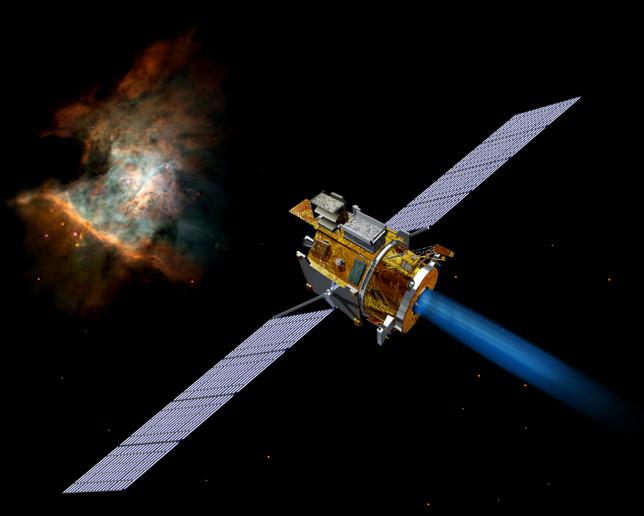
All right, Tank wants to know, since NASA has been working on the ion propulsion thrusters more frequently, how much longer do you think we will need to wait until they will use one to send us to neighboring planets?
Ooh, so ion propulsion, that's, so what you have is a mini nuclear reactor that heats up a gas, and that gas, it ionizes the gas, which means it rips off electrons from the atom.
Is that what that means?
That's all that ionizing means.
You're ripping electrons off of the atom.
And then the atom then sort of, the atom and the electron live together in a soup.
Normally, the atoms grab all their electrons back and you have a regular gas.
You heat it up, the electrons get ripped off.
Now you have a gas where there's free electrons roaming around, running free.
And that's a plasma.
We have a word, it's called a plasma.
An astrophysical plasma.
And this kicks out ions, kicks them out.
You can set up a cavity so that out one end, a very fast moving ion flies out that end.
That's your exhaust for your engine.
And you recoil from the flow of that ion out the back of your spaceship.
Now you might say, well, how fast can that get you if it's just an atom?
The point is, the recoil of your ship from the atom is higher per amount of mass that you're trying to move than any other form that we have.
So ion propulsion accelerates you slowly, but very efficiently.
And so ion propulsion would be better not to move humans around the solar system, but to send cargo in advance of where you're headed.
Because who cares how long it takes the cargo to get there?
You know, you got places to go, people to see.
The cargo can take however long.
Well.
You send the cargo ion, we send you chemical, and you're good to go.
Landing on the beach with the beer ready waiting for you.
You're listening to Star Talk Radio.
We gotta take a break.
We'll be right back with Cosmic Queries.
We're back on StarTalk Radio.
I'm your host, Neil deGrasse Tyson.
I'm an astrophysicist.
It's with me in studio, Leanne Lord.
Leanne.
Neil.
Thank you.
You're a Twitter person.
I love Twitter.
You thrive in the Twitterverse.
As do I, I love the Twitterverse.
Isn't it an interesting place?
I love it there.
Yeah.
I've met some very interesting people.
I don't know what it means to meet someone in the Twitterverse, but okay.
Is the dating scene that hard in person?
Well, I didn't mean it like that.
I actually, a lot of-
Here, Dan, here's my Twitter mate.
A lot of StarTalk fans out there.
Oh, yeah, excellent.
And so, just to get it right, you're LeighaNN, L-E-I-G-H-A-N-N, L-E-I-G-H-A-N-N, LeighaNN, L-E-I-G-H-A-N-N, L-E-I-G-H-A-N-N, LeighaNN, L-E-I-G-H-A-N-N, L-O-R-D, yep, altogether.
Yeah, we can follow you with that one word name, and I follow you, so I'd like your words of the day especially.
Thank you.
And at StarTalk, we tweet, StarTalk Radio, and also you can find us on the web at startalkradio.net, and on Facebook, just look for StarTalk Radio, we're there, you can like us.
So, today, this is our Cosmic Queries after hours.
It's one of my favorites too, and we're talking about exploration, and these are questions sent in by the listeners of StarTalk, and they knew the topic was exploration of land, sea, air, and space, so bring it on.
And I haven't seen these questions before, so if I don't know the answer, I'm just gonna say, next.
Well, then I will give you the next question from James Phillips, and James says, I wonder if Mr.
Tyson believes an interstellar probe to Alpha Centauri is feasible with real world technologies such as fusion or fission propulsion or laser-boosted solar sail.
Yeah, in fact, okay, first, yes.
Well, I could have done that one.
Can I try it?
So, Alpha Centauri is the nearest star system to the sun.
It is not itself a star.
Most people don't know that.
It is a triple star system.
And the nearest, so two stars orbit each other and a third orbits those two.
And the nearest star in that system is called Proxima Centauri, aptly named if you know your Latin.
Is that Latin or Greek?
Proxima.
I think it's Latin.
You think it's Latin?
Yeah, okay.
Which means I'm probably wrong.
All right, well, we'll take it.
And Proxima Centauri is 4.1 light years away.
So if you were sat on a beam of light and we watched you take this journey, we would sit around for 4.1 years, four and one-tenth years before you arrived, if you got there by the speed of light.
But the question was, with our technology, what could work?
The fastest spaceship we have ever launched is the mission to Pluto, the New Horizons ship.
Why was it the fastest we have ever launched?
Because the first rule of scientific experiments, you want to be able to conduct the experiment before you die.
So.
Note to self.
So they created a relatively small, low-mass probe and put it on the biggest rockets we have to get it out there as fast as possible.
It took the astronauts three days to reach the moon.
It took this, it took New Horizons upon being launched from Earth, took about six hours to cross the orbit of the moon.
That's how this thing is booking.
All right?
Wow.
So if I put you on that spaceship and didn't aim it to Pluto and I said, let's send it to Alpha Centauri, it would take about 75,000 years.
Next question.
So if the question is.
Can you get it?
Well, we have to go with a set of very fertile people so that multiple generations down the line, they will arrive and they will be your distant descendants.
Yeah.
So all of these methods.
Yeah.
So ion drive and nuclear drives, that can speed that up a bit.
Maybe you'll get there in 10,000 years.
You're not getting there in a year.
We don't have the power to do this yet.
We really got to wait for warp drives and wormholes and things that right now live only in science fiction.
Right.
And don't forget fold space from Dune.
Fold space.
Well, that's kind of like a warp drive.
Exactly.
I'm not sure which predates which, but I'm curious.
Dune, well, the movie was 1980s, but the book was 1950s, I think.
So that's predating the Star Trek universe.
It would predate Star Trek.
All right.
Are you ready for another question, sir?
Go for it.
All right.
This is from Rob.
1950s or 1960s.
We need a fact checker in this room.
For Dune?
Yeah.
The novel, I think.
But we'll get a fact checker next time.
It couldn't be.
All right.
The next question is from Rob Stuhler and wanted to know, has anyone ever tried launching a craft out of our galaxy?
And how would you figure out the exact speed and best point to leave our galaxy?
You know, that's an interesting question.
Stage left.
Because first our galaxy is huge.
It's got a hundred billion stars in it, homage to Carl Sagan there.
Billions and billions of stars.
You like that?
I do.
Do you want me to do it again?
Billions and billions of stars.
And it was a word Taylor made for Carl Sagan and the universe, right?
It's a threesome there.
So our galaxy, if you want to leave our galaxy, presumably you want to go somewhere.
There are interesting destinations outside of our galaxy.
Really?
The two nearest galaxies were first written down and described by Magellan.
And he thought they were just clouds in the sky that was sort of permanently affixed to the sky, and to this day, they're called the Magellanic Clouds.
One of them is large and one of them is small, so we call the large one the Large Magellanic Cloud, and the small one the Small Magellanic Cloud.
And if you want to be in the lingo and you want to impress an amateur astronomer, you say, have you seen the LMC or the SMC?
That's what they are in their abbreviated form.
That actually sounds better.
These are nearby dwarf galaxies where awesome star formation is going on in them.
And they're very gaseous and you make stars out of gas clouds.
And they're cranking.
And so that'd be a good place to visit.
And then if you want to go to the nearest sort of full red-blooded galaxy, it'd be the Andromeda Galaxy.
That's two million light years away.
And that sounds far, but it's the closest big old spiral galaxy like us.
It's a little more muscled than we are, but it's otherwise our twin.
Well, what do you mean by that, more muscled?
More muscled.
It's more mass.
It's bigger.
But it has the same shape, the same morphology as we do.
It's a spiral galaxy with spiral arms and a nucleus and a supermassive black hole in its center as we have a supermassive, but ours is much lower mass.
Some people have black hole envy.
When they hear, oh, their black hole is bigger than our black hole.
But if you want to go places.
Who are the people who say this?
Where are you hanging out, Neil?
Now I'm a little worried about your social life.
Black hole envious people.
So there you have it.
Those are destinations.
But of course, again, we need ways to get there.
Which way would you go?
I would go along, you would, why not take advantage of the rotation rate of the galaxy and launch yourself in the direction that the solar system is already headed.
Then you get the boost of the speed of the solar system, which is a couple hundred kilometers per second.
That's approximately what our speed is.
And so then you head whatever gets you in that direction.
That's why we try to launch close to the equator, because Earth's rotation is faster at the equator than at higher latitude.
You're going about a thousand miles an hour at the equator.
Where we are here, it's about 800 miles an hour due east.
You're going slower.
I don't know if you knew that.
I did not.
Did the complete blank look of shock on my face?
Yeah, there was a blank look of shock.
So you want to take advantage of the speeds that the cosmos gives you.
And so launch sites want to be near the equator.
Am I revealing my ignorance and about to get fired if I ask such a basic question like why are we faster at the equator?
Oh, yeah.
So the whole earth is rotating as a solid object.
So watch what happens.
The equator goes once around the earth once a day, right?
You're standing on the equator and how far is that?
So you take out the tape measure, measure the waistline of the earth.
It's about 25,000 miles, right?
You did that in one day, didn't you?
And how many hours in a day?
24.
So round it out, it's about a thousand miles an hour.
Just rounding it.
A thousand miles an hour.
Now, where are we?
We're in New York City.
We're not at the equator.
The circle that New York City makes around earth's axis is not as big as the circle you make if you're at the equator.
Right.
Because we are closer to the pole and we're on a round object.
And so our circle is littler.
Yet we still go around the earth in 24 hours.
Yes.
So we're going slower.
We have to be.
If you go to where Santa is, he's just sitting there saying, he's sitting in his chair turning once a day.
He's moving the slowest.
He's not going 1,000 miles an hour because his circle around the North Pole is small or not a circle at all because he's on the North Pole.
If I take you a foot away from the North Pole, how big is that circle?
Let's do the pi r squared, carry the two.
That circle is pi times two feet in circumference.
I put you one foot away from the North Pole, pi times two feet.
That's how far that is.
Okay.
That's like six and a half, six, a little bit more than six feet.
No, it's six feet.
You do six feet in 24 hours.
Can't move much slower than that.
No.
So if you're going to launch something into space, you want to exploit the rotation speed of the Earth.
You launch it from the equator is your best bet.
Why do you think we launch from Florida and not from Maine?
I thought the rent was cheaper.
Sorry.
But that's why.
Thinking like a New Yorker.
You got it.
Thank you.
You know, I spent so long answering that question, we don't have time for a second one in this segment, but we got to work.
We have more.
More segments coming.
When you're listening to StarTalk Radio, the Cosmic Queries part, we'll be back in a moment.
We're back on StarTalk, the after hours edition Cosmic Queries it is.
It's where your questions came to us, and we answer them.
Well, I answer them, but they're posed to me by Leanne Lord, our in-house comedian of the day.
Leanne, thanks for being on StarTalk.
No, thank you for having me.
So you tweet, you know I tweet.
I know you tweet.
I tweet too.
And I retweet you.
You do retweet me, but only if I earn it.
Don't do it just wantin.
No, you do good quality tweets.
But they're brain droppings mostly.
They're just thoughts I always used to have anyway, and now I get a place to put them.
Yeah, there's a, here.
And we are lucky for it.
Sharing them with all who want to give it attention.
But from your tweets, I learned where you are in the country where as you do your routines.
And so that's great to follow you that way.
So you got more questions for me.
I do.
And I haven't seen these.
You're pickin them yourself, reachin into the question box.
What do you got?
I am, and next up is from Keith Clinton.
And Keith says, do you ever think we'll have enough energy to explore the higher dimensions?
And is that pursuit translatable to our explorations in space?
Like, for example, could the LHC become the engine for a thousand-year ship?
No.
Next question.
No, actually, we don't know how to get out of our own dimensions.
We just have no clue.
Assuming there are higher dimensions and modern physics suggest that that's likely, and we only have access to the three spatial dimensions, and we are prisoners in the fourth of those dimensions, that would be time.
We are prisoners of time because we are forever locked in the present, transitioning from the past into the future.
We don't have access to the past.
We don't have access to the future.
Whereas, in our other three coordinates, X, Y and Z, height, width and depth, you can move to the left and to the right.
You can move up, you can move down.
You can move forward, you can move back.
You can move within the coordinate system of space, but not in the coordinate system of time.
And modern physics suggests that there are more dimensions than just these four, that there's another six, possibly another seven dimensions.
Really?
We don't know how to access those dimensions.
And if you wanna go to a dimension that is not even a part of our world, what would that even mean?
There was a book written about this.
I forget, late 1800s, it was called Flatland by Edwin Abbott.
We need a fact checker to get the right year that this was, I think 18, late 1880s, 1890s.
We'll find out, Flatland by Edwin Abbott.
And it described a world where you had people who were shapes.
So you were triangle and I'd be a square and someone else would be a pentagon.
Well, in fact, your status in society was measured by how many corners you had, how many edges you had.
So circles got no dab.
You were a circle, you ain't got no side, you got one side that goes completely around.
So our in-house fact checkers are Edwin Abbott, 1884.
That's good, I remembered that pretty good, right?
Yes, that was excellent.
1884.
In fact, I've just been recently been asked to write a guest forward to a new edition, a sort of a new printing of that book.
It's still in print.
And it explores what this community of shapes do when one of them pops out of their world and sees three dimensions.
They don't see a triangle anymore, they see a pyramid.
The square doesn't see a square anymore, it sees a cube.
And it's mind-blowing when you think about it, because there's a whole other way of seeing information about what's sitting there right in front of you.
And so it could be mind-blowing if any of us popped out of our dimension and saw a higher dimension, what that would even mean.
What that would feel like.
Right, and given how limited our senses are, could we really perceive that properly?
Our senses have no way to embrace what that is.
Wow.
It might be that we have no way to even describe it, because our brains are forged on the planes of the Serengeti, distinguishing which will eat us from that which we can eat ourselves.
And that is the structure of our brain.
And so to embrace a higher dimension, I wouldn't know how to get there, and if we did, I wouldn't know how, might have to bring a poet with you.
A line that resembles a comment made in the movie Contact, when Jodie Foster's character went and visited the alien, and she couldn't describe it.
She said, we should have brought a poet.
Oh, that's beautiful.
Because when you run out of words, you need a poet at arm's reach who can take over for you.
Finally, a job.
So we don't know how to get there, and if we did, we don't know how to act.
There you go.
That's the answer to that great question.
All right, next question is from Matt Valdez.
Oh, wait, I'm sorry.
By the way, if you could access another spatial dimension, you could never be contained within a prison.
True.
You'd have to have a dimensionality of the prison matching your access to those dimensions.
So in other words, I can.
So you're already thinking about incarceration, so we're gonna get there and act the fool, so we gonna need to incarcerate somebody.
So I put you, surround you by six walls, I mean, the ceiling floor, four walls around you, six sides, and you're in prison.
Do you know what that's like?
That's like taking an ant that sort of only knows the page on which it walks and drawing a square around it.
Say, you're in prison.
No, I'm not.
Okay, so what can an ant do?
It can step out of the page and go over the square and come back out the other side.
But they had to access a higher dimension to do that, the third dimension.
I lock you in a prison cell.
If you have access to the fourth dimension, just step into it, go out of the cube, and then step back into your, step out of your three dimensions into higher dimensions, then step back in outside of the cell that previously kept you imprisoned.
This is almost feeling like the premise of the Gunslinger series that Stephen King does.
Oh, I'm sorry, I'm not that.
No, no, no, I'm incredibly geeky.
Okay, we gotta finish up this segment, but more Cosmic Queries when StarTalk Radio returns.
We're back on StarTalk Radio, the Cosmic Queries portion.
So Leanne, you tweet, you know I tweet too.
I know you tweet.
I tweet at Neil Tyson.
I love your tweets.
Well, thank you.
I retweet you.
They're mostly Cosmic Brain Droppings, I mean, there's no point to most of them, but they're just, the thoughts I have anyway, and now I have a place to just put them, so.
And we're lucky for it.
Oh, thank you, thank you.
But your tweets I follow, because you not only tweet cool stuff, but I've learned where you are in the world.
Yes.
So that's great.
And occasionally, you're in the Middle East.
Talking to troops.
I'm in the Middle East.
Talking to troops, which I love.
What a legacy that is.
So congratulations on that.
Thanks.
So you got another question.
These are questions left to us on Facebook, and these are on Explorations.
What do you got?
Yes, I have a question from Matt Valdez, and he wants to know, he says, Neil, what's your outlook on the future of space travel, especially the prospect of manned Mars missions following this year's election, and what do you think the future of NASA is if it stays on the course it is now?
Man, you know, I wrote a whole book on this, you know.
Well, if you could just chunk it down.
So I'd be lazy and say, go and buy the damn book, all right?
Well, not lazy, but a nice plug.
A nice, cheap plug.
Yeah, the book is Space Chronicles, Facing the Ultimate Frontier.
So it's really all about that, but you don't have to read the book.
You can see a talk that I gave for C-SPAN, Book TV.
Go on my website, look for Book TV, and then you don't have to buy the book.
You just listen to me talk about it.
It's the only book talk I gave on that book.
But I can summarize for the benefit of this listening audience.
In the light of the recent election results, Obama gets re-elected.
Obama has a plan for NASA.
He's been accused of not having a plan or killing NASA.
He's been accused of ruining NASA, right?
But it's not the only thing, but he's been accused of ruining NASA.
There's a lot on that list.
Let's get to the NASA item on that list.
Okay, page 87.
Right, so he's been accused of, for example, killing NASA because he ended the space shuttle program.
He didn't end the space shuttle program.
It was preordained by a board that was set up to analyze the Columbia disaster, the space shuttle that broke up on re-entering the atmosphere.
And why did that happen?
What is the cause?
How can we make sure it doesn't happen again?
A board was set up.
This is under the watch of George Bush.
And what did we find out?
They call for the ending, the phasing out of the space shuttle.
Because deeming it too dangerous and the aging fleet will not allow access to low earth orbit with the safety record that we want and require to have.
So, Obama inherits this.
And so we end the space shuttle under his watch.
Technicalities.
So he gets blamed for that.
All right, fine.
Rational people understand that he had nothing to do with this.
However, what he does have something to do with is his own space plan going forward.
And I was there when he announced it.
All right, in Kennedy Space Center.
He comes in, Swagger's, you know, the man can, man's.
He does have Swagger.
He comes off of Air Force One, you know, struts down the steps, and he had Buzz Aldrin with him, all right.
So they come in and he describes his plan.
What is it?
He said something interesting that received applause at the time.
He said, you know, we're planning to go back to the moon now, but really, because that's what's in play, that's what's in place out of the Bush administration.
And so it was like, all right, we're planning on going to the moon, but wait a minute, we've been there, done that.
I paraphrase.
We've been.
Yeah, I felt that.
You felt the paraphrase.
We've been to the moon, so why not put our sights farther?
Let's think about Mars, asteroids, deep space.
So I wanna rearrange NASA so that its next place it goes is not the moon, but Mars and beyond.
And that was a novation, okay?
It sounds great.
First time I'd ever heard a president talk about visiting asteroids and going into deep space, so that sounded good.
And so, but then I thought to myself, wait a minute, you know, afterwards, I said, wait, there are people now designing rockets to get us to the moon.
Now we're not gonna go to the moon?
What happens to these engineers and the whole workforce that was tooled to make this happen?
Lose their jobs.
I really can't believe that.
That's what happened, okay?
Couldn't they just be reassigned?
It's not just NASA jobs, it's jobs within the industry that supports NASA.
Lockheed Martin and Boeing and, you know, all these, the aerospace infrastructure.
It's a web.
Of the country, okay?
That's right.
And so, what is the future?
Obama's plan will have astronauts going to Mars, but when?
In the 2020s, the 2030s.
And I'm thinking that's a president to be named later on a budget not yet established, leaving me very low confidence that his plan will work.
I want NASA's budget to be high enough so we don't have to stretch out this research to going into the new propulsion that'll get us to Mars.
Give me a real budget.
Let's make it happen now so we can go to Mars on a time scale that we can all talk about and energize society.
You're listening to StarTalk Radio, the Cosmic Queries, we'll be right back.
StarTalk Radio, I'm Neil deGrasse Tyson, here with Comedienne, the Landlord.
Do you prefer Comedienne or Comedienne?
I will take either.
With whatever feels right to you.
Or Smart Babe.
I like that one, too.
Smart Funny Babe, yeah.
Smart Funny Babe.
You got it, you got it.
So, you are reading to me questions, Cosmic Queries, because it's the Cosmic Queries part of StarTalk Radio.
Talking all about exploration of land, sea, air and space, so give me one.
I haven't seen these questions before, ever.
Nope, nope, and this is from Tim Kuzniar, and he says, recently, director James Cameron, your buddy.
We had him run in with his nice guy over the sinking Titanic, and he got a little pissed off, but he fixed the sky for the 3D release, after I told him he had the wrong sky.
And that is the power of Neil deGrasse Tyson.
No, it's the power of publicly being embarrassed to find out that he put the wrong sky above the thing.
But anyway, that's another old show.
All right, so recently, director James Cameron made news doing a deep dive in the Marianas Trench.
And an event.
The Marianas Trench, the deepest part of Earth's crust.
Thank you.
And do you know where that is?
No.
Just off the coast of the Philippines.
I thought it was Brooklyn.
Now, an event that had not taken place for decades.
Why?
Apparently people haven't been there for decades.
I had no idea.
Now, the ocean is easier to explore than space because it's right here.
Why haven't we explored more of it?
Ooh, I have two answers for it.
First, it's not easier to explore than space.
No.
Proximity is not what matters here.
What matters is what happens to you if something goes wrong, okay?
That's, you wanna figure this out?
So, at the bottom of the Marianas Trench, it's five or six miles below water.
The pressure outside of the vessel that goes down there, if a crack develops in the vessel, you are crushed instantly by the water pressure that surrounds you.
Ouch.
Instantly.
And I have to do a back of the envelope calculation to find out how much pressure it is, but it is dangerous and it is dark and it is all of the above, okay?
Space, what's the pressure difference between your capsule and space?
It's less than one atmosphere.
So, you can go in space with just an oxygen tank and a suit, yeah, you want a pressure suit so that you don't, but-
And a scarf.
And a scarf.
So, the real answer to that is, it's not as easy going to the deep depths of the ocean as it may sound simply because they're very close.
Just because it's close doesn't mean it's easy to get to.
Okay.
That's first of all.
But there's a better answer to this.
A more accurate answer.
And you know what that answer is?
Mm-mm.
Space is cooler.
Space is cooler.
It's just a cooler place to go.
Now, am I biased?
I'll tell you why I'm not biased.
You ready?
You ready for this?
All right, you're the oceanographer, and you stand up in front of eighth graders, and you say, come with me to the bottom of the ocean.
It's awesome.
We've never been there before.
There might be life forms we never find.
New species, new plant life.
It's dark.
Come, it's awesome.
And look, you gotta design the capsule that'll go down, okay?
Fine, then I come behind you.
Ready?
On one of the moons of Jupiter called Europa, there is an ocean of liquid water that's been liquid for billions of years.
There might be alien life thriving there, and I wanna go ice fishing on Europa, Jupiter's moon, who's with me?
I win.
I win every time.
You're a geologist, you say, who wants to study volcanoes?
They're cool, they're active, they're hot.
And there's an active one over here in Pinatubo in the Philippines, and there's this, and come with me.
And I say, Mars has the largest volcano in the solar system.
There's a volcano on one of the moons of Saturn that hurls chunks of ice.
It's an ice volcano that we still don't understand.
Who's with me?
I win.
Wow.
I win every time.
So the issue here is we should really do all the frontiers of science, all of them, because wherever there is unknown, we ought to be able to have a funded program with scientists exploring it.
But if the funding becomes a popularity contest, you're just gonna lose because space is just cool.
Just admit that.
Well, can I say I see your cool space and raise you the little mermaid?
Can I do that?
No?
So space, oh, by the way, and space now has sort of geopolitical consequences and strategic consequences.
It's the new high ground.
No one ever fought for the new low ground.
So space has military drivers that the bottom of the ocean doesn't any longer.
It once did, by the way.
Did you know that the separation of the mid-Atlantic ridge, which birthed the evidence for continental drift, that was mapped and discovered by the Navy to try to understand where you're gonna hide a submarine at the bottom of the ocean?
And it was also, when they laid the transatlantic cable for communications, for commercial purposes, you have to understand what the floor looked like.
They used maps supplied by the Navy.
So back then, the seafloor was a strategic commodity.
It's not so much today.
So there you have it.
Wow, so coolness wins.
I don't want science to be a popularity contest, but I am saying if there's limited funds and you want to get people interested in being scientists, space, it's got the geology, it's got the astrophysics, it's got the engineering, it's got all the frontiers of science applied to space.
Then you can spin that off and do the good stuff, do the good work down here on Earth.
We gotta come to a close with StarTalk, the Cosmic Queries.
Leanne, thanks for joining me again.
Thank you for having me again.
Great having you.
You've been listening to StarTalk Radio, brought to you in part by a grant from the National Science Foundation.
As always, I am Neil deGrasse Tyson, your personal astrophysicist, getting you to keep looking up.
See the full transcript



 Unlock with Patreon

 Become a Patron