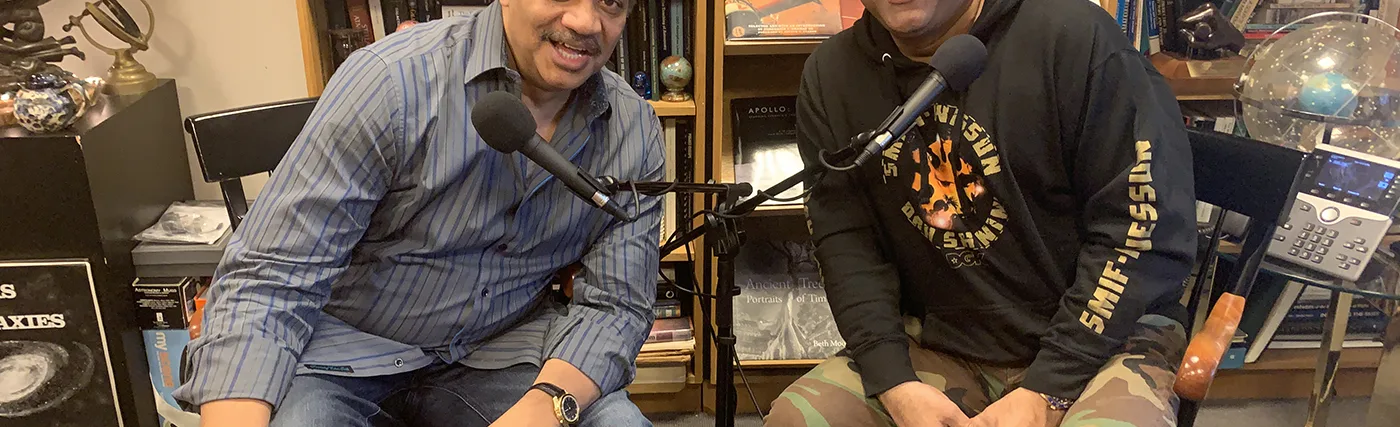
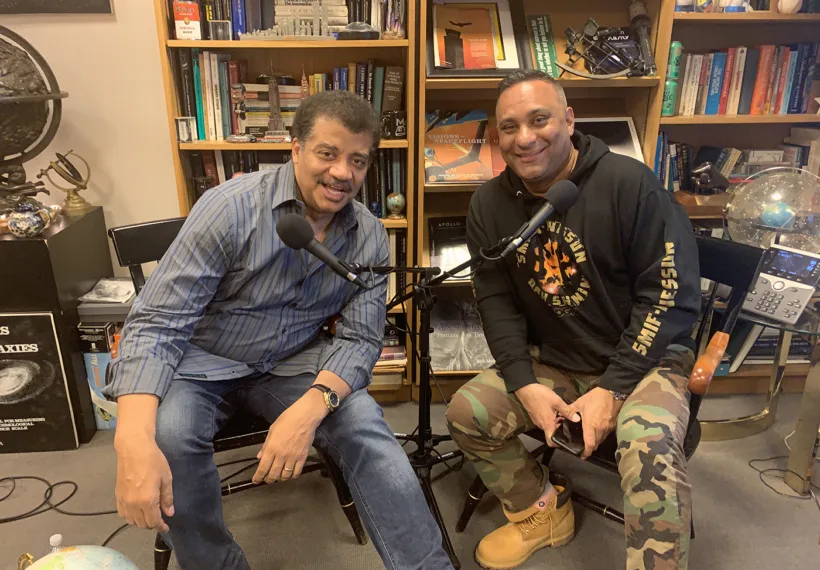
Astrophysics is everywhere. On this episode of StarTalk Radio, Neil deGrasse Tyson sits down with first-time comic co-host Russell Peters to answer fan-submitted questions about everyday astrophysics. What you may not know, is that besides being a comedian extraordinaire, Russell is a card-carrying member of the space geek club, so he fits right into the StarTalk family.
You’ll find out why Mercury and Venus don’t have moons. We investigate what separates a celestial body from being a planet or a moon, and, as always, Pluto makes its way into the discussion. You’ll learn why an object needs to have gravitational dominance in its orbit in order to be considered a planet. We also ask, “Could all our planets be perceived as moons to the Sun?”
Discover more about the impact of the Earth’s axial tilt. You’ll hear why the equator stays warm all the time. You’ll also hear why there would be no seasons if the tilt in the axis was undone. Find out how we would “survive” on a gas giant. You’ll take part in a thought experiment to understand positive and negative energy.
Find out what the most distant cosmic sight is that you can see with the naked eye. We explore the visibility of the Andromeda Galaxy and The Magellanic Clouds. Learn more about the discovery of the Andromeda Galaxy. Neil tells us why possible intelligent life in the Andromeda Galaxy would be seeing us not as we are, but as we were. Neil also shares with us the single most alarming cosmic event you can witness with your own eyes.
Explore why some planets rotate in the opposite direction. Neil explains why E = mc2 is the most important discovery in physics. We investigate the modern use of the word “theory.” We also ponder how you would know that you’re living in a special time of scientific discovery. All that, plus, get details on the relationship between the Earth and the Moon, and, you’ll learn how similar an exoplanet must be to Earth in order to host human life.
Transcript
DOWNLOAD SRT
From the American Museum of Natural History in New York City, and beaming out across all of space and time, this is StarTalk, where science and pop culture collide. This is StarTalk. I'm your host, Neil deGrasse Tyson, your personal...
From the American Museum of Natural History in New York City, and beaming out across all of space and time, this is StarTalk, where science and pop culture collide.
This is StarTalk.
I'm your host, Neil deGrasse Tyson, your personal astrophysicist.
And I'm here today with comedian extraordinaire, Russell Peters.
Russell, dude!
Neil.
First time on StarTalk.
First time, first time list, first time caller, long time fan.
Thank you for your enthusiasm.
It's real.
I believe it's real.
It's genuinely.
I heard rumors that you were on some other show, and said, who'd you want to have dinner with?
And I came up in the list.
You were the number one person.
Okay, well, we're testing you on the show first before we make the dinner plan.
Go ahead.
Go for it, yeah.
Before I invite you out.
Well, so thanks for doing this.
Today is an episode of Cosmic Queries.
Correct.
Every now and then, we gather questions that we've either solicited or trickled in from our fan base.
And the topic today is everyday astrophysics.
You didn't know there was such a thing, huh?
Well, I mean, would this be astrophysics for dummies at that point?
I don't know, actually.
You've been handed the questions.
Oh, I've got the questions.
You've got all the questions.
These are actually really good questions from what I can see so far.
Okay, well, that's...
I'm impressed and I'm like, oh good, that's a question I would like to know as well.
Well, that's good.
So you can pick them that way.
But before we get into that, remind me, you're on the road all the time touring.
Constantly.
Constantly.
It's all I know, 30 years of this.
So where is home?
There's a bus somewhere.
Well, technically home is, well, I guess technically home is Toronto.
Born and raised in Toronto.
Born and raised in Toronto.
But I've been living in Merck of 13 years now.
Merck of 13 years now.
13 damn years.
I'll tell you what, boy.
Tell you what.
You need the H in front of it.
What?
So no, it's great to know that you're out there and you've been doing this a long time.
So just trying to make comedic sense of the world for us just so, because we need some laughs.
There's some people in this world that definitely need some laughs.
It needs something.
It needs laughs before that asteroid hits us.
When you're done with this, get the hell back out there and get back to work.
So what do you have for us?
All right, you ready?
Yeah.
Renee Douglas.
We're duty-bound to make sure the first question is from a Patreon.
Oh yeah, absolutely, that's what I'm reading.
That's what you're reading, okay.
Renee Douglas from Patreon would like to know why do you think Mercury and Venus don't have moons?
Oh, oh, hmm, well, Mercury is pretty small, right?
Mercury is, I forgot whether it's just slightly bigger or just slightly smaller than our moon.
So, but it's small.
It's much denser, it has a huge iron core, so it's much heavier than the moon.
So it's got planet mass, but its size is small.
And it's hard to have something else orbiting you when you're small.
Jupiter is huge, has more mass than all the other planets in the solar system, and it has 60 plus moons orbiting it.
60 plus?
It's its own mini planetary system, if you will.
But the act of being small doesn't preclude having moons.
It's just harder when you're that small and orbiting that close to the sun, because then you have a gravitational tug of war.
Who's your daddy?
Who's your gravitational allegiance?
Who's your gravity daddy?
Who's your gravity daddy?
So, by the way, Pluto is also small.
They're like six moons in the solar system bigger than Pluto.
But Pluto has multiple moons.
The point is, that far out in the solar system, there's very little sort of gravitational disturbances from other objects.
So you can sustain orbits however delicate they are for much longer.
Is size, I always thought size was indicative of whether it was allowed to be a planet or a moon.
No, well, sort of, okay.
So it turns out if you're really, really small, your gravity loses to the structural integrity of the object.
So the rock will take whatever shape it wants.
So below a certain size, stuff in the solar system looks like Idaho potatoes.
Yes, I've seen those.
You've seen, no, yeah.
I've seen the pictures.
You've seen the pictures.
You've seen, in fact, I used to have one here.
Yeah, in fact, right up there.
Can you reach up and grab that?
Yeah, you can reach up.
You get it.
Just grab that.
This is a precise model.
Thank you.
I was hoping it was real.
Anyhow, so this is a model of an actual asteroid.
And this is sufficiently small that it takes whatever shape the rocks demand of it.
All right, and the rocks take their own shape based on the chemistry and how they formed.
So, but if this object were larger, then the gravity of the object says, I'm trying to get everything as close to the middle as I can.
And there's only one shape you take if everybody tries to get close to the middle, and that's a sphere.
So to be a planet, you got to be big enough to have enough mass to be a sphere.
But that's not the only rule.
Pluto's big enough to be a sphere.
Now we say, in your orbit, we want you to be dominant.
We don't want anything else competing with your orbit.
So Pluto is orbiting what we call the Kuiper about this thousands of other objects orbiting out there with Pluto.
It's littered, right?
Littered, great word, just like the asteroid belt.
Correct.
Littered.
So nobody in the asteroid belt owns the space of objects.
So they're all asteroids, even though one of the asteroids is big enough to be a sphere.
And Pluto's big enough to be a sphere.
So the rules are, are you big enough to be round and significant enough in your...
A little sensitive, but thank you.
Okay, big enough to be round.
And are you dominant enough in your orbit to have cleared it out so basically you're the only game in town?
And if you have to satisfy both of those, then you're a legit planet in the rules.
Are we...
Could we effectively be seen as our...
All our planets as moons for the sun?
I don't see why not.
Except because the sun is like alive with energy.
We have a different designation for it.
Because it's hot.
Hot's a little overrated, but it's a little warm.
It's warm.
Yeah, you would vaporize.
I can take the heat.
It's just the humidity on the sun that I can't handle.
So, you can think of it that way.
And not to overrun this answer, but people wondered a hundred years ago or more, at the turn of the previous century, wait a minute.
If the solar system has a star and planets that orbit it, and planets have moons that orbit them, atoms have nuclei and electrons that orbit them, maybe it's that all the way down.
That's fair.
Or all the way up, right?
So we have a galaxy, there's a center of the galaxy, and our whole solar system is orbiting the galaxy.
Maybe it's just solar systems all the way down.
But you get to the size of the atom, and there's nothing smaller than that.
There's nothing smaller than the particles that make up the nucleus.
Except for anti-matter.
No, there's a...
You wish.
See what I did there?
Yeah.
So there isn't some other structure of the natural world that we have yet discovered, nor that we think is there, if you probe the atom and look at the nucleus and say, oh, there's another layer right on down.
We ain't finding that.
Well, that was Rene Douglas from Pittsburgh.
You want this one?
You ready?
You don't even have to go in order.
Okay, well, that's good.
What would the climate be like on Earth if it wasn't for the axial tilt?
That was from Michael Grote.
Oh, yeah.
So that's a good one.
So this is someone who knows that Earth is tipped on its axis relative to our orbit around the Sun.
So we're tipped like this.
Tipped 23.5 degrees.
In fact, this has got Earth back there.
Let me get Earth.
Hold on.
Yeah, so this is a– so I'm holding in my lap for those who are only listening.
A map of Earth, which we're familiar with– Marcia Globe.
Thank you.
Let me hump you out with this there.
Thank you.
Want to hang on there, Astrophila?
It's a globe.
And it's the kind of globe we see in social studies class because all the countries are color-coded.
But, of course, Earth from space shows no such color-coding.
I know.
It's weird how they did that.
I tend to believe this globe much more.
So we're tipped on our axis.
And it turns out that because of that tipping, for one part of the year, the Northern Hemisphere is tipped towards the Sun.
And six months later, that same hemisphere is tipped away from the Sun.
And if you tip towards the Sun, your rays are much more intense and there's much more heating of the ground and you get summertime.
And around the other side, we're tipped away from the Sun.
The Sun's angles are low.
The angle of the rays is low and we experience winter.
Now since we're part of the same Earth as the Southern Hemisphere, if we're tipped towards the Sun in the North, they're tipped away from the Sun at the same time.
So we experience summer when Australia experiences winter.
That's all.
That's all that's going on.
So then how does the Equator stay warm all the time?
Oh, well, if the Equator is exactly between the Northern Hemisphere and the Southern Hemisphere, then they are switching always between summer and winter, then the Equator has no seasons.
Interesting.
It can't have seasons.
It can't have seasons.
When it's even on the other side?
It can't have seasons because it is always exactly between all other seasons.
The only way to be that is to have no season at all.
And what they do is they say, oh, it's the rainy season or it's the stormy season.
To make them feel good about it.
Just so they think they're having a season.
But temperature-wise, the Equator has no seasons.
And it's largely true for all the tropics, but if you want to be precise, the Equator does not go through seasons.
So if you want to undo the tilt and have Earth just pointing straight up and down, no seasons.
But it would still rotate, right?
We would still rotate on our axis and still revolve around the Sun.
We still have years, but there would be no seasons.
For anyone?
Again, unless it's just rainy season versus not.
There would be no temperature-based seasons of any significant measure.
Would we still have cold and warm and hot?
So the farther away from the Equator you go, the cooler it would get.
Right.
The whole Earth is not the same temperature.
But at a given latitude, you don't get seasons.
That's all I'm saying.
So the hottest part would be the Equator, and then you move away from the Equator to the Poles.
And that would be the coldest spot.
I don't think you should blame the Polish for this, but whatever.
The Poles have done nothing to you.
Let's see.
If the Poles are people from Poland, then the Polish are people that are sort of from Poland?
Yeah, they're kind of.
They're from Chicago.
I'm Pole-ish.
What else you got?
Let's see.
If we were just plopped onto a gas giant, such as Jupiter, like when they need to explain that one to you, what would happen to us, assuming we could survive?
Well, if you...
All right, I'll just keep reading.
I'm not an astrophysicist, obviously, but even I'm looking at this going, come on, come on, Jeremy Small, you're better than this.
The word assuming, I think, carries this part.
Assuming we could survive, there isn't a solid surface we could stand on, so where would we go?
Good question.
So, if I plunk you down on Jupiter, you would just descend through the clouds.
Jupiter gets denser and denser and denser as it goes down.
If you have a pressure-proof suit that you're wearing, you will continue to fall until you are about the same density as the surrounding area, and then you just sort of bob there and float.
That's what would happen.
So you would find your floating point.
Your floating point.
Exactly.
But if you didn't have your pressure suit, you'd be crushed by the atmospheric pressure that was there.
And you would vaporize because it gets very hot very quickly.
Is that what happened to Cassini?
Ignoring the vaporizing and avoiding getting crushed, you'll find your place, your zone.
So is that what happened to Cassini?
Oh, Cassini.
My boy did some homework.
I'm a nerd for this stuff.
Just a quick side note so you know.
In 2017, I went to Chile.
I get that he's pronouncing that all like he knows Spanish.
Chile.
I'm a Chileno.
I went to the European Southern Observatory.
Yes, I went there.
And I spent three nights there.
How?
I have a friend.
You knew somebody.
I'm friends with Nile Rogers.
You know people.
And Nile, this guy had invited us all down.
And then last minute, Nile bailed, but the rest of us all went.
Isn't it magical?
It is ridiculous.
It is ridiculously magical at the top of a mountain when it gets dark and you see out and it's just you and the cosmos.
But I thought that I was going to look through telescopes and see things because they have those giant things.
There's no lenses.
Yeah, no.
They just shoot lasers.
Lasers is another thing we can do.
The two reasons why you would shoot lasers, but we can save that for another question if it ever gets asked.
But it is truly magical to be on a mountaintop at night.
It is pretty wild.
Yeah.
They did pull out like a little rinky dink telescope for us.
Well, because we don't look through telescopes anymore.
No, apparently not.
I found out.
You thought there'd be this giant eyepiece waiting for you to walk up to it.
I thought like this…
And you see the gates of heaven through it.
I saw the pictures and I was like, oh my God, I'm going to look through those.
And I'm like, you don't look through those.
It just sends us data.
And I'm like, well, how's that help me?
I could have read the data at home.
All right.
Can I sneak mine in?
Oh, sneak.
Go on.
Let me sneak the one I wrote last night.
You got your own question?
I do.
Is that allowed?
I don't know.
Engineers, is that allowed?
I brought a question.
Go for it.
Is the Big Bang theory only for the observable universe or does it encompass the entirety of everything?
So first, it's a TV show.
Right.
Finishing its last season.
Highly successful and I've never watched one episode in my life.
Really?
Yes.
Highly, one of the most successful shows ever, actually.
So if you type the Big Bang theory into Google, the show comes up first.
Right.
Far more important.
Far more important.
And then next, I think there's a K-pop band called Big Bang.
Is there?
Yes.
And then they come up next.
Then the origin of the universe.
These are our priorities.
Is this still considered a theory?
So a theory is the modern word we use to describe successful understandings of the operations of nature.
So quantum theory, relativity theory, evolutionary theory.
So people say, oh, it's just a theory.
That's the word we use to describe stuff that works.
If you have an idea that hasn't been tested yet, it's a hypothesis.
Oh.
So Einstein's theory of relativity is Russell's hypothesis.
If you have an idea about something…
I have no idea.
Until it's put out and then it gets fully explored and investigated and tested and has other predictive value, then we're good to go with it.
So the Big Bang is our understanding of the existence and expansion of the universe in which we live.
It goes not only to the edge of the observable universe, but it would include the universe beyond that.
It's just that it's hard to get answers to that which is beyond our horizon.
So colloquially we say it is the theory of our understanding of the visible universe.
But technically the whole universe came into existence, even the parts you can't see in what we call the Big Bang.
So from nothingness comes somethingness.
Yes.
By the way, just to put you at ease with that, because the way you said that was all pejorative.
I just want you to know.
It was.
It had a little pejorative to it.
You copped a little attitude on that.
I was like, and I wasn't really excited with the answer.
I was like, I didn't really answer anything for me.
How do you get something from nothing?
So let's say you have, oh, you know, let me save the answer to that after the break.
The answer to this, Mr.
Bender, next week.
When we come back on StarTalk, we'll find out how you get something from nothing on this edition of Cosmic Queries.
Bye The future of space and the secrets of our planet revealed.
Earth, Space, Earth, Planet, This is StarTalk.
You are.
We're back on StarTalk Cosmic Queries edition, Everyday Astrophysics.
And helping me answer is my co-host today, visiting for the first time, Russell Peters.
Russell.
Hey.
I'm back.
I can't go to Netflix without seeing your face.
I created that job before.
You're trying to get me to watch all your stuff.
Yeah, don't waste your time.
Listen, you're an astrophysicist, you're smarter than this.
I love your rapport with the audience.
It's great, it's great.
You just make them all feel like they want to be there.
So.
Well, hopefully, they want to, you know, I'm not only captive, you know, unless they have Stockholm Syndrome and I don't know about it.
So you've got questions?
I've got questions.
And it's on Everyday Astrophysics?
Yeah.
Bring it on.
Actually, you left me hanging on the last, it was a big cliffhanger that we left on.
And you didn't finish it for me.
Oh, I forgot.
And I almost forgot too.
Because you greased me out of it.
Oh, yeah, I did.
Yeah, I said nice things about you.
Hey, it's all about me.
Yeah, I was like, I'm listening.
So, the question was, how do you get something out of nothing?
So, the thing is with energy, you can have positive energy and negative energy.
It's not just an emotional thing.
It's actually a real physical thing in the physical universe.
And each of those have consequences on space, time and matter.
But if you bring them together, it sums to no energy at all.
So, how does this happen?
So, think about it.
Let's say there's level ground.
And then I have a shovel and I put ground from this part and I stack it over here.
So, I'm digging a hole and making a mound.
Well, I can keep doing this and I can have a hill as arbitrarily as high as I want.
And I can climb to the top of the Empire State Building.
But there's a hole next to it.
So, how did I get that high?
How is that even possible?
I took the dirt over here and I put it over here.
But if I put the dirt back in, then everything's level again.
So, it's a way to think about what it means when you have negative energy and positive energy.
There are a lot of things we do where you started with nothing but you ended with something.
Something that you care about.
But in the total picture, it sums to zero.
I see.
That's a good explanation.
That's what I'm saying.
That I can walk away with and go, okay, I get that.
And not lose sleep tonight.
I would have lost sleep.
Tonight, I'm going to be sleeping going, damn it, I should have asked him.
Oh, right.
Let's go with, I haven't read this one, I'm just going to read it now and see what happens.
And see what happens.
Let's see what happens.
It might be a crappy question, we don't know.
All right.
Vincent Zimmerman wants to know.
From where?
Where is he coming in from?
Twitter.
Twitter, sure.
From the town of Twitter.
What's the most distant star you can see with the naked eye?
Oh, so that's an interesting question.
I can answer that two ways.
So, one of them is the most distant thing you can see with the naked eye is our nearest red-blooded galaxy, the Andromeda Galaxy.
And for the longest while, until the early 1920s, it was called the Andromeda Nebula.
Because it was just this fuzzy thing in the night sky among the stars that trace out the constellation Andromeda.
So, we named it after Andromeda.
And it was just a nebula.
A fuzzy thing.
And then, with better and better telescopes, we said, wait a minute, this thing is composed of stars.
Wait a minute, this thing is far away.
Wait a minute, this is an entire other galaxy.
It's not just a fuzzy thing in the Milky Way.
It's another Milky Way.
Well, how far away is it?
It was not close, quote, close like these stars we see in the night sky.
This is outside of our entire galaxy.
The stars you see in the night sky are tens, hundreds, a few, or thousands of light years away.
The Andromeda Galaxy is two million light years away.
You can see that with the naked eye.
I believe I saw that when I was in Chile.
You would have.
No, no, no, no, no.
That's too far north.
There are other fuzzy objects in the night sky.
That's called those were first described and written about by Ferdinand Magellan.
That guy was no Magellan, I'll tell you.
Sorry, what I should say is Western folk first learned of these two clouds when Magellan did his round the world voyage.
Clearly Aboriginal peoples of Australia knew all about the Magellanic Clouds.
So, they named it in his honor, the Magellanic Clouds, and they were called clouds at the time.
They are galaxies as well.
Yes.
Except they're closer.
There's a small one and a big one.
And they're called the small Magellanic Cloud and the large Magellanic Cloud.
Yeah, they really went out on the names.
They blew the bank on that one.
So, those are relatively nearby, a couple of hundred thousand light years away.
The Andromeda is two million light years away.
You're not seeing an individual star, you're seeing hundreds of billions of stars.
The muddled, muddied light, the blended light of hundreds of billions of stars that comprise the Andromeda Galaxy.
That is the farthest object visible.
And you can't see that from New York or any light polluted place.
Just go out in the countryside, it'll be there.
Would you venture to think that if there are people there, that they could see us the same fuzzy way we see them?
Oh, by all means.
Oh yeah, I think about that all the time.
In fact, if there was intelligent life there and they had detectors and they're looking our way, they would see us not as we are, but as we were two million years ago.
Because that light is only just now reaching them.
So they would not see signs of what we would call intelligence on Earth.
They'd see very…
If they saw us now, they wouldn't see those signs either.
So yeah, the Andromeda Galaxy.
There it is.
That's pretty awesome.
This is a completely different type of question, let's try this.
This is a slightly angry Lugia.
I don't know, that's their name on Twitter.
Why do sodium and chloride, two extremely toxic and harmful chemicals, combine to form normal table salt?
This is the beauty of chemistry.
So you think that a thing's properties are somehow inherent in the thing.
But the property is what manifests after you combine it with whatever else is.
So you combine sodium, which is a lethal metal that you can cut with a knife.
That's how soft it is.
And it reacts violently with water.
Add that to chlorine, which would poison you if you breathed it.
And put them together and you get completely necessary table salt.
Necessary for life.
So when you put them together, it's a new chemistry.
It's a new thing.
Don't think of it as it probably has some of those properties it used to have.
No.
All that matters is what are its electrons doing when they talk to your electrons.
And if the configuration is different, that's all that matters.
And the electrons that manifest themselves to you in table salt are differently configured than the electrons that manifest themselves to you as either sodium or chlorine.
And for me, the best way to say this, I had a little paragraph in this in one of my books, it was, let's take hydrogen.
Hydrogen is explosive.
If you have a ball of hydrogen and light a match to it.
So is Mexican food.
Carry on.
Thank you for that clarification in case we didn't.
So hydrogen will explode if you light a match to it, a ball of gaseous hydrogen.
Oxygen promotes combustion.
If you have a flame and add oxygen to it, it will burn faster.
Combine hydrogen and oxygen, you get water that puts out flames.
There you go.
It reminds me of George Carlin's old bit about halfway dirty words.
Words aren't dirty until they're put together.
Oh, okay.
So he has a follow on to the seven dirty words?
Well, this is old great material, but he said, caulk isn't a dirty word, it's in the Bible.
And if you go to the dentist or the doctor and they give you a sucker, you put them together, you got a bad word.
Okay, so good point.
So alone, those words mean things, you put them together, it means something else, entirely.
And so it's the same thing, meaning is everything in language.
And if two words together have a different meaning, deal with it.
Don't say, wait a minute, take it apart, and those have their own separate meanings.
Therefore, the word together has a, no, that ain't how it works.
So it's the same as the sodium and the chloride.
Exactly the same as the sodium and the chloride.
But it works in the opposite way.
Where sodium and chloride come form together and make something nice.
And make something beautiful.
Yes.
Got you.
See what I did there for you?
You're welcome, kid.
So what else you have?
Let's see.
Raul Sala Naranjo.
You can do better than that.
Try that again.
Raul Sala Naranjo.
Naranjo.
Listen.
It's on Twitter.
What am I doing?
All right.
It's on Twitter.
All right.
What would be the single most alarming thing that I could see with the naked eye?
Oh.
Oh.
I got this.
Okay.
I got this.
I guess that's up for interpretation.
I got this.
Okay.
You ready?
I didn't know what the single most alarming thing I could ever see with the naked eye was until I saw it, which meant I did not anticipate it.
Okay.
You ready?
This is 1999.
I'm on the Brooklyn Bridge at 2 o'clock in the morning and I'm looking up because that's how we roll.
That's exactly how you roll.
And it's November.
I remember this because there's a meteor shower.
Okay.
Meteor showers are best typically after midnight.
So there I am and Brooklyn Bridge is a nice…
You're away from lights.
It's still very lit, but you're away from lights.
As good as you can.
I'm a city person.
It's the best I can do.
And I'm there and I'm looking up and I'm seeing this meteor shower.
It's called the Leonid Meteor Shower.
And you see the streaks of light.
They're shooting stars.
It's beautiful.
We're getting like three or four per minute.
This is a good rate.
Then I saw a new star in the sky.
I said, I don't recognize that star.
And it just got brighter and brighter and brighter.
And then it disappeared.
Then I saw a puff of smoke and I said, whoa, whoa.
Okay.
So you know what just happened?
No.
You don't know what I just witnessed.
It was a meteor that was headed straight towards me.
And it disintegrated.
And it disintegrated straight towards me.
There was no streak.
There was no and I thought to myself, this is the final moment of my life.
It's the best way you could go.
In all fairness.
I mean, it's the most appropriate way.
We are so accustomed to seeing streaks of light in the sky.
And some of those are going to be headed straight for you.
And they're not going to make a streak.
They're just going to get brighter.
That when I realized a split second after that had happened, what I just witnessed, I freaked out.
I mean, not in a psycho.
I just intellectually freaked out.
And I said, damn, that's what that's going to look like.
So that's the most terrifying thing to look up and see.
Well, there you go, Raul.
That's definitely the most terrifying thing Neil saw.
But what about you?
What could...
All right.
What else you got?
That's Ramona Vaughn on Facebook.
Ramona Vaughn.
Ray Mona.
Ray Mona.
Ray Mona Vaughn, can you explain why some of the planets in our solar system rotate in the opposite direction?
Yeah.
Yeah.
So, the planet Uranus, for example, its axis is tipped 98 degrees, so it's rotating upside down.
But what determines that being?
Oh, because it's going backwards.
Well, no.
You're asking...
I was hoping you were going to ask that question.
That's a very intelligent thought out question.
It's because the right hand rule.
But Uranus doesn't know that.
Uranus is like, Earth, what's going on there?
Oh, okay.
I'm a lefty.
I'm a lefty.
It's called a right hand rule.
So here's how you do it.
Okay, so hold up your right hand in front of you, like you're going to shake someone's hand.
Good.
Now stick your thumb up.
That's the axis of rotation.
Now curl your fingers.
Your thumb is pointing north.
Yes.
I'm declaring that.
By tradition.
Right.
So if you go to the planet and curl your fingers in the direction it's rotating, your thumb is going to point north on that planet.
So, if I take Uranus with my thumb up and fingers curled and I then tip my thumb so it's pointed downwards, Uranus is turning back the other way.
But the north still has to have that relationship to that rotation.
So that's what defines the north of an object.
The right hand rule.
Just by convention.
That's how we can say Uranus is rotating upside down.
Now, why do we think that happens?
So their south is our north.
Correct.
So the rostra oia.
No, they're north.
Why did you get me to agree with you on that?
Their north is their north.
Their north is their north.
It just happens to be in everybody else's occupying the same area as everyone else's southern hemisphere.
That's all.
But Uranus doesn't have issues here.
Well, Uranus doesn't have much.
So all I'm saying is that Uranus…
So we think in the early solar system, because all the planets would have formed in the same sort of circulating cloud, and so you don't get upside down things in that.
All the planets are going the same direction around the sun, that's the direction the sun is rotating, that's the direction the earth is rotating.
So everybody's turned in the same way because that's the rotational energy of the original cloud out of which we formed.
If you rotate the other way, the way we explain that is you had some bad stuff happen to you early on, you got slammed by some other object in the early solar system that tipped you on your axis.
So possibly during…
We think likely, not just possibly, but even likely.
From the Big Bang.
No, no, way later when we were forming our own solar system.
Big Bang made the whole universe.
Wait 10 billion years, then you get our solar system.
We're a little late.
We're the dust settling, so to speak.
Very good.
There we go.
Very good.
So, it got slammed in the early solar system, and then it got tipped and has been that way ever since.
So, we got to take another break, and we'll be back more Cosmic Queries Astrophysics Household Edition.
The future of space and the secrets of our planet revealed.
this is StarTalk.
Third and final segment of Cosmic Queries, Household Astrophysics Edition.
Is that what we call this, Household?
Everyday, Everyday Astrophysics.
Household sounds like a cleaner.
Like these are like tips for you to get the stove shiny again, you know?
Using the cosmic principles.
So Russell Peters, great to have you on the show.
So you got all the questions there.
I got all the questions.
Give them to me.
This is from, I don't know if that's a real name.
IC Bank Carl.
It's an Instagram name.
What is a fascinating fact or thought that makes your appreciation for the universe overflow?
That's a deep question.
That's beautiful.
That's a beautiful question.
Let me just hear that question again.
I feel we need sax playing in the background when you do it.
What is a fascinating fact or thought that makes your appreciation for the universe overflow?
A fact and a thought are two different things.
I know.
But here goes.
Here goes.
I bask in our collective ignorance on the frontier of the unknown.
I long to look out.
Look behind me and say, hey, we got that.
I look in front of me and say, we have no idea what that is.
And so what keeps me awake at night and has me run back to my office every morning, is the prospect that we could be on the heels of a major discovery, answering a question that we might have posed already, but possibly revealing a question we had not previously known to ask.
That's my muse, my cosmic muse.
I feel you overflowing.
I had to give an overflowing answer.
You're like in LA when it rains.
The LA River.
So overflowing.
All right, Russell, give me more.
All right.
Harry from California.
No last name.
No.
Just Harry.
Do you know Harry in California?
No, but he's scarylevenbread is his Instagram name.
Harry from California wants to know, what do you think the single most important discovery in the history of physics is and why?
Oh, I got this.
Now, physics or astrophysics, are they two different things?
Astrophysics is a subset of physics, but we good.
We good.
Some years ago, I wrote an essay.
One award from the American Institute of Physics, a writing prize award.
And the title of the essay was In the Beginning.
And you're in the chair that I won, and it's stenciled on the back.
Plus, I got $3,000, which is totally cool.
$3,000 is always a good thing to get.
Except I don't have the $3,000 anymore, but I do have the chair.
Because you bought this damn chair with it.
So here's what I celebrated in that essay.
In that essay, I celebrated the existence and the consequence of E equals MC squared on the arc of the universe.
There is no understanding of matter and energy in the universe without that equation.
Stars would not produce energy.
There would have been no Big Bang.
Everything we take for granted in this universe owes its foundation to E equals MC squared, the equivalence of matter and energy in the universe.
For me, that was the greatest discovery because of how much it enabled us to understand.
Combine that with quantum physics.
I had a lot of good folks working on it in the 1920s, a watershed decade in the history of human understanding of the universe.
Quantum physics is a theory of the small.
Atoms, molecules, nuclei.
Coming to understand how the universe works on its smallest scale made us badass.
Not only could we have now, well, bad good and bad bad.
Take the word bad in both contexts because that empowered us to end civilization as we know it.
The foundation of the nuclear arsenals.
The atom bomb.
Exactly.
Exactly.
Yet, it gave us our deepest understanding of how the world works and is the foundation to the entire information technology revolution.
There is no creation, storage or retrieval of information in the IT universe without an understanding of the quantum.
Are you saying IT because I'm Indian and that's what my people excel at?
Well, that's your people.
My people, we excel at IT.
Aren't you from Toronto?
Yeah, but I got to go back to India for my family.
You got fam in India?
I do.
Oh, cool.
So, yeah, for me, equals MC squared.
That's I think the most profound fact of the universe.
There's some close seconds and thirds in that list, but I put equals MC squared at the top.
So, and what's cool is we learn that in like third grade.
That's your first equation, right?
Well, I was never a good student.
Oh, yeah.
I became more curious as I became older.
I wanted, because I always questioned everything.
That's all.
That's it.
I know.
You don't need anything else.
Wait, but did you find it, let's go off topic here, but don't you find it fascinating that so Albert Einstein came up with E equals MC squared, right?
But in such a short amount of time, like it took us how many centuries to get there, and then from then to here, we just did so much in a short amount of time.
Okay.
Like, why were we so dumb before that?
Like, what made us so stupid before that?
And then all of a sudden we're like, oh, bam.
It looks that way.
It only looks that way.
I have books from five years before E equals MC squared.
That would have been the year 1900.
I have books.
You read those science books, read those books and say, the discoveries of recent years are so vast and so amazing.
We are lucky to be living in special times.
Look at the steam ships across the ocean.
We're laying telegraph cables.
We can now communicate great distances.
We have the railroads across the country.
The world is smaller than ever before.
What a great time to be alive.
That's what they're writing in the year 1900.
Right.
So, that's what you sound like today.
What a great time to be alive.
Look at all the discoveries we've made.
All I'm telling you is when you're living in a great time, every year feels like you're living in a special time.
Come back in a hundred years, you'll say, those idiots back in 2019, what the hell did they know?
Yeah.
Well, yeah, you can go back to 1999 and be like, a computer.
It was, you know.
Right.
No, no, no.
In 1999, no one has any concept yet of a smartphone.
Yeah.
Well, we had the Palm Pilot, I believe.
I had a Palm Pilot.
I had a Palm Pilot, and I thought that was pretty good.
Yeah.
You thought it was great.
I remember 1987 movie Wall Street.
Yes.
Okay.
In that movie, there's Gecko on the beach in the Hamptons with a cell phone.
Yes.
And it's like shoulder-mounted cell phone, right?
I remember, because I saw that movie in First Run, and I remember, wow, that's cool.
He could walk, and there's no wires, and he's talking on a phone.
Any of us today looking at that say, what the hell were we thinking?
I remember my brother's first cell phone was about the size of that book, that physics energy book.
Big fat book on my table.
It had a handle that was pulled out.
And it still had a receiver, and the buttons were separate.
But it was portable.
It was portable.
I used to sit in my brother's car and talk to my girlfriend at the time, like 1988, 1989.
You shone off in front of your girlfriend.
No, because he had free minutes after like 9 o'clock, so I would use it then.
And it wasn't long distance, didn't matter.
So the evidence you're living in special times is that at every moment you think you're living in a special time.
Okay, but okay, let's go with not just equals, let's say from like the mid 1800s to now, we made some big strides, but what was happening before that, that just we were not doing anything?
It just seems like we were not being logical back then.
In the middle of the 1800s, we discovered and perfected and harnessed electricity.
Right, that's what I'm saying.
When all that started.
Since you want to go before electricity.
Before that, like let's go 1700s.
Oh, oh.
Like we were just like, what were we doing?
Back to the steam engine.
Steam ships.
Excuse me.
All right.
All right.
All right.
Let's go 1600s.
1600s.
We discovered that Earth goes around the sun.
The Earth is not in the middle of the known universe.
What was that guy's name again?
That was Galileo?
Yes.
See?
Yeah.
Just checking.
So, no, there were discoveries.
Making sure you're legit.
Making sure this isn't just the Internet's trickery.
It is true that discoveries happened less frequently.
It is less likely that there was an engineering discovery that would change your life at that time.
That is true.
But think of the mindset.
If any discovery changed your life at that time, that was amazing.
Right.
Because previously it didn't change anybody's life.
It would change it over generations.
Right.
That's when things were selling like hotcakes.
What I'm saying is people cared about hotcakes at that time.
Yes.
That was the best part of their day.
And you go later on their advances in medicine.
And we discovered cures.
And there was…
So…
Yeah, but what I'm saying is like they were all farther apart.
You know, spread apart more.
And they seem like…
The 1700s into the 1800s, we invent the chronometer that's seaworthy.
So we can figure out longitude on Earth, which has precision navigation.
There's stuff…
You think you live in special times.
Just go back then and you'll be celebrating that.
I'm just saying.
No, but I'm saying…
What I'm saying is that I feel like every day we're discovering something new that's going to change our lives.
But now there's so many things coming in.
There's so many things that we're discovering that they hold back on us now.
It's almost like…
Hold on a second.
Yeah, there's too much for you.
Yeah, we got to be nice.
We got to hold it tight.
I was talking to a computer guy the other day.
He was telling me about technology that is about to be introduced to the public.
He said, but we've had this for over 12 years.
Okay.
And now they're introducing it to the public.
They make it seem like it's the newest, greatest thing.
He goes, but this isn't around.
Because they have a marketability of the other stuff, and they want to get their money's worth out of it.
The R&D that produced it.
Yes.
So there's so much…
Hold them back.
It's an interesting concept.
So if we keep this up, we could be a century behind what we could be doing.
Just like they're trying to make a buck off of stuff that they invented a hundred years ago.
Exactly.
Okay, interesting.
This is an interesting conspiracy theory.
I don't know if it's a conspiracy or if it's just a hypothesis.
We only have a couple of minutes left.
We're going to go into lightning round.
So ask me five questions and I'll give you sound bite answers to them.
Okay?
From these questions.
They took my bell from me.
We're going to have to simulate this.
Okay, ready?
Go.
Okay, here.
Ready?
Go.
When the Earth and the Moon become double tidally locked, what effect could that have on tides and weather patterns?
Oh, excellent.
So, the Moon is spiraling away from Earth at the rate of a few inches a year.
One effect of that is that Earth is slowing down in our rotation.
We have to put in leap seconds every now and then.
You know what the Moon is trying to do?
It's trying to slow us down so that one day on Earth equals one month for the Moon.
When that happens, we will always show the same face to the Moon.
And when that happens, there will be no tides at all.
Tides will end.
Really?
Yeah.
Well, moon tides will end.
We will still have sun tides.
But the moon tides will end.
Yeah.
What are moon tides exactly?
The gravity of the moon across the Earth stretches the Earth.
The part of the Earth close to the Moon pulls closer to the Moon.
Part that's farther away is farthest away and it stretches.
And Earth rotates inside of those tidal bulges.
You're at the beach and the tide comes in, the tide goes out.
Nothing's coming in and out.
You are rotating on the solid Earth in and out of a tidal bulge caused by the Moon and the Sun on the ocean surface.
Is it like when you're in a bathtub with water and you start rocking back and forth?
The water starts...
No, because in that case it's the water that's moving.
In this case it looks like the water is moving, but it's not.
It's you rotating into it.
Hardly anyone knows that because colloquially we talk about tides moving in and out.
But we are rotating into the tidal bulge and out of the tidal bulge.
And there will be a point where the tides will just be static and they will never change.
So that is inevitable?
It will take longer for that to happen than the future life expectancy of the sun.
So don't worry about it.
Okay, so that's a concern of mine.
I was supposed to give a short answer to that question.
All right, how similar must an exoplanet be to Earth in order to host human life?
Oh, you know, I think we can handle a planet that has slightly less gravity.
You know, if you go to an exoplanet with slightly less gravity and you weigh 190 pounds, you're not going to complain.
Slightly more gravity if your heart is strong and you weigh 230, 240, you're not going to complain.
So don't take me back up there.
So there's a range.
You won't be fatter.
You'll just weigh more.
Your weight is not only how many molecules you have in you, it's also what's the force of gravity operating on you.
So you'll weigh more but you won't look heavier.
You'll just be heavier.
So my mass will be the same.
No, mass will be the same.
Correct.
But your weight can be less or more depending on what planet you're on.
In fact, it's less or more on Earth.
If you go to the equator and the equator is spinning, at the equator you're moving 1,000 miles an hour.
You weigh less on the equator than you do here in New York City.
You weigh less on a mountaintop than you do in a cave.
We should go to the equator, guys.
They should have weigh-ins for fights at the equator.
At the equator.
And if you had a mountain on the equator, you'll weigh less than any other place on Earth.
That's it.
You got that?
I'm going to propose that to the UFC.
But you have to ascend the mountain and you'll lose the weight that you would have hoped you'd lose by being in a lower gravity well just by climbing the mountain.
So you bet off just by the way, it's not all that much weight.
You pee out more weight than you would lose by going to the equator.
So it's ounces.
It's not pounds.
Well, then I'd be pissed if I went through all that.
Russell, we got to go.
Why?
This is so much fun.
Thanks.
We got to do this again.
Yes, please.
Next time you come through town.
Yes.
You're a world tourist, you know, world performer.
But I come to New York all the time.
New York has got to be in your soul somewhere.
It's definitely in my soul.
Very good.
It's my favorite place on Earth.
Russell, great to have you.
You've been listening to and possibly even watching StarTalk.
And I've been your host, Neil deGrasse Tyson.
Thank you to Russell Peters.
Thank you.
The one and the only.
And as always, I bid you good-bye.
See the full transcript



 Unlock with Patreon

 Become a Patron