


 Unlock with Patreon
About This Episode
How do we discover more exoplanets? Neil deGrasse Tyson and comedian Matt Kirshen explore telescopes, exoplanets, and more with professor of astrophysics and Principal Investigator of HATNet Exoplanet Survey, Gáspár Bakos.
At what rate are we discovering exoplanets? Learn about the HATNet and how ground telescopes are helping the search for exoplanets. Learn how light detectors find their subjects and how low earth orbit objects impact exoplanet detection.
We discuss the difference between light pollution and light pollution from satellites. Discover models of what starlink will look like in the night sky and what simple ways we could decrease light pollution. Also learn first-hand the ways that astronomy is being impacted in the age of proliferating satellites.
Could an exoplanet have life like us in a binary solar system? What can we learn about exoplanets using their transits? We discuss biomarkers, planets without stars, and how many stars we have access to. Plus, could we someday use gravitational waves to detect exoplanets?
Thanks to our Patrons Thakiddv2, Aiden, Randy Spaulding, Jon Schwalbach, Mark, and Nicolay Doytchev for supporting us this week.
NOTE: StarTalk+ Patrons can watch or listen to this entire episode commercial-free.
Transcript
DOWNLOAD SRTWhen it comes to auto, home and life insurance, you want a company that’s on your side, like Amica.
They take the time to understand what you need and tailor a policy to meet your needs.
When you need Amica, their representatives put you first and let you know what you can expect from them.
They’ll tell you exactly what you need to do and walk you through it.
By choosing Amica, you know you’ll have someone in your corner when you need it most.
Amica, empathy is our best policy.
Are you a business owner with big dreams for growth in 2023?
Well, you’re not alone.
Two-thirds of business owners have identified acquiring new customers as their top goal this year.
PayPal is here to support you on your growth journey.
Give your business an instant credibility boost and offer more ways to pay with PayPal as your trusted payment partner.
Maximize your growth by selling in more places.
Reach new customers online, in-store or on the go.
We all know PayPal.
We all trust PayPal.
Rethink what’s possible for your business with PayPal.
Visit paypal.com/us/startalk.
On the next episode of StarTalk, it’s a Cosmic Queries featuring the expertise of a colleague of mine from Princeton University.
The name is Gáspár Bakos.
And he is at the Department of Astrophysics there, where he has developed a system of small telescopes to discover exoplanets.
So we’re going to find out how does that work, why does a small telescope still get to contribute to a field that’s on the frontier, and we also learn how these satellite trails that we’ve read all about and seen videos of launched from rockets and how they affect the data that he’s searching for, as well as the beauty and majesty of the night sky that we’ve all missed ever since cities have become electrified.
All coming up on Star Talk.
Welcome to Star Talk, your place in the universe where science and pop culture collide.
Star Talk begins right now.
This is Star Talk, Neil deGrasse Tyson here, your personal astrophysicist.
And this is yet another Cosmic Queries edition.
I got with me Matt Kirshen, Matt, my co-host.
How are you doing, man?
I’m very good.
I’m excited about this topic.
Not least because a couple of weeks ago, as a birthday present from my wife, I went to Mount Wilson Observatory for a lecture and then a look through the big telescope.
So I’ve never-
A look-see, very good, very good.
I feel like I’m up at an amateur level now on this, but I want to hear from the pros.
Excellent, excellent.
So there are people who are experts in all of the things I listed, one of whom is actually just across the river, across the moat here, we call it the Hudson River, over in New Jersey.
Is a colleague of mine from Princeton Department of Astrophysical Sciences, Gáspár Bakos.
Gáspár, welcome to Star Talk.
Yes, hi everyone.
I’m glad to be here.
Excellent, excellent.
And you are a PI on a project called HATNet, which is search for exoplanets.
And of course, people, I don’t think everyone thinks much about the fact that at any given spot on Earth, where most people live, you don’t see the whole sky.
So if you’re gonna find exoplanets in a place you’re not looking, what do you do?
Indeed, there is a project called HATNet, which is an automated telescope system, because finding exoplanets with the naked eye will be really very challenging, I would say impossible.
But the idea behind robotic telescopes is they can actually scan, monitor big areas of the sky nonstop, and then we can use computers to analyze all the data.
And we can place these robotic telescopes to fancy astronomical locations which have clear skies, high mountains, and have internet and power.
That’s getting very difficult.
And they’re not very large, so it’s not a big disruption to the physical location.
Oh yeah, they’re actually tiny.
This was an amazing thing that we realized about 20 years ago that we can actually do cutting-edge science with tiny telescopes.
Because stars, when a planet goes in front of them, they blink, and that blink can be detected with a small telescope if it’s all carefully engineered and run.
But HATNet, apparently, you have telescopes in multiple places on Earth, and why did you do that?
Oh yeah, so the transits are elusive, and the transit of a planet, the time instance when it goes in front of its star, will have nothing to do, whether it’s daytime or nighttime on Earth from a given location.
So it might actually go in front of its star and the star blinks when it’s broad daylight here in Princeton.
So the idea is to put telescopes around the globe at tactical longitudes so we can observe around the clock.
In other words, the sun never rises above our telescope empire.
Or never sets, it also never sets.
It never sets, it depends.
That’s an equivalent, this whole British empire, the sun never sets, it never rises either, but logically, it also never rises.
But okay, so you can cover it.
I love your phrase, tactical longitudes.
But now, what about latitude?
Yeah, you can also be tactical with latitudes because here’s the thing, if you go too far to the south, you freeze to death.
And I don’t like that.
If you go too close to the equator, then you have too much humidity and jungles, which are lovely things, but it’s just not good for astronomy.
Or too far south if you’re in the southern hemisphere.
In the north, it’s the same thing.
And plus, in the north, if you go too far north, there’s no ground.
You can’t touch.
There’s another problem.
Most people don’t know that Santa Claus lives on an ice floe.
Okay?
Most illustrations of Santa Claus at his workshop, they have mountains and pine trees and things.
It’s like, no.
So that’s worrying.
With climate change, it could disappear.
He could end up swimming in it.
This would be sad.
This would be Santa Claus in a bathing suit.
Just sitting there on a float.
It’s already happening.
Last year, the Arctic did not freeze over.
That was in the news.
Ships can be crossing it at any time or something.
So it’s like.
So where are your Southern Hemisphere telescopes?
Where are they?
So the first station we built is in Chile at Las Campanas Observatory in the Andes.
So it’s a pre-existing observatory location, right?
So you didn’t have to build roads.
You didn’t have to put in the internet, like you said.
You just ride the pre-existing infrastructure.
Yeah, exactly.
But we did pour the concrete piers.
We poured in a container, like a shed for instruments.
And we hold in all the things and build all the infrastructure up for our local installation.
But there is other infrastructure already there.
The second one is in Namibia in the Kalahari Desert.
There is an existing installation there called the HESS Telescopes.
So again, we had internet, we had power, sort of.
It was a bit tough in the beginning.
But it’s an amazing place.
And the third one is in Australia in the Outback at Siding Spring Observatory, which again has sort of very good infrastructure.
All right.
Well, very cool.
And last I checked, the catalog of exoplanets was nicely rising through 5,000.
And are you going to make predictions about how soon we’ll hit maybe 10,000, doubling that number?
Yeah, that’s a very hard thing to extrapolate.
Let me ask a different question.
At what rate are you discovering exoplanets?
Yeah.
Are you good at this?
Well, so our rate, we actually found 140 something exoplanets between 2006 and now.
And our rate has been going down because our space missions have been contributing majority of the discoveries.
But, you know, space missions have a limited lifetime.
So Kepler was a famous one that flew from 2009 through sort of 18.
And then TESS is now a highly productive mission, which will run for a limited time.
And TESS is itself an acronym.
What is it?
Transiting Exoplanet Survey Satellite.
Satellite.
There you go.
Right, right, right.
I’ve been fascinated by this.
But you’ll continue cranking with or without the space observatories, is what you’re saying.
Well, an idea, what we do is we complement the data coming from space.
Let’s say TESS observes an area for 27 days nonstop and it finds transiting planets.
Now, some of the transits will be single transits.
There will be just a blip in the light curve.
And we don’t know when the next blip is happening.
We don’t know.
But if we complement it with ground-based data, we can solve for the period.
Oh, excellent.
So TESS makes the discovery.
Now, you follow up to verify that it’s a repeating phenomenon.
Yes.
Because if they just see one blip, that could have been anything.
Oh, yeah, yeah.
There’s many false positives.
That’s another thing that there’s 5,000 planets candidates right now.
But I think the number of confirmed planets with mass is measured, say, is about 270 from TESS.
So there’s like a huge difference between the two.
So it’s still a lot of work to happen there.
So now you’re also involved in…
You’re part of a documentary called Dark Sacred Night.
Yep.
That’s some powerful words there.
So what’s going on with that?
Well, I’ve been…
I grew up on the dark skies as a kid.
I…
Was that the moon?
Where did you have dark skies?
The ISS.
Yeah, you were an astronaut.
Okay, fess up to us.
Where were you when you grew up?
I grew up in the northeast part of Nigeria, on the border of Cameroon.
There was no electricity and no TV, no internet, no phone.
But we had the dark sky.
And it was really amazing.
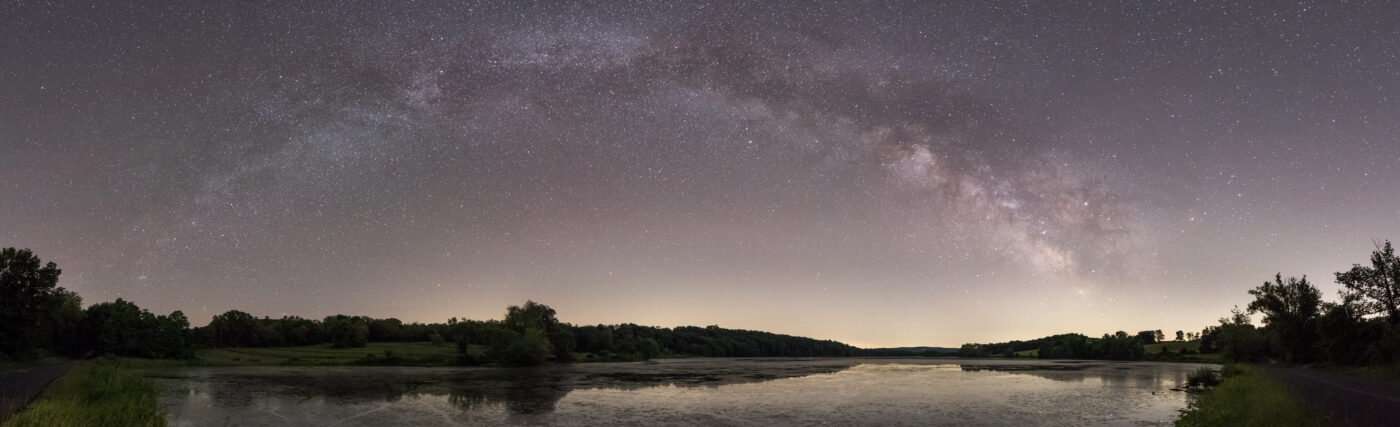
I remember as a five-year-old looking up, I would see the Milky Way going down to the fence or whatever, the horizon.
And then I realized when we moved back to Europe that this is not something I see from there.
At all.
You don’t even know it’s there.
All that beauty is missing.
I felt pity for all of us here.
We just don’t see this thing.
And I thought, is it actually a necessity or is it a stupidity?
And after a while I realized it is more of a stupidity.
If lights were properly designed and named down, it was not wasted, then we would actually see the Milky Way from the majority of the US.
So we have both civilization plus a dark night sky, is what you’re saying.
Absolutely, yeah.
So not having our cities any less lit, but just having smarter lighting that is less wasteful, less pointing up and escaping less.
Matt, you know what I tell people when I’m in an airplane and we’re about to do our final loop to the airport around a city?
I’d say to the person next to me, you see that area of streetlights down there?
And they say, yeah.
And I say, someone is paying money to send photons to me in an airplane.
It is doing no good for whatever purpose it is down on the ground.
The estimate now is something like 50% of the light emitted in the US by light fixtures goes up straight in the sky.
And that’s pure geometry.
They are not shielded.
It’s not rocket science.
It’s like the simplest thing.
And the amount of money, which Neil referred to, right now the estimate is about $3 billion per year is converted into photons that go up in space simply because of the collision.
Just to light clouds.
Just to light the clouds and airplanes so we can see the system.
I’ve talked about this before on this show, because I grew up on the outskirts of London, and now I live in Los Angeles.
And Neil, you grew up in New York.
I remember the first time I was somewhere that was sort of remote and in the middle of nowhere and you could really see the sky.
And I was like, oh, that’s what stars are.
That’s what people used to write poems about and draw pictures of and stuff.
So, Matt, that moment for me was in the Hayden Planetarium.
Oh, really?
Oh, is that what the sky looks like?
So, Matt, this is a hybrid, nice conversation with our guests, but also we solicited questions from our audience.
We absolutely did.
So, Matt, what questions do you have for our man here?
Yeah, so a load of Patreon patrons came through with some great questions.
So Shane McDaniel says, when you use long exposure detectors, how do you keep them in the same line of sight through the exposure so that all the data lines up, given the Earth is rotating and the cameras in space have their own velocity, etc.?
Nice, good, good.
I don’t know if this refers to a space mission or a ground-based telescope, but whatever it is, we have developed tracking on the skies.
On Earth, we have what we call the polar axis of all space telescopes.
You will see a big axis pointed at roughly the North Pole, which is Polaris at our time.
And the telescope spins around this with what we call sidereal rate.
And they also have other fine things like the auto-guide.
We have a special detector which is sensing starlight and would like to nudge the motors left and right to keep things exactly in the center.
And for a space mission, it’s similar techniques.
They have gyroscopes, they can orient.
And plus in space it’s somewhat easier actually to track.
Because you know, you have less external forces, you’re not necessarily like spinning with the Earth itself.
You’re pointed at some direction.
Yeah, and just to add some emphasis there, you mentioned sidereal time.
Because I don’t know if people know that the stars revolve around the Earth, if I may speak in that way, pre-Copernican.
They revolve at a different rate than the Sun does.
So the sidereal rate is the star rate that the stars go around the Earth.
And that’s every 23 hours and 56 minutes.
The stars make one complete loop, whereas the Sun makes one complete loop in 24 hours.
So yeah, we’ve got smart people figuring all that out.
But you know what my iPhone does today is if I want to take a long exposure, it doesn’t say, hold it really steady while I can do this.
No, it takes multiple exposures, multiple short exposures, and then in software when the exposure is done, it registers the light in that image, stacks them, adds them, and that’s my final photo.
And I don’t even see the intermediate stages of it.
So that’s another way to accomplish the same thing.
So Gáspár, what you’re saying is we know enough about the rotation of the Earth to compensate for it when we’re taking long exposure photos.
Yeah, yeah, we have measured the spin of the Earth very well.
So well that we actually even see…
That’s not something we correct for during the night.
But strictly speaking, we see when the Earth spins down or spins up due to changing seasons.
So we really know…
That’s badass.
That’s just totally bad.
We are so good at knowing the rotation of the Earth, we can say when it’s varying.
That’s just…
that’s…
Yep.
That’s…
that you’re showing off.
The Earth used to be our primary clock, right?
Earth.
And you wouldn’t know if the clock was varying if your clock itself was the foundation of your timekeeping.
So now you have to be able to keep time better than Earth does to then show that Earth is either speeding up or slowing down.
Yeah, exactly.
And its rotation rate.
That’s crazy, crazy.
Crazy.
Now streaming exclusively on Paramount Plus.
We are the explorers.
Through great wonders and great danger.
We come together.
The new season of Star Trek Strange New Worlds.
The next great age of exploration starts with us.
Ready for some fancy flying arrogant.
Oh, you know I’ve got this.
Star Trek Strange New Worlds.
Now streaming on Paramount Plus.
Live long and prosper.
It doesn’t make a difference if you’re driving across country or on your daily commute.
The time in your car is perfect for listening to podcasts.
Use T-Mobile’s network to help keep you connected to all your favorite podcasts when you’re out and about.
Now here in New York, people don’t really drive that much.
But you do use ride share and you’re on public transportation.
You might be on a ferry or you might be on a bus.
And you know what you’re doing?
You’re listening to something.
And if you want that something to come through on the fastest 5G network, well, then you better be using T-Mobile.
T-Mobile covers more highway miles with 5G than anyone.
Seems obvious if you need great coverage, especially when you’re on the go, check out T-Mobile.
They’re the largest and fastest 5G network.
Find out more at tmobile.com/c-y.
That’s S-E-E-W-H-Y.
Fastest based on median overall combined 5 speeds, according to analysis by Ucla of Speedtest Intelligence Data Download Speeds for Q4 2022.
See 5G device coverage and access details at tmobile.com.
I’m Joel Cherico, and I make pottery.
You can see my pottery on my website, cosmicmugs.com.
Cosmic Mugs, art that lets you taste the universe every day.
And I support Star Talk on Patreon.
This is Star Talk with Neil deGrasse Tyson.
So Matt, what do you have for our guest?
Well, I’m going to combine a couple of questions because I love to do that.
So there’s a question from Mark Bode, firstly from Boulder, Colorado, who says, is a question about the proliferation of low Earth orbit satellites.
But it doesn’t seem like the rate humanity is launching these things will reduce any time soon.
What is the best way we can ensure the skies remain clear and free of light pollution to enable important activities such as the search for extrasolar planets?
And then also Kevin Browning from White Deer, Texas says, How does low orbiting satellites and space debris interfere with the search for exoplanets?
What can ordinary people like myself who care about the night sky do to convince Congress or companies like SpaceX to reduce light pollution and the number of orbiting satellites?
Okay, so, Gáspár, you have to answer that in three sentences.
Actually, first, why don’t you distinguish for us the difference between light pollution and satellite pollution?
Because it’s not the same thing, is it?
Yeah, there are some subtle bits here.
I would say light pollution has a ground-based component, which is bright satellites, poorly designed lights going up in the sky and illuminating our atmosphere and the night sky, making it brighter.
And the second component, which is fairly new and unexpected, so to say, is light pollution coming from thousands or so, maybe tens of thousands of artificial satellites orbiting the Earth, reflecting back light from the sun or emitting radio waves, which is also electromagnetic radiation.
A form of light, yes, it’s another form of light.
These are the two components.
To deal with the first one, I would say technically it’s sort of a trivial thing, and yet you’re not doing it.
There are many other things in the history of humanity which were trivial and we have not been dealing with it, but this is another example of that.
But you know, to give some hope, I think some of them were dealt with.
So we used to pollute our rivers far more than we do now.
We used to pollute our atmosphere with freon and with other pollutants that would decrease, like…
Smokes stacks.
I grew up where I had to brush ash off my shoulders because every apartment building burned its own trash at certain times of day.
So yeah, when I grew up, the sky was bad for multiple reasons.
So London used to be covered in soot for centuries and now it’s sort of clean compared to that.
But light pollution…
The Thames River used to stink.
Yeah, light pollution, which is basically shielding all the lights, aiming them down where they are supposed to be lighting and dimming them to proper levels and not over lighting.
This is it.
And it has not been achieved.
It’s like just stunningly bad.
And I’m clearly amazed that this is still going on under, you know, there’s definitely a trend and recognition of going green and being less pollutant.
And yet we’re wasting like $3 billion a year on lighting up the sky, which is very harmful for us.
It’s not about the stars, by the way, you know, it’s this thing of, yes, we want to see the stars, but it’s about our own health, which has been now clearly detected to be very, very bad for our health, having strong ambient nighttime lighting.
It’s very bad for nature, for ecosystems, and even bad actually for safety.
But that’s a different topic.
As for the night, going back to the question, the satellites up in the sky, that’s a hard problem to solve.
The problem is that the sun reflects back from these satellites, and they are sort of useful in broadcasting internet.
Now, almost everyone in the US has relatively broadband internet, if you think, like 10 million people in New York, no one complains about having no internet.
So, providing them with another internet is really about business and it’s not about saving the world.
There are some parts of the earth where internet is very poor, say in the middle of the ocean, the middle of the desert, but there are very few people there.
And historically, these people have been, if needed, have been using satellite phones for emergency communications.
There have been some efforts in dimming the satellites, painting them black, they overheated, putting them on a sun visor, which reflects light in a different direction.
I think one idea is to have a smart design of satellites, being very, very conscious about the light reflected back, and to have strong limits on the number of satellites through agencies and regulations and by essentially updating the International Space Treaty, which is so outdated that the majority of it is from the 1960s and 1970s, completely unprepared for an individual launching his own satellites in numbers of thousands.
There is nothing in a space treaty like that.
So it is a crazy situation that there is some treaty that has general policies about what we can use satellites for, no warfare, things like that.
There was some ideas about the Soviet Union was concerned about America broadcasting TV over the Soviet Union in the 1970s.
That was basically the last major update of the space treaty.
I think there is a risk of a runaway process that companies will start competing for the number of satellites and trying to get even broader bandwidth and shorter response time.
And so it might grow into the tens and hundreds of thousands, if not limited, by some central agencies.
So, that peace treaty came out of the United Nations.
It has a much longer title, if I remember.
Something like a treaty for the peaceful use of outer space.
It’s got some long title, which is very hopeful at the time.
But I agree, it’s now 50 years out of date, practically, and it needs to be modernized.
And many countries signed it, right?
So it had good intent at the time, for sure.
Yeah, I mean, there’s no real agency at the moment who would say, there’s agencies who let these tens of thousands of satellites to be launched.
And the decision is essentially based on radio waves and orbital elements.
But there is no environmental element in the consideration, saying, no, guys, you can’t do this.
You can’t paint the Hudson River red.
It’s not yours.
Yeah, so our crack team of researchers dug up the full title of the treaty I’ve got it here already.
The Treaty on Principles Governing the Activities of States in the Exploration and Use of Outer Space, Including the Moon and Other Celestial Bodies.
See, they needed astronomers in there to make a good acronym.
Yeah, do you guys call it the Tupac-a-s-a-u-a-n-c-m?
There’s definitely some really dodgy space acronyms as well, where they’ve just taken letters from the middle of the word as well.
Like, you can’t do that.
It’s got to be the starting letter.
That’s not allowed.
Not allowed.
Alright, really good answer there.
That gives us a much deeper insight into what’s going on and what the challenges are, and how hard the solution might be.
But, Gáspár, you said it’s really just human stupidity for half of the problem.
But let me add, so let me get back to one of the specific points of the question.
Satellites trailing across the sky.
Does that affect your data taking when you’re trying to discover an exoplanet?
Big time, it does.
I actually see the trend in my own data now.
Essentially every image I take during the night, I would say up to three hours after sunset, and from three hours before sunrise, every image I take anywhere in the sky will have at least one trail or more.
And those trails cross stars, and so the light of that star, when I measure, will have a big bump in it or some noise.
So it becomes like an intense noise filtering.
Now some people say, oh, if you co-add all these images in a smart way, then the satellite trace will disappear.
Yeah, but I don’t co-add them.
I’m trying to measure individual images and all the light of all the stars.
So it’s a…
To co-add, that’s lingo for…
We assume every picture you’re taking is of the same thing.
So now you take them and find out one of them has this weird streak.
It’s clearly…
You drop that out, and then everything else is fine.
But if one of the pictures contains something you need, and that’s the one that gets dropped out, you lose your data.
Exactly.
Am I right in thinking one of the things you’re looking for is specifically a change in the image when a planet crosses the star?
Yes, precisely.
I mean, last time I was in Chile a couple of months ago, I let my camera, like my astrophotography equipment out to take a time lapse.
And what I saw on this video in the morning, when I reviewed it, was I saw this bright shooting star that’s being crossed by another shooting star.
And I said, this is remarkable, I have this photograph of two shooting stars crossing.
And then came another like 500 on the horizon.
This is a regular DSLR, you know, end user camera on a tripod.
And literally, there was like a shower of satellites on the horizon from Chile, not hundreds, but more.
It looked scary.
Matt, these are the alien invasion that he’s not telling us about.
It looked like that, yeah.
It looked like the aliens were coming.
We did see, when we were up at Mel Wilson, there was, I guess, is it Starlink?
Is it the most satellites?
But there was a sudden trail of about 10 maybe more satellites in a row, just crossing the sky in a straight line.
And it did look, it looked very alien invasion like to me.
It was just, I’ve never seen a series of things moving in a direct straight line.
And it’s also a cultural thing.
There are simulations showing how it will look like if it does proceed as it is now.
Essentially, it will be very hard to point out, for example, for a child, where is the Big Dipper.
There will be all these moving bright dots.
And in between that thing, when you see that the thing that’s not moving, it will be actually so confusing.
So we need a video game shooting down the satellites.
So you can see that.
One thing I forgot to mention, forgive me.
So, Matt, you went to Mount Wilson Observatory, which was the observatory that Edwin Hubble used, Edwin Hubble, the man, not the telescope, used to discover that our Milky Way is not alone among galaxies in the Universe and to discover that the Universe is expanding.
And so did they finally get that as a landmark?
I think they wanted, because it’s a landmark in our understanding of our place in the Universe.
I don’t know what his official designation is, but certainly they make a big deal of that and they’re very proud of that.
And it was pretty cool to look through the same telescope that Hubble looked through.
It was pretty impressive to go, oh, this is where, as they put it in the talk, like they discovered the Universe essentially here in that location.
Yeah, in a sense.
That’s correct.
Let’s see if we can get one in before the break.
Absolutely.
So Augustin from Puerto Rico, who is the host of the Curiosity Dads Scientifica podcast, on which I believe Neil has guested, talking about the Arecibo Observatory.
I have.
And try to improve your Spanish the next time you read that, okay?
Yeah, that was…
I took a very quick run at that and I was hoping to skip past a notice.
That was serious gringo Spanish.
That was horrible.
I was hoping it would be missed, but it was not.
Neil didn’t let that one slide.
But Augustin asks, can an exoplanet have life like us on a binary star or a dwarf?
Oh, I love that.
Love that.
Are you thinking…
Gáspár, are you thinking about life on the planets?
Yeah.
Oh yeah.
I think it’s a fascinating topic.
And I think the first sort of written record of someone contemplating about it is from ancient Greece, but there’s also Haydn in the 18th century pondering about all the stars being suns and why not they have planets and why some planets actually aren’t like the Earth.
And he actually writes in his work, Cosmotheoros, where he writes like, and there must be all these alien civilizations on these planets and some of them might be intelligent and looking back at us.
So he was really ahead of his time, dangerously…
This is the Dutch astronomer, Chris John Huygens.
Yeah, exactly.
I think he published his book sort of to say posthumous, just to make sure he’s not burned on some stage or something.
Speculating about life in the universe.
Yeah, if the universe is divine because God created it and we are the divine creation of God, you would not expect to find life anywhere else but Earth.
So this is quite heretical.
Yeah.
Amazing thing is, now we know that there are…
The estimates vary over time because we are refining it, but this is basically about 20% of solar-type stars have a planet that’s rocky.
So it’s not like a helium or hydrogen giant that’s rocky like Earth and is in what we call the habitable zone.
So if you multiply the 400 billion stars in our galaxy, you take this about 40 billion of them similar to the Sun and you multiply that by 0.2, that’s about 8 billion rocky habitable planets just in our own galaxy.
To be clear, the math you’re doing on the fly there is you’re multiplying big numbers by fractions.
Normally when we think of multiplying numbers we make them bigger.
So I just want to clarify.
You’re taking the fraction of the 400 billion, then the fraction of what remained, and then as you hack away at the large numbers, you get the numbers that have all the features that you’re looking for.
It’s still a massive number.
I think it’s an interesting thing if you look up at the Milky Way, which is lost for 99% of Americans, but if you actually happen to go to one of the national parks or travel far, you look up at the Milky Way, what’s the probability of someone looking back at you?
I think that’s a fun question, which we don’t know the answer to yet.
That’s a little creepy, though.
But, Gáspár, we left out a part of that question, which was, what percent might be orbiting a binary star?
Oh, I see.
Yes, that was indeed part of the question.
So, first of all, just to give a tiny introduction, we actually did not know that there are stable planets around binary stars.
So, meaning there’s two stars orbiting each other very close in, and there’s a planet far out orbiting this binary star.
It was only in Star Wars.
Tatooine is the only one.
Now we know they exist.
And we also know that some might be in what we call the habitable zone.
So, the probability is also exists, but these planets are much less frequent than the ones around normal stars.
Right.
So, I guess the point there that you imply is that if that planet were orbiting closer to the binary star, the orbit would become less stable, because it would get really close to one star and then far from the other.
But if you’re far enough away, it just sees kind of one average gravity field.
Is that a fair way to describe it?
That’s a fair way of describing it.
And if it’s very far away, it feels one gravity field, but it does not feel heat anymore.
So, it gets losing.
So, you want to be in the right place.
So, for a binary star that’s somewhat more limited, and I don’t have an exact number, I don’t think anyone does, but we are closing in on that number by, first of all, knowing the frequency of planets around binary stars or getting a handle on it.
And in the future, I think, we will soon learn about what fraction of them are in this habitable zone.
And I’ll add that most of the stars you see in the night sky are multiple planet, double and multiple planet systems.
So, it’s not a question about a rare possibility, right?
Binary star systems are not rare in the night sky.
So, it’s a very natural question to wonder whether they could also be repositories of habitable planets.
Well, 70% of stars are in binaries indeed.
And I have to add that there’s another solution, when the two stars are very far from each other, orbiting in, say, thousands of years or tens of thousands of years, and both of them host planets very close in.
That’s a different argument.
That’s the opposite of the other one, right?
A planet orbiting far from the pair, and a pair is orbiting far from each other, so they carry their own solar systems around themselves.
Yeah, exactly.
You can have both.
Hey, you’ve been searching for a hotel for that epic trip that you’ve been planning, but there’s so many options that you can’t decide which one to book.
The Choice Hotels family of brands has over 7,500 locations with a hotel for every type of stay, like Cambria Hotels with offerings like rooftop bars, spa-like bathrooms and convenient downtown locations, or a comfort inn for the whole family to enjoy.
Cambria Hotels offer spa-like bathrooms with many that have Bluetooth mirror connectivity so you can listen to your favorite podcast, and we all know that’s StarTalk, or songs while you get ready.
Each Cambria Hotel is curated with locally-inspired design elements, providing guests with a sense of space and place in the city you’re visiting.
Cambria Hotels offer hyper-local craft beers on tap.
Okay, you had me at craft beer.
How about rooftop bars, lounges, and outdoor spaces for guests to enjoy?
Comfort offerings include a free hot breakfast, great pools for the entire family, and spacious rooms.
Make your travels come true today when you book direct at choicehotels.com.
That’s choicehotels.com, where travels come true.
Advance is proud to offer free curbside services at most locations and for most vehicles to help drivers like you get back on the road.
Head to your local Advance Auto Parts to get your existing battery tested for free.
Need to buy a new battery?
They can recommend and install one that’s right for you, including the powerful, durable, and reliable Die Hard Battery.
Plus, Advance team members will test your starter and alternator to make sure your car starts and charges for even the longest of road trips.
They’ll also install your new wiper blades for free, loan out tools for your DIY projects, perform check engine light scanning and more.
Go to advanceautoparts.com, download the Advance mobile app, or visit a store for more details.
Matt, what more questions do you have for our guest?
Yeah, we got some great questions.
Well, the one that I had loaded up from Christopher Stowe has just been answered by you.
It was about planets and stable orbits around binary systems, so you’ve covered that.
And just to be clear, when we talk about stable planets, it has nothing to do with their emotional state, just to be clear.
No, planets are notoriously unstable in many ways.
They can go off at any minute.
Orbitally stable, yeah.
There are ways of erupting at short notice.
But just to be clear, an unstable planet can either fall into the host star or get kicked out.
So the orbit does not maintain itself around the host star.
Yeah, those are the two solutions.
And curiously, we see the effect of both.
The planets that fell in the star, they pollute the star.
So you can detect elements due to planets that fell in the atmosphere of stars.
And the planets that were kicked out, that’s really amazing, I think.
But they were detected through what we call microlensing.
They are dark, you don’t see them, but they go in front of, roughly, in front of a star, and they lens the light of the star due to their gravity.
And then you see the background star brightening up.
And with this thing, over a decade or two, they actually measure that there are roughly about 40 billion free-floating planets in our galaxy, like one-tenth the number of the stars.
So, they are vagabond planets.
Yeah, they have no stars.
So, if you know some weird civilization that somehow developed on such a planet, because they have, say, radioactive heat coming from the planet, they would actually have a very different view of the universe.
Like, they don’t have a central star.
At one point, might discover there are even planets orbiting stars.
So, the ancient Catholic Church was right.
That does segue quite neatly, I think, into a question from Scott Bringlow from Canada.
Captain Scott here says, With transits being the predominant method of exoplanet discovery, what characteristics of the exoplanet are you not able to identify using this method?
And more importantly, what can you identify using this method?
I find it fascinating you can glean so much info from what amounts to a very small dip in measurable light from light years away.
Yeah.
I guess we would compare this method to maybe direct imaging, for example.
Let’s compare those two together.
Yeah.
So I’m fascinated by how much we can actually learn from a transiting exoplanet.
And I think that’s generally something that is amazing about astrophysics, that we have a lab which is infinitely far away compared to what we can reach, and yet we can figure things out.
So the transit is, I think, the best example that you, first of all, from the depth of the transit, you can tell how big the planet is.
That’s pretty obvious.
Like if it’s very deep, then the planet is big compared to the star, and if it’s shallow, then it’s tiny.
Because it’s just blotting out light, and it just blots out more light.
Yeah, yeah.
That’s simple.
But you can also measure the period.
You see how frequently you see these transits in front of the star, and you can tell the orbital period of the planet.
So these are easy, okay?
Okay, provided you kept monitoring it.
So it’s not just snapshots, you have to keep checking to wait for that to happen again.
Yeah, that’s entirely true.
You need to…
All right, so there could be some transits where the orbit is like on a 20-year period or something, let’s say, and we haven’t seen it come back again.
Right?
So we’ve got to be some of those too.
Yeah, there are some of those, and there are some where you have a transit and you miss the second one because it was daytime or whatever happened, your spacecraft was oriented in a different direction.
So there’s all of these, but you measure the depth, you measure the period.
Now the other things that are sort of less trivial, but you can also tell how far the transit is off from the center line of the star.
Does the planet go exactly along the line of sight, crossing the star along its diameter, or it’s like slightly offset, or maybe it’s even grazing?
So, you can tell this from the shape of the transit.
I think that’s sort of an interesting thing.
You can also tell how far…
So the shape, by the shape you mean, as the light begins to dim, it will dim at a certain rate.
And the rate at which that light dims tells you whether it crosses the middle or above or below the equator.
Interesting.
Yeah, but naively, if it’s a grazing transit, the planet just barely goes in front of the limb of the star.
You will see this very shallow, very gradually fainting, barely fainting star, whereas if it goes close to the equator of the star, you will see a sharp decrease in the brightness of the star.
And the brightness will stay low until it’s worked its way out again.
Yeah.
Whereas if it’s grazing, it’ll just dip in and come back out.
So it’s amazing what you can deduce from just the shape of that.
That’s fascinating.
And now comes the, so these are the, what we call like geometric parameters, which you can figure out.
It’s not very complicated, but I think what’s amazing is, for example, you can tell what’s the angle, bear with me, between the planet’s orbit and the spin of the star.
So is it like a star spinning, say, the axis of the spin points exactly up in some coordinate system and is the planet orbiting exactly perpendicular to that or is it somehow misaligned?
You can tell this from combined observations of the light of the transit and doing what we call radial velocities, like measuring the red and blue shift of the star during the transit.
I mean, that’s an amazing thing because in our own solar system, we are, the sun is about seven degrees misaligned with respect to the general earth’s orbit of the planets.
But if we discover planets which orbit close in, like they orbit around their stars in two days and the stars spinning exactly the opposite direction as the planet’s orbit.
So it’s like upside down spinning and the planet is orbiting in the same direction as you would expect.
And what else, I mean, you can, here’s an interesting quiz if the planet is going in front of the star and then during that transit there’s actually a spot on the star.
Then for a short time instance the planet will not be covering the star’s bright surface but the spot.
So you will see a brightening in middle of the transit.
So you can actually scan the spot on the star using the planet going in front which has been done.
And Matt, our official term for spots on stars are called star spots.
Yeah.
Official term.
And that stands for solar, temporary.
Yeah, because sunspots, we didn’t know what they were until long after they were named but the name stuck and they’re dimmer than the surrounding brightness of the star.
So your planet crosses the star and crosses a spot and so because the spot plus the planet had a certain brightness dimming and then the planet covers the spot and so now, I mean, and then the star brightens up a little bit because now the spot is not adding to the planet blockage.
Yeah, yeah.
And I left out the most, maybe most important one, which is measuring the atmosphere of the planet and the elements or molecules in the atmosphere.
So, what you can do is to take a spectrum of the star when the planet is not in front of it.
So, you take a spectrum, you see the starlight split into wavelengths and from it’s a very complicated spectrum and from that you can figure out what elements there are in the spectrum of that star.
And then you take another one when the planet is blocking the star and the starlight is actually shining through the atmosphere of the planet and the planet atmosphere will be absorbing some of the starlight.
If you compare the two, the spectrum of the star without the planet in front, with the planet in front, you can tell what the atmosphere of the planet is made of.
And I think that you can tell, okay, there is an atmosphere here which has water molecules in it or it has sodium in it.
These have been all detected.
Or if it has oxygen, that would be kind of interesting because oxygen is not stable.
And so, something would be making that oxygen.
And this would be your first indication or at least your first hint of life, I guess.
Yeah.
So, that’s why I mentioned it because exactly the best bet right now for what we call a biomarker is ozone and oxygen.
Because if there is no life replenishing these, they would basically oxidize the planet.
So the planet would become big, red and rusty instead of what it is.
Yeah.
And in this case, in Earth’s case, it’s the plant life that’s making the oxygen, not humans or any other animal life.
Plus, you know, in the first two billion years, we were not producing oxygen, we were producing methane.
So, this is not saying that if you see a planet with no oxygen, it has no life.
We can’t say that yet, but it is one of our best bets.
But if it does have oxygen, that’s a good bet.
That is a good bet.
If you’re a betting person.
Yeah.
So, I think the question also is what we cannot discover from this.
And I mean, the transit is such that obviously what’s on the dark side of the planet facing towards us, we don’t see any details.
We can’t resolve the planet.
The transit will not resolve spatial features on this planet.
Whereas a direct imaging of one, the hope is one day we’ll have enough resolution to actually see oceans or clouds or something on it.
Yeah, so the direct imaging is that we can actually see the planet directly.
That’s a separate cottage industry that’s unfolding right now in our field.
Matt, give me some more.
See if we can fit in a few more before we land.
Yeah, well, I’m going to combine two again because I’ve got two questions.
You’re such a combiner.
Well, this is also, you know, our expert here combines images from small telescopes and that’s what these questions are about.
David Lees from Chiang Mai in Thailand says, Dr.
Bakos, considering your specific interest in small telescopes and their application in your research, could you elaborate on the advantages and disadvantages of using these in exoplanet detection as compared to larger telescopes?
And Jose Marcelino says, as someone interested in instrumentation, I’m curious on your perspective on the challenges and opportunities of using small telescopes for astronomical research.
What are some unique advantages they offer?
I like that.
And also, in the realm of extra-soil planets, what are some of the most intriguing findings or trends that have emerged in recent years?
Are there any specific characteristics or planetary systems that have captured your attention?
So I guess that’s two questions from the second one.
Okay, and I want to try to get yet another question in after that, so, Gáspár, see if you can answer that quickly.
Yeah, yeah, this is, this question, I would need a lecture on this, basically.
I will try to be quick.
The trends are very quickly.
First, most important, there’s plenty of exoplanets.
Essentially every star has a statistic in exoplanets.
That’s something that came out from the past 20 years.
Second, the planets in the universe are very different from our own planets.
They’re ones that are very strange.
They’re orbiting just a few days around their suns, they’re orbiting the opposite direction as the stars spin.
Third, there are planets that are completely unexpected, like much bigger than Jupiter in mass, much, much bigger.
There are planets that we don’t have in the solar system that are between the mass of Earth and Neptune or Neptune and Saturn, all kinds of weird things.
There are many eccentric planets, not nice circular orbits like in the solar system, but they go on these widely eccentric orbits.
And once again, the eccentric is not a psychological state.
Just to be clear.
I think we now know that small planets are far more frequent than big ones.
We now have a handle on the frequency, the occurrence rate of planets.
And we know that long period planets are also far more frequent than short period ones.
This has been measured.
It’s not some rough, you know, we actually know the numbers.
I think those are the most important ones.
And so the small telescope stuff, the charming thing is a small telescope is obviously much, much cheaper than a big one.
And yet you can do a lot of science with it.
And then big telescopes can selectively follow up on the gems that you found.
So it’s a much more optimal use of resources.
Another thing is many people are capable of and many nations or say institutions who are not well funded are capable of running small telescopes.
Or even student programs.
Exactly, but to run a space telescope, where is the 10 billion coming from?
At a space agency.
So any nation…
I think the bottom line of that question is how many stars of the night sky do your small telescopes have access to?
Because if the star is too dim, you can’t do it.
But whereas a big telescope can monitor a dim star.
So how many stars…
you have enough work cut out for you.
Yeah, so I’m just developing a new small telescope system, which will consist of 64 small telescopes in an array, each having its own detector.
And it will see the whole sky above reasonable elevation, above the horizon.
And it will measure the brightness of about 100 million stars every 30 seconds.
100 million every 30…
we’re good.
You good.
You good on that.
Well, then I think that leads quite neatly into…
I think if there’s time for one final question…
Let’s slip it in.
Slip it in there.
Troy from Virginia says, Dr.
Bakos, do you foresee the creation of a detection method that will expand our current model of the visible universe?
Like a brand new one other than…
I mean, the latest one, it was gravitational waves.
We have detected neutrinos, right?
That was amazing.
We detect cosmic rays, particles directly coming from far away.
We have electromagnetic radiation and we have gravitational waves.
Just to be clear, each one of these requires a different kind of quote, telescope to observe.
Right.
So the gravitational waves, that was LIGO, and then you have neutrino detectors, those are underground VATS, all right?
And then you said electromagnetic, that would be traditional telescopes.
And is there anything left?
I mean, what’s left?
Well, I think what’s left is, for example, detecting dark matter through…
So we don’t know what dark matter is.
All we know is it does not interact with electromagnetic radiation at its light.
Okay, so a dark matter detector.
Why isn’t that just detecting its gravity?
Because that’s what…
I mean…
Well, so we have detected its gravity through looking at the spin of galaxies or the properties of galaxy clusters.
I get it.
It’s effects, but not the thing itself.
We would like to see, like, what’s the particle?
But particle is really annoying because it does not interact with anything.
And of course, the gravity of an individual particle you can’t measure.
You need big lumps of this dark matter to see.
So that’s sort of a new thing.
I think that that’s the one I would list for this.
Otherwise, I guess, improving the detection methods for all of these, having big space telescopes, large ground-based telescopes, clear skies all together will hugely improve our capabilities.
Why don’t you take us out with just a commercial for the Vera Rubin Telescope and what that will do for the measurement of transient phenomena.
And then you can wrap it in how bad the satellite trails would be in the face of those data.
Yeah, so the Vera Rubin Survey will be commissioned next year, starting scanning the sky from Chile using a giant telescope.
It has a mirror diameter of six and a half meters and it will scan the sky every three days, so it will constantly work every night, but every point in the sky will get an observation roughly every third day.
And it will see very deep down, very faint things, so it will be very rich with exploding things in the universe very far away.
Now, having said that, it’s an extremely sensitive telescope, so a satellite going through leads to this giant bright streak across the image, spoiling a big part of the image.
Are you going to have to only use it outside of the twilight zone?
Ooh, I like the way that came out.
Okay, the evening twilight and morning twilight is where you get the reflection of the sun, so maybe the telescope would only be at its best between the two edges of twilight.
Well, these twilights are very long, so there’s a ton of that because for the satellites, what we call twilight is that they’re orbiting further up at 400 km.
So you can easily see them three, four hours after sunset than three, four hours before and then you have the whole night already.
So in a summer night, the whole night is twilight for the satellites.
In a winter night, there might be a couple of hours in the middle that is less, fine, but you’re losing the majority of your time.
And so if it repeats the sky every three nights, it can see, it should detect anything that varies on that kind of time scale.
Is that a fair expectation for it?
Yep, that is a fair expectation and it will see many things that change, either move asteroids or blow up supernovae or them collapsing stars into a black hole or all kinds of interesting things.
Well, you convinced me, let’s shoot them down.
In a video game, as a minimum, in a video game.
I mean, you could with lasers that are used for adaptive optics.
I think if one hit a satellite, I’m sure the military has the technology of doing that, if they really want to.
So, Gáspár, when does your documentary come out?
Dark Sacred Night?
That documentary came out on the Garden State Film Festival, and it even won a prize.
I forgot what prize, but…
Garden State is New Jersey?
I didn’t know that some people think of New Jersey as a garden.
And it’s publicly available on YouTube.
Oh, it’s available out, okay.
For a while, it was only through buying a ticket to the cinema.
Thank you for highlighting that for me.
But now it’s all open, yeah.
So, I highly recommend.
It’s a short documentary.
It’s 10 minutes, maybe, or 15.
Well, Gáspár, it’s been a delight to have you on Star Talk and share your expertise with us, especially from my old stomping grounds of Peyton Hall on the campus of Princeton University.
Yeah, we miss you.
Thank you for inviting me.
All right.
Excellent.
And Matt, always good to have you, man.
It’s always good to be here.
All right.
This has been Cosmic Queries.
Neil deGrasse Tyson here, your personal astrophysicist.
As always, keep looking up.
This episode is brought to you by Starfield.
Embark on an epic journey through the stars in Bethesda Game Studios’ first new universe in over 25 years.
In this next-generation role-playing game, you decide who you are and what you will become.
The most important story is the one that you tell.
Captain your own ship as you venture through the settled systems, exploring over 1,000 planets while unraveling humanity’s greatest mystery.
For all into the Starfield, visit www.starfieldgame.com to learn more in pre-order.
Rated M for Mature.
I can’t keep this in anymore.
I can’t even believe I’m saying this, to be honest.
You know you can tell me anything.
I’m capital VFD42, capital Z, lowercase M, underscore, lowercase P, capital L, reverse slash apostrophe, lowercase RS.
I know how you feel.
Just between us, I’m underscore comma dash underscore dollar sign, capital G, lowercase W, comma forward slash dash dash reverse slash.
No way, I am so glad we had this conversation.
I know, me too.
Turn on total privacy with end to end encryption.
WhatsApp, message privately.


 Become a Patron