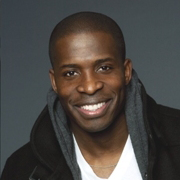
Neil deGrasse Tyson welcomes comedian Godfrey as first time co-host to take us through fan-submitted Cosmic Queries about cosmic phenomena. First up, Godfrey finally gets a chance to ask Neil about his relationship with Carl Sagan. Next, it’s time to talk about Einstein and tachyons: their ability to travel at the speed of light, how they live backwards in time, and the possibilities of sending tachyon text messages. Explore the passage of time and what timelines would look like from a higher dimension. Neil also contemplates meditation, and how humans might be a pathway for the universe to understand itself. Go beyond the event horizon to discuss Hawking radiation, and how much space might be inside of a black hole. Discover what alien civilizations might be seeing when they look at Earth, depending on where they are in the universe. You’ll also hear what Earth would look like if the moon were destroyed, and why Saturn would’ve looked different to the dinosaurs. Find out why early astronauts needed ice water in their veins, especially during moon landings. Pull back the curtain on the naming process of stars, planets, asteroids, moons – did you know we once had a Planet George? All this plus Neil avoids falling for a classic joke and tackles questions in the Lightning Round ranging from “How does life come from non-life?” to “If the universe were finite, what would we see at the edge?”
Transcript
DOWNLOAD SRT
Welcome to StarTalk, your place in the universe where science and pop culture collide. StarTalk begins right now. This is StarTalk. I'm your host, Neil deGrasse Tyson, your personal astrophysicist. Today, we're doing a fan favorite edition of Cosmic Queries....
Welcome to StarTalk, your place in the universe where science and pop culture collide.
StarTalk begins right now.
This is StarTalk.
I'm your host, Neil deGrasse Tyson, your personal astrophysicist.
Today, we're doing a fan favorite edition of Cosmic Queries.
And I got with me, I've never had him before, Godfrey.
Godfrey.
Godfrey tweeting at Godfrey Comedian.
Godfrey Comedian.
You didn't use your last name, Danchimah.
Danchimah.
Danchimah.
Okay, that's fine.
We don't have to go.
It's too long.
Too long, too weird.
Too weird, it can sound Japanese sometimes.
Danchimah.
The bathroom's two doors down on the left.
If I'm Cosmopain, I use my last name.
We get an email with sending it to you on that one.
When I need an extra push, I go, Danchimah.
Okay.
That was not one of the Cosmic Queries.
But if we start out with scat jokes at the beginning, there's no place to go after that.
Anyhow, it's cool having you on, man.
Thanks.
Listen, I've been watching your shows.
I see you on Bill Marshall, Real Time.
I got a hot air on though.
I just try to put the air on.
But you know how, you step in, you say a little thing, let the scientist talk, bam.
I'm like, I'm proud of that man right there.
That's right, he's articulate and smart.
Thank you, I got a fan out there.
And you're Cosmos, it's awesome because I used to watch Cosmos with my dad, with Carl Sagan.
Oh yeah.
He took over the reins.
And then when I saw you, a 14 year old kid, you met, Carl Sagan, he gave you his number.
His phone number.
So I had people say to me, I should have told him that the bus really couldn't come through and I had to spend the night in Cornell because he gave me the phone number in case the bus back to the city didn't happen.
Unbelievable, unbelievable.
No, but I was too honest back then.
You were too honest, oh my, was he the nicest dude ever?
He was very polite and very, it was almost, he cared.
I mean, that's really it.
He cared about the trajectory of others who would come behind him.
Not enough people do that in all the professions one-
Oh, it's called comedy, yeah.
All my friends suck.
Hey man, can you tweet for me?
I don't know, might take my followers.
Yeah, that crap.
But Carl was like, wow.
He was a genuine person.
Man, he could have at least given you his turtleneck and his jacket too.
Just his elbow patches.
His elbow patches were awesome.
And you said, because we were talking before we started the show, and I thought that he was a guy that said billions and billions of stars.
He only said the word once at any time.
And Johnny Carson.
Johnny Carson was the one who doubled up on him.
Imitating him with-
No, I can do Johnny Carson, right?
All right, let me hear.
Okay, watch.
I did not know that.
Wow, good stuff.
Carl Sagan.
Here I go, watch this.
Wow, billions and billions.
And then Ed would go, ho, ho, ho.
No, no?
Can I get some Johnny Carson fan love?
Okay, for everyone over 60, that was Johnny Carson's imitation.
You know there's a 60-year-old man going, I like that boy.
That boy does Johnny Carson.
Okay, go ahead.
So we got some, this is a Cosmic Queries edition on Cosmic Phenomena.
I haven't seen the questions before.
Called from our fan base.
And so you got them.
You have the steering wheel.
Yes, I do.
So let's bring it on.
Okay.
I'm gonna read one from a Patreon.
Patreon, these are, oh, yes.
So these are people who support the show.
And so basically they extort the power setup to get their questions asked first.
Yo, I thought the Patreon was a name, like an alien name.
Oh no, oh, the Patreons.
Because you guys are Cosmos.
So I thought it was like-
The Klingons, the Patreons.
I thought they were like, I am a Patreon, my name is.
This guy's name, it's a little annoying.
Okay, well.
Kyle, why'd you have to spell your name like C-Y-L-E?
So it looks like Syle, but it's Kyle.
Trying to be individual, that's all.
Trying to be special, you know, like when Christina, it's with a the and a K, it's all K.
Okay, here's a Patreon, Kyle Yokum, he's from Tennessee.
All right.
So I think I'm gonna use an accent for this one.
That's Texas more than Tennessee.
Well, okay, what's this now?
That's, uh.
Exactly.
As long as you don't know where it is.
I don't like how you specify my name.
Oh, I spent some time in the cell.
I got some.
Okay, all right, here we go.
How's that one?
That's Ranch, Texas.
Okay, Tennessee, I'm from Tennessee.
Yeah, there we go.
I'm from Tennessee.
Okay, here we go.
Kyle Yocum, here's the question, all right, ready?
Here we go.
Okay, the math of Einstein's equation shows nothing can reach the speed of light if it has mass.
But if we discovered a mass less particle that could be accelerated beyond light speed and travel backwards in time, the instant it did, would it begin to decelerate again since acceleration required forward movement in time and going backwards in time would be the reverse?
If so, it seems it would just be stuck at exactly light speed.
Could this be why photons are always traveling at that.
Wow, that was a lot.
It seemed like he was repeating something that was obvious.
No, but obvious to whom too?
It's almost like he said, the instant it did, would it begin to decelerate?
That's almost like a common sense.
Okay, so the way it works on the other side, would you cross over Einstein's equations?
Anything with mass cannot accelerate to reach the speed of light.
It's never been seen, nor is it theoretically possible.
We've tried it.
We have experimental evidence, theoretical foundation, and the like.
Things that travel the speed of light have no mass at all, like photons, which he correctly noted.
My academic brethren hypothesized a particle that lives faster than light.
It doesn't have the problem of accelerating to the speed of light, because it just lives faster than the speed of light.
If you have such a particle, what would happen to it?
It would live backwards in time.
We call this particle tachyons, from the Greek tachyos meaning fast.
The tachometer is the same root.
That would be like Usain Bolt, a tachyon athlete.
Tachyathlete.
Tachyathlete.
Tachyathlete.
We finally got it.
Tachyathlete.
The word tachy is a common root when people want to refer to things going fast, where speed is the measure of things.
We hypothesized that there might be a particle called tachyons.
Tachyons are really cool if you think about it.
Because if I sent it to you now, you would have gotten it before I sent it.
That's kind of cool.
You can imagine.
I've thought about this.
Here's an interesting scenario if you could text via tachyons.
What?
I see you walk.
There's a banana peel in your path.
I don't want you to trip on it.
Okay.
But you already tripped on it.
I send you a tachyon message that you get in the past.
Right.
You got that with me.
Yeah.
So I send you a tachyon and I say, watch out for the banana peel.
I'm already on the ground.
And then your smartphone jiggles, right?
You pick it up.
Yeah.
Read the tachyon.
And then you're no longer looking where you're stepping.
Right.
And you slip on the banana peel.
Well, that depends on your phone package.
I mean, if you got sprint.
So, it may be that changing the past might not be possible because the very act of me trying to interfere with you stepping on the banana peel is what actually made you step on the banana peel.
You were not paying attention to the banana peel because you were reading the text that I sent you to not step on the banana peel.
So, are you saying that is it true that everything happens at the same time?
Well, so there's another way to think about that.
So, if you have like a yardstick, you can say all the numbers are on that yardstick at the same time.
They're all just there.
You can be 8 inches, 30 inches, they're just there.
So imagine a timeline that's just there.
You're born on one end, you die on the other end.
It's just there.
Wherever you could jump in, jump out, join yourself at any part of your lifetime.
So therefore, in a sense, your timeline, when viewed from a higher dimension, is all happening at the same time.
Deep.
I think I kind of got there.
This is tacky on thinking.
Yes, it's tacky on thinking.
You want to tacky on brain, this is how you do it.
I already thought about it yesterday.
I already thought about it.
Except the timeline has to be thought of in the higher dimension that allows you to see the entire timeline all at once.
That's the only point.
In our current dimensionality, we are prisoners of the present.
Forever transitioning between our inaccessible past and our inaccessible future.
Okay, then we just live in the present.
That's what it is.
That's all we can do.
All we can do, but a higher dimension being would say, hey, just rejoin.
Who would that be, Buddha?
Not from any images I've seen illustrating him.
What higher energy?
There's a higher dimensional being.
And who would that be, though?
This is what I want to know.
We're talking from a human perspective.
Now, who's this higher being?
It'd have to be maybe the Dalai Lama if he meditates to a certain point.
Okay, so if you meditate, but what I wonder is if meditation is happening interior to your brain and not objectively verifiable by others outside of your brain, so if your mind experiences it, then you go back in time in your mind, sure.
But we're talking about a physical reality, not a neurological reality.
And meditation is all about your neurological reality.
Okay, but don't you need, isn't mind and body the same thing or no?
No, because we can pith your brain and your body.
The things we can do to your mind and your body is still there.
That's true.
I can take out this part of your brain and you can't speak.
This other part of your brain, you can't recognize faces.
This other part of your brain, you lose your appetite.
I can do, we know enough about the brain to know how to, what the causes and effects are.
Let me tell you something.
Here's the reason why we don't know a lot about the brain.
You want me to tell you why?
You got this.
You got this.
I got this.
I got this.
What is it?
The reason why we don't know, we still have mysteries about the brain is because we're using the brain to try to think about it.
So why would the brain give you that secret?
The brain's like, I'm not going to give you all my stuff.
So you're asking a very deep question.
And the mind understands itself.
We don't know.
And guess what?
What you just thought about, the mind gave you.
So as I think about it, we are assemblies of atoms and molecules in this universe that the universe itself created.
And we're on a mission to decode and understand the very operations of the universe itself.
So as has been said before, we, in a way, are a pathway for the universe to figure itself out.
That's heavy.
So the fact that we can even approximate some of what is real in the universe gives me hope that our mind can figure out our mind.
I think there would have to be something outside the mind to figure out the mind.
Probably to do it best, for sure.
You have to.
Right now we're kind of grogging along.
It's like an unborn child deducing the nature of its mother.
You can't do it because you're inside.
Exactly.
No idea what your mama looks like.
Unless you have one of these mirrors that you can stick out.
Wow, that would be scary.
You have like an alien vagina?
Jesus.
Sorry, vagina is a proper word.
It's scientifically proper.
If a hand came out to look at it, oh, goodness.
So here you go.
So on the other side of the speed of light, all the properties of tachyons include, last I had checked up on them, that it would take an infinite amount of energy to slow them down to the speed of light.
And they're capable of infinite speeds.
So that's what, so if you want to take Einstein's equations and flip them to the other side, knowing you can't pass through the speed of light, these are the properties of what's going on.
That's heavy.
That's fast.
What is it, 186,000 miles per second?
282 miles per second.
Wow, was that pretty good?
That's very good.
Godfrey!
I got a number right.
Three significant figures in the speed of light.
Let's go, let's go.
That was a good one, Yolkum.
That just took most of this segment.
How about this one?
This is pretty simple.
A radio farmer from Facebook.
How much space is there inside a black hole?
Well, okay, so you can measure the volume of the event horizon of the black hole.
One of the most poetic terms ever.
Given what it does to you as you go out this one way, you don't come back.
This is the zone within which there is no return.
The event horizon.
The event horizon.
The event horizon.
And now, after hours, the event horizon.
One man in a world.
In a world.
The event horizon.
Starring Samuel Jackson.
Yo, where's that black hole, man?
Of course, it needs Samuel Jackson.
I don't know.
I can't see a damn thing.
So, you can measure the volume of the event horizon very cleanly.
But.
But.
For reasons that remain a little bit mysterious to me, when you run the equations, Einstein's equations of what happens inside of a black hole, it births an entire other space time.
An entire other universe.
So, if you can survive the fall into a black hole, what you will see is the entire future history of the universe you came from unfold before your very eyes.
Because time slows down for you and everything else would look like it's moving fast.
And the entire future history of your universe unfolds before your very eyes and another universe opens up in front of you.
So that the black hole as a portal to an entire other what we call space-time continuum the entire other universe.
That comes out of Einstein's equations.
The same equations that give us the structure of our universe.
So no one has gone in to test this because you're coming back out.
But everything else about his equations work so it gives us high confidence that maybe this is happening there too.
That's why we talk about there's some variance of multiverse thinking where every black hole is just a conduit to a whole other universe.
You think it's a whole other universe?
We have this interconnected warren.
Isn't it just stars being swallowed up?
It'll swallow stars.
And it becomes more math, yeah.
It never planets though.
It'll swallow anything that comes near it.
It comes near it.
Anything.
And nothing comes back.
Well, there's a way.
We don't know.
There's something called Hawking radiation.
Hawking radiation.
Yeah, Hawking radiation.
So Hawking, Stephen Hawking.
Stephen Hawking.
He's famous, legitimately famous for a whole lot of reasons.
One of them was he calculated that the energy field surrounding the black hole, you remember E equals MC squared?
That's the equivalence of mass and energy?
Yes.
That energy field can spontaneously create particles, right?
Particle pairs, matter and antimatter pairs, one of which falls back into the black hole, the other escapes into space.
Okay.
So, a black hole can essentially evaporate very slowly, particle by particle, evaporate by this phenomenon so that it can lose mass through its energy field because mass and energy are one and the same.
Right.
And so, this is called Hawking radiation.
So, yes, do come out but in a very different state than you went in.
We got to take a break when we come back with more Cosmic Queries with Godfrey on Cosmic Queries.
We are back on StarTalk, Cosmic Queries edition.
And I got Godfrey here.
Hey, man.
What's up?
Godfrey tweeting at Godfrey Comedian.
Yes, that's right.
That's a lot of characters to give up to your Twitter handle.
Is it?
Godfrey Comedian.
It's the only way.
That's the only way.
I wanted to be as-
You can shorten it and just say God.
No.
I cannot do that.
No, shall not do that.
I would say, well, lowercase G.
Because people will come up to me and go, oh, do they, and they do it like in an air going, do they call you God for sure?
You know what I mean?
I'm like, yes, they do.
Yes.
Yes, they do.
And you're a sinner.
Yes.
Are you ready?
So these are Cosmic Phenomena.
I haven't seen the question, so bring them on.
Bring them on.
So I'm bringing you, let's see what I'm bringing you.
Let's see what you got.
I'll see what I got here.
Joshua Shoop from Twitter.
Aliens are so far away, they can see our entire history as it's happening.
Is that why they don't want to come here?
Yes.
Well, just let me clarify why that would be the case.
If you are at any distance from anything you're looking at, you see it not as it is, but as it once was.
I see you not as you are, but as you were four billionths of a second ago.
Whoa.
So, light takes about a nanosecond to go a foot.
A nanosecond to go a foot, wow.
A billionth of a second.
So, you're about four feet from me right now, I see you as you once were, four billionths of a second ago.
So now, let's put a civilization in Alpha Centauri, the nearest star system to ours, that's four light years away.
You're four light nanoseconds away from me.
Alpha Centauri is four light years away, so anybody there is watching, if they were, could get our signals, they would be seeing Earth, what was going on four years ago, there was another campaign for president, Obama was smashing that dummy, what's that dummy's name?
Oh, that Mormon guy, Mitt Romney, Mitt Romney, you could see him getting pummeled, so he loses, so they would be watching the last few weeks of that campaign, in real time, in real time, as it was unfolding, because the light is just arriving at them at the time.
Wow.
Okay, so now, if you go farther, so there you go, there are galaxies that might be, there is one, 65 million light years away.
Why did I pick that number?
The stuff that was happening here on Earth 65 million years ago is only now just reaching them.
It's just reaching them?
Just reaching them.
So they're going to say, hey, let's check out Earth TV, the Earth's channel.
I'm sure that's what they sounded like.
So they would see the extinction of the dinosaurs, because that's when the asteroid struck.
Meteor.
The meteor struck.
The size of Mount Everest.
That's what they would be seeing.
They would watch that in real time.
So there's a lot of interesting history on Earth that shouldn't preclude alien visitation.
At least maybe they visited the dinosaurs.
Then you could ask, why didn't they help them out, if they were really checking?
I was thinking they wouldn't come because of Trump.
No, nothing.
You did.
But Trump is a very recent phenomena that has not had enough time to reach any planets beyond our own solar system.
Can you imagine?
So there's no understanding of recent current events to any aliens anywhere in the galaxy.
I don't want to Trump you, but I go wrong.
That's what he did the whole time.
Wrong.
Wrong.
So that's interesting.
You would actually see the dying of the dinosaur, the extinction of the dinosaurs.
Yeah.
That is cool.
So they would have access depending on their distance.
Okay.
They would have access.
So what are some events?
So let's say, well, it's a good example, World War I and World War II, pretty tragic times in the history of the earth 70, 80, 100 years ago.
They might say these people have messed up.
Right.
Right.
And say when we will not come anywhere near.
This is the, in summary, aliens have never visited because according to them, there's no sign of intelligent life on earth.
There it is.
All right.
I have another question.
Cosmic Phenomena.
Bring it on.
This is by William Morris.
Facebook.
What's a henway?
About two to three pounds.
Next.
You can't.
You can't.
What do you think?
I was born yesterday.
I just wanted to see that.
What's a henway?
There's no science behind that, huh?
That's it.
Next.
That's it.
What's a henway?
We should call the first warp drive a henway, so that wherever they land, they say, we got to fix the henway.
We got to fix the henway.
What's a henway?
You could run that joke clear across the galaxy.
That was awesome.
What a jackass.
Well, this is in...
I'm old enough to remember F-Troop.
F-Troop.
That's Larry Storch.
Larry Storch.
And what was it?
But it was like the cavalry and the Indians in the Wild West.
And the name of the tribe were the Hakawai Indians.
The Hakawai?
The Hakawai.
And I think in the first episode...
You remember the first episode of F-Troop.
So I think...
Am I remembering?
I think I'm remembering this correctly.
In the first episode, the cavalry meets this tribe.
And they say, who are you guys?
And the Indians say, where the heck are we?
That's hilarious.
The Indians say that.
They say, no, they didn't know where they are because they got lost.
The Indians did.
They got lost.
They say, where the heck are we?
And they say, oh, you're the Hakawai...
No, who are you?
Where the heck are we?
They say, we're the Hakawai Indians.
I think that's how that happened in the very first episode.
The Hakawai Indians.
Yes.
I just caught that again.
I'm telling you, I'm eight years away.
The Hakawai Indians.
I took you a full 12 seconds.
I was like, the Hakawai, because the way you said it.
Because that's how they said it all the rest of the episodes.
But it's F-troop.
It was sitcom.
It's a sitcom, man.
So that's good.
What's the Henway?
You knocked that out.
So if I invent the warp drive, it's the Henway warp drive.
Henway warp drive.
I like that.
Wait, how do you, hens?
Yeah.
Hens?
Hens are the...
That sounds better.
Okay.
Here we go.
Ray Clark, Facebook.
If the moon were to somehow be blown apart, would Earth end up with a set of Saturn-like rings?
If not, what would happen?
Yes.
Yes.
Temporarily, we would have rings system.
Awesome.
Awesome.
Yes.
Using awesome the way God intended awesome to be used.
Oh, yeah.
Not, it would be awesome if you could pass the salt.
No, no.
In my day, we used awesome when we discovered the cure to polio.
We used awesome when we walked on the freaking moon.
Do you believe that?
I don't know.
We were talking about that.
Do you believe that they landed?
I just want to know.
You're asking the wrong...
The astronauts should have been black because we would have been more excited.
Upon landing?
Yes.
Houston, we have just landed on the moon.
Yeah, baby.
That's how we do, baby.
Forget the cosmonauts.
We did it first, baby.
I'd be like this.
No?
That's one small step for a man.
You land on the moon, you go, one small step for a man, one giant step for a man.
It's like when the white dudes score a touchdown, they just give the ball to the ref.
When we score, we're like, yeah.
Shake something.
Shake something.
No, here's the thing.
Here's the thing.
Here's the thing.
I think the emotions that would come about among people who would rejoice in having just landed on the moon are incommensurate with how you might react in the face of disaster if you face that on your journey.
If the oxygen tank blows, holy shit, what am I going to do, oh my God.
That's the same person who lands on the moon.
Oh my gosh, I landed on the moon.
So you need some, you need people with ice in their veins.
Yeah.
And Neil Armstrong was just such a person.
Yeah.
Well, all right.
I guess, but I just.
He's landed on the moon and he's running out of fuel.
Okay.
Do you know about, I don't know if you knew about this.
We're running out of fuel.
He was, because where they were going to land, he's, there was like rocky and it was not smooth and he was worried that the lunar excursion module would tip.
He starts going sideways.
Okay.
And he's losing very little fuel that's left.
And so Houston is saying, you got to land that puppy.
No, I'm going to still look and he's monitoring how much it is.
You know, his heartbeat was when it was like 85 or so.
I mean, it was some low heartbeat.
Any of us get just when we're irritated that we're waiting in line or something.
So no, these were very special set of the right stuff.
Okay.
It was truly the right stuff.
How long did it take to get there?
Three days.
It was three days.
Three days.
In the ship.
Yeah.
Well, how...
Drinking Tang.
I'm just saying, drinking Tang and sitting there.
Three days.
Yeah.
Three days.
Three days.
Okay.
All right.
I'm glad you explained it to me because I was doubting it.
Yeah.
No.
Oh, oh.
You asked me if I believe it.
One doesn't need to believe when confronted with evidence.
That's all.
Oh, that's deep.
Wow.
I should tweet that, shouldn't I?
Yeah, you should tweet it.
You should tweet it.
July 21st, my birthday.
So, it would always show the anniversary of the landing.
They would show, you know, landing on the moon the day before that.
Well, July 21st was the date of the newspapers that reported it.
Right.
That's my birthday.
July 20th is the big deal.
Yeah, it's the big deal.
Okay.
So, the big deal, Neil.
Hey, you're Neil Day!
A lot of Neils.
We're both Neils.
We're both Neils.
Okay.
So, boom.
Did I even answer that question?
What was it?
What was the question?
It was that would the Earth end up with rings?
Oh, yeah, we would end up with rings, but the particles are not stable.
Why?
Because they'd be hitting one another, and they'd be falling, and they have energy from the explosion.
Some would escape, others would come back to Earth, so...
We wouldn't have like our own little rings like Saturn?
Saturn's ring system is in fact not stable.
It's not stable.
No, no, no.
It's a temporary feature.
In fact, there's good evidence to suggest that the dinosaurs, if they had telescopes, had they looked at Saturn, would see no rings at all.
Why is that?
Because the ring system, different calculations give different numbers, but millions of years is a common number that I've seen for the life expectancy of the ring system of Saturn, which meant they would have been long, they would not have formed yet at the time of the dinosaurs.
So stuff, you know, things collide, stuff happens.
Stuff happens just because it didn't happen in your lifetime, doesn't mean it's not happening in the universe.
So yeah, if Earth would have a beautiful ring, it would be beautiful.
You think it would be better than Saturn's?
Saturn used to be my favorite planet.
It's my favorite planet.
Oh, Saturn's a tough competition.
Yeah.
No, because Saturn's big.
Saturn's big.
Give me some big rings.
Big rings, big rings.
Yeah, yeah.
Is that, you good?
You good on that?
We're good.
We're good.
I got another one.
All right.
Okay, here we go.
By the way, by the way, tides would be greatly reduced at that point.
That's true.
Right.
Because there would be a whole lot of other things would change about Earth.
Women wouldn't be so moody.
It's right.
It's the period, right?
We're sending you all the mail.
Yeah.
It affects, doesn't it affect, yeah, wouldn't it affect the menstrual cycle every 28 days?
No, because the phase of the moon is not 28 days.
Oh, wait, oh, what is it?
Yeah.
Waxing and waiting.
What is it?
Yeah, waxing and waiting is 29 and a half days.
Okay.
It does not match the average menstrual cycle of women.
Okay.
Therefore, you cannot credit or blame the moon for any periodicities in the human female.
Consider also that there are plenty of other mammals whose menstrual cycles are very different from a month.
They're mammals too.
What other mammals?
Well, I'm not an expert on this.
Dolphins, right?
Isn't it dolphins?
I'm just saying that mice, just look at your mammal list.
Mice?
I'll just look at any New York apartment for the mice.
There's nothing magical about a month.
Nothing magical about a month relative to menstrual cycles.
That's all I'm saying.
I thought that, you know.
I thought I was on this.
If it's not an exact match, that means they go out of phase yearly.
So this is not a thing.
All right.
I like that.
We can send him all the mail right there.
We get on this.
Would it affect all our moods though?
Because they say the moon, when it's full moon, it's affecting our moods.
Okay, if you live in a city, I don't know how you can justify that given the fact that at night street lamps are brighter than the full moon.
True.
And you don't talk about your moods being affected by street lights or what brand of bulb is used.
Quartisol levels are up.
Sure.
But you can't credit or blame the moon for that.
It's because we illuminate our nighttime lives.
That's true.
That's true.
You're right.
Are brighter than the full moon.
You know how you know this?
You can only barely read under a full moon.
So you come in at night, you put on brighter lights and you can read just fine.
That's true.
So people want to blame the universe for all kinds of stuff that's happening in their lives?
No.
It's just you.
It's just you.
You're high and you're crazy.
Blame it on your ass.
And Shakespeare in Julius Caesar.
Right.
The fault, dear Brutus, lies not in the stars, but in ourselves.
Tweet, man.
That's man, Neil deGrasse Tyson, boy.
I like that one.
Can we, another one?
All right.
Well, if it's fast.
I love this because I'm always a fan of this, but this is Dan Fisher, Facebook.
If comets eject their gases into space, do we know of any dried up comets, the ones that exhausted all of their gas reserves?
Yes.
Nice question.
Yes.
So, comets are a mixture of ice and rock, and the ice, when it comes near the sun, gets heated and then it evaporates, or technically speaking, it sublimes when you go directly from a solid to a gaseous state.
I'm loose in my vocabulary, then I just say it evaporates.
But sublimation is the correct chemical term.
You've seen sublimation with dry ice?
Yes.
You ever see dry ice?
It doesn't melt.
It's solid, and then it's not there anymore.
It all, it's over.
So with comets, every time it comes around the sun, it loses some of its ice.
And eventually, you can have a comet that's just a ball of debris moving around the sun and it's no longer a comet.
It's just a ball of debris.
And we'll just call it an asteroid at that point.
And there are many asteroids, there are many asteroids we think were once comets that are just dead right now.
I mean, they're living asteroids, but they're dead comets.
Like retired comets?
That's a better word.
They're like, I don't do that thing.
Oh, man.
Now, I'll make you young boys go around and around.
I used to be, and then the other comets say, used to be the man at one time.
Halley's Comet, what's happening, brother?
Yeah, you can slap him as he goes by.
76.1 years.
Is that the truth about Halley's Comet?
86.1 years it comes?
It's time around the sun varies depending on what Jupiter does to it.
Okay.
It could be 74 years, 77.
It averages 70.
So you believe that Mark Twain was born and died in Halley's Comet when it came in return?
We don't have to believe it.
It's a fact.
It's a fact.
And when things are facts, you don't have to believe your human belief system to accept them.
You said Jupiter.
Remember the Jupiter effect?
Remember that?
That big deal?
That's another segment.
When we come back.
That's another segment.
The man is on fire.
He's lit up.
I'm like a comet, man.
You can't get enough.
He wants more.
When StarTalk returns, more Cosmic Queries.
This is still StarTalk.
I'm your host, Neil deGrasse Tyson.
I serve as the director of the Hayden Planetarium in New York City, and yeah, it means I have the keys to the sky.
I wanna go.
Wanna go?
I'll invite you.
Come on, man.
Let's go now.
I'm gonna go now.
Godfrey, you've got a comedy special on Showtime.
Yes.
What's it called, what's it called?
It's called Regular Black.
Uh-oh, all right, here we go.
The reason why I call it Regular Black because growing up in Chicago, my African-American friends, they heard my parents talking.
Okay.
And my parents had thick accents.
Thick Nigerian accents.
Oh yeah, and they were like, yo man, where are your parents from?
I said, oh, I'm Nigerian.
They were like, oh, we thought you were like Regular Black.
Like, we're Regular Black.
You know, like we from Mississippi, Kentucky, we thought you were Regular Black.
No, but what you should have said was I am African American.
That would have been, oh, come on, raise back there.
That would have totally, that just, nothing they can say.
Nothing.
There it is.
That's where that title comes from.
Yeah, so Cosmic Queries, Cosmic Phenomenon.
All right, what do you have?
Go.
The controversies of naming celestial bodies.
What's the controversy?
What's the controversy?
It's Rick Roberts asking.
No, there's no controversy.
There are no controversies.
Next question.
Like, do they matter?
You ready?
Okay, so planets are named for Roman gods.
Okay.
Asteroids were formerly named also for Roman gods when people thought they were planets.
Okay.
Then after the first few dozen asteroids were discovered in the asteroid belt, they said, these aren't planets, these are something else.
We need another word for them.
And even though on the sky, they kind of look like a star because they're little and you can't see like a surface on them because they're so little.
There's like a point of light.
So they're kind of star-like.
But they're not stars, they're asteroid.
Star-like.
Star?
I didn't know that.
You didn't know that.
That's why you come on.
That's why we do this.
So what would hemorrhoid be?
That's, they're out near Uranus.
The astral light?
Yeah.
Find the hemorrhoids near Uranus.
I like that.
What?
Neil deGrasse is quick, baby.
He's a tackian.
He's a tackian comedian.
You said near Uranus.
That was perfect.
I'm just trying to, I know my universe.
You said hemorrhoid that's ass-like.
Near Uranus.
You just did a whole booty joke.
Scientifically.
That justifies the booty joke.
We've got science in there, science vocabulary.
Okay, that was-
Okay, so asteroid.
So then when too many of those got discovered, then we just gave up.
And they're named after any person, place or thing.
So there's a, oh, initially they were named after feminized things and objects.
So there's an asteroid, Mozart, Mozartia.
Mozartia?
Yeah, that's to feminize it because the asteroids are only named after feminine, the original asteroids are named after feminine gods.
What?
Roman gods.
Okay.
So now then they just gave up because there's too many asteroids.
So, because there's hundreds of thousands of asteroids.
And so, so I even haven't, there's an asteroid named after me called Tyson.
No.
Not Mike Tyson?
I said it's named after me.
So why would it be named after Mike Tyson?
I don't know.
I made an asteroid.
Oh, you're saying there's an asteroid named Tyson and I'm claiming that it's named after me.
Wondering if it's named after Tyson Chickens, Tyson Beckford.
That would be a handsome asteroid.
That's a handsome asteroid.
That would be chocolate black.
Ooh, it's sexual chocolate.
Sexual chocolate asteroid.
If I do it like a, sorry.
Sexual chocolate.
There's asteroids named after person, places, things, and pets.
Okay?
There's even one named after Santa.
All right, so asteroids have the most diversity in what they have been named.
Because there's so many of them.
There's so many of them, thank you.
Just run out of all the gods there ever was.
All right, so moons of planets.
Like Jupiter.
Any moon of any planet.
Is named after the Greek gods that played a role in the life of the Greek counterpart to the Roman god after whom the planet is named.
So Jupiter has one of its moons is Ganymede.
Ganymede was the man servant of Zeus.
And Zeus is the counterpart to Jupiter.
So these two nomenclatures are homage to the Roman and Greek traditions that have influenced Western science.
What about I?
The growth of Western science.
I was a character in Jupiter's lie.
I don't remember all they were, all they were, but they're there.
You look them up, they're there.
Okay, that's right.
Now, there's more to this answer than I think either you knew, right?
Yeah.
Okay, so now, okay, so you got that.
So it turns out Herschel, William Herschel, was the first person to discover a planet.
The first person.
This is the planet beyond Saturn.
For most of human civilization, there was only Mercury, Venus, Earth, Mars, Jupiter, Saturn, six planets.
In fact, most of the time, there were only five because we didn't know Earth was one of them.
Ah.
It was just Mercury, Venus, Mars, Jupiter, and Saturn.
Okay.
Okay?
So Mercury, Venus, Mars, Jupiter, five plus the sun and the moon were counted as planets, planets from the Greek meaning wanderer, which means you move if you wait long enough against the background stars.
And there were seven wanderers that were known to the ancients.
And this is where we get the names for the seven days of the week.
So what day is named after the sun?
Sunday.
After the moon?
Monday?
Monday.
And in our culture, it's a mixture of Roman and Norse mythologies, but each of those gods corresponds with the controlling god over those seven entities.
Okay.
So then Copernicus comes around, discovers that we're one of these planets, because we go around the sun like everybody else, and we're not in the center with everything going around us.
So they're complicated things, just so you know.
Right.
We have the coolest name, though, out of all of them.
Nicholas Copernicus.
Nicholas Copernicus.
That's the tightest name.
Not Galileo Galilei?
Galileo Galilei looks lazy.
That looks lazy.
Okay, because it's the same thing.
Copernicus.
Nicholas.
No, Copernicus.
That's a rhyme waiting to happen.
It's a rap having to rap.
Everything surrounds me, baby.
Copernicus, baby.
What's up, Cap?
I'm...
Keep working on that and come back.
We'll hear how that...
Kepler.
Kepler's tight.
Johannes Kepler.
Ooh, that's hot.
He's badass.
He was the first person ever write down an equation that described physical reality.
He wrote Kepler's Laws of Planetary Motion.
That was in early 1600s.
So we've only had mathematics describing the universe for 400 years, and he basically birthed that.
So getting back to the names.
So, because Herschel was the first to discover a planet, no one had a tradition of naming planets yet, because they hadn't been discovered yet.
Everyone knew these things in the sky, so there was no tradition yet.
So he just named it after his principal funder, which was King George.
So for many decades, the enumeration of the planets of the solar system was Mercury, Venus, Earth, Mars, Jupiter, Saturn and George.
George?
Yes, planet George.
Wow.
So, now that's kind of...
That's so me, that's so gangster.
That's gangster.
Name it George, I gave you the money.
Don't try it, I want to be a planet.
This didn't last, internationally it didn't last, but they had to like be nice to the Brits, because they discovered it, all right, so as a recompense, the moons of Uranus rather than, this is the only exception, rather than being named for Greek characters in the life of the Greek counterpart to the Roman god after whom the planet is named, Uranus' moons are named after fictional characters in Shakespearean literature.
Oh, okay.
So that's homage to...
There might be one, I don't know, there's like 60...
Othello.
Can I get an Othello?
Well, go check on that.
We've got Miranda, Puck, Oberon, there are a lot from A Midsummer Night's Dream.
Okay, okay.
That's there.
Okay, and lastly, stars are no longer really named anymore.
Most of the stars that have names have Arabic names.
So the Arabic tradition is also preserved in the modern reckoning of the names of things.
And after a certain while, we just number them in a catalog.
Comets are named after the discoverers or people after whom the discoverer wants to name them.
But they're named after people, exclusively.
Okay, I know only Edmund Halley.
Yeah, Halley.
Halley's or Halley's?
It is Halley.
Halley is Bill Halley in the Comets.
Whoa, we got a rock tonight.
That messed with the proper pronunciation of Edmund Halley for decades.
Sure was a shake, a rattling roll.
Around the sun.
We got to go lightning round.
Three minutes left.
Okay, lightning round.
Boom, boom, boom.
Do it.
Okay.
These questions are too long.
This is Petey J.
Kregel.
Here's a shorty.
How does life come from non-life?
Oh, sorry.
We have no idea.
That is a biological frontier.
How do you go from organic molecules to self-replicating life?
That is a fascinating frontier in biology.
And we look forward to the solution of that in the coming years.
Next.
Here is Rafael Alves.
He's from Rio de Janeiro, Brazil.
How is it possible that the further we look into the observable universe, we see the cosmic microwave radiation, the oldest light in the universe, assuming that it comes from matter beyond our observable universe, doesn't it mean that the universe expanded faster than the speed of light after the Big Bang?
If the universe is roughly 13.75 billion years old, how could the oldest photons have traveled around 45 to 47 billion light years towards Earth?
How come our 13.75 billion year old universe is 93 billion light years across?
How is it possible?
Because the universe can, the fabric of the universe can expand faster than light.
There is no law of physics preventing that.
The speed of light limit is anything traveling within the space that is self-expanding.
That cannot travel faster than light.
The fabric of the universe itself can travel without a problem.
And yes, the early universe did expand faster than the speed of light itself.
This is not a contradiction.
Godfrey, we got time for one more.
Okay, give it to me.
Peter Murdock, is there any way to tell how large the universe is?
As more light reaches over time, we see more.
But if the universe was finite, could this stop happening?
And if so, what would that look like?
I love that question.
You know why?
Because I think about it all the time.
Because there's an expanding horizon.
It's a time horizon.
And in a billion years, we will see a billion light years more of this universe.
Because that's an extra billion years that that part of the universe had to reach us.
Because in other words, if we're only 13.8 billion years old, where's the light from something that's from 15 billion years away from us?
It hasn't had time to reach us yet.
Wait a billion years, net net comes in, you see that part of the universe.
Now, watch what happens.
If in 16 billion years age, nothing starts coming to us, that would mean the horizon has washed over the last bit of matter in the universe.
And there'll be no more cosmology left to be revealed.
Because, and that would be then the literal edge of all the matter in the universe.
Done.
Whoo.
That has not happened yet, which is why there is still something called cosmology, where we can look far out and see the birth of the universe itself.
Oh.
Godfrey, thanks for...
Thank you for...
Oh, this is...
My brain hurts.
Yeah.
You are no longer a Cosmic Queries virgin.
No, I'm not.
Welcome to the company.
No, I just got banged.
Big banged.
Godfrey, you're on Showtime.
I'm going to find you after I pay my bill for Showtime.
They're paying the bill for you.
The Cosmos is.
No.
I'm Neil deGrasse Tyson, your personal astrophysicist.
This has been StarTalk and Cosmic Queries edition.
See the full transcript



 Unlock with Patreon
 Become a Patron