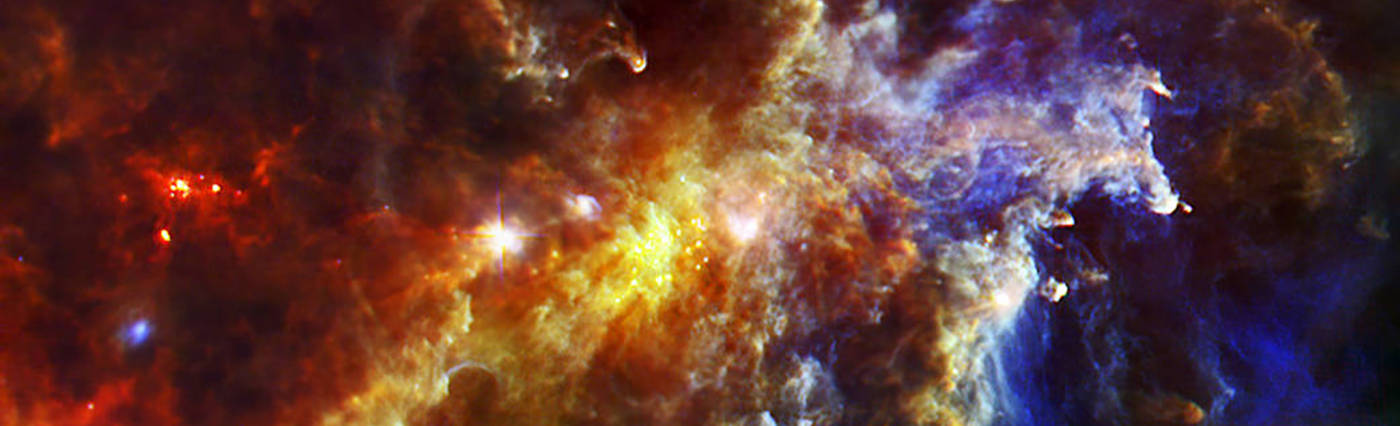
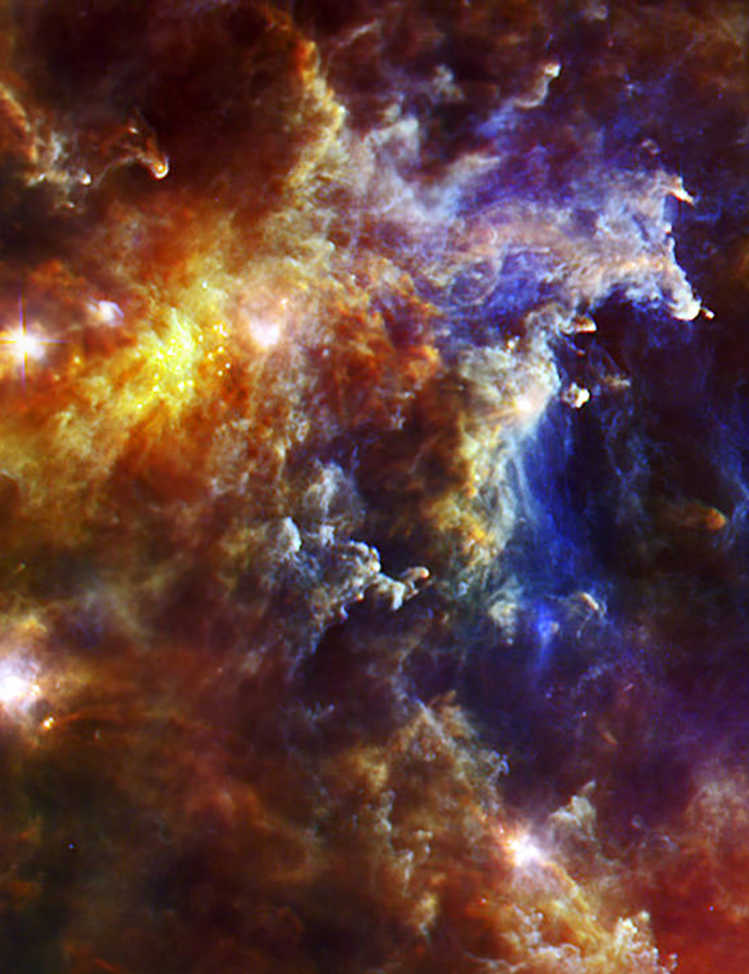
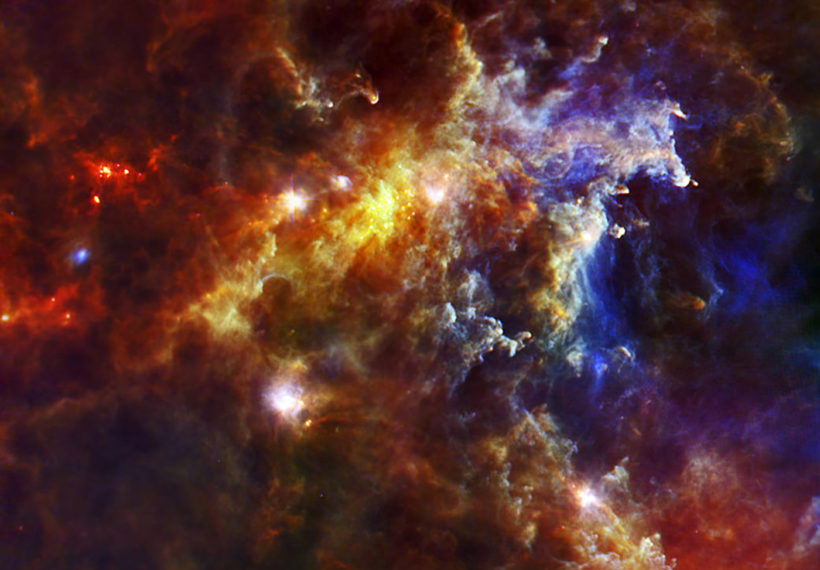

Dust clouds associated with the Rosette Nebula, a stellar nursery about 5,000 light-years from Earth in the Monoceros, or Unicorn, constellation, in an image from the ESA and the PACS, SPIRE & HSC consortia, F. Motte (AIM Saclay, CEA/IRFU - CNRS/INSU - U.ParisDidedrot) for the HOBYS key programme.

Cosmic Queries – Cosmic Conundrums

Shown: The Rosetta Nebula stellar nursery approx. 5,000 light years from Earth. Image Credit: ESA and the PACS, SPIRE & HSC consortia, F. Motte (AIM Saclay,CEA/IRFU - CNRS/INSU - U.ParisDidedrot) for the HOBYS key programme.
  • Free Audio
  • Ad-Free Audio
  • Video

About This Episode

On this episode of StarTalk Radio, Neil deGrasse Tyson and comic co-host Chuck Nice are answering your fan-submitted questions on everything from discovering extraterrestrial life to traveling through dimensions. Anything that you’ve cosmically wondered about, we are ready to answer. 

To start, Neil and Chuck ponder where they would pilot the USS Enterprise if they were sitting in the Captain’s chair. You’ll learn why Neil would take a tour of his own “backyard” before setting off anywhere else. We investigate how time works as you move closer and further from the edge of the universe. Neil tells us how to kill a black hole, and the answer may surprise you.

We discuss dark matter. You’ll hear why dark matter should really be called dark gravity. You’ll explore how we study dark matter even though it doesn’t interact electromagnetically. Then, we investigate the Higgs boson, the Higgs field, and the Large Hadron Collider. Neil shares a helpful metaphor to understand the Higgs boson that involves a Hollywood party, Chuck, and Beyoncé. 

Neil and Chuck debate which is more likely to happen – extraterrestrial contact or the ability to travel through the dimensions. You’ll learn more about higher dimensions and how they interact with the reality of other dimensions. We investigate the possibility of complex organisms existing in the liquid masses of our solar system, like on Enceladus or Europa. Neil gives us a lesson in thermodynamics in order to explain how life survives. 

Lastly, you’ll explore Low Earth orbit. Discover why people who live along the equator would weigh less than people living elsewhere. All that, plus, Neil explains how fast the Earth would have to be rotating for you to float.

Thanks to our Patrons Darrell R. Scott, Sand McDowall, Simon Kent, Daniel Chellew, Nathaniel Armstrong, Patrick OBrien, Evan Kelly, and Francois Fraser for supporting us this week.

NOTE: StarTalk+ Patrons and All-Access subscribers can watch or listen to this entire episode commercial-free.
Transcript

DOWNLOAD SRT
Welcome to StarTalk, your place in the universe where science and pop culture collide. StarTalk begins right now. Neil deGrasse Tyson here, your personal astrophysicist. This is Cosmic Queries edition. Cosmic Conundrums. Would sound like we couldn't fit them together...
Welcome to StarTalk, your place in the universe where science and pop culture collide. StarTalk begins right now. Neil deGrasse Tyson here, your personal astrophysicist. This is Cosmic Queries edition. Cosmic Conundrums. Would sound like we couldn't fit them together in one category. Better known as hodgepodge. Nice in the house. We are in the Coronaverse. Yes, we are. Well, of course, we always have our different inquiries gleaned from all over the internet. And as usual, we start... Wait, we're not bringing in another expert, so this means I have to know all the answers. Yes, you do. Yeah, we always start with a Patreon patron because you guys give us money. Thank you. Thank you, by the way. Thank you for your money. Isn't there a nicer way to say that? No, I just like being direct like that. It sounds cool. Thank you for your money, which is what I want to say on every birthday. And allow me to say that we're using the money to invent other incarnations of what it is we do, which are all in themselves experiments that we test. You battle test them, see if they work, refine them, and that takes money that we're not otherwise getting from sponsors. No, exactly. It keeps us vibrant. It does. The Patreon people don't even know. There's stuff that we've done because of you, which is cool. All right, let's go to Stacey Brown, who's our first Patreon patron, and she says, Dr. Tyson, if you were captain of the Starship Enterprise, where would you go first and why? And of course, we have to suspend disbelief and say that warp is real. So traveling at this beyond the speed of light is now a capability. So now that gives you the option to leave this galaxy, go anywhere you want in the observable universe. I would stick in my own galaxy because it's not enough we know about it. So let me just know my backyard first. All right. So I would take a tour around the galaxy, around the hood. Once around the block, James. Once around the block. Left to the solar system's own motion, that takes about 200 million years for one trip. And so, you know, that's still fast, given the scale of all of this. But the sun and all the planets and all the comets and all the asteroids and everybody is all moving around the galaxy together. Now there's something happened on the internet recently. Of course, if we are going around the sun, and the entire system is orbiting the galaxy, it means we don't complete a closed orbit around the sun. All orbits are corkscrews. Right, because the galaxy is also moving. Well, the solar system is moving. Right, so if you followed the path. So there was all this attention given to someone showing the video of this and saying, oh, this is a new theory of the solar system. Oh my gosh, did the experts know this? It's like, people, this is just two motions simultaneously. Okay, if you do this, you go your orbit. If you go that way, it's a straight line. If you do this and that, you get a helix. You get a corkscrew. It's like when you drop a ball on a plane. Oh, yeah. It goes straight down to you. But if I'm watching you, the ball actually went forward at 500 miles an hour. Exactly. Yeah, yeah. But so did you. So it just went straight down to you. Exactly. Right, right, right. So that's cool. Wait, wait. So I would do that, that's just to, but then I'd go straight to the center and observe the supermassive black hole dining upon stars that have come too close. Nice. That's what I would do. All right. Gonna watch the galaxy have a snack. There you go, Stacy. All right, let's go to another Patreon. Tony, Tony Mirabella. Wants to know this. That is a cool name. Tony Mirabella. He does sound like a Vegas act, right? That's kind of cool. Tonight only, Tony Mirabella. Welcome to the beautiful downtown Stardust Lounge here in Vegas. Ladies and gentlemen, it is my pleasure to bring to you the one, the only, Tony Mirabella. And he's singing before he comes out on stage. Well, that talks half. He's singing off stage first and he comes on. Exactly. Okay, he says, what do you think unlocking the secrets of dark matter could do for us scientifically? Would it lead us to being able to harness it? Those are two really big questions. How old is he? Is he some kid in a basement? Trying to figure something out. A future superhero nemesis in the making. He's making his own little universe or something. Can we harness this? We have no idea what dark matter is. I have my own preferences, but my preferences don't matter. What matters is what experiments are active and in progress. And right now, the going thinking is that it is a category of particle that simply doesn't interact with us electromagnetically. So electromagnetism is like light and magnetism and all the things that make atoms stick together as molecules. So you are held together by electromagnetic forces. And therapy twice a week. I don't have to hold you together, but physically, emotionally is another thing. I don't know what's holding you again emotionally. Physically you are held together by electromagnetic forces. This would be a category of particles that does not interact with our electromagnetic forces, which means they just pass right on through like you are not even there. So how do you observe something like that? Gravitationally. Okay, so the only reason why we know there is dark matter here is because we have some galaxies, but add up all the matter in those galaxies, it doesn't account for what's going on in this part of the neighborhood. Because you see galaxies from behind whose light gets lensed according to Einstein's general relativity. And you can ask how much mass does it take, how much gravity does it take to lens by that amount? And you come up with a number way bigger than simply counting the galaxies that are there. Something else is happening. So we call it dark matter, because we don't know what else to call it. Like I said, I've said many times, it's really dark gravity. It's literally dark gravity. We don't know if it's matter. The folks betting on it think it is matter, and there's a new kind of particle that we have yet to isolate. That's all. That is cool. So if we do isolate it, what would you do with it? You put it in your hand, no, it'll pass right through your hand, because it doesn't interact with your hand. So I don't know how you would contain it. How do you contain it? You would need a dark matter box. Who's going to make the dark matter box? It's a philosophical problem. It really is. If there's a thing that passes right through you, how do you contain the thing that passes through everything? Everything. So everything it passes through, you need to find something that can hold it. To hold the thing in. Correct. There you go. You need something that interacts not only with our forces, but also with its forces. That could be yet another frontier of discovery in the universe. What is that intermediary thing? If you were that civilization, you'd be badass. Oh my gosh. You control not only all the universe that we know about, but the rest of the universe that's influenced by dark matter. You'd be able to grab it, make dark matter planets out of it, if you could make it stick to itself. So, yeah, that would be a powerful posture to purvey. All right, so now take that and dark energy. Is that also in the question? Oh, no, that was... No, it's not in the question. I answered Vegas Act. You answered Tony Mirabella's question. I'll move on. Maybe it'll come up in a different question. You're like, don't push it, bro. All right, here we go. Eduardo Munoz from Facebook says... Eduardo. Eduardo. Hello, my name is Eduardo. Perhaps you know my good friend, KittySuppers. Who was that in Shrek? That's... What's his name? Antonio Banderas. Antonio Banderas. That's Puss in Boots. Puss in Boots in Shrek. That was really good. Yeah, I love it. Okay. So, Eduardo says, can you explain to us in mortal language... By the way, he's from Brooklyn. His name is Eddie. Who you are fantasizing about Shrek 4 or whatever. And he's sitting in Brooklyn. He's in Park Slip going... Somebody going, Yo, Eddie! Can you explain to us in mortal language how the Boson gives mass to matter? So how does Higgs work at the Higgs Boson? How does it give mass? Yeah, yeah. So let me attempt this, okay? That's a lot. So you need to think of mass not as mass in the traditional sense and not in this explanation. Think of it as inertia, okay? So inertia in common parlance is the tendency of something to want to stay in motion. But it's also the opposite of that, or the inverse of that. It's the tendency of something to not want to move. To stay at rest. So inertia is whatever the thing's doing, that's what it wants to keep doing. That's it. All right, that's it, okay. Inertia, lazy. So you can measure the mass of something by finding a way to measure the inertia that it wields. Got you. Okay, so now watch. Let's go to Hollywood. All right. And we're going to a Hollywood party. And. I used to have a drug problem. No, go ahead, go ahead. Pick an actor who like no one has heard of that you know of. Chuck Nice. You acted a couple of things. What have you been in? Oh, please, let's not embarrass me. No, no, tell me one. Tell me one. I just did Kevin Can Wait. Oh, Kevin Can Wait, the TV series. And it got canceled. I did an episode and they were like, well, this is over. This will never work. He broke it. There we go, but anyway. So Chuck Nice walks into a party in Hollywood. And the bar is on the opposite side of the floor. It's a crowded party. All right. You want a drink. You walk straight to the bar. Absolutely. You'll get there in 10 seconds. Of course I will. Beyoncé walks in. She wants to go to the bar. Thank God, because I'm already there. She wants to go to the bar. Right. But what happens? She begins to accrete people. That's correct. So she can't get to the bar in 10 seconds. She has a very high famous person mass, because everyone wants to be around her. And so her posse moves slowly through the room. Gotcha. And if you move fast, you have low party inertia. She moves slow. She has high party inertia, a resistance to going fast. So you have low resistance to going fast. You just walk right across the thing. Or no resistance. Or no resistance, exactly. Yeah, that was me. Yeah, people, in fact, if you're funky smelling, they're parked away, you get there faster. If it's me, I go straight past the bar, out the back door, because that's how much they actually want me at the party. So this is making sense so far. So think of it as the party field. The party field is giving mass to the particles moving through it. That party field is like a Higgs field. Right, because those are the party fields. They're party goers. The Higgs field is like, they're like the party goers in Los Angeles. In Los Angeles. Right. So you got that? So the more famous you are, the slower you can move through a crowd, because everybody wants a piece of you. Right. So in that way, Beyoncé has a very high party mass, you have a very low party mass. Correct. And you get everybody else in between. So that's kind of what the Higgs field is doing. It is the resistance to movement of the particles that pass through it. God, first of all, it's just a great picture. Because we can all imagine that, right? That's a great depiction. And that is fascinating. Like, who thought of that? I don't know. I might have heard it somewhere. I don't remember. Yeah. I mean, that's probably the best way you're ever going to understand. I think so. I think so. Yeah. That's great. That is really, really great. Oh, and one other little thing that we learned from Jaina, okay? Friend of StarTalk. Jan 11. Jan 11. That grants particles its mass, but it's not most of the mass of the universe. Most of the mass in atoms comes from the force fields inside the atom, not from the particles themselves. Binding energy of the atoms. So yes, it gives mass to quarks and electrons and this sort of thing. Yes, but the total mass of everything in the universe is not represented by the Higgs field. It's just the particles within that are out there. Okay, so just a little detail. And I got straightened out on that by Jaina. That's cool, man. Well, that's all really good stuff. Man, Eduardo, I hope that cleared some things up. Cleared. We're gonna take a quick break. When we come back, more, more. You gotta take us out in that voice, go, go. Stay tuned. More StarTalk Cosmic Conundrums when we return. We're back. Sorry, I'm like, I don't have it. I don't have the, what should we call that? That is an accent, that's all. I guess so, I don't have the accent. All right, keep going, Cosmic Conundrums. Here we are, all right, here we go. Woo, here we go. Jenny Totten wants to know this, she's coming to us from Facebook. Hey Neil, does time move faster at the expanding edge of the universe and slower at the center? Now in there, there are some assumptions that I don't know, I don't know. We might have to talk to, first of all, the center part and I don't know. However, I love the question in terms of the expanding edge. Okay, here's something interesting, might not be what you were thinking. All right. If you're moving away from me in an expanding universe and you have a clock that's ticking seconds, okay? If I watch that clock, consecutive seconds that I observe will come to me more and more delayed. Right. Okay, so when I observe you, it will look like you have slowed down. Right. But as far as you're concerned, you're just running a stopwatch. That's right, that's right. So when she talked about the expanding edge, if you're gonna watch that edge, you will see things slow down in that place, okay? But it's not an actual edge. It's not a physical edge. It's just a horizon where you, that's all that is. If you go to that edge, now you're in the middle of a new horizon that is itself whatever distance away it would need to be if you did the math on that. So the way to answer that is if you want to make any of that true, it's the opposite of what she said. You'd be observing objects evolve more slowly on the edge, the expanding edge, and you are relative to you. Right, gotcha. Okay, that's pretty cool, actually. That's pretty dope, I gotta say, I like that. All right, let's go to Virgil Hayward. And Virgil says, it's pretty cool, man. I gotta tell you, these people, they're into this stuff. We've got good people. We do. We've got good people. He says, is there any theoretical way to destroy a black hole? Oh yeah. Yeah? Yeah, yeah. You just wait around till it evaporates. Gave me the oaky doke. I'm sorry. That's the oaky doke. It's an answer. It's the answer. You just wait around. Small ones evaporate faster. Big ones, like the ones in the centers of galaxies, they might take, I don't know. A trillion years? Oh, whoa, whoa, much longer than that. What? Oh yeah, yeah, yeah. A Google years? Yeah, Google years. I'll give it a Google. By the way, Google people is an actual number. Yeah. And it was a number before it was the name of a corporation. And spelled differently, G-O-O-G-O-L, the Google. Well, they actually misspelled it. Yeah, they misspelled it before the company. So Google years is a one followed by a hundred zeros. Then you could evaporate the seriously large, massive black holes in the centers of galaxies. And yeah, then in that future, it'll be a universe with nothing, because all the stars would have died. The proton would have decayed. So the very foundations of matter would have broken up into fundamental particles and- Really all you have is particles. Particles, exactly. That's all you have. The fundamental particles of the cosmos. So the universe will end not with a bang, but with a whimper. Cool. And not in fire, but in ice. Cool. Literally. Cosmic conundrum, cool. Cool. It just reminds me, there's a line in Back to the Future, the second one, where, I think it's the second one, whichever one it is, Marty keeps saying, oh, that's heavy, oh, that's heavy. And Doc says, why do you keep saying, because it's 1955, right? Why do you keep saying it's heavy? Is something wrong with Earth's gravity in the future? That's exactly what I would have asked if I were Doc. I like that. Back to the Future one. So, yeah, there you have it, Virgil. It's, wait is your answer. We'll just wait around. You gotta wait, bro. Yeah, that's why we don't know any way to undo the black hole. Right. The theoretical way to destroy it is time. There you go. All right, here we go. Schneider from Facebook says, which is more likely, extraterrestrial contact, celestial-ly or inter-dimensionally? Oh, definitely, physically. Dimensions, we don't, wait, no, no. No. No, no, I want it to be true. You do. Oh, yes. Well, access to higher dimensions, come on now. Right. I think we even did a thing on going to the fourth dimension from the three dimensions, two dimensions. With the sphere that drops through a piece of paper. Exactly. Which is just a painterly, beautiful. You love that analogy. I do because it makes things so easy. Well, let me describe it for people. So, if you have an intersection of dimensions, the consequences can be extraordinary. Yes. So, if we live inside a sheet of paper and a three-dimensional being says, I've got this sphere and they don't even know what a sphere is, all they have are circles. Ha ha ha, right? So, a circle is a sphere in two dimensions. Or a sphere is a circle in three dimensions. You can say it either way. So, if I'm a mighty three-dimensional creature and I take a sphere, a hollow sphere, and I pass it through your universe. My paper universe. How would you describe this? You say, oh, there's a dot. Where did that dot come from? It's mysterious. Then the dot becomes a circle. Now, you only know it's hollow in the inside because I have to open up a portal so you can look in. Otherwise, it's just a, you wouldn't know it's hollow. But anyhow, so it's a circle. And what happens to the circle? It grows. Until what size? Until it's the diameter of the sphere. Until the full diameter of the sphere. And then what happens? And then it will shrink. It shrinks down and then becomes a point and then disappears completely. And you have to explain that to your friends. That is so cool. So, imagine a four-dimensional thing passing through our universe. Right. That would be, how would you even describe? You'd see a cube show up in the middle of nowhere and then disappear. Right. That would be the three-dimensional slice of the four-dimensional hypercube passing through our three-dimensional world. So in other words, the two-dimensional slice of the sphere is a circle passing through your paper world. Right. The three-dimensional slice through a four-dimensional hypercube is just a cube. So the cube will start small, get bigger, and then shrink down again, disappear. I know, no, dimensions are cool. So I don't know how to access another dimension. I wouldn't even know where to begin. So I will bet that we will contact extraterrestrials before we know how to go in and out of higher dimensions. Right. But the idea would be that, so here's what I want to tack on to this though. How would, they would know how to observe us, but how would we ever be able to observe them though? If they, if there are higher dimensions. Yes, they're the higher dimensions. They could observe us and we would not even know they were there. Never even know they were there. Correct. So then, you know, oh, okay. And so then what we would only be able to observe is what they are able to put into our. No, not to put into it, but to pass through it. Not put in, but pass through our reality. Yes. I guess they could put it, they could put it in our reality, but it would be so, their reality is so much richer, it'd be, they'd want to just pass it through. It's like, so let me give the paper people something to play with and just draw a circle. Right, exactly. That's not gonna do much. Yeah, yeah, right. So we would observe that, we would never be able to observe their universe. Unless we had access out of our dimensions to their dimension, that's correct. Now, here's something interesting, ready? If you're a two-dimensional being, and you have skin, so you draw the skin, we have an insides. We three-dimensional beings would be able to see inside their bodies, the heart, the lungs, the mouth, the eyes, everything. But they would not be able to, because they can only see in the paper, and they would just see the outer skin, which is just a line. What that means is a four-dimensional person can see every one of our organs at all times. I feel so naked. Just, I feel vile. They can see inside your organs. That's cool. So surgery, the future of surgery could be four-dimensional surgery, where they come at you from a fourth dimension and never have to cut you open. Think about that. I like it. That's a sci-fi story right there. Gotta tell you, never gonna happen in America. Not with this healthcare. That's all I can say. Yo, that is so cool. Well, hey, Lee, thanks so much for that question, man. That's very, very cool. Let's go with- Time for a couple more questions. Fierrera. Fierrera. Fierrera. Fierrera. Fierrera. Mario Fierrera. Mario Fierrera says, Do you think it's possible we'll find complex organisms like fish in the liquid water masses in the planets and moons of, he says, our solar system'? Yeah, okay, so first, a fish is a way complex organism, right? Generally, when biologists speak of complex organisms, they're not talking about fish. They're talking about multicellular creatures that might have some appendages. They might have, like at the Cambrian explosion of life, when was that, 450, 500 million years ago, we went from single-celled creatures rapidly when the conditions changed on earth to multicellular life. And that multicellular life had limbs and eyes and tendons. It had features that you could talk about and point to. Generally, we call that complex life. Complex life. So how about it's a single-cell organism, but it has propulsion, like, Oh, you mean a way to move around? No, no, that'd still be simple. Single cell, that's simple. It's still simple, even if it's moving or not. Even if it couldn't do a lot. But we're talking about, I got legs, and I got eyeballs, and I got a nose and ears, that sort of thing. That's complex. Features, as you said. So the question was, will we find something? Okay, I want to find life in the oceans beneath the frozen surfaces of the moons of Jupiter and Saturn, and I want there to be life there, but if there isn't, okay, I'll recover. But if there is life, it'll be something that swims. It'll be something that, and think of all the things in the ocean that swim that are not fish. That's so true. What swims or that is alive, like coral. You have shellfish, I mean, you know, swimming fish, right? So who else do we have? We have Ariel, is it there? I can't forget Sebastian, the hermit crab. The hermit crab, he's got a Jamaican accent. Why you do this to your father, Ariel? Your father, he love you so bad. So, you got Ariel, Sebastian, you've got, what else? You've got sponges. Sponges, clams and oysters. You've got SpongeBob, is it on there? SpongeBob. SpongeBob. Who's the starfish in SpongeBob? Patrick. Patrick, of course. Correct. I was confused with Mr. Squidward. Squidward. Squidward. You know what? I just realized I know too much about SpongeBob. That was too easy for me. That was. You didn't even, let me think about it. You did. That was way too easy for me, man. That should not have happened. That should not have happened, Chuck. You know, we doing a show about astrophysics. Who's SpongeBob's friend? Oh, Patrick and the Nerd's Mr. Crab, and of course, there's Squidward. And who's the squirrel? Sandy. Sandy, that's right. Thank you. Yeah. So, anyhow, where was that? You're saying if the life is going to be there, it's going to have features and you know, you want that. It could be, I mean, think about it. It'll be at least as exotic as the range of creatures that are exotic in our own ocean. Exactly. And the funny thing is the deeper you go in our ocean, the more exotic the life becomes. Well, unless you've seen it before, unless they've seen you, you look exotic to them too. We got to take a break when we come back. That was not a compliment, Chuck. Cosmic Queries, Cosmic Conundrums when we come back. Thank you Hey, we'd like to give a Patreon shout-out to the following Patreon patrons, Daniel R. Scott and Sand McDowell. Thank you so much, guys, for your help. Without you, we couldn't make this show. And for those of you who are listening, who would like your very own Patreon shout-out, go to patreon.com/startalkradio and support us. We'll love you for it. We're back, Cosmic Queries, Cosmic Canons. Very nice. Chuck. Yes, sir. Bring them on. All right, let's just jump right back into this. This is Ross. Good question so far. These are very good questions so far. Ross Nippled says, Oh, just one thing about the previous segment's question. Asking about what kind of life we might find, if we find life. If we find life. In the oceans and things. It's not only if there's water there. Right. I just want to get thermodynamic on you. Go for it. All right. As far as we know, whatever life is, it will require metabolism. It'll have to process energy in some way. For it to process energy, in its environment, there has to be a place that has more energy than in another place. So that there is energy flow. Yes, exactly. Like our sun. If the entire ocean were exactly the same temperature and there were no water currents and there was no source of energy, we don't know how life could come to be or exist or even thrive. So life does not happen without a transference of energy. Correct. And technically you'd call that an energy gradient. So that's what you need. All right. And so under there, there's sources of energy from like the gravitational stress from Jupiter and from Saturn and other moons on those moons. And that pumps energy like deep in the center. And so- So wait, wait, wait, wait. If it's hotter in the center than in the edge, then we're good. So you mean the gravitational forces of the planet that this moon is orbiting. The tidal forces causes an undulation that creates energy heat. Like when you bend a paper clip back and forth, back and forth. A better example would be when they say, if you're gonna play racquetball, let's warm up the ball. And what are you doing? You hit the ball. You squeeze it and it pops back up. It's a deformation and a reclamation. Every time you do that, you're pumping energy into the ball from your racket. That's what's going on to those moons right now. All right, that's dope. That's really dope. And the hottest moon in the solar system is called Io, and it's closest moon to Jupiter, and it's feeling this ferociously, and it's got the most ferocious volcanoes that ever were, because it's hot in the middle, this stuff has got to get out, and it's hurling every day. And that is basically from gravity. That's all that's... Gravity stress. Gravity stress. Stress of gravity. It's pumping it. And by the way, it's outside of the Goldilocks Zone. Right. So we used to think, oh, you need the sun, and it's got to be just right. And no, you just need energy. All right, there you go. Okay. God, I just love science. All right. All right, Roy Luckett from Facebook says this. Roy what? Luckett. Luckett? Luckett. That's a word? That's a name, okay. All right, Roy. Roy says, hey, Neil. Roy Luckett, that's a cowboy name. Hey, I'm Roy Luckett. How y'all doing? I'm Roy Luckett. Welcome to the Grand Ole Opera. Come on by for the rodeo. Roy Luckett says this. Hey, Neil, let's talk about low orbit. Nice. And that's all he says. So, is that all there? That's it. Oh. That's why I wanted to read it because who writes that question? That's cool. Roy Luckett said that. Roy Luckett, and you know what that does? He's kicking back with a beer, and he wants it. Talk to me. Bring it on. That's right. All right. So, ooh, how deep into this rabbit hole do you want to go? I don't know, man. All right, you ready? Low orbit. You ready? Go. I don't think you're ready. All right. Are you ready? I'm about as ready as I'm ever gonna be. As ready as you think you can be for what I'm about to tell you? That's right. All right. So, does it make sense to you that people, this is like inside baseball here, okay? Just be ready for this. Does it make sense to you that on Earth's equator, people weigh a little less than people anywhere else on Earth because of the centrifugal force of Earth's rotation? Okay, the equator is moving the fastest. Right. Basically, a thousand miles an hour. Okay. Because we have 25,000 miles in the circumference, and how long does it take Earth to rotate once? 24 hours. It's about 24 hours. See, divide those. It's about a thousand miles in an hour. About. All right. If you had a different latitude, the circle you take in 24 hours is smaller. Right on down to the pole where Santa's got no circle at all. He's just pirouetting. Okay? Very nice. All right. So, yes, we're rotating as a solid object, but the folks moving the fastest are right on the equator. And I forgot, I did the calculation once. They weigh about, you know, four ounces, like about a quarter of a pound less. That's a lot. Yeah, no, it's a lot. No, it's very, it's measurable with a household scale. Yeah, I was gonna say, I thought you were gonna come up with some like, you know. No, no, no, no, it's real. It's real. Okay, that's cool. That's cool so far, so good. So let's spin Earth faster. All right. They'll weigh even less. Poor Santa, his weight doesn't change at all. Right. Well, because first of all, he's fat. No, stop. Let's be honest. No, he's just pirouetting. Of course. So there's no centrifugal force on the pole. Right. So, now you weigh a pound less, or kilogram less, or whatever is your favorite unit. We just keep doing this, and you can ask yourself, at what speed must I rotate Earth so that you don't weigh anything? You'll just float there on the equator. That's an askable question, isn't it? It is. If I'm spinning you up, and you're weighing less and less and less, you know what speed that is? You rotate the Earth once every 90 minutes. Instead of 24 hours, it's an hour and a half. An hour and a half. And everything on Earth would just lie out in the space. Everything on the equator. Everything on the equator, because that's right. Everything on the equator. It's okay. Right. The other stuff doesn't have as much centrifugal force. Right. All right. So. Go ahead, keep going. Okay, so wait a minute. Okay, so if I'm on the equator now, and my feet aren't even touching the ground. I'm just floating. I'm just floating. Yet somehow I'm staying with Earth, as you had always been, even up to that moment. Correct. Up to that moment. You're there, now you just weigh one pound. You can jump high, but you're still rotating with Earth. You rotate Earth a little extra, now you're just floating. I just described for you orbit, low Earth orbit. You know, I forgot that that's where we're going. That's where we're going. That is. Do you know how long it takes the space station to orbit the Earth? 90 minutes. So that, oh wow, that is cool, man. I dig it. Is that good? That makes sense. Is that good? That's good. That's an orbit. I love it. Okay, so low Earth orbit is, now, of course, low Earth orbit in practice, you want to be above enough of the atmosphere so you're not burning up through the atmosphere. Of course. So you want to be high enough. So you go up 100 kilometers, about 60 miles, you're high enough above most of the atmosphere so that you can now orbit the Earth faster than the Earth would take you, and you complete one orbit in 90 minutes. If you're right exactly above Earth's surface, it's actually 88 minutes. 88, if you do the math, it's 88 minutes. You go up to where the space station is about 90 minutes. All of that's low Earth orbit. LEO, we call it, affectionately. LEO, low Earth orbit. Yeah. You go a little higher up, 500 miles up, that kind of thing. You get to MEO, medium Earth, middle Earth orbit. Not middle Earth, but middle Earth orbit. Middle, okay. And there you'll find the GPS satellites. All right, so they'll do an orbit, it'll take longer than an hour and a half, but slower than 24 hours. Okay. Then you go a little higher, you get GEO, geosynchronous orbit. So these are orbits where, oh no, you can do the opposite and say, if I go farther away, I can stay in orbit with a lower and lower speed, okay? Here's Earth turning beneath my feet. Is there a distance where I can orbit exactly with the rotation of the Earth so that I take one orbit in 24 hours? Yes, there is. It's 23,000 miles up, and it's called geosynchronous orbit. And there's the synchronicity. There's the synchronicity. So you launch that, I saw it, it just hovers overhead. That's very cool. And if you park one park between Europe and the United States, you can beam signals up to it, and you can talk to beyond the curvature of the Earth. That's it. That's it. Elon Musk wants to launch constellations of satellites so that you don't have to beam out to 23,000 miles. You know why? Because if you beam a light signal 23,000 miles, that's far enough away that the round trip, you notice that in communication. It's a lag. There's a lag. It's a lag, you'll notice it. And sometimes you'll see it in a broadcast, or even sometimes you've been on a phone and there was a lag. That's probably hitting a geosynchronous. So, communication, you want the satellites to be lower. But if it's lower, you're not always in view of it because it orbits out of your zone. It doesn't stay with you. So now, if once this goes out of the thing, you want another one coming in right behind it. That's why Elon is launching hundreds of satellites so that everyone has fast internet and with no lag. Cool. Well, thank you, Elon, and thank you, Roy Luckett. Roy Luckett. Oh, damn, boy, I didn't know that was such a good question. Hell, Leo, right there, that was. Chuck, we got time for one more question. Make it a good one. Or make it a bad one. We'll turn it into a good one. Okay, Sean Farouk says this. If a faraway planet emits a light of low frequency and light of high frequency, which one of them will win the race and reach us first? Oh, the speed of light in a vacuum does not discriminate by frequency. Boom, there you go. However, if it goes through a medium, it does. Gotcha. And it is because different frequencies move through media at different speeds that the colors manifest after it comes through. So if you put light through a prism and you put it in at the right angle, at the correct angle, the white light comes in and the prism says, blue, you're coming out first, red, you're coming out last, I'm spreading. And since it's spread, since they go through it different speeds, all the colors reveal themselves as they come out of the prism. There you go, separating in the process. Yeah, so the prism is glass. Right. Air will separate the colors. Diamond does it the best. It's the most transparent. It's the densest transparent thing we know. So that'll do it the most. Slows down the light better than anything. And it slows down light to 40% of its vacuum speed. Oh yeah, of course that makes sense, which is when you look at a diamond and it refracts all the light. Yeah, the light reflects all the pretty colors. That's what's going on. And it does that better than glass does. That's why diamonds are diamonds and glass are glass. Don't tell my wife that. Cubic zirconium gets you halfway there. So different frequencies of light do travel at different speeds through a medium, and just to make that clear. And so now there is medium in space, like gas clouds, when light comes through the air, you get this effect. You get this effect. And you can get a time lag in an explosion if the explosion happens in multiple frequencies. You'll see it happen in one frequency before it does in another. And we have coordinated our telescopes to check for this. You have a radio telescope, a visible light telescope, an infrared telescope, and you can see phenomenon if it's coming through a medium that will differentially slow down the frequencies of light. No, it's very cool. That is excellent. But in a vacuum? That's it. It's a tie. The speed of light is the speed of light is the speed of light. That's very cool. Okay, Neil deGrasse Tyson and Chuck Nice signing off from the Coronaverse StarTalk Cosmic Queries. Keep looking out.
See the full transcript

In This Episode

Get the most out of StarTalk!

Ad-Free Audio Downloads
Priority Cosmic Queries
Patreon Exclusive AMAs
Signed Books from Neil
Live Streams with Neil
Learn the Meaning of Life
...and much more

Episode Topics