


 Unlock with Patreon
About This Episode
What happens when two galaxies collide? On this episode, Neil deGrasse Tyson and comic cohost Chuck Nice answer questions about The Big Bang, The Big Rip, asteroids, quarks, and all things that go BOOM. How do explosions work?
How much of the universe is just things slamming into things? Neil explains aurora borealis and what we would do if an asteroid was headed towards Earth. Why are all craters perfect circles? Learn about how high speed impacts work, kinetic energy versus binding energy, and why you won’t find a rock in the center of a crater after an impact.
With all these explosions, how noisy is space? How do sound waves work? Is there such a thing as the music of a black hole? What happens to the event horizons of colliding black holes? We explore human senses, the sound of the sun, and synesthesia. Are there other ways to present data to utilize our other senses? Would Star Wars be a silent movie?
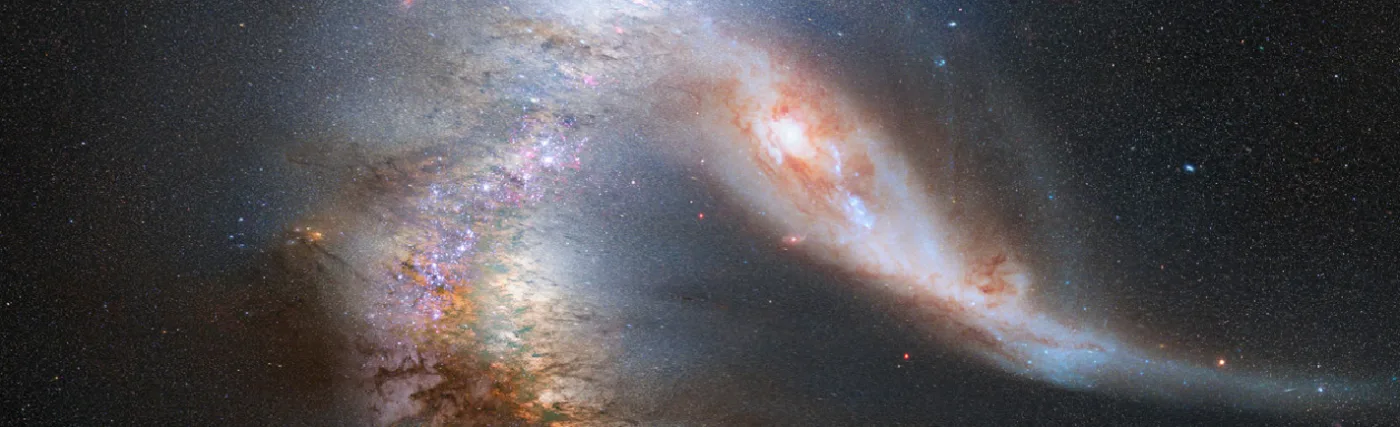
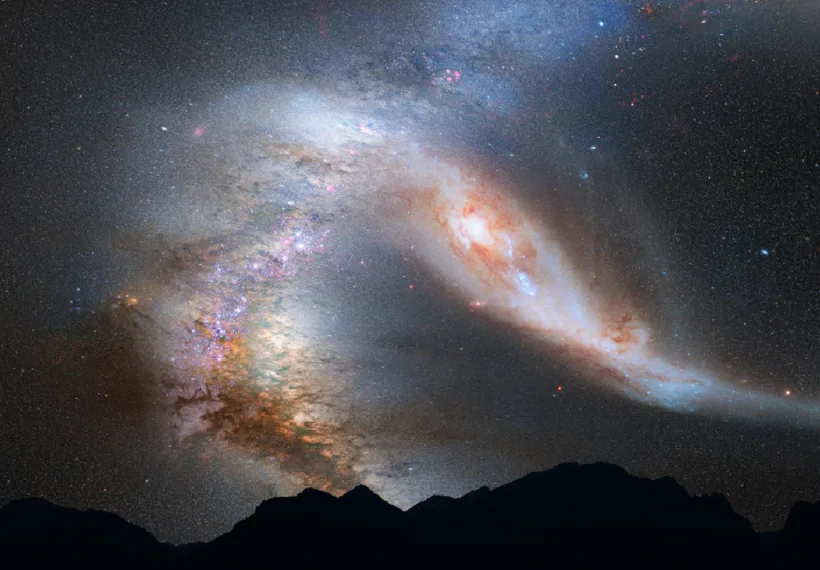
What happens when two galaxies collide? Neil describes the beautiful ballet of two galaxies colliding, which objects hit each other and which don’t. What happens to dark matter in this collision? How long does it take to complete the collision? Could the Big Bang and the Big Rip be causally related? When will the Big Rip happen, if it does? Find out what happens if you try to split up pairs or quarks. Finally, was our Big Bang someone elses Big Rip?
Thanks to our Patrons badutjelek2000, Dominik Appl, Justin Quinones, Sandra Makela, REGAN MCGEE, Dana S., Howard Clemetson, George Sharabidze, GR 只, and RK Threethreethree for supporting us this week.
NOTE: StarTalk+ Patrons can watch or listen to this entire episode commercial-free.
Transcript
DOWNLOAD SRTWelcome to StarTalk, your place in the universe where science and pop culture collide.
StarTalk begins right now.
This is StarTalk, Cosmic Queries edition, Neil deGrasse Tyson, your personal astrophysicist with Chuck Nice, Chuckababy, my co-host.
Hey Neil, what’s happening?
Yeah, yeah, and on your resume now, I would start saying Chuck Nice actor, in addition to comedian.
What’s up with that?
Well, I just figured, what the hell?
Put it on my resume.
Did you once say you were acting like a comedian?
Right, yeah, that’s what I’m on as well.
I’m acting like a comedian.
So let me just put that on the resume.
Put that in there, why not?
You know what I mean?
So today’s topic is a fascinating one, and it’s so ubiquitous.
It is so ubiquitous that, in fact, in the repertoire of public talks I give, one of them is entirely on this subject.
And so I will visit a town, go to a theater, and 3,000 people will come and listen to me talk for two hours on this subject.
And it’s called Cosmic Collisions.
Oh, have you been injured in an accident?
Yeah, most cosmic collisions, you’re not injured, you are vaporized or you die in some way.
Wow.
So it’s just things that go bump in the night and in the day.
So much that drives this universe is the result of things slamming into other things that it’s just astonishing.
Ways you might not have even thought about it, to give you a simple one, for example, you heard of aurora, aurora borealis and aurora…
Northern lights.
You know what the southern lights are called?
No.
Aurora australis.
Oh, okay.
You didn’t know that.
Yeah, it’s your northern hemisphere bias for you to only think of northern lights and not think of southern lights.
Right.
So these are collisions between charged particles from the sun and what we call the solar wind and our atmosphere, our upper atmosphere.
These particles slam into atmospheric molecules and it kicks them up to higher energy levels.
And generally atoms and molecules don’t like staying at higher energy level if they can help it.
And so then they de-excite.
And to de-excite in many cases…
They get married.
In the cases…
My life is way too exciting.
I need to calm this down.
God stop.
So they…
So they’ll de-excite and in many of the cases, the de-excitation gives off visible light.
And the visible light is oxygen, it’s nitrogen, it’s sometimes it’s sodium, other sort of chemical elements in our atmosphere.
That’s what gives you the different colors.
And because…
Like fireworks.
Like, and because the solar wind comes in sort of waves, if I call it that, it blows in.
From across the solar system.
So the aurora can change shape like instantly, right?
It’s an active dynamic phenomena.
And so that’s just one example of cosmic collisions.
And so I’m leading off with that.
I don’t know if anyone’s going to ask that.
But apparently you got like a whole boatload of questions on this very subject.
So let’s see what you’ve got.
You’re absolutely right.
It is a boat.
Look at this.
Every time I do this and I still have like…
You’re scrolling the screen.
I’m scrolling.
Like, yeah, yeah, look at that.
Look at that.
It’s unbelievable.
All right.
The number of questions we have.
And because I give an entire talk on this, I am the local expertise on the topic.
So, normally if it’s a new topic, we bring in somebody to help us out on the Cosmic Queries.
No need for this.
Oh no, I’m good for this.
Yeah.
And if I don’t know, I’ll say, I don’t know.
All right.
But you never believe me.
I was going to say, okay.
I mean, that’s just not going to happen.
Actually, that’s not true.
There are times when you’re like, okay, well, we don’t know, but that’s not going to stop you from talking to the subject in some way.
That’s true, because we might know something.
Plus, there are two kinds of I don’t knows.
There’s I, Neil deGrasse Tyson don’t know, because I haven’t learned it.
And we don’t know as it is unknown to all humans on earth.
And part of what it is when you get your PhD in a subject is you learn thoroughly what we know and what we don’t know.
So you know where the frontier is, so you can go there and advance human understanding of the universe or whatever is the subject of your expertise.
Irrespective of the question, the answer will never be from either you nor any of your colleagues who hold that PhD.
The answer will never be, I don’t know.
As an educator, I want you to leave still having learned something, all right?
But all right, look, we can test it.
Yeah, I’m more literate than that, yeah.
By the way, how cool would that be?
Or you know what else would be cool?
What?
When you give an answer and at the end of it, you go, doy.
I know.
All right, give it to me.
All right, here we go, here we go, here we go.
This is Dade Bloomfield and he says-
From?
Do we know where they’re from?
I like when they tell us where they’re from, no?
Dade does not.
Okay, we got to solicit that next time.
Okay, so go on.
So Dade says, hey, Dr.
Tyson, Lord Nice, I’m Dade from Milwaukee.
Sorry, there it is, Neil.
You got it, Milwaukee in the house.
You got it inside the body of the question, how likely is it?
That just means you didn’t read the questions in advance.
That’s what that means.
I think I got time to read these questions.
You know how long some of these questions are.
Okay, Dave, who secretly two sentences later is from Milwaukee.
There you go, that Dade, as in Dade counting.
Okay, that’s so funny, because I’m so busted.
He says, how likely is it that if an asteroid were to hit the earth, that we would actually notice it in time enough to react?
If we noticed it today, how long do you think it would take us to come up with an executable plan?
Yes, so I assume he means that if we know that tomorrow an asteroid is gonna hit, what can we do in the next 24 hours?
Okay, so of course it depends on the size of the asteroid.
So 65 million years ago, when an asteroid, the size of Mount Everest struck the Yucatan Peninsula, what is today the Yucatan Peninsula, left a 100-mile diameter crater on that order of size.
It doesn’t just kiss your ass goodbye.
70% of the world’s species went extinct, including all the big tooth dinosaurs.
So there’s certain size asteroids where you just sit on the beach and just watch it happen.
And because there’s really nothing we know how to do about it, all right?
So that’s just that.
So it’s not that in principle nothing can be done.
Right now, we have people fighting over whether Earth is flat or whether they should take a vaccine and you think we’re gonna coordinate in order to deflect an asteroid.
I don’t have that much confidence in civilization, sadly.
So, but if it’s smaller, let’s say something that might take out a city, right?
Oh, okay, that’s so manageable.
That’s totally manageable.
Yeah, so what you do is you find out where it’s gonna hit.
Usually, there’s uncertainty in the calculations of where it’s gonna hit.
So we have what’s called an error circle, but if it’s something coming in at an angle, it becomes an error ellipse, an uncertainty ellipse.
So usually, in other words, you know better where it’s gonna land left to right than you will front to back because it’s headed in that direction, right?
So the error ellipse is this elongated circle in the direction of the path of the asteroid itself.
So you find out what that is and then evacuate it.
Okay, that’s not all that hard.
I mean, think about what happens.
I live in Manhattan and think about it.
Every 24-hour period, millions of people enter and exit that island.
Very poorly, in their work day, okay, through a system of bridges and tunnels and boats even.
So that’s New York, millions move, okay?
So it seems to me, if we have some idea of the region where we’ll hit, we could notify local authorities and they can clear out that zone, allowing the thing to fall so no one will actually get hit.
Now, if you happen to be nearby, it’s gonna explode on impact, make a crater, but that explosion will scatter debris into the area and it’ll rain down asteroid particles and earth particles that have been kicked up.
So, but that’s less deadly than being where it actually hits and explodes.
And by the way, it will explode.
And you say, well, how is it gonna explode if it doesn’t have any bombs?
So here’s how that works, okay?
This is a very subtle point.
It’s a high speed impact.
Which has a very specific meaning.
It’s not just that it’s going fast, okay?
So here’s an object moving through space.
And you ask, well, how fast is it going?
How fast is it going?
So you get at its speed, it’ll hit us at a minimum of 25,000 miles an hour.
Okay, that’s about seven miles per second.
As a minimum, all right?
But that’s if it just sort of fell to earth.
If it has motion of its own, combined with motion from earth, then what you really care about is the closing speed.
And then that could be upwards of 40,000 miles an hour.
Nearly double that.
Okay, so you have to just sort of watch for those numbers.
So here we go.
So here’s it coming in at very high speeds.
Now you can calculate what we call the kinetic energy.
You probably heard the term.
It’s a very specific measurement you make.
Yes, how much mass is there and how fast is it going?
Okay, that’s all the only two things you need.
That’s all you need.
That’s all you need.
And so kinetic energy is one half times the mass of the object times its velocity squared.
Okay?
Okay.
But the mass times the velocity squared.
Oh, by the way, it’s not an accident that the famous, what’s Einstein’s most famous equation?
Notice there’s a mass and c is the speed of light squared.
Constant, right.
But notice there’s a mass and a velocity squared.
It’s an energy.
So mass and a velocity squared are energy no matter how you slice them, okay?
So one way to write down a value of energy is the mass times the velocity of that object squared.
That’s all I’m talking about.
It’s not an accident that equals mc squared has that same structure to it.
So kinetic energy is one half mv squared.
All right, write down that number, okay?
Write it down.
Now, ask yourself, what’s holding the thing together?
All right?
Right.
So go down to the molecules.
And they’re molecules connected to each other inside this solid object.
And you can ask, with what energy are these molecules hanging on to each other?
So imagine you and I standing next to each other, we just lock elbows, okay?
So we’re all just molecules locking elbows.
What will it take for two people to pull us apart?
That’s a certain energy, right?
That’ll either release your grip.
Or rip your arm off.
Or rip your arm off, right?
Both of them.
You can calculate what those energies are.
You can either release the molecule or bust the molecule open.
All right.
Do that for all molecules in the object.
That’s a total energy.
It’s called a binding energy of the object.
Okay.
So now I have a kinetic energy of its motion and a binding energy of the physical object.
And you ask yourself, which of these is larger?
If the kinetic energy is larger than the binding energy, we’ll call it a high-speed collision.
And here’s what happens.
This object is coming in.
It slams into earth with very high kinetic energy.
Well, velocity is one of the terms in the kinetic energy equation.
After it hits earth, how fast is it moving?
Oh, minus whatever.
How fast?
Oh, as it hits earth, it’s moving with the velocity.
Oh, it already hit earth.
It hit earth.
How fast is it moving?
It’s just stopped.
Give me a velocity.
Right, oh, oh, minus the…
No, no, didn’t minus, I’m just asking a simple question.
Oh, how fast does it move?
With the velocity.
What is the velocity after it has hit the earth?
Oh, I don’t know.
Yes, you do.
It hit earth.
Oh, zero.
Thank you.
Zero.
It’s zero.
Okay, so then I asked you, where did all the kinetic energy go?
No such thing as a free lunch in this universe.
So, all that kinetic energy on impact with the earth, it did several things.
One, it makes a crater.
It flies things up into space, but it also goes back into the object itself, completely destabilizing everything that’s binding it together.
Because it’s more energy that’s holding it together.
And so the instant that happens, the thing can’t stay together and so it explodes, period.
That’s how you get the explosion.
That’s why you get the explosion.
In fact, that’s why every crater you have ever seen on the moon is a good example, but look anywhere in the solar system, is a perfect circle.
Right.
Even if these suckers come in at an angle, you think, oh, it’ll make an oval crater.
Yes, the uncertainty ellipse is an ellipse, but once it hits, it explodes.
And the explosion is what we say is isotropic.
The force is the same in every direction.
It makes a perfectly circular crater and usually the object can’t be found.
It’ll vaporize 90 something percent of the object.
If you’re gonna look for a big rock that’s there, you’re not gonna find it.
In fact, they did.
You know that big, Arizona is known for its holes in the ground?
Okay, yeah.
So one of them is a meteor crater, we call it.
Oh, you mean actual celestial caused holes in it.
I thought you meant dive bars.
I was gonna say, yeah, you’re absolutely right.
All those are holes in the wall, not hole in the ground.
Oh, that’s right, they are.
Yeah, yeah, that’s right.
So with that, when people said, if this is left by a meteor, there ought to be a big meteor down in the middle.
So they started excavating.
They could find anything.
It’s before we understood this whole concept of a high-speed impact, a high-velocity impact, where you basically vaporize the object in an explosion.
It’s a cosmic pillow fight where the pillow explodes and there’s all the feathers.
And we’re still frolicking.
Well, that’s an important analogy because a high-speed collision has not as much to do with the speed as it does what is the thing made of, right?
So what’s holding your pillow together?
It’s some stitching around the edge.
Exactly.
If I slam it hard with more energy than that stitching and it hits you upside the head, the stitching will break and the pillow will break open because in that moment, the pillow engaged in a high-speed collision.
Yeah, same thing happens with a sock full of oranges.
Don’t ask me how I know.
Yeah, I’m not coming over for your next sleepover.
All right.
So yeah, that’s a long answer to that very good question.
Nah, that was cool, man.
Just evacuate.
You can evacuate in 24 hours.
That’s why we have roads, right?
And why everybody has cars.
Plus, you can evacuate in every direction, okay?
In most places, unless you’re like in the Florida Keys or something, now you gotta go just that one direction.
By the way, if it falls in the ocean, then you gotta watch out for the tsunami.
Okay?
Yeah, it is something to keep in mind.
But most of the earth is ocean, right?
Yes.
And so you just leave away from the coastline.
And most of that which is land is not inhabited.
So chances are it’s not gonna hit a city even if it had the power to destroy one.
Well, now I can sleep.
Yeah, yeah, there you go.
That’s not bad at all.
All right, give me another one.
Okay, this is Theresa Anosky.
She says, how can there be a collision, cosmic or otherwise, without a lawyer being involved?
Oh, so this is a new dimension for lawyer ads, right?
Exactly.
Was your house destroyed by a meter?
Yeah, who you gonna sue on that one?
Yeah, yeah, yeah, yeah.
So just an interesting point there.
The, one of the brightest, most devastating recent, recent, now nine years ago, was in Chayabinsk, Russia.
There was an air blast of an asteroid 17 meters across.
Some of the best footage we have of that coming in are from forward-facing dash cam footage of cars.
And so here’s an interesting point.
And that’s, Europe and parts of Asia have these to obtain video of a collision that you might be in, which reduces the need for lawyers, okay?
Often a lawyer’s arguing whether something did or didn’t happen or who was at fault or who was more at fault than they’re claiming and all of this.
If you have video, that just cuts through so much of what might otherwise happen in a courtroom.
So you can imagine a day where everything, I mean, I wouldn’t want this because it’s an invasion of privacy, but if everything, we’ve got a video of everything.
Well, okay, that didn’t make a difference with in Los Angeles in 1991.
I did not, I was about to say.
I was going to say, you have a lot of video you want.
What’s that boy’s name?
That was Rodney King.
Rodney King, okay, so I take it back.
Apparently video doesn’t matter in some cases, okay?
If you’re getting your ass whooped by the cops, apparently it doesn’t matter.
But for everything else, it might matter.
Exactly.
So yeah, it’s a testament to the fact that human sensory systems are rife with error.
Not only seeing what isn’t there, thinking you’re not seeing something that is, hearing something that’s not, perceiving.
So it’s such rife with error that science really didn’t take off until we were able to replace our senses with machines that would have a reliability that we could only dream of having with our own eyes, ears, nose, mouth and touch.
Chuck, we got to take a quick break, but when we come back, more Cosmic Queries on Cosmic Collisions on StarTalk.
I’m Joel Cherico, and I make pottery.
You can see my pottery on my website, cosmicmugs.com.
Cosmic Mugs, art that lets you taste the universe every day.
And I support StarTalk on Patreon.
This is StarTalk with Neil deGrasse Tyson.
Thanks for listening.
One of my favorite subjects.
In fact, I give a series of public talks around the country at a theater near you, and I give the host a choice of what topics they might want to hear from me, because I have nothing really to sell you other than the universe itself.
And the ticket.
And so they see the, I don’t have a product to sell you other than, like I said, the universe.
I know what you meant.
And so it’s, one of the subjects is cosmic collisions.
And every now and then they pick that, and they’re usually in for a treat, because it’s just a fun topic, and so many things shape the universe by slamming into other things, giving us what we think of as something that’s beautiful or spectacular.
They’re really just something coming upside the head of something else.
And I think we also have a odd fascination with the macabre.
And-
Yes, we do.
People just want to know, like, how are we going to die?
How’s it all end?
It’s like the same thing you watch NASCAR for.
For the crash.
Not one crash.
This was the worst race ever.
All right, here we go.
This is Deb Beach.
Deb says, hey, Dr.
Tyson, a recent article from the New York Times about research in 2003 astrophysics working with, astrophysicists working with NASA’s Orbiting Chandra X-ray Observatory.
The article notes that the sound waves were coming from a giant cluster of galaxies in the constellation Perseus caused by explosions from a huge black hole 250 million light years away.
They provided a sound clip that was modified so that we could hear the quote unquote music of the black hole.
My question is, how musical noisy is our galaxy of, and what other phenomena creates sounds in space?
So, here’s the thing.
Here’s the thing.
I’m not a fan of turning astrophysical data into sound.
I get it, and it has some value.
I’m just not a fan.
Because of all of the off ramps that that gives a person into thinking the wrong thing about the universe.
So, let me just start it out by saying anything, any energy that creates a change of pressure through a medium is creating sound.
That’s how your eardrum works.
That’s how your eardrum works, okay?
This air is pressure in the air, puts pressure on the eardrum, and it gets converted to electrical, chemical signals that your brain then interprets as sound.
Okay, anything.
So, most things actually make sounds, okay?
If you could hold a microphone up to the sun, it is gurgling and there are pressure waves inside the sun.
Oh my gosh, gurgling, the sun is actually boiling, all right?
It’s hot in the middle, less hot at the surface, and anytime you have a heat gradient, if that gradient is strong enough, it will, gradient is a fast change in what it is, then you’ll have boiling such as what would happen on your stove.
So, point is, what they did was they found places in the universe where the medium, the interstellar, intergalactic medium, depending on which research results they’re looking at, that there are these pressure waves through it.
Now, but they’re very low frequency, very low, like Basso Profundo low.
Like Basso Profundo low.
You all never heard Basso Profundo.
Just Google some YouTube videos of it.
It is a hoot.
It’s nutty, man.
It’s nutty.
The voice is so low, you can almost look at their, their vocal cords vibrate, you know?
Yeah.
Anyhow, so it is such a low frequency that in order to hear it, they had to artificially boost the frequency by 47, 48 octaves.
Well, that’s nothing like what you heard then.
Right, so if you were there, you just wouldn’t hear it.
The sound would sort of wash over you.
You wouldn’t even know it was sound.
So you boost the frequency.
Now you can hear it in this narrow range.
Well, we have several orders of magnitude.
20 hertz to 20,000 hertz, if I remember correctly.
And that’s a nice range, but it’s small compared to the total possible ranges that are out there.
Go ask your dog, okay?
So, you know, it’s funny, Chuck, you and I grew up at a time when in our biology books, the human body was praised as some kind of pinnacle of evolution.
Yeah, we still use our dog to sniff out drugs, because we can’t, right?
Our dogs can hear frequencies, we can’t.
People say if a tree fell in a forest and no one was there to hear it, did it make sound?
Yeah, because the dogs heard it, okay?
That’s what your dog is hearing every time you see him just look up like, what?
And there’s nothing going on, just nothing.
They heard the tree fall.
Yeah, he was like, another tree?
Chuck, I’m going to tweet that.
Right, he was like, wait, somebody just destroyed my bathroom.
Another perfectly good bathroom just destroyed.
So, anyhow, the point is that if you do that and then say these are the sounds of the universe, it’s a little misleading because it’s not what you would hear, plus most of the rest of space is empty and sound needs a medium to transmit.
And so not only wouldn’t you hear it when it was there, it wouldn’t travel to you anyway.
So that’s why I’m always a little uncomfortable talking about and thinking about sounds in space.
And by the way, there’s a medical condition called synesthesia.
I find a fascinating condition where your sensory wiring is crossed.
So I think I get it right.
There’s some people who hear colors, who see sounds.
Yeah, so it’s fascinating sort of cross-wiring of your senses.
So what we’ve also done is we’ve taken frequencies of light in images.
And because the different frequencies, there’s red, orange, yellow, green, blue, violet.
Those are different frequencies of light.
But we see way more than that with our modern equipment.
We see ultraviolet, infrared, x-rays, gamma rays.
So I’ve seen some people take those frequencies and attach a sound to them.
And then they have that sound emanating from an image and the combination of sounds from all the data that’s in the picture.
So when I first heard that, I said, no, that’s wrong.
You can’t do that.
But then I realized I was speaking with Richard Dawkins who strongly suspects that because bats are mammals and they have basically the same brains we do, a lot of the same processing power, he thinks that bats hear in color.
Because what else would they be doing with the part of their brain that sees color?
Why not hand it the audio signals that they’re getting from their echolocation?
So if a bat can hear color, then I thought to myself, why should I have a problem with us seeing sounds?
Right.
See?
So in that regard, maybe we’re at the beginning of a whole new way to bring data to people.
Because if you’re sight impaired, for example, you want to hear what the picture looks like.
I mean, why not?
That’s kind of cool.
Yeah, it’d be kind of cool.
There’s surely a whole future in that.
If you’re hearing impaired or vision impaired, you bring the data into another sense.
But you want to do it sort of authentically, right?
If there’s a separation of frequencies, you map them into a new set of frequencies that are still separated in that new regime.
So anyhow, so yeah, so that’s how you get sounds in the universe.
And by the way, collisions and things, they all make sounds if you’re right where they are.
But you wouldn’t hear them if you’re out in space.
That’s the only difference.
So in that regard, Star Wars would be silent loopy.
Right.
Just so you know.
And there goes the box office.
Alright.
God, it was so great.
If only they had some kind of sound effects with it, it would have been even so much better.
It’s better.
Yeah, we don’t like watching silent explosions.
I think that’s what that comes down to.
It’s a miracle, baby.
Miracle.
We’re really good at blowing stuff up.
And we’re less good at knowing where the pieces go at the end, by the way.
That’s a whole other conversation.
Chuck, we’ve got to take a quick break when we come back.
We’ll be back for part three of our three segment Cosmic Queries about Cosmic Collisions.
Chuck, we’re back.
I’ve been giving sort of luxurious answers to those several questions we’ve had so far.
That’s funny.
No, let’s do a little bit of lightning round.
I want to show people I’m capable of that.
Yeah, I just say we do another show, a second show, if you didn’t get your question asked, then come back.
We’ll do it again, all right.
We’ll do it again, you’ll get your question.
I’m still gonna try it.
Okay, go.
Okay, we’ll try it, here we go, here we go.
Zachary Klier, clear, clear, clear, okay.
Zachary says, greetings, Dr.
Tyson, Lord Nice.
I recently read that upon a recent published work in which researchers suggest that when two progenitor galaxies collided head on, their dark matter and stars would have sailed past each other.
The dark matter would not have interacted with the stars, which would not have been able to too far apart to collide.
But as the dark matter and the stars sped up, the gas in the space between the two galaxies and stars would have crashed together, compacted and slowed down, leaving a trail of matter that formed, dun, dun, dun, a new galaxy.
You just described galaxy sex, bro.
Wait, did his question have the sound effects in there, too?
Or did you add those?
No.
Okay, everything spoken there is accurate.
So here’s what happens.
The galaxy collision is one of the most beautiful, balletic things you’ve ever seen.
So first of all, galaxies are mostly empty of stars.
Right.
All right?
So if there were just a few bumblebees flying randomly in the continental United States, there’s a greater chance that two of them would accidentally bump into each other than for two stars to collide when two galaxies come together in space.
That’s how empty, empty space is.
Wow.
So when the two galaxies come, they will basically pass through each other and come out the other side.
Okay?
The dark matter, whatever that is, we don’t know what it is, the dark matter will do the same.
Why?
Because dark matter not only doesn’t interact physically with our matter, it doesn’t interact chemically, it doesn’t interact with itself.
So it would have to interact in order to make a dark matter planet, for example, or a dark matter star.
Something has to work such that it can become compactified.
Why are you a solid object, Chuck?
Because your molecules are sticking to each other in some way that it turn you into Chuck.
Dark matter, as far as we know, has no ability to stick to us or to stick to itself.
So the dark matter passes through.
But the gas clouds, oh, they are not gonna, you can’t pass gas through gas, okay?
I’m sorry.
Before I trigger a cascade of flatulence jokes from Chuck, okay, not that we can’t pass gas through gas.
Gas clouds cannot move through other gas clouds without consequence.
And it’s like two hot marshmallows touching each other.
They stick.
Ever done that, two hot marshmallows?
Absolutely.
It’s like contact cement.
So everything else passes through each other, the gas sticks together, and that energy feeds the formation of new stars.
And so you could, so these filaments of gas that are left over from these collisions, we can basically form an entire family of dwarf galaxies by doing this.
That is pretty damn amazing.
So yeah, so these are collisions.
And the problem is it takes about a quarter billion years to fully go through this collision.
So we know they happened primarily only because we simulate them on the computers.
And just so you, I want you to appreciate my people, okay?
If you’re gonna collide two galaxies, every inch the galaxy moves closer to itself, the sum of all the gravity vectors operating on every point in space changes.
So if you’re a star, you take three steps to the left, everybody else took three steps to whatever they’re going, and now the total gravity field is different.
So you have to recalculate what’s tugging on you and in what direction.
And once you go through this exercise, that’s when you find this extraordinarily balletic collision.
It’s like a train wreck, right?
The structure, the beautiful structures of the galaxies get completely destroyed and distorted.
And it’s just beautiful.
So if I wanted to see a phenomenon in the universe, I would want front row seats for a quarter billion years on the collision of galaxies.
Very cool.
Oh, I left something out.
So these gas clouds will make their own shards of galaxies.
But the system of stars, they will pass through each other, come out the other side, but they still see one another, and then they’ll slow down, stop, and then collide again.
And this will continue until it settles.
Into a new galaxy that has lost all of its, if they were spiral galaxies, completely lost all of its beautiful spiral structure.
And it’ll become one big giant blob of stars.
And if they each had black holes, the black holes will find each other and merge in the middle.
Yeah.
All right.
So back up when that’s happening.
Yeah, man.
All right, that was not a soundbite answer.
That was fascinating.
Fascinating.
Here we go.
Hello, Dr.
Tyson, Lord Nice.
This has been plaguing me for a couple of years now.
Who is this?
Who is this?
Oh, I’m sorry.
Yeah.
James Weldon.
Sorry, James.
Thank you.
Yeah.
This has been plaguing me for a couple of years now.
Is it possible the Big Bang and the Big Rip are causally connected?
I heard from a science YouTuber once that the amount of energy needed to split elementary particles such as quarks is so infinitely great that the very act would mathematically create new elementary particles rather than actually splitting them.
Well, I’d like that.
By the way, the namesake of this format, Cosmic Queries, became a book published by National Geographic a couple of years ago, and there’s an entire section on how the universe will end.
All right, and all the hypotheses are there, including the Big Rip, which would happen in 22 billion years if, in fact, the acceleration of the universe continues.
So here’s what’s interesting about the universe.
Wherever you have a lot of energy, stuff happens.
Stuff happens.
I’ll give you an example, okay?
Do you know what protons and neutrons are made out of?
Sugar and spice and everything like.
Yes, precisely that junction.
Made out of quarks.
Now we’ve never found an isolated quark.
They’re always in pairs.
Okay.
Always.
All right.
So now, well, why not?
Why don’t we just get in there and rip them apart?
Well, here’s what happens.
As you pull them apart, they pull on each other more strongly as the distance increases.
It’s like a finger puzzle.
Okay.
Or something even…
Do people have finger puzzles anymore?
Okay.
They don’t really have…
Well, we’re just a rubber band does that.
Right.
That’s true.
Yeah.
Right?
As you pull on it, it’s pulling on you more strongly.
So, this is a force that operates the way a rubber band does, but watch what happens.
If you pull on a cork with enough strength, I finally got it.
Check, check.
I got it.
I got it.
And then it snaps into two.
The energy you put in was exactly enough for the snapping rubber band to create another cork.
And now you have two pairs of corks instead of one.
Yes, yes.
It is like, don’t F with me.
You see I’m happy here as a pair of corks.
Yeah.
That’s some Lone Shark stuff right there.
That’s right.
So, I like the idea that the energy required to rip the universe, the very fabric of the universe, is sufficiently high that it could create multiple Big Bangs.
I haven’t researched that enough to know if there’s something that would prevent it, but I’m telling you that energy is opportunistic.
And so I like that possibility.
Yeah, this is kind of cool.
It could be that our Big Bang was somebody else’s Big Rip.
Somebody’s Big Rip.
Yeah, yeah.
And I don’t want everything to come from anything termed the Big Rip, so I don’t want that to be…
I don’t know what else to call it.
It is.
The universe is ripping.
I don’t know what else I’m going to do.
Yeah, but if you check out the book, there’s a whole section if you want to know all the ways the world would end.
Chuck, do we spend so much time?
Chuck, we don’t have time.
All right, one more.
Quick, quick, quick.
Dr.
Tyson, Lord Nice, when we detected gravita-
Who is this?
Wait, wait, who is it?
Who is it?
Jason Whiter.
Jason Whiter.
Dr.
Tyson, Lord Nice, when we detected gravitational waves from the collision of two black holes, what happened to their event horizon?
Oh, very cool.
Whoa, that’s a great question.
It is, it is.
And in fact, don’t we have an explainer on this with our black hole in residence, black hole expert in residence, Janna Levin?
Janna Levin.
Yes, I think we do talk about this.
I think it was an explainer, but I’ll just tell you right now.
And then we got to call it a quits.
So what happens is the two event horizons merge to become one larger event horizon surrounding the total mass of the two objects together.
That’s what happens.
They enter each other’s event horizon when this happens.
And Janet gives a brilliant explanation for how that happens and why it happens.
And so I recommend you do a fast search on that and you’ll get there.
All right, Chuck, we’re going to call it quits there.
That was great, man.
And guess what?
We still have like 60 questions left.
Which is awesome.
All right, we’ll do this again.
We totally will do this again.
Cosmic Queries, second edition, the sequel, we’ll just number them up because there’s no end of this.
And like I said, it’s one of my favorite subjects.
So Chuck tweeting a Chuck Nice comic.
Thank you, sir.
Yes.
I never give my social media handles on this, but maybe I’ll…
Because you don’t need to.
If I had 14 million people following me on anything, by the way, I would stop giving it like, hey, guys, stop, take it easy, chill out, okay?
I need a second.
Can I get a second?
You know.
All right, I’ll do this one time.
Okay.
On Twitter, it’s Neil Tyson, and on everything else, it’s Neil deGrasse Tyson.
On Facebook, TikTok even, and the TikTok is an official TikTok of StarTalk, by the way.
We have a bunch of us making sure that works out.
And I’m in all the content, but we have people, experts, TikTok, you know, people one third my age.
That’s a definite TikTok expert.
Oh, that’s so funny.
Yeah, I got a toddler just like, here’s your problem.
You’re not going to be able to get engagement if you keep doing this.
Exactly.
By the way, do you know when they’re going to stop this shortage of baby formula?
All right, this has been Cosmic Queries, Cosmic Collisions Edition, the first of what will surely be many.
Neil deGrasse Tyson here.
Keep working on.

 Become a Patron