This episode’s guest host is Dr. Amy Mainzer, an astrophysicist at NASA’s Jet Propulsion Laboratory. She’s the perfect guide for exploring asteroids and comets – and comic co-host Chuck Nice is the perfect guide to make Amy feel at home on StarTalk Radio. Together, they answer your questions about where asteroids and comets come from, where they’re going, how fast they travel, and what happens when they crash into something – like Earth. Find out about the spacecraft we’ve sent to explore the small bodies in our solar system: NEAR, Rosetta, and even New Horizons – once it’s done visiting the dwarf planet, Pluto. Discover why ISON fizzled, why Apophis isn’t so scary, and why there’s a debate over whether Ceres is an asteroid or a dwarf planet. You’ll also learn about the Kuiper Belt, the Oort Cloud and how playing Asteroids prepared Amy and Chuck for this episode of StarTalk Radio.
Transcript
DOWNLOAD SRT
Welcome to StarTalk, your place in the universe where science and pop culture collide. StarTalk begins right now. Now. Welcome to StarTalk Radio. I'm your guest host today. My name is Amy Mainzer, and I'm an astronomer from the Jet...
Welcome to StarTalk, your place in the universe where science and pop culture collide.
StarTalk begins right now.
Now.
Welcome to StarTalk Radio.
I'm your guest host today.
My name is Amy Mainzer, and I'm an astronomer from the Jet Propulsion Laboratory.
And I'm here today with my co-host, Chuck Nice.
Hey, Amy, how are you?
I'm doing great, how are you?
I am great, I am, I gotta tell you, I am better because you are here, and you are so much better looking than Neil.
Aw, thank you.
Well, even though I miss Neil, I love him to death.
Of course, he's off-
He's a busy guy right now.
Yes, he is, doing the Cosmos, that's what he's doing right now.
Yeah, he's gonna become Mr.
Universe pretty soon.
And I'm sure that has been a dream of his for so long, to carry the title Mr.
Universe, he actually can do that now.
He actually can now.
So let me ask you something before we jump into the show.
Of course, we're doing Cosmic Queries, where we have a bunch of questions that are taken from Facebook, the internet, Twitter, startalk.net and any number of outlets where you might find the StarTalk brand.
But before we get into that, tell me about Jet Propulsion Labs.
And I know that's part of NASA or is it part of NASA?
Yeah, this is part of NASA.
And the funny thing about the name is there really is no Jet Propulsion that goes on there whatsoever.
No Jet Propulsion at Jet Propulsion Labs?
There is no Jet Propulsion at the Jet Propulsion Labs.
It's a historical name.
And it's back from the early days of rocketry.
And I guess they thought calling it the Rocket Spaceship Lab was a little too weird and scientific.
It was science fiction at the time.
So they called it Jet Propulsion.
Jet Propulsion Labs.
Sounded a little better.
And now what do you guys do there for NASA?
Well mostly we do robotic space missions.
So we explore the solar system and the rest of the cosmos with our robots, which are basically our eyes and our ears.
Oh.
Yeah.
So it's great.
I get to go explore the cosmos from the comfort of my couch, which I love.
Because you got your own little robot up there doing the work for you.
Absolutely.
Yeah.
So I don't have to, you know, I can still eat donuts.
I mean.
It's a much better life.
So you guys are, you're listening and watching the universe for us.
You're like the NSA of the cosmos.
Yes, except that we are not really interested in, you know, any sort of bad behavior.
Although we do like to look for things like potentially bad behaving asteroids.
So we do keep an eye on those with our robots.
Very cool.
Very cool.
And you look familiar to me in a way.
I feel like I may have seen you on the History Channel.
I hope I'm not embarrassing you.
Is that true?
Yeah.
I did.
It needs to be on that.
Yeah.
It was fun.
It was really nice.
Very nice.
One thing about scientists, we love to talk about science.
In fact, try to get us to stop talking about science sometimes.
Well, that's good to know because that's exactly why we're here and that's exactly what I got for you right now, which is a bunch of questions and it is perfect for you because it's comets and asteroids.
Oh, some of my favorite topics.
So here, so let's jump right into this and let's start off with Steve Bristow.
How did the asteroid belt in our solar system come to be in orbit?
And how did they come to be, period?
Where did they originate?
Oh, the asteroids.
Asteroids and comets are kind of like the leftover bits of junk that were the remnants of what happened when our solar system first formed about four and a half billion years ago.
Now I'm going to channel Carl Sagan here.
Four and a half billion years ago.
You sound a little Dr.
Evil when you go, four and a half billion years.
Well, the thing about that is that all those years ago, there was a giant cloud of gas and dust.
In the beginning, there was a whole lot of junk, a lot of gas and dust, and it collapsed under the influence of gravity.
Eventually, it formed a sun in the center.
The stuff got hot enough and dense enough to ignite fusion, and the rest of it clumped into planets.
Jupiter swept up most of the stuff because Jupiter is the biggest planet.
So huge.
Yeah, it's this whopping massive planet in our solar system, and then it forms Saturn and all the other smaller planets.
Well, the thing is, they didn't quite clean up the mess they left behind.
There's always a little bit of pits and pieces there left, and those little bits of space debris, if you will, those are what became the asteroids and the comets today.
Things that formed a little further away from the sun, where it was cold and really dark, those are what formed the comets, the icy stuff.
And the stuff that formed closer to the middle, well, that's the rockier stuff.
It was too hot for ice to form there.
So that's how you get asteroids.
So right there is the difference between comets and asteroids.
So one, big giant ice balls, and the other, big giant rock balls.
Exactly, space rocks versus space sort of icy rocky things.
And now it's kind of a continuum.
We find asteroids that sometimes masquerade as comets, and then we have comets that sometimes turn into asteroids.
So there's kind of a weird, we used to think they were two totally different kinds of things, and now we know that there's kind of a gray area in between.
Kind of like actors who want to be music stars.
Okay, so yeah, they're slashies, right?
Right, there's actor slash dancer, actor slash musician.
I'm Kevin Bacon, I'm a big actor, but I'm also in a band with my brother, like that type of deal.
Exactly.
Sometimes we have asteroids who are, well, sometimes we emit lots of gas and have comas that come off of us.
You caught me off guard there, Amy.
Go ahead, though.
So, yeah, so sometimes these are the slashes of the solar system.
They're basically things that sometimes can cross the boundary between asteroids and comas.
So basically, these things have been here from the beginning of our solar system.
Yes, that's right.
And they're just basically remnants that are still kind of hanging around.
Exactly.
Like teenagers that will not move out of their parents' house.
In fact, and they make a giant mess occasionally.
Sometimes they even crash into things.
They really are teenagers.
They are very badly behaved sometimes.
Asteroids, the teenagers of the cosmos.
All right, cool.
Well, there you go, Mr.
Bristow.
There's your answer.
So let's move on.
That's a very good answer.
I'm glad you said that.
Here's another one from Twitter.
EM at infinity X91.
Okay, there's a handle for you.
How does a rock become a comet?
So you told us about this gray area.
So, you know, this is a great follow-up question.
How does a rock become the actual comet?
Well, every now and again, we see some strange behavior in the asteroid belt between Mars and Jupiter.
In fact, in recent years, we've seen asteroids that suddenly kind of explode or have like a big poof of dust come off of them.
We think what happens is that sometimes they get hit by other asteroids.
And it makes a mess and it looks like a comet.
Ah!
They're tricky, they masquerade.
So they're masquerading as a comet.
They're not necessarily, so they don't really have the ice on them.
Exactly.
They just have the dust that's coming off of them, like ice melting away.
You got it.
So it creates the appearance of a tail, but it's not really like a comet.
And they are a big mystery.
So that's one of the great mysteries of our solar system.
There's always something new to learn, you know?
Sometimes asteroids act like comets.
There you go.
Oh, so I get it.
Asteroids are the drag queens of the universe.
Call RuPaul, yes.
And with that, it's time to take a short break.
We will be right back.
Welcome back, here we are again on startalkradio.net, and I'm here with my co-host, Chuck Nice.
You can catch him on Twitter.
That's right.
At ChuckNiceComic.
At ChuckNiceComic, and I might as well return the favor because you are at Amy Mainzer, and that's M-A-I-N-Z-E-R, Amy Mainzer, right?
Yeah.
On twitter.com.
Which is a very good German name, yes.
And I understand you roller skate.
That's something that we were talking about in the break.
I do, I roller skate.
And what is the purpose of that?
Oh, it's because it's as unlike work as you can get, but it is also, it is very good exercise.
That's what I tell myself.
So not inline skating, actual roller skating.
Oh yeah, old school quad skates.
And do you roll and bounce?
I do in fact roll and bounce.
And do you have a giant radio that you carry on your shoulder while you're doing it?
Well, I'm actually very proud of this.
My skate partner and I, we won the JPL talent show, the first annual JPL talent show.
So I'm very proud of that.
Sweet.
It was, you know, it was the JPL talent show.
So it's not exactly American Idol, you know.
Right, I understand.
Yeah, you got to consider the competition, right?
Yeah, but we roller skated for that, so.
Sweet.
That was good.
Hey, well, let's jump back into our Cosmic Queries, and we're talking about comets and asteroids, and we have called questions from all over the internet.
And this one comes from Facebook, Jeff Turner, and he says, any concrete plans for launching exploratory missions to the Kuiper Belt?
Ah, okay.
So the Kuiper Belt for folks is a region of icy bodies that are comet-like, and probably some of the origins of the comets are out there.
And it's out really pretty far away in the solar system.
So this is this leftover bits of stuff from the formation of the solar system.
It's very cold, very far away.
Getting there is tough.
Now, the thing is, we have a mission that NASA has launched a long time ago.
I think it might even be nine years ago now.
It's not going all the way out there, but it is going to Pluto, our favorite non-planet.
Our favorite ice ball in the sky.
Yes, and there are some plans once this mission, which is called New Horizons, once it goes flying past Pluto, there may be a plan to see if there's a place that could go to visit in the Kuiper Belt.
So we're just going to have to see what comes up.
But it is on its way and it has got a long way to go.
So there's your answer, Jeff.
There are concrete plans.
They're just somewhat tentative.
They got to find the object first.
Yeah, it's actually tough.
These things are so far away and they're super faint.
It's really hard to see them.
So they're trying to find a place for New Horizons to go after the Pluto encounter.
So wish us luck.
And in the meantime, you got Pluto to hold you over.
Exactly.
It's going to be a nice show for Pluto pretty soon.
All right, so let's go to our next question, also from Facebook.
And this is Tony Annunziata.
When was the first comet discovered and what was it called?
Oh.
Ah, that's a good one.
Oh, okay, that is a good one.
Little comet history for you there, Amy.
Cometary history, yeah.
So actually, I think the first comet was probably observed by ancient humans long before recorded history.
And if you look back, you can see drawings of what are obviously comets in some very, very ancient texts, from the Chinese, from all over the world.
People saw these strange wandering stars in the sky.
And of course, if you were a court astronomer and you did not correctly predict one of these objects' arrivals, you could get in some very big trouble.
Really?
Oh yeah.
Because comets in a lot of times in the past were considered bad omens and frightening.
People were scared of them because they didn't know what they were.
I mean, just these bright things that appear in the sky randomly.
Right, and the gods were angry.
And of course, we got some really good information from the dinosaurs about what could possibly happen.
What could possibly go wrong.
So nowadays, we have a little better chance at predicting the arrival of comets.
And fortunately speaking, as a professional astronomer, I know that it's not off with my head if I don't correctly predict one's arrival, but we still try to do our best.
Yeah, you know, one of my favorite, this isn't a side, but now that you said this, one of my favorite animated series of all time is a series called The Avatar.
And it's all about the very beginning of the series, it's all about the arrival of a comet that will give these people superpowers.
Very cool.
It is cool.
Well, you know, the kind of funny thing about comets is we think that they may have even brought some of the chemicals we need for life.
That's kind of a superpower.
That is a superpower.
So now let me ask you this, when you, because this is one of the theories that I've heard is that the earth not only is it in a perfect position to support life, but the life itself was seeded on the planet by, in fact, a comet itself.
Is that the case?
Well, we know for sure that comets have a lot of water and they got a lot of other chemicals in them.
They even have, in some cases, I think they know of some really complicated things, which are the precursors of our DNA, basically.
So it could be possible.
And there are theories out there that say that these comets came in and basically pelted the earth when it was first formed.
And that may have been enough to get the process started.
Nice.
And pretty cool.
There you go, people.
You have your whole life, it's owed to a comet.
There you go.
That's a pretty good omen right there.
Not a bad, that's not a bad omen.
All right, let's go on with Robert Rushing.
And Robert says this, greetings from the UK.
Or should I say greetings from the UK?
I have heard some theorize that the water on earth could have been deposited here by comets, which is what you just said.
These comets have to come from somewhere.
So where do you think they originated from?
And what is the source of their water?
And that's a really involved question there.
And that's a tough one for you to answer.
Right, well, it's certainly not the tap, clearly.
They definitely have to come from somewhere far away.
It ain't Avian.
No, it is not Avian, definitely not.
So we know that the comets come from a couple different sources in our solar system.
Some of them are way out there, and we think they might even be halfway to the nearest star.
Yeah, really far, really cold, super cold, deep freeze.
And that stuff that's been out there is very, very old.
It is ancient.
And it is again, billions.
Billions.
Billions.
Billions of years old.
It's extremely old.
So when it gets here every now and again, we don't even know exactly how, but sometimes these objects get kind of shuffled loose from that cloud that surrounds our solar system.
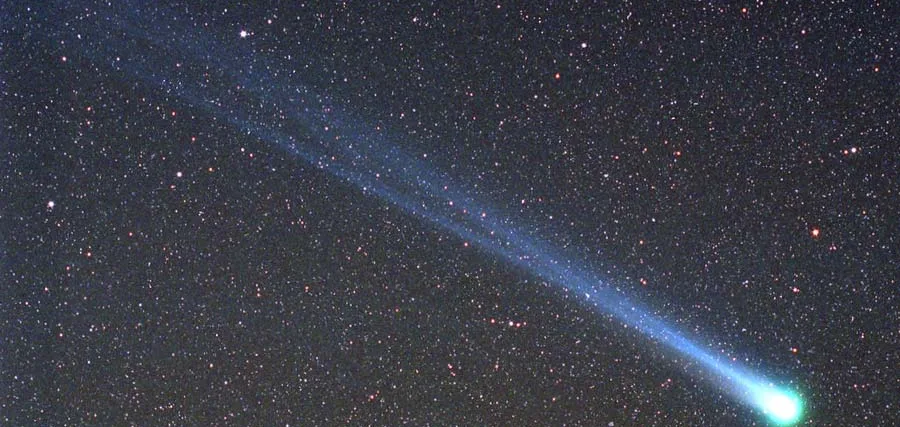
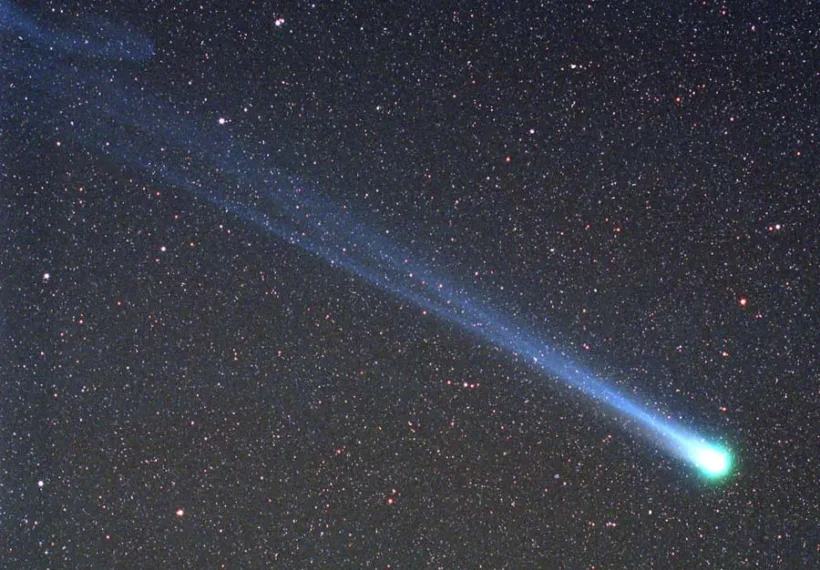
We call it the Oort cloud.
And occasionally, one will get flung inward and bring all of that ice and volatile material inwards.
And when it gets to the sun, what happens?
It starts to melt, because our sun's from what I hear, kind of hot.
Yes.
Yes.
Exactly.
So the sun basically does a number on the comet, starts to vaporize it, and it can form a big long tail.
And eventually, some of them actually make their way to earth.
We think that that may have been how a lot of the earth's oceans actually formed.
Wow, are you serious?
Like it was that much ice?
Could have been, yeah.
So, wow.
So the tail of the comet is actually expelling that much ice that if it were to get caught in the earth's gravitational pull, pull down, it creates oceans?
Imagine lots of comets.
Lots of them.
Lots of comets.
I mean, right now, this is kind of a quiet time in our solar system's history.
Oh god, you're scaring me.
And now we're kind of, we're glad for that, right?
Yes, we are.
Because life here on earth does not really like it when things get too interesting.
No, exactly.
But early on, when the solar system was first forming, we do think there was a period when the earth pretty much just got pelted by asteroids and comets, and that could have been when the water got here.
Wow, that is fascinating.
Very cool.
All right, well, there you go, Robert.
There's your answer.
That's where this stuff comes from.
And let's hope it never happens again.
Yes.
All right, let's move on to Dimitri.
And Dimitri wants to know this, writing in from Facebook.
What is the biggest asteroid we've ever observed?
If it gets to a certain size and it isn't orbiting anything, is it just considered a rogue planet?
So a compound question.
First of all, what's the biggest one we've ever seen and we've recorded?
And secondly, what is the size where it's no longer an asteroid, that it's just a rogue planet?
And do we know those answers?
Right, we do know those answers, although the second answer is kind of a religious warfare question.
Always the fun stuff.
Yeah.
But yeah, the first, the biggest planet or the biggest asteroid that we know about in our solar system is called Ceres.
Ceres.
Yes, and it's, I think it's about the size of Texas.
It's a big asteroid.
Holy moly.
But lucky for us, it is safely away in the main asteroid belt between Mars and Jupiter, so it's not going anywhere.
So it's not going anywhere.
No, you don't have to worry about Ceres.
So Ceres is not trying to make a house call.
Oh no, we actually like it right where it is.
We do not want it to come visit us.
Unlike Apophis.
Which is gonna get really close.
Who's kind of just like peeking in the window, little pervert that it is.
That is gonna get a little too close for comfort.
It won't hit.
We are very sure of that.
We're sure of that.
But we're gonna keep track of that one.
We're gonna keep watching that one.
All right, and so now the second part of this compound question was what size, if there is, because I don't know, where it's no longer an asteroid, it's a little rogue planet.
Well, the funny thing about Ceres is it has a joint name.
It is also called a dwarf planet.
And that's the religious warfare part, right?
Because look what happened to poor Pluto.
Is it a planet or is it now what's called a dwarf planet?
Okay, now before you go any further, is it true that the reason why Pluto isn't really a planet is because it's mostly ice?
Is that what it'd be?
Oh, boy.
So now if Ceres were mostly rock, is it really a dwarf planet?
These are all really tricky questions.
And I predict that astronomers are gonna be fighting over this for many decades to come.
Oh, so really, this is basically the contention at the Thanksgiving table where it's just full of...
It gets pretty unpleasant in some of these meetings, I gotta say.
Astronomers are normally pretty quiet people, but not when it comes to this stuff.
Not when it comes to dwarf planets.
Well, that brings us to the end of this segment, and we'll be right back on StarTalk Radio.
And we're back on StarTalk Radio.
So you're ready to go, Chuck?
Yes, I am, Amy.
And we're doing Cosmic Queries.
We've got questions from all over the internet, no matter where they come from, whether it's Facebook, Twitter or what have you.
And this next one is from Marco Horvod.
Marco says this, everyone knows about Haley's Comet.
How often does a comet that is visible to the naked eye appear?
And when is the next one?
Ooh, when is the next super comet?
Yes.
Oh boy, okay.
Well, there's always a comet of the century that people get really excited about, but they don't happen that often actually.
So we see naked eye comets, maybe once every few decades or so, something like that.
If you're really lucky, one will get really, really active.
The thing about comets though, is they are so hard to predict.
They just do whatever they feel like.
Ooh, I like that about that.
I know, sometimes, well, it's annoying if you're an astronomer, because you wanna know what are you doing, stupid comet, right?
So part of the time, we can tell that they're gonna get really bright and really active when they get close to the sun, but sometimes they just don't feel like it, and they don't.
They really are like teenagers.
They are exactly like teenagers, or cats.
Or cats, I like that, comets, the cats of the universe.
Exactly.
Come here, come here, whatever.
I don't feel like it.
So we just recently had a so-called Comet of the Century called Comet Ison.
Comet Ison.
And it was supposed to make a very close pass by the sun, and people thought it might become a spectacular naked-eye comet that everybody could see.
The thing is, it got a little too close to the sun.
Oh, so now does that negate all of the fireworks because things just burn off so quickly?
Is that what happens?
It pretty much was a, it was a bust.
So it's a dud.
It wasn't just even a dud, it was a nothing.
I mean, the comet literally fell apart.
Oh, really?
It got super close to the sun, and it got so close that it basically, everybody was watching and waiting to see what would happen, and the sun pretty much just-
Just destabilized it completely.
Yeah, poof, gone.
So now it's just, oh man, what a shame.
It was such a disappointment, because we were really hoping it would come back and make this great light work, great fireworks show, and yeah.
And nothing.
Nothing.
Just like-
A big nothing.
Just like cats.
Kind of like Geraldo Rivera and the vault.
Remember that?
Yeah.
That was really disappointing.
That was very disappointing, right?
Well, this was the vault of the comet world, comet Ison.
There we go.
It was a bust.
All right, Marco, there you have it.
That's what's happening.
Let's move on to Scott McGregor.
And here's what Scott wants to know.
Do you, Amy, have a favorite asteroid or comet?
If so, why?
Which one do you think is the most interesting?
Oh, this is just, this is, no, I can't answer this question.
This is like Sophie's choice.
Is that like asking you to pick a kid?
I love them all.
They're all my favorites.
I love them all.
Come on now.
Okay, well, all right, I like the ones that I discovered.
You really do like your own children.
I do like my own children.
It's kind of bad.
Actually, there is one particular weirdo thing that we found with our survey when we were out looking for asteroids, and it's called the first known Earth Trojan.
And this is an asteroid that actually is stuck to the Earth in a peculiar way.
Okay, really?
Yeah.
Now, it's stuck to the Earth.
It is actually trapped in a gravitational resonance with the Earth, which sounds really cool.
And this actually is a really cool asteroid.
It's basically, Earth is following it around in its orbit around the sun.
Sweet.
And it's kind of trapped there.
And what's gonna happen is, after a while, eventually it's gonna pop its way out.
Right, but right now it's like a little mama's boy.
Oh, yes.
Just trapped, can't get out.
Can't get out, won't leave.
Won't leave.
And Earth is like, no, you come with me.
No, I can't see my baby go.
She's like, no, no, don't leave me.
So that's, okay.
That's one of my favorites.
That's one of your favorites.
If I had to pick.
Very cool.
All right, let's move on.
Nathan Holmes wants to know this, writing in from Facebook.
I just read about the Rosetta satellite that would be launching a probe into a comet.
Would it be possible to land equipment on the surface that would in essence turn the comet, check this out, into a deep space satellite?
Ooh.
Yo, that's a brilliant idea.
That is some cool science fiction right there.
That's some cool sci-fi right there.
So what is the probability and could it have happened?
Oh, okay.
Well, so the Rosetta mission is actually going to send a lander to this comet.
Now don't ask me to pronounce the name.
I always get it wrong.
We call it Cherry Gary for short.
Cherry Gary Comet?
Yeah.
Sounds like a flavor of a soda.
Yeah, exactly.
I was drinking some Cherry Gary, man.
It's delicious.
It's like Cherryumov-Gerasimenko.
Yeah, Cherry Gary.
Cherry Gary.
So this thing is going to land on Cherry Gary coming up pretty soon.
And it's going to basically take a whole bunch of measurements of this comet.
It's going to tell us a lot about what it's made out of.
Now turning an asteroid or a comet into a spaceship, well, that's a tougher thing to do.
That's a lot harder because these things are huge compared to our spacecraft, a lot of them.
And this comet is a pretty big one.
This is a kilometer or more across.
So it's pretty large and the little lander is really not that much bigger than a suitcase.
I mean, it's not a very large lander.
So you're really talking about a flea trying to push an elephant.
So now is it possible to hitch a ride on a comet and use it as a deep space probe?
Or would that even be necessary?
Sure, well, who wouldn't like a ride along with a comet?
Right.
It could be really fun.
So that's kind of what Rosetta is gonna do.
It's actually going to ride with this comet as it goes around the sun for a while.
And it's gonna monitor the comet to see how it changes when it gets too close to the sun, as it heats up, as it cools down.
So it is gonna teach us a lot about how comets behave.
Sweet.
Yeah, Rosetta is a pretty cool mission.
Really looking forward to it.
Awesome.
Awesome.
Well, there you go, Nathan.
There's your answer.
So we're gonna take another short little break here and we will be right back with StarTalk Radio.
Bye And we're back.
We're here on StarTalk Radio Cosmic Queries Edition.
And check us out on social media.
We are all over the internet.
We're at startalkradio.net, and you can catch us on Facebook and Twitter at StarTalk Radio.
Absolutely.
Well, let's jump right back into this, Amy.
We have from Yelena Noskina, who actually has kind of a follow-up question.
Some comets are said to be traveling for thousands of years, and yet we see ISON get burned up by the sun.
How is it that we have comets at all?
So ISON was a spectacular science event of the year.
This is a comet that came in from the Oort cloud.
It came in from far away, and it has been out there for billions of years.
Right, right.
Wait, you have to say it.
Billions of years.
Yeah, that.
So it came in, and it made its way into the inner solar system, but not only did it get in, but it made a very close brush with the sun.
Just a few times the radius of the sun itself.
And that is so hot.
The thing is, is people had no idea what was going to happen.
Now we see sun, what we call sun grazer comets.
And these are little tiny comets by and large.
They just get pulled into the sun.
We see them with our satellites that are actually watching the sun, and the sun just eats them up.
Just like breakfast cereal.
There you go.
It's a Scooby snack for the sun.
Exactly.
Comets.
Exactly.
Well, this one was a much bigger comet.
This was about more than a kilometer across.
It's mostly very primitive ice that sat there from the beginning of time.
Okay, the beginning of our solar system anyway.
And when it got close to the sun, nobody knew.
Was it gonna flare up and put on this spectacular light show in our night sky?
Or was the sun just gonna tear it apart?
And we were watching this thing on our satellites in real time.
It was really spectacular.
I mean, these satellites allow us to have this great view of the thing.
Right.
Well, turns out the sun tore it apart.
Tore it apart.
Yeah.
So it just basically, the sun is Thunderdome for comets.
Poor old Comet Iceland did not leave the Thunderdome.
One comet checks in, no comet checks out.
Yeah, it was pretty disappointing for Comet watchers.
So basically, it's kind of like, it's very fortuitous to be able to see a comet get into our solar system, get by the sun, and then continue on so that we can see the spectacular display in the sky.
Absolutely, yeah.
Because what you're saying is these sun grazer comets, as you called them, happen all the time.
Yeah, they happen all the time, and that was a huge surprise.
Until we really started monitoring the sun consistently, we didn't know about these things.
I mean, we saw comets that kind of went around the sun and didn't get too close, and they went on their merry way.
But these sun grazers, they just get swallowed up whole.
Well, there you go, Yelena, there's your answer.
The sun, the roach motel for comets.
All right, let's move on.
We have Anton Prius, and Anton says, could we ever send some sort of organism to test if they could survive on an asteroid or a comet?
So now we're always interested in pulling stuff off of these things.
Could we put something on it?
Ooh, well, this is a toughie.
Okay, so in a sense, we kind of already have.
When we send spacecraft to asteroids, there was a spacecraft called NIR, the Near Earth Asteroid Rendezvous Mission, and it actually touched down on an asteroid.
In a curious sense, we do our very best to clean these spacecraft and get them super duper clean, but there's always little bits of germs and bacteria that are left.
We try really hard to get them super clean.
So I'm sure there's a little bit of some space DNA now out there on that asteroid.
Whether it survived, of course, probably not.
Asteroids are pretty hostile.
There's no air for most of these things, and they can get either burningly hot or terribly, terribly cold.
So it's very unlikely that life would be able to survive on an asteroid.
That would be my guess.
You know, it's a nice place here on Earth, and it's probably not such a nice place to take a vacation.
There you go.
But we can always hope.
Yeah, there is always hope.
Unfortunately, whatever did survive there would probably come back and kill us all.
Like Wrath of Khan.
Yeah, that's it.
Andromeda strain style, that's it.
Andromeda strain, exactly.
All right, let's move on.
We got Jake Betcher, he says, if an asteroid were on a collision course for Earth, what method would be used to deflect it and how long would it take to prepare this?
You got it.
Okay, so we actually think about this a lot and what we try to do is find the asteroids well in advance of any potential close encounters because that gives us the most flexibility to design a mitigation system.
There are options to deflect it by just simply whacking into it.
Just hit it.
Just hit it.
The Deep Impact Mission actually did that with a comet in 2005.
It just ran into the comet and that actually can push something.
If you have enough time, you might be able to do something that's just a simple kinetic impactor.
So there you go, Jake.
Your answer is just like your health, early detection is the key.
Exactly.
So we're gonna have more here when we come back to StarTalk Radio.
And we're back on StarTalk Radio.
I'm Amy Mainzer, your friendly neighborhood astrophysicist from the Jet Propulsion Laboratory, and I'm here with Chuck Nice.
And now, it's time for the lightning round.
Yes.
And that's the sound you will hear when you finish answering the question, or when Amy finishes answering the question.
And let's jump right into this.
Here we go.
Steve B from Twitter wants to know who tweets at at Beer Cannon.
Is there a maximum speed for asteroids slash comets, and could something approach so quickly that we'd never see it coming?
Oh, the average speed of most asteroids and comets is about 20 or 30 kilometers per second.
That's really fast.
40,000 miles an hour.
And it is possible that they sometimes come in faster depending on their orbits.
Things can come in from directions that we cannot see.
Oh, that is not the answer I wanted to hear.
Okay, Shahan Tasneem wants to know this.
How plausible is the theory that our moon was the result of an asteroid strike on Earth?
If true, are there any other planets that have moons resulting from the same event?
Aha, okay, well, we think one theory is that a Mars-sized proto-planet hit the Earth when the Earth was forming.
It actually scraped off the crust of the proto-Earth and formed our moon.
It is potentially possible that this could have happened on other worlds.
Okay, good to know.
Anna Williamson wants to know this.
How big of an asteroid would it take for a strike to break the Earth?
Would it have to be a moon-sized asteroid?
She wants to know, like Alderaan-style destruction.
That's it.
Just obliterate.
Blow it apart.
All right, well, we think that a Mars-sized proto-planet was enough to knock off the moon, but not destroy the Earth.
So for something like that to happen, it would have to be a pretty big object, almost the size of the Earth.
Ah, one-to-one ratio.
Yeah.
Okay, so Phil Green would like to know this.
In the movie Armageddon, they were describing how a rogue comet went through the asteroid field and all that rock turned Earth into a shooting gallery.
Is that scenario realistically possible?
Well, the Armageddon movie had a few flaws, surprise, surprise.
Shock, shock, shock.
Shocking, but the thing they got mostly right is that if a very large comet were to come in, it would certainly cause a lot of destruction.
We do think that the asteroid belt was reshuffled early on in the formation of our solar system in an event called the Late Heavy Bombardment.
Aha.
Boom.
There's your answer.
Late Heavy Bombardment.
Deal with that, Phil.
All right.
Here's one from Rich Coteau.
Can an asteroid consisting of gold or silver be out there?
And if it hit the Earth, who would own it?
Well, I say I would love to find a gold or silver asteroid if I could, but the ones we find that are metallic tend to be nickel iron.
Nickel iron.
Not nearly worth as much.
No, not nearly as much fun.
And the answer to the second part of the question is, if it does exist, I own it.
Okay, so just back up off my ass, Troy.
Get off my ass, Troy.
This is from Twitter.
I-H-Y-H, okay.
Is there a possibility of discovering new elements that are not on our periodic chart?
Can we find that in asteroids?
Oh, well, we certainly find a lot of very exotic materials that are not common here on Earth because they have sunk to the center of our planet long ago.
Maybe it's remotely possible that someday somebody will find one that is way out there on the periodic table.
Hasn't happened yet.
Mostly these very exotic weirdo elements are created in laboratories.
Ah, so we don't even need asteroids for that.
There's your answer.
So, Melanie Bowman wants to know this.
Would it be possible to redirect a comet to hit Mars for terraforming purposes?
After impact, would terraforming work or would it just make a Martian mess?
Ooh, well, we do actually have a comet that is getting very close to Mars.
It will not impact, so we don't get to do the experiment.
Now, comets are pretty big, really big.
A lot of them are more than a kilometer across, and that is very hard for us to move.
Unfortunately, it's not easy for us to do that experiment, so we don't know.
Oh, my goodness.
We got a we don't know.
Look at that, Melody.
Okay, this one comes from Google+, and Elad Avran wants to know this.
Can comets travel between star systems, or are they always bound to one star?
Oh, this is a toughie.
Okay, so we think that the comets in our Oort cloud, which is a shell that kind of surrounds our solar system, and we are a tiny, tiny thing in the middle.
Well, we think that sometimes it's possible for a nearby passing star over the course of many billions of years could potentially grab some of our Oort cloud comets and pull them off.
It could happen.
So the answer is yes.
Yes.
Cool.
Okay, Alex Fawcett wants to know this.
How scientifically accurate is the 1979 Atari?
Atari game Asteroids.
Okay, I spent way too much of my childhood playing that game.
Me and you both.
Yes.
And so when I became an asteroid scientist, it turns out the game is actually not that bad.
If you hit an asteroid that is big in the game, it breaks into a lot of little pieces.
And sure enough, that is exactly what happens to the asteroids.
Wow.
That is awesome.
All right.
Here's a very quick one.
What role do you think plasma physics plays in the landscape of comets?
Oh my goodness, a confusing one.
And that's all the time we've got for this lightning round on StarTalk Radio.
Thank you so much, Chuck Nice, for being a great cohost.
Thank you.
It was seriously a pleasure.
It's been a blast.
And I'm Amy Mainzer.
I'm an astrophysicist at NASA Jet Propulsion Laboratory.
I'm cohosting the show for our own Neil deGrasse Tyson, who is off around the cosmos right now.
So check us out on startalkradio.net and we're on StarTalk Radio on Twitter and on Facebook.
Thanks so much, and clear skies, everyone.
See the full transcript



 Unlock with Patreon

 Become a Patron