


 Unlock with Patreon
About This Episode
When will we create a livable habitat in space? Neil deGrasse Tyson and comedian Matt Kirshen explore the possibilities of tessellated space structures, artificial gravity, and other challenges of space living with Founder of MIT Space Exploration Initiative and Aurelia Institute CEO, Ariel Ekblaw.
We discuss Gerard O’Neill’s visions of space and the L5 Society. Learn about the Aurelia Institute’s work in creating modular smart space structures and the challenges of creating a space habitat. How do we make sure that space travelers aren’t microwaved like a hot pocket? Have there been any advancements in artificial gravity?
Will it be possible for someone who’s 33 years old today to visit space in their lifetime? What’s the most important breakthrough we need to bring down the cost of space travel? How are we going to stop people from getting sick on the way to space? Discover how the human body changes in space and what “space face” is. We also explore an approach to artificial gravity seen in Andy Weir’s Project Hail Mary.
How would you create food in a space colony? How would you safeguard a habitat from space debris? What’s the role of AI in space travel? Finally, once we get there, what jobs would people have in space?
Thanks to our Patrons Rafael Pérez Pastor, Jay Patel, Justin Sharkey, Nick Wood, Debbie Karimullah, and Patrick for supporting us this week.
NOTE: StarTalk+ Patrons can watch or listen to this entire episode commercial-free.
Transcript
DOWNLOAD SRTWelcome to StarTalk, your place in the universe where science and pop culture collide.
StarTalk begins right now.
This is StarTalk, Cosmic Queries edition.
Neil deGrasse Tyson here, you’re a personal astrophysicist.
I got with me co-host Matt Kirshen.
Matt, welcome back.
Thank you so much.
How’s it going?
All right, dude.
You’re host of probably science.
And you’re based out in LA, right?
I am.
And I’m briefly back there.
I think every time I’ve recorded with you recently, I’ve been in a different hotel room, but this is…
I don’t need to know your private life.
Why are you giving me that much information?
Did I ask?
Just the highest bidder.
Wherever you need me to go.
Excellent.
So, Matt, this is a Cosmic Queries edition on everybody’s favorite subject.
Space Civilizations.
Oh my gosh.
I love thinking about it, but I claim no particular expertise in it.
So, we combed the landscape and we found somebody who is all up in it.
All up in Space Civilizations.
And someone that goes by the name of Ariel Ekblaw.
Ariel, welcome to StarTalk.
Thank you so much for having me.
It is such a treat to be here.
Excellent, excellent.
And so, I’m looking at your resume here.
It’s like, what?
I feel like a dog hearing a high-pitched whistle.
You’re CEO of the Aurelia Institute.
I’ll read some more here, and then you’re going to have to do some explaining here.
Founder and director of the MIT Space Exploration Initiative.
Author of Into the Anthropocosmos.
Got it.
One word there, whoa, and your research focuses on tesserae platforms, which sounds very acronym.
So let’s see if we can unpack that.
Tessellated electromagnetic space structures for the exploration of reconfigurable adaptive environments.
And you want people to buy that?
Terribly tortured acronym, never again.
You can call it just let’s go to space, right?
So tell me what all this is.
So what is the Aurelia Institute?
What’s your background first?
What’s your background?
Yeah.
So background, my parents are both pilots, grew up with a real love of science fiction.
In undergrad, I studied physics, math and philosophy.
I always really loved big picture questions about the universe, but I decided I want to get more concrete, not just studying physics and cosmology and particle physics.
So I transitioned in grad school to do space exploration, and my PhD was test array, looking at robotic self-assembling systems to build habitats out in orbit that are way bigger than your biggest rocket payload fairing.
Wow.
So I remember going decades back, who’s the guy who had the L5 Society or he was founder of it, I think.
Oh, I don’t know.
This is the L5 Society?
Jerry O’Neill.
He was into big space colonies.
Are you trying to make his vision real?
100%.
I am a huge Jerry O’Neill fan.
High frontier.
His vision for life in space, I think, was really compelling.
We’ll do it a little differently now.
It’s a little different than how it was conceived up in the 60s and 70s, but yes.
He was almost cult-like.
Presumably, you’re born well after that man was long gone, but you’re now trying to…
That’s why I asked Matt instead of you, because he might have been alive.
But you dug up his ashes, and you’re trying to reassemble the man’s ashes.
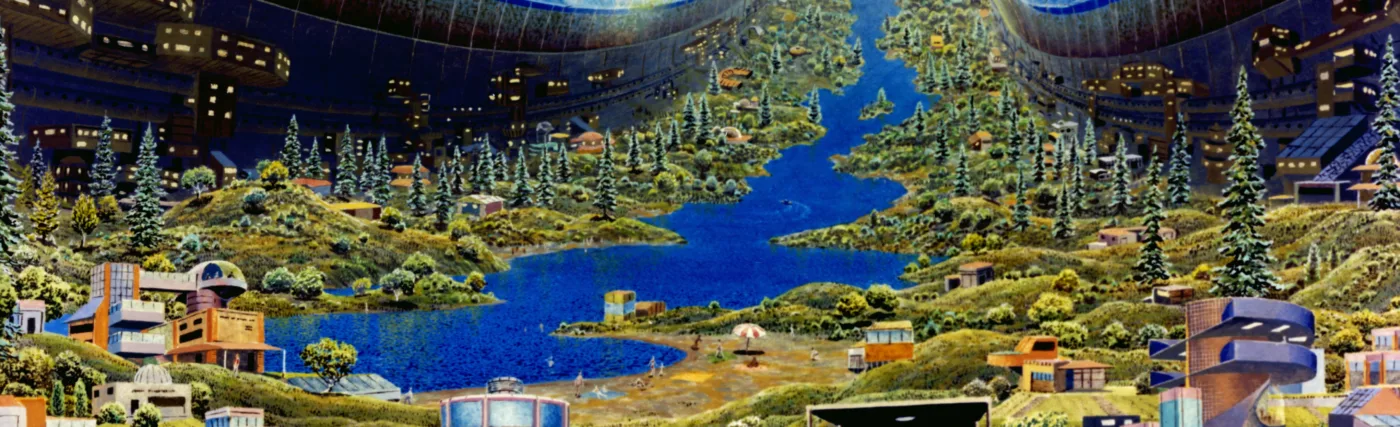
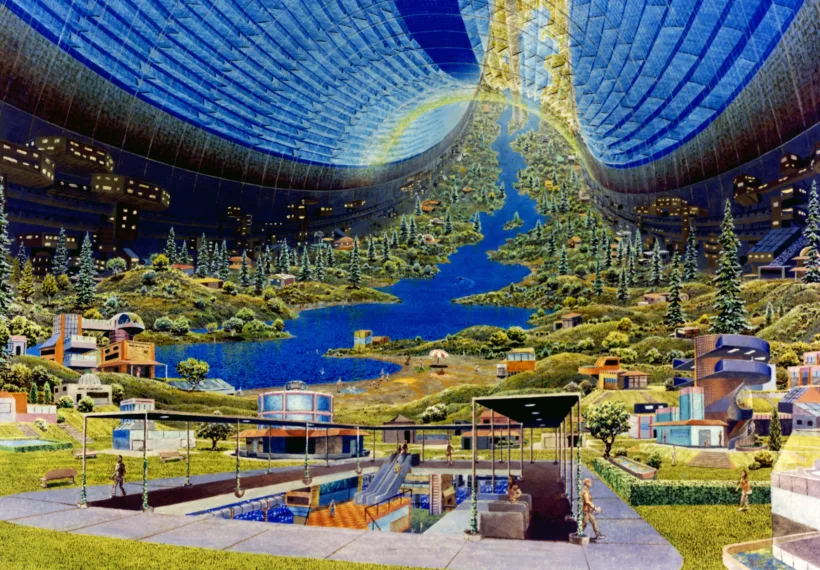
I’ve seen artist illustrations of what he was imagining.
Is that what you’re imagining?
That is what we’re imagining.
The secret keystone of our system is going to have Jerry O’Neil’s ashes in the 17th quarter.
Science fiction-worthy space structures, how do you build them?
And then how do you think about the society operating and hopefully thriving, not just surviving inside of them?
So tell me, Tessa, lady, we’ve all seen that word, and we think we know what it means.
And I think I know what it means.
But you’ve got it applied to space here.
So tell me what’s going on here.
Because when I think of tessellated, I think of a same shape repeated, but maybe, but shifted a little bit so that you can build a surface out of it.
A pattern.
A pattern.
Tell me more about it.
Tessellating.
So the idea of tesserae is to take pentagons and hexagons, they tessellate in 3D.
And when you have enough of them, they form a buckyball, again, really inspired by Buckminster Fuller, Spatial Earth, people have seen geodesic domes before, but it’s a particularly efficient shape for space.
You want to maximize your interior volume for a given surface area.
So a sphere would be super efficient.
What’s a little bit more easy to build than a sphere?
It is more modular, a buckyball.
And so the tiles of the tesserae are pentagons and hexagons that can pack flat in a rocket.
Basically, think about it like a glorified PEZ dispenser.
Once you’re out in orbit, those tiles are…
Yeah, now we’re like, okay, we’re good.
Does it have a little dark head on it?
It’s the kind of whatever you like.
You just pop out the basic bricks, basically.
The bricks, exactly.
Your unit of construction unit.
A building.
We sometimes talk about them like space legos if legos had magnets.
So it’s meant to be really simple.
They find each other.
The tiles have some sophisticated code and sensors and electronics that help them dock.
The magnets supply the docking.
And if they do it wrong, if the two tiles come together incorrectly, they pick up on that themselves.
They have this intelligence embedded into each building brick, into each unit.
And then over time, they’re able to assemble a large dome or a self-assembling habitat.
You have intelligent bricks, basically.
Self-assembling pieces here.
Exactly.
Well, if they’re that intelligent, why would they miss attach in the first place?
Gotcha.
Gotcha.
You got me.
You got me.
Well, we don’t want to over constrain them.
And so there’s some freedom of the magnets to dock in and out of plane.
It’s important for some of the flexibility of the system overall.
And so them being able to have self-corrective logic is an important piece of it.
The other aspect is the beauty of a modular habitat is very different than any other type of space habitat we have right now.
If there’s a micrometeorite impact that hits a tile or in a happier situation, maybe you’re having a conference in space and where you had a window tile yesterday, now you need a birthing port to be able to welcome 10 other spaceships to come join you.
With a reconfigurable modular habitat, you can pop tiles on and off at will.
And so you can have essentially a habitat that evolves to your mission needs at any time, period of time.
Okay, so it is Legos.
It is Legos.
Yes, space Legos.
I don’t like my Lego being smarter than me.
Okay.
You know, that could give people some angst out there.
No, no, no.
They’re very friendly.
They’re very friendly.
No angst allowed.
How do you deal with gravity?
How do we deal with gravity?
Are you rotating?
What do you have going there?
Yes.
So the initial conception is using microgravity to help them self-assemble.
And then some of the work of Aurelia Institute that you had alluded to earlier is moving beyond these just kind of passive pressure-containing orbs to actually rotating them to get artificial gravity.
So the next series of projects that we’re working on designing are around the artificial gravity direction.
But the way that we work at Aurelia is we test out these concepts in miniature in space demonstration missions, technology demonstration missions.
So the technology behind test array, the small tiles have been tested twice now on the International Space Station.
They’re still under development.
And we’re just beginning to conceive of a similarly small-scale test vent that will help us learn more about bearings and rotating large pieces of architecture in space to get artificial gravity.
But it’s all part of this larger tech roadmap.
All right, so one thing to have the house.
Now, where’s the food come from?
Ah, the space food.
Well, fermented food.
We’re thinking about what are all of the accoutrements that need to go inside of that habitat to make it a real life, worth living, where more people see themselves in that environment.
I think a lot of people look at the International Space Station, and it’s very impressive, but it looks like a science lab.
Not everybody wants to live inside a science lab.
So the other things that we had worked on for the last six years at the MIT lab, and that’s where I started before we spun out Aurelia Institute, we were looking at fermented food, Miso, we flew Miso to the International Space Station.
We designed musical instruments that could only play in microgravity, so that we’re inventing new cultural artifacts for life in space.
Looking at biophilia and how do you surround yourself with plants that’s more than just a factory farm in space.
What is a musical instrument that can only work in microgravity?
How does it physically differ?
Right, so there’s kind of a couple ways to do it.
One is that the physical mechanisms only make sound when they’re floating.
So when they’re passive and they’re on earth, they’re just passive, there’s not anything happening.
But they actually have some agency and as they begin to float or are tossed between two human players, to musicians in orbit, that’s where the sound is generated.
The other way to do it is with exhalerometers.
So nerd nugget, a way that we’re actually able to use sensors to measure the presence or absence of gravity and acceleration.
And so you can also do it with accelerometers and essentially a synthesized digital music.
So you can have a whole zero-g orchestra.
That would be hilarious.
I love that you just said that.
That’s exactly what we have been working up towards.
We have a few instruments and the idea is to have a zero-gravity orchestra.
Okay, but you know what you definitely need though?
What?
You need a theremin.
Oh, we still need a theremin.
That’s very popular.
Theremin doesn’t need gravity.
I think it’s just electromagnetic fields.
You know a theremin, Matt?
I do, yeah.
A friend of mine had one.
It was a lot of fun.
It’s the official sound of aliens in 1950s movies.
Have you actually tried…
I’m aware of the idea of rotating a spacecraft to generate artificial gravity.
Has that been tried in real life?
Or is this just something that’s theoretical?
So it’s theoretical, but it’s very practical.
So it’s not an open science question that we have to solve.
It’s more like open engineering, logistics.
Very important distinction.
Excellent distinction there.
It’s not like, how do we do it?
No, it’s just rotating gravity.
Yeah, got to build it.
So we’re working on small scale mockups to get us there.
And then the idea is to learn enough about the ways that subsystems interact that when we actually build the big one, that we’ve learned enough to make that a successful project.
Well, I can’t believe we made this a whole subject for this show, which means we solicited from our Patreon members questions on this subject.
And Matt, you have them all.
I haven’t seen them.
See what you can slip one in before we end the first segment.
I can certainly do that.
So Cameron Bishop says, I’ve seen a lot of artist’s impressions of future human exploration in places like close proximity to Jupiter or Saturn.
Apparently, Neil, you’ve even said you want to do ice fishing on one of those moons.
Yeah, I want to cut a hole in the ice and go ice fishing.
Get in there.
But aren’t those planets in their close orbits encased in shells of very high energy belts of radiation?
How are we going to ensure that future explorers aren’t microwaved like a hot pocket when visiting the awesome planets in our solar system?
Nobody wants to be a hot pocket.
So Ariel, what are you doing?
Not only obviously Jupiter has a very hostile radiation environment, but even if you’re outside of Earth’s protective magnetic blanket, what protections do you have?
It doesn’t sound like your triangle, your pentagons and hexagons could do this.
It depends on what materials we choose.
So we’re modeling some of the structures for a round lower orbit, similar to what the ISS is, so a stuffed Whipple structure.
But once we’re actually beyond the orbit, beyond the bed Allen belts, there is a much more significant radiation load.
And so some of the proposals, I wouldn’t take credit for inventing them, we’re building on the shoulders of giants here at NASA and others, but things like water walls or additional metal shielding, other types of radiation protection that can be built into the habitat infrastructure for a longer duration mission.
Because water is highly absorbent of high energy radiation.
So you’re thinking maybe that your sphere, your Bucky sphere, it has a layer of water on its outer surface, perhaps?
And it’s a good way to also get what we call the environmental control and life support system going.
There’s a lot of water that needs to be recycled in a space habitat, gray water, like what you do in a building on Earth.
We do recycle urine in space.
And so being able to make use of those liquids in other contexts, maybe for water walls or radiation protection, is one of the proposals that’s out there.
So you recycle urine as well as body sweat that evaporates into the air, right?
All of that.
It’s important it’s a closed loop ecosystem.
The best that we can do to really make it a closed loop recycling ecosystem is super important.
Ariel, if I’m going there, I’m going to last to a comet, so I have fresh water every morning.
You all could drink the pee.
Recycle pee?
I’m going to have my own tap of keg right out the window.
I would have got my own damn comet.
Yeah, so it’s an engineering challenge that does have solutions waiting to be invoked.
But you don’t foresee, for example, hanging out near Jupiter anytime soon.
Is that right?
Probably not in our particular habitat.
Not in the tesserae, but we’re working on different models.
Who knows?
I think other interesting points like Europa, there are other good justifications for getting out to Europa for the search for life in the universe.
But the habitats that we were just talking about, the tesserae model is really meant for Earth, Moon and Mars, like the near neighborhood of our solar system.
But if we find life on Europa, I think we should call them Europeans.
I’m pretty sure I’m Matt.
Matt, what do you think of that?
I’m a European, technically.
I’ll claim it.
All right, one more question.
See if we can slip one more in.
Go.
Okay, so you’ve answered the first half of this about microgravity, but Brady Harmon says, have there been any developments in artificial gravity?
Is it all sci-fi or can we do it?
And also Brady says, Vegemite serving tip of the day spread on a hard-boiled egg.
I’m guessing Brady is from Australia.
He fights Brady.
Yeah, he can only be from Australia if he’s giving culinary tips for Vegemite.
Let’s take a quick break and when we come back with our guest Ariel Ekblaw, we’re going to find out about how we make artificial gravity.
They do it in sci-fi with or without rotating space stations.
So let’s find out when we return.
I’m Joel Cherico, and I make pottery.
You can see my pottery on my website, cosmicmugs.com.
Cosmic Mugs, art that lets you taste the universe every day.
And I support StarTalk on Patreon.
This is StarTalk with Neil deGrasse Tyson.
We’re back, StarTalk Cosmic Queries.
We’re talking about space civilizations, and we have an actual, authentic, scientifically trained, engineeringly trained person thinking about this, not just crazy sci-fi people who just make stuff up.
So we have an authentic person making stuff up.
So, Ariel, so Matt, where do we leave off?
We had a question about artificial gravity.
We had Brady from Australia who, as well as Vegemite Serving Tips, wanted to know if there had been any recent developments in artificial gravity.
Yeah, other than a rotating platform, Ariel, is there any other way to do this?
Doesn’t seem like there would be.
That’s what we’re focusing on, is the rotating platform.
I think one interesting tidbit for Brady, there’s a couple different ways to do it, right?
You can do a smaller ring and rotate it fast, but that’s going to be uncomfortable for the astronauts, the future Space Flight participants, or you can do a really big ring and rotate it slowly, but then it’s a bigger challenge to build and to operate.
And so we’re trying to find that sweet spot, the right size of an artificial gravity station, and a quick, fun, recent update, there’s a group called Gravity Labs that’s looking at making real a technology that is described in Hail Mary, Andy Weir’s latest book.
We love Andy Weir.
We love Andy Weir.
I know we love Andy Weir.
I also love Andy Weir.
But that tether approach, a very basic approach to generating artificial gravity, even before you have some beautiful ring that’s fully encased.
There’s a cool company out there, Gravity Labs, that’s looking at doing that for a science lab, not necessarily to put humans in it just yet, but to be able to test out that platform.
So there’s definitely some kind of gondola at the end of a tether that gets swung around.
In that gondola, you’d have the gravity that you see.
I love the most high-tech science to get the stuff up there, but underneath it, it’s no more complex than when you’re a kid and you swing a bucket on a rope.
It’s a fundamental physics.
It turns out the laws of physics are supposed to behave somewhat consistently throughout the universe.
Yeah, not only when you’re a kid, but when you’re in space.
Yes.
So, all right, cool.
What else you got, Matt?
I’m going to combine these two questions because they’re sort of opposite sides of the same coin.
So Craig Codwell from Bedford, UK says, Craig is 33, and do you think it will be possible within my lifetime to visit space in some form of another or for a reasonable price?
I know you can go at the moment for a ridiculous price, but I imagine like most things, it will become more affordable for everyday people in the future.
And I love the show.
And then Andrew Oh says, why should I care about space tourism?
It’ll likely never be something I could afford and wouldn’t frequent rocket launches increase CO2 needlessly, all for the rich to get a front row seat to the fruit of their labor.
Oh, wait, so Ariel, so tell me about the exhaust of the main rockets in modern rockets.
Yes, so this is a great question about the environmental impact that the space industry might have.
Right now, the space industry’s carbon footprint much lower than aviation, right?
But if we succeed in our goals of having way more frequent launches, then there is a significant potential impact.
And so there’s some fantastic research already into green propellants, how to try to, before we get as deep into things as the aviation industry, is actually try to solve this upfront.
I am not a rocket scientist.
I am a space habitat engineer and designer, but we are very closely looking at the carbon footprint and the environmental impact for this scaling up of life in space.
And when is it going to be cheap?
This is the question, the answer to their question is absolutely in their lifetimes.
They will get to go and it will be more affordable, more affordable than it is now.
Yeah.
So if we’re looking at the next, if there’s 33, right, in the next 30 years, we are at the cusp right now of an explosion of new tech, maybe it was not the right word to use in this context.
Bad word.
Yeah, bad word.
Don’t talk about rockets and explosions of anything.
But we are at this inflection point where the cost of going to space is coming down, multiple different companies and not just governments.
And that’s why it’s a big deal.
There’s actually an economy growing up around this now that’s more sustainable and the cost will be dropping.
I’m older than our 33 year old guy.
I don’t have another 33 years to wait this out.
So can you do it in my lifetime?
Over.
Okay.
We’ll get going.
For you, Neil, anything.
Call me when you…
Well, okay.
I feel like you know some people who work at some of these companies, Neil.
I feel like you’re near the top of the guest list than most of us.
Related to that as well, Amelia Silver asks, what do you think is the next most important technological advancement that we need to make in order to bring down the cost of space travel?
Duh, it’s warp drives.
Everyone knows that.
Next question.
Okay.
Or just really big bottles and really big pumps.
Where is the biggest cost?
Is it in the engineering setup?
Is it the launch cost?
Is it keeping you alive once you’re there?
It seems to me those expenses have been shifting relative to each other over the decades.
I think they really have been.
Right now, people would still say it’s mass to orbit, so it’s the launch costs, but reusable rockets, like SpaceX’s reusable platform, have actually been succeeding in really bringing those costs down.
So there will be a point where the costs transition to maybe what is more driving it is the length of stay in orbit or the number of people or the logistics, the supply chain that you’re trying to support once we have a large human society up there.
But right now, it is launch costs.
So per pound, what is it today per pound?
It varies really wildly.
Usually quoted per kilogram.
It can be in the thousands, like tens of thousands, hundreds of thousands per kilogram right now to put a small cubesat into orbit because the price is a little different depending on what you’re paying to go up.
A small cubesat, about $200,000 to go up to orbit.
Okay.
So I have a middle-aged man belly.
So each pound of that man belly is like tens of thousands of dollars.
But now you have to measure it in cubesats.
Like you have to give me the youth.
And then I can give you an accurate quote.
So I need like ripped abs and no excess fat.
And then I get a cheaper ride into space.
That’s what you’re telling me here.
I think.
Yeah, it’s still mass-driven.
But we’re getting there, I think, because it’s not just SpaceX is the only game in town now.
Blue Origin, right?
They’re aiming to get Orbital Starship, Next Generation SpaceX, ULA and others.
It’s a really fantastic ecosystem that’s going to make it possible for your guests to go in their lifetime.
So you haven’t mentioned it until just now.
But is a lot of what you’re doing on the backs of launch companies that are coming online right now?
It is.
Absolutely.
We need the road to space to be built to be able to empower this next generation life in space.
So absolutely.
Yeah.
And we work really closely with a lot of these launch companies to get experiments to orbit, right?
Even before we’re building the big habitats, all of those other things we talked about, we test the musical instruments on zero gravity flights.
I’ve flown in zero gravity nine times over the course of my career to MIT, hundreds of parabolas to test all this stuff.
And that, yeah, it’s incredibly amazing to get to work on the shoulders of those companies that’s empowering.
Just for people, for people that don’t otherwise know.
So you can experience zero G without, quote, going into space, you get on one of these vomit comets.
I think they don’t want to call it that anymore.
And so they can go very high and execute an arc where that arc is basically in free fall back to Earth for how much?
But it’s only for seconds, right?
How much time do you get in free fall?
Yeah, it’s 15 to 20 seconds, but it’s like a roller coaster in the sky because you do that arc that you described, that parabolic arc 30 to 40 times.
Oh my God.
I think I would love that, like my favorite ride in theme parks rather than the rollercoasters.
I love the pirate ship, the one that just rolls back and forward.
The sort of little zero gravity feeling in your belly or when you go over a hill quickly on your little hump in the car.
I love that feeling.
Yeah, but wait a minute, Ariel.
I would take that all day.
You don’t just transition to zero G.
It’s zero G and then you come out of zero G to more than one G and then you go, so my stomach will be floating and I know I’m made of the inadequate stuff.
I think you’d love it.
I think you’d love it.
And that’s one of the cool things about the space industry.
It’s actually similar to the work we’re doing with Aurelia Institute is to welcome everyday people onto the zero G flight.
So we have an application program where you can come through Aurelia.
We bring outreach partners and the people love it.
I hate roller coasters, but I love the zero G flight.
It’s actually far smoother and it’s an incredibly sublime experience to be truly weightless and imagine your life in space like that.
No, Ariel, you’re being badass here.
Roller coasters don’t excite me.
Space.
They put me in space.
That’s for regular people.
There’s a fun video of Stephen Hawking on one of the zero G flights where he comes out of his wheelchair and there’s a smile if you’ve ever seen one on the man’s face.
It’s a profound moment.
It’s a really profound moment.
Right, right, right.
So, Matt, keep them coming.
Well, this feeds very neatly into this and also overlaps with your parents’ profession.
Tarina from San Francisco says, I remember an episode of Things You Thought You Knew that explained…
That’s one of our spin-offs from StarTalk.
Yes.
Uh-huh.
And in that, you explained why people don’t throw up on planes as often as they used to.
How will space tourism manage to help several nauseated tourists enter orbit?
Throwing up during every trip sounds like a tourism downer.
Especially since, if you throw up in zero-G, the throw-up just floats in the air.
This is true.
And it’s just in the air, and it gets in your hair, and whereas on one-G, the splatter pattern on the sidewalk outside of bars at 2 a.m.
that’s the famous throw-up pattern because gravity brings it down.
All right, so Ariel, what are you going to do with all the tourists throw-up?
Well, it’s a great question, Neil.
Have you thought about that?
We have thought about it.
There’s fantastic anti-emotion sickness medication, either Dramamine or Scopalamine, things like that that NASA uses, but there’s also a lot of really great research here at MIT and elsewhere around space sickness and how to overcome that, how to train your vestibular system to behave or to appreciate it a little bit differently.
But it is something that people always miss.
Inner ear.
Yeah, so it’s a little bit of that cognitive dissonance of your body feels a different gravity vector than it’s used to, but your eyes are still seeing a stable environment in front of you.
And that cognitive dissonance sometimes in the vestibular inner ear and versus what your eyes are seeing can make people feel pretty queasy.
My understanding, that’s also behind just regular travel sickness, isn’t it?
That’s why it’s easier to look at the horizon when you’re on a boat because when you’re inside the boat, your eyes are telling you everything’s stable, but your body is telling you no, it’s not, you’re bouncing around.
And same with reading in the back of a car as well, right?
Yes, yes, it’s actually so well, it’s funny, it’s not necessarily correlated people who get carsick get space sick, but it is related.
Some of the, yeah, some of the feelings and the sensations that you get.
But some astronauts do and some astronauts don’t.
And it’s actually one of the things that NASA has the most trouble predicting when they select astronauts is who is going to get, you know, have a little bit of a tough time acclimating to space.
I guarantee I’ll get space, you don’t have to wonder about me on that one.
You’re going down the list now, Neil.
You need to.
No, I got, I am stuck now.
Put me in space right now.
Let’s go.
All right.
Yeah.
So because in a zero G bubble, any throw up that escapes whatever vacuum you’re trying to, it just stays there like forever.
That’s so fun.
That’s not the only thing that’s interesting about the human body from a health perspective in space.
We can get into this in a minute.
But if we’re talking about space societies, the shape of your eyeballs changes.
Your heart gets weaker.
You get space-face because the fluids redistribute to your body in a crazy way.
So there’s all kinds of interesting human physiologic spaces as well.
What is space-face?
So space-face is because gravity is usually helping your fluids throughout your body drain towards your toes.
In space, it redistributes and you get puffy space-face.
And that’s part of why astronauts are obsessed with hot sauce because they can’t taste anything.
It’s like having a head cold the whole time.
And so the hot sauce and the sriracha really cuts through the space-face.
And their eyes bulge or something?
What happens?
Becomes slightly more spherical.
And so any change to your eyeball shape is also going to affect your lens and your eyesight.
There’s bone health challenges because you’re not walking against gravity.
So your bones weaken.
This is all why artificial gravity in a space habitat is so important because we really do need to be able to have people spend time in close to 1G to keep their bodies healthy.
So Ariel, I’m waiting for 1G.
I’m not paying you a million dollars for my eyeballs to pop out, my face to explode, and my…
And to lose taste.
No, no.
I’m staying here on Earth.
Just so you know.
Can I just ask as well?
So from a sort of body scientific point of view, if you do have a rotating spacecraft that generates the equivalent to 1G, will your body experience that exactly the same as the way someone on Earth just in regular 1G would experience it?
Or are there different forces acting on you?
Interesting.
So if you’re actually able to spin the habitat adequately in the super local space where you’re walking in 1G, you will experience it much like you would experience it on Earth.
But there’s going to be a gradient as you get close to the center of the ring.
It’ll be more and more and more like microgravity.
So you want to basically stay right on the edge of that ring where you’re actually going to be able to be generating the forces that would be more like what you would feel on Earth.
And I think I’ve seen some sci-fi where they have ladders that connect from the outer ring to the center.
And as they move up the ladder, they weigh less and less.
And right in the core, they don’t weigh anything.
So that transition is there.
Exactly.
And to your point earlier, Neil, about the L5 Society and Jereo Neil, this is something he writes about in The High Frontier that you could be bicycling.
High Frontier, one of his books.
Yeah, you could be bicycling up a mountain and then be floating and you have a flying bicycle as you get up to the level of the port of the habitat that’s not rotating, that’s not as fast.
So yeah, it’s just a wild…
Right, right, the core, the axis of the rotation, right, if the mountain goes up there.
But also, there’s something profound here, Matt, if you didn’t know this, that your, the 1G you experience, minus this gradient effect going towards the center, right at the rotating outer section, is actually indistinguishably identical to the gravitational force that would give you 1G.
And that is the foundation of Einstein’s general theory of relativity.
It’s called the equivalence principle, and it’s one of the most profound acts of human thought in the history of human thought.
It’s to equate those two forces, the force of rotation or acceleration, right?
Like what you’d have in a rotating object.
And standing here on earth, what he said was these are indistinguishable from each other in principle and built all mathematics and a whole branch of physics based on it.
Yeah.
It’s crazy.
This is such a great point, Neil, too, because as a space person, I get asked a lot about zero gravity and that’s why we try to be careful to say microgravity because there really is no zero gravity, right?
Newton tells us the law of gravity tells us that there’s always a gravitational attraction between objects.
But if you’re in free fall, you’re feeling like you’re not being acted upon by gravity, but you very much are.
And so that’s a nuance.
Yeah, but I still don’t like microgravity.
He just might rather say zero.
I’m a zero-G guy.
You’re not getting me to say microgravity, unless I’m saying it to say that I’m not going to say it.
I’ll take my wins where I can get them.
As long as we get you into space, Neil, I’ll be satisfied.
All right, Matt, give me one more before we go to our next break.
Yeah, so Andrew Atkins says, do you think that the future of space exploration and tourism will depend on our ability to develop some sort of cryogenesis or stasis for humans?
Or will we work more towards sending out machine-based AI to do all the traveling for us?
Love the show.
Ooh, because it seems to me, Ariel, it’s a great question.
But I think that that questioner, what’s the fellow’s name?
That is Andrew Atkins.
I think Andrew is thinking, are we going to travel to the stars or something where we take decades or maybe even centuries where we’d have to somehow put ourselves in suspended animation?
But all your destinations, you can get there in a few days, right?
Right.
It’s a great question because the search for exoplanets and Goldilocks planets is raising these questions about if we find some, would we want to go out and travel to them?
How would we get to them?
How would we do suspended animation?
But for our near term habitats in the area of the solar system that we’re contemplating, we would not need to put humans in that level of stasis.
But also the future of human space exploration will absolutely be one in symbiosis with humans and robots.
And so there’s a really large role to play for robot probes and AI systems, even with the future of chat and GPT and other AI tools that I think will be really significant for the future of life in space.
And I want to get back to you on that after this break.
What role AI might play in this.
When we return, StarTalk, Cosmic Queries, this is the Space Civilization Edition when we return.
We’re back, StarTalk.
This is a Space Civilization edition of Cosmic Queries.
And we’ve got one of the world’s, I say the world’s expert in thinking this stuff through, Ariel Ekblaw.
Ariel, how do we find you?
Are you on social media?
You have a footprint there?
I am on social media.
I’m at Ariel underscore Ekblaw on Twitter.
You can also find our team.
You gotta spell Ekblaw.
You can’t just say that by not spell that for people.
The usual way, Neil, the usual way.
The way you always spell Ekblaw.
The way you always spell Ekblaw.
E-K-B as in boy, L-A-W, Ariel underscore Ekblaw.
And Ariel, not the way we spell in the Disney princess.
Actually the same way.
Actually the same way.
It’s A-R-I-E-L underscore Ekblaw, E-K-B-L-A-W.
And so you’re on…
That’s your Twitter?
Yep, Twitter.
And then Aurelia, A-U-R-E-L-I-A, Aurelia underscore labs for both Twitter and Instagram for the Aurelia Institute.
That’s what you’re CEO of?
Yes, that’s what I’m CEO of.
That’s the new habitat building lab.
That’s meant to be the Bell Labs of space.
And so you spun that off from your time at MIT, is that correct?
I did.
Or is MIT still an umbrella to you?
Yeah, so I’m still…
I’m actually here at MIT today.
I’m sitting here at MIT.
But we have passed the baton for the lab that I’ve founded at MIT to another amazing person, Cody Page, who’s going to take that forward.
And so I ran that lab at MIT for seven years.
But we’ll still continue to support it because it’s my baby.
So I love it.
You birthed it.
But now you spun off and now you have like…
You pay rent on a different space.
Is that correct?
Yep.
Yeah.
I love that you asked that.
That’s what makes it real.
It is so true.
I pay rent in a different space.
So what money is paying for this if this is not going to happen for 30 years?
So this is the benefit of being a nonprofit.
We’re not a for-profit.
And that was very intentional because I wanted the freedom to think really long-term for Humanities Horizons and do a lot of education and outreach work like the zero-g flights that we run for Aurelia.
But it’s philanthropic support.
It’s support from companies and support from grants like NASA.
Very good.
Very good.
We got my vote.
Thank you.
If you need a vote.
Thank you.
Well, you should come and visit sometime, Neil, when I talk to…
All right.
Next time, I’m in Cambridge.
I’m totally…
I’m in Cambridge, yes.
I’m in Cambridge, America.
The other Cambridge, too.
So, Matt, give me some more.
Christian Holmes says, Hello, Director Ekblaw.
Are there any plans for terraforming planets in the future?
If not, what would be viable ways for an advanced species to terraform a planet, hypothetically?
So she doesn’t want to terraform a planet because she wants everyone to live in her habitat.
How did you know?
So I bet I know the answer to this question.
It’s going to say terraforming, that’s for centuries from now.
Okay, let’s listen.
Okay, Ariel, what’s your answer to that question?
Terraforming, that’s for centuries from now.
Well, yes, yes and no.
There’s two answers to the terraforming question.
One thing, I just want to give a quick plug for Earth.
There is no planet where humans have co-involved in the way that we have co-involved on Earth.
So I think terraforming is an amazing concept, but it’s not going to create a plan B planet.
So when we go out to do space exploration, we should be still really protecting and preserving Earth, honoring that.
It’s not about abandoning Earth.
What do you mean co-evolved?
Co-evolved with what?
With the biosphere, the geology and the geophysics of Earth.
This is the place where our human biology and the biology of the planet have lived in symbiosis, have lived in together in concert.
That’s what terraforming is going to be.
Well, you told me we can’t figure that out.
Maybe we can figure it out.
We will evolve if we succeed in it, then humans will continue as a species, right?
Natural selection to evolve with terraforming.
But Mars is usually where people talk about terraforming.
One of the challenges is there’s no liquid iron core moving in the center of Mars to produce a magnetic field like what we have on Earth, which helps protect our atmosphere.
So if you are going to terraform Mars, you’re going to have to be constantly replenishing the atmosphere that you’re trying to keep around the planet.
NASA and some others have some fun ideas for this.
You could put basically a shade at a certain point in space and block the cosmic wind, block some of the solar radiation that would be coming and blowing your atmosphere away.
But that’s one of the big challenges to get terraforming going.
And then the final answer is exactly what Neil said.
Yes, just come live in my floating space habitat, my space, my Jerry O’Neill space city.
It will be better.
There’s no perchlorates in the soil.
It’s a much better place, I promise.
Okay.
Fresh soils, that’s what we want.
Are you going to have farm animals there too?
In the images I saw of the Jerry O’Neill space habitats, there were farming communities, and it was all on our sort of rotating inside surface of a rotating cylinder.
And so you look at it, there’s farm plots of farm, animal silos.
So would you, I presume you wouldn’t want supply ships to bring you food.
You’d want it to be self-sustaining.
Self-sustaining.
This is one of those lovely things that has changed a little bit since the 1960s.
It’s delightful to look at those Jerry O’Neill images, but they’re a little bit like 1960s suburbia or rural taken up into space.
We have a chance now, whether it’s lab-grown meat or sophisticated urban architecture and agriculture in resource-constrained environments to design, we could design a more urban landscape within one of those habitats.
So there’s a lot of choice now in how we think about the urban planning, kind of at planetary scale or urban planning at this really massive habitat scale.
Well, in a city, people are stacked high because there’s not much space.
But if you’re in space, why would you ever need a city?
You stack radially.
You stack radially.
You grow in three dimensions in a way you never could on Earth.
All right.
They’re a good answer.
You know, the other cool thing I just want to sneak in here is to spin those cities.
Right now, for artificial gravity, we’re thinking loaders, a lot of energy.
There is a model where you could have a city in space that spins on the power of light alone.
So you have solar sails, like planetary society, right?
And they’re able to pick up the photons, that incident energy, and spin your habitat around.
But once it’s spinning, it’ll just keep spinning, right?
You don’t have to just take energy to start it, but you don’t need energy to sustain it, presumably.
Energy to sustain it, and also to slow it down, to stop it.
So you do also have to design in those features to basically be able to retract the solar sails if you need to be able to.
That’s when people start throwing up, when you start speeding it up and slowing it down.
That’s true.
You’re reminding me, keeping me honest.
I’m still thinking about the throw up.
All right, Matt, what else you got?
So Matthew Swider, I hope I pronounced that close to correct, says, what safeguards are we putting into place to protect the planet from space debris with a push for space tourism?
I love it because it seems to me, Ariel, a lot of space debris might be closer to Earth than this place you might build your space station, your space habitat.
So there’s space debris that we’re responsible for.
And then there’s just meteors that Earth plows through several hundred tons of meteors a day.
And that’s just stuff in space.
So if Earth is doing it, you’re going to be doing it, too.
So what’s your shield for this?
On the man-made debris side, this is actually one of the topics that’s near and dear to my heart.
We put out a book a few years ago called Into the Anthropocosmos.
And the idea was, how do you be good stewards of the space commons?
And over the last few decades, we really haven’t been.
There’s so much debris, like Neil said, between where we are on the surface and where I want my habitats to be that we have to pass through now.
And to answer the question from the audience member, one of the ways that we could address the man-made debris would be to do an approach kind of like Pac-Man in space.
A large spacecraft of some sort goes and physically captures debris, maybe with a net, maybe with other mechanisms.
Words of mouth.
With his mouth, yeah.
You said Pac-Man.
A net for a mouth.
A net for a mouth.
He’s got to eat it.
Like some kind of space goat that you can-
A space goat.
That’s how you sell it.
Oh, Matt.
That’s how you’re going to sell it.
Yeah, Matt, that’s how we’re going to sell it.
You got to talk to Astroscale and some of these companies and tell them.
I have a better idea.
I got it.
I got this.
Everyone participates in it.
So you control your own Pac-Man space eater.
Oh, like Twitch.
Twitch plays Pokemon, but Twitch plays Pac-Man in space.
Right.
And so you see where a piece of debris is and you navigate to it and you chomp it.
And it’s a contest.
So you can eat the most of it.
I love it.
Boy, you clear up space like that.
No, actually we put crowd-sourced citizens space debris.
Oh my gosh.
Yeah, all right.
Let’s do this.
You got it.
You got it.
But you can’t stop meteor showers from slamming into your…
So what do you do about that?
That’s the harder one.
So that’s where we need micro-meteorite debris shields.
And some of the technology that we developed in the space exploration initiative back at MIT, one of the students here, Juliana Cherston, an amazing PhD student, who’s looking at building next generation skins of habitats.
So I’m working on the shell.
She’s working on these skins that can pinpoint exactly where an impact happened.
Maybe detect a gas leak or detect something from this impact, and then try to be able to self-heal the habitat.
That works for small stuff.
As Neil was saying, there’s also big stuff that you just need to be able to navigate around it.
And sometimes even the ISS has to boost its orbit and move out of a cloud of debris that would be coming towards it.
So lots of different…
Way better to have like laser blasters.
Yes, yes.
A little bit of Dr.
Evil.
No, it’s something headed your way.
You don’t move out of the way of it.
You just vaporize it.
That’s all.
If I remember anything, though, from 80s computer games, if you blast something, it then splits into two slightly smaller ones and then you need to blast them and then eventually…
No, that would be like a kinetic kill, but a laser kill, you’d thermally vaporize it and then it’s just dust at that point.
I had the wrong weapons in the game.
Gaseous, gaseous dust.
That’s all.
So, Ariel, tell me about what…
Let’s go revisit just the role of AI in this.
How do you see it at its most helpful and how do you see it where it might be its least helpful possibly detrimental to your goals?
Well, the latter first, that would be HAL.
We definitely don’t want a HAL.
You don’t want homicidal computers.
Open the pod, Bay Doors HAL.
Yeah, we were trying to avoid that version of the AI agent.
But something that even just within the last few weeks, chat and GPT coming online and providing this nature of an AI assistant that is almost as sophisticated as what we see in Star Trek.
When they talk to the computer and it’s a fully useful kind of native language experience, we have that now with ChatGPT.
And so imagining responsive space habitats of the future with AI agents incorporated will be a really big part of what airspace nerds we like to call human factors.
Okay, you know what scares the HAL out of me?
What?
It’s the capacity for language to be thoroughly ambiguous.
That’s so true.
So that to say we have language models that understand our language.
No, I don’t trust it.
You know, the most famous sentence in that world is time flies like an arrow, fruit flies like a banana.
Yes.
So these two sentences are identical in structure with similar words and have completely different meanings.
And so you say, well, ChatGPT would just know.
But what I’m saying is wars have been fought.
Over misunderstanding.
So I worry that the absence of precision of language should not be mixed with the precision necessary to not die in space.
That’s my opinion.
That’s my public service announcement.
I think you’re right and that extends to many different things where there’s a desire to integrate ChatGPT all of a sudden really quickly, but there definitely is a need for a human in the loop or some type of AI safety control infrastructure as well, which absolutely would be something for a mission critical context like space.
I served on a board of the Pentagon for several years and AI was becoming that much more visible over those years.
And so we drafted a document such that if any commander is going to, if any AI is in the position to judge whether a kill order should be given, there has to be a human in the loop.
They cannot autonomously decide to take the life of another human.
And so that’s a more extreme, of course, version of what you’re saying.
You’re saying the value of a human, we want to retain that.
Otherwise, just for philosophical reasons, but also we don’t want AI to be our overlord necessarily.
Yes.
Yeah.
You agree with that.
I agree.
I think human in the loop is an architecture, a systems engineering term used in a lot of contexts, but you’re absolutely right.
That’s a way to not just philosophically keep humans involved, but to have a shepherd, a shepherd of these interactions.
That makes sense to me no more.
Matt, I think she’s AI herself.
I think, don’t tell her I said that.
Say a paradox at her and see what happens.
Thanks guys for the vote of confidence.
I’ve got one last question.
And just by the way, for reference, I heard that fruit flies like a banana as a kid.
And for years, I just thought it meant fruit flies like a banana flies.
You know, if you throw a banana through the air, that’s how fruit flies.
But so Tegan Mercier says, I was wondering what a colony on space would look like.
What kinds of jobs would be available and which would be of highest importance?
Are they similar to jobs we have on Earth?
And it’s not asking this question, but it is implied how high up the rank would standup comedian slash podcaster rank.
Is there a role for comedians in your future universe?
Yes, I mean, it seems like an absolutely quick answer, but one of the goals of democratizing access to life in space, building the artifacts of our sci-fi space future, is to build a really richly envisioned life in space.
And so what I always say to people, even though I was trained in math and science, we need everybody in the future of a life in space.
We need space doctors, space lawyers, space comedians, entertainers.
And that’s part of a message, I think, that we should be getting out to the public these days, which is math and science, incredibly important.
It is really important to emphasize STEM fields, but there’s a lot of…
It’s the holistic view of the future of space.
Right, right.
Yeah, okay.
I love that.
Matt, was that your last question?
That was the last of the Patreon questions that I had in front of me.
Micah, we never get through the whole list.
A testament to Ariel for being like tight and clean answers, and we just kept this train moving.
Ariel, this is a first.
We need an award.
I’m honored.
Great question.
I don’t know what that is.
All right.
All right, guys, we got to call it quits there.
This has been delightful and informative and hopeful.
How many hopeful anythings happened today?
So, Ariel, when you start launching your segments, give us a call.
We want to, like, brand one StarTalk or something.
StarTalk hexagon.
You got it.
Well, Eric, it’s a delight to see what the arc of your life is and will continue to be.
And maybe one day you’ll take the whole StarTalk staff on a zero-g plane.
That would be fun.
We can make that happen.
Make a whole episode, film an episode in zero-g.
But you have to point it away when I throw up, okay?
The boss can’t be shown throwing up.
We’ll take good care of you.
We should flunk together.
All right, Ariel.
And Matt, always good to have you.
Always good to be here.
All right.
This has been StarTalk Cosmic Queries.
Neil deGrasse Tyson here, your personal astrophysicist as always.


 Become a Patron