


 Unlock with Patreon
About This Episode
What do astrophysicists mean when they talk about “information”? Neil deGrasse Tyson and comic co-host Chuck Nice dive into questions about the black hole information paradox, moon moons, wormholes between black hole universes, and more!
Why do astrophysicists worry about lost information, and what actually happens when a molecule meets a singularity? If something goes in and never comes out, does that information leave our universe forever? Neil explains the role of entropy and how particle-antiparticle pairs at the event horizon might just hold the inventory of what the black hole ate. From there, the duo heads into cislunar space. What are the odds of a 2032 asteroid impact, and is it possible for our Moon to capture a moon of its own? Neil explains the energy required to slow down a passing object and why the Moon remains a solitary companion.
Things take a turn for the heroic, and the villainous, as Neil and Chuck debate their comic book alter egos. Why are villains inherently cooler than heroes? If Neil were a superhero, would his signal be the digits of π? Between Chuck’s dreams of Dr. Manhattan-style duplication and Neil’s mission to save the “geeks” from bullies, the duo explores the cultural shift that turned nerds into the richest people on Earth.
Why would the time circuits in Back to the Future lead Marty McFly into the vacuum of space rather than Hill Valley? We break down the orbital mechanics of the Gregorian calendar before shifting to the thermodynamics of the laundry room. If heat makes things expand, why do your clothes shrink in the dryer?
The show wraps up with a lightning round: Is our universe actually inside a black hole? Could Rick’s portal gun from Rick and Morty actually navigate a multiverse with different laws of physics? Finally, Neil explains the mechanics of accretion disks and those massive black hole jets. If a black hole were headed toward our solar system, would we have any defense at all, or is it time to kiss your ass goodbye?
Thanks to our Patrons Dustin Franke, Joel Bradley, Bill, Bailey’s Old Guard, Ezrah Davies, Joseph, David Tilbury, David Holt, Andrew Bowen, John Blair, BigShrimpin, Niall Heaton, Stefan Tabakov, Roger McVay, Steve, John Skobrak, Mau Guzmán, Marcus, Michael Astro-Knight, Charlize, Zach Sweet, Trish Edwards, 에이 큐, Michael Kitchen, Alboogie, studioofmars, Anders Öqvist, Liris, Robbie Bentley, Harry Campbell Blyth Clark, Timmeh, Stupot, Wick3dHeathen, Denise Pinheiro, Kenneth Millen, Porn Person, Bill, PotatoGraphick, Conrad Dunfee, Steve A, Priit Pääsukene, Étienne Pouly, thomas rodriguez, Jibak, Michael S, Kerin McGee, Kyle Young, S.P., Adam Sweeney, Micah Sell, Austin, Emmyb, Caiden Osborne, Devinder Singh, John Posey, Thierry Hubert, Spider, B. Nielsen, jonathan Ryan Munns, tanya henry, K Be, Tyler, Moseph Thuglewits, A O, Tim Gibbs I, Robert Buckley, Maggy, Abhi Arikapudi, Luna Sylvan, omarelsewefy, Kevin, Sylvain Racicot, Aiden Nathan, naked alien, Mohammed Al-Sabah, Derek S., Mark Oestereich, DarkInferno, Joseph Hernandez, Osboyjr, Jay Titus, Nathan Hargett, Dave Baxter, aspiring scientific journalist Also a cow, Charles Ian Norman Venn, Amanda, Tony DeGregorio, Michael Chunn, jeffrey gerber, Raymond McGovern, Ricky Byrd, Glen Bizeau, Richard Rines, Matthew Drumheiser, Raj, and kornschnitzel for supporting us this week.
NOTE: StarTalk+ Patrons can listen to this entire episode commercial-free.
Transcript
DOWNLOAD SRTChuck, by the time we finally have a Cosmic Queries with a theme.
A proper Cosmic Queries.
Like in the old days.
This one is Black Hole Leaning.
Oh, Black Hole Leaning?
Leaning.
Oh, you can’t, but you don’t want to lean up against a black hole.
Oh, that’s a bad analogy there.
All right, coming up, Cosmic Queries.
Mostly Black Holes edition.
Welcome to StarTalk, your place in the universe where science and pop culture collide.
StarTalk begins right now.
This is StarTalk.
Neil deGrasse Tyson, you’re a personal astrophysicist, and we’re going to do Cosmic Queries today.
Cosmic Queries with Chuck Nice.
Chuckie, baby.
What’s up?
All right, how are you feeling now?
Oh, feeling great.
Have you been practicing how to read people’s names?
Because you’ve gotten a little better.
No.
As far as I am concerned, if I mispronounce your name, you are now officially in the StarTalk family.
Because you mispronounce them with affection.
That’s right.
Yes.
So I’m told this time it’s not entirely a grab bag.
It leans towards which subject?
Black holes.
Black holes.
Everybody’s favorite subject.
Everybody loves black holes.
Nobody doesn’t love a black hole.
That’s right.
All right.
So just go right in.
Let’s rock and roll here.
We’re going to start off with Brian Berg.
And Brian says, hey, Dr.
Tyson, Lord Nice, Chuck, you should be able to nail this one.
Brian from Portugal.
You know what, Brian?
So then he says, hey, can you help explain the information paradox with black holes?
My understanding is that quantum mechanics and hawking radiation are at odds about this.
One says information is forever.
And the other says information disappears when a black hole evaporates.
Are we any closer to understanding how this can be?
Thanks for keeping on doing what you’re doing.
Well, thank you.
So, I can answer this to the best of my ability.
But I think that that’s really a Jana question.
Jana and Brian Green.
And Brian Green.
But, especially Jana, because she’s really…
Yeah, mostly Jana.
She’s the black hole expert.
She’s totally into this.
With the black hole blues.
The black hole blues.
She got a whole book.
That’s her book.
No, no.
The black hole blues.
Black hole blues.
Blues.
She so badly wants to be able to say it that way.
Yeah.
The black hole blues.
So, here is my understanding of that situation.
Okay.
All right?
You have a black hole.
You go in and you never come out.
Right.
So, if something contains information at all, and it goes into the black hole, did that information leave your universe?
That’s a question.
Because what you’re inside the black hole is no longer part of your universe.
You’ve crossed over an event horizon.
So, that was a question.
And I think it was even a bet that involved Kip Thorne and Stephen Hawking.
Okay.
Okay.
There’s a history of bets with fun, sort of frontier questions on new science that’s being developed and discovered.
And what do you win?
The universe.
I don’t know what that was.
A dinner at a fancy restaurant, a bottle of wine.
It’s actually a real bet there.
Something in reach of, you know, your first born or anything like, or your house.
Yeah.
Right.
That’s a bet.
So information theory is very important.
And there’s sort of a latter emergent understanding of how we also need to think about the world.
It’s not just an interplay of forces and matter, motion and energy.
Okay.
There’s information contained within it.
And entropy is a measure of the disorder of information.
Correct.
Okay.
So we have this energy field outside of the event horizon that belongs to the black hole.
Right.
The black hole is responsible for that.
Okay.
Particle, antiparticle pairs get created.
Gotcha.
And they fly in opposite directions.
If the angle is right, one of them will just fall back in, and the other one will escape.
And the other one goes out.
Goes out.
Right.
Okay.
If you inventory the particles that are created out of the gravitational field, it is exactly the particles that the black hole ate.
So somehow, knowledge of what the black hole ate that was living inside the event horizon is communicated to the gravitational field.
Right.
And it’s pulling it out of what was inside the event horizon and then releasing it into the universe.
And therein lies the evaporation.
That is the evaporation of the black hole, but the preservation of information.
But the preservation of information.
The preservation of the information is completely wild.
It’s wild.
I love it.
Oh my gosh.
That’s crazy good.
Yeah.
Now, there may be nuances to that that I’m not getting or I haven’t, but that’s the basic thing that’s going on there.
Right.
And so that resolved the information paradox.
Right.
So the information is not lost.
The information is somehow known, preserved, and then demonstrated or expressed in the gravitational field.
In the gravitational field.
And as the black hole gets smaller and smaller because the evaporation is slow.
Evaporation is slow, but it happens.
There’s a point where the black hole disappears altogether.
And so it has returned to the universe once it came.
Wow, man.
That’s the kind of stuff that’s tell you, man.
That’s good stuff.
All right.
What else you got?
All right, this is SP.
SP says, greetings, my lord and my doctor, Shay from Arizona here.
All right.
I love StarTalk, and this is my very first question.
F, excellent.
I wonder about-
Say it right.
Welcome.
Welcome to StarTalk.
Very good.
SP says, I wonder about Asteroid 2024YR4 and what might happen in 2032 as it makes its approach to our planet.
The odds of it impacting the Earth are almost nothing, but it has about a 4% chance of impacting our moon.
My question is, what are the odds of it being captured by our moon instead?
According to the paper, can moons have moons?
By somebody Raymond and Raymond, Colomere and Raymond.
Our moon is large enough to host a moon of its own, and my curiosity has peaked.
Can you also talk about the effects of what we might experience if our moon has another moon?
Okay, cool.
So, a couple of things.
Good question.
So, we are getting better and better.
We have better and better data on asteroids that put Earth at risk.
And these are called Near Earth Asteroids, or Near Earth Objects, NEOs, which would include comets.
NEOs would be a Near Earth Asteroid, NEOs, anybody who is a Near Earth Object.
All right.
And just for context, if I had Earth here as a schoolroom globe, and I ask how far away is the moon, if you are thinking about how it is drawn in textbooks, the moon is like somewhere over here, a few feet away.
It’s right there.
Right there.
It’s not.
It’s actually not.
It’s 30 feet away.
Right.
Okay.
If you were doing it 30 feet away, there’s a lot of empty space there between the moon and us.
That’s why it takes eight minutes to get to Earth orbit.
When people say you’re going into space, Earth takes eight minutes to get to Earth orbit.
It takes three days to get to the moon.
Wow, that is a lot of empty space.
That’s a lot of empty space.
All right.
So it is of interest if an asteroid or comet comes between us and the moon.
It’s what’s called cislunar space.
So that’s the area of the moon’s orbit around the Earth.
If it comes in there, that feels a little tight, but it’s not as tight as you think.
Because you’re remembering the textbook picture of the moon sitting right off our elbow.
Oh my gosh, you’re going to thread that?
That’s dangerous.
But no, it’s 30 feet away.
It’s like a field goal post that’s the size of the stadium itself.
I don’t know if I can make it.
That’s an exact analogy here.
So when we think of danger and close approaches, anything closer than the moon will get reported that way in the press.
All right.
This one has a chance of hitting the moon.
That’d be fun to watch.
But consider the moon has been hit before.
True.
Have you looked at its face?
Yes.
All right.
It doesn’t have a pizza face for nothing.
It wouldn’t be the first time the moon got slammed by an asteroid out there.
Just keep that in mind.
Second, it is almost impossible to capture an object without consequences to another object.
Right.
The earth and the moon, if there was a third object in the system and that other object came in from outside, moving very fast, something has to slow it down.
So, it’s going to need a close approach with some other object, like a third object, where it exchanges gravitational energy so that the asteroid slows down while the other one speeds up.
And then the other one escapes the system and then it stays with us.
So, it needs a third body to carry away that extra energy.
And that’s not going to happen.
So, the moon will not capture a moon.
Not by that mechanism.
No.
Now, it would be kind of cool to see the moon at night and then a moon going around it.
They would each have exactly the same phase, which is kind of cool.
If you have a half moon, you have a half other thing that’s up there.
Because they’re both in the same angle between you and the sun.
So, yeah.
So, it works.
So, that’d be kind of fun.
That’s all.
But yeah, don’t expect it to ever get captured.
It’s not going to be fun to think about, but not going to happen.
Capture Orbit is a special case.
Okay.
Not impossible, but a special case.
Very special.
Got you.
So, this is Kevotron.
And Kevotron says, Hey, Dr.
Tyson, Lord Nice, I’m Kevin from Charlotte, North Carolina.
Nice, I was just there in Charlotte.
Oh, cool.
He says, Fiction has always been my preferred type of literature throughout my life.
From long novels to short comic books, I love the imagination authors put into their characters and stories.
To see what your imagination is like, my question for both of you is, if both were in a superhero comic book, what type of villain do you think each of you would be?
Why can’t he have what kind of hero would I be?
Or a hero if you can’t see yourself as a villain.
Gosh.
So, let me preface that by saying, I want what I do, which is, I write non-fiction.
I don’t want what I write to be referenced as the negative of something else.
You want every assertion to be positive.
Yes.
You want every assertion to be positive.
Yes.
So, I invented the word.
I think what I write and others who are in the non-fiction world, if you write fiction, we write faction.
That’s actually a better word.
A way better word.
Yes.
Except it also means a splintering of a group.
But many words have more than one meaning.
So true.
So that wouldn’t be the first time that happens.
So, Chuck, would you be a villain or a superhero?
Oh, that’s a rough one, man.
Because the villains are often far more cool.
Really?
Oh, yeah.
And the reason they do that is because it makes the superheroes the underdog.
And you always want to root for the underdog.
There’s something about them where you feel for them.
Yeah, like, you look at the Transformers, the Autobots are cars.
Big deal.
Whereas the Decepticons are, they’re jet planes.
Well, the Decepticons are far more cool than the Autobots.
But the Autobots always win.
But I never want it to be Lex Luthor, okay?
I wanted his money, but that’s it.
I gotta say, I wouldn’t mind being Lex Luthor.
Because Lex Luthor is nothing more than Batman gone wrong.
What?
Yeah, think about it.
Batman is a billionaire who creates all these toys so that he can fight crime and uphold justice.
Lex Luthor is a billionaire who is also a psychopath, so he creates toys to try and kill Superman.
Okay.
But if he were good, he would be an awesome, like count, he would be an awesome, like tandem hero with Superman.
Allow me to quote the Joker in Batman.
Go ahead.
You complete me.
Yeah, yes.
I complete you.
No, he says, yeah, you complete me.
Yeah, yeah.
But it’s talking directly to Batman.
To Batman, right.
Without you, I’m nothing.
Right.
Yeah.
So, you know, the yin and yang I like is all of them.
There’s another saying, which is said in a geopolitics, you’re only as great as the greatness of your enemy.
Ooh, that’s a great, that’s a really profound statement.
So there was Saddam Hussein trying to hide in the desert, and he says, I got the entire US military after me.
I am no longer a badass.
I went from badass to dumbass, real quick.
No, no, what I’m saying is, while he’s alive to say that, that’s quite a boast.
Yes, it is, right.
But the fact is that he was the biggest, baddest dude in the Middle East until Uncle Red, White, and Blue showed up.
Yeah, yeah, yeah, yeah.
So, so.
So who would you be?
What hero would you be?
I’d be a superhero.
I’d be Mighty Mouse.
Don’t laugh.
I’m confessing my inner.
By the way, everybody loves Mighty Mouse, but why Mighty Mouse?
Because I’d like that he sings when he goes to save people.
Here I come to save the day.
And that’s how you know he’s showing up on the scene.
You can hear him echoing through the corridors.
Right, give me your money.
Here I come to save the day.
Aw, man.
And then there’s another key.
He sings it in.
Yes.
So, somehow I was enchanted by that as a kid.
Mighty Mouse.
Mighty Mouse.
He had a big old chest.
Yes, he was more chest than he was anything else.
No, he was all chest.
He was all chest.
But my mission wouldn’t to be to save the damsel or whatever he was.
Okay, my mission would be to save the geeks who were being pummeled by the football quarterbacks.
Because in my day, that’s what happened.
Any geek being bullied, you would show up.
Exactly.
And back in my day, we hadn’t figured out that you could report bullies to the principal.
That’s because…
They were a fundamental part of your life.
Right.
And you were forced to deal with them because what happens is, you go to an adult and you say, this guy’s bullying me.
And they say, yeah, because you’re a snitch.
Look at you.
You know, my father said, he said, anybody bullies you, punch them in the face.
And that’s what everybody…
Not only he said, my grandmother told me that.
Yes.
You punch them in the face and they will never bully you again.
And they said, they’ll never bully you again.
I said, yeah, but they are going to beat my ass right then, you know.
You do have to take one ass with them if you’re going to stand up to a bully, okay?
That’s the thing.
They will never mess with you again.
But that one time that you did that…
In my day, nerds had very low stock value in society.
Today, it’s the richest people in the world.
And I was around just before the transition where the quarterback and the athletes, they needed the nerd to help them with their computer homework.
So there’s a limit to how much you can get really on a nerd.
Also, you’re probably going to work for them one day.
That wasn’t yet fully established in the future.
And also, you might want to cheat off of them one day in class.
Well, that’s always been the case.
So I would be protector of the nerds.
That’s cool.
I’d be Dr.
Manhattan.
Because he can go anywhere in the universe he wants.
Anywhere, anytime, anywhere.
And also be in several places at the same time.
So that’s kind of really cool.
Plus, he knew all the secrets.
Made me feel bad for just wanting to be Mighty Mouse.
Well, listen, it’s fun to think about.
Dr.
Manhattan from the Watchmen series.
Yeah, yeah.
The movie got me.
I mean, I always loved it.
The Watchmen was the graphic novel.
Correct.
Then there was the movie.
Right.
Then there was the series.
Yes.
And I was going to say, I always liked him in the graphic novels.
But it wasn’t until the movie that I wanted to be Dr.
Manhattan because he was in his lab working and in the bedroom having a threesome with his wife, with himself, which is awesome.
What?
My man was still working on his science and getting it in with his wife and himself.
In a threesome.
Okay.
You can’t beat that.
Okay.
That’s weird.
All right.
Here we go.
That’s a little weird.
Yeah.
And add to this, though, to understand the severity of what I had to come save, there’d be a little signal for me.
What would it be?
It would be digits of pi in the sky.
That’s cool, though.
So the more digits, the more serious-
The more serious the case.
The case.
Increase the urgency.
Wow, that’s so funny.
It was just 3.-
52 decimal places.
That’s atomic wedgie.
I have to go interrupt there.
If it’s one decimal place, it’s just someone trash-talking you.
Right.
That’s great.
That’s what it would be.
That’s funny.
Thank you for that question.
All right.
This is William Heisenberg III.
He says, greetings, Dr.
Tyson and Lord Nice.
My name is Heisenberg?
He says, I’m William Heisenberg.
Heisenberg, okay.
Yeah, the third.
And then he phonetically, Wilhelm.
Wilhelm?
Heisenberg, so.
Heisenberg.
Heisenberg.
He says, so I got it right, Wilhelm.
I didn’t say Wilhelm, though, okay?
Because I’m not that pretentious, and you’re an American now.
It’s Bill.
My Wilhelm.
Okay.
All right, buddy.
Here we go.
He says, in Back to the Future, you had to hit 88 miles per hour to activate time travel.
I was thinking about that.
First, you have to set the date to 1955.
Who’s to say that the actual Cosmic Time Reference is?
For all we know, time could interpret that as 1,955 years from the Big Bang.
Now, that would be an uncomfortable arrival.
Second, they never programmed a location, so you’d probably appear in open space.
And without anything to slow you down from 88 miles per hour, would you be stuck endlessly slipping through time, unable to decelerate below the activation speed?
What do you think?
Whoa.
Here’s what I think.
Here’s what I think.
You need a second job.
You just spent too much time thinking about this.
I’m going to say ship building is what you need in a bottle.
Ships in a bottle, because this is too much thought.
I’m joking.
What an interesting thing, though.
So a couple of things.
A couple of things.
We can unpack that one bit at a time.
The time machine panel, which you program, that knows that it’s 1955 on the Gregorian calendar.
You see it on the display.
It’s on the display.
I don’t remember if it said AD, but it’s completely implicit in how the whole thing was conceived.
All right, so that’s the first point.
So there’s no risk of going back to 1955, ABB.
After the Big Bang, they’re not going to get in after Big Bang.
All right, of course, AD, the A doesn’t stand for after.
What’s it stand for?
It stands for year.
It stands for what?
Year in Latin.
Oh, okay.
Anno.
It’s Anno Domini.
So you’re going to give it that because the whole panel lit up.
Right.
All right.
And now, significantly, he goes back a number of years, not a number of months or a number of days.
If he’d gone back 30 days, he’d land in the middle of space because Earth is not there now.
Correct.
Okay.
Right.
Okay.
Or then.
Right.
Any actual time travel machine, ideally should also be a space travel machine.
Right.
Right.
Okay.
Because you’re sitting here, you say, I want to go back to yesterday, and you walk in, you want to come out, you want to still be here.
Right.
That had to transport you in space as well.
Right.
So it’s a space time machine.
It’s not just a time machine.
Correct.
It’s got to be a space time machine.
Otherwise, you’d be dead on your first transport.
Exactly.
You’d be in an empty space.
Right.
All right.
So had he gone back 30 days, 30 minutes, 30 hours, 30 days, 30 months, he’d be dead.
But he went back 30 years.
And a year, Earth returns to its place.
Okay.
In its orbit.
Right.
He’s still on Earth.
In any whole number of years.
Right, because it’s a whole year.
So you’re right, a year ago to, no, a year ago this time, the Earth was here.
Correct.
Now, we’re ignoring the leap days.
But also, what about the fact that in our solar system, on the tip of that spiral, that thing is moving too.
Oh, you’re talking about the whole solar system moving through space.
Yeah, the whole solar system is moving too, though.
So the question is, how far did the solar system move in a day?
Right.
Okay, so you have to factor that in.
Okay.
You would.
But to factor in one of them cinematically, that’s good enough.
Okay.
All right, to get them all, then you’re just being annoying.
Right, exactly.
Okay, if they knew.
It’s like saying that football is not, you’re not first in 10, you’re first in 30 feet.
Okay, shut up.
You’re not first in 10 yards.
Well, it would be.
No, but you don’t say it that way because you’re just over-complicating things.
Oh, I gotcha, gotcha.
You know what I’m saying?
Like, you don’t say, first down 30 feet to go.
No, it’s first in 10.
Yeah, you know, because we know what it means.
I gotcha.
So, 30 years, so now, apparently, what’s his name?
Uh, this is Vilhelm.
Vilhelm, Bill.
Bill.
You didn’t pay close enough attention to that scene.
Really?
That mall is called Twin Pines Mall.
Where do we think it got its name?
Marty, exactly 30 years, goes back in time, and he arrives at Twin Pines Ranch.
The ranch gave itself up to be a mall, as is so common with the strip malls or the suburbs.
Right.
Alright?
And so, out of an homage, you keep the name that it once was.
Twin Pines Ranch.
Right.
And it says it in that scene back in 1955, when he arrives, crashing down the door of the barn of Mr.
Peabody’s Ranch.
Okay.
So, we’ve got him going back in time, still arriving on earth.
We got him going back in time, arriving in Twin Pines Ranch, which is the same place as where the mall was that he just left.
Okay.
It’s America.
So, what does the farmer do upon seeing a DeLorean arrive with Marty, who has a hazmat outfit on, because he’s handling plutonium?
Right.
Okay.
What does the farmer do?
He invokes his Second Amendment rights.
God damn it, get off my property right now.
I’ll tell you what.
No, you don’t ask them first.
You shoot first and then ask.
That’s right, yeah, I forgot.
So the shotgun comes out.
The shotgun, yeah.
Marty is trying to escape.
He’s driving fast.
He bowls over one of the two saplings that are the twin pines of his ranch.
There are two five-foot tall saplings with a picket fence around it.
And that’s the twin pines of the Twin Pines Ranch.
Marty bowls over it, attempting to escape and not get shot.
Okay?
Okay.
Now, hang on.
Hang on.
I thought Wilhine put too much thought into this.
Damn!
Wait a minute.
So the second shot against Marty hits Mr.
Peabody’s mailbox.
Okay.
And that’s how you know it’s his Peabody on it.
So that’s how you know he’s Mr.
Peabody.
When it hits the mailbox, the mailbox explodes with his shotgun.
I didn’t think anything of it until I gave this talk.
I gave a talk where I described that scene in southern Georgia.
And somebody in the audience, you know, looked like, you know, someone who owns a few guns.
Of course.
You know, had like a like a camouflage, you know, like a camo hat, you know, somebody probably held a few guns.
He said, I have something to comment.
I said, oh, did I miss something?
He says, yeah, that shotgun would not have blown up the mailbox.
I said, what would it have done?
He said, it just would have put holes in it.
Oh, OK.
Like a shotgun pellets would do.
And where were you when you gave this talk?
Southern Georgia.
Oh, he would know.
So so that’s when I said that’s what that’s where I discovered that he introduced himself as a nerd redneck.
And that’s where I discovered this this this beautiful kind of new kind of nerd.
Welcome to the nerd club, the nerd neck, the nerd neck.
And we agreed he could be a nerd neck.
And that’s what we had when we for our patron.
We have private Q&A with Patreon.
And one of them is also a self-proclaimed nerd neck.
Oh cool.
And he wrote me a letter saying, sign your nerd neck.
So anyhow, so Marty leaves.
Right.
Okay.
Then he goes into town.
He has to figure out how to get back and all of this.
Then he goes back to the future and we rejoin him at the mall.
Right, cause that’s where he left.
That’s where he left.
Right.
It’s no longer called Twin Pines Mall.
Are you for real?
It’s called Lone Pine Mall.
Oh snap!
Oh snap!
And the camera doesn’t zoom in on her, it’s just there.
It’s just there.
Oh man.
Okay.
Okay.
So my boy, he’s gotta go back and watch.
Well, Wilhelm, there you have it, my friend.
No, no, he just got out geeked.
You did.
I thought you had a lot of attention to detail here, but apparently…
You better wake up early in the morning, you want to out geek me.
You can’t out back to the future, Neil, on this one.
Wow, that was something else, man.
All right.
That was something else.
All right, let’s go to Colin Montote, or yeah, Montote, who says, hello, this is Colin from the Berkshires of Massachusetts.
He says, I’m asking this question for my wife, Billy.
I would like you to explain what information means when it’s used by you astrophysicists, like the question of whether black holes destroy the information and all that, hawking radiation.
What is the information?
I need help on that.
Okay.
Okay, because for me, as I came to understand it, the information, it was good enough to simply have the inventory of particles that went in and came out, all right?
But we know that if a molecule goes in, the molecule has more information there.
Absolutely.
There’s order.
Because it’s a construction.
It’s a construction of these particles.
And when the hawking radiation re-emerges, it doesn’t give us whole molecules.
Right.
So I cannot answer that.
I have to check with my black hole people.
Okay.
Because to me, a molecule will have more information than a particle would.
Absolutely.
Well, look at that.
What a great question, Colin.
What?
We’re going to dig into a black hole and get back to you.
Unless.
Unless.
The act of making the molecule reduce the information somewhere else.
Okay.
Reduce.
So you have less entropy here, more entropy there.
So instead of thinking about it as how much information is in the molecule, you look at the entropy budget.
Right.
All right.
Why are we complex?
Where did that come from?
In a closed system, that can’t happen.
Right.
Thermodynamic.
Right.
So go ahead.
We’re not a closed system.
No.
There’s introduction of energy into the system.
From where?
Our great Lord Ra.
The sun.
So we’re getting energy from the sun, building information here, building complexity, reducing entropy here.
However, the sun’s entropy increased.
Right.
The sun is going to burn out one day.
So I’m thinking that’s how that is reckoned.
That makes a lot of sense, though.
That does.
I’m pretty sure that’s how that will go.
Okay, cool.
All right?
I love that answer.
But I’m gonna double check with Janet.
We still gotta talk with Janet.
Yeah.
It’s a great answer, though.
I hadn’t thought of it that way.
Janet Levin, if you’re a new subscriber, she’s a friend of StarTalk’s.
She’s a professor of physics at Barnard College in Columbia University.
And she’s written a couple of books on black holes.
Black holes.
Yeah, and she’s a theorist.
Theoretical physicist.
She’s our resident black hole expert.
So, yeah.
All right, this is Joe Chiarelli.
Joe Chiarelli, who says this.
Hey, Dr.
Tyson, Lord Nice, Joe Chiarelli here from Connecticut as a new patron member.
Nice.
A new Patreon member.
He says, I had the pleasure of meeting you and Gary at Chuck’s special in New York City.
Oh my God!
Oh my gosh!
Look at that!
Oh, look at that!
Well, thank you for coming to that.
We were all there in good numbers.
Yeah, it was.
It was great.
Chuck gave a stand up, a science-informed stand up routine.
Stand up comedy special.
Do you have a title for it?
It’s called Chuck Nice, Just Smart Enough.
Oh, okay.
That’s the name of the special.
All right.
Because everybody I’m with is always smarter than me.
That’s one of the things that happens when you work here.
Well, you do what I do for the…
I’m surrounded by him and all his buddies and they’re all freaking super geniuses and I’m a dumbass sitting here, but I’m dumb enough to know how dumb I am.
That makes you smart.
So that’s what I do.
I just sit and listen and learn.
So my motto is from Michael Dell.
Okay.
Okay.
My sister used to work for a Dell computer in Austin, Texas.
Right.
And she would tell me stories.
So Michael Dell said, the day you wake up and find yourself as the smartest person in the room, change rooms.
Well, you need to get up and leave.
Because this is just us here in his office.
So you need to go right now.
All right.
Let’s see what Joe says.
He says, and by the way, Joe, thanks for all the nice words.
He says, Neil, when we think about things getting hot, we think of them expanding.
So why do clothes shrink in the dryer?
Thanks for the love.
Thanks for the show.
I love it.
Three years.
That’s one of the deep mysteries of the universe.
That’s so funny.
Wow.
That’s funny.
Why do clothes shrink in the dryer when things normally expand when you heat them?
I mean, that’s kind of a…
Because you know what shrinks the most is wool.
Right.
But what I never understood is…
Because you have to wash wool in a special way.
Normally warm water and wool light.
If it’s summertime and you hose down sheep, and then the sun comes out and it heats it…
Yeah, they don’t become tinier shoes.
They don’t become tinier shoes.
So what’s up with that?
Stop leaving us out in the sun.
Yes.
That’s so funny.
So, not all material behaves in the same way by the same thermodynamic forcing.
Right.
So, here’s one that we just accept, that ice floats.
Right.
Well, ice is water that is colder than the water it’s floating in.
You’re right.
Things that get cold normally shrink.
Normally sink and shrink.
They’ll shrink.
They’ll get denser and denser and shrink.
Cold things shrink.
Right.
Ice at three degrees Celsius expands.
Expands, yeah.
I’m sorry, water at three degrees Celsius.
Becoming ice.
Becoming, no, it’s not ice yet.
At three degrees, it expands.
Okay.
And that floats to the top of the lake where it freezes.
And it stays at that larger state.
Right.
Floating, actually insulating the water below.
Right.
Allowing fishes to survive the winter.
All right.
Because once you put a layer, an ice layer on top, the bottom of the lake no longer is climatically connected to the, or weather connected to what’s above.
Ice actually becomes insulation.
Insulate, ice as insulation.
Ice as insulation.
Exactly.
So, ice does the opposite of that.
And there’s a few other materials that will do this.
Okay.
And the chemists know about them.
So for example, if you want something that does not expand or contract at all, you combine two materials that have opposite properties.
That’s cool.
And then they’ll work opposite each other.
Right.
In this way.
Nice.
The thermocouplers are these metals that bend when they’re heated.
Okay, so typically these would be valves to a gas valves.
All right.
So you heat it, it stays open.
When you turn it off and it cools down, it closes back naturally.
Just because of its own response to temperature.
So, with regard to clothes in the dryer.
Can’t help you.
What can you do?
I gave you the rest of the physics of what’s going on.
What’s going on, but yeah.
That will remain a mystery.
Along with what happened to my other sock.
And along with, does the refrigerator light turn off when you turn the refrigerator on?
Right.
Yeah.
And people say, of course it does, because you just press the button on the side and you see the light goes out.
And I’m like, yeah, but that’s because the door is open.
So, I once tweeted this.
I said, one of the mysteries of the universe does the refrigerator.
So, someone put their cell phone in the refrigerator.
Oh, hilarious.
Okay, and it started filming and then they closed the door and then it got dark.
And it got dark.
You gotta love people.
You gotta love people.
Chuck, we only got five minutes.
How many do we do?
We got like a boatload of questions there.
Oh, who cares?
Let me go.
Stop.
Let’s go, let’s see how I can answer them fast.
Go.
All right, this is Tom Lindelius who says, greetings from Uppsala.
Uppsala.
Uppsala, Sweden.
Sweden, yes.
He says.
There was an important observatory there from the early 20th century.
Did not.
It probably goes earlier, but the data that I’ve seen from them is quite relevant and significant.
Had no idea.
When they were a player in that space.
Very cool.
He says, if our universe actually existed inside a black hole, wouldn’t everything seem to be converging into a single point, the singularity, rather than expanding also, wouldn’t we be able to spot any evidence of spaghettification, like large galaxies or gas clouds appearing stretched, thanks in advance?
The spaghettification happens when you get very close to the singularity.
Right.
The bigger the black hole, the less the spaghettification is at the outer edges.
In the beginning, you’re just falling.
You’re just falling through.
If we are in a black hole, and our black hole is the size of our universe, then the spaghettification is not a thing, okay?
We’re just occupying the volume inside the black hole.
And we’re not the collapsed system, like when a star collapses, to make the black hole in the first place.
So, yeah, spaghettification is not an inevitable fact of falling into a black hole.
Okay.
All right.
Very cool.
That’s all.
All right.
This is Rid, R-Y-D.
Hey, Dr.
Tyson, Lord Nice, Remy from Nantes, France.
Love this show.
If black holes are actually newborn universes with different physics, can a wormhole cross them or get us out of our own universe or are space-time separated and we’re just stuck?
Yeah.
I do not know for sure, but everything I know about wormholes tells me they can get you anywhere.
For example, if there’s a multiverse and there’s another universe over here, in principle, you should be able to pop a wormhole.
That would be the tunnel to that multiverse.
To that multiverse.
However, in a multiverse, every universe has slightly different laws of physics.
Oh, that’s not good.
That’s not good.
So you open the portal and then flip a coin through there, and then they grab it.
If they explode or disintegrate, the coin melts, but then just stay, keep your ass.
Yeah, we’re gonna stay right here.
Exactly.
So, that’s another universe.
In the same way, the forward-facing universe in a black hole would be in another universe.
I don’t see any reason why a black hole couldn’t connect any two of those.
And that’s exactly what Rick’s, Rick has his…
The portal gun.
The portal gun.
In Rick and Morty.
There you go.
All right, this is Christophe de Maassigneur, who says, hello, Dr.
Tyson, Lord…
Maassigneur?
No, M-A-E-S-E-N-E-E-R, Maassigneur.
Who says, hello, Dr.
Tyson, Lord Nice, Christophe, calling from Belgium.
Love it.
I know that the answer today would be, we’ll get spaghettified.
But let’s suppose our current limits in technology aren’t an issue.
What would it take to fend off a black hole coming towards our solar system?
A mission like DART would be out of the question because it would get equally spaghettified.
Curious to hear your encounter, your counter-apocalypse ideas.
So a black hole is coming at us.
In my day, what you would say is, kiss your ass goodbye.
Right.
But, more seriously, what we would have to do is get all the rockets we have, attach it to the side of the earth, and get us the hell out of the solar system before the black hole gets close enough.
Literally spaceship Earth is the answer.
Spaceship Earth, because you can’t touch the black hole.
You can’t nudge it out of the way.
Right.
There’s nothing you can do to the black hole.
To the black hole.
And if you are on the course to fall into it, once you get to that event horizon, it’s over.
It’s over.
It’s over.
So you want to move Earth to another place, ideally to another star system.
Right.
Because we value…
Yeah, because we need sunlight.
We need sunlight.
Right.
Exactly.
All right.
Very cool.
One more.
Here we go.
This is Jeff.
He says, hello, Dr.
Tyson, Lord Nice.
I’m Guilam Hewitt from Birmingham, UK.
Birmingham.
Yeah.
Oh, well, I wish Gary was here.
In class the other day, I was reading The Elegant Universe.
That’s Brian Greene, right?
Brian Greene.
Best-selling book.
Yeah.
He said, and it was explaining black hole entropy and mentioned that after every interaction, for example, an asteroid falling into the black hole, its accretion disk expands.
I find myself wondering why this happens, why the accretion disk expands after these interactions.
By the way, love the show.
Excellent.
That’s really cool.
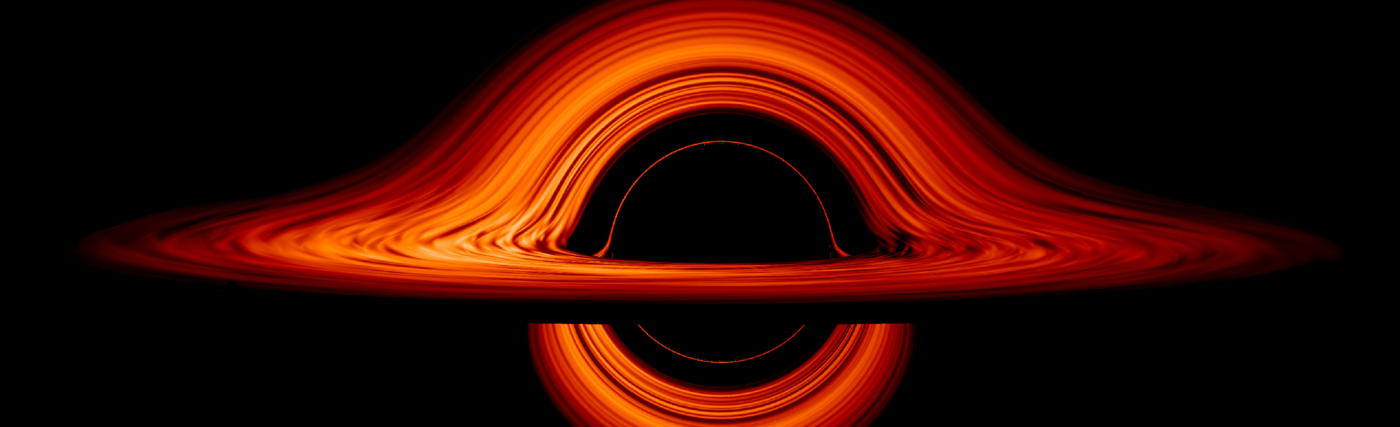
Accretion disk is the holding pattern for the material that ultimately will fall in.
So, that’s the bright hot thing that you see going around the black hole.
The bright hot thing.
That’s the accretion disk.
The reason why it exists at all is because rarely is anything moving through space and headed exactly toward the black hole.
Okay.
Even if the black hole influences its path, it will curve it around, but it’s never headed straight in.
That’s a very rare trajectory to head straight in.
Okay.
All right.
So the material gathers and it wants to fall in.
Now, if you jump off a roof, why does hitting the ground kill you?
Well, because the ground is not going anywhere.
When you jump off, you’re speeding.
You’re speeding up.
Yeah.
You speed up.
You just fall and fall and fall.
No, but you can jump off a curb and you’re not going to die.
Because you weren’t falling long enough to have high speed.
Gotcha.
I see where you’re going.
It’s a simple point.
It’s a real simple point.
So, where did you get the energy that was ultimately manifest as high speed at the bottom?
The elevator gave you that energy.
Right.
Called gravitational potential energy.
Gotcha.
So, you’re at the top, you fall, at the bottom, you die.
Gotcha.
Here is material falling into the black hole.
Where does its energy go?
Because it’s speeding up, but then you get stuck in the…
Oh, that’s so cool.
It gets stuck in the…
So, that’s the ground for the black hole.
Yes, yes, yes.
That is awesome.
Yes, yes.
That’s why it’s all hot and bright.
Because normally when you hit the ground, it breaks all your bones.
Yes.
But if you’re gas cloud, that becomes heat.
Dude, that’s amazing.
It heats up.
And it heats up to such high temperatures, it begins to radiate ultraviolet x-rays.
And so, x-ray telescopes are what discover black holes.
So, if the asteroid simply fell straight into the black hole, nothing would happen to the accretion disk.
Nothing.
Because it would just speed up and get lost on the other side.
But if you hit the accretion disk, all that extra speed had to go somewhere.
And it’s distributed throughout the Korea.
And that energy is now in the accretion disk.
It’s in the accretion disk.
And that’s why…
And it heats up and then it expands.
So, when you see light from a black hole, you’re not seeing any light from inside because light can’t escape a black hole.
That’s what you’re seeing.
You’re seeing the accretion disk or the material is trying to get in so fast that the heat is so immense that the accretion disk is preventing the heat from escaping.
What’s the only way the heat can escape?
It can’t get out through the disk.
How’s it going to get out?
It can’t.
It has to join.
No.
There’s other ways it can get out.
With the heat from the disk?
Yeah.
If it’s ferocious, it’s trying to get out of the disk, but it can’t.
Right.
There’s two ways it can get out.
Up and down.
Okay.
These are the jets that we see coming out.
Oh, the black hole jets.
Very cool.
Black hole jets.
Nice.
You get the accretion disk, black hole jets.
And the black hole jets.
And that’s what we’re seeing.
Yeah.
Black holes are cool.
Dude, what a great question.
Yeah.
That was cool.
Yeah, very good.
So the only thing wrong about the question was he assumed that the black hole had eaten.
Right.
No, but the accretion desk ate it.
Right.
And it gets hot and it expands.
You got it.
That’s what we got time for.
That was great.
A black hole leaning.
Yes.
Cosmic Queries.
Right.
Love that.
So Chuck, we got to call it quits there.
Oh, it’s a shame.
But we’ll be back.
Yeah.
Oh, I’m going to shamelessly plug my next book.
Oh, cool.
Because it’s a question and answer book.
I love it.
It’s called Just Visiting This Planet.
It’s Merlin Returning, because Merlin was a column that I wrote in a magazine for like 15 years.
And people just wrote in with questions.
That’s why I’m very comfortable in that space, because I cut my teeth as a scientist and as an educator responding to people’s questions, however crazy they were.
And so it’s just coming out now.
This is another extension of that.
And it’s illustrated by my brother, who’s an artist.
High school at Music and Art in New York City.
Very cool.
And I went to the Bronx High School of Science.
And now you guys are working together.
I’m loving it.
This is true steam in a family coming together.
Family steam.
Nice.
So, yeah.
So people who love queries about the universe, it’s questions answered with this character called Merlin.
But I think it’s more fun.
You could type it into ChatGPT.
But you know and I know there’s no soul behind those words.
There’s no there’s no entity.
There’s no personality.
Yeah, just the dead eyes of AI.
All right.
This has been StarTalk Cosmic Queries.
Until next time, I bid you to keep looking up.


 Become a Patron