


 Unlock with Patreon
About This Episode
What happened before The Big Bang? On this episode, Neil deGrasse Tyson and comic co-host Matt Kirshen answer questions about inflation theory, multiverses, the cosmic microwave background, the formation of our universe, and the possible end of the scientific method with cosmologist Brian Keating.
When did the need for inflation theory start? We travel back to the 1920s and the origins of our expanding universe. What’s the difference between inflation and expansion? Discover quantum fields, quantum fluctuations, the Heisenberg uncertainty principle, and dark energy. What sparked the Big Bang? What caused the irregularities in the cosmic microwave background?
What was Albert Einstein’s biggest blunder? What was the early universe like? We explore what plasma is and why it’s the cosmic microwave background and not other wavelengths. Find out about debates in cosmology about the impacts of inflation theory? Is it bad for society to accept inflation? We discuss the concept of the multiverse and how an article in Scientific American has led to a geek fight.
Does inflation theory spell the end of the scientific method? How much of the universe expanding will be factored into interstellar travel? What are some new discoveries from the BICEP project? Learn about efforts to prove inflation theory, cosmic acceleration, and the different versions of multiverse theory. Did our universe start and end with The Big Bounce? If the CMB is expanding outward, how can we see it if it’s past us? Finally, will it ever be possible to see beyond our horizon?
Thanks to our Patrons Jack McCarty, Mira Killian, David, Colleen OLeary, Kelia Hamilton, Lucas Charlston, Brad Z, Clueless Gamer, Billy, and larry hall for supporting us this week.
NOTE: StarTalk+ Patrons can watch or listen to this entire episode commercial-free.
Transcript
DOWNLOAD SRTWelcome to StarTalk, your place in the universe where science and pop culture collide.
StarTalk begins right now.
This is StarTalk Cosmic Queries edition.
Neil deGrasse Tyson, your personal astrophysicist.
And today, I’ve got Matt Kirshen with me as my co-host.
Matt, how you doing, man?
I’m good, thanks.
I’m coming to you from sunny Colorado.
I’m at the in-laws house right now.
Oh, at the in-laws.
Do we really need to know, like, you know, is it?
I’m just letting you know this, just so that, if anyone’s watching the video rather than just pure audio, you know that this arrangement behind me was not my doing.
This is, it’s already been commented by Lindsay, the producer, that I look the most like the professor out of anyone on this Zoom right now.
You’ve all got pristine clean offices.
I’ve got papers, reference books.
I feel very educated right now.
Let’s see, okay, now I’ve got to hold up that side of that promise.
So, Matt, Matt’s your comedian and you host a podcast, mostly science.
Probably science, probably science.
Probably science.
One day, it’ll be completely perfect.
So close, so close.
And I’ve been a guest on your program and I’ve enjoyed it and I’m waiting for my invitation to come back.
Well, you’ve got a book coming out soon, haven’t you?
Well, every month, like not now, but yeah, in a while.
Okay, if that’s enough to get me back on your show, I’m delighted.
Well, I never want to overplay my hand when it comes to getting the big guns on the show.
So we’re here because we’ve got a topic that is at the beginning of everything.
The subject today is the Big Bang, the cosmic microwave background, inflation, the origin of the universe, everything that started at the beginning.
And I have some expertise there, but not enough to like drive an entire cosmic query.
So we went combing the universe and we found Professor Brian Keating.
Brian, welcome to StarTalk.
Thank you.
So you’re a cosmologist, Chancellor’s Distinguished Professor of Physics, University of California, San Diego, UCSD, and you got a podcast of your own, which I was also a guest on.
I love the title of that one, Into the Impossible.
So that just sounds like fun, where you take the guests and where you take the audience.
And so we’ve got you here.
Let’s lay some fundamentals just for the show before we go to Matt as he digs up the questions we’ve solicited from our Patreon members.
But just, what are like the three biggest reasons why we’re all convinced that the Big Bang was a real thing?
Well, I think there’s multiple pieces of evidence, but I think none stronger is the fact that we exist and we’re made of matter.
And that matter came from somewhere.
And where it came from, I think, is best described in the least ignorant form of description as the Big Bang.
It means a lot of different things.
Some correct things, some incorrect things.
But the fact that there’s sort of shrapnel left over from the most cataclysmic explosion, literally, in the history of the cosmos, the biggest explosion that ever could be envisioned, it is perhaps not surprising that cosmologists such as myself look to whatever’s left over from this explosion to tell us what it was like when that explosion happened.
And I think the problem that the layperson has is the conflation, not the inflation, we’ll get to that, but the conflation of the Big Bang with the origin of time, with the origin of the universe.
And they need not be synonymous.
And I think that’s the most interesting development in the last few years, is this realization that what we call the Big Bang is really the terminus on a voyage backwards from today where our ignorance really ends, which is at this epoch when the first elements in the periodic table were formed.
And that took place in a period of time much, much shorter than an episode of the Big Bang Theory TV show.
So I think it’s fascinating that we are all leftover byproducts.
You know, your friend and mentor Carl Sagan, we talked about when you were on the Into the Impossible podcast, he used to say we’re all star stuff, but most of us is hydrogen.
And that hydrogen came from the Big Bang.
So we’re actually Big Bang stuff more than we are star stuff.
I like that better.
I want to be Big Bang stuff.
I mean, that does sound a bit like a scar band.
Oh yeah, very good.
There was a sentence you said, a phrase you said in the middle of that that really struck me where you said that Big Bang is where our ignorance ends.
Because I think, you know, I would have certainly younger me and probably me just now would have said it’s where our knowledge ends.
Oh, no, no, he’s coming the other way on the time vector there.
Once you have the Big Bang, everything was before that, we’re like ignorant of and we’re poking in the dark.
And now our knowledge begins going forward.
Did I get you right there?
Yeah, that’s absolutely right.
So Matt, you were thinking backwards on that one in spite of all the books that are in your space there.
I know, if only any of them were physics related.
Or I had read any of them.
There’s a lovely Japanese word, which I love to bring out on my friends, except if they’re Japanese, many of my collaborators are.
I think it’s called Sanduku, not Sudoku, but Sanduku.
It’s the art of buying books without the intention of reading them.
They have a word for that?
Yeah, they have a word for everything.
They have a word for that.
It’s Yiddish, you know, it’s a word for everything, Neil.
Oh my gosh, we need that word.
So tell me also about inflation, what everyone’s heard so much about.
What was the need for it?
Because it feels like an add-on to the Big Bang.
I mean, who ordered that, right?
The Big Bang was kind of doing okay without it.
We needed inflation, and now we’re fine.
That’s right.
Yeah, I always say, you know, our job as cosmologists, when one of my students graduates, I tell him or her, I say, congratulations, you’ve now earned your ticket to an even harder problem.
You know, because our job is to find the flaws in the currently existing paradigms of the universe.
So what happened originally, we go back way back, we go back to this guy.
You know, I’m sorry to infringe upon Matt’s territory.
I don’t know, Matt, if you’re a prop comic, but I’m a prop cosmic.
I like all my cosmology puppets.
I got one of Neil in my office.
I broke that out last time, but here’s Galileo.
We’ll break them out as necessary.
So Brian is holding up finger puppets, sock puppets, of various people.
And he just held up Albert Einstein, okay.
Yeah.
So Einstein and many of his contemporaries for thousands of years prior to him believed the universe was eternal, static, perhaps cyclic, if you go back way far before in the Egyptian cosmology of the thousands of BCE years.
People believed in either cyclic or static, some version of an eternally existing universe.
And it wasn’t until the late 1920s when the notion that the universe was dynamic and not static came into play based on evidence collected by Vesto Slipher, Henrietta Levitt and of course Edwin Hubble.
And these scientists ushered in this notion that was allied with a theoretical, you know, conception by a Belgian priest named Lemaitre that the universe could have been and should have been much smaller in the past if today it’s much, much larger and tomorrow it will be larger yet.
So the notion that the universe began with a Big Bang really got ushered in in that epoch, but, and it’s less than a hundred years old.
It’s pretty fascinating to think about that.
And it’s had its own incarnations, but it was dissolved to solve a problem in the pre-existing cosmogony, the origin of the universe not existing, that it being static, eternal.
Well, that was inconsistent with evidence.
Big Bang comes along, boom, that supplants it with evidence and data.
I see what you did there, you said boom.
I see what you did there.
I’ve got to put a bang in there every so often, per my contract with Big Bang Productions.
And then, as often happens, the ticket that I said is to solving a problem is a new problem.
And so people realize the, I’m going to drop another word on you that Neil will know, but our British friend might not, lacuna.
We have a gap in our understanding based on the data, based on the observations, that there was something incommensurate with the Big Bang Theory that couldn’t be explained.
Namely, how the universe got its spots behind me.
I have a beach ball if you’re watching and if you’re listening.
It’s an inflatable beach ball produced by the WMAP team.
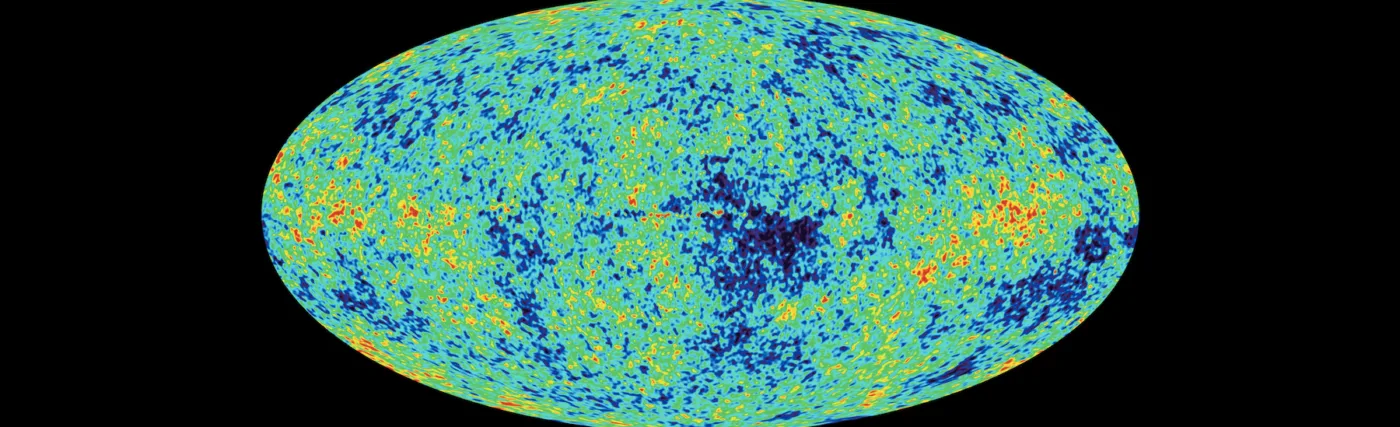
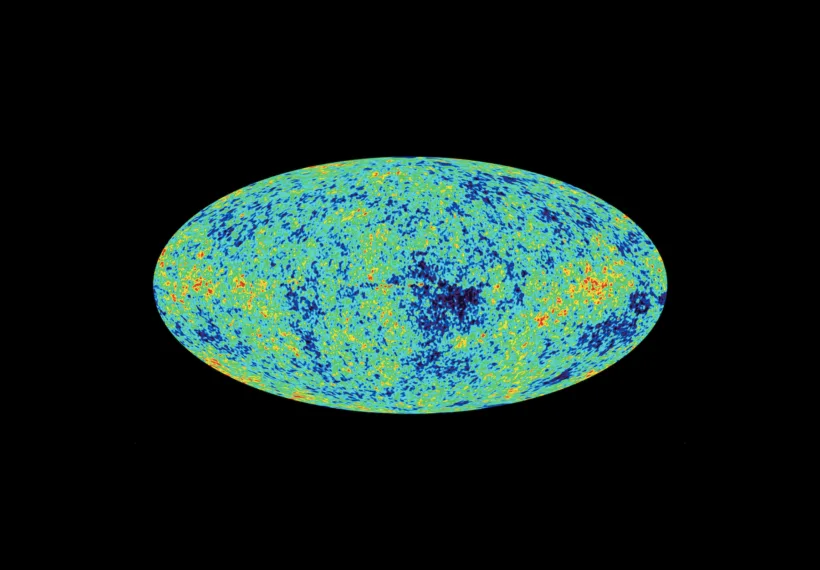
Neil’s friend, David Spergel, and others have produced a beach ball representation of the fluctuations in the cosmic macular background, which is what I study, I assume we’ll get into that.
And other features of the universe became incompatible with a universe that was purely emerging from a singularity or from a very compact dense state.
And to explain the peculiarities that were observed in the data in the 1970s, as Neil said, we required some kind of explanation.
That explanation was conceived by Alan Guth and Paul Steinhardt and Andre Linde and many others, Stephen Hawking, to have different features of what we now call inflation.
But the difference is that there is evidence for inflation, but I would say it’s more circumstantial.
What inflation explains is why the universe is so large, so flat, and possessing tiny fluctuations, and also having other properties that we can observe in the data about the various amounts of particles, energy, forces and fields.
And so it’s exciting, but it’s not proven.
Right now, inflation is about 7%.
So what percent inflation was the universe at?
Can I take it further back?
Because I’m confused here.
So just to be clear, there is a difference between inflation and expansion.
Expansion is what I’ve known, you know, learning from like school physics, is the universe is expanding.
We know that from like redshift, from the Doppler effect, and you reverse it back, and that’s how you calculate when the Big Bang happened.
What’s inflation and how is that different?
You could think of inflation, if you think of the Big Bang as an explosion.
It’s not an explosion in the conventional sense, but it could be helpful to think about it as an explosion happening everywhere at a single moment in time, if indeed that did launch the origin of time.
We can talk about that.
But the spark that ignited that explosion, if you will, relies in the inflation paradigm on a quantum field, a new object, a new entity in the inventory of the energy budget of the universe.
And that energy is provided by a quantum field called the inflaton or inflaton.
And that drove this exponential expansion of the universe that happened a trillionth of a trillionth of a trillionth of a second after the Big Bang, if the Big Bang was indeed the origin and a singularity in the classical conception of that term.
And that lasted for less than a trillionth of a trillionth of a second.
And in that time, the universe inflated from a grapefruit size to 30 orders of magnitude larger than a grapefruit size.
And that happened at a rate, if you calculate how fast that would occur, it’s far in excess of the speed of light.
And so it’s the ultimate energy injection into the universe.
It has many properties in common with what we call dark energy and the cosmic acceleration that we observe today that was awarded to, Nobel Prize was awarded to three physicists in 2011.
Dark energy, cosmic acceleration.
That new field, which we just call dark energy, has many properties in common with the inflation occurrence.
But the inflation would have occurred 13 billion years, almost 14 billion years earlier.
So inflation is the spark that gives the impetus that causes the universe to expand to the vast size that it is today in an exponentially small amount of time.
And that explains why the universe has the particular pattern of microwave background fluctuations that my colleagues and I study.
So I want to go to our questions real quick.
But just frankly, Brian, if I would hear all that for the first time, it sounds like you just made it all up just now.
It sounds like…
How about inflation?
Yeah, that’s a ticket.
Let’s code this.
You know those books, Neil, that say everything I needed to learn, I learned about in kindergarten?
Well, everything you needed to learn about inflation, you can learn in advanced quantum mechanics.
Oh, okay.
Well, there you go.
So, Matt, give me what you have for us.
There’s a bunch of questions immediately right on this subject.
So, Chris Love asks, regarding the cosmic microwave background, whenever I see an image that represents it, there are hot and cold spots all over it.
I’m curious what the mechanism might be that causes those hot and cold spots.
Is it the distribution of normal matter, dark matter, the expansion of space-time or something else?
Thank you for the knowledge and keep looking up.
And also, you know, because all those maps are color coded to represent temperature, we’re left with the impression that you touch one spot, it feels hot.
You touch one spot, it feels cold.
So, but that’s not…
No, that’s just to help the viewer see what’s going on.
They really are hotter or colder, but let me explain first.
Yeah, but by how much?
Oh, well, a very, very, you know, frosty 10, 1 millionths of a degree Kelvin.
Yes, exactly.
You’re not going to pick that up on your Edmund scientific thermometer.
Right, right.
So, the hot sections are…
About 100 micro Kelvin hotter than the average CMB temperature, which is 2.7 Kelvin.
Got it, got it.
2.7 Kelvin, which is…
Yes, which is minus 400…
Yeah, it’s frosty day in Denver, where you’re at, Matt.
It’ll be 454 degrees below zero Fahrenheit.
I just want to make it clear that we say they’re hot and cold spots, but the range in that temperature is smaller than any two places in the room you’re in.
Well, Neil, you know better than anybody, you know, what cosmologists will call a crisis, the fact that a boson has one billionth of a percent more mass than it was expected to.
That’s a crisis!
I’m going to jump out of any windows on that one.
That’s right.
Yeah.
So to explain these fluctuations in the cosmic microwave background, let’s explain what the CMB is.
The CMB is the Cosmic Microwave Background.
It’s an all-pervasive field of photons coming to us as if we’re inside of an enormous oven.
And that oven, thank God for us, is only at a temperature of 2.7 degrees above absolute zero or 450 or so degrees below zero Fahrenheit.
And that was discovered in 1965 in, of all places, New Jersey.
And I’m a New Yorker, Neil, so I can make fun in New Jersey.
I have a ticket, I have a license to do that.
So it was discovered in Holmdale, New Jersey by Penzias and Wilson.
They couldn’t get rid of it no matter where they looked, when they looked, how they looked.
This background radiation comes to us in all directions.
And they thought it was perfectly uniform.
But over the decades, cosmologists realized it has major amounts of a very difficult word to pronounce for the first time, but anisotropy.
So anisotropy means not isotropic.
Isotropic means it looks the same everywhere you look.
And so these are notions that have to be explained.
Why is the universe very, very close to perfectly uniform, but it’s not perfectly uniform?
We’ve known since the time of Isaac Newton, the finger puppet somewhere around here, Isaac Newton said, if the universe were perfectly static and isotropic everywhere you looked, then we would never form.
There’d be nothing to break the symmetry and say, oh, a planet should form here, a star should form there.
Under even the Newtonian…
Matter would just be equally spread everywhere, I guess.
It would never condense and collapse and form bound gravitational structures.
So, we’ve known that the universe couldn’t be perfectly uniform in that everywhere you looked in the universe, you saw the exact same temperature.
But the question to ask, what’s causing it?
Yeah.
So, what’s causing it was the reason that inflation needed to be explained.
So, in the inflationary paradigm, the explanation comes from the fact that the thing that blew up the universe by 30 orders of magnitude from an initial cosmic primeval seed was a fluctuation in a quantum field, what’s called a scalar field.
And that field I called it before, the inflaton.
This quantum field, like all quantum fields, like the Higgs boson, like the photon field, like any field that you so choose in physics, has unavoidable, irreducible quantum fluctuations.
A quantum fluctuation is an expression of the Heisenberg uncertainty principle.
That you can’t know exactly all the information about a quantum field or quantum particle, a photon, an electron, a croton, my favorite particle.
You can’t know everything about them with infinite precision.
If you do, you have complete uncertainty in other aspects of its property.
So one thing we know is that at this extremely brief epoch of time in inflation, there would have been large fluctuations in the amount of energy in the universe.
And Einstein says that all forms of energy are equivalent to sort of a mass fluctuation via the most famous equation in all of science, E equals mc squared.
So the theory is this.
The inflaton is a quantum field.
It, like all quantum fields, has fluctuations.
Those fluctuations can be equated to sort of mass inhomogeneities.
And those mass inhomogeneities then, according to Einstein’s general theory of relativity, equate to the curvature of spacetime, which the questioner asked about.
So if you look at the fundamental logic of progression, inflation explains the CMB fluctuations by the fact that this quantum field had these irreducible perturbations, these fluctuations, thanks to Heisenberg.
Now all this presupposes that inflation exists, which we don’t know about.
And what my team of scientists in the Simons Observatory is attempting to do is build an experiment, an instrument to collect data to provide evidence for those quantum fluctuations.
And we can get into how we do that.
But the base answer to that question that was very astutely posed by the audience is that they do represent actual overdensities in temperature and in matter in the early universe that were caused by primordial seeds themselves caused by fluctuations in this quantum field.
I know it sounds complicated, but I mean, your audience is pretty brilliant, so I don’t want to under-answer.
As Lady Gaga says, born that way.
That’s okay.
All right, we’re going there.
We’ll take a quick break.
When we come back, we’ll get right back into the questions with our guest, Brian Keating, who is a cosmologist, who’s taking us back to the beginning of things, the beginning of time, space, energy and all that.
And I got Matt Kirshen helping me out here when we return.
Hi, I’m Chris Cohen from Haworth, New Jersey, and I support StarTalk on Patreon.
Please enjoy this episode of StarTalk Radio with your and my favorite personal astrophysicist, Neil deGrasse Tyson.
We’re back, StarTalk Cosmic Queries, Cosmology Big Bang Edition with cosmologist Brian Keating, who hosts the podcast, Into the Impossible, which, Brian, that comes from a quote from Arthur C.
Clarke, is that right?
Yeah, that’s right, yeah.
So when you were on my podcast, I’ll have you back on, hopefully this fall, and it’s a famous quote, Arthur C.
Clarke, so I co-direct the Arthur C.
Clarke Center for Human Imagination at UC San Diego.
Excuse me?
And Sir Arthur had many aphorisms, many cosmic quips.
One of them that you like is, for every expert, there’s an equal and opposite expert.
He also said, for any advanced technology is indistinguishable from magic.
And then he said, the only way to determine the limits of the possible is to go beyond them into the impossible.
So that’s the origin of our podcast.
Cool, into the impossible.
One other thing before we pick up our next question with Matt.
We’re in this year, we’re in the 2020s.
And this is like the centennial decade of all kinds of wild, freaky discoveries made in the 1920s, Brian.
And when I think back on that, to me, the 1920s must have been the greatest watershed decade in physics of any decade there ever has been, or perhaps will be, from the expanding universe to Einstein, you know, and they were trying to figure out Einstein.
Do you have any special memory you have?
Yeah, well, I’m not quite that old, Neil.
But it’s true, yeah.
You’ve held up well.
The discovery of antimatter, the prediction of antimatter, quantum field theory, all these wonderful things.
Yeah, you’re right.
Alexander Friedman, we were chatting about off air.
You know, he came up 100 years ago in 1922 with the initial framework for what would later become known as the Friedman equations, which are the derivation from Einstein’s theory of general relativity that the universe can either expand or contract, but it can’t really be static unless you put in, as Einstein did, a fudge factor, which he called the cosmological term or the vacuum term, the lambda term, and he was steadfastly in opposition to these predictions refined by George LaMaitre later on.
In fact, Einstein said famously, your mathematics is exquisite, LaMaitre and Friedman, but your physics is atrocious.
You know, it’s just one of the many blunders that Einstein had.
You know, it’s too bad, Neil, because he could have had a good career.
I know, I know, I know.
But since at the end of the day, this cosmological constant was real, all right, in the dark energy term, what I like saying is that Einstein’s biggest blunder was saying that that was his biggest blunder.
Never admit, never admit.
He’s so badass that even when he was wrong, he was right.
That’s right.
And we’re still finding things out about him that he predicted and now are only now being verified.
Yeah, that’s true.
Exactly, exactly.
So, Matt, give me some more, dude.
This is great.
By the way, there’s a bunch of people’s questions that have been answered just in the process of you answering the other questions.
So, I hope people feel satisfied with that.
Let’s hear their names anyway.
Okay, thank god, guys.
I’ll talk to you later.
I got to go.
No, let’s hear their names anyway.
Rebecca Fusk asked a question about why would space suddenly inflate and what makes it inflate, which you answered.
Good, we got that.
Checkbox there, yeah.
Yeah, but Jeff Hunt says, As a layman, I understand the cosmic microwave background radiation to be the echo of the radiation from the moment the universe starts to cool.
What is our current understanding of what existed before the temperature dropped enough for it to become visible?
Ah, so that’s another very astute question.
So the CMB, or Cosmic Microwave Background, are the oldest photons in the universe.
So what we want to do is explain where do those photons come from?
Why did we just get to see them as they were 380,000 years after the Big Bang?
So those photons…
Yeah, I want to see them 379,000 years after the Big Bang, okay?
So come back on the show when you can tell me that, alright?
Yeah, you need a time machine.
And luckily we have telescopes like this, time machines, telescopes are time machines, alright?
So when we look at the CMB, we ask where did those photons come from?
And then of course we’re going to ask where did the matter and the plasma that made those photons, which is what they are originating from, where did that come from?
Where did the thing that came before, where did the inflaton come from?
I’m sure one of your audience is going to ask me that, right?
So that’s what we do in science and we may come to a point where we have to throw up our hands and say we don’t know.
But we’re not ready to do that yet because in a sense we haven’t reached the limit of what data can tell us.
So the answer to the directly answer to the question is those photons are the leftover heat that come from the fusion of hydrogen and its isotopes into helium, lithium, beryllium and the lightest, you know, five or six different elements on the periodic table.
That occurred in the first few minutes after the Big Bang.
And then there was really a plasma that the universe was too hot right after you nuclearly fuse, and that’s not a word, but you fuse together two protons, you are left over with enormous amounts of heat.
That’s how the sun produces so much heat and light.
Well, that heat and light doesn’t allow atoms to form.
So an atom is a binding of a proton and an electron that makes a hydrogen atom.
So the nucleus of hydrogen is a proton, and then the electron come together.
The universe was simply too hot.
It was being zapped by photons.
Any time a hydrogen atom deigned to form, it would get immediately zapped apart, ionized, as we say.
And that occurred until the heat cooled off due to the expansion of the universe.
And that took 380,000 years.
Yeah, so what did the universe look like before then?
It was an opaque plasma.
It was essentially two plasmas, a plasma of, which is the fourth state of matter.
It’s a purely conductive medium made up of pure protons or pure electrons, charged particles, and charged particles are opaque.
So a mirror is actually not a bad representation of a plasma.
Plasmas reflect all the photons on the, if there’s enough plasma in three dimensions, unlike a mirror, which is two dimensional, then the plasma will just keep reflecting the light and it’s kind of like a cloud or a three dimensional mirror, if you will.
The light can’t escape.
Normally when we think of opaque, we’re not thinking of a glowing object.
So this is a full three dimensional glowing thing that is the universe that you can’t see through, much like, I guess, the sun.
You can’t see through the sun.
Yeah.
You can’t see through the sun.
It traps any light that tries to, any light photons that hit it are just going to bounce around or just be…
Yep.
Yep.
It’ll be bouncing around.
So plasmas are opaque, but neutral atoms are transparent.
So once hydrogen could form, the universe went from a plasma, two plasmas as I said, to a single gas of hydrogen.
And that took about 380,000 years.
It didn’t happen instantaneously.
It’s much like a condensation process.
You have steam in a shower.
If you ever go to a steam shower, you can’t see through the steam.
It looks like a fog.
None of us have ever showered.
I’m glad we’re not doing this in person, Neil.
I’m glad we’re not doing this in person.
I’ve never seen a steam shower.
Of course we’ve seen it.
What kind of…
Have you ever been to a Turkish bath?
We all have good hygiene, I think, in my audience here.
But go on.
So you know that if you have a steamy shower and then you turn on cold water, the water vapor condenses and makes liquid.
And then you can see in the shower.
So that process, the analog of that process is the formation of hydrogen.
Then the universe became transparent.
And we see those leftover photons which have their beginning in the fiery cauldron that produced the first elements on the periodic table.
So I think it would be a cool trick if you could turn the sun into a transparent ball of gas rather than the plasma that it is.
And just watch that happen.
And then it would just basically disappear, right?
And you would get to see what was behind it.
So you just throw some cold water in there?
That’s all you need to do.
Just add a little bit of cold?
In the plasma shower.
Go at night.
Don’t forget.
Related to this, Eric Varga asks, why is there only one type of wavelength of light, microwaves, to see the cosmic background?
Why do we not have ultraviolet or gamma or radio cosmic background?
Love it.
Love it.
These are great questions.
Go for it.
So I said that the cosmic microwave background, it is a relic at a temperature.
I classified that by its temperature.
The universe and the cosmic microwave background photons is an example of what’s called a black body radiation source.
A black body, these were first discovered and their properties were explained by Planck in 1900.
And they are reflective of the fact that any object made of ordinary matter…
But don’t use the word reflective in that sentence.
Choose a different word.
Yes.
Pun intended, Neil.
Pun without discretion.
They were absorptive.
So they were, they are representative of the fact that you heat up anything, including an iron rod or a ball of hydrogen and helium like the sun, to any temperature, it will emit a broad range of wavelengths.
So in fact, there were originally wavelengths of light that were invisible because they were too short for the human eye to see.
They were ultraviolet.
They were equivalent to the energy that’s required to zap apart a hydrogen atom into a proton and an electron.
So that energy level corresponds to a wavelength of light that was very small.
But since the universe has been expanding all the wavelengths in that black body, which kind of looks like a bell curve, the distribution of energy versus wavelength, the peak today has been redshifted by 1,000 times the value that it had when the hydrogen gas first condensed 380,000 years after the Big Bang.
Not 380,000 years ago, 13,800,000,000 years ago.
And so since that time the universe has been expanding by a factor of 1,000 and it went from ultraviolet, and if you just do the math, the ultraviolet wavelength expanded by 1,000 times, you get about 2 mm wavelength.
But that’s just the peak.
It’s like a bell curve.
There are indeed photons of shorter wavelength and longer wavelength in the black body distribution.
So why doesn’t anyone talk about them?
Because the peak is exponentially decaying on either side.
So you have massively easier time detecting the peak photons than you do the shorter or longer ones.
But in fact, Penzias and Wilson did detect the longer wavelength, less energetic photons, to almost 50 times lower in energy than the photons that we detect today with our more advanced technology.
Okay, cool.
So we could in fact have a cosmic radio wave spectrum or a cosmic infrared spectrum.
But we don’t reference it that way, because the emissions in those band passes is meager.
That’s right.
Also, when we talk about the sun, the sun peaks in the visible part of the spectrum.
But I think if you add up all the infrared coming from the sun, we have more infrared than visible light.
I think I did the math on that once.
Yeah, that’s right.
And you can detect it with your hand with your eyes closed.
Yeah, I guess so.
There you go.
At least you have a heat source.
Matt, give me some more.
All right.
So Jared Sorba asks, Sorba rather says, what do we make of the more recent data that seems to indicate inflation may not be as even as we thought?
If so, is the new physics the same physics with slightly different implications or too early to tell?
I think you answered the first part of that a bit earlier on.
Yeah, but I like that.
So let me add a little nuance to that question, Brian.
So if the inflation is not symmetric, and I’m not up on that news story, but at what point do you say we just need to tweak the inflation rather than say, oh, my gosh, we need new physics?
So that’s one of these many cosmic controversies, as the Brits might say, that are kind of…
This is America, Jack.
Don’t break out the Bronx accent.
Don’t break out the Bronx accent.
I’ll break out my Long Island accent.
You don’t have to pretend you’re going to be British.
No, this is America, Jack.
You’re from New York City.
America.
So when we do observe the cosmos, the first thing that you’d want to say is that the universe is isotropic, as I said before, but not perfectly isotropic.
And it should be homogeneous, which means that it should be the same kind of physical properties everywhere in the universe, but it should also look the same everywhere you are in the universe on average.
Okay, I can’t tell you that every single star should look identical to every other single star in every direction you look.
Of course not.
But our theory of inflation predicts that there should be an expansion of the universe and only in kind of models that don’t obey perfect cosmological symmetry.
In other words, what’s called the cosmological principle, which is an extension of what’s called the Copernican principle, which is basically, I call it the cosmic big brother that says, you’re not special, you ain’t so great.
You know, it says that the earth is not the center of the universe.
Somebody needs therapy.
It’s just…
It’s that…
Not all big brothers treated their kid brothers that way.
I can only speak for how I treat my two younger brothers.
Thank you.
So when we assume that the universe is on bulk scales, homogeneous and isotropic, that means that if we find a departure from that, we’re really calling into question the underlying symmetries that we expect the universe to hold to.
Now, I should say there are alternatives to inflation which have caused even more controversy, that people believe that inflation is not only incorrect, not only not good science, but there are even those that say it is bad for society to accept inflation.
So this rose to a head in 2017 when a Scientific American article was published by my friend Anna Aegis, Paul Steinhardt at Princeton, the two of them, and Avi Loeb who is at Harvard.
And they published an article in Scientific American and said the universe inflation leads to this concept called the multiverse.
And the multiverse to them, this is their opinion, spelled the end of the scientific method.
Because in the multiverse it literally means that I have a podcast called Likely Science and that Matt has a podcast called Probably Impossible and Neil has talks.
Anyway, it says that everything that possibly can happen, according to Lindy, Guth and others, does happen in this capacious universe.
So they claim, these three authors claim, it was inconsequential, inconsistent with the scientific method.
Then there was a letter written by 30 Nobel Prize winners and Guggenheim fellows and a responsa to it, Rick David Kaiser and Alan Guth and many others.
Geek fight, geek fight.
It was a fight.
It was incredible.
I couldn’t believe it.
On the pages of Scientific American.
It was like the Inquisition.
And they said, this is wrong.
You’re not scientists.
No, you’re not scientists.
But just to be clear, that original letter, that group were espousing a completely different model for the universe than what is currently here.
So they already peaked their whole card, right?
Right, exactly.
They’re going to write a letter.
What do you think is going to be in the letter?
They’re going to say everybody else is wrong and they’re right.
That’s right.
We’re going to take another break.
And when we come back, let’s try to do maybe a lightning round.
Matt, do you think Brian has that in him?
A lightning round?
I think he does.
I think even still we’re not going to get through all of them because this was one of the most popular subjects ever.
One of the most popular.
I don’t think Brian has it in him.
He’s a mixed explainer there.
We’ll see how he does on a sound bite mode.
Alright, when StarTalk continues.
We’re back.
StarTalk Cosmiquequery’s Cosmology, early universe edition with Brian Keating.
And Brian, you do a lot of stuff for the public.
I was very impressed to see you visit high schools, you’ve written books, so you’re a man about town, bringing your expertise to all those who will listen.
And you do it well enough so that that’s a growing supply of people, because you could bring it to all who will listen today, and that could get halved every day if you really suck at it.
So, very good to see that this is a growing…
I’m a little controversial because I say I believe that scientists such as myself have a moral obligation to give an explanation to the public.
I don’t think that’s controversial.
Well, my colleagues think it is.
They say, well, why are you wasting your time on the YouTube channel?
Yeah, of course they’re going to say that.
Of course they’re going to say that.
We are not among those who feel that way about you.
Because your YouTube channel is doing better than theirs.
No, that’s exactly…
I would kill for them to…
I would give them my following.
They don’t even have a YouTube channel.
That’s what the problem is.
That’s the problem.
All right, lightning mode.
Let’s do this.
All right, let’s crank some out then.
Don Lane asks, how much will the expanding nature of the universe figure into interstellar navigation computations?
Absolutely negligible.
The universe is expanding less than about one second per century on the appropriate scales.
It will not be observable in your lifetime, let alone in the navigational kind of trajectory.
So any place you want to go to before you die is way less than any time of significance with regard to the expanding universe.
Good.
There it is.
Nice one.
Chris Hampton says, could our universe be expanding because it is filling with space-time fluid?
And could the reason it keeps accelerating be because there are more, quote, faucets opening up?
Okay.
So, Brian, who left the spigot on?
The universe.
Of course, my wife.
It’s always me, Neil.
It’s always me.
Yeah.
Actually, the answer is very—the question is very perceptive.
Because essentially the notion of the dark energy, which is the responsible party for the accelerating universe, not only is the universe getting bigger every day, the rate at which it’s getting bigger is getting bigger every day.
Therefore, we have a time derivative of a velocity that’s called cosmic acceleration.
So we equate that— That’s called just acceleration, and this is applied to the universe, cosmic acceleration.
Yes, exactly.
Right.
So indeed, this substance has what’s called an equation of state.
And that equation of state is a relationship between a substance’s pressure when you try to compress it versus its density, how many ergs per cubic centimeter, how much energy there is per cubic centimeter.
So actually, the flubber-like material, it’s not a fluid, the dark energy, we don’t know exactly what it is, but we know what it is not.
It’s not a fluid like water.
Water has very different pressure-density relationships.
But it has a strange relationship, which when you try to compress it, it says, oh, okay, great.
Instead of resisting it like water would, it says, oh, I love this.
Let me suck you in.
And it’s kind of like an anti-gravitational force.
So, it’s not fluid like water, but it is filled with an equation of state.
And if you say it like that, you sound more erudite and you’d be correct.
The answer is yes to this question.
And it is a space-time fluid, not a traditional fluid that we might otherwise think of.
Keep it going, Matt.
Okay, Alejandro Reynoso says, Hola from Monterrey, Mexico.
And what new discoveries do you think we can get from the BICEP project?
Ah, so the BICEP project is a project I started way back in 2001.
We built a polarimeter, which is a telescope…
But first, why BICEP?
What does that word come from?
So BICEP is a corny name that I came up with.
It stands for Background Imager of Cosmic Extragalactic Polarization.
So I said that inflation is not proven, but there is one signal which we would hope to detect, and it’s called gravitational radiation, or waves of gravity produced by the violent shaking and shuddering of space-time.
Einstein predicts that will cause waves of gravity to percolate throughout the cosmos.
So have we found it with LIGO?
Are they looking for you?
No, LIGO cannot see this.
It’s way too weak because the universe has expanded by a factor of trillions and trillions of times since the inflationary epoch.
We can only see it with a microwave telescope to look at the imprints of these waves on the CMB.
We’re using the CMB, Neil, as the detector.
That’s so phenomenal.
Okay, so you can’t measure A, but you can measure A’s effect on B because you can measure B.
Yep.
Putting our detector right at the source.
So in 2001, I came up with an experiment with colleagues at Caltech, which we call BICEP, like I said.
It’s the subject of this book, Losing the Nobel Prize.
And that’s it right there, if you’re watching on screen.
Otherwise, I’m showing a picture of our telescope at the South Pole Antarctica, where I’ve been twice.
We put a telescope there, and we’ve upgraded it ever since.
In 2014…
But just to be clear, the address of the South Pole is South Pole, Antarctica.
That’s what that sounded like.
Or you could send it to negative 90 degrees, negative 90 degrees.
It actually has a post office, and you actually have a gift shop there.
Negative 90 degrees, and any longitude will do, right?
Because they all converge.
Every direction leads north, exactly.
At the South Pole.
So was it successful?
We’re still in soundbite mode here.
So that’s 2001, that’s 20 years ago.
So BICEP made an announcement in 2014.
We detected inflation, we detected these waves of gravity.
Turned out we detected cosmic dust, particles of dust in our galaxy, not the imprimatur of inflation.
Oh my God, stuff sitting on our nose in our own galaxy.
That’s right.
Oh, okay.
But BICEP is still flexing away.
And so it’s other, the project I lead now with my colleagues, called the Simons Observatory, which is going to be the most advanced cosmic microwave background experiment.
Named after Jim Simons, right?
The wealthy investor.
That’s right, Jim and Marilyn Simons.
Who’s very, very into science and math, which is a good thing.
All right, man, let’s keep going.
All right, Ruhan Periacheri asks from the Bay Area says, Is it possible that a new universe is born every time another universe dies, say via big rip or bounce?
We say multiverse like there are multiple universes existing parallel to us in some higher dimension.
But what if that higher dimension is actually time itself?
Very good.
Yeah, so in fact, there are multiple versions of the multiverse, as kind of this question is hinting at.
There’s a quantum mechanical multiverse, there’s a many worlds multiverse, there’s cosmological multiverse, but also there is an alternative to inflation which avoids the multiverse problem.
And that’s called a cyclic or bouncing cosmological model, which does feature a universe collapsing, if you will, to create our universe that we see.
And there’s no reason that couldn’t happen multiple times in multiple places throughout the universe.
So it’s exactly correct.
Alright.
I’m going to combine these two questions because these are two things that I struggle with conceptually.
Daniel Kolakowski says, if the cosmic microwave background is radiation expanding outward from the Big Bang, how are we able to see the light here on Earth?
Wouldn’t the radiation be traveling towards the edges of the universe and that’s not visible to us?
Thanks for helping me understand this.
And then also Robert Weaver from Michigan says, I understand it’s not possible to see beyond our cosmic horizon as light has had not enough time to travel to us.
If that is true and space is expanding faster than light, are we forever landlocked in regards to the observable universe?
No matter how fast we go, the edge is traveling faster away from us so we never see more than we do now but actually less as time goes on.
So I don’t know whether those two are connected or not but they felt conceptually connected so I checked them both at you together.
Yeah, Brian, what can you do for us here?
Alright, so imagine two observers, Albert and his evil twin, and they separate faster than the speed of light.
As long as they started out closer in distance such that their light could have, when this light was launched from one of the two observers, it could have maintained its velocity and trajectory towards the other observer.
It doesn’t matter how far away that thing is now.
We look at when it was emitted, when it was detected, and it doesn’t matter where that galaxy is now.
So it is true, there is a whole branch of objects in the universe.
In fact, I did a calculation for my cosmology class, which I’m going to teach in a few minutes, and that showed that 97% of the universe by volume is causally disconnected, can never communicate, landlocked, in the words of your poetic…
I love the reference, yeah.
Yeah, so that means that, yeah, we can’t see those objects.
It doesn’t mean we couldn’t see them in the beginning, because in the beginning they were not expanding.
They weren’t at redshift greater than one, as cosmologists call it.
So indeed, we can still see them, but we can never access them.
And there’s a difference between being able to see their original emission and being able to contact them now.
So exactly correct, they are isolated from us by cosmological event horizon.
Brian, you’re doing good here.
And then the second part of how can we see the cosmic background radiation if the universe is expanding away from us?
Yeah, let me reword that as I think I understand it.
If 380,000 years ago all these photons were set free, well, they should be in some way beyond us today, en route to exit the universe or whatever.
Why are they still headed towards us?
Well, so the photons are traveling towards us and at the time of their emission we work physically closer to them.
And since that time of emission, the time at which the CMB was formed, the universe expanded by a factor of a thousand times.
So a photon would have been within our cosmic horizon, would have been able to access us, just like any object that’s at a redshift greater than one.
You could ask that question of any object, the CMB is at a redshift of 1100.
So the answer is similar to the answer I just gave.
It launched the photons such that they will reach us with the exact trajectory just reaching us now, and the process of this formation of the CMB was not instantaneous.
And we will continue to see those photons, but caveat that we won’t see them with the wavelength that they were originally in.
As we described earlier in the show.
So what you’re saying is it was en route to us today from the beginning is what you’re saying.
Yes.
We were in its future light cone.
Nice, nice.
So it moved not only through space, but through time.
As, of course, these things go.
All right, Matt, keep it going.
All right, Megan Munoz says, is it possible that space is created in a black hole?
I have this weird theory that the matter that goes into a black hole may be torn apart so much that it literally turns to space.
And I mean, not only does the object disintegrate, but in the process more space is created than was originally taken up by the mass.
Maybe that’s why space expands.
That is, if the new space could make it outside of the black hole, can I have a scholarship?
Has it made enough to get a professorship from one of you?
So, Brian, if he has any answer other than I don’t know, let’s ask him when was the last time he visited the inside of a black hole.
Okay, go Brian.
The shower, exactly.
So, right, so I get about ten letters a week saying, you know, Einstein was wrong, I can prove it, but I’m not good at math, so can you share the Nobel Prize with me?
You do the math and you figure it out.
That’s right.
I’ll keep the Nobel Prize.
Thank you.
So, no, we have no evidence for that.
It doesn’t mean it’s not possible.
There are people that do predict that time is created when black holes at the, beyond, inside the event horizon, singularity, but we have no way to access it.
It is beyond the event horizon.
So even if it did get produced, like Hawking radiation, we’ve heard about Hawking radiation undoubtedly, that radiation exists, but it’s so impossible, even in practice, to envision detecting it, it’s all but irrelevant, as is, unfortunately, your new theory.
Sorry, scholarship revoked.
That was a smackdown if I ever heard one.
At least take me out for a drink before you ask me for a scholarship.
Matt, I don’t think we have any time for any more.
Do we leave a lot on the cutting room floor?
Oh, there are so many good questions.
You could do a whole second, maybe even three episodes of Public Works.
We will totally have to do another episode on this.
Well, Brian, it’s been great having you on.
I think you’re first time on StarTalk.
Let’s make sure it’s not the last.
And Matt, you’re a comedian, so is that what you do at nights?
After sunset?
Yeah, that’s the after dark job.
So yeah, I post what shows I’m doing on Twitter, at Matt Kirshen, and then probably Science is the podcast, and I mention my shows on there as well.
And you do stand-up, so if you want to find you, find out what city you’re in, we can find you on your website.
And Brian, how can we find you in the social media pantheon?
I’m at Dr.
Brian Keating, Twitter, Instagram, and my website, briankeating.com.
If you join my mailing list, I will send you all a piece of space dust, a meteorite from the origin of time and space itself.
briankeating.com is the way to find me.
That’s a little suspicious there, but okay, I’ll let you have that one.
I was going to say how big the space dust is.
Isn’t all matter in some level space dust?
That’s true.
As Carl Sagan said, we are a rock emote of dust floating on the sun.
Yeah, there you go.
Pale blue dot.
Alright guys, this has been StarTalk Cosmic Queries, the Cosmology edition.
Clearly we’re going to have to do some more of these.
Brian, good to have you.
Matt, always good to see you as my co-host.
Thanks, my friend.
Neil deGrasse Tyson, your personal astrophysicist.



 Become a Patron