“Why are some asteroids mineral rich and some just big rocks?” “Is the asteroid belt actually the debris from a failed planet?” “What’s the difference between comets, asteroids, meteoroids, meteors, meteorites, planets, dwarf planets and more?” “Are there interstellar asteroids?” “Do we have the ability to track meteors the size of the one that exploded recently over Russia?” In this week’s podcast, Neil deGrasse Tyson and comic co-host Chuck Nice answer fan questions about asteroids. You’ll find out why the Moon doesn’t have an iron core, what science fiction movies get wrong about the asteroid belt, and what happened to the other planets in our early solar system. You’ll also learn about Abe Lincoln and the Leonid Meteor Storm of 1833, the practicality of deflecting asteroids to use as weapons, and whether Neil would rather be a pirate or a ninja. (And that’s not even the weirdest question this episode!)
Transcript
DOWNLOAD SRT
Welcome to StarTalk, your place in the universe where science and pop culture collide. StarTalk begins right now. This is StarTalk, the Cosmic Queries edition. I'm Neil deGrasse Tyson, in studio with Chuck Nice. Hey, Neil. Hey, Chuck. Hey, good...
Welcome to StarTalk, your place in the universe where science and pop culture collide.
StarTalk begins right now.
This is StarTalk, the Cosmic Queries edition.
I'm Neil deGrasse Tyson, in studio with Chuck Nice.
Hey, Neil.
Hey, Chuck.
Hey, good to see you, man.
This is not our first rodeo.
No, it is not.
It is not.
No, it is not.
What have we done?
We've collected questions from our fan base, basically, those who like us on Facebook or to-
Or Twitter.
Or, yeah.
Or Google Plus.
Or Google Plus, and they've been, we've solicited questions from them on the topic of-
Asteroids, yes.
Asteroids, yes.
Great video game back in the day, by the way, I just gotta say.
You're dating yourself.
Yeah, and that and Pong, you were totally rocking the bar scene, I'm sure.
No, I like asteroids too, and I have a bit of trivia about asteroids later on if you're interested, the game asteroids.
Okay.
If you remember, and if you're interested.
I will keep that in mind.
So you've got them all, so let's rock the house.
And let us remind the audience that these are questions that you have not seen.
I've not seen, and I can't claim to, this is not Stump Dr.
Tyson.
No, it's not.
It's not, but it's, I don't want to see them in advance because it's more fun hearing them right up front.
And we get to hear your truly spontaneous answer to these things.
You hear me fumble over, and if I don't know an answer, I'll just say, go next.
Right, exactly, right.
And we'll end the hour with the lightning round.
Which is, actually what's funny, I got a tweet that somebody retweeted from one of our former Cosmic Queries.
And the question, let me see if I can get it right, can there be time without gravity or motion?
Can there be time without motion?
And that's what the question was.
Answer, Neil, colon, no.
Moving on.
No, there can't be the measurement of time without motion.
Exactly.
There's of course time without motion.
Let's jump right into this and let's start off with Deepak Argawal is the person who sent this in.
How come we never know anyone with the names of people who ask questions?
I don't know, man, but I love it.
Deepak Argawal.
I wanna hang out at a cocktail party with a guy named Deepak Argawal.
Okay, go on.
Would it be possible to go through a brief summary of the nomenclature of asteroid, minor planet, comet, meteor, meteoroid, et cetera?
Sometimes I think people, including myself, toss these terms around, are not completely sure of what all the differences may be.
Great question, because I'm in that group that he talked about.
Are you ready?
Please go right ahead.
In the solar system, there's a star, and we call that the sun.
By the way, it wasn't always thought of as a star.
The star was what was on the sky, and the sun was what we saw in our daytime sky.
Those two words were not historically the same thing.
They're not the same in the Bible.
They're two separate things.
It would be much later that we would learn that the stars of the night sky are just like the sun, except much, much farther away.
So we have the sun.
Then we have what are called planets.
Originally, planets were wanderers against the background sky, and the Greeks first named them the planetes, meaning wanderers, and there were seven wanderers, now traceable to the names we give to the seven days of the week.
So the seven wanderers were Mercury, Venus, Mars, Jupiter, Saturn, the sun, and the moon.
All of those moved against the background stars.
And so some are easy, Sunday is sun, Monday is moon, and Saturday is Saturn, right?
So those were planets originally, and no one knew anything about moons or asteroids, but comets were easy, okay?
We knew about comets, and comet is made mostly of ice, and as it comes near the sun, the ice evaporates sublimes, if you want to be technically accurate, and it grows a tail, boom, comet, no doubt about it.
Okay, so once Copernicus came along, he said, wait a minute, the sun is in the middle, and we go around the sun, and so we're a planet, the sun isn't, then planet got redefined to just be stuff that went around the sun.
Mercury, Venus, Earth, Mars, Jupiter, and Saturn.
Then we discovered Uranus and Neptune, we discovered Pluto, then we discovered asteroids.
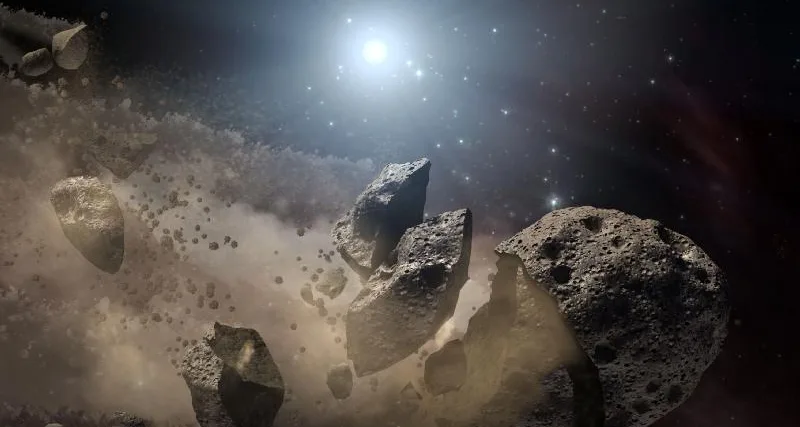
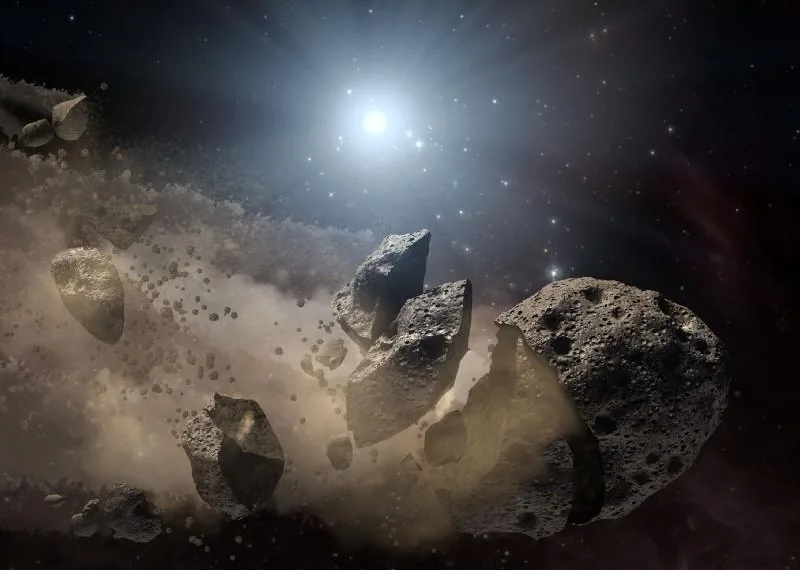
Asteroids are craggy chunks of rock that orbit primarily between Mars and Jupiter.
They're really tiny, they're so small in a telescope, you cannot see their surface.
Distant stars, you can't see their surface through a telescope either, they're so far away.
So people said, well, if they're really tiny in an image, like a star, but they're not stars, they're asteroids.
So they're tiny stars?
Oh, star-like.
Star-like.
Asteroids.
Star-like.
So those are asteroids.
Gotcha.
All right, so now, as an asteroid comes crashing through our atmosphere and has rendered a glow, it is a meteor.
Gotcha.
If any of it survives and you can pick it up on the ground, it's a?
Meteorite.
Meteorite.
That I didn't know.
There you go.
Gotcha.
All right, now, since Pluto's episode, poor Pluto, when we redefined planet to mean that which is round and has cleared out its orbit of a miscellaneous debris, of most of the debris that was there when the solar system formed.
So Earth has cleaned up most of what was in its orbit.
At least we still get hit, but we cleaned up most of it.
Pluto has not.
Pluto is in a zone in the outer solar system called the Kuiper Belt.
There is more mass in the Kuiper Belt than the mass of Pluto itself.
Pluto does not own the Kuiper Belt.
Whereas we own our orbit.
You have my house.
So, we came up with a new word for round objects that don't own their space.
And those are dwarf planets.
Dwarf planets.
Exactly.
And so one of the asteroids is big enough to be round.
It doesn't own its space because it's in the asteroid belt.
That is a Ceres, is big enough to be round.
And so that's also a dwarf planet.
Ceres was the goddess of harvest and cereal comes from the name Ceres.
Nice.
We're just rocking it.
Okay, so now, Minor Planet is basically all asteroids and I think they include comets in that as well.
So everything that does not have a round shape basically we call a minor planet.
You're gonna call it a minor planet.
A kind of minor planet, that's right.
It's the catch-all drawer.
It's the catch drawer.
It's the catch drawer for the cosmos.
Minor Planet.
So that was a great question, just helping.
Oh, there's also Meteoroid, which is a tiny asteroid that is most of what you see as the shooting stars in the night sky.
So the Meteoroid becomes a Meteor, becomes a Meteorite.
Gotcha, okay, so streaking across the sky, tiny little, it's a Meteorite, lands on the ground, it's still intact, Meteorite.
Meteorite, usually the Meteorite's vaporized, but who's counting?
Man, that took almost the whole segment.
It did.
But guess what?
It was good, because now we have all of those definitions going forward.
So we can just rock the rest of it, okay.
Because I'm serious, I'm glad you did that, because some of those things, I get confused.
Even Chuck Knights gets confused.
Those things confuse, but no longer.
So you got another one, I don't know if we can fit it in the last 20 seconds of this segment, what do you got for me?
Okay, what's the reason behind some asteroids are incredibly metal rich, and some are just big rocks?
That is an awesome question.
Too long, in the next 12 seconds, I can't answer it in 12 seconds.
Okay, then would you know what?
Cliffhanger.
Cliffhanger, you gotta come back to StarTalk Radio.
We're talking about asteroids in the Cosmic Queries part, which I like to think of as StarTalk after hours.
We're back to Cosmic Queries of StarTalk.
I'm Neil deGrasse Tyson with Chuck Nice.
Yes, sir.
Chuck tweeting at ChuckNiceComic.
That's correct, that's correct, sir.
I follow you.
I follow you, too.
You make me laugh every now and then.
Oh, well, thank you.
I think I said that thank you too quickly.
Yeah, you did.
You make me laugh sometimes.
All right, so you're reading me questions that we've called from the internet.
I've not seen them, but it's not stumped Dr.
Tyson.
No, it isn't.
It's fresher, I think, if I'd never heard them before.
And right before, we had a little cliffhanger.
John Savage wanted to know, what's the reason behind why some asteroids are incredibly rich metals or metal rich, and some are just big rocks?
That's a big, that's an excellent question.
So, it turns out a very small fraction of asteroids are metal rich.
Most of the rest are rocky, okay?
They're non-metallic.
And it comes about for a really good reason.
Well, it's the fact that we find asteroids this way tells us a lot about their origin.
When the solar system formed, it's a huge gas cloud, and that gas cloud is a mixture of most of the elements on the periodic table.
There's hydrogen and helium, all the way on a cobalt, nitrogen, oxygen, silicon, iron.
All these elements are just mixed in the gas cloud, and the heavy elements are not so much, but they're there.
It's mostly hydrogen and helium.
The sun gets is mostly hydrogen and helium.
It's got like, that's where most of the hydrogen and helium went.
All right.
If you start making objects out in the solar system, once most of the hydrogen and helium is taken away, you have all the rest of these elements, and they start getting made.
If that object was ever molten, as most of these are when they form, who's gonna sink to the bottom?
The heaviest.
The heavy stuff.
The iron, the platinum, the gold, the iridium, the osmium, the tungsten, all gonna sink to the bottom.
And the lighter stuff is gonna flow to the top, which is the, what are they called, silicate, so rocks.
Compared to iron, rock is light, right?
So those rise to the top.
And so now you have a body that has formed in space, and then another object smashes it to smithereens.
And the smithereens are now asteroids.
Right.
So now you have rocky asteroids made from the crust and mantle of that object.
Because it came from that part, from the rocky part.
Came from the rocky part.
And then you have metallic asteroids.
That precious few, the precious atoms that collected in the center, ready to be pre-sorted for our pleasure.
Ah, yes, yes.
So the geologist calls that differentiation.
Not to be confused with what you do in calculus.
Right, okay.
Just so you know.
Just so you know.
For those of you who are wondering, because I already knew that.
You were, for the geek set.
Yeah, the geologist meant no harm by saying differentiation, but that's what that is.
So that's why earth sits at core is mostly iron.
There's a lot of iron in the universe, and it's heavy and it goes down to the middle, and all the other heavy stuff stuff is there with it.
There you go, there you go, John.
Heavy metal, it's not just a music, okay?
And by the way, there's also a lot of iron in our crust.
A lot of it is bound with other elements to make it light, but, and you find iron ore that comes through.
This is how we do our mining.
There's a lot of what goes on in mining, but if we were at the core, there would be no mining.
You just reach down, pick up the iron.
And it's there.
It's there, it's everywhere.
We're filthy with iron.
Right, do we mine rock?
No, it's just there.
All right, very cool.
Give it to me.
This is Todd Smith, look at that, what a normal name.
Is the asteroid belt a failed planet or just coagulated debris field?
Ew, that sounds like a disease.
You have coagulated debris fields, Hunter.
So, we don't know what the mass of the asteroid belt might have been in the early solar system.
I mean, I might have colleagues who work in that field who would give a good guess, but I don't work in that field, so I couldn't even guess for you.
But I can tell you how much the thing weighs now.
Really?
Yes.
Okay, you ready?
Yeah.
Bring all the asteroid pieces together and they will sum to about 5% of the mass of our moon.
What?
You heard what I said.
You heard what I said.
That's it!
That's it!
That's it!
What?
Registered you to say that again?
That's it!
That's it!
So that's why when they show these science fiction stories of, oh, we've reached the asteroid belt and they're dodging them left and right.
Every mission we've sent to the outer solar system did not have to dodge asteroids, all right?
I am so disappointed.
Yeah, so there's a zillion of them, probably a million asteroids, but they're very widely spread apart.
And in fact, the biggest asteroid, Ceres, is more massive than the rest of all the asteroids combined.
And Ceres is little, right?
So there's not much stuff out there.
So to say this was once a mighty planet, I'm not ready to say that.
Gotcha.
There's not much there to begin with.
If you put the moon out there and smash it to smithereens, it would have an awesome, it would be a 20 times more awesome asteroid belt than what we have now.
What we have right now.
Just our moon.
Except the moon doesn't have much iron.
Moon is an anomaly among large spherical objects.
It should have an iron core given its size because it would have had all those ingredients and it would have differentiated out, but it has hardly any iron, which is what led to the, this wasn't asked, but I gotta get it off my chest, which is what led to the impact theory hypothesis for the formation of the moon.
That earth formed, we already differentiated our stuff, somebody else comes along and side swipes our crust, and all of our crustal material becomes the moon.
And that's why there's a good match between the moon and our crust, and the moon has hardly any iron.
See, and I thought you were gonna say that's why we have the theory that the moon is anemic, because it has very little iron.
Nice, that's very medical of you.
Okay, what else you got?
Let's move on.
Tim Pilgrim wants to know, would it be possible to use an asteroid as an interplanetary bus service?
So you jump on the asteroid while it passes Earth, and then you jump off it again when it's going around Mars.
I love it.
Really?
I love it.
But it so would not work.
Why not?
Because you have to catch up with the asteroid to step onto it.
There you go.
And by the time you've done that, you can get to where you're going by yourself.
So in other words, it's like driving a Ferrari to catch a bus.
Yeah, exactly.
If you had the Ferrari, you don't need the bus.
There you go.
Right, now if you somehow found a way to get the asteroid to stop and start, but whatever power that is, you don't need the asteroid.
Right, you just harness that power.
You got your own spaceship.
So it's a nice idea, but no.
I think maybe it's thinking of those cartoon things where it goes by and you reach on to it and then your army elongates.
Right, and then you just get snatched along.
You snap back and then you're with it.
But no, the physics prevents that from being a useful idea, but it sounds like a really cool idea because asteroids are going everywhere.
Right, yeah, well, listen man, you get an A for creativity, F for practicality.
But okay, let's move on.
What else you got?
This is Alex Stevens.
Alex wants to know, interstellar asteroids, are there objects that enter the solar system from interstellar travel?
Also, can orbiting solar systems ever leave the sun's gravity and fly toward another star?
Please answer this one, I've been dying to know.
Okay, so this is an excellent question.
First, our studies of the formation of solar systems tell us that our solar system might have had 20 or 30 planets when it was born.
What?
Where are they now?
That's what I wanna know.
They have escaped.
What happens is they end up on unstable orbits and they get flung to interstellar space and they're called rogue planets.
They are homeless planets wandering the galaxy without a host star.
And now I feel bad for them.
No, there's surely no life on their surface, but many planets have heat sources within.
Earth still does.
Exactly.
The geologists, rather than calling it Earth heat, call it geothermal sources.
That's correct.
Because they like bigger words.
But it's Earth heat, geothermal Earth heat.
Earth has heat.
That's what gives us volcanoes and things.
It has nothing to do with the sun.
I can imagine one of these planets having life thriving deep within.
Deep within the planet.
But they would never know a day of sunlight because they are not near a star.
So it has been suggested that there are more rogue planets in this galaxy than there are planets in orbit around stars.
So that's a hypothesis that remains to be tested, but the models tell us that that is likely.
First.
Second, what was the first part of his question?
That was, so do we actually encounter objects from another solar system since we can lose objects?
Exactly.
So we can lose them.
Why won't we some come our way?
Why can't we end them?
Okay, space is vast and mostly empty.
Right.
So, something has to come near enough to us to then plunge through our orbital, our planet.
So we look for comets, which come from the outer reaches of the solar system.
It's not likely to happen with an asteroid, but comets.
Comets are cool.
First, they render themselves visible with their beautiful coma and tail.
And coma is by the way Latin for hair.
So it's Latin for hair.
And so that's how you get, that's where the comet coma gets its name.
So you can see them much farther away than you could an asteroid.
We've been looking for every comet whose orbit we can measure to see if its orbit is hyperbolic.
If you have a hyperbolic orbit, it means you have-
No, no, no.
You have a hyperbolic orbit.
You have more energy than what the sun will contain for you, which meant you were never bound to the sun to begin with.
Which means you came from outer space.
So it's the arc that goes around.
The arc that goes around.
When you speak hyperbolically, it means you're using language beyond what is necessary.
A hyperbolic orbit, it has energy beyond what the sun can contain.
We have yet to find a comet with hyperbolic velocity.
You're listening to Cosmic Queries.
Neil deGrasse Tyson here with Chuck Nice.
We'll be back in a moment.
We're back to StarTalk, Cosmic Queries, which I like to think of as StarTalk after hours.
But it's really not, it's just.
Yeah, exactly, it's just StarTalk with questions.
In some versions of StarTalk, the questions will follow one of our broadcasts.
That's why I think of it that way.
But other ways you can get this is just us.
Chuck Nice and I.
That's right.
So, we're talking about asteroids.
These are questions called from the internet.
So now, before we go any further, because I have a question.
So, you were talking about hyperbolic.
Oh, before we broke.
Yeah, before the break.
So, we've been looking for a comet with a hyperbolic velocity.
That would be sure evidence that it came from outside of our solar system.
Because a hyperbolic orbit means it has more energy than what is contained in orbit around the sun.
So then, what are the other kinds of orbit?
Types of orbits.
Yeah, so if you have exactly the energy to escape the sun, exactly the right amount, not hyperbolic energy, where you're beyond it.
You're beyond it.
Exactly energy, then you have a parabolic orbit.
A parabolic?
Yeah, a parabola.
You've all heard the word.
So now, what orbit would that be?
That's what we see as-
No, no, no, it's open-ended.
And so, when it gets to infinity, it stops.
Whereas a hyperbolic orbit, when it gets to infinity, it's still going, right?
I know that sounds crazy, but mathematically, that's how that plays out.
All right.
So, now, neither of those are bound to the sun, because they're open-ended.
So, a bound orbit would be an ellipse.
Okay.
And every comet we've ever had-
Is elliptical.
Is elliptical.
And some are extreme ellipses, damn near parabolas, but they're not parabolas, and they're definitely not hyperbolas.
Right, so-
And you keep tightening it up, and the other kind of orbit would be a perfect circle.
And the object in the solar system that comes closest to that is Venus.
Really?
Damn near perfect circle, yeah, very cool.
Let's see, I always like Venus.
So we've never found an object, but the day we do, we are all over it.
Oh, by the way, some geologists have found what types of material within asteroids that they think came from another solar system, because the chemistry doesn't match the chemistry of other things in our solar system, but they themselves were not particles moving through.
They collided with one of these, these asteroids have been hanging around for billions of years.
So they get embedded, you check it out, and they're called pre-solar grains.
They've been around even before the solar system was invented.
So they met, they met one of those hyperbolic.
I think I have that right.
Yeah, they met a hyperbolic, they said, where you going?
Very cool.
All right, well, here we go.
Does the Earth have an asteroid season?
As in a time during a period of our revolution around the sun in which we are more likely to have contact with asteroids.
Indeed we do.
Way to go, Dalton.
Yeah, so every night you look up, if you have good eyes and good seeing conditions and the moon is not in the way, moonlight is not in the way, you'll see one shooting star every minute or two.
That's the sort of the background level that's always there.
But as we go around the sun, there are streams of particles, streams of debris left over from comet orbits that had crossed our orbit.
Because as a comet nears the sun, the ice evaporates, but the other crap that's in there mixed with the ice, it dislodges and it sits in the orbit behind it and in front of it and it spreads out and that orbital path is there.
Well, when I say it's there, it continues to orbit the sun, but we plow through these orbital debris trails and that's what we call meteor showers.
Ah.
And that's why it only takes, it's one night or two nights to get a meteor shower because given our speed and orbit around the sun, 18 miles per second that is, we plow through it, come out the other side and we're clear and free again.
So we're literally moving through, like a little thunderstorm, like a little rain shower.
A little meteor shower.
And in fact, if you come through this debris exactly right after the comet passed, there's more debris there than what is average.
Then you get a meteor storm.
Ah.
Yeah, you get, oh, those are awesome.
Those you get like a hundred meteors per minute in some cases.
History tells us there were wood cuts from the 1830s and 1860s because they didn't have, photography couldn't have captured it back then.
That shows, it looks like one of these chrysanthemum starbursts in a fireworks display.
So, meteor storms happen and people freak out if you don't otherwise know what you're looking at.
Yeah, that would have to freak you out.
The gods are not pleased.
In fact, there's a story about Abe Lincoln.
In 1833, there was one of these meteor storms, the Leonid meteor shower.
You get a storm every 33 years because the comet's orbit takes 33 years to go around the sun.
And so the line up of, and its orbit crosses earth.
The line up is such that we come right near the head of the comet every 33 years.
You had one of these meteor storms in 1833.
The local preacher, who is well read in the Bible, of course, in Revelation, there's a part where it says, at the end of days, stars will fall from the sky and land on earth.
Okay, so he sees this, he comes running, knocking on doors, goes into Abe's room, says, the end of the world is near, repent.
Abe Lincoln comes running out, he looks up, sees this beautiful shower, but notices that all the stars that he's familiar with were still there.
The Big Dipper, Ryan.
Right.
He went in, went back to sleep.
And then he went and killed some vampires.
Yo, that's cool.
So it helps to know a little astrophysicist.
I mean, he was well read, better read apparently than the preacher.
So he had enough common sense to say, well, the stars are still there, this has gotta be something else.
Something else, and therefore, they are not falling out of the sky.
So that was a meteor storm.
And just one more reason to love Abe Lincoln.
That's all I can say.
I know, right?
The man freed the slaves, and, and like, snap, there you go.
There he is, he knows the night sky.
We gotta take a break.
We'll be back with more Cosmic Queries on Asteroids for StarTalk.
We're back to StarTalk, the Cosmic Queries edition.
That's right, absolutely.
Chuck, that's the voice of Chuck Nice you just heard.
Chuck, give it to me.
By the way, you can find us on the web at startalkradio.net, where there are like archival shows and stuff.
We've got blogs, it's a nice place to hang out if you have nothing better to do with it.
Yeah, and especially if you're first time here, then you can go back and see what you've missed.
See what you've missed, totally.
And you're in like a whole bunch of those, too.
Yeah, exactly.
Well, you know, I love it, especially I love doing these because I mean, where else can you connect Abraham Lincoln with meteor showers?
Okay, as we did in the last.
As we did, okay?
As we did in the last segment here, okay.
Seriously, and it now be attenuated.
That's what made it cool.
All right, let's move on.
Here we go.
This is a-
Did you just use the word attenuated?
Yes, I did.
Why, was that not good?
No, this is an SAT word, that's good.
Here we go, this is from Brendan McLennan.
If we learn how to deflect an asteroid, doesn't that actually raise our chances of being struck by one?
As there is a greater chance that a madman, a rogue country, or even us could use this technology as a doomsday weapon.
Oh, here's a man who's trying to think this through.
He certainly is.
Unintended consequences.
Absolutely.
So surely that's possible, but the energy required to direct an asteroid to a spot on the earth so that you can do damage there, when we already have nuclear weapons that can do the same thing.
With pinpoint accuracy.
With pinpoint accuracy, renders such an idea militarily pointless.
Right, so in other words, it's possible, but you would be stupid to do it.
That would just be why.
You just put a bomb in a plane and fly away.
Just what are you doing, right?
I mean, so we already can destroy countries.
Right.
We don't need to, you know, Hollywood scenarios to make that happen.
Yeah, exactly.
It's like, it's kind of like having a gun and then manually inserting a bullet into someone.
Hey, man, come here.
Come here, man.
I'm gonna push this right in your heart.
That's exactly what this is, okay.
All right, great.
All right, let's move on.
Matt Kovach, yes, Matt Kovach.
Why would the government warn us?
You sure it's not Kovach?
It could be Kovach.
Yeah, Kovach.
Why would the government warn us if an asteroid that was big enough to cause extinction were on its way for a direct impact with the Earth and only the government knew it and could not stop it or divert it?
I mean, why would they let us know?
In other words, if this is gonna happen, there's no way in hell the government's gonna let us know, right?
You know why?
Why?
Because the government isn't the ones discovering asteroids.
People do it in their backyards with CCD cameras and their amateur telescopes and programs on the computer that calculates orbits for you.
There is no such thing as a government coverup because the sky is above everybody's head, not just Washington, DC.
So you cannot hide information when intelligent people are running the rest of the surface of the earth.
And any amateur astronomer who's talented in that trade can find a killer asteroid and plot it up and then tweet about it.
So now that begs the question.
This is a follow-up from Chuck Nice.
So that means the scenario in the movie Deep Impact is essentially impossible.
Where an asteroid is found and the government prevents anybody from knowing about it.
Exactly.
They'd have to go into every amateur astronomer's backyard and say, yo.
All right, you just answered my follow-up question.
Oh, what's that?
No, that was it.
My follow-up question was, if there is an extinction level asteroid about to hit the earth, would we be able to see it ourselves?
Like, you know, basically, like, look up, there it is.
Yes, probably, but the bigger telescopes will see it farther away, so you get a longer baseline, but there will be a point when everyone who's got even a backyard telescope would be able to find it.
Look up and say, there it is.
Keep in mind that most comets are discovered by amateurs in their backyard, period.
Okay, cool.
Yeah, and in Armageddon, where the asteroid was Texas-sized, excuse me, we would have discovered that in 1802.
Come on now.
Okay.
All right, here we go.
We got a minute left in this segment.
All right, here we go.
Brad Thor Rissmiller.
I love it.
The third, yes, okay.
What amount, he needs a Roman numeral.
He certainly does.
What amount of trajectory modification can be achieved via painting an asteroid white at various important distances?
I gotta be honest, I have no frickin idea what that means.
Okay, what he's saying is, if you take an asteroid and paint it, because asteroids are dark, if you paint it white, it will reflect sunlight, and the bouncing sunlight off of that side will serve as a kind of mild propulsion to push it out of harm's way.
So, but the problem is, it's not a big push.
It's a gentle push.
You're using the pressure of photons, the particle of light, bouncing off.
Yes, and so when you, by the way, there's a version of the, remember that spinning thing in a bulb?
Most of that is because of convection of air around it, but if you completely evacuate it, light pressure will spin the thing around.
So you do that for an asteroid, you need it early enough so that as low as that is, it'll still clear its way and clear it out of harm's way.
Brilliant.
Brilliant.
We will come back to StarTalk Cosmic Queries.
We are back in our final segment of StarTalk, the Cosmic Queries edition.
I'm Neil deGrasse Tyson with Chuck Nice.
You're reading me these questions, I've never seen them before, but they've come to us on our website, solicited on the subject of asteroids.
That is correct.
And we are in the final segment, which we're gonna call the lightning round.
The lightning round, so we're gonna try and get in as many questions as possible in this period of time.
As is possible.
And we are inaugurating our very first bell for this purpose.
So when you're done, you'll let me know by hitting the bell.
Go.
Fantastic, this is from Brian Lefkowitz, do we currently have the technology to track and deter asteroids from impacts like the one we saw in Russia recently?
No.
By the way, that one was about the size of a third of a football field's length.
No, it's 15 feet across.
So we do not have the power or the knowledge to track those.
By the time they come, it's too late.
Too late.
Here we go.
I always read that the biggest threat when it comes to asteroids is that we can't always see them if they are coming from a certain angle.
My question is, what percent of the area around the Earth would this be the invisible zone or blind spot?
Basically what he's asking is, does the Earth have a blind spot?
Earth has a blind spot and it is towards the sun.
The brightness of the sun washes out anything coming.
So you could hide behind the sun and come at us.
We would never know.
Oh my gosh, you would never know.
But it takes a long time to get from the sun to us.
By then, we have a different angle around the sun and perhaps we would then see this object against dark sky rather than against bright sky.
Curiously, the brightness of the sun is our blind spot.
Just like morning traffic.
Wow.
As you drive into the rising sun, exactly.
Next.
How large would an asteroid be and not wipe out most of the life on Earth when it hits?
Is it more location or size?
This is the real question.
Is it more location or size that would be the deciding factor when it comes to wiping out life?
No, no, no.
Just barely not wiping out life.
Just barely not wiping out life.
Not wiping it out completely.
That asteroid is about a kilometer across, a little more than a half a mile.
We've calculated this.
That has enough energy to completely disrupt civilization.
Where people are walking around with bows and arrows and it is like caveman days all over again.
It will not render us extinct, but the support structures, transportation, food distribution will be completely destroyed and it doesn't matter where it hits.
Oh man, I hope it hits me because I don't want to be around afterwards.
That sounded awful.
Okay, what would the class of asteroid have, what class of asteroid would have as much effect on how powerful of an impact it will have on the earth?
So class CSM, I don't know what those are and that's what he wants to know.
Yeah, these are three different classes of asteroids.
One would be mostly metals, one would be mostly rocky, another one would be what we call chondrites.
So what matters is not what is in them, what matters is simply how fast is the thing moving and what its mass is.
That's the good thing about physics of collisions.
What the stuff is made of doesn't matter.
By the way, the rocky ones are less likely to reach the ground, you'll get an air burst.
Still bad.
Right, because there's a sense of shockwave.
Hiroshima bomb was specifically designed to explode in air to maximize its killing radius.
Because if it hits the ground, it just makes a crater and half your energy went into making a crater and not killing people.
I didn't need them to get morbid on you, but that's, so doesn't matter what they're made of.
It's all bad and it's just the kinetic energy, its velocity and its mass.
Next.
Wow.
Wow, that was not encouraging at all.
How likely is it that a comet, sorry, Matt, Eli, gotta give proper credit here.
How likely is it that a comet will hit Mars in 2014 and the new Curiosity rover could land on the site after the impact for study?
Okay, so there is a comet that's coming a little bit dangerously close to Mars.
All calculations show it's not likely going to hit Mars, but if it did, it would be quite a show.
And we're worried about trying to get Curiosity over to the impact site.
Curiosity is in basically a zone, a crater, where it's going to stay for its whole life.
No, it's not a globe tracker, but it would be kind of cool to go into that crater afterwards.
We have to design another mission to do so.
Okay, cool, cool.
Next.
Let's move on to Philip Johnson, okay?
Not the architect.
Not the architect.
If Hollywood movies are to be believed, they would suggest that it's possible to land on a massive asteroid as an Armageddon.
How big would the asteroid have to be before in theory you could land on it and walk its surface?
Okay, so asteroids have very low gravity.
And so, no, you can't, you weigh a few ounces on these asteroids, maybe a pound, right?
So that's not realistic to walk.
Any muscular motion, you practically go into orbit.
You're just going to fly off.
You just fly off.
So you really need grapple hooks or some sticky bottom shoes to make this happen.
So they're all low.
All the gravity is low.
So you just, everything has to be rethought.
You're not going to be depending on gravity.
You're not going to be traveling.
You're not taking a trip on the asteroid.
You're not just strolling, taking a walk in the park.
Andrew Geffner wants to know, would you rather be a pirate or a ninja?
Oh, well, a pirate among the asteroids, because then you could take everybody's resources that they took.
Yeah, or the best would be to be both, a pirate and a ninja.
Then you could like arg and then kick their butt.
One question left.
What do you got?
Okay, this is Victor Rueles.
Marijuana, THC, is it possible to have a planet made of THC and therefore an asteroid made of THC?
I don't think so, but if there were such a planet and the people on it, they would still be talking about building their space program.
THC, tetrahydrocannabinol.
We've got to call it in to this Star Talk, what's this show called?
Star Talk Lightning Route.
Chuck Nice, great to have you on the show.
Brought to you in part by the National Science Foundation.
This is Neil deGrasse Tyson, as always, bidding you to keep looking up.
See the full transcript



 Unlock with Patreon

 Become a Patron