



 Unlock with Patreon
About This Episode
Neil has his own asteroid?! On this episode, Neil deGrasse Tyson and comic co-host Marcia Belsky answer fan questions about different types of asteroids with Marina Brozovic, orbital dynamicist at NASA’s Jet Propulsion Laboratory.
How do we know the precise location of asteroids? Learn about radio telescopes, the origin of the word asteroid, and the DART mission. How solid is an asteroid? Does it have to be one rock or can it be many? Can asteroids have their own moons? Are asteroids always grey? Find out about the color of asteroids and more.
If the definition of a planet is that it clears its orbit, what about the asteroids in Jupiter’s orbit? Discover the Trojan and Greek asteroids as well as the asteroid belt. You will learn about Carolyn and Gene Shoemaker and David Levy and their work cataloging asteroids. Discover Neil’s own asteroid, 13123 Tyson. If Neil’s asteroid ever got knocked out of place and headed towards Earth, would it be an extinction event? How many asteroids are binary or have their own moonlet? Can a moon have a moon? Is everything a moon?
We discuss asteroid apocalypse movies like Don’t Look Up and Armageddon. Would launching nuclear weapons at an Earth-bound asteroid be feasible or even useful? We learn about the difference between deflection and disruption. Discover Shoemaker-Levy 9 and its impact with Jupiter in 1994. What was it like to see? All that, plus, we ponder geopolitical questions on asteroid deflection.
Thanks to our Patrons Deborah Carson Weekly, Kesha Nevins, Heather Peartree, Mikolas82, and Kayla Nickel for supporting us this week.
NOTE: StarTalk+ Patrons can watch or listen to this entire episode commercial-free.
About the prints that flank Neil in this video:
“Black Swan” & “White Swan” limited edition serigraph prints by Coast Salish artist Jane Kwatleematt Marston. For more information about this artist and her work, visit Inuit Gallery of Vancouver.
Transcript
DOWNLOAD SRTWelcome to StarTalk, your place in the universe where science and pop culture collide.
StarTalk begins right now.
This is StarTalk.
I’m your host, Neil deGrasse Tyson.
You’re a personal astrophysicist, and this is going to be a Cosmic Queries edition.
And I’ve got a guest co-host.
She’s an old timer with us, Marcia Belsky.
Marcia, welcome back.
Thank you so much.
It is always so fun to be here.
I learn so much.
This is my only postgraduate education that I get.
Oh, is that right?
It’s an honor to be back.
Great.
So since you do agree to keep coming back, it can’t be all that bad for you.
Yes.
So today we’re going to talk about asteroids.
And our expert guest is Marina Brozovic.
Thank you for joining StarTalk.
You work at the Jet Propulsion Labs in Pasadena, California, and presumably they don’t only do jet propulsion.
So what is the Jet Propulsion Laboratories?
Tell everybody.
We are specialized in robotic explorations of the solar system.
So we run missions, like there was Cassini on Saturn and we run Mars Rovers, but we also do a lot of science.
So one of the science work that we do here are asteroids.
And to be more specific, we do some very kind of unique work because we work with planetary radars.
We work with this very large planetary radar in Mojave Desert in California.
So it is really huge dish, like 70 meters in size.
And that is not really by designing a planetary radar.
It’s used for spacecraft communication.
But when projects or when missions are not using it, then they give it to our scientists to observe asteroids.
So you piggyback what was the original design of that telescope, of that radar dish.
Yeah, it is part of the deep space network.
So NASA has, you have to communicate with your spacecraft.
And so NASA has these big dishes all around the world.
It has it in Australia, it has it in Spain, and it has it in Mojave Desert.
Marcia, is it just me or does the phrase deep space network just sound like the coolest thing ever?
It is so, all of this is blowing my mind.
Like, this is so cool.
Yeah, all I know about asteroids is that people on Twitter were speculating that one was about to crash into Earth because they blew up one with a rocket ship.
But I don’t, apparently Marina told me that’s not true.
So that’s very comforting.
Twitter generally is not true.
Are you serious?
So Marina, what do we need radar for if we have regular telescopes that can spot asteroids?
Well, so optical telescopes are the ones that discover asteroids.
But radar is a follow-up instrument.
But just to be clear, an optical telescope specializes in visible light, and a radar telescope is radio.
Correct.
Okay, so let’s go.
Yes, we are bouncing, so we are kind of bringing our flashlights.
Optical telescopes, asteroids are being, like some sunlight, you see them as little moving points on a plane of sky.
You measure where this little moving point is, fit the orbit, there you go.
With radar, there are two things that we do with radar.
One is we ping them.
So we, you know, bounce off our little flashlight microwaves off the asteroid, which gives us exactly very precise location where it is with respect to us.
So line of sight distance.
And then we also always say, you know, in optical telescopes, asteroids look like speck of lights.
And with radar, they become small worlds.
And just to be clear, that is the original origin of the word asteroid.
When, was it Herschel, who first named them, saw that there were these dots of light moving across the sky, and there were only dots of light, just like regular stars, because stars are so far away, they’re just dots of light.
So, he described them as star-like, asteroid.
Asteroid, Latin for star, oid is like.
So, they’re nothing like stars, but to an optical telescope, it’s just a star that’s moving.
That’s right, that’s exactly right.
That’s the origin of the word asteroid.
Okay, so now, apparently, you weren’t content just knowing it was a dot moving across the sky, were you, Marina?
Yeah, so with radar, most of the time, we are observing near-Earth asteroids, and they’re usually, say, within one-tenth of astronomical unit from Earth, and they’re about at least several hundred meters in size.
So, they’re fairly close and fairly large.
So, an astronomical unit is the Earth-Sun distance taken as a new yardstick to measure distances.
Yes, yes.
Yes, that is a kind of a yardstick for us, but I’m saying, so we observe relatively close, and as I said, they are relatively large asteroids.
But we are able, so they know to be millions of kilometers away from Earth, and we are able to see something that is six feet in size.
We can see surface boulders.
It is that level of detail.
And you can imagine.
And the asteroids, like, I didn’t even get ready today.
Like, don’t.
I didn’t know you were…
I didn’t know you were photographing me.
Yeah, we get to see a lot of little details.
So every kind of observing session needs to be like a mini space mission because you’re flying, you know, there’s asteroids coming in our neighborhood and we pink him with radar and reveal how it looks like.
We know we are very interested always how large it is because, you know, that is one of the kind of key parameters for planetary defense.
You think?
But wait, so I’ve heard rumors that many asteroids might just be piles of rock traveling together sort of loosely held with, like, chewing gum and bailing water.
Sticky putty.
So please fix what I just said.
Make it right or make it wrong.
But that’s what I heard tell.
That’s what the people are saying.
The people are saying, oh, Twitter is saying.
Twitter is saying it’s just made of gum and rocks up there.
I guess Twitter was right this time because actually, you know, they are rubble piles.
We think, you know, anything larger than about, you know, 200 meters is really loosely held together aggregate of rocks of various sizes.
So, you know, like small rocks, big rocks, a lot of fine dust, like regoliths.
And so, and you actually can see that in space missions.
I mean, if you have seen the images of asteroid Bennu that NASA’s OSIRIS-REx took, it’s rock on a rock on a rock.
You know, it’s all rocks just piled up.
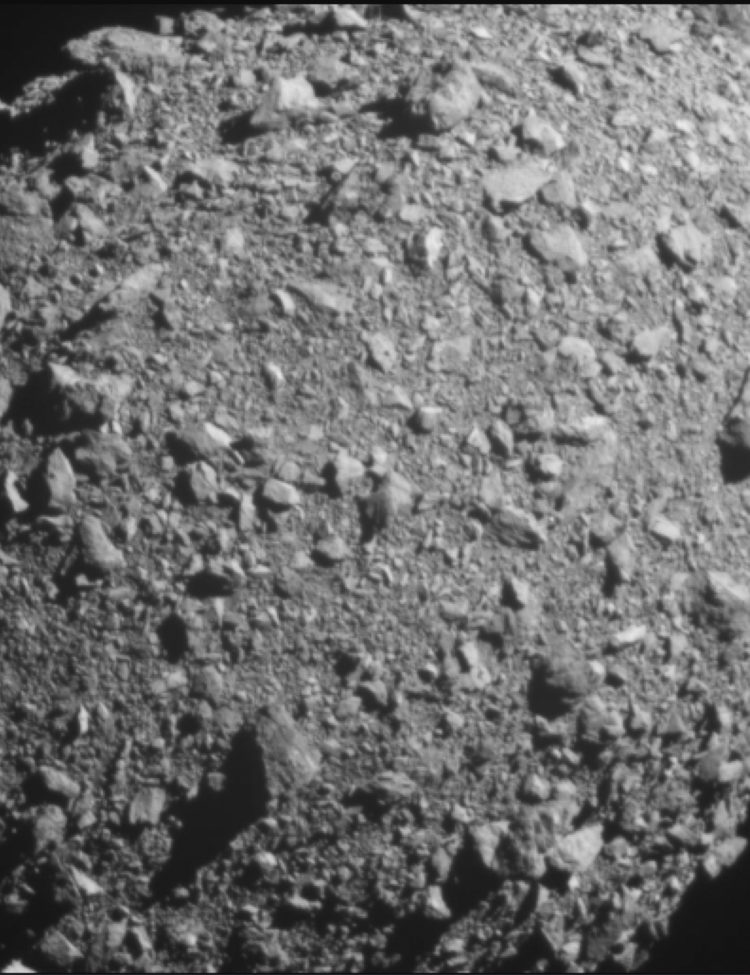
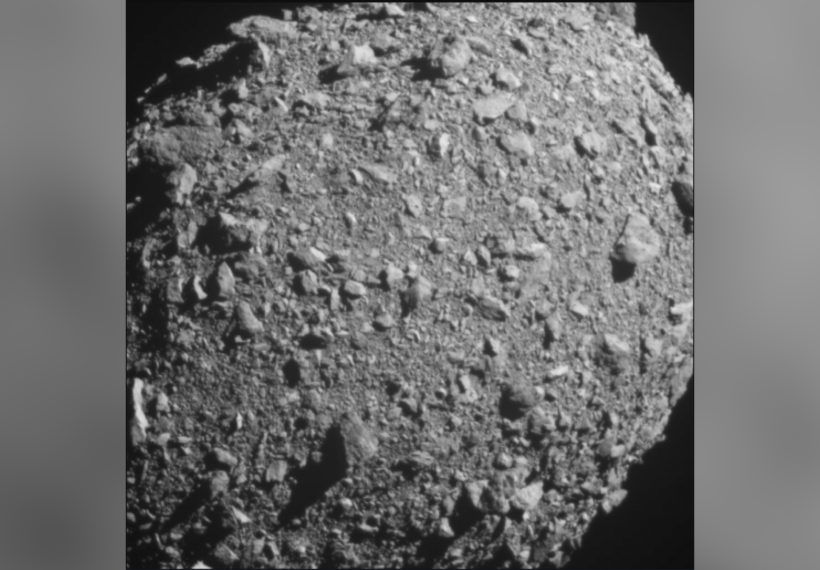
And if you saw images from the latest DART mission, the one that’s smashed into the moonlet, you also saw that both of the asteroids, they looked, they had huge boulders of very, you know, and basically they’re aggregates of rocks loosely held together by gravity.
By their own gravity?
Of course, gravity.
So even though they’re small, we think of small things of having hardly any gravity, but whatever gravity they have, it’s enough so that they have some kind of shape.
Otherwise, you expect the rocks to just drift away.
Yeah, actually, that’s a good point that you’re making, because so there is something interesting that happens.
These rocks, when they spin fast, about two hours, very often they end up with a satellite, because basically the first two things happen.
The kind of the material starts, you know, it starts kind of traveling toward the equator, and it starts kind of, you know, gravity can’t pull it anymore.
It starts flying off, and then it clumps into a satellite.
So that is exactly, you know, we know that…
Marina, I want it to become a ring around the moon.
That would be cool if our moons could have rings.
I’ve always thought that.
I know.
They probably have.
Marina, I want you to work on that and get back to us on Monday morning.
Those are very hard observations.
Those will be very, very hard observations because you would have to kind of really catch it in action.
You know, how there is a ring around the asteroid, and then it’s clumping into a moonlet.
Wow.
Well, I think we have questions from our fan base, our Patreon fan base.
So, Marcia, I haven’t seen these.
I don’t think Marina has seen these either.
So, you’re just pulling these out of the ether right here.
Yes.
Keeping you on your toes.
Exactly.
They can’t hide the conspiracies because they got to reveal the answers right then.
So, what do you have, Marcia?
All right.
So, this first question is from Yaniv from Israel, Yaniv Kos.
And it says, why do all asteroids look gray?
Are they really gray?
If so, why?
Or are we always just using black and white cameras?
Oh, I like that.
Marina, we want color here.
So, what’s up with this?
What’s going on?
Yeah.
So, they don’t…
No, we don’t use definitely black and white cameras.
There are plenty of spacecraft with full color cameras.
The asteroids are actually quite dark.
They have something…
So, we measure how dark they are.
There’s something called albedo.
It is how much of the sunlight they reflect.
So, most of them don’t have…
They reflect maybe at most about 15 to 20% of sunlight.
So, they indeed are kind of various shades of gray.
Dark gray, it sounds like.
Yeah, it’s very dark gray.
I mean, if you ever kind of looked at some samples of meteors, they know to be quite gray, except there are certain types.
There is one type that is really like almost like a little marble.
It’s very rare.
It’s Insta-type.
It’s called Insta-type and it looks literally like white.
Insta-type?
It sounds like you just made that up to sell on an infomercial.
Buy some Insta-type.
That’s totally from the QVC channel.
I don’t believe you now.
Yes, they’re beautiful kind of marble white, little kind of gray specks.
They’re very pretty, but they’re rare.
They reflect about 30 to 60% of sunlight.
There are some of them which are really bright, but they’re known to be also as a charcoal.
The ones that have a lot of carbon, they reflect maybe a few percent of light.
So, yeah, they’re mainly actually pretty dark.
They don’t reflect light.
Okay, perfect.
All right, so let’s get another one.
Okay, so this is from Jen.
They say, hi from Michigan.
I’ve been hearing about the Trojan asteroids lately.
Did I hear correctly that they are in Jupiter’s orbit, and how can that be?
I thought that part of the definition of a planet was that it had to clear its orbit.
Ooh, this one, Jen did some homework on that one.
Are we going back to Pluto?
Neil’s favorite talk.
Marina, everything lands back at Pluto.
People are still not over Pluto.
I just still can’t shake it.
Let’s get to, we’ll get to that answer, right, when we come back on our first break in Cosmic Queries, the Asteroid Edition, with our guest Marina Brozovic from the Jet Propulsion Labs with Diego.
Hey, I’m Roy Hill Percival, and I support StarTalk on Patreon.
Bringing the universe down to earth, this is StarTalk with Neil deGrasse Tyson.
We’re back, StarTalk Cosmic Queries Edition.
We’re talking about asteroids with my co-host, Marcia Belsky.
Marcia, welcome back to StarTalk.
Thank you so much.
So glad to be back.
And you’re in a comedy festival coming up in November, November 13th on Alan Cummings.
What does he have to do with this?
So Alan Cummings owns a cabaret bar in the East Village.
That’s funny, because I saw him on Broadway performing in the musical Cabaret.
So maybe somebody saw that and said, yeah, this is, this is gotta, we gotta keep people.
Full circle.
He knows how to work his brand.
Yes.
Yeah, so it’s a really great space.
It’s at East Sixth between Avenue A and Avenue B.
In New York City.
In New York City, yes, in Manhattan.
And I’m doing my hour there.
It’s called Marcia Belsky Evangelical.
And it’s on November 12th at 7:30 p.m.
at Club Cummings, which is Alan Cummings cabaret bar.
And it’s for New York Comedy Festival.
So it should be really fun.
And your musical comedies, hilarious.
Thank you so much.
My favorite song, was it 100 Tampons?
Yes, that’s the NASA song.
A NASA song called 100 Tampons, that’s all I’m gonna say.
You gotta go find out where this woman is coming from.
Yes.
So we have as our guest, our asteroid expert, Marina Brozovic, working at the Jet Propulsion Lab.
Could you tell us how you got to where you are?
If somebody wants a job like yours, what’s your background?
Well, as I said, I started as an amateur astronomer.
I’ve been an amateur astronomer since high school and I studied physics.
Just to be clear, Marcia, an amateur astronomer is actually an expert, all right?
You would never go to an amateur neurosurgeon or an amateur.
Amateur astronomers are experts in the night sky and they live nothing better than showing off their telescope to whoever will walk by and stop and look through.
Okay, so we got amateur astronomer in the house.
Then what happened?
I went to study physics and then I did grad school in physics and I was a postdoc at Caltech and Caltech is, and JPL have very good connections.
There is constant transfer of people between the two and so when the time came, I interviewed for JPL and I’ve been here ever since.
Cool, so does your paycheck say NASA or Caltech?
It is really Caltech.
That’s what I was wondering.
We are contractors, yeah, we are contractors.
Yeah, JPL and APL lab.
So we are actually contractors of NASA.
APL, Applied Physics Lab.
Applied Physics Lab.
Back on the East Coast, yeah.
Back on the East Coast, that’s our, you know.
Very, very excellent.
But we are NASA lab.
Mm-hmm, you got it.
Okay, so Marcia, that question we left off with, which was, remind me?
Yes, so this was from Jen from Michigan, and they were asking, is it true that there are Trojan asteroids in Jupiter’s orbit, and how can that be?
Because they thought that part of the definition of a planet was that it had to clear its orbit.
And Pluto is listening to this right now, okay?
Pluto, ears are burning.
Yeah, yeah, no, that’s a very great question.
Yeah, Trojans are a very interesting population of asteroids.
They are in stability points.
So there is actually, imagine this triangle between the Jupiter sun and this clump that is basically objects are able to orbit there without Jupiter kicking them.
So there is a clump of asteroids, Trojan asteroids, along Jupiter orbit that is in front, 60 degrees.
And then there is another clump behind, also 60 degrees.
And that’s where some, as I said, they’re still orbiting the sun, but Jupiter is never managing to catch up with them to kick them out.
So these are, you know, gravity stability points where kind of Jupiter gravity and sun gravity are at peace.
And you can just sit there and also orbit the sun.
And it’s very, yeah, it’s, they’re very interesting because, you know, there’s-
So they basically collected there, right?
Nobody put them there.
Just asteroids wandering throughout the solar system found it to be a safe space for them, in a sense.
Wow.
And Jupiter’s sitting there trying to swat them away when it gets out of reach.
It’s just out of reach, exactly.
Well, actually, there is, I think the front groups, front group of Trojans, so the one that’s leads 60 degrees, that one is called Trojans.
And the one trailing are Greeks.
So the objects in the first clump are named after Trojan warriors and Trojan heroes from mythology.
And the trailing one is the Greek champ.
And NASA has actually…
And Jupiter is trying to keep the peace there, right, between Troy and Greece.
The Roman gods, much later.
A later god is keeping the peace, yes.
Yeah, and NASA has actually a mission called Lucy that is going to explore objects from both of these camps, from Jupiter Trojans.
It will first go through, it has such a kind of orbit that it’s first going to swing through one cloud of Trojans.
And then it’s going to go and explore the other one.
And there’s some really, these objects are ancient.
They’re really telling us something about how the solar system was built.
So what fraction of Jupiter’s mass is represented in these trapped asteroids?
Oh, tiny, that’s, I mean, super tiny.
When you think about it, actually, what is fascinating, when you look at the main asteroid belt in general, I mean, so that’s the main asteroid belt is between Mars and Jupiter.
And there are millions of objects there, actually billions, if you really count the small sizes.
But if you were to sum up everything, everything in the main belt.
If you were to glue them together into one object.
Glue them together.
It is less than 1 25th of our moon.
And most of that mass is actually in asteroid, in dwarf planet Ceres.
Ceres is about a thousand kilometers across.
So you can imagine, you know, if all that big mass of main asteroid belt is so tiny and Trojans, I mean, if you were to sum up all Trojans, that’s really smaller.
It’s even less.
So.
It’s even less, yeah.
It’s really tiny.
So the idea of clearing your orbit, it just means there’s nothing else big to compete with you.
It doesn’t mean there isn’t debris and other junk that could be there.
As one of the criteria for planethood.
Yeah.
Well, as I said, I definitely have to go and read up on my, you know, what is the exact definition.
But I can tell you this.
Just don’t get me started here.
So here’s the point.
There are other objects around where Pluto is orbiting the sun that have mass that rival Pluto.
So Pluto has not cleared its orbit in that sense.
Right, but you can have junk, junk that doesn’t.
So it’s about who’s the alpha in the situation.
Pluto is not the alpha dog, but Jupiter is totally the alpha planet.
Jupiter completely dominates the solar system.
Absolutely dominates.
Yeah, not only its orbit, it’s really, right, I agree.
Earth is the size of its storm, its red spot.
Yeah, it’s a…
So now the asteroid belt.
So one of the asteroids in there, I have one named after me.
I got an asteroid.
There’s one, three, one, two, three Tysons.
Yeah, you have it very easy.
I mean, you’re really kind of almost right.
It’s one, three, one, two, three Tysons.
Yeah, it’s easy.
I don’t have to.
That’s not a hard thing to remember.
And just for people to know, that asteroid is not my password on anything, okay?
I think you’re protesting a little too much.
So yeah, I mean, your asteroid has quite an interesting story.
Well, first of all, it was discovered by legends in field of asteroid.
It was discovered in 1994 by Carolyn Shoemaker and David Levy.
Yes, they got asteroid hunting team like no other.
Yes, English majors, both of them.
Oh, throwing it down.
Yes.
Yeah, yeah, yeah.
I mean, this is the power of amateur astronomy.
Actually, they both went on to get all possible honorary degrees and awards in the field.
I mean, they truly were legends in the field.
And so, in 1994, they discovered asteroids called 1994 KA, which will later have your name.
And yours is a binary asteroid.
You know, you are-
How come I didn’t know that?
You are-
When did we find, did you find that?
How did you, how did I not know that?
In 2015, there was, I went looking, as I said, I went to their database.
I went to see-
I know, and in 2015, there was a companion.
So you have a primary that is about 11 kilometers in size.
So, a nice size asteroid.
And then there is a satellite about four kilometers in size.
And I can tell you that at least 15% of main belt asteroids are binaries.
And similarly, similar amounts are in binary or binaries having near earth population.
So they have companions.
Last I checked, it was not a near earth?
No, no, no, your main belt, I can also tell you.
And you can verify, just verify for me.
Neil needed to verify that.
Cause imagine the bad press if the Neil deGrasse Tyson asteroid hits the earth.
I know, hits the earth.
That would blow up on Twitter, I’m sure.
You would never live that down.
Oh, well, I looked at your orbit and I really feel like I’m giving you a forest up here.
I don’t.
But you’re actually.
Wait, wait, wait, Marcia, doesn’t that sound great?
I looked at your orbit today.
I looked at your orbit.
That sounds invasive in some way.
It’s in Scorpio right now.
That you are a little bit eccentric and slightly inclined.
Oh, interesting.
So yes.
I like that.
I might be inclined and eccentric.
Yes, you know, everybody’s in plane and you’re kind of, yeah, you are kind of.
So inclined means the orbit is tipped relative to…
Plane of the Earth, a little bit around the sun.
So that is it.
Looking up.
Right, and then you have the, you said I’m a little bit eccentric.
Eccentric.
So not quite a perfect circular orbit.
You’re not perfectly for circular orbits, but yes, it is actually a very, very cool object.
Well, thank you.
Orbiting a little bit outside orbits of Mars.
And I’m glad it’s not.
It’s not a lunar asteroid built.
It’s not hitting Earth.
That’s all I care about.
No, I don’t know.
Maybe a couple of million years.
Don’t say that.
It takes time.
Only full-level movies you have.
Something is a main belt.
Then three weeks later, it is on Earth.
Oh yeah, yeah, correct, correct.
Exactly.
It’s like movies.
They gotta do it within two hours.
They gotta do it.
Yeah, that process takes usually a very long time.
We’re talking millions of years until the objects from the main belt space end up migrating into the near Earth space.
Better hope it crashes into the ocean.
Well, then you have tsunamis on the…
Well, at that time, 11 kilometers, yeah, that would be dinosaurs.
I mean, that would be dinosaur size.
I mean, that would be chick-fil-a size.
So you do not want that size anywhere near.
No matter what.
That’s a risk to have an asteroid named after you.
That’s the risk you have.
That’s just the burden I carry, Marcia.
This is what I do.
So give me another one.
See if we can slip another question in before we break again.
Okay, this is from Connor Holm from Squim, Washington, from the Pacific Northwest.
Hello, hello.
It says, hi, on average, what percentage of asteroids have moons?
Is there an upper limit to how many moons an asteroid can have?
I didn’t even realize asteroids can have moons.
Let me top that up and say can, because we learned that you said about 15% are binary.
So maybe if one is big and one is small, we’ll say it’s a moon.
Can a moon have a moon?
Can a moon have a moon?
That is a very good question.
And if you look in orbital mechanics, there is no reason not to, but it’s not going to be stable for a long time.
So it’s probably not going to be very long lived, but we do have a triple systems, you know, in both main belt and in near population.
They are rare.
So you have a, you know, again, central object, which is the largest, and then you have two moonlets orbiting it.
And we found so far only four in near population.
So it’s small.
It’s maybe 1%.
As I said, those are all lower bounds because, you know, we can-
Wait, wait, wait, you’re describing double moons rather than a moon with a moon.
Yes, correct.
So triple systems, so we have triple systems, but no, we have never found, you know, a, you know, that something, that moon has a moon.
That would be very, very-
Well, maybe it’s just a matter of definition because isn’t Earth a moon of the sun?
It is.
It’s all relative.
And then Earth has a moon.
Yes, it’s all relative, yes, you’re right.
We have a moon going around-
So everything’s a moon.
Everything’s a moon, thank you.
So is the definition of a moon just anything that orbits something else?
Yeah, it’s, yeah, you’re, actually we usually say natural satellite.
We would say that Earth is a natural satellite of the sun and our moon is natural satellite of Earth.
So it’s kind of, you know.
I think there were some efforts to tighten that definition.
Marina, correct me if I’m wrong.
If you, so we, Pluto has a moon, except the center of mass of Pluto and its moon-
Is outside.
Outside, right?
Correct.
So it’s easier to think of Pluto as a double X planet, a double dwarf planet than, you almost got me to say double planet there, but I’m not.
As a double dwarf planet, that’s-
I’m taking notes and record it to the IE.
Then as a main planet and a moon going around it.
Whereas for Earth, our center of mass is within Earth’s surface between the Earth moon.
So we can think of we being a primary and then the moon going around us.
So is there any talk about where the center of mass is and if that affects the definition?
Well, in the case of asteroids, I’m telling you, so all of these binaries that I was, you’re dealing with a really large primary.
So center of mass is always inside, pretty much inside primary.
And I told you that we did find four equal mass binaries, but kind of we call them then equal mass binary because they’re orbiting the common center of mass.
Right, right.
They’re rare, those are very rare objects.
All right, cool.
All right, Marcia, give me one, slip one more in before the break.
Okay, one more before the break.
This is from Kevin Browning.
He says, hi from White Deer, Texas.
I just recently watched Deep Impact and I was wondering if the idea of launching nuclear weapons to stop massive asteroids or comets is just Hollywood fantasy or has it been something seriously discussed by scientists?
Is it feasible or is it something that is dated and no longer taken seriously?
Basically, is someone gonna nuke Neil’s asteroid if it starts coming towards Earth?
No one’s gonna nuke my asteroid.
No, so two quick things before we go to break because I think we’ll have to answer that on the other side.
Kudos to, what’s his name again?
Is it?
This is Kevin Browning from White Deer, Texas.
So kudos to Kevin for choosing the Deep Impact film to reference here and not Armageddon, where Bruce Willis saves the world.
I did some analysis of Armageddon and it violates more known laws of physics per minute than any other movie ever made in the history of the universe.
So whereas Deep Impact actually had official advisors for it.
So kudos to him there.
Now you pronounced the word nuclear, nuclear.
Is that what he wrote?
I did, wait, I think that probably is just how I said it.
Nuclear.
What did he write?
He wrote nuclear.
The reason why I ask is because George Bush, former governor of Texas pronounced nuclear.
And was he just an homage to his former governor?
That’s what I was just checking.
No, he didn’t spell it nuclear.
I just said it like that because I’m from Oklahoma.
So I thought something like that, yeah.
Busted.
Exactly.
My accent came out.
Okay, we’ll find out about Deep Impact Factor Fiction when we return.
We’re back, StarTalk, Cosmic Queries, all about asteroids.
Love it.
I got Marcia Belsky here, my co-host.
Marcia, what’s your social media footprint?
Where can we find you?
My social media, everything is my name, at Marcia Belsky, M-A-R-C-I-A-B-E-L-S-K-Y, except for on Instagram, I am at MarciaSky, because I’ve had that handle forever.
But, yeah, find me there, I would love that.
Like Neil said, I do musical comedy, and I also recently wrote a short comedy play called Man and Woman, so I post all of that information.
Oh, cool, we can find you there, okay.
And you’re from Oklahoma and say nuclear, okay, I just want to.
And I’m from Oklahoma and apparently say nuclear, which I didn’t even realize I said it wrong.
I’m just calling you out, just calling you out.
And Marina Brozovic from Jet Propulsion Labs, are you on social media?
Actually, no, I am one of those, you know.
Okay, that means you actually get work done during the day.
Yes, yes, I have email, I have email and a phone and so.
It’s so healthy.
If I didn’t do comedy, I would like to think that I wouldn’t be on social media because I can just feel it rotting my brain.
Okay, I know it’s important.
No, no, but Jet Propulsion Lab has an excellent public website for people to visit.
I know, they have a great educational, yes, great educational site and a lot of good information.
Is it jpl.nasa.gov?
That is correct.
You got it, okay.
So a lot of good people making those websites.
Excellent.
So we left off by…
Who’s the guy again?
We left off with Kevin from White Deer, Texas, Kevin Browning.
He wanted to know…
Who asked a question about nuclear weapons.
So a couple of things.
Let me tune that question for you.
Marina.
So other than deflection of an asteroid, which we know was tested with the DART mission, how realistic would nukes be bearing them into…
In that case, there was a comet that they dug into.
And can you comment…
If you’ve seen the film, can you comment on other sort of accurate or badly inaccurate physics that was in it?
Well, I did see, obviously, I did see Deep Impact and I did see Armageddon.
It was a while.
It’s a mental health factor.
But to make a kind of long story short, I mean, yes, nuclear devices are a kind of last resort.
If something is really big and we don’t have much time to react, but in reality, we would have probably decades to prepare and we would probably go with the kinetic impactor, you know, something that DART Mission just demonstrated on DLBOS system.
So kinetic impactor, it’s moving so fast that the energy of the, its kinetic energy is sufficient to create the explosion that you’re interested in.
Yeah, so there are two things there.
You have to just push it.
You don’t want, there is a, you know, difference between deflection and disruption.
Deflection is you just want to push it.
Disruption is if you hit it too hard and it goes in pieces.
And then you have much bigger mess because all of those pieces are heading your way.
Big mess.
So it’s a big mess.
So if you decide to go with that kind of, you know, disruption, then you better give enough energy that all of them, you know, clear Earth.
So that is, that you would probably have to do with the multiple kinetic impactors.
Or we need a death star.
A death star could totally…
One or the other.
That would be…
Just obliterate it.
Death stars obliterate planets.
That’s what they do.
Yeah, yeah.
Wait, but that’s comforting.
You said that likely if there was any, like, major event that was going to disrupt Earth with the technology we have now, we’d have decades to…
Yeah, as I said, the first and foremost, you have to find them.
You know, you have to find them before they find us.
That is kind of this cliché with the pressure that we’ve been repeating, but it’s so true.
And that’s why we have…
Find the sleeping bear before the bear finds you sleeping.
Oh, my God.
No pressure.
We have these, you know, NASA is funding a lot of these optical telescopes that are on every clear night going and looking after these…
after near-Earth asteroids that can potentially endanger Earth.
And, you know…
Okay, but there’s something you implied, but I want to sort of tease out here.
And it’s that…
Marcia, I think Marina said that if we find one, we’ll have perhaps 10 years, because the good thing is that anything big enough to render us extinct is easier to find.
Well, okay, here’s the good news.
We are really concerned with things that are larger than one kilometer, because those are the ones that really have global consequences, the impact of that.
And we have found more than 90% of those objects.
So we think there may be several dozens that we still have to find.
But some of them are not easy, because they could have exotic orbits, like they can be very inclined, and there can be kind of a lot of times in a bad geometry, so the Earth is on one side, and they’re behind the sun, and you just kind of play this hide and seek for a long time.
So, you know, it’s complicated.
So Marcia, those asteroids are sentient, so they know to hide in the glare of the sun.
Yeah, they’re hiding like the ones from Jupiter, and we’re like, get out of there.
We want to see you.
So what would be like worst case scenario, like shortest amount of time we would have to like prepare if something huge was hurtling at us?
It’s called kiss your ass goodbye.
That’s the solution there.
Yeah, as I said, it’s extremely unlikely that that would happen because as I said, we found more than 90% of that population we are very concerned about, so global consequences.
But we still have a lot of work between this smaller population.
So we think anything between 140 meters to 1 kilometer, that is pretty serious as well.
We found about 50% of that population.
So we still have a way to go.
So as the size gets smaller, we have less and less of the total known in our catalogs because they’re harder to track.
Very, very, very much so.
And we are also very concerned with this population that is between say 50 meters and 140 meters.
It doesn’t look much, but that is at the level of a city, extremely dangerous.
And we really know very small population there.
So the kilometer size asteroids are enough to disrupt civilization in some fundamental way.
Yeah.
Right.
Supply chains, transportation.
Yeah, basically they would kick so much dust.
They would kick so much dust up in the atmosphere that you would end up that plants would start having problems with photosynthesis and then the whole chain reaction with food, with food chains would collapse.
But Marcia, you know who would really have the problem?
Anyone was where it hit.
That’s what I’m thinking too.
I’m like, and if it hit Manhattan?
That’s where the real problem is.
We have enough telescopes pointed here.
Going back to Neil’s asteroid that was discovered in 1994, you know what else happened in 1994?
It really kind of started, right?
That wasn’t the Stroom Maker leaving 9.
So this was the first time we ever witnessed a major comet slamming into another object in the solar system.
And it was a comet that broke apart from gravity, okay?
And it was slammed into Jupiter, and one piece after another hit.
And Hubble Telescope was just freshened a couple years earlier, and we turned every ground-based telescope to it.
In fact, I was at an observatory in Chile, and I took time out of my observing plan to get data on that comet.
And you know what was cool?
See, I’m getting all excited.
Thanks, Marcia and Marina for sending me out to this.
So because it was a comet that broke apart, each piece became its own comet.
So each piece had its own tail.
It was the coolest thing.
And yeah, it slammed into Jupiter, killing all the dinosaurs on Jupiter.
I was like, poor Jupiter.
It doesn’t deserve that.
And it was scared.
It was scared by the same people that discovered your asteroid.
They are like that.
Well, you were missing…
Carolyn Shoemaker and David Levy also discovered your asteroid.
And then there was also Gene Shoemaker.
Gene Shoemaker, right.
He was the third.
They discovered it from Palomar here, just in the neighborhood.
And they discovered it in 93.
And then in 94, it slammed them to Jupiter.
It was incredible, I mean.
Right, right, right.
Gosh.
Yeah, one of the great moments.
And so what I wonder is who was looking at our planet when that same size asteroid hit Earth and took out the dinosaurs?
Was someone else getting excited when they saw that?
Yeah, that’s what I’m wondering.
There were some alien civilizations.
They did not have, you know, dinosaurs did not have space program, but we do.
Yeah, you’d know if they had a space program, they’d still be here, because they would have totally deflected that asteroid.
I mean, this sounds like an amazing Pixar movie.
Like, should we pitch this?
The dinosaurs?
Should we do this?
The dinosaurs with NASA, right?
That’s what that is.
Yeah, and they prevent their own big way.
Well, they said, it’s sort of been done.
It’s sort of been done.
Now, this is down the rabbit hole here, but Ice Age 5, the animated series, I actually have a cameo in that because I otherwise would not know, and I wouldn’t even know it had five installations.
So apparently they discover, these are like Ice Age mammals, they discover that there’s an asteroid headed their way and they want to deflect it.
And so I show up inside one of the creature’s heads, Buck Weasel, and I’m Neil deBuck Weasel, and I’m just in his head, I’m in his head telling him what to think about.
And so they deflect the asteroid.
So the animals have deflected the asteroid.
Sentient, conversational, smart mammals other than humans have done this in the past.
As evidenced by this documentary, Ice Age Five.
Yeah, by Ice Age Five, the well-known documentary.
Let’s keep going, see if we can get a couple more in here.
Absolutely.
Okay, so this is from Dylan.
I feel like this kind of leads from what we were just talking about.
It’s about a different movie.
It says, greetings everyone.
I was wondering how you guys felt about the movie Don’t Look Up.
Is that really how we would react and what could you slash we do to have a better outcome?
I feel like you were kind of getting into this that the myth of that movie is how fast it would happen maybe.
Well, a quick earlier point to Marina’s notion that we might have 10 years.
In Armageddon, it was a Texas-sized asteroid that was within months of hitting Earth.
And a Texas-sized asteroid would have been discovered 200 years ago.
And the government could not keep…
There’s no way the government could keep it a secret.
It’s in the freaking sky.
See, you got me started on Armageddon.
I told you it violated more laws of physics per minute than any other.
Let’s leave that.
There are a lot of space conspiracies, and I think they are hinged upon the idea that somehow these things could be kept secret.
The government prevents the whole world from knowing what’s in the sky.
So, I assume you saw it.
Don’t look up, Marina.
I did not, but I do roughly know the premise.
So, yeah, but going back to what Marcia already started saying, everybody thinks there is this one telescope on Earth that can observe asteroids, and there is one person that knows how to do asteroid orbit.
All that is public information.
And actually, we have this kind of clearinghouse for data where everybody in this world that observes asteroids sends in their measurements.
Immediately.
By the way, just…
So, it’s not some guy in a cave that has to call for it.
Information is public.
Everybody has access to this data.
And as a scientist, we love to talk.
So, it’s possible that we would keep anything to secret.
Plus, the government is not competent enough to accomplish any such cover-ups that are displayed in the movies.
There’s no way.
So, one of my most retweeted tweets in the past two years was when I said I watched the Don’t Look Up, this fictional tale of an asteroid where a scientist warns and people reject the warnings and social media takes it lightly.
And then I said by the time the movie was done, I’m certain it was not fiction.
It was a documentary indeed.
That was how I thought about it.
So, yeah, it scared the hell out of me.
Even though it was a little bit comical, Marina, I’ve been enough in social media and interacting with the press and with people that so much of what I’ve seen and felt was pumped up and exaggerated for the movie, but it’s all there.
They didn’t pull that out of nowhere.
There was a plausibility to it that left me a little scared.
In terms of how we would react to any sort of global catastrophe.
Marcia, I don’t want to be the laughing stock of the galaxy by being the only species with enough intellect to have a space program, but with enough stupidity to not know what to do with it.
Oh, you know we’re already there.
You know that if they’ve been watching us with their telescopes, they’re like, these idiots.
Don’t say that.
I don’t want to hear that.
Well, you know, we have every two years, we have this planetary defense conference.
Where actually you have experience from, you know, from scientists to engineers to space mission planners to even kind of politicians, government officials, even United Nations.
Everybody gathers in one spot, and then we have this, what do you do?
You know, there are people that are negotiating, you know, there are politicians that are going like, okay, who is sending what?
You know, who is sending reconnaissance mission?
Every spacefaring nation will contribute this.
And so there you have…
Right, if an asteroid is headed for the Indian Ocean, and we have technology that could help it, who pays for that mission?
Right.
That would be a better one.
If you want to deflect it, then say it is going to impact country A.
But if you want to deflect and save everybody, it is going to…
The corridor, impact corridor, will have to pass over country C, D and E in order to move it off the earth.
And if you don’t fully execute that…
And that’s what they’d really do.
You have other targets.
Yeah, the asteroid has new targets.
That’s probably what would end up happening.
They’d be like, oh, let’s just send it to this country.
But those are interesting questions.
And those are interesting questions, but that’s, I mean, that’s why…
Many people are working on this because we need to have protocols in place.
Well, I’m delighted that you’re on the front lines there, Marina.
We’ve got good people doing good stuff, trying to save the species.
I don’t get as worried.
Yeah.
I feel like the difference between that and the global warming, though, is there’s no financial incentives for companies to allow an asteroid to hit us.
You know what I mean?
I feel like we’d get our butts together.
That is so encouraging to hear that.
I don’t know myself, but think of all the things we do do that reduce our life expectancy every day.
I know.
Every day.
But if I may add, I think that in recent polls, actually, I think that public is very much aware of the need for us to find all the potentially hazardous asteroids.
So I think that the public is that we have kind of public in our corner with respect to this particular issue.
Go look at the movie Don’t Look Up, and you will reverse that comment.
It is too believable the way that the public reacts in that movie.
Guys, we got to land this ship.
So anyhow, this has been great, informative.
And thank you, Marcia, for sharing your joy and comedic outlooks with us.
And Marina, it was a delight to have you on our Rolodex.
My pleasure.
Thank you for being on StarTalk.
This has been a StarTalk Cosmic Queries edition.
Asteroids, Neil deGrasse Tyson here, as always, bidding you to keep looking up.


 Become a Patron