
Cosmic Queries: Aliens

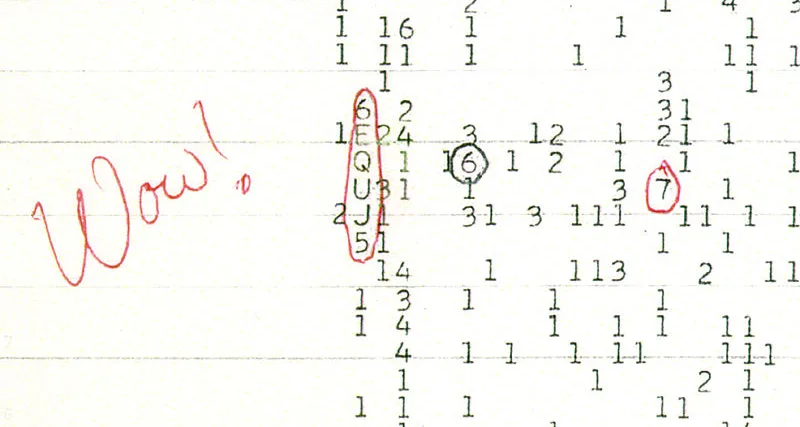
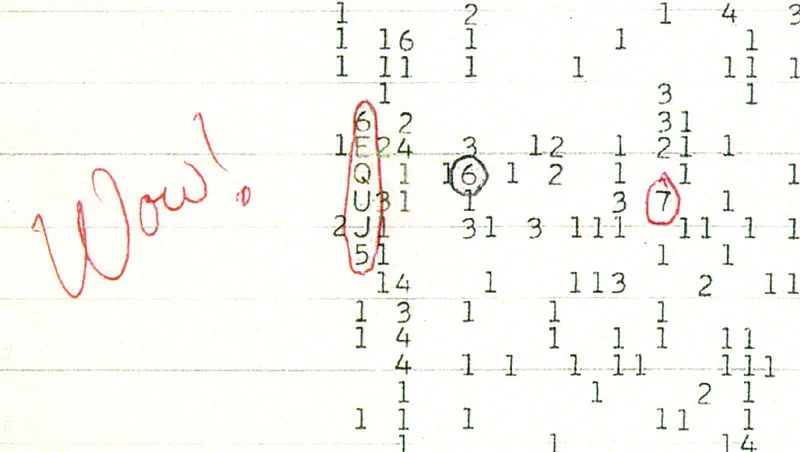
Copy of the original “Wow!” computer printout, taken several years after the arrival of the strong narrowband radio signal detected by Jerry R. Ehman on August 15, 1977 while working on a SETI project. Credit: Photo Credit: Ohio State University Radio Observatory; North American AstroPhysical Observatory (NAAPO).
  • Free Audio
  • Ad-Free Audio

About This Episode

Could the “Wow!” radio signal recorded by a SETI researcher have been alien in origin? What laws of physics might limit the forms alien life could take? How near would alien civilizations have to be to detect life on Earth? What senses might an alien life form have beyond the ones humans possess? These are just a few of your questions that astrophysicist Neil deGrasse Tyson and comic co-host Leighann Lord answer in this Cosmic Queries episode. You’ll find out what Dr. Tyson, the director of the Hayden Planetarium, would ask an extraterrestrial if he met one – and if he thinks we could even understand them. It’s an out-of-this-world episode filled with science, chemistry, exobiology, physics and informed speculation – whether you believe in the possibility of alien life or not.

NOTE: All-Access subscribers can listen to this entire episode commercial-free here: Cosmic Queries: Aliens.

Transcript

DOWNLOAD SRT
Welcome to StarTalk, your place in the universe where science and pop culture collide. StarTalk begins right now. Welcome to StarTalk Radio. I'm your host, Neil deGrasse Tyson, and I'm an astrophysicist at the American Museum of Natural History, right...
Welcome to StarTalk, your place in the universe where science and pop culture collide. StarTalk begins right now. Welcome to StarTalk Radio. I'm your host, Neil deGrasse Tyson, and I'm an astrophysicist at the American Museum of Natural History, right here in New York City, where I also serve as the director of the Hayden Planetarium. You're listening to StarTalk Radio. And I've got with me, co-hosting Leanne Lord. Leanne, welcome back. Welcome back, Leanne, professional comedian. Professional stand-up comedian. Intrepid explorer of the world. World traveler, absolutely. World traveler, every time I turn around, I follow your tweets. You're popping up in another city, making them laugh. That's what I do, have laughter, will travel. Not only that, you show up in the Middle East too. I do, I do. I've performed in Baghdad, which is actually safer than Brooklyn. So you and Bob Hope, right? They're safer than Brooklyn. Well, I get security there. Not in Brooklyn, you live in Brooklyn. While in Queens. Okay. See, now the Brooklyn fans are gonna be so mad. Oh, yeah, but no, it's a great thing. You and Bob Hope, I mean, what a story tradition of entertaining the troops. I love it. So thank you. So today, we are StarTalk After Hours. I love it. That's not the name of it, but that's how I feel when I'm doing StarTalk Cosmic Queries. We're in the Cosmic Query part of StarTalk Radio where your questions get answered and we solicit them in advance on Facebook, on Twitter. And Leanne, you've got the supply. You've got the stash. I have got these stash of questions. I have not seen them. No. And so be kind to me as you send them my way. I will do what I can. I make no promises. The topic today is aliens. Yes, aliens are, this is that. It's a huge topic. It is a huge topic. So it was very difficult, but I've tried to narrow them down. Okay. And we're gonna have some fun. All right, let's do it. All right, this first question comes from Watson McKeel. And he wants to know what other senses could aliens have besides the five we humans possess? Awesome question, Watson. Is that the dude's name, Watson? His name is Watson. If your name is Watson, you can only ask an awesome question. Oh, I know. So first of all, it's lately people have imagined or considered that we have more than five senses, right? We have a sense of balance, you know, a sense of- Some of us. Yeah. Have you been to a dance club? It's awkward out there. So I'm gonna stick with the five just for the purposes of this question, because they're clean and classical and they're well understood by us all. It turns out that the people who would claim they might have maybe a sixth sense, where they can know something beyond what the five senses deliver, that's what science is. Science is all about either enhancing the senses that we have- Or inventing senses that our human biology never considered. That's what we are, that's what we do. So we can detect slight changes in gravitational fields, we can detect magnetic. You have no way to detect a magnetic field. You can walk right on through it and your Julia would fly in one direction or another if it were magnetic, but your human biology could not detect whether or not you were in a magnetic field. So we have tools that will do that. If you were exposed to high energy radiation, you have no detectors for that. Eventually you would know, because your body parts start falling off. Yeah, you have cancers and things you find out later, but not while it's happening. So hence we're susceptible to ionizing radiation because you don't know it while it's happening. But we have detectors that can do this. We can detect ultraviolet light outside the visible range of the human eye. The retina cannot see ultraviolet, can't see infrared, can't see microwaves. We harness these, we observe these in the universe, we use them all around us. Your cell phone uses microwaves. It is a detector of things your human biology cannot see, wouldn't even know is there. So, when you wanna ask what senses might an alien have, we have a whole repository of things they might be able to see, detect, think up, notice that our human biology can't, but our science can. So, I'd reach into that bag of detectors and say, alien, what do you got that we don't got, all right? And maybe they can detect radio waves. Maybe they can see microwaves with their eyes. Maybe they can know when they're about to be rendered sterile by being exposed to high-energy radiation. Maybe they can figure all this out and know what beams to step into and what not, what stars to set up their civilization around and what not. Some stars are very dangerous to live around, but you only know after you catch organ diseases and die. So... I have to say, I'm sitting here quiet for two reasons. One, I'm mesmerized, and two, I'm feeling very inadequate as a human being with my little limited five senses. Oh yeah, yeah. You should so, that's how you should feel. Yeah, just feel like they are not only incomplete, they also do not serve you well. They don't serve you accurately. And this was the delay that science experienced. Science was not invented until like the 1600s, as we now practice it. And until then, people say, I got my senses. Seeing is believing. No, no, seeing is what you think is true, what you want to be there. Seeing is one of the most susceptible of our senses in terms of what's, as a- Well, thank goodness, that's how the species continues. Exactly. Thank goodness for our eyes deceiving us, or some of us wouldn't be here. What, there's a country western song, the girls get prettier at closing time at the bar. That sounds about right. Yeah, so our senses are susceptible to all manner of distortion. And so, it wasn't until science was invented that we made any meaningful headway in our understanding of the physical universe. So, I'd certainly give aliens the opportunity to have many of our scientific senses as part of their own alien biology. Wow, that's cool. Sorry, that was a really long answer. No. It was okay? I am very cool with that. I think Watson is going to be very happy. And you know what we want all aliens to be, we expect them all to be able to do? To read our minds. Yeah. But of course, they'd have to know English, you know? Well, if they're here in America, depending on where they are on the planet. Oh, of course, they have to read like Serbian or something. They have to know the language. Yeah, there's lots of languages. They would need a language translator. So that'd be cool. Well, now if I'm putting on my Neil deGrasse Tyson hat, if they can actually read our minds, perhaps they're reading biochemical signatures independent of language. Ooh. I should hang out here more often. So what you're saying is the language is just a layer on top of the thoughts that lay beneath them. Yes. And those thoughts are propagated, stimulated by biochemical reactions across the synapses of the human mind. Yeah, that's what I'm thinking. So you. Saying. Exactly. You're reading my mind, alien Dr. Tyson. We gotta wind down this first segment of StarTalk after hours. StarTalk, the Cosmic Queries. And Leanne, thanks for being here for this. Several segments to come for you just bringing questions from the internet. Bringing it from the internet. And landing right here in the lap of StarTalk Radio. On StarTalk, the Cosmic Queries Hour, I've got Leanne Lorde. Leanne. Yes. You don't spell your name like a normal person. I don't really know what normal means. Well, I wouldn't care how you name spell, but I have to figure out how to spell it to follow you on Twitter. That's true, it does take a little bit of an extra step. An extra step, L-E-I-G-H-A-N-N. Right, thank you, Mom and Dad. Leanne Lorde, one word at Twitter. Excellent, excellent. You're listening to StarTalk Radio. You know, we're on the web, startalkradio.net. We also tweet at StarTalk Radio. Good guess if you figured that out. And of course, we're on Facebook. You can like us there. You can find us at StarTalk Radio. And in fact, these are the places where we have collected these questions for our Cosmic Queries hour. And these questions are all about aliens. Yes. Okay, what do you got next? Well, I have a question about aliens from Robert Gilman. Do they ever say where they're from? No, I don't. Okay, we gotta get them. I'd like knowing where they're from. Yeah, that would be nice. That would be nice. This is, I believe, a multi-part question, so I will try my best, Robert. Forgive me if I stumble. And by the way, if I don't know the answer, I'll say next. Oh, okay, no, no, no. So I'll go through this 17-page question and you'll just say next. Or if I am not authorized to answer a question, I'll say next. Right, right. We might not have the security clearance to hear the answer. All right. Ready for you. All right. Is there any law, theory or speculation that dictates the bounds of physical characteristics of life forms? For example, would all life forms throughout the universe give an adequate evolutionary time, eventually resemble the rough size of terrestrial animals? Would the gravitational effect of the planet influence the size of the inhabitants? This is an awesome question. This is like an intelligent question. These are great. These are awesome. Yeah, I love it. I promised I'll find something less intelligent. I just want to celebrate the awesomocity of that question. You are awesome, Robert. So Robert is correct. There are laws of physics that limit what biology can be. Okay. So a couple of things. For example, if you're really, really big, could you have life forms the size of an entire galaxy, let's say? I mean, just imagine. Just let's go extreme on this. Okay, a thought experiment. All right, thought experiment. All right, how about the size of the solar system? You're some space giant. And you wanna be the size of the solar system. All right, well. I would think a diet is in order immediately. Well, here's the problem. Suppose something happens to one part of your body and you're gonna react to that. Someone tickles your toe. But you're the size of the solar system. Well, the signal cannot get to your brain any faster than the speed of light. And so if you wanna cross the solar system, it's like five hours across, it's hours across, okay? I tickle your toe. Several hours later, your brain learns of it. And then you say, oh, go scratch your toe. Because you have an itch down there and several hours later it goes by. And so five, eight, nine, 10 hours later, you scratch your toe. But by then it's too late. If harm is being done to you, you cannot react in a sensible timeframe. So survival kinda depends on the ability of the organism to function as a coherent, responsive entity in reaction to stress in its environment. So there's a size above which I don't think it's likely you're gonna find life. So would that go any ways to explaining why short people are more reactive, perhaps than bigger people? Because they're more compact and they have more of a trigger to that reaction. I'm trying to interpret. I didn't know short people were more reactive. Well, maybe the Napoleon complex, perhaps. Oh, I see, they react to, yeah, and they can be a little spunkier. Just a bit. There's no big spunky people, have you noticed? I've noticed that, I've noticed that. It's always the little dogs that start stuff with the dog barking. Yeah, yeah, the big ones, I'm tired, I'm too tired. Exactly, the St. Bernard's just trying to chill. I'm just trying, yeah, yeah. And the Chihuahua's just hanging on. No hyper St. Bernard's, right. So maybe we get a little bit of that fact, a little bit of that revealed in this. Other things, there's a size smaller than which you cannot realistically be, given the laws of quantum physics. There's a size below which quantum fluctuations, these are the vibration of particles on the smallest scale, prevents anything from happening in any coherent way. You can have circulatory systems, you can have anything that has predictable behavior because in that realm, nothing is predictable with any accuracy. Sorry, you can predict statistically, but you can't say exactly what a particle is going to do when it's gonna do it. And life, I don't think thrives under those conditions. So life can't be too big, it can't be too small. Also, it needs an energy source. So you gotta have some sort, you can't just be out there in the middle of nowhere and survive. And so we think these are fundamental to life. I'm betting you that the life will be based chemically on carbon, because carbon is the most chemically fertile element on the entire periodic table. If you're gonna have life based on some element, base it on the one that makes the most kind of elements in the most kind of ways, and that would be carbon. And carbon is bountiful in the universe. And we had John Stewart as one of our guests on StarTalk, and did you know he majored in chemistry when he started college? Before he switched to psychology. And I said, well, so I asked the geek question, do you have a favorite element? He said, yes, carbon. I said, yes, but I wanted to hear why it was his favorite element. I said, why? He said, because it was the slut of the periodic table. It made molecules in every which way you can. So I bet you that life in the universe is also based on carbon by the sheer abundance of it, and by how sticky it is in its capacity to make complex molecules. Well, you know what that actually brings up? A question I was looking here, because someone had asked this, and had asked, what would a silicon-based life form look like then? Yeah, so you know the reason why people suggest silicon right after carbon? Why? Because, in case you didn't know, you must not remember that chart of mysterious boxes that hang before you for an entire school year in your chemistry class. I do, I remember the, I had therapy that year. Okay, so there was a chart of boxes. There was a chart, and I cried a lot. All right, and it's called the periodic table of elements because certain features of the elements repeat themselves as you go left to right across the table. So, that's why it's called periodic, all right? And so, if you look at the element that sits right below carbon, you have your pocket periodic table, you're looking it up now. Oh, absolutely, probably, there's an app for that. Right, there's an app, there's so an app for looking up the periodic table. And elements in a column bond with the same other elements that are out there in the universe. This is a part of the repeating behavior as you cycle through the chart. So carbon has six atoms in its outer shell, I'm sorry, it has six electrons in its outer shell, okay? And so it can combine with other atoms that have electrons that can join it in its shell or it can donate electrons to other atoms. They can combine in so many different ways. And- Lending to the slut reputation. Lending to the slut reputation. Directly below carbon is silicon. Oh, it's all coming back to me now. Yeah, it's not silicone. That's different. That's inexpensive. Right, that's a different procedure. Did I overshare? TMI, everybody. All right, so silicon as an element combines in similar ways as does carbon. It's just less abundant in the universe and its bonds tend to be very strong. Like one of the active ingredients in rock is silicon. And so you don't want the bond to be too strong because then it's harder to experiment. Life is this big experiment in chemistry. And if you make a bond that lasts a billion years, you're not, you're not. Yeah, rocks are rocks, right? I mean, the different kinds, but they're not getting up and walking around. And so chemicals based on carbon have the capacity to offer extraordinary diversity in their chemical offerings. And thus more flexible? Can you use the word flexibility in what it can do? Yes, yes. In fact, I said carbon has six, no, it has four. The point is it can receive electrons in its outer shell. It can donate electrons in many different ways. And so carbon has four, four electrons in its outer shell. Alrighty. Oh, well now this one, these questions seem to flow. I love this. Do you think it's possible that there could be extra terrestrial life that does not take a solid form? Let's see, I know we're mostly liquid, but our bodies act as solids. And I like this question because I think I saw this on Doctor Who. Oh, you a Whovian. I am now. Oh, yeah, yeah. Once you get hooked, there's no going back. No, not at all, not at all. And then you watch that instead of other shows you thought you liked. Right. Right, right. It supplants the... So I don't see why not. I mean, no one ever accused an amoeba of being solid. So we've got non-solid creatures here on earth. So... It's so undependable. So surely aliens would come up with some amoeba-like creatures. And plus you had to like the blob from that original Stephen McQueen movie in 1958. That was a non-solid alien form that I thought was quite creative because it didn't look like an actor in a costume. And so an amoeba, a huge human-sized amoeba would be just totally terrifying and awesome. And so I don't see why. Whether you can have gaseous forms of life, that's a little more questionable as far as I can tell. We're gonna come back to StarTalk, the Cosmic Queries Hour. We're back with StarTalk Radio. I'm Neil deGrasse Tyson, your host. I'm an astrophysicist and serving as your talk show host. Yes, and I have Leanne Lord right here in studio with me, comedian Leanne Lord. Yes, live in captivity. Live in captivity. We captured her for this Cosmic Queries Hour, where you send in your questions about the shows that we do. And this one is on Cosmic Aliens. Yeah, so, not illegal aliens, but Cosmic Aliens, right? Okay, so what do you got for me? Yeah, I haven't seen these questions. You're just plucking them from the repository. Yes. All right, what do you got? Okay, this next question is from Colin Walker. That sounds so proper. Colin Walker. Sounds very British. I probably should have said it's from Colin Walker. And he wants to know, what about the wow signal? Let's delve into that mystery. And I have to say that is a mystery to me, because I don't know what wow, W-O-W, I mean, that's whip them out Wednesdays. Oh yeah, you know, I once knew all about the wow signal, and there was a, I think that was a radio. I'd have to go back and do my homework on that. I'd have to go back and do my homework on that. The radio telescopes, the little bit that I remember, that I've long since forgotten it, was that there was a signal detected by radio telescopes that was not of known terrestrial origin or even of cosmic origin that, from objects whose signatures we already know and understand. So it was then identified on a chart. But the concern was, could that have been a signal sent to us by aliens, by intelligent aliens, a radio signal? Well, perhaps I'm combining ideas that don't belong, but was that the basis of Carl Sagan's contact? We've been dreaming up aliens contacting us forever, ever since there have been radio waves. And ever since we knew that radio waves can pass through the depths of space with little hindrance from intervening gas clouds that would otherwise block visible light, right? Because you might say, why don't they just flash Morse code at us or something? And it would get blocked by all manner of dust and gas within the galaxy. So you'd send radio waves, passes right through it. And so radio waves have that feature. It's very good about them. Radio waves pass through this building so that you can get radio reception inside of buildings. Well, clearly where I live, I have a radio blocker because there are certain stations I'm just not getting. Stations don't come in. Well, they're blocking you, yes, that's right. I'm taking it extremely personally. So the point is you can have anomalous radio signals, but you can't do anything with them unless they repeat. You see, because we're, you know, I mean, maybe it was an alien saying, hi. Well, okay, can I get some more communication, please? I need a little more than that, you know, give me digits of pie, tell me, you know, tell me what you had for breakfast. We need a conversation. Give me some more, give me more than just the one blurt of radio signal. That's why it's easier to talk to an adult than a child because a toddler will just go, hi, and move on. So I'm, so with, with, so yes, and by the way, some radio signals could be just a glitch in the electrical current that's driving the detector. So that's why to be safe, to be secure in our interpretation, we kind of require, we didn't send the memo to them, but the aliens should know because we require that if you're gonna send us a signal, you wanna repeat it. They should know that we require. They should. I'm hearing a lot of assumptions here, sir. No, because if we. This is sort of why men and women can't communicate well. I'm just saying. Women are thinking men should know. This is what we require. Because maybe we weren't listening at that instant that you sent the signal. Maybe. Maybe I just turned a telescope to you now. So you should put it on a repeat loop. If the aliens are listening, repeat loop. On a repeat loop, as StarTalk, after hours, goes out to the universe. Well, they are fans. Let the aliens know. Judging by some of these questions. If you're gonna send us a signal, repeat it. You know, lather, rinse, repeat until further notice. So that we can get back to you on that. So the wow signal was a singular signal in a radio transmitter's detector. Radio receiver's detector. So given everything you've said, we probably shouldn't be obsessing over this. No, you shouldn't. And if it was aliens, there's nothing we can do about it. I mean, yeah. Okay, moving on. Moving on. The next question is from Tom Lee Cohn. Oh, by the way, and if I'm completely wrong and misremembered the whole thing, then nevermind. I love that disclaimer. Who did that on Saturday Night Live? Who was that character? Oh, nevermind. No, that was Emily Lattella. Was it? Yeah, nevermind. Nevermind. Yeah, the first, you're dating yourself right there. Dude, there's Wikipedia, there's Google, there's YouTube. That's how you know about the early seasons on Saturday Night Live. Am I not supposed to know about Beethoven? Oh, you got out of that one. Thank you very much. Moving on. What else you got? Next question is from Tomley Combe. What's the first name? Tomley. Tomley. That's T-O-M-L-Y, Tomley. And Tomley wants to know, how far away would an alien planet have to be from us to notice our life signatures? What would be the distance that they could figure out there's life here? I'm thinking they could smell us, depending on how good their noses were. Yeah, except the molecules that contain that which has a smell don't leave our atmosphere. And so it would have to like somehow on its own say I'm leaving and then wander through the universe like Rafiki smelling, smelling, what's the dude? I don't know. I don't have kids. Rafiki from Lion King smelling Simba, okay? Simba was alive and he smelled him. We got to take a break, but I want to get back to that answer. You're listening to StarTalk, the Cosmic Queries. This is StarTalk Radio, we're back. I'm Neil deGrasse Tyson, your host, and I'm joined by my co-host, Leanne Lord, Leanne, welcome. Thank you, thank you very much. Always good to have you here. This is the Cosmic Queries part of StarTalk, and before the break, I only partially answered one of the questions. What was that question? By Tom Lee, someone named Tom Lee. You're actually correcting my ignorance on why the aliens cannot smell us. Oh yeah, they can. Why there's a barrier there. Oh, the question was, how far away can an alien planet detect us? Right, right, what distance would they have to need to figure out if they're here? And you said maybe they can smell us. Maybe they can smell us, revealing that I was an English major. I said no, because the act of smelling is the intersection of molecules with your olfactory glands, olfactory senses. And those molecules, they carry your smell, your aroma. I have an aroma. That's better than saying you have a smell. Yes it is, yes it is. Right, yeah, football players smell, right? So, they would have to travel through space, land on that planet, and then they'd have to pick it up. And I was showing my cultural breadth by saying Rafiki in The Lion King smelled Simba, confirming that Simba was still alive when everyone thought he was dead. I'm impressed, sir. Get with the Disney program here, okay? All right, so, if they were intelligent species and they're looking for intelligence, then- They're not coming here? That's for sure, but what they can look for is the leading edge of our radio signals. And we discovered radio waves in the late 1800s. That's what led to early telegraph communication. But then we figured out we can broadcast a signal that contains information. And when we started broadcasting, the signal left Earth and created what we now call our radio bubble, the leading edge of the earliest radio communications of the intelligent species that lives on Earth called humans. So, that radio bubble is about 70 to 80 light years in radius out away from the Earth. So, that has washed over many stars and exoplanets that we've now discovered. So, if they have a good enough detector, they'd be able to interpret and a way to interpret the signal they receive, they might be, they're the carrier waves on the television signals, they might be able to interpret, for example, early episodes of I Love Lucy or The Honeymooners. Lucky Ducks. Or, I just worry that they would learn how humans interact by watching those two shows, and that would be a disaster for any understanding they have of our species. So, that's if they want to find intelligence, but if they wanted to find life at all, you could be much farther away than that and just look at the atmosphere and analyze the chemistry of Earth's atmosphere. And you know what they would find? They'd find oxygen. Do you know, if you took away all life from Earth, the oxygen would go away. Not at the snap of a finger, but it would go away relatively rapidly because it's life that sustains the oxygen on Earth. Oxygen, you never find it just hanging out, minding its own business because it is chemically reactive. So, it's codependent. Codependent, I like that. And methane is another gas that is a common product of the actions of life, life as we know it. So, if they knew this, they would look to Earth, look at our atmosphere, let a beam of sunlight come through it, and that sunlight would reveal the chemistry of our atmosphere. And that's what we are doing with alien planets ourselves. We're looking for oxygen and methane. Yes, and methane could tell you that they're farm animals because that's the major ingredient in cow flatulence. You know another thing you can look for? StarTalk after dog is taking an interesting turn here. Another thing they could look for, if they're looking at us and they say, wait a minute, they find like chlorofluorocarbons in the atmosphere, they find smog and other pollutants, that would be the surest sign to them that there's no sign of intelligent life on Earth. Yes, we're here when it's not that bright. Right, when not that bright. Can I ask you? Oh, by the way, there's a recent paper, sorry. There's a recent paper that said, if the planet has a moon and the moon comes around the backside where it's dark on the host planet, if that planet has artificially created light, that light would reflect off of their moon and you'd be able to see the night lights reflected off the moon that orbits the planet. There's a recent research paper on possibly detecting the nighttime illumination of alien cities. Wow, so yet another thing we could look for. So you could do that from a couple hundred light years away, very sensitive spectroscopic detection. I have a question about the bubble, the radio bubble. Is that a constant or is it expanding? Because you said you gave a number, like 60 or 70 years. It's like 75 light years in radius and it's moving at one light year distance per year because it's moving at the speed of light. And radio waves, I didn't make that clear, radio waves is a form of light. All light, radio waves, gamma rays, x-rays, it's all light, including Roy G. Biv, red, orange, yellow, green, blue, indigo, violet. Which is how I set up my closet. Is that right? I really do. That is so awesomely geeky. Oh my God. Take a photo and we'll post it, okay? All right, we finished that segment. We'll come back to more Cosmic Queries on Aliens and the Cosmos. Subs www.zeoranger.co.uk StarTalk Radio, we're back. I'm Neil deGrasse Tyson with my co-host for this episode, Leanne Lord. Leanne. Hey, Neil. I love your word of the day and your tweets. I learned something and I smile. That's the whole point. Excellent. Comedian with a pedagogical mission statement. You feel smarter and happier at the same time. That's my goal. There you go. This is StarTalk After Hours, I think of it. And we are, it's Cosmic Queries. We're reading your questions. It's kind of our give back to you. And so Leanne, you've got, I haven't read these, so you're plucking them from our bin. What do you've got? These are from Facebook, I think. Yes, these are from Facebook. And I am very impressed with what folks are sending in. And this is from Leah Mangue, I believe that's pronounced. And she says, my son, who's nine, wanted to know. Great age, by the way. Isn't it? I remember nine. If you can meet an intelligent alien life form, what would your dream meeting be like? And what would you want to learn from he, she, them? It. Covering the gamut. That would be the most awesome encounter ever. Wouldn't it? In my life. Very YouTube-able. Oh, yeah. So first, we have to figure out how to communicate with one another, all right? Let's assume that they're not, we can't read minds. I certainly can't read its mind. Plus, you first meet them, do you extend your hand? In their culture, that could be a sign of danger, or that you wanna aggression. Aggression, war, yeah. Right. And if they extend something of theirs, who knows what they're trying to do to you? Right, yeah, don't, yeah. Mama said, don't touch that. Don't touch that. So, you gotta figure the social mores and the cultural expectations of an alien who arrives. It's hard enough with inter-human alien visits, right? I mean, think about it. You know, some countries, you're not supposed to put your feet on the table. You can't say it one way, you walk another way. And that's just with our own species. Now imagine another life form that has no DNA in common with any life on Earth. So, let's assume we got past that. And the alien is in a tuxedo at the dinner table. I love it. We're at a dinner party. We're at a dinner party. And let's imagine I can actually have a conversation with the alien. I would wanna know, first, are there as many kooky people on that alien planet as they are here? What do you do with your kooky people? Yeah, when your kooky people said, the world is gonna end this year, what do you do with them? We give them a reality TV show, next. So first, I wanna get that out of the way. And then I was gonna say, it took us a long time to discover science as a way of understanding the world. Was science natural to them? They had to have known science because they presumably got here on a spaceship made of some technology. So I'm a scientist, so I'd be curious how they came to discover what they know about the universe. And then I'd put forth our periodic table of elements and I'd show them E equals MC squared and I'd show the proudest moments. And then if they're really, really smart, they'd say, oh, our toddlers did that. And then they'd show me something that would can be completely beyond. I said, wait a minute, and I roll up Stephen Hawking and I say, Steve, what do you make of this? He might not know either. So it could be that he's so much smarter than us that we couldn't even have a conversation. I mean, imagine chimpanzees discovering humans and wanting to invite us to their dinner table. What would we talk about with them? We could say, hey, how do you feel today? And they wouldn't be able to decode what we said. They couldn't speak with us. They'd ask us, did our termites taste good today? And that would be it, right? So I don't know that we'd even be on the same level. If they had enough technology to get here, they're gonna be ahead of us. And maybe their simplest thoughts transcend even the most complex imaginings of our species. I believe I saw this on an episode of Stargate, SG-1. SG-1, yeah. There is some incompatibility there. There could be some intellectual incompatibility unresolvable, but if we're on the same level, I just compare what science discoveries have been made. And then I turn to art and I say, what do you guys do to stimulate the senses that you have to take in the world around you? Because our five senses, we invest a lot of emotional, intellectual and financial currency stimulating our senses. We buy art that our eyes say are beautiful. I never thought of it described that way. That's right. We listen to music that soothes our ears. We make very tasty foods to soothe our senses. We all love massages because the sense of touch makes us feel good. Maybe that's why we're limited to five. We couldn't afford more. Couldn't afford more. And if they had eight senses, I'd ask, how do you stimulate those other four, the three beyond hours or the, so I'd take it out of just pure science discoveries and just find out what do they do in their cultures to bring joy and happiness to their lives. We would read poetry. We would embrace art. We would sing a song. That's what I would do. That's beautiful. We got time for a short one. You got another quick? We do, we do. Okay, this is from Mark Fesco. He says, surely you've watched the Alien franchise featuring Sigourney Weaver. If we would ever come in contact with a life form such as that, would you support the total annihilation of their species, or would it bother you on a moral level? Really, Mark? Really? If it's gonna kill you or you can kill it, you kill it. I think it's pretty simple. That's a simple thing going on there. I think if you could save one for study to understand and learn about it, the knowledge of discovery, I think as a scientist, I would always value, but to say, let's have it live among us and occasionally it'll take one of us out, but don't kill it for moral reasons. I think morality has a line and it's, I wanna survive. And if it's me or an alien, it's me, excuse me. We gotta wrap this up. Leanne, thanks for being on StarTalk Radio. No, thank you for having me, I love this. Well, this has been brought to you in part by a grant from the National Science Foundation. I'm Neil deGrasse Tyson. For StarTalk, I'm signing off bidding you farewell and compelling you daily to keep looking up.
See the full transcript

In This Episode

Get the most out of StarTalk!

Ad-Free Audio Downloads
Priority Cosmic Queries
Patreon Exclusive AMAs
Signed Books from Neil
Live Streams with Neil
Learn the Meaning of Life
...and much more

Episode Topics