Discover more about the concept of the holographic universe. We investigate electron microscopes and why they let us see more than light-based microscopes. You’ll also learn why matter is waves and particles. You’ll find out more about moving around in zero gravity and how you could propel a wheelchair while floating in space.
Explore Hawking radiation. You’ll learn more about gravitational redshifts. We calculate the impact of merging black holes. We also discuss time dilation: do electromagnetic signals get warped by time dilation? Neil explains the Fermi paradox and “The Great Filter.” We ponder if the urge to explore the universe is the same urge that might destroy us.
We try and work out a design that would make solar panels and lasers work together for wireless energy transfer. Get details why the future imagined by the 1950s-60s has been reshaped by the accessibility of information. All that, plus, Neil advocates for common core math and the importance of asking the right questions.
Transcript
DOWNLOAD SRT
From the American Museum of Natural History in New York City, and beaming out across all of space and time. This is StarTalk, where science and pop culture collide. This is StarTalk, I'm your host, Neil deGrasse Tyson, your personal...
From the American Museum of Natural History in New York City, and beaming out across all of space and time.
This is StarTalk, where science and pop culture collide.
This is StarTalk, I'm your host, Neil deGrasse Tyson, your personal astrophysicist.
And this edition of StarTalk, it's Office Hours, which is another version of Cosmic Queries, we're just calling it Office Hours, because you can come in with any question at all on any subject.
And I got my man, Chuck Nice here.
Of course, brother.
How are you, man?
Thanks for doing this.
Hey, it's always my pleasure.
I haven't seen the questions yet.
No, you never do.
One day, you'll show me the questions.
No, I will not.
I'll mug you in the street if you give me questions.
So what do you have?
That'd be pretty funny, actually.
I think I just saw Neil deGrasse Tyson beat the hell out of a guy and run off with some papers.
I wonder what was that?
What was that about?
Yes, of course, we take questions from all over the internet, wherever you can find us, and so we always start with a Patreon patron question.
All right, let's do it.
And this is Ari Mowdy, or Ari Mowdy, from Patreon.
Ari says, hey, I'm from Los Angeles.
Some astrophysicists say there will eventually be universe death when the last atoms are ripped apart by the expansion and we enter the big freeze.
But we are also told a universe can come from nothing and taking any volume of empty space and waiting a gazillion years, matter can and does arise from that void.
Aren't these contradictions?
Why wouldn't something from nothing happen after heat death if that is a fundamental part of how the universe works?
So Ari Mowdy, he just got everything, man.
All up in it.
In the question.
He was like, I'm going shopping for astrophysics and I'm going to put everything in the cart.
Everything in.
So right now, the temperature of the universe, if you put a thermometer out there, and it sort of could receive the energy of the void, basically the cosmic microwave background, that energy gives you about three degrees.
But we used to be much hotter when the universe was smaller.
We've been expanding and cooling.
Not fundamentally different in principle.
The mechanisms are the same, but have you ever let air out of a bicycle tire?
Does anyone still ride a bicycle?
Of course, yes.
I do it all the time, and it's not even my bike.
I just walk around Manhattan, I see a bicycle tire, and I'm just like, you know what?
Expanding air is cooler than the air that it was before it expanded.
So the air going past your thumb feels cool.
It's not just because it's moving, it's actually dropping in temperature by expanding.
And so the universe expands and cools.
It's a thermodynamic fact.
And by the way, we can look to faraway galaxies whose light came to us from a time in our past, and their measurements you can make and show that that galaxy was feeling a warmer temperature in its time than the temperature that we measure today.
That's pretty wild.
It is completely wild.
Because you're not talking about a very big source.
Like that light source is just the source.
It's a light source, yeah, but it's ubiquitous.
So everybody feels it.
And there's certain...
So now how exactly...
There's certain atoms where the electron will move in a certain way depending on the bath it's in.
There you go.
The bath of light.
I got you.
That makes sense now.
They're a little more excited farther away than they are here.
That makes perfect sense.
So we're not just making this up.
Right.
You know I hadn't listened, I just had to make sure.
You know what I mean?
So, and as we get twice as big, the drop the temperature in half.
Three times as big, it drops it to a third.
So there is a directly-
The direct.
Inverse proportional relationship to that drop.
Inverse proportion, very good.
I don't know where I put that.
Not just proportional, inverse proportional.
So, as this continues, the temperature of the universe drops, all stars will ultimately burn out as they shut off one by one in the night sky.
Look at that.
As they shut off in the night sky, you can ask, well, are we making new stars?
Well, we are with the gas clouds that are still out there, but then they make a star and then that star dies.
So the gas gets sort of trapped up in stars that die.
All right, so then there's no more gas to make stars.
Then the atoms themselves decay.
And ultimately in about 10 to the 30 years or so, which is a huge number, huge number, the protons decay.
The very structure of matter itself loses all integrity.
And so the universe ultimately dies not with a bang, but with a whimper and not in fire, but in ice.
It peters out.
That's wow.
After I said those poetic words, you say, it peters out.
Is that the best you got for me?
That was the joke.
That was the whole joke.
So this idea that you can get something from nothing, I just wanna spend a minute on that if I can.
So if you start with nothing and then create something that has both positive and negative energy in it, all that matters is that the sum, you add them together and you get zero.
Zero, that's it.
So you can start with nothing yet have something if the total energy goes to zero.
So another way to think about that is, let's say you have a level field.
Let's say I wanna dig a hole.
So I'm gonna dig a hole and stack the dirt over on the left.
So I keep doing this.
I can make a mountain as high as I want.
Right, but you're gonna have a hole.
I'm gonna have a hole.
I'm gonna have a hole.
I got a hole.
I got a hole.
So what we're not sure about is whether you create another universe within this universe that has expanded out of that void.
Our best understanding of this multiverse hypothesis is that the universe that's created is not causally, where we say causally connected to what's outside of it.
So you could in principle have multiple universes popping up into existence.
But in the expansion and the edge of what that universe is, you have no way to interact with it.
So there you have it.
Wow.
We're stuck in this one.
We're stuck in this one and that's all there is to it.
Yeah.
That's pretty wild.
Yeah.
Man, that's a, well, listen, he got his money's worth on that one.
He got his money's worth, bro.
That's right.
Yo, Ari, that's a great question.
It took us to, wow.
Took us to the edge of the universe.
Took us to the edge of the universe and back.
Not only in space, but in time.
Could you go to the edge of the universe without space and time?
Actually, once Einstein put forth relativity.
Right.
Where the fourth dimension is time, and people say, well, that's weird, why is that?
No, no one has ever been at a place unless it was at a time.
No one has ever acknowledged a time unless they were at a place.
Think about it.
If I say, Chuck, I'll meet you tomorrow at 10 o'clock.
What's your next question to me?
What are we doing?
No, that's not.
Okay, what's your question after that?
Of course, where?
Where?
Where?
I give you a time, you ask where.
Okay, I say, Chuck, I'll meet you tomorrow at the corner of 33rd and 3rd.
When?
When.
We know intuitively that our path through life involves the juxtaposition of space and time.
We know that intuitively.
We just don't think of it in those terms because they're measured by such different tools, a watch and a map.
Right.
So, but in fact, they're conjoined and Einstein formalized that statement in his theories of relativity.
Amazing.
That is great stuff.
You got it.
All right, let's move on to another question.
Hey, how about Woody?
Clearly this is a Pixar, Disney Pixar character who's just writing it.
Woody would like to know.
Woody, do lasers and solar panels work together?
We could design and build the components for specific purposes of wireless energy transfer at great distances, which frequency on the light spectrum would be best suited for this task.
Then how would you resolve the problem of a five watt laser being a dribble like Chuck at 3 a.m.
after too few many 500 kilowatt laser, what?
What the hell is this guy talking about?
I think I got his point.
So what he wants to do is I have energy here and I want to put it over there.
So by the way, that, when you think about it, is kind of like what war is.
What is a battle?
I have energy here and I want to put it over there.
That is kind of what the waging of war is all about.
I have a bow and arrow, I put energy in the arrow here and then the arrow goes over there.
There's a bullet, it has energy.
There's a bomb, there's a delivery mechanism.
Oh, thanks for the sound effects there, Chuck.
Yeah, no worries.
So I think there, what he wants to, is it he?
Yeah, Woody, I assume.
What he wants to know is if I have laser energy over here and laser goes fast and it's very directed, can I just have a catcher's mitt somewhere where I want to deliver it and then use it there?
And then use it as energy.
So in principle, nothing's stopping that, okay?
Except the curvature of Earth's surface, if you believe in a round Earth.
So you can't beam light and bend it, okay?
Not on Earth.
Unless you have a gravitational force that will bend it for you.
Yes, that would work.
So on a black hole, you try to send a beam of light and it'll just curve and go around the black hole itself.
So, but on Earth and sort of normal gravity that we live in, no.
So it has to be a line of sight delivery.
Right.
If it's enough energy to be useful, it's gonna be pretty dangerous to cross that beam.
I shouldn't be laughing.
I know.
It's really serious.
That's really a serious issue.
But at the same time.
If it's enough energy to do good stuff with it.
Right, if it's enough energy that'll do some real harm.
It'll cut you in half just walking down the street.
See, what's funny about that is, if you were smart enough to make that happen, but you didn't even think it through.
Completely.
And so you actually do it, and like on the test run, you got the catcher's mitt there, and you're just like, oh my God, look at this.
We've actually figured out a way to transfer energy over great distances, and oh damn, we just killed somebody.
Or a more tragic version of that story was, let's celebrate and dance.
And then they accidentally danced in front of the beam.
It kills the inventor of the.
So your version has poetic justice.
Right, that one.
So, yeah, so that's an issue.
So insulated wires, we kind of already do that with electricity.
Electrified, well, that's information we send by fiber optics.
Not energy itself, so you're right.
Yes, it's a small amount of energy, but it's not enough to.
It's not enough to power anything.
To power anything, correct.
And what we learned, here's just an interesting, you didn't ask this, but let me put this in the mix.
Do you remember everyone's expectation of the future as imagined in the 1950s and 60s?
Flying cars, motorized walkways.
People were thinking that energy would be very accessible, basically, it takes energy to fly cars.
But that's not what became accessible.
Information became accessible.
So we're living in an information age, and it cost you nothing energetically to send information.
True.
And as a communicative species, information is a highly valued commodity.
So we send information around the world.
You know, with no effort, because yes, it's a big effort, but no, the investment of energy that that requires is extremely low.
So back then, no one imagined a world where...
So the movie 2001, A Space Odyssey?
Yeah.
The computer was this big thing in the center of the spaceship, and it was controlling everything.
No one is imagining that you're gonna carry a computer on your hip.
Right.
Plus entertainment on your hip.
This was not, because it's information.
Yeah.
And distributed information is what that is.
All right, so we do send energy, but we send it in wires and they're insulated so you don't touch the wire and get electrocuted.
That's the electricity version of a laser.
Right, right.
Yeah, here's the wire sending energy here.
Go grab it with two hands.
No, you're not gonna do that.
No, no, go stand in some water.
Hold this, hold this and stand in the puddle.
Just took out some assurance on you.
Let's have a few more questions in this segment.
Okay, all right, let's, this is Zachary Sprodlin.
Pretty sure I said that right, Zachary.
Zachary Sprodlin wants to know this.
Given your vast knowledge of physics, what are your thoughts on a holographic universe?
Okay, I've never heard anybody ask this question.
This is okay.
Do you believe the universe to be holographic in nature?
If so, do you think we should be researching more about the perceived difference between the particles and waves, or are we already doing as much as our tools will allow?
What are your thoughts on nature of waves versus particles and this perceived separation therein?
Okay, that's a whole other thing, but let me start with the holographic universe.
I don't claim to be like a total expert in the holographic universe, but I'll share with you what I know and my understanding of it.
There are calculations you can do that shows that in a black hole and the event horizon, that's the point of no return, that if you fall through that event horizon, all the information contained within you gets remembered at that event horizon.
So that's a little bit spooky because you can ask the question, are we something real or are we just some...
Imprint.
Imprint.
Of some other thing that's real.
Of a thing that was real, right?
That's correct.
That's it, that's a...
It's almost like the Plato shadows argument or conversation that you have.
Is there some higher reality of which we are just shadows representing it?
And so it's a spooky idea that has sort of theoretical tap roots, but I wouldn't know how to test that.
Maybe the folks who came up with this have thought that through, but I'm not there with them on that.
I don't know how you would test this, but usually if the theoretical underpinnings are working and they're based on other theories that are well tested, like relativity and black holes and all this, you want to take it seriously.
They didn't just pull it out of the ether, okay?
So that's an intriguing fact.
Now, waves and particles, the duality, yeah, matter is waves and particles.
Right.
Okay, wait, do you know why an electron microscope works?
Because it costs a lot of money.
I don't know.
I just know they're really expensive.
Why is the word electron in the same phrase as microscope?
Microscopes use waves, light waves.
Right.
Okay, well, you can't, can I blow your mind?
Go ahead, better than.
Are you seated?
I'm seated.
Okay, here you go.
Doesn't make sense that with whatever microscope you're using, you cannot see detail smaller than the wavelength of light you're using to illuminate the object.
That makes sense.
How does that make sense?
Absolutely, because it's what you're looking at.
That's what you think, okay.
As a matter of fact, you couldn't see it.
No matter what you're looking at, if there is no light, then you don't see anything in the microscope.
You'll see anything.
That's it, you see nothing.
So you need some light.
So now you turn on the light.
All right, now, if I'm using red light, red has a certain wavelength, okay?
But if I use light that's shorter wavelength, so orange or yellow or green or blue, of the visible spectrum, blue or violet, has the shortest of the wavelengths.
So if I have a violet light microscope, I will see detail better than I would in a red light microscope, okay?
You'd also see all the really nasty cruddy stuff because it's a black light and it's just like, eww, I don't know what was on this slide.
That's if you go ultraviolet.
That's if you go ultraviolet, not just violet.
Not just violet, ultraviolet.
Get your ultra going.
So here's the thing.
It also means you can pack more information into a certain sort of size.
It's why Blu-ray players have higher resolution than regular CDs.
Because regular CDs didn't use blue lasers.
And who knew streaming was going to take them both out, regular CDs and Blu-ray.
CDs are what we used to, you know, what DVDs.
For you kids out there, used to be something called a CD.
Used to end you up buying a thing.
Okay, so the point is, an electron has a wave associated with it that is in the realm of deep, deep UV into X-rays.
So if you illuminate a source with electrons, you basically have X-ray wavelength light telescope.
That's very cool.
That's what you have.
And you can see, that's why, if you see pictures taken for an electron microscope, you're seeing the fibers on the microbes.
Yes.
Because you're using the wave.
The wave.
Of the particle.
Of the particle.
The wave of the particle.
Damn!
Damn!
Damn!
Yo, that's hot, that's hot.
And so my point is, there is no meaning for you to ask, is it a wave or a particle?
Right.
It is both.
It is both.
And just because your brain can't wrap your head around it, doesn't mean it's not true.
Wow.
We don't have, when I say your brain, I mean our vocabulary, our awareness of a reality, requires that we choose it as this or is it a that?
Is it a book?
Is it a chair?
Is it a you, this or you're that?
This is, we're forcing this in ourselves because we'd like compartmentalizing.
This is part of the gender thing.
Are you a boy or are you a girl?
Which is it?
Well, I haven't decided.
You haven't decided.
So this forcing seems to be a deeply human thing, but when it's time to understand the universe, It's not nature.
Doesn't necessarily have to be nature.
It's not cosmic nature.
You got it.
We gotta take a break.
All right.
Okay, we're in Neil deGrasse Tyson's office hour on StarTalk.
This is Star Talk.
Which is a way of saying cosmic queries, but you can pull that query from wherever you want in the universe.
We got Chuck here to mangle your name as you were.
You got a little better, Chuck.
Little better.
I'm an educator, I want to give...
I think it's part of the charm of the show, the fact that I can't read or mention, I can't figure out anybody's name.
All right.
So, let's move on to Kyle Ryan Toth.
How easy was that?
Kyle Ryan Toth, three syllables, you got it all done.
Hey Kyle, man, thanks, bro.
Oh, the Ryan is two syllables.
Yeah, Ryan is two, yeah.
Not when I say it, though, it's Ryan.
Ryan, Ryan, Ryan, come on down, it's time for dinner.
Hey Ryan.
Ryan, Ryan, how you doing, man?
Everything is what it is, how you doing, man?
Who was it, it was Jeff Foxworthy, who said in Texas there's certain words that are like single syllable words, which have multiple syllables.
Yes.
Like I don't give a shit.
That's like, I have a friend, he was like, if you're Italian, jeet sounds like one syllable, but it's a whole sentence, you know?
Say jeet, yeah, not yet, you know, but jeet.
Why is that if you're Italian?
I don't know, that's what he told me, so.
Oh, you mean Italian descendants speaking like within a Brooklyn accent?
Yeah, yeah.
Oh yeah, okay, that's right.
I'm thinking pure Italian, I'm saying no, I'm not getting that.
Right, sorry.
No, this would be right, the diaspora Italian.
I got one.
No, I'm saying.
No, yeah, and wait.
Okay, that is, do you know what I am saying?
Right.
Do you know what I am saying?
No, I'm saying.
No, I'm saying.
No, I'm saying.
And y'all mean?
Y'all know what I mean?
Yep.
There you go, there you go, y'all mean.
All right, here we go.
No, I'm saying.
So.
I'll go to the rest of the show.
I'm gonna say, I'm gonna give the answer, no, I'm saying.
All right, here we go.
Here we go.
How do you even spell it?
N-O-M-P-O-S-T-O-F-Y-S-A-I-N, no, I'm saying?
No, I'm saying.
No, I'm saying?
Mm-hmm.
Mm-hmm.
Mm-hmm.
It's unspellable.
No, it's mm-hmm.
Mm-hmm.
Mm-hmm.
Mm-hmm.
And if you're a black woman, it's mm-hmm.
Oh, the hands gotta get all in there.
Mm-hmm.
Mm-hmm.
Mm-hmm.
That's the same thing you just went on higher octave.
Well, no.
The pitch actually connotes the feeling behind the mm-hmm.
So there's the affirmation mm-hmm.
It's like, baby, you look good.
Mm-hmm.
And then it's just like, so I didn't go to work today.
I'm sorry.
Mm-hmm.
Okay.
So the pitch carries meaning.
Carries meaning.
Even though you're saying exactly the same thing.
That same thing, but it's all in the pitch.
You know what I mean?
That's good.
I learned something today.
And then there's mm-hmm.
No, that's a, you are lying through your-
That's it!
You are lying.
Right.
Better known as Negro please.
So there you go.
Here we go.
I got a word where the pronunciation changes just by capitalizing the first letter.
Wait a minute.
Go ahead.
You'll get that later.
Okay, go.
Okay, here we go.
You want the word?
I'll tell you what.
No, no, no.
Let's make it a tease.
We'll do it after the question.
After the break.
After the next break.
After the next break.
Oh, after the next break.
Well, that's a real tease.
No, keep you coming back.
You gotta stay here now.
You are forced.
You are forced to be here.
Okay, here we go.
Imagine a planet orbiting close to a black hole and experiencing extreme time dilation.
How would outgoing signals of electromagnetic communication be affected?
Will we still receive such signals?
Would they be distorted and or appear very slow-paced?
Yeah, no, yeah.
It still goes at the speed of light.
If the planet is outside the event horizon, it's not trapped and it's in orbit.
Yes, it is in a deep gravitational well.
There is very serious time dilation relative to anyone looking at them.
They will send out a signal and the energy of their light as it comes out, it will continuously lose energy so that by the time, not speed.
Not speed.
It'll still come out at the speed of light.
Just energy.
But if it starts out at a high energy band of light, by the time it gets out, it will be a very low energy band of light.
Interesting.
Yeah, so you're gonna get very low energy.
See, and that's counterintuitive for what you would think because you would think that it would lose speed, but you can't, light can't lose speed.
Not light.
Light cannot lose speed.
By the way, a way to think about this is, if I send a beam of light, there's a certain amount of energy and I do that in one second, let's say.
But now I'm looking at you and what you're calling one second now takes an hour for me.
Okay.
Then that amount of energy that if it's packed into one second delivery time has a certain intensity to it.
Right.
But for now, it's taking you an hour to send out that energy as far as my watch is concerned.
Right.
So the energy gets diluted over that ascent from the black hole.
Interesting.
So, yeah, it's called a gravitational redshift.
Right.
Oh, cool.
It has a term.
There's probably a Wiki page on it.
I got good people, my astrophysicist, my community.
I think we got some of the best Wiki pages, accurate Wiki pages out there.
And by the way, it is a hard page.
I'll compare it with other sciences.
I think we do a good job.
No, no, you guys do a good job.
I'm gonna tell you what you don't try to do on that Wiki page is make it easy for regular people like me to understand.
Gravitational redshift is there.
Yeah, gravitational redshift.
All right, that's a great, hey, first of all, that was a great question, Kyle.
So thank you so much.
All right.
What else, bring it on.
Let's go with Annie C.
Hickman.
And Annie wants to know this.
She says, I am a teacher and a manual.
Give it up for the teacher.
Yeah, give it up.
Boom, blow it up for the teachers and Emmanuel because God, are they making such a sacrifice to just waste your life on these kids.
Damn, Chuck.
You know, I'm joking.
My mother was a teacher.
I have nothing but the utmost respect for teachers.
She says, I am a teacher and a manual wheelchair user.
From time to time, my students and I wonder if a wheelchair could be powered in space with fireworks or perhaps they are ready to get rid of me.
To send her up there.
Because they want to send her to space and put fireworks on a wheelchair since fireworks are rockets.
She's thinking about propulsion here.
She is thinking about propulsion.
Also would having mobility issues on earth be erased in space since there is no gravity?
If you float around the space station, for example, aren't you using your legs for the need to balance?
You know, that's a great question because people would think that in zero gravity that your movements might do something in terms of affecting the way you drift about in zero gravity.
So what is the answer there?
So first, great question.
Great question, and so I presume it means she has power, she has arm power to propel her wheels.
So that's a key element of this.
So first of all, in space, you don't need the wheelchair.
You have a wheelchair so that you're not on the ground.
When I say in space, I'm referring to zero G in space.
Just take that as a given here.
So if you're in space, generally people are not maneuvering themselves with their legs.
The spaceships are designed, Space Station is designed to have grips.
Oh, you're right.
I've never seen them use their legs.
They're always grabbing little grab-ons.
And then they pull themselves.
And they swim through the air.
Yeah, exactly.
And so you don't want to go too fast because you have to stop somewhere at the other time and you got to be ready to stop.
So if you have full use of your arms and your arm muscles, you'll be doing what everybody else is doing on the Space Station.
So now the difference is you won't be able to do some of the sort of acrobatics that they do to show you.
So for example, one of them is they'll start rotating and then they'll bring their knees up to their chest.
You might be able to pull your own legs up if you don't have use of your legs.
You just reach down and grab them.
But otherwise they're pulling their knees up and then they see that they spin faster.
And that's just having spinning fun.
Like when an ice skater brings their arms in, they spin faster.
If you bring your extremities in and you had a slight rotation before you have a faster rotation.
And in case you don't feel nausea enough for being in zero G, now you can just spin and then throw up right on the spot.
Paint the walls.
Yeah, go ahead and paint the walls.
If you're spinning while you throw up, then there's this spiraling effect.
That's a beautiful picture.
So I don't think NASA shows up.
So now, okay, so now that's on our wheelchair and the rockets now.
So here's the thing, because I'm thinking in my head.
It's not about the chair.
No, no, no, I'm talking about what she was saying.
If you put rockets on a wheelchair, but on the wheels themselves, would you propel yourself through space in that chair, even though you don't need it?
Or would the rocket just spin the wheel in place?
So what will happen is, you're, because the wheel is on an axle, and so now you're putting something called torque onto it.
Torque is a force that causes something to rotate.
I've always loved the word torque.
It's a bad-ass word.
Yeah, give me some torque.
Exactly.
You know, the car folks all like torque too.
Yeah, 600 pounds of torque.
Foot pounds.
Foot pounds, thank you.
It needs a distance.
It needs a distance and a torque.
Right, because it's a distance from the point of rotation.
How many feet away and how many pounds forced to push it.
So what you'll do primarily is rotate the wheels.
But there's something called conservation of angular momentum.
So if you're in space and you wanted to keep your wheelchair, if you sent wheels rotating one direction, something has to compensate and rotate backwards.
Okay, so you'll push the wheels that way and you'll just rotate in opposite direction.
So the two of you will be going in opposite directions, spinning around.
Correct, so what you want is, if there's a force operating on you, you want that, this is inside baseball here, you want that line of force, if you extended it to go through your center of mass.
Right, right.
And that way your entire system moves.
It's just moving all at once.
All at once.
If you're off the center of mass, you're gonna start rotating.
And that means you're gonna rotate.
You have some movement forward, but a lot of that's gonna go into your rotation.
And you wanna be stable out there.
So there you go, Andy.
What you wanna do is lose the wheelchair.
Lose the wheelchair.
You don't need it.
Altogether, you don't need it.
You don't need it.
Yeah.
Yeah, very cool.
And you like fireworks rather than just those jet packs.
So you can take Roman candles or whatever, light it.
And since that has a Roman candle, is intermittent, right?
So you can just adjust it.
Hold it where you want.
Where you want.
And let it pull you.
And let it pull you, yeah.
Very cool.
Very cool.
God, I want to go to space now.
Okay, and throw up all over everyone.
All right, do we have time for another one?
Yeah, yeah, a couple more.
Let's do it.
Okay, here we go.
This is Jay DeGator.
Jay DeGator wants to know this.
What the?
We'll go with that, Chuck.
Yeah.
Amen.
We'll go with that.
Yeah, so, yeah.
Yeah.
That's me.
It's DeGator, y'all mean?
No, yeah.
I know what you mean.
No, I'm playing.
All right, here we go.
What does the merging of black holes mean for the future of the universe?
Could the universe eventually, if it does start a sort of contraction phase, be the victim of a collective hypermassive black hole?
Could we be left with a singularity or a black hole containing all the information in the universe waiting for the next big bang to trigger?
Or does the universe have more, not so distant problems to worry about?
You're prioritized.
So black holes are not as voracious as lore leads us to believe.
There's a black hole in the center of our galaxy.
And it's what we call a supermassive black hole.
I forgot the exact mass.
Hundreds of thousands of times the mass of the sun.
I'd last 600,000, but it might be a million.
I forgot the number, but it's large, okay.
And the formation mechanism is still a little bit of a frontier in my field.
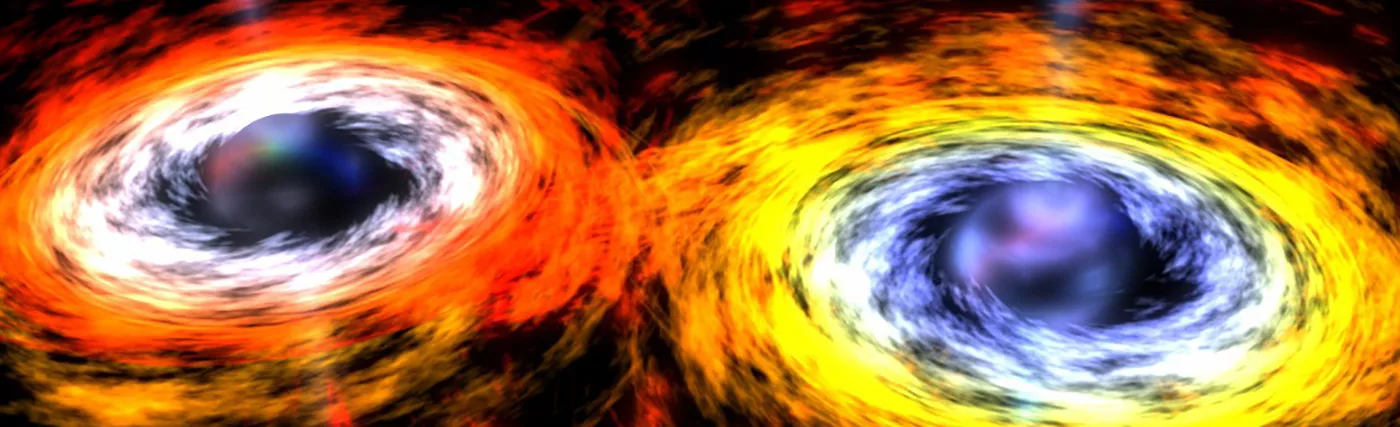
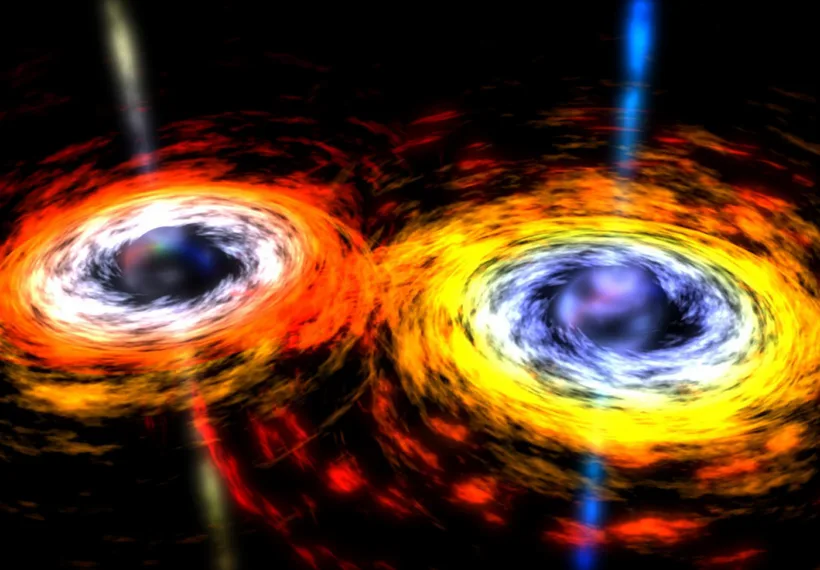
You can merge two black holes if two galaxies collide.
Right.
And we've seen that happen.
It's happening all the time, every day all the time.
And so as they collide, the black holes will ultimately find each other.
And then they will merge.
And then you have a black hole twice as big.
But the black hole's not reaching out.
If you would not otherwise fall into a black hole, you're not gonna now start falling into the black hole.
We are safe.
It's not a drain.
It's not a toilet bowl drain.
Right.
So we're not gonna one day land.
We're not cosmic poop.
Right.
Land in that.
So no, in fact, in the very distant universe, black holes ultimately will evaporate, according to Hawking radiation.
It's a really interesting phenomenon.
So now, okay.
Can I tell you what the phenomenon is?
So a black hole has very strong gravity.
Well, how much gravity does it have?
Well, you can think of the gravity having a density of energy.
We call it the energy density of gravity, okay?
In its vicinity.
Every now and then, spontaneously, that energy becomes particles, according to E equals MC squared.
Okay.
We'll do that just spontaneously.
And you make a particle pair, a matter and antimatter particle pair, and they go in opposite directions.
Oh.
Okay.
By the way, they have to go in opposite directions so that the momentum cancels, because it started out as just a pocket of energy sitting there doing nothing.
Right.
You can't have a particle just go in one direction and nothing cancelling out that motion in the other.
Oh, like a bazooka.
Yes, the recoil in the other direction.
Otherwise, the person becomes the recoil.
That's pretty funny.
That would be funny.
But note to the next design.
That is awesome.
Let me redesign that.
Why do you guys have 25 bazooka shooters?
Yeah, because we got 25 shots.
Yeah, so there's a recoil of that to send it forward.
So the same with the spaceships, the rockets that take off, you recoil at the back, all the exhaust.
So, what point was I making before?
You were talking about, so the particle as it evaporates.
Oh yeah, so what happens is, so the energy density spontaneously makes a particle pair.
One particle falls into the black hole and the other escapes.
Right.
That takes mass away from the black hole.
And that is the evaporation of the black hole.
Yes, it's very slow, but it's real.
But this spontaneous particle, you know, basically.
It's called Hawking radiation.
It's Hawking radiation.
That's what it's called.
So it's the dissemination of the particles that are opposites, and one going away, one going in.
Yes.
And then all of a sudden, if it keeps continuing, then the black hole is gone.
It evaporates to nothing.
To nothing.
Correct.
Yeah, yeah.
So we gotta take a break.
When we come back, you will learn what words pronunciation changes just by capitalizing the first letter.
Oh yeah.
In Neil deGrasse Tyson's office hours.
Thank Bringing space and science down to earth.
You are listening to StarTalk.
We're back on StarTalk, Cosmic Queries Edition, Neil deGrasse Tyson's Office Hours, where we take questions on anything.
It doesn't have to be in a category.
And they're coming from everywhere.
Everywhere.
Chuck is helping me out here, Chuck, keep it going.
All right, let's jump right in.
First, you gotta give the answer to the tease.
Okay, I like words a lot.
Okay, so what is this word that you can capitalize the first letter and change the meaning of the word?
Completely, yeah.
Completely.
The word is.
I feel like I'm on MPR.
The word is P-O-L-I-S-H.
Polish.
And then you capitalize it and it's Polish.
So one is what you do to shine something and the other is.
Is your nationality.
Is the nationality from Poland.
Right.
Very nice.
It's weird.
It is weird.
It has nothing to do with this show.
No.
But I don't know why I.
So don't start a sentence with polish.
Yes, because it has to be capitalized.
Polish your shoes.
Polish my shoes.
Polish my shoes.
You racist son of a.
Let's go to Fyodor Popov.
Fyodor.
Fyodor?
This is Fy.
Yes it is.
Yeah, Fyodor.
It's Fyodor.
Yeah.
And last name?
Popov.
Popov, okay.
Fyodor Popov.
Fyodor Popov.
Hey, Fyodor.
Hey, Fyodor.
Here we go.
Fyodor says this.
If you had to guess, where lies the great filter?
Now, first of all, what is the great filter?
I have no idea yet what he's asking in this question.
So please proceed.
All right.
There you go.
There you go.
No, no, let me hear the whole question.
That's it.
What?
If you had to guess, where lies the great filter?
I don't know what the great filter is.
I mean, unless it's, you know, Brita.
The great filter.
If it's Brita, I'm good.
Where lies the great filter in my refrigerator?
Filter.
Filter in my water.
The great filter.
Chuck, I have no understanding of that question.
So we gotta go to Wikipedia.
Maybe from that, again, I'll be able to say something.
Say something.
Okay, all right.
So in that case, what I'll do right here is go to Wiki.
Wiki, so you help me out here from Wiki.
And I'll read it to you what they say it is.
The great filter in the context of the Fermi paradox is whatever prevents dead matter from undergoing abiogenesis in time to expanding lasting life as measured by the Kardashev scale.
Okay, I can say something about this.
I just didn't know it was called the great filter.
So in...
Now, all I got from that was Fermi paradox.
So the Fermi paradox was a question posed by the great physicist Enrico Fermi, who born in Italy came to the United States, basically Cold War, not Cold War, Manhattan Project.
So Enrico Fermi posed the question.
Because you can run the math.
You can say, all right, how long has Earth been here?
How long did it take life to form?
How long did it take what we call intelligence to form?
Now that we're intelligent, how long does it take to travel to another planet?
Let's say we have a spaceship, all right?
Is it a generational ship?
Fine, so it takes 10 generations to get there.
Then you become pilgrims.
Set up tent.
Now, from there, you go to two other planets.
From each of those two planets, they go to four more.
From one to two to four to eight, so it grows exponentially.
You can populate the entire galaxy with intelligence in a shorter time than evolutionary time scales.
That's on an evolutionary...
The dinosaurs went extinct 65 million years ago.
That's a very short time.
Very short and it's small compared with the lifetime of a planet.
Exactly.
Especially the future of the universe.
If that's the case, why hasn't it happened yet?
And where are the visitors trying to populate this planet that we're on?
So it's the Fermi paradox.
Where are they?
Maybe they were already here.
Maybe we are there.
Maybe we are them.
So there's some religions that are based on that.
That God is actually the aliens.
Yeah.
Right on.
Okay.
Just by the fact that you said that.
I don't judge how crazy people are.
That's what you said.
That was implicit in your...
Oh, man.
So this dead matter, they don't mean dead matter because that implies it was once alive.
They mean inanimate matter.
Inanimate matter evolving to become self-replicating life.
So the question is maybe that takes so long that it puts a damper on this whole...
On the other processes.
On all the other processes.
Right.
However, that happened really fast on Earth.
We went from inanimate molecules to self-replicating life within a couple of hundred million years.
And once you have life, life was there for billions of years.
So that's not really that long.
No, it isn't.
Right, right.
So the filter, I don't see that as the big filter.
You know what I think the filter is?
What?
Whatever urge you have to colonize planets.
And then all your descendants have that same urge.
Right.
There's gonna be a point where there's a planet I wanna colonize.
Oh, but you wanna colonize that same planet.
So then what do we do?
You're gonna have a blood feud with your own family.
With your own family.
Right.
Correct.
And so it could be that the urge to want to expand is self-limiting because you will fight wars.
You cancel yourself out.
You cancel yourself out.
The very urge that causes you to strike out and discover is the same urge that destroys you in the end.
Correct.
Wow.
Right.
And so there are whole categories of these kinds of problems in life.
For example, I don't know if it still happens if you lose a quarter between the base and the back of the seat and your car.
Right.
And you reach for it.
Right.
The act of reaching for it which separates the two cushions more and then it falls further in.
See, I'm cheap.
That whole seat's coming out.
Get in that quarter.
I have actually pulled a seat out to get the money that's falling.
We got one minute left.
Let's do lightning round.
Go.
All right, here we go.
You know what?
This is an education question, so let's do it.
This is Steven Donham.
He says, hey Neil, love your show.
Listen all the time.
My question is about Common Core math being taught in school.
It seems like a waste of time and kids have to go through all of these extra steps to get the right answer when there were simpler ways to get the right answer when it comes to life and death and space.
Wouldn't it not be better to get the right answer the fastest possible way?
Oh, good question.
Okay, I am not doing a lightning round on that question.
It's too important.
It is very important.
I'm gonna end with my answer to that question, okay?
This is the end of the show and that's why I picked it.
I'm doing deep dive on educational philosophies.
That's why I picked the question.
In my recent months and years.
Well, you're an education.
You're an educator.
A deep dive and I'm looking at what people have said, what have worked, what hasn't, best practice and I have come to conclude with regard to that question.
Okay.
That what matters more than the right answer is the right question.
Interesting.
And taking a cue from Isaac Asimov.
In an essay he once wrote called The Relativity of Wrong.
The Relativity of Wrong.
Yes.
Okay, so here you go.
You're in elementary school and I have a spelling bee and I ask you to spell cat and you spell it K-A-T.
It's marked wrong.
You don't get any credit for that because the correct answer is C-A-T.
But suppose instead you had spelled it X-Q-W.
X-Q-W.
It's still marked wrong.
And that's so much farther away than K-A-T.
It's so much farther away than K-A-T.
In fact, you could argue that K-A-T is a better spelling than C-A-T.
You know why?
Because if you look up cat in the dictionary, C-A-T, the phonetic spelling is K-A-T.
That's awesome.
But you got it marked wrong.
Right.
So this urge to get the right answer.
Right answer.
Yes, I don't wanna diminish the importance of right answers.
That has value, but it has less value than you think it does.
Because in exploration, you have no answers.
You're on the precipice of the boundary between what is known and what is unknown, and you're taking a step into that unknown.
And you don't know what's there.
You don't even know what question to ask.
I know what's there, a cat.
But you're probing, you're poking, you're trying to figure out what question to ask.
And most questions don't even have unambiguous answers.
Right, exactly.
Can I give you an example?
Okay, what's the diameter of the sun?
Ask me that.
What is the diameter of the sun?
You look it up, it'll say 864,000 miles.
Fine.
But in what wavelength of light did you make that measurement?
Other wavelengths of light emerge from deeper in the star.
Right.
Okay?
And if you're using X-rays, it's bigger.
The corona emits X-rays.
We found that out earlier in the show because of the different wavelengths.
That's a different wavelength.
So, you have to specify.
How high up does the atmosphere go?
Earth's atmosphere.
Because it's 62 miles, 100 kilometers.
That's, we've just agreed, because that's a round number in kilometers.
There's still air molecules above 62 miles.
That's why we have to boost the Hubble telescope every now and then, because air molecules are knocking it out of orbit.
Okay?
So, there is no demarcation line.
It fades until it blends with the interplanetary medium.
So, we like tidy answers, but most of science is not even about the answer.
It's about the general understanding of what's going on, and then you take it from there.
So, no, common core math is a good thing.
It's got you thinking in ways that it will enable you to tackle a problem in the future that you have never seen before.
And if you're in space, it's not about knowing the right answer to a pre-designated question.
It's about figuring out an answer to a question no one has asked before.
Right, right.
And so, you need the tools and the methods and the power of inquiry to accomplish that.
Wow.
There you go.
There you go, drop the mic.
That was, that's a very good answer.
I'm saying.
I like it.
I'm writing this up.
It makes sense.
It's going in the next thing.
All right.
Chuck.
This was good, man.
Always good to have you.
Yeah.
You know what I mean?
This has been StarTalk.
We're recording this in the, my office.
The Cosmic Crib.
The Cosmic Crib at the Hayden Planetarium in New York City, part of the American Museum of Natural History.
And as always, I bid you to keep looking up.
See the full transcript



 Unlock with Patreon
 Become a Patron