


 Unlock with Patreon
About This Episode
In our quest to understand the universe, how can we be sure our conclusions are correct? Human beings have evolved to find meaningful patterns in nature, but sometimes the patterns we see are just figments of our imagination—or perhaps the result of wishful thinking. Join Neil and guest co-host Leighann Lord as they investigate the weird and wacky world of pseudoscience.
NOTE: All-Access subscribers can listen to this entire episode commercial-free here: Cosmic Quackery.
Transcript
DOWNLOAD SRTOur universe is filled with secrets and mysteries, leaving us with many questions to be answered. Now more than ever, we find ourselves searching for those answers as the very fabric of space, science, and society are converging. Here for...
Our universe is filled with secrets and mysteries, leaving us with many questions to be answered.
Now more than ever, we find ourselves searching for those answers as the very fabric of space, science, and society are converging.
Here for the first time, these worlds collide as we give you the knowledge that breaks the barrier between what is science and what is merely pop culture.
This is StarTalk.
Now, here's your hosts, astrophysicist, Dr.
Neil deGrasse Tyson, and comedian, Lynn Copletts, StarTalk.
Welcome back to StarTalk.
Indeed, I am your host, Neil deGrasse Tyson.
Astrophysicist.
My day job is actually as director of the Hayden Planetarium in New York City.
Today, my guest co-host, subbing for Lynn Copletts, is comedian, Leighann Lord.
Leighann, welcome to StarTalk.
Thank you, Neil.
Thanks for having me.
Leighann is a professional stand-up comedian.
She's been on ABC's The View.
She's occasionally called in to comment in foxnews.com.
I'm the fair of fair and balanced.
You're not the balanced of the fair and balanced?
And you've got a blog that I've loved reading in veryfunnylady.com called The Comic Perspective.
A one-letter shift from the cosmic perspective.
Do you know this?
Yes, I do.
I was actually telling people when I was coming here today that sort of the comic and the cosmic perspectives were meeting.
There you go.
Yes.
Well, today we want to talk about cosmic quackery, really.
You've heard of medical quack talk, right?
Yes, I have.
There are actually versions of these folks who tell you things about the universe that's just simply not true.
Things that they didn't take Physics 101 in school.
Uh-oh.
Like some other people who might be co-hosting today.
Did you never have Physics?
I never had Physics.
Not even in high school?
Well, it was an option and I sort of avoided it.
I'm so embarrassed to say that now.
But no, no, no.
I'm going to redeem myself.
I'm going to the library.
I'm getting Physics for Dummies and I'm going to brush up.
Now, but I also, from previous conversations with you, I know that you're like a sci-fi buff.
I'm a huge sci-fi fan.
So, but that means you can't hang with like the real sort of...
Can't hang...
.
geeks at the sci-fi convention.
Dude, no, I'm queen of the geeks.
Really?
I go and I'm conversant in Star Trek, old and new.
I wear a Bajoran ear cuff.
Excuse me?
Yeah, exactly.
Please don't question my sci-fi credibility.
All right, we'll get back to that maybe.
So, interesting, because the people, there are many people, for example, who are in denial of the advances of science.
And one of my favorite quotes from Arthur C.
Clarke, who'd be a champion of sci-fi community, is that any sufficiently advanced technology is indistinguishable from magic.
Yes.
And so magic could be in our own technologies or even if aliens came in and it would just look like magic to you, if they had some advanced hardware or some ideas about how the universe works.
Like I have Windows and Mac is magic to me.
Yeah, I...
We'll bring that up later, too.
Did you know we hear from Bill Nye every show?
I love Bill.
Really?
I do, I do.
The way you're looking, that face you just put on, I'm so not giving you his email.
Well, listen, listen, I know there's a whole restraining order thing with me and Bill, and I know if I could just talk to him for five minutes, we could get past it.
Let's see what he's got to say about this week's subject.
Hey, Bill Nye, the science guy here.
Last week I was on television with a couple of guys who claimed that no one has ever been on the moon.
The whole business was a hoax.
When you hear something like that, it's your responsibility to decide if such a claim is reasonable.
Landing on the moon seemed beyond our capabilities.
Until you go out and look at the rockets and the records, pictures and warehouses full of documents, it's amazing but not impossible.
These guys didn't want to think about it very much.
Magicians seemed to saw people in hat.
Same athletically built assistants night after night.
Astrologers claim the moment of your birth determines remarkable features of your personality, no matter place or economic circumstance, and there would only be 12 varieties of people.
Astronomy demands so much of our ability to think.
We determined that we live on a round planet with no space pictures to prove it.
We discovered the Big Bang without hearing a sound.
We figured out that 94% of everything is made of something we know nothing about.
This is Bill Nye hoping this week's Star Talk gives you something remarkable to think about.
That's my Bill.
No, that's actually my Bill.
There's songs people singing about somebody named Bill.
Yes, wasn't that The Fifth Dimension?
The Fifth Dimension.
Well, ding, ding, ding, points for me.
So Bill is trying to set the mood here and he's right on.
There are things that go on that we do in science that some people are in denial of.
And there's science that people think they know well enough to then sort of co-opt it and then do sort of pseudoscientific things with that.
And I'm assuming by your tone that that would be wrong.
Well, I don't want to value judge it.
I don't mean wrong like it's morally wrong.
It's wrong because it's uninformed.
It's uneducated.
In many cases, most cases, it's just plain ignorant.
And now I always wondered, a good friend of mine is also a magician, a very famous magician, the Amazing Randy.
If you've heard of him, Amazing Randy, he's a professional magician as well as someone who's scientifically literate.
And so you know what he does, when someone makes a claim that's extraordinary with pseudo-scientific statements about how the world works, he goes and investigates what it is that they're doing.
So he's a detective as well, right?
Yeah, that's it.
He's hustling.
His magic talents, magic talents, his talents in magic enable him to spot somebody else who might be using sleight of hand in whatever it is they're trying to perform.
And so, but then I asked him, so why do people believe things that are just not true?
You do performances in front of people that are not true.
So what's the harm?
Like, who cares?
Maybe it's just entertainment.
Let's see what the amazing Randy has to say about this.
It's not all entertainment.
That's the point.
As a magician, I deceive people for purposes of entertainment.
That's far, far different from deceiving them to cheat them or change their outlook on reality, which could easily be done if they begin to believe that what I'm doing on stage is genuine and in foreign public serves us all.
And I can't help but think, as I see this nonsense being promoted, that we're inundated with these days in the media all over the place, that these people, they vote as I do.
That's the problem, you see.
The people that listen to this nonsense, they get the same vote that I get.
And I'm not going to vote the way they will.
Equal vote.
That's right.
That's right.
But it's a free country.
So what, again, so what?
Why do you care?
It's let them think what they want.
Why do you care?
Yeah, but it's a public service now, Neil.
I must say it's a public service.
You see, I know things that they don't know.
And what I try to do is not reveal the magician's tricks to them, but I try to reveal to them the fact that they can be fooled.
Now, I often get academics saying to me, after I do a public lecture at any place in the world, they come to me and they say, boy, you really taught us a lesson here.
And it seems to me that these people who believe in all of this nonsense, the pseudoscience and the chicanery out there, they must be really stupid.
Well, I take them aside, and what I'll do at that point, Neil, is I'll show them the damnedest card trick they've ever seen, and they rear back and say, oh, but that wasn't a trick, simply because they're scientists.
And scientists are not the best people to judge these things.
They believe they can't be fooled.
Anyone with a Ph.D.
after their name, I believe you do have one, at least one, they often get convinced, I guess I know everything now, and no one's going to be able to fool me.
And so when I show them something like a dazzling card trick that really blows them out of the water, they assume falsely that it can't be a trick, because they know how tricks are done.
No, they don't.
So that's a bit of a kind of a hubris or an arrogance of their academic position.
Exactly, exactly.
And they've got to get over that, really.
So if they're ever called on to investigate somebody's telekinesis or mind spoon bending or whatever, then they ought to bring you, because you're an expert in watching people fool other people, whereas a scientist has no such training or background.
That's right.
And not necessarily me, of course.
I'd be pretty busy under those circumstances.
But an experienced magician, and I emphasize that, an experienced magician, a professional, someone who's been in it for a long time, because amateur magicians often think that they know everything, too, and they know how all the tricks are done, and they can be as easily fooled if they're not well informed.
So an experienced magician, and I've been called in on many cases like this all over the world, is very valuable just for the opinion.
Without being a scientist, remember, I'm not making any presumptions that I have the degree that I should have as a scientist.
No, not at all.
I'm strictly an amateur when it comes to that, but I do have this specialized expertise.
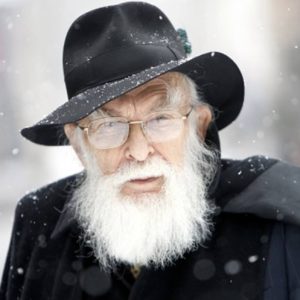
That's the amazing James Randi.
Very amazing.
Right here on StarTalk.
You're listening to StarTalk Radio.
I'm your host, Neil deGrasse Tyson, and I'm joined by this weekend's visiting co-host, Leighann Lord.
Professional comedian, Leighann, welcome to StarTalk.
If you have something to say that you want to tell us, you can tweet us at StarTalk Radio.
Or one word, of course.
Or give us a call at 1-877-5-STAR-TALK.
If you have an opinion, a comment about pseudoscience, or maybe you're into some of this stuff, and you want to tell us, if you dare.
If you dare.
Because illusions are being dashed.
There are a couple of cases here.
I'll give you an example, and some of it is just, I think, the consequence of rampant science illiteracy.
There was a court case a couple of decades ago where there was someone who was going to be indicted because the moon was, they claimed it was in a particular phase one night instead of another phase.
They brought in an astronomer to say, well, no, it was a different phase rather than that.
And the judge said, well, how did you know?
And there's this thing called the astronomical almanac that gives all the phases of the moon.
He said, here.
And then the judge threw out the evidence saying, you can't know the phase of the moon any more than you can predict the weather.
That somebody didn't have Physics 101.
And, wow, that was a judge?
A judge, people standing in judgment of whether somebody goes to jail or not.
And this is an educated person, you know, law school.
Someone who would claim they are educated.
That's the problem.
We have many people who say they are educated, believe they are educated, but they have these holes in their background, and they don't know it.
By the way, there's nothing wrong with ignorance.
Ignorance has got a bad rap, but if you just happen to not know something, fine.
You go learn about it or bring in an educator, you're going to plug that hole.
But if you're ignorant and don't know it, that's danger.
I don't think it's ignorant and not knowing it.
It's ignorant and not wanting to change it.
Oh, that's even worse.
That's where the evil lies, I think.
Yeah, even worse.
And I remember when I was a kid, age 14, I remember this distinctly.
I already knew I was kind of interested in the universe.
And there's a comet coming along that was discovered way out in the solar system, farther away than comets are normally seen.
So that meant by the time it gets close to the sun and the heat will evaporate the ice to make the long beautiful tail, there would be a really beautiful comet.
It was to come around at Christmas time.
It was a beautiful...
A present from the universe.
And it was called Comet Cahootek.
And I was all ready for this.
And by the way, scores of comets are discovered every year.
So this is not special?
Well, it was special because it was slightly brighter than what the others would have been.
From further away, so therefore brighter.
Yeah, you can see it from further away.
So that means by the time it got close, it would be even brighter.
So there you go.
There I'm walking down the street and I saw grownups holding up, not everybody of course, some grownups holding up a sign saying, repent, the end of the world is near, the comet will end Earth.
And I'm thinking, what?
I was 14 and the little bit of physics I knew told me that this guy had no clue.
No clue.
And so I didn't understand, I was just trying to...
So you could have helped this man if you had simply given him a physics book and going, no dude, we're going to be okay.
Just read this book, we're fine.
Well, some people don't want...
Some people like The End of the World.
Oh yeah, The End of the World is a very sexy concept.
I mean, there's a lot of money to be made there.
I guess so.
Movies and everything.
Movies, TV's, books, the whole deal.
So, I know, my head was spinning after that.
Worried what I'd have to confront by the time I was an adult living among them.
The alien species that is adulthood.
We're going to take our first break.
You're listening to Star Talk Radio.
Give us a call at 1-877-5-STAR-TALK.
Or send us a tweet at StarTalk Radio.
We'll be back in just a moment.
Whether you're a space cadet or a rocket scientist, we want to hear from you.
The phone lines are open.
Call now.
This is StarTalk.
Welcome back.
I'm your host, Neil deGrasse Tyson, joined by my guest co-host, Leighann Lord.
Hey.
I have a question for you.
Yeah, what's that?
We were talking about comics.
Just before the break.
I didn't know that comment that you mentioned because I'm more familiar with the Hale-Bott comment.
Yeah, everybody saw that one in the 1990s.
Yeah, I remember that.
And I remember it simply because they died with outfits on.
That cult.
Oh, the Heaven's Gate cult.
Heaven's Gate cult, yeah.
People beat adults doing crazy things.
This is scary stuff.
But now how did those comments sort of compare?
Because you said the first one was really bright.
The first one, people expected it to be very bright, as bright as what Hale-Bopp turned out to be.
But it turned out that it wasn't that bright.
It didn't have enough times around the sun.
It was a very long period comet.
And you got to come around the sun enough times to jiggle loose enough ice to evaporate it, to give a very visible tail.
And this was a very tight comet coming around.
So, lots of promo, no delivery.
Kind of like today's little teeny-bopper stars, not really delivering on the promise.
We'll all talk and no tail.
Are we going there?
Can we do that on StarTalk?
I didn't know it was that kind of show.
So, Comet Hale-Bopp was one of the brightest comets actually in recorded history.
And there's this cult who believed that there was a spaceship behind the comet and that the end of the world was coming.
And they all put on that.
I think they were wearing Nikes?
They were all wearing Nikes.
That's embarrassing.
It was.
And Adidas was very jealous.
So, they were all wearing Nikes.
They took some suicide potion.
They were all dead, just dead, hauling the bodies out of the house.
I know that could not have been on the East Coast, because this sounds like a West Coast kind of thing.
It really does.
Yeah, no, no, we don't roll like that here.
We are live in Los Angeles and Washington, DC.
The show is produced in New York City.
And you can stream it live on startalkradio.net.
You know, there are a lot of people, the skeptics out there, who like professional, you know, you can, they're professional skeptics.
Are they really?
They get like paid to like be a skeptic.
Now, you know how we get professional skeptics, don't you?
No.
They go to Catholic school.
You get skeptics in comics, which explains why I'm in my field.
Did you come out of Catholic school?
Yeah, I escaped.
So you can only be a comedian after that.
Is that what you're saying?
Well, it's one of the forms of therapy to recover.
I can't afford to actually pay somebody, so this is it.
You know, there's one thing, if someone has an idea, how do you know if they're saying the right thing and has scientifically informed, if you don't otherwise know your science?
And somebody says something extraordinary.
It's an interesting question for a skeptic.
How do you expect someone to distinguish what is extraordinary fake from what is extraordinary real?
And I asked Michael Shermer, who's editor of Skeptics Magazine and a...
There's a magazine?
There's a magazine, Skeptics Magazine.
But they're too skeptical to actually subscribe?
I don't believe the skeptics.
So there's actually, that's principally, that is produced on the West Coast.
There's an East Coast Skeptics Magazine called the Skeptical Enquirer.
But I think that West Coast has got the bigger job ahead of them, given what we know comes out of California and the Pacific Northwest.
Let's see what Michael Shermer has to say.
When I ask him, just how do you distinguish science from pseudoscience?
Because he does this professionally.
The way I do it is I have a certain confidence in the scientific community and the experts in that particular field.
So I don't know much about string theory other than what I read in the popular accounts of it.
So I go to my friends at Caltech, like Kip Thorne, and go, hey Kip, what's the deal with this stuff?
I mean, you know more about this than I do.
And what do you and your colleagues think?
Is there something to this?
Is there not?
And it's not that I have faith in Kip, like a religious person would have faith in his pastor.
I know that Kip Thorne and his colleagues at Caltech have a peer review system where there's checks and balances and they keep track of each other because they know what the science is, even if I don't.
So you're eavesdropping on the peer review system by...
Yeah, and they have a track record of debunking things.
And I was encouraged by a couple books last year that were skeptical of string theory, going, okay, that's enough.
You guys don't have any empirical evidence yet.
Let's be a little more cautious here.
And I thought, okay, this is a good example of science at work being skeptical.
You get a grace period for a while where you're just doing theory, but at some point, you got to have the facts on the ground have to count for something.
So that grace period is where nobody really has data yet, but they're just massaging ideas to see what works and what doesn't.
Yeah, I think that begins at science fiction and works its way up into theoretical physics.
And then at some point, though, you have to have contact with reality.
And if there's some empirical data.
Now, another good example of this junk science is cold fusion.
You remember in 89 when Pons and Fleischman held that famous press conference and everybody was very excited.
Energy too cheap to meet is going to save the world and all.
It was very exciting.
This is energy fusion of atoms to make energy produced on a tabletop rather than in a big, expensive particle machine.
Yeah, and what could be cooler?
You don't have to use the energy companies you just have in your house.
Okay, great.
But within weeks, it was clear no one was able to replicate those experiments.
So that was a nice example of science.
See, science is skeptical.
I mean, we're skeptics.
Scientists are skeptics.
And you start with the null hypothesis that whatever it is you think is true is it.
Now, go ahead and try to prove otherwise.
So you think you have cold fusion?
Great.
Where's your evidence?
Show us.
And show us exactly what you did so we can go back to our labs and do the same thing and we do and we don't get the same results.
So, okay, there's something else going on here.
It all comes down to show me the evidence.
Yeah.
Now, I have a question.
I was under the impression that cold fusion was just a band from the 80s.
Am I wrong on that?
Or is there more than one type of cold fusion?
Was it a band?
I have no memory of any band from the 80s at all.
Wow.
Did you just sort of skip that decade?
I was in graduate school.
Oh, so you weren't here.
You weren't here.
You were in an alternate universe.
Alternate universe.
You missed a good decade.
You're listening to Star Talk Radio.
Give us a call at 1-877-5, Star Talk.
I'm here with my co-host, Leighann Lord.
Leighann, you know, part of it, if it's about the evidence, this is what's interesting.
You know about the Face on Mars?
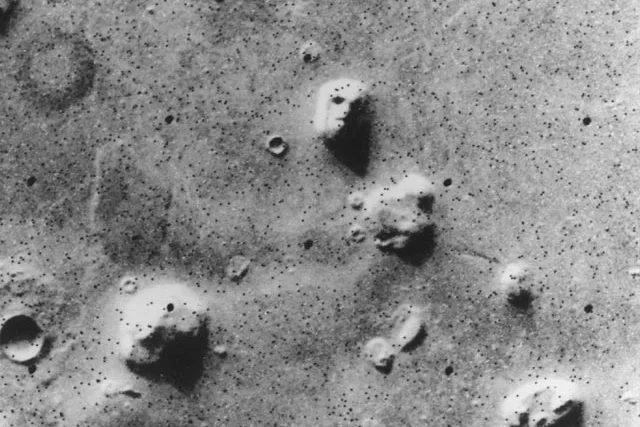
There's a whole Face on Mars community out there who believes that Mars has evidence of there having been civilizations thriving on its surface.
There's a community of people?
A whole vocal community of people.
These people don't have cable then?
Maybe they do have cable, and they got the shows that don't know the difference.
So here's what happened.
In the 1970s, the Viking missions to Mars, there were two of them.
One landed, one orbited.
The orbiter took pictures of the Martian surface, and one of the mesas, because by the way Mars has wonderful surface features.
There are rivers and valleys, dry river beds and valleys and craters and mountains and volcanoes and ravines.
Until the developers get in.
There's Starbucks there.
Or McDonald's will be the first ones in, for sure.
So it has all these interesting land features.
And if you photograph the surface at different sun angles, you get shadows showing up on the surface that take on certain shapes and sizes and forms.
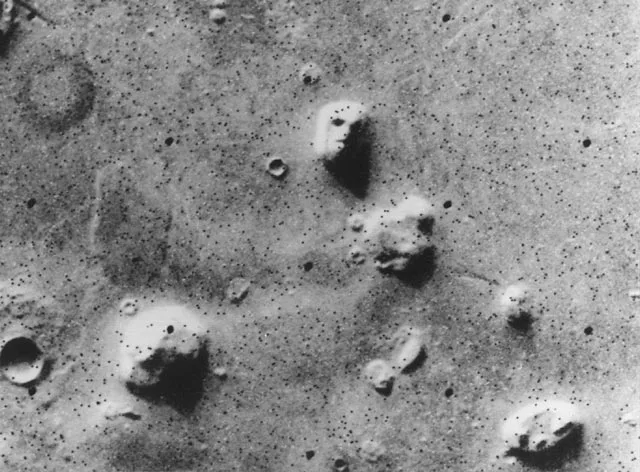
In that first set of photos from the Martian surface, there was a mesa that looked like a face.
A human face.
A human face, yeah.
What a coincidence.
Not a turtle face.
Not a cat face.
And so who is it that's looking at these pictures?
Humans are looking at the pictures.
So coincidentally.
Yeah, so I wonder if we were lobsters, would we be looking for lobster faces?
So there's this, we want to see what it is that we're most familiar with.
That's one thing that drives us.
But another thing is there was a human face.
Simeon is more appropriate to say.
Simeon?
Simeon, because it's an ape-like face.
Oh, okay, I thought you meant the guy that sells me beef patties in my neighborhood.
Oh, his name is Simeon.
It is, it actually is.
I'm like, sorry, Simeon.
These are Jamaican beef patties?
Oh, cool, I haven't had one of those in a while.
Are you serious?
I mean, I brought some beef patties for you, but you're not going to have none.
Give me that, bring some next time, we'll get you back.
So, by the way, that region of Mars is called the Cydonia region, and there's not only evidence for a face in these first photos, but people notice what look like pyramids and other sort of structures that would not have happened under natural causes.
So here's what you do.
You have to ask, if it's a face, it'll be a face in any sun angle, because facial features look like a face no matter what angle of the rays of light that I put on your face.
Otherwise, I could shift the light into another direction and you'd look like a slab or something, right?
So it's a face today, all day, every day.
If I come back next week, it'll be a face.
Exactly.
So the trick here is to come back to that region with a different sun angle and see if it looks like a face.
Well, we did that.
NASA did that.
And didn't look like a face.
But we found the region and we saw the raised ridges that would cast a shadow that would give you the impression that it was a face.
So we got a better image under a different sun and the face went away.
And?
And so what happened was the face people said, well, we think that it was a face back then, but the civilization knew that we were looking, this is one variant on this, knew that we were looking at them and that they covered up the face.
They covered up the evidence.
The aliens covered up the face.
When these same aliens just come to earth and take the memory of the face away from us?
That's a good one.
I'm just trying to help the conspiracy people.
So I'm curious how our listeners view evidence because this is an issue about how we move forward into the 21st century.
What does evidence mean to you?
And if you know what you believe in no matter what, then does the absence of evidence matter to you at all as well?
I'm just curious about that.
You know, Leighann, it's pattern recognition.
That's what it comes down to.
What do you mean?
We're humans.
We're trained, interestingly, to find patterns even if there isn't a pattern there.
And our friend Michael Shermer is an expert at this.
So let's see what he has to say about pattern recognition and why people's brains are wired in this peculiar way.
Check him out.
So why do people believe weird things?
What's your take on that?
Well, the deeper reason is because people have to believe things.
That is, we're pattern-seeking primates.
We connect the dots.
We connect A to B and B to C, and often A really is connected to B, and B really is connected to C, and that's called association learning.
All animals do it.
You know, you grow new neural connections when you learn something repeatedly, and it's a good thing we're able to do that.
That's how organisms survive, and we're an organism.
It's also how you want to play the piano, I guess.
Yeah, or anything.
So the problem is that we don't have a baloney detection kit built into our brain that says, that's a true pattern, that's a false pattern, and here's how to tell the difference.
It's very difficult, very tricky to tell the difference.
So let's say you're a hominid on the plains of Africa, and you hear a rustle in the grass.
Is that the wind, or is it a dangerous predator?
Well, if you assume it's a dangerous predator, and it turns out it's just the wind, you've made a type 1 error, false positive, but no harm.
You just become more cautious, you move away, you can start a glance over there.
You've actually numbered the errors?
You've actually numbered the kinds of errors?
Yeah.
But let's say you think the rustle in the grass is just the wind, and it turns out it's a dangerous predator, well, that makes you lunch.
And so you're now taken out of the gene pool, and so I'm arguing there's a natural selection for always assuming the patterns are real.
The rustles in the grass are always dangerous predators and not just the wind.
And so we've evolved this sort of natural tendency toward magical thinking, superstition, to do all...
Wait, wait, wait.
But if I think it's wind, that could be real also, because it might be the wind.
That's right, yeah.
That's right.
And there's no harm in that.
The harm is not realizing it could be a predator.
That's where the selection process begins.
What you're saying, though, is that it's better for me to think the worst of the patterns that I make than to have just innocent thoughts about the patterns at all.
That's right, and there's a selection for that.
And not only that, but that the pattern is not only real, but also infused with intentional agency.
That is, there's some power, there's some force, some spirit behind it.
Why do you need that?
That's magical thinking.
Well, because when I mentioned the phrase, dangerous predator, that implies that the predator has intention, and the intention is to eat me.
So that means that there's an intentional agent there.
And that's the basis of the belief in ghosts and spirits and gods and aliens and conspiracy theories.
And you think about what aliens are always like.
They're always like these super secret, fast, powerful, invisible agents coming down from on high to save us or destroy us.
And really, that's kind of the basis of polytheism and animism and the belief in ghosts and, you know, angels and things like that.
So you've got it all explained.
That's what our brains are.
Unfortunately, our brains are designed to do that.
And the best tool to tell the difference between true and false patterns is science.
But it's only a couple hundred years old, and our brains are millions of years old.
So guess what wins out?
It's the superstition.
So this is an uphill battle that you may never win.
I have job security as the publisher of Skeptic Magazine.
We're never going to run out of topics.
There will always be a new generation to believe weird things.
That was Michael Shermer.
That was great.
Professional skeptic.
Did I hear you imply in that interview that thinking positively is going to get us killed?
We should just think negatively all the time and we'll be fine.
I think I did imply that, didn't I?
So don't worry, be happy is not what we need.
Yeah, the people...
They're not here anymore.
Those skipping through the grass saying, don't worry, be happy, that's just wind.
Those who think it's a tiger are not eaten by the tiger.
Yeah, so...
And there are people who try to go to the end of the world with scenarios.
The whole field of numerology is a...
People who try to see meaning in numbers.
When numbers are just stuff we invented to account for the real world.
Numbers aren't magic?
No, not in the least.
See, I was an English major.
Once again, numbers are magic.
Numbers are Pythagoras.
Remember Pythagoras?
I used to hang out with a guy.
No, I'm sorry.
He made patties for you.
You're listening to StarTalk Radio.
You can give us a call at 1-877-5-StarTalk.
I'm your host, Neil deGrasse Tyson, astrophysicist, with my guest co-host today, Leighann Lord.
Welcome.
So Pythagoras, you should remember him.
The Pythagorean theorem.
Whether or not you remember what it was.
No, I can't remember what it was.
I'll be honest.
Yeah, there you go.
All right, but you got Pythagorean theorem.
I remember the Pythagorean theorem.
He was a pioneer of numerology.
He would see like six stones on the pathway and there'd be like six people standing next to them.
He'd think there was some mystical connection between the number six in that case.
And so numbers, it was an attempt to get meaning out of nature just by the manipulation of numbers.
And you got to start somewhere.
I'm not even faulting him.
But it's a method of learning and knowing that has been so long discredited that it's astonishing that even today that we have people who invest entire life's energies in them.
But it seems kind of cool.
There's an entire Jewish sect that that's all they do.
No, no, that's the Kabbalah.
The Kabbalah, that's right.
That's what they do.
They assigned numerals to the Hebrew characters of the Torah, and they manipulate, add them, subtract them, multiply, divide.
Here's the problem.
There's so many ways to combine numbers, so many ways.
Add, subtract, divide, multiply, times three, times four, divide by two, carry the two, don't forget to carry the two.
You got it.
There's so many ways that you can find meaning in almost anything you look for, because you extract it.
You know what it's like?
It's like, have you ever done archery or if you shoot arrows?
In the hood all the time.
That's how I get a seat on the bus.
I went on with my crossbow.
You never went to camp?
All right, I went to camp.
I can't be having art.
If you shoot arrows in the side of a barn, no one does it, but try it one day.
Then try to aim for the same spot on the barn.
Shoot all your arrows.
Then afterwards, go back and draw a bullseye where most of your arrows hit.
Then say, look how good an aim I have.
That's what numerologists do.
And that's wrong?
That would be wrong.
That would be wrong to do.
Is Kabbalah that thing that Madonna is doing?
I can't keep up with Madonna.
I don't know what she's doing.
Okay, I'm sorry.
What did you read about Madonna?
It's just sort of out there in the universe.
Not my part of the universe.
It's one of those pop culture things that you absorb.
Like, hey, Madonna's doing Kabbalah.
Oh, I guess I should too.
Now, speaking of numerology, just last night, I Netflixed Knowing.
I saw that.
Okay.
That's an interesting film.
That's numerology.
He's not manipulating the numbers.
The numbers are already there.
The numbers are real data about real phenomena.
So that one, it smelled a little like numerology at the beginning.
And you remember his counterpart, astrophysicist, was saying, look, there are these numbers that look like they're nothing here.
You're just extracting the numbers that fit something that you're trying to find.
He's drawing the bullseye around where the hits are.
Then he found out all the numbers have meanings.
So bada-bing!
You got some clairvoyant folks among you.
Run with it.
Roll with it.
Go for it.
So you're flip-flopping, though.
No, I'm not.
Dude, you just totally flip-flopped.
No.
You said you can't just look at the numbers and extract meaning, and you put them together, you can find anything.
But no, but in this case, the numbers did mean something.
No, because if he had a whole sheet of numbers and found six digits that matched a disaster in the real world and say, all these numbers mean something, no!
He drew a bullseye around those six digits.
But every numeral on that page had meaning.
Had actual meaning without having to manipulate.
He didn't have to carry the two on anything on that sheet.
But he did have to find the pattern.
Which apparently was pretty easy.
Well, he was drinking wine all through the film.
And then it turns to scotch.
So the point is, at the end of that, there's like the end of the world.
I don't want to give away the movie.
I just did.
So the end of the world is an interesting state of mind.
Spoiler alert, late!
After the fact.
So Michael Shermer, our skeptic, I asked him about apocalyptic scenarios.
Why do they keep coming up?
Why does everybody want the world to end?
Let's see what he tells us.
There you have a combination of that patternicity, the connecting the dots and finding meaningful patterns around the noise.
And you have something else there that there's this whole idea of a huge dramatic change.
Either it's going to be a return to the good old days, you know, sort of like the Renaissance, the return to the ancient Greeks or something like that, or there's going to be this catastrophic destruction and a starting completely over.
And so it's not just that the right does this with religious apocalyptic scenarios, the left does this as well with environmental apocalyptic scenarios.
And 2012 kind of combines them all.
It has, you know, gods and god and angels and destruction of the environment and colliding planets.
I mean, 2012 is like the mother of all disaster scenarios.
Did you see the movie trailers for 2012?
It also had aliens, by the way.
So, you got it all in some aliens.
We're going to milk this thing, believe me, with Skeptic Magazine.
We have three more years of just, you know, hammering this thing out because it won't go away.
You know, there's going to be a hundred documentaries and the films and books and magazines.
But doesn't this mean that...
And then, of course, nothing will happen.
So, in 2013, we can all go, OK, so here we are.
Now what?
You're back on Star Talk Radio.
That was Michael Shermer, editor of Skeptic magazine based in Los Angeles, and just telling us about the penchant, the human penchant for thinking disaster is impending.
It's very sexy.
I don't know why it's sexy.
I think it's pretty...
It's scary.
You know what it is?
It's one of my favorite quotes by Voltaire, that any fool can survive a crisis.
It's the day-to-day living that wears you out.
Oh, that's interesting.
And the crisis is...
It's exciting and it's sexy and it's big, but...
I'm sorry, I was not up on my Voltaire reading this morning.
It's basic comedy reading, quite frankly.
You know, this thing about 2012, I'm averaging now 10 or so emails a week, and it's up from five last year.
People worry that the world is going to end.
Okay, wait, but the world was going to end, what was it, in 2000?
Every decade, there's an end to the world.
And you would think we'd wise up.
Yeah, you'd think, but people forget.
It's like it's back.
The world was going to end in 2000, the world was going to end in 1991, because the sun was going to fall off its axis, the world was going to end in 1982, because it was a planetary alignment, the world was going to end in 1973, because of the Kamekuhu tech.
So now this decade needs its own end of the world.
So every generation, or half generation gets something.
I think so.
Actually, I got married because of the last one.
My husband proposed to me.
December 31st, 1999.
I think maybe he thought it wouldn't go through.
Really?
I swear to God, I don't know.
He was worried, he said, I'd better get this one done right here.
Yeah, right here, right now.
And then the next day we were still here, and he's like, uh, okay.
And you said, too late, I got the ring.
Yeah, we're jumping the broom.
There we go.
We got a caller.
We got Al from Los Angeles.
Al, are you on the line?
How are you?
Hi, you're live on StarTalk Radio.
Welcome.
You got a question.
Yeah, I know that.
First, I want to say that my friends and I agree that you're the smartest guy in physics, I tell you.
Oh, well, thank you.
I'm not, but thank you anyway.
Well, I take my chances.
They're talking about ignorance.
And more in relation to science, and how many or most of us are ignorant of science.
And, you know, I look at scientists, and I can say that if you take them out of their realm, they probably too will show a basic ignorance with respect to certain aspects of other fields.
Oh, no doubt about it.
No doubt about it.
Let me give you an example.
When you brought up the incident decades ago with respect to the defense that the Moon was in a particular orbit, the consequence was a triggering factor in this guy's behavior and had a scientist who was testifying, and the judge asked him, how does he know?
He said, it's in the book.
Well, in law, there are rules of evidence.
If you just introduced the book, it's hearsay.
In order to be admitted into evidence, there are certain rules that we have to follow.
So maybe the lawyer who was involved in this wasn't familiar enough with the rules of evidence in order to question or to present his evidence in a way that conformed to the rules of evidence.
Now, typically...
Wait, wait, wait.
So here's one of my concerns, though.
You make an interesting point.
The courts have their own rules, science has its rules.
I'll give you that.
But one of my concerns is what we know in science.
For example, and this shows up with, for example, UFO sightings.
And there's a whole separate show we're going to do on that.
But it has to do with, in science, the lowest form of evidence you can introduce to a conversation is eyewitness testimony.
Yet in the court of law, that seems to be such high form of evidence, and that scares me greatly because we all know...
That's changing.
That's changing.
Oh, it's changing.
Very nice.
There have been numerous studies which have showed the problems with eyewitness identification, especially when you're talking about members of different races trying to ID members of other races.
And as a consequence, there's a substantial controversy that is going on now within the intellectual legal circle with respect to that, just as with fingerprinting, believe it or not.
But we've known this...
Yeah, but we've known this problem in science, we've known this data problem with eyewitness testimony like for centuries.
I'm just wondering why it took the legal folks so long to pick it up.
The law changes, it's an evolution within the law.
And before the law, before it is accepted that something represents the truth, i.e.
as we know it, it has to first have an acceptance within your community, that is the scientific community, of such certainty that we find its reliability to assertitude.
Now, you sound a lot like a lawyer yourself.
Am I accurate in that assumption?
Yes, you are.
Ooh, busted!
And did you do that with some sort of psychic ability?
Oh, by the way, I don't know who you had on your program last week, the comedian, but I swear she sounded just like Paula Palmstone.
Oh yeah, no, it was not Paula Palmstone.
She's totally related.
Thanks for checking in, and I'm heartened to learn that there's evolution, not only in science, but in legal professions as well.
So thanks for your call.
So that means someday lawyers will be human?
Is that what I am understanding?
The lawyer jokes are no end in this profession.
I had to take the shot!
That was a cheap shot.
I'm sorry, Al, it's not for you.
I just had to go for the shot.
So, you know, it's funny.
So this Mayan calendar is related to the 2012 apocalypse prediction.
So, you mean that's what it's based on?
Well, it started it because the Mayan calendar ends its cycle in the year 2012.
And so there are people who believe that the Mayans had deep insight into the 21st century.
These are Mayans from a thousand years ago.
Who are no longer here?
They're no longer here.
Okay, I'm just checking.
Okay, so their calendar was to predict the end of the world.
It's claimed by others that it predicted the end of the world in 2012.
That was that claim.
But of course, they're not around anymore.
Right, so we can't really ask, hey, Mayans, is this what you had in mind?
Now, Bill Nye has an idea about, have you seen the Mayan calendar?
It's like packed with content.
Bill Nye said it ended in 2012 because they ran out of rock.
Somebody had to go get another stone.
And that's probably why it did end.
It's not my turn to get the stone, you get the stone.
Forget it.
We're not writing on the stone anymore.
I'm not doing it.
You know, it's so much we make of things that might have just have very simple causes and effects.
It's like The Life of Brian, The Gourd or The Shoe.
Do you know that movie?
I'd forgotten that scene.
They're following who they believe is Jesus, and he drops a gourd, and someone picks up the gourd and goes, this is what it means, it's the gourd.
And they say, no, no, no, Jesus dropped the shoe.
No, it's the shoe.
So you get the divergent people go, this is what I'm going to follow, that's what I'm going to follow.
The gourd, yeah.
It's the gourd or the shoe.
It means nothing.
Entire whole branches.
Oh, yeah.
We're going to take a break.
That's another show.
We're going to take a break.
You're listening to StarTalk Radio.
I'm here with my guest co-host, Leighann Lord, professional comedian.
You can call us at 1-877-5-StarTalk or send us a tweet at startalkradio.net.
See you in a minute.
Bringing space and science down to earth.
You're listening to StarTalk.
Welcome back to StarTalk Radio.
I'm your host, Neil deGrasse Tyson, astrophysicist, with my guest co-host, Leighann Lord, comedian.
Hello, Neil.
Hello, Neil.
You know, our subject today is pseudoscience and how people's minds can misthink things because they don't know enough science to not misthink it.
So in many cases, it's really just science illiteracy.
Just the same way you can have literary illiteracy, you can have science illiteracy.
And I think everybody should have Physics 101 just coming out of the box.
That's really what you're asking.
Wow, start them out fresh in kindergarten.
Okay, no ABCs, no 123s, we're doing physics.
What?
Do I get snack and a nap?
No, we're doing Physics 101 because Neil sets up.
I think that's what you need.
And otherwise, you're susceptible to being taken advantage of.
But that makes you a better consumer.
Ooh, ooh, those are, whoa.
Yeah, it's a little sinister.
It is sinister?
I have to agree.
You're parted with your money really fast.
And so people in school who say, I will never need to know this as they're learning it in their science class or their math class.
You do if you want to stay protected from chicanery that's out there.
James Randi, the amazing James Randi, the magician.
We heard from him earlier in this hour.
I asked him about pseudo scientific beliefs and why do people believe one thing and not another?
And is there anything that's no longer with us that is still here?
Let's see what James Randi tells us about this.
You'd think there's something like phrenology, which is reading the bumps on a person's head to tell their character.
You might think that that's a bygone thing.
A good part of our library here is a huge collection of books on phrenology in many different languages that was given to us as a gift.
And it's sort of a sad little corner of the library, but it's a massive nonsense that people wasted more intellect and time and trouble on trying to study how you could tell from the bumps on a person's head what their character was, whether they were criminal or whatever.
And I've seen many, many more books than I have in this library on the same subject.
You might think that that would be dead, but no, it's making a comeback.
Now, the Florestein Shoe Company some years ago, they started to sell Magniforce shoes.
I remember that.
Magniforce shoes, yes, they had little magnets, little magnets at the toe, at the insole, and at the heel of the shoe.
And they cost about $35 a pair more because they had these little magnets.
Now, if you ever wanted to find a paper clip, all you have to do is go to the sole of your foot.
It was very handy for that.
But it was supposed to, according to the advertising that they published with it, it was supposed to help your blood circulate.
When it got to your feet, it rushed it back up to your head.
Now, don't ask me how that's supposed to happen, but there is iron in blood, you see, so there's a logical connection, ho, ho, ho.
But the MagnetForce shoes were discontinued when they sold the company back to the original founder of it, and he cancelled them out immediately.
And that was a move forward, I would say.
But can you imagine actually selling shoes with magnets in them because they'll help your blood?
Well, they're magnetic necklaces that make the same claims.
For the same purpose, exactly.
I was hoping you might come up with that because we've all seen that, haven't we?
The quanta ray bracelet, for example, that has magnets in it, it doesn't make a darn bit of difference.
Where you put magnets, it's going to help you pick up paper clips, but that's the only thing.
James Randi.
Wow, I don't like Randi.
Because I...
Magnets?
I have the bracelet, man.
You bought a magnetic bracelet?
Well, I hurt my elbow.
I do martial arts, because comedy is really a very scary business.
Now you're telling me this, because now I'm like, okay.
But as long as I show, I hurt my elbow, and it was really painful, and you know, should have gone to the doctor.
I was trying things, you know, the Ben Gay, everything.
I said, oh, a magnetic bracelet.
It says it'll help.
It says healing on the package.
Where can I go wrong?
I bought it.
I put it on.
Actually, I did feel better, but I honestly could never tell you if it really was.
So what you have to do next time is hurt both elbows and then put the bracelet on one, and then you could do the experiment the right way.
So I can have a control elbow is what you're saying?
Exactly, control elbow.
I think I'm going to subcontract that out because I'm a wuss when it comes to pain.
Because what happens is you go into deep pain and the human body heals you all by itself more often than not.
And so when you're in deepest pain and you're looking for a solution, whatever you did at the time you had deepest pain, you end up crediting that for getting better when you would have gotten better in most cases all by yourself.
So if I had had a rum and coke, I would have said, hey, it's the rum and coke.
Especially the rum part.
There are other things like astrology.
People believe that the universe affects them.
By the way, I've never met a kid who's into astrology.
It's only when people's social lives get more complex do they start thinking that the universe is affecting their lives.
It's the hormones.
You need something to help you manage your hormones.
Is that right?
It's almost like a mental illness.
You're doing fine in childhood, and then all of a sudden the hormones say, how do I manage?
Do you know your sign?
I do.
I'm a Virgo.
Virgo, which is supposed to mean that the sun was moving through the constellation Virgo when you were born.
But in fact, it wasn't.
It wasn't?
No, no.
It was 2,000 years ago, but not now.
Because Earth precesses on its...
Earth precession is like the science way to describe wobble.
So Earth wobbles on its axis.
Like a weevil?
Just like, exactly like a weevil, except we're also spinning.
Whereas the weevil...
We're wobbling and weevil.
Weevils wobble without spinning.
We spin and wobble at the same time.
Where that coordinated.
We're a drunken little planet.
And so, the fact that we wobble, 2,000 years ago, was about one-twelfth of the total period of our wobble, which is 26,000 years.
And if you're one-twelfth around, the sun actually was shifted into a different constellation now.
So it's the sign before Virgo that corresponds with your birth sign right now.
But they don't tell you that in the books.
They don't tell you that.
They leave that one out.
Okay, I gotta be honest.
I missed all the numbers, because all I'm hearing is that I'm not a Virgo.
I'm a Leo.
I know nothing about being a Leo.
You've been reading the wrong horoscope the whole time.
But it's so me!
Actually, the professional horoscope people tell you that the old-style stuff worked just as it needs to.
So I'm just saying.
So, anyhow...
You're killing me, Neil.
You're killing me.
It's an excuse to not take full control of your life.
And I think it concerns me as an educator that this is rampant among us.
Well, can't we have some illusions in our lives?
Don't you want the real world to react to rather than the illusive world?
I'm not saying I want the entire world to be one big illusion, but some.
Some.
I'd like to read my horoscope.
I would like you to have some skepticism.
I'm from New York.
Don't be completely skeptical.
No, of course not.
But not be too gullible.
You gotta be just right.
So, like, New York is really skeptical, and maybe California is too gullible, and we meet in the middle, which is...
In Kansas?
We can't meet in Kansas.
I'm gonna come back and work on that example, because maybe that's not the best one.
Let's check out Michael Shermer.
He's gonna bring us to the end here with...
I asked him about skepticism and gullibility.
Is it possible to be too much of either?
Let's see what he has to say.
I think we have the capacity to be good critical thinkers.
The rub is in, you know, keeping an open mind so that you don't miss exciting new ideas, but not so open-minded that your brains fall out.
That's the rub.
And, you know, Sagan used to make this point.
He made the point beautifully in Demon Haunted World, his last book there, that, you know, there's a very delicate balance there, because if you are too skeptical, then you're gonna miss some really exciting revolutionary new ideas.
You don't want to be too skeptical, but on the other hand, most of us tend to be too gullible, so better to err on the side of caution, but keep a little bit of an open mind.
So really the goal for all of us, but you especially, because you're at the top of the hill here, is to train people what measure of skepticism they should invoke.
Open the possibility of ideas and phenomenon that no one has ever experienced before.
That's right.
Yep.
Well said.
That's fair enough.
So Michael Schumer, thanks for being on StarTalk.
What's your latest book?
The latest book is The Mind of the Market, which is basically why people believe we're things about money, which is very appropriate these days.
So all subjects are a fair game to you.
Absolutely, yeah.
Not the pseudoscience, but man, we tackle religion and politics and economics, the whole thing.
Why not?
And we're going to tap you big time for 2012 when the world ends.
Oh, yeah.
All right, Mike, thanks for being on StarTalk.
You're welcome.
Thanks for having me.
So, Leighann, we got a tweet, someone concerned about whether scientists are into pseudoscience as well.
This is a tweet asked, given the postulated inaccuracies of the standard model of particle physics, do you think our science research will be considered pseudoscience?
Worried that the frontier of physics is such an extreme spot in terms of so distant from experiment that maybe it's just all pseudoscience.
I've on occasion called it sort of a new mythology, because if you don't have experiments to back up your claim, go home and come back when you do.
Until then, there's not much of a conversation we can have.
So the person who came in from the TweetNation is actually correct then?
On some levels, yes.
So you've got, on some level, the scientist has to be honest and say, look, I'm just making this stuff up and I don't have to be able to show it.
You just got to trust me, dude.
Trust me on this one.
But it's on the frontier, and as long as everybody knows it, it's the only game in town.
And by the way, like I said, ignorance is not bad.
It's just, if you're arrogant with your ignorance, that's the problem because then you're spreading it and making other people ignorant alongside you.
Like a virus.
Leighann, thanks for being on the show.
Thank you.
You've been listening to StarTalk Radio.
My guest host has been Leighann Lord, stand-up comedian.
Thanks for being on.
StarTalk Radio has been funded by the National Science Foundation.
We'll see you next week.

 Become a Patron