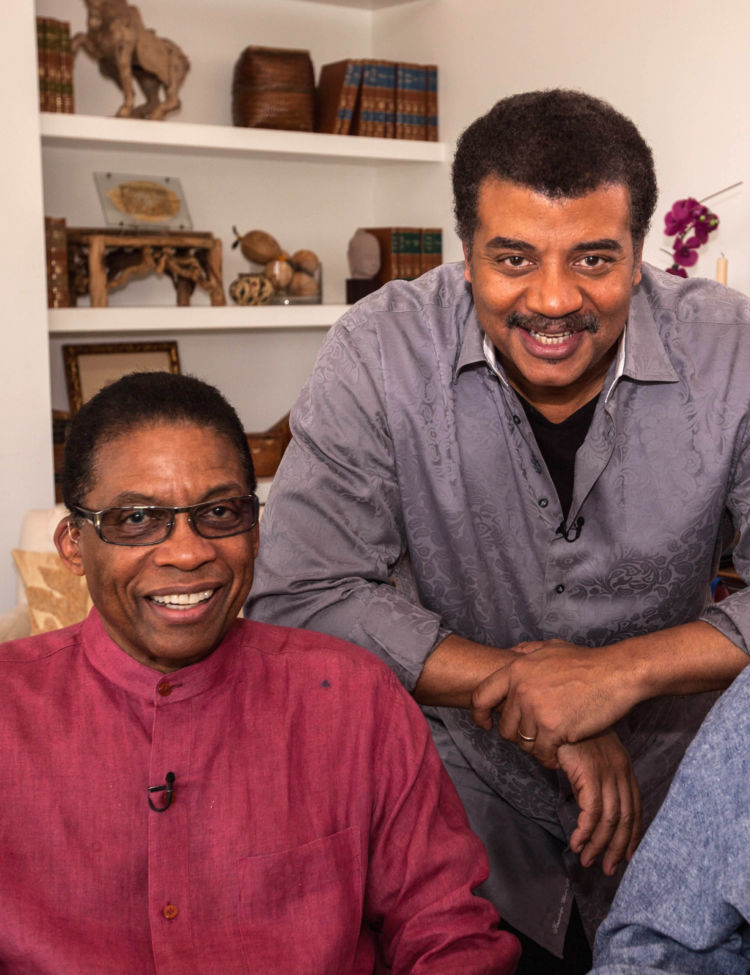
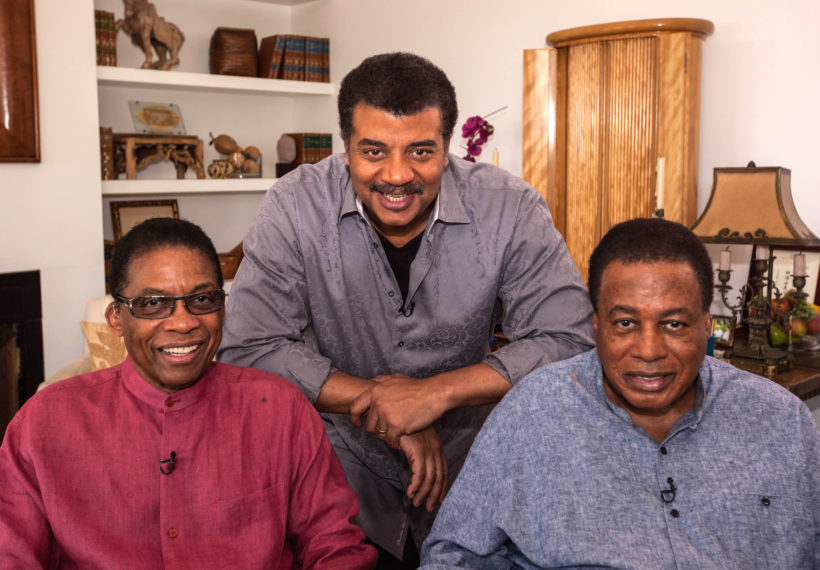
Sit back, relax, and let the sounds of sharp notes and smooth vibes take over as Neil deGrasse Tyson chats with jazz legends Wayne Shorter and Herbie Hancock about the art and science of jazz music. Along with comic co-host Chuck Nice, musician and “bad-ass science groupie” Sean Ono Lennon, and artist and jazz enthusiast Stephen Tyson (Neil’s brother), Neil dives into the creative process behind those symphonic melodies. You’ll hear about Wayne and Herbie’s first steps on their path in music, the importance of having great mentors, and why jazz may not be as popular as it once was. You’ll learn about the art of tinkering: why Herbie used to take apart watches and clocks, how Sean self-taught himself piano and guitar, and how you can “intellectually tinker” in science and music. You’ll also hear about Wayne’s cosmic inspirations, including a space adventure comic book he drew in 1949, and some of Sean’s lyrics that have been shaped by the language of the cosmos. You’ll also learn about how Wayne and Herbie would describe jazz music to an alien visiting from Mars, the improvisational nature of jazz, and why Stephen thinks jazz is an expression of the human spirit. Charles Limb, neuroscientist, surgeon, and musician, stops by to talk about what playing jazz looks like in the brain. Our panel also discusses the relationship between rules and creativity, and Mona Chalabi delivers some data about music, math, spatial reasoning, and Mozart. All that, plus, Chuck visits the Columbia University Jazz House, we answer fan-submitted Cosmic Queries about the physics of jazz, and Neil asks Wayne to play astrophysical sounds from the universe on his legendary saxophone.
Transcript
DOWNLOAD SRT
Welcome to StarTalk, your place in the universe where science and pop culture collide. Star Talk begins right now. Welcome to the hall of the universe of the American Museum of Natural History. I'm your host, Neil deGrasse Tyson, your...
Welcome to StarTalk, your place in the universe where science and pop culture collide.
Star Talk begins right now.
Welcome to the hall of the universe of the American Museum of Natural History.
I'm your host, Neil deGrasse Tyson, your personal astrophysicist, and tonight we're gonna talk about the art and science of jazz, featuring my interview with jazz greats, Wayne Shorter and Herbie Hancock.
So let's do this.
Who's my co-host tonight?
Do I get a chuck in the house?
Yes, you can, my friend.
Chuck Nice!
How are ya?
Good to be here, Neil.
Welcome back.
Tweeting at Chuck Nice Comic.
That's right, baby, Chuck Nice Comic.
He's feeling the jazz already.
Now, we need some artists.
We need some cred, man.
We need some street cred, so we went out and found Sean Ono Lennon.
Sean Lennon, welcome to StarTalk.
I got the street cred.
I'm gangster.
He's a musician, a deep thinker.
I think of him as a philosopher because I've talked to him and it's like, this guy's brain is everywhere it needs to be to make sense of this universe.
Wow, thank you.
Who else do we have?
We need some artsy folk to do this show.
And we also have our art historian and artist, Steve Tyson.
Steve, welcome.
Yeah.
You're also quite the jazz enthusiast.
Oh yeah, absolutely.
So with my interview with Herbie Hancock and Wayne Shorter, they both played for the legendary Miles Davis Quintet.
That's right.
And Wayne Shorter is a saxophonist and composer.
He's won 10 Grammy Awards.
Herbie Hancock, a pianist, a keyboardist, a composer.
He's got 14 Grammy Awards.
And some of the all time greats in the field.
And I sat down with them recently at Wayne Shorter's home in Hollywood.
And at first I asked Wayne how he got started on his path to music, as I always do.
I want to know what the tracking is of people's lifelong love.
Let's check it out.
I was playing hooky from my classes at our side school.
You know, you never amount to anything if you play hooky.
And they caught me.
And they caught me.
And the vice principal had my mother and father in the office and all that.
He said, why didn't you go into class?
Let's see where you went when you played hooky.
I said, I went to this Adam's Theater around the corner from the school and saw like Jimmy Lunsford, Dizzy Gillespie, Lionel Hampton and all that.
And Charlie Parker.
And so, oh, so what she did, she called the music director and put me in his class.
And that's where it is.
What a great teacher you had.
Yeah.
Yeah, rather than wrap you over the wrist, they're saying there's an energy here to be harnessed.
So not energy, curiosity to be harnessed.
That's what we need here.
But those are the great mentors that we've had the opportunity to experience that have recognized something.
And instead of taking the naysayers kind of standard, say standard viewpoint, they wanted to find out something.
And as a consequence, we have a Wayne Shorter.
Steve, you're glad we have a Wayne Shorter?
I'm very glad we have a Wayne Shorter.
What I wonder is the contingency of life.
Because if that didn't happen, if it's enough in him, maybe it might have still expressed itself.
I just wonder that.
Because you're an artist, you've been an artist as long as you can remember in your life.
So did you play hooky?
Don't answer that.
Don't answer that.
No, no, not really.
But yeah, what would have happened if the teacher hadn't said, you know, let's take that energy and let's see where it can be applied.
Do you think he would have never become a musician were it not for that moment, or that there's enough other possible contingencies of life that it would have manifested?
I think it's hard to say.
I think it's because mentoring in those days was kind of a requirement for being a jazz master.
I mean, Miles taught so many people and brought in young players like Tony Williams and Herbie when they were like teenagers.
And, you know, there's not really a culture of that.
There's almost like a Philistinism now where there's like an anti-cultural, anti-learning, you know, trend in the world.
And I feel like musicians don't mentor young people in the same way that they used to.
And I think that's why there aren't as many great jazz musicians as there used to be.
Did you ever play hooky?
I actually was thinking about that.
That's a yes.
I didn't have to play hooky because I had a Walkman and I remember listening to Bitches Brew in class and getting in trouble.
That counts as playing hooky.
Your brain was not in class.
Mental hooky for sure.
That's a whole other thing.
So Wayne Shorter was on that record.
He basically ruined my academic career.
So Steve, how did you know you wanted to be an artist?
My father would sit us down and he would take out a pen and he would start drawing.
And I started seeing that, wow, this is like a family experience here.
And he is expressing something and we would look at what he created and I said, well, let me start doing some drawing.
And by the time I got to high school, the High School of Music and Art, it was music and I was drawing and painting to music.
So that further stimulated the interest of this fusion of arts.
So did I say that he's my brother?
Did I say that?
Because I've only ever known you to want to draw.
I don't know another Stephen Tyson, but that one.
I love drawing.
That was my vehicle of expression.
And somebody encouraged that for you.
That's right.
And having that kind of support system, where our parents would say, well, we can see where the energy is going, we'll support that.
See, I might have been an artist too, but instead they arrested me for my art, because they were like, you cannot spray paint the side of people's garages.
That is called destruction of property.
Yeah, but that was vandalism then.
But now there's a lot of really famous graffiti artists, like Basquiat and stuff.
You just needed to break through.
I was ahead of my time.
Steve, you did graffiti too.
Yes.
Okay, that's it.
Don't worry, Steve, the statute of limitations is up.
So Wayne got his path playing hooky.
But we have to...
How about Herbie?
We got to find out about Herbie.
I asked Herbie too.
There were a couple of reasons I got into music.
One of them is that my mother recognized that when my best friend, Lovesto Corley, had a piano that his parents had bought him, she noticed that I seemed to like the piano because every time I would go to his apartment, first thing I'd say is, hey, can I play you a piano?
Well, I couldn't play the piano.
I don't know what I play.
I mean, can I bang on your piano?
Yeah, right.
Exactly, exactly.
So she said, well, he seems to be interested in the piano.
So she told my father, we got to get this boy a piano.
So that was the first thing that happened.
But even before I got the piano, even before I went to Lovesto's apartment to ask him if I could play his piano, even before that, I was already taking watches apart and clocks and trying to put them back together because I was always curious.
And I wanted to see how things worked.
Well, I noticed what you said.
You were taking them apart and trying to put them back together.
I caught that.
That was well and good.
That was up with the parents.
That was well and good until I tried to take apart my Lionel electric train.
Then I got a spanking for that.
Yeah, that's got some extra stuff going on.
That was when spanking was allowed.
Today, that wouldn't happen here.
It's been suggested that the next generation, their curiosity is not fostered in exactly that way because nothing can be taken apart.
You don't take apart your computer to meddle with its parts.
You don't take apart your watch.
You don't even have a watch.
And if you did, it's digital.
So this whole world of the tinkerer learning how things work might be a lost error.
There is tinkering in music.
And all kids love music.
Sean, do you tinker?
I am a tinkerer because I think it's because my dad was famously self-taught that I always thought when I was young I had to be an autodidact, you know, just teach myself.
And, you know, I think I actually would have benefited from some more mentoring because I was always like, I'm going to learn myself.
But yeah, I would tinker, taught myself piano, taught myself guitar, taught myself drawing and all that stuff.
But it was sort of like a pride thing, like I'm going to do it like my dad did.
But in a way I regret, you know, not studying more seriously.
And Steve, isn't doodling a form of tinkering, right?
It is.
It's the artist version of, you know, a proto-engineer taking apart the radio.
Absolutely.
You know, it's looking, testing things out, trying this, trying that, you know, seeing what feels right, what fits right.
I know in science we can tinker in many ways, physically with objects, but of course in the mind.
Albert Einstein famously had thought experiments and German gedanken experiments where you just, that's kind of, that's intellectually tinkering.
Absolutely.
When you talk about the engineering, if you listen to his music, you can hear the engineering and the structure of his music.
Like, one of the favorite songs that I have from him is a song called Watermelon Man.
And the opening sequence is like a bunch of, like tropical bird calls made with.
But when you look at that, the swan...
Were you actually on that album?
You know how they did that with the water bottles, right?
That African percussionist.
That African percussionist.
Here's the thing.
If you're genius, you can see things that are there that no one else noticed.
But that ability of the mind has a flip side.
And that flip side is like adjacent.
It's like right there.
Because if you are so good at seeing patterns in nature or anywhere, you could be so good that you'll end up seeing patterns that aren't really there at all.
Sure.
And this is crossing over into madness.
Are we talking evil geniuses?
Well, no.
I mean, I was reading about how, you know, savants who have a kind of autism, but like a successful rain man type of autism, it's because they might be missing certain regular parts of the default mode network or how most brains work.
And so they are forced to create novel neural connections, which are basically insights.
And, you know, I know with brain scans, you can see the difference between an insight versus a linear puzzle solving.
So if you're given like a math problem, sometimes you can just see the answer, which is inspiration, and then sometimes you just methodically solve it.
And insight is what genius is, right?
I mean, that's what creativity is.
That's where you're assigned to genius.
Thank you.
We're featuring my interview with jazz greats Herbie Hancock and Wayne Shorter.
And while in Wayne Shorter's home, found something special when I was rummaging around his house.
Let's check it out.
This...
what is this?
Dated 1949.
1949.
I saw a movie called Rocket Ship XM.
That's the first book I ever read.
Yeah.
Robert Heinlein.
And so I look at it, so this is...
And I sat...
What, what, what is, what?
Did you draw these?
Yeah.
This is a comic book.
Yes.
With rocket ships.
You even had the bullet shaped ship that was common at the time.
Yeah.
This was designed, that concept is derived from the V2 rocket that was used in the Second World War because that rocket left the atmosphere before it reentered and hit its target.
And anyone at the time knew that the future of space exploration is going to have to have something that looks like that.
Yep.
Because we never sent anything outside the atmosphere before.
So in the 1940s and 1950s, everybody who drew a spaceship, the spaceship looked exactly like this.
So did we...
How old were you?
I was, let's see, 15.
15.
This is out of control.
Yes, in 15 years...
You start looking at the anatomy of girls.
Yeah, there's some curvy linear shapes in here.
When I was drawing and my parents walked through, I sit in a big armchair and they walked through the room.
I was drawing and I do like this.
Put my hand in.
My mother, she knew what was happening.
She just...
It's incredible.
These are some shapely people you're drawing here.
That's the balance.
It's incredible, right?
It's just perfect.
Wayne!
And when I made a mistake, I would make some landscape.
And I would think, there's no such thing as a mistake.
Yeah, I love that.
You can't go back.
You got to get it...
Because it's a pen.
That's why I drew with an indelible pen to kind of parallel.
You can't go over anything.
You got to keep going forward.
Keep going forward.
It's transforming the negative into the positive.
Yeah.
I'm still reacting to it.
That is super cool.
Steve, you drew comics as a kid, I remember.
Yes, I used to like drawing comics a lot.
I think a lot of it had to do with wanting to tell a story, you know, observing life and wanting to tell a story.
And nobody's a greater storyteller than Wayne on his saxophone.
Yeah.
And the fact that he could sustain a story for 54 pages.
In his book.
In his book, yeah.
I mean, that's incredible.
That's incredible.
And his skill at the age of 17 or something?
15?
I mean, that's amazing.
The man's got some talent.
Right.
And it also captured his science interest, because he could have drawn just landscapes or something, but there's a rocket ship, there's planetary surfaces.
And I'm always enchanted when I find artists that have been touched in any way.
Excuse me?
By science.
So, Wayne Shorter's interest in science, it manifests in so many ways.
Perhaps birthed with that series of comics he drew, but there's more to come.
Let's check it out.
So, Wayne, you've got space-related titles.
I've been looking at the list.
Orbits, On the Milky Way Express, Supernova, Universe, Pegasus.
These are constellations, concepts, ideas.
So, are you a closet astrophysicist?
That's the whole point of this interview, to find out.
Yes, when I went to NYU, I wrote a piece called Universe.
My first year, first freshman year.
So, you and the Universe go way back.
So, I can talk about the Universe, but if an artist is touched by cosmic themes, it enables us all to feel the Universe.
That's why I like it when I see it.
I'm just saying.
Alright.
And so, Sean, how does science influence your music?
Well, I think I'm especially dorky in that I have quite a few songs that contain science-inspired lyrics.
I could tell you some if you want.
What, your latest album is titled what?
My new band is called The Delirium, and our album is called The Monolith of Phobos, which was inspired by the C-span Buzz Aldrin clip where he reveals to us...
It was our C-span, no one saw it.
I know, I don't know.
But, you know, he reveals that there's this Monolith on Phobos, essentially, which is the moon of Mars.
And I'm not saying it's an artificial structure, but it's odd that it's there.
Let's put it that way.
Do you have other scientifically-inspired lyrics?
Yeah, I do.
I actually, since this is a jazz-themed show, I thought I'd mention...
I wrote the lyrics for a John Zorn song.
He's a famous jazz musician from New York.
And they're pretty science-inspired.
They're like, The sun is a selfish lover Because the moon's often left half full And stars always stare at the gutter Because even light has to bend some rules Man will fly farther and farther to escape woman's gravity But there is a hole at the heart of every galaxy Yo, that is hot!
Coming up, how would you explain jazz to aliens?
That's next when StarTalk returns.
StarTalk, from the American Museum of Natural History, will feature my interview with jazz legends Herbie Hancock and Wayne Shorter.
I asked them, what is jazz?
Check it out.
An alien just arrived from Mars, and they're curious, and they have a sense of hearing, and you need to tell them what jazz is.
What are you going to say?
I would take them to hear the music.
And then, if they had some questions after that, I would respond to the question.
Oh, so you wouldn't try to explain it up front?
No.
Just take them to the club.
That's no fun.
Take them to the club.
Yeah, yeah, right.
I put them in front of a mirror.
An earth mirror.
And you say, that's jazz.
Jazz is you.
Yeah, jazz is you.
Even when you're an alien.
It's very hard to explain it.
So maybe Wayne's on or something.
Well, consider that the bar scene in Star Wars, they're playing jazz.
How's that for intergalactic?
There we go.
They're not playing classical music.
There's not a ballad.
Nobody's singing anything.
The aliens are jamming.
Yep.
On their alien musical instruments.
But it was clearly jazz.
Yeah.
I think there was no question about it.
So, something I don't understand.
Steve, you know, I happen to like jazz.
I was a late comer to the genre.
But there are people who hate jazz.
And can you explain that?
No.
Okay.
Ha ha.
Sean, could it be that improvisation has an unpredictability that creates discomfort in us?
That we need the confidence that what comes is something we expect rather than something we don't?
Because people like blues, and that's an improvised form of music.
I mean, there's a lot of soloing in blues, you know.
I think it has to do with being ready for, you know, stretched harmonies and dissonance and chords that are more dense and complex than, you know, simple triads, which is what rock and roll and blues is usually about.
Jazz has more complex geometries that are harder to appreciate if you don't have a sort of foundation to get it, I think.
It just makes me wonder if human spontaneity, the edge of creativity and freedom, everyone else, whatever you've just discovered there, nobody else is ready for it yet.
It's got to sort of work its way in and create a level of comfort within us.
But in the 30s and 40s, I mean, even like early bebop, you know, everyone loved jazz.
It's just now people aren't as into it because, you know, they'd rather listen to Bieber or something, they're believers.
And I think it has to do with the culture, you know, because I don't think jazz was so unpalatable when it was, you know, it's the golden era.
Okay, Steve, what is jazz to you?
Well, jazz is an expression of the human spirit.
But I brought an alien.
A Martian is not human.
So are you going to tell the Martian is an expression of the human spirit?
They're not going to get it for sure.
Well, to the extent that the human spirit is an expression of life and the alien is a living thing, then I would say that that's where the connection is.
What you going to do with that?
Snap that.
Yeah, but if they're not human, who's to say that they would even hear the frequencies of music that we play music in?
Because I preface my question that they have audio sensors.
Okay, of course.
Take that.
Well, I agree with Herbie.
I mean, you know, Frank Zappa said that writing about music is like dancing about architecture.
So I feel like there's not much you can do other than just jam with them or show them a jazz show, you know.
All I know is I don't know what to believe anymore.
Wayne Shorter and Herbie Hancock don't know what the hell jazz is.
And I just found out his father was in a rock and roll band.
You don't like Def Leppard, man?
What's wrong with you?
Wait, Chuck, do you have any insight as to why the French love jazz more than Americans do?
Because the French love anything that we don't like.
They're doing it to spite us.
Oh, don't love your own America, awesome.
Good for you.
We love it.
Do they really like it more?
You know, I think jazz is celebrated all around the world more so than it is here in America.
I think in France it's because they didn't have segregation and there was still segregation in America.
So a lot of jazz musicians were able to tour and thrive there.
So they were touring there a lot.
That's a very good point.
How do you explain Japan then?
Japan?
Well, Japan, they're into lots of different things.
Seriously, they love all kinds of music.
Yeah, this is true.
So I tried to get Wayne Shorter to express sounds of the universe through jazz, through his saxophone.
So I prepped him for a cosmic phenomenon to see how he...
Can he roll with it?
Uh-oh, this is going to be deep.
Let's check it out.
I want to describe something astrophysical to you.
And I'm wondering if you could convert that to a musical expression.
In the center of the sun, energy is created by fusion, and a photon of light is born.
This photon of light careening back and forth eventually escapes the sun.
That takes hundreds of thousands of years for that photon.
To get from the center of the sun to its surface, and it takes eight minutes to get from the sun to earth.
Is there music in that?
Can you feel the photon?
Feel the photon.
I like that.
That's an album title right there.
Feeling the photon.
The photon fears nothing.
Okay.
And if I move in any direction other than that, I think this one thing incorporates a tone that's really, like the photon, it incorporates all of the movement and struggles and everything like that, and all of the short term goals and stuff like that that the other people be looking for, and this photon is wrapping around that whole thing for millions and millions of years, and something else is wrapping around that.
And that's us.
Okay, now we know why people hate jazz.
What the hell was that?
Did you see your face in that clip?
You were like, what the hell are you doing?
What are you doing, Wayne Shorter?
Well, you know, Herbie and Wayne are Buddhist, man.
It's like the sound of one hand clapping.
That was the sound of one photon rocking.
Not even Sean Lennon can clean it up.
I tried.
So, I want to hear another take on the sound of the photons journey from deep inside the sun.
I think we all do.
And we've got a band called the Columbia University Jazz House to help us out.
Guys, can you give it a shot?
I think that was Wayne's note.
That was Wayne's note.
Who knew he was right all along?
Do you think maybe he had that whole piece in his head?
No, I don't.
And then just the note was the last expression of it?
Yes, that's exactly what happened.
Sean, is that your take on it?
Yeah, I think that his brain is like the sun in that piece, and it took many years for the thought of the photon to escape his neural network.
And then by the time we heard it, it was escaping his brain as a single note, which is like the eight minute travel to the earth.
So what we heard was the eight minute journey to earth, but not the 100,000 years struggle.
Exactly.
Right on.
Now the whole thing makes sense.
Well, talking about curiosity and creativity through the lens of the great American innovation called jazz.
And right now, it's time for everybody's favorite segment, Cosmic Queries.
This is where we answer questions from our fans.
And tonight we took your questions about the math and physics of jazz.
And our first question is from Jessica Schaffner from Detroit, Michigan.
She says, songs written in major keys tend to be more happy and uplifting, while minor keys tend to give feelings of melancholy.
Is there a possible biological reason or is this a learned trait?
Sean?
I think it's partly cultural, because if you look at Indian music, which is microtonal, and Middle Eastern music, there's a lot of minor thirds that are sort of celebratory lyrically.
So I don't think that minor is physically inherently sad, although I do think it's more common in cultures to associate the major third with a happy feeling.
But certainly, I do think they're examples of a minor third being happily sung, essentially.
So Jessica, your answer is yes and no.
Next.
Thank you, sir.
Our next question is from Matt Snyder from McCungy, Pennsylvania.
And he says, when humans travel to Mars, would they be able to play and hear music outside of their shelter, or is the atmosphere too thin?
Ooh.
Now, that is a real question.
Yes, it is.
I got this.
Bring it on.
Well, you may remember from your physics class that there's one of these great demos where they have a ringing bell inside of a jar, a glass jar, and they evacuate slowly the air out of that jar.
And you're listening to the bell ring, and as the air comes out, the bell gets weaker and weaker and weaker.
But it's still hammering away, and there's a point where you can hear nothing at all.
It doesn't mean there's no air in there.
It means there's not enough air to communicate the vibrations of the bell through a medium, through the glass, and then through the regular air in the room.
So there's a thinness of air below which you're not going to hear any acoustic sounds.
And Martian atmosphere is like, it's a fraction, a small fraction of Earth's atmospheric pressure.
So I'm thinking you're not hearing much noise at all.
Oh, very cool.
So Chuck, not only do you read me cosmic queries, you are also our Senior Sidewalk Science Correspondent.
Yes.
So what do you have for us tonight in math and music?
Well, I actually dropped in on the guys of the Columbia University Jazz House at their dorms.
Really?
Yes, to see if they could make math into music.
All right, let's check it out.
I can hear the guys playing right now.
See?
Jazz house jam session.
These dudes are playing in the kitchen.
What's up, guys?
So I'm here with Kevin and Andy, the brass section of the jazz house.
These are woodwinds.
I don't appreciate your tone, Kevin.
All right, guys, so if music is math and math is music, can you play this?
No, that's not the song.
That's not the song.
That's not the song.
That's not the song.
But I hear some more music.
Ah, who do we have here?
What's up, man?
Hey, how you doing?
All right, what's your name?
David, how are you, buddy?
I'm doing great.
Is this your dorm room?
This is my room, yeah.
Get a lot of jazz action happening?
A lot of improvising going on?
No.
How important is math to music?
Math is absolutely essential to music, in my opinion.
It's the foundation of everything that we know about rhythm and harmony.
Beats and measures, measures and beats.
That's right.
So let me ask you, if math is music and music is math, can you play this?
Of course.
It's one of my favorite tunes.
Really?
That is not, that's not the song.
Like, I don't know that song.
But I hear some drums.
I hear some drums.
Nice.
All right.
Who do we have here?
My name is Daniel.
Daniel, can I ask you a couple of questions?
All right, Daniel, if music is math and math is music, can you play this?
Give me a week.
I don't have a week, man.
It's our show.
All right.
Do my best.
Do it.
That is not it.
That's not it.
That's not it.
That is definitely not it.
How about you guys?
Can you guys, can you guys play this?
This is what I love about the Jazz House.
There's musicians everywhere.
Yeah, that's it.
That's what I'm talking about.
That's it.
That's it.
Well, next, jazz greats Herbie Hancock and Wayne Shorter, explain what it takes to be creative on StarTalk.
Here's the StarTalk, right here at the Rose Center for Earth and Space.
You're featuring my interview with jazz legends, jazz greats, Herbie Hancock and Wayne Shorter.
And I asked, what do they do as creative artists to overcome any forces in society that might constrain their creativity?
So let's check that out.
You get a lot of resistance from the practical business world that we cannot sell this because it's not a viable product to ethereal, something like that.
And then we will blame, there's a tendency to blame these marketing people and everything for not marketing what we call something called art.
And they stand as resistance.
But when we get on the path of enlightenment, we know that the resistance, we have to investigate what resistance means.
If we take the example that an airplane cannot take off without resistance, what does that mean?
In fact, the airplane takes off into the wind.
Yes.
Because only into the wind does it achieve maximum lift.
Yes.
So you need that resistance.
The resistance that people present, instead of money, power, and fame that they want, their real function is to be the resistance that's needed for the creative process, whether they know it or not.
Did he just justify all the naysayers that are out there?
Saying the creative people in the world need the naysayers?
Did I just hear him say that?
We actually do.
We have a phrase in Buddhism that is turning poison into medicine.
Much of it comes, I think, from a misunderstanding of the relationship between you as a human being and external circumstances.
If you understand that that relationship is really a symbiotic relationship and that much of what happens to you that you blame for your suffering actually has to do with a much deeper part of your own life.
In Buddhism, we call it the fundamental darkness.
We also have our fundamental enlightenment.
Actually through doing this practice, you strengthen the fundamental enlightenment part of who you are and that really helps you with the idea of stress and understanding.
There's always forces that will stress people out.
It's not so much, I suppose, of getting rid of stress.
It's dealing, knowing how to navigate the stress.
You nailed it.
That's Buddhism.
I'll be Buddhist for the day.
So, Sean, you have constrainers in your music business?
I do think what they're saying is true that resistance, the metaphor is beautiful.
Resistance is what makes an airplane fly.
They're obviously Buddhist and very philosophical, those guys.
For instance, Bach.
I thought it was just physics.
Some of Bach's most beautiful pieces are very constrained, like fugues and cantatas.
For example, there's the crab canon that Bach wrote, which is a Mobius strip, and it's a palindrome.
That's very restricted.
It has to be completely symmetrical, but it's a very beautiful piece to listen to.
I think there is a direct relationship between rules and constraints and creativity.
It's sort of like a balance.
It's a tug of war.
So it turns out you could actually bring some science into this conversation of creativity and music, because after all, this is StarTalk and we find science in every nook and cranny it could possibly hide.
So we found someone who studies what playing jazz looks like in your brain.
Nice.
Nice.
Dr.
Charles Limb is a neuroscientist and jazz musician at the University of California, San Francisco, and he's standing by live on video call.
Drew, can you bring them on?
So you're a surgeon, a neuroscientist, a saxophone player, and as I understand your profile, you've carried out research on the neural basis of musical creativity.
When are you going to do something with your life, man?
That's right.
I've been studying how the brain enables us to not only hear music but also make music.
It started for me as, like I said, an obsession with sound and then turned into an idea that I could actually use something like neuroscience to address the topic and learn more about it.
So tell me about the images of people, was it playing or listening to jazz?
What's going on in their brain?
What have you found?
Sure.
So we used a functional MRI to look at jazz pianos' brains while they're playing, improvising, and we compared the improvised brain from the memorized brain.
And we found a pretty interesting thing, which is that the prefrontal cortex of the brain was shutting down when musicians were improvising in comparison to memorizing.
And this is a big portion of the brain responsible for a lot of things, but to some extent, conscious self-monitoring might be the most important role of the brain that gets shut down during improvisation.
So just so I understand, there's the improvisational brain that you observe, and then you said the memorized brain.
So that would just be sort of aping something that you've learned and try to get it perfect.
Yeah, we basically had musicians memorize a standard and play that tune and then improvise on it.
It was just the blues.
And we looked at the difference between when they were soloing on the blues and playing a memorized blues melody.
And the brain changes radically.
So what can we learn?
I mean, so that's just factual information.
Now what does that mean?
So I think it means that creativity is kind of the novel combination of ordinary processes in the brain, meaning that the brain is basically shutting itself off in order to allow for an unrestricted flow of ideas during improvisation.
It's the brain doing something that it's very well equipped to do in order to come up with a new idea.
Except some people are better at it than others.
Absolutely.
But can we assert that creativity is hardwired into the brain or do you have to train your brain to be creative?
Because we agree not everyone is equally creative and some people are not creative at all and some people are leading us into the future by virtue of their creativity.
I think that humans are inherently creative.
It's just that there are multiple forms of creativity, some of them that are in the art realm and some of them that are in a very mundane realm.
So, this conversation is creative.
When you're driving home from work and you're zipping through traffic, you're improvising.
I think that the human brain is hardwired to create because that's how we survive as a species.
One thing is for sure, though, we as scientists understand very little about how humans are able to be creative and when we think about all of the capacities that human beings have, the capacity for creativity may be the most important thing that we've had as a species.
And so to be able to examine the creative brain as it's real time generating new ideas may be one of the most important things for us to understand how it is that we're able to generate novelty and how it is that we'll come up with new solutions for problems in the future.
And I think that one way to view this is that artists may be our creative experts in our society and they're sort of trained to generate new ideas, this is what they do for a living.
And I think that in the case of the jazz musician or the freestyle rapper or any other artist who does spontaneous improvisation as their main craft, they've essentially trained their brains over many years of study to be able to improvise on the fly.
And this is not something that you just kind of wake up and can do all of a sudden.
You really have to practice this craft.
And I think that these people that have devoted their lives to these kinds of arts have certainly figured out a way to get their brains to generate ideas in a way that we did not previously know how to do.
And maybe by looking at how they're able to do these things, we can understand some of the basic fundamental mechanisms of how the brain is able to create.
All right.
Thank you, Charles.
We're talking about creativity in art and in science, and it turns out there's extra insight we can get into what it is to get extra insight because we've got Mona, who's got some data for us.
Mona, can I get some data, please?
This is Mona Chalabi, she's a data journalist with The Guardian.
What do you have, Mona?
Thanks, Neil.
I wanted to look at this connection between music and math, and what I found was a study that was published in the journal Nature, where people were asked to listen to Mozart's Sonata K448 for about 10 minutes before taking a test, and what they found was that people were...
Before taking a math test?
No, it was a test of spatial reasoning skills, right?
And those are skills like the ability to visualize an object and then try and build it out of Legos.
They're skills that are related to problem solving, so they're relevant to subjects like physics or math.
And again, these people demonstrated better spatial reasoning skills after taking the test.
In another study, they actually found that rats who had listened to Mozart's Sonata were able to navigate a maze faster than rats who hadn't listened to the music.
In fact...
I know, it's incredible, right?
Loads and loads of studies have found this, but there is a bit of a snag.
They call it Mozart's effect, but it only seems to improve spatial reasoning skills for about 10 to 15 minutes.
So it doesn't really hang around too long.
So you have to listen to Mozart continually.
Oh, I don't think that will do it.
Wait, wait, so we have, in New York City, in our subway, we have street musicians, some of whom play Mozart.
So that's why the rats navigate the subway tunnels really well.
I was going to say, that's the last time I'm listening to Mozart in my house because I don't want to encourage the rats to get any smarter.
Yeah, exactly.
But anyway, the research might help explain why Herbie Hancock developed an early interest in science and music.
Super cool.
Very cool.
So now, what happened to those rats when they listened to hip hop?
I don't know.
That study hasn't been published, they're still working on that one.
The controls in that experiment were compared to white noise or no music at all.
And what is white noise?
Chuck is very sensitive.
I'm sensitive to race, I don't like, I don't see color.
White noise is just like, oh God, turn that down.
Yeah, it's when Donald Trump's audience clasps that's white noise.
So I'll explain to Chuck what white noise is.
Okay, thanks very much.
Thank you, Mona.
Take care.
So there's some famous people where the art and the science was one and the same.
And at the top of that list is, of course, Leonardo da Vinci, and there was nobody like Leonardo.
Yes.
I mean, to him, how could you possibly say, tell me about your art distinct from your science?
No, it is the one and the same.
No difference.
And then you have other places where engineering has affected art and art has affected engineering.
You look at the design of Apple products and you say, well, there's not only the beauty of the design but the functionality of the product.
And Herbie Hancock is definitely thinking about this connection.
So I asked Herbie just to see his take on this, especially given his background in engineering.
Let's check it out.
The scientific community created this technological age.
Where did that impetus come from?
If you ask many of the people like Larry Page, it was music.
He said it was music.
Larry Page, one of the co-founders of Google.
Yes.
There are many people who we revere in the scientific community.
Einstein played violin and I've seen that happen over and over and over again.
So if these people who have this attachment to the arts created this technological age that we're living in, then in order for it to thrive, we need the arts the same way they needed it.
To me, the arts are like the heart.
And I think it's a crime really to dismiss the value of the arts in the human experience.
You know, when I think about creativity in art and science, I see what's similar and then I also notice what's different.
And what's different is if Beethoven were never born, nobody would ever compose the Ninth Symphony.
That came out of him and nobody else.
Whereas if Einstein were never born, somebody would have eventually discovered relativity.
He was kind of ahead of his time, so it would have taken a little longer, might have been a combination of scientists, but he is discovering a pre-existing thing in the universe.
So the creativity of the scientist is wrapping our head around a pre-existing reality.
Whereas the artist has no pre-existing reality.
They can create a reality, and maybe it's a little too far for whoever is looking at it to understand it at the time, so we all sort of drag behind it and eventually say, hey, wow, they were on to something.
Because that's the true moving of a frontier forward.
Did what you do kind of leave people behind, and they got to run and catch up after you.
So while both fields are deeply creative, in science, the universe is the judge, jury, and executioner of our creativity.
In art, in music, the ultimate judge is the human spirit and the human soul.
And that's what it looks like from the cosmic perspective.
Guys, take us home.
You've been watching StarTalk.
As always, keep looking up.
See the full transcript




 Unlock with Patreon


 Become a Patron