


 Unlock with Patreon
About This Episode
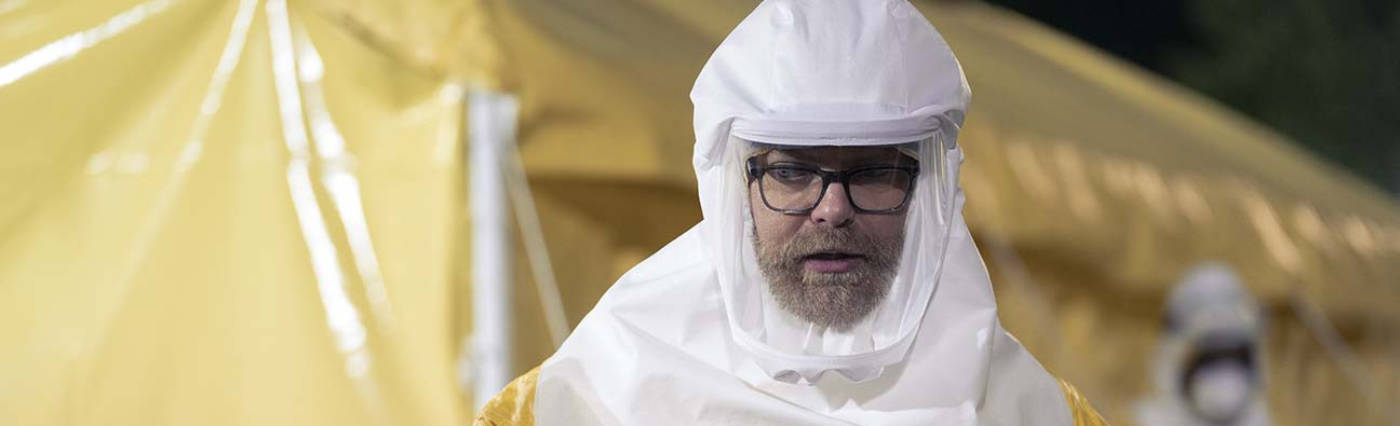
He’s Dwight from The Office, he’s a climate activist, and he’s definitely a nerd. On this episode of StarTalk Radio, Neil deGrasse Tyson sits down with actor Rainn Wilson. Rainn is best known for his role as Dwight Schrute on The Office but he’s always busy. To start things off, Neil and Rainn discuss Rainn’s podcast Metaphysical Milkshake, his climate series An Idiot’s Guide to Climate Change, his media company SoulPancake, and why it’s important to produce uplifting content.
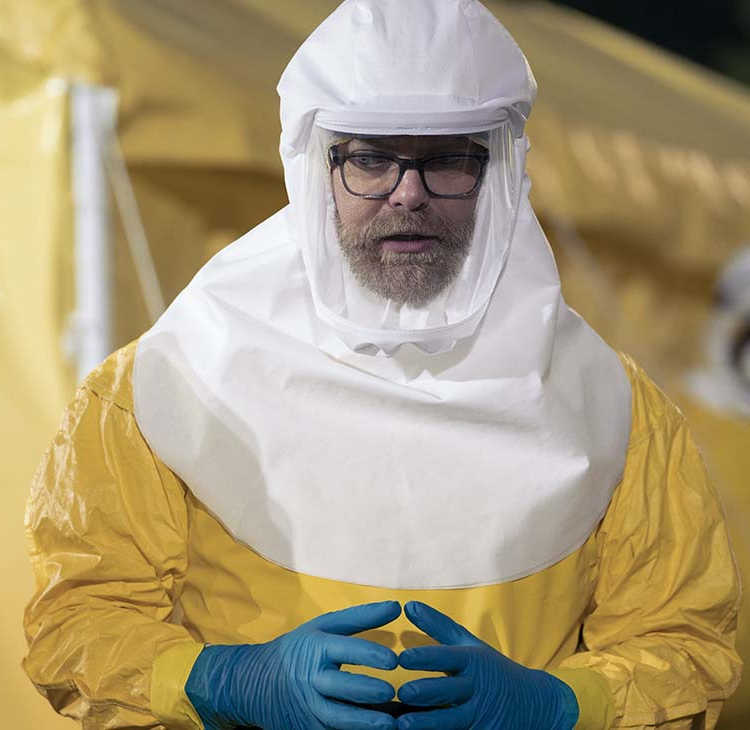
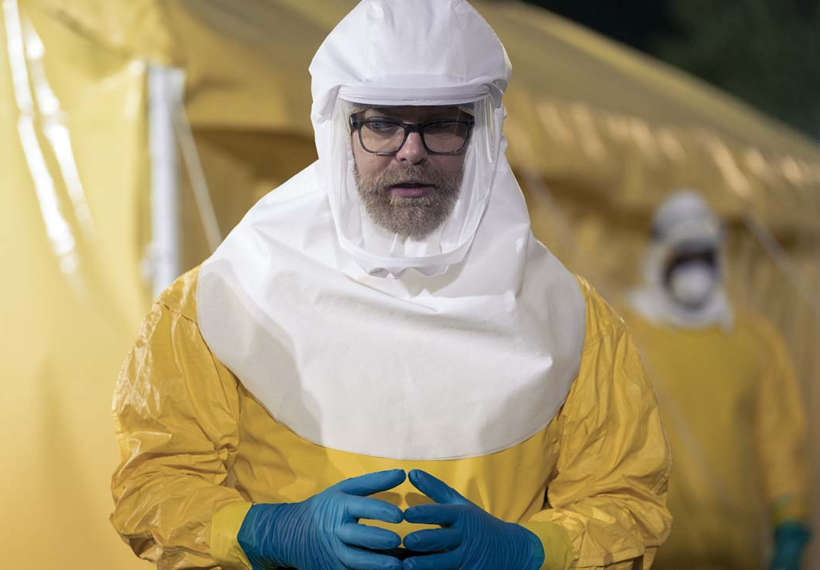
Rainn fills us in on his trip to make An Idiot’s Guide to Climate Change and why it’s important to reach out to young people when it comes to climate science. You’ll hear about Rainn’s new show, Utopia, in which he plays a virologist. We discuss why the show’s release has had serendipitous parallels with the current COVID-19 pandemic. And, you’ll find out if Rainn retains any science knowledge when portraying a scientist.
Then, Rainn answers some fan-submitted Cosmic Queries.! You’ll find out his favorite comic book character. We dive into his love of science fiction. Neil and Rainn share the nerdiest things they’ve ever done. Rainn also tells about his time on set making Sahara and the deep conversations he shared with Penélope Cruz.
Lastly, Rainn gets to ask Neil some Cosmic Queries. We investigate “spooky action at a distance.” Neil tells us about the birth of electromagnetism and field theory. We investigate quantum entanglement. All that, plus, Rainn asks Neil about the most transcendent experience he’s ever had studying the universe.
Thanks to our Patrons Jennifer Sell-Knapp, Chris Reynolds, Nancy Umanzor, Daniel Rolandelli, Raymond Mang, Saad Algwaizani, Tyler Causey, and Christopher Lowther for supporting us this week.
NOTE: StarTalk+ Patrons can watch or listen to this entire episode commercial-free.
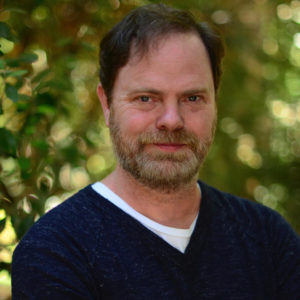
Rainn Wilson photo by Christopher Heltai.
About the prints that flank Neil in this video:
“Black Swan” & “White Swan” limited edition serigraph prints by Coast Salish artist Jane Kwatleematt Marston. For more information about this artist and her work, visit Inuit Gallery of Vancouver.
Transcript
DOWNLOAD SRTWelcome to StarTalk, your place in the universe where science and pop culture collide.
StarTalk begins right now.
This is StarTalk.
I’m your host, Neil deGrasse Tyson, your personal astrophysicist.
And we’re going to go slightly off-format today.
This is just going to feature my conversation with Rainn Wilson.
His fans know all about him and his portfolio.
And of course, in fact, he’s in a recent Amazon Prime.
Do I call it a mini-series?
We’ll find out on a subject.
It depends on if it has a season two.
If it has only season one, it’s a mini-series.
Rainn Wilson, welcome to StarTalk.
Thank you.
So, I’m calling this my cosmic crib because you and I are just chilling.
Normally, I have a co-host and experts and all that.
It’s just you and I having a conversation, reaching for our geek roots.
I love it.
That’s awesome.
Let’s do this.
So, you’re best known, and do you hate it when people say he’s best known for?
Do you hate that when people do that?
No, come on.
I mean, it’s just true.
I’m best known for playing Dwight Schrute.
It’s just true.
In The Office.
And how many seasons did that go?
That was nine seasons, 10 seasons.
That’s crazy.
Every time I turn on, there’s The Office.
And so I just want to just congratulations for being a fixture in that show.
And in the Geekiverse, you are deeply loved.
And especially most recently, you have a show that dropped and it’s called Utopia, in which you play a virologist.
So we’ll have to get to the bottom of that.
And also you’ve got a podcast of your own?
Yep.
SoulPancake?
Yep, yep.
Will I ever be on SoulPancake?
Probably not, probably not.
You wouldn’t make the cut.
I’m so sorry.
You’re not legit enough.
No, it’s a podcast called Metaphysical Milkshake.
I did with Reza Aslan.
Oh, so SoulPancake is your production group.
SoulPancake.
But SoulPancake is the company that I co-founded.
It’s a digital media company.
So it’s SoulPancake presents Metaphysical Milkshake.
They’re very much a part of it.
It’s kind of in the whole SoulPancake vibe, which is about exploring life’s big questions and making uplifting content and bringing people together.
And our podcast is in sync with that.
Does that work today?
Because no one wants uplifting content.
They thrive on conflict and tribalism.
So how’s that working out?
Well, yes.
How is that working out?
You know, there is a-
You’re not following the Facebook model.
There is a large percentage of the population that is looking for uplifting content and unifying content and something that contains hope and joy even.
And, you know, I just look at-
I mean, you saw the documentary, The Social Dilemma, yes?
Yes, yes, yes.
Very interesting.
I mean, it got right to the heart of the problems.
Yeah, yeah.
And I mean, I knew a lot of the stuff that was in it before.
A lot of people watch it and are like, well, I knew all that.
It’s like, well, yeah, I knew it, but it wasn’t put together in a-
the puzzle pieces weren’t put together in such a-
In a coherent way.
In a coherent way.
And you see that so much of the division going on in the world right now is this Facebook model.
If they can get you outraged, they get you clicking buttons more and they get more ads and they make more money.
So outrage and division fuels commerce.
So we’re a digital media company.
Yes, we would like people to watch our videos, but we’re trying to combat this by bringing people together and using the best aspects of the web and of YouTube and digital content.
That is so noble.
I mean, I’m proud of you.
And I hope it succeeds by greater than all measures, because then others would then emulate it and then it would maybe be this force of attraction away from all that continues to divide us.
And what’s this in that same production company, an idiot’s guide to climate change?
Oh, yes.
So you’re into that too.
You dig this.
I keep wanting to say Dr.
Tyson.
No, no, it’s Dr.
Neil to you.
Just Neil, just Neil, please.
I know, but I keep wanting to say Dr.
Tyson.
Why is that?
You command such respect.
I never want to call anyone a doctor.
Even my own doctor I call Steve.
It is fascinating.
Many people call me that and I never, I don’t introduce myself that way.
When I give public talks I say, here’s doctors, no I don’t.
But so I have to receive it as an unsolicited honorific.
Yes, okay, good.
I’m warmed by it, but still it’s not necessary.
Well, okay Neil.
All right Neil, shut the f*** up.
Here’s what we’re gonna do.
So you know, you would dig this show, An Idiot’s Guide to Climate Change.
Here’s what we did.
I got involved with this nonprofit called Arctic Base Camp that basically explores the science of how climate change is affecting the Arctic and tries to really impart that information to movers and shakers.
Because as you know, in the world of climate change, what’s happening in the Arctic is far more extreme than what’s happening even in California.
I mean-
Yeah, in fact, when they say we’re warming the earth by one or two degrees, that’s the average.
The Arctic gets a much bigger hit from that.
Exactly, almost double what we’re feeling in North America right now.
Almost double this.
So, I got invited to take a trip with them to Iceland and Greenland and meet some scientists that were working up there.
And so, we didn’t really have a budget for SoulPancake.
It’s a smallish company.
So, but on like a $60,000 budget, we were able to kind of pull together.
I kind of documented myself on this trip up to Greenland and we made it a six part series.
Greta Thunberg is on the series.
And the whole point of it was like, listen, there’s a lot of people that believe in the science of climate change.
Of course, as you always say, you don’t believe in science.
Science just is.
Right, right, of course.
But wait, wait, wait, wait, just put, wait, back up for a second.
You can’t just call up American Airlines and say, book me a trip to Greenland.
Like how did you, what was the path that you took?
So yeah, so getting to Greenland was a bitch.
We had to-
Did someone invite you to Greenland?
Yeah, the scientist, Dr.
Gail Whiteman, who’s the founder of Arctic Base Camp and there were a bunch of other scientists that were working up there and she was like, we were going to do a bunch of events and she was like, Rainn, I’m going up there to meet with these scientists.
You should come along and just see firsthand what’s going on and-
We’ll document it and you can make it into this little series and then you can also kind of, as you know, you can speak to science much more when you’ve kind of like lived it and gone through it.
So the point of the show though, Neil, was that there’s a lot of people that buy the science.
There’s a lot of people that don’t buy the science and think it’s kind of a crazy liberal conspiracy.
But there are some people in the middle.
There are some young people in the middle that are kind of getting it from both sides that maybe they’ve got a crazy right-wing uncle that doesn’t buy the science-
Yeah, it’s Thanksgiving.
It all happens at Thanksgiving.
But maybe their friends at school are climate activists and you know, or something like that.
So do Fire Drill Fridays with Jane Fonda or something.
So they don’t know what to think.
So I tried to make it like I’m the doofus, I’m the idiot going, who doesn’t know anything about climate change, wants to learn something that’s going on this trek.
So it’s fun.
I try and use humor.
It’s kind of, you know, off-putting and-
It was a lot of fun.
We had Greta Thunberg was on it and we had a blast.
Excellent.
Did you glean any tactics, any tools or the tools of communication from that trip?
You know, that’s a great question.
I didn’t.
I don’t know.
I don’t know what to do.
You know, just-
I’m-
Where do I go?
What do I do?
I’m sorry.
I thought you said you were hopeful, dude.
I do think that we just need to keep fighting the good fight and trying and really work with young people.
You know, people over 40 or 50, they got their minds made up.
You know, they’re never going to change their minds, so.
Yeah, it does seem to be demographically split that way.
That’s a fascinating fact.
And so therefore, the younger demographic, they’re tactically different if you’re trying to get some of them off the fence versus, you’re right, the old, awesome, pride folks.
Exactly, so try and reach some of the young people.
And we can make a difference.
If we make extreme changes right now throughout the world, we can meet the goals of the Paris Agreement.
It’s going to be really, really hard, but we can do it.
And we just have to keep believing.
That’s it, that’s all I got.
Okay, well, that’s helpful.
And do you think, so I’m just wondering if there should be tourist jaunts to Greenland so they can see.
That might help.
Because I always think, I think the Flat Earthers are a conspiracy just so that they’re the first ones to go into space.
Because that’s where we’re going to want to send them so they can see the round earth firsthand.
So they get a free, just send them off, just do that now.
You don’t even need to go to space.
You can just fly to Europe and you’re up so high, like the sun’s rising, you see the curve of the earth.
It’s not…
So here’s what you do.
You set them up into space and say, you have to confess earth is round, otherwise we’re not bringing you back.
Oh, there you go.
Perfect.
I would not suggest bringing people to Greenland, mostly because the carbon footprint is so big.
And I talk about that in the series, but just flying to Greenland, it’s so much gas and taxis and whatnot.
I mean, the only way to do it is if you’re going to like I’m going to plant a frickin forest when I’m done flying to Greenland.
But…
Just to make up for it.
And Greta is quite the ambassador.
Was she on the same trip with you?
Or did it come in and go in another time?
No, this guy who’s on our board, Callum Greaves, works with her and her organization.
So he was able to kind of patch her in and we did it, we shot remotely with her.
She didn’t go on the trip, but she’s a firebrand, man.
It’s remarkable what she’s done.
Really good, doing that right.
So now you have a show that just dropped, like days ago from the moment of this recording.
And I already know people who have binged the entire series.
And I said, damn.
So I confess, I just read some of the reviews.
I haven’t seen any of them yet.
But I just like the fact that you’re a virologist.
But in Utopia, it is curiously weirdly synchronized, some overlap with our current pandemic.
So what’s up with that?
It’s pretty crazy, man.
I mean, this is based on a British show.
Utopia was on the BBC a long time ago, like 10 years ago.
As was The Office.
Yes, and in fact, we’re fighting that same battle.
There are these hardcore fanboys of the British original series, like the American series sucks.
It’s going to fail.
It’s terrible.
And how did that work out?
It always makes more money in America than in England.
I don’t get that argument because no one’s taking away that TV show.
Like no one, when we made The American Office, we didn’t take all copies of The British Office and like burn them.
Like no one can watch them, like you can watch them over and over and over again.
Plus, it’s an American office show in an American office, right?
It’s not Americans in a British location, right?
Yes, exactly.
But Utopia is the same thing.
And it’s been being developed for years.
Gillian Flynn was a showrunner and creator of our version.
And it’s all about conspiracy theories.
But the parallels are creepy.
So give me like a three sentence overview.
A group of comic book geeks discover a graphic novel that contains the keys to the destruction of humanity, which includes crazy viruses and a supervillain named Mr.
Rabbit.
That’s how it begins.
How’s that?
Then it takes off from there.
It’s all downhill.
So it’s a conspiracy theory thriller with some science fiction and drama and really dark sense of humor.
I call it Stranger Things meets Quentin Tarantino.
Oh, so it’s got some blood and war in it too.
Yeah, it has human heads being smashed.
Okay, so tell me about the virus.
What’s the virus up to in this story?
In this story, I play a virologist, Dr.
Michael Stearns, who discovered a really obscure virus in the Andes Mountains in Peru that killed a couple hundred members of the Peruvian military.
And so I studied it and I created a super vaccine that not only inoculates it but cures the disease.
Now, let me guess, you’re a scientist, you call this to people’s attention and no one listens to you.
No one listens.
No one cares.
I’m just spitballing there.
Yeah, exactly.
So I’m just relegated to kind of researching this virus in the basement of my college in Chicago.
I’m a small potatoes guy.
And then there happens to be this huge pandemic sweeping America.
And the parallels between my virus and this one are very stunning.
And so it does turn out that my virus is the virus that is killing hundreds or thousands in America.
So all of a sudden I get thrust into the spotlight and I become this very, very unlikely hero.
Oh, OK.
Well, it’s good to have a scientist as a hero, even if it’s in a gory, weird storytelling.
Yeah, no, it is.
It is.
Usually the scientist gets long forgotten after you pass them by in the beginning of a storytelling.
So I’m happy to learn of this.
And does it also address social cultural things like fear, vaccines and this sort of thing?
Yes, yes, it does.
And it was amazing.
So we shot this thing.
We finished this thing in September.
The virus, the Wuhan virus started in December.
The pandemic was in February or March.
And we were texting each other like January, February, March, like what is happening here?
Is our show coming true?
This is nuts because not only is it the virus, but there’s a whole segment of the show that’s about the vaccines, the production of vaccines, rushing the vaccine to market.
How are we going to get this vaccine out?
Who should take it?
Rainn, what it means is you have a really effective PR firm.
Apparently, yeah.
I guess that’s it.
They started the Wuhan virus.
You’re a PR firm.
I’m waiting for, because this is an Amazon show, I’m waiting for the conspiracy theory that Jeff Bezos started the virus in order to promote Utopia on Amazon Prime.
And with the virus, no one is going out, so everyone needs their stuff shipped.
Exactly.
Yeah, he’s the only one.
He’ll be a trillionaire by the time this is over.
Rainn, we got to take a quick break, but when we come back, more with Rainn Wilson, one of our patron geek saints out there.
Yes.
And we’re going to take questions from our own fan base, specifically our Patreon patrons when StarTalk returns.
We’re back, StarTalk, a Cosmic Crib edition.
We’re in conversation with Rainn Wilson, who’s an actor, and I just learned, a climate activist.
And can I call you that Rainn, the climate activist?
Why not?
I’ll take it.
You’ll take it, okay.
And so right now in this portion, we’ve solicited questions from our fan base, and we’re gonna lead off with Patreon members.
These are the folks who actively support our podcast.
So we got a question right here for you, Rainn.
All right, so when reading and memorizing scripts for a science-heavy show like Utopia, how much of what you need and learn sticks with you and furthers your understanding of science in general?
Also, just wondering, what was your favorite comic book character?
Ah, nice.
Okay, good.
Don’t you answer that first, because that’s presumably a fast question.
Favorite comic book character.
So here’s the deal with me in comic books.
So I was a huge comic book nerd as a child, and then around 11 or 12, I discovered these things, Neil, called books.
They don’t have pictures in them.
There’s no pictures.
There’s just stories.
No, I’m just giving him shit.
I switched over to science fiction, but I have in the other room of our house, I have my 1970s and 1980s science fiction book collection.
It’s like 400 books that I read when I was a teenager.
So Dungeons and Dragons and science fiction books were how I lived my teenage years.
But ultimately favorite comic book character, I loved Superman at first and then Green Lantern because I figured out that Green Lantern could kick Superman’s, but by just making a kryptonite shell around him.
But then I really loved Thor because I loved mythology and I loved the way that it blended kind of Norse myths and mythological characters with superheroes.
So I was really big into Thor.
So if you’re first into Superman and later into Thor, those are the two authentic alien superheroes that come from other planets.
That’s true.
Just to put that in context in case you’ve never thought about that.
I hadn’t really even thought about that.
I guess because I’ve always felt like an alien myself kind of in my understanding.
So there you have it.
Okay.
So now tell me, I actually claim cameo appearances in five feature length films, but that doesn’t make me an actor.
And if I’m playing myself, I don’t really have to prepare for it.
So as an actor, what is the relationship between preparing for a role where that role has expertise and what might be real expertise that you’d glean along the way?
That’s this question that was just asked.
Yeah, it’s a great question and I get asked this one a lot.
Fortunately, I spent years playing a paper salesman and I didn’t have to do a whole lot of research about…
Did you train for that?
Yeah, and a beet farmer.
I didn’t like research like beet growing harvest yields and irrigation techniques for the sugar beet.
But imagine how much better you would have been had you done.
I know, I’m kicking myself right now.
But I will be brutally honest.
I play a virologist and I didn’t do any research on what a virologist does or learns or anything like that.
I’m sorry, I apologize, science nerds.
But because in this case, and I would if I was in, if it really was about the science, like if this was a show where I was in the lab a lot and doing work and talking about concepts of viruses and stuff, but I start in the lab and I’m immediately like, episode two just like launched out into the world and I don’t really deal with the science of it so much.
So I knew it wouldn’t really help my performance or my kind of authenticity to kind of dive into the research.
Is that because it’s scripted in a way where you are more than just a scientist, you’re a whole person who’s interacting with a social ecology that’s out there?
Yeah.
Because for example, so I forgot which show it was.
It was one of these doctor shows and there’s Lawrence Fishburne as the medical examiner performing autopsies, right?
So they don’t put him out in the field too much.
You know, when you go down into the bowels of the, where they store the bodies, he’s there.
And so his lines have to come out convincingly to what might be an audience who has fluency in the analysis of dead bodies.
So presumably some of your lines have to be sort of medically authentic when you deliver them.
Well, in this case, in this case there were really only a handful.
Like I’m talking three or four lines over the entire series that needed to kind of sound medically and scientifically authentic.
When you’re doing a TV show and you’re in the milieu and you’re playing a doctor or a surgeon or a specialist or something like that, you’re coming back time and time again.
You know, like Dr.
House or something like that.
You really might need to learn some more about medicine to be able to every single episode be diving into some kind of distance.
Right, and authentically deliver the lines.
Right, I mean, it’s got to at least sound convincing to some experts and especially in the Geekiverse.
You’ll be held to that.
That’s true.
We got people who are experts or know experts and I’m a big, well, I’m known at some level.
Yeah, you do this in the movies all the time.
I watched your live, I literally followed your live Twitter feed of, was it Gravity?
I think it was Gravity.
Everything that was right and most things that were wrong, but it was great.
It was mysteries of Gravity.
That was the hashtag I created for it.
But I try to give some latitude to the creative arts.
People think I’m just a total nasty person to ever see a movie with, but I think I’m just misunderstood in my intent.
Yeah, thank you.
You need a hug.
If this weren’t COVID, I would give you a hug.
I just need an air hug.
Yeah.
So let’s get another question from one of our Patreon members.
Oh, sorry.
I didn’t give the name of that.
That first person was Robert Stanley.
Yes.
Okay, thank you, Robert.
And the next one is Chris Hampton.
And these are clearly your fans.
Hey, Rainn.
That’s where I have another house, Chris Hampton.
Chris Hampton.
That’s east of West Hampton.
Right.
It’s like, hey, Rainn.
So these are like total fan folks out there.
Huge fan.
Do you ever get into deep conversations about the universe with the other actors on set?
If so, who have you had the best conversations with?
Oh, that’s fantastic.
So let’s broaden that to just your, you know, not only Utopia, but also The Office.
How about that?
Yeah, that’s great.
In the downtime, in downtime.
Yeah, yeah.
Sure we do.
You know, there’s a lot of downtime when you’re on the set.
So there’s a lot of like really deep conversations.
The one that just popped into my mind immediately was I did a long time ago now, it’s about 15 years ago, I did a role in this action adventure comedy with Matthew McConaughey called Sahara.
Oh, I missed that.
Yeah, it’s a big silly romp through Morocco and explosions and camels and hidden treasure and stuff like that.
That’s the whole move.
Explosions, camels, hidden treasure.
There it is.
There’s a little bit more to it than that.
And I played a science geeky nerd in that one.
But I remember talking to Penelope Cruz and I was just blown away by how smart she was and how, I mean, first of all, she’s like the most beautiful woman on planet Earth.
So it was a little bit, my jaw was kind of dropped.
But she’s, you know, she speaks five languages.
She runs all these orphanages.
She has got university degrees.
She’s very well read.
You can only know that in the downtime.
Now that I think about it, that’s how you know that.
Yeah, just sipping on a coffee, eating on a sandwich.
And we just had some, we didn’t have a bunch, but I just remember this one conversation where we were talking about, you know, world peace and how to achieve it and working together and different cultures coming together and some big concepts.
And I was just super impressed with her.
I like that.
So I did not know that about Penelope Cruz.
Very, very good.
Supermodel genius, basically.
I have a very opposite experience that I once had.
Okay.
I was filming, again, in a cameo role.
And we’re between takes.
So I’m sitting in my, you know, in the chair.
You know, the director’s chair.
But of course I’m not the director.
But that’s what they’re called, the director’s chair.
And there’s someone else.
One of the other actors is there.
And there’s some new photo from the Hubble Telescope that had just arrived.
And I’m excited.
I’m an astrophysicist.
I say, have you seen this photo?
There’s stars being born in the middle of this gas engine.
Oh, okay.
And then went back to reading People magazine.
And this is a person who’s playing a medical doctor.
And I was just so, you know, and again, I’m naive to assume that an actor is the thing that they’re acting.
The fact that they’re so good at what they’re portraying, making me think that they know this stuff, that’s why they’re a good actor.
Yeah.
Okay, so I’m so torn by this reality that an actor can be completely ignorant about everything in the world and all that matters is they deliver those lines.
At the end of the day, actors are idiots.
You said it.
You said it best.
No.
Actors are idiots.
Just that one.
Well, I’ll say something else here.
Okay, just to dig myself out of the hole that you just threw me in, even though I dug the hole, okay?
So I remembered a scene she was in where she delivered a line and the director said, no, you need the line to be, this is a person you remember from the past and you had good memories then, but then you had later bad memories, so you have conflicted emotions, go.
And out came three lines from her.
It was like, yes, it’s all there.
In the body, in the eyes, in the gestures.
And I said, damn, damn, that’s good.
And so I asked her in the break, I said, well, so how long have you been acting?
She said, well, it depends on when you want to start counting, but since I was six, I was like, okay.
So if you ask me, how long have you been thinking about the universe?
It’s like, since I was nine, I got that.
And I’m totally, I’m all in in the universe.
And so she was all in with the actor.
No, I appreciate that.
There’s a, people don’t, a great actor makes it look so easy and effortless.
I always use Brad Pitt as the example.
Like, it’s just like, everyone watches a Brad Pitt performance.
You’re like, I could do that.
If I was that good looking, I could do that.
I mean, he just is standing there the same time.
Oh, that’s the only thing.
If I had won the genetic lottery like he had, I could do it.
But Brad Pitt is a phenomenal actor.
I mean, transformative, subtle, precise, emotional.
Like, I’m astounded at his, the intelligence of his performances.
All of them.
So, it’s really complicated.
And you spend your whole life making it look really easy.
But it’s not…
And you hope someone notices and then you get the next gig.
Let’s do one more question before we take the next break.
So, this is Violetta, a 12-year-old astro nerd in Birmingham, Alabama.
And my mom, Izzy, is also a nerd.
Nerd, nerd, nerd soup here.
Okay, we want to know.
Do you consider yourself a nerd?
And if so, what level of nerd are you?
And what’s the nerdiest thing you’ve ever done?
Thanks, love you guys.
We only have a couple minutes, so I need a fast answer here.
Okay, I love this question.
I have a chess clock over my right shoulder.
That should prove to you.
I used to play competitive chess and I was on the chess team and we would drive around competing in chess.
And once I went to a chess tournament and I saw a guy who had mold growing in his ear.
I’m not exaggerating.
That’s how nerdy I am.
Okay.
You didn’t have the mold but someone next to you did.
They did.
It means you’re hanging out with that crowd.
I was hanging out with the crowd with a guy who had mold in his ear.
That’s how nerdy I am.
There we go.
I’m going to answer this too.
I’m a nerd from way back.
I went to the Bronx High School of Science.
But I was kind of a nerd jock.
The whole spectrum of tribalizing that goes on in high school.
We have the jocks and the nerds.
In the Bronx High School of Science, everybody’s a nerd.
The nerd spectrum has shifted.
The whole high school spectrum has shifted in the nerd direction.
Everybody is a nerd.
I was just a nerd jock.
Then you had the nerd nerds.
They were like extra.
For me, what’s the nerdiest thing I did?
I once wrote down every single number that had any significance that I knew at that moment.
It was a whole sheet.
It was all the digits of pi that I knew.
I also happen to know the fifth root of 100 to 12 decimal places, but that’s another story.
Every phone number that I knew, including their area code, so these were 10-digit numbers, other numbers.
I just wrote that and I said, how many numbers could possibly be in my head that are just there for random access?
And I filled an entire sheet.
And each number had meaning in my life.
I thought that was kind of a geeky thing to do.
That takes the cake.
That’s remarkable.
I just thought maybe that was kind of geeky.
Although I do have notebooks filled with my…
God, I wish I could just grab one right now.
I’ve got notebooks filled with the drawings I did of my Dungeons & Dragons characters.
Yeah, that’s good.
Here you go.
Okay, Izzy, Mom Izzy and Violetta, where we are on that scale.
And just briefly, however nerdy you think you are, there are people who are way more nerdy than you are.
True.
And when I finally calculated the mass of Thor’s hammer, someone corrected my calculation and said, the actual mass of Thor’s hammer.
My calculation was as geeky a thing as I’ve ever done with a superhero universe.
And that is the Marvel Universe, of course.
And then someone out geeked me, who was a material science engineer who worked for the Navy, who had all kinds of superhero paraphernalia in his office.
And he showed me the errors of my calculations.
Oh man.
And was he right?
Yeah, I had to concede.
Well, good for you that you had the humility to say, you know what, you got me on that.
You got me.
Yeah, so it turns out I calculated that his hammer weighed the equivalent of a herd of 300 billion elephants.
And I had authentic ways to calculate that.
He said, no, it’s actually made of a fictional substance called Oolooloo and it weighs exactly 42.3 pounds.
And my answer was so much better than that.
So, but I had to concede.
I concede.
And then one of my fans said, no, Neil, Neil, they didn’t say on what planet it weighs 42.3 pounds.
Because you weigh different amounts on different planets.
But anyhow, we got to take a break.
And when we come back, Rainn, if you have questions for me, that will be the chance to ask them.
Great.
When StarTalk returns.
Hey, it’s time to give a Patreon shout out to the following Patreon patrons, Jennifer Sel Knapp and Chris Reynolds.
Guys, thank you so much.
Without you, we couldn’t do this show.
And for anyone else listening who would like their very own Patreon shout out, please go to patreon.com/startalkradio and support us.
We’re back, StarTalk Cosmic Crib.
Welcome to it.
And in my Cosmic Crib, I got Rainn Wilson.
Rainn, it’s been a delight in conversation with you the first time we’ve met.
And I’m also, I feel good that we’ve exposed your geek underbelly.
Yes.
It’s actually not your underbelly, it’s all around you.
It’s my literal belly, yes.
It’s your literal belly, not your underbelly.
It’s on top, all around you.
And so in this third segment, we want to, I just want to probe what are the depths of your cosmic curiosity?
Because it’s not every day someone hangs out with an astrophysicist.
I want people to fully exploit that occasion if they want to.
So yeah, so listen, I hear a lot from people about this thing that Einstein referenced, spooky action at a distance.
And then I know that this is kind of a controversial concept and I just can’t wrap my head around it.
I’m really a science neophyte around this stuff and I really have a hard time taking science and math into my brain, but you know, I know it has to do with theoretical physics and kind of some experiment or some happening in one place affecting something in some other place.
And I’m just wondering what that means.
I always hear that and I just don’t, I tried to watch a YouTube video on it, I couldn’t wrap my head around it.
I love the way you said that.
All right, it predates Einstein.
Let’s go back to Isaac Newton.
So when Isaac Newton first wrote down his equations of gravity, and in these equations, there’s a mass term of one object and a mass term in another, you multiply them together and you divide by the distance between them squared.
And when you do that, that’s the force of gravity between these two objects.
So these two objects at a distance from each other, feel each other’s presence.
But he knew there’s nothing in space.
There’s no cable connecting them.
There are no, there’s no pulleys.
It’s empty.
And this deeply disturbed Isaac Newton.
It’s like, there’s gotta be some way that they’re physically connecting to each other.
But until we discover that way, I know my equations work.
So I’m sticking with my equations, okay?
So the equations work.
The orbit of the moon around the earth, earth around the sun, Jupiter’s moons around Jupiter that you could see with a telescope.
It was knocking them out of the park.
But he was uncomfortable that you could have action at a distance.
And thus became this quest for, is there something else going on in space that enables these two objects to know about each other?
And then we ended up exploring electromagnetism.
There’s another thing, action at a distance.
Okay, magnet, there’s a magnetic, the concept of field had to be introduced.
And that was Faraday in the 19th century.
Faraday introduced the concept of magnetic field.
And if we’re gonna talk about fields, we have a gravitational field, if you wanna talk that way.
And it’s this zone out there where things can happen.
But there’s still the mystery of what’s going on across, what is gapping that distance?
And it took modern field theory to come to an understanding of it.
So before I get to that, let’s get the gravity solved.
So Einstein figured out that gravity is not action at a distance.
Gravity is a distortion of the fabric of space and time.
And I as a mass am distorting space around me.
And if you want to move in my space, you’re gonna follow that path.
So Einstein is quoted as saying that mass tells space how to curve, space tells matter how to move.
So it kind of sidestepped the action at a distance question because you’re just sliding up and down like a skateboarder on a varied terrain going up and down in the hole and out of the hole.
That’s what things are doing.
When things are in orbit, they’re just sort of falling on this curved fabric of space time.
So that kind of buys us some time on this, all right?
Maybe that’s all we have to do to think about gravity.
With electromagnetism, we’re not talking about spooky action at a distance.
It’s a photon is exchanged between two particles and that creates the force.
So photons carry the force of electricity and magnetism.
That’s modern field theory describing that.
And so we’re done there.
So now, you folded that together with this other thing, which is, wait a minute, there’s something way over here and something’s happening and it’s not gravity and it’s not electromagnetism, there’s something else.
That, I think, was part of your question.
So, but there’s another sort of modern version of that that reveals itself in quantum physics.
And it’s called quantum entanglement.
And so quantum entanglement is where you can have two particles.
You know, you heard that particles can be wave, you know, matter can be wave and particles at the same time?
You might have heard about that, the wave particle duality.
Well, okay, if you create a particle, you can create a pair of particles that are entangled with each other where they have complimentary properties.
All right, now, separate the particles.
You don’t know what properties one of them has until you measure it.
You just don’t know.
But the moment you measure it, you instantly know the properties of the other particle because they’re complimentary, okay?
What one is, the other is sort of the complimentary variant on that.
So if you separate these particles and don’t measure them, just separate them, put them at great distance, then the instant you measure this particle, the other particle shows up with the complimentary properties.
And so the wave is occupying that entire space and they instantly know about each other.
That is the crowning achievement of action at a distance.
In fact, this information communicates, this happens faster than the speed of light.
It happens instantaneously.
So sci-fi people are asking, can you make a warp drive that’ll do this instantaneously and send something, information instantly?
So there’s a whole frontier of sci-fi people thinking about this phenomenon.
Well, that’s what I was gonna say, Nick, that’s the first thing that popped into my head is like, wait, so these two, I don’t wanna say elements, but these two things, particles that have been split apart, can connect with each other, not communicate like language, but there’s a tension between them, you know, is faster than light space travel a possibility?
You know, other than this quantum entanglement phenomenon, and there are a few other, there’s quantum tunneling, which is also an instantaneous thing, but other than that, moving physical objects through space faster than the speed of light, there is no known exception to it, and highly tested laws of physics that say it’s impossible.
So we’re kind of stuck with that.
What you need, you need warp drives.
You have to bend space, and then you cheat by cutting across shortcuts through it, or tunneling through wormholes.
You can do it, you’re not going to accomplish it by physically moving faster than light through space.
Got it.
So there you have it.
That’s good.
Now I’m thinking of you in Galaxy Quest.
I can’t get the image of you.
That was my first role in a movie that was played.
You’re supporting alien actor roles.
Playing the thermion, Blanc the thermion.
Thermion, yeah, very good.
And so another question I had for you is like, what was your most transcendent experience in astrophysics or astronomy that was filled with the most wonder?
Like what discovery or galaxy or experiment did you kind of witness that kind of made you gasp and really stretched the limits of your wonder?
Yeah, I like that.
And I think wonder is an undervalued feature of what it is to be a scientist or to be anyone on a frontier.
We have one foot in what is known and the other foot in what is yet to be discovered.
Many people fear that.
They have to have an answer.
They can’t bask in the ignorance of the yet to be known.
And that’s unfortunate because the wonder is to gaze upon something and say, I have no idea what I’m looking at.
And let me find out.
Rather than I have no idea what I’m looking at, I’m afraid, let me run back into the cave, right?
These are two wholly different reactions.
So for me, for parts of my PhD thesis, it involved obtaining data on mountaintops.
And I went to mountaintops in the country of Chile where those telescopes have access to the southern hemisphere of skies, where the center of the galaxy passes overhead in the middle of their winter, which is the middle of our summer.
So I would be there, on the mountaintop.
And this was a pilgrimage because I have to travel all these thousands of miles into the southern hemisphere.
Then you have to flip your biorhythms to go nocturnal because your night becomes your day.
All right?
And so then there’s this sort of physiological transformation.
Then you have to regain your intellectual chops because you’re about to get data that’s going to plug into research.
You already have in progress.
Okay, so then the sun sets.
There’s a cloud layer that happens to roll in.
Well, that cloud layer is below you because you’re on a mountaintop.
Okay, so now the cloud layer completely surrounds you.
And the moon is out just a little bit.
So as it gets dark, there’s still a little bit of light.
I can see the tops of the clouds in moonlight.
And I’m this island of rock with telescope domes that has ascended above this cloud layer.
And there’s nothing else in the world, nothing in your sight line to the horizon, except you on this mountaintop above the clouds.
So it’s me on Earth, but really above Earth, looking out to the universe, ready to point my telescope to the center of the galaxy, waiting for photons that have been traveling for 30,000 years, emanating from the middle of the galaxy to land on my detector.
And so, and I’m there alone.
This is a very solid, well, there’s a technician in another room, but it is a moment when you are communing with the cosmos.
And for me, that is the closest thing I’ve had to a religious, spiritual moment.
Not religious in the sense of, oh, there are gods up there.
No, no, just a spiritual moment where I’m not, in this moment, I’m not thinking of the universe.
I’m feeling it.
That’s beautiful.
And that’s happened to me many times on the mountaintop.
Wow, that’s a great story.
That’s fantastic.
Yeah, I feel like those moments of transcendence is what we’re really going for, you know, as human beings on this planet.
Like, that’s kind of what makes…
And some people who have never had it might not know that that is something to go for.
Yeah, that’s true.
So that’s another…
That’s true.
It’s a direction to head.
But I’ve had that same experience at a radio head concert, you know.
Oh, okay.
I did not expect that to be the same.
I’ve had that same experience.
Okay, that’s great.
You know, camping and being in the wilderness and seeing the stars.
I’ve had that same experience at the birth of my son.
But those moments…
Okay, wait.
Does your son know that you’ve analogized his birth to a radio head concert?
He would be thrilled.
Have you disclosed this?
He’s a huge radio head fan.
He’s 16.
He’s already seen them in concert twice.
He would be thrilled.
All right.
Well, dude, that’s…
Listen, I love that question and thanks for empowering me to relive that moment, which was very special for me.
And dude, we got to get you back on at another time.
I don’t think we’ve plumbed all of the nerd space that we’re capable of reaching.
Happy to come back anytime.
But Rainn Wilson, thank you for being on StarTalk.
Dr.
Neil deGrasse Tyson, you’re very welcome.
This has been StarTalk.
Let’s call it the Rainn Wilson edition.
I’ve been your host, Neil deGrasse Tyson, your personal astrophysicist, as always, is bidding you to keep looking up.
 Become a Patron