


 Unlock with Patreon
About This Episode
On this episode of StarTalk Radio, Neil deGrasse Tyson is investigating the connections between coronavirus and climate change alongside comic co-host Chuck Nice and expert guests. How has coronavirus impacted climate change? Can methods used to track climate change be used to track the spread of coronavirus? We explore these topics and a lot more.
Our first guest is Gavin A. Schmidt, PhD, Director of the NASA Goddard Institute for Space Studies. To start, we get a little background on CO2 emissions. How has the air quality changed over the current period of widespread quarantining? You’ll hear how the decrease of car and air travel has impacted our climate. We explore how climate modeling is similar to modeling the spread of coronavirus. You’ll also learn the benefits of “simple” vs “complex” modeling. Gavin tells us why models are fundamental to scientific enterprise.
Then we welcome our second guest, Katharine Hayhoe, PhD, director of the Climate Center at Texas Tech University. She also has her own YouTube channel called Global Weirding with Katharine Hayhoe. Katharine explains how coronavirus made the jump from animals to humans (zoonosis) and why this is not the first, or last, time it will happen.
Find out why the current pandemic is like a microcosm of climate change. Investigate the role that government has played in this pandemic so far and what governments can learn from dealing with this situation. Katharine explains how this pandemic and climate change are similar in the fact that they both impact the poorest people the hardest.
We take a look at the spread of conspiracy theories during this pandemic and how they come from the same places that helped spread climate change conspiracies. Lastly, you’ll also hear about climatefeedback.org, a website run by a network of scientists to bring you truthful climate change news. All that, plus, Katharine shares a hopeful message for the future.
Thanks to our Patrons – Taylor Brandt, Carlene Goodbody, Leonard Saldana, Kaden Kartsone, Nicole Deschaine, Jeremy Newman, Nathan Hwee, and Nicholas Marazoff – for supporting us this week.
NOTE: StarTalk+ Patrons and All-Access subscribers can watch or listen to this entire episode commercial-free.
===================================
About the prints that flank Neil in this video:
“Black Swan” & “White Swan” limited edition serigraph prints by Coast Salish artist Jane Kwatleematt Marston. For more information about this artist and her work, visit Inuit Gallery of Vancouver, https://inuit.com/.
Transcript
DOWNLOAD SRTWelcome to Star Talk, your place in the universe where science and pop culture collide.
Star Talk begins right now.
This is Star Talk.
I’m your host, Neil deGrasse Tyson, your personal astrophysicist, and I’m here with my coach, Chuck Nice.
Hey, hey, hey, hey, Neil, what’s happening?
OK, of course, we’re in the Coronaverse.
Yeah, without a doubt.
Touch Chuck through my audio and electronic vibes.
That’s not true, Neil.
You always touch my heart.
Today, we’re talking about the Coronaverse as it relates to climate change.
Yeah.
But you haven’t thought about that one, have you?
Actually, I have.
Well, except I ain’t asking you about it.
Oh, this is true.
I need some like some expert commentary.
Then you could joke about it.
OK.
That’s how you roll.
Sounds good.
All right.
So it turns out right up the street from us is the Goddard Institute for Space Studies.
Yeah.
It’s a branch of NASA that specializes in like climate and atmospheres and planets.
And many people don’t know about it.
It’s up near Columbia.
In fact, it’s part of the Columbia campus.
And it’s on the same block that has that corner restaurant where the it just says restaurant on the-
Yeah.
From Seinfeld.
Seinfeld, right?
It’s on that block.
It’s on that block.
Yeah.
It’s very men in black.
You know, it’s like it’s such a nondescript facade.
You have no like you would have no idea that this is a part of NASA.
We are not authorized to comment on that fact further.
So what I’ve got here is I don’t want to call him.
Maybe I could call him chief climate scientist.
What we know, he’s director of NASA’s Goddard Institute for Space Studies in New York, Gavin Schmidt.
Gavin, welcome to Star Talk.
Hi, Neil, Chuck.
Nice to be here.
I think you’ve been on before.
So let me just say, let me welcome you back.
Thanks.
And today we want to talk about the impact of the coronavirus on climate and maybe more interestingly, vice versa.
How has climate change influenced how and why the coronavirus can spread?
So before we get there, just what can you tell us in general about CO2 emissions?
Because that’s the big driver in our atmosphere for how much heat we retain, heat energy we retain.
So how does that, why should anyone think about the coronavirus and CO2 in the same sense?
Okay, I’m going to broaden it out a little bit.
One of the things that we do as part of our economy and part of the energy that we generate and the electricity that we use is that we burn fossil fuels.
When we burn those fossil fuels, coal, oil, natural gas, it produces carbon dioxide.
That carbon dioxide goes into the atmosphere where it turns out to be a really, really important greenhouse gas, and that’s causing the planet to warm, right?
So the accumulated amount of carbon emissions that we’ve had since the Industrial Revolution 150 years ago has warmed the planet by about 2 degrees Fahrenheit over that time period.
And the warming that we’re seeing now, decade by decade by decade, is almost entirely due to our activities.
But it’s not just carbon dioxide.
It’s also the pollutants that we’re putting into the air that you can touch and see and feel.
Soot, smog, all of these things impact the climate.
If CO2 was purple, then we would be much more plugged in to its role as pollutants in the atmosphere.
Well, yeah.
So we’ve increased the amount of carbon dioxide in the atmosphere by about 40% over that period.
So that’s really quite a substantial amount.
And we can see the other pollutants, right?
And right now, if you’re in a city where there’s a lockdown, you’re actually not seeing them.
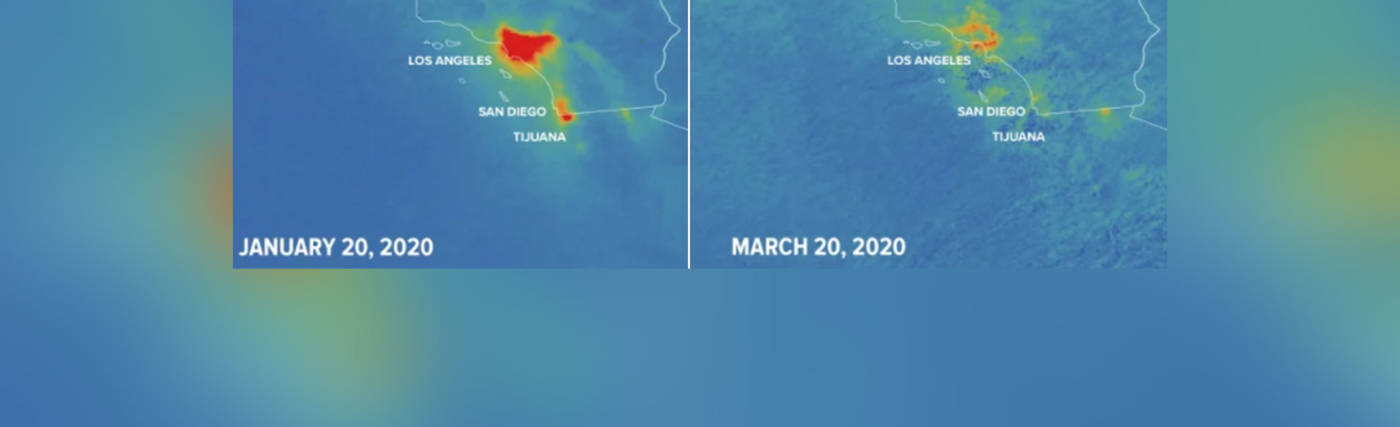
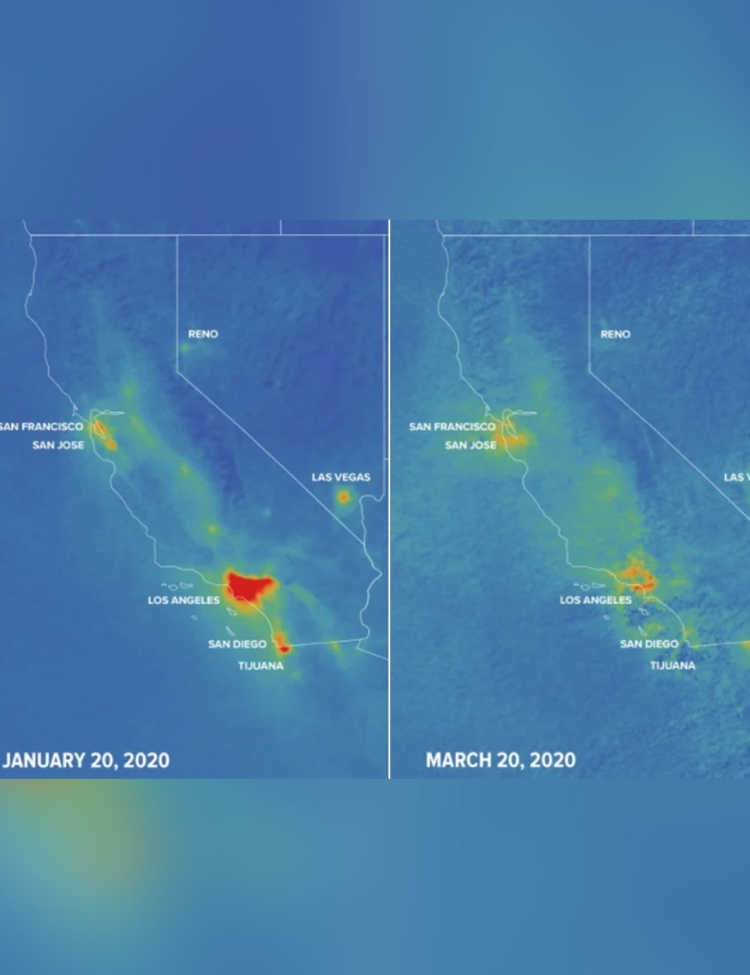
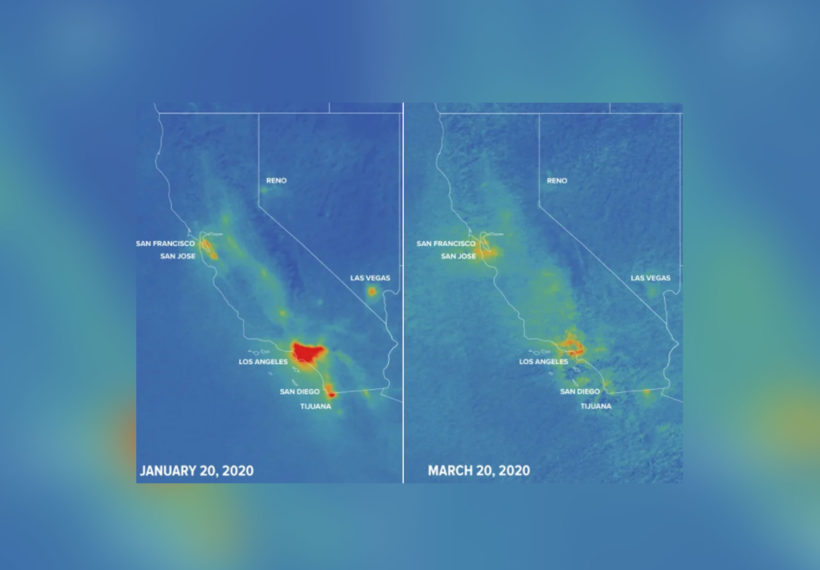
Your air has been cleaner now this month than perhaps it has been in many, many decades.
And that’s true in China.
It’s true in northern Italy.
It’s true on the East Coast.
It’s true in parts of California because we’ve stopped driving around so much.
So the amount of transportation that’s going on, the amount of internal combustion engines that are being turned on has gone way, way down.
And those are producers of things like nitrous oxides, NOX, NO2, which are a component of smog.
That leads to high ozone levels, which are very unhealthy.
Just a quick question.
There is no element with the letter X.
So NOX is a whole range of nitrous oxides that are NO2, NO4, NO6.
And there’s a whole complex slew.
So there’s one class of nitrous oxides that are very reactive and are both ozone precursors and unhealthy in and of themselves.
And we have been, because they come out of internal combustion, those have been going way, way down.
So clearly, Gavin, this problem is solved.
I mean, I don’t even know why we’re having this show.
It sounds to me like we’re all good.
Yeah.
Well, see, I mean, this is the thing.
You know, we know that these pollutants and we know that Cum Dark Side comes from our industrial and agricultural activities, right?
So we’ve known this for centuries.
If the answer was as simple as let’s just stop doing everything that we’re doing, you’re right.
We would have solved this problem.
And right now we’re doing half of that, right?
We’re half stopping a lot of the things that are producing some of these pollutants.
But I don’t know how much fun you’re having right now.
But I don’t know that this is really a final and permanent solution.
Let me just ask, tell me about air travel as well.
That’s a contributor just as driving is?
Right.
So air travel is about 3% of global carbon emissions.
And obviously air travel has gone way, way down in the last couple of months.
But it gives you a sense of how difficult the carbon dioxide problem is.
It’s because even if we stop flying, that’s only 3%.
We stop driving, that’s maybe another 5-10% because we haven’t stopped the trucks, we haven’t stopped the trains, we haven’t stopped the shipping.
And so the total emissions for carbon dioxide that we’re expecting to change as a function of this, as a function of the coronavirus is perhaps only about 5-10% of global emissions, which is not that much.
Plus the farming footprint hasn’t changed for carbon dioxide, correct?
And electricity, you know, we’re still generating electricity, we’re using it to power our internet binge that we’re having right now.
Okay, not all of which is carbon footprinted, but a great deal of it globally is though.
Right, right.
Particularly coal, right?
I mean, you still have a bunch of countries that are burning coal.
And recently in America, you know, we had to bring it back.
And so, you know, we haven’t brought coal back.
So we have coal is having its lunch eaten for it in the marketplace.
And so coal in the US and in most of Western Europe and Japan is on its last legs.
But there are still a lot of coal power stations being built, being used in China, India, parts of Eastern Europe and the like.
So not that you’re a medical expert, but let me just see what you know of this.
If the air quality is a little better, is it too early to know whether the cleaner air is actually saving the lives of people who might have otherwise been on the brink with respiratory issues?
So I mean, that’s a great, great point.
We know that heavy amounts of particulates, small particles in the air are very, very deleterious to people’s health.
And they kill literally hundreds of thousands of people prematurely every year in China and similarly in India and in other parts of the world.
So reducing those pollutants is a health gain.
But whether, you know, how many lives we’re saving or how many lives we’re not cutting short for like a month of clean air or two months of clean air, that’s a little bit trickier because most of the problems are associated with persistent exposure.
And so if we if we kind of cut it down and then kept it cut down, then I think we’d be saving many, many thousands of maybe even hundreds of thousands of lives.
And we should be working towards that.
Something was still in the early stages of I think medically of understanding is you’re right, a couple of months of clean air, what’s that relative to years and years exposure?
So if you did have this respiratory susceptibility to pollution, early evidence has been showing that you are more susceptible to the virus, to the coronavirus and its effects on your lungs.
Have you seen that or read about that?
I’ve only read about it.
And again, you know, I’ve just seen these kind of, you know, kind of preprints that have been popping up to suggest that there is an impact of heavy pollution making your susceptibility to coronavirus worse.
Some people are the pre-printers.
Oh, so science works much faster than our ability to publish it.
And so the scientists who are working at the cutting edge of the coronavirus, both the epidemiology and the biology and the impacts are producing science at a very, very rapid rate.
And they’re just kind of throwing up their papers onto what are called preprint servers, where you can look and that every day there are hundreds of papers being put on these servers where you can get a really cutting edge view of what people are doing.
Now the problem with preprints is that you don’t know if it’s right.
And it hasn’t been checked.
It hasn’t been peer reviewed.
And so there’s some stuff up there that is obviously not going to be correct and is kind of be more confusing than useful.
But like the one that said that the aliens brought the coronavirus, that’s a preprint bit.
Oh, come on.
That’s that’s what’s wrong with that, Neil.
I mean, come on.
Hypothesis.
Not yet peer reviewed hypothesis.
Yeah, that’s what they want you to believe.
The preprint is kind of like a rough cut screener, basically.
Yeah, no, no screening.
It’s a rough cut.
It’s just a rough cut.
Without any screening.
Without any screening.
Yeah.
So tell me about one of the things you and your entire institution as director of GISS, Goddard Institute for Space Studies, relies on is climate modeling.
Yes.
Modeling in general, which is quite a daunting task when the models you create and intended to represent reality have many, many variables in it.
And you have to sort of get a handle on all those variables.
Is there any connectivity between modeling climate and modeling the spread of the coronavirus?
And which modeling works best for you?
Is it swimwear or eveningwear?
You don’t want to see me in swimwear.
Let me tell you.
Yes.
Go ahead.
I once got caught on Google Street View running through the park, like with my shirt off.
And it was there for many, many years.
And it was just horrible.
I derailed us.
We’ll get back on track.
Have you seen?
There was a comic or something a few months ago.
There was hurricanes coming through.
It was it was a Trump joke.
It says something like Trump wasn’t interested in climate change until he heard that the European models were doing better than the American model.
That’s pretty funny.
That’s damn funny.
Yeah.
Sorry, sorry.
But modeling with with with connection to coronavirus.
Sorry, that was a question before I took us down a rabbit hole.
Right.
So, you know, let’s be clear.
Models are absolutely fundamental to the scientific enterprise.
Right.
You know, if you want to make a prediction for something that’s going to happen to be able to test your theories, you have to be able to quantify that.
You quantify that using a model.
Now, there’s different kinds of models.
And I think a lot of the conversation related to the coronavirus and the epidemiological models that are being used is that people don’t really understand why how there are different kinds of models.
Right.
So, you know, there are some models where, you know, you get a bunch of data and basically you just fit a line through it or you fit a curve through it and you say, OK, well, that’s what’s going to happen.
But just to be clear, the model is intended to be able to not only predict what will happen in the future, but assess the intensity of what will happen in the future.
So you put a line through the data that you have and assume that the continuation of that line or curve takes you to where you can now alert authorities.
Right.
So, I mean, so if you’re if you’re on an exponential growth path, then, you know, you don’t want to make a linear extrapolation from that you want to make an exponential extrapolation.
But that only goes so far.
And then what happens when you you institute some public policy and then really the system has shifted.
And so you really need to model that a little bit differently.
And so the whole idea is to be able to make predictions so that we can be prepared or more prepared than than we currently appear to be.
So there’s there’s models where basically you’re just fitting a line.
There are models that are more sophisticated, where you’re actually trying to track, you know, how a virus goes from one person to another person to another person, in what kind of circumstances.
And some of that modeling is very, very, very complex.
Some of it is, you know, you have little agents who are kind of infecting each other and you’re trying to aggregate that to the national or the global numbers.
That’s very, very complicated.
The fitting a straight line stuff is very simple.
But it turns out that oftentimes you get a good sense of where things are going with the simpler models.
But if you actually want to make a useful prediction, you need to do that more complex modeling.
And with respect to climate, you know, there’s the same kind of thing.
You know, you can look at the temperatures over time, and you can put a straight line through it.
And you think that that’s a prediction.
It’s not terrible.
But it isn’t going to tell you what’s going to happen the next time there’s a volcano or the next time there’s an El Nino event or the next time that we do something about emissions, right?
So, to get back.
You’re saying that you can’t predict when you have unpredictable things, you can’t predict with precision or accuracy when you have unpredictable forces jumping in to mess up your model.
Well, it’s hard to know exactly where things are going to go because the answers from your model are hopefully going to impact public policy and people are going to make different decisions based on what they think is going to happen, right?
So the lockdowns that we’ve seen, those are in response to models that said, well, if you don’t do that, it’s going to go up exponentially.
And so they said, well, we don’t want that.
So let’s change things.
And now that’s a new element that, you know, and that’s going to give a different answer.
So it’s not that the models changed, right?
But the scenarios have changed, you know?
Okay.
So with that in mind, because the important thing, if you know, and this is just from, I’m not the scientist here.
I’m listening to this.
I want to know what have you gotten right that I can rely on looking into the future?
So can you give us an example of what models you have already executed that said, hey, this is the deal and we got it right?
Or even more importantly, we were way too conservative.
Right.
So going back to my field, where I know more of that kind of stuff.
So in climate, you know, we started seriously looking at the carbon dioxide problem in the 1960s.
And people made predictions then that said, okay, well, by the end of the century, you know, we’ll have warmed up by about a degree Celsius.
And we did.
But it wasn’t just like, you know, it was going to get warmer.
It was quite precise.
And then they said, well, okay, but up in the stratosphere, which is the part of the atmosphere above the weather, they said, well, actually, something weird is going to happen there.
It’s going to get colder.
And it turns out that that happened as well.
And then they said, well, you know, the water vapor is going to go up.
And they said, well, you know, that happened too.
And all of these things that we predicted, the increase of heat in the ocean, we predicted that at the rate at which it’s actually warming up.
Well, this is all good.
Chuck, it means they’re bad ass, okay?
Yeah, exactly.
That’s my point.
So my point is this.
What are you guys doing wrong that nobody gives a shit that you got all this stuff right?
Right, that’s a crucial issue that has to be solved.
Just a quick thing for the Celsius illiterate Americans.
You said the temperature will go up by one degree Celsius.
One degree Celsius, if I remember my math, equals 1.8 degrees Fahrenheit.
Yeah, it’s about two.
You don’t need to worry too much about the decimal position.
But yeah, I mean, that’s how much we warm.
So, let me just add, I just want to bring this segment to a fast close because we have more of the show on continuing the topic with yet another guest.
So just to be clear, the fact that there is a virus pandemic is not itself of interest to you, a climate scientist.
What’s of interest to you is the effect that that pandemic has had on our consumption of fossil fuels and how that then affects your climate model?
Well, I’m pretty interested in what’s happening with the virus just as a basic human being.
I’m not purely a scientist.
But you know you’re a human being.
Thank you for that.
Yes, yes, yes.
But yeah, no, I mean, wearing my climate scientist hat, I’m very interested in how this is impacting air quality, radiation, temperatures going forward, carbon dioxide going forward.
Yeah, and we’re diving into that.
In much the same way after September 11th, we had weeks of no traffic, no air traffic.
And so I remember reading the astronaut accounts for that they no longer could see the contrails criss-crossing the country and the world over that period of time.
It’s a great example that you brought up there because in that period, the air traffic was only down for a few weeks.
And that wasn’t really enough to kind of pull out the signal that’s from the contrails, what they do to the climate, to kind of disentangle that from just the weather.
But like this situation that we have here is going to be longer and more long lasting.
And I think we will, in fact, get an answer to that same question.
This will help your models become more accurate.
Yes, it’s a pretty high price to pay for a few improvements in a model.
But but yes, we will use it.
Well, Gavin, great to have you back on Star Talk.
You’re just up the street.
We want to make sure you stay within arm’s reach of us because we’ll surely find or Six feet away, Neil, six feet away.
We’ll find or invent some excuse to get you back on.
Great.
When we come back to Star Talk, we’re going to have a chat with climate scientist Katherine Hayhoe on that next segment.
Stay tuned.
We’re back on Star Talk in the coronavirus, and this edition of Star Talk is any connection at all between the coronavirus and climate change.
Mm, yeah, yeah.
And so for this segment, we’re bringing in a new expert, a new guest, and this is gonna be Katherine Hayhoe.
Katherine, did I pronounce your name correctly?
You did.
Katherine is a living embodiment of a Naughty By Nature song.
Oh, is that right?
That’s right, hip hop hooray.
Ho, heyhoe, okay, enough of that.
Also Ramones, Ramones, heyhoe, here we go.
Oh, hey, ho, let’s go.
All right, all right.
And Snow White and the Seven Dwarfs.
That’s hi-ho, not hey-ho.
Well, you can say it, hey-ho, off to work we go.
No, no, we’re stopping there.
So, Katherine, you are director of the Texas Tech Climate Center.
And in that capacity, you also serve as professor at Texas Tech, and what department are you?
Well, I have had a varied career.
My undergraduate degree is in astrophysics.
Yes, my master’s and PhD is in atmospheric science, and I am currently in the political science department at Texas Tech because climate change is the most political science there is.
Don’t tell me that.
I don’t want to hear that.
Well, tell me now how, why are we talking to you about the Corona virus?
We are really concerned right now, obviously, about the impact of this pandemic on our world.
But the reason why we’re concerned is because it affects our health, our welfare and the economy of our families, our loved ones, our communities, our cities, our countries.
And that is exactly what climate change affects too, just over a longer time scale.
So this is like a microcosm of what, it’s a disaster reel playing out in fast motion.
Right?
Yeah, that’s exactly what it is.
It is playing out in a matter of days, whereas climate change plays out in years to decades.
But in terms of where we are with climate change, we are as if we were in the second week of March on the coronavirus pandemic.
In terms of how far we’ve already progressed and how great and how imminent the risk is that we face today.
So tell me about ecosystems and the spread of the coronavirus or the existence of the coronavirus in the first place, or any virus, especially species jumping viruses.
How is that all interconnected?
So coronavirus came to humans through a process called zoonosis.
That means it jumped from animals to humans.
Wait, that’s a word?
Yes, zoonosis is absolutely a word.
So it is not a happy event, it’s just the opposite.
It is where a virus that already exists in an animal population jumps over to humans.
And we have no immunity to it and we are incredibly vulnerable.
So the fact that it jumped over to humans is primarily due to the fact that animals like pangolins were being sold in wildlife markets.
What kind of animal is that?
It’s like an armadillo almost.
It’s like a kind of a really armored looking little animal like an armadillo, but nobody should be eating.
And what’s it called again?
Pangolin.
For a moment I thought you were saying penguins.
And I was gonna say, Katherine, I know you’re a scientist, but I think you’re mistaken.
I don’t think you should be eating penguins either.
Yes.
But, but we know that first of all, as human expansion shrinks wildlife areas and fragments ecosystems, humans are coming into more and more contact with animal populations that have nowhere to go.
And then as climate change is changing where different types of vegetation grow, where different animal species live, increasing the risk of droughts that wipe out food supply.
That’s also making animals more desperate and more likely to engage with humans in their search for food, which puts us additionally at risk from getting more of these diseases, making that jump from animals over to humans.
Wait, wait, Katherine, you’re freaking me out at this point.
What you’re saying is, I don’t want to put words in your mouth, so you correct me if I’m wrong, that the coronavirus is just one example of what will continue to happen going forward as we displace ecosystems.
All right.
Well, that’s our show, people.
Moving along.
So, so, so Katherine, tell me about what roles governments, will governments learn something from the coronavirus that they can then apply to staving off climate change?
Come on, Neil.
I’m supposed to be doing the comedy.
Come on, man.
Try to put me out of a job.
What is happening?
All right.
Let me just say one would hope so.
And one would hope that the basic lesson they would learn is an ounce of prevention is worth a pound of cure.
This is not, forgive me for saying this, rocket science.
It is just understanding that a stitch in time saves nine.
Preparing for and preventing future risk is a lot safer and more affordable than waiting for the tsunami to roll over your head and then trying to survive it.
Can you talk about the fact that food insecurity is a big deal right now because of Corona virus and food insecurity with respect to climate because that’s when things get really real.
When people can’t eat, that’s when the proverbial S hits the fan.
Mm-hmm.
Well, I’ll tell you that going all the way back to when I decided that I had to do my best to study climate change instead of astrophysics, what stabbed me in the heart, what made me really change my mind on what to do with my life, was when I found out that the poorest people in the world were the ones who were most affected by a changing climate.
And we are seeing that play out here today.
Let me give you a couple of examples.
So first of all, I was talking to colleagues who live around the world and they were saying, people who live in poor countries, the middle-class people are sitting in their air-conditioned homes with the groceries they ordered online and Netflix and internet, and poor people can’t go out to get jobs to support their families and they’re even beat up and arrested if they do go out because of the quarantines, but they can’t even feed their families.
Here in the United States, we are seeing that African-American populations are being disproportionately affected by this disease.
We don’t know for sure, but I suspect it’s what we’re seeing around the world.
People who already live in areas with very poor air quality, which is primarily due to burning fossil fuels, which is what causes climate change, those people are much more vulnerable.
A study they did on SARS, like 15 years ago showed that if you caught SARS and you lived in an area with very dirty air, you were twice as likely to die from it as if you lived in a place with clean air.
And so we know that that is the case in the US today.
And then there’s the issue of, like you just said, food shortages and food security.
The more well-off and affluent we are, the better insulated we are, at least for the first few months, from the impacts of pandemics, from climate change, from disasters.
It is always the poorest and the most vulnerable who suffer first.
All right, so you’re in a department of political science.
So you, these are people who, who presumably care what you say, because you’re coming to them from an entire scientific foundation of an understanding of the past, present, and future of nature, and our intersection with it.
So what kind of an audience do you get?
I would say that many of the political scientists I’ve spoken with are even more worried about this than climate scientists, if you can imagine.
Yes, because they know that one of the first things to go as disasters build up in the world, one of the first things to go are democratic systems.
Ooh, that’s ugly.
Yeah, that is scary.
You mean it becomes more totalitarian?
People are willing to cede more control to a leader in a time of disaster.
Ooh, when we come back to Star Talk more on the coronavirus and its other similarities to climate change.
Hey, we’d like to give a Patreon shout out to the following Patreon patrons, Taylor Brandt and Carlene Goodbody.
You know, Carlene, in my younger days, I was also called Goodbody.
Thanks guys for helping us make our way across the cosmos because without you, we couldn’t do it.
And for those of you listening who would like your very own Patreon shout out, go to patreon.com/startalkradio and support us.
We’re back, Star Talk, in the Coronaverse, keeping our distances.
Not physical distances, but we are totally in each other’s face electronically.
Ain’t that right?
I’ve got with me some extra expertise in the guys, Katherine, Katherine Hayhoe.
Welcome back to Star Talk in this segment.
And just to remind people, she’s director of the Texas Tech Climate Center.
Very cool.
And she has an ear, she has the ear of political scientists who care, academic political scientists in particular, who care about things that could disrupt the apple cart of politics, if I may call it that.
So let me ask you, Katherine, could you tell me about any similarities you see about people’s attitudes towards climate change, plus or minus, and attitudes towards this COVID-19 coronavirus?
Absolutely.
So for a long time, we’ve known here in the US, and sadly increasingly in other countries around the world, my home of Canada, the UK, Australia and more, that the number one predictor of whether we agree with over a hundred years of science, that tells us that digging up and burning coal, gas and oil is wrapping an extra blanket around the planet that’s causing it to warm.
The number one predictor of whether we agree with those facts is not how smart we are, it’s not how much science we know, it’s not how educated we are.
It is simply where we fall on the political spectrum.
And today we see that the further to the right we are on the political spectrum in the United States, the more likely we are to dismiss the risks posed by the coronavirus pandemic as well.
Why?
Wait, so does one cause the other or the other cause the other?
They’re both symptoms of the underlying cause.
The underlying cause.
So there’s a third underlying cause.
I think the underlying cause is fear.
It’s fear that the world is just changing too quickly, that people who have sort of been at the top of the heat for a long time are feeling like they’re being shoved to the back of the line.
And that anything that talks about change, whether it’s immigration, whether it’s, you know, government solutions, whether it’s clean energy.
I mean, we’ve been using coal since the middle ages.
What’s wrong with it?
Anything that’s new is seen as a threat to the established status quo.
So when you say fear, you don’t mean fear of the consequences of climate change or the virus.
You mean fear of a change in their sociopolitical status.
Absolutely.
So you will resist.
See, so why don’t, if, okay, let me just ask you.
If I don’t want my status to change, why don’t I just declare I don’t wanna make these changes?
I see the science, I agree with the science.
I don’t wanna change policy based on it.
Why don’t they just do that?
That would be the honest thing to do.
And some people actually do do that.
But a lot of people, our self-defense mechanisms kick in.
99.9% of the climate denial I see is actually solution aversion.
But the solution aversion will arrive cloaked in either a sciency or religiously sounding smoke screen.
In other words, it’s just a natural cycle.
It’s the sun, God is in control.
But when you dig down anywhere from 30 seconds to a minute on their own initiative, people will say, well, I don’t want to fix this problem because it means government control.
I can’t drive my truck.
I can’t do my job.
China’s gonna take over the world.
But our psychology comes into play because if I say it’s a real problem and it will hurt the poorest people in the world, but I don’t wanna fix it, that makes me the bad guy.
And none of us want to be the bad guy.
We wanna be the good person.
And so we throw up this defense mechanism to explain why we are good and smart in rejecting this problem.
Well, if we were not good, we’d at least be neutral to it.
Right.
So are you trying to tell me that if I don’t give a damn about poor people, that I’m a bad person, Katharine?
Because I gotta tell you the truth.
I don’t give a damn about poor people.
I’m just saying.
All of my friends are rich, Katharine.
I’m just letting you know right now.
I’ve got some things your friends could do with their money and that can’t be fucked.
So wait, so let me dig in just a little deeper.
So what about those who are conspiracy prone and you get some of those in every big scientific political issue, even every science issue, just whether we landed on the moon, whether we earth is flat or round.
And so have you seen any similarities between the pandemic and climate change with regard to just claims of conspiracy?
Yes.
In fact, some of the very same organizations that regularly spread conspiracy theories about climate change have been spreading conspiracy theories about the pandemic as well.
Oh my goodness.
So it’s conspiracy central then?
It is.
And one of my colleagues, Steve Lewandowski, he’s a cognitive psychologist at the University of Bristol in the UK.
That’s my favorite kind of psychologist by the way.
Yeah, yes, he’s great.
So Steve has studied conspiracy theories in general, everything from the Queen killed Princess Diana to there’s this international cabal of scientists that have been controlling climate for 200 years.
And he shows that they’re all part and parcel of the same mindset.
With my weather scene, I shall one day rule the world.
It’s actually an episode of Family Guy where Stewie takes his little weather machine and he actually succeeds in doing just that.
So where do we go from here?
What’s your advice?
I mean, I’d like the fact that you are at this nexus of the science and the politics and the pop culture.
Something that we know, if any real solution has to be put into effect, it’s got to influence politics.
It’s got to influence people’s hearts and minds.
So, you know, I’m reminded of when everyone was hauling whales out of the ocean because the really useful, the whale blubber is useful for light and fuel oil.
And that does work for the base.
Oh, wait, well, and then there are people who didn’t want to kill these big, beautiful creatures.
And then we stopped killing the big, beautiful creatures.
Is it because of this movement?
No, it’s because we found oil in the ground and didn’t need the whales.
And your life was not at risk pulling oil out of the ground compared to whaling vessels.
So maybe you’re not going to convince people’s hearts and minds, Katherine.
You have to come up with an economic solution that everybody can embrace.
And then people will just do it.
I’m going to be totally honest.
So first of all, I’m not an economist, but I listen to economists.
And nearly every economist in the world, including the two who won the Nobel Prize a year and a half ago, agree that the most effective way to start cutting carbon emissions is to restore the massive imbalance between the cost of fossil fuels and clean energy.
Most people think that clean energy is massively subsidized and fossil fuels aren’t, and it’s exactly the opposite.
Direct subsidies on fossil fuels in the US are about double the subsidies on renewables.
And if you include the indirect subsidies from the air pollution from 200,000 deaths in the US alone every year from the air pollution from fossil fuels, if you include the indirect, the subsidies to fossil fuels exceed the Pentagon’s budget.
So a price on carbon would restore the balance so that we would see that actually clean energy is much cheaper.
And even with this imbalanced system, wind is already cheaper up the whole middle of the country for electricity and solar is already cheaper in the Southwest than natural gas or coal.
Tell me about the CO2 we’re not putting in the atmosphere now relative to any long-term climate goals.
Yes.
So under the Paris Agreement, pretty much every country in the world agreed to try to limit global warming to 2 degrees C, noting that we’re already at 1 degree C.
The C is Celsius.
Or technically Kelvin.
Yeah, it’s just a degree range.
So 2 degrees Celsius or 1.5 if we could.
Because there’s no magic number, like if we end up at 1.5 we’ll be totally fine and 1.6 will be totally screwed.
It’s like cigarettes.
The more cigarettes you smoke, the worse it is.
So if we want to end up at 1.5 degrees, then one way to get there is to cut our carbon emissions pretty quickly.
We’d need about a 40% cut by 2030 and we’d need a 100% cut by about the middle of the century.
And that sounds like astronomical in terms of human emissions.
But here’s the thing.
Wait, wait, just back up for a sec.
So the target is 1.5 degrees Celsius over how much time?
Stabilize it at 1.5 degrees Celsius by the end of the century.
Oh, so what you’re saying is, whatever more we warm the Earth, don’t warm it more than by 1.5 degrees.
Right, so we’re already kind of up to here.
Do we kind of plateau or do we just keep on going up?
But isn’t it true that let’s say we were to make those targets, right, and make them right when we’re supposed to, that there is, much like the economy, climate has a lag time, so we’re still going to see increases in the warming.
That’s absolutely true, and that’s why after mid-century, we’d have to start sucking this stuff back out of the atmosphere.
Wow, so we have to reduce, you know, and then we actually have to extract.
Yes, and that extracting can be done in some very low-tech ways.
Planting trees is one way to do it.
But there’s also some really cool high-tech ways.
A couple of really smart companies have figured out how to sap carbon out of the atmosphere, and they can turn it into liquid fuel.
Okay, now you’re just making stuff up.
I just want to re-focus this.
So if we promise to asymptotically get to one and a half degrees, there’s still the matter of all the CO2 that’s in the oceans dissolved, right?
That’ll still keep coming out, which is why you were saying we have to keep extracting it out of the air.
Is that correct?
Yes, so the ocean can get back in balance with the atmosphere.
So it sounds like a big number, but here’s the thing.
If you look at how we’ve reduced our carbon emissions due to the pandemic in just a few weeks.
Not on purpose.
Not on purpose.
Just to be clear.
No, and not sustainably.
We couldn’t sustain a reduction that’s due to shutting down the economy and throwing people out of work.
I mean, that is bad.
But if we had achieved it through increases in efficiency, through clean energy and through drawing down carbon, we would be a quarter of the way to meeting our Paris Agreement targets in just a few weeks.
I mean, that’s encouraging, though.
Yeah, yeah.
It shows that if the threat is actually staring us in the eyeballs, it shows that we can do it.
But the problem is this.
As you yourself just said, Neil, it’s a timeframe issue.
Climate change unrolls in slow motion.
And I’m really afraid as a scientist that by the time we get to the point when disaster is staring every single human in the eye, it’s going to be too late to act.
Let me ask you a final question here, because we’re running out of time.
Forgive me for borrowing a medical term here.
What advice do you give people to inoculate themselves against bad science?
Oh, I see what you did there.
When it comes to not only climate change, but also the coronavirus.
Well, so inoculation is really important because we live in a world today where somebody thinks that if they can Google something, they know more than the experts.
And so inoculating ourselves against fake news is something I do with my students.
I take my students through things and I say, if something sounds too extreme or too good to be true, it probably is.
If something was said by Dr.
So-and-so, Google Dr.
So-and-so.
Do they actually have expertise in what they’re talking about or not?
Take everything with a grain of salt depending on what media outlet you’re getting it from, because we know that certain ones skew more left, others skew more right, and then you have ones that are extremely factual, like Star Talk, of course, as well as the BBC and the CBC national news networks in Canada and the UK that have to just stick to the facts.
But I think that really being aware that just because something is on the internet doesn’t mean it’s real.
Just because a politician said something doesn’t mean it’s real.
I think that’s really key to learning or to starting our journey towards inoculating ourselves.
Can you tell me if there’s a way to fact check or Google the source a lot of people say or many people say?
Is there a way that you can confirm that?
Oh, yes.
So I direct people to Snopes all the time.
Snopes fact checks all the little statements that people are…
When in doubt, go to snopes.com.
I’m in the dark here, guys.
What is Snopes?
But Chuck…
I’m serious.
I don’t…
What is Snopes?
Snopes checks anything that…
You might even be a little suspicious of the authenticity of its content or of its origin.
Oh, that’s why I don’t know it.
That’s what I got you for, Neil.
So there’s an organization called Climate Feedback.
And what they do is they’ve gotten climate scientists together to peer review news articles.
And they give the news articles a rating of truthfulness.
So any news article that fights a politician or an organization, they actually have it peer reviewed on Climate Feedback.
What website is that?
climatefeedback.org Nice, nice.
Cool.
I’m going there tonight.
Katherine, we got to end this.
Give us one last bit of wisdom that you can share with the Star Talk universe.
I think the pandemic has taught us all that no matter who we are, no matter what country we live in, no matter what language we speak, no matter where we fall in the political spectrum, when it all comes down to it, what really matters to all of us is the health and the well-being of our family, our loved ones, our friends, our community and more.
That’s exactly why we care about climate change too.
And that’s why no matter who we are, no matter where we live, no matter what language we speak, no matter what part of the political spectrum we’re on, we are already the perfect person to care about climate change because we’re a human who lives on this earth.
That’s a mic drop.
That’s a mic drop.
Katherine Hayhoe.
Love having you on here.
We’d want to get you again.
Anytime.
This is great.
We will definitely find a way to, we’ll invent an excuse to bring you back on.
Thanks and regards to your family.
Stay safe, stay warm, stay fed, and keep trying to change the world.
Thank you.
All right, Chuck, always good having you.
Always a pleasure, Neil.
All right, this has been Star Talk in the Coronaverse.
A special installment on the Coronavirus versus time of change.
You didn’t think we could do that, but we did.
I’ve been your host, Neil deGrasse Tyson, your personal astrophysicist, as always, meeting you again.


 Become a Patron