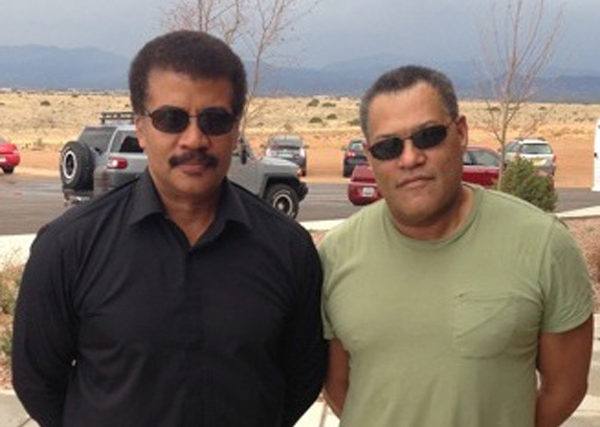
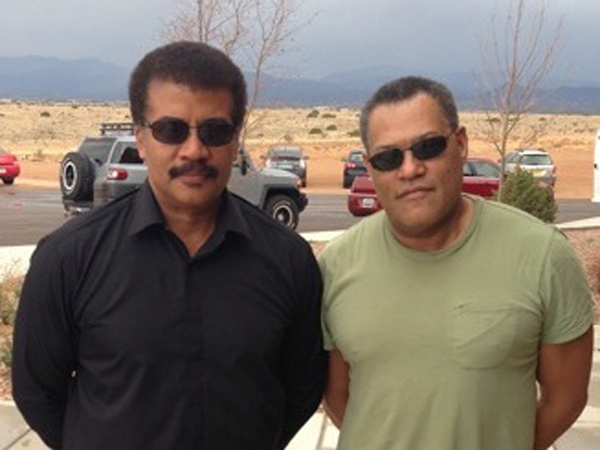
Red pill or blue pill? You get both when Neil deGrasse Tyson interviews Morpheus himself, actor Laurence Fishburne. They sat down while Neil was in New Mexico filming COSMOS and Laurence was filming The Signal, a new indie sci-fi film. You’ll get a healthy dose of reality, as they talk about Fishburne’s roles in The Matrix, Searching for Bobby Fischer, and CSI. And you’ll dive into the world of the imagination as the two sci-fi fans discuss why style can be more important than substance in sci-fi and geek out over Star Trek, Superman and Watchmen. They also talk about chess, science vs. religion, planetariums and using math and science to explore the world. Laurence tells Neil how and why he became an actor at age 10, and discusses his future plans to produce, direct, write plays and return to Broadway. You’ll also find out what role Laurence wanted to play but didn’t, and why he got the key to the city of Cambridge.
Transcript
DOWNLOAD SRT
Welcome to StarTalk, your place in the universe where science and pop culture collide. StarTalk begins right now. Welcome to StarTalk Radio. I'm your host, Neil deGrasse Tyson. I'm an astrophysicist and director of New York City's Hayden Planetarium. In...
Welcome to StarTalk, your place in the universe where science and pop culture collide.
StarTalk begins right now.
Welcome to StarTalk Radio.
I'm your host, Neil deGrasse Tyson.
I'm an astrophysicist and director of New York City's Hayden Planetarium.
In this StarTalk, we're featuring my interview with the award-winning actor, Laurence Fishburne.
You've probably seen him in a bunch of movies, and he was shooting a new sci-fi indie film in Albuquerque, New Mexico when I ran into him when I was filming Cosmos on a soundstage in Santa Fe, New Mexico.
Cosmos was filmed all around the world, as well as in two major sound studios, one in Los Angeles, one in Santa Fe, and in Santa Fe is where we filmed all the scenes on the spaceship of the imagination.
If you haven't seen Cosmos, check it out.
It's actually online.
If you don't catch it in real time on television, online, it's www.cosmosontv.com.
In this first clip with Laurence Fishburne, I run down the list of some of his most popular movies.
We also discuss his interest in science and the influences that led him to a career in film and television.
Laurence, you have the most diverse acting career of anyone I have seen.
I mean, thank you.
From Pee Wee Herman to Apocalypse Now.
Pee Wee's Playhouse, Apocalypse Now.
Nightmare on Elm Street 3.
School days.
School days, of course.
And one of my favorites, which was not a box office success, but so well made and so beautifully done.
And you were the character of the movie was Searching for Bobby Fischer.
Yes, Bobby Fischer was one of them.
Oh man, what a proud product that is.
That's a really great movie.
My son, in fact, got into chess by seeing that and now he's moving on.
He's 12.
Really?
Yeah.
So, you know, I'm not just blowing smoke.
There's a lot here.
My regret is that I missed you on Broadway in-
Oh, in Thurgood.
Thurgood.
Well, we'll send you one.
Oh, good.
We actually shot it in DC where he did most of his great work.
But he was with Howard, right?
Howard.
Howard.
And then of course Supreme Court and all of that.
It was like doing the home team thing, it was great.
And I listed all your sci-fi movies here.
So we've got Ven Horizon, certainly, The Matrix trilogy, Contagion, Man of Steel, and when you're in progress, The Signal.
Maybe we'll talk about it if you can a little later.
My very first one, which is one that not a lot of people know about, which is called Cherry 2000.
Cherry 2000.
Cherry 2000.
I have to look that one up.
If you blink, you'll miss me.
So you are a background actor in that one, isn't it?
Not exactly background, but not much more than a glorified extra.
So let me ask you, mother, junior high school math and science teacher, any effect on you at all?
Yes.
I would have to say definitely I am a natural reader.
My father is also a natural reader.
I did fairly well in math and I guess I did okay in science.
I think both of those two subjects just helped round me out in terms of making me a curious person.
So I am naturally curious about the world.
Many people who take math and science who don't become mathematicians or scientists think that it's, well, I will never use this again, but you just hit the nail on the head, that it changes your outlook.
Yeah.
I mean it made me curious about the world and it gave me a way into the world, a way of investigating the world and exploring the world that wasn't just about what things looked like or how people talk.
I mean, I had that kind of curiosity naturally, but for example, I would say the big piece that allowed me to think about another part of the world and another culture, for example, is like the Hindu-Arabic system.
The way they introduced that to you in school is like, what?
You're like, yeah, yeah, yeah, we didn't invent numbers.
Somebody else invented the number system that we used.
That's why they call it Arabic numbers.
So when you think about that, then it gives you a window into that part of the world.
It allows you to start thinking outside of the box.
Outside of the box and outside of your world and where you come from and all that stuff.
So that kind of stuff was great.
And then of course, with the science thing, growing up in New York and having access in Brooklyn, having access to the Brooklyn Planetarium, having access to the one in Manhattan and having the Hayden Planetarium.
Exactly.
That's my place now.
I got the keys.
Oh, you got the keys?
Just back up.
You got to know somebody.
Cool.
I'm right here on 86, too, son.
Neil!
Where you at?
You can knock on the door.
When the moon is in the seventh house.
So you have a secret knock, and I'll know it's you in the back door.
I'll let you in the back door of the universe.
Exactly.
But we had access to Hayden.
We had access to the one in Brooklyn.
And I think all of my friends, we were all curious about, you know, what's going on in the world, and, you know, we had Cosmos, we grew up with Cosmos, Cosmos was on TV, with Carl Sagan.
So it's kind of a baptism.
We had that, we had Star Trek, the original, we had Space 1999, which was all about exploring, you know, it was all about what's out there.
But how early did you think or know you were going to be an actor?
I became an actor at the age of 10.
I became a professional actor at the age of 10.
Did you have any sense that your knowledge of science would matter or play into this?
Yes, I did, because the first thing I wanted to be was I wanted to be a doctor.
Oh, can't put a check in that box because you got that CSI, you're a doctor.
So as a doctor, you know, you got to have some science.
You can't be doctoring on people and not have some science.
It just don't work.
I wanted to be a basketball player.
I wanted to be Walt Clyde Frazier, specifically.
A friend of mine in high school was the ball boy for the Knicks and while Clyde was playing, and I had the same size feet as Walt Frazier.
He had his Puma contract.
Oh I hate you right now.
I'm still trying to find class Pumas.
You got some old ones.
Me and Clyde had the same feet.
I had free Pumas for like a year and a half.
That is crazy.
Yeah.
So this is the era.
This is the era.
So that was the era.
So I wanted to be a doctor, then I wanted to be a basketball player.
Then I became an actor at 10, and I realized immediately that as an actor, I could be anything, anything.
So science would fall under the heading of anything, most things really, when you think about it.
So I was never one of these people like, oh, I'm never going to use that.
It was when I get an opportunity to use that, then I'll explore it some more and I'll learn some maybe.
So when you were a kid in school, were you like the class clown, the geek?
Definitely class clown.
Not anyone to teach you would have said he'll go far.
No, probably not.
But you said you did well in math?
I did well in all subjects, yeah.
Okay.
So you're a good student then?
I was a good student.
All right.
Generally, that's when people say you'll do well, but...
I was a little too social sometimes.
Funny thing, in life, that's great, but in school, they don't like it.
No, and I challenged one of my teachers who was the one who said I would go far.
I challenged him a bit, but you know, he got over it.
You've been listening to StarTalk Radio, I'm Neil deGrasse Tyson.
When we come back, I'll talk with Laurence Fishburne about one of my all-time favorite movies, The Matrix.
The Matrix is everywhere.
It is all around us.
Even now, in this very room.
You can see it when you look out your window, or when you turn on your television.
You can feel it when you go to work.
When you go to church.
When you pay your taxes.
It is the world that has been pulled over your eyes to blind you from the truth.
Welcome back to StarTalk Radio.
In this show, we're featuring my interview with the actor, Laurence Fishburne.
In this next clip, we talk about his role as Morpheus, and it's from one of my favorite movies of all time, The Matrix.
We also touch upon his portrayal as Perry White in the Superman movie, Man of Steel.
And although Laurence Fishburne has been in a lot of science fiction films, as we'll hear, there's one particular role he wishes he could have played.
So we gotta do some time on Matrix here.
Sure.
It's one of my top three favorite films in my life, is Matrix One, of course.
Right, yeah.
I'm sorry, Matrix One.
I'm with you.
I just thought it was stunning and jaw-dropping.
It was.
And everything about it.
At the time, did you have any concept that this was gonna become what it was?
What I knew was that it was simply the most original material that I had ever encountered, and that I was gonna play that part.
Okay, that shows the sign of somebody who's driven by art.
Yes.
Others aren't.
Well, I'm lucky and blessed that way.
Yeah, and just how it was filmed and the themes.
And there's one science flaw, which they had to leave it in.
So I'm not gonna get on their case.
But in your speech about how they needed to get their energy.
The copper top thing?
The copper top thing.
And it's all to turn humans into batteries.
So it turns out that whatever energy it takes to get the energy out of the person, you could just use that energy.
Every time you use energy to get energy from something else, you lose energy.
So you're feeding this entity, organism, food, which is energy.
Right.
To then use the human as energy, you're not getting as much energy as you put in ever.
Ever.
Ever.
Now, the way out of that was using this plus some solar and nuclear power, we run the city.
These are the batteries.
Right, these are the multiple kinds of batteries and we got humans in there too.
The fact is they didn't need the humans at all.
But it's really cool though.
It's...
I have to admit, it's a case where coolness overrides everything.
Coolness overrides it.
And sometimes in science fiction, that's the criteria.
Sometimes it's style over substance.
And style works in science fiction.
It does.
Because you could take a style where you're not passing judgment.
Well, that didn't fit that era.
That's not what they would have done in 19, whatever.
Right.
It's one thing for a movie to be successful, but it's also another thing to build a whole fan base around it, clearly, The Matrix has this.
Because I imitated you.
Yeah.
You're writing a watch, ready?
Yeah.
I'm Morpheus.
Yes.
I do that all the time.
Do I need my sunglasses for that?
Yeah, you gotta get your sunglasses.
I'm Morpheus.
As you no doubt have guessed.
I am Morpheus.
I am Morpheus.
What was great about him for me, as he turns out to actually be just, you know, one of my favorite characters and everyone's favorite characters in science fiction is Darth Vader.
Vader is a great character.
Morpheus is kind of like Vader and Obi-Wan rolled up into one guy.
So the power and the philosophy.
Yeah, he's light mentor and dark mentor.
So that's a fully realized human being in a way that we don't get to see that often.
Yeah, I know it was working for me because you were Morpheus in that role and I'm not thinking Laurence Fishburne.
I'm just thinking Morpheus.
Yeah, yeah.
And when I see you on Searching for Bobby Fischer, you're the homeless guy in the park.
So I guess I'm complimenting you.
But the character, it lives in that time and place with you.
So what's your favorite special effect in The Matrix?
Oh, wow.
My favorite one is when the whole team goes to see the Oracle and there's that shot in that room on the phone.
I know every frame, so you don't have to try to remind me.
Okay, so the shot in the room on the phone and the camera goes around the phone.
Yes, and everyone is coming in.
And then suddenly when the camera makes the revolution, everybody's there.
That's my favorite special effect.
Really?
Yeah, because it's not a special effect.
It's, you know.
It's simple, actually.
It's very simple.
The camera's in the room, it's on a track, or a steady cam, I can't remember which.
The phone rings.
We were in the room and the camera made one revolution and before it made the other revolution, we all rushed and got into position.
Okay, so you're easy to please, so forget the bullet time.
Yeah, yeah, it's an old time movie trick.
It's like the camera never lies, but we can lie to it.
That's my favorite special effect.
It's an interesting, it has a good sort of musical beat to it.
It's got great music, you know, and it's got the great movement of the camera and then suddenly you've got this beautiful tableau of this whole team of people just suddenly around the phone, pick up the phone and go, we're in.
In The Matrix, you're really an action hero on some level.
Yes, exactly.
And that's a genre unto itself.
Unto itself, but you know, I mean, that's a really a young man's game.
You know what I mean?
I'm not looking to be an action hero at 60.
I don't mind doing some action.
Well, you convinced me you knew a little bit of Kung Fu.
I do, I know a little bit of Kung Fu.
Movie Kung Fu, I like Kung Fu, it's pretty good.
So, Perry White?
Yes, editor of The Daily Planet.
I have street cred with Superman.
I don't know if you know this.
How so?
I was in a Superman comic a few months ago, Action Comics 41.
Superman wanted to find his home planet, find Krypton, because the light signal of Krypton being destroyed would be coming to us about now, okay?
And he came to the planetarium.
So I'm director of the planetarium.
And I'll send you, I'll send you.
That is so cool.
The comic.
And so I'm there with Superman.
I may have the comic, Neil.
I'm told there were two, there's Superman comics and action comics.
I may have the comic.
Here's the fun part.
So I go, we're talking through the plot about how I'm going to deal with him and what questions he might ask.
And I said, oh, by the way, if it makes no difference to you, could you take a few pounds off of me?
And the guy said, Dr.
Tyson, this is the world of the comics.
Everyone looks good.
Everyone looks good.
You gotta love Superman.
You can't not love Superman and you can't not love the bat.
You just can't.
You know, my favorite comment about Superman is that he actually has no costume.
There's nothing covering his face when he's Superman.
No.
His costume is to blend in with it in real life.
Yeah, that's his costume.
His costume is his glasses and his suit.
Yeah, yeah, his mild mannered reporter.
That's right.
Yeah.
He is himself when he is the superhero.
Yeah, that's true.
Is there any role in a sci-fi movie you ever wanted?
Yes, Dr.
Manhattan in The Watchman.
What a striking character that is.
Dr.
Manhattan.
I would have loved to have done Dr.
Manhattan.
However, I just worked with Billy, who played Dr.
Manhattan and he was magnificent.
And he was telling me how they did it.
It's really amazing how they did it.
Well, you know, it's quantum non-location.
I mean, once you turn someone into particles, a particle has different laws that apply to it compared with macroscopic entities.
So a particle can be in more than one place at a time.
So he is decomposed into particles.
He can reappear like on Mars.
Wherever.
You know, my favorite scene of that movie where he brings the woman with him.
When he brings her to Mars, and she goes, oh, I'm sorry, I forgot.
He's all, I love that.
That was just so cool.
One of my favorite lines from the comic book is, yes, Superman is real and he is an American.
No, no, no, it wasn't Superman.
It was God exists and he's American.
No, maybe the comic writer said Superman in the movie.
I love that.
So I personally think that's best of genre.
Watchmen?
Watchmen.
Absolutely.
Best of genre among.
Yeah, yeah, nobody delivers a comic book movie better than Zack.
Oh, is that right?
I mean, there's only two frames in the comic book that are missing.
Everything else is frame for frame in the book.
Really?
Yeah, pretty much.
Okay, so he's true to the fan base.
I couldn't believe it.
I was watching, I was like, how did he get away with this?
It was really something.
So, do science fiction movies live in a different place in your heart and mind compared with other dramatic roles?
They take a different thing out of you as an actor.
Yeah, I mean, you know, I love science fiction movies.
I love science fiction to begin with, because I'm convinced that we're not by ourselves here.
There's gotta be more than just us.
The cool thing about science fiction is, all the stuff that was imagined, say 50, 60 years ago, some of that stuff is actually real now.
As portrayed in science fiction.
As portrayed in science fiction.
I mean, like, you know, these devices we're walking around with.
I mean, that's real now.
In fact, we've already been past the flip phone.
Yes.
No, that's old.
That's old.
They're talking about, yeah, hi, baby.
I like that kind of stuff, because it allows the imagination to be really expansive and open up and go places.
And that's great.
Well, it's an interesting way to think about it, because in a dramatic role, you're contained by the characters as they are as humans on Earth in a time and in place.
And the realities of what our situation is.
If people can't fly, people can't fly.
You know, if you're making period pieces that happened before the invention of flight, that's it.
Unless it's a science fiction fantasy thing, and some dude shows up and he can fly.
Right, that's a different movie.
That's a different movie, yeah.
I'm so happy that I got to do some science fiction, because for the longest time, it looked like we weren't going to participate in the future.
Lieutenant Uhuru was like first in on that one.
She was like the only one.
The first one in.
Yeah, she was it.
I had her on StarTalk.
Cool.
Oh, man.
She was still hot.
If you haven't heard my two-part interview with Nichelle Nichols, who played Lieutenant Uhuru in the original Star Trek TV series, as well as in the movies, then check it out on iTunes or through our web portal, startalkradio.net.
That interview is from Season 2, Episodes 24 and 25.
You'll have to scroll down a bit to find them, but I guarantee they're well worth the effort.
She's a gracious, spirited lady who led an extraordinary life.
When StarTalk returns, I'll have more of my interview with the also extraordinary actor, Laurence Fishburne.
How to win, he taught you how not to lose.
That's nothing to be proud of.
You're playing not to lose, Josh.
You've got to risk losing.
You've got to risk everything.
You've got to go to the edge of defeat.
That's the way you want to be, boy, on the edge of defeat.
But what?
Welcome back to StarTalk Radio.
I'm Neil deGrasse Tyson.
In this show, we're featuring my interview with Laurence Fishburne.
In this segment, we discuss his role as a chess hustler in the film Searching for Bobby Fischer.
That 1993 movie is based on the life of a young chess prodigy in New York City.
The title of the movie is said to be a metaphor about the character's quest to win the game at any price, just like his idol Bobby Fischer, who some consider to be the greatest chess player of all time.
In the movie, the young boy first picks up the game from speed chess players that hang out in Washington Square Park.
As portrayed by Laurence Fishburne, their teaching style greatly differs from that of the chess coach played by Ben Kingsley.
You know, scientists have speculated that computers should be able to solve the game of chess.
In other words, to come up with perfect strategies to always win.
But it hasn't happened yet.
There are 10 to the 120th possible game variations, with 10 to the 43rd possible board position for each move.
Some think limitations in computing, including quantum and thermodynamic barriers, might prevent computers from ever being able to examine the entire tree of possible move consequences in the game.
Let's listen to what Laurence Fishburne has to say about chess and the movie Searching for Bobby Fischer.
You were the chess bomber.
I was the speed chess player.
The speed chess guy, homeless guy in the park, and my son was telling me, look, he's pushing the pieces the right way.
You had a coach, I guess.
We had a consultant.
There's a character in the film called, I want to say, Gandolfini, but his name is not Gandolfini.
The character that Ben Kingsley played was based on a real man.
Oh, Pandolfini.
Gandolf was in...
Gandolf is someone else.
Lord of the Circles or something.
Anyway, to me, the thing about that movie that's great is that movie stands the test in time.
You can go back and look at that movie now.
And that movie resonates.
That movie plays beautifully.
For parenting, for ambition.
Yeah, it's got real life stuff in it.
And it's a classic in that sense.
Also, it reminds me of the New York that I grew up in.
New York was like that at the time when I grew up there.
And certainly up until at least the late 90s it was.
So did you play chess before this?
I learned to play the game when I was nine.
And I love the game.
I wish I played seriously, but I don't.
I can move the pieces.
I know where they go.
I can teach anybody the fundamental rules of chess.
And get them on their way to playing a game.
Not playing a good game, but just playing the game basically.
So doing that movie was great, because for a little while people thought I played seriously.
And that always is kind of fun.
But I taught a couple of young people during that period of time.
You know, people who otherwise might not have gravitated to the game.
Is there any question about the universe you've been harboring that you might want to ask me?
My question about the universe is, it's kind of God related.
It's like, has there ever been a moment where the scientific community and the religious community came together to discuss and debate the existence of God and his place or her place in the universe?
There are panels on this all the time, but they never converge.
Well, when they do, they tend to converge on the, well, we don't know what was around before the beginning of the universe could have been God kind of convergence.
But what's happening there is they're assigning the scientific ignorance to the religious knowledge.
But what happens when the scientific ignorance goes away because you made a discovery?
And the history of exploration shows that there are plenty of things that religion pretty much had control over, like epilepsy.
What was that?
That you were possessed.
The devil was in you.
There was no other accounting for what you were frothing at the mouth.
It happens at an instant.
You know you did something bad.
So the devil took ownership of your body, and now we study the brain, it's epilepsy, you can do medicine.
So things like that start shedding from, and it just keeps going.
Yeah, because I'm of the mind that so much has been shed, so much has been understood, so much has been scientifically understood and looked at that there must be some space for the religious community to go, okay, well, great.
So what is the nature of God?
That space can't occupy places where they were previously making claims about the world.
Universe made in six days, and Earth is in the middle, flat.
Yeah, you got to shed that.
You got to shed all that.
Because we've moved past the steam engine.
Right, right.
We've been off world, man.
Off world?
We've been off world.
I'd like that.
I'm not going to say we've been to the moon before, I'm going to say we've been off world.
We've been off world, so we know we are not confined to this space.
You know, it matters more that we were off world than that we went to the moon.
Yeah, it does.
Because when we went to the moon, we would look back and discovered Earth for the first time.
For the first time.
We saw Earth.
We saw Earth as nature intended it to be seen, not with color-coded countries, Oh, wow.
but as ocean and land.
And land and atmosphere.
And atmosphere.
Previous drawings of the Earth never showed cloud.
Atmosphere wasn't even part of Earth.
It was only after those pictures came out that people said, wait a minute, I better think about the environment.
You know when the Environmental Protection Agency was founded?
1972.
No, 70.
70.
We're still at war.
Cold War, hot war, civil rights, people getting shot.
But we take the time out to say, let's protect the environment.
That happened because we saw Earth for the first time.
For the first time, as it was meant to be seen.
As it was meant to be.
As God has seen it.
When we return, we'll have more of my interview with Laurence Fishburne.
Thanks Welcome back to StarTalk Radio.
I'm Neil deGrasse Tyson, and we're continuing now with my Laurence Fishburne interview.
In this part of the show, we talk about his role as Dr.
Ray Langston in the TV series CSI.
Of course, CSI stands for crime scene investigations, and the show features crimes that police try to solve by using the tools of forensic science.
The show's been a big hit for CBS, running for 14 seasons, and spanning a whole franchise with spinoffs, CSI New York, CSI Miami, comic books, video games, novels, and even a traveling museum exhibit called CSI The Experience.
But before we get to that, Laurence and I start off with perhaps some of his lesser-known work.
How much voice work do you do?
I do a lot of voice work.
I voiced the Silver Surfer for the Fantastic Four movie, and I also did a voice for Ninja Turtles, the last...
I'm sorry, I missed that one.
Yeah.
That one got by me, I'm sorry.
That's cool.
Which Ninja Turtle were you?
Oh no, I was the narrator.
I narrated the opening.
Okay.
I kind of set it all up.
Can you name your Ninja Turtles?
Leonardo, Donatello, and I forget the other two.
Do you realize that the Italian segments of the space station are named after...
No, really?
Those in the know say it's the Ninja Turtles, but if you don't know the Ninja Turtles, oh, Renaissance artists.
Wow, that's great.
Yeah.
And of your roles in science-themed shows, does anyone rise above the rest?
I think probably the most purely scientific was the role that I played on CSI with Dr.
Langston, being a pathologist and having to really use scientific dialogue, be in a lab, as it were.
I gotta say, those bodies look really dead.
Those bodies are really good.
They did a really good job.
So I'm assuming they're not really dead bodies.
They're not really dead bodies, but also the science was maybe 85% correct on the show.
Sometimes they would do it in a fake kind of way because it was something that, you know.
They gotta still tell the story that they wanted to tell.
Not just because they had to tell the story, but they didn't want people, for example, there was something called the CSI effect that happened after CSI first aired, where criminals were actually watching the show to see how to beat the investigators.
Wow, and how to cover their tracks.
Yeah, so after about two seasons, they started altering the science just a little bit so that it wasn't exact.
Wow, I wonder what that says about other shows like Breaking Bad to teach you how to make meth.
Man, what a great show.
Are you tapping any of your science literacy when you're thinking about these roles and doing these roles?
Or is it mostly your acting talent?
It's mostly my acting skills that I've developed over the years.
Now, like I say, CSI, which for me was the closest that I've gotten to being a scientific person.
I had the benefit of technical advisor who was always there, who would explain if there was ever a question about how something gets done, why something gets done, is this correct?
We had several coroners that would come in and they offered us the opportunity to go.
We always had a coroner.
Right?
And we had the opportunity to go and see the coroners actually at work.
I opted not to do that.
I felt it would be just a little insensitive to family members of the deceased.
But the producers are thinking about trying to get the most out of you for this.
Yeah, I mean, it was the closest that I've come to it.
But mostly it was the acting skill.
But there were people that were there that you could rely on and you could talk to about the science of it.
So that gave you a confidence to just run in and do your role.
Because I knew that they really worked hard at making it as close to truth as possible.
Real real instead of fake real.
Yeah.
Right.
I think that's one of the things that set that show apart from everything else that was on television.
And of course, it's actually had an influence on how many people are choosing to major in chemistry and in biology.
Especially women, because these are fully developed characters and it's not just the stereotyped wire haired scientists.
They got problems, they got loves, they got joys.
Scientists as real people.
As sexy real people.
Exactly.
Nice.
We actually had on StarTalk the science advisor to the movie Contagion.
Yeah, an advisor to the CDC.
He's a specialist in communicable diseases.
I wonder if it was Elliott, because Elliott was with us every day.
He was wonderful, man.
Every day he'd be like, let me show you this, let me show you what we're tracking now.
That science advisor to the movie Contagion was Dr.
Ian Lipkin, and he was on our first show about the zombie apocalypse.
That's season 4, episode 13, in case you want to check it out, at startalkradio.net.
When we return, we'll have more of my interview with Laurence Fishburne.
As of last night, there are 5 deaths and 32 cases.
There's a cluster in an elementary school.
Okay, that's the kind of thing you're going to have to be prepared for.
It's going to be all over the news big time.
What's your single overriding communications objective?
We're isolating the sick and quarantining those who we believe were exposed.
As of this moment, you and I are attached at the cell phone.
If you need resources, call me.
If you get into a political dogfight, call me.
If you find yourself wide awake, staring at the walls at 3am wondering why you took the job.
Subs www.zeoranger.co.uk Tell me that, that's just it, DJ, and I never told anybody.
But this ship knew about it.
It knows my fears, it knows my secrets.
Gets inside your head, and it shows you.
Welcome back to StarTalk Radio.
You can find us on Facebook at StarTalk Radio.
And we also tweet, of course, at StarTalk Radio.
If interested, I also tweet at Neil Tyson.
We're wrapping up my interview now with Laurence Fishburne.
He's a talented actor with such a broad range, not only appearing in the sci-fi films featured in this show, but also, for instance, in Event Horizon and Predators.
He played roles in many different kinds of movies, including Apocalypse Now, Boys in the Hood.
He even played the title character in Shakespeare's Othello.
In this final clip, we start off talking about the movie he was filming, The Day in the Desert in New Mexico.
And then we get into a deeper discussion about his plans for the future.
Yeah, I got this thing, the signal that I'm doing with this young director called Will Eubanks here in New Mexico, which is a very interesting little piece about a young man who's confined to a wheelchair.
He and his hacker buddies get contacted by a signal somewhere out here in the desert.
They're in MIT.
Somebody in the desert is really messing with them, really hacking them.
So they get in the car and they come to find the signal.
I would think that would be a bad idea.
Yeah, it is.
And then they disappear.
And when they reappear, well, they're somewhere in the desert with strange scientific folk.
Because we are strange folk, indeed.
And I play this strange scientific man who's trying to help him piece together what has happened to him.
So are you alien or Earth?
I am definitely Earth.
And I am definitely here.
It's just a little...
It's having fun with the space time continuum.
Yeah, it's some other shit altogether, let me just say.
Because I wouldn't have done it if it wasn't some other shit altogether.
It's really...
When I read it, I was like, oh, this is going to be good.
Yeah, I got to do this one.
So I hope you dig it.
And so where are you going to be in five, 10 years?
Oh, goodness, I'll still be acting.
I'll be producing a lot more.
Yeah, it's all about producing, writing, directing.
I'll be directing a lot more.
I'll probably have two to three shows on television somewhere, maybe network.
As lead or as a character?
As a producer and as a creator and possibly as lead.
I might do a lead in one of them, but...
I'm almost accustomed to you showing up in a preexisting movie, you know?
That's obviously a different role than being the leading man, but you have such a strong presence that it makes certain scenes in a movie, right?
Sure.
So I'm just wondering if someone said, here, you can be leading man and you get a zillion dollars, but it's schlock.
No thanks.
Because it's a craft.
After the CSI experience, it was brought to my attention that there may be space for me in the television landscape as creator.
We seem to be in a golden age of cable television right now, beginning with Sex and the City and Sopranos.
Then the list goes on.
And then it just keeps getting bigger and bigger.
So really looking for some material to create and to take more of the existing material, a book or something, and then expand it for television in that way, there's a possibility of an animated series that we're working on.
I hope to do Thurgood again, so maybe you'll get a chance to see it.
So, and my folks are still at the 85 and they're of the era and my father was active in the civil rights movement, so I also try to do that.
The beauty of being an actor is as you age, you play older people.
Somebody's got to play them.
There's always grandpas and uncles and you know, it's cool, I'm good.
I'm a playwright, I've written a play, I'd like to do some of that.
So if you start writing, then you could write a sci-fi story.
I could write a sci-fi story.
You know, I mean, the sci-fi fan base is so loyal, it's large and loyal and they're there for you forever.
And you've been to Comic-Con.
I have not.
Whatever you heard, it's more than that.
Yeah, I heard it's wonderful.
My wife just did a con in Philadelphia because she's been with the sci-fi icon on a show she did called Firefly.
Oh yeah, was she in the movie as well as the team?
She plays a character called Zoe.
She's Captain Mal's second in command.
I gotta go back now that I know this.
Yeah, she was also in a show called Cleopatra 2525.
And she did many episodes of Xenoblade Warrior Princess and many episodes of The Journey of Hercules.
So you're both in the biz.
So we're both sort of sci-fi people.
Cool, so this could be something waiting to be written.
Maybe.
Actually, my wife is Wonder Woman.
My wife is Wonder Woman.
Does she have the forget thing to put around you?
She has the lasso, she has the magic lasso.
She has the Amazonian physique, the great intelligence, and matchless beauty.
Now there's one thing I'm jealous of that you have.
Okay, I always wanted the key to a city.
I always wanted to do something where the city expressed its love as a key.
And I heard you had a key to Cambridge.
I have a key to Cambridge.
Because I went to college in Cambridge right there.
Yes, naturally.
The Mecca of American education, naturally.
Naturally, Dr.
Dyson, you would have gone to school in Boston.
What did you do to get the key to Cambridge?
Here's what I'm going to do for you, Neil.
You got the keys to the Hayden?
I got the key to Cambridge.
Anytime you want to go to Cambridge with my key, use the key, you got it.
When you get the secret knock going, I can go up in the Planetarium, get my stargaze on.
Let's exchange the keys, all right.
All right, that's the deal.
It was a cultural rhythms festival that they have up there at Harvard every year.
Dr.
Alan Coulter that year.
It's Alan Coulter.
Alan Coulter, right, invited me up there.
He's a friend.
To receive the Cultural Rhythms Award for Artist of the Year.
So it was a lifetime of work.
30 years of-
Okay, still got a way to go then.
Yeah, it's 30 years of acting.
All right, I'll work harder.
Work harder, struggle, survival.
You've been listening to StarTalk Radio.
I'm Neil deGrasse Tyson.
And as always, I bid you to keep looking up.
See the full transcript



 Unlock with Patreon
 Become a Patron