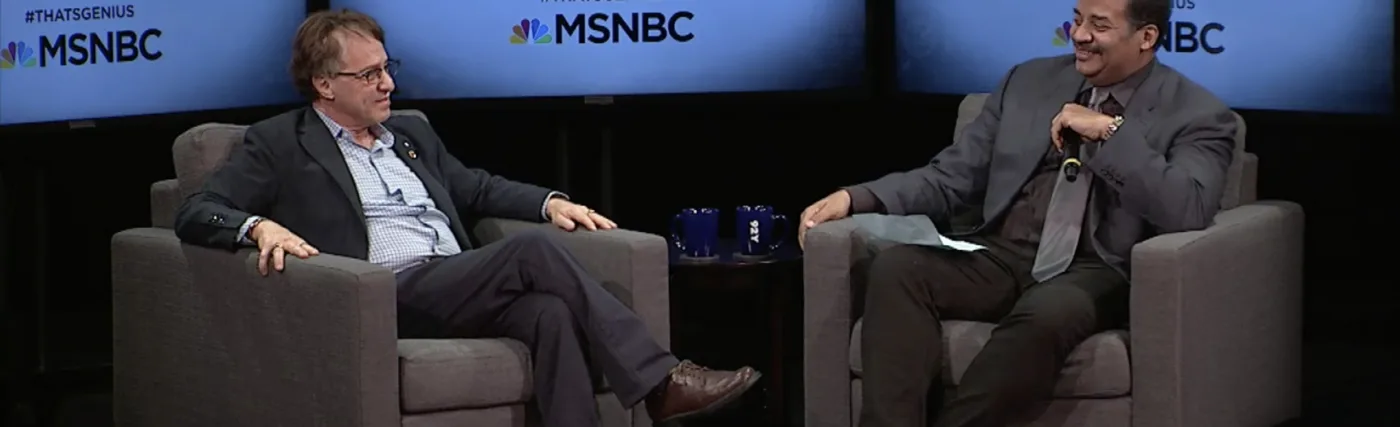
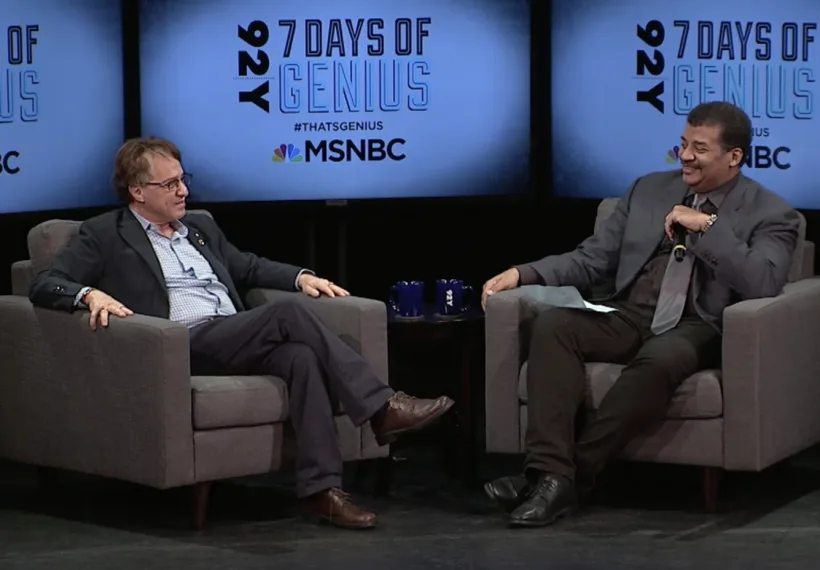
Earlier this year, Neil deGrasse Tyson interviewed noted futurist and inventor, Ray Kurzweil, as part of the 92nd Street Y “7 Days of Genius” series. Now you can listen to that interview without having to travel back in time to the upper east side of New York City. But travel you will, into the future, thanks to a man the Wall Street Journal called a “restless genius.” Discover why Ray predicts that computers will reach the level of human intelligence by 2029, and what that really means. Explore the development of the human neocortex 2 million years ago, with its 300 million modules that enabled humanity to invent language, physics, art and music. And find out why, in the future, we may expand our neocortex again via nano-robots that will connect our brains seamlessly to the cloud, enabling a new leap forward in human intelligence. You’ll learn about the revolutions in biotechnology and nanotechnology that will eventually enable us to live longer, lose weight easier, and fight off pathogens like HIV and diseases like cancer. Neil and Ray also discuss immortality and the strain it would put on the planet’s resources like energy and water, Edward Snowden and concerns about the loss of privacy vs. the desire for security, the benefits of biotechnology vs. concerns about bioterrorism, and fictional depictions of dystopian artificial intelligence run amok.
Transcript
DOWNLOAD SRT
Lenovo is sponsoring Life with Machines, a new video podcast hosted by comedian and tech whiz, Baratunde Thurston, where he discusses all things AI. Lenovo's Smarter AI is your AI. Personalized and easy to scale, Smarter AI delivers outcomes that...
Lenovo is sponsoring Life with Machines, a new video podcast hosted by comedian and tech whiz, Baratunde Thurston, where he discusses all things AI.
Lenovo's Smarter AI is your AI.
Personalized and easy to scale, Smarter AI delivers outcomes that matter most to you and your business.
With full stack AI hardware, software, and service solutions, Lenovo is bringing the transformative power of AI to industries, organizations, and people of all kinds.
Discover how Lenovo and Baratunde are using AI for good to power people forward.
Listen to Life with Machines, now streaming wherever you listen to your podcast.
The holidays bring the world together, and language can help us enhance our connections.
How will you be connecting with others this holiday season?
As the most trusted language learning program for over 30 years, Rosetta Stone immerses you in an enriching experience.
I'm learning and practicing Spanish with Rosetta Stone, so that I can say things at the holiday table and nobody will know what I'm talking about.
Things like, Estas terriblemente equivocado, which means you are horribly mistaken.
Start learning today with Rosetta Stone's Lifetime Membership Holiday Special.
Visit rosettastone.com/startalk for unlimited access to 25 language courses for the rest of your life.
Available for a short time at rosettastone.com/startalk.
With incredible new features and upgrades, there's never been a better time to armour up and play the critically acclaimed action RPG Diablo IV.
Get ready to continue the epic story in your battle against evil in the new expansion Vessel of Hatred.
As darkness spreads through the lands of Sanctuary, it's up to you to fight back the encroaching corruption.
Read the benefits of massive updates to character progression, loot systems, difficulties and tons of added activities.
Face off against new and iconic bosses teeming with the spoils of Sanctuary.
Plus harness formidable powers of the jungle with the all-new Spirit-Born Class, now yours to customise and progress alongside five other iconic classes.
Embark on the epic journey solo or with friends.
You'll quickly understand why Diablo IV has been called one of the best action RPGs of the last decade by PC Gamer.
Forge your own path through hell-torn lands of Sanctuary.
Get Vessel of Hatred, available now in the Diablo IV expansion bundle, rated M for Mature.
Welcome to StarTalk, your place in the universe where science and pop culture collide.
StarTalk begins right now.
Hello, good evening.
I'm Susan Engel, and I have the privilege of being the director of 92nd Street Y Talks.
Tonight's event is part of our third annual Seven Days of Genius Festival, which invites leading thinkers to explore all aspects of genius, how we define it, how it emerges across communities and cultures, why it matters, and what the future of genius looks like.
Neil deGrasse Tyson is an astrophysicist at the American Museum of Natural History and the Frederick P.
Rose Director of the Hayden Planetarium at the Museum of Natural History.
Please join me in welcoming to this stage Dr.
Neil deGrasse Tyson.
Thank you all for coming out.
You come here to watch a conversation I'm about to have with the one and the very much only Ray Kurzweil.
Ray, I've got his bio here, and I'll read his bio, and it's just stunning that he walks among us.
And so that someone such as he is there saving us from ourselves and leading us into the future with a guiding light of wisdom, science, and technology.
So he's one of the world's leading inventors, thinkers, and perhaps most importantly, futurists.
And he's got a 30 year track record of accurate predictions.
We will double verify that this evening.
I want to know what predictions he swept under the rug that we didn't hear about later.
And he's been called a restless genius by the Wall Street Journal.
That's the best kind, by the way.
And the Ultimate Thinking Machine by Forbes Magazine.
And he was selected as one of the top entrepreneurs by Inc Magazine, INC.
There's a separate one for pen lovers called INK.
That's not the one.
Which described him as the rightful heir to Thomas Edison, one of the most famous of the restful geniuses in our history books.
PBS selected him as one of the 16 revolutionaries who made America.
He was the principal inventor of the first CCD flatbed scanner, the first omni-font optical character recognition, the first print-to-speech reading machine for the blind, the first text-to-speech synthesizer, the first music synthesizer capable of recreating a grand piano and other orchestral instruments, and the first commercially marketed large vocabulary speak recognition.
All this is software.
Somebody's got to do it.
He did it.
Somebody's got to do it first.
He did it first.
Among his many honors, he's received the 2015 Technical Grammy Award for Outstanding Achievements in the Field of Music, and he's the recipient of the National Medal of Technology.
This is a medal granted to you in a ceremony at the White House, which is under covered by the press, by the way, because I think somewhere deep down they think it's somehow political.
But I was on one of these committees to tell the president who should get such a medal for the National Medal of Science, and we're just sitting there advising the president on what this is, and the president just basically does what we tell him at that level.
And so it's basically the country's Nobel Prize, if you will, for the country honoring its own citizens for their contributions in science, and in this case, the National Medal of Technology.
And he was inducted into the National Inventors Hall of Fame.
Why wouldn't he be?
I'd be disappointed if this weren't here.
Holds 20 honorary doctorates and honors from three US presidents.
He's written five national best-selling books, including the New York Times bestseller, The Singularity is Near.
I think he was going to start a cult back then, we'll find out.
We'll get to the bottom of that one.
And also How to Create a Mind in 2012.
And he's director of engineering at Google, heading up a team developing machine intelligence and natural language understanding.
Help me give a very warm 92nd Street welcome to Ray Kurzweil.
Oh, very good.
So Ray, all right, here's what I want to know.
Are you some superhero's nemesis that will show up and bring Superman down when he shows up?
Well, I mean, Superman...
See, he's got to think.
He's wondering if that's...
See, he's taking that...
That's a serious question to him.
You're supposed to say, oh, stop joking.
No, you're thinking...
Okay, go on.
I have thought about that because I wrote a novel with a superheroine, but she doesn't melt steel with her eyes.
She melts problems with her intellect.
And so I think actually intelligence is the most powerful force in the universe.
Ooh, good answer.
Even stronger than gravity, say.
Okay, all right.
But this is physics versus computer science.
Well, good.
So one of the things that have been on everyone's mind, especially lately, there have been movies on this, and there's always been some attempt to portray it, but seems to be more so lately.
And that's the buzz about artificial intelligence.
There seems to be fear factors coupled with euphoria about what role that could play in our lives.
And so, do you have any insight into why it's become all the buzz?
Well, I've been following this for 50 years.
In the 60s, some scientists at Carnegie Mellon said that within 10 years, computers will be able to do anything that a man can do.
Maybe that was a positive, intended to be a positive comment on what women could do, but it did lend embarrassment to the field, and we entered what was called the AI winter, where people were very pessimistic, and those of us in the AI field were sort of embarrassed, that, oh, this will never work.
Now people suddenly are saying, oh my God, it's going to work.
So everything they thought would have happened in 10 years back in the 1960s, we are saying now is going to happen in 10 years.
Well, I'm saying actually, computers will reach human intelligence by 2029.
I've been saying that consistently, so that's a little more than 10 years, but not that much more.
So just a few years ago, the accusation was, well, A, I can't even tell the difference between a dog and a cat.
Now can do that in 10,000 other categories, and you can give this Google program a picture, and it'll say, oh, that's a cat and a dog playing with a ball of yarn on a TV set, and it can accurately describe pictures.
It can actually create things that are funny, it can paint a picture in the style of Angola.
Why does anyone fear this?
This sounds quite primitive.
To what, compared with what scares people.
But they've been watching too many AI dystopian futurist movies, where it's usually the AI versus the humans for control of the world, or two groups of humans for control of the AI.
We don't have one or two A.I.s in the world.
We have one or two billion A.I.s.
You know, each of these things we carry around with us is an AI.
We can access all of human knowledge with a few keystrokes.
And that, I think, will keep it safe because it's very deeply integrated with humanity.
But that's not how it's been portrayed in these dystopian movies.
Well, of course, in as early as, was it 1985, the film Terminator, the net, you know, achieves consciousness and then takes on its own identity.
So to say there's a billion A.I.s and we all share it on our pocket, once the cloud was introduced, this smacks of a centralization of all of our knowledge and all of our decision making.
But it's actually not centralized, is it?
I mean, we each have our own cloud, we have our own information.
So they want us to believe.
Well, interestingly, you know, A.I.s...
You're telling me we're all walking around with our own cloud over our head.
That's what you're telling me.
Well, yeah.
I mean, we're already expanded in the cloud.
We're going to do that quite literally in the 2030s.
We'll have nanorobots that go inside our brain and connect our neocortex to the cloud.
So just the way that this can multiply itself a million fold...
This is actually a billion times more powerful than the computer I used when I was a student at MIT per dollar.
But it can multiply itself thousands of millions fold in the cloud whenever it needs to.
So we can't yet do that with our brains.
If you remember, two million years ago, we got these big foreheads.
I remember, yeah.
And we...
so we got additional...
The frontal lobe became developed.
Making human birth catastrophic for the woman.
Right, but there was a benefit to it also.
You ever see cats being born?
They just pop right out.
Because cats have these little heads, nothing complicated in the birth canal.
But it was worth it.
We got these Mondo craniums.
But it was worth it because we got this additional neocortex.
Says the man, it was worth it, right?
Okay.
Well, women got the additional neocortex also.
Okay.
And what we did with that is we put it at...
The neocortex, which is where we do our thinking, is organized in a hierarchy.
We put that additional neocortex at the top of the hierarchy.
And as you go up the hierarchy, we get more intelligent.
Things get more abstract.
So at the top of the hierarchy, we say, oh, that's funny, that's ironic, she's pretty.
The bottom of the hierarchy, I can tell that the edge of this stage is straight.
Very simple things.
But at the top, we can do humor and music.
And in fact, that additional neocortex was the enabling factor for us to invent language and art and science and physics and StarTalk programs.
And no other species does any of those things.
We're going to add to our neocortex again.
Two million years ago, that was a one-shot deal.
You know, no other primate has this big forehead.
They have slanted brows.
But it was, you know, it didn't continue to expand.
Otherwise, it really would have been a problem with birth.
But, so we're going to...
In fact, it's been suggested that that was the limiting factor to how much more intelligent we would ever get.
Because once you start killing 100% of your mothers, that's the end of the species, right there.
Right, so there's a trade-off between how many mothers die and how many children are born.
Until we go to a whole new paradigm, which is basically to connect wirelessly our neocortex to the cloud.
Just, and that's not...
Or just birth everyone with a C-section.
Then they can have huge heads coming out in the future.
Yeah, but still, how big could it be?
I mean, it would be very hard to carry them around.
The heads would just be...
You know, this multiplies itself a million fold, but if it were physically a million times heavier, you know, we couldn't carry it around.
Good point.
We will connect wirelessly our neocortex to the cloud.
This is with nanobots that enter your neocortex.
Right.
So, we have 300 million modules in our neocortex, each of which can recognize a pattern that are organized in this hierarchy.
We create that hierarchy with our own thinking, but it's 300 million.
So, is that a big number or a little?
Well, it was big enough for us to invent language and physics, but it's also limited when you realize how long it takes to read a book or learn a language.
We will be able to expand that, and that expansion will not be a one-shot deal.
It will be connected to the cloud.
The cloud is pure information technology.
One of my themes is that information technology grows exponentially.
It roughly doubles in power every year.
That's what the cloud is doing.
The cloud is twice as powerful every year, and when we can connect and expand our neocortex in the cloud, it will expand without limit.
And so we'll be funnier, and we'll be sexier, and...
So, just to clarify what I think you just said, that in 20 years, plus or minus, so the mid 2030s, we will have nanobots that we can feed into our brain that directly connect to the cloud, rather than through anything we carry in our pocket.
And in that way, wirelessly, we can basically download entire books, entire languages, and we will then know these things just by the act of downloading them.
Well, that's one implication.
Into our brains.
But we'll have more neocortex, so we won't be limited to a mere 300 million pattern modules.
We'll have billions or 10 billion.
Biologically or just simply because we have these nanobots?
We'll have this extension that's non-biological.
Non-biological, right.
I mean, this would be pretty useless if it didn't have an extension.
I mean, when you access all of Google...
Yes, it would just be a gaming device otherwise.
You can access all of knowledge and...
I got that.
So isn't this like the scene in The Matrix where they sit in the chair and they upload...
One of my favorite lines of the film is Keanu Reeves.
They teach him martial arts and he says, I know kung fu.
And you mean I'm going to know...
Or jujitsu, whatever.
So in 20 seconds, he's now an expert.
Are you telling me that's what's going to happen?
The non-biological portion of our thinking will be able to download skills, right?
Wow.
All right.
So this is intellectual psychological dimension that you're describing.
But another fear that people have of AI is that it might take over all of our jobs that previously used our intellect.
That kind of happened 200 years ago and 100 years ago when machines took over human physical labor and people thought that'd be the end of all employment.
But of course, that wasn't the case.
It was a naïve fear.
It's happened many times.
I mean, if I were a fresh and futurist in 1900, I'd say, okay, a third of you work on farms and a third of you work in factories.
But I predict in 100 years, by the year 2000, it'll be 3% and 3%.
That is what happened.
Today, it's 2% and 2%.
And everyone would go, oh my God.
So you were way off.
So, all right, but the fear factor is, what jobs do the rest of that 60%?
So what happened?
65% of jobs today in the United States are information jobs.
It didn't exist 25 years ago, let alone 100 years ago.
So in 20 years, what's the profile of the workforce?
We're gonna be smarter, as I said, because we're gonna enhance our intelligence.
As we already have, even though this isn't connected in my brain, it may as well be, and it does make us smarter.
Just a quick insert there.
Because it's not physically connected, but it's at your fingertips, isn't that good enough?
I would kind of rather carry this around than let someone inject nanobots into my frontal lobe.
Well, speak for yourself.
No, I'm just saying, how quickly do you want to access the data?
Although I am nervous that you've not grabbed my phone.
I can wait 20 seconds for this.
I'm cool with that.
No, I mean, your fingers are very slow, right?
I mean, it'll be much faster to do that.
Okay, so tell me, what is the...
And it's not so futuristic.
I mean, Parkinson's patients already have actually many computers connected into their brain.
There are places, the part of their brain that was destroyed by that disease, that actually communicates wirelessly.
They can download new software to the computers connected in the brain from outside the patient.
That's today.
They're not blood cell size yet.
They're actually the size of a tiny pea.
They can be inserted with minimally invasive surgery.
Once they're the size of blood cells, we can just swallow them.
But...
Swallow the nanobots.
Right.
But miniaturization is another exponential trend.
We're shrinking technology at a rate of 103 volume per decade.
So these computers will be the size of blood cells in the 2030s.
Now isn't there...
I've got to get geeky on you now.
Isn't there a limit if we're communicating via microwaves, basically, which is the communication technology here.
A microwave wavelength is sort of a millimeter up to a few centimeters.
And the receiving device has to be at least as large as the wavelength in order to receive it and extract information from it.
If you have something the size of a cell that is much, much smaller than a millimeter.
Okay, you're bringing up an engineering issue.
They're not all going to communicate outside the body.
They're going to be on a local area network, sending information to each other.
So now your body has a local area network inside of it.
A very local area network.
Yeah, exactly.
And that's already exists.
We have, there are computerized technologies being put in the body where there are local area networks inside the body.
So you're basically creating your own neural net, basically, within you.
So you already thought this through.
Okay, forgive me.
I thought I could stomp on that one, but apparently not.
Experiences make life more meaningful.
And with mastercardspriceless.com, you can immerse yourself in unforgettable experiences in dining, sports, art, entertainment and more in over 40 destinations.
From a round of golf with a legendary player to a cooking class with a celebrity chef, you can fuel your passions and create lasting memories.
Explore experiences today at priceless.com exclusively for MasterCard card holders.
Terms and conditions apply.
Lenovo is sponsoring Life with Machines, a new video podcast hosted by comedian and tech whiz Baratunde Thurston, where he discusses all things AI.
Lenovo's smarter AI is your AI.
Personalized and easy to scale, smarter AI delivers outcomes that matter most to you and your business.
With full stack AI hardware, software and service solutions, Lenovo is bringing the transformative power of AI to industries, organizations and people of all kinds.
Discover how Lenovo and Baratunde are using AI for good to power people forward.
Listen to Life with Machines.
Now streaming wherever you listen to your podcast.
If you're ready to elevate your driving experience, the first ever Kia K4 is worth a closer look.
It combines style and performance with a sleek futuristic design featuring StarMap LED headlights and an available panoramic display for unforgettable looks.
SiriusXM comes standard in every Kia K4 bringing you closer to what you love.
Plus with an available 190 horsepower turbocharged engine, the Kia K4 delivers everything driving enthusiasts crave.
Learn more at kia.com/k4.
So, tell me again, what is the distribution of jobs in 20 years?
What percent of people are doing what?
Up and down the line?
Well, if you were to describe the jobs that exist today, creating websites and mobile apps and chip designs and computers, and if you described that to people a century ago, they wouldn't know what you're talking about.
So, we're gonna have new types of jobs, creating new types of knowledge that don't exist yet.
And that's been the trend.
Oh, Ray, that's a cop-out.
No, no, I'm not going to accept that.
You can't tell me that with some confidence that in 20 years, there will be nanobots running around our frontal lobe, yet you don't know what the job market will be.
Well, we'll be...
If you're predicting the future, don't tell me now, I have no idea what jobs we're gonna have, but you'll have nanobots in your brain?
That's no!
Give me...
put something on the table.
So that in 20 years, we'll put your ass back on the stage and find out whether it happened.
Well, we'll be doing...
Excuse my language there, I'm just......radio podcasts with comedians.
You know, well, it won't just be one or two of us that can do that, but we'll all be able to do that.
We'll be funnier, we'll be creating more profound music, literature, science, technology.
I mean, look at how many fields are of science and technology.
There's thousands of them.
They didn't even exist 20 years ago, let alone 100.
100 years ago, there was physics and chemistry, and that's why the Nobel Prize is physics, chemistry, biology.
I mean, most of the fields didn't exist then, and now we have thousands of these fields.
We're going to continue this exponential explosion of knowledge, and we're going to continue going up Maslow's Hierarchy, where we don't have to do...
You know, people are very eager to retire because they basically don't like their work.
The goal of life is, I think, actually to love what you do.
I like to say I retired when I was five because I decided I would do what I wanted, and I think that is really the goal, to be able to have a passion for what...
How old were you when you wrote your first computer program?
Well, 12, but there were only 12 computers in all of New York City.
At the time.
So why did they...
What crazy, stupid person allowed a 12-year-old to touch one of the 12 computers of New York City?
So can we distinguish, just to get our lexicon on the same page, when I think of biotech, I don't think of nanobots.
I think of just the future of possibly manipulating the genome, this sort of thing.
So where are you with regard to advances we might make in our biological form versus the connection between technology and our biological form?
Right, so there are three overlapping revolutions.
They all have to do with information, biotechnology, nanotechnology, and artificial intelligence.
And they're in that order.
So biotechnology is here now.
And it basically consists of the observation that we are software.
Our biology is software.
It's made up of genes.
They are actual sequences of data.
They evolved a long time ago when conditions were very different.
For example, one of our little, 23,000 little software programs is called the fat insulin receptor gene, says basically hold on to every calorie because the next hunting season may not work out so well.
And that was a good idea a thousand years ago.
You worked all day to get a few calories and there were no refrigerators, so you stored them in the fat cells of your body.
I would like to tell my fat insulin receptor gene, you don't need to do that any more.
I'm confident the next hunting season will be good.
Like three hours from now when you served your next meal.
At the supermarket.
Yeah.
So, that's actually...
Yeah, the supermarket is like food is spilling off the shelves of...
So, that was done.
We have means now of turning off genes, so they turned off this gene in animals and these animals ate ravenously and remained slim and they lived 20% longer and they got the benefits of caloric restriction while doing the opposite and the Jaws and Diabetes Center is working with a drug company to bring that to the human market.
That's just 23...
That's one of the 23,000 genes we'd like to tinker with.
But biology is very limited in capability.
It can only last so long and wears out and so ultimately we can go beyond the limitations of biology.
So there's these overlapping revolutions.
The ultimate health revolution with nanobots is basically a little programmable nanobot that's just like the T cells in your body.
It can go after pathogens but it's not limited by the limitations of our immune system.
Our immune system evolved...
So we just do better than what you're born with basically.
Right.
For example, our immune system doesn't go after cancer.
It says, oh, that's me and it doesn't consider it an enemy.
It doesn't work on retrovirus like HIV.
It is stupid.
I mean, life expectancy was 19,000 years ago.
It was not in the interest of biology for people to live very long because it was very limited food.
And now there's some value for older folks like you and me to share our experience and accumulated knowledge.
So we'd like to live longer and go beyond these natural limits.
So just perfecting biology is not ultimately as good as going beyond the limitations.
And the pure technology will enable that and empower that.
Right, so that's another application of these nanobots.
You wrote a book in 1999 called The Age of Spiritual Machines.
Everybody's got their own private definition of how they use the word spiritual.
And it's the latest thing when you want to say you're religious, you say, but I'm spiritual.
So how are you using that word in the title of that book?
Well, what is the ultimate spiritual value?
It's consciousness.
We feel that a conscious entity is sacred, like a person or like an animal that has feelings.
But not everybody actually agrees on which animals or if animals are conscious.
Anyone who owns a dog or a cat is certain they have consciousness.
Well, that underlies the debate about animal rights.
I mean, I feel my cat is conscious.
Not everybody agrees with that.
Those people probably haven't met my cat.
But...
Did you create this cat?
Well, my cat is robotic, actually, as it turns out.
But we will have that debate about machines.
Now, we don't worry today about causing pain and suffering to our computer software.
We're more concerned about the pain and suffering it causes us.
But that is actually...
When I talk about computers reaching human levels of intelligence, I'm not talking about logical intelligence.
If you say, oh, well, emotions, virtuality, consciousness, those are all sideshows.
The essence of intelligence is ability to think logically.
Well, then computers are already smarter than we are.
It is being funny and expressing a loving sentiment where humans have an edge today.
That is the cutting edge of human intelligence.
But that's where I think computers will match human intelligence by 2020.
So, let me ask, just to get a little philosophical on you.
As a scientist, and I grew up basically in the geekosphere, and I'm curious, when we think of who is smart in the class, it's who knows the most, who can solve a problem the most.
It's not the person who is most emotional.
Generally, we don't use the word smart for that person.
Yet, you are grouping that feature of what it is to be human as something that computers have yet, a place where computers have yet to tread, and when they do, they'll then be truly smarter than us.
But if your emotions, for example, interfere with your ability to make the correct decision given the outcome you seek, how can we possibly call that intelligence?
Well, I mean, you go around with a comedian for some of your presentations, recognizing that humor is, in fact, a high form of intelligence.
It takes a lot of intelligence to think of.
What he's referring to is that the StarTalk Radio show, my co-host is always a professional stand-up comedian bringing a level of levity to the conversation.
And insight, I mean, humor is a high form of intelligence, and creating poetic language is a form of intelligence.
Expressing a loving sentiment, music, either recreating it or creating in the first place, these are really the highest forms of intelligence.
Computers are beginning to encroach on that.
So what you're saying, not to put words in your mouth, but that's exactly what I'm going to do.
What you're saying is right now the computer can wipe our floor in a game of chess that we invented.
The computer can beat us at Jeopardy, a game that we invented and it's based basically on pop culture.
So the computer can beat us at all of these things.
It still can't beat us in our capacity to write a brilliant novel or to compose a beautiful poem or to paint a transcendent work of art.
Exactly, although Jeopardy is a step in that direction.
I gotcha, so what I'm asking you is, are you saying the day will come where the computer will write the Nobel Prize-winning novel and the poem that generations will study thereafter and supplant even that aspect of what it is to be human?
Right, but I put it differently in that we're going to combine with our intelligence.
We're going to become a merger of biological and non-biological intelligence.
We are already...
So, there will still be humans who do this.
It's enhanced.
We create these tools to extend our reach.
This allows us to remember all of human knowledge.
We can build great structures like this building here, which we couldn't do with our bare muscles.
So we extend our reach, and we're going to do that intellectually.
And we're doing that already, but it's going to become more profound.
So you're ready to erase the difference between a machine that has this power and a human that has been enhanced by that which ever gave the machine power in the first place.
But I mean, you know, what is a human, but it's a collection of physical stuff which follows the laws of physics.
It's not, you know, a mystical property.
We can study a neuron, and it is a machine.
So we are perhaps the most complex machine that we know about in the universe.
So then the individuality will go away, because we will all have exactly the same access.
On the contrary, we will become more different.
We are actually more the same now.
We all have the same architecture, 300 million neocortical modules.
Yeah, but we both eat the same set of nanobots, and it goes to our frontal lobe.
So aren't we still the same now with nanobots running around our head?
No, we can become more different, because right now we have the same architecture brain.
Now we may fill it with different thoughts, and Marvin Minsky, who died recently, was my mentor, and he wrote a book called The Society of Mind, basically describing our neocortex as a society of different factions that fight each other.
So some of those societies are more effective, because they're harmonious and working together, and some of our societies of mind are at war with each other, and therefore we're ineffective.
But we have basically the same architecture.
So what you're saying is, with this new architecture, there are more places to go emotionally and intellectually.
Exactly.
So that if I have leanings, whatever is causing that, towards poetry rather than physics, I can then be a great poet, enhanced by all of the nanobots that allow it.
You can profoundly study and master poetry or music in a deeper way than we can today, because we'll have more brain power to apply to it.
And we'll become more different.
I got a question for you.
All right, as an astrophysicist, we think about aliens a lot.
I'm not authorized to divulge any more about that than that.
And what I think about often is, how much on earth, in human civilization, we invest in ways that titillate, or stimulate, or serve our five senses.
So, there's a sense of taste.
So, there's fine dining, and wine, and restaurants.
And there's a sense of touch.
So, we pay good money for a massage.
There's a sense of sight.
So, we like looking at art.
And there's a sense of hearing.
So, we make music.
An alien might have 12 senses instead of five.
And so, you visit their society, they might have whole tracks of their economy in the service of titillating their other senses that are completely oblivious to us.
Can you imagine a future where we actually give ourselves more senses that we might when they get addicted to them being served?
So, you ask what kind of work we'll do.
We'll be creating art and experiences and virtual environments for these additional senses or enhanced senses.
In a sense, we're already doing that, but not the kind of virtual reality environments and experiences that are now emerging.
It would be even hard to describe a couple of decades ago.
So, yes, I think we can...
All this sensory information, you know, as a physicist, a lot of it we don't capture.
Most of it just goes right by.
So, we could capture that and create enhancements, like culinary and musical and artistic experiences with these enhanced senses.
So, that's another way in which we can create a kind of work that we can't even describe today.
If you're ready to elevate your driving experience, the first ever Kia K4 is worth a closer look.
It combines style and performance with a sleek, futuristic design featuring StarMap LED headlights and an available panoramic display for unforgettable looks.
SiriusXM comes standard in every Kia K4, bringing you closer to what you love.
Plus, with an available 190-horsepower turbocharged engine, the Kia K4 delivers everything driving enthusiasts crave.
Learn more at kia.com/k4.
When it comes to hiring, the best way to search for a candidate isn't to search at all.
With Indeed, don't search, match.
Indeed is your matching and hiring platform with over 350 million global monthly visitors, according to Indeed data, and a matching engine that helps you find quality candidates fast.
If you need to hire, you need Indeed.
You can even use Indeed for scheduling, screening and messaging to connect with candidates faster.
93% of employers agree that Indeed delivers the highest quality matches compared to other job sites, according to a recent Indeed survey.
And since Indeed's matching engine is constantly learning from your preferences, the more you use Indeed, the better it gets.
Join over 3.5 million businesses worldwide that use Indeed to hire great talent fast.
Plus, listeners get a $75 sponsored job credit to get your jobs more visibility at indeed.com/sxm.
Just go to indeed.com/sxm right now and support our show by saying you heard about Indeed on this podcast, Terms and Conditions Apply.
Need to hire?
You need Indeed.
Now, there's another topic that makes the news every now and then, and it's the possibility that we might be on the brink of a medical advance that would have humans live forever.
So is that a good thing?
Yes.
You're going to need another planet, because if people don't die, I did the math on this, okay?
And at the rate that we are now growing our population in the same number of years in our future as has elapsed since Columbus, we will have a population so large on Earth that everyone will have to stand up straight in order to fit in the available landmass.
Well, that's...
You need another planet.
That's with people dying, by the way.
That's with regular people dying at age 80, 85.
Now you want people to live forever?
Well, I dispute that math, but before we get to that, let's talk about how we will actually achieve...
It's a 2% growth with a doubling time of 37 years.
I mean, right now, if you take a train across America or any part of the world, 99% of the land is not used.
And you could actually build the luxury housing for everybody in the world and fit them in a small part of Texas.
So we actually have plenty of land mass.
And we have plenty of resources.
For example, energy.
Oh, we're running peak oil, running out of energy.
We have 10,000 times...
Just to be clear, peak oil is almost jargon, actually.
And it refers to the point in time, whether or not, I don't think we've hit it yet, where thereafter, we will only be drawing less oil out of the ground than what had been drawn previously, which means the oil economy must shrink thereafter.
And so, it's been all the talk in economic circles.
Go on.
Yeah, I mean, even with an oil, shale oil, we have like 5,000 times more oil than we need to meet all of our energy needs.
But we have 10,000 times more energy than we need coming from the sun for free.
And solar energy is growing exponentially.
That's one of my themes.
It's doubling every two years.
Our technology that enables us to harness solar energy.
It's doubling every two years.
And there's only six doublings now from 100%.
So within 12 years, we could meet all of our energy needs, ultimately at very low cost.
And at that point, we'll be using one part in 10,000 of the sunlight.
So we have 10,000 times more energy than we need inside the earth with geothermal tides and wind.
And I mean, we're a wash in energy.
We're also a wash in water.
It's just most of it can't be used because it's salinated or polluted.
But if we have clean energy, we know how to clean up water.
That's actually a joke.
We're a wash in water.
Yeah, just kind of if you caught that.
All right, so you're not worried that earth can support quadrillion people.
You're not worried about this.
You're not worried.
Not about that issue, no.
So what are you worried about?
So if I were to ask, what is Ray's worry list?
Give me your top three or four things.
Well, I mean, there's been a lot of concern now about the downsides of these technologies.
What, such as?
Such as AI run amok, a la the kinds of future dystopian movies that we've seen, like Terminator.
So Elon Musk and Stephen Hawking have been sounding the alarm that, oh my god, AI is really going to work and maybe it's going to be dangerous.
So I mean, I wrote about this going back to The Age of Spiritual Machines in 1999, and that led Bill Joy, who was then the chief technology officer of Digital Coop Incorporation.
At that time, he was a leading technologist and he wrote a cover story in Wired magazine, Why the Future Doesn't Need Us, about the grave dangers of GNR, genetics, nanotechnology, robotics, which was artificial intelligence.
And basically described these downsides, which I described in my book.
So technology has been a double-edged sword ever since.
The sword.
Yeah.
And fire, I mean, which kept us warm and cooked our food, but burned down our houses.
And these new technologies are very powerful and they can be used for good or ill.
So I do take comfort from the experience we've had with one of these technologies, which is already working, which is biotechnology.
So the same technology which we can use to reprogram ourselves away from disease and away from cancer could also be used by a bioterrorist to reprogram a benign virus, like a cold or flu virus, to be deadly communicable and stealthy and create...
Basically weaponize a virus, essentially.
So that was recognized more than 25 years ago, and they held a conference called the Asilomar Conference and came up with a set of guidelines to keep biotechnology safe.
It's called the Asilomar Guidelines, and they've been reinvented every few years as the technology gets more sophisticated.
This is our attempt to have a morality to keep track with the...
Ethical standards, and this is actually work.
We're now getting benefits.
You can now, for example, fix a broken heart.
Not yet from romance, that'll take some more advances in virtual reality, but from a heart attack...
I won't even take that another step.
We'll let that one go.
Half of all heart attack survivors have a damaged heart.
My father had that in the 60s.
We didn't know anything about stem cells then, but I've talked to people who could hardly walk after a heart attack, and now they've been rejuvenated by reprogramming adult stem cells.
So we're getting...
I could go on.
We could talk for hours about the benefits, and there have been no...
The number of negative incidents have been zero.
That doesn't mean we can cross it off our worry list.
Okay, we took care of that one, because the technology gets more sophisticated, and there are new dangers emerging all the time.
But it's a good model for how we can keep these technologies safe.
That's number one, is you have a second concern.
Well, that's...
There are existential risks, like biotech run-em-up.
There are subtle risks, like losing privacy, for example, is very much on people's minds.
And as a computer guy, fundamentally, in spite of that you have these inventions and patents, you're a computer guy in your soul of souls.
Does the lack of privacy concern you?
I'm actually not...
By the way, and I say that, the obvious answer should be yes.
However, anyone younger than 25 puts everything they ever could possibly know about them on their Facebook page.
So, they have no commensurate concept of privacy relative to the Cold War generation where there were spies and you had to keep secrets.
I'm actually less concerned about that.
I think we're doing a pretty good job on privacy.
I mean, how often do you hear about major breaches with Apple's email or Google's email?
I mean, these companies know how to keep this information secure.
So, tell me about the Apple vs.
FBI.
There's many layers to that dispute.
Now, the FBI could crack that phone easily.
I mean, it's very simple to do.
There's some code in there which detects...
Wait, wait.
Ray Kurzweil saying something is simple is not the same thing as the FBI saying something is simple.
Well, they can absolutely crack that phone.
Wait, wait.
If someone was good enough to crack the phone, they wouldn't be working for the FBI.
They'd be working for Apple, getting five times the salary, wouldn't they?
Well, there's software in the phone that detects if you're trying different combinations of passwords, of pass numbers, and if it detects that, it then stops you and actually erases the information.
Self-destructs.
Right.
Without the mission impossible, smoke coming out of it.
So you could take the software, which is an object code, and disassemble it, and a competent programmer could find where that code is and bypass it.
And the FBI can do that.
So they would bypass the code, and therefore, they'd be able to run through the 10,000 possible codes.
So why is it that they're pressing this case?
Both Apple and the government are really concerned about the precedent.
The FBI wants a precedent set, so they can come with other requests in the future, and Apple doesn't want the precedent set.
So this one phone is really a federal case, more because it's a precedent than because they need phone numbers.
Because of the underlying issue.
Now, it's not an easy issue.
Suppose there was a phone that had information that could lead you to stop a terrorist attack using WMD.
I mean, most people would support, oh, we got to get that information and stop this kind of attack.
I mean, there could be attacks that make San Bernardino and Paris seem trivial, so.
I got to interject a story.
Now, 20 years ago, we were exploring what technologies we might use for the new planetarium that we were building, what became the Rose Center for Earth and Space.
And one of our trips was to East Germany.
Now, this is seven years after the wall came down, but I still call it East Germany because it was very different from West Germany.
People's clothing was not very colorful.
People hardly smiled.
The culture, the mood was completely different from anything we had grown up and experienced in the West.
And I finally had a long conversation with someone that I just never had a...
You know, I grew up in the West, in the Bronx, right?
And I had a conversation, and I said, what was going on behind these walls?
Oh, our government told us that all of these protections were necessary to keep us safe.
We need the wall.
We have to prevent you from watching these TV shows.
We have to prevent you from traveling to these places or reading these newspapers.
And so when I heard that, I said, wow, so you can basically subjugate an entire population on the grounds that you are doing something in their best interest.
So for you to say that surely you would want to break a code of privacy if it could prevent a weapon of master destruction, that makes a good headline, but the total picture that that paint scares me.
Well, I think...
Okay, that's the other 40% on that side, right?
Yeah.
I think we have a basic conflict between privacy and security, but I think privacy is gonna win.
There are now encryption codes that are unbreakable, and regardless of what companies like Apple do, people are gonna use a layer of encryption that cannot be broken, and that already exists, and it's already being used.
So, ultimately, privacy is actually gonna win, which is good from that perspective.
We'll have to find other ways to stop criminals and terrorists, and I'll, you know, I don't work for the intelligence agencies, so I'll leave it to them to...
So, is Ed Snowden a hero of yours or a traitor or a treasonist?
What is he to you?
We learned a lot that I think the American people needed to know from his revelations.
So in that regard, it was a good thing.
The authorities claim that he compromised information which put people's lives at risk.
I have no way of evaluating that, but we do know a lot of things that the government is doing that we didn't know before, and I think that's a positive thing.
It's pretty amazing that this low-level contractor had access to so much information, isn't it?
He was really smart.
In fact, we interviewed him for StarTalk.
He sent a bot, a motorized bot, not a nanobot.
It didn't get in my head.
And came in and I said, how do I know you're really controlling it?
He said, you want to see me turn left?
And then he like turned left and then turned right.
But he wouldn't tell me where he was hiding.
But we have the whole, it's all on StarTalk.
It's been posted.
So these are other challenges.
I worry that if nanobots are coursing through my brain, that someone one day might be able to control that.
I kind of would rather stay biological as I...
Well, your thoughts are already in your emails and your texts and you worry about that being...
Yeah, because I did that on purpose.
I'm cool with stuff I do on purpose.
It's when someone has access because my frontal lobe nanobots are connected somewhere in some cloud.
I don't know who's coming back into my head.
We do express ourselves pretty intimately in all of our communications and all that's electronic.
And I travel around the world, I don't talk to very many people at all who say, oh, my life was ruined because my privacy was infringed on.
So I think we're doing a pretty good job on privacy.
And it's just a technical reality that the technology of privacy, which is encryption, is outpacing decryption.
So if you're on the side of privacy, I think...
I like that phrase, encryption is outpacing decryption.
That's really good.
That gives me hope.
More hope than I had when you first sat down.
Well, actually, it has to do with physics, because the big worry was quantum computers would break any possible encryption code.
And so that would be the end of privacy.
I was always dubious that quantum computers would ever work, and they don't work, and I don't think they will.
So privacy, I think, is alive and well.
So let me just ask, just because I love pop culture and I love going to movies, is there a film that, in your judgment, most accurately portrays the future of AI?
Well, I thought a pretty good movie was her, because there wasn't one AI out there.
Like, everybody had their operating system.
So Theodore had Samantha, and his human love interests also had her operating system that she fell in love with.
And they were your administrative assistants, but also it was Theodore's therapist and Theodore's lover, and it expanded Theodore's capabilities and experiences.
So I think something like that will take place.
I thought it didn't make sense that Samantha didn't have a body.
You know, it will be easier to provide a human level body in virtual and augmented reality.
That would open up a whole other industry.
Well, that's always the case with all of these communication technologies.
You know, the first book printed was a Bible, but then came a whole century of more prurient titles.
OK, so ladies and gentlemen, join me in thanking Ray Kurzweil.
If you're ready to elevate your driving experience, the first ever Kia K4 is worth a closer look.
It combines style and performance with a sleek futuristic design featuring StarMap LED headlights and an available panoramic display for unforgettable looks.
SiriusXM comes standard in every Kia K4, bringing you closer to what you love.
Plus, with an available 190 horsepower turbocharged engine, the Kia K4 delivers everything driving enthusiasts crave.
Learn more at kia.com/k4.
See the full transcript



 Unlock with Patreon
 Become a Patron