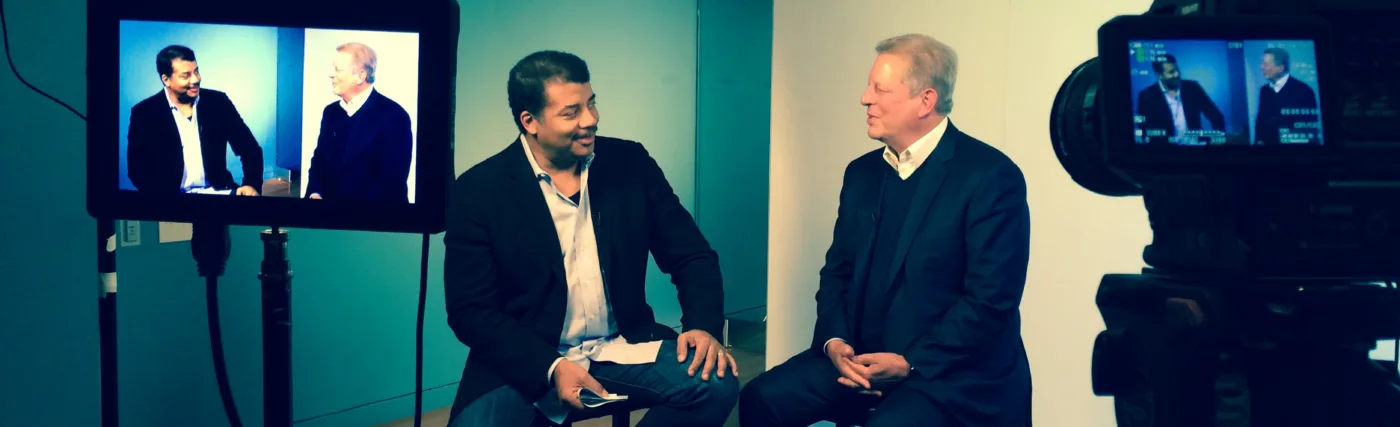
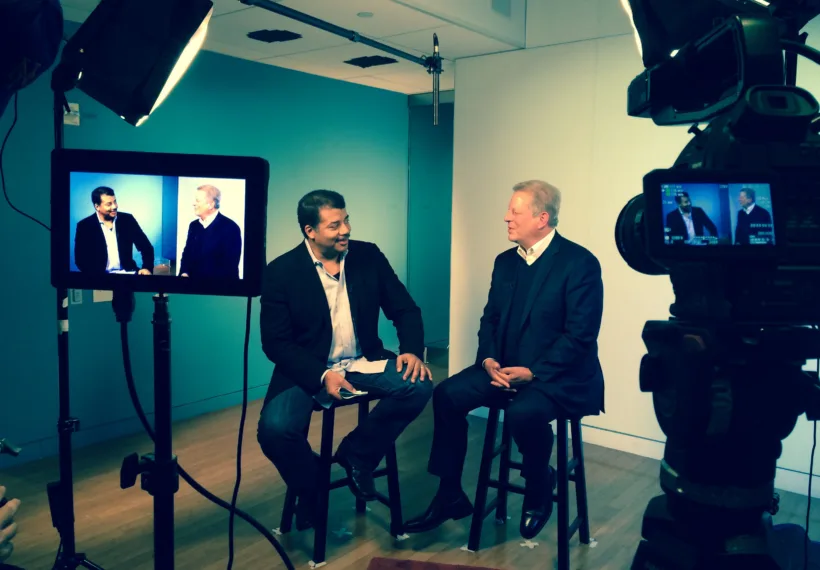
Few subjects are as politicized as climate change. But, as host Neil Tyson says, it’s dangerous when people “see the politics more than the facts.” Together with former Vice President Al Gore, Neil looks past the politics to examine climate change, clean energy and the future of Earth. He’s got help in studio from the New York Times Dot Earth blogger Andrew Revkin and co-host Maeve Higgins. You’ll hear how a college course Al Gore took with Dr. Roger Revelle, one of the first scientists to study global warming, led to his involvement in climate science. Find out how Gore’s 1998 proposal to create an Earth-monitoring satellite stationed at Lagrange Point 1 resulted in DSCOVR, which allows us to calculate Earth’s energy balance for the first time. Learn which change in behavior will have the most impact on atmospheric CO2 and how solar, wind and hydroelectric power is already cheaper than fossil fuels in many places. Explore the obstacles to adoption of alternate fuels, and why small villages in under-developed countries may have an easier time switching to solar than countries like Germany and the U.S. Neil and Vice President Gore address the potential for nearly limitless solar power and how it can help the world’s growing water shortage. Plus, the two discuss the ethics of emerging technologies, and the former Vice President tells Neil why he’s excited about Spider Goats.
Transcript
DOWNLOAD SRT
Welcome to StarTalk, your place in the universe where science and pop culture collide. StarTalk begins right now. This is StarTalk, and I'm your host, Neil deGrasse Tyson, your personal astrophysicist, and I'm also director of the Hayden Planetarium at...
Welcome to StarTalk, your place in the universe where science and pop culture collide.
StarTalk begins right now.
This is StarTalk, and I'm your host, Neil deGrasse Tyson, your personal astrophysicist, and I'm also director of the Hayden Planetarium at the American Museum of Natural History right here in New York City.
And my cohost today is Maeve Higgins.
Maeve, welcome back.
Thank you for having me.
Oh my gosh, and today we're featuring my interview with Vice President Al Gore.
And we'll be talking about, of course, climate change.
What else?
That's all that comes out of the man's mouth, and of course, the future of the Earth.
And I'm not gonna do that alone.
I know a little bit, but not enough to carry this.
So we go into our reservoir, to our portfolio of experts.
And so we've got Andrew Revkin, who previously served as an expert on StarTalk for my interview with the head of the EPA.
And that was Gina McCarthy.
Yes, thank you.
I guess that was like your audition and then you made it.
You made it to the radio show.
So you're a senior fellow for environmental understanding at Pace University.
That sounds like you made up that title and have...
Indeed.
Yes.
Senior, not junior fellow, senior fellow.
No, they came up with that part.
Of environmental...
It was like, should I be in communication, blah, blah, blah?
Okay, well, I'm glad you got to declare your own title.
And you founded the New York Times blog, what does it go,.
earth?.earth..earth, very, very nice.
More than eight years.
Yeah, since 2007, yeah, yeah, so that's almost nine years ago.
And you've been writing about climate change, like for more than 30 years.
And you brought this crusty old weather beaten book with you, Global Warming, understanding the forecast written in 1992.
Yeah.
Only 17 when you wrote that book.
So let me ask you this, your book, I've read some pages of it, forgive me, I haven't read every page, even though you have put them all online, because it's no longer in print.
One can find all of the content, and you were boasting off camera that nothing had to change because your foresight was impeccable.
Does that remain the case?
Well, I'm not unique for one thing.
There's been tons of people, the science on global warming, the basics, greenhouse gases trap heat and make the atmosphere warmer and the oceans will warm up.
All that stuff has been clear.
The New York Times said a really good story of this in 1956.
You also wrote.
I don't know, by the immortal Waldemar Camphart, actually.
Waldemar Camphart.
Yeah, wrote this article in 1956 and every beat in that story has been in every story you've written.
I've seen about climate change ever since.
Do you know anything about the reaction to that story in 1956 where people like, Camphart's got to get it together.
That's right.
Talking crazy.
That's a good question.
There was no social media record at the time of like...
We're not talking about hydrogen sulfide.
That's a geek joke, actually.
The act of smelly gas in farts.
So let me ask this, in this book, I mean, you're a journalist, right?
So you are compiling basically the fruits of the research that's going on among scientists around you.
But are you the only one putting it together and then making predictions?
Are we crediting a journalist for predicting the demise of the earth other than the scientists?
No, the only thing in this book that I predicted that seems to be unusual is there's a line in the book where I say, again, I was writing this in 1991, and I said, perhaps earth scientists of the future will determine that we're in a geological age of our own making, a post-holocene geological age of our own making.
And maybe they'll call it the anthracene.
I said anthracene at the time.
And then I was thinking, but I was thinking this would be like 200 years from now, scientists of the future.
30, right.
No, it actually, it ended up being, well, right, it ended up being the year 2000, when two scientists-
Only eight years later.
So the anthro-pocene rather than the anthracene.
I like anthracene better, fewer syllables.
Anthracene is nice and clear.
It's slicker.
I still would prefer to have that.
Let's get to my interview with Al Gore.
As we know, he's been the leading advocate of the climate crisis.
And if you follow him on Twitter, he's punching it every single time.
And that was not just a latter day interest of his.
He's been active since the 70s, hardly when anyone else was talking about it on sort of a global scale.
And as I understand it, he held the first congressional hearings on climate change as his first year as a congressman.
So that's cool.
And of course, he did the Oscar-winning documentary An Inconvenient Truth.
Now is that 10 years old?
Oh my gosh.
And so he was also a co-recipient of the Nobel Prize.
I forgot about this, for the Intergovernmental Panel on Climate Change.
Right, because he has to share that with a lot of people.
So let's get to my interview with him.
And I start out kind of fun and playful, and I knew, but I want to make everyone else know, that the Vice President lives in the headquarters of the US.
Naval Observatory.
And we just chatted about that a little bit.
Let's check it out.
So how cool was it as Vice President to live in the US.
Naval Observatory?
It was fantastic.
Nobody knows that's your home.
We have telescopes.
I know.
The US.
Naval Observatory, US hand-owned.
Fantastic.
This is like the headquarters.
Absolutely.
And there's a timekeeping device.
The atomic clock.
The atomic clock is there.
That's your home.
You live there.
I had Mr.
Hale of the Hale-Bopp Comet come over and give a running commentary looking through the telescope.
That was very cool.
No, that's just a cool thing.
I mean, I just want to let the world know that the Vice President's residence is on the grounds of the US.
And even though it's in an urban environment with a lot of light pollution, the longevity of those observations give those telescopes enduring value.
Yeah.
Yeah.
So you and Al Gore buds, right?
Well, yeah, he endorsed this old book back when he was still Senator Al Gore in 1992.
Says Senator Al Gore.
But 1992, this must have been like a split second before he became Vice President.
I'm sure it was when he was going to the printer or something.
I feel like it would be pressure to be friends with Al Gore.
You couldn't just be like, hey, want to have a barbecue?
What a lovely hot day it is.
I mean, back then, it was me, journalist, him, congressman, and so it wasn't like friend friend.
But no, we've been in touch over the years off and on for a long time.
And it's interesting.
Did you ever go to his house?
Stick-to-itiveness is an essential quality if you're dealing with global warming because this is a very hard problem.
So it's not like a one president problem or one pope problem.
Now, Maeve wanted to know how friendly you actually were.
So what was your friend?
What was your question, Maeve?
I was curious.
I never knew that the vice president lived in an observatory.
Does Joe Biden live there now?
I suppose so.
I haven't asked.
But I don't see why he wouldn't.
But you're wondering if Al Gore ever invited him to a party?
Yes.
That's what you're asking.
That's really impolite if the answer is no.
I'm really sorry.
But were you ever invited to?
No, no.
I've been to the White House, but not to the Naval Observatory.
But don't you think that that would be a cooler place to live even than the White House?
Yes, it's completely way cooler.
The White House is a big house.
It's not even as big as some rich people's houses are, except it's got the underground thing and a helicopter waiting for you to escape.
Other than that.
I was looking online.
I was curious to know what Cheney thought of the Naval Observatory, because he didn't strike me as that kind of guy who would like the telescopes and stuff.
The only thing I found that was interesting was that it was actually one of his undisclosed locations, was his house.
Remember if something was happening at the president?
He could stay there.
So basically, he could stay at his house.
That's how private he was that his own house was an undisclosed location.
Maybe it's because nobody knows where the observatory is, they knew it was safe.
So in my next clip, I wanted to know just where did this interest begin?
If you're a politician, often they have a hobby horse, but why was his hobby horse climate change?
We just went there.
Let's find out.
I always love science.
I can't say that I particularly excelled in it, but I always found it fascinating.
What did you major in in college?
I started as an English major and I switched to be a government major, but I took courses in science and it was one such course that really changed my life.
I walked into a course outside of my field of major concentration that was taught by a great scientist named Roger Revelle.
He was the first scientist to measure CO2 in the Earth's atmosphere.
This was back in the 60s.
And he described everything that has unfolded since then.
He had a very clear vision of it.
And that was really the reason why I got involved as a very young man in trying to understand climate science.
It was that teacher who opened my mind and fired my curiosity and...
Is he still alive today?
No, he's not.
Did he know that he had that influence on him?
Absolutely.
And I became close to his family.
Is it possible that were it not for his influence that you might not have ever gone in this direction?
There's no doubt in my mind that learning from Professor Revelle was the reason why I got involved in climate science.
Absolutely.
So we just never know in life what single encounters can do.
That's right.
Do you have a quick Revelle story?
Revelle was amazing in the 50s, the International Geophysical Year.
1958.
Yeah.
He had the wisdom to assign Ralph Keeling, a name you probably know, to start measuring CO2, carbon dioxide, in a consistent way on top of the Mount Lowe Observatory in Hawaii.
And that Keeling curve, ever since then, this is a little wiggly curve.
Up.
Up, And there, if there was a pile of apples along with the cookies, I think we still all would have been reaching for the cookies.
Well, because cookies taste good.
That's right.
Apples are kind of fibrous and stuff.
And also, there could be some pesticides on the skin that would.
But, I mean, that-
That's right.
There are no pesticides in my homemade chocolate chip cookies.
Exactly.
Exactly.
That period, the sort of 2005, 2006, was when this really became political.
And in Gore, completely well-meaning in his approach to the issue, still was a politician and still framed it, even in the film, there's this sort of partisan aspect to it.
Well, he had a politician's baggage going into that film.
Yeah.
And by the way, most documentarians have some kind of political baggage, even if it's not from elective office.
Absolutely.
No one ever accused, who's the other guy who made-
Michael Moore of being Republican, right?
They know he's coming from the Democrats' worldview, regardless, right?
So they're kind of like political scientists and sociologists who've studied what happened and part of what has happened is it became a political badge.
It's like abortion or gun rights and there's global warming.
But that means people have to see the politics more than they see the facts.
And that's dangerous because sometimes you can have a political leaning and maybe that leaning is correct, right?
Just because you're a politician doesn't mean you're lying.
Although it gets to, you know-
I should tweet that.
Should I tweet that?
Just because you're a politician doesn't mean you're lying.
And Al, you know-
And what he did, and while in office, he had this dream of having an earth monitoring satellite that would continue to get data on this very problem.
I don't think it was, it just recently launched, right?
And a little bit of a tribute to him after the fact.
It was called the Discover Satellite, which is a cheap acronym really.
The Deep Space Climate Observatory, DSCOVR.
You leave out a vowel, you play with it, you get the Discover Satellite.
He's always had the putting in extra vowels and leaving out vowels.
He's had that, hasn't he?
Wasn't he the potatoes guy?
Uh, no.
Oh, that was Dan Quayle.
That was Dan Quayle.
Yeah, yeah.
She's foreign, so she'll give her a couple more years in country and she'll get all her votes.
I'm so sorry, Al Gore.
So, yeah, so we, I had to, in my conversation with Al, it had to go to that point because it had been launched and we had some good data.
So I wanted to get his, was it when his baby's that he's now proud of?
Let's check it out.
That was in January of 1998 when I proposed putting a satellite out at the L1 point where of course the satellite will remain between the earth and the sun and co-orbit the sun and now it's out there a million miles from the earth roughly.
So it's just parked there and it's just looking at earth, the side of earth that happens to be facing the sun.
So it's always full earth.
So you get 14 blue marble style photographs every single day, they can simulate the rotation of the planet now.
It's a single image satellite but you piece together the images and make a movie of the rotating earth.
You can see storm systems form and take shape.
So just congratulations that it finally got launched.
Thank you very much.
I'm very excited about it.
And in 2016, they will have finished calibrating one of the other instruments on this satellite which will give us for the very first time the planetary energy balance.
We've never had that.
We can measure the energy coming from the sun to the earth because it's a single source but the energy that's radiated back out and reflected back out into space is over 360 degrees.
So we've never been able to measure that.
That will give us a much, much more precise way of understanding the climate crisis because we've been focused on temperature.
But most of the extra heat content goes into the oceans and it has long residence times there.
Whereas the energy balance day by day will now be able to be measured precisely.
So that's as scientifically literate as you could ever hope a politician to be.
Thinking about the total energy balance over the full surface of the earth rather than in one region or another.
So Andrew, just give me your reflections on this, on him as a politician, on these projects, on the future of the world.
Well, everything he just said reflects something that's essential in figuring this problem out.
One is sustained observation.
And we're really bad at that.
And this is with stream gauges, the US Geological Survey or acid rain levels or CO2.
It's been a fight just to sustain that measurement of CO2 on that mountain.
So having a long term vision, like he wouldn't even be in office when the satellite would be deployed, and having the ability to harness Congress to budget that.
Harness Congress.
Sounds kinky.
Well, to sort of work with Congress.
But I wonder something.
Wait, wait, wait.
So you can say all that you're saying.
But what matters is whether people who vote, and people who represent those who vote, understand and agree with it.
If they don't agree with it, you can talk out your ass and it doesn't make any difference.
So I've tried, I failed.
So now I blame you, journalist, Andrew the journalist.
I think there's something interesting in the sticking to a thing and the same, the consistent and working over years rather than some kind of like spasmodic Hercules move.
So is there something that like normal people can do each day to like work towards helping?
Like it seems like that's what he's trying to do.
Well, there's a guy named Michael Sivak at University of Michigan who just studies transportation and he just recently calculated what would the one thing be that everyone in America could do that would make the biggest difference.
And it's like an order of magnitude difference.
It's drives.
So for other, for normal people, that'd be a factor of 10 difference.
Sorry.
You said order of magnitude.
Sorry.
Sorry.
That's fine.
It's jargon.
That's fine.
It's time, a multiple.
It's driving.
Driving.
Either driving a car that's twice as efficient or driving half as much.
And that's a five percent.
Or not at all.
Well, I'm right in New York City or wherever you can.
So that would be a five percent reduction in the country's emissions of carbon dioxide.
Everything else, like making your house more energy efficient, whatever is like literally 10 times less impactful.
But there's America, Jack.
I know.
I know.
And Texas is a big, long state with lots of driving to do.
So it's kind of like, and by the way, incremental change is not going to get you there.
That's why since that same period, 2006, I've been writing about our utter disinvestment in the basic sciences that you would need to foster to take our emissions of this gas to zero later in the century.
When StarTalk continues, we're going to take on other topics such as where are we with clean energy?
Where is it now?
Where is it going?
What's on the horizon?
What new technologies will enable it?
I've touched on some of them.
I've been to some clean energy conferences.
It's kind of fun to see what human ingenuity can come up with, but is it enough or is it too late?
Welcome back to StarTalk.
I'm Neil deGrasse Tyson, and I'm with my co-host, Maeve Higgins.
Are you still just off the boat, or when do we stop saying that?
No, I've been here for two years now, so.
Oh, okay.
Yeah, I think a 10-year mark makes you a New Yorker, apparently, so just eight more years.
Okay, have you eaten a hot dog off the street corner yet?
Oh yeah, I thought you were gonna say off the street.
I think the ultimate meal is like a slice of pizza crouched over a trashcan.
I've definitely done that.
So we'll count you among us.
And of course, we've got environmental journalist, Andrew Revkin, who's been thinking about this almost his whole life.
And we're featuring my interview with vice president Al Gore.
And we talked about how he got started, what prompted him to care about any of this at all, his activism and wondering whether there are any sort of solutions that exist to solve the climate crisis, which is basically a CO2 crisis because our sources of energy are fossil fuel based primarily, especially transportation.
So what came naturally in the conversation was just to talk about solar energy.
I mean, why not?
And let's just see where that went.
Check it out.
What have you seen coming up on the horizon?
Because I don't think anybody's going to change until the sun is cheaper than coal.
Yeah.
Right?
Until that happens, you can beat people on the head.
This is America, Jack.
I'm not going to do anything you tell me to do unless it's cheaper.
Well, I have good news for you.
Yeah, what's that?
It is now cheaper in a growing number of places around the world and in a growing number of regions here in the US.
So the trend line is good?
The trend line is good and it's not only a trend line, it's a trend exponential curve.
And we both know that in some areas of science and technology, like computer chips, for example, or digital cameras or LEDs, they yield to R&D and the technology gets better and cheaper at the same time.
And the performance goes up?
Performance goes up.
Think about cell phones.
I remember the first big clunky cell phones.
Shoulder-mounted cell phones.
Back in those days, 1980, AT&T, then the only phone company really, asked McKinsey to do a world market survey.
How many of these can we sell by the year 2000?
And the answer came back, 900,000, almost a million.
And when the year 2000 got here, they did sell 900,000 in the first three days of the year.
And now there are almost 7 billion of them around the planet.
And the interesting question is, why were they not only wrong, but way wrong?
For one thing, they didn't understand how quickly the price would come down, sort of like computer chips.
They didn't understand that the technology would dramatically improve as it got cheaper.
And in the regions of the world where they didn't have landline telephone grids, all those folks could leapfrog and get telephones for the first time.
Same thing is happening with solar.
The price is coming down, the quality of the product is going up.
And in those parts of the world that don't have landline electricity grids, wow, they are really installing these things so quickly.
Now they can have power when they never even had it before.
That's correct.
That's exactly right.
So that's the number one most exciting new technology.
It continues to get cheaper every single month.
It is now way cheaper than electricity from coal in many regions within three years.
In 47 of the 50 US states, it will be cheaper than electricity from coal.
Wind is already cheaper in most of the US and the UK than electricity from coal.
Efficiency doesn't have the same kind of sex appeal because it's a lot of things, but the new digital tools and the Internet of Things that are helping us become way more efficient, way more quickly, that's reducing.
The same thing that the Internet did for bits of information, we're now seeing an ElectraNet that's doing that for electron.
So, Andrew, do you share that optimism?
There's great stuff happening with those technologies.
And by the way, just to be clear, given my physics background, I must disclose this, that wind power and hydroelectric power is also solar power because the sun is driving both of the sources of energy from both of those.
Oh.
Yeah.
And coal is too.
It's just been in the ground for a hundred years.
Yeah, yeah.
But it's not renewable.
No, no, I know.
Yeah, it's all traceable to the sun at some point.
Actually, volcanoes are not traceable to the sun.
We have geothermal energy.
That's all earth.
Yeah, yeah.
Tap it from within.
Yeah.
I mean, solar is great and the deployment rates are way up and the incentives are great.
But you go to Germany, which has got the greenest sheen of any country right now, and you look at their fossil fuel use, both oil, gas and coal, two different kinds of coal, one of which is pretty darn bad, and it's hardly been blunted.
They're basically turning off their nuclear power and they've been substituting renewables, which is great for them in terms of their priorities.
I differ with the nuclear issue.
But when you look at that fossil, if Germany can't really blunt its fossil fuel use, then you look at the global trends.
Wait, wait, wait.
I missed what you said.
You're saying in Germany, the rise of renewables is real, but they're only replacing the sources of power that they otherwise had but were not fossil fuels.
And also not producing greenhouse gases.
Yeah, it's a policy decision that Germany has been freaked out more about nuclear power than a lot of other countries.
But then take it to, so that's the German case.
So I didn't know that.
I could email you some or actually go to dot Earth, my blog, and you'll see some.
So wait, wait, wait, wait, I got you right here.
Don't be sending me to your blog.
All right, all right.
I have the man right here.
I ain't going to your blog.
Just can we establish that?
Okay, fine.
Okay.
A, B, isn't it true that half or more of all energy use is in transportation?
And transportation does not have an obvious electrical option except for passenger cars.
But a truck, I mean, a Tesla, for example, most of its weight is battery.
You cannot have a truck carrying any kind of meaningful cargo if most of its weight is in its own batteries.
So if that's the case, then yes, you swap out everything else, but you're still stuck with, unless we have some other new way to move stuff.
Well, there's work being done on fuels coming directly from solar energy.
It's a big, long leap to do that.
Biofuels that exist, you know, theoretically, you're taking CO2 out of the air, putting it in a plant, putting it in a fuel, putting it back in the air.
So you're not adding CO2.
But when you look globally, the energy demand of the world is up, up, up.
There are 300 million people in India, that's the population of the United States, who don't have any electricity.
They can't turn on a light bulb.
Is that what he was speaking about when he was saying that they would skip?
Yeah, yeah, yeah.
And here's the issue.
Whole countries where that's the case.
Yeah.
But that would be the case if they're all going to stay in rural villages.
But we're on an urbanizing planet and you need jobs in those urban areas, whether it's manufacturing or services.
So why can't solar power leapfrog them?
It's just not like, see, information, you can have an information revolution in a heartbeat.
You say after the fact.
Yeah, well.
We know that it happened.
Well, no, I know.
But electricity and energy systems have much more historically, they've had way more inertia in them.
And it's, you know, I would love to just sort of do that.
Now, you just interviewed Bill Gates.
I did.
Did anything come out of that related to this conversation?
Well, yeah, very much so.
He's, you know, he's making the point that all the gains we're making with renewables right now are great.
But looking ahead to a world of 9 billion people by 2050, we don't know if it's going to be beyond that.
And hopefully most not poor, meaning.
And if they're not poor, that means they'll all use an electricity in ways that that abject poor people in developing countries today or not.
And and and and here's another physics thing.
Well, it's a chemistry and physics thing.
CO2 is a durable gas.
You release it, it stays in the atmosphere, it stays in circulation.
So it's building and building and building.
You can't stop global warming by just slowing emissions.
You have to go to zero by sometime this century.
Or find a way to take it out of the atmosphere.
Right.
Well, that's one way to go to zero, meaning net.
And he's investing some of his own money.
And he's recruited other billionaires, ranging from Tom Steyer, who's a very liberal progressive billionaire, to the Tesla, to Elon.
Actually, I'm not sure if Elon Musk is one of them.
I can't remember.
At any rate, he's trying to get people to focus on this investment gap for these long throw.
But he gets punished because it kind of feels like a Hail Mary, kind of like wishful.
He calls them energy miracles, which I think is kind of a mistake anyway.
It makes me think about like in the 1950s when Ireland was being, there was like a big rural electrification drive, and these two old farmers that lived across the road from us thought it was a phase.
They were like, this isn't going to...
It's an electricity thing.
They should ride it out, but we'll be back to candles.
What is this witchcraft?
These wax, these electrons.
Believing what Bill Gates has to say, and if he's putting his money there.
Yeah, but there are two sides to this.
There's whether people will embrace it.
That's the Ireland 1950 problem, I guess, that you're describing there with your neighbors.
Your neighbors didn't have electricity?
Did you have electricity?
Yeah.
So this was when my dad was a kid, and they had electricity, and then these two old bachelor farmers refused.
So that's one hurdle, right, will people embrace it?
But I don't see that so much as a problem today if it's in front of them and it's cheap.
But another one is, of course, there's the politics of it.
And I couldn't have a conversation with Al Gore without talking about the politics of things.
And so let's see how he reads the politics of clean energy.
Check it out.
What do we need your sermons for if the marketplace is going to take it there anyway?
Well, because there is a determined effort to slow down this revolution, not only in the US but in a lot of countries.
The old coal and oil and gas and utility companies are using their legacy political power.
At the border of West Virginia, is there a mugshot of your face and saying stop them before he comes in?
Actually, you know, West Virginia is one of the places where solar panels are being installed very rapidly.
Now, let's take the example of the case of Florida, where the Sunshine State, the head of the big coal burning utility there said, well, it's also the partly cloudy state.
They actually make it illegal because the state legislature is in cahoots with the big carbon polluters.
They actually make it illegal to buy solar electricity from somebody that installs a panel on your roof.
It's one of only four states where that happens.
But there are lots of other obstacles that the old companies are throwing up.
And we need to work with the old companies.
This shouldn't be a war.
We should get on with this.
As a former politician, you would know better than anyone, you can't just bust into a state.
You're on the 10th step of your 12-step program.
You can't just bust into a state where people have legacy jobs from multiple generations, doing whatever it is they're doing without having some kind of transition plan.
Yeah, that's right.
And we should take care of the coal miners, for example.
I've long proposed that, but this is happening anyway.
The coal companies are going bankrupt.
We're seeing China turn away from coal.
We're seeing all over the world this massive revolution.
One of the questions for those of us who live in the United States of America is, shouldn't we be leading this?
We invented and developed these technologies.
Do we want all these things made in China?
Shouldn't we get a lot of those jobs here?
There are going to be jobs all over the world.
They can't outsource who's going to install a panel on the roof.
It's going to be in a local community.
You can't outsource a construction job.
That's as American as John, not yet.
The robots can't do most of them yet.
In come the robots off the container ship.
That will be an interesting day.
That's another conversation, but this is an opportunity, Neil, to lift the prosperity of the global economy in a way that no other project can.
It's the most massive business opportunity in the history of the world.
Andrew, what countries in the world recognize this as a business opportunity and are taking the bull by the horns?
Well, they're recognizing it as an energy opportunity, too.
Give me some countries.
Bangladesh.
Bangladesh?
Through the process of the climate negotiations, one of the things they pledged to do was to see what we could do with solar.
And they have really ambitious targets and numbers there.
And what I heard from…
But the United States is not going to say, we're going to do this now because it works in Bangladesh.
No, no, I know.
Right.
Because I'm wondering, based on what you know in your journalistic explorations, are there certain countries that if they do it, then they will shame other countries into doing it, and then you have a whole domino effect, and then the whole world converts overnight?
No, I don't think it's going to work that way.
Because it's not that we haven't converted.
We used horses for 10,000 years, and within a 10-year period, nobody uses horses anymore, for anything, essentially, just for entertainment.
That happened between 1890 and 1920.
I arrived here on horseback.
There was the manure crisis.
Yeah, the manure crisis.
Now, who would have thought that something so permanent could be swapped out so quickly?
Because something came around that was relatively affordable, as Henry Ford said.
He wants his workers to be able to buy what they're building on the assembly line.
And so maybe it's all this...
I try to get there in the conversation with Al, but it didn't land.
Maybe it's simply economic.
The day you can show me something cheaper that uses renewables, I'm there.
Not because I gave a rat's ass about the environment, because I'm saving money.
Absolutely, you're right.
It has to be that smooth.
If it isn't, and also in some cases, we have this huge infrastructure for gasoline to put in cars.
This is why there are some people still thinking we need a liquid fuel, whatever it is, because you can't do the horse thing in America the way we're with all of our cars and stuff.
It's not quite that fast.
But there's a guy named Nate Lewis at Caltech, a solar scientist, who conveyed this to me best.
The big challenge here, and this is what you said, he said it's not like going to the moon in comparison to the moonshot kind of thing.
It's like going to the moon when Southwest Airlines is already flying there handing out peanuts.
He said this to me a while ago.
In other words, we have an energy system.
It works.
It's like you plug stuff in, so it's a substitution for an existing system.
That's why if it isn't cheaper, every effort so far to make the dirty fuels more expensive.
You're talking about the overhead in our infrastructure will make it that much harder to convert.
Now, they did it with LEDs.
They got LEDs now that have screw bottoms.
When they first came out, that's not their native state.
They have an Edison bottom.
Then maybe new homes would be built in with DC and not used.
My nightmare as a journalist is I'm constantly looking at what people are saying and looking at the data as much as I can.
New York City, this is a sobering statistic, but I got to say it.
Mayor Bloomberg, before he left...
I'm drunk right now, so I'm waiting to be sober from that.
Okay, go.
If it's sobering, we will measure that.
You're going to walk in a line.
The Bloomberg administration did a survey of all...
Bloomberg is the mayor of New York.
Former mayor.
They looked at all the buildings in New York.
There's more than a million.
They concluded, based on what I understand about turnover, that 80% of the buildings that exist in 2050, they found, exist right now.
We all have this vision of a transformed world in 2050.
It's basically what you see out the window.
How can there be a million buildings when there's 8 million people?
That means we're averaging 8 people per building.
I didn't fact check that.
I don't believe it.
I don't believe those two numbers juxtaposed as they apply to this city.
At any rate, what do you have your office in?
I grew up in a building that had 5,000 people in it.
That was just a regular apartment building in the Bronx.
Just think of that stat though.
80% of the buildings in New York City in 2050 exist now, which means it's a huge retrofit.
Regardless of the number, that's the percent that matters.
It's not like some magical new energy, zero energy world will be there.
We have to work at it in a very, very sustained way.
The efficiency stuff that former Vice President talked about is challenging to do and that kind of thing.
And then there is opportunity in the other countries that haven't built their giant cities yet.
But that's hard too.
It's all hard.
Dreamers, all of them.
You have to be, everyone, but this requires sustained work at every level from the guy I met.
That's not going to happen because people follow their pocketbook and not philosophy.
I'm talking about innovators.
Innovators, sure.
Not every person.
I mean, there is a guy in India, Harish Shande, who has developed a very successful business, going to villages and saying, what are your energy needs?
And they will come in with a little solar panel that is enough to power some sewing machines and that changes lives.
And they get on the internet and that changes lives.
They shouldn't ask what are your needs, they should ask what are your wants.
That's very different.
When StarTalk continues, more of my interview with Vice President Al Gore.
Welcome back to StarTalk.
I'm with Maeve Higgins, my co-host, Maeve.
Andrew Revkin, do you tweet?
I do.
What's your Twitter handle?
At Revkin.
At Revkin, R-E-V-K-I-N.
I wish it was something really inappropriate.
You're like, I can't say.
He's a professional here, all right.
I teach Twitter too.
Before the break, we were talking about clean energy and possible tech solutions to it.
And we all dream of a world of limitless energy, right?
Why not?
In fact, in the 60s, when we imagined a future, what we didn't really get right was that information would be unlimited, but not the energy.
That's what we didn't get right.
And if you have unlimited energy, then flying cars are a nothing, right?
Just fly your car, right?
And so I wonder, can we have a world with limitless energy?
Brought it up with Al, let's see what he had to say about it.
So the calculation goes as follows.
The world gets as much energy from the sun in one hour to power the entire global economy for a full year.
So it may not be literally limitless, but that's close enough.
And as we improve the fraction of that energy that we can harvest profitably, then we do approach a point where energy is abundant and very cheap.
And, to use a geeky economic phrase, it has zero marginal cost, meaning, of course, that after you build the solar installation, the next kilowatt hour is for free.
That's not the same as with a coal-fired generating plant.
You've got to back up the train.
You've got to buy the coal, you've got to do all that stuff, and you've got to deal with the pollution also.
We're now dumping all that pollution into the atmosphere as if it's an open sewer, 110 million tons every day.
We've got to stop that.
It's not working for us.
But again, on the opportunity side, if these new renewable energy sources get cheap enough, then projects like desalination become a lot more feasible.
Which are energy intensive.
Yeah.
So limitless energy, what a future that might be.
So I have to clarify something that he said.
Yes, you can add up the total energy we receive from the sun and say it would drive in an hour.
But of course, some of that energy is actually keeping our plants alive.
You can't just take all the solar energy that's hitting earth and then drive human needs, right?
The rest of life on earth lives off the sun.
So maybe give them 20 minutes and then the rest of them, nom, take that sun energy.
Yeah, we'll take the rest of that, damn it, because we're the humans.
Just to be clear, there are parts of the world that need the sun.
And of course, you took away all the sun, then all the light, then earth would plunge into darkness and cold.
So just to be clear.
But the calculation is still fascinating to do.
We have to get a sense of how much energy there is.
So as a journalist, have you thought about this and you'd see any downside to this?
To having basically as much energy as we need?
No, no, I did write a piece a few years back where I kind of had this dream.
I literally had a dream.
What if we had the perfect energy source?
You know, it's like Saran Wrap or something and it just does that.
You got energy wherever you need it.
Does it end all of our problems?
What does it have to do with Saran Wrap?
Well, it's like some kind of super cheap material.
You just sort of put it around and have limitless energy.
We have limitless computing now, right?
We don't even think of it.
We have birthday cards that have chips in them that sing happy birthday to you that has more power than...
You never got one of those?
Okay, yeah, go on.
But what you said actually, and I hadn't thought about it, but it's true, that it's like this wonderful thing, the World Wide Web, which is supposed to connect us.
If you don't use it in a certain way, it actually isolates you from everyone because you just cluster with your own type wherever they are in the world.
So energy is the same.
If you don't use it, if you have abundance and you don't think about things like biodiversity or what do you do with the salt from that desalination plant or those kinds of things, you can still have a world that you would not be proud of necessarily.
I just wonder if there's no end of unforeseen consequences because it's one of these, be careful what you wish for.
Right, because as well, the immediate thing I think if there was like unlimited energy is like all the time that you would save and like say if you could just like having a dishwasher and you could save all that time.
But I also think people are bad with time on their hands.
No, it's true.
No, no, no, no, but that's where you come in, entertainment.
Oh, so that's stock and entertainment goes up.
Actually, I've been asking people recently whether in a world like where we're all not poor and all energized, you're going to need entertainment more than ever.
So actually, I thought it's really a sustainability thing to think about entertainment.
It's like a part of our sustainable development.
In fact, entertainment is kind of on the rise.
Look at the re-rise of television and what role it's playing in people's lives.
People who used to be coal miners would be like YouTube stars now.
How do you get the coal out of your face?
Melinda Gates, you know, Bill and Melinda, they put out their letter every year and I did this interview.
I didn't talk to her about her part of the letter.
Melinda Gates, Bill's wife, who runs their foundation.
Her whole part of that letter was about time because in developing countries, the kids are getting the firewood and not going to school and the girls are not going to school.
So time is precious.
In my last clip with Al Gore, we just explored, how do you balance ethics with this?
Because if you have the power to make a decision, that could be good in one way, but maybe not ethically the right thing.
So let's get a politician's and inform politician's perspective on this.
Well, I'll give you one concrete example.
When I presided over the legislation that did the Human Genome Initiative, we required that 2% of it go into ethical studies to make sure that there was adequate attention being paid to that, and they have done a lot of impressive work.
But it's not that simple.
We all have to be prepared to engage in conversations about some of the difficult choices that will soon be available to us, like trade selection, like crossing species boundaries.
You know about spider goats?
I'll give you a quick example.
Sounds interesting.
Yeah, well, spider silk is very valuable.
It has the tensile strength and lightness.
It has unique characteristics and it's sought after.
But you can't farm spiders.
They're cannibalistic and aggressive and those are only two of the reasons I don't want to farm spiders.
So by spider silk you mean that with which they make their webs.
Yes, that's right.
That's right.
So here's what you can do now and it is being done.
You can splice the genes from orb weaving spiders into goats and produce spider goats, which mercifully look like goats, but they secrete spider silk in their milk through their udders where it can be strained and retrieved in large quantities and they're now herds of spider goats.
One of them is in Utah.
You okay with that?
Completely.
Some people...
Completely.
Some people wonder, okay.
By the way, that's a reminder of the commonality of all life on earth that we all share DNA in fundamental, deep ways.
It is.
However, I'm okay with that too, but there's some things that you and I both might think press the boundaries of what we think needs a little more thought and study.
What about genetic modification of human babies to enhance this function or that function or...
Cosmetic or otherwise.
Pick the eye color, the hair color, whatever.
Designer babies.
Yeah.
That gets creepy.
I'm not so...
And creepy is the word that comes up a lot.
But here's an example.
The people who say, don't cross species, that's not...
It's like pause.
Suppose.
I'm making this up now.
But suppose we go to the newt and we find the gene that enables it to regenerate its limbs.
And we go to the veteran and say, I'm putting a newt gene in you.
Now, your limbs get regenerated, that had just been blown off serving us in the military.
Is anyone going to say no to that?
Of course not.
Of course not.
And that's why when you opened your question with the concept of fear, I wanted to right away say, let's look at the fantastic and exciting opportunities.
But yes, there are some things that we need to be cautious about.
So, Andrew, if I understand the data correctly, you advised the pope on his recent encyclical?
That's way overplaying.
I have a quote here.
I have a quote here that came out of those collaborations.
Nowadays, man finds himself to be a technical giant and an ethical child.
That was said, spoken by a cardinal who's one of the pope's kind of posse from, he's from Honda.
It sounds like someone who's just afraid of technology.
But it was a great meeting and it articulates, yes, you need to have an argument of where the science is in the same room with people who are exploring those other components.
The Vatican, 2014, ahead of the encyclical, they had a meeting with Nobel Prize winners and economists and philosophers and in the end, one of the world's great oceanographers, echoing this, I asked him, Walter Monk, I said, what, how's this going to work out?
He said, it'll take a miracle of love and unselfishness this century, basically.
And I thought, okay.
Or just a new invention.
So Maeve, what's your take on this?
Well, I was thinking if we do save all this time by getting all this new energy, then we could devote that time to thinking, philosophizing.
We can think again.
That's my take out.
I like that.
Maeve, we will end on that note, Maeve.
You've been listening and possibly even watching this episode of StarTalk, featuring my interview with Al Gore.
Andrew Revkin, thanks for once again being on StarTalk.
And Maeve, always had good to have you back, Maeve, love having you.
I am Neil deGrasse Tyson, your personal astrophysicist.
And, as always, I bid you to keep looking out.
See the full transcript



 Unlock with Patreon


 Become a Patron