


 Unlock with Patreon
About This Episode
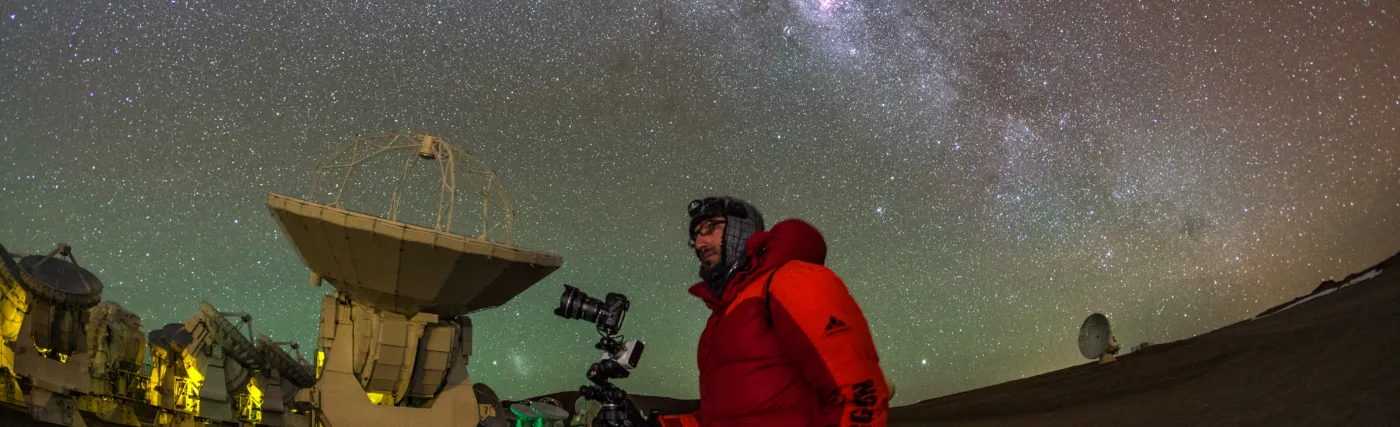
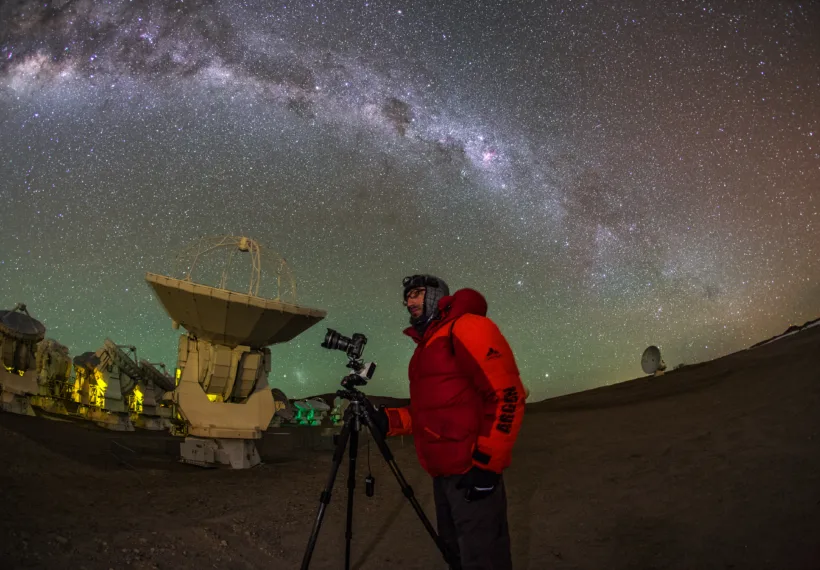
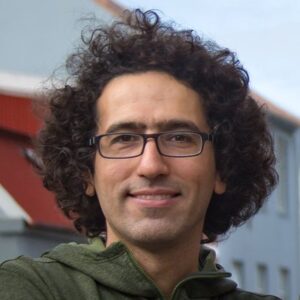
How do you take an incredible photo of the cosmos? In this extended conversation, Neil deGrasse Tyson and comedian Chuck Nice learn about how to start taking photos of space with astrophotographer and National Geographic Explorer, Babak Tafreshi.
Learn about Babak’s journey to become an astrophotographer and steps individuals can take to protect dark skies in their community. Find out how the switch to LED light has contributed to light pollution and what sky-friendly measures communities can take. How is wildlife impacted by light pollution?
What is the most difficult object in the sky to photograph? We discuss capturing comets and atmospheric phenomena. What is ball lightning? Has Babak photographed UAPs? Plus, learn how to get started in astrophotography as well as some tips on how to take long exposure night photos on your smartphone.
We talk about Babak’s favorite objects in the sky to photograph and the generations that are missing out on the Milky Way’s beauty. Babak describes photographing the unexplained and we explore the magic of meteor showers. Plus, find out where you can find a dark sky location near you. How do we keep people looking up?
Thanks to our Patrons Sass Hoory, Paul Kemp, Tor Emanuelsen, Gavin M Benedict, Norman Pestsaina, David Wiester, and Brady Smith for supporting us this week.
NOTE: StarTalk+ Patrons can listen to this entire episode commercial-free.
Transcript
DOWNLOAD SRTEvery memorable gift starts with a story.
This holiday season gives something with power.
Jefferson’s Ocean Bourbon and Jefferson’s Ocean Rye are aged at sea where they’re transformed by unpredictable and unrelenting elements.
They’ll taste the journey in every sip, darkened by pounding waves, kissed by ocean air, caramelized by equatorial heat.
Give the gift of adventure.
Give Jefferson’s Ocean Bourbon and Jefferson’s Ocean Rye.
Please sip responsibly.
Copyright 2023, Jefferson’s Bourbon Company, Crestwood, Kentucky.
Want to learn a new language?
You’ll need the most trusted app for that and that will be Rosetta Stone.
You’ll get fast track learning with their immersive lessons and with Rosetta Stone’s true accent feature, you’ll get feedback on how well you’re pronouncing words.
Find convenient lessons as short as 10 minutes.
Don’t put off learning that language.
There’s no better time than right now to get started.
For a very limited time, StarTalk listeners can get Rosetta Stone’s lifetime membership for 40% off.
That’s 40% off unlimited access to 25 language courses for the rest of your life.
Redeem your 40% off at rosettastone.com/startalktoday.
And I said, damn, now I know what my last moments on earth will look like if the meteor is gonna take me out.
Yeah, it’s, if you look at meteor showers, you see them time to time.
I have pictures of them.
They’re just like supernova.
Yeah, yeah, they just show up and then they just appear.
Yeah, yeah, yeah.
Welcome to Star Talk.
Your place in the universe where science and pop culture collide.
Star Talk begins right now.
This is Star Talk.
Neil deGrasse Tyson here, your personal astrophysicist with my co-host, Chuck Nice, Chuck.
Yes, Neil.
We’re doing another one of these and this is going to be a Cosmic Queries, always a fan favorite.
And this one is a topic that we should do more often and we don’t.
And what is that?
Dark skies and astrophotography.
This is how you get into it.
Oh my God.
Everybody’s got a camera.
Everybody’s got, you know, we got this.
I don’t know if the camera is that good.
We got this.
I mean, can I really do something with my iPhone?
Can I really?
I could give you some advice, but we got to go full guns to get all the advice we can here.
And we’ve got with us, right, in the house, Babak Tafreshi.
You are an astrophotographer, a space photojournalist, which sounds like you go to space to get pictures.
That’s probably not what it is, but that’s what it sounds like.
Cosmo Paparazzi.
Yeah, let’s get a close up on that lander, right?
Alpha Centauri over here.
Over here.
Alpha Centauri.
Smile.
This way.
Who are you wearing?
Who are you wearing?
Your National Geographic Explorer.
This is a highly privileged coveted designation that goes to people who are scattered around the world doing their thing in the National Geographic family of people bringing the universe to the rest of us.
You’re also an amateur astronomer.
You studied physics in school.
Love that.
And you’re an advocate for night skies, dark skies.
And that’s another good thing.
Plus, you’re a founder of the World at Night Initiative.
So, let’s tell me what you’re about.
Babak, what drives you?
How did it all begin?
Well, I’m originally from Iran, from Tehran.
I’m an Iranian-American science journalist and photographer.
My interest in astronomy started with the first look at the moon, like many others.
At the age of 13, I borrowed this telescope on top of a roof in an apartment in Tehran, which is highly light-polluted.
I had a look at the moon and couldn’t believe my eyes.
It was much more than the map I had in my hand.
All the craters, mountains, and this was just a tiny telescope, two inches.
I can remember that scene still second by second.
It was almost like being the Apollo orbiter going around the moon because I had no tracking with the telescope.
So it was with the earth rotation, the scene was moving across the view.
And I thought, you know, that would be cool to capture it on film.
So that was the next night, which failed.
Just to be clear, you said something that I want to make sure our audience fully understands.
You have a telescope that’s not plugged in.
It just points in one direction and the moon is in the frame.
But because Earth is rotating, what’s in the frame is passing by.
And the magnification of the telescope is such that you’re basically observing the rotation of the Earth as the sky goes by.
Any time you look through a telescope, that happens.
Any time you even take a picture of the sky, even your phone, if you go beyond 30 seconds, you start to see stars are not pinpointed anymore or little trails.
This is a fact for the Earth rotation.
I mean, it’s a very easy evidence of how Earth is rotating and how the sky is turning above us.
That sounds kind of annoying, like it would ruin every picture.
That’s very true.
That’s why we are limited with shorter exposures, less than 30 seconds, unless you use a device that tracks with the Earth’s rotation, that can freeze the Earth rotation, we call it the star tracker, or use a motor attached to your telescope that can track the stars.
I didn’t have that, that tiny telescope.
So that’s why the view was moving, and it felt like being in an orbiter around the moon.
So later on I became an editor at Astronomy Magazine of Iran.
I started the TV program for about 10 years.
We had a weekly TV program on space and astronomy.
I was highly inspired by Neil, in fact.
I emailed you back in the 90s.
If you can remember, I’m not sure.
Oh my gosh.
Did I reply?
You did.
You did, in fact.
Well, that’s good.
Yeah, because if you didn’t, this would be very awkward right now.
It would be an awkward moment completely.
But I do reply to all emails eventually.
Me too.
So it’s the eventually.
So yes, that was very inspiring to me.
I’m glad to know that I replied.
Yes, I was very inspired by Carl Sagan at the time until when he passed away.
I wrote one of my first articles for Astronomy magazine about Carl Sagan.
And later, I started a program called The Board at Night in 2007.
I was still based in Iran.
And since the program became more and more global with exhibitions here and there, I had to leave Iran because it was not possible.
With all the limitations from the government and also the sanctions and internet filtration.
So me and my wife decided to leave to Germany.
And later on to the US, I became a National Geographic photographer in 2012.
And recently, much more involved with Nat Geo across the platform, the society and other parts of the platform of National Geographic.
So let’s go to questions now.
Chuck, we covered the good ground here to see what people have.
We do.
People are very curious about this.
It’s good to see.
Got to love this audience.
This is Tasha Rath, who says, hello, Dr.
Tyson, Lord Nice and Mr.
Tafreshi.
By the way, Chuck, my last name is pronounced Rath, as in wrath of God or wrath of Khan.
Tasha is spelled R-A-T-H.
I think I’m capable of pronouncing that.
There’s no other way to pronounce that.
No other way to get that one out there.
Yeah, exactly.
Ratha.
Yeah, Tasha Rath.
Okay, anyway.
She says, I’m from Oakland, California.
I hope my question is, what are the most impactful actions individuals can take to help protect the dark skies in their home and community?
Also, are there any stargazing apps that you can actually recommend that are effective at identifying objects in the night sky?
Or are they all as dumb and unhelpful as the ones I have tried?
So, I’m going to answer the first one.
Babak, you don’t have to mention this.
Ready?
So, things you can do as an individual, walk around with a BB gun and shoot out lights.
Babak actually agreed with that.
Let me just say as the adult in the room to all of our listeners, we are not condoning that you destroy public municipal property by shooting out streetlights.
Which is something drug dealers do so that they can do their business.
In the dark.
So, the individual, what power does the individual have?
Well, talking to your communities, if you’re going to a church, to a temple, to a mosque, if you’re meeting with the family members, talk with the communities.
Because this is how the culture changes.
The problem of light pollution is not like plastic in the ocean which takes decades to recover.
It’s not like climate change we are facing for the next century to recover that.
It’s a very quick cultural change.
Night sky is becoming brighter and brighter by 2% every year on average.
This is a very rapid change because of our move to LEDs.
LEDs are much brighter and if they’re not used in a proper way, they can create much more sky glow.
Especially the white blue LEDs which are harmful to human body as well by changing our circadian rhythm.
So, look at the light pollution not from the perspective of astronomers.
It’s very important for astronomers, but this is a very small community.
In a larger scale, light pollution is waste of energy, so it’s money involved.
Light pollution harms billions of birds and nocturnal animals.
Light pollution is about human health as well by changing our sleep cycle.
And then light pollution is important to reduce, to reconnect with the night sky, which is our origin and probably our future.
So, these are the important elements to enter into the discussion, because I have the same problem with my neighbors.
A few years ago, I was in a condo association and there were very bright lights.
It took me three, four weeks when I got to that place to just move the direction to a way that it could be some changes.
They didn’t feel safe without those lights.
So, the first step was what kind of light do we need here?
Does it need to be permanent or motion sensor?
In most cases, motion sensor lights are fine and they’re affordable, widely available.
What temperature of light do we need?
Does it need to be white, blue or yellow?
In most cases, we see much better with yellow light, because you can see shadows and illuminated areas at the same time.
With white, your eyes get saturated.
A quick interjection.
Chuck and I have an explainer on the temperature color of light.
I think if I remember correctly.
Correct.
Something that people normally don’t think about a temperature and what color light is, but of course in astrophysics, it’s everything.
It’s the very foundation.
Or photography.
Except there’s some photographic language that’s the opposite.
When they talk about a cooler light, they refer to blue.
But a blue is a higher color temperature.
So there’s some conflicting language there.
But we strain that out in our little…
Look it up in our archives.
That’s a good explainer.
Check it out.
Yeah, I think so.
The temperature.
The color temperature.
And another point before we pick you up, Babak, is the LEDs are brighter watt for watt, which means when you switch to LEDs, you actually save money, even if the illumination is brighter in the zone.
So you can save even more money by dropping it down.
And so the switch to LEDs was a money-saving move, but you don’t want to be irresponsible about it.
Which way is the light pointing?
But the cool thing about LEDs in addition to that is you can mix the diodes so that you can create a different color temperature.
Yeah, exactly.
That’s what I do at home.
So that explainer worked, Chuck.
Yeah, man.
Why do you think I do this job, man?
Okay, so Babak, pick it up.
LEDs, I think it’s a must change for sure.
I managed to change the LEDs from 5000 Kelvin, which is white-blue.
It has, you know, 50% blue light in it, to 3000 Kelvin, which we consider is sky-friendly.
For interior at my home, I use mainly 2200 Kelvin, which is very appealing to the eye.
It’s very relaxed, especially in middle of the night, if you want to go to the bathroom.
If you have this bright white light, you have a hard time going back to sleep.
But with the soft yellow light, it’s much easier to go, because we have some blue detectors in our retina.
The cells are responsible only to detect blue light.
It’s almost near the center of retina.
And those are triggering the brain to drop melatonin.
And that, of course, activates our body.
If you get too much blue exposure, that’s why the blue LEDs are not good for anybody near the bedtime or anywhere near the bathrooms.
And when you say drop melatonin, what you mean is restrict the production of melatonin, not literally dropping melatonin into you.
Yes, it cannot do it.
And back, your voice is so soothing.
I have to conclude that you get full night’s sleep every day.
You got your lighting.
You talk yourself to sleep?
Yeah, in fact, I just finished a photo workshop here for two weeks where I didn’t have any good night of sleep.
By the way, with what you just said, it’s important for people to know just as an aside, not as an aside, as an addendum.
When you’re reading screens at night, if you’re on a tablet or your computer, you should change the blue light setting on your screen because that could be disrupting your sleep patterns as well.
Yeah, that’s true.
And you know, this is the same impact on many other species with the white, blue LEDs, so LEDs are essential change for energy saving, there is no doubt about that.
This is the future that has already started, but it’s a question of what kind of LEDs we need to use at every place in the offices.
We need white LEDs in dental rooms, in surgery rooms.
You don’t want your surgeon to work under red light, obviously, but do we need white LEDs on a beach which is home to sea turtles?
Definitely not, because they’re widely, they’re very largely impacted by that light.
That’s why many turtle-friendly beaches in Florida, Costa Rica, Mexico, they are changing the light to red, and it’s fully shielded.
We call it full cut-off.
You cannot see the bow from a distance.
It’s only illuminating the ground where it’s supposed to illuminate, not to the horizon.
Is that so the turtles can come to shore at night and lay their eggs?
Two reasons.
One is that because if the beach is too bright, they don’t come there usually.
And the second, when the baby sea turtles are hatching, they look for the brighter horizon, which is naturally the ocean, not the bush and the sand.
But now, this other horizon with all the hotels and streetlights is much brighter than the ocean.
They go to opposite direction in lands, and of course, that doesn’t end very well.
That ain’t right.
See a turtle end up in a strip club instead of the ocean.
That’s terrible.
Or the casino.
It’s terrible, man.
Okay, cool.
So how long did it take for you to effect that change?
It took me three, four weeks.
So it takes some time, and it’s very important to start with your local community.
Because this is how we are going to change this.
We are naturally afraid of dark.
So on my T-shirt it says, addicted to the night.
You know, we are going to become acquainted with the nights to discover that there is a beauty in this natural darkness.
It’s good to have natural dark nights.
Some places it’s impossible, like New York City.
But if there is a place which is now dark enough for nocturnal species and seeing the Milky Way, let’s keep that the way it is.
You want to make sure your day goes smoothly, you want your voice to be smooth as well.
Throat irritations like hoarse voice, throat tickles and can really get in the way.
From making a good impression on a first date, to perfecting that presentation you’ve been practicing all week, or just hitting those high notes for everyone in the car, whether they want to hear them or not, you need something you and your voice can rely on.
When a new Ricola throat balm comes in, it’s an entirely new and tasty way to do throat care.
It coats and protects against throat irritations and has a delicious duo of a liquid center with honey and smooth caramel-flavoured coating.
So whether you’re talking, presenting, singing or even podcasting, new Ricola throat balm is the drop you want to shop.
It’s the perfect drop of protection to add to your daily routine to make sure you’re at your absolute smoothest.
Try new Ricola throat balm.
Coat your throat.
Now available in the cough and throat drop aisles in stores across the US.
No one sees the world quite like an airline, but the world seen below is changing fast.
That’s why Delta Airlines is committed to net zero carbon emissions by 2050.
It’s why they’re partnering across the industry to create the future of aviation and switching ground vehicle after ground vehicle to electric.
It’s why Delta is accelerating their push to source sustainable aviation fuel.
And it’s why they’re also getting rid of 4.9 million pounds of single use plastics annually.
That’s just what they’re doing, but it’ll take more than just the 90,000 people at Delta.
It’ll take everyone at every airline and in every industry because Delta knows a thing or two about getting where it needs to be.
And they believe it’s time we all got going together.
Learn more at delta.com/sustainability.
Many of us travel a lot, whether it’s for work or for play.
And you know, with me, it’s mostly for work.
And whether you’re on the road, which I am, or at home, we all use our phones to stay connected.
Maybe you use your phone to download apps or play games, make playlists or download TV episodes in seconds.
Or maybe you’re like me and you like to use your phone to watch football because you’re on the road and you can’t see your favorite team lose to the Jets.
I’m sorry.
I’m so sorry.
Where’d that come from?
Well, no matter what you’re doing, it requires a strong network like T-Mobile.
T-Mobile is America’s largest and fastest 5G network.
It’s built for speed and coverage.
Stay connected to what matters when in town or on the road because they cover more highway miles with 5G than anyone else.
Coverage like that just makes everything easier.
You know, I’ve been a T-Mobile customer for years and I have to tell you, everywhere I go, it works.
To find out more, visit tmobile.com/networktoday.
Coverage not available in some areas.
Vast is based on median overall combined 5G speeds according to analysis by Ucla of Speed Test Intelligence Data Q2 2023.
See 5G device coverage and access details at tmobile.com.
All right, Chuck, give me another question.
All right, here we go.
This is from our old friend, Alejandro Reynoso.
From Monterrey, Mexico.
And he says, hello, or should I say hola?
He says, my question is, what is the most difficult thing to photograph and why?
Oh, I love that.
Well, to me, there has been many challenges, of course, from the beginning, when I started in early 90s.
On film photography, simply the Milky Way was the most difficult thing to capture properly because the film was so low in sensitivity.
And then you needed a star tracker device, you needed clear dark area, which was not available to me in the city.
So that was challenging.
Today, with your iPhone or any smartphone, you can capture the Milky Way on the first night, on your first shot of the night sky, outside in the dark.
How much more sensitive are the chips in phones compared with the film you used back in the early 90s?
And they use the same terminology, which is ISO.
So what would be?
The equivalent.
So the film is ISO 100 at the time.
We were using 100 to 400 and above that, it became very grainy, very difficult to print large.
But nowadays, even the phone cameras are using ISO 1600, 3200, even higher.
With some of the cameras I use for animals at night, we are shooting at ISO 50,000 to 100,000.
And it’s picking almost every single photon that it arrives, the quantum efficiency, the percentage of photons which it can record, it’s up to 70 to 80%.
With film, it’s down in single digits.
That’s true, that’s true.
Sensitivity is single digits, yeah.
So there are handheld photos you can take today.
The previously required tripods.
Even of the Milky Way, handheld photos with phone, because the phone is stacking images, it takes quick shots of, let’s say, half a second and a stack of those which are not shaking and give you a final image after three to 10 seconds, even handheld, you can see the Milky Way.
But the challenge today is more, for me, is more into objects such as a supernova in the Milky Way, which didn’t happen for the past 400 years, or a new comet, a bright new comet, or atmospheric phenomena.
But just to be clear, we are overdue for a supernova in our Milky Way.
Every 100 years or so, and we’ve gone 400 years, not since Kepler’s supernova in 1600s, that we’re overdue.
So watch the night sky, okay?
You guys are worse than the heirs of a rich a-hole.
Like, don’t worry, one day that star is gonna die real soon.
In fact, there is one that can explode any night.
Any day now, that star can die and give us what we need, baby.
It’s hard to photograph something that is transitory, right, that you don’t know when or where it’s gonna happen.
That would be the top of the list.
And some of them are atmospheric phenomena.
One of the objects that I really love to capture, other than mysterious things like red sprites, they’re related to lightening.
Or blue jets.
There is one object I have not managed to document.
In fact, it’s never been documented properly.
It’s called ball lightning.
Ball lightning?
Wait, you’re saying it’s never been photographed?
Nobody knows.
Some scientists don’t believe it exists.
And some have many papers about it.
Well, we should say what it is first.
Because maybe somebody, not everybody knows what ball lightning is.
It ain’t Michael Jordan on a good night or Steph Curry dropping threes from outside.
But what is ball lightning?
It’s a ball of charged particles in the air that travels very slowly, sometimes fast.
And it’s in the size of anywhere from a basketball to maybe smaller.
And it has been documented in the history.
Visually, people have seen it.
This charged air can even go through the walls or windows.
And so there are paintings, for example, people looking at this magical ball coming in and they’re sometimes explode, of course, because all of a sudden the charged particles are released, could be indoor and it can create damage too.
It’s usually happen in a very humid condition.
So humid places are better to observe them.
And we have many visual documentation of that, but never been documented properly by a camera that you can rely on the image.
There has been a couple of them and later on we found out it was AI generated.
Okay, so just to be clear, the reason why you have static electricity because charges build up and you get near something where it can discharge, that will happen under dry conditions because in dry conditions that you will hold your charge until you get near the object.
Under damp conditions, you’re constantly can discharge.
But if you have a damp environment, then maybe the ball lightning is itself in its own dry pocket.
Could that be what’s going on here?
That’s true, yeah.
When I read one of the explanations was that there are similar atmospheric phenomena that has been never documented.
Even red sprites were never documented until 1980s.
Nobody believed they exist.
Some of the UFO sighting we have are in fact atmospheric phenomena which are not familiar with.
So the recent hearings with NASA are encouraging people with their smartphones to capture anything they don’t understand and your smartphone has metadata of location and time and the like and bring it to a clearing house.
So it might be some of these phenomena that were so hard to catch before because people weren’t walking around with cameras until very recently in the history of civilization.
We could get to the bottom of a lot of these mysterious phenomena.
Yeah.
I’m thinking.
It’s like people getting beat by the cops.
It’s just like that, Chuck.
You know, before it was very unlikely you would see that.
Now we got cameras everywhere.
It’s just like, wow, why has this happened every other day?
Yeah, no, it’s been happening.
Right, right, right.
Thanks for that analogy, Chuck.
Very, the perfect analogy.
Yeah.
Another question.
I’m just trying to get hate mail.
No, it’s can’t get hate mail for the truth.
Okay.
This is Kevin the sommelier, our friend Kevin the sommelier, who says, for someone who wants to get into astrophotography, what would you recommend to get started?
Just like in return for someone who wants to start their wine journey, they would understand more like German Riesling or New World Port Noir.
Those are great places to start.
Well, thanks for the tip, Kevin.
And Neil, what’s a New World Pinot Noir?
So, New World is anything other than Europe that planted vines later than Europe.
So, there would be South America, North America.
So, like Oregon or Washington State.
Exactly.
And especially making wines in the European style.
And we might even include Australia in a kind of a New World sense of that.
So, that’s what he means by New World.
So, how would you begin?
Well, you can start with any digital camera, with even a cell phone, but it needs to be on a tripod.
So, if you’re using a cell phone, it needs to be on an adapter that connects to a steady tripod.
Then, for example, on an iPhone, it can go up to 30 seconds.
It’s good to activate the RAW format when you’re taking an image.
On the phone, you have the possibility to capture it on RAW.
And if you’re also shooting with a proper camera, you have to shoot in RAW, because we need every bit of information for low light images, night sky images.
If you compress it to JPEG, it doesn’t work very well.
And if you’re using a camera, the most important other than the camera itself, which is better to be a low light photography device, is the lens.
The lens needs to be very fast, meaning that the aperture of the lens can open very widely, so you can get enough light in the short amount of exposure that the Earth rotation dictates us.
Because if you go with much longer, 10 minutes, you get a beautiful image of a star trail, not the pinpoint stars.
So in order to receive enough light in 30 seconds, you need to use a lens which has an aperture of f2.8 or better, such as f2, 1.4.
These are fast lenses.
And then comes the place, because you need the darkest sky location.
So look at the darkestsky.org website.
Look at the light pollution map.info website.
And these are sources you can find the darkest sky places near you, where you have to go to see the Milky Way.
But also back to the question, it’s very important to know about the night sky.
If you’re going to be a wildlife photographer, you have to know about the animals.
The same is here.
It’s fun and interesting to learn about the stargazing.
So then you realize what season is best for the Milky Way.
What season can I capture beetle juice and Orion?
What season is best for the Summer Triangle or Bright Star Beagle?
When can I get a comet?
When is the best time for a meteor shower?
And all these is the knowledge that you can get gradually by reading about practical astronomy.
It’s fun and it enables you to capture much better images.
Babak, how do you make your smartphone take a 30 second image?
How do you make it do that?
When you hold, let me explain on iPhone, for example.
When you hold iPhone, it’s limited.
The night mode on iPhone is limited to one to three seconds handheld.
If you keep it steady, it goes to ten seconds.
Usually you have to tap on the night mode on the bottom and then there’s a slider.
You will see a slider.
As soon as it’s on a fixed tripod, not necessarily on a tripod, but any fixed platform, even on a table, on the ground attached to a rock, then you see the slider goes to 30 seconds.
iPhone will recognize vibration of your hand.
Look at that.
It automatically sees that it’s not vibrating and then extends the time you’re able to take the picture.
I did not know that.
On Google Pixel, it goes to four minutes.
Google Pixel goes to four minutes.
So when you say RAW, you mean uncompressed.
So you’d have to do that in the settings for the camera, where it asks you what format.
Yes.
Under the Format, in iPhone, going to Settings, Camera, and then Formats, you activate Apple Pro RAW.
Of course, your phone needs to be the Pro version in order to have the RAW format.
And how do you keep the image from getting too bright?
Because the longer you’re exposed, the brighter the image will become if you’re in a fixed position.
Especially if you have moonlight, for example, then you don’t need 30 seconds.
Or if you’re near a city, these 30 seconds high ISO images will come into a result of completely overexposed image.
So it depends on the moon condition.
I usually prefer to shoot the night sky during the crescent moon to first quarter or last quarter, when the moon phase is between 50% to 10%.
When your moon is brighter, the landscape will be beautifully illuminated, but the night sky is washed out.
Chuck, when I was younger, I would…
Because the moon is just reflected sunlight.
So you could take a picture at night with the full moon or of just the landscape.
And if the exposure is long enough, and then you get the result back, it’s like a daytime photo.
Like, you would not know the difference.
It’s just sunlight reflected off the moon with enough exposure.
You get it.
Wow.
Yeah, it’s very confusing when you look at it.
Yeah.
So another little fact that the full moon is about six times as bright as a half moon.
And the laws of reflection are not linear with the angle of sunlight hitting the moon versus the reflected light to your eye.
So the full moon is much, much brighter.
And it’s a mess for everything else in the sky.
Okay, text from the wedding planner.
She’s talking about a cake pop mural.
Ah, exciting.
Ooh, it’s $8,000.
I don’t know, we’re trying to save for a house.
Well, you only get married once or twice.
The three time stops.
There’s a lot of bad money advice out there.
For knowledge you can trust, come to GISA Credit Union.
Whether it’s saving for the wedding or everything that comes after, we can help get you where you wanna be.
Find a healthier approach to money at GISA.
Walmart Plus members save on meeting up with friends.
Save on having them over for dinner with free delivery with no hidden fees or markups.
That’s groceries plus napkins plus that vegetable chopper to make things a bit easier.
Plus, members save on gas to go meet them in their neck of the woods.
Plus, when you’re ready for the ultimate sign of friendship, start a show together with your included Paramount Plus subscription.
Walmart Plus members save on this plus so much more.
Start a 30-day free trial at walmartplus.com.
Paramount Plus, a central plan only.
For registration required, see Walmart Plus terms and conditions.
I’m Joel Cherico, and I make pottery.
You can see my pottery on my website, cosmicmugs.com.
Cosmic Mugs, art that lets you taste the universe every day.
And I support Star Talk on Patreon.
This is Star Talk with Neil deGrasse Tyson.
All right, well, let’s go to Jaden Peters.
Jaden Peters says, greetings from Ogden, Utah.
Amateur astrophotographer here with a very easy to pronounce name.
Thank you, Jaden.
I was wondering what your favorite celestial object to photograph is and what equipment you have used to photograph it.
I am truly inspired by your beautiful, beautiful photos.
Definitely the Northern Lights is one of my favorite because it’s ever changing, especially when aurora is overhead.
It’s creating a kind of aurora known as crown, and it’s almost like raining in colors down to you.
It’s an effect of perspective, in fact.
That is my most favorite object in the night sky to shoot.
Unfortunately, it’s not possible to shoot it from my neighborhood in Boston area due to light pollution and latitude, but from Iceland, from anywhere, Nordic countries, Alaska, Northern Canada, these are frequently viewed.
Another object that I love to photograph is a bright comet.
And those are not very common.
Every decade we have one great comet.
The last one in the Northern Hemisphere was two decades ago, in 1997, Comet Halebob.
And then we had 2007, another great comet in the southern hemisphere sky.
And nothing after that.
There were good comets, but nothing we can call a great comet.
So I’m really looking forward to it.
Something like Halebob can be viewed from the middle of New York City.
So it’s very impressive to look at it in the dark sky.
It has maybe a tail of 30, 40 degrees.
I remember Comet Haya Kutake in 1995.
The tail in the dark sky was 90 degrees.
Okay, so you can’t summon up a comet, nor can you summon up the Northern Lights.
So you have to be very opportunistic when these events are available to you, correct?
How about for us mere mortals?
Is there anything pedestrian that you really like photographed?
The Milky Way.
The Milky Way is like elephants in wildlife safaris.
So that’s what you’re going to see.
And it’s unfortunate that more than 95% of population in developed world can no longer see the Milky Way from their living area because of flight pollution.
And that includes North America and Europe.
If you include the entire world, it’s about 60% now that they cannot see the Milky Way anymore.
So there are generations who have never seen the Milky Way.
I had a recent program and a New York Times retired journalist was with us and she never saw the Milky Way in 80 years living in New York City.
For the first time she saw it in this program, I do every August and May, and she was almost crying.
She was so impressed by the beauty.
Of course, she was also disappointed that the Milky Way didn’t appear to the eyes with color because our eyes cannot pick the real color of any diffused object at night time.
We’re not sensitive enough to colors.
Spoiled by Hubble.
We’re the James Webb.
We are.
Tell me about it.
Oh, wait.
Do we have one more?
Because I want to hear the answer to just one more.
Okay.
Fast.
Bring it on fast.
Very quickly.
It’s a super fast.
This is Jason.
And he says, have either of you, that means the two of you, not me, have either of you ever seen something that gave you an undeniable truth about something else?
So you look through your lens and you see something that confirms something, a truth in another area of your life.
I think that’s a great question.
Yeah, sure.
Well, since early 90s, it’s been like 30 years since my teenager that I’ve been photographing the night sky.
I captured many UFOs.
But every time an astronomer explained that.
So for me, there has been some really exciting moments.
First time I captured a rocket exhaust, for example, or this cloud coming out from the extra fuel dumped by a rocket in the upper atmosphere.
Or the first time I captured a military grain drone.
I had no idea.
I thought this is a UFO.
Or first time I captured an exploding fireball, a very bright meteor we call it BOLI.
And these were really changing moments in my career.
And then I learned something that these are natural phenomenas or manmade phenomenas.
And I still have a few objects in my images which are not explained and I imagine they are related to large drones.
Well, look at that.
So your UFOs became IFOs in the presence of expertise.
That’s all that happened there.
Yes.
So, for me, it was the Leanded Meteor Shower in 1999 where we expected a meteor storm because Earth was passing very close to what was the head of the comet responsible for the debris that were plowing through as we orbit the Sun.
So rather than a few good meteors every five minutes, you’d expect maybe a few good meteors per minute or even a higher rate than that.
So I’m there mid-span of the Brooklyn Bridge in New York City and I’m looking up and I see a star just appear out of nowhere and it just got brighter and brighter and brighter and then it disappeared.
And I said, whoa, and I had to like, I’m thinking in like fast time here and I say, well, that’s not a meteor, meteors streak left and right and up and down.
And then I said, oh my gosh, that must be an angel.
No, I said, yes, it was a meteor headed straight for me.
Yes.
That’s what I’m saying.
I had to deduce this from first principles.
Yes.
I said, if there had been at all angles, at some point, what’s a meteor going to look like when it’s headed straight towards you?
Wow.
My gosh.
Well, fortunately, most meteors from a shower are coming from icy objects.
Yeah.
Otherwise, it could be.
So, it got brighter and brighter and then, of course, it dissipated into the atmosphere and then that was it.
That was it.
And I said, damn, now I know what my last moments on earth will look like if a meteor is going to take me out.
Oh, man, I never heard that story before.
That’s super exciting.
Oh, yeah.
No, you never told me that.
Yeah.
That’s amazing.
That’s super exciting.
If you look at meteor showers, you see them time to time.
I have pictures of them.
They’re just like supernova.
Yeah, yeah.
They just show up and then they disappear.
Yeah, yeah.
Wow.
So, how do we get people before we continue to get out and do more to look up?
I mean, Neil’s always saying, keep looking up.
How about the people who aren’t looking up at all?
They not keep looking up.
How do they start looking up?
I think a trip to a national park or a state park in a darker sky place is the best way to do this because many of the national parks in the US and Canada are darker sky designated locations, especially in the southwest US.
Some of my favorites, for example, in Arizona and Nevada border is the western end of Grand Canyon, or the Great Basin National Park.
It’s at high altitude in Nevada and it’s also very dark.
There are plenty of darker sky locations in that area, all the five major national parks in Utah are darker sky designated or going to be soon.
In northwestern Nevada, we have the Black Rock Desert, another darker sky place, even very close to Las Vegas, on the way to Beatty, on the way to Death Valley, there’s a darker sky area.
Another place I have photographed many times is Cathedral Gorge, which is inside Nevada on the border of Utah and it’s just fascinating rock formations with darker sky above.
Or all of Australia and Central Africa.
Yeah, no, but you’re right.
If most of the population of the world lives in the Northern Hemisphere, and most of that population lives near cities, then we have to be very surgical about how we get these people out there.
They need to know where to go.
Is there a map they can go to online that identifies these dark spots?
There are two ways to do that.
One is light pollution map.info, that’s a website and there is also a layer for Google Earth, a university study provided this layer of known as the map, the atlas of artificial sky glow.
And this you can add it to your Google Earth and then you can zoom in and see another place.
Another website is bluemarble.de.
It’s a German enthusiast who includes all these satellite images from every year.
You can look at Earth at night and find dark sky places near you.
But do not forget that elevation is not there.
So even if you’re in a bright area, but you find an elevated side, which is at least 4,000, 5,000 feet above sea level, then you start to see darker sky even within the cities.
Very cool.
And right now you are speaking to us from Iceland.
What are you doing there today?
From Reykjavik, Iceland, this was my last day after two weeks of a photo workshop capturing the Northern Lights and the Milky Way with a group coming from all around the country.
I do this all around the world.
I do this twice a year in March and September known as Aura Photo Tours.
Oh, wow.
So people can actually hang out with you and learn how to do what you’re doing.
Oh, look at that.
Yeah, I do four or five workshops.
My invitation might still be in my inbox, I’m guessing.
Exactly.
Yes.
Let me check my inbox, see if I’ve ever been invited on this.
So you made a career of this.
This is a brilliant, important and envious career path that you made for yourself here.
Congratulations on that.
Thank you.
Keep that going.
All right.
Chuck, we out.
All right.
This was fun.
All right.
And Babak, thanks again for being our guest on Star Talk.
All right.
I’m Neil deGrasse Tyson, your personal astrophysicist, finishing up this Cosmic Queries edition of our search for night skies.
As always, especially after this episode.
Who’s up for Bora Bora?
You know I want to, but I’d have to dip into my emergency fund, and you know how it goes.
Come on, live a little.
Self care is an emergency, so.
Right.
There’s a lot of bad money advice out there.
For knowledge you can trust, come to GISA Credit Union.
Whether it’s planning for the unexpected or your next vacation, we can help get you where you wanna be.
Find a healthier approach to money at GISA.
Walmart Plus members save on meeting up with friends.
Save on having them over for dinner with free delivery with no hidden fees or markups.
That’s groceries plus napkins plus that vegetable chopper to make things a bit easier.
Plus, members save on gas to go meet them in their neck of the woods.
Plus, when you’re ready for the ultimate sign of friendship, start a show together with your included Paramount Plus subscription.
Walmart Plus members save on this plus so much more.
Start a 30 day free trial at walmartplus.com.
Paramount Plus is central plan only.
Separate registration required.
See Walmart Plus terms and conditions.
 Become a Patron