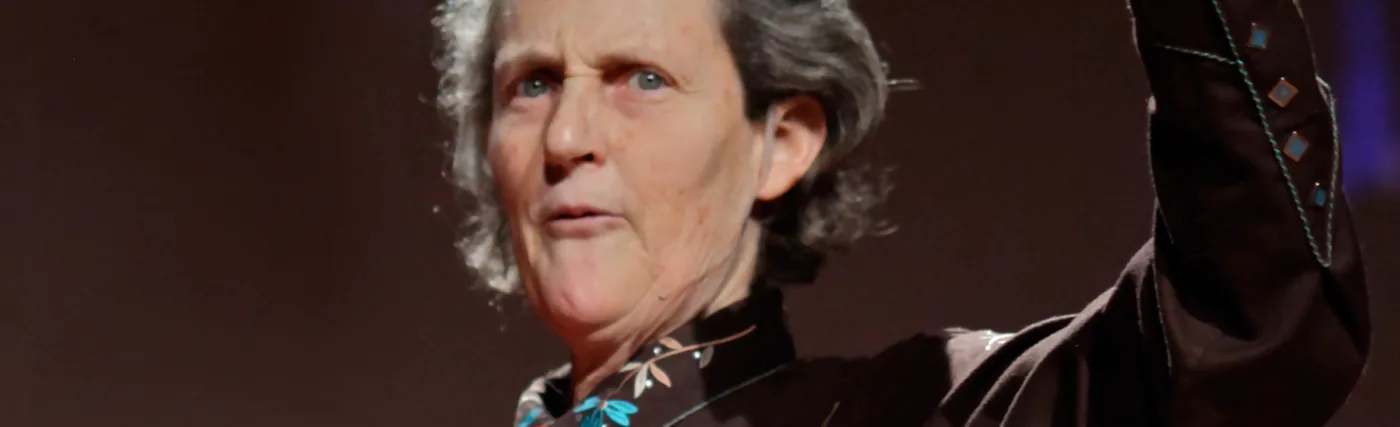
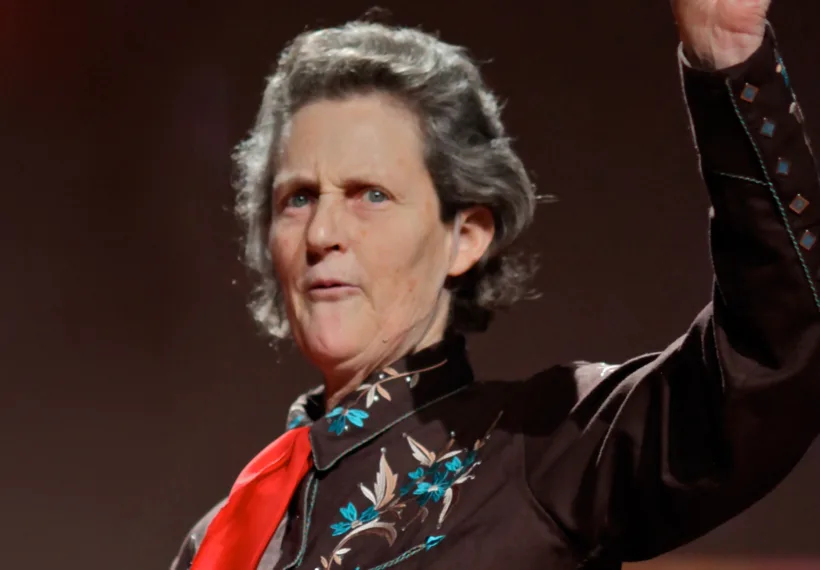
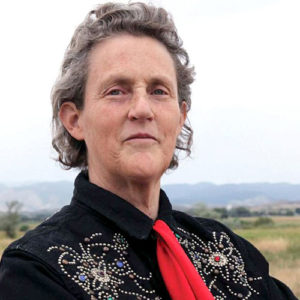
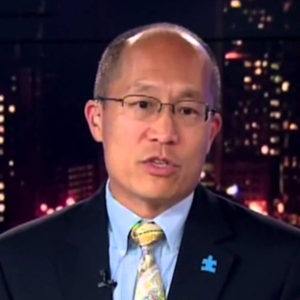
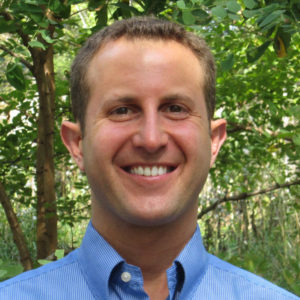
Discover how Dr. Temple Grandin’s own autism helped her revolutionize animal welfare when she sits down with Neil deGrasse Tyson in his office at the Hayden Planetarium in NYC. Dr. Grandin, a leading voice in understanding autism, explains how autistic brains are different. Explore Temple’s style of photo-realistic thinking – “My mind thinks kind of like Google Images” – and her concerns about the “smart, geeky kids” at one end of the autism spectrum. In studio, Neil is joined by co-host Chuck Nice and Dr. Paul Wang of Autism Speaks, who describes searching for a cause among environmental risk factors and genetic vulnerabilities. You’ll also hear how Temple, a Professor of Animal Science at CSU, changed the way animals are treated in U.S. slaughterhouses, reducing discomfort and improving animal welfare. Learn about biological system overload and overbreeding in racehorses and dairy cows. Humane Society VP Paul Shapiro explains Temple’s far-ranging impact and debates veganism and cultured meat with resident steak lover Chuck. (Warning: Adult lyrics in music clips.)
Transcript
DOWNLOAD SRT
Welcome to StarTalk, your place in the universe where science and pop culture collide. StarTalk begins right now. This is StarTalk. I'm your host, Neil deGrasse Tyson, your personal astrophysicist. I serve as the director of the American Museum of...
Welcome to StarTalk, your place in the universe where science and pop culture collide.
StarTalk begins right now.
This is StarTalk.
I'm your host, Neil deGrasse Tyson, your personal astrophysicist.
I serve as the director of the American Museum of Natural History's Hayden Planetarium, right here in New York City.
And I got with me in studio as my co-host, the nice Chuck Nice.
Yes.
How you doing, man?
I like that, the nice Chuck Nice.
Yeah, yeah, I could say the terrible Chuck Nice, but I'd be lying.
No, you wouldn't.
So today, you know, we had the opportunity to interview Temple Grandin.
Yeah, fascinating woman.
So you saw the movie.
Yes, I did.
As a matter of fact, I got to interview, I had to watch it because I had to do an interview with Claire Danes, who played her in the movie.
So I got her on StarTalk.
Nice.
Yeah, yeah, and she's quite the geek, it turns out, like a Star Trek geeky.
She's got geek in her, that's all I'm saying.
That's all I'm saying, and she's a fascinating person because there's things she does and ways she thinks that other people don't think that way.
It makes conversation with her fascinating.
But then you can wonder, well, is she this way and insightful because she's insightful because she has, in the autism spectrum, does that give to her or take something away?
So did you have expertise in this, Chuck?
In the fact that I am not a genius, I know that.
I can tell you what a genius isn't.
So I had to go out and get somebody who was.
In studio with me is Dr.
Paul Wang.
Doctor, welcome.
Thank you, great to be here with you guys.
Welcome, and you're vice president and head of medical research at Autism Speaks.
That's right.
It's own organization.
It's a nonprofit organization, 10 years old this year.
Yeah, well, congratulations, 10 years old.
Did you found it?
Hardly, I've only been there about a year and a half founded by Bob and Suzanne Wright.
Excellent, and in doing the homework for this episode or so, because I know very little about it, Autism has its own Awareness Month.
I didn't know that.
April.
April is Autism Awareness.
Now, how do you pick a month?
How do you do that?
Yeah, that must be the calendar gods.
The calendar gods.
AAA, Autism Awareness Month in April.
Oh, AAA, Autism Awareness Month in April.
It could have been August.
It could have been August.
We should do it again.
Yeah, absolutely.
Well, at least they didn't give you February like they did us.
Chuck, Chuck can't go a single episode of StarTalk without, okay.
I gotta get it in there, that's all.
I think they gave you leap year.
I'm sure that was on the table at the time.
So, we know most people who first heard of Temple Grandin know her because of, she's a pioneer in how you handle livestock.
Livestock handling, professor at Colorado State, I think.
Right, right, that's correct.
And so, she's one of the most, I mean, she was in the Time 100, in their heroes section.
Yeah, revolutionized the way you handle cows.
She did a lot of work with cows.
Cattle, especially.
Cattle, that's what I meant to say.
I said cows, but I meant cattle.
Yeah, so what we're trying to do in this show today, as we feature my interview, we're trying to get to the bottom of what makes her tick.
Nice.
And why does she tick the way she does?
How much of it is just because she's different?
Because any one of us is different from the other, but she's different in this other way?
Or could it actually be this medical condition that she has?
And you're an expert in this?
I'm a developmental behavioral pediatrician.
Oh, okay.
I think that qualifies as an expert.
A little bit, a little bit.
Work with hundreds of families affected by autism, and now, of course, with Autism Speaks.
Fantastic.
And so what's the goal of Autism Speaks?
Autism Speaks is the biggest science and advocacy organization for autism.
We want to make everybody understand autism, be aware of it, and do what we can to improve the lives of people with autism.
So now, here's a simple question, and we may or may not have time for it.
What causes autism?
That's a great question.
Yeah, I was joking.
By the way, you know when people say it's a great question, it means they actually don't know the answer.
If they knew the answer, just give me the answer.
So that's a great question.
No, I'm only saying that because of Jenny McCarthy and the whole vaccine thing and, yeah.
Autism is a complex disorder and I think like most complex disorders, neuropsychiatric disorders, it's caused by a combination of genetic vulnerability and environmental risk factors.
Man, that was the greatest way of saying I don't know, I haven't heard in my life.
That was like Wiki page, I don't know.
Here's a whole explanation.
I've been practicing that for months.
I gotta tell you, that was awesome.
This explanation needs some more sourcing to.
You get a Wiki info ticket on that one.
So is it possible to have a first onset of autism as an adult or is it primarily you see it in kids?
Is that how it?
Absolutely, it's a neurodevelopmental disorder.
It starts very, very early.
It may actually start before birth.
Oh really?
There are changes in the brain that we know are part of development before birth.
So it has its roots there.
Temple Grandin, I mean she has a life story.
I mean if she's an adult and she's a functioning adult, you know she's got some stories.
Right.
And let's hear the first part of my interview with her when she came to visit the Hayden Planetarium and came up to my office.
Awesome.
And I had to hide all the Star Trek things in my office because she's a Star Trek fanatic.
I love this woman.
Wouldn't we otherwise be able to have this conversation because she'd want to talk about Star Trek.
And I thought I couldn't like her anymore.
Okay, let's find out how she began.
I grew up in Dedham, Massachusetts, outside of Boston.
Wait, that has a farm?
Well, no, no, as a child, no, it was a suburb.
I had absolutely no contact with cattle until I went to a boarding school that had a small dairy with 12 dairy cows in it.
Oh, so the dairy cows in the school were part of some educational curriculum?
Well, it's just they just had them at the boarding school and I worked at the farm.
I took care of the horse barn when I was 15 years old, cleaned eight horse stalls out every day.
Horses were my life when I was 14, 15 years old.
You're dressed very horse like now.
You've got a horsey thing.
Well, I was bullied and teased as horribly and the only place where I was not bullied and teased were the specialized interest things and they were horseback riding, electronic slab and model rocket club.
Ooh, you were a rocket geek?
Yes, I was a rocket geek.
And you know what I did?
I made a rocket that looked like Mr.
Patey, our headmaster.
Wait, was that a compliment or an insult?
No, it was kind of a compliment.
Well, that is cool because when I did model rocket, there weren't many sort of girl rocket people.
I mean, it was all boys, you know.
And so were there other girls at the time?
No, I think I was the only one.
Yeah, that's what I'm saying.
That's what I'm saying.
But Mr.
Carlock, my great science teacher, got me turned around in science and got me interested in studying.
He also ran the model rocket club.
Excellent, so a good, influential teacher story right there.
Because some teachers do have the opposite effect.
Absolutely, because they did a lot of work cleaning a lot of horse stalls.
But then when you get a science teacher, they get you interested.
And if you saw the HBO movie, I actually did build the optical illusion room that was shown in the movie.
And I was happy when I found out the stagehands had a lot of trouble building that, even though they had the drawings off the internet.
So, there are some things that are true on television.
So, I had not known that her, professionally, she thinks about the design of arms and how you corral cows.
The seeds of that were then very early in her childhood.
Sounds like it, yeah.
She was interested in animals from an early, early, early point.
Yeah, now back then, she would have been in school like in the 50s.
Wow.
Yeah, that can have been easy.
No, she has a really compelling story.
She actually was thought to be what we used to call retarded.
She didn't speak for the first few years of her life.
And then through the hard work of her mom and then these other inspiring teachers, she got to be what she is now, which is amazing.
And back then, people thought, what caused autism back then?
Back then in the 50s, they thought it was quote unquote refrigerator moms.
They thought it was moms who were emotionally cold.
Just emotionally removed from their children.
Exactly.
Wow.
Whoa.
That's something.
So now, you know, she talked about being mercilessly teased.
Is there still a stigma attached to autism?
We still have so much.
You mean are we still?
Yeah, are we still in that point where we look at people, you know what I'm saying?
Have we made some headway?
We've made headway, but there's stigma attached to all disabilities still, I think.
Okay.
So common symptoms, lack of speech, no interest in interacting with people.
Really, it's impairments in social interactions, impairments in communication.
I don't wanna say it's lack of interest.
If you talk to Temple, if you talk to people with autism, yeah, they like other people.
They wanna have relationships, but it's hard for them.
Ooh, and how about their demeanor, their?
They can seem cold because they don't know how to interact.
Gotcha.
Okay, because in her book, Thinking in Pictures, she allows the rest of us to become aware of how she sees the world, literally and figuratively.
And let's find out what the visual mind means to her.
Later on in my life, I found out how much my visual thinking was different compared to a lot of other people.
And in my book, The Autistic Brain, I have a whole chapter in there where I talk about two kinds of visual thinking.
Object photorealistic visual thinking, like how I think, and then more visual spatial, where you are in space, visual thinking.
One is two dimensions, the other is three dimensions, if you think about it that way.
That's right, well, one of them is photorealistic, and the other is where are you located in space?
And there's actual scientific research that verifies those two kinds of visual thinking.
And which one are you?
I am the object photorealistic, more artist type visual thinking, or industrial designer type visual thinking, and the mathematician is more where are you located in space in relation to other things.
So do you think there's, in the school system, there's not enough of that that we're trained to have?
Or can you learn it?
Can you get a little better at it if you're not born with it?
I think you can get somewhat better at it, but you're not gonna take me and make me an algebra specialist.
Algebra was just impossible.
And I think in science we need both kinds of thinking.
Because what I'm really good at when I review a journal article is looking at the methods.
Because when I read the method section of a paper, especially an animal science paper, a biology paper, I wanna be able to visualize how did they do that experiment?
And then you got two different studies that come out with opposite results.
And I usually find if I read the methods, I'll go, oh, they used a different breed of animal, or they used young animals versus old animals.
And sometimes people will leave out really important things in the methods, like what breed of pig did you use in that study?
But what I'm seeing now in science is everyone's all hung up on whether you use the latest SAS program.
And they fight over what statistics you use.
Yes, we gotta do statistics.
And I need to work with a statistician.
But you also need my kind of mind, I call it the methods place, to make sure that people are fully describing exactly how they did an experiment.
So if somebody else wants to redo that experiment, they do use the same breed of animal and they do it the same way.
Okay, so what you're saying is, everything that we ever do that's new, we need you.
We need you like in arm's reach.
Because you know people are gonna make messed up decisions.
And I'm worried now with all the emphasis on math, of my kind of mind getting pushed off the team because I can't do the algebra.
Can having a photorealistic vision be distracting to you?
No, it's just the way I think.
My mind thinks like Google for images.
And I've been thinking about.
But it could be, but wait a minute, it could be too much info, TMI.
Maybe there's too much information and you.
I can control it.
I can control it.
You have the power.
So in my field, astrophysics, you know, half the field is visual.
Yeah, you gotta get in the computer and program it, but there are things we can only look at because we can't poke it, you can't stick it in a Petri dish, you can't do any of this.
So would it be cool if like, in fact, more visual people were in the world?
And I told her that to her face.
So the first time the cloning machine is invented, we'll just make more of you.
So we can hand one of you to everybody.
But there's the thing is, there's lots of little clones of me around and I'm worried about them going nowhere.
And I'm seeing too many of the little math kids too, especially when you get out away from the tech centers, just kind of going nowhere.
So there are people...
That was a brilliant answer to my question.
We don't need the cloning machines.
There are other people like you who are already out there.
They're already out there.
And what I'm worried about is where they're gonna end up.
But I'm seeing too many smart geeky kids ending up in the basement playing video games.
Things aren't being done that nurture the ability.
When I was a little child, my mother encouraged my ability in art.
And a lot of these kids wanna draw the same thing all the time while I did horse heads over and over again.
But I was encouraged to do lots of different things.
Okay, this kid wants to just do nothing but anime characters.
Let's do his car, let's do his house.
Let's broaden that fixation out.
We gotta turn it into a skill that they can use.
That's the future.
Well, and the other problem you have with autism is I think it's difficult for special ed teachers to shift gears between the smart geeky kid and very severe cases of autism that are definitely not gonna be doing science or any other kind of high level job.
Particularly, there's only one word that's supposed to describe the whole continuum.
There's a word issue here.
Well, I'm seeing smart geeky kids getting these different labels and not going anywhere.
They're ending up on social security playing video games when they ought to be out in Silicon Valley or working on some kind of science project.
Now, the problem you've got with autism is that the other end of the spectrum, you've got an extremely handicapped kid, maybe can't dress himself, has epilepsy.
You know, we're gonna need a social security check there.
But it's a very, very, very big continuum.
So the system is a blunt instrument.
That's the problem.
It's as though it doesn't really know how to, know where to draw the line.
Yeah, Paul, this line, I mean, they now speak of an autism spectrum.
A few years there, there was like Asperger's people.
So how does that work?
Yeah, the official classification has changed.
There used to be separate diagnoses of autism and Asperger's.
Now it's officially all this one big spectrum.
And the problem was people weren't using those terms precisely.
Somebody would say you had Asperger's and a different doc would say, no, you have high functioning autism.
So now we talk about a spectrum.
And once I read what was on that spectrum, I now can identify a fourth of my colleagues.
They used to be, oh, they're just not socialized.
And now, oh my gosh, they're precisely explained by this.
Absolutely.
And people with autism are amazing.
They have amazing minds like Temple showing you.
People with autism in finance, in programming, inventing, exploding guitars, all people with autism.
And you always wonder who might your hero be if you have this condition.
And I asked Temple Grandin that, let's find out.
So, Star Trek's your favorite science fiction?
Oh, I was a Star Trek-y.
Oh, absolutely.
Mr.
Spock is my favorite character.
Why wouldn't I have guessed that you could be his?
He's your guy.
Right.
And of course, he's many people's favorite character.
He was, I don't think people like that were portrayed in that way before.
He was straight, rational, emotions didn't come in, and you needed him.
Well, I really related to Mr.
Spock and his logic.
Okay, and the next generation, there was like data.
That was data, and I related the data.
We had data on StarTalk.
Oh, it was great to have him on.
Would you not have liked the shows as much if you didn't see yourself in one of the characters?
I don't know, but I just, of course, when I was first starting to watch that show, not as much was known about autism.
You gotta remember back when I was a teenager, there were no books about this stuff.
None of the resources they have today existed.
Right, it's come a long way.
Yeah, so do you agree it's come a long way?
It has come a long way.
We talked earlier about the sigma attached to people with autism or other disabilities.
It's much better now, but still, we have to make sure these people get the help they need so we can cultivate them to become like Temple.
But we have like Rain Man is a character, is a cultural icon at this point.
Yeah.
And others with other, now of course he wasn't autistic, but even Forrest Gump.
There are people who are celebrated in their disability.
Yeah, I didn't even know Mr.
Spock was autistic, but gosh, I'm happy to find that out.
But to the extent that he was not otherwise relating to people, he's got some of the properties of an autistic person.
And we should celebrate them.
All right, so we gotta take a break, but let me give you a hint of what happens when we come back.
I asked her, I had to know if she could be reborn without autism.
Oh.
Would she?
Oh.
I went there.
I so did go there.
We'll see when we come back on StarTalk.
We're back on StarTalk.
I'm here with Chuck Nice.
That's right.
Chuck, you're still tweeting.
Chuck Nice Comic.
That's right.
Chuck Nice Comic.
I follow you.
I follow you too.
Indeed.
And I have here Dr.
Wang.
Hello, welcome.
Thank you.
Yeah, yeah.
Do you tweet?
Do you tweet?
No, sorry, not yet.
Well, okay.
We gotta work on that.
So you got, so you're a medical doctor and expert on autism.
The future of this, is it in the study of neuroscience?
Is it in, I mean, do you know what causes autism at all?
Because certainly a whole lot of people think they know and they're not vaccinating the children.
So what is the latest research on this?
In general, we don't know.
We know some of the factors that increase your risk for autism.
They're genetic risk factors, they're environmental risk factors and probably those things interact with each other.
So you're genetically vulnerable, then you meet up with the environmental risk factor, boom.
And then it kicks in.
Exactly.
But right now, as far as you know, you can't inherit it from your parents.
In most cases, no.
That would have shown up in the data already.
There definitely is a familial influence and that shows in the genetics.
If you have a brother, let's say, with autism, then you're much more likely to be diagnosed yourself.
Okay, and so the future of neuroscience, are they hot on the trail on this?
Absolutely, very cool neuroscience going on, looking at what is different in the autism brain, both in terms of the electric waves that are happening.
This is like an fMRI.
FMRI, looking at activation.
So they're thinking while you're measuring.
Yeah, exactly.
So we've already identified the part of the brain that isn't facial recognition, and you should already know what's not connecting to those parts of the brain.
A big theory is that the problem in autism is actually the connections.
So you have different parts of the brain that aren't working quite right, but maybe it's because they're not communicating with the other parts of the brain that all need to be coordinated.
Not because they themselves are not functioning as a part of the brain.
That would be so cool.
Well, then you gotta figure out how to plug them back in.
Plug them back in.
And that's it.
And you're there.
Look at that.
We've cured autism.
Oh, right here on StarTalk.
Look at that.
So let's find out what Temple Grandin thinks about the future of neuroscience.
Genetics is a very, very big, big factor in autism because I have found if you have families where you've got computer science, DAED, Silicon Valley, they seem to be clusters.
I see that showing up on my web page results.
You know, you take two geeks and you put them together.
Unfortunately, there's sometimes a chance of having a kid with severe autism.
It's not gonna end up working at Silicon Valley because it'd be non-verbal.
On that continuum, there is the other extreme.
Then there's the other extreme.
Einstein had no speech until age three.
In a lot of school systems, he probably would have been diagnosed with autism.
Let's look at Van Gogh.
I profiled him in my book, Thinking and Pictures.
How about Steve Jobs?
And he was a weird loner who brought snakes to school, and he was bullied and teased.
The thing that saved him was the high school, local garage computer club.
And getting in with those other science geeks.
So the system needs ways to nurture those who don't fit the mold that we want everyone homogenized into.
The other thing we need to do, because the other thing I've talked to a lot of parents and a lot of people where they have little math genius kids.
And you've got a kid that's in fourth grade, they're making him do baby math, and then he's behavior problem.
I go, okay, that kid's probably gonna need special ed in reading, because they often have trouble reading.
But he might need to do a high school math book.
Well then give him a high school math book.
Just keep advancing in my head.
Another thing you'll have is some kids can do the math without having to do the calculations.
And I just go, lock him in a room, stripped of electronics, because I've got to rule out cheating.
And once I've absolutely ruled out cheating, then just let him do it that way.
You've got to realize he thinks differently.
And when I do my Autism Talks, I've got slides, I show extreme origami that some of these kids have made on folding patterns for origami.
I go, this is not my mind, but this is the other kind of visual, spatial and mathematical pattern thinker.
Well, here's what I wonder.
Let me ask you an ethical question.
Once we learn more and more about the brain, we might develop methods and tools to get inside there and make alterations.
You going throughout your life, people saying, well, she's weird, she can't do the math, she can't do this.
Yet you have something extremely important to contribute.
What would have been the urge to say, well, fix this?
Well, the thing that worries me is, let's say you made me social, and you took a lot of scientists and things and made them social, they wouldn't have done the science.
See, I kind of think there's a big range here.
A brain can either be more cognitive or a brain could be more social.
And there's a great big range, because I've often said, who do you think made the first stone spear?
It wasn't the yakety-yaks around the campfire.
It was the person focused.
It's some person that today would be labeled mild Asperger or mild autism that probably made that first stone spear.
So society needs a little bit of everybody, it sounds like.
Would you agree with that assessment there?
Absolutely, we need them, we need them.
So tell me about the rest of what many people stereotype for autism, such as what used to be called idiot savant, the savant elements of some autistic people.
And are those people autistic?
I think some of them are, yeah, absolutely.
And it is a big bucket, a big spectrum.
So you have people like Temple who are doing great, who are doing great in society, but then you do have kids who haven't developed language yet, who really are impaired, who need a lot of help.
So Temple has a good, hard-earned and well-deserved reputation and contributions.
I'm talking about the people that have singularly odd mental powers.
There's one that comes to mind is a young man who can play anything that he hears audibly.
I don't care how complex the piece may be, he is able to replicate it right away, but not only replicate it, he is able to then in turn enhance it, but he is severely autistic.
We like that scene in the movie Amadeus where he hears the notes once and then plays it back and enhances it.
Could you give us the top three stereotypes that people have for autistic people that you want to overturn?
Yeah, dispel.
I think number one is that they don't care about other people.
If you talk to people with autism, they'll tell you, actually they do, it's just that it's really hard for them to interact, to be social and express it, exactly.
So that's number one for sure.
Okay, thank you.
Number two is something we've been talking about already, that they'll never amount to anything, that they're retarded, that they can't contribute to society, and that's false too, and we're hearing about that firsthand from Temple, and we've learned that from a lot of other people as well.
Those are really the big two, I think.
So, and she made the interesting point in the earlier clip that, yes, there are people who will be collecting the Social Security check or whatever, but the rest, get them out there.
Right, absolutely.
But do you know how to draw that line?
Is that an awkward thing to do?
I think the key is to start working with the kids early, and she was talking about that too, and then hopefully most of them will be out there, will be doing something.
It's a tough hill to climb, and most people with autism now as adults living at home don't have regular employment.
We need to work on that.
At some point, you have to say, I can train this person or I can't train this person.
That line that you draw might be different 10 years from now than it is today.
Absolutely, I think at this point, you gotta give everyone a chance.
And more awareness may lead to that line being pushed back, because as people become more aware and more educated about autism, then when we spot it, When you spot it, here it is.
You're able to say, oh, I know what to do with this person now, or how to approach helping this person succeed.
So, you know.
Oliver Sacks wrote this book, An Anthropologist on Mars.
Okay.
And that title refers to Temple Grandin, which I think is cool.
That is cool.
Because first it references Mars, for any other reason.
And it also references that Mars had a civilization at one point.
It says, though you are from another planet, then everything else is a fresh observation for you.
Right.
So, watching people behave and conduct themselves.
Let's hear what she has to say about that reference.
Well, you see, when I was very young, I didn't know that my thinking was different.
I didn't even know that people had all these eye signals until I read about them when I was 50 years old.
And, but sometimes I felt-
You mean when they give hints to one another from a distance.
But sometimes I felt like I wasn't anthropologist on Mars.
Like I'll be on a plane, for example.
I'm in a window seat.
And the people in the aisle in the middle seat are like having a romance going on.
And they kind of look into each other's eyes and they're just like, they're off in heaven.
And I'm like, I feel like I am an anthropologist on Mars, studying the Martians here on this plane that are beside me.
So, just to follow that through, if you otherwise have no idea what people are doing with one another and you're simply observing it, that is the most unbiased scientist you can be as an observer of cultures.
Yeah, as Temple is saying, she just couldn't understand what people were doing when they were interacting.
It comes naturally to people who don't have autism.
She doesn't layer her own expectations or knowledge or presumptions.
In fact, we have to do that.
Oh, does she like me?
Does she not like me?
Does she look in my direction?
Yeah, because it's the social cues that let you know that you have crossed the line, you're now a stalker.
But the social cues not only let you know when you're crossed the line, they also tell you if you didn't see it coming, right?
There's a cue that you should have picked up on and you didn't.
Right, yeah, and yes, exactly.
It's just like, you know, why isn't he getting that I want him to ask me out?
Now, why I'm using a guy.
Well, that's because guys are idiots, but that's well known.
I don't know why that just happened.
Okay, but you know what I'm saying.
What does neuroscience say about empathy?
Because there are people who are not autistic who don't have empathy, like certain kinds of criminals who can't relate.
Yeah, I was gonna say, we do call them sociopaths.
Oh, come on, that's the word for it.
That's gotta be a big factor in the studies.
Oh yeah, there's been great research actually on empathy and how hard it is for people with autism.
Some of this comes out of England actually from a guy named Simon Baron Cohen.
He's a cousin of Sacha Baron Cohen as it turns out.
I was gonna guess that, but thank you.
But he shows pictures just of people's eyes and he asked the subjects, try to tell me what emotion this person is showing.
Are they angry?
Are they dreamy?
Are they upset?
Are they happy?
People with autism have a really hard time doing that just like Temple was saying.
Right.
But is it trainable?
It's hard to train.
Like Temple was saying, she's really need to be stuck.
He turned out pretty good.
Yeah, but I'm still a sociopath.
See, that's the problem.
Believe it or not, though, that is what sociopaths do.
They don't feel the empathy, but unlike somebody like Temple, they learn the actual cues that they should be mimicking.
Responding to.
As feelings.
So, you know, the angry eyes, they recognize as anger, and then they respond in kind, but they don't really feel anything when they do it.
Yeah, got a feeling I'm gonna get a call from the FBI after this show.
Right.
Right.
Is there a tendency for artistic people to need to be medicated?
Because Temple had strong sort of bouts with anxiety.
Yeah, definitely.
A lot of people with autism have other medical issues going on.
Psychiatric things like anxiety, epilepsy also, you need medication for that, other medical problems too.
She talks a little bit about this.
Let's find out what she says.
Another problem is us visual thinkers tend to have a lot of anxiety issues and antidepressants prevented me from getting hooked on drugs and alcohol and things like that.
And some people have higher fear or lower fear.
I'm a real high fear.
In fact, my amygdala or fear center is three times larger than normal.
But for the last 35 years, my fear has been controlled with antidepressant drugs.
Because I used to have horrible, horrible panic attacks just all the time, horrendous stress-related health problems.
What's the top of this, not to get all in your personal life, but an example of...
Well, imagine having terrible states fight all the time.
Like you're gonna do the biggest job interview of your life, you're gonna do the biggest speaking engagement of your whole life, and you were that nervous all the time for no reason.
That's the way I used to be.
But you're totally chilled right now.
Well, you know, my very first talk I ever gave in graduate school, I panicked and walked out.
I wasn't totally chilled in the beginning.
Okay, well, that's hopeful for people.
I wanted to hug her at that point, that here is somebody who said, here was my problem, here was the solution, here was the dose, and now we're cool.
I'm chilling with her in my office.
It gives me great hope for medicines of that kind for that purpose.
If I could tip my hat to the psychopharmacologist, or whoever it is that's out there doing this.
It can help, no question.
I'm just sorry that I spent all this time doing drugs and alcohol instead of taking antidepressants.
But is there the risk of addiction in people?
Yeah, these drugs of course have side effects like all drugs.
We don't want them overused, but they have their place, and they can be very helpful for some people with autism.
But you have to, he just sounded like, yes, we just trial and error.
Well, that is kind of what it is.
Is that what you just said?
Because you said it's trial and error.
You know, basically, medicine's an empirical science, right?
We try things, if they don't work, we stop them.
If they work, great.
If it doesn't work, then you stop it, okay.
What I always wondered also, as an educator, I don't like seeing intellectual capital go untapped in anyone, and now I see why she'd be the Time 100 in the hero category, because she'd be a hero even if he didn't have autism.
Just somebody who has achieved, who has figured out what was, quote, wrong with her, taken some of that, exploited it, taken the other part, fixed it, and now she's carving a path that everyone else is gonna wanna emulate, who might have the challenges that she has.
That's fantastic.
We want everyone like this to be what they can be.
Is this one of the goals of your organization?
Absolutely.
Well, Dr.
Wang, thank you for coming with us on StarTalk.
It's been fun.
On this journey, I learned a lot interviewing her, and I learned a lot listening to you, and Chuck, you knew all of this already, right?
Oh yeah, you know, what can I say, me and Temple.
We're geniuses.
We're way back.
We're back, StarTalk, deGrasse Tyson, here's Chuck.
Doing good.
Yes, sir.
We've been featuring my interview with doctor and professor, hair doctor, professor, Temple Grandin.
Yes.
And-
Fascinating moment.
Yeah, I wanna talk about her work with animals.
This is more closely related to her profession and how she's employed.
Right.
And pretty short, since you grew up in Philly, you don't know anything about farm animals.
So I had to bring in some expertise.
Yes.
So I brought in Paul Shapiro.
Yes, Paul.
Paul, welcome.
Neil, Chuck, great to be with you.
Yeah, he's vice president of the Humane Society of the United States.
Is there a Humane Society outside of the United States?
In fact, Chuck, we do also run Humane Society International.
Global baby.
So he's thinking about farm animals, but he's a vegan.
So is that the right, don't you need someone who eats animals to understand?
Yes.
You must have a kid to be against child abuse, right?
That's the only way you can be against child abuse is if you have a kid.
You know, to be honest, I gotta tell you the truth, I was never against child abuse until I had children.
Now you understand.
And now I'm like, oh, so that's what this is about.
You know?
Well, she revolutionized the cattle industry with her, she figured out how to create humane animal handling facilities.
Paul, do you guys are well aware of this in your world?
Dr.
Grandin has done remarkable work to help reduce the suffering of animals at slaughter, especially cattle.
There are statues to her on the farm.
So, no, the people didn't do it.
The animals are like, the cows are like.
You go to any farm and there's a cow looking up at a statue of Temple Grandin.
And so, we discussed her autism and it's often, people will think of the autism and say, oh well, she did this in spite of the autism.
She did these great things, but maybe, in fact, she did it because of the autism.
Wow.
It's because the autism gives her a different outlook that the rest of us don't have, because nobody else was thinking that way to achieve those design changes.
So, let's take a look at another clip of my interview with her, where she talked about the very fear that she has.
She has strong anxiety issues, medicated anxiety issues.
Let's find out what role that actually played in her insight into designing farms.
Where I got into the head of the cattle was the things that they were afraid of.
You see, back when I first started working with the cattle, I didn't realize I was an extreme visual thinker, things completely in pictures.
In fact, some brain scans shown in the Autistic Brain Book actually show they have a huge big visual circuit.
So I started going out to these ranches and feed yards in Arizona, and I noticed cattle would block out a shadow, refuse to walk over a shadow, refuse to go by a reflection.
There'd be a chain hanging down, they'd stop, wouldn't go through the veterinary chute, hang a coat on the fence, refused to go by it.
And they were afraid of all these little visual details, and nobody else had noticed this before.
And it just seems so obvious to me, because I found if you get rid of all these little visual distractions, and you make sure it isn't too dark, because they don't like to go into dark places.
Who does?
Then the cattle would walk through the chutes.
And it seemed obvious to me, and now I've learned later on, that a lot of other people are not a visual thinker, to the extent that I am, and that's why they don't see it.
So it's not that you actually got inside the head of the cow, you just made a connection that no one else ever thought to make.
Well, that's right.
And the other thing big inside a head is how animals make fear memories.
Like dogs get afraid of things, horses get afraid of things.
Something can happen once and then they're afraid of it ever more.
But it's sensory based.
Like in one of my earlier books, Animals and Translation, we talk about the horse that was scared of black cowboy hats, because during a veterinary procedure, someone had thrown alcohol in his eyes, and he was looking at a black hat when that happened.
Now white cowboy hats were no problem, but black cowboy hats were bad.
Or another animal that was terrified of diesel-powered equipment, but if a piece of equipment ran with a gas engine, then it was fine.
Because diesel makes a different kind of noise.
That's right.
And maybe this happened to be an elephant, and maybe someone had done something to it with construction equipment, and that would have been diesel-powered.
But they tend to-
Meanwhile, people are saying it was just an engine, and they're not really thinking closer about it.
But you see, you gotta think sensory.
Diesel sound different than gas engines.
You know, the animal tends to associate something it was looking at or hearing right when the fad thing happens.
So, horses are racist.
That's basically what I learned.
Why they gotta beat a black ass?
I'm like, once again, okay.
Well, that's fascinating, though.
So, Paul, have you read Animals in Translation?
I have read it, and I would only wear a white cowboy hat.
It's just because you'd get kicked in the ass.
You'd have a horseshoe imprint on your...
What can you tell us about that book?
It's a great book, I highly recommend it.
And one of the most interesting things that I remember from it is that Dr.
Grandin talks about, of course, there are all types of environmental problems that we cause for farm animals and the way that they're housed.
One of the biggest problems is that we're genetically selecting them to overdrive them.
So she talks in the book about how today's chickens have been bred to grow so big that they balloon up and many of them can't even take more than a few steps without collapsing.
And this is one of the bigger problems that farm animals face.
Chicken obesity is a big problem?
Hey, man, you are what you eat.
Oh, I get it.
Chicken obesity.
Chicken obesity.
These birds are monsters compared to what the ancestors of the today's chicken were.
I mean, these birds can barely even walk toward the end of their lives.
So, but what I try, maybe it's semantic, but to say she taps into the mind of the animals, is it fair to say that?
Or is it just, she sees the world differently than the rest of us?
Yeah, she's not tapping into their mind like the force.
These are not the cows you are looking for.
These are not the cows we are looking for.
Or Spock mind melding with the chicken, you know?
I mean, in all honesty, I think that she can see the world in a way that perhaps cattle might be able to see them more visually.
But of course, there's a humongous difference between cattle to pigs to chickens.
I mean, you're dealing with a difference between birds and mammals in some of those cases.
So I don't think that any one person could look at the way that all farm animals see the world.
But I do accept that she probably sees the world differently than non-autistic people do.
And that may be more similar to how some cattle do too.
So she works at Colorado State University where she's a professor.
And I didn't know that she authored like 400 scientific papers.
So she's totally going at it, right?
Making this happen.
There's a film about her that made a big deal of the curved corral.
Can you tell me about that briefly?
Yeah, sure.
So cattle want to return to where they were coming from.
And so if you have them walking in a straight line, many times they'll balk and they'll wanna go back.
And so she invented basically a curved chute.
So let's say you wanna vaccinate cattle on the farm.
You bring them in a curved chute, so you go to a semi-circle for them.
And so that way they're much easier to vaccinate than if you were to have them just go straight there.
Where's the there?
Let's say a vaccination.
You need to put animals in a chute to vaccinate them, for example.
So if they feel like they're gonna return from whence they came, they're more likely to cooperate.
Yeah, they're more likely to cooperate and they are returning from whence they came because they get vaccinated and they go back to where they were.
So what's interesting to me is, what's this expression, do this until the cows come home?
That implies they never wanna come home.
Oh yeah, that might be another one of these false.
Explain that one.
Yeah, this might be another one, kind of like out of thin air and you realize that, you know, air actually isn't that thin.
Tell it to an asteroid, slam it to the air and it'll break up.
Or it could be like when the cows were on the cattle drives to go off to be sold and slaughtered because they're never coming home.
That could be, Chuck.
They know?
So Paul, you're not a meat eater.
That's true.
And Chuck?
Oh God, yes.
Are you kidding me?
It's a long show to have that attitude like that.
When I hear the name Temple Grandin, I think steak.
Right, half of all cattle is now handled in the designed facilities that she influenced.
Is that about right?
In the United States, half of the cattle go to slaughter plants that she influenced, yeah.
Yeah, yeah, so I was just.
Why only 50%, I mean, if it works so well, why hasn't it been embraced by the industry as a whole?
The meat industry isn't necessarily known for its progress and progression on a lot of issues, Chuck.
I got you on that one.
I asked her about this, because I always wondered if you're gonna care about the animal, then you're gonna eat it.
I just, let's, I mean, let's, it just was a simple thought.
Let's find out what this, where this goes.
People ask me all the time, how can you care about animals and be involved in slaughtering them?
One of the things I got to thinking was those cattle would have never have existed at all.
The animals would have never have lived at all.
We've got to give those animals a decent life.
There are problems.
You know, there's problems with pushing the metabolism of a dairy cow too hard.
There's problems with the beta agonist growth promote and some things pushing metabolism too hard.
Well, what happens if you do?
Well, you get lameness, you can get stiffness.
Chickens, if they grow too fast, and that's just done with genetics.
And one of the things that I've worked on on animal welfare guidelines is outcome standards.
I don't care what you feed them or how you breed them, but that animal better not be lame and in pain.
It better not have a good body condition.
It better be an environment where it's not gonna get lung damage from ammonia.
Back in 1999, I worked with McDonald's Corporation and Wendy's to implement animal welfare audits at slaughter plants.
And boy, I can tell you, before 1999, the plants were bad.
Broken equipment, they'd have problems with, you couldn't get cattle shot on the first shot because a gun was busted, and things are not perfect today, but they're much better than what they were in the past.
And there's still room to go, but the trend lines are...
But compared to the early 90s and the 80s, things have drastically improved.
I mean, I used to go into plants on the night shift back in the early 90s and the 80s, and you'd have four broken captive bolt guns, and they were shooting every animal five times.
It was absolutely atrocious.
These are the bolt guns that they shoot into the temple, I guess, to take...
Well, they shoot right into the forehead of the cattle.
It's got a steel bolt about six inches long, bam, right into the forehead of the cattle, and when it works right, it will make them brain dead instantly.
Instantly, right.
Instant brain dead.
And if it doesn't work, that's bad.
It was totally bad.
It's totally bad, and these guns require a lot of maintenance.
Now most of the plants have a dedicated maintenance program.
They put the gun on a test stand to measure that it hits hard enough.
Before the McDonald's audit started in 1999, none of that existed.
Paul Shapiro, you are Vice President for Farm Animal Protection at the Humane Society of the United States.
And you're vegan, so is this even the right question to ask you?
What's the most ethical meat we can eat?
Are you the wrong person to ask?
Listening to that quip and watching Chuck's face as she described the slaughter process, I wondered what he was thinking about that.
Oh, I was thinking about no country for old men, but that's a whole nother story.
So, you know, look, most of the animals who are raised and killed for food in our country suffer in ways that most people wouldn't wanna see.
However, there are some farms that are treating their animals better.
No doubt about it.
But one of the things that I've thought is most interesting about this whole issue, yes, there are some farms treating their animals better and there are also companies now that are producing meat where no animal was slaughtered whatsoever.
They're taking a cell from an animal and growing cultured meat that's anatomically identical to regular animal meat, because it is animal meat.
And that's what people were doing.
So yes, there are more ethical options out there that you, for example, Whole Foods has higher standards than other supermarkets, but this cultured meat may be the next wave.
Whole paycheck.
Nobody's eaten your laboratory meat, Paul, okay?
Just letting you know.
Chuck, right now you're eating meat from animals who lived in their own feces, pump full of antibiotics and hormones.
And that's what makes them taste so delicious.
That's the good part.
You love the hormones.
Okay, the petri dish meat is not happening.
So here's a fascinating question.
When you think about just the genetics of selectively breeding animals, you can breed them to maximize something or to optimize something.
Maybe that's the same concept.
And so this came up in my conversation with Temple Grandin.
So let's find out her take on this.
Race horses are pretty edgy.
Well, I'm concerned about what I call biological system overload race horses.
We're breeding to run, we're breeding to run.
So you're breeding great big muscles on matchstick legs.
I mean, the fact these horses have broken their legs when they're just running on soft dirt, that's totally horrendous.
You know, if you over-select an animal for some single trait, you're gonna end up with bad things happen.
And I call that biological system overload.
You know, the dairy cow right now has gotten to where she's producing so much milk, she won't breed back.
You know, she's gotta have a calf every year to keep milking.
And if she's put so much into milk, that it's hard for her to breed.
So it's the cost of success, the unintended consequences of the successful genetic selection.
What we have to do is look at what would be optimal, not the maximal, what would be optimal?
We don't wanna go back to the dairy cow of the 60s or 70s, we certainly don't wanna do that.
But what would be the optimal level?
Wait, wait, they just gave less milk?
Oh yeah, they gave less milk.
They also lived longer.
We've got some dairy cows right now that only last for two or three years of lactation.
Takes you two years to grow a dairy cow.
It takes me two years to grow a dairy cow, which is a full lactating milking dairy cow, and only use it for two years.
That's not very efficient, not very efficient use of resources.
You know, maybe cut back a teensy bit on the milk production, then you have a dairy cow that lasts for five years of milking.
Then your total milk is greater.
Yeah, they're very difficult to breed back now.
She's putting so much into milk that she's not putting anything into Repro.
So tell me about stress in animals versus abusive animals.
Maybe it's the same thing.
Yeah, sure, I mean, it can be abusive to cause them stress, but as Dr.
Grandin is pointing out, right now we're breeding animals to really overload them.
So for example, think about turkeys.
We've bred turkeys right now to have breasts that are so huge that they can't even mate naturally.
So what you have-
You know, Hollywood has done the same thing, Paul.
That was an alley-oop for you, Chuck.
I throw it up, you slam it in.
Wait, Chuck.
I'm sorry.
But the breasts are so large, they can't mate.
The tom cannot mount the hen.
So there are dudes on turkey farms whose sole job it is to collect, in quotations, the semen from the toms and then transport it over to artificially inseminate the hens.
So virtually every single turkey that is eaten in this country comes from the process of artificial insemination just because they've bred them so big that they can't even mate.
I was once at a Thanksgiving dinner and the guy boasted that he had shot a wild turkey and brought it in.
Turkey on the table said, what the hell is that?
There was like no meat on it.
I felt like it was during the Depression or something and we got a pigeon out from the back.
And interestingly, the turkey is the only Native American farm animal who we eat in this country.
All the other farm animals we're eating are not Native to our continent.
So you're saying turkeys are Native Americans?
They are.
Is that what you just said?
They are, and in fact, Ben Franklin wanted the turkey to be the national symbol rather than the bald eagle.
You know, that's the only thing about Ben Franklin that I don't like.
I love everything else about Ben Franklin.
He is my hero, except that one fact, because you can't be tough with the turkey as your national symbol.
You should go try to look at a wild turkey, man.
Very fleet-footed, fast runners, fast flyers.
There was no food to feed everybody at the table with the turkey.
Temple wrote a paper called Animals Are Not Things, and do you have thinking about this?
I mean, there are things.
I mean, what?
There are things in the way that we're things.
We're all animals, and animals like turkeys and other farm animals have personalities.
They're individuals.
They have likes, they have dislikes, and most importantly.
Okay, so if they're a thing, you're more likely to deny them certain protections.
That's exactly right.
They're not objects.
They're not inanimate objects in the way that Descartes thought animals couldn't suffer.
These animals are individuals.
They're smart, they're social, and most importantly, they don't wanna suffer.
Okay, so you draw a line between something that can suffer that's alive and something that presumably can't suffer that's also alive, like a blade of grass.
Yes, that's exactly right.
I think that if someone is capable of suffering, I'd prefer not to cause him or her to suffer.
I believe that the treatment of animals is such an important moral decision that we're making that future generations really are going to look back at our current treatment of animals in utter revulsion.
And I believe the children of the future teach them well and let them lead the way.
You've been listening to StarTalk Radio and I've been your host, Neil deGrasse Tyson.
I wanna thank Temple Grandin for putting time in her day to come to my office and give us a StarTalk interview.
And my in-studio experts, Dr.
Paul Wang from Autism Speaks, the non-for-profit organization thinking about those challenges and problems, and Paul Shapiro from the Humane Society of the United States.
Chuck, as always, it's great to have you as my co-host.
And it's always great to be here.
You've been listening to StarTalk Radio, as always, I keep you.
See the full transcript



 Unlock with Patreon
 Become a Patron