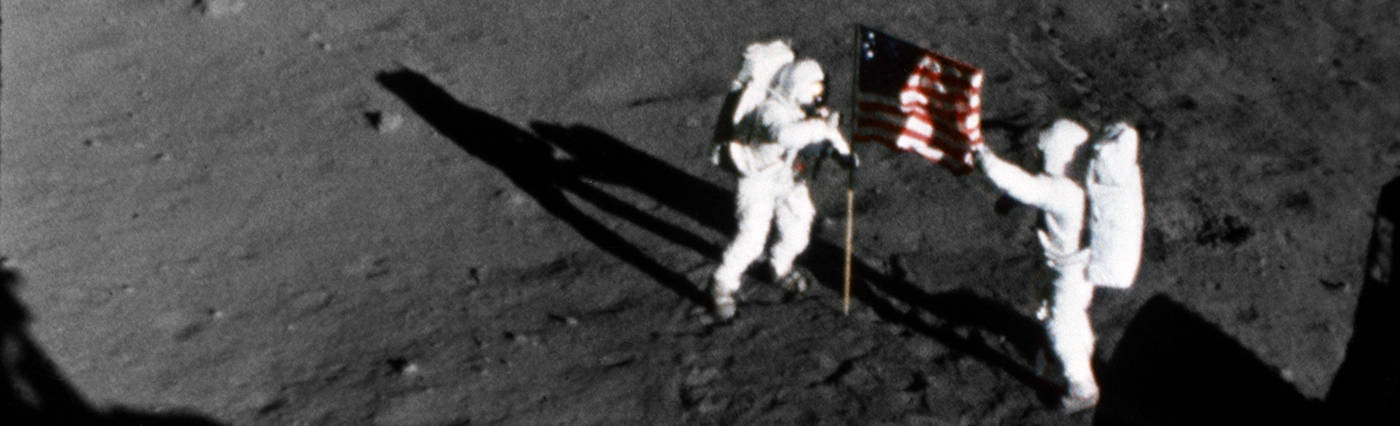
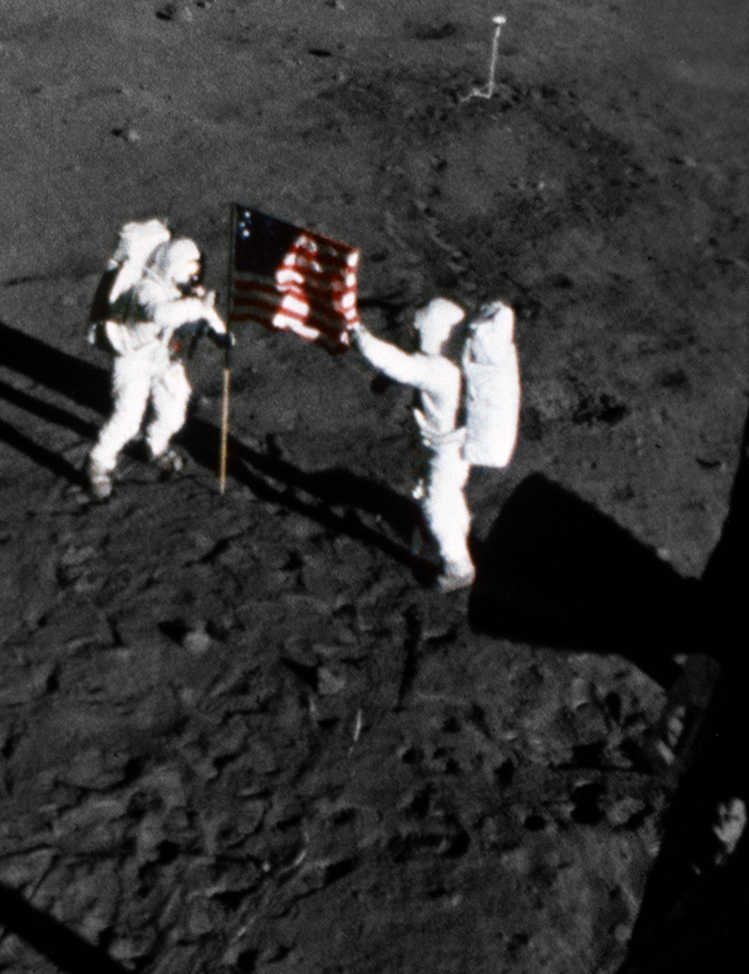
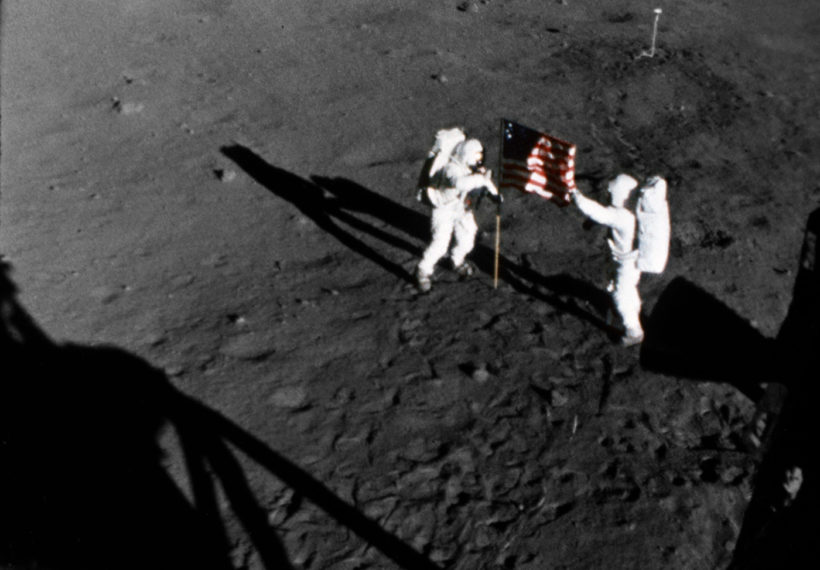
It was just one small step that changed the course of history forever, On July 20, 1969, humans first set foot on the lunar surface with the Apollo 11 mission. 50 years later, we celebrate the anniversary of that mission and look towards the future.
On this episode of StarTalk Radio, Neil deGrasse Tyson and comic co-host Chuck Nice answer fan-submitted questions about Apollo 11 and the future of human space exploration. You’ll learn about Neil’s book Space Chronicles: Facing the Ultimate Frontier, which takes a hard look at the state of space exploration now. Neil tells us why the original title of the book was too dark to put on shelves. We look back at the state of space exploration before the Moon landing and investigate the Russian’s dominance over the United States.
Find out why we don’t go to the Moon more often even though the computing power of our smart phones now matches the computing power of Apollo 11. What lessons did we learn from going to the Moon that we can apply to going to Mars? Investigate the differences in launching from the lunar surface and the red surface. You’ll also hear why Neil and Chuck think sending Flat Earthers to space is a good idea.
Who takes ownership of Mars? Find out about Neil’s idea of homesteading asteroids. We also explore the idea of terraforming Mars and terraforming Earth. When a fan asks where humans should head next after Mars, Neil explains why the approach should not be about sequencing destinations.
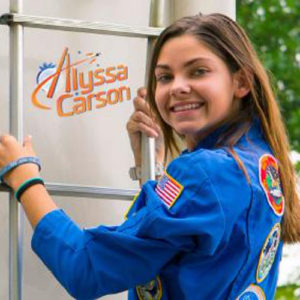
Then, special guest Alyssa Carson, the world’s youngest astronaut in training, drops in to join the conversation. You’ll hear about her involvement in Mars One, and what her current training looks like. We also discuss what “The Right Stuff” looks like in the Mars Generation. All that, plus, Neil weighs in on the importance of the Moon landing and how it shaped our society today.
Transcript
DOWNLOAD SRT
From the American Museum of Natural History in New York City, and beaming out across all of space and time, this is StarTalk, where science and pop culture collapse. This is StarTalk, and I'm your host, Neil deGrasse Tyson, as...
From the American Museum of Natural History in New York City, and beaming out across all of space and time, this is StarTalk, where science and pop culture collapse.
This is StarTalk, and I'm your host, Neil deGrasse Tyson, as always, your personal astrophysicist, and today is a Cosmic Queries special space edition, all space.
Why?
This is the 50th anniversary year of Apollo 11 and the 50th anniversary of the 50th anniversary of the 50th anniversary of the 50th anniversary of the 50th anniversary of the 50th anniversary of the 50th anniversary of the 50th anniversary of the 50th anniversary of the 50th anniversary of the 50th anniversary of the 50th anniversary of the 50th anniversary year of Apollo 11 launching from Earth and landing on the moon and returning safely to Earth.
Not only that, we want to look at the future of space exploration and I have a lot of expertise in that category, so it's just me in this episode, but I don't do this alone without a co-host.
I got Chuck Nice.
Chuck.
Hey, hey, Neil.
Can you do this with me?
Can you hang with me?
Absolutely.
Because I got, you know, I've been, I got this.
Normally we have another expert, but I got this all on my own.
I think.
You are the expert on space.
I think.
I'm on the expert on space and out.
So we good.
We good.
Totally good.
Totally good.
All right.
So what do you have?
Well, we have questions as we always do.
Solicited from our.
That we have gleaned from the internet.
Fan base.
And our very many incarnations.
And we always start with a Patreon patron because they give us money.
Right.
Would you like to give us some money?
You could give us some money.
Read your question.
You don't have to give money to get your question asked.
They just get their questions asked first.
Priority, as we say.
So this is.
By the way, let me just, as introduction to this.
Yeah.
Just as introduction.
Just as an introduction.
I've written two books on space as an exploratory endeavor.
As distinct from astrophysics.
I was gonna say, you've written more than two books on space.
Yes, yes, yes, I'm talking about going to space.
I've got two books on that.
So one of them is this one.
Space Chronicles.
Space Chronicles, Facing the Ultimate Frontier.
It's now in paperback and it's more affordable than the hardcover.
Just a quick story about this.
This is not the title that I submitted the manuscript with.
All right.
No, no.
Now are you sure you wrote this book?
A different book came out the other side.
The title was, Failure to Launch, The Dreams and Delusions of Space Enthusiasts.
Oh, well, so encouraging.
So encouraging.
That you can't have a book with the word failure in it.
And they got all upset and they had meetings after meetings after meetings and they came up with, I said, fine.
So I said, Space Chronicles Facing the Ultimate Frontier.
But this is an indictment of everyone who says, oh yeah, we got to the moon in 1969.
We should be in Mars by 1985.
And how come we're not?
It's because we need charisma.
And there's a lot of sort of misinformation and delusional thinking out there.
This book is a full exploration of that.
Of the fact that we have yet to progress beyond.
There are reasons for that.
Really?
There are reasons.
And the reasons people give, they're not the reasons.
They think they're the reasons, they're not the reason.
It's all in here.
Well, give me the book.
He's like, go buy it.
So this is every...
You really are a good marketer.
I'm like, let me see.
So this is every thought I've ever had about our past, present and future in space.
Well, there are reasons.
And it's not because we need another Kennedy to give a stirring speech.
No, we were at war with the Russians.
And they're the godless communists.
And they had beaten us in practically every metric.
They were winning.
They were, thank you, okay?
They invented the rocket equation.
Yep.
That was 100 and something years ago.
Rocket equation, that tells you how much fuel to put in your rocket to put a payload into some destination.
You know why that matters?
Because the fuel you're burning has to lift the weight of the fuel you need to get back.
Of all the other fuel you have yet to burn.
And so every increment of poundage in your payload has tremendous consequences to how much extra fuel you have to carry.
That's why the Saturn V rocket is mostly fuel.
So all the stages below.
All the states, all fuel.
It's all fuel.
Astronauts in the little bitty section up at the top.
Okay, the little bitty section.
So that's the rocket equation manifest.
A Russian came up with the rocket equation.
The Russians had the first satellite named.
Moose and squirrel.
I forgot about it.
Rocky and Bullwinkle.
No, Sputnik, right?
Boris and Natasha.
And Natasha.
So Sputnik.
Sputnik.
And so they had the first satellite.
They had the first non-human mammal that was a dog.
Leica.
I didn't know the dog's name was Leica.
You didn't know the dog's name?
No, I didn't.
No.
Whose show are you on?
I did not know the dog's name was Leica.
Okay, and they had no plans to bring Leica back alive.
Why are you laughing?
That's not funny.
It just seems so cruel.
Like, you know.
No plans.
It's like man's best friend is just like, good boy.
Like.
So, I think Leica might have been a girl dog instead of a boy dog.
It might have been.
So anyhow, so people got all upset about that and I thought about it and I said, you know, okay, that's really bad that they didn't bring Leica back alive.
They knew Leica would not survive that.
That wasn't the point of the experiment.
But I thought to myself, what was Leica before this?
Alive.
I'm gonna go with alive.
Yes, alive, but as I heard the story, wandering the streets of Moscow, homeless, stray dog, gets plucked from the streets of Moscow and becomes as famous as Lassie overnight.
But she had to die to do it.
I'm saying sometimes to get famous, people die.
This is true.
So if I had a choice of be it dying homeless in the streets of Moscow or dying being the first mammal in orbit and be remembered forever, except you didn't know the dog's name.
It's better to burn out than to fade away, so Laika actually made a mark.
That would be Neil Young of you.
Wasn't that, that's one of the lines of one of his songs.
I believe it is.
It's better to burn out than to fade away.
I don't think it went like that.
Anyway, so they got the first non-human.
They had the first human.
They had the first space station.
They had the first female.
They had the first black person in space.
What?
Yes.
It was a Cuban, a Cuban, a dark-skinned Cuban, but he went up on the Russian spacecraft.
So they did all of this.
And we said, then we land on the moon and say, we win.
So we redefined the finish line and said, we win.
That's how that went down.
And so now we realize they're not really going to the moon and they couldn't do it.
And so we just abandoned the whole thing.
That's it.
We stopped going to the moon in 1972.
And people say, oh, we just need a politician with charisma and political will.
It ain't got nothing to do with that.
It's we felt threatened.
And when you feel threatened, money flows like rivers.
And it's so funny because in that speech, you talked about stirring speeches.
In that speech, JFK actually talked very much about money.
Right, well, Andy, well, he had two big speeches.
One to the joint session of Congress, have to show off now, April 25th, 1961.
Six weeks after Yuri Gagarin had just come back from orbit alive.
We didn't have a spaceship that could not blow up with carrying people yet.
That's when Kennedy said, we'll put him out of the moon, and return him safely to earth.
And that's, and we said, oh yeah, let's do it.
You know what he said two paragraphs before that in that same speech?
No, go ahead.
If the events of recent weeks, he couldn't even utter the man's name.
Right.
Couldn't, the events.
Ha ha ha ha.
Ha ha ha ha.
If the events of recent weeks are any indication of the impact of this adventure on the minds of men everywhere, we need to show the path of freedom over the path of tyranny.
That's right.
The battle cry against communism.
That's it.
That's what that was.
And then the money flowed like rivers.
That's all you need to do.
That's all it was.
That's it.
Bring up communism or socialism.
It's the I don't wanna die driver.
That's all I'm saying.
Nice.
All right.
Give me some.
Okay, here we go.
Here we go.
First question.
That was good stuff.
Okay.
I got more, but I'll save it.
All right, save it, but that's good stuff.
All right, so this is Mateo Moonslave.
Oh, I'm sorry.
Mateo Manzalde.
Chuck.
It looked like Moonslave for a second.
Mateo Manzalde.
Manzalde.
And our Patreon patron who says this.
If we consider that the technology used in Apollo 11 is less than what our smartphones have now.
The computer power.
That's right.
Yes.
What not this mean that the price and facilities to reach the moon is within our reach at this time with no problem?
If so, why has it cost so much to return?
In a way, I see what he's saying.
It's like, if the power in the palm of our hands was the same computing power that sent Apollo 11 and they land it, why aren't we all just sending stuff to the moon ourselves right now?
That's a great question.
That's a great question.
Because the cost of the computing power that was on Apollo 11 was small relative to the cost of the actual power of the rocket engines and everything else that went into the design, construction and safety measures.
So if most of the cost of that mission was in fact computing cost, we can say, yeah, let's go this afternoon.
I'll meet you on Enclavius.
What are you doing, right?
There's a restaurant right on the corner.
Meet me at the big crater.
The big crater restaurant.
They have good food on the moon, but they have no atmosphere.
What?
Aren't I allowed?
Can you allow me?
I gotta, it was well-placed.
Okay, thank you.
Thank you.
This was astrophysic humor.
So that's not the price that needed to drop.
That's all.
Well, that makes sense.
It is true that we, you know, computing powers.
So in other words, the computing power didn't play as much of a role.
Not in the cost.
Not in the cost.
Of getting, you have to build the thing.
You have to, you know, the vehicle assembly building.
You know, the infrastructure.
Right.
And this is a big gap, I think, in our modern thinking of what civilization is and what it has become.
We're all anticipating the next app.
Right.
We all love our next app.
Everybody loves an app.
But where are the inventions that give us transportation systems?
Housing, climate control, energy.
These things are not solved by just awaiting the next app.
This is true.
They require infrastructure, often government infrastructure.
They require government political will.
Yes, exactly.
And without that, you just fade relative to everybody else.
I was in China.
I was about to say.
I was in Shanghai.
You just explained why we are losing to China.
I was in Shanghai.
Yeah.
Right.
Okay.
And there's a sign up there.
I took a picture of it.
There's a sign and it says, okay, men's room this way.
Okay, it's in Chinese, but then there's a thing.
Men's room this way, a boutique shopping this way, maglev that way.
The maglev.
The magnetic train.
The magnetically levitated train to get you, that's from the airport back into Shanghai.
Okay, going hundreds of miles an hour, not touching the track itself.
And I'm thinking, they're just so casual about it.
You can choose to go to the bathroom or on the maglev.
And I'm looking here just bowing at the maglev because that's something we've only ever dreamt of here.
It's over, people.
That's all.
Game over, people.
Maglev next to a bathroom sign.
That's the end of, that's the end.
That's the end.
That's end game right there.
That's end game.
Man.
I always wanted to get robbed in Shanghai.
All right.
That became a verb to get Shanghai.
That's why I want to get robbed in Shanghai.
So I can say I was Shanghai'd.
Okay, here we go.
Let's go to Andy Bracken from Facebook, who says, what lessons from going to the moon can we apply to putting people on Mars?
Looking forward, this young man is.
Okay, there's a big difference between landing on moon and landing on Mars, other than distance.
Well, true.
And that is the moon, as I described in the restaurants there, has no atmosphere, so it means you can't exploit the friction between your craft and the air to slow you down.
To slow you down.
So you have to bring fuel with you to fire in a retro way.
Fire the retro rockets.
Fire the retro rockets, so that you slow down and have a soft landing.
And whereas Mars, though the atmosphere be thin, it's like 1% the thickness of our own atmosphere, which is why that scene in the movie The Martian, where they're in the space and they're trying to launch and there's a wind storm that kicks up.
And they're like, yeah, they're rocked around.
Rocking the thing.
And it'll be like, you'll be like, you'll be like, oh my God, that's refreshing.
It'll be like someone just blowing gentle air on you.
Is that a Martian breeze?
Does anyone have any sarsaparilla?
And I got all up.
I would love to take advantage of this.
And Andy Weir's face about that.
I go, oh, he's the author of it.
He's got engineering background, turned novelist.
Got all up in his face.
I said, what are you doing, dude?
And he said, well, he needed some ruse to make, you know, just to give the excuse to laugh.
Well, what else could he have used?
So I don't know.
I gave it to him, because everything else was good.
Plus, he handed me a very high compliment.
He said when he's calculating all the other stuff in the movie, in his story, he imagined I was looking over his shoulder.
And he's saying, will New York tweet about this if I publish this?
Oh my God, he turns you into like a cosmic boogeyman.
Boogeyman, exactly.
Some lurch over his shoulder.
So that was a high compliment.
That's a very high compliment.
Although a little creepy.
No, but that's very cool, actually.
He didn't want me to tweet about his ass afterwards.
I wish more people did that in movies.
So that's one thing.
You'd have to bring extra fuel to land on the moon relative to landing on Mars.
That's all, because you need fuel to land.
Otherwise, you just use air breaking and parachutes and this sort of thing.
So that's one important thing you learn.
Another thing is both of them are far away from Earth and you're not near any plant life or you probably don't have a factory yet.
So you have to figure out how to live on your own instead of living off the land, because there's no, that doesn't exist.
The settlers, the early settlers, they live off the land.
Well, plus from Europe, they came here, there were people to greet them on the other side and they breathe the same air as they did for long.
I'm sorry.
That was good, yeah, that was good.
Not for long.
Took a couple of centuries, but yeah, we did a number on the air.
And if the ship broke, the trees in the New World were made of wood like the old trees in the mother country.
So it's not entirely analogous to say the pilgrims of tomorrow will be the settlers of Mars.
It's not really the right way to think about it.
Makes sense, yeah.
It's gonna take a heck of a lot more to settle Mars.
It's gonna take a heck of a lot more.
So in both places, you'd have to set up factories to extract mineral resources or natural resources.
You'd have to set up HAB modules, unless you terraform them in advance, HAB modules so that you can breathe the air without always having on a space suit.
So you'd have to do the same in both places.
So to learn something, no, although you can test a lot of things out on the moon, which is much closer, three days away, instead of nine months.
So I'm a fan of going back to the moon just to get our mojo back.
Without that, you go to Mars and something goes wrong.
We'll save you in nine months, right?
That's how that...
In other words, it was nice knowing you.
That's how the NASA mission control.
Exactly.
Well, guys, you had a good run.
Next question.
All right, next question.
Here we go.
This is James Thompson from Twitter.
He says, what are we going against scientific principle to have a flat earther come along for the ride?
And the future mission, if for nothing else, but to squash the notion that the Earth is flat being a myth.
All right, so I would say on the very first mission, the one where you have enough capacity to take a busload of people, gather all the world's flat earthers and stick them on that first mission.
Oh, you say yes.
Oh, yeah.
Just send them all up and then, yeah, just put them all in orbit.
They'll shut them up forever.
But here's the real question.
What?
Do you bring them back?
See, that's the question.
I'm all about putting them up there.
I'm sorry, Houston.
Right, exactly.
We run out of money to bring you back.
No, I'm an educator, so I try to, I'll do whatever I can in order to get someone to understand objective truths in the world.
And what do I do?
I get one of them who they elect to be their representative and you give them a free ride.
I don't have a problem with that.
All right, that's kind of cool.
We gotta take a quick break.
When we come back, it is the 50th anniversary of Apollo 11 and humans future in space when StarTalk returns.
The future of space and the secrets of our planet revealed.
We're back on StarTalk, 50th anniversary of Apollo 11.
Neil Armstrong, Buzz Aldrin walking on the moon, Michael Collins not walking on the moon.
If you go on the moon, just say, okay, you guys go down to the playground, I'll wait for you.
Oh man, yes.
I want, no, I'm there by myself.
I'm trying to figure out like if, how they got to choose.
Choose, right, right, no, that's a complicated thing.
That's it, I mean, because that's a-
It's a complicated algorithm.
Yeah, so we can talk about the 50th anniversary of Apollo plus our future in space.
We solicited questions.
This is Cosmic Queries.
And I'm the in-house expert for this.
By the way, I had a second book on space.
So this is my second book, it came out last year, it came out 2000, no, yeah, 2018.
Accessory to War, the unspoken alliance between astrophysics and the military.
So we all know-
Pretty much, there is no military without astrophysics.
Yeah, there is no history or any of that.
You guys don't get to, they don't get to do anything without you guys.
Right, basically, and it's unspoken because you think we're just on mountaintops waiting for the photons of light to come from stars to grace our detectors.
And that is most of what we do.
However, we have a lot of common thematic overlap.
Things we care about, the military also cares about.
Like detecting dim things that are moving in the sky.
Like multi-spectral imaging of things that might otherwise be hard to detect.
Like the timing, precision timing of phenomenon in the universe.
So in fact, this sextant right behind you, just reach up and grab it, pull it down.
You get it?
It's an authentic sextant from centuries past.
So Chuck, you're a young tyke here.
So this is an early GPS.
That's how people figured out where the hell on Earth they were with a sextant.
There's an authentic sextant which has got the filters because you can use it in the daytime with the sun.
It's a solar filter.
But anyhow, my point is time, location, coordinates, monitoring things in the sky that for us, they're harmless unless it's an asteroid, but for the military, it could be lethal.
This is an entire exploration of that.
This is basically astrophysics if you're not in a hurry.
Because it's 500 pages.
Right, so a little bit more.
Yeah, a little bit more.
Yeah, you need a little bit more.
A little bit more.
Two afternoons.
I have a co-author, Avis Lang, long-time editor of mine from Natural History Magazine.
I couldn't have finished this in any sense.
I figured it would take me several life expectancies to finish this.
Really?
Yeah, so I needed a co-author.
So a very hard-working co-author, Avis Lang.
Well, that's very magnanimous of you.
Because I would have been like, I wrote this book.
No, that's the end of it.
But it says, yeah, I know what it says.
All right, question.
Here we go, here we go.
John Laird from Twitter wants to know this.
How do you see humanity dealing with the concept of ownership in space?
An American flag sits on the moon, but we came in peace for all mankind.
What happens when US astronauts and Chinese taikonauts land at the same spot with potentially, here's the real point.
Highly valuable assets.
See, there's nothing on the moon worth anything.
Okay, well, there is actually.
There's helium-3.
Oh!
Yes, this is an isotope of helium, which is a key ingredient in thermonuclear fusion.
Correct.
It's what's created when in fusion, in the sun.
Yeah, the sun does that every moment of its life.
It pushes out helium, right?
Well, helium is a byproduct of it, but you need helium-3 as an intermediate product before you get helium-4.
And helium-4 is the final byproduct of it, yeah, yeah.
So, and helium-3, our particles that come from the sun, get lodged in the, quote, soils of the moon, so you need some factory device, some plowing device, to sift through the dust.
So you could actually, you could mine the moon for helium-3.
It would be mined, you'd be bulldozing.
Bulldozing.
Yeah, yeah, with filters.
What do they call it?
What do they do?
Strip mining.
Strip mining.
You're gonna shave off the top of mountains?
Shave off, shave down the mountain.
Shave down the mountain.
First it is a mountain, then it is no mountain.
How did that moon end up completely smooth?
Cue ball.
Right?
Moon is a cue ball.
Wouldn't that be great?
Once again, we see the effects of humankind.
The moon, a cue ball.
But go ahead.
So anyway, but his point being, if there's a highly valuable asset.
So watch.
So I don't have a good answer to this, but I can tell you that if humans go into space in a big way, it's not just the astronauts and engineers participating.
It's the artists who want new vistas.
It's the lawyers who have new frontiers of legal precedent.
All right, if let's say you meet an intelligent alien and kill it, is that murder?
Well, our laws don't talk about space aliens, okay?
So if you, what are you talking about?
It's not murder.
If it's an alien.
If it's an alien, Chuck.
But go ahead.
So, there's an entire legal frontier.
And we've already made some inroads in that.
I think something that was successful in the United States was homesteading.
In homesteading, if you have enough money, time and resources to go to some unquote developed spot and cultivate the land and turn it into some crop or whatever, then you keep the land.
You've got to keep it.
You've got to keep it.
So let's not talk about the surface of the moon.
Let's talk about an asteroid.
I was about to say that.
Which we know has natural resources.
And we've got a zillion asteroids.
So I say, I'm gonna launch a mission to an asteroid.
And it's got these minerals.
I go there.
It's my asteroid.
So who does that first, a government or a private person, a private company?
Who gets there first?
Generally, governments do expensive things that have no return first.
And then when you figure out how to make a buck on it, then private enterprise comes afterwards.
That's why the first Europeans to the New World were not the Dutch East India Trading Company.
It was Columbus.
Sent by a country, by Spain.
Not even by Italy, which was busy doing other things.
Italy should have been his thing, but it wasn't, it was Spain.
So that gets me angry.
On a Columbus day, with the Columbus Day parades?
Who comes out for the Columbus Day parades?
A bunch of Italians.
Italian, Italian Americans.
It should be Spaniards.
It should be the Spaniards.
Climbing up the flag pole, say, go home, you didn't pay for this man's voyage.
You had nothing to do with his voyage.
Sit your ass back down and let the Spaniards cheer this man.
And how do we know that that mattered?
Because Queen Isabella, King Ferdinand said, here's a satchel of Spanish flags.
Take them and put them wherever you find land.
And that's why most of the New World speak Spanish and not Italian.
Well, there you have it.
You know who speaks Italian in the world?
Italians.
Italians, Torchina, I think.
I don't know what Torchina is.
Well, this part of the issue here, okay?
And Vatican City.
Vatican City, right.
And maybe one other place in the world, Italian is one of the multiple official languages.
That's it.
And we cannot list how many places speak Spanish.
It's because Queen Isabella said, we're going around the world and we're gonna get people who do this and they're gonna carry flags with them.
So in space.
This is the exploration attitude that they had.
So when you're in space, there's...
By the way, it's not always good for who gets explored, right?
No.
If you explore a place where no one is there, fine, but when people are there to greet you and then you plant a flag, say, the queen now owns this.
It's like, wait a minute, man, I'm already here.
I'm already here.
Yeah, you didn't discover nothing.
How did you plant a flag in my bedroom?
Let me try to kick your ass, whether you can't, because now they got bigger guns and bigger everything.
That reminds me of very quickly, I once found $20 in a couch cushion in my home as a kid.
And I went and I held it up and I said, Dad, I found $20.
He said, give me that.
You can't find it in my house.
Very good.
That was not some treasure hunt of uncharted land.
So the question was, so homesteading is a model that has worked.
I think that the best plan there is not to imagine China going to the same asteroid we go and plant the flag and then we fight about it.
I think the best plan is to come to peace on Earth before this exercise begins.
Oh, that's a good one.
And then we see this exploration as something that is a sort of an Earth activity.
Right.
In the service of the future of the Earth, not for the betterment of one nation relative to others.
Boy, that sounded very kumbaya.
That really did.
I like it.
I think I still had that in me.
I'm all about it, man.
That's beautiful.
That was very Gene Roddenberry.
I like it.
Gene Roddenberry, creator of Star Trek.
Yes, I should have.
Just for the non-geeks out there.
Okay, so here we go.
Matt Quick wants to know this.
Matt Quick?
Matt Quick.
Good name.
Matt Quick.
What Quick means in the Bible?
Alive.
Yeah, it just means alive.
The quick and the dead.
It's just the alive and the dead.
But in the Old West, it was, you know, can you shoot fast?
And if you can't, you get shot in the head.
Well, if you were quick, you were alive.
And if you weren't, you were dead.
It's the same.
It's the same.
That's funny.
All right, here we go.
We know the first destination of humans off planet was the Moon.
And we know the next is likely Mars.
But after we've landed on Mars, where would you like to see humans set foot next?
Interesting question.
So there's an old quote from the space community.
If God wanted us to have a space program, he would have given us a moon.
That's crazy.
That's a good one.
That's a good one.
I like that saying.
There you have it.
There you have it.
So I'm not into sequencing destinations.
I have a more unorthodox perspective.
I want to have a suite of launch vehicles that can take me anywhere I want, whatever my needs happen to be.
You want to go mine asteroids?
That's a certain combination of rockets.
You want to look for life for your scientists?
You want to look for life on Mars?
Different combination.
You want to have a tourist jaunt on the moon?
That's a different combination.
You want to sail the back of a comet?
That's a different combination.
You want to visit, no, you don't want to visit Venus.
It's 900 degrees Fahrenheit.
Sweet.
I don't have to cook anything.
Great.
Just put it out on the windowsill.
Just pull a chicken out of my pocket.
Plunch.
But just consider that you get cooked at the same rate the chicken does.
That's part of the problem.
That's ugly.
So there aren't that many nearby destinations with a surface upon which to walk.
Right.
So the moon and Mars are kind of it nearby.
And Mercury is too hot.
How about the moon of another planet?
Some of the moons of the other planet.
That's where I would go next.
You need a little more life support, but definitely, definitely.
Or maybe the goal is not to land and walk around on a surface.
Maybe it's to hang out in space itself.
One of the things we learned is we know how to build stuff in space.
Right.
We have a space station.
Is that sitting on the surface?
No.
We have the ISS.
There was Mir before that.
Yeah, yeah.
Mir, the Russian one.
And so maybe we're not looking for surface.
We're looking for habitats that are free-floating in space.
I like that idea.
That's kind of cool, actually.
Why not?
Who needs a planetary surface?
And plus, we had the twin brother who just spent a year in space.
We know it can be done.
What can be done?
Spend that much time in space.
Yeah, yeah.
What's my guy's name?
I forgot his name.
What's his name?
Scott?
Yeah, Scott Kelly.
Scott Kelly.
The handsome of the two went into space.
That's what he told me.
That is messed up.
It's funny.
I have a friend.
I'm the bald, handsome one.
I have a friend, Brian Scott McFadden.
He's a comedian.
He does a joke and he says, I have a twin brother, but my parents said they love him more.
Okay, so, all right, here we go.
Look at this.
Hash Factory wants to know this.
What's his name?
Hash Factory from YouTube.
Hash Factory.
Like Hashish?
Like Hashish, maybe.
Exactly.
Now, I'm thinking about Hashish.
Not wondering what was he on here.
What's the question?
Arrowgreen426 from YouTube says, what do you think changed our society when we landed on the moon?
Psychologically, what did it do to us?
That's a great question.
My answer will come in a moment.
We take this final break of our three-part StarTalk Cosmic Queries on our future in space.
Unlocking the secrets of your world, and everything orbiting around it.
This is StarTalk.
StarTalk, we're back, Chuck Nice.
That's right.
Tweeting at ChuckNiceConnect.
Thank you sir, yes.
Very good, I follow you.
Oh, I follow you too.
I don't follow that many people.
I am honored.
Good.
I am honored.
So we're talking about the 50th anniversary of Apollo, we're talking about the future of space exploration, and we figured this show would not be complete without a one-on-one exclusive interview with Alyssa Carson.
You know Alyssa Carson.
She is the future.
She is, it's not just thinking about, she is the future.
18-year-old, who everybody thinks is gonna be the first next person to walk on Mars.
Wow.
And so, do we get Alyssa online?
Alyssa?
Hello.
Thank you for Skyping in.
You're in Germany right now?
And where do you call home?
Home is Baton Rouge, Louisiana.
But soon Florida, kind of all over the place right now with transitioning to college and all.
So, bit of a mess.
All right, okay, you're just graduating high school.
Wow.
So, I got on you here.
So, you're starting college soon.
What will you be studying?
Yeah, so I am planning on studying astrobiology.
And with that, super similar to astrophysics.
Just a bit of a mix of all the different sciences.
And super excited to be doing that.
Just kind of get out of that high school phase and actually have space-related classes and lectures.
So, I'm really looking forward to that.
Fun classes, right?
Isn't astrobiology harder than astrophysics?
Even if it's harder, does it matter to her?
She wants a 10.
Let the woman take what she wants.
I'm just teasing Neil.
I'm teasing Neil, Alyssa.
That's all.
So, you're not thinking about the moon.
We're about to have a 50th anniversary of the moon landing, and you ain't even that.
You're like the self-proclaimed Mars generation.
Tell us what's old fogies, what that is.
Definitely with the 50th happening and all right now, it's super great to be looking at everything that we've accomplished so far within the space program.
And I definitely think, depending on what our ideas are, we may go back to the moon, I think that's kind of the idea.
But I think going back to the moon will kind of start possibly rolling on to Mars.
But I think if we are going back to the moon, it should be kind of in the very soon future, whereas Mars, we still have several years in getting there.
But I definitely think that this generation, in terms of the Mars generation, this generation is the people who will be either working towards a mission to Mars, witnessing a mission on Mars, or being part of that mission on Mars, because we will actually see first person set foot on Mars and that's the goal that we're reaching for.
So you were, I have in our notes here, you were one of the ambassadors for the Mars One plan.
We had the founder of Mars One on StarTalk.
And what was your role in that whole exercise?
Yeah, so Mars One was based out of the Netherlands and they also had their idea of wanting to go to Mars.
They had the idea of colonizing Mars.
So we had met with them actually in the Netherlands.
And I eventually became an ambassador because at the time when we went over there, I was super big, especially in just promoting the idea of going to Mars in general, because it was kind of an idea, but a lot of the general public didn't really have that idea that we were planning on going to Mars, that there was an idea of going to Mars.
And so I think that was a huge part of it, in helping them advocate for their mission, also helping advocate for going to Mars in general, and starting to open up that idea of possibly colonizing Mars in the future.
But you left out the part where you go to Mars and don't come back.
You left that out of that explanation.
So would you have considered going to Mars on a one-way trip?
Because that's part of what Mars One meant, wasn't it?
Right, right, yeah.
Definitely the idea of Mars One was a one-way trip, because they wanted that colonizing.
You go, you live there, you learn everything.
And so, yeah, it was definitely all four talking about getting to Mars one way or another.
And I thought that so many benefits would come from a mission to Mars, and that if that was the route, that was the plan that would end up happening, and that was my only option, then I guess I'd be stuck living on Mars.
Why are you so desperate to go to Mars?
As a young person, I'm interested.
I mean, why do you hate us so much?
Wait, wait, are you running away from Earth, or just at Mars beckons, or both?
Right, I mean, definitely when I was little, I was probably just curious about Mars and about space, and I was just curious to know when I've been there before, I had this interest, what could be there.
I think as I've gotten older, I've learned more about the importance of going to Mars and all the benefits that we can get in terms of building the technologies to actually get to Mars and those helping everyone else here on Earth, or the idea of starting to learn more things on Mars, seeing if developing the technologies to travel there, travel further and continuing on that route.
And so I definitely, the more I've learned about all that and the more important I've realized it is, there's gotta be that crew.
So I've always been interested in going to space, of course, just like so many people.
And so Mars is kind of that next place that we are planning on going.
So I'd be happy to be on it.
So what I like the fact is, in your sort of recitation there, you're including the fact that there's not only the astronauts, but there's the engineering that goes in.
There's a lot of pieces that have to come together.
And not many people think about it in that context.
A more sort of holistically stem construction there.
But let me ask you, I'm old enough to remember all of the lore, most of it true, about the original set of astronauts being the right stuff.
So for the Mars generation, are you the right stuff?
And what does that even mean today?
And I definitely think in terms of becoming an astronaut, a lot of things have changed since those first seven astronauts, you know, we went from just military guys to so many more people now taking part in the space program.
And I think as we continue, we're going to have even more of a variety of people in the space program.
And in terms of, I guess, me having the right stuff and being selected, that's just really what I'm working on and trying to do.
I don't necessarily think I'd be ready to do everything perfectly on a mission to Mars now, but definitely just doing the best I can and almost building a resume to eventually apply and really hope for the best to be able to translate everything I've studied and learned here on Earth and translate that into a mission to Mars.
For me, the right stuff is, did you barf in the centrifuge?
That's a good, yeah.
If you don't barf in the centrifuge, that's the right stuff as far as I'm concerned.
What's your relationship to NASA?
Does NASA know you exist and are you on their radar, literally and figuratively, to be the first, to be plucked, to put on that first mission to Mars?
I will, I definitely have met people who work at NASA and I mean, going through Space Camp, I've also met many people who work at NASA.
A lot of the, I guess, more so-called trainings that I've done recently, starting since I was 15, has been through a citizen science organization called Project Possum, and so they are, their main study is clouds in the upper atmosphere.
However, their ultimate goal as a program is to do a suborbital flight to collect a sample of this cloud.
And so with them, I do suborbital space flight training, such as water survival training, G-force training, decompression, all kinds of different things that actually are very similar to things that will eventually help and apply towards going to space.
So every 18-year-old has G-force training.
I had a G-unit training.
So, do you get frustrated?
I mean, I do.
I just want to, by how much attention, backwards attention space is getting.
Oh, look at what we used to do.
Isn't that great?
The Saturn V and the Apollo.
Does that frustrate you or are you saying, well, that's okay?
What I'm trying to ask is, how do you, what is your confidence that we will all make this happen according to your dreams, rather than just reminisce about the old days on the front porch in a rocking chair?
Right, yeah.
I definitely think that, you know, definitely the 50th is a time to celebrate what we have done, but I definitely think things such as the SLS and the Mission to Mars, I definitely can use a bit more attention as far as, you know, if you walk up to someone on the street and you ask them about it, they wouldn't really have too much of an idea as to what is going on or what the plan is, when, you know, what timeframe they would be looking at.
I do think it is interesting, you know, the amount of media and, you know, like movies, TV shows, all that, but it's now, you know, surfacing about Mars, something to do with Mars, commercials, whatever it might be.
And that's kind of, I think, that buildup towards that, you know, adjusting everyone like, oh, you know, Matt Damon went to Mars, so we can send astronauts to Mars.
It must be possible.
It must be possible.
To grow poop potatoes on Mars.
Absolutely.
Thinking about opening a restaurant.
Special recipe potatoes.
There you go.
So we only have two minutes left.
Is there something you wanna, you know, we have some reach in this show, but not that you need it, because like you're all over the internet with your ambitions.
But is there some message you want us to carry forward that we can try to make your dream and the dream of so many, myself included, more real?
Yeah, you know, something that I think is super important is getting kids to realize that they can start working towards their dream or their goal or their passion at an earlier age.
You know, you don't have to wait until you get to college to start researching what you wanna do.
You know, if there's something that you're interested in, something that you're passionate about, you can definitely start researching it and going to, you know, a science museum or going to whatever it is.
Start asking, maybe find someone in your area that has a career, ask them what they did and kind of get a little bit of that jumpstart because, you know, if you know you're interested and if it changes after that, then that's fine too and you can continue working and pursuing your dream and never give up and really never let anyone take your dream away from you.
Well, I can tell you this, that whether or not the next mission is to Mars, whatever next mission where we're sending humans to a destination, I want Alyssa on that mission.
Absolutely, Alyssa definitely should be yes.
Yes, so, anyhow, Alyssa, we gotta call it quits there, but thank you for being on StarTalk and we'll hope to reach for you again if we do another space show just to find out what's the latest in the Mars generation.
Because we're the Apollo generation.
Exactly, the next time we talk to you, you'll probably be on Mars.
You know, because I think you're gonna get there much sooner than you think.
I really do, you seem like such a driven young woman and it's wonderful.
Yeah, it gives us all hope in the next generation.
Absolutely.
It's not like, oh, the next generation is gonna ruin everything.
No, the next generation is gonna fix everything and take civilization to the next generation.
You've restored my faith in people your age.
I may actually start liking my children again.
All right, Alyssa, thanks for checking in.
We'll find you again.
Take care.
So Chuck, that last question, I think, did we get that answered in this interview?
We did not.
And it was, what do you think changed for our society when we landed on the moon from Arrow Green 426?
And one of the things probably would be someone like Alyssa.
And I'll tell you what happened when we landed on the moon.
Bill Gates and Steve Jobs witnessed it in their early to mid teens, and they transformed the world in which we now live.
So the power of space exploration isn't just Teflon or Velcro or whatever, the stereotype.
All the other great Tang.
Tang, whatever, that's the big Trinity.
Teflon, Velcro and Tang.
I think not all of them are space derived, but that's the trope.
So I think its impact on a civilization goes beyond just what is the economic return.
It's how do you feel, how do you think?
And the fact that when we went to the moon to explore the moon and we discovered Earth for the first time, the modern conservation movement began while we were on the moon.
Very, very, yes, so true.
And the American Civil Society was the foundation of the American Civil Society.
And the American Civil Society was the foundation of the American Civil Society.
And the American Civil Society was the foundation of the American Civil Society.
And the American Civil Society was the foundation of the American Civil Society.
Lead was banned in paint.
There was a DDT was banned.
All of that occurred between 1969 and 1973.
And are we gonna say, oh, we just figured out that's what we should do?
No, we were still at war in a cold war with Russia, in a hot war in Southeast Asia.
And just all of a sudden we're gonna say, let's clean up the earth.
I claim, I assert that we did that because we saw earth floating adrift in space, spaceship earth, and said, oh my gosh, no one is gonna come save us.
We have to save ourselves.
And thus began a modern understanding of our relationship to nature.
That's the kind of stuff space gives you.
And now we're like, yo, we gotta move to Mars because we don't really mess this place up.
But my last point on that, and then we gotta call it, my last point there is, if we're all gonna ship a billion people to Mars, so that's plan B, in case something bad happens on earth, some humans will survive, the species continues.
The remnant.
It's a nice idea, it makes a good headline.
Elon Musk was a fan of that, as was Stephen Hawking, but I think it's not how it's gonna go down.
Because to do that, you want to terraform Mars.
By the way, I have a coffee mug from SpaceX headquarters.
And it's Mars, but you put hot liquid in it, it becomes a terraformed Mars.
It's really cool.
It's green and blue, it's really cool.
You know, it's one of those colors.
Thanks for making me jealous.
You don't have one of these?
It's a terraforming coffee mug.
That's cool.
Anyhow, I got it on property at SpaceX.
So if you have another planet and you terraform it from the current state of Mars to some Earth-like planet and you do that to save us from Earth because we're destroying the environment, I'm just simply saying, whatever it takes to terraform Mars and ship a billion people there, it's gotta be more effort than fixing Earth's problems.
If you could terraform Mars into Earth, you could terraform Earth back into Earth.
Can you not?
That's so true.
Thank you.
That's what I'm saying.
I'm just a realist here.
No, that's true.
We gotta call it quits right there.
Chuck, any final word?
Mars.
Thank you, Chuck.
Chuck, at his most articulate.
I've been and will continue to be Neil deGrasse Tyson, your personal astrophysicist.
This has been StarTalk Cosmic Queries Edition, the 50th anniversary of Apollo.
I remember, I was there.
I'm not there, but I was somewhere else.
I was gonna say, when did that happen?
One small step for a man.
Hey, is that Neil deGrasse Tyson over there?
I was unearthed at the time.
Anyhow, we gotta call it quits there.
Thanks for tuning in, we'll see you next time.
See the full transcript



 Unlock with Patreon

 Become a Patron