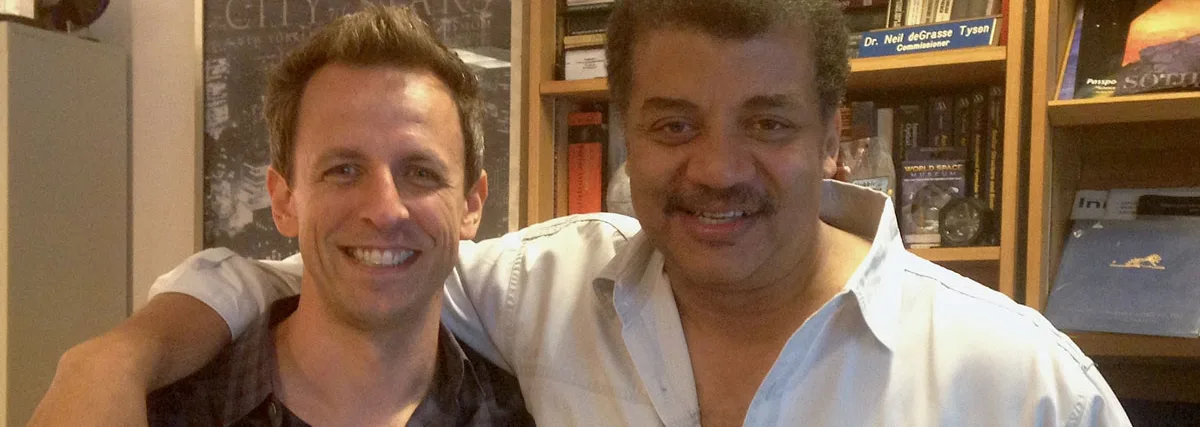
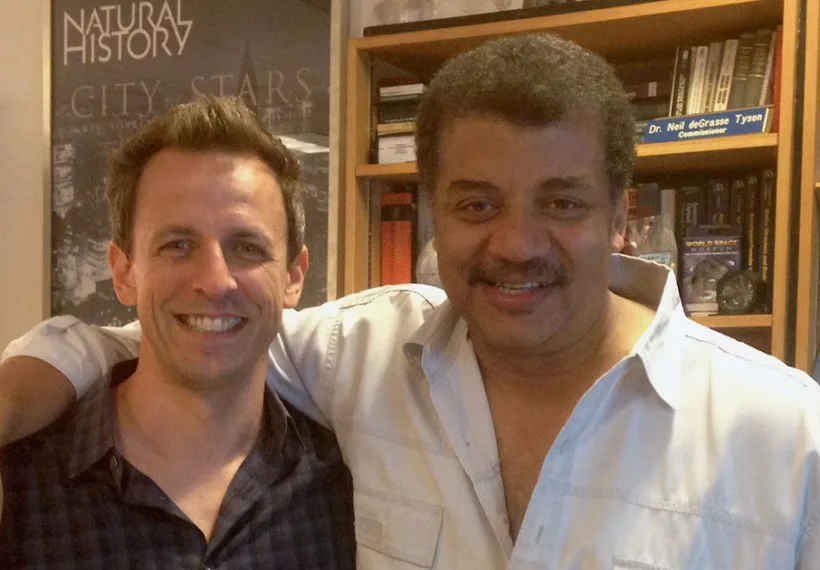
Seth Meyers hosts the Emmy® Awards Monday, August 25, but you can listen to Neil deGrasse Tyson’s interview with the host of Late Night this Sunday, August 24. The two talk about whether there is a science to comedy, and what makes good comedy, especially political comedy. Find out how tough it is to follow President Barak Obama’s “opening act” at the White House Correspondents’ Dinner. Seth talks about his first night on Saturday Night Live – which happened to be the Season 27 opener just days after 9/11. He also reminisces about his 12 seasons on SNL, including what it really means to be the head writer, and the infamous Sarah Palin skits with Tina Fey, some featuring Palin herself. The two hosts discuss science, math, hosting Late Night, Venn diagrams and “This Week in Numbers,” as well as Seth’s role as a time-stopping super hero on The Awesomes. Plus, you’ll find out how to make an airport TSA officer smile. (Hint: it involves either an Emmy… or a meteorite.)
Transcript
DOWNLOAD SRT
Welcome to StarTalk, your place in the universe where science and pop culture collide. StarTalk begins right now. Now. Welcome to StarTalk Radio. I'm Neil deGrasse Tyson, your host. I'm an astrophysicist and director of New York City's Hayden Planetarium...
Welcome to StarTalk, your place in the universe where science and pop culture collide.
StarTalk begins right now.
Now.
Welcome to StarTalk Radio.
I'm Neil deGrasse Tyson, your host.
I'm an astrophysicist and director of New York City's Hayden Planetarium at the American Museum of Natural History.
Today, we'll be listening to my interview with Seth Meyers, former Weekend Update anchor for Saturday Night Live, and host of NBC's Late Night with Seth Meyers.
He's also hosting this year's Emmy Awards ceremony.
In this first interview clip, we start with the basics, where he grew up, his experience in school, and whether he has any interest in science.
I was an inside child.
I don't know what that means.
I didn't like going outside as much, so I liked doing things that were inside.
I was a reader.
I liked reading a lot.
So that's like people have an inside voice and an outside voice, you were an inside child.
Where'd you grow up?
I grew up in southern New Hampshire.
Yeah.
Live free or die?
LFOD, as we say, yeah.
Okay.
For me, it's like sitting in an air-conditioned room, reading in the summer seems to be like you're beating the system.
Like it's not hot or sticky.
It's just very comfortable.
So yeah, you know, I was a big comic book fan.
I loved-
Okay, so that's the start of some geek credential you might be carrying.
Yes, very much so.
Just got back from Comic-Con, actually, which was a delight.
Did you have the rare childhood where you go off to college and your parents did not throw away your comics?
They kept them.
They kept them.
Yeah, and my parents are just very loving parents.
Or your house was big enough.
It was big enough, yeah.
When you live in New Hampshire, you can have the space.
But I also think they want the house to be a museum of their children.
Rather than quickly putting the jacuzzi in your bedroom.
They had a great moment.
This is years ago now.
I guess it would be 98 during the McGuire Sosa home run chase.
My parents had this moment of thinking, wait, Seth has all these baseball cards.
So they went through my baseball card collection and they found all these McGuire.
And the idea had always been like, these will pay for.
And then realizing that everything was worth $1, $1.25.
And at that point they asked if they could throw away my baseball cards because they knew they were worthless.
But at least comic books still have stories.
You can't throw them away.
Right, so at the time, did you want to be the heroes or do you want to write them?
I wanted to be a cartoonist.
That was one of the first things I wanted to be.
Early?
Pre-college.
Pre-college, yeah.
So you have to have art you can draw?
A little bit.
I feel like I'm very good at knowing when my skill level has peaked and when other people have started passing me by.
I was a very good artist.
Not many people are aware of this.
No, self-awareness is the greatest gift.
It is the greatest gift.
You know, I eventually later in life had it on SNL when I realized I'm not as good of an actor as the other people I'm surrounded by.
I need to find a job where I just get to say, hi, I'm Seth Meyers, as opposed to hello, I'm this character.
So that explains it.
That explains it.
You know, I gotta wait till weekend update to see Seth Meyers.
There are certain people when they put on wigs, it's transformative.
Fred Armisen is a perfect example.
Fred can pay hundreds of different kinds of people.
I put on a wig, I look like a guy in a wig.
I look like a guy who walked into a cheap wig store and put on a wig.
No one loses their awareness.
Yes, exactly.
I had a cartoonist teacher once a week after school and my mom would drive me to this guy who was a professional artist.
Loving parents once again.
Loving parents once again.
Most kids are dragged to piano lessons and you get a cartoonist teacher.
I got a cartoonist teacher and we would go and draw and it was really fun and I liked it a great deal, but then I just eventually realized, oh, I'm not that good at it.
But that was a thing I wanted to do at a really young age.
Well, that's the great filtering that should go on in everyone's life.
Yes.
Right, you do it, I like it still, but I'm not good at it.
Let me still keep finding other things.
Yeah.
But don't tell me you didn't want to be one of the superheroes.
That's a guy thing, right?
I did.
I don't have a tattoo, but had I gotten one, I thought about this a lot when I was in high school, I would have gotten the Flash logo, the Flash.
The lightning ball, yeah.
That was the one I always wanted.
Okay, did you know that Flash has atmospheric separators in front of him so he doesn't burn up going through the atmosphere?
That's great.
I will say I love the Flash so much because I remember at a very young age, my dad told me the thing about how he keeps his costume in his ring, which I just thought was the greatest thing, that you could pop out.
That I didn't know.
Yeah, so he pops it out there and just gets into it really fast.
That's because he carries it with him.
Yes, so he's got like sort of a, and that was another thing I wanted when I was younger, is a Flash ring.
But the problem with Flash comics is he constantly more than any other hero has to be having thought bubbles explaining what he's doing because he's moving so fast, he can never be in conversation.
With anybody.
Right.
You know, there's a new Flash show, I think on CW, coming out this year.
And it looks good, I saw the trailer, but that is the problem they have to figure out.
There's never any banter with the Flash.
That's, maybe they don't know that yet.
Yeah.
It's like when they did Waterworld.
Yeah.
Do you realize you're on water the whole movie?
Do people really think this through?
Okay, so you did comics and the Birth of Geek credentials.
Yeah.
Were there any teachers that had singular influence on you?
The teachers that influenced me the most were always sort of English teachers.
I had a lot of great teachers who embraced the idea of reading and reading books that weren't the assigned books, but just the idea of how important that was.
You have awesome sentence composition.
I want to add to this.
That's great.
I think that I've learned just from having a talk show, you really have to learn sentence composition.
No, the sentences that can be interestingly embedded in themselves.
Yes, wow.
With humor and insight and entertainment value.
The biggest problem I had in high school was I always tested really well, but I wasn't a great student.
And science was something where I was very frustrated by it at a very young age.
To the point where you didn't like it as a field, where you just said, no, I'm just not good at it in school.
Well, I liked-
Do people have that experience and then they hate science the whole rest of their life?
I still really love math because math was, I felt like I could hear the clicking of right answers, where in science, I always felt like it was a puzzle I couldn't quite finish.
Oh, very insightful.
Yeah.
You know why in science, on the frontier, you don't know where you're walking, what you might step in, you have no idea.
And so you're just groping in the dark until maybe there's a light that appears.
Whereas the math, you're right, you can still grop in the dark on the frontier of math, but math as an enterprise, yeah, they're clicking ears there, oh, for sure.
And I like answers.
I want answers.
If I'm gonna do homework, I want answers.
You want answers?
I want the truth.
So you went to Northwestern?
I did.
Very cool.
But there's no comedy major there, right?
So you-
No, I had a radio TV film major.
I worked in a video store in high school.
That was all my sort of film education.
What's a video store?
Yeah, it's a thing back in the day.
Back in the day.
You used to take your wagon there.
And then if you got past the Indians, you'd rent if something was out.
It's so amazing back in the day, well, I remember just new releases at the video store.
You would go for weeks and it would just be out.
The movie you wanted would be, you'd have to drive to a video store, it'd be out, and then you'd just drive home without a movie.
But I went to film school, and the thing that pushed me away from the production side of film is just how scientific filmmaking is.
Writing, you can sort of always do at your own pace.
You can always do in your own space.
There's sort of no rules when you're writing.
I mean, ultimately, as you get more professional, you find rules and whatnot.
Plus all the parks are in front of you.
There's a dictionary, there's your mind, there's the paper.
There's a blind page again.
Whereas lighting is lighting.
You can't decide, oh, I'll light it later.
You have to light it now.
And light it in a particular way.
And so I just discovered how much patience and knowledge you needed to be a filmmaker.
Whereas I sort of thought, oh, maybe I'll try to focus on writing more and then let smarter people than myself.
So that was allowed in that major, yeah?
Yeah, there was a sort of sub major for writing and I found my way to that.
Welcome back to StarTalk Radio, I'm Neil deGrasse Tyson.
In this show, we're featuring my interview with Seth Meyers.
In this next clip, Seth and I talk about what first brought him to comedy, and how that led to his 12-year run on Saturday Night Live.
We actually had superlatives in our high school yearbook.
There was a class clown, there was another one called Best Sense of Humor.
I got Best Sense of Humor.
Someone else got Class Clown.
And I realized the difference is the class clown would stand up in the front of the class and just clown around for everyone to laugh at.
And disrupt everything.
The Best Sense of Humor sits in the back of the class and sort of says something snidely about the class clown.
So they split the category.
They split it up.
It's like splitting best director, best picture.
Exactly, very much.
It was a very progressive high school to think that we needed to reward the two different kinds of humor.
And then my freshman year in Northwestern, I saw the improv troupe performed at New Student Week.
The improv troupe in Northwestern is called Meow.
It's very famous.
And I instantly knew that's what I want to do more than everything.
But I auditioned for it three times without getting in.
You need that story otherwise.
Yes.
You have people who said, you're not going to make it.
Absolutely.
The Jordan.
You need the Michael Jordan.
You didn't make the high school basketball team.
Right, right.
But I got in my senior year and I started going up to Chicago to study improv, like take classes.
And so embraced that my senior year.
Quite the legacy of the city.
Yeah, absolutely.
I was lucky that my mother was a theater major.
My father was an engineering major at Northwestern.
They both went to Northwestern.
So you were an academic grad.
Pretty much.
You had free tuition.
No, I definitely did not have free tuition, as I was often reminded by my father.
But I mean, I had free enough and then my parents paid for it.
So SNL, I read Holy Cow.
You debuted the first live show after September 11th.
Yeah, it was crazy.
If I remember, that was opened by Giuliani and Paul Simons.
That was important.
You need the genetic to the city and to the show.
Of the many things that Lorne is great at...
Lorne Michaels.
Lorne Michaels.
One of the things he's best at is whenever the show has to be important, which Lorne is loathe for the show to be important.
He always wants to remind you, we're an entertainment show.
Our job is to make people laugh.
When people try to get too self-important in their writing, he always tells you to back off.
But he does know there are moments where the show has to play this role of importance.
By the way, I moved to New York August 20th.
It's crazy enough that I'm moving here just to be on SNL and living my dream.
9-11 happens.
We don't even know if we're going to do the show.
There's all this talk about it.
Your first time you're on SNL, it's crazy enough just if it's your first time, with all this other stuff on top of it.
I will say no one remembers it as my first show.
That's not the history.
No one's like, oh, you know what I remember about that night?
That kid was on one line.
But yeah, Giuliani was on stage with Lorne.
They threw to Paul Simon, he played the boxer.
And then they came back and it was filled with first responders on stage.
Yeah, firemen and everything, yeah.
And this seems, if it was in a movie, you would think it was a little too on the nose.
But I was getting ready for my last SNL, 12 and a half years on the show, which is a very long time.
And it was this Saturday morning and I was getting ready to leave my apartment and my wife had the radio on and Paul Simon's the boxer played.
I was like, Hey Campbell, this is a perfect bookend.
Also a title of another album.
Yes, exactly.
You want to keep tying it together?
I got the Paul Simon thing.
I'm glad you got it.
I have a bit of trivia for them, for you.
Okay.
Yeah.
There is a lyric in one of their songs, April She Will.
You might not remember this, so if you heard it, you'll get it.
But starting with April, he analogizes the name of the month of each month with his sequence of girlfriends.
April She Will, you start out happy, but then makes you sad when it rains or something.
And May, she'll, okay, April, May, June, this goes through.
There is a lyric in that song that is a pre-global warming lyric.
Really?
Yes.
You ready?
Yeah.
Okay, the autumn winds blow chilly and cold, September, I'll remember.
Wow.
It's like, no, no one is thinking September is autumn winds blowing chilly and cold.
Yeah.
That is a long gone concept.
And that lyric could not have been written today.
Yeah.
That's just a little bit of pre-global warming.
That's really one of the worst things about global warming is how it's dating songs.
I think you were really upset.
So not to get sentimental, but were you sad to leave SNL to get your next job?
I was really sad.
And that was one of the reasons why I came back and did the first half of this last season was I wasn't emotionally ready to leave.
With that said, couldn't have had a better situation moving all of, you know, nine floors as far as offices go and working on the same floor.
Oh, right.
Yeah.
Just 30 Rock.
And the great thing was the part of SNL that I was so worried I was gonna miss.
You didn't have to move to LA.
Say it.
Oh, I did not have to move to LA.
That was a real prerequisite of this job.
I did not.
I can't, you know, my brother loves LA so much.
My wife loves LA and it's just not for me.
I'm convinced that there'd be no such thing as standup comics if there weren't LA and New York to compare with one another.
Absolutely.
It's like the starter kit.
Airplanes and two cities on the coast.
If you can't get past that.
Airports.
Security at airports.
Yeah, yeah, yeah.
Yeah, that's the starter kit.
That's the starter kit.
If you can't make somebody laugh talking about the differences between LA and New York, get out of the business.
Get out.
But, yeah, so it's been great, but it's nice.
The thing I was worried about missing was working with the writing staff and, of course, the upside of my new shows.
I have a writing staff there and so you just find a new family.
So you became head writer at SNL.
How much of a show does a head writer write?
Some weeks you write a lot of it just because you have a hot week, but you're just competing with all the other writers.
Where the head writer job sort of starts.
Competing in a happy way.
You just want the best stuff to come out.
You're writing and some weeks you'll write two or three things and if you have a hot week maybe all of them go to dress rehearsal.
But head writer definitely does not mean best writer.
Head writer sort of means on Wednesday after you read everything that everybody's written, there's sort of holes in the show.
Oftentimes a hole will be a monologue or the hole will be we don't have anything political to open the show.
And the job as head writer is to facilitate and to just make sure those things get done.
And the other thing is after we do that.
So it's a leadership role.
It's just a leadership role.
Yeah, you're bridging the gap between Lauren Michaels and the writing staff.
And is it true you wrote most of the Sarah Palin bits?
I did.
I did.
I was really lucky.
I mean, when you write anything for someone like Tina Fey, the amount she adds to it, like on the floor, she comes up with better jokes than the ones you have.
And the 2008 elections was such an exciting time to work on the show.
The entire writing staff was chipping in, but those were fun to write.
So we heard rumored that the Sarah Palin bits were just pulled out a whole cloth that you can actually go to speeches and comments she's made.
Is that pure comedy unto itself?
Well there were, I think we did six sketches with her.
And the second one was right after she did that famous Katie Couric interview.
And we had sort of written a script with jokes and what not.
And I remember Tina on that week, that one specifically said, I think we should just transcribe it and just do it exactly what she said.
So there was a huge chunk of that sketch that was just transcription.
And I think in the best way of when you're sort of writing, of any sort of political writing, and I feel like this is something that Colbert and The Daily Show and John Oliver now do really well, is they sort of use the subject's momentum against them.
It's like judo as opposed to karate.
And I think when you do that, it seems very fair.
And I think it makes the point better than when you do something that could be perceived as sort of an ad hominem attack on someone.
I never thought about it, but that's exactly what's going on there.
And like you said, especially The Daily Show will get clips and you'll play the clip.
Yeah.
And there it is.
And then you think the clip is out of context, and then they play more of that same clip.
Right.
No, you had it right what that meaning was.
You know, if you go back 10, 15 years, you are watching someone say like, this person's an idiot, and without sort of that proof, I think people then think it's just the political position of the person who's saying that.
So Sarah Palin was really fun.
Although it went the other way as well, because I remember one of the things we wrote and one of the last ones was her turning to another camera and saying, I'm going rogue.
And then that was the title of her book.
So we borrowed from each other.
So do you have a moral, cultural responsibility?
I really think your first responsibility when you're doing this is remembering that you're entertainers.
On Saturday, we're talking about, you know, 1130 at night, even more now when you're doing weeknight shows at 1230.
You have to remember, like, what are people tuning in for?
What is your responsibility?
And we want to have a show that's both smart and silly.
And number one, I want to laugh, I guess.
Yeah, I want to make people laugh.
Like that's what I'm there for.
But as far as any time I feel like you can call out people in power, the those elected officials who have this responsibility to us, anytime you can sort of call them out for not fulfilling that responsibility, that's a fun thing to do.
It's fun and good and could have a purpose.
Yes.
Achieve a goal.
Yes.
But in a really good way, Lauren Michaels constantly reminds us, you know, this is you, we're entertainers.
Achieve your goals in your own time.
Don't let it get too much to your head.
Otherwise you'll take yourself to it.
Absolutely.
You can't do comedy.
You'll overrate your own power.
Yes.
You absolutely will overrate it.
Because I do feel like sometimes the chemistry of when you're influencing people and when by trying to influence them, you're pushing them the other way.
Like that, we'll never really know.
Welcome back to StarTalk Radio, I'm Neil deGrasse Tyson.
We've been featuring my interview with Seth Meyers, and in this next clip, we talk about his new job, hosting Late Night with Seth Meyers on NBC.
So I've been a guest on your show.
You've been a guest, you were great.
You played along, you talked to Pluto.
I talked, you brought Pluto in, oh my gosh.
That was a great bit, and I gotta tell you my three favorite, your Venn diagrams.
Thank you.
Oh my gosh, and every time I see a Venn diagram, of any kind, I say, that is so brilliant and so simple.
Yes.
Yet somebody had to invent it.
Some dude named Venn, you know?
Right.
I want, in my life, to invent something that simple.
Yeah.
And I don't know what that takes.
That is the definition, we were talking about math earlier, of the sound of a click.
Also, I've always found, and I don't know if you've found this as well, but a lot of my best ideas happened immediately.
This is the way I've always felt about sketch writing.
Yeah, a thing I've always said to writers, too, is good comedy ideas should write easy.
They should write downhill.
Whereas if you have an idea and you've been working on it for eight, 10 hours, it might not be a good idea.
Because there's something about comedy that, if the audience can tell if it's tortured writing, if it's over-constructed.
That's the word, over-constructed?
Yes.
Over-built.
And Venn diagrams is a perfect example of it.
I bet one day he thought of it so fast.
And any scientist is a math person, you have the weekend numbers.
Yes.
Is that going strong?
That's going strong too, still in the rotation.
In the rotation.
Well, you-
Hasn't been subbed out.
No, well, you have to generate so many of these desk pieces.
The top 10 list on David Letterman is the Venn diagrams of late night desk pieces.
The fact that they've been doing it every night for all these years.
And there are people who tune in just for that.
Just for that.
So you try to come up with something that, eventually we want to say, and now it's time for Venn diagrams and have everybody applaud with excitement, knowing, oh, I like Venn diagrams.
Right, right.
And like I said, like the weekend numbers, I don't think there's enough quantization of life.
We shouldn't have too much of it, but we need more than what we do have.
People think that life is just something that, oh, that feels good, or is this, or is that, but actually you can measure that.
You can count that.
You can know how big that is.
Well, I am a sports fan, and I think one of the things I liked most about sports, even as a kid, is all the statistics of sports.
And now there's been this explosion in recent years of even deeper statistics, specifically in baseball.
Because baseball, you have the time to talk about it between pictures.
Exactly, it's so much time.
The reality is I watch less baseball than I read about it later, and I agree.
I think there's something very nice and very comforting about being able to quantify things.
I have a whole category of sports tweets that I put out, and some of them are baseball.
And so here's one, let me share with you.
I think if you get hit by a pitch on ball four, you should go to second base.
That's great.
Absolutely, because that has to be a punishment.
Yeah, you hit by pitch, you get first base.
Ball four, you get first base.
You get hit by a pitch on ball four, you go to second base.
Great, I sign off.
Okay, now on basketball.
Yes.
If you have a three-point line, because you're rewarded for being far away, I think a slam dunk should be one point.
Okay, I'd like that too, but I'm not going to sign off on it.
Because we have to remember this is entertainment.
Yes, okay.
So you don't want to do anything that makes less dunks.
You don't want to make dunks less rewarding.
Less rewarding or have fewer of them.
Yes, exactly.
Okay, all right, we'll give you that.
But I'm fully on the ball four thing.
And I'm a big fan of Back in My Day.
I think about that all the time when I give talks.
I try to fold in something that pokes fun at recent past.
Yeah.
And I have kids.
Do you have kids?
No, just married.
Yeah.
You have kids?
No, just my wife.
I don't know what that means.
I'm just saying that she wants them so much that it's only because we're just married that I don't have them yet.
Oh, gotcha.
So the kids, you get to be in the mind of someone who takes everything for granted that you saw discovered.
Yes.
Right.
There's a whole other realm of material waiting for you to tap.
And that happens, I just want to tell you.
So can you imagine anything such as a science of comedy or mathematics of comedy?
Is there?
Yeah, I think not.
Could it be so formulaic that it's no longer funny?
Well, there's this really good book called, I want to say I'm Dying Up Here.
And it was about the comedy store in LA and the-
Yes.
And it's a sort of, I want to say the late seventies, but it's Leno and Letterman and one of the comedians in the books.
He believed he'd figured out the science of comedy.
And of course he had.
Like anyone who thinks they've gotten it down to ones and zeros has lost what makes comedy great.
With that said, the other head writer job is, you know, when you rewrite sketches, just by trial and error, you can sort of say, hey, as somebody who's seen 500 sketches, I will just tell you that they will.
So you're invoking a life experience force rather than a mathematical force.
Yes, but I do think there's a little bit of, you know, as with experimentation and finding results and sort of tracking them, you know, but they're not absolute rules.
So your life experience gives you insight as to whether somebody's idea, somebody's skit, somebody's joke, might fail.
And let's assume you're right most of the time.
Is there anything that's fixable about it, or you just pour it out and start a new glass?
No, you can fix it.
You know, an example of something I've sort of learned at SNL, which I think is different, because this can work in other comedy shows and people pull it off with great aplomb, but at SNL, I always found like, when people are playing characters, if the character knows they're a loser, it's less fun.
Whereas if the character is just loving their life, a good example for me is Kristen Wiig's Target Lady.
Had no idea she was a weirdo.
She was so happy with who she was.
The audience knew she was a weirdo.
Whereas I think if you have the character be sad about who they are, the audience will also feel sad.
Especially with live television and that live studio audience, the audience has empathy for the characters.
So you try very hard to make sure that they are sort of upbeat.
Welcome back to StarTalk Radio, I'm Neil deGrasse Tyson.
Seth Meyers was the keynote speaker at the always entertaining White House Correspondents Association dinner in 2011.
Let's hear what he had to say about that experience.
When I stood at the podium, you realize that the podium is sized for the president, and the president is taller than I am, and I felt like a little kid, and there's a thing you can pull out, like sort of a three inch step.
So if you watch it, I actually look a little taller than the president, because he spoke and then he came and somebody pulled my thing out and I stood.
So this is the speaker's version of a phone book.
Absolutely, full phone book, yes.
At least I didn't have to walk up with a phone book, and then everybody saw me set it down.
For younger listeners, a phone book is how you used to get.
Back in the day.
Back in the day, back in the day.
And let me say, it used to be the president went second at the White House Correspondents dinner.
Obama flipped it, so Obama gets to open.
He's the president of the United States.
He murders.
He murders because he's the president and you have to follow the president.
He had great timing in there.
He has a stand-up's timing.
A stand-up's timing.
Making matters worse, he doesn't end with a joke.
He ends with a spare thought for the troops.
Like he brings the room all the way down.
He ice's the room and then you ladies and gentlemen, Seth Meyers, he's just killer.
Killer, but he's great.
Was it your year when he said, Zola's talk about my birth certificate, but we did some research and we produced something better than that?
We have my birth video.
The Lion King.
The Lion King.
That was upstanding.
That was great.
And again, I'm sitting there thinking, why do I have to follow?
Because again, he's also the president.
You know, like if you're good and he's good, the tiebreaker is who's the president.
And the crazy thing about the year I did it was the next day he announced Sealed Team Six had killed Bin Laden.
I spent three weeks leading up to that.
All I did was think about that performance.
I really used 100% of my brain.
I went full Lucy, full Lucy.
I used all 100%.
And I couldn't make dinner plans.
And here he is, outstanding, working on the Bin Laden thing.
Yeah, and perfect timing.
So some comedy is just fun and entertaining, but other comedy is politically barbed.
Sure.
You've led that parade here.
Oh yeah, I don't know if I've led it, but I think it's been a good era of people who've been doing it.
Does it influence politics?
I don't know.
Or does it reflect it, and is it just the scenery along the way to where it's going inevitably?
Well, I think to some degree.
You know, everyone sort of said after the 2008 election that a lot of the comedy shows have a big influence on it.
That was claimed, huh?
Yeah, that was claimed.
But then of course in 2004, I think those comedy shows were sort of making the same points and didn't have the same influence.
So, you know, we'll see as time goes forward.
I think to some degree, when you look at 2008, I think a lot of comedians, Asad El included, were pointing out the shortcomings of a candidate like Sarah Palin.
But the reality is I do think most Americans would have come to that conclusion on their own time.
Or it would not have mattered to them and they'd still vote for her.
Right, I mean, that's, yeah.
I don't know who the fence people were that in the end were thanks for.
Why are there more liberal comedians than conservative comedians?
Is it just an illusion that I have?
I think it's real.
No, I think you're right.
I think the best comedy comes from going after the favorite as opposed to going after the underdog.
I feel like a lot of conservative politics, they seem to be piling on the underdog.
I don't know, it's less fun for me for people who aren't going after sort of the head of the dragon.
I got you.
And I can think a lot of conservatives right now would say that comedians don't go after Obama enough.
But I think there is a lot of examples of that, of comedians who do.
But also, you know, liberal comedians aren't gonna go after Obama for not being conservative enough, they're gonna go after him for not being liberal enough.
You know, my disappointment with President Obama has been that he's more conservative than I thought he would be.
Not because he wears high-waisted jeans.
Look, that's great.
When he does something like that, when he gives us a little nibble, a little something we can make a joke about.
So, you're doing the Emmys this year.
Yes.
I'm not gonna see you this year.
No, you're not going?
No, because Cosmos was nominated for 12 Emmys.
12, are they all?
It's in the documentary category.
Gotcha.
And your night, you don't announce the documentary.
Writers at SNL, I've heard, refer to the Creative Arts Emmys as the Ponytail Emmys, because there are so many sound engineers.
There's a lot of guys with ponytails at the Creative Arts Emmys.
The Creative Arts Emmys, though, have a very special place in my heart, because the only time I won an Emmy was for writing song lyrics, and that was at the Creative Arts Emmys.
It feels a little bit less than the Emmys, I'm not gonna lie.
Than the regular Emmys.
Unless you win.
Because the Emmy's the same.
And when you're holding that Emmy, you don't care which Emmy it is.
If you're holding an Emmy, everything is outstanding.
Boarding an airplane with an Emmy, everybody's really excited to see it.
If you've been waiting your whole life to see a TSA person smile, win an Emmy.
Take it at an Emmy.
Okay, my one encounter with a TSA person was a completely odd thing.
I brought a meteorite, a very heavy, dense meteorite, through security.
And this is an opaque object in the x-ray.
And they say, what is in there?
And I kept thinking, how am I gonna play this?
I was like, oh, it's just a meteorite.
I just had to be really just cool, you know?
Don't you get these all the time?
And so I showed it to them and they all gathered around and touched it.
And so it was good.
So we're back on StarTalk Radio.
I'm Neil deGrasse Tyson.
In this final part of my interview with Seth Meyers, we talk about his animated series, The Awesomes, which is streamed on Hulu.
My producer at Late Night, Mike Schumacher and I, who used to be a producer at SNL, we had this idea for a superhero show back in 2006, and it kicked around forever.
It was in development at Sci-Fi, MTV.
Wrong guy.
That's a quantifier.
Wrong guy to use a pipe verbally with.
Yeah, forever.
I got forever, all right.
But Hulu's been a great place for it, and the animation world is such a different world because you do have to sort of lock your idea in months before you see the finished product, whereas everything else I've ever done.
You can change it an hour earlier.
Absolutely.
You can change it on the fly.
And we work with a great, Bento Box is this great animation company, and they're very patient with us, but every now and then somebody has to call us and say, this cannot happen.
Bento Box, I guess they're in Japan.
They're not actually, they're in LA.
Absolutely.
So you have a superpower.
Yeah.
You can stop time.
Yes.
For 10 seconds.
Yes, but it kills me.
Slowly it kills me.
So I have to be very limited.
Life kills you.
No, stopping the time puts so much pressure on my brain.
The power.
How much does it kill you?
It starts to have nosebleeds, and I've been told by my doctor on the show to be very careful about using it, because they don't quite know.
They haven't been able to scientifically test it.
It's too much stress on you.
Too much stress.
And using the stopping time on the show, which is based on me personally, I'm an over-thinker, so I need to live in a world where I can't procrastinate, which I live in now with Late Night, which I lived in with SNL.
If given extra time, I just spin out and overthink.
So every time this character, Proc, stops time that you think he's likely to-
Proc, this is that you're nickname?
Yes, that's the character on the show.
Your doctor.
Proc is a shortening of Professor Doctor.
So you feel free to use that.
Okay, yeah, well, no, I've been added to titles.
Gotcha.
If a title implies that you should believe me because of my title, rather than for how good of an argument I offered you.
I mean, I don't really use a title, too.
One of my favorite things is when I meet somebody every now and then they ask if I have a business card.
It's like I'm a late-night nurse.
Why would I have a business card?
So it hasn't, what's the first-
Season one was last year.
Well, I missed it, I'm sorry.
Oh, no worries, no worries.
And then August 4th was the premiere of season two.
Okay, well, it's right there, so-
Yes, it's right in Hulu, and hopefully we're helping people go back and watch.
It's also, you know, because we came from comic books, we tried to do an animated show where it does tell one story, and you do have to watch the previous episode to be able to follow the plot.
So this is your excuse for showing up at Comic-Con.
Yes, that was why I went.
Because they've been cutting down on the rules.
There've been some shows.
They said, oh, look, there's a great audience, let's just go there, no, you don't have any comics, and you don't have any soup or anything, and you don't belong.
There's so many shows that don't belong at Comic-Con.
Yes, completely, oh, my gosh.
I mean, the good news is, it doesn't seem like the populace is that upset about it, but when you have a real show, the Shmear Comic-Con, you do get a little upset with your hall placement.
Yeah, Cosmos was featured at Comic-Con because we had animations within each episode.
Cosmos fits into Comic-Con, whether you had animation or not, that fits.
Well, they had my peeps, I mean, there's a whole geekosphere.
Yes.
And you were in a couple of movies.
No, just I think literally a couple.
I think a couple, two movies, a couple equals two.
Yeah.
Forgive me, I've seen these movies you were in, but I don't remember you.
Okay, great.
Is that a good thing or a bad thing?
I think it's a good thing.
Did you blend in with, it's a good thing.
Were you such a good actor?
No, I think I have a few lines.
It's a very good thing that I have my own talk show and don't have to be in movies anymore.
My most sciency movie, Journey to the Center of the Earth.
The Jules Verne story.
Yes.
Journey to the Center of the Earth.
And I had two scenes.
I was a scientist.
You were a scientist.
I was Dean Alan Kitzens was my name and I have a trading card, which is hilarious because they did 3D trading cards, but I'm in no action scenes, so my trading card is just a head shot.
So wait a minute.
So in your animated life, you were a professor.
Yes.
And in Journey to the Center of the Earth, you were academic professor.
Yes, exactly.
There is something there.
There is something there.
Yeah.
But I had two scenes.
The first scene was right in the beginning of the movie and I basically said to paraphrasing here, but I said to Brendan Fraser, you can't go to the center of the earth.
And then I had a scene at the end of the movie where I basically said, what, huh?
So those are my two scenes.
Both.
Wait, do that again.
Let me hear that again.
What, huh?
You were what?
You were where?
Fully the center?
Now, actually, I'm disappointed that that's the best they scripted for you in response to someone going to the center of the earth.
I know, I know.
Just a guttural utterance.
Yeah, that was about it.
But I will say it was 3D and it was using a new 3D technology at the time.
And the first scene, the director said, if there's anything you can think of to do, just because it's 3D.
And so the first thing I did, because basically I was measuring Brendan Fraser's office because he was about to lose his job.
In the end, he didn't because of the center of the earth thing.
That's the kind of thing that can give you tenure, you know, a job, yeah.
The first 3D moment in the film is me turning the tape measure to camera and then snapping it back.
Okay, all right, it's gotta be something.
Something that people don't do in real life.
And then we read up on this that in Korea, the movie was in 4D.
Was it really?
Yes.
Oh my goodness.
Yes, so they put in other effects.
Sound, smells, water spray, and so your other senses are now, we're engaging it.
So they-
Wow, and then-
Just so you know.
They did a sequel, a few months, like five years later, with The Rock.
You mean Dwayne Johnson?
Dwayne, Dwayne The Rock Johnson.
And I instantly texted the director, who I hadn't spoken to for five years, and then I just wrote, I am so excited we're doing another one.
This is so great.
I can't wait to see you.
They did not pick up my sarcasm because he texted me, like, oh, I don't know if your character is gonna be back in the second one.
You've been listening to StarTalk Radio.
We're brought to you in part by a grant from the Sloan Foundation.
I'm Neil deGrasse Tyson, as always, compelling you to keep looking up.
See the full transcript



 Unlock with Patreon
 Become a Patron