Transcript
DOWNLOAD SRT
Welcome to StarTalk, your place in the universe where science and pop culture collide. StarTalk begins right now. Welcome to StarTalk Radio. I'm your host, Neil deGrasse Tyson. I'm an astrophysicist and director of New York City's Hayden Planetarium at...
Welcome to StarTalk, your place in the universe where science and pop culture collide.
StarTalk begins right now.
Welcome to StarTalk Radio.
I'm your host, Neil deGrasse Tyson.
I'm an astrophysicist and director of New York City's Hayden Planetarium at the American Museum of Natural History.
You're all invited.
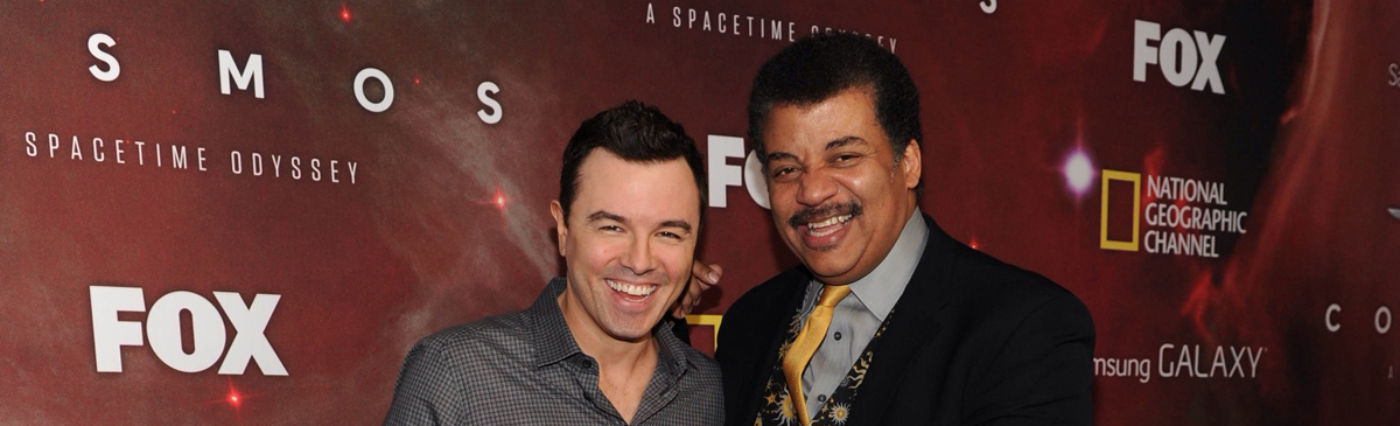
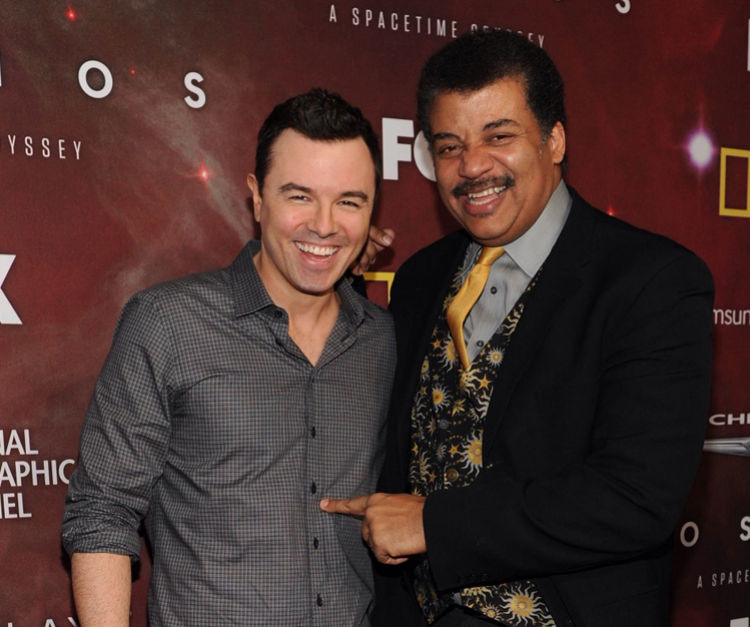
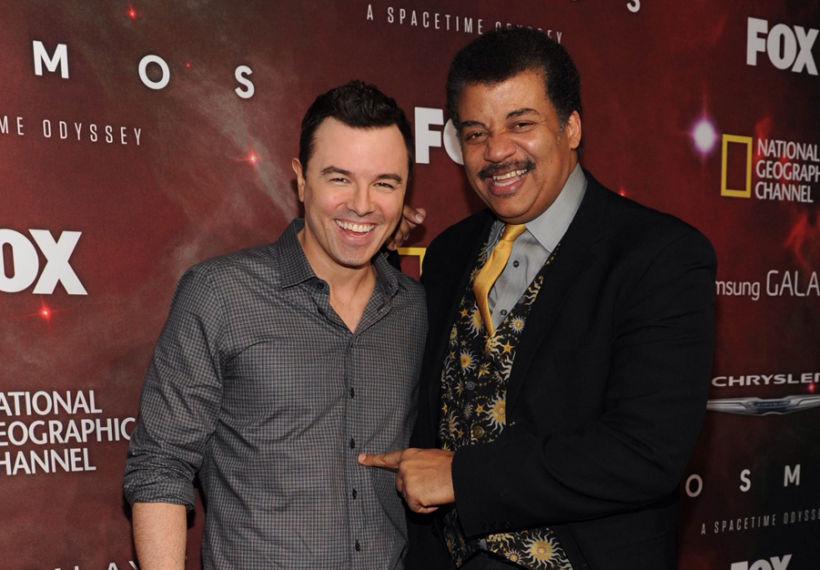
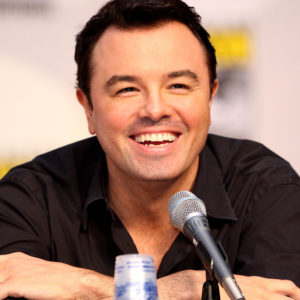
Our show today features an interview with Seth MacFarlane.
Many of you know him as the creator and voice town for the Fox animated series Family Guy.
He's also the co-creator of the TV shows American Dad and The Cleveland Show.
And in recent years, he's turned his skills to movies, co-writing and directing the hit 2012 film Ted.
He also wrote, directed, and starred in his latest movie, a comedy western called A Million Ways to Die in the West.
But my connection to Seth comes from the TV series Cosmos, which I hosted.
And we'll hear later in the broadcast that he's an executive producer of the series and was instrumental in bringing the show to Fox television.
But in this first part of the interview, I spoke to Seth about Family Guy.
For those who haven't watched the series, it's centered on a family.
Parents, Peter and Louis, their children, Meg, Chris and Stewie, and their pet dog, Brian.
The cartoon originally premiered on Fox in 1999 but was canceled in 2002.
The show moved to the Cartoon Network in 2003 and immediately became their top rated show.
The first two seasons were also released then on DVD and the huge sales convinced Fox of the errors of their ways and they gave their series another run in 2005 and it's been going strong ever since.
Family Guy has been described by one critic as a nasty but extremely funny cartoon.
I gotta agree with that.
The show originally based much of its comedy on the character Stewie voiced by Seth.
Stewie, the youngest child in the family, is a super villain who conducts evil experiments and has plans for total world domination.
But as the show has developed over the years, its humor has expanded to encompass current events and pop culture.
When I spoke with Seth MacFarlane, I told him how I first discovered his show.
You know, my kids introduced me to Family Guy.
They were huddled around their computer.
See, they seemed like smart kids.
Your kids are smarter than any of my friends.
Your kids are what, like 12?
One is 13, the other is 17.
I have no friends my age who are as smart as your kids.
So they were huddled around the computer.
And they said, oh, nothing, nothing.
And then I snuck in there and I said, wow, this is some funny stuff.
And then I noticed that every second or third episode, there is some reference to science.
Sure.
And it could be a positive thing about science or critique of people who themselves are critiquing science, right?
There is some science reference.
So I said, there's a thread going through this guy.
I wonder what that is.
I was always a big science fiction fan and so I, whenever possible, jumped at the opportunity to have Stewie veer into that world.
That's right, he's the primary science conduit.
Animation fans tend to be fans of science fiction and have an interest in science.
Evidenced by the demographics that attend Comic-Con.
Yes, yes.
Everyone they're dressed as Klingon actually knows the difference between fantasy and objective reality.
Yeah, it's true.
They know the laws of physics.
Kind of have a better grasp on reality than most people.
What a profound concept.
I never thought about that, but I think you're probably right.
Yeah, and then there's not only the science, there's the persistent reference to science fiction.
Well, actually there's reference to a lot of pop culture, but I think only the science fiction earns full episode attention, right?
Yeah.
Like Star Wars.
Right.
Did George Lucas call you after that?
It is strange.
If you're really being anal about it, is Star Wars really science fiction or is it kind of action adventure?
Yeah.
Fall into, I mean, if we're really being sticklers about it.
I would have to agree, because there is no science in it that you're saying, hey, that could happen one day.
I mean, I'd love it.
Don't get me wrong.
No one is having those thoughts, unlike with Star Trek, where they actually put thought into the warp drives and the phasers and the photon torpedoes.
Yeah.
They know that a parsec is a unit of distance in that time.
That's a really geeky reference to the original.
That always bugged me.
That always bugged me.
Really, even in 77, with all those smart people walking around, nobody caught that, huh?
As Han Solo's boasting of his Millennium Falcon.
Sex sounds like second.
It must be time.
He describes how fast he was in his Millennium Falcon and cites the unit of time in parsecs.
Thank God they never got to light years.
So to my surprise, after we had lunch one day, all you did was ask me questions about the Big Bang in the early universe.
So I say, yeah, this guy's like, he's all there, yeah, yeah.
And then nothing else was spoken and you walked away into the mist.
And then eight months later, six months later, Stewie visits the Big Bang in his time machine.
Now I didn't see that episode when it aired, but my cell phone started lighting up.
Okay.
There it was, a full screen credit, Neil deGrasse Tyson, science consultant.
I'm trying to remember, did we ask you if we could do that?
No, not at all.
It was just us being extraordinarily presumptuous, trying to legitimize ourselves.
This will get the critics on our side, damn it all.
But how many cartoons get to cite science consultant?
Exactly.
No, it was good.
I recommend to anybody, you'd probably get it on Netflix or wherever.
It's the episode called The Big Bang Theory.
Stewie uses his time machine to go back to the Big Bang, and he's outside of the space-time continuum with Brian.
That was brilliant, it was brilliant.
Not just because I inadvertently advised on it, but I think it was very well done.
In my world, everybody's favorite scene in Family Guy is when Peter wants to become a redneck and take on the culture.
Gets the hat, gets the boots, they move south, and he turns on the TV.
Cosmos.
Tell me what went through your head there.
What is that?
It's an illustration of the modern-day clash between science and religion.
And I don't remember who wrote that gag, but it was in one of our cutaway rooms.
We have these satellite rooms that go off the main room, and they come back with a series of gags, and we'll pick the best one.
So, you know, I'm not the only Cosmos fan on that staff.
I did do the voice of Carl Sagan, though.
Let me hear, let me hear something, Carl.
It's just a slightly, slightly altered Kermit the Frog.
I feel terrible.
He's one of my heroes.
But it was, he had a very distinctive voice.
Yeah, yeah, yeah, yeah.
And so in that scene, in case you hadn't seen it, there's Carl Sagan delivering some lines from the original Cosmos, and it's edited.
And Peter says, honey, look, it's Cosmos edited for Rednecks.
And he says, in the beginning, there was the Big Mac.
Yeah, I think they've got to stretch it all out, because that's the only way.
And the universe is 13 billion, 6,000.
You know, it's interesting, and I do try, and I know you do as well, to try to talk about that without succumbing to the temptation to say, come on, there's just no evidence.
I mean, the Earth cannot be 6,000 years old.
It just can't.
I mean, it's not a matter of your beliefs versus my beliefs.
It just can't.
But there aren't many cartoons that address this.
That's my point.
So I tip my hat to you.
Did you have any concept at the time that you would be working on Cosmos?
No, because I didn't know that it was even being discussed.
We hadn't met.
Yeah.
You've been listening to StarTalk Radio.
I'm Neil deGrasse Tyson.
When we return, we'll continue the conversation with Seth MacFarlane on how he came to produce the Fox TV series Cosmos.
Welcome back to StarTalk Radio.
I'm your host, Neil deGrasse Tyson.
Our show today features an interview with the actor, writer, director, voice talent, Seth MacFarlane.
He's also a producer, and he served in that role for my TV series, Cosmos.
In this part of the interview, I talked with him about when we first met and how he came to bring this Cosmos sequel to Fox TV.
Do you remember when we met?
It was at that Seafood, well, we met at the Science, that's where we discussed Cosmos.
But we met.
At the Science and Entertainment Exchange.
Now, evidence that there's a science thread running through Family Guy is that you're like a founding advisor to the Science and Entertainment Exchange.
This is crazy.
No, I mean, it's crazy good.
It's an honorary title of sorts, but.
But you have to have some energy to try to join the two.
Yeah, I love the idea because, you know, well, first of all, everyone in Hollywood is also very interested in science.
These are people who are.
And they're educated.
Yeah, they're creative by nature.
They're curious by nature and they want to know.
They don't want to settle for what the most comfortable illusion is.
They want to know what science can tell them.
So you and some of your pals, who else is in this?
Well, Jerry and Janet Zucker founded it.
Okay, Jerry Zucker of Airplane, Naked Gun.
Naked Gun, that whole series.
Top secret.
So it's a way for writers, producers, creative Hollywood.
To connect with scientists.
To connect with scientists.
And it's a branch of the National Academy of Sciences.
Yeah, and I think the thinking was that, well look, Hollywood wants to get its science right because it just makes us look like we've done our homework.
And it's in the interest of the scientific community because the entertainment industry is so widespread and when they see a forensic show or a space show or a medical show or a show that deals with any branch of science, audiences assume that we've all done our homework and we almost never have.
Unless you have a science consultant on staff, we've almost never done our homework.
And look at the success of the sitcom The Big Bang Theory.
They have a physicist on staff who changes the whiteboards every day with a new equation relevant to what's going on in that show.
And then it gets talked about in the blogosphere, right?
So it's a very rich thing.
Why can't you hear the band in the background?
Oh yeah, yeah, yeah, yeah.
We're backstage at The Tonight Show.
And we meet there to the science and entertainment exchange and then we exchange phone numbers and it's Hollywood.
I said, hi, this is never.
And you fricking call me, you come to New York and you call me.
Sorry it was two in the morning and I was drunk, but you know, a call is a call.
What the hell were you thinking?
Hollywood is a one industry town.
And the only people that I know in Hollywood who are involved with science are all medical person, they're doctors, they're, I have a friend who's a brain surgeon and they're some of the most interesting people that I know because you hang out with them and you don't talk about your project, you don't talk about movies, you don't talk about TV.
They've got something else to talk about.
They've got something of substance to talk about and gosh, this Neil guy seems like he knows a thing or two.
He'd be a fun guy to hang out with.
Okay, so the first time you visited me in my office and we went to the space show, my office at the Hayden Planetarium, it was very cordial and I was pleased that you thought of me but that was it and then it was a second call where we were at the seafood place.
You remember that?
Yeah, that was-
Remember what you asked me.
Yeah, yeah, yeah.
You called the lunch.
I said I got some disposable income here.
How often did someone ever come up to anybody?
What can I do with this?
Well, because I remembered reading in one of the SIG, I think it was The Cosmic Connection.
I think it was one of his first books and he was lamenting that, boy, if we had found a private investor to pay for the attachment of this extra little thing to this spacecraft, we could have done this experiment.
I don't remember what it was.
Something that stuck with me was-
It was a unique and lost opportunity.
Yeah.
They just didn't have the money and I said, my God, this is exactly the kind of thing I'd love to write a check for.
And so, I said to you, what's going on in the world of science that I can be useful for?
Yeah, and what I told you was, we've got the National Science Foundation and National Institutes of Health.
These are major government organizations, but the NSF budget's like $6 billion at the time.
I'm not made of that kind of-
So, whatever is the disposable income you were referencing, it would not really make a difference there.
But you didn't know at the time that Andrew and Steve Soder, two of the original writers of the original series and I, and Mitch Cannell were shopping around Cosmos.
We had already knocked on the door of Discover Channel and PBS, and they all wanted to control it and manipulate.
So I thought, let me just step in this pool of water that you put out there, and I was expecting you to say, well, maybe I can do a pilot.
That's not what you said, you remember what you said.
I think I said, Neil, you've eaten all my fries.
Yes, they were good fries.
Sorry, I admit, they were good fries.
And I have long arms, but those two come by.
I said, why don't I take you into Fox?
Yeah, that was the craziest thing I'd ever heard of.
At that instant, I said, no, he doesn't get it, okay?
This is a waste of time.
The Discovery and National Geographic, they're great places.
Although I think Discovery has that ghost hunter stuff now, okay, that's not so good.
Yeah, there's a little bit of falling from grace there.
But my point is that it took me about 12 seconds after hearing you say, let's take it to Fox, and I said, Fox, he doesn't get it.
This is not going to work.
But Fox is 20th century Fox, and Fox is Fox Sports, and Fox Business, and Fox Searchlight Pictures, and Fox has the number one show on television, and Fox, that's the best idea.
And so it took me 12 seconds to agree with you.
But the first four seconds, if you had said, Neil, what are you thinking about?
I would have said, go get out of here.
We don't actually got nothing to talk about.
You would have kicked my ass in front of the whole restaurant, and I would have been humiliated.
So, what possible confidence did you have?
Other than that, maybe you had Fox by the gonads, because you're in a deep contractual relationship with them.
I have pitched shows to them, to animated shows, that they have declined to produce.
So it is not an automatic yes from Fox.
Plus they canceled Family Guy at some point.
So nothing was automatic.
But this regime that is there now, Kevin Reilly and Peter Rice, these guys are very outside the box.
So these are the executives, and their titles are what?
I don't know, they're both chairman, I guess.
President, chairman, big shot, head honcho, big Jesus, top dog.
But I thought, if anyone at a network anywhere is gonna bite on something like this, it'll be these guys, because they are kind of outside the box.
And one of them actually came from Fox Searchlight Pictures, which had brought Slumdog Millionaire to the screen.
Yeah, and what amazes me is hearing you say that some of the other networks wanted to manipulate, and it is amazing at the end of the day when we look back.
I don't think I've ever done a show where there's been less meddling.
That was people's fear, of course, when it got announced that Cosmos was appearing on Fox, with you as an executive producer, people, their heads blew up.
They said, no, this will never work.
But they really let this thing be what it is, and they didn't try to change it.
Yeah, and of course, the rest is history.
Now, one of your big contributions to it is the suggestion that we animate the historical bits, which in the previous Cosmos, it was like glued on mutton chops and fake British accents.
So what will you think?
I was a little tepid to it, but then when I started seeing the animation, I was like, hey, I like this, now I want more of it.
And then you can do more in an animation.
People can slow it up.
You can get in the head of people.
So what were you thinking?
Well, for a primetime network, anything you can do to make everything a little splashier, because the original Cosmos was very splashy.
Sagan-
In its 1980 sort of way.
In its 1980 form, yeah.
I mean, Sagan, I don't remember the exact quote, but I think he said something to the effect of, I want this show to be so visually stunning that people who have no interest in science will watch just because of the effects.
And the other reason was that for television, obviously your budget is limited, and we expected a very heavy special effects workload for this show.
And as you can see, I mean, they just turned out great.
And there's a beautiful feature quality effects work that these guys did.
So, you know, we can't be blowing all that money building historical sets.
Which don't touch new ground.
Right.
Cinematically.
Right, right, right.
You know, plus to send you all over the world at all these locations, there wasn't a lot of wiggle room, so.
So you had to put the budget where it could return the greatest.
It was more exciting to look at for a younger audience and it was more practical budget-wise.
So it really worked out both ways.
Plus we can get some marquee voices for it.
And to schedule the sound room.
Yep.
Who do we have?
We had Patrick Stewart.
Sir Patrick Stewart, yeah.
Amanda Seyfried, Richard Gere, Kirsten Dunst.
You know who I would have wanted?
Liam Neeson.
We could just get him to say, I have a special set of skills.
Right, he could have been Einstein.
So a lot of these are friends of yours that you've worked with.
So you were not just someone who brought us to Fox.
You're someone who had a connectivity that enabled talent to show up for this.
In some cases, I think Annie knew Kirsten Dunst.
Yes, that's true.
But a lot of them just wanted to be involved.
And our director of photography, Bill Pope, who directed The Matrix, my favorite movies ever.
Yeah, a lot of people just wanted to be in on this somehow.
Paul Sorbino, I think, did the show as well.
I'll keep coming up with names.
So you're saying it wasn't completely you, it was just the total package that had the attractive force?
Yeah, it's science, it's on Fox, the country needs it.
Yeah, it's a thing that people gravitate towards.
For some of us who are used to documentary style, we had to adjust to having commercials.
You live in the world of commercials, but we needed some help there.
You knew that, right?
Yeah, there's a lot of tweets I notice commenting on the absolute dichotomy between the content of Cosmos and the hard cut to a car commercial or a fast food commercial.
It's very sobering.
Yeah, but the way I look at it is it's like the Russian bear where people say he's not riding the bicycle that well, but then they forgot that it's a bear riding a bicycle.
What a luxury it is to complain about the commercial cuts on Fox for a science documentary.
True.
Our show today features an interview with Seth MacFarlane.
In addition to being an actor, writer, director, producer, voice talent, he's also a pianist and singer.
He released an album in 2011 called Music is Better Than Words, and it was nominated for a Grammy Award.
So naturally, he's particular about the music used in his productions, and the score for his latest movie, A Million Ways to Die in the West, has already garnered critical praise.
I spoke with him about the music for that film, the music for Cosmos, and how working as a director of movies differs from being the Cosmos executive producer.
So you wrote, produced, directed, starred in A Million Ways.
In Cosmos, you were executive producer.
So am I asking a stupid question?
Want to say what's the difference?
You know, it depends.
An executive producer can mean you're running the show on a daily basis, or it can mean you slap your name on it and you go away.
And so much of this took place while I was shooting The Western, but between Andrean scripts and Brannon's writing and...
Brannon Braga.
Brannon Braga.
And who also directed on the show along with Bill Pope.
And you know, Jason Clarke, who pulled together this unbelievable effects work, and Cara Vallo, who oversaw all the 2D animation.
You know, by the time I came back into the mix, these shows were pretty far along and they just looked spectacular.
It really came together in a huge way and it's resonated with so many people.
Yeah, but you were the glue and the magnetic force that brought, as in magnetic attraction, the force.
People always say it's a magnetic attraction, but man is also repelled.
I wish Aaron's spelling of Cosmos.
I don't know if that's good or bad.
Nowadays, when you're on interviews and talk shows and things, in the old days, I suppose they would always ask you about Family Guy, but has Cosmos worked its way?
Absolutely.
It's now part of your identity.
I get more tweets about Cosmos than I do about Family Guy these days.
I get asked about Cosmos on an average day more often than I can ask about anything else.
It's amazing.
So now it's another one of your legacies.
And just so you know, all of us had to defend you at the beginning of this.
Thank you for that, by the way.
Will there be any farts in space?
Will there be any?
And I said, no, the guy knows science.
He understands science.
Just look at Stewie's time machines.
There's a whole episode called The Multiverse.
So it's time to reveal another Seth.
And people kept trying to pigeonhole you.
And I said, let the talent arise where it is.
So we were your defenders.
Oh, I appreciate that.
I appreciate that.
It was necessary.
I'm told that the Wall Street Journal commented that Million Ways has an awesomely thought through musical track.
And you're a musician yourself.
I've seen you perform.
It's great.
You want to be Frank Sinatra.
Admit it.
OK?
As you sip your scotch and rocks during this interview.
In my suit.
So the music for Million Ways, did you pick it?
You know, we can talk about music for Cosmos, too.
I'm very picky about composers.
My friend Joel McNeely, who I did an album with, is a phenomenally talented composer.
He used to do the Young Indiana Jones, Chronicles, among other things, which had a great score.
Wrote a great classic Western score.
Because we know Western scores when we hear them.
Got to have a great composer.
And there are a lot of really bad composers working in Hollywood today.
But obviously, for Cosmos, we got Alan Sylvester.
Is he your bud?
He is, he's a friend.
He's a friend.
We had wanted to do something together at some point, and this popped up.
I mean, just to remind people, he did Back to the Future, Forrest Gump, Roger Rabbit, Contact.
Yeah, and Contact, yeah.
And it's interesting, at the very end of the last episode of Cosmos, there's a little wink to Contact in his music.
And I got to meet him at one of the parties.
He looks like a regular guy.
Yeah, he's just like you and me, but so talented and wrote such beautiful music for that show.
He's been with the full orchestra.
It was funny because I'm in the ship, you know, the ship of the imagination.
And during the filming, because you were busy with A Million Ways, of course, and you'd check in on us every now and then, but people saying, so Neil, you're gonna have your own theme music like Shaft?
That wouldn't quite have fit.
So when I saw the first musical mix, I was like, damn.
Who's the bad man?
You own that ship, man.
You sit there very comfortably.
You're listening to StarTalk Radio.
I'm your host, Neil deGrasse Tyson.
You can find us on the web at startalkradio.net and on Facebook at StarTalk Radio.
We tweet at, where else?
StarTalk Radio.
And if interested, I tweet at Neil Tyson.
When we return, we'll have more of my interview with Seth MacFarlane.
In the 50s and 60s and 70s, even well into the 80s, there was a national pride that was connected to scientific discovery.
And somewhere along the line, that went away and we started to become less interested.
Our space program dwindled.
When I was a kid, I watched Cosmos and it was presented in such a way that placed it in a very different category from other science documentaries that tended to be a little on the dry side.
And part of it was that you had this personality in Carl Sagan, who was clearly so passionate and so interested in this.
There's never been a more important time for Cosmos to reemerge than right now because of the fact that we have, in too many ways, roundly ignored and rejected science when it used to be a source of pride for the country and for the species.
John longed with all his heart for that one true friend that he could call his own.
And for little John Bennett, Christmas Day brought a very special new arrival.
Wow!
I guess Santa paid attention to how good you were this year, huh?
Oh, Merry Christmas, John.
I love you too, Teddy.
You know, I wish you could really talk to me, because then we could be best friends forever and ever.
Now if there's one thing you can be sure of, it's that nothing is more powerful than a young boy's wish.
Except an Apache helicopter.
An Apache helicopter has machine guns and missiles.
It is an unbelievably impressive complement of weaponry, an absolute death machine.
Well, as it turned out, John picked the perfect night to make a wish.
Welcome back to StarTalk Radio.
I'm your host, Neil deGrasse Tyson.
Our show today features an interview with Seth MacFarlane.
In addition to writing and directing the movie Ted in 2012, he voiced the title character, a nasty teddy bear who comes to life.
As I mentioned in this part of our interview, I played an unexpected role in the creation of this movie.
You knew that I had criticized Titanic for getting the wrong sky.
You called me up and said, look, I'm making Ted, he's born Christmas Eve 1985, give me a sky.
What was your motivation?
You know, I didn't want to get that phone call from you, Neil.
I didn't want to have you call and say, the guy who was involved with Cosmos couldn't get his damn stars right.
So you called me up, I was very flattered and honored.
The movie is such a fantasy, but you have the right sky.
And there's Titanic all serious and it's a historical.
They just pissed on the sky.
The sky where the sinking ship was the wrong sky.
We know where the thing sank and what it looked like.
And the left side of the sky was a mirror reflection of the right side of the sky.
Those jerks.
You know, there's so many night star shots in A Million Ways.
I haven't seen it yet, but I feel like I've seen 17 different promos.
Can I staple it together?
Is that the whole movie?
Amazingly, you know, we get asked that a lot.
Amazingly, there are so many jokes that are not in the trailers.
It actually is in a situation where...
We have the best jokes in the show.
Yeah, you never want that.
You never want to ruin all your...
The Doc Brown joke I kind of wish we had saved, but it's one of many surprises of that type.
So just so people know, that was filmed outside of Santa Fe, New Mexico, at the same time we were filming Cosmos in the studio.
So we got to use some of the overhead, the cost of cranes or booms or whatever.
So thanks for riding your cinematic hotel.
Hey, you know, the past and the future, working together.
Because obviously your movie budget is way bigger than our TV budget, but I felt like a part of the family.
Oh, Neil, always.
You were always a part of the family.
So how many night skies did you have to get right?
I don't know.
You know, we called the effects house and we were like, please just check with Neil on all this stuff.
I got a few phone calls, but they didn't ask me to give them a sky, but I think they knew they were all on notice.
It may be a disaster.
No, they were all on notice.
And if they're not right, I'll tweet about it.
Please do.
I'll certainly be taking a very close look at the night skies featured in A Million Ways to Die in the West.
And when I do, I'll give you a full report.
You know, one of the great things about Seth MacFarlane is his desire to get such scientific details right.
And his passion for science not only led him to become the executive producer for Cosmos, he also acquired the full collection of Carl Sagan's papers and donated them to the archives of the Library of Congress.
He said, and I quote, the work of Carl Sagan has been a profound influence in my life and the life of every individual who recognizes the importance of humanity's ongoing commitment to the exploration of our universe.
When StarTalk Radio returns, we'll have more of my interview with the actor, movie director, and science enthusiast, Seth MacFarlane.
All right, come on, if Mission Control thought we could help get the shuttle out of orbit, it can't be that hard.
Okay, okay, try this.
Hit up, up, down, down, left, right, left, right, B, A, start, then we'll have unlimited lives.
Come on, we're running out of time!
Oh, Meg, all your suicide threats over the years and you're just as chicken-sh** as the rest of us.
Hey, guys, I think I have an idea that could help us.
In space camp, we learned about countering forward momentum with retro rockets.
If we use them now, the ship might slow down enough for gravity to pull us out of orbit.
Chris, if you think it'll help, just try it.
Oh, we're slowing down.
That's a good sign.
For a long time ago in a world lit only by fire, our relationship with the stars was far more personal.
For thousands of generations we watched the stars as if our lives depended on it.
Because they did.
We humans were not the biggest, the strongest, nor the fastest of all the animals we competed against.
But we did have one thing going for us, our intelligence.
One aspect of that was a genius for pattern recognition.
Night after night we watched the stars.
And over time our ancestors noticed that the motions of the stars across the nights of the year foretold changes on earth and threatened or enhanced our chances for survival.
Welcome back to StarTalk Radio.
I'm Neil deGrasse Tyson.
In this part of my interview with Seth MacFarlane, we spoke of our hopes and expectations of putting the science documentary Cosmos on the Fox television network.
Was there anything unexpected in your work on Cosmos?
You know, not really, because it was such a new experience that I really didn't have any expectations, high or low.
I had no idea how this is going to turn out.
This could be spectacularly brilliant, or it could be a misfire and we just can't do this for TV in this day and age.
Well, we knew that it would survive on content, whether or not it would be a commercial success.
We knew we'd get the science right, but no one would know whether it would work.
But whether it would resonate with people to this degree.
And you know, when I watch it, I watch that first episode in a screening room, I'm like, my God, this holds up beautifully.
It's like you're watching a movie.
They're just stunningly spectacular episodes.
And coming from your broad background, for you to say that, it meant so much to us, because we're interlopers in your world here.
No, it's gorgeous.
It's a real achievement with the number, the amount of different styles of media that are in that show.
It's a hell of an achievement.
And they would later tell me 13 episodes at a 42-minute broadcast hour.
It's like a nine-hour movie.
Oh, yeah.
And so I'd look at the call sheets, and I'm the only one that's ever called.
Actors, you know, who's coming in.
You deserve a lot of credit.
There's two things I love about this, obviously.
It's not like Leonardo DiCaprio narrating a movie about climate change.
You're an astrophysicist, so if people approach you on the street, having seen the show, you can walk the walk.
I love that conversation.
It's not just, can I take a picture?
It's like, tell me more about the black hole.
But for a guy who has...
I hope to God I succeed as well as you have in my version of what you've just done.
For a guy who is stepping up to the camera for the first time to this degree, who is not an actor, who is an astrophysicist, to hold an audience on primetime television for an hour every week is a pretty astonishing achievement.
Well, thank you, and also getting back to that bear, is it how well is it riding a bicycle?
Getting back to that, just to see Cosmos discussed in the same sentence with Game of Thrones.
How is it doing against Game of Thrones?
That's a sentence that someone has to start.
As host and as executive editor of Cosmos, I've been totally gratified by the very warm popular reception this series has gotten, as well as the critical reception it has received from reviewers.
And I think it may be a sign that America and perhaps the world are ready to sort of move on, to start thinking of objective realities as the foundation of our interactions internationally and the basis of governance.
Who knows?
We'll see.
Finally, I had to ask Seth about his experience on September 11, 2001.
We all have a story from that day.
And his has already been featured in our show about the 10th anniversary of 9-11.
That's back in Season 2, Episode 30, in the StarTalk archive, in case you want to check it out.
And that would be on startalkradio.net.
Back then, my interview with him had been over the phone, but now I had him in person, and I thought it would be worthwhile to touch upon it again.
So Seth, is it really true you cheated death in 2001?
It is true.
I cheated death.
I gave death a run for its money and patted myself on the back for my ingenuity, to quote Captain Kirk.
Yeah, I was booked on the first flight that hit the World Trade Center, Flight 11.
From Boston to…
Yeah, from Logan to LA.
And through a combination of a little too much to drink the night before and a travel agent who put on my itinerary that the flight left 10 minutes later than it actually did, I showed up and they had just closed the gate.
And so they told me I could take the 11 o'clock.
And so I went into the lounge and went to sleep and woke up about 45 minutes later.
Everybody was huddled around the TV and the first plane had just hit.
And I said, my God, that was the plane that I was supposed to be on.
So did this totally freak you out?
Yeah, I mean, it was very rattling.
The first thing that came to my mind oddly was, oh shit, we're all still in this airport.
You know, what if something's going to happen here?
That was, I remember the first thing that came to mind is that we should probably get out of here.
This is the kind of event that makes people religious.
Well, some people.
Some people?
Not this person.
For better or worse, not me.
Now, the way I see it is every flight that takes off anywhere, somebody probably misses that flight.
You cross the street on your way to work, and if you had crossed the street five minutes later, you would have been hit by a car and you don't even know it.
That kind of stuff happens every day.
This was, in terms of our culture, just much more visible and profound than something like that.
So you just understand the statistics of it all?
Yeah.
And you've missed planes before?
Yeah, oh yeah, I had missed a lot of planes.
I'm perpetually late for everything.
All right, so you couldn't overreact in that kind of way?
Okay.
No.
Because I was eyewitness to it.
I mean, I lived downtown.
I saw the whole thing.
And it was before I knew anything of Family Guy.
So this would have been snuffed.
Yeah, which some people I think probably, they would prefer it that way.
If there was no Family Guy.
Well, Seth, thanks for making time for this.
Always, my friend.
You've been listening to StarTalk Radio.
I'm Neil deGrasse Tyson.
As always, until next time, I bid you to keep looking up.
See the full transcript



 Unlock with Patreon
 Become a Patron