You’ll learn about Jordan’s upbringing in Kalamazoo, Michigan in the “shadow” of Derek Jeter. Jordan tells us about his roots in mathematics and how he went to school at the “nerd farm,” and he explains how having a math background allowed him to be an analytical thinker in the comedy world.
Discover more about Jordan’s new show. He takes us inside the process of how he and his team try to come up with a formula to make disturbing topics educational and funny – while also shining a light on people taking action. Jordan shares how he got arrested while filming and how that led to the perfect poster for the show.
We ponder if the audacity of our current administration is exactly what we need in order to ignite another Moon shot or Mars shot. Get details on Jordan’s visit to HI-SEAS, the Martian simulation station in Hawaii, as well as his time spent at Space Camp. Lastly, Neil and Jordan debate whether monetization, or even a lottery system, will play a key role in future space exploration. All that, plus, Jordan explains why training to be an astronaut is similar to being in an improv troupe.
Transcript
DOWNLOAD SRT
From the American Museum of Natural History in New York City, and beaming out across all of space and time. This is StarTalk, and I'm your host, Neil deGrasse Tyson, your personal astrophysicist, and we are coming to you from...
From the American Museum of Natural History in New York City, and beaming out across all of space and time.
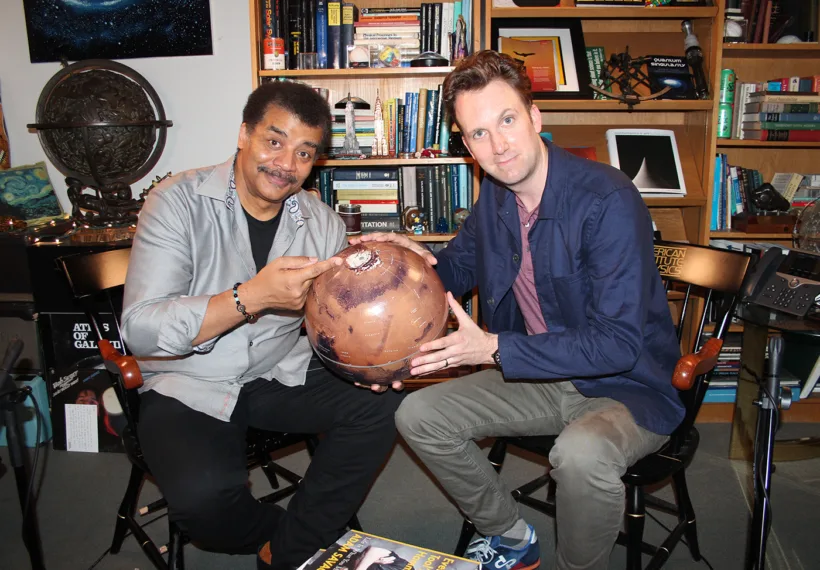
This is StarTalk, and I'm your host, Neil deGrasse Tyson, your personal astrophysicist, and we are coming to you from my office at the Hayden Planetarium of the American Museum of Natural History right here in New York City.
And today, I have a special guest, and he's going to be my only guest for this hour.
We don't do that often.
It's only if everything clicks and all cylinders are in place.
I've got with me the one and only Jordan Klepper.
Jordan, dude, welcome to StarTalk, your first time.
This is my first time.
Thanks for having me.
A lot of pressure.
Excellent.
The only one here.
I'm not saying there's no pressure.
Yeah, you're making it very clear.
And by not saying that, you're making it very clear.
Okay, we can do this.
Well, welcome.
You've got a show on Comedy Central.
You've been spawned from the Daily Show.
I like to think that.
Spawn off.
Yes, spawn, birthed into the world.
Birthed, hatched.
Through the magic of John Stewart and Trevor Noah.
Yeah, because you've worked for both of them.
I've worked for both, yes, and they pushed me now through their lovely comedy cavity into the world.
Through their birth canal.
Yes, their birth canal.
There you go.
You've got a show.
You command the whole hour with very high production values.
You're going around the world, subjecting yourself to different things, interviewing people.
And in particular, the reason why we noticed you recently is because we saw that you've got a show on the space program.
And so, we'll get to that in a minute.
I just don't want you to think we would have asked you on here for any old reason.
You did a lot of other episodes that we don't care about.
I didn't want to say it that way.
You actually do some stuff that legitimizes you in my mind.
And Neil, this was for you.
I knew it.
I know I did six episodes.
I was like, Neil is not going to be into any of these.
You need one of them.
Let's give him some space.
I just want to look at your background here.
You had a double major in math and theater.
How does that work?
Boy, I tell you, so I went to...
Where was this?
This is in Kalamazoo, Michigan.
Kalamazoo?
I was just in Kalamazoo.
You were in Kalamazoo?
Just a few weeks ago.
What were you doing in Kalamazoo, Michigan?
I want to know.
I'm also part host as well.
I might flip the...
Well, Jordan.
Well, first, did you know that our very own Derek Jeter was raised in Kalamazoo, Michigan?
As somebody who grew up in Kalamazoo, I, of course, knew that because I've lived in the shadow...
Judges, judges, do we...
The shadow of Derek Jeter.
It's a long shadow.
Everyone else has to live up to that.
Let me tell you.
What's the longest shadow?
It's not high noon.
That's the smallest shadow, right?
Yes, it is, in fact.
Small shadow of the day.
So what are we talking?
He's like a 6 p.m.
shadow in Kalamazoo.
He went to my high school just before I did, and Derek Jeter was a hero.
I knew his sister, Charlize, and everybody thought Derek Jeter, he was such a good athlete, he was going to be a professional basketball player.
Basketball player.
He was great at basketball.
Well, you make more money in baseball.
You play more games.
All the money comes out better.
He knew that.
And he could play the sport longer, too.
Exactly.
I think he made the right choice.
We're not the best prognosticators in Kalamazoo.
So I grew up there.
I went to a place called the Nerd Farm, which is the math and science center, which means you go to a special math and science school.
I'm biased, so that's why I say it's nice.
This is right.
If I was one of your other friends, I might have said, what's wrong with you, dude?
If this was the Joe Rogan podcast, I'd be talking about my public school for the other half of the day.
But for you, Neil, I'm talking about the Nerd Farm.
The Nerd Farm.
We love it.
So what happens?
So you're in school.
They notice you have a little geek in you.
They got some geek.
They put you in the Nerd Farm.
They put you in the Nerd Farm if you got a little geek.
They got special facilities for the geeks.
You focus on math.
You focus on science.
You spend four years doing that for half the school day and for the other half, you go to the public school.
Well, so they nurture this.
They nurture.
Very enlightened system.
Yeah, Kalamazoo is really proud of it.
The math and science center, it's students go in all different directions afterwards, but it's sort of a chance for people to kind of indulge that geeky side.
I gave a public talk in Kalamazoo in a four-city tour of Michigan just recently.
Yeah, it's a great town.
I loved it.
It was fun.
Very friendly people and sort of unpretentious.
Just people just want to be themselves and want to learn.
They're kind folk.
The motto in Kalamazoo is yes, there really is a Kalamazoo.
Which I love.
It's already defensive.
Right, because it's already like, because they're like, what are you, from Kalamazoo?
It's not even real.
It's like, well, it is real, yes, there really is a Kalamazoo.
I believe it's an old Algonquin word.
Okay, that's what I figured.
Yeah, you're already defensive when you come from Kalamazoo.
So the theater part, how did that fit in?
Well, so I got a scholarship that paid for my college if I studied math and I did.
And I will say, I was a smart kid, but when you're a math major…
We'll be the judge of that.
Well, you will be.
If you edit this correctly, I'm a smart kid.
I love math.
I love solving problems.
I love the process of math.
But I also realized within that, that that was not something that…
No, many people think math is getting the answer.
But it's not.
It's the process.
It's the journey to the answer.
And I would say, like, what I ended up finding while I was doing math was I think I enjoyed the performative elements as well.
I started finding improv.
Performative elements of math?
Not necessarily.
No, yes.
How do you do it?
How do you do your math, Neil?
You want the street quarter?
I will calculate digits of pi while I dance.
Who wants that?
I got seven digits.
Who's got ten digits?
Ten.
While I was doing math, I was doing improv and comedy as well.
And so that became...
As early as high school or was that by then in college?
As early as college.
I found the improv team in college.
Nice.
And college was?
Kalamazoo College.
Kalamazoo College.
So Little Liberal Arts College right smack dab in the middle of Kalamazoo.
Improv World popped up and I was like, I think I want to play around in that.
And it was full of discovery.
People laughed at the things I said occasionally.
That helps.
It does help.
There was not a ton of laughter or applause in the math class.
Linear algebra doesn't have many standing ovations.
Never ever did it have a standing ovation.
It turns out I was so needy that I was like, I'm going to follow the thing that gives me a standing ovation.
I will say as much as like I then went into the world of comedy, the world of math, it is true.
It's a way of thinking.
It's about process.
And then I kind of go into the world of comedy where you start writing sketch comedy, start doing improv, but in the world of like sketch comedy and writing, there's a process there as well.
And I think like that kind of mathematical brain can help an artist or a person in that world try to figure out ways in which they can move an audience to an understanding of what a joke is.
Yeah.
You become analytical in it.
And I think that has value.
And not everything is intuitive.
In fact, maybe the best is a combination of both, which you would certainly get, you know, going with the stereotype of now you got both brain halves, you know, tickled.
I think that's I've always seen too, like, there's even there's the two brain halves in the comedy.
I don't know if that's held up, you know, in neuroscience analysis, but it's a nice metaphor for thinking about two ways of approaching the world.
I think like standups definitely approach things from an analytical perspective.
And I'm more of an improviser, which is more of like the creative, let's go search and find.
I think ultimately, when you start working, you want a little bit of both.
You can search, but eventually you have to figure out why things work and then put it down on paper and then sell it and see if Coke will buy advertisements.
So this is a sort of obvious question, but maybe not for some people.
You the portfolio of shows you've been doing now on Comedy Central, what's the name of your show?
Klepper.
That is the name of the show.
That's why I didn't remember the name of your show.
I've seen a few episodes.
I've had a handful of shows and now we're just like, you know what?
They're going to call it, it's that guy, the Klepper guy's show.
Just call it the Klepper show.
No, there's good precedent.
There's the Andy Griffith show.
Yep.
And then Mary Tyler Moore.
Mary Tyler Moore.
And they don't say anything what the show is about.
It's just a people's name.
That's the Mary Tyler Moore show.
I think I'd like to think I'm the Frazier of political satire.
Okay, so you've tackled some very disturbing topics.
So what's your formula for making them funny?
Would you wait for a moment where there's a silly or fun element?
But at the end, you're very socially progressive in what you're trying to get people to do and what you're trying to get them to think.
And some of these topics are very sad.
They are.
I think when we started out doing the show, it's essentially a doc series, a documentary series on Comedy Central, which doesn't usually do these types of things.
And we wanted to pick topics that were important, that I cared about, that my staff cared about, that we thought needed more attention.
And what, you were in the Bayou?
I was in the Bayou.
I followed...
What was the title of that?
So that one was Battle in the Bayou, which was a group of environmental protests who were locking themselves to pipelines to try to stop the pipeline from moving through the Bayou.
Or get killed.
Or get killed.
Yes, yes.
This is...
These are the two.
It's one or the other.
It's like, okay, so this was sort of a chance for us to see what environmentalism looks like up close.
In the trenches.
Let's get in the trenches.
Get in the boat.
The boat ended up sinking, is what I found out, 5 a.m.
in the Bayou.
Your boat or their boat?
My boat.
I went out with them.
They were going to the Bayou.
They were going to lock themselves up to this pipeline.
So, you're a conservative worm who got in there and sank the boat.
Don't blow this for me, all right?
He's a spy!
We got him!
We found him!
It turns out I'm just an idiotic comedian slash conservative spy.
We found ourselves in the Bayou.
We go up.
It's not very deep, I don't think.
It's just sloggy.
It's not super deep.
It's wide, though.
They said there were alligators down there.
We saw them on the way and we go by the site and there's a security boat that's there that starts to follow us and they turn into the wake.
We take on a ton of water and we suddenly find ourselves swimming to the shoreline.
So, you get wet doing a docu-series and I think to go back to the idea of where the humor is.
The humor is you didn't get eaten.
The humor is you don't get eaten.
If we put me in a dangerous situation, the audience is going to feel bad for me.
They're going to see me complain about how hard it is to enact real change and I become the conduit of difficulty.
Okay.
And that's always good fodder on a stage.
I think so.
We followed veterans who were suffering from PTSD and I think what you find…
There's a different episode?
That's a different episode.
What was that one called?
That one's called Wrestling with PTSD because they do it through literally professional wrestling.
And so, they found a creative way to deal with an actual problem.
I get in the ring.
I become a part of it.
And I think the humor comes through me trying to…
But did you wear a singlet?
A wrestling singlet?
I wish it were as forgiving as a singlet.
What do you call half a singlet?
It's like the Speedo you shouldn't be wearing in the 21st century.
Neil, what is the scientific term for banana hammock?
I stumped you.
There you go.
You got to Google it.
All I know, I think what I saw it as is unflattering.
I wore something that did not flatter off what God or the universe gave me.
Or your actual musculature that could otherwise be flattering in a different outfit.
It turns out they hired me for my brains, not my body.
So how did that play out?
Did you help people recover?
Just the fact that you get to air their story?
I think part of it is shining light on people who are actually taking action.
Joking aside, I've gotten to work on some great shows where you're in New York and talking about what's happening out in America.
This was a chance to be like, I want to go out and see people who are doing stuff day in and day out.
We're in our own bubble here.
We're in a bubble.
We're in a bubble.
I mean, it's a big bubble, but it's still a bubble.
It's a bubble.
I went to Georgia and there are a bunch of students who are DACA students, undocumented students who just want to go to college and they're protesting, they're trying to get their voice out.
Didn't you get arrested?
I got arrested standing up with those students.
So, yeah, I mean, these are the lengths Comedy Central makes you go through.
And they let you out?
They let me out.
Did they look at the rest?
I was like, I have a body of work.
Have you seen my body of work?
12 hours later, after some coughing, just make sure you're not contraband smuggling, they let you out of jail.
Okay, that happens.
But I think, you know, you're hopefully moving the needle by bringing attention to it.
And I don't want to pretend like me being down there for a week with people is going to be the thing that changes everything.
But hopefully, through a little levity and point of view, I can show like there are people doing good things.
There are people who are fighting.
And I think like, even if I fail with some of that fight, we should, we should take a little inspiration from the people who are pushing something forward.
So what you're really saying is, if the show ever gets canceled, the ones you've completed are still an important contribution to the television repertoire.
Neil, I'm not saying that you just said that I'm going to type it out, I'm going to put it on my gravestone.
I appreciate that.
No, you can be proud of it.
By the way, at least in New York, it's airing at 1130.
What's up with that?
Well, because the Good Old Daily Show takes place right before that.
Oh, so you want the run-in.
So in this world of figuring out viewer, they're like, oh, this tends to appeal to people who are politically engaged, interested, and maybe a little bit stoned at 1130 at night.
No, I'm older than you, so you may not remember this.
It's the origin of ABC's 1130 show, ABC's Nightline.
Was 1130?
That was 1130?
Well, whenever it came on, there is an origin for it.
Its origin story is it started out as the nightly updates on the hostage crisis in Iran.
Day 40, day 150, day this, and then they got all this audience that had just birthed the show and what they were doing is they give the final news story in the evening news and that would take you right in to this new program that was birthed simply because of Iran coverage.
Is that right?
That's what that is.
So the evening news fed the follow-up show and that became its own thing.
I'd like to think people are tuning in to my show with the daily hostage crisis that is the American political system.
We all feel like we're being held hostage.
We'll just see if this guy is safe.
Take someone hostage.
Yes, yes.
On Broadway now is The Network with Bryan Cranston.
Can you give me tickets?
Have you seen it?
You got to know somebody.
Neil, you.
I'm looking at you, man.
You got to know somebody.
I'm sorry.
You're my somebody.
Neil, this is what it is.
Yeah, I did see I was on like the third row.
It was great.
Oh, now you're rubbing it in.
Yeah, he was extraordinary and he won the Tony Award for that.
And guess what, Jordan?
What?
It closed.
Wow.
So, I get to rub it in some more.
I know you're a man who likes to focus on real facts.
He can't.
I mean, the show is his performance.
You don't have to share every fact, Neil.
Some facts are best left unshared.
Like that one.
That was, I did learn that from some wise people.
They said, just because it's true doesn't mean it has to be said.
That's a lovely phrase.
Yeah.
It was some government people I worked with.
Government political types.
So, all truths don't always have to be what you lead with.
Let it be true, but not advertised.
It doesn't mean you want to hide it.
You just don't want to display it.
That's all.
I've had a marriage counselor who said the same thing.
And one other thing.
There's another related to that is, occasionally stretching the truth or ignoring one or two bad things is the right thing to do, such as when you're speaking at funerals.
There are times when just let this one go.
Would you say now from a scientific mindset, things like climate change, things that feel like perilous situations that people are maybe failing to grasp?
No, those aren't the truths I'm talking about.
I'm talking about truth about a person.
When it comes to science, you're...
Science?
No, I'm all in.
You're straight-laced.
I'm all in.
Back up.
Science in the face.
Why did you give me a free pass here?
So one of your shows, which is why we invited you to StarTalk at all, not that we don't love you more.
It's all about the space program.
Nicely timed with the 50th anniversary of Apollo 11 landing on the moon.
So I want to spend the rest of our time together talking about your experience there and then we'll compare notes.
It's a little bit I know, but I didn't get all in up in it the way you did.
Oh, that's what I do.
I put on the suit.
All up in it.
I got all nice and dirty.
All right.
So when StarTalk returns, more of my exclusive interview with Jordan Klepper.
Bringing space and science down to earth.
You're listening to StarTalk.
I'm deGrasse Tyson.
I'm here with Jordan Klepper.
You surely know him from Comedy Central.
If you don't, you should, because he's got a new show on Comedy Central, where he goes around the world investigating topics that we all care about or all should care about.
And he does it in a very hands-on, involved way.
Very different from seeing him behind the desk making comedic quips at stories that other people bring.
So, you did do a few on-location stories for Comedy Central.
I did, yes.
When I was at The Daily Show.
And Jordan, when you went to the conventions and things, those were fun.
A lot of field pieces for The Daily Show as a correspondent.
You're out in the field a bunch.
So, this was sort of an extension of that.
Get me out there.
Okay, excellent.
And we've got you on the show because you explored our space program.
And first, what motivated you?
Second, is there some overriding social cultural issue that you wanted to tear apart, not to destroy it, but to unpack?
I will say, so it was two things.
I've been a little bit of a space nerd since I was a kid.
I would go to two places when I was a kid.
My parents would take me to Washington, DC or Cape Canaveral.
Cape Canaveral in Florida.
Yes.
And so, you know, I fell in love with the idea of becoming an astronaut, as I think a lot of people do.
A lot of kids do, yes.
I think I've gotten to indulge that throughout my life.
Back when I was hosting the show called The Opposition, we had Scott Kelly on.
Astronaut Scott Kelly, who spent over 500 days...
Is he the good-looking one of the twins?
He's the hot twin.
The hot twin.
Mark Kelly is the...
The totally ugly twin.
The ugly twin.
The ugly twin running for Senate.
Scott's the sexy, sexy twin.
I love them both.
We've had Scott Kelly on here.
Was it Scott or was it Mark?
We had one of the twins.
You had the sexy one.
We had the one who went into space.
Yes.
The one who agrees to do the show, they get to be the sexy one.
That's what I've always said.
Well, so Scott Kelly came on the show, which was extended time.
But just in case people don't remember, because he's a twin, it became of high physiological and biological interest to send one into space for an extended length of time, leave the other one here on earth, and then they come back and you compare them.
That's all.
And according to relativity, the one into space came back a little younger than the other one, by the way.
Yes.
But not by very much, but you can calculate it.
And squishier, right?
Well, that's for different reasons.
It's not like space made him squishy.
Well, I mean, being in space made him squishy.
No, no, if they had rotating space stations that had artificial gravity, he wouldn't be squishy.
So that's what it is.
Well, there could be other reasons, but that's the main one.
Well, I want to get to the bottom of my squishy question.
Oh, are you squishy before?
I'm a squishy denier.
Let me be very honest with you, Neil.
I've been a squishy denier since I was a kid.
I asked my trainer, you know, where's my six pack?
And he said, it's in there.
It's just under the fat.
That's it.
I said, okay, I'm good.
We just need gyms that are rotating at a certain speed that allow us squishy men to become less squishy.
Exactly.
So, I had Scott Kelly on the show talking about important things like squishiness.
On your show or back?
On my show, back on The Opposition.
He was a guest on the show.
I remember The Opposition, yes.
And so...
That was between when you left The Daily Show in 2017 and your current contribution.
Exactly.
It was a late night show.
We had a lot of fascinating people on.
And talking to Scott backstage, he was talking a lot about the right stuff and how that was...
The movie and the book.
Exactly.
Now, he read the book when he was a kid and it inspired him to want to be an astronaut, to want to engage in science again.
And it got me thinking.
It was like, oh, you know, I had such a fun time, you know, jumping back in and talking about space with Scott Kelly.
I'm going to read the right stuff.
It was about a year ago.
I read the right stuff and I became obnoxious with all of my friends for the following four months.
Just saying, you have to read this.
It's amazing.
I just I was re-energized with the space program with all the documentaries coming out about the Apollo 11 mission.
It was one of these things that suddenly just lit up in me.
And we're trying to look for stories.
And I was I'd come in and I'd tell my office mates.
By the way, since we're talking about space, it didn't light up with you.
It ignited.
Oh, yes.
Thank you.
May I help your vocabulary?
Yes.
There's a spark that ignited in me.
It ignited.
And then blast off.
I was back in it.
Continue.
So, while I was pitching stories in our office.
Thank you for allowing me to edit your personal commentary.
If you can make me a little bit smarter, more clever throughout, I will take it, Neil.
So as we're pitching stories, I'm consistently referencing how much I like the movie First Man, how much I liked The Right Stuff.
First Man, the profile of Neil Armstrong.
Exactly.
I thought it was such an interesting human way that to me, even the process to getting the moon in and of itself felt like such a difficult and lonely process that I thought a movie like that was able to capture.
And as we're pitching these things, my staff is like, why don't we just do an episode on space?
For God's sakes, you can't stop talking about it.
They're trying to get you to shut up.
They're trying to get me to shut up, which any good staff will do.
You know this.
Of course.
And at the same time, what we were talking about, like I'm somebody who's progressive and on the left side of the aisle, who's often very critical of our commander in chief.
And at the same time, President Donald Trump is talking a lot about the space program.
He's making outlandish claims like he made the comment is like, what will it take to get us to Mars?
If I gave you unlimited money, could we get there before the next election?
Which is a ludicrous claim.
But in that moment, it lined up somewhat with my instinct of like, oh, yeah, we need to dream big.
This idea of dreaming for that moonshot slash Mars shot.
That's something that I feel is missing.
It was when I look back at the Apollo 11, I look back at the Apollo program in general, at least through rose colored glasses, you hear of a time where people were coming together.
They're investing in science.
They were trying to do things that felt impossible.
And through doing that, there are a lot of benefits to our society.
And there was a lot of cultural cohesion with some caveats for sure.
But there was a positivity there that felt like was lacking.
And we actually have a commander in chief who I don't agree with on almost anything, but it's sort of like, hey, I think we can get to Mars.
I'm like, you sound crazy.
But in this case, I like it.
And so we look to do an episode of like, what does the fight look like to get to Mars?
Is that the kind of thing?
Are we going to make America great again with a big asterisk?
But are we going to like go back to what was unique and interesting about the Apollo 11 mission?
Is that something that's in store for America?
Is that something that's good for America?
The reason why I didn't interrupt you is because I have nothing to add or subtract from what you just said.
Thank you, Neil.
Not that other times when I interrupt you, I do.
Yeah, I was going to say this is really making me look back on the rest of the interview.
No.
So firstly, yes, it is absurd to imagine that we would land on Mars before the next election, but it's not absurd to imagine that we would have a Mars program ready to happen before the next election.
And if anyone else thinks it's absurd, you have to ask, is it crazy for a president to say, I want to start getting to Mars and before the end of my next term, I want to have landed on Mars so I get to make the phone call.
I don't know that President Trump said that, but he's surely thinking it.
So is that a crazy thing?
Here's my question to you.
Is getting to Mars in six years more crazy than getting to the moon in seven?
President Kennedy's speech, where we're going to go to the moon in 1962, no, excuse me, 61.
We didn't have a ship that could launch a human being that wouldn't explode on the launch pad.
We didn't yet have that spacecraft.
And he says, we're going to put a man on the moon before the decade is out and we do it within eight years.
So, to go from an impossible dream to an accomplished dream, that's got to be more remote than anything any sitting president can say today that they want to have happened in the next six years.
That's all I'm saying.
I 100% agree.
I think that's what is...
So, however crazy you want to say Trump is, just be level.
And as a scientist, I try to be level headed about all this.
Same with Trump's Space Force.
Trump said Space Force, everybody said, no, no, we got problems on Earth.
People just reacted without pausing and thinking on what, well, let's think about this.
Otherwise, you're just aligning yourself with political whims and not using your own brain to analyze a statement made by one side of the aisle or the other.
So...
I think it's a very compelling question that a person who is radioactive when it comes to politics, but it would take somebody in a position like that to set the bar that high and then trust that people pulling together could potentially get there.
I think we're in a time where I'm hearing a lot of people talking about climate change.
In order to stop the effects of climate change, we would need the type of effort it took during World War II to come together.
I was just in Detroit this past weekend and I was looking at the architecture of Detroit and some of these buildings that were built that are...
Stunning.
Gorgeous, stunning.
The architecture building I was in, a monument to American ingenuity, was built in 13 months and it's unbelievable.
In World War II, we were building battleships right here in the Brooklyn Navy Yard, just pumping them out.
When we agree that, hey, this is something we're going to do.
Now...
All pistons aligned.
All pistons aligned, let's get these things done.
And I think...
Excuse me, that's an internal combustion engine reference.
All gears are in place for the electric motor.
Yeah, all panels have been loaded to...
All solar panels are tracking the sun at all angles in the sky.
Now I'm lost.
We're never going to get to Mars.
This is what it is.
We're not going to be able to contextualize it in a way that is going to get us all on the same page.
Neil, it's on us too.
All right, I'll work on it.
There's something really evocative, one, about grandiose thinking, two, about scientific exploration in a way that is on a level that is beyond what people can imagine.
And I think some of that comes with a time period where people are afraid.
I think wanting to beat the Russians was a big part of the 60s.
Not wanting to die.
Yes.
Not wanting to die.
That works every time.
No doubt about that.
You're a character stick person.
That's a good stick, not wanting to die.
And so, I think it's a compelling question right now.
It shouldn't just be thrown out with the bath water of like, can we get to Mars?
Sure, that sounds ludicrous.
Was that a main question in the episode?
Because as of this recording, it hasn't aired yet.
The thing that kicks us off is, I don't agree with the president on many things, but this is actually something that connects with me.
Is this something that is going to be realistic in our lifetime?
What is that going to take?
And so, we accept that as like, all right, let's go talk to some people.
We go and we talk to Scott Kelly to hear, he's been up there.
He has some opinions what he thinks.
I go to a Mars habitat in Hawaii to see what some of the training would look like.
Was that in a, I don't know the Hawaii one.
I know of one in Canada.
Yes, there's one on the Big Island, on the volcanic mountain Mauna Loa.
They're all volcanic, just FYI.
That's how they rose from the bottom of the ocean.
All right, don't make me look like an idiot.
Actually, that's what an archipelago is.
You know what that is?
It's a hot spot underneath Earth's moving crust, okay?
And it's just sitting there and the crust is there and it punches through, makes a volcano, then it goes dormant, the crust keeps moving, then it punches through again, pauses, it keeps moving, punches through again.
So it's a string of volcanic islands.
So an archipelago essentially is a volcanic series of islands.
As I understand it, my rudimentary geology, that's correct.
How many islands does it take to be an archipelago?
Is there like a flat line?
More than one for sure.
I don't know.
But go on.
So I went to Mauna Loa, which is a place called Hi-Seas, which is a Mars habitat that is actually turning also into a moon habitat.
Because it's got the volcanic terrain.
They have the volcanic terrain.
It is incredibly remote.
NASA had paid for this site.
Now it's privately owned.
And the European, the International European Space Agency was sending potential astronauts.
The European Space Agency.
Yes, yes.
They were sending people over actually as we were leaving there.
That's a long way from Europe, dude.
That's a hike.
That's like, you might as well just dig a hole through the earth and go through.
Well, at that point, if you're living in London with the rain, you're like, I'll go to Hawaii for a week.
So we spent some time, I spent some time on the top of Mauna Loa, kind of talking to them about not only what it would, what life on Mars could look like.
You mean the people who were in this habitat?
Exactly.
Are they sneaking in Cheetos or something?
Or are they?
You know, they'll say they aren't, but I think there's something going on.
They're licking their orange fingers?
You got it.
It's like, yeah, this.
Check your fingernails.
I know, they're sneaking something in.
Cheetos are not naturally occurring on the Martian landscape.
I know this for a fact.
No, the spite of the red color.
It's not Mars dust.
They're licking off their fingertips.
Something that was interesting, a lot of what they're testing right there is just the psychological challenges of living on Mars for an extended period of time, not only the possible two years there and back, what it's like to live in a small enclosed space with people.
And what's sort of funny as a lay person, but also as an improviser, as somebody who's taught improv, that's all about group dynamics, is about how you can teach people how to listen, how not to kill one another, how to build off of ideas.
And so, a lot of the things they were training for and studying up there were the type of things that are basic human communication things.
But isn't that already fully researched just with families at Thanksgiving?
We already know, we already know, we're getting a group of people who know each other really well.
What happens when they got to sit down together?
The problem, we haven't recorded it.
We haven't written down.
No one is recording their own Thanksgiving.
They just talk about it the next morning with the water cooler.
Exactly.
Nobody's writing, we got to put pen to paper, guys.
You can do scientific research every Thanksgiving.
One thing I'll add to that before we take our next break is, again, I'm old enough to remember a lot of the Twilight Zone episodes in real time.
They were made during the buildup of the space program on the way to the moon.
Space showed up in many of the topics.
More as a philosophical thing, not this is really going to happen this way.
They just said if space is a goal, what are some ramifications of this?
And multiple episodes were about the loneliness of space and how it could mess with your head.
And I said, wow.
And then when I got older, I realized there are times I don't want to talk to anybody.
I'd be perfectly happy spending a week, give me a book, a Netflix account.
I'm fine.
I don't want to talk to anybody.
And I'm socialized.
Imagine the hermits who are out there who could go years doing this.
So then I realized that's BS.
There are plenty of people who don't need human contact for their own sanity.
Every astronaut in space is getting yacked at by NASA all the time.
Time to wake up.
Mission control.
Have you done your thing?
Shut up already.
There is no loneliness in space.
Just I want to nip that in the bud.
Plus, we're not sending one astronaut anywhere.
They didn't know that at the time.
During the Mercury program, it was one astronaut.
But later on, it's a whole team of people.
So I'm not buying this psychological thing.
You can easily find seven people who really just don't give a shit.
And to be perfectly happy, staying there alone.
But take those seven people who don't give a shit, who are good at being alone, and put them together?
Get everybody who's been married for 50 years and get them to write their journals and then just cue off of that.
No, I'm sorry.
People who are pros at marriage, send them up there.
There you go.
There you go.
When we come back, I just want to get more detail from Jordan Klepper about his episode on Are We Going to Mars When StarTalk Returns?
The future of space and the secrets of our planet revealed.
This is StarTalk.
We're back, StarTalk, a singular episode with one guest who's doubling as my guest, my co-host, and my expert.
We don't do this very often.
We're flying close to the sun.
Jordan, you're feeling that burn on the sun?
It's getting tosy in there now.
His wax wings are still holding on.
So reference to Icarus in case anybody...
Icarus for those people following it at home.
It doesn't end well.
So tell me some of the things you subjected yourself to.
So I subjected myself to a trip to Hawaii, which was devastating, devastating.
That's just so...
But you know what?
I'm such a tough guy.
You took one for the team there.
In the name of science, send me back to Hawaii.
So other than subjecting yourself to a trip to Hawaii, what did you do?
So I...
Did you do the centrifuge?
So I didn't do it out there.
So what I ended up going to...
So we spent some time in Hawaii.
Hawaii was just one of your trips.
Hawaii's...
Habitat Hawaii.
Habitat Hawaii.
And we talked to Hank Rogers, who is a multimillionaire who's investing in that and trying to invest in space.
I love millionaires named Hank.
That's just the right thing to say.
That's just...
It's really a blue collar millionaire.
That's a man.
That's a practical guy.
I did a little day drinking with Scott Kelly down in Houston, which was day drinking with an astronaut.
That's a thing.
That's a thing, day drinking.
What was the beverage?
It's a drink called Space Dust.
There's a bar outside...
It's classified.
Stop there.
Okay, go on.
There is a bar outside of NASA in Houston where all the astronauts go to, which we were going to interview Scott.
We were talking about...
Because NASA is in a community just like a suburb of Houston.
It is very much not in Houston, is what I found out, and when you meet there, we're like, where do you meet up?
Well, there's a bar all the astronauts go to, and in my mind, I have the right stuff, I have these romantic ideas of like, you're going to walk in, there's going to be Chuck Yeager in the corner with a spittoon.
Yeah, there's spit.
Why is there spit?
It's got to be spit.
You can't be badass unless you're spitting.
There's a tough guy spitting at a bar.
And you turn into this, and what makes this bar remarkable is it's the closest bar to NASA.
Oh, it's efficient.
It's efficient.
Yes, these are all scientifically trained people.
It's efficient.
It's the closest bar.
So we'll go there.
There you go.
So we drank the local IPA, which is called Space Dust.
We get a little boozy.
And then I headed to Space Camp because I wanted to try it.
In Houston or there are others.
The one in Huntsville.
Huntsville, Alabama.
Yes.
So you go to Huntsville.
Huntsville has a standing full-scale rocket model of the Saturn V.
It's unbelievable.
Yeah, it's like a compass direction.
And there's so much history there with how much of that was built in Huntsville.
And I think it does feel like such a unique universe almost out of place with so many other places that you travel to in America.
Huntsville is an enclave unlike anything else in all of Alabama.
Very true.
It's highly educated scientists, engineers.
They have a good school system and the rest of Alabama, not so much.
Yes.
Yeah, Huntsville, it's a unique little spot.
So another thing we were looking at with this episode is where is America's trajectory with our potential mission to Mars?
Wait, before you get to that, I still want to know what you subjected yourself to.
Physically, I went to space camp and I got myself in the spinning thing.
I got myself in the centrifuge, which is also a...
The spinning thing is that one that goes in all coordinates, yeah.
Yeah, it's the Leonardo da Vinci...
So I got naked, you know.
The Vitruvian man.
Just like the Vitruvian man.
Just like the Vitruvian man.
The looks I got at space camp, Neil.
I gotta tell you.
I forgot Vitruvian man is butt-naked in the middle of that circle.
I forgot all about that.
Not even Speedos.
The original comedian, the Vitruvian man.
Also when I went in there, I did the centrifuge, which goes up to 3G's, and I was doing it with...
By the way, just FYI, 3G's is like where a good roller coaster will take you.
Don't do this to me.
Yes, I'm so doing this to you.
The rockets could accelerate to higher than 3G's.
They just don't.
It's an interesting fact.
When they launch from Earth, there's all this fuel.
But the thrust is the same.
It's constant.
And so there's a lot of fuel.
As the fuel gets burned, the rocket weighs less.
So the same thrust will actually accelerate it faster.
There's a point where it could accelerate much faster than 3D and they throttle back just to not have you pinned against it.
Because they don't have to.
They don't need to.
Has that always been the case?
In the old days?
I don't know.
But recently, that's how they do it.
They throttle back so that you don't experience much more than 3G's.
Yes.
Getting launched into space.
That's why they pegged it at 3G's.
Also, in space camps, I know there's primarily children that are coming through.
And 40-year-old satirical comedians.
It's a weird cross-section.
So did you barf up your lunch?
I did not barf.
I felt terrible the entire day.
So you're kind of the adequate stuff.
Yeah, I quickly realized I'm not going to space.
One, I'm too big and tall.
Two, they didn't tell me that you...
You're about 6'4.
I'm 6'4.
Yeah.
I turned my head as I went into the centrifuge.
So you felt queasy.
That's fine.
That's expected.
I felt queasy.
Each one, my body was not made for it.
So they...
So what else did they make you do?
What did you make yourself do?
Well, because there's also...
they essentially have you...
They run you through a simulation where you attempt to fix the International Space Station, which they put you in a sling to simulate zero gravity, which is just essentially...
You look like a weird cow that's going to slaughter.
They lift you up.
They place you horizontal and then you just kind of float around trying to fix it.
Because you're not actually weightless at that time.
You can still swallow what goes down in your stomach.
There's still an up and down.
If you drop your pen, it'll fall.
I don't think about the swallowing.
Is that incredibly good?
No, no, no.
They didn't know initially.
If you...
No, I shouldn't have mentioned that at all.
Only because...
What do you know, Neil?
What are you hiding from them?
I'm not authorized.
No, no, no.
There was...
In the early days, we didn't know for sure if you could swallow in space.
But you can...
In zero G, that is.
But it turns out you can do in space anything that you can do upside down.
Is that right?
Think about that.
So you can swallow upside down.
And you can eat upside down.
And that's gravity in the complete opposite direction from right side up.
Which is just based on the strength of your body, right?
Of all of the valves and everything.
You can live, not for long nor comfortably, upside down.
Your blood still pumps.
So that me...
And you can do it horizontally.
So you can do it vertically, horizontally and upside down.
Zero G is not a thing.
You're fine.
Yeah.
Well, I know that was talking to Scott Kelly, not to get too gross about it.
But I asked him about using the restroom.
The restroom, yeah.
Both of them.
And he talked about like, that is a definite...
That is the first question a 12-year-old asks.
Is that what you're doing?
A scientist asks.
The word is...
The first question...
An aspiring scientist asks...
Do you...
It's the first question a highly curious human being will ask.
Thank you.
That includes children as well as scientists.
Yes, exactly.
You pick which one you want.
If you watch my show, it might also be the second and third question he asks.
Yeah, it's an interesting thing.
So do you think, based on everything you saw, does your show, that episode of your show, have a conclusion?
I think the conclusion is, I'm optimistic about it.
From a selfish point of view, I do think it's something that has potential.
I think I am inspired by the idea of placing that bar high and trying to achieve it.
Talking to people like Scott Kelly and other folks on the ground, it feels like we're probably, if it were going to happen, 12 to 15 years off.
Who's this person you interviewed that wants to be the first person to step on the list?
We found this person who's been training to be an astronaut since she was three years old.
Literally has certifications from here across the world.
Has gone to space camp, I think, 18 times.
She's an 18-year-old girl who, this has been her dream.
We kind of wanted to talk to somebody who was much like...
So we got to send her.
Yeah, we got to send her, right?
Does she know she could die?
She does.
She's talked about that.
Good.
She's even talked about potentially removing a gallbladder or things that, for a potential Mars mission, they would...
things that you might remove as, what, contraceptively so that you...
Oh, in case you have, like, your appendix.
Yes.
You don't want your appendix to get inflamed when no one can come to it.
Yes.
So you proactively remove it.
Prophylactically.
What did I say?
I said contraceptively.
Oh, God.
I knew it was a sexual thing that I was nervous about saying.
You can say proactively, but proactive, I think, is a perfectly fine word today.
Okay, let's do proactive then.
So she was discussing that.
I think what I took away from that was I wanted to talk to somebody who is of, as she calls herself, the Mars generation.
I remember when I was...
They're not thinking about the moon at all.
They're thinking...
Moon is not even there.
No, it's...
The moon might be the way in which you do a little stop there and then go all the way to Mars, but I think she wants to be there.
She wants to be the Neil Armstrong of our generation.
Or their generation, perhaps is maybe more acute.
The Neil Armstrong of us all today.
There you are.
We all get a Neil Armstrong.
Yes.
I think I'm optimistic as far as that goes.
We look a lot also at the private space race.
And I think that's...
Where's the money going to come from if it costs a trillion dollars?
I mean, I think that's where you're looking at what's happening with SpaceX.
You can dream all you want, but nobody's writing a check.
No.
Go home.
Well, I think the capitalism, the thing that's happening in America and always has driven America, I think SpaceX, Blue Origin, those types of endeavors may get us close, I'm hoping.
Yeah, I'm skeptical only because if they're a business, they want to make money off of it.
And how are you making money off of sending the first mission there?
Where's the return on that investment?
Unless you're going to charge people to watch it.
You know, like the Olympics, you're charging people.
I mean, it's commercial time, but maybe that's what it'll take.
Well, honestly, you talk about American ingenuity and not to be a cynic, but I wonder if that next phase of American ingenuity is like, how do we profit off of going to Mars?
Talk about that Pepsi t-shirt.
It's America.
Merica, dude.
America.
Put a price tag on it.
Put a price tag on it.
We buy it.
Put a Merica.
So, if I can't buy it, I don't want it.
It ain't mine.
It ain't mine.
So, here's something.
I ran the numbers on this.
You could make a mission to Mars every time on a lottery.
Okay, so we have 300 million Americans.
If everyone...
This is hard, but just running blunt numbers.
If everyone puts in $100, okay?
That's a lot for most people, but it's not an unreachable amount of money.
We've all spent $100 on something in our lives before, okay?
Everyone puts $100 for the chance that you will be on that mission.
And $100 times 300 million is what?
How much is it?
This should not require a calculator.
Move the decimal over two places.
$30 billion.
Mr.
Math Guy from way back.
$30 billion.
That is two years of NASA's budget allocated by the government.
Plus NASA puts in some, the government puts in some.
You could do this, I think.
There's some variant on that.
And everyone will do it every week.
I mean, why not?
And if you don't get to go, you get to see other people go, and that's part of your pleasure.
I bet you get more pleasure watching someone else walk on Mars than you would watching someone else win the Mega Bucks lottery.
I get almost no pleasure from that.
You get negative pleasure.
I didn't.
I could root for somebody.
Right, right, exactly.
I think there is a way.
I think there is financial ways in which you can make it a closer reality.
I think what we talked about earlier as well, I think as a country we have to care about this.
And the things that often move us are fear.
I think...
Yep, fear is a biggie.
Whether it's patriotic pride of something that we can achieve, I don't know.
I think we could use some of that.
There is a sense of unity there.
But I think we like to compete.
And I think seeing China land on the dark side of the moon suddenly makes maybe us a little bit more excited.
The far side of the moon.
Far side.
Dude.
I blew that one, didn't I?
Yeah, because you…
No.
Yeah.
You know where I got that.
Security, could you take…
Let's end the show now.
It was going so well.
It was going so well.
All sides of the moon get sunlight.
You took a chance at having me be a guest and a co-host.
Wait till I fire our booking.
I'm sorry, everybody.
No, no.
I'll give you a hall pass on that one only because of how strongly influential Pink Floyd's Dark Side of the Moon album was.
Thank you.
Whether or not that was your favorite album, you should say it was your favorite album.
That was my favorite album.
There it is.
That's your hall pass.
Have a little sympathy for me, guys.
Please.
Yeah.
So, I agree that if China looks like some kind of frenemy threat, because obviously we trade heavily with them, so they're not an explicit military enemy.
We're not aiming missiles at each other, but the idea that they would do something first and we don't, we're Americans, that could light a, ignite a flame under us.
So tell me about other topics that we can look forward to.
Well, we, our final episode that we're covering, we covered legalized marijuana in California.
And so, you know, there's an equity program out there that tries to deal with basically people who are affected by the war on drugs, trying to give them preferential treatment in starting businesses in Oakland, California.
Oh, nice.
Okay, so it's a drug show.
It's essentially a drug show.
Excellent.
Yeah.
So another way to go to space, if you will.
So that, so that drops 10 episodes.
How many episodes?
Eight episodes.
Eight episodes.
Well, we look forward to more of this.
Yeah, we got plenty.
Stay out there.
I will be out there.
And maybe we can get you back for just, fix that dark side of the moon thing.
I'll do my research, Neil.
That's on me.
I promise to be better.
If you invite me back, I promise to be better.
Excellent, dude.
Thanks.
Neil, thank you.
This has been StarTalk.
Most of you have heard this show.
Some of you may have even watched it on our YouTube channel.
I've had Jordan Klepper, our guest, triple serving as my co-host, my expert and a comedian and a informative guy and the main interview.
And we don't do that often, only when we've got it all wrapped up into one character as he is.
We've got to go.
I'm Neil deGrasse Tyson, as always, bidding you to keep looking up.
See the full transcript




 Unlock with Patreon

 Become a Patron