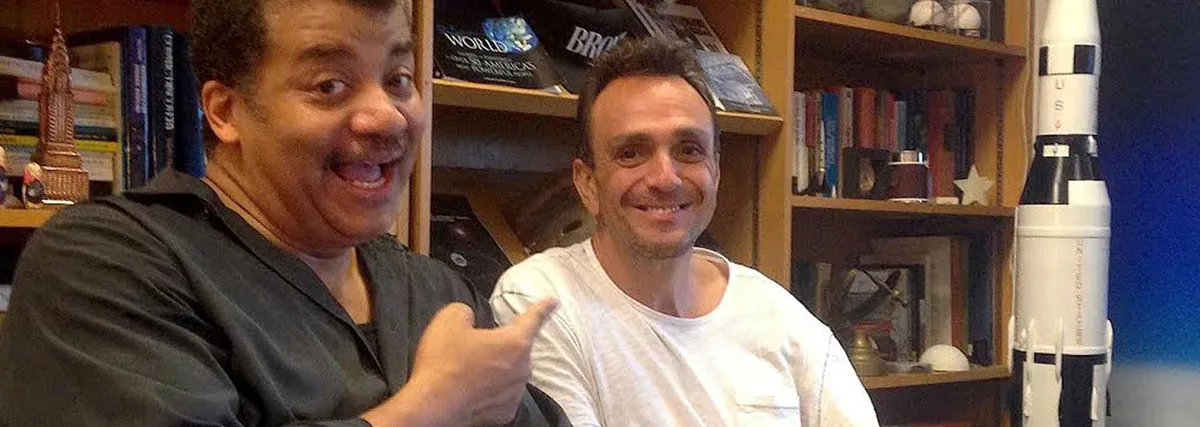
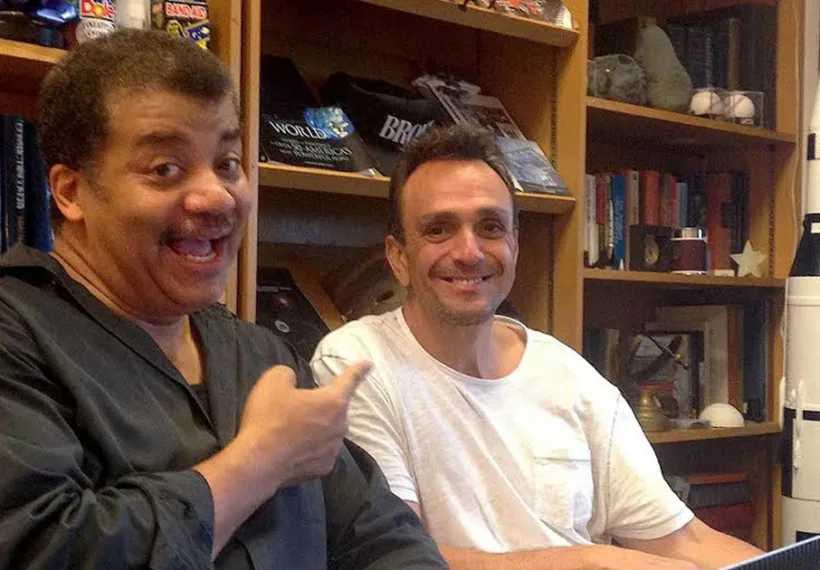
In this episode, Neil deGrasse Tyson chats with Captain Kirk, Sylvester Stallone, Woody Allen, Johnny Carson, Carl Sagan, Apu Nahasapeemapetilon, Chief Wiggum and Moe Szyslak – a.k.a., Hank Azaria. Join Neil and Hank as they explore the differences and similarities between voicing an animated character and acting on screen in Godzilla, Friends, Huff and Ray Donovan. Hank shares how he came up with Agador in The Birdcage and Pharaoh Kahmunrah from Night at the Museum: Battle of the Smithsonian. You’ll find out why there’s so much math and science-based humor in The Simpsons, from Euler’s Equation to black holes, and hear about the time Stephen Hawking was late to a table read for the show. Get the scoop on Hank’s upcoming animated FOX series Bordertown. And if you’re a Star Trek fan, you won’t want to miss Neil and Hank trekking out over the famous Corbomite Maneuver, whether they like Kirk or Picard better, and who owns the actual Gorn costume head.
Transcript
DOWNLOAD SRT
Welcome to StarTalk, your place in the universe where science and pop culture collide. StarTalk begins right now. Welcome to StarTalk Radio. I'm your host, Neil deGrasse Tyson. I'm an astrophysicist and director of New York City's Hayden Planetarium at...
Welcome to StarTalk, your place in the universe where science and pop culture collide.
StarTalk begins right now.
Welcome to StarTalk Radio.
I'm your host, Neil deGrasse Tyson.
I'm an astrophysicist and director of New York City's Hayden Planetarium at the American Museum of Natural History.
The following show features my interview with the actor, Hank Azaria.
It's possible that many of you may know him better for his voice than for anything else he's done.
This one man has provided the voices for a broad range of characters on the animated Fox series, The Simpsons.
His talent for mimicry and accents has also been central to many of his other roles in movies and television.
In the first part of this interview, I established Hank's geek cred.
Of course, we don't only invite geeks to be on StarTalk, but we do love to celebrate them every chance we get.
And as you'll hear, Hank Azaria turns out to be a card-carrying member.
And his passion for the Star Trek TV series even helped him develop his remarkable voice skills.
Do you have what people might call geek credentials?
Oh, yes.
Give me some.
Okay, I'm a Star Trek freak to the point where, I mean, I grew up watching.
That counts, that's enough.
You could stop there and you're in the club.
But if you got more on this.
No, I have more specifics than that.
Well, first of all, I remember loving it as a child.
Are you old enough to have seen the first run?
No, I was born in 64, I think it premiered in 66.
But it was already in reruns by the time I was six, seven, especially on WPIX in New York and Guatemala.
And I remember loving it as this intense science fiction adventure.
And by the time I was about 15, realizing that in many ways it was hilarious.
Then it became like, by the 19th time I saw certain episodes and certain like Shatner overacting moments.
Well, then you're reminded why the show got canceled for some of those episodes.
Yeah, and then in college it continued and we actually, those were the early days of computers.
The only thing we really used the computer for was to codify all the Star Trek episodes.
Really?
Yeah, we'd have like the actual title, our title, funny moments we liked, cool things about the, yeah, that's pretty geeky.
That's geeky, okay.
So you're born and raised in New York?
That's true.
Public schools?
You know, you don't sound like a private school guy.
You sound like you hung out in the streets, so.
Well, I grew up in Queens, so you can't avoid the streets.
But I went, you know what happened?
My sisters are older than I am.
And they went to public schools in Forest Hills.
And one day my sister came home covered in coleslaw.
There was a big brawl in the lunchroom.
Not a food fight, but a brawl?
A brawl that she got in the middle of.
She came home hysterical, crying, covered in coleslaw.
And my parents like, that's it.
That's it for public schools.
No public school for you.
So I went to Montessori schools as a little guy.
And then I went to a prep school in Queens called QForest for grades seven through 12.
So are there any memorable teachers there?
Well, I had some great teachers.
I do a poll and I say, how many great teachers can you list in your life?
And nobody has more than two or three, at most four.
And typically if one of those great teachers was a science teacher, then they become a scientist.
I found that interesting.
Yeah, see, I don't think I had a great science teacher.
I loved science as I did.
I had some pretty good ones.
I had an amazing English teacher in high school, a great history teacher in high school.
I remember in Montessori, I had one or two particularly gifted teachers that I remember very fondly.
In college, I had an incredible European literature teacher.
Listen to you, European literature, excuse me.
A guy named Saul Gindelman at Tufts University taught European literature and Yiddish literature.
And they were amazing classes.
People would take them just to hear them talk.
I thought Yiddish was more spoken than written.
I guess not.
It's guys like Sholem Aleichem, who wrote the Tevye stories originally that became the middle on the roof.
And Sholem Ash, and then into the modern tradition of like Bernard Malamud and Philip Roth.
So you read Yiddish?
No, I read all the translated stuff.
I can't speak, I can't read.
Do you know any other languages?
I don't.
So you're just American?
I'm a Sephardic Jew, which is a Spanish Jew.
My parents are both fluent in Spanish.
And for about a minute in high school, when we went to Spain for a month, I was fluent, but when I came back, and it's all gone.
I can do accents, but I'm not so good with language.
That's what I was wondering, yeah.
Cause if you're good with voices, maybe having known multiple languages works the tongue and the lips.
But you got there from a whole other way.
I can sound like I know the language, but I don't really know the language.
My wife is linguistically very gifted.
She speaks Italian fluently, and she can pick up a language really fast.
Polyglot, I guess, when they call those folks.
If you want to be all technical about it.
Let me ask you, most people, I think when they think of acting in life, they don't necessarily think of being a voice actor.
What came first for you?
First for me came acting.
I don't know many people who set out to be a voice actor only.
And you went to Tufts?
I did.
Did you major in acting there?
Yes, I majored in drama there.
And there certainly was no voice over there.
We did plays.
College theater is a lot of classics and experimental stuff that's very difficult to sit through.
So the really training ground for you, and it's painful for the audience.
Is that what you're saying?
Absolutely, with rare exception.
Well, you got people of varying talents, and learning, and usually the very academic approach.
There's some very intellectual concept behind the production that may not translate so much into actual, enjoyable, visceral theater.
So did your teacher say, that guy Hank, he'll go far?
I certainly got a lot of the roles.
I was there at a great time.
I'm an Oliver Platt, you know that actor?
We both went to Tufts together, and did a lot of theater together there.
He was great.
I had a lot to learn then.
I was very raw.
He was like as good as he is now, he was that good then.
I learned a lot from him.
I found him very inspiring back.
So when did your voice become an actor?
I was always a mimic growing up, as long as I can remember.
So you could imitate people off the bat?
Captain Kirk, for example.
But while you were watching it in reruns that early, were you imitating him at the time?
Yes.
I was trying to.
I was always trying to record.
Because you wanted to sort of have playful mockery of it, or because you wanted to be Captain Kirk?
Both.
Really?
Absolutely both.
When you find that you can sort of actually really sound like your heroes, I can actually get Captain Kirk's rhythm.
You feel great about it.
I guess, right.
Because we all have heroes, but we have no access to their talents.
So you had extra psychic value to your imitations.
Well, I hear myself being able to do it, and I would delight myself with it, like how that actually sounded like.
You know, I mean, Rocky came out when I was like nine, maybe.
You know, to be able to really sound like that.
You know, hey, yo, well, I'm standing here.
I was like, wow, I can make that noise.
That's awesome.
But I didn't.
So Sylvester Stallone's voice is a noise.
Well, you know, I always say that now.
Because I've been doing it for so long, it's a career.
It feels to me just like noises I'm making.
So whatever you hear, you can just create it on the spot, essentially.
I found as a kid that I could pretty much instantly mimic something.
And then I found later on, there were certain impressions that I couldn't get.
But I would work on them for a week or two, and I would get them.
Like Woody Allen, for example, somebody that I worked on.
I couldn't get it right away.
But he was a hero.
He's a hero, you know, a hero of mine.
I tried.
Johnny Carson is another one that I couldn't do right away.
But I worked on it, and it came.
Because it was important to me.
I loved these guys so much, I really wanted to get the impression.
OK, now you've got to do Carl Sagan, now that you're sitting here.
You know, I never really worked up a-
Don't tell me that!
You're here on StarTalk!
Billions and billions of, what was it, stars?
The journey through, that's how I remember it anyway, very deliberate, measured, kind of, wrapped himself around the words.
I'd need a few minutes to actually hear him to get it right, but it was sort of like that.
Yeah, yeah, yeah.
He was into the syllables of the words he pronounced.
Since we're talking scientifically, this is what I wonder, you know what goes along with being able to mimic?
And I only realize this in the last decade or so.
As more and more celebrities do voiceovers, but you don't know it's them, well, by doing a car commercial, I can instantly pick out a voice.
I'll say, OK, that's Kiefer Sutherland, or that's Scott Glenn, or that's Jeff Bridges.
And I think it must be connected to the ability to mimic somehow.
Voices that most people, you would say, yeah, it sounds familiar, but I don't know who that is.
And also, if I've heard somebody once, I'll remember what their voice sounds like a long time afterwards.
All right, so now the radio audience wouldn't know this, but when you were imitating Woody Allen, you were going through the body gestures of it.
So I was surprised when you see the behind the scenes voiceovering of these animated features.
You see the actors gesturing behind the microphone.
I'm saying, nobody's looking at that.
So I wonder, how important is your body when you're only doing voiceover of characters?
You're as fully engaged as when you're acting.
You have to be.
You do.
You have to put your whole body into it.
That's what's so tiring about it.
Look, it is easier than showing up on a set and getting into hair and makeup and wardrobe and shooting a 16 hour shoot day just to get two pages worth of dialogue on film, which is what you do in a movie or a TV show.
It's easier than that, but it's so concentrated.
I can only do about three, four hours of voiceover recording before I collapse.
Because your whole body is in it.
Your whole body, mind and soul.
You have to gesture and pretend you're really acting that out in order to make it sound real.
Like if you're supposed to be sounding like you're lifting a heavy object, you have to kind of go, all right, let's get that up there, you know.
Or if you're supposed to sound like you're running, the easiest thing to do is just jog in place and say the lines.
So I presume it's hard to imitate someone who doesn't have obvious, unusual vocal intonations.
Yeah.
So imitation is like an illustrator trying to draw a caricature of something.
They're gonna find your nose or your eyebrows or something that they have to exaggerate.
So is it really true you can't imitate someone who's got nothing interesting in their voice?
I mean, I guess you can, but it's very, very difficult.
In the same way that like it's easier to do a very pronounced British accent, you know, a Cockney accent than it is to do a subtle one.
It's much harder, you know, and even that is probably too much.
It's really difficult to do a subtle accent.
It's very hard to do somebody who's got a subtle vocal quality.
I can do a broad stroke impression immediately to get something really good.
Like I've had to do accents.
My French accent wasn't very good when I first played a role in a long game poly where I played the French guy.
And to work at it at first, I couldn't do it too well.
But I worked on it and it came out all right.
Wee-wee.
At what point do they choose you to do a French accent or just get some French actor?
Well, that's kind of my gig now in Hollywood.
I'm known as the accent guy.
So people think of me for that.
So they'll go to you before they'll get draw-dip-a-doo or something.
Not necessarily, no, I mean, if they want the real deal, they'll do that.
Especially for comedy, Naked Foreigners for some reasons.
I'm just not wearing too much and speak in an accent.
That's a category of illustrating character.
Yeah, it's a very small niche.
But it seems to be my niche.
Do you prefer inventing characters out of whole cloth or do you rather base them on people and life experiences that you've had?
You know, for me, there's no difference.
I'm always sort of starting with what feels like a mimicry, an impression to me.
Even if it starts to get really far afield from what that person's actually like, it kind of starts with, you know, like when I did this role in The Birdcage, I played a very flamboyantly gay character, a Guatemalan.
And I worked on a Guatemalan accent pretty hard.
And he talked like this.
He was very...
Wait, so Birdcage was La Cajafal, wasn't it?
La Cajafal.
The American version was The Birdcage.
So you were in that movie.
I was.
I got to go back now because I wouldn't know what you looked like.
I played the houseboy.
He talks like this and a Latin guy and he's, you know, very mothering and sweet to everybody.
And I realized a couple of weeks into shooting that I sound exactly like my grandmother.
I sounded almost exactly like.
Oh, because you have Spanish heritage.
Yeah, she was a very sweet Spanish lady.
And she was very loving and nurturing and oh, baby, I love you.
And having that image of her in my mind, it helped me be feminine.
And maternal.
It would have saved me a lot of time building that character.
Forgive me, I did not see the sequel to Night at the Museum, which was the Smithsonian.
Yes.
The original was took place here.
Here.
Yes.
We are interviewing you in my office at the Hayden Planetarium, the American Museum of Natural History.
So what character were you?
Forgive me for not knowing.
I played Kamun Ra, an Egyptian pharaoh who came back to life, and I used the voice of Boris Karlo as an inspiration.
When I say inspiration, I mean I ripped it off.
Because that's what pharaoh spoke like.
We're sure.
You know, we were playing around.
I mean, we were playing around with like, what should he sound like?
What the hell should he sound like?
And I first had this sort of just upper crust English accent I was using.
We did the table reading.
The head of the studio actually, sometimes they have good ideas.
He said, you know, can't the voice be a little sillier?
And we were like, all right.
So I went for a wardrobe and makeup test, which usually doesn't involve sound.
They just want to see what you look like.
But we threw a mic on there and I just threw out a bunch of voices.
And as a joke, because Boris Karloff was the original mummy, I said, what about, you know, Boris Karloff or the mummy?
Maybe this would be good.
With a lisp?
Yeah, well, he didn't really let me a little bit live.
I exaggerated it.
And it just made everybody laugh.
They're like, that's the one.
I'm like, really?
That's out there.
But OK, let's give it a whirl.
But it actually worked, because Boris Karloff could be, he was a great actor, actually.
He could be really menacing.
It was the villain in that.
So it worked pretty well.
Well, if you know this, we, to this day have, this sounds like a cheap ad, but we have night at the museum for parents and kids.
Oh, you do?
So you spend the night in the Hall of Ocean Life, but before then they turn out the lights in the dinosaur hall.
And you go with a flashlight and you go vassal hunting.
How old are the kids?
I think the target would freak my son out a little.
Like fifth through eighth grade kind of thing.
And I just learned, because I don't run these things, they now have night at the museum for grownups.
Oh, really?
You can't be younger than 21.
I can go in character and freak people out.
They're dressed as an Egyptian man.
I am Qamun Rol.
I am half gone.
Once removed on my mother's side.
Rightful ruler of Egypt.
Future ruler of...
Well, everything else.
Now, I have lost some men.
So, I am in need of some new generals to join me in my little plan of conquering this world.
Ivan the Terrible, Napoleon Bonaparte and young Al Capone.
Some of the most despicable, the most feared leaders in all of history.
Gentlemen, it is just fantastic to meet you all.
A black hole?
I'm sorry, can we call it that?
Yes, it's the preferred term, and most scientists believe that what enters a black hole never comes out, but some think they may be a gateway to other universes.
Hey, can it open a pencil bag for me?
Help a brother out, BH.
Ow!
Guys, stop throwing things in the hole.
The more you throw in, the bigger and more dangerous it becomes.
Come on, you can't look at that infinitely dense little guy and not want to feed it something.
Welcome back to StarTalk Radio.
I'm your host, Neil deGrasse Tyson.
For this show, we're featuring my interview with the actor Hank Azaria.
In this segment, we start off by discussing The Simpsons.
His work on this long running animated series has earned him three Academy Awards.
This hugely popular show is not only a platform for his amazing voice talent, but the show often plays with science topics and concepts.
How many voices are you in The Simpsons?
I'm 20 or 30 regular running characters.
What?
20 to 30?
Yeah, of guys you'll pretty much see.
And they're delineated and you can nail them each time.
Of course, yeah, those definitely.
Since I created those, those are easy.
You got them.
Yeah, those are simple.
And this, you haven't been investigated for schizophrenia or anything?
Is there some word that psychologists have for you?
As much as I often joke like, oh, there's a lot of voices in my head or different personalities, that's never an issue.
Besides the voice thing, I do consider myself a character actor and I consider it a compliment.
People have said I tend to disappear in roles and this and that, vocally and otherwise.
And I think that is true psychologically of me.
Like I tend to get very into whatever it is I'm doing to an extent where I'm almost like, am I the same person that I was three months ago before I was doing this?
That's happened to me sometimes, but I've never.
But that's a good thing for an actor.
I suppose so, but sometimes the line gets a little blurred in not such a good way or I'm like, huh.
I can remember being a teenager when you don't have these things sorted out and I fit in with so many different peer groups.
I could hang with the tough kids because I could kind of talk like, yo, what's up, dude?
That's why I didn't have you in a prep school growing up.
Yes, but then with the nerdy kids, I'd be happy to talk Star Trek and that accent was gone.
And then as a teenager, you sort of wonder who you really are almost to like a weird degree.
Then you kind of realize, oh, I can just kind of be a bit of a chameleon and I found a way to do that professionally, which was a nice outlet for it.
But I never like get weird like, am I Chief Wiggum?
I never like think I'm Chief Wiggum or something.
I never like wig out like that.
That's what I'm trying to investigate here.
That's the whole point of this interview.
No, that's never happened.
I've been paid by the American Psychological Society.
Sometimes I feel close to Moe.
Sometimes I do.
Because he's, I feel he's from Queens.
He's got a New York accent.
And I used to bartend.
I used to bartend.
And I feel like if I didn't get the Simpsons, I'd probably still be a bartender.
So were you there from the beginning?
From the beginning of the half hour version.
Oh, so it started as a 15 minute.
As a little, kind of like minute or two.
Oh, it was only a couple of minutes.
Yeah.
In what, the Tracy Ullman show.
Exactly.
Right, right.
So how quickly after that?
It goes a half hour and then they find you.
Actually, they had hired somebody else to do the voice of Moe and I thought for years they weren't happy with his work, but I found out not long ago from Matt Groening that his work was fine.
He was an abrasive personality.
They just didn't like, poor guy.
I mean, he made a, I owe him a debt of gratitude, but they just didn't like him.
They were very meticulous in the first few years but we'd have to do a lot of takes.
And I guess he got frustrated.
And I guess he was the voice of GI.
Joe.
And he went, you know, when I do GI.
Joe, we never do this many.
Oh, there it is, yeah.
Yeah, and so it was like, okay, well, we'll see you, GI.
Joe.
Keep being GI.
So I have to ask you a crass question.
If you're 20 to 30 characters on The Simpsons, do you get like 20 to 30 separate character paychecks for that?
No, I wish.
I am not paid like by the yard.
That's what I was wondering, yeah, yeah.
No, they get the whole thing.
They get my, they're paid for my time.
I'm paid for my time.
So it's a package, it's you.
Yeah.
Give me this voice in this minute, the other voice the next minute.
There are some epi, I don't think there's ever been an episode where I've done less than like five.
And there's some I've done like 30 or something.
And I've done, by the way, more voices than that.
There's just 20 or 30 ones that appear very regularly.
Over the 25 years, I've probably.
Who's the convenience store guy?
Is that you?
That's Apu, that is me, yes.
Apu Nasa Pima Petalang is his name and he is a proud Indian.
And he works, this is a little known fact, he works 24 hours a day.
Very difficult schedule.
It's a 24 hour convenience store.
He is there 24 hours a day and he works 24 hours a day.
And he has eight children now, so it's very difficult for him.
So when you're in the sound studio, what kind of stuff do they make you do?
In other words, when we think of actors getting into character, that takes a little psychological effort and they get into character and then you can draw from it.
But you're so many characters.
Do you ever have to go back and forth from one to another?
You mean like talking to each other?
All the time.
That's gotta be hard.
It was a little hard at the first couple of years.
I've had a lot of practice at this now, but now it really, especially with characters you're so familiar with, you know, for Appu to talk to Moe.
Hey, shut up, Appu.
Why don't you be quiet yourself?
Because I don't feel like being quiet.
Somebody is a little bit feisty today.
Oh, feisty.
What is that?
An American word you learned?
For me, you know, once I have the voice, the whole, like, character falls in.
So I don't know why that is.
Intonations and word selection.
I'd be interested to hear what a scientist, like, Police Chief Wiggum talks like this, and you know, I have to put them out the side of my mouth.
I don't know why.
And he's really dumb, Police Chief Wiggum.
And somehow, if I talk like this, I just feel a lot stupider than I am.
So what you're saying is, so you, the voice creates the psychological state of the character.
For me, it does.
The whole body and psyche will follow, if I click into a voice.
Because it's not gonna work if words get swapped that would be more common with one character than another, or phrasings or anything.
So, yeah.
Yes.
Otherwise, you'd fail at your job.
Exactly.
So, and I don't know, it's just for me, once it's like a shortcut with acting, because actors will sort of build characters from the ground up.
How does he walk?
What was his history like?
What traumatized him?
What does he really want?
If I can find the voice that works, a lot of that will just get filled in all of a sudden.
Because when you were imitating Woody Allen, you got that meek posturing in there.
You have to, yes.
You have to clear your throat a lot too.
Because, you know, what he does.
The Simpsons is legendary for many reasons, including the frequent reference to science and math.
Yeah.
And maybe frequent is not the right word.
When there are such references, they are real and meaningful.
Yeah.
Who is that primarily?
Who's putting that in there?
There's been a few guys over the years, but most of these guys, or a lot of them, many of them have been there from the beginning, they're Harvard guys and they're really, really smart.
And to a lot of these guys, who is it specifically?
I know that, I'm pretty sure George Meier used to put in a few of those.
I'm not sure who on the current staff we really can, we have to thank.
One of my favorite episodes was it The Simpsons in 3D or something?
Yes.
And there's a grid that opens up in the, and it's one of these black hole, the black hole starts forming in the grid and Homer is sliding down and he says, oh, I knew I should have read that book by that wheelchair guy.
Because he doesn't know what's going on.
Oh wow.
And there's a street sign that has Euler's equation on it, which is a profound, almost spiritual expression of mathematics.
E to the power I pi equals negative one.
That was on a street sign.
You don't just pull that out of your ass.
Somebody did some homework for that episode.
Well, Al Jean, who's been running this show for years, I'm sure he's had a lot to do with many of these.
And he's an interesting guy because more than anybody I've ever met, more than any other comedy writer I've ever met, comedy is like math to him.
It's this like, the script becomes this equation that he's figured out that pays off in the right places and sort of works as it is on paper.
As a result, sometimes it's a little bit frustrating for us voice actors who want to deviate from that a little bit.
Like we'll improvise something and it'll like snap him out as if you've changed a line of the equation.
You can't mess with the equation.
Exactly.
And so he'll have to sort of wrap his brain around it.
You know, I never thought of it that way because what is a joke, but an equation with an equal sign at the end?
Pretty much.
It certainly is to Al, you know?
And he's almost a savant like that with the comedy.
But otherwise, how much latitude do you have if you say, well, my character wouldn't say it that way.
He'd say it this other way.
Do they give you that space?
I mean, you're an old timer now for, you know, they've got to give you some space.
Yes, but I always try to give them a couple exactly as written and then I do a couple where I play around with them.
And then, yeah, they let them decide in editing.
But it's up to, it's kind of dealer's choice.
Different show runners, some of them really embrace all the different stuff and people, Al is more like, no, this is how I worked it out.
So as long as it's good, I don't.
By the way, did I ever tell you the story of, you know, when-
There's only a second time we've met so the answer is probably no.
I might have told you it at the airport when I saw you about, I think I might, I did, but I'll tell again here.
That's what we met at the airport.
This was our third time together.
We met on the street.
Yes.
I was in my own business.
You did my show.
You stuck a camera in my face.
What's it like being a dad?
You're like, what?
You gave us such greats.
Did you see any of those?
No, it was great.
You gave us such great stuff.
I told you about when Stephen Hawking visited us.
I told you about this, didn't I?
No, no.
I guess he was a fan of the show and he was going to come to our table read and we were all.
Just so I know what that is.
That's when we read the script for the first time.
And you feel it and shake it out.
Mostly it's for the writers.
They hear it and they'll do their rewrite based on how it just sounded.
We do that on a Thursday and we record the show on a Monday.
They'll rewrite on Friday and then we'll.
So it's their tradition.
We've been doing them for a long time now.
We usually get about 50 to 100 people watching them because it's kind of an event.
It's fun.
So Stephen Hawking was coming.
So we're all very, very excited by this and he's late.
10 minutes late, 20 minutes late.
He's not late.
Time has just not.
Here's what.
He's on time.
The rest of the universe was early.
That's where I'm headed here.
So he's significantly late.
And there's this Hollywood thing where when important people are late in Hollywood, first you don't mention it.
And then after about 20 minutes in hushed tones, the like, well, what do you want?
Should we start?
What should happen?
So that debate kind of starts and we're like, well, do we start?
Do we just go?
I mean, and it's kind of going back and forth.
And Harry Shearer is reading his newspaper and without looking up from his newspaper, he just chimes in.
Does the man have no concept of time?
I think it might be the funniest line I've ever heard anybody say.
Ever.
About anything.
Yeah.
Ever.
Does the man have no concept of time?
But he appeared in the show, Stephen Hawking, actually.
I think maybe just one episode.
Yeah, so the list of scientists, which apparently doesn't include me.
Really?
I can't believe we haven't.
I don't want to sound jealous or anything.
That's amazing.
I just thought I'd let someone on the cast know.
I'll put it in a word.
No, that's fine.
No, it's too late.
Too late.
That's not too late.
It's hardly too late.
You're only thinking of me now that I've done Cosmos, okay?
What kind of bard I needed to get noticed by you guys.
So you've had Stephen Jay Gould.
Yeah.
He was in an episode.
I think it adds a certain fun credibility.
There's a lot of really mathematical and science Easter eggs, I guess, as they call them, as they put in the show.
There was even an interesting article about that recently, about how there's a lot for math geeks to hang on to.
Yeah, also, I remember an episode where, was it, Homer discovers a comet.
I might have the details wrong, and it's named after him.
But then they find out that the comet is headed towards Earth, and so then they blame him.
I don't even remember this one.
It's one of these mob scenes with torches, and they burn down the observatory.
And what an statement of people's sense of the cause and effect of things.
Yeah, the whole mob mentality theme is a big one in The Simpsons.
Just how the psychology of mobs and how they can turn, and how easily influenced they are.
That's one of their really good social satire things that they do.
So you were in a show called Huff, and you played a psychiatrist.
That's right.
That was about eight, nine years ago.
Uh-huh.
How did that go?
That was great.
I loved that show.
It was hard to do because it was about a lot of difficult emotional things.
Because what I always wonder, you have an ensemble of actors, and many of them are playing, let's just call them for the moment, regular people, you know, husband, wife, and then there's some actor that has to now play a learned person in the midst of that group, and they go to that learned person to get something explained.
It's a different role in a group of actors, right?
It is, and it was often a little more boring.
Yeah, because you don't get to emote like everybody else does.
We would see a lot of his sessions as a psychiatrist, and my lines would be, mm-hmm, really?
Well, why did you feel that way?
While people were doing these astonishing monologues, these emotional monologues, we were like, aha, okay, well, we'll see you next time.
But a lot of the show was about how...
That show was a lot really about addiction, actually.
Everybody in that show was addicted to something, even though it didn't purport to be that, that's really what it was about.
And it was definitely about how a guy who could have...
know what was good for everybody else and fix their lives, had no clue when it came to his own life.
Yeah, that's a common fact.
Had a big blind spot for his own codependencies and addictions and whatnot.
So you were in Futurama.
I would play Zoidberg's uncle.
The voice was kind of like this, and it was like an old Jewish comedian which was sort of based on Georgie Jessel.
Remember Georgie Jessel?
Yeah, he's here.
Why would you know him?
But he was a comedian from like the 50s, 60s, who talked like this, Georgie Jessel.
You're in a series of animated shows that have huge geek following.
Yeah.
So you must be sort of a demigod at Comic Con.
You know, I've never gone and I'm dying to go.
And I'm a big comic book geek and sci-fi geek.
You've never been to Comic Con?
Never been.
I'm dying to go.
And now they opened one up in New York.
I would venture to say that I will definitely go to that.
Yeah, because as you know, the geek following is probably the most loyal following.
And they'll hold you to stuff.
They're not just blindly loyal fans.
If you're not true to a character or you step out of it in a way, they'll be on your thing.
Well, that's like comic book guy.
The role they play on The Simpsons.
He will often bust people on, excuse me, in episode 8F09, you had a white dog.
And yet in episode 4F12, the dog was tan.
How do you explain this discrepancy?
That's comic book guy.
And they'll exist, you know.
So in your Comic Con Universe geek credentials, you also voiced something in Spider-Man?
What was that?
I was Eddie Brock, who was another New Yorker.
Eddie Brock kind of talked like this.
And then Venom.
He became Venom.
Was he a nemesis of Spider-Man?
Venom, yeah.
He's a pretty cool nemesis.
Remember when Spider-Man got that black suit for a while?
Yeah, yeah, yeah.
That was actually an alien symbiote.
He just found the suit and it enhanced his powers.
But he found that he was losing control of himself.
And the alien was kind of taking over and making him do bad things.
And he couldn't get rid of it like it wouldn't leave him.
And he got it off him by sort of somehow it glommed on Eddie Brock.
And it kind of combined with who you really were.
So when he was Spider-Man, Peter Parker was a good guy, that he was only kind of...
It added aspects of his personality profile.
It was making Peter Parker do stuff he didn't like, but it wasn't horrible.
But Eddie Brock was kind of a bad dude.
To begin with.
Yes.
And he also had not a very strong will.
So the alien completely took him over and was this awful character named Benham.
And that was you.
That was me.
So, your resume, is it like...
Is it sectioned by awful, reprehensible characters, lovable characters?
What does your resume look like?
It's upon request.
Your theory of a doughnut shaped universe is intriguing, Homer.
I may have to steal it.
Wow, I can't believe someone I never heard of is hanging out with a guy like me.
All right, it's closing time.
Who's paying the tab?
I am.
I didn't say that.
Yes, I did.
I hate this, but I have to go.
I can't miss my flight.
Are you sure?
I'll bet there's another flight to Manskin like...
July.
Pošalusta počisti moj mernic stoka.
It's really beautiful.
What does it mean?
Please clean my beakers.
I don't get out of the lab much.
Welcome back to StarTalk Radio.
I'm your host, Neil deGrasse Tyson.
We've been featuring my interview with the actor Hank Azaria.
In this final segment, we have a free-ranging discussion about his roles in the movie Godzilla, the TV show Friends, and his new animated series on Fox.
We also bring it back to Star Trek to answer the age-old geek question, Kirk or Picard?
Forgive me, I was never a fan of the show Friends.
Okay, I forgive you.
It wasn't popular up in the hood, you know.
It wasn't one of those kind of shows.
I can understand that.
But you were a recurring character.
I was.
And you played a scientist.
I did.
David the scientist guy, that's what they called him.
That doesn't have the same ring as Bill Nye the science guy.
That's like a lame imitation of that, right?
So did you have to do any homework for that?
I did not.
I applaud your honesty in front of this audience.
I was required to be funny and be believably geeky.
And that's about as far as the science went.
And you had enough natural geek in you to play that.
I put on glasses.
Yeah, a little studious look.
So I don't know if I'm alone in saying that in the 1998 Godzilla, I really liked your role because it felt like you were just trying to get the shot.
You know, and you were the cameraman, the news cameraman.
Yes, that was a tough movie on a lot of levels.
It didn't come out as well as we wanted it to.
It didn't do as well as we wanted it to.
It became the symbol of like what was wrong with Hollywood at that moment.
These kind of overblown budgets that didn't deliver and were just kind of rehashing stuff that had already been done in a way, not as well.
It was tough for me because I thought that these guys had just done Independence Day, which was a huge, huge success.
And we were all in that cast hoping for the same kind of success and it actually had kind of more of a negative impact.
But yes, I'm glad you liked it.
I heard the newer one was better.
I haven't seen that yet.
I haven't seen it either with Bryan Cranston.
But yeah, that said, the other thing about that was we shot that for about five months and Roland Emmerich directed it and he's a German guy and he came to me one day and he said, so we got a great idea.
We're going to do everything in the rain.
All it's going to be raining.
The creature is going to look better in the rain.
It's going to be beautiful.
I'm like, great.
Now that you mention it, I don't remember seeing the sun at all.
Pouring.
The problem with that.
Dark and dank.
I told that at the time I was, I wasn't married to her yet, but I was going out with Helen Hunt, who was a pro, had done everything under the sun as an actress already.
I told her that and she was like.
Can I boast?
She came to this office.
Oh yeah?
And sat in that chair.
Oh yeah?
Did she do the show?
I coached her, no, before StarTalk, longer, in the early 90s, and late 90s.
And I coached her on how to be the wife of an astrophysicist in a play that she was starring in in Broadway.
Oh.
It was called Lifetimes Three.
And it had John Turturro in it, and Data was in it.
Oh, Brent Spiner.
Brent Spiner.
He's in this season of Ray Donovan.
He plays a shrink, actually.
But I had all three of them in this office, and I'm telling them about how to be an astrophysicist.
That was just fun.
That is fun.
That was a little charming moment.
Okay, but go on, so you were dating her.
We were dating at the time, and I told her that it's gonna be all in the rain, and she was like, oh no, that's terrible.
I'm like, it won't be so bad.
She's like, okay, I hope not.
And she's thinking, you idiot.
Well, every exterior pouring down, and Hollywood rain is, it's like a deluge, so the camera will see it.
It was so miserable.
We all got sick like multiple times.
We had to wear wetsuits under our wardrobes.
You know, that's an interesting point, because in a baseball game, when it starts to rain, the camera doesn't pick up the rain.
Often doesn't.
It has to be lit, correct.
It's got to lit in the right way from behind.
It's got a glow.
It's got to be pretty thick.
And then thought that through.
So.
You had a wetsuit under your clothing.
That would be soaked through.
The wetsuit would be soaked through by lunchtime.
You had to change wetsuits.
And the hardest part was.
And then Helen Hunt broke up with you, because you were an idiot.
Well, not long after that, I got soggy.
She was like, enough with you.
Oh, it was terrible.
Three weeks of night shooting in the rain in downtown LA.
And we'd be suffering through this going, OK, it's going to be worth it.
But when it comes out, and it wasn't.
Well, my favorite rain line, I don't remember if you were in the car, but they're trying to drive uptown.
And they get on the on-ramp to the FDR drive.
And they say, let's take the FDR drive.
And meanwhile, Godzilla is bearing down on the city.
And she says, everyone knows you're not supposed to drive on the FDR in the rain.
It had its moments.
It was like, that was a very New York urban joke.
Because you don't drive on the FDR when it's raining.
Because there's no shoulder.
It's slippery.
One accident takes out that stuff forever.
So back to Star Trek briefly.
So I've got to ask you, Kirk or Picard?
Boy, you know, I would have always said Kirk.
And then about nine, 10 years ago, I binge watched all of Next Generation and really loved it.
And now it's a tough call for me.
I think I have to go Kirk.
Push comes to shove, I got to go Kirk.
I'm Kirk too.
Not that I don't love me some Picard.
Yeah, he's great.
I do love Picard, but Kirk had a certain seat of the pants.
Yeah, I mean, Picard doesn't fight.
Well, was he never in a fight?
I don't think ever.
I don't think one time that he ever socked an alien in the jaw.
Kirk was, Kirk fought the Gorn.
Exactly.
You can fight lizard, lizard aliens.
I used to love the Gorn.
Ben Stiller's a buddy of mine.
He is the proud owner of the Gorn head.
No.
The actual Gorn head.
So the head is out there.
Oh yeah.
Ben dragged me once to like an auction of all these crazy things.
He's a huge Star Trek fan and collector.
Wait a minute.
That wouldn't have been the Christie's auction but about 10 years ago, seven years ago.
I was at that auction.
Oh, you were there?
I didn't buy anything.
So that was expensive.
It was.
They had the foam phaser that would be on the hip of the stunt people so that when they fell, they wouldn't be impaled by the real phaser.
Right.
That went for $150.
Yeah, yeah, yeah.
And I said, no, I can't, you know, I'm done here.
I just watch.
I don't know what he paid for the Gorn head, but I think it was a lot of money.
That's a great sentence.
What did the Gorn head go for?
So you said you'd take Kirk over Picard.
I would.
You know why I take Kirk over Picard?
Why?
One reason.
Why?
One reason.
There was an episode, forgive me for not remembering, the name of the episode.
I bet I know it.
Where he is threatening some Klingon vessel and their deflector shields are damaged.
Right.
The Enterprise and their photon torpedo can't shoot.
There's something wrong and they actually can't defend themselves.
And so Kirk tells them, if you don't back the hell up, I'm paraphrasing, of course, but if you don't care, we will do something, okay?
And we will knock you out of the water.
And I got all the details wrong, but the sense of this is accurate.
I know all the details.
And Spock says, Captain, this is no time for a game of chess.
And he says, Spock, it's not chess, it's poker.
It's poker.
And I said, holy, that's my man right there.
Making executive decision.
Is called the Corbomite Maneuver and that's the device that he claims to have on board is Corbomite, which is a self-destruct mechanism that would take out space all around the Enterprise, including the ship that was threatening the Corbomite Maneuver, is the title of that episode.
Thank you, and since there was no such thing as a Corbomite, he just made it up.
Totally made it up.
And the other folks don't know it, and Spock doesn't know anything about bluffing, and so I thought that was just a brilliant move.
That's great.
I want to be Kirk.
I remember, at one point the aliens, it wasn't the Klingons, I think it was...
Romulans?
No, it was a one-time alien, like the Folians, I think.
One-time aliens?
Yes, it was, they only made a one-time appearance.
And oh, it was that, you know what?
It ended up being, remember they got visual contact, and it was that really scary alien?
And then when they finally went on board, it was that little kid.
Oh, yeah.
Which happened, it was Ron Howard's little brother.
That was the same episode.
That was the same episode.
It turns out that they aren't these scary aliens, it was just they were actually faking too.
I think that's the same episode.
And at one point, he says, please show us proof that you have this Corbomite device.
And they're going to and who is going to answer goes, no, wait, let him sweat it out a little bit.
Doesn't answer right away.
You know, that's very that's all poker.
And then he just clicks on it goes, request a nine.
Come on, let me see your whole cards and saying, no, it's poker.
Yeah.
Okay.
That's life.
Yeah.
Captain Kirk.
So what's next for you?
I'm working on this.
I just finished the season of Ray Donovan on Showtime, which just started airing.
So you were Showtime property at this point.
I mean, these are your big gigs.
Well, you know, I've done two.
So I guess I'm part of the family.
Well, it's got good ads.
I mean, the ads are out.
Yeah, they do.
I love Cable series there.
I think I love them because they I like this is a crime show.
I love crime fiction and these shows, they last.
They're able to be so realistic and they go for so long and they get so into the character.
They're like reading a book almost.
You feel like you've just read a good novel.
Yeah, yeah.
And I got a new cartoon coming on Fox called Border Town.
Well, you don't have enough cartoons to your credit.
They came and I said, all right, sure, why not?
This is Seth MacFarlane and a guy named Mark Henteman.
These guys did Family Guy for a long time.
As you know, Seth was the executive producer on Cosmos.
I did know that.
I did see that.
And he, not many people know this because we didn't make a big deal of it.
In our first episode when we had Giordano Bruno, one of our heroes of our storytelling, Seth was the voice.
Oh, really?
Giordano Bruno.
Oh, yeah.
Really?
Very sensitive read.
I mean, it was great.
And that's the same person who does Peter Griffin, right, or Stewie.
So, we were delighted to see that range.
He's amazing.
He's pretty amazing.
So, this cartoon is what you say?
It's called Border Town.
And what role is Seth having it?
Seth is just executive producer.
He's executive producer.
He's really just shepherding it.
And where's it going to air?
On Fox.
On Fox.
It'll be on probably next spring.
That's right.
Simpsons is a Fox.
It is.
Yeah.
As his family guy.
And so pretty out there, dare I say this character I play is the most racist character since I think Archie Bunker.
I think I could say that with confidence.
Is he lovably racist?
Not particularly.
I mean, he's funny.
But I mean, like Archie Bunker, he's meant to be or like Colbert, he's meant to be so extreme that he's a fool.
That he's a caricature.
Exactly.
And he's supposed to point up, you know, what's awful and ridiculous about this guy.
But it's, you know, how Family Guy doesn't really pull any punches.
Well, I think they get away with it because they have other characters that critique it in the same show.
That's exactly right.
So that's how you clean your hands on that.
Very much the same in this show.
Yeah.
Okay.
Interesting.
But it's funny.
Yeah.
Good luck with that.
Thank you.
Hank, thanks.
Thank you.
It was a pleasure.
You've been listening to StarTalk Radio, brought to you in part by a grant from the Alfred P.
Sloan Foundation.
I'm Neil deGrasse Tyson, and as always, I urge you, until next time, to keep looking up.
See the full transcript



 Unlock with Patreon
 Become a Patron