You’ll learn about Edward’s early education and how his interest in the universe began. He tells us about Carl Sagan’s impact on his intellectual interests growing up. Did you know Edward was originally set to major in astronomy at Yale? Find out why he changed fields of study and how his interest in the Cosmos has stuck with him ever since. You’ll also learn about his connection to the Hayden Planetarium.
Then, we dive into Edward’s other interests, and there are many. You’ll find out more about his data company, EDO, Inc., which uses machine learning applications for media data. Edwards tells us about his time spent working on President Obama’s Committee on the Arts and the Humanities that studied the importance of arts programs in overall education. And, we discuss Edwards role as a United Nations Goodwill Ambassador where he promotes biodiversity all over the world. All that, plus Edward gets to ask Neil questions about the universe, including worm holes and black holes, bio-signatures on exoplanets, and putting telescopes on the dark side of the Moon.
NOTE: StarTalk+ Patrons and All-Access subscribers can listen to this entire episode commercial-free.
Transcript
DOWNLOAD SRT
From the American Museum of Natural History in New York City, and beaming out across all of space and time, this is StarTalk, where science and pop culture collapse. This is StarTalk. I'm your host, Neil deGrasse Tyson, your personal...
From the American Museum of Natural History in New York City, and beaming out across all of space and time, this is StarTalk, where science and pop culture collapse.
This is StarTalk.
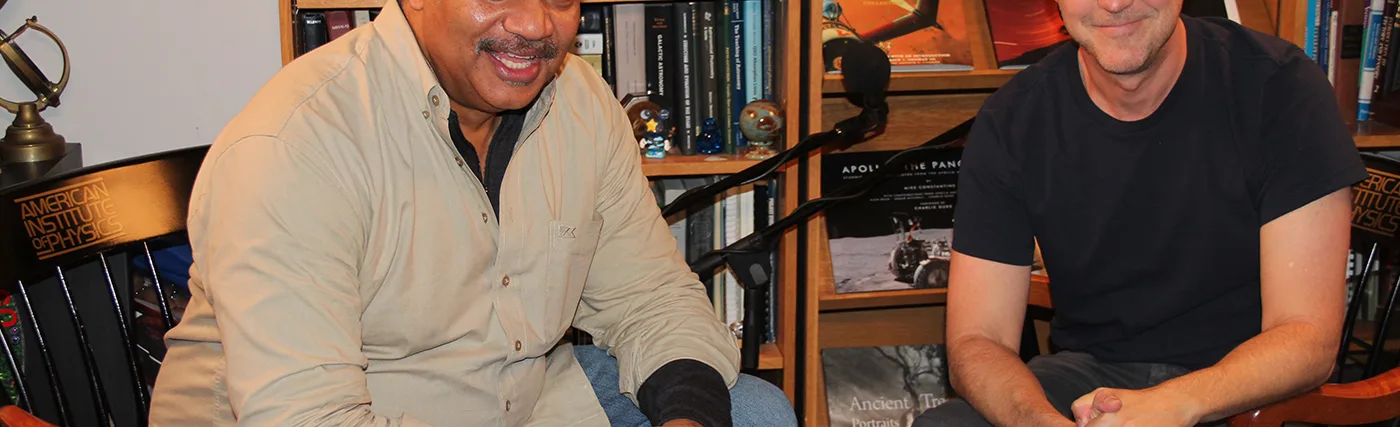
I'm your host, Neil deGrasse Tyson, your personal astrophysicist, and today we have a special edition of StarTalk featuring my conversation with actor, producer, writer, filmmaker, entrepreneur, Edward Norton.
Edward Norton, welcome to StarTalk, dude.
Thanks.
Thanks for coming on.
This is the only StarTalk I would ever go on.
Yeah, because we're talking about actual stars in the universe.
Yeah, it would have a different sobriquet and it'd be like star maps or something.
I don't want to be in that.
So what we like to do with our guests is just get some background understanding of what might have been some early science or math influences in your life, if any.
Just curious, just in school, where'd you grow up?
Grew up in Columbia, Maryland, between Baltimore and Washington.
Baltimore family.
Orioles fan?
Lifelong season ticket holder, kind of.
Yeah, no, I grew up there.
I went to public school my whole life.
I had many good, many terrific teachers in our little public school.
That's very encouraging, by the way.
Yeah, and I was ecumenical in my academics.
Then I liked everything, kind of.
I hated high school, I wasn't popular, so I was very isolated.
Learning things, music and science and history and reading books and going to the theater.
Fortunately, my parents and my family were really intellectual and active, and so they were like, I didn't like being at school, but I liked what I was learning in school.
And then I was really lucky and I got into Yale, which for me was like being lifted off of a desolate planet and put on earth.
It was very rich and the people were amazing and diverse and intellectually ferocious.
And when I got there, Carl Sagan was like a hero of mine, and I originally.
Carl Sagan was at Cornell.
He was at Cornell, yes, but I, you know, the original Cosmos and his books with Andrei and we're in my grandparents' shelf.
I remember going through those books like fascinated and I went to Yale and thought that I was gonna be an astronomy major.
What?
Yes.
What?
I know.
Am I just learning this now?
Yeah.
What?
And I actually, the battery of my early classes was overweight physics and astronomy.
And inspired by the influences basically of the Carl Sagan enterprise.
Yeah, I was, I, yeah, you know, I, it's funny the way, when you're young, you laugh at it now, but like I was, you know, I was really interested in Japan too and martial arts.
Not from something, but just cause of like the James Clavell series Shogun with, you know, Richard Chamberlain and then going and finding the book and reading Clavell's Shogun.
It just seemed very exotic to me, you know?
And I was very drawn to things that seemed exotic and Carl Sagan's, like those books and that series made it seem extremely, like narratively exotic.
And it hooked me.
I was really hooked by all that.
And so then what happened?
Yeah, I know.
It all went south.
There's an off ramp there somewhere.
It all went south.
The funny thing is I was doing theater in my life, in my young life, I was very into theater as well.
My mother taught Shakespeare and-
The high school plays kind of thing?
Yeah, yeah.
And I went to a theater arts school outside of my high school, which was kind of my happy spot.
But I didn't have, I wrote little plays and I made little films with my video cam.
Because I didn't have a very developed sense of the actuality of doing that.
Whereas in a funny way, I felt like, I really did feel like the Sagan, the thing he did made it look like, now that's a thing to do.
That's like, you know, and I really did go to school thinking that's what I want to study.
I didn't know if I wanted to do that, but that's what I wanted to study.
I mean, to do it professionally versus.
Yeah, I wasn't like an 18 year old with a directed sense of a career at all.
I just was like, this seems like cool to learn about.
You're at Yale, you're thinking of astronomy, physics, math has to be in there, so then what happened?
Well, I have a couple of memories.
I wanted to say that in a different way.
I didn't mean to sound disappointingly.
Yes, what transpired?
Yeah, exactly.
Well, I remember one very funny thing was that one of my freshman year astronomy professors, I believe she was Dutch, was a woman named, I want to say Patricia Vader.
But her name was Vader.
And this is in 1987.
And she entered the first day of the lecture class in astronomy wearing all black, including like a long black sweater and black boots.
And as she walked down to this stage, like people started to laugh and someone goes, and everyone was like, this is great.
She's leaning into it.
This is going to be fun.
And she got up and gave this look like, what's all this?
Like she clearly didn't, wasn't in on the joke at all.
And then it was sort of like, oh, this is not going to be a light-hearted romp through astrophysics.
And it wasn't, it was, I remember thinking it was a bit of a grind.
So you didn't survive the baptism?
No, no, I did.
But what actually happened was I was taking some physics classes and things like that.
And I had a roommate who was not from some moneyed family with alumni at the school, but showed no evident talent for any academics whatsoever, was inebriated a lot of the time, came from sort of a Western Pennsylvania public school or whatever.
And none of us could figure out how he was at Yale or what he was doing there.
And one day toward the end of, I don't know, the first year or something like that, he was very affable, but he really seemed pretty dysfunctional to me.
And he was bothering me about like, let's go watch football and drink beer.
And I was like, I have work to do.
And he was like, well, what's the problem?
And I was showing him like I had been diligently working on my problem sets all week.
And I was still...
Your math and physics.
Yeah, and underneath.
And he was like, let me see.
And I showed it to him and he starts laughing at me and proceeds to say, what's the problem here?
And then just basically schools me, like takes me through a week's worth of work, corrects it, fixes it, shows me how easy it really was.
And I looked at him like, what the F?
And he goes, yeah, that's my thing.
And I said, what's your thing?
I said, I've never once seen you out there.
And he goes, I'm in the graduate school.
And he was 18 and he was taking like, I don't even know what the number on it was, math and physics, basically at a graduate level.
And I had this real light bulb moment, like a real epiphany, like a window into like, this guy has a gift, like a gift that I do not have and I am not going to catch up with this.
And it wasn't a competitive thing.
It was more like, this is like a gift, a talent.
And I meditated on it a lot in the rest of that year because I was really struggling and I, other things I was excelling at, they like, I leaned into them and they like, carved like butter for me and I redirected at that point.
So this roommate was a pivotal moment for you.
Very.
But I stayed, you know, I stayed, I stayed lay fascinated.
Which is fortunately in my field, it's possible to be.
There's a lot of popular level books.
There is.
Documentaries.
You can just hang on.
But I, you know, I would read Feynman and read, you know, everything that I ever came out in sort of a popular matrix, I've always kept up with and been fascinated by.
And I think I mentioned when I, literally like the first film I made, where I ever made like more money than I needed, which was maybe three or four films in.
I think the first like check I ever overwrote to any institution for over $10,000 was to the planetarium here to fund astrophysics departmental role for like two years or something like that.
Excellent.
Well, thank you.
Well, thank you.
And I don't even, I came in, I talked, it was before the renovation.
Well before, because I would say this was in 97 or 98.
And that was sort of my like nod to my past interest.
Thank you.
Because those early monies were tap roots for a lot of what would come here.
Because we ultimately created a brand new department of astrophysics and hired faculty.
And my friend Jonathan Rose and his family were very involved.
Jonathan Rose is the Rose family.
I am the Frederick P.
Rose director of the Hayden Planetarium.
I know it.
His dad.
His dad.
That's his dad.
And Jonathan is one, is and has been one of my friends and mentors for many years.
He's been very active in city planning.
City planning.
Sustainability.
And there's another Rose brother who's also active in that.
Yes.
But Jonathan is one of the great thinkers and doers in what I would call progressive urban planning, applications of ideas of sustainability.
Fabulously wealthy, but he cares about people.
He cares about the full functionality of a city.
And interestingly, he sort of takes it around to the subject of my film, but...
I can take you to your film.
My grandfather was sort of a mentor of his.
I can take you to your film.
Yeah, okay.
You take me to your film.
I can take you to your film.
That reminds me of your film.
Yeah.
Exactly.
No.
A film that you wrote directed stars in Motherless Brooklyn, which I didn't know anything about until I saw a screening of it.
And I'm a native New Yorker.
And it's deep in the urban conflicts of planning and design and housing and construction.
What a journey into that it was.
So did your sensitivity, your friendship with Jonathan Rose, did this give you some awareness of the book from which that's derived?
No.
Well, and actually, interestingly, I know Jonathan because my grandfather...
Well, there's Jonathan Latham, the author...
Yes.
No, I'm sorry.
I know Jonathan Rose because he...
My grandfather was sort of a mentor and inspiration to him.
My grandfather was a very famous urban planner, progressive urban planner and thinker named Jim Rouse.
And Jonathan, when I first moved to New York, I worked for him in affordable housing development in New York.
And my first exposure in New York was going around and interviewing people who had been homeless and gotten stabilized through affordable housing.
And that's what opened up this interest in all this stuff.
But lest it sound like a documentary, my real...
What drew me into it was the book.
The book is Jonathan Letham's late 90s novel about a Tourette detective with Tourette syndrome and obsessive compulsive disorder who has to solve the murder of his boss and only friends around, basically.
And it's this great character.
It's like...
So you read the book and resonated with the character.
Yes, but there was nothing about New York in the 50s.
It's a contemporary book about a guy who has this affliction of Tourette's, or condition, I should say, but who has many gifts within, has a photographic memory and an ability to puzzle out, you know, complex things.
But Jonathan's book, which is beloved, is really a character study.
It's a character study of this mind.
You're inside his head.
And the plot is Byzantine and sort of a frame for this character.
But when I became interested in adapting it, I said to Jonathan that...
To the author.
But a film is a tableau, it's a bigger tableau.
I knew Jonathan loved noir films and I sort of proposed to him, I said this is a little radical but what if we take the core of this book, this guy with this condition, but we set it in a moment when if we open it up into New York social history instead of sort of dispense with the plot of the book and let this Tourette detective take us into a more Chinatown scale canvas of what…
Chinatown is in the film.
Yeah, the film, which I love as a film because it's a great atmospheric, sensual…
It's very atmospheric.
Right.
You're in the streets with them while we're there.
Yeah, and it's about the crimes underneath the veneer of LA.
It's about what's the shadow narrative under a place that has a sunny American narrative, literally.
But I think that…
But as an actor, you read this character and said, I want to play this character with Tourette syndrome and obsessive-compulsive disorder.
With these…
You just said this is me.
Well, I thought, this is a great challenge.
This is hard.
You know, it's like, you know, maybe in…
We do things because they're hard, not because they're easy.
Yeah, exactly.
I mean, I think in your field, what draws anybody, if not the things that are hard, right?
Hard to figure out.
You step right up to the plate for that.
Yeah, you say, ooh, let me get into that because if you cracked that, wouldn't that be very satisfying, right?
So, did you have to…
did you speak with Tourette syndrome experts?
How did you prepare for this role?
Well, there's not…
That's a cliché question, but…
No, no, but, you know, it's a…
The mind is a crazy place.
It is.
It's well documented.
Oliver Sacks wrote about Tourette syndrome.
The late Oliver Sacks.
Yes.
And a friend of StarTalk's, too.
He's been on a couple of times.
Yeah, an amazing clinician and writer.
There's at least two very good documentaries about it, in which you…
the condition in which you get to meet many people and see the broad spectrum and diversity of how it manifests in people because in no two people is it the same.
How often does it come with obsessive-compulsive disorder?
It's an overlay that's not uncommon but not at all ubiquitous.
And how often does it come with the sort of very sharp memory, which you aptly portrayed in the film?
That is, I met people who said that their word compulsion made them have very excellent memory for things that people had said.
Because, not to stretch an analogy, but your character in the film is very concerned about detail, remembers detail, but also wants things to make sense.
Yes.
And puzzle pieces multiple times, you reference puzzles.
And he says puzzles, and he says that an unfinished puzzle is like glass in the brain.
Pieces that he has not yet resolved into making sense to him feel like glass in the brain.
And I related to that a lot.
I relate to that even on a story level, even when I was working on trying to write the script and make it all make sense once you were at the end of it.
That's what any good scientist attempts to do with nature.
You get a piece over here and another bit over there.
You don't know if they're connectable at all.
Maybe they are connectable, but you need other pieces between them to know that they're part of the same puzzle.
Yeah.
And you know what's really funny is literally this Sunday night I was in Palo Alto.
I presented one of the breakthrough prizes for science.
It's this new thing that's very lucrative.
I think it's one of the largest cash prizes for scientific achievement in science and math in the world.
Bigger than the Nobel.
$3 million.
Yes.
So, it's like three times bigger than the Nobel, right?
Yeah.
Nobel is like one and a half.
So, anyway, very substantial.
They've invested wisely over the years.
Yes, exactly.
But they also, you know...
Who did you give it to?
Who did you present it to?
So, that's what's interesting.
The person I awarded to is named Jeffrey Friedman.
He's a clinical doctor.
He created a drug called Leptin that basically...
He figured out what the gene is that controls the body's digestion of fat.
And in figuring out the gene, they were able to come up with a thing.
And so, people whose bodies essentially were making them morbidly obese, no matter what they ate, literally he...
And having all kinds of terrible...
Side effects.
Heart and side effects.
He literally created a cure.
That doesn't mean everyone who's overweight takes this pill and his things.
But some people who had a genetic disorder that was really substantial, he discovered the gene that controls the regulation of fat in the body.
And in the little film they had about him, to your exact point, he'd worked on this for a long time.
And he describes the moment that he looked at the slide that he knew revealed what the gene was.
People in the room had tears in their eyes, because he said he knew at the moment that he looked at it, that it had all fallen into place.
He knew what he was looking at, and he knew that in short order there were going to be people whose lives were going to be saved.
Transformed.
Literally saved, who were on death's door.
And then they brought this woman out who is built like an athlete, who was dying and was saved by the drug.
It was unbelievable.
It was just unbelievable.
And everything about that whole evening I was really liking, because essentially they've got a lot of Hollywood people coming up and saying, hey, stop paying attention so much to what this is like, great work.
And it's needed.
We need the elevation of the heroism of those kinds of careers.
Thank you for participating.
Yeah, it was great.
To bring sort of actor-celebrity spotlight to the rest of this is part of that visibility that these kinds of events need and I think require, sustain.
The funny thing is, I think I worked, I was on President Obama's committee for the arts and humanities, right?
So we did a lot of work on...
You've been on the UN too?
Yeah.
We did a lot of work on looking at actual, the actual measurable effect of arts education programming on overall educational efficacy performance rates and stuff and it's really, it's not even fuzzy.
It's like where arts education is a component, kids do better at all STEM.
That everything.
Everything.
And our argument was it should be called STEAM because you should have arts in there and that arts...
And that makes, you know, it makes complete sense to me having an interest in both that visual arts and think about visual arts and their role in astronomy.
Think about, like, think about the importance of being able to understand narrative to talk about things in ways that open it up for people.
If you don't have arts, I think, like, you know, science without some of the dimensions of the arts in them are much more, I don't even want to say boring, they're less activated for people.
You know what I mean?
That's a good word, activated.
Right, right.
You need the activation provided by the imagination that art requires of you.
Yes, yeah.
And training the imagination, I think, I mean, this, you know, it's not like Einstein wasn't saying this all the time.
It's like you have to have artistic imagination to do good science.
That's a quote, right?
Imagination is more important than knowledge, I think, is an Einsteinian quote, which is right up that alley.
Yeah.
Edward, hold that thought.
We got to take a break.
When we come back, more of my interview.
Bringing space and science down to earth.
You're listening to StarTalk.
We're back, so, Edward, so did you think about your brain more, having played this role and studied the symptoms of Tourette's?
Yes, yes, and I think, I don't know if you, I could, I imagine many people could relate to this, but I think that it's, you know, we see it in many forms of disorder or condition, or whatever you wanna call it, that the difference between someone who presents as let's call it stable, and someone who's dealing with an instability can be a matter of like a gene, or a few neurons, or, you know, a little bit of a chemical imbalance.
And that idea that we, you know, so Tourette's to me, as an actor, one of the things that, you know, there's something called a Meisner exercise.
There was a famous teacher named Sanford Meisner, Sandy Meisner, who would have actors do, take a sentence and say it over and over and over again with emphasis like, you know, I don't want you to do that.
It's like, I don't want you to do that.
Like, I don't want you to do that.
Like, he showed how much you can change intention just by playing with emphasis and how there's almost limitless adaptability of intention that you can express.
This is what the actor brings to a script.
Right, exactly.
No, and you have to understand the intention will change the emphasis the way you use words, right?
But it's almost like, it becomes almost like an incantation when you do Meisner exercises, right?
And to me, Tourette's, if you are someone who compulsively mimics other people's voices, or which I always did as a kid, or if you get obsessed with wordplay, the rhythm of words or the intention that's in different things, then Tourette's, it looks like you're looking across a golf that's only a foot wide, because you're saying to yourself, as an actor, I've walked down the street in New York muttering to myself many times, probably looking like, you know, in the early 90s, it was like, that kid looks like, he's probably schizophrenic.
Now they're like, oh, it's Edward, he's probably rehearsing something.
You know what I mean?
It's like New York is very tolerant in a way of people muttering to themselves.
But I think that you, the idea of Tourette's that's in the book, which is a voice in the head that you're doing battle with, a part of your brain that is trying to suppress another part of the brain from doing something unrestrained or anarchic.
Everybody's having that conversation all the time.
It's just a matter of whether it spills out of your head.
Is it literal?
Yeah, is it made vocal?
And I think the idea of being in battle with your own head is something like, I'm not sure if there's anybody who can't relate to that.
And so I think, I like that idea, like that he as a character with Tourette's, it's exotic because it's so extreme in him, but it's not actually unrelatable.
It's like, it's easy to get fairly instant empathy in the beginning of the film when he tells you, I have something wrong with my head.
And this is why, this is what it does.
There's a lot about it that almost right away, you're going, I can sympathize with that.
You know, it got my empathy.
And I don't know if it was intended to hit the audience as much as it hit me, but it's when your character says, you know, if I get high or if I do these other things, it diminishes the effect, but then my thoughts start getting fuzzy.
And up until then, we are respecting you and we're valuing you because you have such a sharp brain.
You remember things.
And now I'm saying, oh my gosh, in order for him to not have the manifested symptoms, now he's gonna be fuzzy brained.
Now he can't be what we value in him when he's fully expressing the affliction.
And so to me, I felt that because my brain matters to me.
I wanna be sharp.
I wanna remember things.
And also, I mean, when you think about stories, there's actually, I think, a genre of films that doesn't get tagged as a genre, but if you Motherless Brooklyn, Forest Gump, Rain Man, but in the sense of being underdog characters and characters who carry us through a story and we're rooting for them because of their affliction, not despite their affliction, right?
But I cite a lot the film about John Nash, right?
Oh, yeah, yeah, Beautiful Mind.
Because he, if I remember the book right and not the film, he didn't want to be.
Nash won the Nobel Prize in economics.
He was a mathematician at Princeton University at the time, yeah.
Right, who had probably schizophrenia, most likely, right?
But if I'm not mistaken, if I remember right in the book, there was a lot they left out of the movie.
But he tried different drug paradigms, but basically went through that.
Like it ruined his capacity to think.
Right, right.
You know.
This is a great dilemma.
It's a moral dilemma.
I saw a lecture by Oliver Sacks, where he talked about his own neurological peculiarities.
And I said, Oliver, if we found a cure to one of your afflictions, I forgot which one we were talking about in the moment, and we can go back and correct that in your childhood, would you do that and then relive your life?
And he said no, he wouldn't.
Because the affliction was the foundation of who he became as an adult.
It's why he got interested in neuroscience in the first place.
So if you go around and start snipping and nipping and tucking genes to get rid of a symptom, when that symptom may be fundamental to the rest of who and what that person is, that's a scary territory to be on.
Can you be on an ethics panel going forward?
The deeper we get into things like CRISPR and stuff like that, this is becoming like not futuristically relevant, it's becoming very relevant right now.
CRISPR, I always forget the acronym, but it's where you edit genes basically at home.
Yeah, well, and just the idea that you actually can do gene editing that is transferable, that is permanent and inheritable, and the idea of sort of designer babies and all that becomes, but what if you don't know what the salutary effects of a thing are?
What happens if you design a baby that has no ailments of any kind and maybe our life efforts to overcome our physical mental challenges is the very foundation of the character that we end up carving as adults.
And without it, what do you become?
I mean, did you know Stephen Hawking?
Yes, we met.
In fact, one of his last interviews was on StarTalk.
Well, did he, I wonder, I don't know.
I mean, we weren't beer drinking buddies.
Yeah, no, no.
We met several times, had dinner with him.
I always wondered if, one thing I never particularly gleaned out of reading his stuff was whether he specifically ever said that his condition of, you know, the constraints that were on him, because obviously he did very significant work before his...
Correct, so that's why I don't think that argument would hold.
It doesn't really hold up.
It wouldn't hold.
Before he was afflicted, he was already brilliant.
He manifested unimpeachably good at what he was doing.
Right, yeah.
But I think that the thing that I tried to inject in the film, there's a character played by Michael K.
Williams who is a trumpet player, a star trumpet player in a jazz band.
Yeah, jazz was quite prevalent in the film.
There's a lot written about the jazz notes in the mind.
Do you study any of that before you went there?
Yeah, yeah, I was into that music.
I think if there's any music that's Tourette-ic in its expression, it's like bop, jazz, you know.
It's very, taking melodies, deconstructing them, looping them, trying them out multiple times, different refrains, it's all.
And different bits of jazz performance affected your characters, the manifestation of the Tourette's.
That was a fascinating scene.
They open up, they allow him a moment where he's not trying to suppress it, where he can kind of find like...
A resonance.
Alignment and play with it and not feel like anybody's looking at him.
Because like the other character says, you can't really disturb the piece in a small club with a hot band, you know what I mean?
But I think that the conversation they end up having where the trumpet player says, like your head is like mine, you're twisting things over and boiling around, and some people call it a gift, but it's a brain affliction, just the same.
He's talking about music.
And he said at least he has a trumpet to blow it through.
Exactly, like my character sort of envies that he's got, that the trumpet player has a mode to put it in that makes it productive, which he doesn't feel that he has.
And I do think, I mean, I think, you know, I feel lucky all the time that I've got like an outlet for my compulsions, you know, that's healthy.
Because I'm sure lots of people who just don't get introduced, they don't get shown a vector down which they can apply the like, you know, the high speed, you know, if you have a brain that's working in a very high gear, but you don't have an outlet for it, it can take you in all kinds of addictions and all kinds of other, you know, terrible places.
So I think it's like when people talk...
So you're saying addiction is just a misdirected compulsion.
I'm not saying that generally.
No, no, not to simplify it that way.
But I'm saying if you think about people, when we talk about like, why do kids, why do we want to cultivate, like think about how many kids, you know, have hyperactive minds and stressful situations and the, you know, the pleasure and relaxation they can get from being given a framework into which to put their thinking.
I mean, if you...
That happened to me in sixth grade.
Yeah.
I was mostly disruptive in school.
Not in an evil way, just I had this social energy that was uncontained.
And the teachers saw that all my book reports were on the universe.
This is in sixth grade.
They said, here, here are classes you can take at the Hayden Planetarium.
So midweek, I'd get on a bus and come all the way down into Manhattan and take advanced classes in astronomy and physics and math.
And then I was calm in class.
So the teacher figured it out.
Partly because you were looking at the other like sixth graders going, you fools, you have no idea what's going on around you.
It's like sort of the Woody Allen thing of like, it's all expanding.
In fact, that conversation was in Brooklyn in the movie.
How could you be calm when the whole universe is expanding?
Yeah, it's expanding and the mother says, you know, what is that your business?
You are here in Brooklyn.
Brooklyn is not expanding.
So you have other interests, I noticed.
Investments in a data company.
What is that about?
No, that, not an investment.
I started that company.
Oh, come on.
Yeah.
No, no, it's my company.
Excuse me.
We do.
A data company.
What's going on there?
This gives you serious street geek cred, just so you know.
Whatever you already had, it adds to it.
Yeah.
Our company, we do very sophisticated kinds of machine learning applications to media data.
We create original data signal around whether things like television advertising is actually driving people to take actions that correlate with buying things.
So, companies buy your consultation services?
Put it this way.
Yeah, we're like Nielsen, but Nielsen is like a Stone Age axe and we are like a gamma knife.
We really are.
It's just, are you watching it or are you not?
That's the Nielsen range.
Well, no.
Not yet.
Or notionally, can we come up with like a proxy, can we come up with a credible proxy for how many people might be watching this?
Which is not, in the world we're in, that's not such a valuable insight anymore.
Especially when there are actions that people take lined up within seconds of having seen a thing that have a pretty high-grade like relationship to whether they're intending to do something.
Okay, so you're just acting on the side.
No, it's a, no I'm not.
I've spent, I've spent.
I think I'll add.
I ping pong.
Let me star, direct and write a movie just on the side.
No, I go back and forth.
I could.
This is good.
Yeah, my film, my film has taken up the last two years of my life.
Like I saw some things saying, oh he hardly does movies anymore.
I was like, I just spent the last two years solidly writing and directing and acting in a film.
How am I not in the movie business anymore?
Because you need your three movies a year and the summer blockbuster and the...
It's like Orson Welles puts out Citizen Kane and they say, oh he's a dilettante.
It's like, what?
It's like my 40th film.
I've got my Malcolm Gladwell 10,000 hours.
You can't take it away from me.
You got it.
So what's this about the United Nations Goodwill Ambassador, by the way, the idea that there are any Goodwill Ambassadors at all is just a great concept.
But you've got, you're the Goodwill Ambassador for Biodiversity?
Yes.
Where did that come in?
Well, my dad is a career conservation litigator and organization builder.
My brother's sister and I grew up in the conservation, environmental sustainability trade.
And I've been involved in...
So you've got the interest and the pedigree to be exactly that.
I've been involved in a lot of work on community-based conservation and sustainable economic development, and they needed a bio...
Biodiversity is a very...
It's poorly understood.
I think that we're moving...
Bio-interdependence.
Yeah.
Well, this is Edwin O.
Wilson, right?
Yeah.
And I think he's done in that field, I think, what you've done with astrophysics and cosmology.
He's helped people understand that interdependence.
But the problem is, I think, in our modern...
Let's call it in the last century between when Teddy Roosevelt and Gifford Pinchot kind of essentially started and John Muir, that's the fountainhead of the American conservation movement, right?
It went through all these phases of sort of preservationist moves because of the spiritual, the intrinsic spiritual value of wild places and nature.
And we've definitely gone through this like 70s, 80s version of like the panda, the elephant, like these iconic, you know, fauna and saying we need to save these animals because, not so reductive that they're cute, but because they're important, they're iconic, right?
And the problem is, is that bio-diversity.
We tend to want to save fuzzy animals.
Yeah, macro-fauna and thing.
And we don't realize that like, with $10 trillion, we couldn't replace what bees and butterflies do to our economy, right?
We cannot replicate what beehives do in our agricultural economy.
Actually, have you seen the series Dark Mirror on Netflix?
So Black Mirror.
Yeah.
One of the episodes, they have artificial bees.
Yeah.
They run out of bees.
They made bee robots.
Yeah.
And that's not happening anytime soon.
No one should kid themselves.
And yet, we're having this huge collapse of pollinator diversity and all of it.
And the ramifications, the idea that we have to understand biodiversity within our economic framework.
We have to realize that fisheries are collapsing globally and the ramifications of this are almost unquantified.
So, it's not just animals, but plant diversity, too.
The corals and all the rest of that.
So, the fact that you have this sort of genetic lineage of biology, biodiversity and conservation, and you have the luminosity being an actor, that's, I guess, the ideal combination to be an ambassador.
Well, yeah, it needs a narrative, too.
And the narrative, which you have training in constructing.
Because I'm just trying to think who makes a good ambassador.
You got to be able to answer somebody's question about this.
You can't just be a pretty face.
You got to have some teeth behind the...
Stage accessories doesn't persuade anybody.
By the way, I think what Jim Cameron did with Avatar is, to me, when people say, well, what's the role of...
Jim has all the money in the world.
He doesn't need to make more Avatar films.
He is making more Avatar films.
Specifically, because his conviction is that we need a mythology.
The young people need to get invested in a mythology that puts alignment with natural systems in a heroic presentation and extractive, non-sustainable villainy into a villainous country.
Avatar is the most popular, it's the most seen piece of filmed entertainment ever made, and it has the central emotional event is a tree falling.
This is very significant.
It's like, that's how you build cultural values.
It really is.
You get a generation of kids feeling like this is awful.
I don't want to be like a part of that destructiveness, you know?
And they get it from early on.
So that means really you should be ambassador for many things.
I need to be an ambassador to sleep for the next few months and then I'll consider my other ambassadorships.
We got to take a break.
When we come back, more of my interview with writer, producer, director, actor, Edward Schroeder.
Hey, we'd like to give a Patreon shout out to the following Patreon patrons, John Gallagher and Asfurt Sigurvinsson.
Nice Icelandic name there.
Hey, if you'd like to get your very own shout out, go to patreon.com/startalkradio and support us.
The future of space and the secrets of our planet revealed.
This is StarTalk.
Welcome back to StarTalk.
So, Edward Norton.
Well, just congratulations on two years, the movie.
Thanks.
It's great, and I was particularly attached to it because of how embedded it is in New York City.
I'm hoping that it would have an appeal to other municipalities.
New York was a complicated place.
There's some good historical, really accurate referencing to the value of Central Park in Manhattan, who was there before.
There were squatters, and there were farms.
There's still a region of grass called Sheeps Meadow.
Where did that name come from?
You can ask yourself.
So I was delighted to see that bit of sort of a history kissing.
Yeah.
Along the timeline.
You want to weave interesting tendrils through.
Of reality, of real history, you threw it.
Because I think, look, first and foremost, to me the challenge is make a film that's like the films I love, like LA.
Confidential or Chinatown.
First and foremost, you got to work that hypnosis of great photography and a sense, you know, music and a sense that you've gone through the frame and into a big world, a big romantic sensual experience of another time and interesting characters and characters who, like we've been saying, you can root for.
Right.
And I think you first and foremost have to create sort of movie magic and give people the experience that we all go to the movies for, like The Godfather or Out of Africa or LA Confidential or any of these types of films that transport us, you know.
But once you've done that, I think layering in, layering in enough that when people come out of it, they at the very least are saying, wow, did that really happen?
Is that, wait, how much of that is true?
Is that based in truth so that like we were talking about, activating people into a sense of like, is that, was there actually a person in New York who was an authoritarian power boss like that?
You know what I mean?
Robert Moses.
And that's sort of this, hopefully the second level that you can achieve, you know.
So, Edward, what I'd like to do for our StarTalk guest, it's not often, you can run the numbers on this, that you are ever in the same room with an astrophysicist.
So, I want you to take this moment to ask me any question you may have been harboring your entire life about the universe.
I have many, that's the problem.
Since there's a lot in the popular press recently about the first photograph of a black hole, I think, and Hawking talks about this, in the thesis of wormholes or this idea that black holes with their super density are bending space time so much that they could make parts of it touch with each other or something like that, in serious thought, is there any, is there real serious thought around the idea that there's conductivity dimensionally through black holes?
So let me answer what I think that question was.
If you look at Einstein's general theory of relativity, which gives us our understanding of black hole physics, and you follow that through, first, it breaks down at the singularity.
So we need some other theories there, and that's why we have string theorists.
But if you don't hit the singularity, you just sort of move through the black hole.
Einstein's relativity prescribes that an entire other space-time emerges on the other side of the black hole.
And you leave the one behind you once you came.
And so when you talk about dimensions, you talk about what does the black hole do.
So there is the likelihood that a whole other universe pops out on the other side of a black hole.
Contained within the black hole.
But dimensionally, it's an entire other universe.
But we don't know how to test that.
You want to be the guy who goes in and comes out and tries to tell it?
No, of course.
So right now it's a fascinating hypothesis.
But it's not a function of thinking of space-time fabric, of being almost like bent around to being, like in Madeleine Langle's old pop sci-fi things about the tesseract, right?
The idea that you're actually going from one place to another within the same continuum.
Yeah, that would be like a wormhole to get from one part of the universe to the other efficiently.
Right.
Yeah, so it's not clear that it's a wormhole.
Right.
Because we don't see other places in the universe that could be the exit for that.
Right.
We just don't see that.
Right.
And so, it's not clear whether we can exploit it in that way anytime soon.
Okay, I have a much more practical one.
In the work that's being done to look at viable exoplanets and stuff like that, I understand radio astronomy and stuff like that, but when they talk about the signature, you know, the atmospheric signature of life, et cetera, what are we actually looking at?
What are we looking at that we have the capacity to be so granular that at these distances and everything, what is literally the atmospheric signature and how are we measuring it?
Great question.
So, this is a new cottage industry in the field, and it's the search for biomarkers.
Right.
And this is evidence in the atmosphere of a planet that could indicate that the surface of that planet has active life while you're observing it.
You can't see the surface of the planet, it's too small.
It's too dim.
Right.
But what you can do is if the planet passes in front of the host star, light from the host star moves through the atmosphere, comes out the other side en route to you, the observer, and the act of passing through the atmosphere gives the atmosphere a chance to wreak havoc on the spectrum of that star.
And the component parts of the atmosphere differentiated that much.
Oh my gosh, you know what?
So an atmosphere without oxygen is differentiated.
You will see the oxygen signature in the atmosphere of in the spectrum of the star when the planet is passing in front of it.
And it wouldn't otherwise be there when the planet is not passing in front of it.
And is oxygen even the primary signature?
Oxygen is unstable.
We have oxygen, if you got rid of all life on earth, the oxygen would slowly disappear.
So something has to keep churning it out, like our plant life.
There's a whole portfolio of unstable molecules, which if you find them in an atmosphere, something is generating it.
And so you can look at the kinds of things that life does, or methane is another example.
Methane, termites give off methane, so do cows through their flatulence, right?
If you just find methane, there are other ways you can make it, but if you find it, it's tantalizing and makes you look more closely.
And so what is the instrument that's got that level of granular ability to look at the light spectrum and see the distortions of specifically those elemental?
Very powerful telescopes with very highly resolved spectrographs.
Spectrographs.
Okay, that's what's going on here.
You split up the light into its component colors, and when you do that, you see the signatures of elements, molecules, depending on what it is that the light passes.
And we have not been able to do that until we put telescopes outside our own atmosphere.
The telescopes outside the atmosphere are best for that, but if you get a really hunkering telescope on Earth, there are ways to correct for the atmosphere where you can make some headway on that.
But it must be, I mean, I'm saying, this is an argument for having telescopes outside the atmosphere.
Oh yeah, yeah, or on the far side of the moon.
Great question, dude.
Are we putting one on the far side of the moon?
So China landed a spacecraft on the far side of the moon for the first time, so there are more players in this right now, but the problem is-
Has there been talk about a telescope on the dark side?
It's not always dark there, but it's shielded from Earth's contamination, but you need a way to communicate around the bend of the moon.
So you need satellites or transmitters along the edges, this sort of thing.
But yeah, that's the future.
That's the future.
Final thing, prediction on affirmation, timeline to affirmation of a planet that's producing biological signal.
I'd give it 10 years.
If not Mars itself, right in our backyard, I'd give it 10 years.
At the rate at which we're at it.
Yeah, our lifetime, definitely.
My son, who's six, when we were talking about this one time, he said, oh dad, they already know there is life.
And I said, really, how do you know that?
And he said, I saw it on my Magic Bus series.
So, you know.
So he got it first.
Yeah, there's an early, early, early signals to the runner.
Great.
So, Edward, thank you for being on StarTalk.
Pleasure, it was great.
And next time you do another movie, we'll totally want to get your back.
Great.
Only if you really created the movie.
Not just acted it out.
Yeah, exactly.
No, I don't need that.
Dillatantish.
So, you've been listening to StarTalk and I've been your host, Neil deGrasse Tyson, with my special guest, Edward Norton.
And he promised he'll come back for his next movie project.
Only if I see receipts from listeners that they actually bought tickets to Motherless Brooklyn and went.
Motherless Brooklyn.
Another important contribution to film noir.
Motherless Brooklyn, starring Edward Norton.
So, you've been listening to StarTalk and I've been your host, Neil deGrasse Tyson, your personal astrophysicist.
And, as always, I bid you to keep looking up.
See the full transcript




 Unlock with Patreon
 Become a Patron