Transcript
DOWNLOAD SRT
Welcome to StarTalk, your place in the universe where science and pop culture collide. StarTalk begins right now. Welcome back to StarTalk Radio. I'm your host, Neil deGrasse Tyson. I'm an astrophysicist at the American Museum of Natural History, right...
Welcome to StarTalk, your place in the universe where science and pop culture collide.
StarTalk begins right now.
Welcome back to StarTalk Radio.
I'm your host, Neil deGrasse Tyson.
I'm an astrophysicist at the American Museum of Natural History, right here in New York City.
And I also serve as director of the Hayden Planetarium.
Come check us out sometime.
I got with me in studio, the one, the only, the inimitable Chuck Nice.
Yes.
Welcome back, man.
Love having you.
I love being here, man.
And you get into all kinds of stuff.
First, you're tweeting at Chuck Nice Comic.
At Chuck Nice Comic.
Other Chuck Nicers were taken, I'm told.
Yeah, screw the rest of those Chuck Nicers.
You were just slow, I was just admitting.
Put the comic on there.
Also, I was checking your bio in Progress.
You're doing a show where you're just invading people's homes, which sounds creepy.
Yes.
Imagine that.
A black man home invasion show.
That's what it's called.
Yeah, it's called Home Strange Home, man.
It's me going around to some of the weirdest and most unique homes in America.
And calling them out.
And calling them out, yeah.
And what network?
Home and Garden Television.
That is my sister's favorite network.
I love her.
Every speed dial button goes to that network.
My kind of women.
I'm not gonna tell her.
She's gonna find you by accident.
Fantastic.
And she's there.
I got with me also my friend and colleague Charles Liu.
Great to see you.
Professor Liu, excellent.
Thank you so much for having me.
Excellent astrophysicist at the City University of New York on Staten Island.
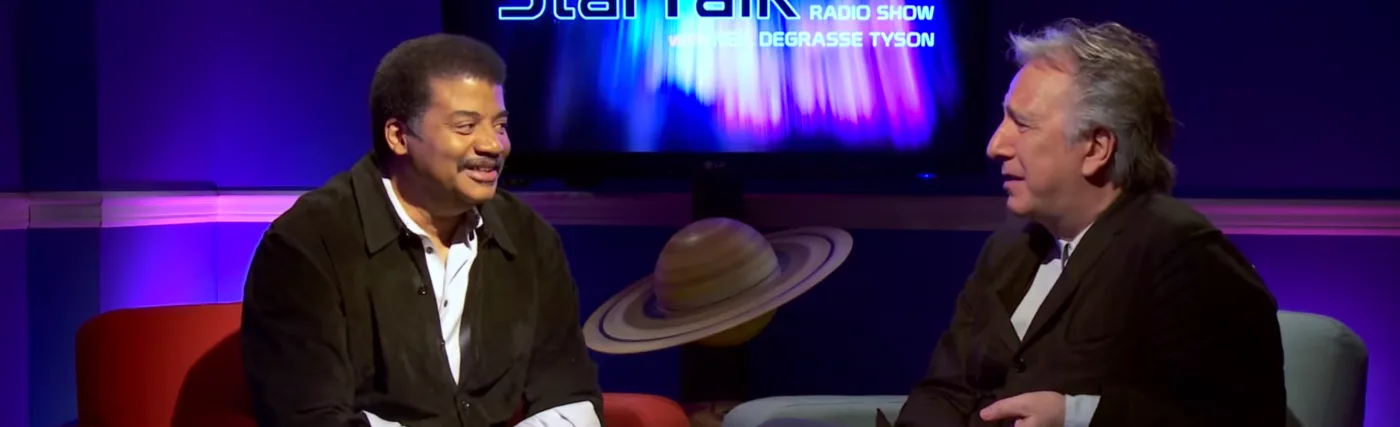
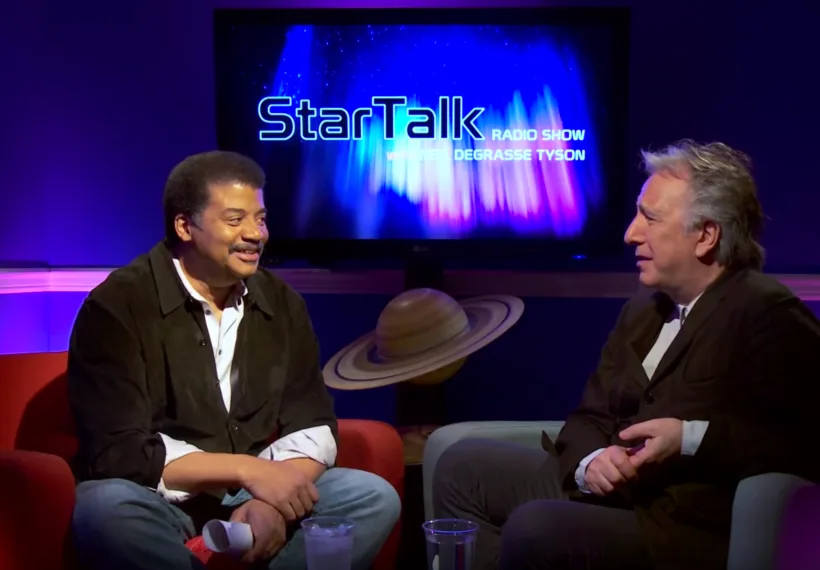
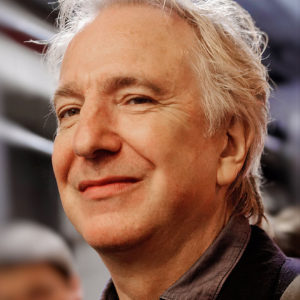
And I've got you here because we're featuring my interview clips with Alan Rickman.
Yes.
Alan Rickman.
Alan Rickman.
By Grand Thar's hammer, you shall be avenged.
And I didn't, I didn't know this in advance.
That was it?
You'll find out.
So Alan Rickman, you may know him from his role in Harry Potter.
He was snake, creepy, defined the word creepy.
He's it, and Harry Potter, of course he was in Die Hard, one of the greatest villain roles ever.
He was in Galaxy Quest, how it can't be a movie as there ever was, in Dogma, many other films, and he was also in Bottle Shock.
Bottle Shock.
Bottle Shock, yeah, wine film.
A big fan of that.
And for folks who are sort of A-list guests like that, I always like knowing what role science might have played in their lives.
It's not always good, so I just like knowing, just so I know what I'm dealing with in the interviews.
Let's find out what Alan Rickman tells us about his life experience learning science.
So Alan, I have to ask, because you've been in some intriguing science fiction films like Galaxy Quest, I always wonder, do people who end up in those roles, do they have some science background that leads them to it?
How is science flavored in your life, in your years in school?
Put it this way, when I did my very last physics exam, I got 4%.
That would be four marks out of 100.
Oh, four, 96, because you lost 4.4.
I got four marks.
Four in your physics.
And I think they used to give you one mark for getting your name right on the top of the paper.
And the teacher wrote a hysterical paper and he didn't mean that it was funny.
What's the corresponding year in school in America that that would be?
That would be when I was about 15 or 16, something like that.
Yeah, and it's before you choose which subjects you're gonna do what we call A-level when you're 17 and 18 and then you go to university.
So, physics or science was never ever gonna be part of my life.
So that when you said, maybe I should be an actor.
Well, at least I had an option.
It makes me wonder, had you done well in physics, we would have never had you as an actor.
I don't know how these forces operate, but.
No, actually, there was somebody in my year who, because it was a good school in that sense.
They didn't kind of try to trap you or type you, and somebody in my year did.
Which is a very UK thing to do, right?
Yeah, well, I don't know about UK, it's world over.
Get a label on people as quickly as they can.
This guy in my year did for his three A-level subjects, i.e.
leading up to university, did physics, maths, and art.
And he wound up being an art teacher.
And I'm sure all the better for having had science in his life.
Wow, so yeah, we got 4% on his physics.
I'm not going to ask you what percent you got on your physics.
Chuck, I'm turning to you on this one.
That's funny, he says that because I remember, now we had physics in the ninth grade, the school that I went to.
Oh, was it private school?
And it was academically advanced.
I was not academically advanced.
And so I failed physics.
And now it comes out.
That's what he said, I think I'll be a comedian.
Yes, and put fun on a physics radio show.
But I loved science and I really felt like, man, I can't believe I failed this class and I blamed the teacher, but I had to go-
That is the right thing to do.
I am so in favor.
I blamed the teacher.
So you're an educator, as am I, of course, but you think a lot about this.
So I'm intrigued that he could fail a class, but still embrace the meaning of science.
Because when Alan Rickman said he got 4%, he wasn't bad mouthing science.
That's right.
He just got 4%.
One thing that he said that was so telling, he said that most places in the world, you get tracked into places.
Oh, you must be the science guy.
Oh, you must be the art guy.
But the bottom line is, especially in this modern world, you can love anything and be anything at the same time.
The information-
Without the metrics of an exam to tell you whether you should do either.
The information that used to have to be forced into you as training for something is no longer that constrained in the classroom.
You can get it anywhere, like all over the world, online.
Oh, so we live in a time where the teacher's not the sole source of your enlightenment.
So the teacher's role becomes whether or not you learn how to think about things in a positive light, whether you understand things in a way that makes sense for you in your life.
If the teacher fails to do that, it is the teacher's fault.
It is not the student's fault.
So I tell all my students, I might teach astronomy, I say, look, if you don't like math and science by the end of this class, don't blame math and science, blame me.
And I'm totally comfortable with that.
I'm really glad to hear it.
What did it for me though was-
So you were burned in effigy recently.
That's fine.
Did you do well in any science class?
I did well in most of them.
I just really, I don't know what it was.
I don't think we had a communication thing, but then my chemistry teacher gave me a book called Introduction to Astronomy.
Your chemistry teacher.
My chemistry teacher gave me this.
Good for your chemistry teacher.
Because the chemistry teacher said, there's no way you can be doing this well in chemistry, chemistry and failing physics.
And when I started, this book was really fascinating.
So as a teacher figured something else must be operating on that.
Yes.
And I found the book so fascinating that it inspired me to continue going.
That's great.
And you became a comedian.
But astronomy is often a gateway science.
When we come back, we've got more of my interview with Alan Rickman, the actor extraordinaire.
And I've got in studio, Chuck Nice, Charles Liu, we'll be back in a minute.
Thanks We're back, StarTalk Radio.
By the way, you can find us three ways.
First, just simply on the web, it's startalkradio.net.
We have an archive of all of our old shows.
Check it out.
But there, you can also download us as a podcast, as you can on iTunes.
We're also in video form on the Nerdist Network of YouTube.
So find us there.
And not only that, we're on broadcast radio.
And so Chuck, with a lot of roots in broadcast radio, it's so great to have you participate in this adventure.
Yes, yeah, I feel the same way.
And my roots are deep in broadcast radio.
Yeah, yeah.
So thanks for that.
And Chuck, you were a radio broadcaster in college.
Yes, I was.
Excellent.
So let's put on our radio voices.
Yeah, we're good.
Well, I did punk rock once in a while.
It's about the hospital.
So in this edition of StarTalk, we've got my interview clips with Alan Rickman, who's actor extraordinaire.
I mean, when he speaks, you can only just be silent and listen to the words as they come out of his mouth.
He first has got the British accent, which means he has access to vocabulary that Americans can only dream of.
And just the roles he's played have been so compelling and so absorbing.
And in this next clip, it came off of our discussion of his exposure to science and what about science might intrigue him.
He didn't do well on that physics class.
He got 4% out of 100.
I thought it was 4% off, 4% in.
So yes, that's bad.
That would be an F minus.
Minus, minus, minus.
So does that influence what roles you might play?
Is it good or is it bad?
Is he still curious?
Turns out he's quite interested in human physiology.
Who isn't?
But to know that an actor is, brings an extra dimension to it.
Let's find out what he tells us about that.
About watching somebody play the piano, I don't know how that's physically possible.
How do people retain that information?
How do they then not look at what their hands are doing?
And how is that message going from the brain to 10 fingers and dividing that information up?
And also operations now where the edges get blurred, whereby people can operate with a tiny camera inside people's bodies.
And apparently the way they train themselves to do that is by getting really good at computer games.
Yeah, I mean, that's a fascinating frontier.
So I'm curious then, I mean, you're intelligent, you're a deep thinker, we've spoken earlier, you even think philosophically about the world.
It seems to me that that could and would play some role in what drives the roles you select in your acting career.
I mean, why wouldn't they?
If someone had an idea, they say, we're gonna cast doctors.
Consider, was it in the 1960s, that movie, that Ozygazimov story, Fantastic Voyage, where the vessel, the proteus, I think it was called, shrunk to some, there's some important diplomat that has a brain tumor and he might die, but they found a laser that could fix it, but they have to shrink down the laser and get inside and do it.
So they take this vessel, put people in it, shrink it down to the size of the confidant syringe, and then you go inside the body.
And then the whole movie is what is inside the body and what they see, and the red blood cells and the ventricles of the heart and the veins and the arteries, and they get to the brain and they pull out their laser, which was a big thing back in the 60s.
And I'm just curious, those sound like intriguing roles.
And if you feel that...
Just means I have to do a lot of background work to catch up.
Well, so, I mean, that's all right.
No, that's enjoyable too.
I like ambiguity in roles, because that's interesting, because it means there's no rules.
And it means you can pull people into a private storytelling space, and they're not being manipulated by outside forces.
Their imaginations are allowed to work along with mind.
But at the same time, I did actually do a film playing a heart surgeon, and I was on really big catch up there, because I was now forced to try to understand how the heart even works.
And then to mime doing a heart operation, because it was about Alfred Blaylock who did the first Blue Baby operation.
Yeah, so when you're an actor, you don't know what you're going to be called to do.
And there he is.
First he's intrigued by the moto-neuro-kineticism of a piano player.
Who is it?
Do you play the piano?
I do play the piano.
Do you play the piano too?
No longer.
No longer.
I took lessons for a little while, but I sucked.
No, my daughter is way better than I am.
But the reality is that indeed, when the human body programs itself, the reason we practice is that we're able to train our bodies to do things beyond our ability to think consciously.
It's the same for playing piano as it is for, say, a football player.
If somebody's coming in and trying to sack you as a quarterback.
Have you run the other way?
Yeah.
What kind of training does that take?
But you literally don't have enough time to think to move.
Your body has to know to move before you can think, oh, somebody's gonna come hit me.
So you're training yourself all those years.
You think, oh, I can play quarterback or oh, I can sack the quarterback.
The reality is your body has to react faster than you can think and command your body to react in order to be successful.
So you're training.
Yes.
So you train, so yeah.
I feel the same way at the Source Awards, you know?
It's like if you hear pop, pop, pop, you don't even think, you just wham.
So you've done this.
This has happened so often.
That's your motor neuro kinetic response.
You would think that it would occur to me just not to go to the Source Awards.
Hundreds of hours, thousands of hours of that kind of practice.
But what is very cool is that the human brain, even with a few hours, can make it so that other humans looking at that person suspect that there's the appearance of ability, even though the true ability is not yet revealed.
So the actor doesn't have to then be the 20,000 hour expert.
They can just look at it.
The 20 hour expert, right.
But they have to know how to mimic.
Exactly, and that itself has its own brain, not a neuro cognitive thing.
So different people are good at different things.
It could be, for example, that the maestro piano player particularly can arrange his or her fingers to become very good at playing the piano.
Whereas the actor or the comedian has the moto neuro ability to find a way to reach those specific aspects that appear to be excellent to others and be able to communicate.
When I was hosting Nova Science Now on PBS, we did a segment on your brain learning while you're asleep of something you had done the day before.
Okay, so you do a task that you've never done before and it's hard at first and you get a little better at it and you keep getting better, but there's a point where you're just not getting better.
You fatigue, I guess, is how we would normally describe it.
You go to sleep, wake up the next morning, kick in, you start at a higher level than you left off the day before.
Because your brain has added the information into it.
And it's not just knowledge, it was adding kinetic memory of what you were doing.
And so when they say sleep on it, it actually has meaning.
And I was able to confirm that.
I did this with multiple, I did it with a video game that required kineticism.
I did it with a typing sequence.
I did it with a memory sequence.
The next day I was better.
And so the brain is working.
So is your brain like making new neural pathways so that you're better at that?
But it's just, I mean, we're not growing new neurons, right?
It's just the rearrangement of the chemical pieces that we picked up.
It all kind of settles in during that time when you're not doing anything else.
So all just sacks of chemistry is what you're telling us.
Oh, chemistry, alchemy, magic.
But as well, you know, Neil, all scientists throughout history who have reached intractable things have at first ascribed them to perhaps magic or divinity.
But knowing that that's just a gap until we fill it with more knowledge.
What's interesting is it works that way historically.
And there's the famous edict or adage from Arthur C.
Clarke where any sufficiently advanced technology is indistinguishable from magic.
Ah, that's right.
Yeah, and so, so, so not only-
Take an iPhone back to colonial America.
No, take it back 10 years ago.
That's true.
You'd still be burned at the stake.
Right, so for an actor to learn to be another whole person, I'm intrigued to, and heartened, well, of course, because we see it and it's real, actors who are good pick it up, they capture the essence of it, to the point where you, the viewer, even if you're an expert in what they're acting, you think that they are what that is.
You want them to be that.
That's true.
On the other hand-
I watched The Big Bang Theory, and I'm certain those actors are experts in all the fields that they talk about.
On the other hand, doesn't it rankle you when, I don't know, maybe Chuck, you know this, when you're watching somebody pretending to play the piano on the movie, and their hands are over here, and you know that the sound is coming from over there.
I'm switching the channel.
I'm not taking you to the next one.
Or the next taping of Big Bang Theory.
Yeah, and some actors, they'll actually want to learn the piano so that, you know, like they want to be that real, or they'll gain the weight or lose the weight.
You're right.
Denzel Washington played a trumpet player in Mo Better Blues and literally learned the fingering, not to play the trumpet, but the fingering.
Oh, okay, so you checked the cheek to see if it was moving.
More of our interview with Alan Rickman, but we come back to StarTalk.
We're back on StarTalk.
Today, we are featuring my interview with Alan Rickman.
I listen to that guy all day.
No, that is not a good imitation of Alan Rickman.
He sounds a little smug when he talks.
Yeah, but then you want that, you know?
But his last line in the last movie, you have your mother's eyes, such pathos.
You just want to shed a tear for the dude.
Yeah, I wanted to shed a tear for that impression.
That's why you're the comedian, and I'm the astronomy professor.
The movie I'm thinking of right this minute is, he was one of the lead characters in the movie Bottle Shock, which chronicles an episode in the history of American ornology.
That's one of those OE words.
Well, Neil, I hope it's okay that I reveal to the world how much of an enophile you are.
This man, folks, is one of the maybe two or three most knowledgeable people about wine in the whole world.
No, that he knows.
You have to let me finish my sentence.
Well, thank you for those kudos, but I'm just saying, so I had to go see that movie, and I found out neither of you saw that movie, so I had to do all the talking this same.
Didn't see Sideways either.
Yeah, so Sideways is another good one.
So I'm just impressed that there's a wine movie out there, and it chronicled this chapter in the history of American winemaking, where California is trying to make a name for itself.
It's got the grapes of the classic wine-growing regions of France from Bordeaux, especially Bordeaux in this particular case, and so they grow their Cabernet Sauvignon grape.
And so the most expensive wines ever at auction from France are this grape.
You put the plantings here in America and they're trying to compete.
And there was a contest in 1976, our bicentennial year.
It was all up with America.
And the French said, let's have a contest.
You guys are so uppity.
Let's put in some of your wines against some of our wines.
And some people were a little skeptical that maybe the French were trying to embarrass us on our, because by the way, the only way you can conduct that experiment is if you taste the wine blind.
Right.
You can't know in advance because then you don't trust the judges.
Especially the French.
Why don't we have a contest where you bring your still?
Right.
So you got to work that and play it right.
And so Alan Rickman plays, was he one of the judges?
I forgot the exact role, but he was there as part of this contest that would be conducted.
And so let's check out this clip and we'll talk more about wine when we get back.
All right, so you study your roles as any good actor does, which tells me then in Bottle Shock, you had to do a lot of wine tasting.
That's not so difficult.
Had to do your homework for Bottle Shock.
No, well, the real problem with that was we were shooting it all in Sonoma.
And so when we came to the scene where it's about a blind wine testing between French, a true story, between French and American wines.
Where you taste the wine and you're not told in advance anything about it.
And this was set up in Paris 30 odd years ago by the character I was playing to publicize his wine academy.
And this all happened and his judges were very eminent French, all French chefs and wine experts.
And snobs, basically.
They knew what they were talking about.
Horror of horrors, the American wines won.
That's an extraordinary story.
The departure from anything to do with the reality is when we shot that scene of the actual wine tasting, it was in about 90 degrees of heat, outdoors in Sonoma, where of course you couldn't possibly have done that because it would have ruined all the wines.
Right, right.
But it was visually stunning.
Right, yeah, look.
It looked good.
Yeah, so there he was.
So he was sort of the British merchant who organized this tasting in France.
And yeah, America won.
In fact, I had tasted the wine that won that contest.
It was 1973 Stag's Leap.
Stag's Leap?
Cask 23.
Wow.
There's Cask 23.
Was it actually that good?
Stag's Leap, 1973.
Now, back then and still California wines tend to mature sooner than French wines.
So, when the French lost this contest, they would then say, Oh, well, the American...
This is 1976 was the contest.
The other French wines were in the early 70s, right?
So, they would say, Oh, ours has not shown well yet.
Come back in two years.
By then, it was too late.
Genie was out of the bottle.
Time Magazine was present at the tasting and they ended up writing about it.
No other American press was interested in covering it.
You know, there is a California wine called Rocket Science.
Yes.
In fact, I had some of that yesterday.
As good as Tag Sleep?
They're coming along.
Actually, I'm a sucker for a wine label that has cosmic themes.
And there's a lot of them.
In fact, I think cosmically themed wine labels are like second behind like nature stuff, like flowers and cute animals.
Just check it out.
There's some with moons and planets and stars.
Yeah.
It's the lucky charms of wine.
The yellow brick road.
That's the next one.
So I'm quite sure that cosmic themes have infused the winemaking.
People might have done well in their Astro 101 and it showed up on their labels.
When we come back, more of my interview with Alan Rickman.
We're back with StarTalk Radio, featuring my interviews with Alan Rickman.
Both of you guys cannot imitate the man.
Okay, you're right.
My co-host.
Doesn't stop us from trying.
Doesn't stop you from trying.
And we just came off of that segment with a bottle shock.
We're at American Wine, won this prestigious French competition, set up to showcase how far California had come.
And the science of wine is fascinating.
In University of California, Davis, there's an entire school there that specializes in the science of wine.
And so what I like is that the Americans were saying, whatever you guys do in France, because you want to raise it to an art.
In California, they're saying, we're gonna bring it down to a science.
We will kick your ass with science.
Blind?
Draw some science on them, son.
So Alan Rickman didn't only do bottle shock, he also did one of the campiest, funniest movies ever, Galaxy Quest.
Dr.
Lazarus.
Yeah, I don't know how many people out there saw the film.
I don't think it was like a number one in the charts, but definitely, it's certainly like a rentable film.
And it was about a TV characters from a science fiction show that actual aliens came who had to protect their civilization or something, they want them to help them.
They thought it was real because they got the television signals from, they went out into space.
We have seen your historical.
It was every Trekkies fantasy come true.
Every Star Trek fan.
Because you want it to be real and the aliens thought it was real.
So Alan Rickman played Dr.
Lazarus, right?
In the Galaxy Quest, he showed-
By Grabthar's hammer, you shall be avenged.
Let's go straight to that clip.
I just asked him, how does this fit into your acting repertoire?
Well, I mean, of course in Galaxy Quest, I'm trying to think if I've done any others, but that was very particularly about a bunch of actors.
Who were all trapped in a really bad TV show.
So that's really all I had to know.
You were portraying an actor on that.
That just didn't occur to me.
And possibly a bad actor.
Who had aims of having been in Shakespeare and found himself in a sci-fi show, which then finished 12 years ago, and now these actors just go to conventions.
Right, and the real aliens showed up.
The real aliens showed up unnoticed in the crowd of people wearing my costume.
The premise is just so crazy.
It was brilliant.
Fun, crazy premise.
I'm glad you did it because it's there.
So this is in his portfolio of acting roles.
Forgive me, I had to reference my notes.
The aliens in the movie are called the Thermians and octopoidal creatures.
They have humanoid form.
They have humanoid form when they were interacting with us.
But when you saw them in their true form, they were disgusting.
So they did it for our benefit so that we wouldn't completely freak out.
That there are actors there who may have trained in Shakespeare and find themselves on a hit TV show that has nothing to do with Shakespeare.
Rickman played that part to perfection, in a sense.
He looked a little grumpy in that role.
He was supposedly Sir Alexander Dayne, a distinguished Shakespearean actor who winds up on TV and ends up looking like a moron.
In one scene in the movie, he had to go stand in front of a Walmart-like box store with his friends and say, By Grabthar's hammer, what a savings.
Yeah, and so the whole point of it is that you can take a role and play with it as much as you want, or you can disdain it and say that's not part of you, right?
In modern Star Trek lore, people are still going around doing exactly the same thing.
In my one cameo on The Big Bang Theory, I chatted with the Raj character, right?
Because he's the astrophysicist on the show.
And I said, oh, so what is your background?
He's classically trained in England.
And he studied Shakespeare.
And then I thought to myself, did he ever imagine that he would be best known for a geeky science kid in a TV sitcom?
And so I guess surely it all folds in, but maybe you've got to go where the...
You've got to roll with it.
And you hate every minute of it.
Until you get a check.
Funny how that just makes everything okay.
Oh, I'm just really selling my soul here.
This is awful.
There is no artistic integrity to any of this.
Ka-ching!
I'm stealing money!
More in my interview with Alan Rickman, but we come back to StarTalk.
We're back on StarTalk.
Find us on the web at startalkradio.net.
Charles, I brought you on the show.
You're an astrophysicist, but you're also a total expert in so many other things, including the analysis of Harry Potter.
Look, Harry Potter's most important relative in the series is named Sirius Black.
Sirius, of course, the brightest star of the night, Scott.
Sirius has a brother named Regulus Black, who is also-
He's another very bright star in the night sky.
And another relative, a female.
Sirius is in Canis Major, it is the eye of the dog.
Regulus is one of the stars in the constellation Leo.
He's in the paw of Leo the Lion.
And they have another relative named Bellatrix.
Bellatrix, let me guess, dog Anus.
No?
No, no, no, no.
She's probably-
Generally, stars in constellations don't identify the anus.
Okay, they try to use the bright star as the eye.
Bellatrix is one of the stars in the constellation Orion the Hunter, and it means Amazon or woman warrior.
But of course, Bellatrix is a sister named Narcissus, which has no star name.
Narcissus is, of course, based on a plant.
It's a flower that grows over the side.
So I once tweeted all the names in Harry Potter that derive from cosmic sources or star names, and there's quite a few.
So JK.
Rowling must have had Astro 101 or knew her mythology.
There's something, so that's good when people know their science.
And this informs their art.
Yes.
And enriches storytelling.
Absolutely.
Let's go to my next clip with Alan Rickman about how science literacy can enrich storytelling, particularly in the sci-fi genre.
Check it out.
I think it's not an accident that some of the most popular movies of all time have had a science fiction foundation to them.
You look at the movie with Pandora in it, Avatar.
You look at ET.
You look at these stories.
It enables you to reach for places to tell a story that you couldn't maybe tell convincingly, which is ordinary people.
But they need great writers and they need great stories.
It's very easy to just kind of sling the ingredients together and call it a film.
And I think there's a danger of that.
When I think back to a film like Alien, which I think was an extraordinary experience to see that when that first came out.
And just sit in a movie theater and be genuinely terrified.
Is there some role, science fiction role, that you think you could or should play or want to play as we go forward?
I'm here ready, willing and able to play anything, anybody in any story as long as it's well written.
And what does that mean?
As long as it uses language well, as long as it's got ideas, as long as it's got a point of view, as long as it's not insulting the audience, as long as it's taking them somewhere.
And as I say, that's a mysterious process.
I'm a good editor of a script, but I have no idea what it means to sit down with a blank piece of paper and come up with a story.
But I'm the servant of it when it arrives.
So sure, it absolutely would be something that would fascinate me.
That's Alan Rickmageddon.
That's pretty noble of him.
So what I liked about what he said is he doesn't want the script to insult the audience, but he didn't at for a moment say that the script couldn't insult him as an actor.
He'll play any role, provided that it served the audience.
And that was good.
It'll take anything anywhere.
That's really important.
And science fiction is a tremendous way, just science in general, because there's so much unknown that's the frontier.
And yet there's enough reality in it that we can relate to this unusual environment.
So what you're saying is there's enough palette that has been undrawn upon for you to go places that where otherwise you'd be constricted here on earth.
That's right.
That's why you-
I put words in your mouth, but I think that's what you're saying.
You're exactly right.
You explore the human condition in other worldly environments, and it allows you to distill the story that you really want to tell.
We can't be the only ones thinking this.
Chuck, you look at the eight out of the top 10 grossing films of all time.
They've been-
Sci-fi.
Jurassic Park, ET.
Avatar, Star Wars.
You just go on down the list.
It's all sci-fi.
Well, because it also, it excites the imagination.
But I thought I was biased because I'm a scientist and of course I like sci-fi.
But like other folk are into this too.
No, because I mean, it's the ultimate fantasy.
Think about it.
To be able, how many people have left this atmosphere and yet you get to go to another galaxy or beyond.
I mean, and then pretty much-
14 people have left the atmosphere.
14 people have left, that's all?
Yeah, that's all.
God, that's crazy.
Well, left to another destination.
That's what I'm saying.
Not just been up and back.
Not just circle around.
Driving around the block.
Driving around the block.
Right, right.
We actually have left to another destination.
Yeah, got their GPS and went somewhere else.
Yeah, 14 people.
So I mean, of course people look at sci-fi and go, wow, I mean, this would be cool if this could happen.
Isn't there incredible comedy and humor in science fiction, too?
Well, without a doubt.
Being able to just laugh about things that you otherwise couldn't because it's too close to home.
Like Kirk getting alien tail when he goes in the bathroom.
Or whatever unnamed crewman goes down with him is going to die.
With a red shirt.
With a red shirt.
More on my interview with Alan Rickman when we return on StarTalk Radio.
In these lessons, I will attempt to penetrate your mind.
You will attempt to resist.
Prepare yourself.
Feeling sentimental?
That's private.
Not to me.
Not to the Dark Lord, if you don't improve.
Every memory he has access to is a weapon he can use against you.
You won't last two seconds if he invades your mind.
You're just like your father.
Lazy, arrogant.
Don't say a word against my father.
Weak.
I'm not weak.
Then prove it.
Control your emotions.
Discipline your mind.
We're back on Star Talk Radio, and we've been featuring my interview with actor extraordinaire Alan Rickman.
Every role he plays, he owns it.
That's true.
You can't even imagine anyone else approaching the roles that he portrays in his films.
He really does make them all his own.
Yeah, I guess that's a good thing for directors.
I should have brought a director here to get them to react to this.
But so what I wanted to know from him in my interview was, does he approach a role with any kind of philosophical?
Like, what's what's his muse as he goes in?
And are there roles that he feels more comfortable in?
Or is as an actor, he'll take on any challenge at all?
I just want to find out.
So I asked him, let's see what he says.
Do you have larger philosophical goals in how you portray it?
Or do you stay focused just on that character in the context of everything else that happens?
Well, I mean, I want to be part of a story.
So I suppose I would say, I don't know how to play a part that isn't involved in a wider context.
I need to know who they are and why they are.
So, yeah, and I would rather what I do doesn't diminish the audience.
Well, I mean, that's an important statement, because in all the roles that I remember seeing you in, you were, in a way, bigger than yourself.
Not in any bravado way, obviously, but just, it's like, yeah, I mean, I feel that.
I see it.
I know somebody kind of like that.
And I, and, you know, whereas there are others, they come on set and they leave and I don't even remember that they were there.
And so you're putting something in there that you don't get with every performer.
Well, it's a mysterious mechanism, acting and theater and storytelling.
It's mysterious.
And it involves, you know, you make a choice to be an actor.
But is it still mysterious to you?
You're in it.
You're accomplishing it.
It's mysterious to me.
I tried it.
I have two cameo roles.
And it's like, this is hard stuff.
And I was playing myself.
And so I think it's a mystery to people who don't understand it.
It's just that what's going on there?
He's pulling it off and he's making it happen.
Just let it run.
It is a mystery to actors as well, to a large extent.
When you feel it, you know, on film, they go, OK, let's move on, cut, move on when they've got it.
It's often mysterious as to what has happened, if it's a work.
So there are people who study emotions.
They've just learned this, that they've divided up emotions into seven categories.
Only seven?
Only seven?
Well, seven and all are combinations of others.
So happiness, sadness, happiness, sadness, anger, surprise, fear, disgust and contempt.
Wait, disgust and contempt are very similar.
I don't have contempt of food in which I'm disgusted for having eaten.
So I think you can make maps of how these would combine.
And a good actor presumably can summon these at any instant.
But what's interesting when you study these across cultures, there's extraordinary similarity.
An angry person in one culture looks like an angry person in another culture, right?
There's no one smiling out of anger in one place and showing their teeth in another.
I mean, there's a commonality across cultures.
No, there's a...
That was a creepy face, Charles.
Don't do that again.
You're scaring me.
Did that create disgust?
I don't know.
That's an eighth category here.
Charles freaking out.
Is creepy a category?
Creepy.
We need creepy here.
His comment about the mystery of acting is so dead on.
It's so mysterious because we haven't studied and understood it.
Are you sure?
Not because it's mystical or anything.
Well, in the same sense that you still really can't tell which painting is more beautiful, this Renoir or that Monet.
There's an aesthetic to it.
Sure, we can try to quantify it scientifically, but is there a part of it that will never ever be able to be quantified?
I don't think so.
I think one day we'll put electrodes on Chuck's head, and when he says angry, and I'll see what part his brain lights up, when he says I'm happy, Oh, love it.
That wouldn't be useful.
The whole brain lights up.
Oh my God, his brain is one big giant light bulb.
It's just one organ.
We won't like him when he's angry.
So it's an intriguing fact that an actor can summon these emotions on command, deliver them, be convincing about it, and they're not even feeling that unless in any derived way.
A lot of them will say they are feeling it.
So nothing external to them created the stimulus.
Right.
But they create the stimulus in us.
Yes.
They themselves, whether or not they feel it, can convince us that they feel it.
That's a scientific thing in the receiving side, not just the transmission side.
Which means they're really good emotional liars.
I wonder what it is to be married to an actor.
Awful.
Can't trust them for a second.
You don't know.
Are they lying or are they telling the truth?
Of course I still love you, honey.
Right.
It's like, not.
We got to start wrapping this up.
Oh, this was fun.
Chuck and Charles.
Charles and Chuck.
Thanks for being on Star.
You've been on Star Talk before.
Yes.
This will not be your last time.
Thank you so much.
Such a pleasure.
I'm going to find you on Friday night.
My sister who loves home and garden television, she's going to find you by accident.
That's right.
She's going to call me in panic.
Will it be creepy when you break in?
No, it won't be creepy.
Only if I actually came in your home.
You've been listening to Star Talk Radio, marked you in part by a grant from the National Science Foundation.
Give it up for the NSF.
Yes.
I'm your host, astrophysicist Neil deGrasse Tyson, and as always, I bid you to keep looking up.
See the full transcript



 Unlock with Patreon

 Become a Patron