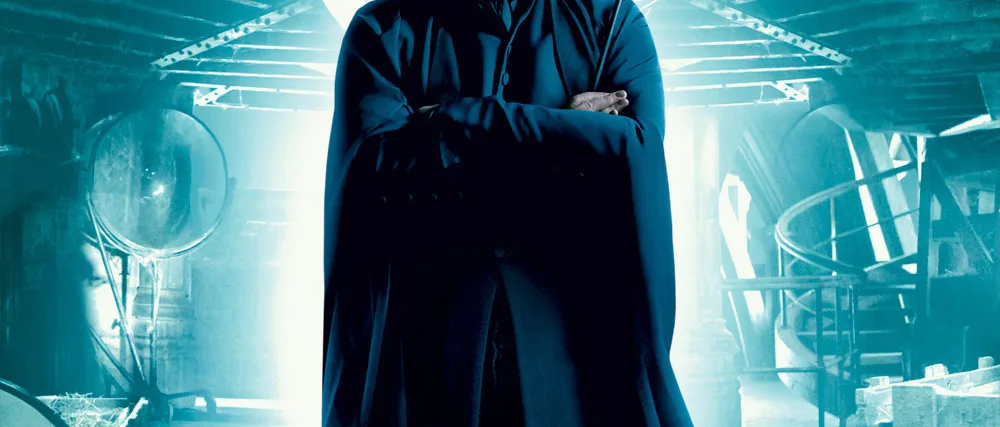
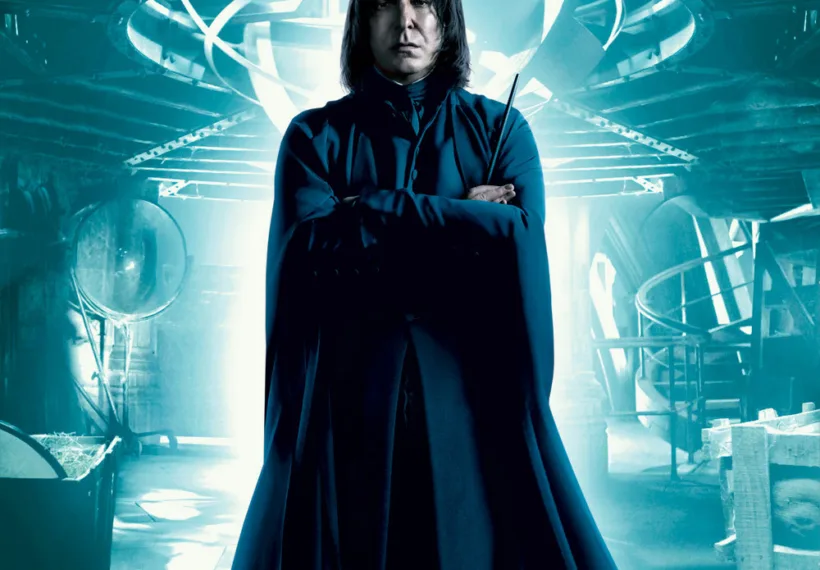
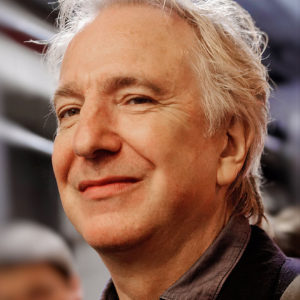
In the conclusion of Neil deGrasse Tyson’s interview with Alan Rickman, the actor who brought Professor Severus Snape to life explains the importance of good storytelling to the craft of acting, and what he sees as his responsibility to his audience. It’s a rare inside look at what Alan describes as “the mysterious mechanism of acting and theatre and storytelling.” In return, Neil explains the physics of roller coasters (Alan is a big fan) and what we’re really seeing when a flock of birds moves in perfect synchronization. They chat about the impact of special effects on the making of movies, and comic co-host Chuck Nice and guest astrophysicist Charles Liu add their own perspectives on the science of the magic in the Harry Potter movies.
Transcript
DOWNLOAD SRT
Welcome to StarTalk, your place in the universe where science and pop culture collide. StarTalk begins right now. This is StarTalk Radio. I'm your host, Neil deGrasse Tyson. I'm an astrophysicist at the American Museum of Natural History right here...
Welcome to StarTalk, your place in the universe where science and pop culture collide.
StarTalk begins right now.
This is StarTalk Radio.
I'm your host, Neil deGrasse Tyson.
I'm an astrophysicist at the American Museum of Natural History right here in New York City, where I also serve as director of the Hayden Planetarium.
So the universe is my thing.
Today, I have in studio one of my favorite co-hosts, Chuck Nice.
Chuck, welcome back, man.
What's happening?
All right.
You're tweeting at Chuck Nice Comic?
That's right.
You got a TV show where you just invade people's homes?
Yes, that is correct.
That's out of control, man.
Oh my gosh.
I'm hoping people will invade the show and watch it on HGTV.
Home Strange Home, Friday nights.
Home Strange Home.
On HGTV.
Where you going to just call people's stuff out?
Yes, that's right.
People can't even, the home is not even sacred anymore.
No, it is not.
Not as long as I'm around.
Like I said, if you come to my house, I'm not letting you in.
That's what windows are for, Neil.
Charles Liu, colleague, friend, professor of astrophysics.
CUNY, thanks for coming on to the show.
My pleasure.
You're a man about the cosmic knowledge, and I bring you for all these emergency cases where in this case, we're featuring an interview with Alan Rickman, the actor.
Severus Snape.
Yes, Snape.
Snape, we will so do Harry Potter in the next few segments.
And you're like, you brought...
This is my daughter's, okay?
Oh, yeah, uh-huh, yeah, uh-huh.
I will admit, I will admit, I did read this one from cover to cover, but this was the only one I read cover to cover.
Uh-huh, yeah, yeah, keep telling yourself that.
No question about it.
Well, I had a whole conversation with Alan Rickman just about science, what role science has played in his life.
He didn't do well on his early physics test, but we would later learn that other aspects of the physical world would intrigue him.
Let's check out for a segment with Alan Rickman, finally, what makes him tick cosmically.
We have good rumor that you love roller coasters.
Is that really true?
Very true.
It is true, that was Cheryl Mataloni posted that on our Facebook, wanted me to ask you about that.
See, to the amusement park enthusiast, it's a thrill ride, but in physics, it is a major physics experiment going on.
Oh, we love it, it's physics 101 writ large.
Two things correlate, which surely you know just as an enthusiast, the highest point of a roller coaster determines, essentially determines the fastest point you will ever, the fastest speed you will ever reach on that roller coaster.
Because it's all about-
You and I can understand that.
Okay, it's all about energy.
That's all it is.
So the machine, the cables are lifting you from the ground level up to the high point.
They're giving you what's called gravitational potential energy.
And you're up there and you don't feel any different.
But if you fell, you would die when you hit the ground because all that energy got converted to kinetic energy.
So it's this balance between potential energy and kinetic energy.
And so when I look at any amusement park, I look for the roller coaster that has the highest spot.
I go straight to that.
So I know that'll get me the highest speeds.
Plus you calculate, you gotta do the, get a physics friend to do this for you.
You can calculate what speed is required for the cars to go completely upside down and not fall out of the circle.
I've done that.
There's a speed.
I mean, below a certain speed, you don't make it.
Or if you've ever been to an English fairground has a thing called a rotor.
Have you ever been on one of those?
No, no.
Oh, it was just this.
And it pins you to the wall.
Yes, yes, yes.
That, but that's.
Well, then as you, as it slows down, you start sliding down.
Right, right.
So the centrifugal forces are good.
Is that similar?
That's no, that's not, it's not.
It's another physics principle.
So what's happening is this wall is presses more and more against you.
And it's the centrifugal force.
You have the tendency to want to fly off, but the wall is in the way.
And so you press against each other and you're just stuck.
And you can't even lift your arm off.
And I always worried, suppose I got sick and then I had to throw up.
It was, you can't, because this worries me.
You have to make turns.
That's a bad thought to put in my head.
But I think this through.
So what you do is you turn sideways and you throw up and then it goes off at a tangent.
Thank you.
Yeah, just evidence for this.
No, so roller coasters are like fundamental physics problems and interesting.
So your favorite one in the world, just so I know?
I just love the old, the big old wooden ones.
The old ones, yeah.
Magic Mountain, that's just beautiful.
The rickety ones that.
It's not too rickety.
In the old ones though, they were not so smooth that you'd end up jiggling left and right as well as sort of forward and back.
And so they feel a little more dangerous instead of these other ones where, you know what I don't like about the new ones?
When they bank the turn, the gondola ends up swinging outward at an angle.
So that the force vector is still straight into your butt.
You never feel a side to side motion because it swings you like this.
And most people don't know this, in the last 10 years or so, airplanes, the computer turns the airplane in the air right now.
If it's got to make a left turn.
Another horrible truth.
No, this is cool, watch.
And it's just like what goes on in the roller coaster.
So you're in the airplane and your liquid is horizontal in your glass.
And then the airplane wants to turn left.
Well, if it didn't bank and all it did was turn left, then you would be pushed to the side like you're turning a car and the liquid would go over the edge.
So what the plane does is it banks itself so that all the forces going sideways compensate for that radius of curvature and you can make a U-turn in an airplane and your liquid remains stable and you don't even tip the computer's.
But the computer hasn't worked out what to do with turbulence yet, has it?
There's your red wine all over you.
Correct.
However, if you, we don't remember, because we don't carry it with us, the susceptibility of planes to turbulence of decades past.
So there was a much rockier road back in the old days.
Now, there's micro adjustments of the aileron flaps that the computers make to keep some level of stability.
I don't think anyone, when was the last time you actually spilled liquid from turbulence?
It hasn't happened.
I bet it hasn't happened ever.
That would be the measure of how much the plane is controlling.
I definitely spilled liquid on a plane.
Yeah, so you tell me, why did you spill liquid?
Because you're holding it while the plane is banking.
If you actually put it on the tray, it's much less likely to go.
But since you're holding it, your whole arm is moving separately beyond the ability for the airplane to control.
So the train's moving and then you're, so you got an extra degree of freedom there.
That's the right word.
Yeah, that's why you spill.
It's your fault.
It's not the plane's fault.
I spill it because I'm drunk.
You drink more on clothes than I do.
But no, I think now I will always remember that every time I'm riding a modern roller coaster, the force vector is up my butt.
Yeah.
Yeah, that's just crazy.
It is, because they bank it around and you don't, it's no longer a side to side motion.
It's straight down.
It's straight down at all times.
Which would explain why I keep crapping my self on this roller coaster.
That's actually a different show.
I'm so not going to the music park with you.
There is now actually even one or two roller coasters, including one, I think, at Universal Studios, where you get launched before you actually get the drop.
You're actually on your way up and they give you an extra force factor.
So you actually have more of a drop.
More speed at the top, as though it was a higher drop.
So you're adding potential energy and kinetic energy on the drop at the same time.
Yeah, so I was also on the one that accelerates the fastest.
It's zero to 60 in like two and a half seconds.
And that's the head jolt right there.
So it's really good physics.
When we come back to StarTalk Radio, more with my interview with Alan Rickman.
We'll see.
StarTalk Radio, and I'm here with my comedic co-host, Chuck Nice.
Chuck doing TV lately?
Yes, sir.
That means you're not doing stand-up.
I still do stand-up.
You still gotta earn your cred.
I still do it whenever I can.
I'm just saying.
I'm on stage.
Just don't get me started there.
I'll be on stage tonight.
Tonight?
Excellent, excellent.
And so Charles, you're also tweeting, but not Charles Liu.
Was there another Charles Liu?
No, but when I was a kid, my friends called me Chuck.
So therefore you're Chuck Liu.
Chuck Liu, C-H-U-C-K-L-I-U.
Chuck Liu is tweeting just education things, science.
Mostly science stuff, fun stuff.
Yeah, nothing too detailed.
You won't know what I ate for breakfast.
We'll look for you there.
And by the way, StarTalk is available in three ways.
We're on the Nerdist Network of the YouTube channels, and so find us there.
We're also on iTunes, downloadable as a podcast, and you can do that same thing from our website, startalkradio.net, and we're in the broadcast universe.
So our signal is, in fact, leading Earth.
Leading Earth.
Headed out.
We've been on the air for two or three years now, so we're almost reaching Alpha Centauri.
Almost.
We're not quite there yet.
Alpha Centauri is 4.3 light years away.
There's the system, the Alpha Centauri system.
The nearest star is Proxima Centauri, 4.1 light years away.
Yes, now you know.
If you want to show off what's the closest star to the sun.
That would be Proxima.
Thank you.
There you go.
Proxima Centauri.
But Charles, the closest star to Earth?
The sun.
So we're featuring my interview with Alan Rickman.
What an actor.
That guy isn't...
No, you guys are lame.
What am I talking about?
Alan.
No, no, sorry.
That was your third attempt.
You don't get a fourth attempt.
I like knowing what people who are successful in other venues, what intrigues them about the natural world, about science.
I'm a scientist, so I live it, some of which I even take for granted.
And so we just chatted about what kinds of things intrigue him just as a human being who happens to be an actor.
Let's find out what rocks his boat.
I'm fascinated watching A Flock of Birds, just knowing all to turn and make patterns and what's going on there?
Well, okay.
So it looks like they all are like computer controlled together.
No, here's what's interesting.
And how do they know, here's the other question, how do they know they're with more of them anyway?
Well, that's a good one.
I've always had that same question.
How does a fish know, same with the bird, how does a fish know what other school of fish to hang out with?
Because they know mirrors underground.
They don't know.
That's what I mean.
Yeah, yeah, how would they know?
They're just their eyeballs.
So the universe brims with mysteries.
That's a good thing, not a bad thing.
But I can tell you with the birds that our sensory system is limited in regimes, in sensory regimes.
So for example, have you ever seen the strobe light effect of a droplet of water?
Surely you've seen this.
The stroboscopic effect of a dropped water in a puddle.
The water comes down and it comes up and it makes like a king's crown with little droplets.
You don't see that.
It happens too quickly.
There's things going on in this world that your brain cannot process because they're happening too fast.
So.
We do it with a TV screen.
That fascinates me because that's, we're not seeing a whole picture of it, are we?
We're seeing a load of little dots.
The TV is exploiting the fact that your brain can't process the information.
That's the whole thing.
It knows you're not gonna notice it.
So it can raster, it could do things on a shorter time scale than your brain can process and your brain makes it all look like it's one.
That's the principle of film, the old rotoscopes.
Is that what they were called?
The Nickelodeon, it's still images when combined.
You have them go by faster.
It looks like it's actually moving because your brain can't figure it out.
Your brain can't do it.
So if you have birds that are ready to flock, all it takes is the movement of one at the front and every next bird responds to that motion, but it goes quicker than you can actually process.
And so there they go.
It looks like it's one coherent thing.
It's just not.
But if you could see that at thousands of a second increments, you'll watch it percolate through the flock.
And that behavior would then be apparent.
You say, oh, they're following the first one and everyone next to them.
And there wouldn't even be a question.
But because our sensory system is restricted, we're left with questions about the functioning of the world that the methods and tools of science then reveal to us.
What's like when you hear a piece of music or a song, you're actually never hearing it.
Because as soon as the sound's made, as soon as I'm saying this sentence, you're putting these sounds together and making sense of them.
It's just a series of abstract noises.
And you're remembering the sentence.
So we all think that you're hearing me talk, but it's just a series of noises.
And as soon as I make them, they're gone.
Like a song, like a piece of piano playing.
Yeah, I mean, philosophers have distracted themselves for centuries on that very concern.
So the sound comes out, then it vibrates the air.
So it's no longer even related to you.
It's just air molecules.
And they vibrate my eardrum.
Eardrum goes into my brain.
And then I have training on what those sounds mean.
And then I understand what you said.
I mean, it's freaky stuff.
Very, because it's not live in front of you.
As soon as you speak it, it's gone.
So now we're just working off the memory of what we just heard you say.
Yes, and fortunately the memory is long enough to capture that.
If we have really short memories, I'd hear your sound and say, who are you?
You know, I mean, so we live inside these time limits and spatial limits.
One of the great challenges of grasping the scale of the universe.
Man, trying to get deep on me there, right?
Right?
But, Philicide, is it there?
Is it real?
Is it?
Well, it's fun.
Certainly the flocking stuff is real.
What do you know about flocking?
What do I know about flocking?
Well, here's the basic point.
If you use a very simple computer program, you just enter three simple parameters for every single particle.
They don't even have to contain it.
So each bird is a particle in this example.
You imagine that each bird is a particle and you just ask it to do one of three different things at once.
One is a separation.
In other words, can't get any further apart than any particular.
So I hold my distance.
Hold your distance.
One is alignment.
You got to follow the person's tail.
Right, you can't fly backwards.
You can't fly backwards.
And cohesion, which means that everyone around you has got to keep the same distance as well.
So not just you, but everybody else.
And you just put that into a simple program.
So the word cohesion, you don't mean glue in this case, but it's kind of a visual glue.
Exactly.
Because if we all know to keep this distance, it looks like we're moving together.
And you put all those three things together.
The little three words again?
Separation, alignment, and cohesion.
By the way, if you're a sphere, then alignment doesn't matter.
Right.
You put a simple computer program, and boom, you can get flocking stuff.
You can see stuff that looked like bait balls in the ocean, like huge flocks of starlings in the sky, just on your computer screen.
The next time you look at a simple screensaver that does those cool dancing, it may well be following one of those three or all three of those at once.
So these are the flocking variables.
Those are flocking variables.
Yes.
That's not flocking interesting.
StarTalk didn't know you had it in you.
So, this issue, oh, it's no longer there, that's, you know, I don't, it's philosophers.
It's transients, right.
Well, the thing about old philosophers was they didn't realize that brains are a recording mechanism.
We literally record that sound, but in our own way, in an attempt to try to reproduce it in our own heads.
The thing is that recording is not permanent.
Nowadays, we have things like DVDs or something, which supposedly as long as you take good care of them, it never degrades and you can always go back to it and reproduce it exactly.
But our brains were designed to record stuff quickly so that we could use it in our survival.
So it doesn't matter that whatever made the sound doesn't exist or that the sound doesn't exist, your brain has the full memory of it.
The recording of it.
So why are philosophers devoting so much ink to this?
Well, they don't anymore.
Oh, you fixed them is what you're saying.
Well, let's just say that early on, like Descartes, I think therefore I am a thinking being that kind of idea.
If a tree falls in the woods and no one hears it, they didn't make a sound.
The answer is yes, it made a sound, but no one was there to record it.
And the recording is the thing that we're talking about.
So that's a lot of philosophers out of business.
Well, I think so, but they've got plenty of other things to worry about.
You know that as well as I do.
They're always thinking about new things.
And Charles, you're good at it.
So I'm looking at your shirt here.
You wore a shirt under your shirt.
Actually, I am a rocket scientist.
Well, let me just say that.
Do you guys ever slip up and say, oh, come on, dude, it's not like it's rocket science.
Oh, wait.
You did rocket science.
Yes, it is.
Actually, we do.
This is actually a gift from my brother-in-law, who is definitely not a scientist, but he always got a kick out of the fact that he could say, oh yeah, we don't need a rocket scientist.
Oh, I guess you can leave the room.
So I was like, well, okay, fine.
It's a fun thing to do.
So the interesting point about the brain being a place to store a memory of what had just happened and it gives reality to it, essentially.
So what it means is you could create a whole new reality by changing how memory lives in the brain in principle.
Absolutely.
If the brain has this kind of malleability, you can create whatever world you want.
I guess that's what's the movie.
That's Total Recall.
Total Recall.
Put in a memory, take one out, right?
Or it could be any argument that you ever have with your wife.
Which would be nice to erase.
Now, that's all part of it.
It's built into the whole system and that's the issue of causality, as well.
You know, Neil.
Well, it's built a system now, but the more neuroscientists figure out the neurosynaptic causes and effects, why not just go in and rewrite the disk?
Well, it's not a bad idea.
And here's something that philosophers-
I have some nice memory.
I'm keeping it.
Well, there's a Dr.
Who episode that describes that the measure of a man is the sum of his memories and had to do with that.
And nowadays there's so many philosophers and philosophers are talking about free will in terms of timing too, because if something happens before you can think about it, did you actually do it because you want to or did somebody else or something else force you to do it?
More on free will when we come back to StarTalk Radio.
We're back with my series of clips with Alan Rickman, actor extraordinaire.
I'm your host, Neil deGrasse Tyson.
I gave him three chances to give me a good Alan Rickman impression, but it's failed every time.
I'm not even gonna go back.
Not gonna go there now.
Don't even know.
Severus Snape?
That was my Alan Rickman doing Jerry Lewis.
That's what anyone sounds like doing Jerry Lewis.
So just don't, you can't pull that one on me.
So Alan Rickman has done many films with completely memorable roles as the villain in Die Hard, as the wine merchant, British wine merchant in Bottle Shock.
But perhaps of recent years, he's best remembered for being Severus Snape, a real creepy character in the Harry Potter series.
That's right, Harry.
I am the Half-Blood Prince.
No, I'm sorry.
Just like, don't even go there again.
I'm a scientist, I must continue to strive.
No, I have notes here that say that that Snape character was reportedly based on JK.
Rowling, the authors of the series, on her chemistry teacher.
Do you have any evidence to back this up?
I particularly don't, but yes, there are various fandom-type things all over the sky.
Fandom things, where they make these connections.
They're trying to account for what came out of this woman's head.
That's right.
You know, you gotta dig where you gotta go.
Yeah, cause it's a serious trip.
And the potions teacher, you know, as much of all the magicians and the wizards there, he's the most scientific of them all.
There's an alchemist.
He was the alchemist of it all.
He was the potions professor.
I didn't figure all that out, cause I just, there was too much Harry Potter.
I just, I had to-
I understand, I understand, I understand.
So I talk with Alan Rickman about making the Harry Potter series, just to tell me about, just what gives?
And so here, here's, here we go.
So when you did Harry Potter, did you have to, did you do research on magic at all?
Were you just-
No, not really.
There's a lot, I mean, it's interesting.
So much of that magic is computer graphics, and that is magic.
And you know, and we watched over the 10 years of filming, we started out going on locations.
By the end, we were just on a pile of grass at the back of the sounds-
So it advanced even in that period.
Yeah, hugely, didn't have to go anywhere.
They just put it all in.
Just stand there, and the day will come when they don't even need you.
They just digitize you and we've got you.
Look at those films like 300 or wherever it is.
And the other one, Beowulf, I think, that was an interesting transition there.
We had quite a lot of those scenes where it's all green screened and there are orange dots for focus, staggering what can be done.
I'm just gonna compare fan bases now.
Fan base for the sci-fi group, and then there's sort of the Harry Potter fan base.
Did you feel some allegiance more to one or the other, or was it all just sort of another day on the silver screen?
Well, no, I mean, obviously, children grew up with Harry Potter, and Galaxy Quest pulls in a wider age range, I should think, because of people who are devoted to Star Trek or sci-fi generally.
And so you've got to generate.
And Star Trek was produced over 30 years, yeah.
You've got a generation of children who, and now it's all starting again.
Now there are kids reading the books from the beginning who weren't even born when we started doing the films.
And when we started doing the films, there were only three of them written.
I think that the thing that pulls it all together is good storytelling, and that's what I'm part of, and that's a kind of magic in itself, of course, because you watch a child, as I often did as these books came out during that 10 years, and they go to a bookshop, this sort of ancient thing that's about to disappear.
And they buy an actual book, and then you watch somebody's imagination disappear into that book, and that's magic.
Yeah, so it's all about how to make magic, right?
And so I was wondering, you're a fan of the series, if not osmotically, through your daughter, but I happen to know you, you know.
Charles will be reading passages from this later.
You have your mother's eye.
Yes, so Charles, so is there any magic in Harry Potter that you see, yeah, we can do that scientifically.
Yeah, sure.
I didn't find any.
You can fly.
Yeah, on a broom?
Yeah.
No.
Well, you got that dude that's going on 140 miles an hour flying with jets, right?
That's just the size.
Oh, jet pack.
Jet pack thing going on.
This is just a broom pack.
Without the exhaust.
That's right.
You can fly and do some light housekeeping at the same time.
I don't think there's anything that cannot be imagined by humans that cannot eventually be done through TV.
Like turning someone into a frog?
Well, already people do that on TV, right?
You've got David Copperfield or other magicians making you think that you turned a Pearson into a frog.
But that's an illusionist.
No, no, he does it for real, David Copperfield.
Others are illusionists.
Well, I understand what you're saying, but isn't it always true that things that we thought, let's take Star Trek, for example, because after all Alan Rickman was on that Galaxy Quest movie, which was the parody of Star Trek.
The soul of the parody of Star Trek.
The soul, yes, exactly.
Communicators, used to be that you could just flip your phone open and go, Spock.
And you could be thousands of miles away from the ship in orbit, and you can actually talk to the person and just go flip like that.
And I have to confess, because I saw it first run, I'm a little older than you here, but both of you.
I saw it on reruns.
But so I remembered seeing the doors open.
No, no, I said, no, that'll never.
Right.
Not even in the 23rd century, that'll never happen.
Grocery store, the door is open.
Somehow warp drives and everything, that was always cool with that, but the doors, Automatic doors.
They knew that you were walking towards, I couldn't relate to that.
So don't get your future prediction from me.
You've got newspapers that act, that move.
Yeah, I was intrigued by it.
Except they're on like a loop, you know.
That's right, they're on a little loop.
Isn't that an iPod nowadays?
That's an iPad.
I mean, iPads.
When we come back more with my interview with Alan Rickman and the magic or science of Harry Potter.
We're back on StarTalk.
Find us on the web at startalkradio.net.
Charles, I brought you on the show.
You're an astrophysicist, but you're also a total expert in so many other things, including the analysis of Harry Potter.
Look, Harry Potter's most important relative in the series is named Sirius Black.
Sirius, of course, the brightest star of the night, Scott.
Sirius as a brother, named Regulus Black, who was also-
Another very bright star.
And another relative, a female.
Sirius is in Canis Major, it is the eye of the dog.
Regulus is one of the stars in the constellation Leo.
He's in the paw of Leo the Lion.
And they have another relative named Bellatrix.
Bellatrix, let me guess, dog Anus.
No?
No, no, no.
Generally, stars in constellations don't identify the anus.
Okay, they try to use the bright star as the eye.
Bellatrix is one of the stars in the constellation Orion the Hunter, and it means Amazon or woman warrior.
But of course, Bellatrix is a sister named Narcissus, which has no star name.
Narcissus is, of course, based on a plant.
It's a flower that grows over the side.
So I once tweeted all the names in Harry Potter that derive from cosmic sources or star names, and there's quite a few.
So JK.
Rowling must have had Astro 101 or knew her mythology.
There's something, so that's good when people know their science.
It informs their art and enriches storytelling.
Absolutely.
Let's go to my next clip with Alan Rickman about how science literacy can enrich storytelling, particularly in the sci-fi genre.
Check it out.
I think it's not an accident that some of the most popular movies of all time have had a science fiction foundation to them.
You look at the movie with Pandora in it, Avatar.
You look at ET.
You look at these stories.
It enables you to reach for places, to tell a story that you couldn't maybe tell convincingly, which is ordinary people.
But they need great writers and they need great stories.
It's very easy to just kind of sling the ingredients together and call it a film.
And I think there's a danger of that.
When I think back to a film like Alien, which I think was an extraordinary experience to see that when that first came out, and just sit in a movie theater and be genuinely terrified.
Is there some role, science fiction role, that you think you could or should play or want to play as we go forward?
I'm here ready, willing and able to play anything, anybody in any story as long as it's well written.
And what does that mean?
As long as it uses language well, as long as it's got ideas, as long as it's got a point of view, as long as it's not insulting the audience, as long as it's taking them somewhere.
And as I say, that's a mysterious process.
I'm a good editor of a script, but I have no idea what it means to sit down with a blank piece of paper and come up with a story.
But I'm the servant of it when it arrives.
So, sure, it absolutely would be something that would fascinate me.
That's Alan Rickmageddon.
That's pretty noble of it.
So, what I liked about what he said is he doesn't want the script to insult the audience, but he didn't, for a moment, say that the script couldn't insult him as an actor.
He'll play any role, provided that it served the audience.
And that was good.
It'll take anything anywhere.
That's really important.
And science fiction is a tremendous way, just science in general, because there's so much unknown that's the frontier, and yet there's enough reality in it that we can relate to this unusual environment.
So what you're saying is, there's enough palette that has been undrawn upon for you to go places where otherwise you'd be constricted here on Earth.
That's right.
I put words in your mouth, but I think that's what you're saying.
You're exactly right.
You explore the human condition in other worldly environments, and it allows you to distill the story that you really want to tell.
We can't be the only ones thinking this.
Josh, you look at the eight out of the top 10 grossing films of all time.
It's a sci-fi.
Jurassic Park, ET.
Avatar, Star Wars.
Just go on down the list.
It's all sci-fi?
Well, because it also excites the imagination.
But I thought I was biased, because I'm a scientist, and of course I like sci-fi.
But other folk are into this too.
No, because it's the ultimate fantasy.
Think about it.
How many people have left this atmosphere, and yet you get to go to another galaxy or beyond?
And then pretty much...
Fourteen people have left the atmosphere.
Fourteen people have left?
That's all?
Yeah, that's all.
God, that's crazy.
Yeah.
Well, left to another destination.
Not just been up and back.
Driving around the block.
Driving around the block.
We actually have left to another destination.
Got their GPS and went somewhere else.
Fourteen people.
So, I mean, of course people look at sci-fi and go, wow, this would be cool if this could happen.
Isn't there incredible comedy and humor in science fiction, too?
Well, without a doubt.
Being able to just laugh about things that you otherwise couldn't because it's too close to home.
Like Kirk getting alien tail when he goes in the driver's seat.
Or whatever unnamed crewman goes down with him is going to die.
With the red shirt.
With the red shirt.
War on Alan Rickman with my interview with Alan Rickman when we return on StarTalk Radio.
These lessons, I will attempt to penetrate your mind.
You will attempt to resist.
Prepare yourself.
Feeling sentimental.
That's private.
Not to me.
Not to the Dark Lord if you don't improve.
Every memory he has access to is a weapon he can use against you.
You won't last two seconds if he invades your mind.
You're just like your father.
Lazy, arrogant.
Don't say a word against my father.
Weak.
I'm not weak.
Then prove it.
Control your emotions.
Discipline your mind.
We're back on StarTalk Radio, and we've been featuring my interview with actor extraordinaire Alan Rickman.
Every role he plays, he owns it.
You can't even imagine anyone else approaching the roles that he portrays in his films.
He really does make them all his own.
Yeah, I guess that's a good thing for directors.
I should have brought a director in here to get them to react to this.
So what I wanted to know from him in my interview was, does he approach a role with any kind of philosophical, like what's his muse as he goes in?
And are there roles that he feels more comfortable in or as an actor, he'll take on any challenge at all?
I just want to find out.
So I asked him, let's see what he says.
Do you have larger philosophical goals in how you portray it?
Or do you stay focused just on that character in the context of everything else that happens?
Well, I mean, I want to be part of a story.
So I suppose I would say, I don't know how to play a part that isn't involved in a wider context.
I need to know who they are and why they are.
So yeah, and I would rather what I do doesn't diminish the audience.
Well, I mean, that's an important statement because in all the roles that I remember seeing you in, you were in a way bigger than yourself, not in any bravado way, obviously, but just it's like, yeah, I mean, I feel that.
I see it.
I know somebody kind of like that.
And whereas there are others, they come on set and they leave and I don't even remember that they were there.
And so you're putting something in there that you don't get with every performer.
Well, it's a mysterious mechanism, acting and theater and storytelling.
It's mysterious and it involves, you know, you make a choice to be an actor.
But is it still mysterious to you?
You're in it.
You're accomplishing it.
It's mysterious to me.
I tried it.
I have two cameo roles and it's like, this is hard stuff and I was playing myself.
That's and so so it's I think it's a mystery to people who don't understand it.
It's just that that what's going on there?
He's pulling it off and he's making it happen.
Just let it run.
It is a mystery to actors as well, to a large extent.
When when you feel it, you know, they on film, they go, OK, that's let's move on.
Can't move on when they've got it.
It's often mysterious as to what has happened.
If it's a word.
So there are people who study emotions.
They've had just learned this, that they've they've divided up emotions into seven categories.
Well, seven and all are combinations of others.
I got eight.
Happiness, sadness, anger, surprise, fear, disgust, and contempt.
Wait, disgust and contempt are very similar.
I don't have contempt of food in which I'm disgusted for having eaten.
So I think you can make maps of how these would combine.
And a good actor presumably can summon these at any instant.
But what's interesting when you study these across cultures, there's extraordinary similarity.
An angry person in one culture looks like an angry person in another culture, right?
There's no one smiling out of anger in one place and showing their teeth in another.
I mean, there's a commonality across cultures.
Are you sure?
No, there's a...
That was a creepy face, Charles.
Don't do that again.
Did that create disgust?
I don't know.
That's the eighth category here.
Charles freaking out.
Is creepy a category?
Creepy.
But his comment about the mystery of acting is so dead on.
It's only a mystery because we haven't studied and understood it.
Are you sure?
Not because it's mystical or anything.
Well, in the same sense that you still really can't tell which painting is more beautiful, this Renoir or that Monet, there's an aesthetic to it.
Sure, we can try to quantify it scientifically, but is there a part of it that will never ever be able to be quantified?
I don't think so.
I think one day we'll put electrodes on Chuck's head, and when he says, angry, and I'll see what part his brain lights up, when he says, I'm happy...
Oh, love it.
That wouldn't be useful.
The whole brain lights up.
Oh, my God, his brain is one big giant light bulb.
It's just one organ.
We won't like him when he's angry.
So it's an intriguing fact that an actor can summon these emotions on command, deliver them, be convincing about it, and they're not even feeling that unless in any derived way.
A lot of them will say they are feeling it.
Right, so nothing external to them created the stimulus.
But they create the stimulus in us.
They themselves, whether or not they feel it, can convince us that they feel it.
That's a scientific thing in the receiving side, not just the transmission side.
The transmission side.
Which means they're really good emotional liars.
I wonder what it is to be married to an actor.
Awful.
I can't trust them for a second.
Are they lying or are they telling the truth?
Of course I still love you, honey.
Right, right.
It's like, nah.
We gotta start wrapping this up.
My gosh, this was fun.
Chuck and Charles?
Charles and Chuck?
Thanks for being on StarTalk.
You've been on StarTalk before.
This will not be your last time.
Thank you so much.
Such a pleasure.
I'm gonna find you on Friday night.
My sister, who loves home and garden television, she's gonna find you by accident.
She's gonna call me in panic.
Will it be creepy when you break in?
No, it won't be creepy.
Only if I actually came in your home.
You've been listening to StarTalk Radio.
Worked you in part by a grant from the National Science Foundation.
Give it up for the NSF.
I'm your host, astrophysicist Neil deGrasse Tyson.
And as always, I bid you to keep looking up.
See the full transcript



 Unlock with Patreon
 Become a Patron