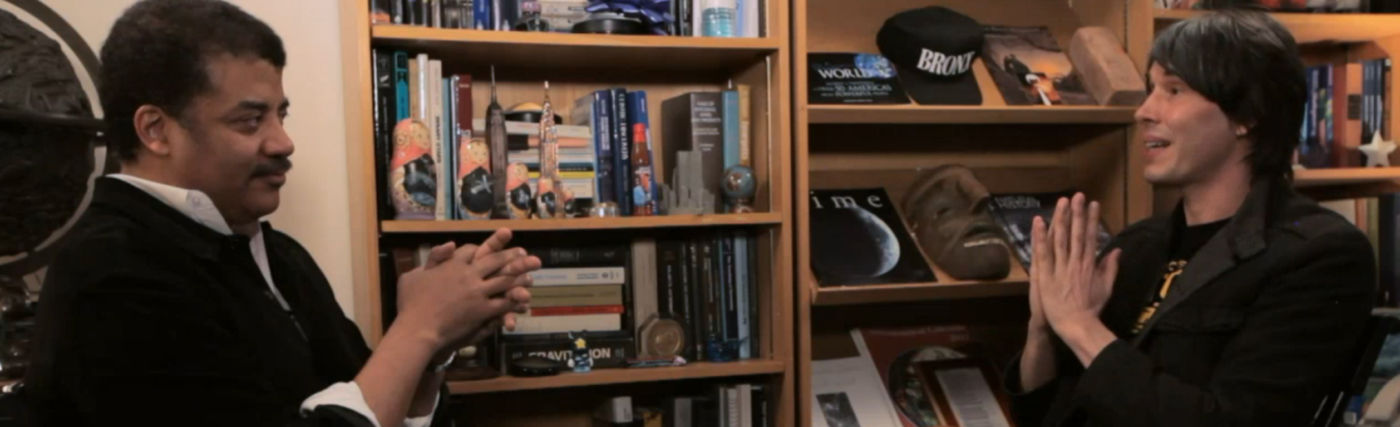
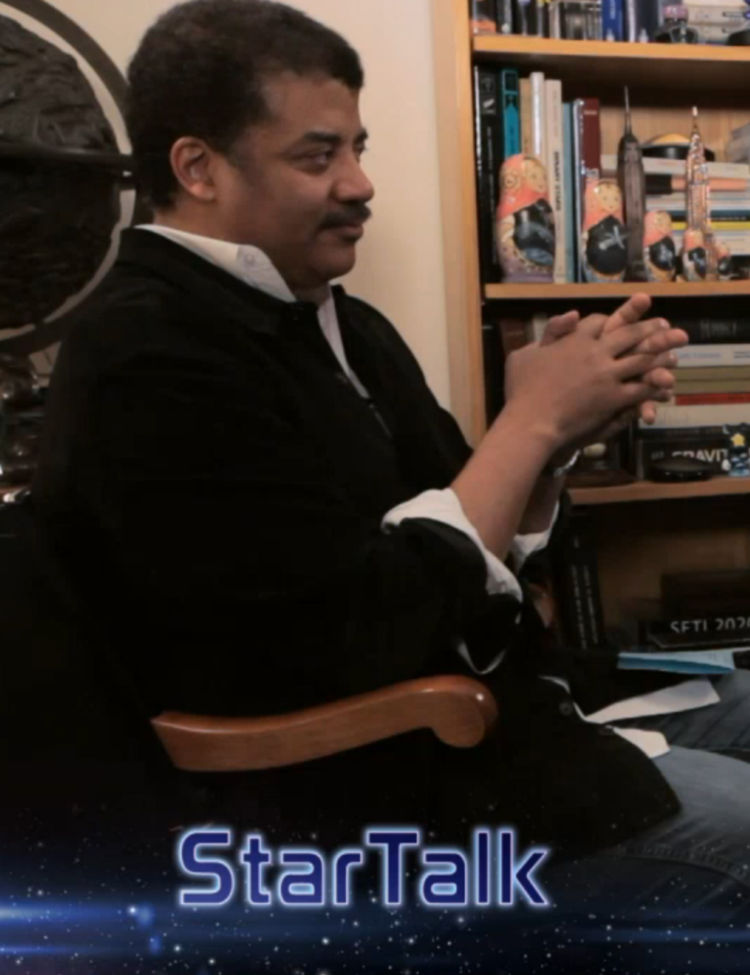
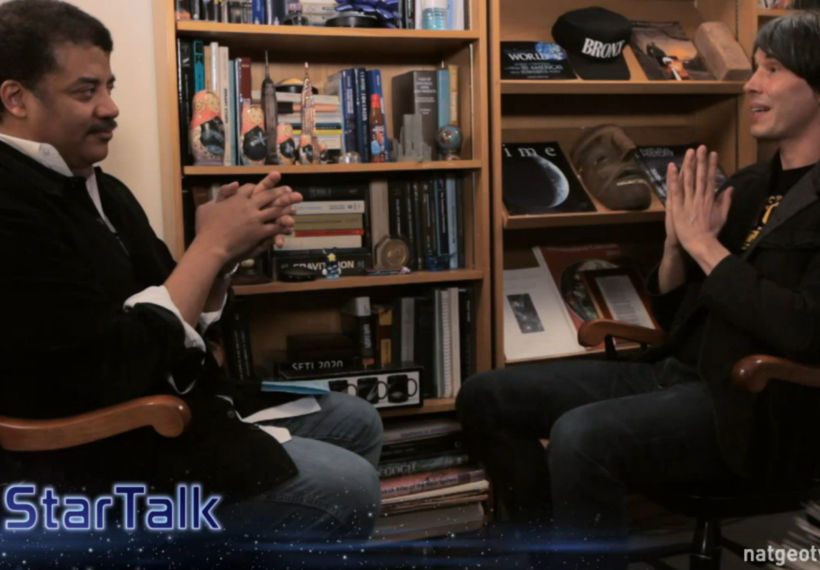
The last thing you might expect two of the most popular science podcasters in the world to talk about is the uncertainty of science, but that’s exactly what you’ll get when astrophysicist Neil deGrasse Tyson interviews British physicist Professor Brian Cox. The two explore the concepts of wormholes, time travel, free will, and time itself, which Prof. Cox and his friend Stephen Hawking see as an unsolved problem. Cosmologist Dr. Janna Levin calls in to discuss whether the past exists as anything but a memory, and how the “future” is different than “north” in the context of mapping spacetime. In studio, Neil is joined by co-host Maeve Higgins and futurist Jason Silva, who champions science’s willingness to “update, correct and upgrade” in the face of new data, and explains why it’s important to “smash people’s reality tunnel every once in a while.” You’ll actually get to hear Brian change Neil’s mind about the feasibility of Star Wars’ lightsabers – and about the bar fight that changed Brian Cox from budding rock star into physicist. All that plus British superheroes, exploring Mars as a reality TV show, and Bill Nye extolling the value of “Looking Up.
Transcript
DOWNLOAD SRT
Welcome to StarTalk, your place in the universe where science and pop culture collide. StarTalk begins right now. Welcome to the hall of the universe. I'm your host, Neil deGrasse Tyson, your personal astrophysicist. And tonight, we are featuring my...
Welcome to StarTalk, your place in the universe where science and pop culture collide.
StarTalk begins right now.
Welcome to the hall of the universe.
I'm your host, Neil deGrasse Tyson, your personal astrophysicist.
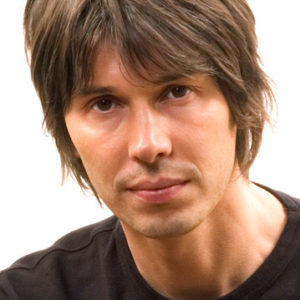
And tonight, we are featuring my interview with Professor Brian Cox.
Brian Cox is like famous all throughout the UK.
He's perhaps as famous, if not more famous, in the UK than Carl Sagan ever was here in America.
And if you've never heard of him, you gotta know about this guy.
We talked about everything under the sun and in the universe.
Because most things in the universe are in fact not under the sun.
Not our sun at least.
We talked about lightsabers from Star Wars.
Are they real?
We talked about time travel, wormholes.
We talked about everything.
So, let's do this.
Yes.
As usual, I have co-hosts.
We have a comedic co-host, Maeve Higgins.
Maeve, welcome to StarTalk.
Thank you for having me.
And the one and the only, Jason Silva.
We all love you as hosts of Brain Games on, of course, the National Geographic channel.
Thank you.
So give it up for Brain Games.
Thank you.
That is fun.
And what's the, you've got a YouTube series, Shots of Awe?
Shots of Awe, yeah.
YouTube, what's that about?
So basically, you remember that line by Carl Sagan when he says, understanding is a kind of ecstasy?
I try to communicate that ecstasy when talking about big ideas related to technology, creativity, the human condition, science.
That's all.
That's all.
Technology, human condition, and science.
Everything.
What it means to be human, yes.
So yeah, that's like my passion project.
No, excellent.
I tell a lot of jokes about my cat.
So I think it's a pretty good match up here.
I think it's going to be great.
Excellent.
Well, in there is this intersection of science and pop culture.
Definitely.
Because you're reaching in this medium that pop culture absorbs.
If you're a comedian, you can't be funny unless you know how to bring pop culture into that context.
Oh, that's what I've been doing.
That's exactly it.
So in my interview with Brian Cox, he actually comes from pop culture.
Most scientists I know come to us hatched out of the egg as a scientist.
Not him, he comes from the world of music.
And so I had to ask him, how did this transition occur?
So let's check it out.
All right.
I was on my way to university, actually to do electronic engineering and not physics.
And I took a year off, we call it a gap year in the UK, to go and be in this band.
And the band got a deal and recorded two albums, rock albums here in the States, toured with Jimmy Page, the band Europe.
And just for four or five years had this sort of life in a rock band, left that band, because we had a fight in a bar, the real rock and roll, went to university then to do physics at the University of Manchester.
And in between that, accidentally joined another band.
We then had a number one hit.
So you have to say a fight in a bar changed my life and I became a physicist.
Yeah, it's the best way to, the best entry into physics I can think of actually.
The thing is I'd always been interested in astronomy, confirmed really actually by watching Cosmos, the first Cosmos, which was 1980 I think.
Yeah, 80 it premiered.
So I was 12 years old then.
So you're a young astronomer, you're into that, you get 13 hours of Carl Sagan on television and that was it for me.
Well, okay, first of all, he had a number one hit song in the UK called, what is it here?
Things Can Only Get Better.
So he's a literal rock star turned physicist.
I love that story.
So Jason, so Carl Sagan apparently was an influence on him in his early years.
Was Carl Sagan an influence on you as well?
You know, it's funny because when I grew up in Venezuela, I didn't catch the original series of Cosmos, but I was a fan of the book Contact.
I loved the movie Contact.
I loved the Ellie Aroway character.
I loved that he described her as a wonder junkie, literally addicted to the mystery, addicted to the question.
And then I rediscovered him through a remixed YouTube series called the Sagan Series, where they took a bunch of his little snippets, audio snippets and speeches, and set them to beautiful imagery, as they've done with some of your riffs.
And I just fell in love again.
I felt the guy was drunk on awe, literally.
So hearing Brian talk about that as well, I was like, you know what, spot on, I can relate to that feeling.
Yeah, so for my next clip with Professor Brian Cox, I just asked him what does he do to keep sort of relevant, to keep the science relevant?
Because he's always got projects that he's bringing forward.
I just want to know what is his formula or recipe, because we're kind of just comparing notes from across the pond.
I love it.
We do live shows in the UK, which also involve music and stand-up comedy and entertainment, we have actors there, all celebrating science.
There's a very strong link between science and comedy.
And I wonder whether you can philosophize or think about why that may be.
Stand-up comedians are great observers, that's part of their job.
Scientists are observers.
So there's an analytical element to stand-up comedy.
So it may be there's some commonality there, I'm not sure.
I think it might just be that there happens to be a set of people who are interested in science and want to push forward, not only deliver the ideas, but have an agenda.
And I don't think we should be afraid.
I know you're not afraid of it.
I don't think I am either of having an explicit agenda, which is to make the world a more scientific place.
Why?
Because I think it will be a better place.
And the more diverse people you get there, the bands, the comedians, the actors, I think the more that science, knowledge, education looks like a club that you would want to be a member of as a young person.
And that's also important, I think, to see ideas as being cool.
The ideas are an interesting thing.
You can be a person that's not only identified with this sports team or this music or this band, but this philosophy, if you like.
That's a rather nice thing.
So the next thing, you need people overturning cars after one of these things.
Yeah, just saying, I do, this is a Nietzsche car.
I don't want the Nietzsche people.
I'm a Kant person, you know that?
Street, street rallies over what philosopher you follow.
I love that idea.
And I think it's true when you're like a young kid and you're a teenager, you actually do feel that.
And then you lose it along the way somewhere if it's not encouraged.
Well, he mentioned that he saw parallels between comedy and science, would you agree?
Yeah, well, I mean, with the curiosity, yes.
But then it's like sometimes when I'm talking to scientists and when I do shows with you, I feel like, oh my God, it's just like I decided what the answers were in my head, but you went and figured them out.
Right.
And I don't know which is better.
No, I do.
But I think the curiosity is both like similar and I feel like maybe the open mindedness because what I love about scientists is that they, they're never like, that's definitely it, like good scientists.
Yeah, unless it actually is definitely it.
Because there are some things that are like, earth definitely goes around the sun.
Let's not get into that.
Earth is definitely round.
But from the frontier, when we are in the act of discovery, stuff can go anyway.
That's where the real sincerity and honesty and candor about your uncertainty comes from.
Yeah, well, it's beautiful to hear him be such a celebrator of ideas.
And part of the, one of the things you celebrate is the uncertainty of science.
And we went there.
Here's the conversation, let's check it out.
The way that scientists think, which is, for me, is a celebration of uncertainty, actually.
It's the opposite in many ways of the way that popular culture is going, certainly in the UK, where you get people, there was a great political essay written recently in the UK about the narcissism of politics and popular culture.
The fact that there's, society is very, it's very focused on people's opinions and feelings.
When actually science is, to be a scientist is to be trained to be the opposite of that, I think.
That I would, I would take great delight if someone turned up tomorrow and said, actually, the universe is not 13.8 billion years old, it's 6,000.
We actually made a mistake.
There's this new evidence has come in and it turns out that's all nonsense.
I would actually genuinely be very excited, but I don't think it's gonna happen.
But it would delight me, it would not be an assault on my very being.
Indeed, it would be, it would confirm that my excitement would confirm to me what I think of my being as being, right?
It's someone who delights in intellectual challenge.
And I think that's trained to an extent and it's part of the scientific training.
But it's also a wonderful way to be.
Imagine that a science book start, well, of course we may be wrong, but.
That's implicit in every science book.
It should be probably explicitly stated.
Of course this might be wrong.
Imagine if every book, if every philosophy, if every religious document began with that.
Imagine if the Bible started, of course we might be wrong, but in the beginning God created the heaven and the earth, and the earth in that form of void, and darkness on the face of the.
That would be rather refreshing, I think.
It's a refreshing position to take.
Certainty is the enemy of science.
It's the enemy of the, I think that's what we, well, I'd ask you the question.
For me, it's one of the things that I fight in my presentation.
What do I want people to understand about scientists?
It's the embrace of uncertainty, I think.
My typical response there is, you read most articles that report on a new scientific result, and they'll say something like, scientists have to go back to the drawing board now.
I say, no, you're always at the drawing board.
Yeah, never left.
You're never left.
The scientist, this befuddles the scientist.
We're always befuddled.
Unless if you're not, you're not on the frontier.
So yeah, there's a mismatch between what people think is going on in the science lab and what's actually going on.
And I'm very conscious, actually, of having this conversation.
It can sound, and it's not intended to sound, it can sound like you're trying to say, well, scientists are somehow a breed apart, which I don't think is true.
And I often, you asked earlier about going into schools and talking to younger children about being a scientist.
And I say to them, I don't think there's such a thing as a natural scientist.
There's the odd, there's genius everywhere.
So Einstein, people like that.
No one's going to think of Einstein or Feynman or Newton.
But the majority of working scientists are just people who are interested, don't have any special ability in mathematics or physics or biology or what it is, just were interested.
And then you can be trained to be that.
You know what's beautiful about that, right off the bat?
Like he's basically, I mean, we know that science has gotten us farther than any other tool we've ever had at our disposal.
Anything of any kind.
Farther than religion.
So to hear him say that, I think that that's probably why science has triumphed because of that wonderful humility, that willingness to change course, that willingness to find new evidence that turns everything on its head and allows us to update, correct and upgrade.
But at some point, this willingness to update correct, that knowledge of uncertainty somehow doesn't intersect with how people want to think about the world.
Yeah, I think like with say something as basic as global warming, there's somebody gonna be like, you can't say that 100% sure.
And then the scientist is like, well, no.
But it means people don't know how to think about uncertainty.
So Jason, you have very successful shows and you're, in Brain Games, you spend all this time showing how our brain, we should just leave our brain at home.
Half the time I see your show, I say, my brain is unworthy, I can't.
We do tell you.
I don't think I've ever seen your show where at the end I say, boy, I feel better about my brain today.
No, I want to trade it in.
But think about what we're saying.
I take your brain.
We're playing with the idea of subject and object, right?
Because we're telling you, yeah, these are certain loopholes in your brain and we're speaking as if the fact, this is the science up until now that tells you this.
But what it's actually telling you is that your perceptions of the world might be wrong.
So, we're telling you an objective fact about the fact that your subjectivity is misperceiving reality.
I'm there, but how many people understand that?
You have to smash people's reality tunnel every once in a while.
Okay, so why is it?
So, here's what I want to explore when we come back from commercial.
Here's what I want to explore.
The fact that there are people who embrace science and there are people who reject science, but at some level, everyone can just accept the fact that spider webs come out of someone's wrist.
In a movie?
In a movie, yeah.
Somehow the movies are okay, no matter what else is going on.
More on superheroes in physics when StarTalk continues.
We're back on StarTalk from the Hall of the Universe of the American Museum of Natural History.
So we're featuring my interview with Professor Brian Cox.
He's Professor of Physics at University of Manchester in the UK, and you have both origins from other countries.
You have some roots in Ireland, then roots in Venezuela, and of course, Brian is from the UK.
And countries are different, different cultures, different priorities, different mission statements.
And I just, I wanted to know what's different in the UK, in his world relative to America.
And one of the things that just rose up, just as I thought of that question was, we have superheroes and they don't.
Let's find out where that goes.
Is there any tradition, forgive my ignorance here, of British superheroes, or is it really an American phenomenon?
That's a good question, a British superhero.
There must be one, I'm going to get.
You see, then there isn't.
If you have to say, I wonder, there's surely, no, there's none.
Sherlock Holmes.
Is that a superhero?
No.
He's got, he's almost.
He has powers of deduction.
He doesn't have physical other powers.
Yeah.
All of our superheroes can do something no other human on earth can do.
Where you can imagine being Sherlock Holmes.
Well, you can imagine Iron Man, there's an engineer.
Yes.
So he doesn't have superpowers in himself, does he?
It's all.
Right.
So you could compare, could you?
I know, but just give me one from British culture.
So if it's not, then it's interesting to me that that is an American film.
King Arthur.
He's waiting, isn't he, in suspended animation.
To rise up.
He pulled the sword, but that's it, right?
Yeah, he's not very impressive.
He's not Spider-Man.
But he, but he, but he's been around for.
Can he fly?
Can bullets bounce off his jacket?
What I'm probing here, for the first time, is trying to understand what is in the American psyche that we generate superheroes by the dozens.
And here we have a culture as near to American culture as exists in the world, in the UK, and there isn't this tradition of superheroes saving the day, or super villains to go against the superheroes.
And so I'm curious what's behind that.
Maybe that's part of the American culture that's to be celebrated, that you have this idea.
You know, from Kennedy's speech, I've always thought, actually, that that speech that Kennedy made was that, for me, is the image of America that I have, which is we choose to go to the moon, not because it's easy, but because it's hard.
You know, that we build a rocket, our materials have not been invented to do that.
You know, that wonderful thing.
And it seems to me to be quite a uniquely, certainly 20th century American ideal that you can do this and you can walk on the moon before this decade is out.
That's a superhero thing to do, isn't it?
Yes.
So maybe it's to be celebrated, just thinking about it, that that's maybe part of the American psyche.
Might we not have gone to the moon if we didn't have superhero mission statements?
Good question, yeah.
So yeah, I think he's got no superheroes.
I don't think so.
James Bond is kind of a rock.
Does he fly?
Our superhero?
No.
Robin Hood, does he fly?
Do bullets bounce off his chest?
Would an arrow not penetrate his rib cage?
Were it not shot into him?
No.
So the American superheroes are like transhumanists.
Yeah, they're transhuman.
Even the ones that are human do transhuman things.
So for me, what was interesting, I've got a fellow physicist in my office, Brian Cox, and we started talking about superheroes, and then you can't help but wonder about sort of the physics of superheroes, and just superheroes just as they connect to science as we know it.
Sure.
And so right now we're going to enter the part of StarTalk we call Cosmic Queries.
These are questions drawn from the internet, and I have not seen these questions before.
This first question is from Mr.
Awesome via Twitter.
He says, Maeve, your hair looks great.
Thank you.
He says, is something like Tony Stark's arc reactor possible?
Arc reactor?
This is the thing in his chest.
Here's my take on it.
If you're producing that much energy in such a small place, either his chest or in some energy generating place in his building, as much energy as that is, you're going to be creating heat.
Fundamental laws of thermodynamics would indicate this.
And that heat would melt everything, vaporize everything.
One of the great challenges of localizing energy and then distributing it where you need.
This is the big challenge of power plants.
Nuclear.
Any kind of power plants.
They all need coolants.
And if you're going to make it, you got to make it as it's being used because it's really hard to store without melting where you store it.
So there's some laws of thermodynamics acting against it.
Yeah.
But I love it though.
And I love me some Tony Stark because he's a superhero with his ingenuity.
With his technology.
With his technology.
If you had to pick somebody.
I would pick him as my favorite.
Yeah, me too.
Over Batman too.
They're both human.
Yeah, they're both human.
They both use technological exoskeleton.
Exo, yeah.
Totally.
Which I think, yeah, I think they're the most appropriate to who we are.
Yeah, exactly.
I agree.
I agree.
Okay.
Brady Birkenmayer from Vancouver.
In one of the DC animated movies, there is a death ray headed towards Earth from the sun.
The Justice League is trying to quickly come up with ideas to save the world and Superman says, maybe I can move the Earth out of the way.
To which Batman responds, if I had a week, I couldn't explain why that won't work.
So, what are the reasons that that wouldn't work?
That was a good voice.
It was, yeah.
So, first of all, if something is headed towards Earth, I would rather move the other thing, whatever it is that's coming.
Like, you move the asteroid out of the way so it doesn't hit Earth.
No, you can make the Earth move, but it would be really bad for things on Earth if you did that.
Yeah, everyone would fall off.
Yeah, yes, yes, we're all sitting here, okay?
Now, are you seatbelted to Earth?
Because what's about to happen, if you just take Earth and just shove it in an instant, and you're not otherwise connected to Earth's surface, you're going to fly.
This is bad for everything.
People would just go fly.
That would just be bad.
Thank you.
So, Brian and I were not finished talking about the physics of crazy stuff.
When we come back on StarTalk, we will rejoin my interview with Professor Brian Cox, where you'll hear us argue about lightsabers.
StarTalk, we're back.
Featuring my interview with the British physicist, Brian Cox.
So, I had to bring up the fact that he and I had like a Twitter argument over the physics of lightsabers.
Aha.
Yeah, and I just had to bring it up and just open up old wounds, right?
Let's find out how it went down.
I don't remember how this happened.
I think I tweeted something about lightsabers, then you jumped in and then people just wanted a fight.
A good geek fight.
I think I said, if lightsabers are made of light, then they could surely do damage by cutting things, but they would not stop one another the way two swords would in a swashbuckling encounter.
That's all I said.
There's a process that I've studied actually.
Photon photon or gamma gamma scattering, we call it.
So it's a measured process at particle accelerators.
So very high energies, very energy collisions, there's a probability that photons will kick off each other, bounce off each other.
Rather than just pass through.
Yeah, so it's remarkable, a remarkable property of particle physics that they don't interact.
So I can look at you and all these other ones that are flying across there don't mess up this view of you.
But actually-
Radio waves and microwaves too.
Same Wi-Fi all over the place, nothing to collide in.
But actually when you go to high energies, then the probability that photons will collide with each other increases.
And one of the interesting things in cosmic ray physics that you might know about is that there's a cutoff.
Yes, spooky cutoff.
Yeah, where the cosmic rays can be at such high energy that the probability they'll bounce off the photons in the cosmic microwave background becomes high.
So my point was just a technical one that photons do have a, there's a probability they'll collide together.
And if you had this high energy, ultra high energy lightsaber-
It would have to be really, really high energy lightsaber.
And so now this would come into the regime that you're describing, and they would come in contact and they would, you would feel this.
Yeah, they interact with each other.
Just like these things interact.
What I loved about that though, as you said, was I loved the fact that there's an audience for that kind of interaction that we had.
And it's really geeky.
Right.
It's just talking about lightsabers and the physics of the lightsaber.
I appreciated how much people would geek out over that.
Yeah, so he just, he taught a new one in me right there.
And with that smile on his face too.
So gently.
Yes, if I had to be wrong, I wanted to be wrong to him in that moment.
Definitely.
Yeah, yeah.
He was like, it's actually kind of great, but you were totally wrong.
And were other people on Twitter, like, piping up with what they thought it was?
No, no, they were like, fight, fight.
You know, nerd fight, nerd fight, it was like cheering it on.
You know?
Well, but interesting also, that he was commenting, he was commenting on how delighted he was that there would be an audience that would be so interested in knowing the physics of an imaginary weapon, which testament to the power of science fiction to make people like, you know, excited and.
Well, so in your sort of pop, with people who know who you are, how have you used Twitter to serve the audience?
I use it as a broadcasting tool for interestingness, basically.
So I follow other people and I leverage their brains as curators of interesting content, and then I use my own brain as a filter to pay it forward and broadcast what I think is interesting.
Okay, so part of your task, which you've done so well, is synthesize philosophical ideas, some of which are very deep, and in some cases intractable to normal vocabulary.
And then you parse it out in very tasty bits.
Yeah.
I just think that we need other ways to enter complicated ideas.
If we're not academics, if we're not reading the treaties or the full paper, show me another way in.
I'm not a scientist by training, but I'm fascinated by scientific ideas.
But I need you to explain it to me in a way that blows my mind.
Maybe the fact that Newton did his best work before he was 26.
Darwin did his best work before he was 26.
Einstein did his best work before he was 26.
Maybe after that, you got to pay bills and earn a living.
All of a sudden, the bandwidth for awe narrows because life kicks in.
Life gets in the way, I would say.
Getting back to my interview with Brian Cox in my office, because I had nabbed him as he came through New York, we couldn't resist.
It's an astrophysicist and a physicist walk into an office.
What happens?
We had to talk about wormholes.
Yeah, we love wormholes.
Who doesn't love wormholes?
We would love to use some wormholes.
Let's see how that went down.
Not to name drop, but I talked to Stephen Hawking about this, actually.
Recently, I asked him a question, and he pointed me to a paper he'd written in the 70s, I think, or 80s called the Chronology of Protection Conjecture.
I know of this paper.
The problem with wormholes is that it looks like you can build time machines because you can get back into the past.
If you can beat a light beam, you can go back in time, and a wormhole would beat a light beam.
Yes.
So he proposes that that's not the way the laws of physics work.
It's a conjecture.
So it's an axiom on this.
So what it's doing in technical language is it's putting causality as an axiom, the idea that cause and effect can't be reversed.
So wormholes seem not to agree with that.
If he's right, then they're impossible.
Yes, so he would say that if you take that conjecture seriously, then when we have a quantum theory of gravity, so when we understand gravity in more detail than Einstein's general theory of relativity gives us, then there will be some physical process that does not allow wormholes to exist.
So maybe, I mean, because already you need different forms of matter, as I understand it, which you need some strange forms of matter or configurations of fields that are not known to exist.
So that never stops an American mind from dreaming this stuff up.
But the idea that you can't build a time machine, you could actually put central, you could say any sensible physical theory will respect causality.
And in fact, not wishing to promote my own books, but the book I wrote, I wrote a book called Why Does E equals MC squared years ago, which is really a…
I love E equals MC squared.
In fact, one of these chairs I have to read on the back was an award for an essay I wrote on E equals MC squared.
I got a chair and it was $300.
Did you?
That's very nice.
But in that book, we actually…
So I wrote with a friend of mine.
We do special relativity, Einstein's theory of special relativity, the standard way.
But then we do it a different way, a geometric way, and we impose causality.
And we show that if you're going to have something called space-time and you want a theory to respect cause and effect, you end up with a universal speed limit, which you can call…
You don't get the number, but you get something, the speed of light, something that massless things have to travel at, and things that have mass must travel slower than.
So you're prepared to say that our life experience, where there's a cause that precedes an effect, may be fundamental to the universe and not just simply our life experience.
Yes, and that's the content of Hawking's paper.
Not proved, we should say.
It would just be really cool if an effect…
if a cause followed an effect.
That would just be an awesome universe.
It would, yeah.
Right?
I mean, it's in an inverted way, but I'm open to that possibility.
I don't have a problem.
He said it's very interesting, actually, and there are problems in quantum mechanics that you can point to.
I understand these are not complete, these things.
Because imagine, so you go back in time, and you give yourself a message about how to go back in time, okay?
So you go back in time, and someone prevents you from giving yourself a message.
So then how did you go back in time to...
Right, so you get these paradoxes.
But maybe when something has to happen, you actually have to do it.
No matter what you do, you will make that happen.
That would be completely get rid of free will.
Yeah, well, I have problems with free will, actually.
Well, in Einstein's theory, it's called the block universe.
In Einstein's theory of general relativity, it gives you this thing called the block universe, where the future and the past are there, in a sense.
So it's an unsolved problem, how time operates and how this universe could perhaps build up.
There's a friend of mine that works on granular structures that build up the future.
Because in Einstein's theory, the future is there.
We travel across the surface of space-time at the speed of light, actually.
That's what we do.
I should say, space-time at the speed of light, not through space at the speed of light.
So we're flying up.
The idea now is we're at rest.
We're not moving relative to each other.
So we're both flying up the time dimension at one second per second, which is the speed of light.
So the future is there in that sense.
So I share your worries about free will.
We're just occupying a coordinate that is waiting for us to visit it.
Yeah, we'll be there.
Our world line will go on intersect all these things.
In one second, we will be one second up the timeline.
Yeah, across the circuits if you like.
It's waiting for us, yes, yes.
When StarTalk returns, we're going to explore the implications of the physics of worm hunters and what it has to say about free will.
StarTalk is back.
We are here under the sphere of the Hayden County Council, for which I serve as director here at the American Museum of Natural History.
So this is my place, y'all in my place.
I'm just saying.
So Jason, we just came out of a clip, we're talking about wormholes and how they could interfere with causality, which is our understanding of life.
The whole thing, right?
Now you studied philosophy, and you're a deep thinker on these matters.
Where do you have thoughts about causality?
Well, I'd be very interested in this notion of once you start playing with causality, what does that say about everything?
Everything, because a wormhole allows you to beat a light beam.
If you beat a light beam, you can disrupt your own past.
Right, so normally we think of things beginning, middle, and cause effect, right?
Can an effect be a reason that a cause happens?
I mean, is that what he's starting to play?
So then it goes into the whole question that everything is pre-mapped, or can we move inside of that space?
What you're saying, I think, is that if an effect can cause a cause.
Can cause its own cause.
Can cause its own cause.
It's the snake eating its own tail.
If an effect can cause its own cause.
It's Escher's hands, the hand drawing the hand that's drawing it.
It's paradoxical.
If an effect can cause its own cause, does that require the absence of free will?
Because it has to happen.
Well, it's a necessary paradox.
So it tells us that free will doesn't exist, but yet from the point of view of subjectivity, we feel free and that's all that matters because subjectivity is all we ever get to know anyway.
So it's one of those things where, yeah, it's all predetermined if that's true and free will doesn't exist, but it doesn't really matter because I feel free and I feel like I make decisions every day and that's all that really matters.
So there's a friend and colleague of mine, Janna Levin, who is professor of astronomy and physics at Barnard College of Columbia University.
She's got a lot to say because she does a lot of thinking about free will and cause and effect.
So I've just been told that we've got her on video call right now, so let's go find out what she has to say on these topics.
Janna, are you there?
So you study cosmology.
This is what you do and the big questions in the big picture.
So I got to hear from you.
What's your reaction is to all this?
Well, once Einstein started to put time on a map, we could start to look and ask, is that aspect of the map always there?
North is always there, whether or not we travel in that direction or there are certain aspects of the idea of having a map and making you think it's permanent.
And so there is a sense in which we can wonder whether or not the future and the past are always there.
And we simply move through this space-time like a bead on a wire.
And that's unclear.
I mean, there's a lot of confusion about this question actually.
So you're thinking, if you analogize time in which as far as we know, we are prisoners of the present, eternally in motion between the past and the future, that if time, if we think of it as a coordinate like any other, that we have access to all directions within it, that perhaps time is just another one of these, and if it is, it completely removes the concept of free will in our lives.
Yeah, well, I mean, if time really exists, meaning right now the past exists in some sense and the future exists in some sense, then that does raise questions about whether or not it's already written.
There are people though who think, look, time is different.
I can show you a picture of the past, but I cannot show you a picture of the future.
And, you know, I can move north, but I cannot turn around and go backward in time.
I mean, there are certain things we know we cannot do in time, and maybe time is genuinely different.
So some people argue that maybe it's only the present that exists and the past genuinely does not exist.
That the map is just an analogy to something.
What do you mean the past doesn't exist?
I have photographs of my past.
It doesn't exist anymore.
Oh, it doesn't exist anymore.
Oh, okay.
And these are really debated topics.
I mean, these are things that people really wrestle with.
And some people think that it's the key to really understanding.
Okay, but I didn't call other people, I called you.
So what do you think about this?
Well, I would fall in favor of saying there probably is no free will.
No free will, wow.
Well, Professor Levin, thank you for helping us out here with the free will question.
And it's very late for you there, so thanks.
Janna Levin, when StarTalk continues, we will rejoin my conversation with Professor Brian Cox.
And we'll be talking about the influence of politics on science, and also exploring what it means to go on a one-way trip to Mars when StarTalk returns.
StarTalk.
From the hall of the universe.
I love saying that.
Jason, Maeve, again, thanks for being on.
Yeah, yeah, we've been featuring my interview with Brian Cox, and so I had to ask him, just because it's been in the news, would he go on that one-way trip to Mars?
I just like collecting people's opinions and views on that.
Is it because he's like your UK competition, so you're like...
Would he go or would he not go, I don't know.
Why don't you go to Mars, Brian?
Go to Mars and don't come back.
Let's check it out.
So their plans for people to take a one-way trip to Mars, are you going to sign up?
No, why would you do that?
Why would anyone want to do that?
Thousands of people have lined up to go on this one-way trip to Mars.
I know, but that wasn't ever the trick.
The great thing about Apollo was the return of the thing.
It was always Kennedy's speech, wasn't it?
It was to go to the moon and come safely back to Earth.
That's a difficult bit.
With the key word safely, yeah.
Yeah, it's not particularly difficult, I think.
It wouldn't be difficult to go on a one-way trip to the moon, I think, even now.
You could do it.
But it's getting back off the moon again.
Okay, so it's not as technologically challenging as the full round trip.
But the idea of just pitching tent on another planet?
It doesn't appeal to me.
I don't think there's much to do there.
There are very few restaurants on Mars.
There are very few, yeah.
But it is interesting.
I mean, and it's interesting that the framework, it's a reality TV show, essentially.
Is that what exploration has become?
Is that what we want exploration to be?
A reality TV show?
I'm not sure.
Actually, well, I am sure.
I don't think that's what exploration is.
You don't want it to be that.
No, I don't.
I don't want that to be the way that we have to resort to funding, essentially killing a load of people, which is essentially what it is, on television.
That's really what it is.
Is that really the way we want to fund the expansion of the frontiers of our knowledge?
I'm not really sure.
Did you time how long it took him to say no after I asked him the question?
So polite, like, I'm not sure, maybe.
I feel like he'd almost be on the shuttle before he was like, no.
Yeah, no, I was like, no, no, no.
Why would anybody do that?
Jason, you, part of you, from what I've seen of your work, you count yourself, I think, among those who would call themselves futurists.
So how would you, is this in our future?
To go to Mars?
And stay, yes.
You know, the first generation.
Summing all of your wisdom.
Yeah, I think the first generation are taking a gamble, I think, but I do think that advances in nanotechnology or even like terraforming and crazy stuff like that will eventually allow us to make whatever we set up in Mars a luxury, hospitable situation for ourselves.
But the way it feels like it's gonna be now, yeah, I would not go.
Yeah, but-
In order to have a second generation of one-timers, you need the first generation.
Somebody always has to do it first.
Pioneers, old men, not me, not me.
So, science is, it's not just all awe.
Somebody, you have to find a way to fund it.
You need some, and in this case, it's TV, it's reality TV, selling eyeballs to advertisers.
And in my conversation with Brian, he talked about the Royal Society, a storied institution in the UK.
Where basically, it's the birth of the modern communication of science among researchers.
And he said he noticed something interesting there that was worth sharing, related to how science gets done.
Let's check it out.
You think of it, and rightly so, as a scientific institution, it's interested in research, the pure acquisition of knowledge.
But if you look back at the books, they've been funded by the king at the time, by the crown, and the books will say, we're going to go on an expedition to past India, through into the Orient, and number one, we'd like to acquire knowledge about the flora and fauna and peoples that are there.
And they'll say, number two, how many deep water ports are there?
How many raw materials are there and how could we get access to them?
So you see that even 300 years ago, the scientists, you get a sense, were playing the political game.
That's the flip side of what the science is, what science is happening.
It's yes, go explore, by the way, claim land for the crown.
Fair enough, but don't you think that there's a trend now, you know, on the back of information technologies, we have a new generation of young, ambitious entrepreneurs that have become billionaires in the digital economy and now feel a sense of wanting to make a legacy and make an impact.
You have the Elon Musk's of the world, you have Larry Page's of the world.
Musk wants us to go to Mars.
Larry Page created Calico, California life extension company to literally cure aging.
These guys are putting their billions into world transforming technologies.
They're investing in this kind of science so that we don't necessarily need to depend on the government and on the politics.
No, they're doing it because they can make a buck off of it.
Eventually, but I think right now Google has their successful business models with Search and all these moonshot projects.
Oh, moonshot projects.
Okay, so like Elon Musk doing his fast train.
Which is amazing.
When we come back to StarTalk, we will revisit Bill Nye.
Commenting on the topic of the day.
Thanks for.
StarTalk Radio.
StarTalk, I've been your host, Neil deGrasse Tyson, I got Jason Silva, I got Maeve Higgins, of course.
Thanks for being with me on StarTalk.
We've been featuring my interview with Brian Cox, and I want to go straight to my friend, Bill Nye.
I don't know where he's gonna be, but he's gonna tell us that knowledge is everywhere, you just have to look.
Let's check it out.
You've probably used the expression busy is grand central.
Three quarters of a million people pass through here every day and very few of them ever look up.
If they do, they're treated to a beautiful rendering of the night sky.
Even as we travel beneath our streets, it's always up there.
Just imagine what our world would be like if we didn't know the stars, if we didn't know the cosmos.
Our ancestors would not have been able to reckon the seasons and raise their crops and then raise their children.
We wouldn't have been able to navigate on the high seas and produce the commerce that makes our world go round.
Today you can take out your mobile phone and tell which side of the street you're standing on because we have satellites orbiting in space.
So next time you're here, take it all in.
It's an image of an October night sky.
But it's whimsical because the constellations are in reverse order.
They're backwards.
But you can know that because you can look at the ceiling here and compare it with your own observation with the real night sky.
You can tell this is art and the cosmos is science.
Grand Central Terminal, Bill Nye.
I didn't know the constellations are backwards.
Yeah, they're backwards.
One of them is actually forward and all the rest are backwards.
By accident.
I think they messed up, actually.
But then he ends it with, and that's why this is art and the cosmos is science.
It's like dismissing art, like whatever.
Well, had they paid a little closer attention to actual star maps, they would have gotten it right.
That's all I'm saying.
So in my interview with Brian Cox, I wanted to get some summative remarks from him, just to reflect on the value of science.
Let's find out what Brian Cox tells us.
All right.
Knowledge.
We need to rediscover our ambition.
America is not the only country that I perceive to have lost it.
Europe lost it a long time ago.
It had lost it before America went to the moon.
But these scientific and engineering cultures, as you said, these superhero cultures, essentially, that we have, need to just rediscover that confidence.
Not just because we want to do things that seem ridiculous, like going to Mars, but because you can argue that that confidence in this country, in the 50s and 60s and 70s, admittedly, perhaps led by some perceived threat from the Soviet Union, et cetera.
But anyway, there was a confidence there.
That investment led to so much that we take for granted today.
And if we're not going to do it, who's going to do it?
He has a different tone on America's ambition.
And then he was like, yeah, a little competition with the Soviets, but really it was our dreams and our ambition, slightly different opinions.
Well, he's downplaying the role.
Yeah, that narrative is more exciting.
Yeah, but he read the backstories in the Royal Society.
Sure.
I mean, he knows.
I think he doesn't want to display it.
Sure.
I know it, and I try to put it up.
You display it.
You know it, but you keep it on the down low.
I recognize the fact that conflict has led to innovation because it acts as an incentive for people to get their game on to beat the rival, so to speak.
But going to space now on the back of private enterprise could have been unthinkable a couple of decades ago.
So I think that those trends will continue because of exponential technologies.
So maybe inspiration is enough to inspire the next young kid to become a billionaire and fund the next mission to the next planet.
I mean, maybe, but it's like kind of gross that they feel like they have to become a billionaire first.
Do you think?
Why is it gross?
I just wonder if that would like, you know, if that would like get in the way because like lots of people are like, I'm going to do this first and then I'm going to go back to my sense of wonder and awe.
But first, I'm going to make my money and I'm going to, you know.
Well, I recently sat down with somebody who had a different definition of billionaire that we could all aspire to.
He said a definition of billionaire could be to positively affect the lives of a billion people.
That's the ambition to become a billionaire.
That's the kind of billionaire you want to be.
Jason, that cannot be followed with any further commentary.
Great.
Let us all go forth and positively influence the billions of our species.
You've been watching StarTalk.
I've been your host, Neil deGrasse Tyson.
See the full transcript



 Unlock with Patreon




 Become a Patron