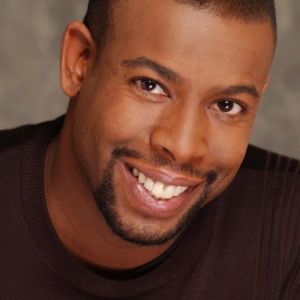
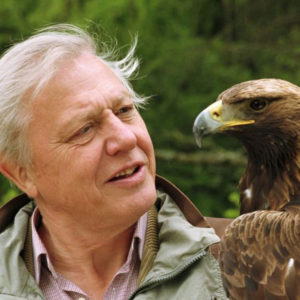
For the first show of our sixth season, host Neil deGrasse Tyson explores no less a subject than the history of life on Earth. Join us as Neil interviews legendary BBC broadcaster and naturalist Sir David Attenborough, whose filmography spans the entire breadth of life on our planet. Helping Neil out in the studio are co-host Chuck Nice and guest Bill Nye, author of the bestselling Undeniable: Evolution and the Science of Creation. Up for discussion: Darwin, natural selection, climate change, creationism and parasites. You’ll hear Sir David chronicle the history of life in exactly 30 seconds, while Bill explains evolution and how amazing Darwin’s theory was considering he knew nothing of DNA, chromosomes, or what we think of today as genes. Find out what books inspired Sir David to become a naturalist long before he’d ever read Origin of Species and enjoy his description of the most sensual reproductive scene he’s ever shot: slugs mating.
Transcript
DOWNLOAD SRT
Welcome to StarTalk, your place in the universe where science and pop culture collide. StarTalk begins right now. And I am director in my day job of the Hayden Planetarium at the American Museum of Natural History. And studio with...
Welcome to StarTalk, your place in the universe where science and pop culture collide.
StarTalk begins right now.
And I am director in my day job of the Hayden Planetarium at the American Museum of Natural History.
And studio with me is the one, the only, the inimitable Chuck Nice.
Oh, yes.
Chuckie Baby.
Chuck Nice comic.
That's right.
Yes.
I've got clips of an interview I conducted with a guest who, Sir David Attenborough.
Wow.
Sir, he's one of the great communicators of our time.
A legendary.
And he hosted all these science documentaries.
I think many people, he is their conduit to science.
Absolutely.
And given his history as a TV host and as a naturalist and as a science educator, you were not sufficient alone to help me with this show.
Won't be the first time I heard that.
So I looked around and I found me some, I call him sir.
I don't know if the Queen ever had anything to say about it.
Sir William Nye.
Bill Nye, thanks for being on StarTalk Radio.
Thank you for having me.
He's Ed so Bill, you know.
So Neil, David Attenborough, dude.
He's the dude.
That's the man.
Except I guess it's dude.
Is it dude with a British accent?
But definitely known as the great communicator.
Yes.
Peerless educator.
Everyone wants him to be their grandpa.
Greatest broadcaster of our time.
So it's been said.
And the cool thing about this show is that if I might just wet your buttocks with my lips for a second.
That is nasty.
Where are we going with this?
Okay, go on.
But I am sitting in a room.
We have David Attenborough on the show and I'm sitting in a room with two of the greatest science educators of our time.
Both of you in your own right, ambassadors of science for the entire globe.
That's pretty impressive.
Chuck, I would have had you on the show anyway.
You got the job.
Chuck, you're fabulous.
Even without that.
Thank you.
Thank you.
Well, let's see, maybe we'll have a science educator dance-off or something.
That sounds good.
Cagematch.
Let's find out where Sir David Attenborough can take us.
Let's start off.
You don't look 87, sir.
So is it because you run around the world that keeps you young?
I mean, if you're being serious, it's luck, isn't it?
Well, yeah, the luck of the genes.
I can think of, well, very close friends of mine or relations of mine who got the same sort of genes and they can't get about at all.
Watching you run around the world, you get down with the animals and the plants and you're crawling on the ground and you're rowing boats.
So you're not just a detached observer of nature, you're a participant.
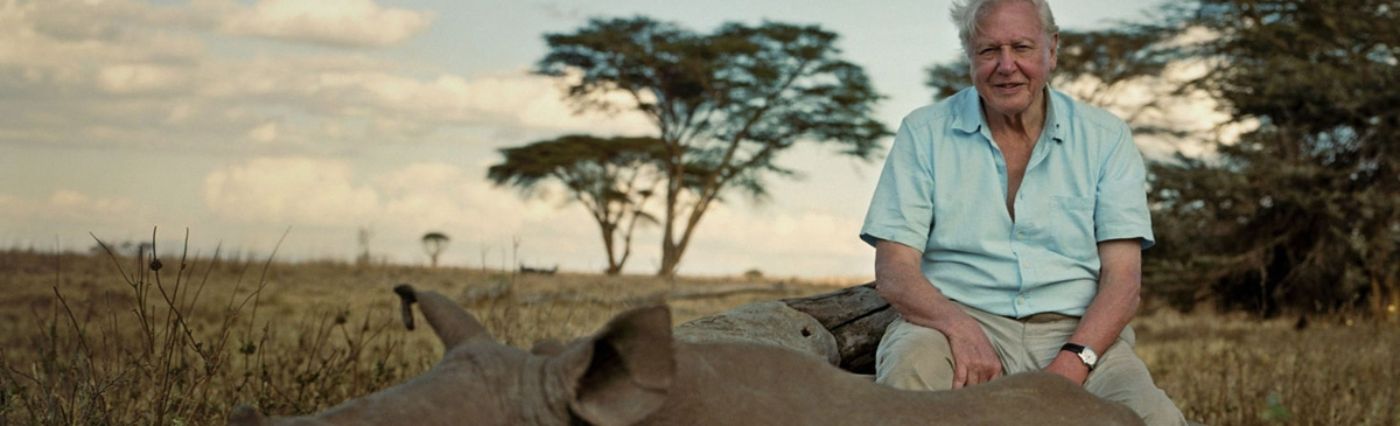
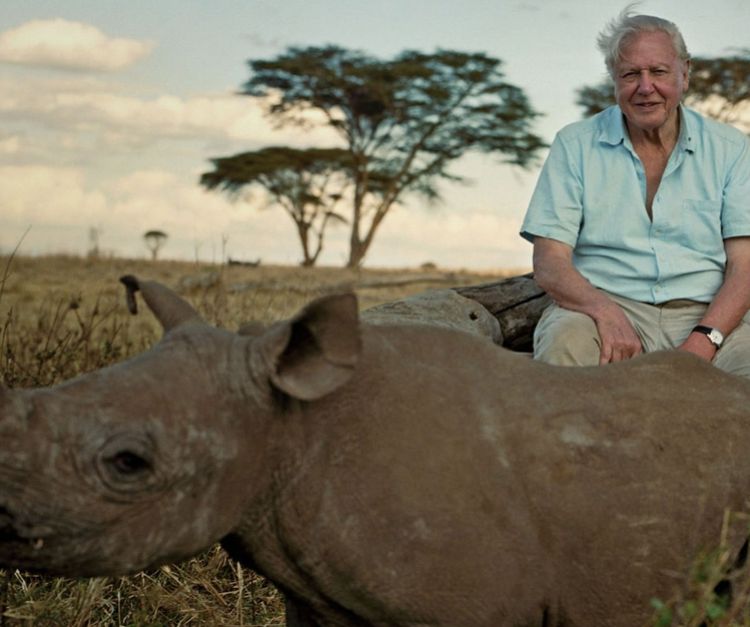
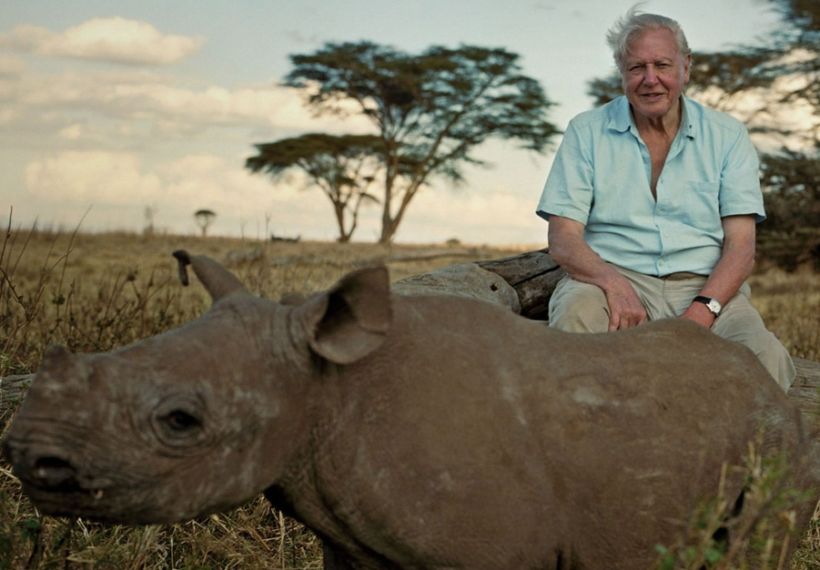
Less participatory than I was, but I mean, yeah, still, yeah, I can pat a rhinoceros on a good day.
You know, when I'm 87, I just hope I'm alive.
It's true.
You're going to break 30,000 days if you do that.
That's a mark for me.
But 30,000 days.
82 in 7 weeks.
There's 30,000 days.
Yeah.
And you know this why?
It's one of my themes about how short life is, and you have to do your best to live well, and we got to admire David Attenborough in that regard.
Okay.
So Bill, people love you.
No doubt about that.
They love them some Bill Nye, but they also love them some David Attenborough.
So you want to find out why?
I say bring it on.
Bring it on.
Let's find out.
I spent five weeks in the UK where we were filmmaking there, and people couldn't stop talking about you.
Everyone I met on my crew, they all wanted you to be their grandpa.
You were the grandpa they always wanted or never had.
That's got to be a greater title than Sir.
I don't even want that one.
How do you react when people just want to adopt you?
There's enough for you to go around.
Come on.
You have such a huge.
I mean, people are very nice.
I was so terribly polite and British of him, wasn't it?
I think that's how they roll.
Yeah, that's exactly it.
Yeah, they roll.
Yeah.
Yeah.
Yeah.
So.
And very modest.
He's been knighted, which is my understanding is a big deal over there.
Yeah.
And I say over there in the world.
So Bill, what does it take?
What does it take to be loved?
Well, I think you're talking about science education.
Yes.
I say it takes passion.
You have to, you have to really want people to get excited about it.
You yourself, Dr.
T.
No, but I'm just talking about the universe and people come to that.
I don't, I'm not really.
But you know that feeling.
I know.
You know that feeling.
Do you realize the sun is a star?
You want to grab people by the collar.
Yes, as I've done a couple of times.
And say, hey, look at this.
Then they call the police.
And so David Attenborough is, has the same passion, but he is from a different culture.
And what he does is subtly, in understated fashion.
But you also have to be a storyteller.
That's what I mean.
He widens out and there's the rhinoceros that he's patting on the nose, on the horn.
On the horn.
We just pictured that as he said it.
Just as easy enough.
Yeah, we didn't have to try to think that.
It was there in front of us as the words came off his tongue.
So I think it's your passion.
I always say all the time, what is it about your favorite teacher that you liked or loved?
And it was that he or she was passionate about it and wanted you to do well.
The teacher wanted you to do well because he cared or she cared about you.
So he's not just a media guy because he studied geology and zoology at University of Cambridge.
I hear that's a good school.
Yeah, Darwin, I think, went there as well, right?
And he's collected 32 honorary degrees from British University.
Yeah, but they don't really count.
You didn't go there.
You didn't attend.
They don't really count.
I heard a rebuttal to that once.
I'll tell you later.
It's a really good rebuttal.
It means they care about you.
No, but it's more than that.
I'll tell you about that in a minute.
All right.
And so, Bill, can you see any cultural differences between how you might try to communicate in the UK with the United States?
You've been around the world.
No, no, it's exactly the same.
Are you kidding?
Except I'm just asking.
No, it's a...
Well, we all play the hand we're dealt.
So I feel that if you're a British guy, you present your art in a British fashion, that understated fashion.
If you're an American guy, you wave your arms and jump around.
You go over the top.
It's the way we roll.
We need explosions.
But what the key to it is...
We're American.
Yeah, but that means if you go to the UK, you look like some ape that just dropped out of the sky.
I look like a guy from the US.
But you know what?
The passion is what does it.
That's what I'm saying.
So they see it.
They see the passion.
And they feel it.
Oh, I'm going to wrap this up here.
I'm going to tie it together.
Okay.
The thing is you want to be authentic.
You want...
When the viewer looks at you, you want him or her to feel that you care about him or her, that you're looking right at him, that I'm trying to engage you.
And that's what...
I feel that when I see him on TV.
And this is when you're doing your Cosmosical thing.
And Carl Sagan, you feel this guy wants to engage you.
You feel it.
And he's authentic.
So Carl Sagan's from the US, from New York, very well-educated, enormous vocabulary.
Uncle Bill is from somewhere in the US, and he uses some slang words, and he'll say, now, right now, which is a meaningful thing, but maybe he's not the best grammar, for example.
But you know that he cares about it.
in grammar and an A-
plus in everything else.
Guy, you give me an A-
plus from Neil Tyson?
Check me out, Chuck.
So what I'm curious about, Chuck was around in another show where we talked about the culture of science.
In England, in the UK, they have a culture of naturalism.
All of these folks who were part of the British Empire, wherever they went, they had people writing about what they saw, what they felt.
Collecting specimens.
Darwin's on their pound note.
I guess it's five pound note.
Darwin, it's not on the one pound note.
That was my man, Isaac Newton, but they don't even make the pound note anymore.
Wow.
Yeah, they have a pound coin, but it's not a note.
Let's find out.
I wanted to get a sense of the legacy that he came out of.
He is David Attenborough, not Isaac Newton.
Check it out.
Here in America, when we learn about British scientists, often the 19th century rises up as the great period of the British naturalist.
Now we see you as, dare I say, carrying on that tradition.
Am I allowed to say that?
No, you're not really.
I mean, I'm not in that league.
I'm not a professional scientist.
I mean, I was educated as a scientist, and I try and keep up, but I'm essentially a television filmmaker.
But can I say that this legacy of British naturalism has influenced what you chose as a life work?
Is that fair to say?
It's in your culture.
I would have thought no more different here.
I'm sure that people here, kids here, are influenced by reading Darwin and Darwin's account of the history of life on Earth, just as they are in the UK.
Yeah, but we don't have the legacy of our own doing this sort of thing.
So I'm just curious.
Well, I'll tell you, people sometimes say to me, what was the greatest influence?
What book did your influences buy?
My answer is Ernest Thompson Seaton.
Do you know who Ernest Thompson is?
No, no.
Well, is he an American?
Well, he's a North American.
He's a Canadian, if you'll allow that.
But he is.
He wrote a series of books about 1910 called Tales of the Wild and Hunters and Hunted, and it's about caribou and wolves and…
The North American mammal.
He was a ranger on the Canadian prairie.
And he wrote the most marvellous book about Canadian than I was before I got on to Darwin.
So a little bit of North America helped you there.
Yeah, certainly.
Well, I've taken some credit for you then.
You know what's weird?
It occurred to me, listening to that, he is who we all imitate.
We want to imitate a high educated British person.
Yes, we do.
He said, look here, his picture is in the audio book.
In the audio, right.
His recording is in the audio book, in the audio dictionary.
That's what I'm going for.
That is the accent, but it's not, it's just how he speaks.
Yes, indeed, indeed it is.
And so we...
He was a Canadian, if I may say.
No, no, no, no.
North American.
North American.
But he's referring to the guy, because if it was Canadian, he'd be sorry, he'd be so sorry.
That's true, that's true.
So what intrigues me, getting back to this cultural difference between how we bring science to the public, how we bring anything to the public, one thing I noticed was in the United States, of course, we don't show humans mating unless it's triple X and you can't see it.
We don't even show other animals mating.
Yes.
But I turned on British TV one time and there was some action.
There was some action.
Some boom chicka wow.
He's still a little, he's still on his mind.
Exactly.
It really made an impression.
Boom chicka wow.
That's what it is.
That's 1970s porn soundtrack.
That's the only porn that I have is 70s porn.
I don't have a very good internet connection.
The principles are the same.
Yes, we are evolving, but not quite that fast.
You'll see a lot of the same interactions.
Can we say interactions are good?
So I had to ask him, what accounts for this?
Let's see his analysis of this.
You know, we have some prudish people here in America.
We're not as prone to show mating animals as show up in so many of your works.
Are the Brits just a little more tolerant of that sort of thing?
Never had any problems.
Okay.
And actually, of course, people only have any problems when that's occurred amongst mammals.
I mean, the rest of the population and so on is of no consequence.
Yeah, that's a good point.
When worms mate, no one cares.
Well, actually, the most sensual, the most sensual reproductive sequence I've ever shot is between slugs.
Have you ever seen a slug, Marcia?
No, I'm sorry.
I must have missed out on that one.
Well, there are a great number of different species of slugs, but there are certain particular slugs, which produces a rope of mucus and hangs down and dangles, and in fact, of course, the things about slugs, as you probably know, is that they are both male and female in the same animal.
In astrophysics, we never learn that.
You don't?
Boy, they're missing out something on Andromeda 4 now, if they don't know about that.
By the end of your slugs, you see, the male part of one slug finds the female part of another and buys the last one.
But the contortions in the dance, in which they do, which is in a series called Life in the Undergrowth, is as sensual as you can probably take.
Who would have thought?
Well, that's right.
And a lot of people wrote in and said, exactly that.
Who would have thought?
And no salt allowed at that party.
That's dead right.
I just love that.
It's the understatement that we Americans find so charming.
But plus Chuck got turned on by that description of mating slug.
Well, how could you not with that accent?
You know what I mean?
Because you know there's something going on.
And you know they're telling you.
And he's not just slugging.
Here we are witnessing the fecundity of the Indian Ocean Sea Slug.
And believe it or not, you're actually witnessing a terrible roldering right now.
You know, it's very exciting.
So I wonder if it's possible to know too much about what's going on in the animal kingdom.
I don't think so.
That's evolution.
The more we know about how everybody does it, the more we're going to know.
You know, he's got a new six part series.
Are you embarrassed by slug sex?
Is that what I'm getting from you?
You're a little put off.
I blushed a little.
Slug sex.
That's what he's talking about.
That's how you make more slugs.
And if they got into a brawl, it would be a slugfest.
Nice.
I'm sure they do get into brawls.
I thought it was funnier than that, like I didn't get like rarious laughs from that comment.
It was funny.
Okay.
That's how the experience...
The comedian, of course.
Yeah, okay, Neil, that was funny.
Yeah, it was funny.
I've never laughed.
So, he's got a new series on BBC One.
I want to say that with a British accent.
Chuck.
BBC One.
Thank you.
We'll turn to Chuck for this.
A new six-part series called Life Story, and it began earlier in the fall, and the guys, he's unstoppable.
He's passionate.
That's what it is.
That's what it is.
He's bringing his passion to the screen.
You live off the passion.
So now I'm thinking everyone on this show, except me, has a tremendous educational TV presence.
I got to teach somebody something.
Okay.
So.
It's passion, people.
And the beauty and joy.
PB&J.
I heard that from someone one time.
So his whole life, he's been making films about life on Earth.
His whole life.
Okay.
And I have to ask him, is that how he rolls?
Let's find out.
Your filmography is huge.
I don't need to repeat that here.
Everyone knows it.
But what intrigues me about it is it spans the entire breadth of life on Earth.
It's not just mammals as we all favor in zoos and things.
It's not just birds as bird collectors would.
It's insects.
It's plants.
Here's one.
Have you done one on fungi?
I've mentioned, yeah, yeah, because we didn't, as you rightly infer, plants are not fungi and not plants.
They're not.
They're a different kingdom altogether.
But actually, there's only one single subject we're covering, and that's the history of life.
But in fact, it's the history, why they appeared in the order they did, why they changed into the way they did.
That's an important sociocultural observation, because we look around the world and we say, this is one kind of life, that's another kind of life, here's one kind of plant.
And what you're saying is, I don't want to put words in your mouth, but if we take a step back, put it all together and say, this is life on Earth, and we're part of that system, that's a whole other outlook.
Well, that's what I've been trying to do all my life, really.
Do you think you've succeeded?
That's for others to say.
I mean, you can chronicle the history of life in a surprisingly detailed way, in quite a short period.
You know, life starts in the deep sea, and it leads to different kinds of invertebrates and shells and crustaceans and shrimps and so on.
Then there are fish with backbones, and fish with backbones emerge onto land and become amphibians with wet skins, and amphibians with wet skins get dry skins and become reptiles, and some of the reptiles turn their scaly skins into feathers and become birds, and the others turn them into hares and become mammals.
This is biology 101 in 30 seconds.
Well, that's what the history is, and you can put as much or as little detail on that skeleton as you like.
And you have put great detail on it.
Well, I mean, that's the essence of evolution by natural selection right there.
There it is.
And in the next segment, that's what we're going to focus on.
And I heard that Bill did some writing on this recently.
I did jot some things down.
No, it's exciting.
And David Attenborough was part of that for me.
This book that I hope we're going to discuss shortly is a result of the stories that I've heard my whole life having to do with life science, biology, how we all got here.
It addresses that deep question.
How did we all get here?
You have answers to that question.
Yeah.
Is that why the book is on the bestseller list?
It is to be hoped.
That is the cause and effect.
When we come back, more of my interview with David Attenborough.
Sir David, when we return.
Star Talk Radio, we're back.
Chuck Nice.
Yes, I am.
In our radio studio, and to my right, Sir William, Bill Nye.
Bill, thanks for being on.
We're featuring my interview with Sir David Attenborough when he visited New York, and he gave a public talk at the American Museum of Natural History, and that's when I snared him for my StarTalk interview.
And it was all about evolution and the beauties and glories of nature.
And in that time, since I made that recording with him, you went away, wrote a book, got it published, and debuted as number eight on the New York Times bestseller.
That's out of control.
Which is now its natural habitat.
Yes.
It's all about evolution, undeniable.
But it sounds like you're not talking about evolution.
You're sticking that in somebody's face, it sounds like.
Well, this is based on this debate that I did in Kentucky with a guy who insists that the Earth, or seems to believe that the Earth is 6,000 years old.
Ken Ham.
Ken Ham.
Ken Ham.
I call it Ham on Nye Debate.
Bill doesn't like it when I say that.
Well, I mean, I thought it would be Nye on Ham.
That's all.
No, no, but there is no such sandwich.
Yeah.
Yeah, there could be.
That would be an inside out sandwich.
You may have started some.
The thing is that it's very important for all of us, in my opinion, to understand the basic idea in all of life science, the basic idea in biology, and that is evolution.
And that is the natural history of life on earth.
That's why we named it Museum After It for crying out loud.
Now allow me to say that Bill's book is not just any other book on evolution.
There's tons of them, but he is the science guy, TSG, and he knows how to...
I'm talking to Chuck now, not to you, Bill.
So the book is a breezy, anecdotal, and the content is real.
And you finished reading the book, and it was though Bill was just sitting right next to you and you were just drinking a beer with him.
So, are you saying that Bill is an extremely effective communicator?
Yeah, I guess that...
I was saying that in another way.
Yes, I could have taken less time.
He was like a really good getter-acrosser of thingsers.
And so that's if you wanted to have things across.
Thank you, Neil.
Seriously, thank you.
Yeah, and I'm going to read my blurb that's on the cover, right?
Oh, look at that.
It's charming, breezy narrative style, Bill empowers the reader to see the natural world as it is, not as some would wish it to be.
He does it right, and as I expected, he does it best.
I love you, brother Neil.
Bill.
Bill.
So you can't know about evolution unless you look around nature and collect stuff.
Yes.
Yeah, Darwin collected stuff.
That's the thing how you got to respect.
You got to collect the theory and the evidence in one book.
And then you observe it, and then you draw your conclusion based on it.
So I want to find out if Sir David Attenborough, just did he collect?
I just wondered, was he one of these subspecies of human who collect stuff?
Let's find out.
You collect stuff as a kid?
Yeah, fossils mostly.
Fossil?
Yeah.
Well, wait a minute.
You're in the UK.
You don't just stumble on fossils.
Yes, we don't have buffaloes.
No.
We don't have rattlesnakes.
No.
We don't have all these lovely things you've got.
We're in the Midwest here in the United States.
So where did you get your fossils?
In Britain.
I lived in the middle of Britain in a city called Nusselt.
And it has rocks of the Jurassic period, which are full of ammonites and shark teeth and ammonites.
Okay, you also have to know what you're looking for.
Anyone else will walk by it and just...
No, no.
If you see a lovely coiled shell in the middle of a block of rock in the middle of England, you think, oh no, that's just going to be our shell that's obviously come from the deep sea.
Well, you think that.
Most people don't even pause.
Well, they pause, they say, and oh yes, I mean, in past times, they said, well, of course, those were put there by the saints.
There was a saint here who was at that place, was infested with snakes, and she decided to rid the people of the snakes and turn them into these things, which are ammonites.
But they believed them, they were called snake stones until the 19th century.
That was an account.
And used as charms to cure disease.
Do you collect stuff as an adult?
I collect anything you could think of, bus tickets, almost anything you want.
It's an interesting phenomenon.
Psychologists have words for people who collect everything.
Well, no, as long as they do it legally, it's okay.
No, but quite seriously, collecting is a very maligned subject.
The fact is that if you collect things, you learn about taxonomy, you learn about cataloguing, you learn about why an animal is related to another animal and what the difference between they are and which are different species.
You learn an awful lot, and it's not an accident that, you know, the greatest naturalist who ever lived, Charles Darwin, was besotted with beetles.
He collected beetles, thousands of beetles.
Do you know how many species of beetles are?
Okay, how many?
I don't know, but it's something like 100,000.
100,000 beetles.
Just kinds of beetles.
Yeah, different species of beetles.
And that led people to think, why?
And some people would say, because the good Lord decided he wanted 3,000.
The good Lord likes beetles.
Yes.
Better than he likes humans, actually.
You've got to explain that one.
Oh, that's true.
And it set Darwin wondering as to why there are so many beetles.
He came up with quite an important theory.
According to evolution by natural selection.
Well, there it is.
I mean, he's got it.
He's got it.
So, Bill, did you collect stuff as a kid?
Yeah.
What did you collect?
Rocks.
And then in 9th grade, we were compelled to get an insect collection.
Ah.
I can still give you order and family of a lot of insects.
And you can see evolution, you know, from your orthopterans to your hymenopterans, for example.
Clearly.
Right.
Your locusts to your four-winged flies.
And you can see it.
Chuck, do you ever collect anything?
I collect dung beetles.
Do you really?
Because it would be pretty cool if you did.
It would be pretty cool because, quite frankly, they're so varied and it really depends on upon where they live.
When you speak of dung beetles, you have to use it in a British accent.
Yes, as a matter of fact, I collect dung beetles.
There you go.
People don't know, but some dung beetles...
I think you're pulling our metal tarsal.
No, I did collect things as a kid.
I didn't collect jack as a kid.
No.
You know what's funny?
I still...
Okay, I'm ashamed to say what I collect right now, but it's hotel key cards.
Don't ask me.
Let's not go into it.
Really?
That's what I collect right now.
Okay, when I was older, I started collecting keys.
Really?
I have a key ring that has maybe 500 keys on it.
Okay.
Then I stopped.
I said, why the hell am I doing this?
And I just stopped.
I just one morning I woke up.
Open every door you encounter.
So Bill, Darwin was a big collector.
He came up with evolution by natural selection.
Could you give us like a three-minute exposition of Darwin's theory of evolution?
The big idea is that living things make more of themselves than can survive, a troubling realization.
But left to their own, dandelions would take over the world, left to their own.
That's why there's so many acorns on the ground under an acorn tree.
That's why there's so many sperm.
Right.
Yes.
Half a billion last time counted.
Yeah.
That would take you all afternoon.
I estimated.
So that fundamental idea...
Damn it.
I lost count.
So you end up...
Start again.
Starting over.
Go ahead.
Well, and you can't really tag them.
But the thing is, species make more of themselves than can survive.
So they compete for places and ecosystems, and then they compete within their own species, that's sexual selection.
And then here we all are.
Now along this line, the conclusion that Darwin reached, and I think many naturalists reach naturally, is that we're all to have a common ancestor.
We're all descended from the same thing, whatever that thing is.
And people throw out the word single celled organism, archaea, something like this.
But there's no evidence on Earth so far that there's any other way to do it except with DNA.
So the thing that is fascinating is Charles Darwin wrote this book where he has the theory and the experiments.
He was quite a diligent experimental in one volume and he didn't know about DNA.
He didn't know about genes as such, genetics.
He didn't know what we think of as genes, he didn't know chromosomes really.
He just was jamming, looking at his collections and reaching amazing conclusions, world changing conclusions.
Got to respect that.
Which have since been confirmed via DNA and chromosomes and genes and so forth.
So we're all connected.
That's right.
We are the world.
Yeah, well, there's a lot to that.
We are the children.
And speaking of which, talking some more about me, I have a chapter here about race.
Here is Undeniable, the book.
The book, yes.
I have a chapter here about race.
If you can run this experiment, I don't think we should do it right now during the show.
Is that because you are outnumbered?
No, because-
No, because we can easily outrun you.
No, actually-
I'm joking.
No, no, you can try this.
A guy from Africa could interact, can we say interact, with a woman from Japan, and all you're going to get is a human.
You're not going to get anything else.
Anything else.
I'm sorry.
Nothing else.
That's all you're going to get.
Right.
And I know we all love our doggies.
That's right.
Miss Saigon there, the man from the west and the woman from the east.
Well, there's a guy who became the most influential man on Earth who was a product of that sort of thing.
Somebody from East Africa and somebody from Kansas.
So true.
Right?
Yes.
Kansas who was no doubt from Northern European descent where they got so far north, migrated from Africa so far north, they had to get the skin light enough to get enough vitamin D or they ain't going to make it.
Or they would have perished.
That's right.
Yes.
We're all playing the hand we're dealt.
We're all alike.
And that man went on to become our first Kenyan president.
With all that said, seriously, it is a deep evolutionary lesson that there is no such thing as race.
There's tribes, but not races.
So what do you say people say, well, if we're descended from apes, how come they're still around?
Oh, no, no.
You're descended from an ancestor before apes.
And why wouldn't the apes still be around?
You don't have to get rid of the apes when you go, why wouldn't a 1955 Chevy be available at an auction, even though you're making 2016 Chevys?
Not a perfect analogy.
Evolution of cars.
Why would they go away?
So when you speak to that, this common ancestor, this is where people want to know, who, what was that common ancestor?
So that's where everybody gets all caught up.
But there are naysayers, there are naysayers, of course, evolution and creation of them.
Okay, now Attenborough gets hate mail from creationists, I'm going to tell you, because he's Mr.
Evolution Man.
So let's get a sample of some and see what he says there.
Do you have creationists running after you saying, are you embracing God's creation?
Well, yeah.
But I mean, if people think that the first woman was made by God putting Adam in a trance and taking a rib from a side, if you believe that, there's no argument.
I mean, because you can't argue with people.
There's no place to go from there.
No, there's no rational argument.
Often also people single out the most beautiful things in nature, forgetting the most atrocious thing.
Yes, exactly so.
They don't think about malarial parasite or the worm in the eye of a boy sitting on the bank of an African river that's boring its way through a little boy's eyeball and turn him blind.
And if you believe God created every species individually, you have to believe that God deliberately put that on ground, which is not compatible with what I understand about the Christian culture.
Not a state of benevolence.
I didn't know about that worm.
Yeah.
And you know what?
I'm keeping an eye out for it.
I'm telling you.
You know, there was in the movie...
Get it?
An eye out.
Get it?
I didn't get it at that moment.
I could tell.
Ladies and gentlemen, these two smart guys...
Chuck's joke needed help on that one.
I was too slow on that one too.
One of the things to appreciate about parasites is they are apparently the best reason to have sex.
And I'm not joking you, and this is called the Theory of...
Because we needed more reasons to have sex than what already existed.
I thought you were talking about gold diggers.
I'm so sorry.
All right.
No.
So one of the old questions in biology is, if you will, I say evolutionary biology is, why do you have sex, and apparently it's to get a new mix of genes, so modern, so different from the previous set that germs and parasites can't quite keep up.
Exactly.
And you stay just a little ahead.
Why don't you just divide yourself in half, like any self-respecting bacteria?
Amoeba.
Yes, and just move on.
No, we're all complicated with all this sports cars and high heels and all this complicated...
Otherwise, one virus could take us all out.
And it may.
It still may.
But it surely would have by now.
Right before it bores through our eyeball.
It's creepy, isn't it?
Okay, so Bill, you debated a creationist, Ken Ham, the Ham on Nye debate.
Is that...
Other...
You know, the science community, there were mixed reviews about whether you should have done that at all.
Yes.
How did you deal with that?
Well, I did my best.
This is to say...
Insufficient answer.
So this is to say the downside is when you do something that it energizes his base.
The upside is...
The creationist base.
Yeah.
And he gets more money from rich people apparently in coal country, but also a lot of just regular donors with that said.
It also raised awareness of his activities and those guys may have crossed a line that will be their undoing.
It's an interesting thing and it would not have been noticed maybe, not to take credit words not do, but you cannot apply for a job at his new facility, the Ark Park, if you are homosexual.
You cannot apply for a job without testifying to your Christian belief.
You can apparently do that if you're the hobby lobby company or something, but you cannot do that if you're going to take tax dollars from the Commonwealth of Kentucky.
So this is a museum, a carnation.
The word museum, there's no artifacts there.
They're all things built by the museum people.
Theme park.
Theme park.
It's a theme park with a roof.
Okay, so now more people know about this.
And so I think that voters in Commonwealth of Kentucky may rise up and not tolerate this unconstitutional thing.
Are you getting mail as well?
Hate mail?
I get, you read hate blogs.
Hate blogs.
But these are not people, as David Attenborough remarked, they're not people you're going to reason with.
Comes with the turf.
Well, Gallup Poll in 2014 said 42% of the United States believes in the creationist view of human origins.
All the more reason to write a book.
So what does that say for the future of America?
We are doomed.
We're doomed.
The longest journey starts with a single step.
Oh, they're all going to heaven on a doomed country.
Is the fundamental idea in all of life science.
I'm not talking about religion, I'm talking about the observable feature of nature.
When we come back, more of my interview with David Attenborough.
StarTalk Radio, we're back.
Neil Tyson here, Neil deGrasse Tyson, that is, with Chuck Nice, Bill Nye.
So good to be here.
Thank you, we got Sir David Attenborough on the line.
Yes, we did.
Yep, I got an interview with him when he came through New York, gave a public talk, and I snared him.
A compelling one.
Indeed, there is nothing he doesn't do that isn't compelling.
How's that for three negatives coming out with a...
Minus one cubed is minus one, that's brilliant.
There you go.
So in that interview, we talked about life, we talked about the environment, and I got some clips of him just going on about just our climate and what's going on there, and what is our relationship with Earth.
Bill, you've done some thinking about this.
Great deal.
Let's find out what he says, and then let's pick it up and see what we can take it.
At some point, you must have in a life in this work, you sit down and sort of digest it all and then offer wisdom for humans.
I would have thought that you start doing that, I mean, if you're interested in the natural world, you start learning it as soon as you're knee-high to a glass hopper, and that you go through life that way, because it's changing.
You know, when I was a student, nobody knew anything about DNA.
Nobody knew when the continents shifted across the surface of the globe.
The changes in our understanding of the work of the life on Earth has changed beyond recognition in my lifetime.
Yeah, but the wisdom, not simply about how to think about life on Earth, but how to think about humans and their relationship to life on Earth.
I mean, in the 2000s, you had a series of shows that talked about humans and our relationship to nature.
Well, I've done programs about what we're doing to the natural world.
We're giving it a very, very bad time.
And we're not careful.
We'll get a comeback.
Already getting a comeback.
A bad comeback.
I mean, yeah, extreme weather.
Yes, the new normal.
A cedification of the oceans.
The new normal is extreme weather.
Indeed so.
I mean, it's easy enough to understand why.
Anybody who's boiled a saucepan of water knows they're overcooked, knows that if you heat something up, you increase the reaction and things start cooking.
We have heated up the Earth since the Industrial Revolution and we're now getting the consequences.
What do you tell people to do?
I mean, I think that the general attitude should be that we shouldn't waste the bounty of the Earth.
That's the main thing.
You know, the waste that we inflict on the Earth is just dreadful.
Especially Americans, of course.
Well, yeah, and us too.
And what we do with plastic.
I got a film the other day of albatross, nesting albatross, that had just circled the Antarctic Ocean and Antarctic continent collecting food for its young and flew all the way back, turned up after 10 days and fed this nesting that was toweling Antarctic girl, regurgitating stuff from its cop, everything, everything that it put in that chick's mouth was plastic.
Antarctica.
Yeah, well, I bet that happens everywhere.
All over the Pacific, birds that are collecting food from the surface are taking back from and giving it to the chick.
And it's plastic and it will be there forever.
Yeah, the environment doesn't know how to dissolve the plastic.
It had never seen it before.
We said, it's wonderful we went into this new compound that is indestructible.
Can you think?
And nobody said, oh, if we're going to keep on doing that, what's going to happen to it?
If it's indestructible, it never leaves nature.
Isn't that extraordinary?
Ever.
No one thought that through.
No one thought that through.
Bill, I know separately because your book is on evolution.
I know separately that you are a big climate change guy.
Yes.
And by the way, there is convergence, intersection between those who claim the Earth is 6,000 years old and those who deny climate change.
Yeah, Ken Ham is explicit that the Earth is getting cooler, it's not warming.
He's just wrong.
I mean, and it wouldn't matter except...
So in the Venn diagram, these two are strongly overlapping.
A dode, Sharpie, a black Sharpie, where they intersect.
You can see it from across the room, the intersection.
Well, you know, it's probably because there is, even if, let's say, the Earth was heating up and we are all headed towards imminent disaster, it doesn't make a difference.
Imminent.
Imminent.
I thought you said eminent.
No, imminent disaster, as in very soon coming with great urgency.
It does not make a difference because one day there will be a new heaven and a new Earth.
So who cares about this place?
So what do we do about that, Bill?
Well, the longest journey starts with a single step.
So people listen to the show, for example, right?
These are scientifically literate people.
People want to know more about science.
I strongly believe that in the next few years, we're going to reach a tipping point, but it is going to be, as we say in sailboat racing, a near run thing.
I say that all the time when I race my sailboat.
It's going to be a close call.
Because that makes it so much clearer to me what you're saying.
It's going to be a close call.
A near run thing.
It's not going to be, it's not clear who's going to get to the buoy first.
The climate change that undoes so many of our urban populations and causes enormous upheaval, or the scientifically literate populace that is emerging with an enthusiasm for scientific truth and understanding the world by critical thinking.
So it's the rate at which people are learning versus the rate at which people are denied.
See, here's the only problem with that, and I think you're absolutely right.
The problem with that is as we continue down this road, which there is also a tipping point where things become irreversible and damage becomes extremely catastrophic, you know.
Not somewhat catastrophic.
Not somewhat.
Extremely catastrophic, which is a term that I'm trying to get people to understand.
No, I'm just here over-exaggerating about everything.
I'm with you.
You understand me?
So here's the problem.
Those, let's say we reach the catastrophe, those that believe in denial will find another way to deny.
It won't be because of climate change.
And so when I say it's a close call, I mean, we could lose.
I mean, the humankind could really be in huge trouble, not just the coastal populations in the developing world, but everybody could be in trouble.
So this is why it's a race.
This is why we do what we do, to try to, dare I say it, change the world.
When is that book coming out?
Next year.
Next year, okay.
Yeah, this will be a book about climate change and how we're going to address it.
And we're going to name it, again, Undeniable.
Well, actually, I'm not joking, you guys, that the title that's being pitched to me is Unsustainable.
I'm not even joking.
It's going to be the series of un-books, undeniable, understandable, unremarkable.
So what we could do, everybody, do we want to talk about this specific thing, or do we have more David Attenborough to include?
No, we totally have some more David Attenborough.
So, because there is a specific thing that I'd like to address, and the model for the specific thing is economic, and it's from the Arctic.
Let's find out.
Can you, if you can put a pin in that, Bill.
The pin is in it.
The pin is in it.
The pin is in it.
Let's find out what David Attenborough thinks about the future.
Are you hopeful about our future as humans on Earth?
I think our grandchildren looking back saying those folks back there, the beginning of the 20th century, 31st century, had it good, much better than we've got it now, I think they'll say.
So you're not hopeful about the future?
No, I think things are going to get worse or less comfortable.
They get more comfortable for some people, some people who haven't got it pretty good now.
I mean, they will either disappear from that part of the world or else their living standards will be increased a bit.
But by and large, I mean, the people who are living high on the hog, which is you and me, our equivalence won't be quite so high.
And so it's a reality check on the excesses of modern life.
So he thinks we're, that's it.
You know, what's funny is that every scientist you talk to, I don't care what their particular concentration, if they know anything about science, they're not hopeful.
No one says, you know what, it's going to be great.
You know, I mean, people need to wake up and realize that every single scientific mind in the world basically says, hey, you know what, we might be in trouble.
Bill, are you hopeful?
Because you're our last hope here.
I'm always optimistic.
If you're not optimistic, you're not going to take action and get things done.
But I say it's going to be a close call.
And this is not an extraordinary claim.
It's going to be a tough nut to crack.
So what we want to do is have a fee for carbon, carbon oxide production.
And then we will return the fee to the people.
Power to the people.
Because...
So I didn't know Bill was a communist.
Had I known that before I invited him on the show.
But here's the trouble.
I can hear Ted Cruz right now.
So Ted, Ted, here's the trouble.
Where's the model for this?
Collect using wealth from the public and redistributing it to the people.
Well, I don't know.
Don't they call that socialism?
Yeah.
And where is it in the United States?
Alaska.
Alaska.
Oh, yeah.
As the Alaska...
They have a reverse income tax.
That's right.
Yeah.
So that is not known for...
The state makes money.
My wife came from Alaska.
That's right.
Yeah.
So every family gets...
It's like $1,000 per...
I don't know what it is now.
This year, it's $1,800.
In her day, it was $1,000 per member of the family, which also meant you might want to have more babies, but it's per year.
And this is the...
it's called a...
it's a tax...
a negative tax rate for the oil profits that they made.
Alaska Production Fund, yes.
So we could do this, and this would provide economic incentives, which I think is the key to getting her done.
To keep it in the capitalist-motivated...
Well, not just that.
So people who make a lot of carbon dioxide, these would be rich people who live high on the hog, as David Attenborough described it, where the meat is strong and properly marbled.
And then the middle class would get the money back.
Oil companies and fossil fuel companies already have this built in.
They're anticipating a $40 a ton surcharge that's in their economic modeling.
It's cool.
We could...
If we did this, and then the countries that don't produce as much carbon dioxide would have a tariff or a fee on the goods that were being imported that had a high carbon output.
But this is not...
Everything's going to be fine.
It is part of the solution.
So bill for president's economic advisor.
That's what you're...
Well, this is not an extraordinary claim and it's not really my idea.
It makes sense.
You're hating people.
But I got to say, it's from a libertarian point of view, strangely enough.
Well, we got to end the show on some kind of nice note.
Okay.
I don't want to send people away crying.
Thank God.
No, let's get her done.
No, thank sir.
So Mr.
Attenborough, I had to ask him, what are a few of your favorite things?
Let's see where that goes.
So what's your favorite plant?
No, I don't have one.
You don't have one?
You like them all?
Well...
Venus flytrap?
Sure, I've got a Venus flytrap on my desk.
You have one on your desk?
Sure.
Don't you?
I'd love to have one on my desk.
Well, it's easy enough.
You can buy them in a normal store.
Venus flytrap and...
Well, that's what you're doing.
I could think of one I could think of.
Venus flytrap.
I could think of something else, a passion flower.
Okay, your favorite fungus.
That one with the red cap with white spots on.
Do you know that one?
I know.
That's an interesting thing.
Of course.
That's got snow white.
Yes, of course.
Sitting on them all the time.
I remember that.
Right.
What's the oddest animal that you've seen?
Well, there's a nice little creature that only lives in crocodiles' tears.
That's interesting.
They're pretty odd.
Wow.
You know, that wins.
The ugliest animal?
Oh, I'm trying to keep it quiet.
She'd be very upset.
So out of respect for the animal if you don't want to say.
Ugliest?
I think some of those internal parasites are pretty horrible.
Yeah, plus what they do and how they work.
Yeah, and where they live.
How about your favorite animal?
If you really wanted to know what animal made me make tears come to my eyes.
That's the animal I want to know.
A six-month-old human baby.
Oh, that's a good answer.
There it is.
Wow, look at that.
David Attenborough.
And you know what?
I was really expecting him to say like raindrops on roses or whiskers on kittens and didn't get any of that.
These are a few of my favorite things when I'm a naturalist.
You both have had six-month-old babies.
Yes.
But they always they move away from that.
Chuck is a baby-making machine.
Chuck, how many babies you have?
How many children you have?
See, he had to think.
See that?
Yeah.
It didn't just come right off his mouth.
He said, let me count.
I'm like the old dirty bastard of StarTalk Radio.
No.
I only have three.
I have to tell you, each one of them, thank God, has made it past the six-month mark, and I couldn't stand them as people when they were there.
I despise babies.
Oh, yeah?
Yeah.
You want to birth them as full-grown adults.
Oh, God.
That would be so awesome.
That's really hard.
So you'll never be as popular as David Attenborough because you don't like babies.
Okay.
If you were a politician, what would you do to the baby that was brought up to your mouth?
Believe it or not, I would kind of turn my head and go, that's a nice baby, and I'd give it right back.
You've been listening to StarTalk Radio.
Chuck Nice, thanks for being on.
As always, Sir William Nye, it's a pleasure and an honor to have you on StarTalk Radio.
Oh, no.
It is we who must thank you, Dr.
Tyson.
We are supported in part by a grant from the Sloan Foundation.
Very cool.
Thanks.
And we encourage our listeners to keep looking up.
See the full transcript



 Unlock with Patreon
 Become a Patron