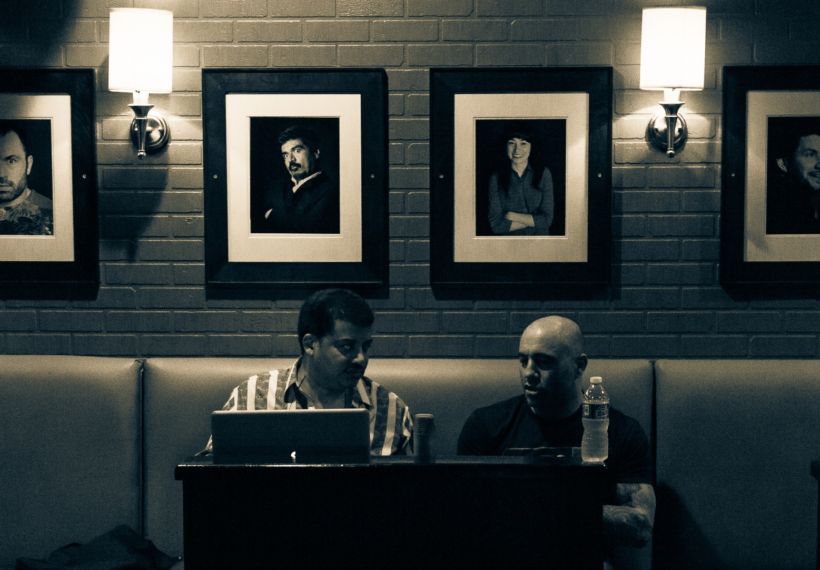
It’s a different kind of StarTalk as Neil deGrasse Tyson interviews Joe Rogan, recorded the night he appeared on The Joe Rogan Experience. As Neil says, the two hosts “spilled their guts onto the table in a kind of free-for-all.” One conversation covered human DNA, evolution, biochemistry, genetic reward systems, and reality TV stars like Kim Kardashian and Snookie. You’ll hear why science is a big part of Joe’s comedy, from the Higgs boson to the Big Bang: “Part of my job is being curious.” The two ex-wrestlers also discuss the physics of wrestling and mixed martial arts, and how science is a game changer in every sport. Neil sums the interview up best: “…here’s a guy who shatters anybody’s stereotype of who should be an expert at what…Joe Rogan is okay in my book… We’re both a big fan of just getting people to think for themselves.”
NOTE: All-Access subscribers can listen to this entire episode commercial-free here: The Joe Rogan Experience.
Transcript
DOWNLOAD SRT
Welcome to StarTalk, your place in the universe where science and pop culture collide. StarTalk begins right now. Now. Welcome to StarTalk Radio. I'm your host, Neil deGrasse Tyson. In my day job, I'm an astrophysicist at the American Museum...
Welcome to StarTalk, your place in the universe where science and pop culture collide.
StarTalk begins right now.
Now.
Welcome to StarTalk Radio.
I'm your host, Neil deGrasse Tyson.
In my day job, I'm an astrophysicist at the American Museum of Natural History, where I direct the Hayden Planetarium, right here in New York City.
In the current show, we're featuring my interview with Joe Rogan.
He's an actor and a comedian, a mixed martial arts specialist, but perhaps he's best known as the powerhouse podcaster behind The Joe Rogan Experience.
We start off by talking about why he often features science in his stand-up comedy.
So Joe, you always talk about science.
It infuses almost everything you do, because all of it, the physics, biology, chemistry, engineering, there's gotta be some force operating.
What is it?
With me?
It's just curiosity.
I just think we live in extraordinary times and the ability to access information is so unprecedented.
And because of social media, especially because of Twitter, and I have a message board that's very popular as well.
The message board is even more comprehensive because they're not limited to links.
They can actually post full articles with pictures.
But there's so much interesting stuff out there.
You're constantly being bombarded with new stories and new technological achievements and new discoveries.
It's just, to me, it's just natural curiosity.
So it's not anything special.
It's something anybody could have.
Yeah, I mean in this day and age, the amount of access to information we have allows the average person just to read peer-reviewed articles, to be wowed by incredible videos and photos that the Hubble takes.
It's just, we live in such crazy, crazy times that for me, like I said, it's just a complete, natural inclination to pay attention to this stuff.
So there's no teacher, there's no family member, there's no museum you visited as a kid.
Something must have kept that curiosity going beyond when other people would have lost it entirely.
No, I think because of being a stand-up comedian, I don't have the time constraints that a lot of folks have.
My day is part of my job.
Yeah, and also part of my job is being curious, and the more I read about things, the more I have stuff to talk about.
Like I have a whole bit about-
More material.
Yeah, I have a whole bit about the large hadron collider.
Oh, let me hear something, go, give me one.
Oh, it's like a long bit about human beings, about time travel, it's like, it's a huge bit.
Gay marriage, it's like, it's 10 minutes long.
It's really, it's not something that you can-
You've got a routine that combines the CERN super collider finding the Higgs boson and gay marriage.
Yes.
Okay, well, I'll have to find that online, all right?
I'm gonna look for that.
So the broader question is, how often is science material for you?
A lot, yeah.
Some of my best bits have involved science.
Is there any quick one you did?
I know the mood isn't there or whatever.
No, no, it's not even that.
It's just my style of standup is more like these long chunks.
Had you heard the one about this?
Yeah, it's not like a one-liner, you know?
Like one of them is the anti-evolution of man, which explains like pyramids.
And the idea is that we are the bastard children of the idiot stone workers of Egypt.
And what happened was the dumb people just out-fucked the smart people.
And it just got to a point where there was no smart people left.
And the bit was about like how many of us really truly understand how this world operates.
And I would like tap on a microphone and go, why is that loud?
I'm a stand-up comedian.
My whole life, it depends upon this, but I have no idea how this works.
I just get up here and I do my job.
And I'm like, how many of us understand how the power is on?
And if the power went off, what would you do?
For most of us, if the power goes out, we sit around and we wait because you figure somewhere out there, there's someone who knows that it turned that thing back out.
But what if that guy died?
Or do we know?
Has that been monitored?
I mean, one day, we're gonna out-fuck all the smart people and there's gonna be no smart people left because women, they wanna have sex with rappers and baseball players.
I mean, maybe you, you're like a celebrity scientist.
I'm sure you get a lot of hot college chicks that are knocking it your way.
But like for the average dude involved in science, there's very few opportunities to breed.
So you're making an argument that for perhaps other comedians, there's a whole resource, a place to draw drugs or reflections on what role science can play in their comedy.
Sure, if that's what you're curious.
I mean, I think for a lot of comedians, the most important thing is they give you an accurate representation of what they find funny and what they think is interesting.
For me, it happens to be a lot of it is science.
A lot of it is ancient history.
A lot of it is speculation about our future.
There's a lot of scientific inquiry for me just in my daily life.
So it has to make it into my comedy.
Because that's the natural effort of a good comedian, I guess, right?
Yeah, it has to be, here's the world through your eyes.
And plus a lot of science is made front page headlines so that you can even reference science that people have some chance of having read about.
Sure, I mean, everyone kind of knows.
Because comedy doesn't work if they don't know what you're talking about, right?
Well, you can explain some things, you know?
I mean, like the large-
Yeah, but it's not a lecture, right?
So you got to, there's a trade off at some point.
Right, there has to be a certain amount of time in between the laughs.
You can't, like when you get to something like the Large Hadron Collider, you have to be able to explain it in a somewhat comedic form, and you have to have at least, somewhere along the line, you got to throw some dick jokes in there.
You got to figure out a way to keep them occupied.
But the idea of the Large Hadron Collider, I had a bit about a Big Bang machine, and the idea was that, like, scientists have never figured out what started out the Big Bang.
And then I think that 14 billion years ago, there were some scientists, and they were probably autistic, and they were on anti-anxiety medication and drinking Red Bulls, and nobody touched them ever.
And one day, they made a Big Bang machine.
And one guy sat around and went, went, I'll press it, and he hit the button, and the whole thing restarted.
And that is the cycle of humanity.
It goes from single-celled organism to multi-celled organism to conscious entity to autistic dude who figures out how to make a Big Bang machine to hitting the button.
And it happens every 14 billion years.
And that is the birth and the death of the universe, infinity.
So according to that theory, we're minutes away from that happening again.
A second now.
I mean, when you look at what they've discovered with the Large Hadron Collider, whether it is the quark-gluon plasma, which is, I believe it's one sugar cube, is some insane amount of weight that we can't even process, like where you would drop it, it would go straight through to the center of the Earth.
I mean, it exists in just tiny microscopic form, but the fact that that's real, that's something that they have created, it begs the question, where does it all end, and does it, and where does it go, and is it sustainable, is it controllable?
What is the future?
Is it a Big Bang machine?
If it keeps going, someday someone will figure out how to reset the universe with the press of a button, or a sequence of events that can be set off.
It seems to me like it's inevitable.
It seems to me like there's no way to stop that.
Is that your biggest fear, that technology and dorky autistic scientist might push the button?
No, yeah, I mean, I guess.
It's in the list, but it's not the top of the list.
No, I mean, I think that would be like a pretty cool way to go.
If that is how it gets reset, there's very little suffering involved.
The only suffering is doing it all over again.
The cave people have to suffer, you know?
That's the suffering.
And migrate around on the ice flows of the Bering Strait.
You've been listening to StarTalk Radio.
I'm your host, Neil deGrasse Tyson.
When we come back, we'll have much more of my interview with Joe Rogan.
Bye Welcome back to StarTalk Radio.
I'm Neil deGrasse Tyson.
In this show, we're featuring my interview with Joe Rogan, a standup comedian and the voice behind the popular podcast, The Joe Rogan Experience.
In this segment, we talk about how he uses science as a touchstone to share his social commentary and perspective on the world.
So for you, it's not enough apparently to just be curious because anybody could pick up a book and read a headline and even chase down the original research papers.
You also philosophize.
You think about what it means.
You think about whether it should be true, whether or not it is true.
And so where do you get your philosophy?
Well, again, I think it really comes from just the access to time that I have, meaning that my days literally, part of my job is researching things and being curious.
Part of your job as a professional standup comedian.
Yeah, as a professional standup comedian, you must be curious and if you are curious and these articles stumble through your path or you run into a documentary, or I watch your show, The Cosmos, which I'm sure is gonna set a lot of people down certain paths.
I don't know what it is that started me down there, but in having this job as a standup comedian, it's just allowed me to explore so many different things, like really in depth to the point where most people, if they have a full-time job, they have to be concerned with whatever it is they do for an occupation.
Whatever the boss tells them.
Yeah, I don't have those-
And you're bossless.
Yeah, I'm basically bossless.
So I don't have those constraints.
So that's where I get my philosophies from.
That's where I get, I mean, obviously it's an accumulation of other people's thoughts that's resonated with me as well and different discoveries that people have had, whether they're psychological discoveries or philosophical discoveries that have also resonated with me that I've adopted into my own point of view, but it just really all comes from being curious.
Who's your audience?
Did you create your audience or did your audience create you in the podcast?
That's a good question.
That's a really good way of putting it.
Because you got your standup, but there are other comedians and they do their standup, but not all of them have the following that is represented in your podcast.
So did you create them or did they create you?
It's really, I don't know.
I'm not smart enough to answer that, but I think that for sure, the podcast represents me in a better way than anything I've ever done before.
It's easy to have a perception of someone, but how well do you really get to know someone unless you hear them talk for hours and hours and hours and end?
And I think that anything else I've done, whether it's hosting the ultimate fighting championship or Fear Factor or whatever, even standup comedy, it's gonna give you a sort of a limited view into how a person functions.
It's sort of like you're operating in a very specific bandwidth or specific frequency rather, whereas with the podcast, Frequency bandwidth.
We talk about everything.
I take them, frequency bandwidth, I like the words.
Keep the vocabulary coming.
Your physics vocabulary, upgrade it at the end.
See how you did on all your vocabulary.
I'll be happy with a C.
But with the podcast, it's really anything that I find curious and that has resonated with a lot of folks that I think felt like they were unrepresented before.
I think that for a lot of people, they feel like a lot of these subjects, they're not being necessarily indulged in mainstream media.
They're not being pursued in the average conversation that they have at lunch with their coworkers.
So what it is, is obviously they can read the science section of the paper.
That's not you.
They could go to a pure comedy club.
That's not you.
They're pieces that are all contained within you so that when you start talking, you are drawing from this huge portfolio of identity and out comes this, what should I call it?
It's a smorgasbord that people dine upon.
That's a good way to look at it.
It's a cornucopia that people dine upon.
That certainly is the podcast.
It also represents, and it's gonna sound really weird, it represents friends to people who don't have friends like that.
There's a lot of folks out there that they might have curious thoughts or they might have ideas about things, but they don't have anybody to talk to about it.
They don't have anybody that they know that's interested in these things.
They don't have these conversations to be had at work or wherever they, you know, or at home or anywhere.
And so what a podcast represents is a chance to sit in on a true, unedited, organic conversation for hours and hours at a time, and it allows you access to a lot of other different ways of thinking.
And I think that is another thing that's really resonated with people.
Right, if it's unscripted, it goes wherever organically is right.
Yeah, and there's not just unscripted.
You can't hide anything.
Yeah.
It eventually comes out.
Right.
No agenda and no one telling you where to go with things.
I mean, if we had a producer, there's several things, especially Brian, my cohost, he says unbelievably ridiculous shit.
You would say, stop, edit that out.
Don't do that.
But that doesn't happen on this podcast.
And because of that, because of the randomness of it all, it kind of makes it a little bit more fun.
And it kind of makes you also realize like, well, this is just completely unscripted.
Like this really is just a bunch of people sitting down and talking.
And because of that, they get very comfortable.
And because of the honesty that we exhibit and the true-
And sincerity.
Yeah, completely sincere.
It feels good.
It feels like this is the type of people that I want to talk to.
Love them or hate them, there is no doubt that Joe Rogan's podcast has a large and growing following.
In addition to science and comedy, he often loves to talk about conspiracy theories.
When I was a guest on his podcast, he grilled me at length about whether the Apollo moon landings actually happened.
And over that time, we also discussed the Mayan apocalypse or the non-apocalypse and planetary alignment and how some people were dejected when they discovered that the world was not going to end.
We also discussed anti-intellectualism.
He's a big philosopher in his own right.
And so the idea that people are not thinking about what they're saying disturbs him greatly.
We talked about exoplanets made of diamond and manmade versus natural diamonds and mining asteroids.
And that was just in the first hour of the show.
We talked about super volcanoes and earthquakes and impact craters and timescales of the universe and solar systems.
We went on talking for another hour and a half.
Apparently, there was no time limit, so I didn't know this when I was there.
We just went on and on and on and on and on.
You can find the entire video of that podcast online.
It's episode 310.
Or just Google Joe Rogan and Neil Tyson.
It'll take you right there.
Here's an excerpt from Joe Rogan's podcast.
It's a snapshot of his unique style that has attracted legions of fans.
In this clip, he talks about how scientists are testing the theory of the multiverse.
Check it out.
That multiple alternate universes exist inside their own bubbles, making up the multiverse, is for the first time being tested by physicists.
Two research papers published in Physical Review Letters and Physical Review D are the first detail how to search for signatures of other universes.
Physicists are now searching for disk-like patterns in the cosmic microwave background, relic heat radiation left over from the Big Bang, which could provide telltale evidence of collisions between other universes and our own.
Whoa, collisions.
Evidence of collisions of universes.
That's the alternative concept to the Big Bang as well.
The idea that our universe, whether it's in a bubble like the multiverse or the people that propose membranes, they propose that the brains collide at certain points and that creates a recycling of the world.
We just can't wrap our head around something that's that far or that much longer a period of existence than our own life.
The idea of this cycle that's billions and billions of years, we are so important in our own lives that the idea that that's how small a part we play for real, I'm gonna exist for 80 years inside some weird biological body and some crazy process that happens every 16, 17 billion years, these things collide with each other and everything starts completely from new.
No planets, man, no nothing, just particles and gas and heat and nuclear explosions and mass connects all these different objects together and they slowly form planets and then life grows on them and then life becomes complex, life becomes intelligent, self-aware, life creates technology, goes to war, blows up the universe and then they collide again and more collide all around and it's a constant cycle of society, life, everything, the universe complexity gets to a certain peak and then just, they just hit each other, boom.
It just, to me, it was almost like a little message that everything is preposterous.
Do you ever stop and wonder how much of your life, how much of the things that you go through are real and how much of it may be some sort of background noise going on in this weird play that you're creating for yourself, that your imagination is put forth and then someday you're going to understand it all.
But right now, it's all the people that are in front of you are the bit players and you're supposed to be trying to figure this thing out as you move along.
All that stuff that's going on in the background, car accidents and war.
It seems like there's too many pieces going together, too.
Too many times I'm like, that's just weird that that just happened like that.
It just seems like it's just...
Yeah.
It's not foolproof, you know?
It's not like you can prove it.
Right, but there's something going on.
Welcome back to StarTalk Radio.
I'm Neil deGrasse Tyson.
In this show, we're featuring my interview with Joe Rogan of the Joe Rogan Experience podcast.
In addition to his podcast, Joe Rogan once hosted the television reality show Fear Factor, which dared contestants to perform stunts such as eating live bugs or being handcuffed underwater with a handful of keys in order to win the grand prize of $50,000.
So of course, Joe had a lot to say about the current TV landscape and how that taps into human psychology.
I am obsessed lately with subsistence shows.
Subsistence shows like the people that live in Alaska and live off the land and just hunt and fish all day.
I am completely obsessed.
My wife constantly makes fun of me because the DVR is filled with all these shows of people living this really primitive lifestyle.
So you're getting ready for something.
No, no, no, no, no.
I'm amazed, first of all, that people find great joy in this.
I think that's fascinating, because I think it speaks to the-
Primal.
Yes, the primal reward systems that's in our DNA.
I mean, we have bodies, essentially, that are in this environment that has changed unbelievably radically in a short period of time, but the physical entity, the human being, is really not that different from the human being of 1,000 years ago, or 10,000 years ago.
And the reality of our environment is incredibly different.
And I think that those reward systems, they manifest themselves in weird ways.
And for some people, that hunting and trapping and fishing and living off the land is like insanely rewarding on like a biochemical level.
Speaking of biochemical levels, you hosted Fear Factor.
Have you thought much about the bio psychology of what drove that show?
Yeah, well, I spent a lot of that show as an amateur scientist, just trying to figure out the human game show contestant and what it is that causes the reality game show person to do what is required of them to win on these shows.
The idea of needing attention is a trip and the idea essentially comes from in the ancient days of human beings, the person who got the most respect was the one who was the most successful in the hunt, the most successful in battle, the one who was the most successful in breeding.
That lead was to be followed because there was benefit in being the leader.
There was benefit socially, there was benefit sexually.
And they had more offspring as well, right?
And as I said, we were talking about before about reward systems built into our genetics.
Well, these reward systems are now hijacked in this weird way where you can kind of circumvent all regular reality, like all hierarchies, and all you have to do is get a camera on you where other people see that and you get some benefit.
And it's really, really strange and aberration, a strange sort of a blip in the matrix where you get like this Kim Kardashian type human where you just get someone who's famous for having a lens put on them and that is essentially it.
There's not that much interesting going on.
There's prettier girls, there's certainly smarter girls, but because this lens is on, there's a great amount of power and energy focused in this one really mundane spot.
So it's a perversion of evolutionary features that exist within us.
Yeah, I think so.
I think the human body is not designed to interpret the medium of television and film in a way that makes sense.
I think that we're so designed to follow successful behavior that when we see a hero on a movie screen and his head is 60 feet tall, and every time he talks, music plays, and his words are perfect because a team of writers has labored on them for hours and hours.
I think the impact of that is really confusing to a lot of folks, and that is why we have all these weird cultural misrepresentations of monogamy and of ideology, and our view of the world is very childlike in a lot of ways, very much like a movie.
Our perceptions of global economics, our perceptions of war, a lot of them are very much childlike and very movie-like in our good guys and bad guys and how things work out in the long run.
I mean, they're all very much like a Sandra Bullock movie.
And as we know in real life, even her own life is not like a Sandra Bullock movie.
So I think it's really interesting to watch this, relatively new, over the past less than 100 years, item in human civilization and how it's impacted us.
So what you're saying is the evolutionary attraction that we have for people who are actually successful in protecting the tribe has been distorted into the awe and respect we give for someone who is big in front of us, no matter who they are.
Absolutely.
I mean, Snooki is the best example.
I mean, there's no reason to pay attention to that.
I mean, I guess there's a little amount of entertainment value you can get for their antics, but there are people that genuinely worship people that are on television for no reason other than that they're on television.
And it's a very, very odd thing.
I really enjoyed Joe Rogan's reflections on how television plays into our psychology, our culture, our politics, our world, our past, our future.
The guys thought a lot about a lot of things.
And so that made my time with him quite enjoyable.
It's, so that made him a different kind of guest.
He wasn't really, it was another sort of talk show host talking to, and we're there just spilling all our guts onto the table in a kind of free for all.
When StarTalk Radio returns, more of my interview with controversial color commentator Joe Rogan.
Welcome back to StarTalk Radio.
I'm Neil deGrasse Tyson.
You can find us online at startalkradio.net, on Facebook at StarTalk Radio, and we also tweet, and what else, at StarTalk Radio.
In this show, we're featuring my interview with Joe Rogan.
He's a standup comedian and the voice behind the popular podcast, The Joe Rogan Experience.
A topic he often likes to discuss on his show is mixed martial arts.
He's a black belt in Brazilian Jiu-Jitsu, and he provides commentary for TV broadcasts of the Ultimate Fighting Championship.
In this segment, I talk with Joe about the physics of wrestling, something I know a little bit about.
I used to wrestle.
I wrestled for eight years, so I think about the physics of balance and strength.
And so, given your curiosity, you've got to do a lot of the same, you're in that same club, right?
Yes, yeah.
It's not just an art form to you, it's got to be a science as well.
Oh, most certainly, yeah.
There is certainly a science to techniques.
And I'm a big fan of technique.
I mean, I am a mixed martial arts commentator.
I'm the guy who breaks down what's happening.
Essentially, most of it is for people at home that really don't understand the real intricacies of special submissions and grappling.
There is a real science to that.
And that science is tried and tested over many, many years.
And it has to do with leverage.
And it has to do, especially today with-
Give me a place to stand.
Yeah.
And I can move the world.
The measurement of the way techniques work and in what situations they work.
And you're dealing with, especially in situations where we were dealing with leverage, you're dealing with like very small areas where something's effective, where it's ineffective just a few inches further.
Or just up here or there.
It's all about where it's applied.
It's not about the amount of force it's applied.
It's about how it's applied and what kind of leverage and how the knowledge of these positions leads to getting someone tied up in a knot that doesn't want to be tied up in a knot.
And then they have to tap out and get submitted.
I mean, it sounds logically that that would make you a better fighter, but presumably there are fighters that don't think about that.
Well, there's-
They might also still be good.
There's a bunch of variables.
There's physical athleticism.
There are some people that are just unbelievably strong.
There's wrestlers who are just cock strong and they could just pick you up and dump you on your head.
And until you run into someone who can counteract that unbelievable physical advantage with so much technique that they can sort of work around it, that guy will be successful.
And that also makes people more scientific and more technical, because then they have to figure out how to overcome these unbelievable physical advantages with better leverage, better technique and better knowledge of the positions.
Because a big thing, especially in jiu-jitsu, is knowledge.
Yes, yeah.
I've been doing jiu-jitsu since 1996.
I wrestled in high school as well.
I only wrestled for one year though.
I was doing taekwondo at the time.
I was trying to do both of them.
But the knowledge of grappling is incredibly intricate.
Every year, there's new submissions and new positions.
I just had a phone conversation with a friend of mine who's a black belt.
He's been a black belt for 10 years, and he came up with a new triangle last night.
He goes, I got this new variation.
I can't wait to show it to you.
And it's always about that.
It's always about innovation.
If you're not paying attention to the jiu-jitsu world, you will miss out on a lot of different techniques.
And then when you're in those situations, you will be at a disadvantage because someone will be doing something that you don't understand, and that's all it takes to tap you.
Do you think science literacy, if every fighter had it, would improve their fighting?
Yes, unquestionably.
Because a lot of fighting is hindered by emotions.
And I think science literacy would benefit fighters extremely.
I think that, as I said before, technique is the most important aspect of martial arts.
And technique, up to a point, allows you to overcome physical advantages.
And that's very scientific.
And I think that the ability to use leverage and the ability to understand force and mass, all of that applied with the understanding of the cardiovascular system, the understanding of the scientific principles of nutrition and rest and recuperation, all of that would unquestionably benefit not just fighters, but any athlete, anyone involved in doing anything that's difficult where you're competing against other people that are also trying to do their best.
Science really changes the entire game because it has with athletes, if you look at any athletes in terms of whether it's Olympic athletes, whether you look at NFL or science and the science of applied understanding of the human body to physical training has changed athletes.
Football players are much larger, they run faster, they move better and the techniques of mixed martial arts absolutely benefit from the use of science and I believe the more scientific a fighter is, the more chance they have not only to achieve victory but to prolong their career and to avoid damage.
When StarTalk Radio returns, more of my interview with actor, comedian, podcaster, mixed martial arts extraordinaire, Joe Rogan.
Thanks Welcome back to StarTalk Radio.
I'm Neil deGrasse Tyson.
We're wrapping up my interview with the stand-up comedian, actor, and TV and internet commentator, Joe Rogan.
In the previous segment, we talked about wrestling and mixed martial arts.
And so, in this final segment, we address a fundamental question that many in the boxing world can spend hours debating.
Who would win a boxing match between Muhammad Ali and Mike Tyson?
I believe Mike Tyson was in a different era.
And I believe Muhammad Ali was dealing with people who had never exhibited that type of athleticism, that type of ferocity.
And he was incredibly successful in his era.
I believe if Muhammad Ali grew up in Mike Tyson's era, he would be better than Mike Tyson.
Because I believe his mind was incredibly strong.
His will and his ability to not just overcome stardom, but transcend it and be a leader was one of the reasons why he's still beloved to this day.
And no one mocks him, even though he has horrible debilitation.
You know, his Parkinson's is just unbelievably bad.
It's still incredibly loved.
Whereas Mike Tyson was just a completely different sort of a guy.
He was an out of control train that could only go so far down the track.
But man, when it was going down that track, the physical aspect of just watching him demolish people was really incredible.
And I think unlike anybody who had ever existed before.
And I think that if you took the Mike Tyson of like when he knocked out Larry Holmes, when he knocked out Spinks, I don't think anybody stacks up with him.
I think he destroys almost everybody in history, but he couldn't maintain that.
It was an insane amount of RPMs that he was operating on.
He was redlining his intensity for so long.
Because I would think of Muhammad Ali having extraordinary technique.
I mean, yes, you're coming in muscled.
I mean, that's the George Foreman fight.
You come in muscled and he avoids you.
I was just analogizing that to your discussion.
Yeah, you can't you can't compare Mike Tyson and George Foreman because what Tyson had that was really unbelievable was speed.
True speed like a welterweight.
He had unbelievable hand speed.
And he could move physically better than anybody I'd ever seen at over 200 pounds.
When you look at his fights, like is it true that he caught pigeons?
Yes.
Yeah.
Yeah.
He was a yeah, he used to have carrier pigeons.
He kept him company in Brooklyn like he kept a whole bunch of them.
Yeah, he was an unbelievable physical athlete.
And his obsession with boxing was at a completely different level than I think anybody before him.
I think his life, which was horribly tragic in his childhood, boxing represented to him this way out.
And he was just driven in a way by whether it's the demons of his childhood or the realities of his environment.
But he was driven in this incredible, perfect storm of athleticism, mind, and obsession with technique and detail with an incredible coach in Customato, who literally raised him as a father figure.
So, I think in Mike Tyson, you have a very, very unique situation that I believe that for two or three years, he's the greatest heavyweight that ever lived.
But Muhammad Ali, I believe, was a greater champion, and Muhammad Ali, I think, was a greater man.
And I think Muhammad Ali, especially like to me, he's a greater hero.
His insistence on not going to Vietnam, his stand, I think really sort of shocked a nation with debate.
And it really sort of defined him as this true, not just a fighter, not just an athlete, but a true leader in our culture.
And I think that's really the difference between him and a Mike Tyson.
I just think he was an incredibly strong person.
And I think that if Ali lived in the Mike Tyson era, if they grew up together, if they came up together, he would have found a way to beat Tyson.
So can I ask you something?
Are you like, because your name is Tyson, are you more inclined to lean towards his name?
Towards thinking that he was one of the greats?
No, no, no, no, no, I grew up with Muhammad Ali.
So you think Muhammad Ali was the greatest?
Yeah, yeah, especially if you put him in another time, he would have become that person in that time.
That's what I think.
But it's gotta be cool having a name that's the last name of one of the greatest dudes who's ever lived.
When he's not in jail.
Yeah, when he's not hurting people.
I really enjoyed my time with Joe Rogan.
We split the visit.
I first was interviewed by him on his podcast.
That went for more than two hours.
Then I pulled him aside and pulled out my mobile microphone and recorded him for StarTalk Radio.
Just want to publicly thank him for granting the time to do that, particularly after the long session we had together.
It's interesting.
I love deep thinkers of any stripe.
And here's a guy who just shatters anybody's stereotype of who should be an expert at what.
He's a mixed martial arts expert, and he philosophizes about the future of the universe.
And he kind of dabbles in conspiracy theory, a little odd for me.
But nonetheless, he comes back and hits the news hard at anything that's in science and how it affects pop culture.
So Joe Rogan is okay in my book, and my first time ever meeting the guy.
I think his strongest points have been just to be cautious of how the media is controlling what they want you to think and who they want you to vote for.
We're both a big fan of just getting people to think for themselves.
That's something that not enough people do, even educated people.
People who like to think that they're the source of opinion.
Often you part the curtains and there they are just peddling back something they saw on television.
So why don't we all just raise a toast to free speech, free thought and all the freedom that brings us.
You've been listening to StarTalk Radio, brought to you in part by a grant from the National Science Foundation.
I'm Neil deGrasse Tyson, bidding you until next time to keep looking up.
See the full transcript





 Unlock with Patreon
 Become a Patron