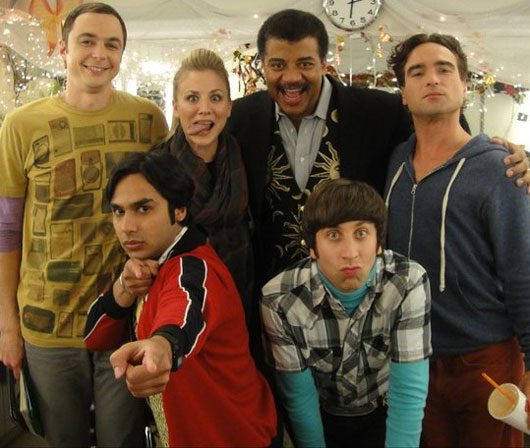
The hit CBS TV sitcom “The Big Bang Theory” follows the adventures of four scientists—Sheldon Cooper (Jim Parsons), Leonard Hofstadter (Johnny Galecki), Howard Wolowitz (Simon Helberg) and Rajesh Koothrappali (Kunal Navyar). Neil talks with Bill Prady, co-creator and writer of the show, about why he decided to create a show about science geeks and the universal emotions that even theoretical physicists and engineers experience. Joining the conversation is David Saltzberg, professor of physics and astronomy at UCLA and science advisor to the show. From romantic relationships to religion to reflections on relativity, learn about the many ways “The Big Bang Theory” uses science to shine a light on society.
Transcript
DOWNLOAD SRT
Welcome to StarTalk, your place in the universe where science and pop culture collide. StarTalk begins right now. Welcome to StarTalk Radio. I'm your host, Neil deGrasse Tyson, astrophysicist and director of New York City's Hayden Planetarium. This week, we're...
Welcome to StarTalk, your place in the universe where science and pop culture collide.
StarTalk begins right now.
Welcome to StarTalk Radio.
I'm your host, Neil deGrasse Tyson, astrophysicist and director of New York City's Hayden Planetarium.
This week, we're going to talk about the hit CBS television series, The Big Bang Theory.
For those who may have never seen it, it follows the adventures of four scientists, Leonard, Sheldon, Raj and Howard, as well as the girl next door, Penny, who's an aspiring actress and a waitress at the Cheesecake Factory.
We'll learn more about all these characters later in the program, but I should let you know that if you do a Google search on Big Bang Theory, number one is this TV show, and number two is the origin of the universe.
I sat down with Bill Prady, co-creator and writer of the show in his office in Los Angeles, and joining us was David Salzberg, an astrophysicist at UCLA and science advisor to the show.
The first question I had to ask was, what were you thinking creating a show about geeky scientist?
And why did you think anyone would watch it?
As I understand the world, there are nothing but geeky people in it.
So based on me and the people I know, so to me, it's a depiction of the world as I see it.
So you have geeky roots to lead to this.
I have the geekiest of roots.
Before I was a television writer, I was a computer programmer, and this is back in the early PC days when, before they were called PCs when they were called microcomputers, and I programmed in Z80 assembler.
Whoa.
So you're card carrying.
I am card carrying, absolutely.
And I've been to my share of Star Trek conventions.
But did you don Spock ears?
That's the question.
I have donned Spock ears, but I've donned Spock ears on television, in fact.
If you hunt through reruns of Dharma and Greg, I had a recurring mute character of a guy, a 40-year-old virgin who went to Star Trek conventions.
And I sat in the chair and got the Spock ears.
If you have a makeup person, take about 45 minutes to put on.
So I've had that experience.
It doesn't get much geekier than that.
Okay, so you've got the roots.
So it's one thing to be of the geek mold, but it's very different to then have non-geek populations embracing a show that is a celebration of geek life.
Did you predict that?
Because The Big Bang Theory could not be this successful unless, quote, regular people were watching it.
If I had the ability to predict what things would make a television show successful, then we would be speaking from my home in the cloud city I would have built.
On Mount Olympus.
On Mount Olympus, hovering in gold hover throne.
So, no, there's no...
I want a picture of a hover throne.
I love it.
But no, you can't predict...
All you can do is ultimately say, I'm gonna do an honest portrayal of characters that interest me.
I'm gonna do stories that I find honest.
And you hope that people find them.
I'm fond of the definition of geek as not necessarily being somebody where it has to be science or science fiction, but it's that unbridled passion toward knowledge in an area.
So I think that there are just as legitimately gardening geeks and rock climbing geeks.
You just listed your next two shows.
That's right.
Well, Gardening Geek is gonna be a very exciting show.
And Dry Cleaning Geek is gonna be big.
The next project is a dry cleaning procedural.
And we don't get to know the characters.
It's all really about just stain removal with a lot of CSI-type photography.
You heard it here first on StarTalk Radio.
So I think the two things that people identify with, one is a passion about an area of interest.
And the other thing is that the feeling that you're on the outside and that other people sort of have it figured out, turns out to be the universal human condition.
That everybody goes home and assumes there are other people who have life figured out better.
I'll talk to people who were clearly the high school football athlete or supermodel, high school cheerleader type, and they say, oh my God, this show is me.
And I look at them and say, oh really?
Okay, fine.
It was the last time you were slammed into the locker.
That's right.
But for everybody, it's the two trains at the beginning of the Woody Allen movie where one train seems to have the party on it and the other train goes by with people sort of peering through the window.
And I think that feeling is one of the things that is an emotional underpinning to Big Bang Theory.
So presumably, you don't carry all this physics, even though you're a card carrying geek.
Presumably, you get help.
We get help.
Chuck Lorre, who is the co-creator of The Big Bang Theory with me, we will often sit as we're writing and we're trying to come up with something scientific and we'll be furrowing our brows.
And I will say to Chuck, what is it we're trying to do now by furrowing our brows is somehow the knowledge of physics going to arrive in our brains.
So we have from the beginning of this project reached out and starting with the first episode after the pilot, it's been to Dr.
David Salzberg, who is a...
The gentleman who is seated to your left at this moment.
To my left right now, who is a professor of astrophysics at UCLA.
David, welcome on to StarTalk Radio.
Well, thanks for having me.
So you're an astrophysicist, but there's more than astrophysics on this show.
There's particle physics, there's some biology thrown in, material physics.
So are you a jack of all trades or do you have your lifeline when Bill calls you?
I am not an expert in all areas of science by any means, and certainly not even all areas of physics.
So one of the explanations of getting a PhD is to learn more and more about as narrow a subject until you know absolutely everything about nothing.
That's an excellent...
But being that I am a professor of physics, it is incumbent on me to try to be broad.
What's wonderful about the show is it's actually forcing me to learn things.
I actually learn a lot from the questions that I get asked by Bill and the other writers.
And so when you guys are writing, what comes first?
Is the storyline first and say we need a science infusion here that's comical or does the science then dictate what the characters are doing with each other?
Both.
Sometimes the moment of science is incidental.
And there you're just looking for, I had a great day at work, you know, X happened.
And when we're doing something like that and nothing really turns on the specific, then as we write, we'll literally put science to come right in dialogue.
And sometimes we'll be a little more specific.
Sometimes we'll say obscure science to come.
Sometimes we'll say discredited science to come.
Because if you want to write a line that says, my God, thinking that we can get the movies in 20 minutes is the same as thinking.
And then we might write discredited science to come.
And so that's a message to David.
We communicate through those notes in the script, and he'll provide a couple of things, and we'll pick one.
So that's the simplest thing.
So David, you have to know the good science and the bad science to slip into the plot lines.
Right.
There was one wonderful moment where they had put in quantum brain dynamic theory for Sheldon to be working with Leonard's mother, Beverly.
And I was really nervous because it's not the most accepted theory, let's say.
But the whole episode revolved around it.
I didn't want to say you can't use it.
So I just mentioned that this wasn't really published in referee journals.
And they solved it with one word.
Instead of working together on this topic of quantum brain dynamic theory, they were working on disproving it.
Oh, there you go.
Yeah, that works.
Well, sometimes we'll do a little internet hunting around, and that's sort of the second way things happen.
Sometimes we do kind of know something here.
You know, every now and then we'll have a vague handle on it.
So we'll put something in, we'll take a shot at it, and then it's like turning in a paper, we'll get a grade back.
And sometimes we get it right, and sometimes we're close.
In that case, you know, we missed by 180 degrees, but that's easy by adding the word not.
I never thought of the word not that way, but that's exactly what it is.
Because the word not solves a 180-degree error.
Oh, hi.
What's going on?
We're up on the roof bouncing laser beams off the moon.
I'm sorry, what?
It's pretty cool.
We've got a two-meter parabolic reflector and everything.
I thought you might want to see it.
That makes no sense.
How can you bounce stuff off the moon?
There's no gravity.
Leonard, this is Zach, Zach Leonard.
Hey.
Sorry, I didn't know you were busy.
Maybe another time.
Yeah, maybe.
Hey, I want to see this laser thing.
Oh, but what about the party?
It's a surprise party.
It doesn't matter when we get there.
Okay, well, yeah, come on up.
Hey, guys, this is my friend Zach.
Hello.
Whoa, is that the laser?
It's bitchin.
Yes, in 1917, when Albert Einstein established the theoretic foundation for the laser in his paper Sir Quentin Terry de Stralung, his fondest hope was that the resultant device be bitchin.
Mission accomplished.
Let me explain what we're doing here.
In 1969, the astronauts on Apollo 11 positioned reflectors on the surface of the moon, and we're going to shoot a laser off one of them and let the light bounce back into this photomultiplier.
Oh, that's very cool.
One question.
How can you be sure it won't blow up?
The laser?
The moon.
That's a great question, Zach.
No, it's not.
Shall then play nice.
It's not a great question.
How can somebody possibly think we're going to blow up the moon?
That's a great question.
Don't worry about the moon.
We set our laser to stun.
Smart.
Now, we'll be able to see the beam when it leaves, but it won't be strong enough when it comes back to be seen by the naked eye.
Naked.
Right.
Funny.
That device there will measure the photons that return and let us see it on this computer.
Raj, get them some glasses.
Cool.
It's going to be in 3D.
Preparing to fire laser at the moon.
Make it so.
There it is.
There's the spike.
2.5 seconds for the light to return.
That's the moon.
That's your big experiment?
Oh, that for a light on the screen?
Yeah, but think about what this represents.
The fact that we can do this is the only way of definitively proving that there are man-made objects on the moon.
Put there by a member of a species that only 60 years before had just invented the airplane.
What species is that?
All episodes that I've seen, that one is so good.
Could you tell me what went through your mind?
How did you come up with the idea?
I don't think we have a lot of political agenda on the show.
Other than there's a shared feeling that there's been a wave of anti-intellectualism that somehow moved through American society where it became cool to be uneducated.
And I find that frustrating.
I want my presidents and my scientists and my doctors all to be smarter than me.
And I think there's a value in being smart and the great advances that we've lived through come from smart people.
So one of the things that Penny discovers is that education and intelligence tends to make people more interesting.
It also at the same time granted makes them geekier.
There are times when you ask Sheldon what time it is and he tells you how to make a watch.
And I think that that's sort of one of the things some of the baggage that comes with it.
That's right, that's a little bit of the baggage.
The other writers have accused me of teaching things to people against their will.
And all right, there are those things.
But there's also when you talk about guys who do what our guys do, which is to marvel at the underlying structure of matter and the universe and to be on that quest.
And I think that that's a more interesting quest to be on than success in beer pong, not that that doesn't have its value.
I think one of the reasons why this sequence works so well is that the stupid guy is stupider than anyone you actually know.
And that allows someone who might not be as well educated to still point to that person as being really stupid.
Yeah, I think he fits a good sort of ecological niche of our Darwinian finches of characters.
I just wanted to mention that when I saw that, I also thought, okay, this guy is clearly dumber than anybody you will come across.
Well, the head of the experiment that does bounce the lasers off the moon, Professor Tom Murphy at UC San Diego, wrote to me, and the part where Zack says that he's afraid of blowing up the moon, Professor Murphy says he gets that question all the time.
From his students?
Well, from people he meets.
From civilians who are watching?
Because we think of lasers as the most powerful weapon that you can ever imagine.
So he explains it, and he says he actually gets a follow-up question, which is, but why risk it?
So this really is going on out there.
Yeah.
So you guys are the pulse of all that is brilliant and stupid in the country.
I think we are.
You've been listening to my exclusive interview with Bill Prady, co-creator and writer for the hit television series The Big Bang Theory, and David Salzberg, astrophysicist and science advisor for the show.
When StarTalk Radio continues, we'll have more of this interview and some of our favorite scenes from the show.
Welcome back to StarTalk Radio.
I'm your host, Neil deGrasse Tyson.
For this episode, I've been talking with Bill Prady, co-creator and writer of the hit television series The Big Bang Theory, along with David Salzberg, a UCLA astrophysicist and the show's science advisor.
I actually had a cameo on the show during its fourth season, playing myself.
Since in some circles I'm known as the guy who demoted Pluto from its planetary status, they had me visit Rajesh Kuthrapally, or Raj, as his friends call him.
On the show, he's an astrophysicist who studies objects in the farthest reaches of our solar system.
In this scene, Raj gets to be in People magazine, thanks to one of his astronomical discoveries.
Oh yeah, 2008 and Q sub 17.
Or as I call it, Planet Bollywood.
Anyway, because of my discovery, People magazine is naming me one of the 30 under 30 to watch.
Excuse me, the 30 what under 30 what to watch what?
30 visionaries under 30 years of age to watch is the challenge to preconceptions of the fields.
By the million guesses, I never would have gotten that.
It's pretty cool.
They've got me with a guy who's doing something about hunger in Indonesia and a psychotherapist who's using dolphins to rehabilitate prisoners and Ellen Page, star of the charming independent film Juno.
Do I get an honorable mention for designing the telescope camera mounting bracket you used?
Sorry, it's not part of my heartwarming impersonal narrative in which a humble boy from New Delhi overcame poverty and prejudice and journeyed to America to reach for the stars.
Poverty?
Your father's a gynecologist.
He drives a Bentley.
It's a lease.
I'm confused.
Is there some sort of peer review committee to determine which scientists would be included?
Peer review?
It's People Magazine.
People picked me.
What people?
The people from People.
Exactly who are these people?
What are their credentials?
How are they qualified?
What makes accidentally noticing a hunk of rock that's been traipsing around the solar system for billions of years more noteworthy than any other scientific accomplishment made by someone under 30?
Boy, I bet they just fence on giving her this kind of crap.
So Raj is from India, and that's not a stretch, because we know many engineers and scientists who come from not only the subcontinent, but the Far East as well.
I was surprised when I met him.
His accent is not as strong as the accent he portrays on the show.
Actually, if you spend time with him, his accent floats somewhere between London and New Delhi, and I'll tell you, when he has a couple of drinks, it moves all the way back to New Delhi.
But he works hard basically just to keep the UK out of his accent.
The best, though, is when Kunal tries to do an American accent.
And he talks about hamburgers and things.
Now, I didn't know until this show that there is actually an affliction where you cannot speak to some people or types of people in certain circumstances.
So selective mutism is real.
But just to remind the listener, so he...
Has an inability to speak around women.
Okay.
Particularly attractive women.
And this was based on a fellow I knew who had this problem, not quite to the extreme that Raj does, but he would stop talking when women came in the room and he...
Wait, wait, wait.
You're telling me the Big Bang Theory is your autobiography?
No, but there are certainly people I know who are well reflected in the show.
But people who are afflicted by it, it winds up being in one of those anxiety feedback loops where the anxiety that the problem will occur becomes the cause of the problem and the brain gets sort of locked in that.
And it's similar to a golfer or a bowler getting the yips.
That's interesting.
There's some baseball players who used to have precision arms.
And then you lose it.
You lose it and they can't find it.
And selective mutism is the same kind of piece of suffering.
That it is psychosomatic doesn't mean that it's not real.
Psychosomatic means having its origin in the mind.
And he's eased by alcohol, we've discovered.
But that's not a practical solution, but it is a drug that works for him.
In the episode I was on, he didn't have the alcohol, so he ate the rum cake.
Even that worked.
And the fact that he could speak, the instant he chewed it, made it clearly...
It's clearly a psychological problem, and we think he ought to get help, and he's tried a couple of times badly.
Speaking of being socially awkward, the character of Sheldon Cooper pushes the boundaries of antisocial behavior.
Although as played by Jim Parsons, he's hilarious.
Sheldon is a theoretical physicist, so as we'll hear in this scene, he struggles to find answers to some of the deepest mysteries of the universe.
Sheldon, what do you want?
I came to tell you, I've got the answer.
Really?
You figured out the graphene problem?
No, I'm still hopelessly stuck on that, but I figured out how to figure it out.
You know what, Leonard, I know I said I could handle your roommate, but I was wrong.
We're gonna have to break up.
What are you talking about?
Einstein.
Yeah, I'm gonna need a little more.
Albert Einstein.
When Albert Einstein came up with special relativity, he was working at the patent office.
So you're gonna go work at the patent office?
Don't be absurd.
That's in Washington.
You know I could never live in a city.
The streets are laid out in the wheel-and-spoke pattern.
No, I'm going to find a similarly menial job where my basal ganglia are occupied with a routine task, freeing my prefrontal cortex to work quietly in the background on my problem.
Sounds like a great plan.
Of course it is.
Even talking to you is visually menial that I can feel the proverbial juices starting to flow.
Well, thanks for sharing with us.
Good night.
Okay, I'll get those drinks started for you.
Sheldon, what the hell are you doing?
I'm trying to get these tables cleared.
We're slammed.
No, wait, wait.
No, wait.
What are you doing here?
A reasonable question.
I asked myself, what is the most mind-numbing, pedestrian job conceivable?
And three answers came to mind.
I told booth attendant, an Apple Store genius, and what Penny does.
Now, since I don't like touching other people's coins, and I refuse to contribute to the devaluation of the word genius, here I am.
You just walked in and they hired you?
Just like that?
Heavens no.
Since I don't need to be paid, I didn't need to be hired.
I simply came in, picked up a tray and started working for the man.
Let me get that plate out of your way.
Sheldon, this is ridiculous.
Is it?
Just a moment ago, I had a minor epiphany regarding polymer degradation phenomenon while scraping congealed nachos off a plate.
Is that really necessary?
Good Lord!
The interference pattern in the fracture, the motion of the wave to the molecular structure, I've been looking at it all wrong.
I can't consider the electrons as particles.
They move to the graphene as a wave.
It's a wave!
The moment to applaud would be now.
I'm sorry, I don't work here.
So that was a brilliant sequence.
Was that done before or after the Nobel Prize was given for the graphene discovery?
Oh, before.
That was before?
Yeah.
So you guys are right on top of things.
Well, I talk to David and I always say I want our guys about 20 feet back behind the cutting edge.
I don't want them accidentally on the verge of a discovery where we have to have Big Bang Theory exist in a parallel universe where a discovery has been made that hasn't been made in ours.
Graphene trans-Neptunian objects, we were a little bit ahead on some stuff that actually happened.
And my favorite is that the toilet in the International Space Station broke about two weeks after we aired an episode where Wallowitz's ISS toilet broke and it broke in almost the way our toilet was said to have broken.
Now you guys are getting spooky.
That's right.
By the way, about the graphene clip that you played, that was a great example of David having a real puzzle to look for a piece of science.
Every now and then you'll sort of work backwards from an idea.
And the question was, is there ever anything that would take Sheldon into working at the Cheesecake Factory?
And then we started talking about Einstein and the Patent Office.
And there's a logic to it.
If you're focused on something that isn't your work, maybe it sort of frees up the mind a little.
But then we went to David and said, look, there's a problem.
He's working on it.
And here's the progression.
It starts with marbles on the floor.
And then it progresses to balls in a Chuck E.
Cheese ball pit.
And then ultimately it's solved by something he sees working at a restaurant.
So we gave him that.
And I think it was a couple of days before you came back with graphene on that one.
I'm just curious how you, given those puzzle pieces, how you got to it.
You made it easy because he had marbles on the floor, which is clearly a planer structure.
Graphene is carbon in a flat plane.
It's basically a chicken wire of carbon, a single layer, completely missed by the theorists.
And the experimentalists made it basically by pulling pencil lead off a paper with scotch tape.
And the person who did it, one of the two who won the Nobel Prize, Konstantin Novoselov, actually came to show afterwards.
He also mentioned Big Bang in his Nobel lecture.
In his acquired Nobel lecture, when you received the prize, and he showed Sheldon working at the whiteboard.
Wait, wait, wait.
First, you break the International Space Station toilet.
Now, you're showing up in people's acceptance remarks for the Nobel Prize.
There we were.
I'm scared.
You're out of control.
Well, we've had a number of Nobel laureates.
I'm going to say that we're the sitcom set that's been visited by more Nobel laureates than any other sitcom set ever, given that we stand at three.
And I think that the previous record is zero.
Jan Hall, who won the Nobel Prize for the Optical Comb, among other things.
Drop by to visit.
You had George Smoot actually speak.
Well, George Smoot, yes, because he sent a letter asking if he could be on the show and then later claimed his assistant had sent the letter.
By the way, the accusation that someone else sends letters, we've heard that before.
That's right.
I have to say, a letter saying maybe the director of the Hayden Planetarium could be on the show is like my mother reporting that she had a dream that I'd invited her to the Emmys instead of my wife.
After the break, there's more of my interview with Bill Prady and David Salzberg about the hip TV series The Big Bang Theory.
Welcome back to StarTalk Radio.
I'm your host, Neil deGrasse Tyson.
I've been talking with Bill Prady, co-creator and writer for The Big Bang Theory, along with David Salzberg, an astrophysicist and science advisor to the TV show.
In this segment, we discuss the characters Howard Wolowitz, an engineer and the only one of the lead characters without a PhD, along with Penny, the girl next door who also happens to be Leonard's love interest.
Both Howard and Penny illuminate some fascinating aspects of the interplay between science and society.
So Howard is an interesting character because he's the only engineer, he doesn't have the PhD, he's very handy with robotics and the fact that he's Jewish is a fundamental part of his character.
So how is religion in general treated in the show?
I think there's no overt intent to have a religion science debate of any kind on the show, but because religion is an aspect of existence in modern society, the coexistence of religion and science is something that you're aware of on the show.
So if it comes up, it comes up.
And we are comfortable with the spectrum of experiences.
So you have, for example, Sheldon who grew up in a fundamentalist Christian home, and he has the hardest time reconciling his mother's beliefs with his own knowledge of the universe.
And we've seen it in moments where his mother has referred to her belief in creationism and intelligent design and things like that.
Leonard's upbringing was atheistic.
His parents, rejecters of religion.
So he comes at religion as an outsider.
And I think there are moments like a Christmas tree where he kind of misses the warmth that it might have added to his childhood.
There doesn't seem to be much warmth in his childhood at all.
Howard is culturally religious.
Jews are well represented among scientists because of a cultural predisposition toward academic careers.
So here's a character whose religion is cultural for him, but not particularly significant.
And Cuthur Pali seems to be the character whose Hinduism actually seems to inform his life.
So in terms of their relationship with religion, there are four different approaches.
Not by design, just by accident, by getting to know the characters.
That's a happy accident because clearly many viewers would be religious and be curious to them how that plugs in.
Absolutely.
And I think one of the things that you find is, you know, sometimes people, there's an assumption made that religion isn't a part of the life experiences of scientists.
And I think what you find is that scientists represent the spectrum of humanity like any other group.
And these things aren't incompatible with the pursuit of science.
The other wonderful thing that Howard gives us is that engineers often have a bit of a chip on their shoulder, that they're hands-on doing the scientific work, but they're sometimes looked at as the grease monkeys of the group.
Sheldon condemned engineers as the Oompa Loompas of science.
Oh, thank God you're here.
What's the emergency?
I got the Mars rover stuck in a ditch.
Where?
On a dusty highway just outside Bakersfield.
Where do you think on Mars?
Howard, is everything okay?
Yeah, baby, I'll be right in.
You brought a girl to the Mars rover control room?
Yeah, I picked her up in the bar.
She's a doctor.
One free barium enema and my mother won't care she's not Jewish.
So what exactly do you want us to do?
I need you and Roche to help me get the rover out of the ditch, and I need you to get Stephanie out before somebody notices she's here.
She doesn't exactly have clearance.
Really?
They don't let strange women from Honky Tonks come in and play with $200 million government projects on distant planets?
Yes, I was bad.
Maybe she'll spank me.
Can we please move on?
Wait, Howard, you know what?
It's getting late, so do I get to drive this thing or what?
Yeah, no, I'm sorry, but something's come up.
Kind of a Mars rover.
Mars rover.
Can Howard come over?
Situation.
So, my friend Leonard is going to take you home.
Anything?
Actually, I was just checking my email.
But, nope, the rover is not responding.
There's got to be other options.
Try calling AAA.
But based on NASA's latest timetable, they won't get there for 35 years.
Plus, I understand you have to be standing next to the vehicle with your card when they arrive.
Snap what?
Okay, I guess we have to turn to Plan B.
What's Plan B?
Erase all the hard drives, grab the surveillance tapes, wipe our fingerprints off every surface and run.
Why wasn't that Plan A?
A NASA spokesman states that due to the loss of data, they will most likely be unable to determine the cause of the Mars rover's malfunction.
Thank God for Plan B.
Howard, didn't you say you worked on the Mars rover?
No, you're mistaken.
Yeah, when we first met, you said that if I went out with you, I could drive a car on Mars.
Penny, who we've never felt was an unintelligent person, but uneducated, her knowledge...
That's an interesting and important distinction.
It is very important.
And that her knowledge is pragmatic and useful.
We've created many situations where our guy's extreme education wasn't useful, but Penny's knowledge of the real world was.
And if that weren't true, then these characters wouldn't need each other, and they very much do.
And what she also has, which our guys lack, and I think they lack because, in the case of Sheldon, because he doesn't want it, but in the case of the other guys, because they've spent a lot of time isolated in academic fields, is they lack an ability to move through the muggle world.
So she can often be a guide to that.
You're using Harry Potter to reference characters in The Big Bang Theory.
Yes, deal with it.
Not surprising.
You have no safety mask or adhesive stickers to allow for purchase on a surface with a low coefficient of static friction.
Tubs are slippery.
I have a series of whimsical duck stickers on the bottom of my tub.
They're holding umbrellas.
The ducks in my tub.
Uh-huh.
They're whimsical because ducks have neither a need for nor the ability to use umbrellas.
Oh my god, I gotta go to the emergency room.
Well, assuming you're correct that your right humerus is no longer seated in the glenoid socket, I would certainly think so.
I don't drive.
It seems we've reached an impasse.
I could call you a cab or an ambulance.
No, no, no.
I can't wait that long.
You've got to help me, please.
All right.
Let it never be said that Sheldon Lee Cooper ignored the pleas of a damsel in distress.
No one's saying that.
It does seem rather ironic that for one of 99-cent adhesive ducks that might die in a fiery car crash.
All right.
There's no need to bark at me.
According to the inexplicably irritable nurse behind the desk, you'll be seen after the man who claims to be having a heart attack but appears to be well enough to play doodle jump on his iPhone.
We have to fill these out.
Describe illness or injury.
I dislocated my shoulder.
And how did the accident occur?
You already know that.
Cause of accident, lack of adhesive ducts.
Okay, medical history.
Have you ever been diagnosed with diabetes?
Kidney disease?
Migraines?
Getting one.
Are you currently pregnant?
No.
Are you sure you look a bit puffy?
Change migraine to yes.
When was your last menstrual period?
Oh, next question.
I'll put in progress.
Okay, moving to psychiatric disorders.
List all major behavioral diagnoses, e.g.
depression, anxiety, etc.
Oh my god, what the hell does this have to do with my stupid shoulder?
Episodes of subpsychotic rage.
So you can almost think of Penny and Sheldon as opposites in every possible metric of humanity.
They absolutely are.
Whereas Sheldon on the scale of intelligence on the show...
We looked it up, 187 is the IQ.
But mostly in terms of education, he has the most with multiple postgraduate degrees.
And Penny, having dropped out of community college, has the least education on the books.
But then if you talk about their ability to function in the real world, the positions are reversed.
Sheldon is almost self-infantilized to the point of inability to function on his own.
He doesn't drive, he's a grown man who doesn't drive, so he's dependent on other people to take him places.
That's called a New Yorker, by the way.
Well, that's right, yeah, absolutely.
But in California, you're very dependent on other people.
And so in terms of his ability to function on his own, he seems to be about 10.
Whereas Penny, on the other hand, grew up on a farm.
She has the ability to repair an automobile engine and things like that.
And also she has the social skills that come of functioning in the real world, a place that Sheldon doesn't care for.
You know, Sheldon, when one of the other characters says, let's go outside, he doesn't get what the big deal is about outside.
If outside were so great, why did mankind devote so much energy to inventing inside?
Which is typical of Sheldon.
His motion, it's agoraphobic and misanthropic.
It's away from places and people.
Whereas Penny is social.
So they represent the extreme.
And it's by design because they...
Of course, it creates a scripting fertility for you.
Well, it's that, but they also represent the two poles on Leonard, who is the character who sits in the middle of them, who longs for the world and he longs for ability to function in the world.
And he exists at a point of balance between Penny pulling him into the world and Sheldon pulling him out of it.
After the break, I'll have more of my interview with Bill Prady and David Salzberg about the hit TV series The Big Bang Theory.
But first, let's hear Sheldon's thoughts about being a scientist after he's had a few drinks.
Let's get serious for a moment.
Why are we all here?
Because we're scientists.
And what do scientists study?
The universe.
And what's the universe made of?
I am so glad you asked.
There's antimony, arsenic, aluminum, selenium, and hydrogen, and oxygen, and nitrogen, and rhenium, and nickel, neodymium, netunium, germanium, everybody!
Welcome back to StarTalk Radio.
I'm your host, Neil deGrasse Tyson.
I've been talking with Bill Prady, co-creator and writer for The Big Bang Theory, and David Salzberg, an astrophysicist and the TV show's science advisor.
In this next scene, we'll hear an emotional argument about competing scientific theories.
She is an arrogant subpar scientist who actually believes loop quantum gravity better unites quantum mechanics with general relativity than does string theory.
Are you going to let him talk to me like that?
Okay, well, there's a lot of merit to both theories.
No, there isn't.
Only loop quantum gravity calculates the entropy of black holes.
Sheldon, don't make that noise, it's disrespectful.
I should help so, it was a snort of derision.
You agree with me, right?
Loop quantum gravity is the future of physics.
Sorry, Leslie, I guess I prefer my space stringy, not loopy.
I'm glad I found out the truth about you before this went any further.
Truth?
We're talking about untested hypothesis, it's no big deal.
Oh, it isn't really?
Tell me, Leonard, how will we raise the children?
I guess we wait until they're old enough and let them choose their own theory.
That's a hilarious scene.
I know it's way back from the first season and Leslie's not a recurring character anymore, but it's a fascinating analog obviously to discussions that parents have about what religion they might raise their children in.
So what was the genesis of that scene?
No pun intended.
No, it's exactly that.
Here we have Leslie was moving much faster in the dating relationship with Leonard than was reasonable.
And we said, let's have them find a stumbling block in the relationship.
This debate is something that we certainly knew in the writer's room.
And we went to David for the specifics of the debate, but we're fascinated in general about Sheldon's work in what was then string theory and became M theory during the course of the series.
But what's really going on is that people are afraid of relationships.
And so people pick arguments with their potential partners to create emotional distance.
This case had happened to be the physics of...
About physics.
But people pick arguments with their potential partner to push them away, to see if the person will come back.
You ask, will that person climb a mountain to get back to me?
And this is one of those cases where what they're talking about almost doesn't matter.
David, there are probably many conflicting physics theories that you could have selected for this.
What led you to loop quantum gravity and string theory?
Well, actually, as Bill said in the writer's room, they'd already picked those.
But I should say the show actually does poke quite a bit of fun at string theory, which has made me a little scared in the beginning, because there are a lot of string theorists.
You think they might band together and storm the set?
I don't know what would happen.
Well, they can untie matter.
They might have power you haven't dreamt of yet.
They know where the strings are, they unknot it and you simply drift apart.
This hasn't gone unnoticed and I've gotten a number of e-mails about it, but they all fit in under the topic of give them hell.
Brian Greene who wrote The Elegant Universe appeared on the show.
He got mocked by Sheldon and Amy for the absurd notion in their minds of trying to explain science to the masses.
That was the scene where he was giving his book talk at the local bookstore.
Right.
And they were sitting in the back snickering.
Right, like they'd gone to see a comedian perform.
But that's also fun.
I mean, part of the sort of normalization of science as a career means that you revere it sometimes, you mock it sometimes.
It's simply an ordinary part of their world.
You know, as we said, when we first sat down that geekery isn't necessarily about science and science fiction.
It's a passion to understand an area beyond the general level of knowledge that exists.
It's an intensity of attention.
An intensity.
Given to one subject.
Or to a field.
And it comes from an underlying fondness of knowing.
To me, that kind of passion toward the world is very appealing.
Maybe even, dare I say, timeless and transportable.
One might imagine a Big Bang Theory counterpart in another set of fields where the dynamics of the characters are just the same.
Absolutely.
Look, we see it in entertainment all the time.
I mean, I hate to call it a formula.
You know, when you have a law show, those characters are lawyers because at some point they had a passion about the law.
The law is fiercely geeky if you really start pursuing it.
You can find those aspects of the law that have the same kind of fascination as figuring out why Klingons look different in one Star Trek series versus another.
By the way, my favorite parts of The Big Bang Theory are the ferocious arguments over fictitious constructs.
Ferocious arguments over fictitious constructs are absolutely a part of The Big Bang Theory.
They're also a part of the Socratic dialogues.
A fictional construct allows you to have a simplified discussion of something happening in the real world, whether it's in the physical world, whether it's in the ethics or morality.
And the fact that our guys' reference points are Star Trek characters or Superman is because that's their mythology.
And when they're having an argument about Superman's moral compass and his exercising of great power, they're not doing anything differently than the conversation Greeks would have had about their gods, which are simply ways of examining moral quandaries.
And whether an argument is logically and internally consistent.
Yes, that's right.
Well, you can break down and simplify an argument.
Not to say that any of this discussion happens in the writer's room.
The discussion in the writer's room is as geeky as the discussion on the show.
And one of the very first things that we had was the question about Superman catching Lois Lane, which is something that's troubled me all my life.
As she fell off the, oh yeah, she would have broken every bone in her body.
Well, I maintain, in fact, that she's coming down so fast that when Superman sticks out those two arms of steel, she's trisected.
We had shell.
One part falls to the left, one through the middle of the arm, and one off to the right.
Right, and I've always said if he really loved her, if he let her hit the ground, it's a more merciful death.
But it gives-
Why, that just occurred to me.
That also happens in one of the Matrix series.
Right, but then you could argue in The Matrix that you're in a world with modified or adjustable rules of physics.
Oh, but Superman isn't.
Superman, well, there you go.
And look, this-
Let's fight about this.
But let me just say, this is the kind of argument that scientists will have all the time where we'll say, let's take an impossible given and now work with it.
Because, in the Superman example, you say, well, let's take the given that a man can fly.
Now, given that, and we're not going to assault that, you have a situation where we'll look the rest of this doesn't work.
But take a look at what's happening in high energy and quantum physics, where you say, let's make an impossible assumption, for example, that the position and speed of a particle are not mutually knowable.
And that is absurd.
That is linguistically absurd.
That is conceptually absurd.
But you discover if you're willing to make that assumption, then all of a sudden, a whole lot of other math falls into place.
And it's the founding principle of quantum mechanics.
That's right.
So you say, all right, well, maybe the ability to hold in your mind, let's say Superman can fly is a building block to the kind of thinking that leads to science.
I wish I could say…
Or it's a manifestation of that kind of brain wire.
Right.
Now, I wish I could say that we sat around and said, look, here's our educational goal.
Whenever I talk to a scientist and say, we'd like to use you or your material, I always begin by saying, you understand we're in the buffoonery business.
That is our primary goal.
I've got to wrap up the show, so that means it's time for my Tweet of the Week.
Let's see here.
How about…
Okay.
The Big Bang Theory.
When geeky scientists can be main characters in a hit primetime series, you know there is hope for the world.
You've been listening to StarTalk Radio, brought to you in part by a generous grant from the National Science Foundation.
As always, until next time, keep looking up.
See the full transcript



 Unlock with Patreon
 Become a Patron