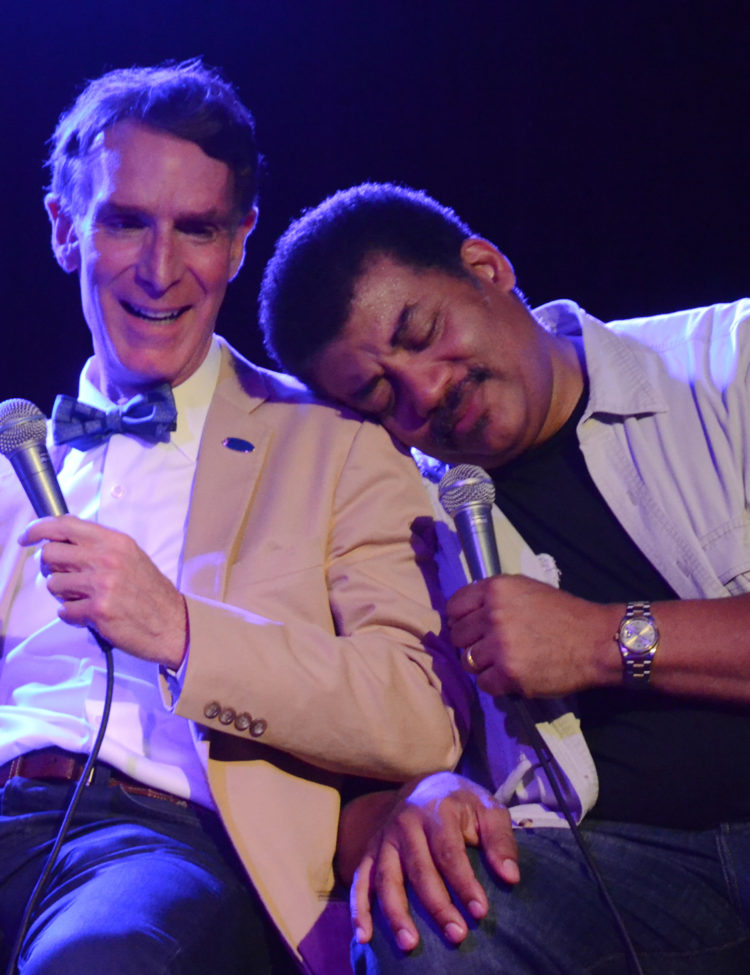
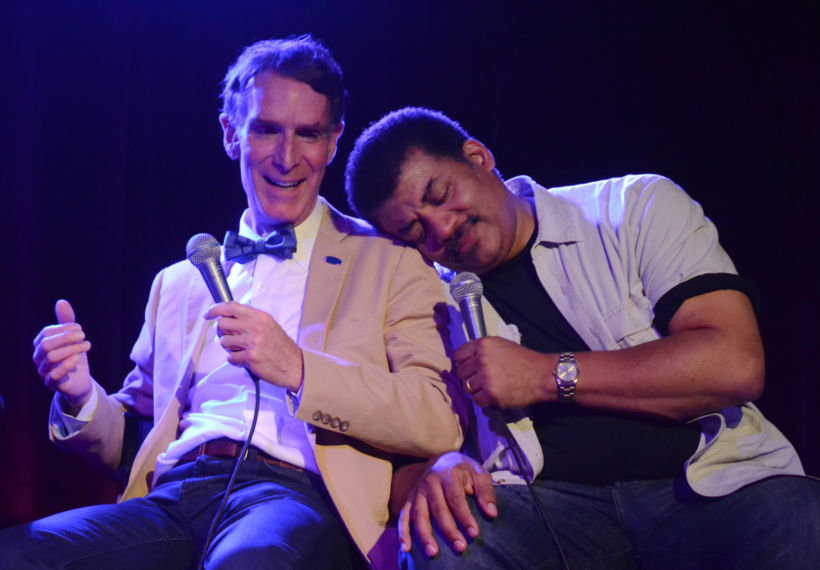
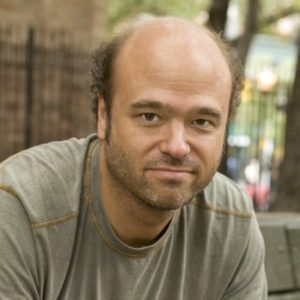
On the heels of the discovery of the Higgs boson, Astrophysicist Neil deGrasse Tyson celebrated by throwing a “Particle Party” at the Bell House in Brooklyn, NY on July 11, 2012. Neil was joined onstage by his old friend Bill Nye the Science Guy and Kyle Cranmer, one of the CERN physicists who actually helped discover the Higgs. Now it’s your chance to join them on a journey into the subatomic heart of the fabric of existence. Of course, it wouldn’t be a StarTalk Live without comic co-host Eugene Mirman, who was also joined by comedian Scott Adsit of 30 Rock and Sara Vowell, author and social commentator. Part 1 starts with a discussion of the 4 forces and 12 particles that make up the structure of nature and ends with the story of how the Higgs boson was discovered and why it’s so important.
Transcript
DOWNLOAD SRT
Welcome to StarTalk, your place in the universe where science and pop culture collide. StarTalk begins right now. Welcome to another super-fun-filled evening of StarTalk. It is now my great pleasure to bring out Neil Tyson. Thank you. Thank you....
Welcome to StarTalk, your place in the universe where science and pop culture collide.
StarTalk begins right now.
Welcome to another super-fun-filled evening of StarTalk.
It is now my great pleasure to bring out Neil Tyson.
Thank you.
Thank you.
Sara Vowell.
From 30 Rocks, Scott Adset!
And Neil?
Welcome to The Particle Party.
Nerds!
The Particle Party, it's gonna be all about the Higgs boson.
I'm feeling it!
I can only take you so far in that subject.
We had to go to the folks who really do this work, and we went to NYU, Professor Kyle Cranmer, come on out.
He is one of the scientists who works at CERN.
Okay, now I got a blank chair here, and join me in the warmest New York welcome for the man I call Sir William to the rest of the world.
He is Bill Nye!
So, let's get this Particle Party started.
You may remember, the date was July 4th.
I tweeted that morning.
I don't know if you saw it.
My tweet was, on the day America chooses to declare its own greatness, July 4th, Europe, who had just announced the discovery of the Higgs particle that morning, Europe reminds us how much America sucks at science.
Wow.
I'm just saying, you know, we could have done that.
I mean, the US could have done it by building the superconductor-supercollider that was canceled in 1993.
Yeah, yeah, yeah.
Three plus times the energy.
Yeah, so what's happened?
Yeah, Kyle.
What the hell's wrong with you physicists?
I was still in high school.
Ooh, I'm Doogie Howser of physics.
No, actually, I was just graduating and on my way, and I was going to school in Texas, even in college, and I would go to Waxahachie and was excited about it.
That's where they were digging the hole for the supercollider.
Before they made the world's largest mushroom farm.
Underground, yes.
So now you're like full-up physicist.
You've been a professor of physics at NYU for five years.
You got your PhD here, but you were in residence at CERN.
CERN stands for what?
The Center for European Research Nuclear in French.
So, you know, all the acronyms are backwards.
All right, so let's get a primer going here.
I want it so we understand the structure of nature, okay?
So last I look, we had four forces.
So remind us of what the forces are.
Right, so there's gravity that we all know and love.
We all know and love.
Do you guys know and love gravity?
Yeah, like, see?
Okay, good.
Okay.
Since this is radio, let the record show.
And that's pretty far from the microphone.
It was a sheaf of papers that was pulled to the floor.
I dropped it to the floor and it fell there.
But wait, there's more.
Not only was the paper pulled toward the floor by the gravity of the earth, the earth was ever so slightly pulled up.
Could you feel it?
We were all.
And may I ask, what stopped the papers from going through the stage?
That's a very good question.
It was largely the electromagnetic interaction that binds atoms together.
That's another force, electromagnetic.
That's right.
It's also what's the lights that are shining on us right now, why your cell phone works, why pretty much all of chemistry.
I said it's two forces.
That's right.
And then the other two are things that most people aren't familiar with.
They're inside the nucleus of an atom.
There's one called the strong nuclear force.
I bet it's strong.
It's strong.
Yeah, that's right.
You can actually tell a riddle that a lot of people would know.
You know that positive charges want to repel each other, and you know that atoms have a lot of protons in them.
So why don't those protons just fly apart?
The strong force.
Where did they get the idea for the name?
Well, I think it's because it's really strong.
And it's a force.
And then there's the weak force, and that one has to do with things like radioactivity and why the sun burns and things like that.
Well, right.
Why the sun gives you a sunburn or why the sun itself burns?
Why they're sort of related.
One thing leads to another, after all.
But do you use the verb burning when it's a fusion in a star?
Yeah, no, we talk about stars burning their nuclear fuel.
Yeah, so do chemists just want to kick your ass for saying that?
Because burning is a chemical reaction, not nuclear.
It is, but you know, wow, we're geeking out.
I don't know what you're arguing about.
You're both mad at the word burning, apparently.
And Neil's mad on behalf of people who aren't here.
All right, so now we got 12 particles.
Yeah, so the reason the chemists are really mad is they have a chip on their shoulder that the periodic table is not the right way to think about the universe and what it's made out of.
It is really 12 fundamental particles.
All right, there's a posse gathering here for you later.
It's great, it's just not the fundamental picture that we have.
The fundamental picture that we have is much more concise.
We only have 12 fundamental particles and everything in this room is really just made out of three of them.
Okay, so give us the inventory.
There are six quarks and there are six other things which go into the...
Do you not know what they are?
I don't know what they are.
There are things like the electron which are called the leptons.
Everything's got on at the end, so it's not the Higgs boson, it's the Higgs boson.
Leptons, which include?
Electrons, and then there are sort of heavier brothers, the muon and the tau, which you may not have ever heard of.
Tau doesn't end in O-N, just in case.
Tau-on.
But leptons would include positrons.
Right, and all of these 12 have antiparticles, so antimatter...
So 12 particles have another 12 antimatter counterparts.
That's right, but we don't really count them as 12 more because they're just so related to the other ones that we just group them together.
Okay, so it's like the good particle and the bad particle.
It's like Owl Man to Batman.
Wow.
Sorry, I'm gonna leave now.
You're speaking to a very narrow nerd audience in a very narrow nerd audience.
Yeah, but there's like one person who's like, oh boy.
And that's me.
What does Owl Man do?
He's from an alternate evil universe.
In the modern DC universe, there's an Earth 2, an alternate reality where Batman's counterpart would be Owl Man, who is part of the Injustice League.
Am I right?
And now, they're the force carrying particles.
What do you got there?
That's right.
So each of the forces have these force carrying particles so that for the electromagnetic interaction, the particle of light is called the photon.
The other ones have, you know, not so great names.
So the weak force has the W and Z bosons.
Where does Z come from?
Just as from?
Because it happens after W, I guess.
I don't know.
Doesn't happen right after W.
It's coming.
And then right there.
I'm a scientist, not a neighbor person.
An alphabetician.
You're telling us how it is.
You didn't make up these mistakes.
That's right.
And then you'll like this one, the strong force, since it's so strong, has the glue on.
I like glue on.
Yeah, for obvious reasons.
Now I get why science is not popular.
Kyle, this seems like a profound absence of literacy among physicists.
It does sound like it was all made by child geniuses.
Well, the quarks is at least a reference to a poem, right?
Oh, to Finnegan's Wake, actually.
But that aside, what are the 12?
Electron, the muon, and the tau.
And then they have things called neutrinos associated to them.
Electron neutrino, tau neutrino, muon neutrino.
And then there are the quarks.
So there's the up and the down, the charm and the strength, and the strange and the tough and the bottom.
And which of these 12 is considered the Judas Particle?
He was framed.
On top of all these 12 particles, there's a god particle.
Well, actually, all we know right now is it's a god-like particle.
There's another particle which is sort of key to this whole story that we have.
The keyon.
Yeah, the keyon.
That's actually the best proposal I've heard for a different name.
Yeah, so there's this particle which is why we're here today called the Higgs boson.
And it's key to like the consistency of this whole picture.
And if it wasn't there, none of the theory would hold together.
You know, we were talking about atoms and like why this piece of paper didn't go through the floor.
There was no Higgs boson.
Atoms wouldn't form in the same way and the universe would just look nothing at all like we know it to be.
Well, we couldn't observe it.
We wouldn't be here.
Because there'd be no mass, right?
There would be no floor for the non-paper to not go through.
But hold it.
This verifies or helps enhance the veracity of a theory, right?
The universe is probably okay the way it is whether or not we called it the Higgs and whether or not we built this thing and we're looking for it, right?
Well, we just wouldn't understand it.
I mean, the universe is here, obviously, but...
You still don't understand it if you're calling it a Higgs-like particle.
Right.
No, that's just conservatism on the side of the scientists.
We already...
You could tell us.
You could...
You couldn't leave your error bars outside and just talk.
You're among friends.
There's no doubt that there's a new particle.
Even the director of CERN has now used the word discovery, which is the first time we've used that since 1995.
This is the most significant discovery in my lifetime.
So this is a high water mark for particle physics.
So when you say high water mark, so on that day, what were the parties like?
Right.
Well, at NYU, we had about 25 people at 3 o'clock in the morning, and we had several bottles of champagne.
Is that the latest you guys have ever stayed up?
And also, the day before the announcement at CERN, Fermilab also made an announcement that they were seeing.
Fermilab outside of Chicago.
Exactly.
And the data that they collected prior to having been shut down, which was roughly a year ago.
Fermilab has been shut down.
Well, the lab is running, but the large accelerator that does this kind of physics is off.
Why?
Do you think...
Stem cells?
I mean, the funding was stopped, I mean, I think it was seen that it had sort of reached its...
Limit of its power.
Limit of its acceleration.
Exactly.
We were getting too close.
Yeah, exactly.
If only they'd used their accelerations for goodness.
So let me ask you this, Kyle, if I may.
Is it not a coincidence that this announcement was made on the 4th of July?
I think it was avoidable coincidence.
It was an avoidable coincidence.
It was both a coincidence and an avoidable coincidence.
The situation was...
I have no idea what that sentence means.
It means they could have avoided it.
They could have done it a different day, but also it's fine.
You don't think they were sticking it to America?
It's a mystery wrapped in a rhythm.
That's sticking it to America.
America can now celebrate finding God and 4th of July.
I mean, the situation was that we got a lot more data a lot faster than we expected to, and no one expected we were going to be claiming discovery now.
We thought it was going to be more like December or January time.
But the accelerator ran so well, we got so much data that right before this major conference being held in Australia, everyone kind of clued in to the fact that we were likely going to claim discovery.
And CERN didn't want it to be announced in Australia.
They wanted to have it on their home turf, and there was basically no time between when everyone was flying over to Australia and the time that that decision was made.
So I think it could have been held on the 3rd, which would have been nice.
I mean, there were certainly things in the media, but there was, it didn't make nearly the splash.
I can't believe Geneva didn't celebrate our 4th of July properly.
Finish telling me why you're calling it a god particle.
The story of the name comes partially from a book that Nobel laureate Leon Letterman wrote which is called The God Particle.
Originally the name was chosen partially by his publicist and editor, and there's a story that he wanted to call it the God Damn Particle because it's so hard to find, but clearly the God Particle sells a lot of books.
There are a lot of people, including myself, that aren't very happy with using that word.
It looks like there's some sort of competition with science and religion or something.
That would never happen.
Science is co-opting God now.
Right.
So I think the thing that is true is that the universe would just look nothing like it does if this particle didn't exist.
So is this something that tells us why there's something instead of nothing?
Some people go that far.
I just did.
You did.
The people that think a lot about string theory and things like that, there is a tie-in here in terms of why we're here and what it means to exist, and the Higgs has a very big role to play in that whole story.
Why was it so hard to find?
Had you looked under the table?
It's somehow related to this mystery of quantum mechanics, which is that when you put something together, you know, nature in its most fundamental way has this funny probabilistic, like, why is it so hard to flip a head six times in a row or something like that?
And it's just...
You mean of a coin.
Of a coin.
Just clarifying.
Rather easy to flip a head six times, harder with a coin.
So anyway, you go to do experiments, and they don't always come out exactly the same way because nature has a probabilistic, a statistical feature.
Right, and we can't control it at all.
Yeah, we have no ability to control this part.
It's precisely explained by...
Quantum mechanics predicts what should happen, and it tells you you're going to have to try really hard.
So you're doing the experiment.
What does that entail?
Like, you push the button...
And the monkey comes out.
Like, what happens?
Outside of Geneva, there's this ring under the ground that's about 17 miles around, and it's filled with superconducting magnets and all sorts of wizardry.
Engineering.
Engineering wizardry.
That's all right, Mr.
Scientist.
So the one ring...
Yeah, so it whizzes one ring with wizards that's ruling all of you right now, and it whizzes these particles around.
They're called protons at essentially the speed of light, and they collide at a couple spots inside of this ring where we have these huge particle detectors, which basically act as like big digital cameras.
And when these particles run into each other, it's so hot.
It's like the moments after the Big Bang.
And there's enough energy to ignite the production of new particles.
So it's not that it's breaking apart.
It's actually making new particles.
And you have a chance, a very small chance, to make a Higgs boson.
And so how many times did they have to do this?
I looked this one up beforehand so that I'd be prepared.
What do you mean you have to look it up?
You're with people who are inventing the thing.
No, no, I just, I tried to come up with some good ways to describe it.
So for the scientists, we had 10 to the 15.
So that's one with 15 zeros behind it, collisions.
That'd be quadrillion.
Yeah, so that's a million billion collisions that we've had in the last two years.
And of that, we made basically thousands-ish of Higgs bosons.
Wait, you've made thousands of them.
And you're just now saying...
That's why he was like, we could have mentioned it July 3rd.
So you're basically like in a cop show.
The coroner shows up and the cop is like, what's the cause of death?
And there's like a guy with his head bashed in and there's a shovel.
And the coroner refuses to make a finding until he gets back to the lab, even though clearly the guy's head was bashed in with a shovel.
There's just something about scientists.
Right, so to put it into perspective, if you took a large Olympic-sized swimming pool and you filled it with sand, there would be trying to find a thousand red-colored sand grains in a swimming pool full of sand.
So that's our job.
That sounds harder than the...
Harder than the puzzle.
Than the shovel.
It sounds doable, and I would have maybe told people July 2nd about it, but...
So to get a particle that's going at nearly the speed of light to turn a corner isn't easy.
And so you need a really...
Tell me about it.
I've talked to them and I've talked to them.
But there's a method, right?
A technique.
Yeah, basically you need powerful magnets.
And the way you make powerful magnets is you need a lot of electrical current.
You need a magnet because a charged particle that's moving responds to the magnetic field.
You will curve that particle.
That's right.
That's how like the old fashioned TV sets worked in the big, you know, CRT type...
You know what I used to do when I was a kid?
You take a magnet up to the tube.
Right.
And you could totally mess with the faces on the screen.
Parents loved that.
Sometimes it left a permanent impression on the screen.
They thought that was cool.
These are beams of electrons and they would avoid the magnetic field.
It was like early Photoshop, you know, where you could like mess with...
But I got to say, the origin for me is cooler than that.
So Michael Faraday, 1831, has got the magnet in the coil of wire that's connected to another coil of wire and the compass moves.
And the woman comes up to him and says, of what use is it?
And he says...
Of what use is a newborn baby?
Yes.
Newborn babes, not that useful.
But, you know, to make these incredibly powerful magnets, you need a lot of electricity, a lot of current, and the way you get that is by using superconducting cables.
And what is superconductivity?
It's a new superhero.
I'm superconductor.
I'm superconductor.
It's basically a wire that when you get it really, really cold, it has no resistance.
Not just a little resistance, no resistance whatsoever.
And that is a quantum mechanical effect.
It's a quantum mechanical effect also.
To do it, though, you have to be sitting about 2 degrees above absolute zero.
So this is colder than the deep outer space.
What, like 1.9 Kelvin?
Bingo!
Yeah!
Nailed it!
It was a wrist flip, you know, the hockey player skating backwards just pooped, just put it right in.
Kyle, the universe is warmer than that, at 2.73 degrees.
That's right, exactly.
Deep space, like in the middle of outer space, it's warmer than it is in the middle of the LHC.
The LHC, as far as we know, is the largest and coldest extended structure in the universe.
Okay, so you get this thing really cold, fabulous coils of wire, you buy a tank of hydrogen...
Liquid helium.
We have some very large fraction of the world's helium supplies at CERN.
The Macy's Day Parade has the rest.
Yeah, that's right.
A result of nuclear fission.
So don't we have a tank of hydrogen and we electrostatically get these...
Oh, that's right.
We use hydrogen to seed the beam itself, the beam of particles.
To seed the beam.
What does it mean to seed the beam?
I mean, I know how it feels, but what does it mean?
I walked right into that one.
It's amazing for the complexity of this whole thing.
The beginning is really just some...
Scuba tank.
It's a scuba tank and the guy goes...
Like Sarah was saying where you just press a button.
It sounds like a valve more.
And then it sprays what?
Hydrogen?
A little hydrogen.
That's your source of protons.
Themselves comprise of three quarks.
Three quarks.
Two ups and a down.
That's right.
So that's where you get your protons because the hydrogen nucleus is a proton.
That's right.
So now you got them.
You got your superconducting coils.
You got high current going through.
You got high magnetic field.
You're curling these babies.
You're accelerating these babies.
Don't you have another beam going the other way?
Exactly.
Yeah.
So the magnets actually have two holes drilled in them.
And there's two different magnetic fields.
And we have to get all of this working together.
So if I want to get these things going very near the speed of light, I time the current on these magnets in sequence, right?
In fantastically fast sequence.
That's right.
Now, let me ask you this.
So...
Bill gets ghetto on Kyle.
Let me ask you this.
I bring you to Brooklyn, and now you're like Brooklyn in the house.
Brooklyn, okay, I'm impressed with Brooklyn.
But I grew up in the city of Washington, okay?
When I was in junior high, a guy got shot, okay?
Now everybody's doing it, but it was new.
All right.
How do we then get the particles going as fast or nearly as fast as light?
I believe I know the answer, but how can we time the magnets to keep up with those, like the greyhound chasing the rabbit?
So, you know, like if you use your cell phone, there's electromagnetic waves, right?
There's all sorts of waves going back and forth between your phone and the cell tower.
Microwaves.
So we use essentially the same kind of idea.
They're just very, very, very intense.
So there's some sort of wave that's traveling along this beam, and that's what gets them going faster, and then we have big magnets to help them turn.
To get the beam to be very intense, we have to add more and more protons.
It's amazing because it's sort of like trying to merge lanes on a freeway, except for you're driving at the speed of light.
The engineers at CERN are so good at what they do that they can merge lanes from protons from the booster accelerator into the big accelerator and put them in the same little bucket that you have.
The beams go around each other like braids.
Of Holla?
Spiral.
Yeah, but really, like Holla.
That's accurate.
So the way that the LHC works, they're just really two different beams that are right next to each other.
They don't really circle around each other, but they do try to recycle the magnetic field from one to the other so that you don't need twice as much electricity.
By the way, how much electricity does CERN use when it's cranked?
Does Geneva dim when they flick the switch?
Well, we have a deal that we basically only run...
He didn't just say no.
He's gotta, like, explain.
Welcome back to StarTalk Radio.
I'm your host, Neil deGrasse Tyson.
You're listening to our show recorded live at the Bell House in Brooklyn, New York on July 17th, 2012.
Along with Eugene Mermin, Scott Adzit, and Sarah Vowell, on stage with me that night were Bill Nye, the science guy, and Kyle Cranmer, particle physicist.
In this next segment, Kyle explains how much energy it takes to run the experiments at CERN that led to the discovery of the Higgs boson.
It's equivalent to a small city, the amount of power that's required.
A lot of it is going into accelerating the particles and even more goes into keeping this ring so cold.
It's like a huge air conditioner.
Well, that's...
Wait, you were saying, so it gets much hotter than the sun, right?
Like, millions...
Where they hit.
Thousands or millions of times hotter than the sun.
Uh, you know, it's...
Either way, say it twice.
So 1.9 Kelvin is cold enough to keep it from blowing up the Earth, is what you're saying, or melting the Earth, or what's going on?
Let's pick that up.
Yeah, why aren't we all dead from your dumb experiment, asshole?
Right, Kyle, let's back up, Kyle.
Answer me truthfully.
Are you making mini black holes at CERN?
As far as we know, no, but we actually...
How comforting!
As far as we know, we don't think we're making Earth destroy black holes.
If it does happen, we'll all be the first to know.
Actually, Europe will.
Fools!
Six hours earlier.
We aren't making anything that's like a black hole like you think of it, like something in the center of our galaxy swallowing up stars.
That is not happening.
That is definitely not happening.
You're making a different kind of black hole.
A more sinister kind of black hole.
We might make this sort of quantum mechanical version of a black hole, which is very tiny and is not going to hurt you.
Can it erase your memories if it's in your brain?
That is one of the future applications that we talk about.
Not scared!
That's what you talk about in the coffee lounge?
We know you're talking stuff in the coffee lounge.
There's a lot of coffee at CERN.
You wielding more power than any scientist have wielded before.
Can you guys just sit around and talk about how can we weaponize this?
Yeah, I think for the most part you've got a pretty pacifist crowd at CERN.
But everybody noticed what an undertaking this is.
They're powering a small city to send a scuba tank of hydrogen in a giant ring to unlock the next secret of the universe.
That is pretty cool.
I have to say that is a remarkable use of our intellect and treasure.
So do you guys, when you hit the button on the accelerator, do you like then wait for the moment when they collide or is it just instantaneous?
Or is it like a, here they go, yeah, yeah, yeah, yeah.
Well, the very first collisions, there are great photos of people when they saw the very first collisions and it was just, you know, thousands of people throughout the laboratory just, you know, elated.
How long did it take you to throw the switch and then...
The beams were going and then at some point they have to bring the beams, quote, into collision, you know, so they have to try to steer the beams so they collide with each other.
They boost a magnet or something?
They can steer where the beams go with these magnets and it's very hard because the beam of particles is thinner than a human hair, so it's incredibly tiny and then to get them to collide...
Because it's a proton.
So it's a lot thinner, right?
Well, no, it's a lot...
I'm just asking, I don't know.
No, no, you're right.
So there's a whole lot of protons.
So one proton is incredibly small, but the beam of protons is...
Oh, it's a bunch of protons, like 80, maybe even 90.
Well, a few thousand after a year, right?
Yeah, yeah.
Does it never stop?
Did you guys just flip the switch one day and then just keep collecting?
It basically runs almost all year long.
We have a deal that we don't run during the winter because that's when Europeans heat their houses where Americans usually cool their houses in the summer.
So the electricity load in Switzerland is mainly during the winter.
So they're going around that all the time?
I mean, the numbers are just mind-boggling.
So they're running essentially constantly.
The particles collide 40 million times a second.
And that's every second?
Or is it when you choose to flip a switch and say, oh, now we're murdered?
Essentially constantly for two years with some shutdowns.
40 million times a second for two years?
That's right.
You got a problem with that?
Yeah, so it's phenomenal.
And each one of these collisions, you know, there are thousands of particles produced flying into our detectors.
We take sort of a three-dimensional digital photo of what happens.
Each one of those is sort of similar to like a really nice digital camera in terms of the file size, except for 40 million of them a second.
So it's like if every American got a nice digital camera and took a photo every second and tried to upload it to Flickr, that's what the amount of data that we have to deal with are.
Is it hard to say, like, after the 20 millionth one?
Are you kind of like, eh?
Well, you know, most of them aren't so exciting, but then you see one that looks like the Higgs.
And how do you know when you've got something interesting?
I mean, you can't go through 20 million photos.
Before you answer that, I just want to clarify here.
You're smashing protons, then the proton disappears because the particles become energy, and then the energy becomes particles again.
That's right.
You sort of...
This E equals MC squared writ large...
Exactly...
.
at the focus of these two colliding beams.
That's right.
Neil is taking his pants off right now.
You can't see it.
No, it's fine, but...
Rit large.
It's basically E equals MC squared is happening twice.
Usually, you think about nuclear bombs or nuclear power, where you take a little bit of mass, and you turn it into a whole lot of energy.
What we do is we take a lot of energy, and we make a very little bit of mass.
So there's this brief period where the protons collide.
There's so much energy that it just sort of vaporizes into this funny quantum mechanical, funny effanescent state that can crystallize into some new kind of particle, some new very massive particle that hasn't existed since right after the Big Bang.
And then that thing doesn't last for long, and it decays.
How long?
Hour, two hours.
Yeah, no, it's funny.
Yeah, I mean, the numbers, there are things like 10 to the minus 23 seconds and things like that.
So very, very, very small numbers.
And you get excited about this.
Look at him.
You love watching Higgs particles die, you monster.
So how exactly do we detect these things?
Right, so it's there for just a split second or not even, and then it decays, and it can decay in a lot of different ways.
So one way that it can decay is into two particles of light, two photons, and then these particles fly and hit our detector, and we see...
Which is like a solar cell of some sort.
It's similar to that.
I mean, in the sense that when a photon hits it, it leaves some energy, and we measure that energy.
You know, we sort of surround this interaction point with all sorts of sensitive detectors.
And these things are huge, like 10 stories high, right?
Yeah, it's like the size of a six-story building, full of electronics.
So they're enormous, and they're 300 feet under the ground.
So the civil engineering involved in actually making this thing was also just fantastic.
Right on.
Now, it gets radioactive, right?
Like, you can't be around it.
I mean...
Did you have your kid before you started working at CERN?
When was your kid born?
You don't want to make him angry.
CERN is very careful about the radioactivity.
We make some particles like neutrons that make things radioactive, and so we have to be careful.
So when you say, be careful, does the detector zone, the six-story high concrete tub become radioactive?
It does.
You know, there's like a half-life associated to it, but to get down there...
Yes, it does.
And there are retinal scanners.
You know, normal people can't go down there, and even...
Only radioactive people can go down there.
Only radioactive people.
Meaning people whose eyes have been pre-approved.
That's right, that's right.
So, people wear dosimeters badges to detect radiation.
Yeah, it's very heavily radioactive.
You have dosimeters?
Sure.
What's a dosimeter?
Not that I don't know.
No, it's not a hard word.
It's a dose meter.
Measures the dose of radiation.
Oh, okay.
Dose meter.
I have an issue with dosimeters.
Because you...
Who doesn't?
No, no, no.
It tells you how sterile you have become.
Why is that useful?
It's after the fact.
You turn it in at the end of the day and they measure it.
Are you joking?
No, I'm serious.
Well, dude, the world's full of radiation.
I mean, I'm not Mr.
Nuclear, but...
It should tell me, like, while it's happening.
Well, it tells you while it's happening in the geologic scheme of things.
Every day you get some.
No, but I mean, compared to the half-life of radon gas, it's pretty good.
Where do you get...
From Bricks?
We're talking about this like it's annoying and it happens at Starbucks.
Like when you're like, I just want a latte, and they're telling me I'm sterile.
All right, let's back up a few months.
Why should we believe this news report when not many months ago, CERN released a news report about faster-than-light neutrinos that was then later retracted?
Yeah, now that's a good question.
I'll say that around the physics department at NYU, there were lots of discussions about this, and a lot of theorists that are like, I cannot believe that they published this paper.
I cannot believe CERN made any news about this.
It's clearly wrong.
Einstein told us this, everything we know about the world is this way.
But it's not the first time that experimental science has turned everything we think we understand about the world on its head.
And that's how science works.
You do experiments.
It might have been true.
It could have been true.
If you saw how it was presented at CERN...
It was cool.
It was like, we are coming to the scientific community to say that we see this thing that we don't understand.
We spent six months checking and cross checking and doing everything that we could, and we can't figure it out.
So we're bringing it to you.
You sent neutrinos to Italy.
Underground, through the ground.
Through the ground.
And it got there faster than the speed of light.
By just a very, very small...
And what I heard is that they knew it was wrong because nothing arrives early in Italy.
That's what I heard.
I don't know.
So, Kyle, does that mean that it arrived before it was sent?
No, not before it was sent, yeah.
That's pretty cool.
Actually, you know, I should say that that's relative.
Yeah.
No, but my understanding, they were using clocks from global positioning satellites, and they didn't take into account there is a difference from one to the other.
Oh, no, that stuff was taken into account very, very carefully.
The very sad part is that after all of this thorough checking, the problem was the dopiest of possible problems.
It was a loose cable.
Yeah.
So...
All failures are mechanical failures.
Yeah.
So the engineers messed up.
Yeah.
I got to tell you, in my old business, connectors are troublesome.
There was a father-son story there.
Carlo Rubia, who won the Nobel Prize and was a famous particle physicist.
What was his specific discovery?
He was involved in the discovery of the W and the Z, and he really kind of pushed the idea of having these colliders in the first place.
Where was that and when?
That was at CERN in the 80s.
But his son was on the experiment that reported the faster-than-light neutrinos, and he was on the experiment that then followed up and said, no, they're not going faster than the speed of light.
So you can only imagine what their Thanksgiving conversations are like.
When we come back, we're just going to talk about where we go from here.
What is the future of the Higgs particle?
Will it have any application at all?
Or is Europe wasting its $10 billion to keep you employed?
When we come back to StarTalk Radio!
See the full transcript




 Unlock with Patreon



 Become a Patron