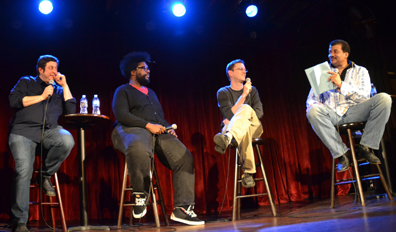
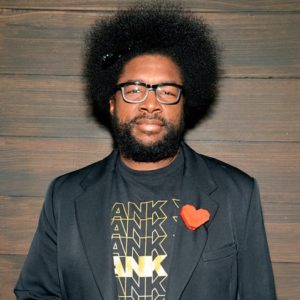
On Feb. 7, 2013, the night before the Blizzard of 2013 (aka Winter Storm Nemo), Neil deGrasse Tyson and comic co-host Eugene Mirman stopped by The Bell House to talk about the weather. Dr. Adam Sobel, professor of Earth and Environmental Sciences at Columbia, was on hand to explain what causes hurricanes, from the Coriolis force and the jet stream to asymmetrical temperatures and tides. Together with comedian Michael Showalter and musician Questlove from The Roots (Jimmy Fallon’s in-house band), the StarTalk Live crew toured the most infamous storms of our century, including the great Galveston Hurricane, the Perfect Storm, Andrew, Katrina and Superstorm Sandy. They also discussed the science of weather forecasting, the categories on the Saffir-Simpson Hurricane Scale, and whether we could – or should – redirect a hurricane.
Transcript
DOWNLOAD SRT
Welcome to StarTalk, your place in the universe where science and pop culture collide. StarTalk begins right now. Now. Welcome, everybody, to another amazing installment of StarTalk Live. It is my great and humble pleasure to bring out America's voice...
Welcome to StarTalk, your place in the universe where science and pop culture collide.
StarTalk begins right now.
Now.
Welcome, everybody, to another amazing installment of StarTalk Live.
It is my great and humble pleasure to bring out America's voice of science, Neil deGrasse Tyson.
So Eugene, tonight, we're gonna devote the whole evening to talking about storm systems and climate.
So let's bring out our guests.
Yeah, your guest first.
Yeah, ladies and gentlemen, the amazing Michael Showalter.
I got two more seats.
I have some expertise in weather and storms, but nowhere near what is necessary to pull this evening off.
So I found Dr.
Adam Sobel, who is a climate scientist from Columbia University.
Adam, come on out.
And we'd like to have someone who we all know, and he just came 20 minutes ago from 30 Rock.
Join me in welcoming Questlove!
Questlove, who I think has the largest afro left in the universe.
There's others that aren't left.
There's a rabbi I know.
So, we've titled this show Storms of Our Century, and you know, we've had a few storms lately, so Adam, seems to me, it's looking kind of bad, these intense storms.
I don't know that we've had more storms.
The ones we've had seem to be sort of record breaking intensity and scale and size and damage.
And so first, let me just ask you, where the hell do these storms come from?
Are you making them in your lab?
Are you a mad scientist in your Columbia lab?
Al-Kaida!
Prove me wrong, science man!
No, we don't make them.
Let the record show.
Scientific name for hurricane is the tropical cyclone, so they come from the tropics.
Okay, so even if it goes across Manhattan, it's called a tropical cyclone.
Well, are you blaming immigrants for storms?
You could view the storm itself as an immigrant to our shores.
Yeah, a Venezuelan weapon.
That's how I see it.
A tropical cyclone forms in the tropics, but it has some other characteristics.
And if it keeps those characteristics as it comes further forward, then we still call it a tropical cyclone.
I'm translating.
In this hemisphere.
Oh, sorry, so he gave the general answer, because in the southern hemisphere, it could go to the south pole.
Very good.
Pole word, very nice.
He's not limited to a hemisphere of activity.
He studies it all.
You learn that when you talk to the Australians about cyclones.
So how do you make these storms?
What goes on?
A tropical cyclone has a few characteristics, one of which is that it comes from the tropics.
Another of which is that it tends to be, when they get strong, they're very circularly symmetric.
So when you look down from space, as you see those satellite images, you see the swirling pinwheel-y thing.
It's more and more beautiful with a nice eye.
The other thing about it is that it's warm in the middle compared to the air outside.
Whereas an extra tropical cyclone, which is the kind that we're going to have tomorrow, is cold in the middle.
So right after people go home tonight, there's going to be a storm.
This is bad coincidence.
We're going to get blamed for this, you know?
We'll blame you.
So tomorrow will be cold in the middle.
So if you can have a storm where it's cold in the middle and a storm where it's hot in the middle, then you're not telling me that you understand what makes storms.
If it can be...
Yeah, if there's two of a thing, how could that be?
No, if there's two...
If the two things are opposite, I need some explain.
Yes.
Right.
So they get their energy from different places.
So the tropical cyclone gets its energy from the warm ocean.
The Caribbean.
Could be the Caribbean.
Could be other warm oceans of the world, the Pacific, India.
Wherever it's warm underneath.
Wherever it's warm enough.
And it's really warm compared to the atmosphere.
So it's giving off heat because the atmosphere is in some way colder than the ocean.
It's venting, the hurricane is a very organized and powerful way that the atmosphere sucks heat out of the ocean.
I hadn't thought about it that way.
The atmosphere sucks.
And the winter storm, the extra tropical storm is different.
So it doesn't care that much about the ocean underneath it, but it gets its energy from the fact that the low latitudes are warm and the high latitudes are cold.
And that's because of how the sun shines at different angles on the different parts of the planet.
And so, when you have part of the planet being warm and part of the planet being cold, the climate doesn't like that.
I mean, if you were to heat up half of the room and cool the other half, you'd have a contrast that would want to even itself out and you'd make a wind to...
There'd be turbulence mid-way.
There'd be turbulence.
But because the earth is spinning, they can't flatten out.
The warm air can't get to the pole easily and the cold air can't get to the equator easily because as they try to go, the Coriolis force...
Coriolis.
Yeah, yeah.
Coriolis force.
It's one of my favorite four forces.
It's not a real force, actually.
But it's one of the Corys.
I got that.
Cori Haim.
I got it.
Cori Feldman and Coriolis.
He was in The Lost Boys.
Yeah, Coriolis.
I heard he's selling his teeth on eBay.
All right, so I got a blob of warm air north of the equator.
I got a blob of cold air up north.
Yeah.
And they're trying to equalize.
Yeah, but they can't do it.
So instead what happens, the Coriolis force turns up and you get the jet stream.
The jet stream is what you have instead.
So the jet stream is like the boundary between the warm and the cold.
And it can stay there because the rotation of the earth keeps it there in balance between the warm and the cold.
It blows around the planet, but it's unstable.
So, the warm and the cold still kind of want to mix because that would be a...
Fun.
If the climate...
Exactly.
If the atmosphere could get to...
That's how babies happen.
Get a room, warm and cold.
You cannot keep the warm and cold apart, is your point.
Well, you can keep them apart for a while, but the jet stream starts to wiggle and develops undulations in it.
And those are extra tropical cyclones.
Those are winter storms.
Interesting.
Too easy?
Yeah.
Too easy.
He's literally describing sex.
And it makes me uncomfortable.
Now I get why there's climate change deniers.
There's no way the wind is doing it.
So then the storm dances up on you and...
I haven't thought about it that way.
I think because you describe it that way, I can't believe you haven't thought about it that way.
That way.
All right, so, you got the hot air trying to go north, cold air trying to come south, a jet stream that keeps them at bay temporarily.
The jet stream gives in, begins to undulate, and that undulation is itself the birth of a storm.
Yes.
The jet stream is the chaperone of weather.
Yes, there you go.
At the junior high dance of climate science.
All right, so now, we've got the hot air trying to go north and it overtakes the part where it's headed towards, right?
Right.
With permission.
Yes.
The overtaking gives you fronts.
As the jet stream develops, wiggles in it, the cold and warm, they wrap up and you get fronts.
That's where you have cold air and warm air right next to each other.
But now you get this sort of circulation.
Yeah.
But the thing to remember is that because an extra tropical cyclone develops from a temperature contrast, that's an asymmetry.
And so the extra tropical storm, the winter storm, inherits that asymmetry.
So they're not beautiful spirals?
No, the clouds tend to have a comma shape.
I've seen that.
Yeah.
It's like the Nor'easters have that, don't they?
A huge comma.
Right.
We call it a comma cloud, that's the technical term.
Comma cloud, okay.
They do that in San Diego every year, right?
The comma cloud.
Everyone dresses up like a robot.
I got here, the Saffir-Simpson scale, which is an invoked, anytime you hear about them talking about hurricanes, they're using this scale.
And it's the hurricane intensity scale from one to five.
I once looked up the description of the damage at each one of these intensity scales.
And it was like the descent into hell in a Dante story line.
So category one, they said, oh, heavy winds, so the wind is, you got this memorized, the winds?
Category one?
65 knots, which is about 75 miles an hour.
We are not knot people here.
We are, okay.
Sorry, you wanted meter per second?
Oh yeah, meter, that's better.
Meters per second.
I bet they're slopping these boundaries, but it's like 75 up to like 100 miles an hour basically.
So they said at these speeds, you lose some roofs, some branches fall, local flooding, that's that.
Category two?
96 to 110 miles an hour.
20% of roofs will blow off, some windows will blow out, trees begin to topple.
People start defriending each other on Facebook.
Category three?
111 miles an hour to 129 miles an hour.
Like all roofs that are not hurricane proof blow down.
50% of trees have broken branches, 20% fall over entirely, severe flooding, and most people start following Justin Bieber.
Category four, where we're up to 130 to 156 miles an hour, it talks about leaves on trees being ripped clean from the tree itself.
And then it says category five, no trees are left standing, nearly all roofs are blown off, most structures are leveled, everything is flooded.
This is Earth trying to kill us.
The people who say Earth is a haven for life, Earth is beautiful, Earth wants us to stop hooking up so casually.
So you guys came up with the scale and it's pretty devastating.
Obviously the category fives are rare, but in another segment of the show, we'll go over the list of the badass hurricanes that have come through town.
I'm just curious, this is an energy scale basically, right?
Yeah.
The destructive energy.
It's the maximum sustained wind.
How you get a category five hurricane?
What are the ingredients?
You have to have very warm ocean, usually not just at the surface of the ocean, but a deeper layer, because as the hurricane spins, it'll mix up water from below and the water will be colder.
And so if the water below is colder, it'll cool off.
So you want a deep layer of warm water.
So you're saying a hurricane can shut itself off.
If it sits in one place for long enough.
So if it moves fast, it doesn't happen because-
It keeps taking heat for every next place it just-
Right, exactly.
I didn't know that.
Yeah, but if it sits in one place for long enough and the water below the surface is cold, then the turbulence brings up cold water and it can shut itself off.
Is that common?
Do hurricanes commonly just stay in one place and then disappear?
No, they move.
But if they move slow, that can happen to some extent.
Okay, so it's warm deep.
Warm deep.
So as it sucks the heat, there's more heat available to it.
So it doesn't shut itself off.
So warm water, you want to start with a humid atmosphere, very high humidity in the atmosphere.
And another thing they don't like is what's called wind shear, which is when the-
Wait, who's they?
The hurricanes.
They don't like it means that makes them less bad.
Right.
The hurricane is bad, so anything that, you know.
We have a question.
I have a stupid question.
Could you stop a hurricane?
Could you go, there's a really big hurricane happening.
Yeah.
Let's go get the hurricane stopper.
Yeah.
It's physically possible.
It's been thought about quite a lot and it's just difficult and expensive.
And you're saying so no one has approached Samuel Jackson.
Is it as expensive as the damage that a hurricane caused?
So there's been a few ideas that have been.
That's a smart question.
Yeah, if it cost $50 billion and you could use it, I don't know, twice, would that be worth it?
So there's a lot of ideas and the ones that those of us in environmental science don't like are the ones involving nuclear bombs.
But the ones that make a little more sense.
Wait, wait, wait.
How does a nuclear bomb...
Yeah, I was like, how are you gonna let this...
You're like, obviously you could just drop a nuclear bomb on a hurricane, but you know, that sounds bad because it's so windy there.
You just told me that hurricanes like heat, okay?
It is a bomb because it makes heat.
They are thermonuclear explosions.
How do you stop a hurricane with a nuclear bomb?
You have 10 minutes, MacGyver.
I'd rather not defend the nuclear bomb idea if I could.
But we are curious.
There have been ideas put out there with nuclear bombs.
I don't think they're...
It just does so much stuff.
You know, if you could change the circulation of the atmosphere enough, you could disrupt it.
It blows up the hurricane and what's ever underneath it is sort of what you're saying.
It's a bad idea.
There's better ideas.
That's a good idea.
Okay, because the hurricane lives from getting its energy out of the warm ocean, if you could cool the ocean, you could weaken the hurricane.
So one idea that is feasible, but just very expensive.
Ice cubes.
Ice cubes?
Well, it would take a lot of ice cubes, but one idea that's been...
You drag a glacier down and stick it right there in the...
That's like a big ice cube.
Or they just float down.
They just float down there anyway.
It's like one of Brewster's Millions.
Yes, I remember that.
Yes, from Brewster's Millions.
Another idea is just pumps to bring up colder water from below.
So if you had a lot of pumps in the ocean, and bring up the colder water, you could cool the ocean and weaken the hurricane.
You'd need a lot of pumps.
You'd have to get them there ahead of time.
You'd have to do it fast enough.
And so, you know that...
I see the pumps.
40 pumps, 90 pumps?
The hurricane is very large.
The pumps need to be mobile.
They certainly need to be mobile.
Because you can't just line the whole ocean with pumps.
Correct.
Correct.
You can't just preemptively put pumps everywhere.
No, you'd have to deploy them in the right place at the right time.
So it's very expensive.
You know, the other interesting thing about it is...
And plus, don't you mess with fishes?
Oh, yeah.
If a fish likes cold water at the bottom, because that's why they're hanging out there, and you circulate them back up to the top...
You don't have to go all the way to the bottom.
You don't have to go down a few hundred meters.
Yeah, there's no fish in the middle.
I said, I'm worried about the fish.
Oh, no, you don't have to go that.
No, there's fish everywhere in the ocean.
I don't know what it would do to the fish.
Fish are his thing.
Fish might not like it.
But that would work.
That would be one solution.
You could at least weaken hurricane that way.
You could do a lot of things.
I think one thing that somebody brought up once in a discussion I was in about this is that there's other ideas that would change the track of the hurricane.
Yeah, send it to Iran.
So if...
Probably not that far.
But a lot of these things...
Towards Iran.
When we try to intervene in the atmosphere in these ways, we usually don't do it quite right and things don't go exactly as you planned because the atmosphere is very unpredictable.
So if you were to try to do something to a hurricane, no matter what you did and no matter whether you did it or not, if the hurricane hit anyone, they would sue you because they could say you made it happen.
Yeah, yeah.
So in a legalistic society, it's probably not a good idea to try to do that.
So my actual example of Iran was actually pretty good.
To be the one place that people would be like, I don't care that you're suing me.
That's right.
No, but this is an interesting sociocultural point.
That's right.
Because if you don't redirect the hurricane, as insurance forms duly indicate, it's an act of God.
If you do redirect the hurricane, it's an act of Andy.
Joe Biden.
But even if you tried to redirect it, even if you didn't do anything to it, but you tried to do something, it would look like you did it, right?
Because nobody knows where the hurricane would have gone if you hadn't done it.
So they'd rather blame God than a human being.
They can't sue God.
That's right.
They could probably file.
But you could then redirect a hurricane, you just would never bring it up.
I don't know if we could do it, but we, you know, you.
But if you tried to, don't tell anyone you did that.
Right.
Just to avoid the legal headache of sending a hurricane to another place.
We create a drink of the night to serve the theme of the evening, and I collaborated with the bartender.
So we created something called the Stormy Weather.
It is rye, a common drink from the north, mixed with ginger beer, a common drink from the tropics.
Stormy weather up the whole coast.
So tell me what happened with Sandy.
All right, I lived in Lower Manhattan.
We were out of electricity for five days, ran out of water after two days, so you can't flush the toilet.
So like we had to leave.
And what intrigues me about Sandy is that the hurricane didn't take out Lower Manhattan.
It was the tides.
That's all it was.
That was enough to take us out.
Yeah, nine.
You live at the edge of an island.
And wasn't it also the levees in New Orleans?
And the levees in New Orleans.
So here we are ready to blame hurricanes, and I'm thinking, no, there's an engineering problem here that has not been met.
No, well, I'll say that I live right where, okay, I'm a brand new New Yorker.
Okay, not West Side Highway, but the-
The East Side Highway.
Yeah, thanks.
In September, three weeks before Sandy, I noticed that the water level was unusually higher than normal.
And you didn't tell anyone?
Okay, I'll be honest.
The person next to me was like, they were making a big deal of it.
Like, something's gonna happen because the water level was different.
You know, I just dismissed it like, ah, whatever, crazy.
And then three weeks later, that person was first on the phone like, I told you, I told you, I told you it was gonna happen.
You know, I was like, well, what are you out there every night, like measuring the water levels?
Yeah, what are you, a water scientist?
That's a thing.
Yeah, so I was just intrigued because there were some trees down and some awesome trees fell.
You know, all the basements were flooded and the underground parking garages, cars were bobbing up out from the openings and it was like an apocalypse, downtown apocalypse.
And it was not even any of the properties of the hurricane that are normally sited because it didn't rain very hard.
It was mostly windy and then the full moon.
Windy and then the tide surge.
Storm surge, yeah.
The storm surge and so what I find interesting is most people think that the full moon has like extra gravity to make the tide.
The moon when it's full does not make any higher tides than it's at any other phase.
The only difference is it lines up with the sun at the same time so that their tides add together, giving you the highest tides of the month.
Because the tide is only a function of how far the moon is from earth.
So a full moon.
That has nothing to do with the phase at all.
Wait, so the full moon is just an indication that the tides will be higher because it's lined up with the sun, but not the result of it.
It's not the result of it being full, other than it's when it's lined up with the sun, you're seeing a full side of the moon lit up.
But the fact that the moon is full alone is not, if there were no sun, you'd have the same high tide every day of the month.
So it'd be fine if we just had no sun.
That is a very good point, Neil.
Thank you for clarifying that the real culprit is that we have a sun.
All right, so was it just bad luck that Sandy hit Manhattan at high tide of the day and high tide of the month?
Because there's several high tides in a day and then it's the highest tide during full moon and new moon.
Yeah, it was bad luck.
The difference between high and low tide at that time was about five feet.
And yeah, the peak of the storm surge, which doesn't last that long, a couple hours maybe, came very close to the high tide so that we got the maximum of both of them at the same time.
So the tide was about at the battery.
The battery at the tip of Manhattan.
Lower Manhattan, right.
There's a tide gauge there.
And it measured, so five feet of tide, nine feet of storm surge, so that's 14 feet above the low tide.
I have a question.
Is it easier instead of getting rid of a hurricane to delay it then?
To just be like, come like tomorrow.
No, no, no, not to, come in a few hours.
Yeah, if it came three hours later or earlier, we would have been fine.
If it had come three hours later, it would have been a lot better for Manhattan and maybe Staten Island, Brooklyn too, would have been a lot worse in Long Island Sound because their tides are three hours.
Ah, who cares?
I know, right, right.
Way more people live in Manhattan than on the Long Island Sound.
Oh, your mom lives, okay.
So Sandy was unusual for New York simply because we had bad luck, is what you're saying.
Well, it was unusual in a lot of ways.
The synchronization of the storm surge and the tide was one of them.
It was also just a big storm surge because it was marginal category one, 40 or something miles per hour.
So winds that strong were out to about 500 miles from the center.
So something like a thousand end to end.
So very, very large area of high winds.
And they were blowing right towards the shore over a very long area.
So that builds up the tidal surge.
It builds it up.
The length over which the wind blows the same way is called the fetch, and the fetch was very large.
It blowing the water continuously.
So persistent winds is what gives you the...
Persistent and blowing right into shore.
So the point is the surge can get us.
Heavy rains can get us.
Heavy winds can get us.
There's three ways hurricanes mess with us.
Yeah, and surge is the one we'll always have to worry about the most in New York, because we're in a lot of low lying areas.
We're not gonna get a category four or five storm here.
The water's too cold.
Miami or something's a difference to us.
I was just imagining, that was category one that was sandy, and if sandy were category three, we'd still be without power.
Yeah, well, it depends.
I mean, a smaller storm would have been very destructive, but over a much smaller area, and the surge depends on the angle it comes in at, the speed it comes in at, the size of the storm.
So it was a bad scenario for New York City as we know.
Yes, no, that we know.
I think we figured that out, okay.
So, we have some bad hurricanes.
In 1900, the great Galveston hurricane.
Now, I read this, and someone's applauding.
Give it up for a hurricane?
Give it up for a hurricane, Galveston!
So, I look at this, wait.
Peak winds, 150 miles an hour.
The island, Galveston, this is off southern Texas, the island is eight feet above sea level, and the storm surge was 15 feet.
So, the entire island got wiped clean.
I heard a Jesus over here, yes?
It's the first time that person has heard about anything sad.
So, in Galveston, 6,000 people died.
This was before we had satellite images, and half the people said, I don't need a space program.
Oh, wait, is the hurricane coming?
So, back then, they couldn't predict.
So, tapping my greatest hits list here, 1926, it was a hurricane that hit Miami.
That was 1926, 128 mile an hour winds.
If you had that hurricane hit today on that trajectory, it would be the most devastating hurricane in history, because the population centers are different today and are much more dense than they were back then.
Because people keep having sex.
Yes, precisely.
And so, hurricanes can grow in their damage factor simply because of our living patterns.
I got 1936, Labor Day hurricane.
So, this is the most powerful hurricane on record hitting the United States.
Did you know this?
I did not.
Yeah, so that one tore through the four-hour keys, full up category five, 180 mile an hour winds.
Whoa.
Atmospheric pressure, 26.35 inches of mercury.
Yeah, that was low.
I got 1991 Hurricane Grace.
You know what put that on the map?
The perfect storm.
The perfect storm.
That's right.
Matt Damon.
He's not in it, but he might as well.
You find a way to mention Matt Damon for every one of these Star Talks.
I just want him to be my friend.
Please find me, Matt Damon.
I am also from Boston.
So that one apparently is only category two, but it combined with this Mid-Atlantic Cyclone, so everything came perfect for the hurricane, and it made a movie.
It was similar to Sandy in a lot of ways, except that Sandy hit us.
Sandy.
I got a place out on Long Island, so I care about this Long Island sound.
I joked earlier.
I care.
And a 3,000-pound tree fell two feet to the side of my car.
The car still got dinged up, but it wasn't smashed up.
I told my son to go out and count the tree rings, which he did.
He got something like 70 rings.
And this is one of the biggest trees in the property.
And I said, wait a minute, if this is one of the biggest trees and it has presumably the most rings, that means none of these trees were here earlier than 70 years ago.
So one ring equals one year?
Yes, yes, because the ring represents the growth pattern, because over the winter, the tree doesn't grow.
It needs energy from the sun, which it gets through photosynthesis in the leaves.
So it needs the leaves.
Oh, and there's no sun in the winter.
I get it.
Go on.
No, there's no leaves in the winter.
So then I looked it up and I found out there was a devastating hurricane that crossed Long Island like in 1938.
So there's no like significant vegetation that survived that transition.
So a high powered hurricane, you pivot civilization on things like that.
Yeah.
38 was a very destructive storm.
The strongest one, I think, to come make landfall in this area.
Is that the one that was in Rhode Island?
Yeah, it made landfall first in Long Island and then went through New England.
Yeah.
So I got a couple more here.
So Hurricane Andrew.
Now, because it's named Andrew and Andrew begins with A, that means what about it?
First one of the season.
So Hurricane Andrew is on the books at $40 billion in damage.
And it was huge.
It was a huge hurricane.
Carried a lot of energy in it, right?
Yes.
Okay.
He missed that class.
He obviously missed the Hurricane Andrew class.
2005, of course, Katrina.
In fact, that was category five in the Gulf.
Landfall was only category three.
And so New Orleans should have surely survived that.
And it's really just faulty engineering there.
Does anybody else get severe weather like the United States does?
We get hurricanes and tornadoes and drought and flood and fires and locusts and frogs.
And we call our country, you know, God bless America.
And it looks like God is not blessing America when you add all this up.
There's definitely places that get it a lot worse in terms of hurricanes.
In tornadoes, we're number one.
Oh, by the way, we take for granted that in The Wizard of Oz, they just showed a tornado.
But if we are the capital of tornado and Kansas' tornado alley, then what is routine for us becomes the center point of a film for the rest of the world.
That's an extraordinary weather phenomenon.
So is the land of Oz.
Yeah, Oz would have been a little more surreal than the tornado itself.
I would have to agree with that.
So, you know, hurricanes before this past century, like the storm of 1609, that decade was extraordinary in science and literature.
Kepler was alive at the time, a famous astronomer.
So was Galileo.
1609, Galileo made his first observations of the night sky with his newly built telescope and published a book a year later called Sidereus Nuncius, where he drew the fact that Jupiter had these stars that hung around with it, that would turn out to be Jupiter's moons.
He mapped spots on the sun and Queen Elizabeth was Queen of England and at work was also Shakespeare.
And the storm of 1609, various fleets were in the mid-Atlantic moving between England and the colonies.
That became the basis of William Shakespeare's play, The Tempest.
When did you guys start naming hurricanes?
And who names them?
And who names them?
Thank you.
And why isn't it me?
Hurricane Mr.
Jelly!
Can't be mad at him.
I don't know the exact year.
They started getting names shortly after World War II.
That late?
Yeah.
Wow.
And I remember.
So for example, the 38 is called the 38 Hurricane.
It's not called Joe or something.
Okay, now I understood.
Correct me if I'm wrong.
Initially, all hurricanes were only named after women.
Because.
Because.
They're terrible.
Because they use their wiles to control us.
Yeah, you know, because at the time, no one was able to predict which way the hurricane was going.
And all of the meteorologists were men.
Like a woman.
So they analogize the unpredictability of hurricanes to the unpredictability of their spouses.
You're lying.
I can't believe I was less sexist than they were.
But there's the line, the Shakespeare line, hell hath no fury like a woman scorned.
I can neither confirm nor deny that story.
Because it was only during the rise of the modern women's liberation movement of the 1970s, where they started interlacing them with male names.
Yeah, wait, I have a question.
When could they start predicting that hurricanes might come?
Like, because in 1800s, they probably were like, oh my god, it's so windy, but.
But no, 38 hurricane, they didn't know until two seconds before it, right?
I think it was a little bit better than that.
Better than two seconds in advance.
I mean, there were forecasts from way back, but they weren't any good.
That's not a forecast, that's witchcraft.
A forecast is just if you say what's gonna happen.
Being right is another thing, right?
But that's a super interesting thing.
That's why they pay me the big bucks.
When did they start forecasting with a monocle of possible accuracy?
The first attempts to use the laws of physics to predict the weather were in the early 20th century.
It got more serious after World War II when we had computers that actually solved equations.
Doesn't Doppler have something to do with it?
Doppler has something to do with it.
That came later.
Doppler radar is using it to see how fast the raindrops are moving.
Yeah.
Yeah, wait, what is Doppler then?
How fast raindrops fall?
That sounds very romantic.
Doppler is the Doppler.
Was that a guy?
It's a gentleman named Kristian Doppler.
Yes.
And he's a German physicist, and he did experiments with train whistles.
And he noted that as a train approached, it was a high pitch.
No, well, yes, it got louder.
It got louder.
Isn't that what it was?
The discovery wasn't that noises get louder as they approach you.
So the train whistle comes, and what he noticed was that the pitch of the sound was higher as it approached him than what it was when it receded.
So for us modern folk, if you stand on the edge of a highway, the car will go, meow.
That was very good.
So you can calculate the shift change, the shift in the pitch, and know exactly the speed of the train.
So the sound waves get emitted.
So I emit a wave, but I'm in motion.
So I come a little closer, and then I make my next wave, so I've compressed the waves in front of me.
So the wavelength increased, and when you have an increased wavelength, the pitch is lower.
Right.
Okay?
The frequency in physics terms is lower.
So, once you measure that shift, you know exactly how fast the thing is moving.
And it's because of that fact of physics, we know we live in an expanding universe.
But back to raindrops.
Right.
So on a more cosmic scale, it also tells us how fast the raindrops are moving towards us or away from us.
Doppler radar can tell you not just that it's raining or how hard it's raining, but which direction the winds are blowing in the place where it's raining.
And so when did forecasting go from like, I think it's going to be windy in a week to like-
I know it's going to be windy in a week.
I'm pretty sure it's so windy.
This is an important story of Hurricane Sandy, actually.
The modern science of weather forecasting started to be what it is shortly after World War II with the first computer weather models.
And then over time, those computer models have gotten better and better.
Of course, computers have gotten much more powerful.
What your phone can do is much more powerful than the first computers that ran.
I know.
I wish I could go back in time and tease those people.
And then the observations, the measurements with the balloons and the radars, now the satellites, that we need to tell the models how to start the forecast because they need to know what's happening now to get to the future has all gotten much better.
Hurricane Sandy was forecast pretty accurately by some of the models about a week ahead of time.
Some of them were doing something different a week ahead of time, so we weren't sure if that forecast was right by about four days before we were pretty sure.
That's an amazing achievement that couldn't have been done a decade or two ago.
Four days warning is enough to prepare a city.
So in New York City, we pre-closed the subway and we pre-closed the public transportation.
There's a lot of prep work that was done in anticipation of this, and there's a day where you wouldn't have known it in enough time to do anything about it.
Absolutely.
We gotta end this segment.
We are live from the Bell House in Brooklyn, New York.
See the full transcript



 Unlock with Patreon

 Become a Patron