Transcript
DOWNLOAD SRT
Welcome to StarTalk, your place in the universe where science and pop culture collide. StarTalk begins right now. Welcome to StarTalk Live. My name is Scott Adsit. I will be your co-host this evening. And as you heard from the...
Welcome to StarTalk, your place in the universe where science and pop culture collide.
StarTalk begins right now.
Welcome to StarTalk Live.
My name is Scott Adsit.
I will be your co-host this evening.
And as you heard from the gentleman from the Smithsonian, it's a science show.
We're going to talk about science, and you're going to get educated, and you might learn something before it's done.
So, I want to tell you about our special guest host tonight.
Neil is not here because he is out demoting planets and punching climate deniers in the cerebellum.
But we do have somebody, as you know, who is a very cool guy.
And, you know, he was floating up in his tin can singing to us.
That's pretty incredible.
He's done a lot of other things too.
One of the things, I will tell you, is he broke into the Mir space station, seriously breaking and entering, with a Swiss Army knife.
In space.
I mean, if the Swiss Army knew that they could have taken over the Russian space program, they would have done it a long time ago.
He's a great guy, a very interesting and wonderful man, and I'm going to bring him out right now.
This is Colonel Commander Hadfield.
Chris Hadfield.
Thanks, Scott.
Nice to see you also.
I don't hear any sound.
One, two, three, four, five.
One, two, three, four, five.
All right, we're getting sound.
Thank you, Scott.
Thank you very much.
So this, I think everybody here knows, this gentleman next to me has been on 30 Rock extensively, and Baymax on Big Hero 6, right?
I am Baymax, yes.
And Baymax, and he's Mr.
Everything on Adult Swim.
If you stay up late at night on Adult Swim, he's a producer, he's a director, he's an actor, he's a voice actor, he's a writer, everything in Adult Swim.
It is a pleasure to be on stage with Mr.
Scott Adsit.
Thank you.
Thank you, sir.
Thank you.
Where are you sitting, sir?
We have some interesting folks to be on stage here this evening, some folks to talk different ideas, including one virtual guest that we'll bring up later.
But first, I would like to introduce a woman who has dedicated her life to protecting your brain from malicious interference.
She is an electrical engineer, she competes in triathlons, and she's a recovering rocket scientist.
Katherine Pratt is here this evening.
And we have a gentleman joining us as well, an engineer.
He is a man who has done the math.
He has measured the weight of Thor's hammer.
And I believe rumor has it that at one point he out-nerded Neil deGrasse Tyson, which is also saying something.
He's a professor of mechanical engineering.
And maybe more importantly, here for FutureCon and AwesomeCon, he's a superhero science expert, Dr.
Suveen Mathaudu.
Welcome to the stage, sir.
Thank you, sir.
Also tonight, on the non-scientist side, we have a very special guest.
If you've heard StarTalk before, you've obviously heard her before.
She's an author, a comedian, and she hosts the podcast, Maeve in America.
Maeve Higgins.
Thank you.
Hi, everybody.
I'm so jealous of all these achievements on stage.
I was so happy I didn't get my white top dirty when I had dinner.
But we are here to talk about engineering the future.
I thought I would start a little bit in the past.
It's been 500 years since the very first person made it once around the world.
One time they launched out of Southern Spain, Magellan and his crew, when they didn't know what they were doing.
It was the wild application of engineering the future 500 years ago.
They took the best technology they had, the best maps they had, five ships, 243 people, and it took three years to go around the world once.
And almost nobody made it.
Out of the original 240 odd folks and five ships, only one made it around the world.
The rest of them were killed or destroyed on the way.
And only about 15 people out of the original 240 made it around.
But that is what early exploration was like.
But we've learned our technology's gotten better, our science, our understanding, our engineering has gotten better.
And right now, up above our heads, there are five people that are going around the world every 92 minutes.
And they're led by Dr.
Peggy Whitson, who's from a farm up in Iowa.
And that space station has been up there since the late 90s, first piece launched in 98.
It's been around the world 100,000 times.
And we run about 200 experiments on board.
But the space station is just sort of the next stage.
From Magellan, to all the people that got us to where we are, space flight is younger than I am.
And now we're to the point where we're starting to colonize off our planet.
It's like another door opening to the future.
But just like Magellan and his crew, we're just figuring it out as we go.
We don't have all the answers.
And what will the future hold in order for us to be able to explore further?
We need, just like all the explorers have, we need better vehicles.
We need better propulsion systems.
We need smarter understanding of the universe around us.
We need all those things.
And as Scott was saying here, we have a couple of people on stage that can help us talk about better human interfaces and how to survive long voyages.
And so that's why we have Suveen and Katherine here, is to talk about those things.
And so, but I thought maybe just to get going, let's start with Suveen.
What do you do?
You work in a laboratory, right?
I'm a professor at UC Riverside.
My students work in the laboratory telling them to do what I tell them to do.
You have students work for you in the laboratory?
I have students work for me in the laboratory.
Nice.
What sort of work are you doing or your students doing in the laboratory?
So I summarize my labs research with a quote from the Ghostbusters, the external plumbing Ghostbusters, not the more recent internal plumbing Ghostbusters.
Ray, so Venkman tells Ray at one point, forget that I know anything about metallurgy, physics or engineering and just tell me what the hell is going on.
And that's what I do.
I study the intersection of physics, engineering and metallurgy to develop novel metallic materials for a variety of applications.
And what sort of applications are you developing the equipment for?
What sort of stuff are your students working on?
Where is it headed?
So one of the more recent things we've been working on is ultra lightweight metals, magnesium, aluminum and certain kinds of steels that can be used in the transportation sector and increase our fuel economy tremendously yet have the same strength and protection as steel and other more expensive heavier metals that are used in transportation.
So Katherine, you have worked on rocket ships.
I have, yes.
And you have worked on robots.
Yes, I have worked on many things.
So tell us about some of those things you have been working on or you are working on now.
Sure.
So one of the things you may be familiar with, I work in the biorobotics lab and we have three investigators so we look at various things and one of the things we have is a surgical robot.
And how many of you have seen the movie Ender's Game?
A couple?
Okay.
So there is a scene in the movie after Ender beats the kid up and they have to do the surgery and there is the kid's head and they have the arms coming down and moving around.
That is our robot.
That is the Raven 2.
That is a surgical experimental platform.
It is not actually proof for human usage.
So the kid had his little e-stop button underneath the drop cloth.
It was two graduate students who were back there moving their arms around.
So it is, I love saying this, they put silver tape on it because everything in the future is silver and then they put blue lights on it because everything in the future glows blue.
And that's why it looks the way it does in the movie.
But that's a great example of something that's futuristic, something that Hollywood needed to show a futuristic thing that already exists.
So we use this in the lab to investigate different techniques for taking out tumors, what happens if someone interrupts the surgery, and other various awesome experiments.
So, yeah.
So that's a great application of technology.
In your robot, how many arms and hands does it have?
It has two, and then it has two little pinchers or various other attachments.
Is your robot single?
I'm sorry?
No, it's fine.
I was just wondering if the robot was single.
I mean, I hear about all these robots being built for all these important things, but I'm like, what about a robot boyfriend?
There's so many singles.
So, they do.
They do, they're just different kinds of robots.
I don't mean that, for the record.
There are other Ravens, so it is possible that there is some interlep.
We haven't seen any reproducing Ravens yet.
You do still have to make them and ship them from our manufacturer overseas.
There was a spinoff company that now sells them.
So, if anyone wants to buy a surgical robot that they can practice on at home, applied dexterity is where you want to go.
Why do you call it Raven?
That is a fantastic question that I should know the answer to.
Is it an acronym?
I don't know.
I'm really sorry, I'm really sorry, Howard and Blake, I should know the answer to this.
Robotic Aid for Very Exquisite.
And Raven too.
And now, so it's reaching inside a person.
How does it know where its fingertips are?
So that's one of the things we're working on.
So one of the students who just graduated, she was working on path planning.
So if you have surgery you want to do up in the nose, you obviously want to be very careful where you're putting your implements.
And so using scans of the head, you can actually plan a path and have the robot know where it's going and so you do the least amount of tissue damage.
But, so that's where you know where you're going, but how do you know where you are?
Cable length.
So it's run by cables.
And so you measure all of the cables and where things are in their state.
So one of the things they have to look at is cable tension.
And as cables slack out, how does that affect how you're doing your surgeries?
It could be probably be used for things besides surgery.
Absolutely.
Yeah.
Golf.
See, it's a doctor, isn't it?
There you go.
I mean, people have not with this one, but people have sewn together grapes inside of a bottle.
If you happen to have a grape stuck in a bottle that needs to get sewn back together.
That's a fairly esoteric.
There you go.
Exactly.
You see a different future than the rest of us.
But can it be used in an application somewhere at a distance?
Like, does the surgeon have to see what they're doing?
The surgeon does see there's a 3D camera set that you can use so that someone sitting far away can use the device.
We have had collaborators from as far away as Illinois who have the software, because it's open source, run the machine in Seattle.
There was a grant to figure out working with Raven 2 on the International Space Station.
So trying to understand being able to use it in remote locations for space.
And then you end up with time lag.
You do end up with time lag, yes.
Do you have any time lag problems when you're doing surgery testing?
So that's something that we've actually tested.
We, several researchers implemented a scheme of hacking the robot.
So what happens if you flood the packets, disrupt the packets, basically make the surgeon's life very difficult and make it very jaggedy.
And then they analyzed at what point was the most bothersome for the surgeon in a task of picking up a peg and moving it over into a space.
And so they're looking at those challenges of what happens when you don't get immediate feedback.
And because that's the sort of technology we're going to need if we have a very small group of humans in a remote place, we can't bring every single skill set along.
Absolutely.
And so that type of remote skill, remote dexterity is really important.
We have, of course, robots up on the space station right now.
We have the huge one on the outside, the Canadarm2.
And it is largely operated by people on the ground, in fact.
But it's end effector.
It's huge.
It's the size of a Sequoia.
And it can grab the whole space shuttle, something that size, a quarter of a million pounds, and move it around, and very precisely.
Do they ever do pranks from Earth?
Like they're like, I'm going to get you.
This is why you don't work in mission control.
But I have the math.
I don't.
And so, yeah, so we have the huge robot arm and we use it, like when one of the unmanned ship comes up and gets close, reach out.
It's an interesting problem.
How do you dock or grab a spaceship?
How do you attach a visiting spaceship?
In all of the science fiction scenarios, in all of the comic books on Star Trek, everything says, Star Trek is real.
I promised I wouldn't mention Star Trek.
There's always some sort of common mechanism by which the two ships can dock or birth or something.
But on the space stations where we're sort of inventing that right now, and the way we do it with those ships is they come up close, as close as we can safely bring them from Earth.
And then essentially, we shut it off.
And then the crew on board the space station, looking through the windows or on TV monitors, grabs the controls.
They rotate it with one hand and move it up and down and back and forth with the other.
And they reach out.
And before this little spaceship drifts off, they reach out and grab it and then attach it to the ship.
But we're going to need a lot more than that.
Like a magnet.
What?
You should tell them, like, maybe use a magnet.
Magnets?
We should have thought of magnets.
Sometimes it's just the voice of a child.
But a magnet might erase all the reel-to-reel tapes inside the spaceship.
I hope you're writing this down, Chris.
I'm making a mental note.
Yes.
So I went from Magellan originally through to Star Trek, through to the space station, to what Catherine's working on.
But in order to go to the moon, not just to visit, but to start colonizing the moon and to go to Mars, we're going to need even more robots.
And they're going to need to be made of a whole bunch of different materials.
What do you foresee is where we're headed with all that?
Yeah.
So if we go to your example of Magellan and the explorers, wherever they got, they had to have the materials that they took with them and some tools, but then they had to use the resources of wherever they got.
So I think it's unrealistic for us to think that we're going to take all the robots that we need into space to get off the blue dot onto Mars.
One interesting thing that I saw this week from a Canadian university was a 3D printer printing another 3D printer.
And yeah, I know, it's inception.
It's like, it's an inception.
Like, which is the real 3D printer?
And was it like, mama?
It was.
Universal across all languages.
And so I envision the same thing.
We'll have some robots perhaps trained to make other robots on our mission to get there for whatever purpose they need.
But then once we get to Mars, we have to use whatever resources we find in the ground.
But on Mars, isn't there just like gas and redness?
Redness isn't a thing, actually.
I thought you said rednecks and I was going to say Arkansas.
But you got the wrong place.
That doesn't deserve to be explored.
But anyways.
What are you going to find on Mars that you could possibly use?
Is there metal there?
Yes, absolutely.
So our whole universe is made up of some simple few elements on the periodic table.
We're talking about mining off of asteroids to get critical things that we have a hard time getting here on Earth.
So when you look at things like iron and nickel and silica and some of the fundamental building blocks of what we have, we just have to learn to take those resources and convert them into the materials that are necessary for us to stay there.
Now, like any explorer, we have to use the terrain of what we have without ruining it to live wherever we're going to go and so I think we'll be building our robots out of that first, but then we'll be building our societies out of the resources that we find off the planet.
And what materials either that you're working on or dreaming of, what are we missing?
What do we need?
What's the transparent aluminum?
What's the next thing that we need?
Transparent aluminum is real.
A colleague of mine created something called aluminum oxynitride, which is aluminum with a little bit of oxygen and a little bit of nitrogen, and it becomes transparent.
It was originally designed as a transparent armor material for vehicles.
It was used in the most recent Jurassic Park, those big indestructible glass things.
Those were transparent A-lon bubbles that got smashed by a T-Rex.
So what we're going to need is very much tied to a prior job that I had.
I worked in Soldier Protection for Department of Defense.
So things that can survive extreme environments.
We have extreme temperature shifts.
We have extreme pressures.
We have extreme impacts.
Micro meteoroids can move at 20,000 miles per hour.
And those can do a little bit of damage when they run into things.
It's interesting being on the spaceship.
If you sit and wait for a while, especially just when you're trying to go to sleep, you can hear those particles hit your ship.
It's like a ricochet.
It's kind of an interesting sound to hear when you're on board a spaceship.
Do the sound.
Bang, like that.
Something like that?
Yep.
It sounds like a sudden, like a bullet has just bounced off the ship.
What if the sound was just like, ow, mom.
But is it like when you're busy working during the day you don't really notice and then when you're trying to go to sleep, it's when you hear it?
That's the only time you're really quiet, yeah.
And the quietest place on the whole ship, we have a little tiny sleep berth.
Back in the early part of the space program, you just kind of slept rough.
When I was on my first two space flights, you just got your sleeping bag and just tied it somewhere and slept there.
But the space station were there for years and years sequentially, and so we have little tiny sleep berths, and they're the quietest place.
You close the little doors, you turn off the fan, it gets a little bit quiet in there, and that's when you hear the meteorites hitting your ship.
Oh my God, that's so terrifying to me.
And that's when you hear the meteorites hitting the ship.
It's like, oh my God.
Alright, so that is the first segment talking about where we are now and where science has brought us and some of the things we're facing.
When we come back, we are going to talk about exploring Mars, looking for life, but we're going to talk about the people that are going to do it as well.
When we come back, we will talk about the new NASA astronaut class.
All right, welcome everybody back to AustinCon, to FutureCon, and to StarTalk Live.
Here we are in StarTalk.
Maeve, Suveen, Katherine, and Scott and I are on stage.
I'm Chris Hadfield.
And what, you're not only for real a professor and a researcher, but there's a lot of superhero materials that are out there.
And I imagine the truth and the fiction are getting blended a little bit.
Yeah, they have over time.
You know, one of the interesting things about these comic book writers is they use the science of the time they came up in.
And it had been in the 1940s to the 1970s, it was the heyday of metals development for space, for defense.
And so we ended up with Iron Man.
We ended up with Captain America's shield.
We ended up with adamantium claws, these fundamental metallurgical things that have carried over, even though we have a whole breath of materials beyond that.
So I like studying how we can make a real cap shield.
How can we make a real Wolverine's claws?
And inspiring people by saying, how do we make the next generation of materials?
And you said the age of metals was up until the 70s, then what?
Well, we expanded into other materials, so polymers.
So when polymers came around and composites came around, they started taking a large sector of what was typically made out of metals.
Look at any car bumper that you have these days.
And like, Dad's Barracuda, it was a steel bumper, and now they're all wimpy plastic.
Did you see the Polymer Man film?
It was terrible.
Was there a Polymer Man film?
What was, you know, Wonder Woman's wristbands, do you know what they're made out of?
Brass.
There's like a fashion accessory.
Hey Suveen, just tip the mic away from your mouth.
So one of the interesting things about DC versus Marvel is DC is rooted in mythos and mythology versus Marvel, which is more rooted in science.
So they had, it was a mystical element that was used in our bracelets.
But there's been plenty of calculations.
If it was strength, it was steel.
Here, Suveen, just talk into mine.
So, so we can't, we can't do this?
This is America, we can do whatever we want.
Can you just stay there the whole evening?
So, thank you.
Recently on board the space station, speaking of Polymer, they have a non-metal part of the whole spaceship, right?
Yeah, the beam.
So the beam module, the Bigelow Exploratory Atmospheric Module is basically a collapsible, lightweight module that can go out in space and then inflate from the inside and be used as a living habitat if we were to get on somewhere like Mars.
And how does that?
I mean, it's like going camping, kind of.
It's like you bring a little tent and then you put it up.
It's exactly like going camping, except you could die.
Why?
Are there bears on Mars, too?
There's John Carter, who's worse.
Is that like an inside science show?
They thought it was funny, right?
I know.
I love this audience.
I really love this audience.
I never thought that somebody being like, who reads the Smithsonian magazine?
Would get huge cheers from thousands of people.
So cool.
Yes, there are terrible, terrible creatures on Mars called humans.
No, yeah.
So it is like camping and that you have to protect yourself from whatever's outside.
So one of the biggest things that we've got to protect against this is radiation, the same cosmic radiation that made the Fantastic Four a terrible movie.
Shade.
This interstellar radiation does a lot of damage.
It can swell materials.
It can cause them to embrittle.
So we have to have layers of metals and polymers that are very thin that absorb the defects that are caused by radiation on top of the kind of things that absorb the impact of the micrometeorites on top of being able to survive temperature shifts from minus 300 to plus 300 degrees Celsius.
You understand what that temperature is?
Speaking of interstellar radiation, who's your favorite superhero?
You want me to say Wolverine.
My favorite superhero right now is Black Panther, and it's been for a while.
Did you see the trailer?
I have, and I'm really excited.
It got my blood going and my blood pressure up.
That's what you want in a relaxing movie.
Yes, exactly.
It's going to be a very tranquil movie, very Anne of Green Gables.
And do you have a favorite robot?
Wall-E.
Wall-E?
I want to get back real quick to why Black Panther is my favorite.
So Black Panther was one of the first depictions of a character, a minority character that wasn't stereotyped.
He was a king.
He was a technologist.
He was a ruler of a country and he protected that country fairly while dealing with the rest of the world.
He sits on top of the most advanced medal that is in everything in the Marvel universe.
Shields, claws.
He's just a very versatile, non-typical maverick character for Marvel.
Non-typical superhero.
Off my soapbox.
Katherine, same question to you.
Who is your favorite superhero?
Who's your favorite robot?
So superhero right now would probably be Wonder Woman.
Yeah.
Very topical choice.
Very topical.
I feel like this is something that Suveen and I are hitting on here.
Robot, I was going to say Wally, but I will say Eva.
I will also say that one of my favorite robots right now is Sarcastic Rover on Twitter.
But also all the robots that we kind of send out into the universe.
So Spirit Opportunity, all the ones that are sort of doing their thing on the surface of Mars, those are pretty awesome.
How about you, sir?
Do you have a favorite superhero and a favorite robot?
I have a favorite superhero robot.
Okay, you can combine the answers.
Maeve, how about you?
I'm Wonder Woman too.
Wonder Woman?
I mean, I'm not Wonder Woman.
I don't mean to out myself like that.
But yeah, I always loved her.
And I think my favourite robot is like, this is just going to sound like...
What?
Feel no pressure from the other end of the stage.
I think my favourite robot, I'm sorry, but it's like those things in vacuum.
Yeah, you're just like...
What are they called again?
Roomba.
Yeah, love them.
Love them.
The future.
I'm going to eventually get two, put them on my feet, travel around.
You know, like, I'm saving.
They're too expensive, but I'm glad that science is focused on making them cheaper.
I think that's the priority in the world right now, since there's no such thing as climate change.
I know what my next grant is going to be on.
Oh, yeah?
You're not going to trash my Roomba, are you?
No, I'm going to make a Roomba that can...
You only need one instead of two.
So from the ridiculous to the sublime, what technology besides Roomba are we going to need to go to Mars?
Just very quickly, what's the number one thing we need?
Netflix, because, like, it's so long, takes so long, you know?
Katherine, do you have a...
Some way to develop artificial gravity so that...
Gravity, artificial control gravity.
How about you, Suveen?
Great power sources that get us there.
High energy density power sources.
Power sources, gravity for me, I think, yes, to both of those.
We're going to need radiation protection.
How about yourselves?
Potatoes that don't require poop.
As an Irish patriot, I was so proud that he chose to grow potatoes.
Irish expertise.
So just recently, NASA put out a call right across the United States for anybody who dreamed of being an astronaut, who thought maybe they had a chance to be one of the next space explorers.
And really sort of inspired by all of the science fiction and by the movies and by what Matt Damon did on the surface of Mars.
All the fantasy of what might be possible but the underpinnings of the reality of what's going on with not only NASA's rockets but what SpaceX is doing and what the other new sprocket companies are building.
When they put all that together, 18,300 people applied for what turned out to be a dozen astronaut positions.
It took NASA about a year or more to go through all of those applications.
And just very recently, they chose the 12 new NASA astronauts.
Here they are.
Chris, sorry, do you know what they, could anybody apply?
Was the application open to anybody?
The application was open to anybody, but there was a minimum bar of citizenship, being able to pass a physical, having at least a technical university degree as well.
But when they got it down to the final 12, they hired PhD biologists, PhD geologists.
Yeah, feel free to cheer out if I call you aologist.
All the geologists in the house.
They hired test pilots because we're going to need test pilots to fly the new ships.
They hired a lady who worked as a submariner in the United States Navy.
A lot of experience in small vehicles.
They hired some doctors.
One of the fellows, a Navy SEAL and a mathematician and a medical doctor.
One guy that they hired.
And they also had a bunch of auditions for people who were obviously not qualified and they were just terrible.
But they just made fun of them and it was really great for ratings.
How cool to be a submariner who has gone down so far and now she's going to be like, boom, the other way.
So they don't have the equivalent of red shirt astronauts like they do in Star Trek, right?
Disposable astronauts?
No, not yet.
Anyway.
However, it's amazing, during the build of the space station, the astronaut corps was up to about 120 people.
Now, when they hired 12, that's about 25% of all of the active astronauts in the United States right now.
This brand new group of 12.
And the idea is that of that group of 12 people, five women, seven men, they are not only going to be joining Peggy and her crew up on the International Space Station, but these will be the people that will be starting to set up permanent habitations on the moon.
And maybe young enough, some of them are, I think the youngest is 28 or 29, maybe the right age to be the very first of us that will travel as far as science fiction has taken us and actually start exploring Mars.
And that's who we've just chosen here in this class.
And also, it's like everybody always trashes millennials, but then it's like, oh, excuse me, I'm actually exploring Mars.
That's the coolest.
And taking a selfie while doing it.
Now you can talk about selfies.
But here's the question.
Should we be sending people to Mars?
I mean, you talked, your favorite robot is, which one is it, Curiosity or?
Spirit and Opportunity, Curiosity, all of them.
And which one, is it, is it Opportunity that's stuck in the sand right now, or Spirit?
Spirit's stuck.
Spirit's stuck in the sand.
I'm waiting for somebody to come along.
Exactly, right?
Wait, someone's gotta go out there and you know.
But robots, of course, are made of tougher materials and they don't need food.
And there are real advantages to sending robots.
So why should we be hiring a new class of astronauts?
Why should we not just be trying to focus completely on exploring the rest of the solar system and beyond tele-robotically?
What do you think?
So one of the things, I don't know if anyone has seen the videos of the DARPA Robotics Challenge, where they try to get the robots to walk around and open a door and drill holes in the wall.
The whole thing is basically like a comic blooper reel because it turns out robots really, if you want to talk about ambulatory robots, they're really not that great.
So we have to get that technology better.
You can make the argument that legged robots would be better in a situation like that than wheeled robots because you can walk around, you don't have to worry about obstacles as much.
If you have a small wheel and a big rock, you're not going to have a good day.
And humans have a lot more fine dexterity.
So being able to pick things up and look at things in a real time situation versus a robot on Mars and a human on earth and the delay and trying to advance plans.
So those two issues I heard, one is that the robots aren't good enough yet.
They aren't dexterous, they don't have fine enough control, they fall over.
You guys, what if they're listening?
But the other is time lag, right?
And how about yourself, Suveen, what do you think?
I was just thinking, just now, why can't we send something in between the two, send up octopi into space and let them, they're dexterous and they're alive and they're smarter than us.
The sense of exploration in humans is something that's inherent into all of us.
I mean, I do it from a scientific perspective.
I want to find out about the world that I live in, and I use tools and those tools are my robots and machines.
But we send out people because it inspires all of us.
They are part of us, they are part of humanity.
When they explore, we explore.
When they find out things, we find out things and it's exciting to see them do that.
Plus, on top of that, they can make decisions that robots can't.
Very complex, tough decisions that a robot wouldn't be able to make.
Yeah.
I think since the time of Magellan, they couldn't have made that voyage without the technology at the best that it existed back in 1519.
Did they have like GPS?
They did not have GPS, no.
Did they know where they were going?
There were no maps at all.
They just kept sailing west until they ran into Brazil and then they turned left.
It took them three months to get down the coast.
To get through what became the Straits of Magellan, it took over a month, in fact.
They were just guessing.
They had forgotten what Eratosthenes had figured out for the circumference of the world.
He thought the world was way, way smaller and the crew kept starving and people dying of scurvy, they just barely made it.
But they prevailed and we've gotten better and better since.
And it's that desire and then learning from it and then applying the lessons and inventing that exploration is all about.
And Peggy and her crew up on the space station right now, they are using tools, they're using robots, but the fundamental nature of exploration is a human thing.
You know, the robots help us, but the robots don't care.
The robots are not interested in what we're discovering, but we absolutely need, I think, the cooperation between the two.
And I think we always have and we're always going to.
I was lucky enough to do two spacewalks.
And we understand pretty clearly what causes the Northern Lights.
We know it's energy from the sun being caught by the Earth's magnetic field and reacting with the upper atmosphere and the little electron states going up and down and fluorescing.
And that's why the Northern Lights glow green and glow red.
But while I was outside on a spacewalk, we went through the Southern Lights.
And what started out as sort of a robotic, technical understanding of how a planet behaves suddenly became so visceral and so beautiful and so entirely different than just the science that's behind it.
To be surrounded by and with it flowing between my legs and around the ship, to see our world that way.
I think that is very much the essence of discovery and exploration.
And I don't think we're going to have robots that are going to appreciate that.
Well, Ray Bradbury always said that we should be sending up artists into space so they could capture the motion.
I agree with you.
But the thing is, we have three artists right here who have a great wealth of knowledge about science, but you all are artists as well.
And I think that's very valuable.
Thank you.
I validate you.
And when you speak about the two working together, like humans and robots, it makes me think of the photos that we got back from, is it the little voyagers, those two little crafts who went and took a picture of Saturn's rings and I took a picture.
And like then when we could see them back here, like people who will never like walk in space, that made me feel like, oh, I am actually connected to this and I can picture it and I can see it.
And that's magic too.
I mean, it's not magic, it's science.
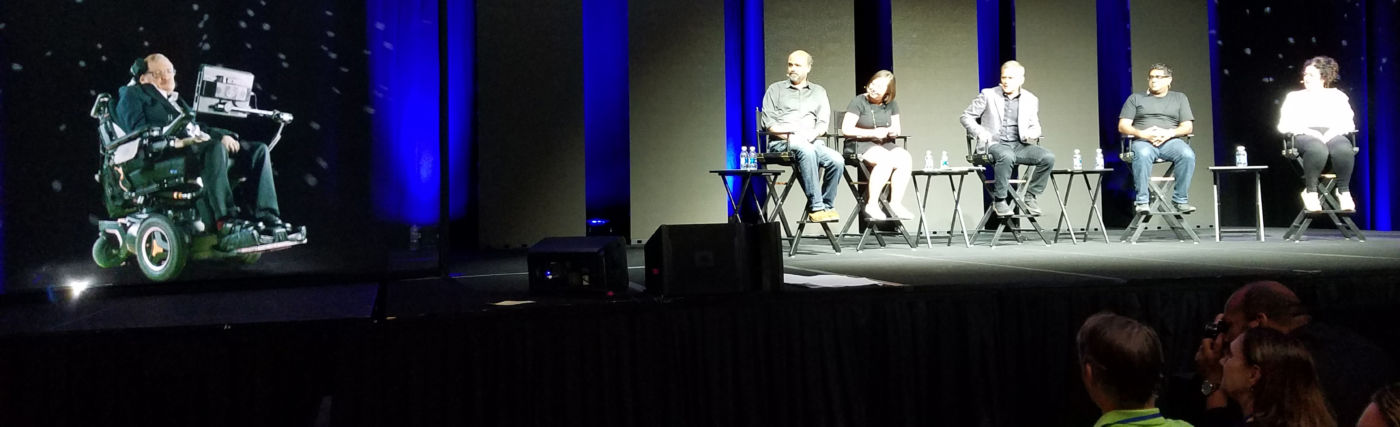
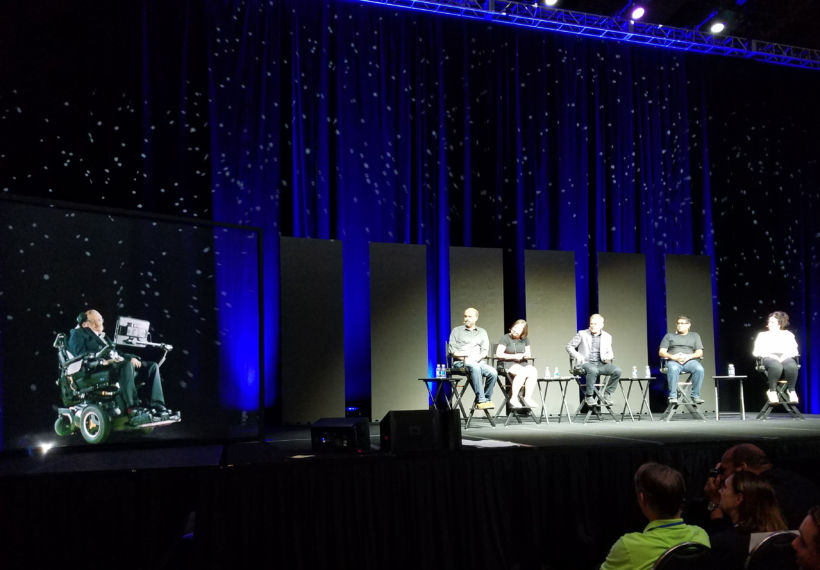
So let's, we have the opportunity, I think, if the technology will allow us to bring in an expert who has sort of thought about a lot of different things and has had time through an extremely long and successful career of invention and discovery and original thought to talk about a lot of different topics, including the idea of exploration in life.
So could we ask Dr.
Stephen Hawking to join us, please?
Thanks.
Hello, can you hear me?
Yes, loud and clear.
Can you hear us?
I can hear you too.
Great.
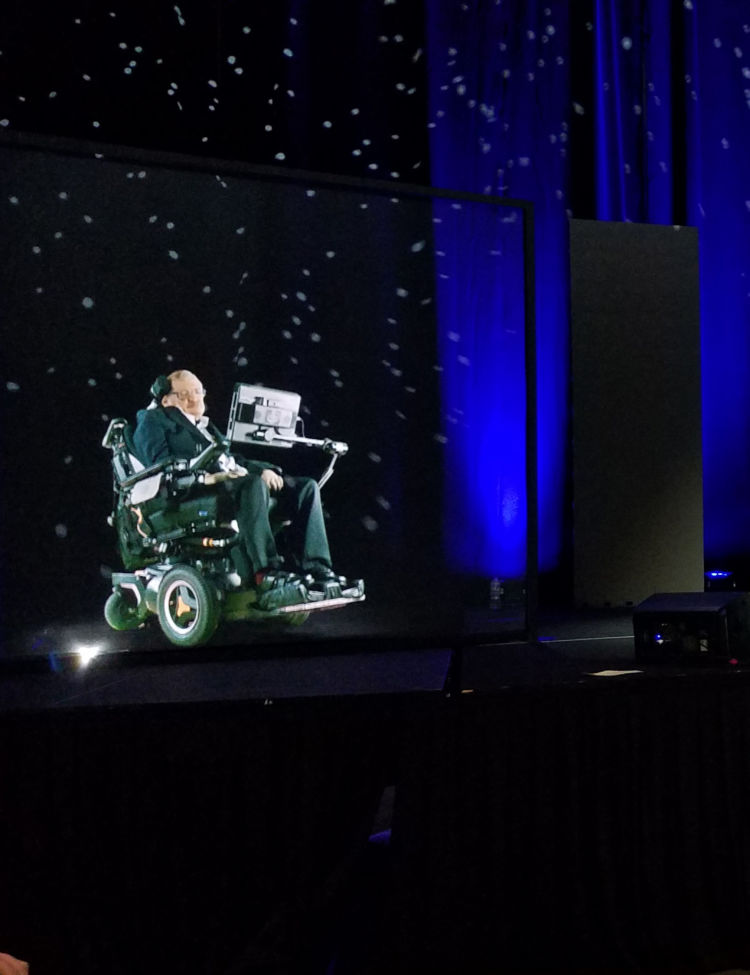
I am delighted to have the opportunity to use ArtMedia's hologram technology to transcend time and space to be with you today.
Well, if anybody can transcend time and space, it should be you, sir.
We have a question for you, and that is, if the combination of humans and their technology and the robots, if it takes us far enough out into the universe so that someday we eventually can find evidence of life somewhere else, what's it going to look like?
What do you think life in other planets or other solar systems might be like?
Our civilization is only about 10,000 years old, but the universe is about 14 billion years old.
Therefore, any other life in the universe is likely to be much more advanced than us, or so primitive that it hasn't even begun to evolve.
In the former case, the Breakthrough Listen Project should be able to pick up their radio transmissions if they are close enough.
But in the latter case, one has a rather boring universe full of potentially dangerous bacteria or other life forms.
A far cry from the usual science fiction picture of glamorous aliens.
Any other life we discover is likely to be artificial, because robots with artificial intelligence are far better equipped than biological life to survive the long duration and radiation damage of interstellar travel.
Thank you, Professor.
That's an interesting thought.
Actually, if it's all right, you don't need to sit there the whole time, but if you want to sign off, maybe we'll have a chance to ask you a question a little bit later also, sir.
Thank you for the answer.
Beam out.
I wish I could do that.
So that's intriguing that one of the deepest thinkers we have thinks that if we do encounter life, in order for it to have survived over the immensity of distance and time, it will have had to no longer be biological, but will have had to transfer itself into some sort of technical or robotic kind of form.
So some sort of hybrid between the two.
But for now, we're kind of stuck with these biological forms.
We're not far enough along yet.
And we're fragile, physically fragile, psychologically fragile.
The crew up on the space station is very much separate from the world.
I was talking to Susan Helms when she was up there back on my second space flight.
And at one point, Susan said to me in passing, she said, hey, Earth said that we need to do this tomorrow.
And I thought, Earth said?
That her psychological fragility, just her makeup was such.
And she became a multi-star general in the Air Force.
I went to test pilot school with her, wonderful person.
But in order to stay healthy that far away from home, even that close, but that separate, she had to completely split herself from the rest of humanity.
You have to recognize that you are no longer an Earthling.
You are a spaceling.
Earth is a separate, discrete entity from yourself.
And you and your crew are that way.
And I think as we go further, we're going to have to honor that.
We put a lot of psychological support equipment up on the spaceship.
In fact, we have a big movie library up there.
We have a huge audio library of songs, books to read, yo-yos, yes, which are fun in weightlessness.
You can walk the dog forever.
But there's even a guitar up on the space station.
And I think we're about to take a break.
When we come back, we're going to talk about, I think, the next step.
We've been looking at this, where we've been, what our science does, what it means to us as people, what this exploration may look like.
And when we come back, I want to talk about how we're getting ourselves and those young astronauts ready for the next phase of human evolution.
But maybe in preparation for that, we'll just celebrate a little bit with what that guitar, I had a chance to do with that guitar up on the spaceship.
I want to thank AwesomeCon.
I want to thank FutureCon, the Smithsonian, and the chance for us all to be here on StarTalk.
Maeve and Suveen and Katherine and Scott, thank you very much for being on the panel.
And I'm Chris Hadfield, and you have been listening to StarTalk Live.
See the full transcript



 Unlock with Patreon


 Become a Patron