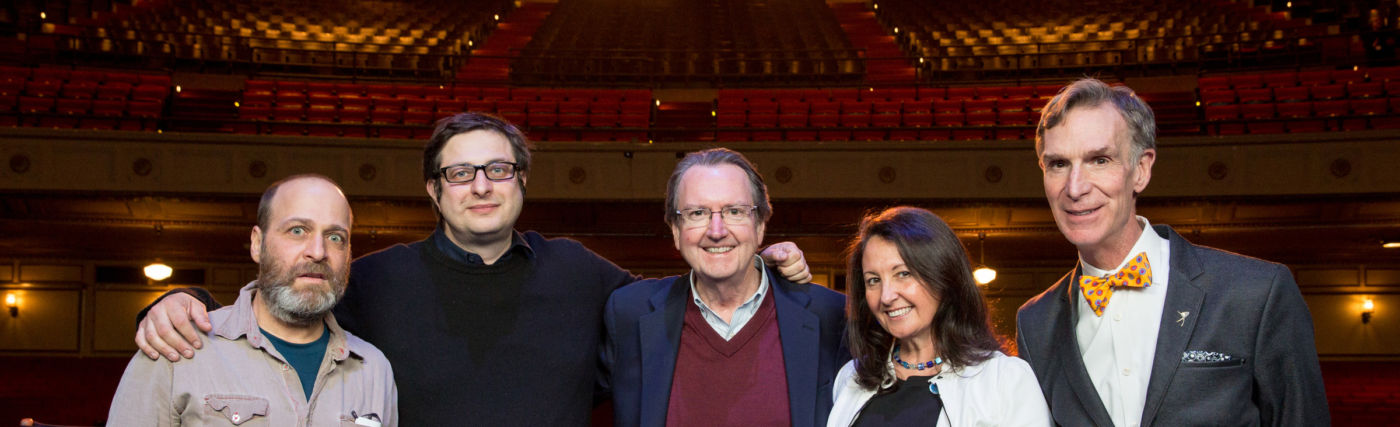
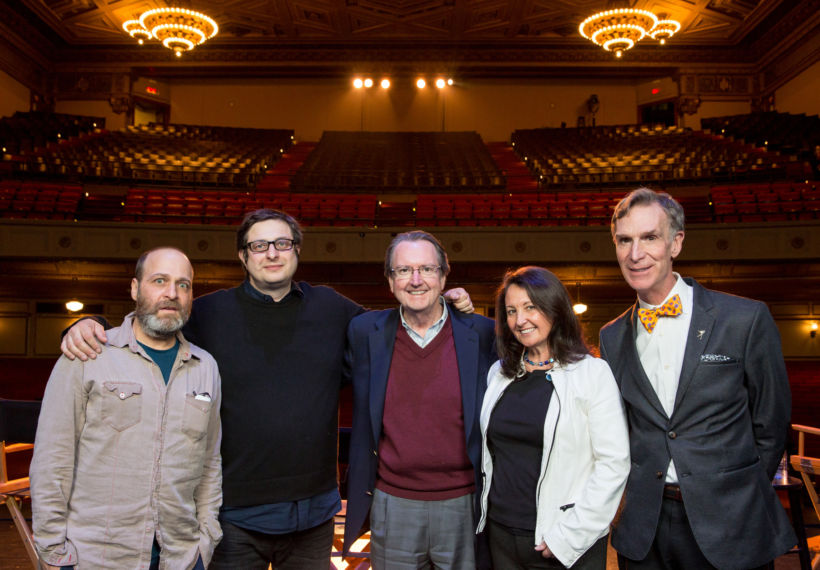
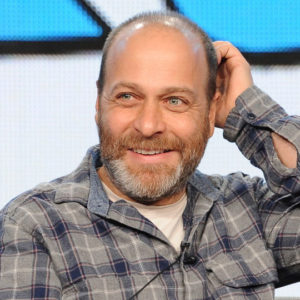
Explore the Moon, near-Earth asteroids and Mars from the stage of San Francisco’s Nourse Theater with guest host Bill Nye, co-host Eugene Mirman and guests astrophysicist Dr. Yvonne Pendleton, “Mars Czar” Dr. G. Scott Hubbard and comedian H. Jon Benjamin of Bob’s Burgers and Archer. Go searching for water sources on the Moon (there are 3!) and learn why there’s even more water on Mars. Find out what we need to know before we go exploring asteroids or Mars, or, as SSERVI Director Pendleton says, “What to wear, where to touch, and what to flush.” Closer to home, you’ll hear about the Chelyabinsk and Tunguska events and how big an asteroid would need to be to be a planet killer. Scott, who was the former Director of the NASA Ames Research Center, explains how the Sentinel Mission looks for asteroids – “You can’t deflect them if you can’t find them” – and the problems he has with NASA’s Asteroid Redirect Mission.
Transcript
DOWNLOAD SRT
Welcome to StarTalk, your place in the universe where science and pop culture collide. StarTalk begins right now. Eugene, Eugene, we're on fire. Welcome, welcome, welcome. Tonight we have a fabulous show. We're going to be talking about space. Space,...
Welcome to StarTalk, your place in the universe where science and pop culture collide.
StarTalk begins right now.
Eugene, Eugene, we're on fire.
Welcome, welcome, welcome.
Tonight we have a fabulous show.
We're going to be talking about space.
Space, yes.
So our first guest tonight is, may I say, full disclosure?
Wait, okay, that would take a long time.
Some disclosure, he's a friend of mine.
He is former director of the Ames Research Center here in the Bay Area.
He was the first Mars program director.
He developed the airbag-assisted landing for rovers on Mars.
He's on the board of the B612 Foundation.
You'll hear about that.
He's the editor of New Space Magazine, and most importantly to me, he's on the board of the Planetary Society.
Ladies and gentlemen, Dr.
Scott Hubbard.
The Mars-ar.
Well, wait, wait, there's more.
Like so many of you, our next guest got her PhD in astrophysics.
She's now the head of Cervi, which is a fabulous NASA acronym.
She's advancing space science and human exploration into the solar system.
Ladies and gentlemen, Dr.
Yvonne Pendleton.
And we have one more comic guest.
It is my great pleasure to introduce.
He plays my father on Bob's Burgers.
Let's get this started.
Sorry.
Are there any questions on what we've covered so far?
There will be a quiz.
Let me ask you this, Dr.
Pendleton, Yvonne.
Yes.
What is this?
This acronym stands for the Solar System Exploration Research Virtual Institute.
And what that means, and I did not pick the acronym, okay.
But what this means is we have researchers across the country, about 300 of them, but they communicate primarily through computers and using technology.
Yeah.
Like using Snapchat.
Something a little different, but we save a lot of money that way, and we get a lot of cross-team collaboration.
So you get groups of people who would never really even go to the same meetings talking to each other and getting new ideas and doing new science.
I'm skeptical.
No, no, I'm sorry.
That's my go-to thing to say, right.
There's going to be a lot of that.
I am skeptical.
Thank you.
It reminds me a little bit.
In the future, the offices will have no paper.
So you're saying you have 300 people.
These are all in the US?
These are in the US.
We also have eight international partners.
And what is our goal at Zervi?
So the goal is instead of having a bricks and mortar institute that you had to build, you bring people together.
And they're the best teams that you could make regardless of where they are.
Geographically located or what, they might have a lab facility that another group wants to use or something like that.
How long have we been in business?
Well, Zervi has only been up and running for about a year.
But it had its predecessor institute, which was only focused on the moon.
Was that the University of Phoenix Online?
No, when you say focused on the moon, it wasn't just telescopes.
It wasn't just telescopes.
It was the same thing.
It was a virtual institute called the NASA Lunar Science Institute.
And that was around for four years before Zervi came online.
And before that, there was something that Scott Hubbard started, which is the NASA Astrobiology Institute.
And it's still going.
It's maybe 16 years old.
Teenagers.
Teenagers doing science.
You're an astrophysicist.
Right.
So were you working on the moon?
Not exactly.
How many people here are not astrophysicists?
But you guys aren't that into the moon, right?
Generally, writ large.
Not usually.
We try to go observing when the moon is out of the way.
The connection is that I'm really interested in the origin of the basic building blocks of life.
The things that make up all of you sitting in the audience and us sitting up here.
And where did those come from?
They came from the stars, and how did they evolve?
And how did they get transported to a place like the Earth?
So I studied comets and the stuff that comets bring a long time before I realized that we've got the moon right next door where those comets have been dumping that stuff for four and a half billion years.
Just dumping it wherever they want.
So I gotta say, from my own experience, I was very skeptical that there was water on the moon.
Because...
We didn't leave any?
Right.
And why wouldn't it all evaporate into the icy blackness of space?
But your claim, or your observation, or they have found...
It's proven, yes.
That there's water on the moon?
In many different forms, at least three different sources.
Is one of the forms water?
I think it has around three.
Ice.
Actually, not liquid.
But we found ice in the bottom of the craters, where you kind of expected it should be.
But there are the makings of water, OH radicals, oxygen and hydrogen, all over the surface of the moon.
And that is getting interacted by with the sun.
The solar particles from the sun come and they bring more hydrogen.
And then you get water.
So that's another way.
And then there's a third part.
But wait, there's more.
Okay, what are those two?
Enumerate those two.
First of all, H2O molecules.
The ice inside the crater is ice.
OHEs that get nailed with an H.
That's the one on the surface.
And they make some more H2Os.
And now the third one.
The third one.
It turns out that the moon wasn't this dry body in the sky that we thought it was.
Oh, no.
And because the moon and the Earth share a history, what we found when we found water in the rocks on the moon, when Apollo astronauts picked up these rock samples, and later we were able to find out there was quite a bit of water in those rocks, we learned that those rocks came up from deep inside the moon.
And it's because the Earth was probably wet at the time when that big Mars-size object hit the Earth and created the moon.
Some of that water went to the moon.
So I look like nobody.
But I've touched a moon rock.
Right, okay?
It's not wet.
So what do you say, there's a lot of water in a moon rock?
What are we talking about?
So, you know, we get excited about a little tiny bit of water, we think, is a lot because we thought it was really dry.
So instead of one part in a billion, there's six parts in a billion or something like that.
But that would be enough for horses to live there.
Like one horse.
Yeah, one horse.
So we are all about, or my understanding is, you're trying to get humans to the moon, right?
Well, it's not that we survey you're trying to get humans to the moon, but should humans want to go back to the moon or near Earth asteroids or the moons of Mars, those are all the things we study, we could help tell you what you need to know before you go.
That sounds great.
Like what kind of stuff?
Well, for instance, space is a pretty harsh environment, and so you need to know...
As harsh as junior high or worse?
So, we're going to go with, hypothetically, we're going to go to the moon, and you're going to give me a shopping list of stuff to take?
What we would do is tell you what to wear, where to touch, and when to flush.
Are you the Us Weekly of space travel?
Who wore it best?
And there's a whole outfit you got to have.
It better have some metal on the outside of it, so that when you go up to that asteroid and you touch something, you don't get zapped.
Or is it static electricity?
Well, the thing is, it's kind of complicated, but there are these plasmas in space, and when the plasma field is low...
Okay.
Nice try just saying plasmas in space like we all knew that.
Well, just think of it as highly energetic particles that are going, zipping around you.
And so there are places, for instance, on the moon, there are places where the solar wind comes across the moon's surface, and it can reduce the plasma field, and when the plasma field is reduced, then any rover that's, you know, its wheels are turning along the surface of the moon, it would need to have something to protect it so that you're grounded once that plasma gets...
Oh, so you're going to get...
Your hair stands on end and...
Yeah, and it turns out the same thing might be true for astronauts going up to an asteroid.
They might need to have some sort of protection around their suit.
So we're finding out stuff like that.
So I got one number in my notes.
On the moon, 600 million tons of water.
There are lots of numbers like that.
That one, you know, various people will say.
It seems like there's an infinite number.
Okay, peer-reviewed, published numbers.
But the thing is, it's ongoing research, and I wouldn't stick with just one number right now because another study could come out soon that might say something different.
I don't know.
The point is there's a whole lot more than we thought would be there.
And why do you care?
You care because water is a resource.
I mean, it's something we all need, not just humans to live, but if you want to make fuel to go somewhere else, like to Mars.
Is this where finesse comes in?
Finesse, that is a cool name for one of our teams that we have.
Dr.
Hubbard, you're on the NAC, for example.
That's right.
Not the group.
Oh, yeah.
The NAC had one hit.
My Sharona.
Yeah, there he is.
Science aside, you're in the band The NAC.
I'm on the NASA Advisory Council.
It doesn't play music.
Here's just the point I wanted to make.
They also have a band.
Dr.
Hubbard, your NAC doesn't start with a K.
No, it starts with an N.
But just notice that the NAC is an acronym within an acronym.
It's an embedded acronym.
The worst kind.
Finesse is, as I understand it, Field Investigations to Enable Solar System Science and Exploration.
Finesse is a program within your virtual institute.
Right.
We have nine teams and that's one of them.
That one is run out of NASA Ames Research Center.
So Finesse is an acronym too?
Finesse is an acronym.
Inside NASA, inside Ames.
Inside Serby.
Inside Serby.
Russian dolls of letters.
Just so that no one can cut funding because they just, how would you even know where to start?
You guys finally figured it out.
I like that.
We need more acronyms.
What has Finesse done?
What is it doing that enables, you were trying to enable human exploration, is that right?
We're trying to address science questions that human exploration needs to know the answers to.
And so what Finesse is doing is looking at analog sites on the Earth that would be comparable to where you might be exploring on an asteroid or on the moon.
Exempli Gradia, for example.
Oh, well, in Idaho, there's a Craters of the Moon place in Idaho.
That's a state park or a national park.
Yep, and they go there and they do remote sensing with their robots and things.
They have their scientists in what they call the back room so that if you were on the moon and you were doing this robotically, you wouldn't be able to just run out and turn a switch.
So they make themselves do all that kind of stuff here.
And they try to figure out, you know, well, what would you really have to do if you were on the surface of the moon and this happened or that happened?
Or what would you have to do if you're going up to, you know, a big boulder on an asteroid?
And so do you also mess around with those delays?
They do.
They build that in as well.
What are the delays?
The time delay so that, you know, when you send a message up to the moon and it comes back, it takes like three seconds.
And it turns out that there's a natural built-in computer delay that is almost that long going, you know, across the world.
Yeah, we got to fix that.
But the speed of light is still an issue, yeah.
Yeah.
Even at the Institute.
We can't solve everything, yeah.
So what is in the solar wind that we're all, we always talk about the solar wind?
Electrons and protons and hydrogen.
And so when the hydrogen comes in...
Well, hydrogen is a proton.
Exactly.
So, I mean, so we use those terms interchangeably, but with you, I know I could just say hydrogen, right?
But electrons and protons are coming...
Yeah, but with me, you can't.
So, is there some scheme that you guys work at, work on, they're finessing, to scrape up OHs and H-ify them into H2O?
You know, that particular team isn't working on that particular problem, but that is the kind of thing that new teams that come into CERVI in the future might actually decide to address.
So, what we do is we provide funding for five years for the current teams, but in another year, we're going to have another competition, and new teams are going to come in and join the old ones, so that you always have this memory, corporate memory going on.
So, when you say funding, what are my tax dollars doing?
So, NASA provides the funding for CERVI for these teams, and it's both the science mission directorate and the human exploration part of NASA.
And so, they together give the funds to us at the central office.
But how much money is it?
$100?
About $15 million a year.
Okay, and the teams only get, you know, there are nine teams, so they get some smaller part of it, right?
So, you split it nine ways.
They get most of it because, you know, we're a virtual institute, so we don't need a lot to run the central office.
And so, we fund them, and then they have to report back to us what they're doing.
And I'm just amazed at how productive these teams have been.
In less than a year, there are many hundreds of peer-reviewed publications that have already come out of these teams.
Go Serby is what I'm getting at.
So...
It's a lot of bang for the buck.
Thank So we are talking about asteroids.
That's the meat of it.
If the earth gets hit with an asteroid, even a small one, like the size of the stage, for those of you on the radio, it's not that big.
It would be very troubling.
Is that accurate?
I would say so, yes.
If an asteroid hit the stage.
Asteroid the size of the stage hit the center.
If it hit the stage.
Right here.
You would be obliterated, you would be atoms.
We would be.
But how, but sure.
That would be a relief.
Let's be honest.
But how far would it go?
At the first 10 rows, no, this entire section of San Francisco.
So even the balcony, all right.
Be turned into atoms.
But meaning for what, 10 miles, 5 miles, 100 miles?
Well, it depends on how big the thing is.
If we had something that was about, let's say 50 feet, would you buy that?
Okay, 50 feet-ish, you know.
17 meters, that's the size of the thing that blew up over Chelyabinsk and Russia two years ago.
And it damaged about 1,000 homes.
It blew up at 60,000 feet.
It was like an air burst coming down.
And about 1,100 people were sent to the hospital.
And if that had gotten all the way to the ground.
Nobody died, nobody died.
Nobody died, but if that-
So we're fine.
So as long as it doesn't get to the ground.
Well, what happens if it hits the ground?
So it has to be bigger in order to get to the ground?
Yeah, it depends on what it's made of and how it comes in and a whole bunch of physics stuff.
It depends on a lot of physics.
Sure, but what happens when it hits the ground?
If it had gotten all the way to the ground, it would have been the equivalent of something that would be in thousands of kilotons.
Hiroshima and Nagasaki kind of deal?
Smaller than that, but still.
Well, that was tough to create, how long would it take?
Like Mopra.
Against Godzilla, you know, not so good.
But in 1908, the famous Tunguska event happened.
Not so famous, because that was 30th of June.
Another thing that happened in Russia, in Siberia, unfortunately it only flattened a couple hundred miles worth of trees and a few reindeer.
But if that had hit here, it would have wiped out the entire Bay Area.
So that was Russia as well.
Yes.
So asteroids only hit Russia.
Well, Jon, that's a good point.
And tornadoes only happen in trailer parks.
Dr.
Hubbard, you're from Kentucky, right?
I know from where I speak.
No, so, but Jon, you raise a good point.
Just if you are an asteroid, you're an asteroid and you're going to come in from the north, human map north.
So a good chance you'll hit Russia.
It's 11 time zones across.
The Chelyabinsk blew up, it was about two and a half minutes or almost three minutes before the sonic boom hit the ground, right, everybody ran to the windows to watch it and wham.
But if you get just a little bigger, you're saying Chelyabinsk was 17 meters?
Thereabouts.
Yeah, what if you get into the 30 and 50 meters, like the size of a football field?
Yeah, so you could just punch it.
It blew his shirt off, that's why he was there.
So if you're in, the size of asteroids in the miles...
Five-eighths of a mile up to a mile kind of size.
Exactly, then you're talking extinction event, as in what happened to the dinosaurs 60 million years ago.
Everything going bad for everybody.
10, 20, 30 kilometers.
So we become like birds and Kimono dragons.
Only the cockroaches would survive, I don't know.
And then if you get down to the 100 meter-ish, 300 feet or so, you're talking about cataclysms that are city killers.
And then down to the 30, 50 meter range, you have tsunamis.
It sounds like science fiction, but it's a real deal.
There are maybe a million of these near-Earth objects.
There you go, Eugene.
That's thousands.
It's a thousand thousand.
Technically.
It's a thousand thousand.
There's millions of them headed for Russia.
And a handful towards Texas.
But here's the thing.
It could be, people speculate, why haven't we heard from another civilization?
People do bring that up, yes.
And it may be that you have to pass the asteroid test, right?
That if you don't have a space program, and a virtual institute, for example, or an astrobiological institute, biology institute, you accidentally let yourself get hit with a big rock and everybody dies.
It's like...
The reasons the dinosaurs went extinct is that they didn't have a space program.
As far as we.
We want to know a lot about asteroids, right?
Yeah, I'd like to tell you that.
You messed around with Rosetta, didn't you?
Well, before we go to Rosetta, I'd just like to tell you that not all asteroids are those big heavy metal kind that we're talking about.
And what we're finding out is some of them are big rubble piles.
And if you go up to them too fast, or you touch them too hard, they're going to disintegrate into a whole bunch of little pieces.
But something is holding them together, and the little ones are spinning fast.
Is it dark matter?
I'm pretty sure it's not dark matter.
Why won't anyone tell me what dark matter is?
So anyhow, my point is that this is why we have to study these ahead of time, because you don't want to find one coming towards you and go out after it to try and mitigate whatever's going to happen.
Mitigate is the same as Bruce Willis kind of thing?
And go out and touch it and find it's going to break up into big chunks that are all going to come and hit the earth.
As they say, you can't deflect them if you can't find them.
You know, they say that.
That's unfortunate that they say that.
Imagine that you're looking for a piece of charcoal against the black sky.
How would you find that?
Well, it turns out if you're looking away from the sun, the sun's heating it up, it's glowing because it's hot, and so if you look in the infrared, you can find these guys.
Now, when you say glowing and hot, Scott, I've had, I think maybe many of us have experienced a barbecue cookout.
Right.
It's not like that, is it?
No, but it is much warmer than the blackness.
Let me throw some numbers out here.
Probably 300 Kelvin.
300 Kelvin?
That's like us.
Yeah.
Yeah.
Because it's warm by the sun.
Wow.
Kelvin, anyone?
250, 300.
Yeah, he's a good guy.
Zero Celsius is 273 Kelvin.
Right, yeah.
So we're talking...
We're talking, you know, 60, 70...
So it's hot as a regular old day on an asteroid?
The side facing...
Facing the sun.
So you want to get in?
You need a space telescope.
Oh, do you have one?
I just so...
It just so happens.
I have the plans here.
You do though, right?
It's called Sentinel.
It's called Sentinel.
And it's a...
In fact, this was not invented out of nothing.
The National Academy of Sciences about six years ago said if you want to find these things before they hit the Earth, put a telescope out in deep space, maybe where Venus is, and look out there with the right size of telescope in the infrared where it's glowing because of the sunlight, and you can find these.
You can't find them from the ground.
Too much atmosphere.
Are you guys at the Institute working on this?
We don't have a telescope, and we don't have the means to fund a telescope.
$15 million a year won't do it.
What if we got rid of health care, would that help?
Briefly.
But the thing is, if you don't find the asteroid that's coming to hit us, you won't need the health care.
From time to time, the last few months or a year, people at NASA, the Asteroid Redirect Mission, now, the Asteroid Redirect Mission, the plan is to go out and get an asteroid, a small one, a charming one.
And this thing, as I recall, is seven meters, which is not very big, I mean, as things go.
If a seven-meter rock hits the Earth, nothing happens, it just burns up, yeah?
Well, the idea about studying the asteroid, if you do bring it back, or if you bring a boulder from an asteroid back, is really more about the technology that would be involved in learning how to do all the things you want to do with it, as much as anything else.
This sounds like, I mean, the technology that Bruce Willis needed, for example, would be a lot bigger and more importantly catastrophically huge than this little thing.
Well, so if I put on my Professor Hubbard hat from Stanford.
At Stanford.
But also from Berkeley.
If I were to give the ARM mission grade, I would have to give it a D.
That's not very good.
Well, the reason it's not an F is because there are...
You know how often I ask that question.
Is because there are two technologies that are very useful if we want to send humans to Mars, which everybody is the horizon goals where we want to go.
And that's the solar electric propulsion for pushing stuff around.
How does that work?
Well, you bring in sunlight and you use a certain type of gas.
You create one of these plasma things.
With xenon.
The warrior princess or something?
But the ARM mission, in my opinion, and it's now shared by the NASA Advisory Council, is that...
Coincidence?
Pretty cocky.
Perhaps.
We took a vote and wrote it down.
It has nothing to do with science.
And it has very little to do with human exploration.
And it has almost nothing to do with planetary defense.
And it will probably go up in cost by a factor of pi.
Other than that, it's fine.
A factor of pi, like three and some change.
So I have here the Asteroid Redirect Mission recommendation by the NAC thing.
Let's see.
There's a risk of meeting the full set of requirements that includes capturing an asteroid which would cause the arm cost cap to be exceeded.
Has anybody ever exceeded a cost cap here?
Anyone?
Yeah.
Is that English?
English?
You mean it would cost more than they say it would.
It means maxing out your credit card.
Yes.
Only in this case, the cost cap is $1.25 billion.
The budgetary goalposts moving and budget overruns that will threaten other programs.
That's a reason to not do it.
Yeah.
Preserve the two technologies.
If you're sending humans to Mars, it could be very useful.
The other stuff I don't find the rationale personally for doing the AR.
Well, you weren't alone.
The whole council said this is a madness or not the best idea.
You guys both come at asteroids from two different directions.
We're trying to study them to find out what they're made of and how they formed.
And Scott, you're trying to find them.
Sentinel is going to look out there and find the million that could be a threat.
Thank We have studied asteroids using the Rosetta spacecraft.
I love the Rosetta mission.
I think it's so cool.
What did you love about it?
Well, it's a comet, and they landed on a comet.
That is so hard.
And it was amazing.
A comet is not an asteroid, right?
No.
No.
A comet has a lot of ice in it.
Asteroids, it turns out, some asteroids have a little bit of ice.
So we've got asteroids that are starting to act like comets, and comets that look a little bit more like asteroids.
So, you know, we say they're different.
They are different.
They come from two different regions of the solar system, but they have some similarities, and they both hit the earth.
As the kids say, it's a spectrum.
Yeah.
There you go.
Yeah, there's some asteroids that are more in his comets.
But can't change themselves.
No, they can't move.
So, but asteroids, if I understand it, are closer to the sun, part of the solar system, and comets are farther from the sun, part of the solar system.
Right.
But they have...
The Oort Cloud.
The Oort Cloud.
Or the Kuiper Belt.
Or the Kuiper Belt.
Oh, so it's where they came from.
That's where...
Well, because where they came from determines what they're made of, because way, way far out there, you know, beyond Pluto, we're gonna visit Pluto, you know, we're gonna get there on July 15th of this year.
Well, actually, Jon, in a sense, yes, everyone, everyone on Earth will be involved in this, so...
Yeah.
Dr.
Hubbard, you and I crossed paths from time to time.
Were you at the launch of New Horizons?
2006, January of 2006.
You were there, yes.
We partied.
Yeah.
Yeah.
So you guys, I am not an expert on rocket launches, but...
But you know when you partied in 2006.
Yeah.
New Horizons is in Jamaica, right?
That's where everyone wears no clothes and that, yeah, yeah.
This is a NASA part, it's a little different vibe.
But if I may, in all seriousness, New Horizons is the name of the mission, and mission is space people talk for rocket ship.
And so I, as you may know, on the Science Guy show, I went to a space shuttle launch.
This is a huge freaking rocket, and this is radio, our most visual medium.
It was a windy day.
It took it a long time.
There was no sock, no foam rubber thing on the microphone.
So it took a noticeable amount of time to get up through the clouds and up into space.
But then New Horizons in 2006 was like, shoo, and it was gone.
It was the fastest rocket anybody's ever shot.
The astronauts who went to the moon went to two and a half days to get there, something like that.
This thing went past the moon in nine hours.
Yeah, you're tax dollars at work.
And it's been going ever since.
Yeah, and it's been going even faster than that because it went by Jupiter and got a shoo, a little, but it's in space, so it just went past Jupiter.
It will arrive in the vicinity of Pluto, Bastille Day, depending on your time zone, 14th and 15th of July of this year, and we will finally get a look at Pluto.
And we can all then take a meeting about what actually goes on on Pluto, icy cloud, watery things, solid rock.
Let me tell you about the resolution you will see, though.
It's the equivalent of if New Horizons were passing that close to Earth, with its instruments, it would be able to see the buildings or the skyline of Manhattan or any city.
So it will find all the cities on Pluto.
The ones, the big ones.
Yeah, things like New York.
It won't see, like, Merlington, Vermont.
It could know when to find the band Fish Jamming.
The thing that's going to be extraordinary are the pictures, right?
And the thing that has always, I found so compelling and makes me so crazy are the pictures of Mars.
And because Mars is a place, I mean, if you were dressed properly, your suit, you could walk around, you could have a picnic.
And along with some other things that Dr.
Hubbard has done, you wrote a book, Explore Mars, right?
Yes, and the foreword was written by, the foreword really is brilliant.
I generally write books, in fact, for the foreword.
But the significance of pictures is huge in our scientific understanding of things, right?
It carries such a vast amount of information and our eye-brain combination is so good at integrating that into an understanding.
I mean, you go from just an image to understanding in a blink, so to speak.
Along this line, what is next for the Virtual Institute and what is next on Mars?
What are we trying to achieve in both of these things?
We would really like to understand what you need to know before you go.
And so that means that you want, if you're going to send humans beyond low Earth orbit again, whether it's to the moon or to near Earth asteroids or to the moons of Mars and then eventually Mars, you want them to go with the knowledge of what they need to take with them, what they're going to find when they get there, how to protect themselves along the way from radiation, that kind of stuff.
That's what our Institute is all about.
What do they need to know before they go?
We have four rovers on Mars.
Dr.
Hubbard, you worked on the first three.
Right.
And Opportunity is still operating after ten years later.
Imagine that.
I mean, it's amazing.
The warranty was only good for 90 days.
I know.
So you guys, it's like if you had a car with a three-year warranty, and you didn't change the oil, didn't rotate the tires for 120 years, that's a bargain, right?
It's like the original Chevy's.
That's your tax dollars at work.
The next step is a sample return, because we've done the flyby, we've done the orbiter, we've got rovers, we've got still opportunity and curiosity is operating.
Yeah, huge thing.
And the next step is, now that we've got all this information, is to go and pick that piece of Mars that will tell us, are we alone?
Is that piece of Mars that we pick, we bring back, and we see evidence of past life?
So why do we have to bring it back?
Ah, there's a bunch of reasons.
How else can you put it in your mouth?
There you go.
Have you thought about getting him at the Institute?
I won't now.
Can I come and taste all the different things we get from space?
Can you get high from it?
Yeah.
So imagine if you got samples here, and we've done this with the samples that the astronauts brought back from the moon.
Instead of having ten scientists look at it, you can have thousands of scientists look at it.
Instead of one moving laboratory, you have dozens of laboratories all over the world.
That's the power of looking at a sample.
And ten years or 15 or 20 years in the future, you can use the new technology and the new instruments to look at those same samples if you took good care of them.
And find new stuff, like the water and these rocks.
You know, when I was in charge of the Lunar Prospector Mission, we said it was a cup of water in a cubic yard of dirt, was what we found in those shadowed craters.
That would be detectable, though, yeah.
But what they found from these old lunar samples that people brought back from the Apollo mission was this parts per billion that nobody even knew was there.
And that would not have happened if we didn't handle the samples.
How hard would it be to take the water that does exist on the Moon and access it to make water that we could realistically use?
The stuff that is in the shadowed craters would probably be easier, but you could probably mine the other stuff.
But by comparison, Mars has maybe tens of billions of gallons of water.
I mean, there are places on Mars that are 80% water ice.
And so you just stick in a shovel and warm it up, and there you go, you've got water.
So to get this sample, this thing, it's taking a long time.
We only do this every 26 months because of the orbits of Earth and Mars.
So what is the next thing?
We've got to get the 2020 rover, which will be like the Curiosity rover, which landed in 2012.
Ten years later, or eight years later, will land on Mars.
Does it land in 2020?
It launches in 2020.
So it lands in 2021 and a half.
Yeah, end of 2020 beginning.
It depends on the specific...
Yeah, it depends.
Okay, so that thing is going to get a sample.
It's going to cache a sample.
C-A-C-H-E.
C-A-C-H-E, yes.
It's going to put in somewhere between 20 and 40 little sort of chalk sized chunks of Mars picked from a bunch of different places.
Because it's driving around picking them up.
Because it's moving around.
Then what happens?
Then the second...
They're sitting there on Mars.
Yeah, so then if you had the budget all lined up, then two years after that, you'd send something that would orbit.
And then two years after that, you'd send the lander that would go out, grab that sample, that little ball, that cache, and put it in a rocket.
The rocket would point at the sky and fire, and the ball would go up.
Carefully.
Rendezvous with the waiting orbiter and bring it back.
So it's going to be 2026 or 2028.
This is the Mars Ascent Vehicle.
The Mars, the Mav.
So basically in around 2029 or 2030 is when we would get stuff.
That's right.
When we get to really look at this one.
Get a taste.
Yeah, get a taste of Mars.
Taste of Mars.
Then I could finally open my little bistro, Taste of Mars, where I'd have one rock for Mars and everyone would put it in their mouth and put it back down.
So couldn't we just go there right now if we had the coin, the money?
I mean, do we need to know more about it to land there?
You mean to do the sample return mission?
No.
To send you?
Yeah, well, I'm not really...
Somebody's qualified.
We'd go there and walk around with a hammer and look for signs of life, right?
Maybe Richard Dreyfuss.
No, because this is an old thing.
And I think, Dr.
Hubbard, I've heard you speak about this.
What our very best robots do in a week, a human can do in about a minute.
That's right.
Is that right?
That's right, yeah.
If you take a really good field astrobiologist and say, go over there and tell me what that rock is, he or she will look around and say, oh, okay, pick it up, use the rock hammer, break it open, look at it with a microscope and...
Ha!
Less than a minute.
Yeah, perfect.
Just in a minute.
It takes the spirit, opportunity, curiosity, rovers, all the commands and all the work they had to do on the order of days to accomplish the same thing.
Is it significantly more expensive to send people because of how you have to keep them alive?
So you're...
So assuming you want to keep them alive...
They've all died.
Yeah.
But meaning then, like, the three or four trips over a period of, like, basically 16 years or something.
Yeah, so if you had 10 to 100 times more money...
Oh, just a second.
10 to 100?
That's a range.
It is.
Because, you know, I mean, do you want to just have linoleum in your spacecraft or, you know, a really nice...
No, you would have really nice, like, Victorian doors.
We would send a very fancy spaceship.
I mean, do you want real mahogany or veneer?
Yeah, stuff like that.
Because it's very difficult to compare the generic robotic mission with the generic human exploration mission.
But sending humans, because of the life support and all the other issues, is at least ten times, maybe as much as a hundred times more expensive.
Meaning we could do it in three years if somebody was like, here's my million dollars.
If you had...
Well, if Jeff Bezos just wrote a blank check...
Jeff Bezos of Amazon.
Should we try texting him?
Has anyone just texted?
So if you had at your disposal many tens of billions of dollars and you didn't care how you spent it, you didn't need to spread it out like the government does because they have a year-to-year budget and you could just have one big glob of money, you could do it in a single mission.
And how much would that mission cost?
Maybe we could do a Kickstarter.
That's what we're talking about.
The annual budget for planetary science is one and a half billion dollars, which sounds like a lot, but it's not that much.
It's less than 10% of the NASA budget.
Which is one half of one percent of the federal budget.
You guys love being bummed about this.
With good reason.
Just to remind you, you're getting a good deal.
I think it's a great deal.
I'd give it more money.
But I have very little say.
We advocate for getting more money for planetary science because these extraordinary discoveries are made for not on the cheap, but for a lot less money than a lot of other stuff that we spend and even NASA spends money on.
But here's the interesting thing that I think people like in what is called, Scott, I think New Space.
New Space.
You were editor-in-chief of New Space magazine.
That's correct.
Peer-reviewed journal.
There are people like at SpaceX and Jeff Bezos, you just mentioned, Elon Musk at SpaceX, Jeff Bezos, who just want to go to Mars.
Let's go.
Go.
Because if we had the cash, the C-A-S-H, and the drive, yeah, you could just go there, right?
I mean, you could.
We know enough about the Martian surface, the Martian atmosphere, the Martian gravity, the radiation environment.
The one big thing...
Oh, that!
The one big thing is right now nobody's got a single rocket that will get the kind of tonnage you need to Mars to support human beings, A and B.
Like, lots of stuff, you know, 10, 40 metric tons of life support.
That's what it comes down to, is how do you support someone or a group of four or six people going out, you know, the six, seven months it takes to get there, spending some time there, and then the six, seven months back, so maybe three years round trip.
Maybe you stop at Asteroids and pick up some of the materials you might need.
That's my recommendation.
Oxygen is us, right?
But Yvonne, that's part of the idea, right?
Exactly, if we understood what was there and where they are, we could do that.
Yeah, it would be a way station.
Right, it absolutely could be.
Or you could stop on the way.
Yeah, exactly, and you would get like Kit Kats and then, you know, oxygen and water.
And everything you need.
Fossil fuels.
So you guys, we are on the way to Mars.
Here's the plan right there.
I hope you enjoyed Star Talk Radio.
See the full transcript



 Unlock with Patreon


 Become a Patron