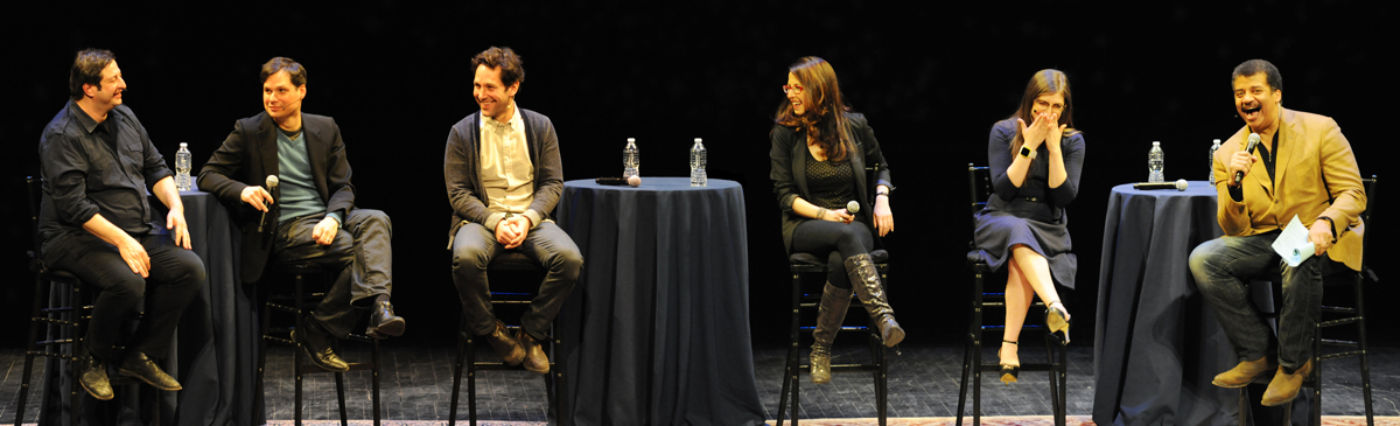
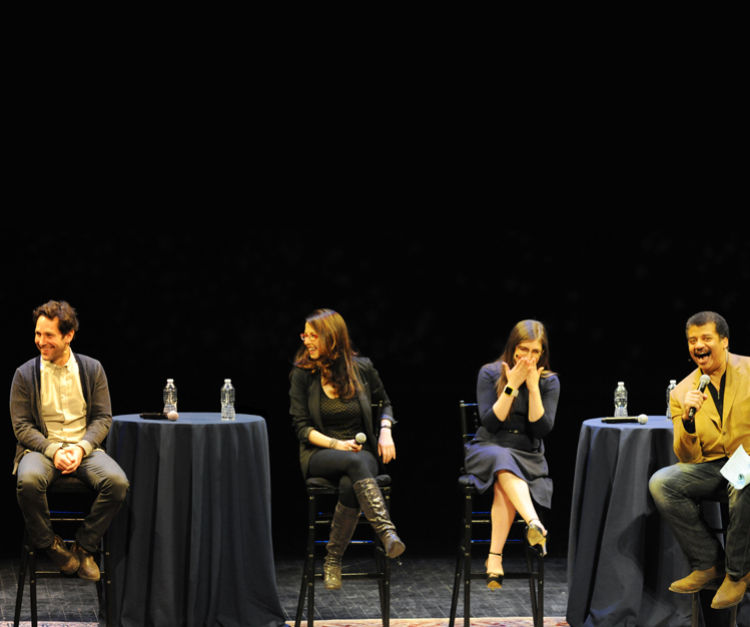
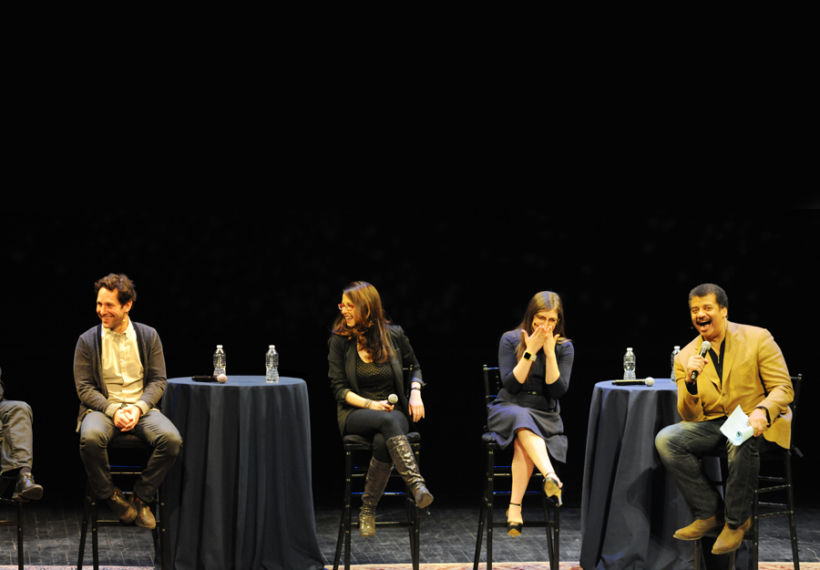
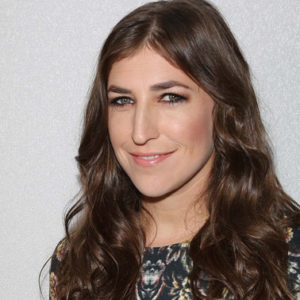
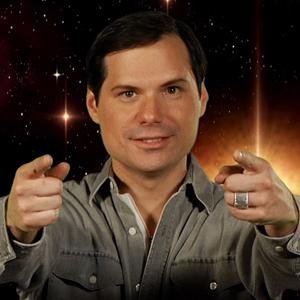
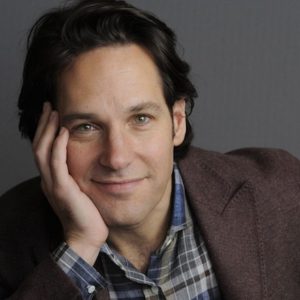
What is consciousness? What is self-awareness? You’ll find out when host Neil deGrasse Tyson and co-host Eugene Mirman welcome actress and neuroscientist Mayim Bialik of The Big Bang Theory, neuroscientist and StarTalk Live! veteran Dr. Heather Berlin, comedian Michael Ian Black and actor Paul Rudd to the stage at the Brooklyn Academy of Music. The freewheeling discussion covers veganism and the colonization of Mars, home schooling, behavior modification and genetic predisposition, Autism Spectrum disorders and waterboarding. Mayim also talks about the socially unconventional characters on The Big Bang Theory, how she landed the role of Dr. Amy Farrah Fowler on the show, and what it’s like to not only be a neuroscientist, but also to play one on TV. And that’s just what happened before surprise guest Bill Nye the Science Guy jumped on stage. (You’ll get more of Bill in Parts 2 and 3 over the next two weeks.)
Transcript
DOWNLOAD SRT
Welcome to StarTalk, your place in the universe where science and pop culture collide. StarTalk begins right now. Welcome to StarTalk, here at BAM. Yes, it is now my incredibly great pleasure to bring on your host, a wonderful man,...
Welcome to StarTalk, your place in the universe where science and pop culture collide.
StarTalk begins right now.
Welcome to StarTalk, here at BAM.
Yes, it is now my incredibly great pleasure to bring on your host, a wonderful man, a hero to science, ladies and gentlemen, Neil deGrasse Tyson!
As promised, there's Neil.
I will now bring on our two comedic guests tonight.
Ladies and gentlemen, Michael Ian Black!
And the always delightful Paul Rudd!
Thank you.
So handsome!
Ha ha.
And now, this is the science side of the house right here.
First, let me introduce, this is her second time as a guest on StarTalk Live.
She is Professor of Cognitive Neuroscience at Columbia Presbyterian.
Heather Berlin, come on Heather.
Come on Heather.
I stumbled, not because I didn't remember a name, but in fact, it's Mount Sinai Medical Center, not Columbia, so my apologies there.
It's your second time, thank you.
This is a neuroscience show, we have one more guest, and I'm a big fan of hers.
Please welcome, warm Brooklyn welcome to Mayim Bialik from The Big Bang Theory.
This is a hell of a line up.
I'm just saying what they're thinking.
Yeah, yeah, yeah.
So we're gonna talk about the brain.
And you're here because, Mayim, you have a PhD in neuroscience.
You don't only portray one who does on TV, you actually have one, right?
Yes, I'm a doctor and I play one on TV.
But you do both.
You also have a new book that just came out on being a vegan.
Correct.
Okay, we have 12 vegans in the audience.
Hey, we're in Brooklyn, there's plenty.
And I try to say, how do I weave veganism into StarTalk?
By just discussing it.
And I noticed that the United States actually has plans, unfunded, though they are, plans to go to Mars by 2030.
And if you're on Mars, they're not going to be bringing cows with them.
You just found the perfect way to incorporate it into this evening.
And so, in fact, they're developing recipes, vegan recipes, to go to Mars.
Because the first colonists there, they want to be able to eat efficiently.
Not damage the environment of Mars.
But don't we need to damage the environment of Mars to make Mars habitable?
Isn't that the entire point?
Mars is just one cow away from being a place people could live.
Well, wait, so it's an interesting...
What does damage mean?
I mean, if you change what it is, that's damaging it, technically.
If you turn Mars into Earth, you totally messed with it, right?
So I don't know if that's a good thing or a bad thing.
But was Mars actually like Earth at one point?
We don't know, but we have evidence that had running water, running...
So something bad happened on Mars long ago.
And so...
George Bush.
Just a theory.
So, are you a candidate for NASA to retain as an advisor in this capacity?
Why?
You just wrote a book on veganism.
No.
I wrote a book on the vegan things that I feed non-vegans that they enjoy.
It has nothing to do with Mars, the space.
I should be on that side of the room to talk about it, not this side.
So it's tasty vegan food for the skeptic, I guess.
Sure.
I write for a website called Kveller and I would often write about recipes that I had made vegan just kind of in passing and people wanted me to publish them.
I'm not like a fancy celebrity chef, like I never look like this.
I usually am in sweats and an apron in my kitchen.
So I wasn't looking to be a celebrity chef and say like, this is how you should eat, it will make your family perfect.
But what I know is what I've sort of cooked my whole life and things that I've made vegan that taste good.
This still has nothing to do with science, but I'll be done talking to you.
Well, it does have to do with it because being a vegan means you're eating efficiently given the ecosystem.
That matters.
Right.
One of the reasons that some people do choose to eat vegan is out of sort of deference to the planet and environmental concerns.
It shouldn't cost more to store food than it does to actually give it to people and sometimes that happens.
And so I'm just saying if you make food that non-vegan people are happy with, that makes you a really valuable person.
Why thank you.
Speaking as someone with a perfect family, I have a question.
Is applewood bacon, is that vegan?
It's got the word apple in it.
It must be healthy.
I was just thinking of your book, Pesto Pasta for Martians.
Yes.
That was what you were working on, right?
So if you go to Mars, it takes six to nine months to get there and then you have to wait for the planets to realign.
By then you can digest the meat you ate last time.
What?
I just want to point out that most people are more omnivores and don't just, like, nobody just, anyway, you go on.
So no, you're there, it takes that long to get there and then you're there for the planets to align again.
It's another year and a half, two years.
So it's a three, four year round trip to do this.
So I mean, people are thinking serious and hard about this.
And until Mars becomes terraformed, you're going to have to sort of make do with plants and what, Paul?
I read this article.
Nothing good ever begins that way.
Except I read this article on the internet.
It's a very sketchy magazine.
I'll throw it out there.
Which magazine?
We.
Life.
Oh, we.
We, which is French for life.
And this was, I want to say it was about 20 years ago, about the terraformation of Mars.
And they talked about churning oxygen out of the rocks, creating some kind of atmosphere.
Like an atmosphere.
Is that what it was?
Let's call it an air shield.
An air shield.
That's what I'm thinking.
It's like an ozone.
That would trap in the air and we would have these kind of habit trails, greenhouse, where we would grow food.
They would populate Mars with about 50 or so people and over time, it would turn into like Judgment City where it's 73 degrees and sunny all the time.
And then you could have your cows that you were missing.
Yes.
So you would eventually, you would have cows.
Because a cow is a machine to convert.
You have to have like 10 for every person though, because that makes sense.
Cow is a machine to turn leaves into steak, right?
In theory.
What else is a cow?
That's what it was made for.
Apparently.
I guess really the only point I was, I just wanted everyone to know that I read like magic.
Yeah, because you certainly didn't have a question at the end of that.
No.
There was no, in fact I was kind of, I was talking about it, not really knowing where I was going to go with it.
Terra formation, guys.
Descend.
So now, another thing we may know you for is as Amy Farrah Fowler on The Big Bang Theory.
I actually had a cameo on The Big Bang Theory maybe before you became a regular character.
Yeah, I was brought on the season finale of season three, and then I was made a regular along with Melissa Rausch, who plays Bernadette about midway through season four.
Okay, I'm a fan of the show.
If you're not familiar with The Big Bang Theory, it's the number one sitcom on televisions, but otherwise, if you're not a TV watching community, it's a caricature of geeks in their lives, and they're professors at, I guess that's Caltech.
Oh, it's a group of physicists and one engineer with only a master's, which he's always teased about, yes.
Yeah, and it's been criticized for its stereotypes, and I'm thinking it's a TV show, you know?
I mean, just let it do what it has to do.
You play a, I don't wanna, a sexually frustrated...
Like every woman inside.
Not every woman.
You preach, sister.
What's interesting to me is they each have some kind of psychological issues.
I think your love interest, who is Sheldon, I think he comes closest to what anyone might describe as having Asperger's or some other kind of non-social behavior.
Right.
So all of our characters are in theory on the neuropsychiatric spectrum, I would say.
Sheldon often gets talked about in terms of Asperger's or OCD.
He has a thing with germs.
He has a thing with numbers.
You know, he's got a lot of sort of that precision that we see in OCD.
There's a lot of interesting features to all of our characters that make them technically unconventional socially.
I think what's interesting and kind of sweet and I think should not be lost on people is that we don't pathologize our characters.
We don't talk about medicating them or even really changing them.
And I think that's what's interesting.
For those of us who are unconventional people or who know and love people who are on any sort of spectrum, we often find ways to work around that.
It doesn't always need to be solved and medicated and labeled.
And what we're trying to show with our show is that this is a group of people who likely were teased, mocked, told that they will never be appreciated or loved.
And we have a group of people who have successful careers, active social lives that involve things like Dungeons and Dragons and video games, but they also have relationships and that's a fulfilling and satisfying life.
And I think that's what we really try and show on our show.
Heather, there does seem to be this trend in society that if someone finds themself on some extreme of some behavior spectrum, that you have to put them back in the middle like everybody else.
And that can't be a good thing, right?
Can I tell you what we in the Church of Scientology do?
I think there's a movement in psychiatry now.
So while I think labeling is important in certain respects because it can help clinicians talk about people in a certain way, it can help with treatment, but there are other negative aspects to it.
People can get labeled with something that sticks with them for life.
And the whole-
Like psychopath?
Not easy to get around.
It's hard to shake that label.
So people normally come for treatment when they're feeling distressed.
And there are a lot of people who are labeled with a disorder who can get on perfectly fine, who don't necessarily need treatment.
And even now-
Then it's not a disorder, it's just an order.
Yeah, it just has to do with the amount of distress it's causing to the person.
And now I think the new DSM, which is the Diagnostic Statistical Manual that we use to diagnose different psychiatric disorders has now actually taken away the label of Asperger's.
And now things like autism or pervasive developmental disorder or Asperger's are all put under this name of autism spectrum disorder.
Well, and also Thomas Insull is trying to sort of do away with the structure of the DSM four or five as we know it to say more that we are all along the lines of many spectrums, right?
So yeah, Tom Insull is the head of the NIH, the National Institute of Health, and the way psychiatric diagnosis is going and the way that I apply for grants, let's say to do research, is that instead of saying I'm gonna study a disorder, because a lot of people with different psychiatric problems can be labeled as one disorder, we're now gonna look at these different dimensions and say, okay, is this person having problems like emotional instability or impulsivity?
And try to find the neural basis of those particular traits and treat that rather than the disorder.
And never think of it as a disorder.
So the Big Bang Theory is leading the way in this.
We are at the fore, oh yes.
This discussion, I know like I sometimes suffer from depression and when I get stressed out, I just burn down a building now instead of taking my pills.
That works great for me.
Did you learn that from the Big Bang Theory?
No.
I learned it from burning down buildings.
Wait, wait, so Mayim, do they have a neuroscience advisors on the show?
I met the physics advisor there.
Dr.
Salzberg, yeah, David Salzberg from UCLA, a very fine university.
Where you got your PhD.
And my undergrad degree as well.
Yeah, we have a physics consultant who, he also has a vast knowledge of general science as those of us who are trained in science tend to.
We have a smattering of this and that.
So use him for even the neuro stuff.
Sometimes I'm used.
Oh yeah.
I mean, we have a really exceptionally intelligent, interesting group of writers, many of whom have science backgrounds.
But yes, sometimes I get strange emails, like what part of the brain needs to be not working for us to have this happen?
Or what should Amy be doing in her lab?
Or we had a couple scenes in the episode we just filmed where I needed to have three different activities that I'm doing in my lab.
And Amy's lab is not a perfect neurobiology lab.
So I tried to at least make things look authentic for what we're doing.
Get a lot of interesting comments, like why would she be doing research in social affect in capuchins if she's also counting spores?
The white boards that had equations on the episode that I appeared.
They used to be black boards, what happened?
So it had equations drawn from my research, and the guy asked me, he said, did you recognize something on the set?
It's a nerd fest over there.
And it turns out he got equations from another Tyson doing research in astrophysics, not from me.
Is it the male model Tyson Gay?
Because he's wonderful.
I don't reference nobody.
So in your own life experience or in the show, tell me about women in science.
How's that treated and thought about?
Gosh, I mean, lots of different ways in my personal brain, but in terms of presenting or representing a female scientist, there were no other neuroscientists at my audition, you know, when I auditioned to play me Farrah Fowler.
It was a group of very talented actresses, but, you know, as actors, we are paid to play whatever's on the page.
We don't have to really be that in real life.
So that was really just sort of an accident.
I feel very lucky that I had that.
I was so disappointed when I learned Raj was not an actual actress.
Yeah, no.
Yeah, we're all actors.
No, but, you know, I think when people especially criticize or say it's such a stereotype, you know, I know people like all those characters.
I promise I hang out with them sometimes.
I know women like Amy Farrah Fowler.
I was asked to do a female Jim Parsons impression was literally the audition.
I had never seen Big Bang Theory.
And I was told they are looking for a female Jim Parsons.
I said, that's great.
Who's Jim Parsons?
I Googled Jim the night before and I saw about 10 seconds of him doing his Sheldon bit and I thought, I can do that.
You know, I know tons of people like that.
So I didn't have to present as a scientist per se that way.
But Amy is based on a few female professors in particular and a few male professors as well.
Out of your own life that you've assembled.
Yeah, I mean, I spent 12 years in academia.
I've met a lot of interesting people in neuroscience.
So yeah, she's based on a lot of real qualities and real things that exist.
And there's all sorts of men and women in science.
And, you know, there were professors in my department who looked like models, both male and female.
And there were those that looked like the characters on Big Bang.
And, you know, the fact that we present Amy as sort of a, you know, frumpy, like they dress me a couple sizes too big and very kind of low on the aesthetic level.
That's not a statement that women scientists can't be attractive.
That's a very specific thing that our writers wanted to craft for this Sheldon-Amy relationship.
But the Bernadette character is a microbiologist, and she gets to wear false lashes, and she wears, you know, fancier clothes than I do.
But I love that I get to go to work and put on slouchy clothes.
I don't have to wear Spanx.
I don't have to spend long hair and makeup.
I wonder, is there any correlation between extreme science talent and absence of social grace?
Heather, is there any research?
I just want to ask you, because that's the stereotype.
It's been with us forever, and it's exploited on The Big Bang Theory.
Name one stereotype that's not true.
Fine, name two.
So, people in academia, there is a stereotype, and the reason for that stereotype is there are a lot of people, particularly in the sciences and engineering, that you have to think very methodically, and the types of personalities, the types of dedication it takes to be an academic, in a sense you have to be a bit asocial.
So I think it attracts people who tend to be a bit asocial, who think very rigidly.
You need to be a bit obsessive, compulsive about whatever it is that you're studying.
But is it that it attracts asocial people, or that the field does not reject asocial people the way so many other fields would?
Well, it could be a little...
Well, one thing that people think is that high intelligence necessitates these personality characteristics.
And that's not particularly true.
There's not a high correlation between high intelligence and, say, Asperger's.
So I think it's more that it attracts people to that field rather than it's correlated per se with high intelligence.
On the shows, you have live rhesus monkeys or something.
Are they projected in, or are they really on the set?
They're fantasy monkeys that you have to imagine when they appear on every screen.
Yeah, we have real capuchin monkeys.
Wow.
I'm a vegan, you shouldn't ask me too much about that.
Acting monkeys, that's what I am.
I'm just an acting monkey.
On Ed, you had real rhesus pieces, right?
On the craft service table?
I skipped over a note here, I want to go back to it.
After you got your PhD, you were a schoolteacher.
I taught in the homeschool community in Los Angeles for junior high and high school.
I did basic neuroscience, I designed course on technological advances in neuroscience.
I also taught high school biology in the homeschool community and a little bit of chemistry.
It's so crazy to me, because our resumes are almost detected.
My question, what does it mean to homeschool as a teacher that isn't, you know what I'm saying?
You don't live there.
How do you homeschool?
It's very, yeah, exactly, a community of homeschool people that all meet up to have their own secret school.
Yes, well, so often for higher level classes, like junior high and high school science, a tutor or a teacher is hired and you meet usually in a home.
Sometimes people meet in parks or community centers.
There's a pack of kids there who are all homeschooled.
I taught 10 high school students who were getting ready to start taking community college and the person on The Big Bang Theory was their biology teacher, it was kind of freaky for them.
Okay, and you've also involved in a STEM initiative I've been reading.
Yeah, I'm the spokesperson for Science, Technology, Engineering, and Maths.
I'm the spokesperson for Texas Instruments, which is the Really?
Yeah, I've been their spokesperson, this is my third year, so I've had a TI-81, depends on how old you are, what TI version you had.
Yay, there's people my age.
That's the Terminator that comes back to kill on the church.
He's the scariest one of all.
TI-82.
What is a TI-81, say we're not whatever the age thing we are?
So it's a hand-held graphing calculator.
So I got mine, I think, when I was 14, and that same graphing calculator took me all the way through junior high, high school, into college and grad school.
There's a new one called the TI-Inspire that now is in color, and you can download images, and you can create parabolas from images of basketballs being shot.
It's exciting.
And so there's also a bunch of physics, there's a bunch of physics and chemistry stuff.
I had no parabola machine.
But I had a notebook that was great, covered in bands I liked.
Can you type in those letters, and then when you hold it upside down, it says, hello?
Yes.
In my day, there was the TI people, and then the HP people, who had reverse Polish notation.
And those were the cool kids.
There's still that debate going on when I go to conferences.
In my community, it's between Twizzlers and Red Vines.
You can spell boob in both.
So, Mayim, everyone has odd relationships with their parents, yet, I mean, in the show.
Go on, Neil.
But your character, we don't know your...
Will your family come into a future episode?
There was one episode with...
There was some laughing.
It'll be funny in a second.
There was an episode where Amy wants to convince her mother that she's dating someone.
This is before she and Sheldon were dating.
So she asks him to pretend like he's her boyfriend, and they Skype with her mom.
So there was a mom scene, and he says to her, because he's trying to convince Amy's mom that they're dating, I just made love to your daughter's vagina.
And that was the end of the Skype call.
Sorry.
Is that okay to say?
I didn't write it.
I don't get it.
I'll tell you later.
Well, on the subject of sex, in The Big Bang Theory, there's a lot of sexual tension everywhere.
In restaurants, in butts.
So Mayim.
Yes, I'm listening.
You have this sort of dual attraction to Sheldon and to Penny.
Ah, Amy is bi-curious.
Bi-curious is a word for that, okay.
We're in Brooklyn, of course they're in.
It's bi-curious and it's charming to watch that.
Yeah, there was a lot in season four.
There was a lot of the understanding that for some people, and Amy was one of them, who arrive late to kind of social interactions like that and especially sort of sexual feelings and feelings of intimacy.
There's an appreciation of all kinds of beauty and obviously Sheldon is very attractive to Amy for a lot of reasons, but Penny is as well.
Are you learning about by curious right now?
That makes me very happy.
Yes, Raj and Howard have a very special relationship.
Somebody doesn't go on Craigslist.
Well, to take us out of this segment, there's an episode, the Goth of Witch Deviation, I think it was called, where there's a discussion about modifying people's behavior.
And Sheldon modifies Penny's behavior by offering her chocolate.
And she changes her behavior like instantly, essentially, for this.
And that brings up the question, do you modify people's behavior?
Do you modify people's behavior by training people to learn how to behave?
Or do you just reward good behavior and punish bad behavior?
Like BF.
Skinner, who was famous for...
Well, he took it to a very far extreme.
Behaviorists, they all thought that we're...
And he did this with his kids.
He might have, yeah.
And you have a newborn, I understand.
I do, she's three months old.
Three months old.
Isn't it fun to be a scientist with kids?
I know.
I put her in front of the mirror, do you recognize yourself yet?
Isn't it great?
She's gonna be messed up.
At least the children who write books are about their parents.
The following show is the live show we recorded on February 24th, 2014, at the Brooklyn Academy of Music.
In addition to my co-host, comedian Eugene Mirman, we were joined on stage that night by neuroscientist Heather Berlin, comedian Michael Ian Black, the actor Paul Rudd, and star of the hit TV show, The Big Bang Theory, Mayim Bialik.
Skinner's idea was that we're born sort of tabula rasa blanksley, and you can make anybody into anything just by training, by giving them rewards and punishers and modifying their behavior accordingly.
What we know now is that we're born with certain genetic predispositions to behave in certain ways, and then you can modify behavior within a range that you're given biologically.
So for even something like intelligence, for example, you can be born with a genetic predisposition to be within a certain, let's say IQ range.
Then your environment can push you sort of towards the top end of that range, or maybe towards the low end of that range.
Then we're knowing now from mapping out the brain and looking at the genome that what seems to be most affected by the environment is the way the brain is wired.
So you're born with certain genetic predisposition in terms of the structures of the...
But let me just ask you.
Can you teach someone math faster by giving them candy than just by teaching them?
I mean, I'm just wondering.
We're holding them under water and being like, learn that, learn that!
And then raise, waterboarding, I guess I'm describing waterboarding.
A towel on the face, a little bottle of water, and snap.
Well, we know that people discount delays with rewards.
So if you give someone a reward right away, they'll put more emphasis, they'll want that rather than waiting for a reward later.
Well, I think the issue there is motivation and not necessarily a skill set and a cognitive ability or a technical ability.
So the fact is, candy makes everything better no matter what you're trying to learn because it's a very strong motivator and it's a potent motivator.
It might not make you better at math, but it might make you study for longer, for example.
What will cocaine do for my math skills?
Ah!
Yes, a kid can learn French in a week on heroin.
That's a reward.
Okay, so a little of both might help, I guess.
I mean, this is the gold star that children get in elementary school, right?
That's the-
I mean, it does work to a certain extent.
As I said, it'll help motivate behavior, but it won't give you a skill set that you don't have.
Well, and I think also as parents, it's one of the early things we learn when we're talking about how we discipline children, and waterboarding, joking aside, threats and fear and punishment and pain are very, very strong motivators to change behavior.
The do you want to condition a child with fear is a much larger question, which is probably not funny at all, and I won't go into it.
There's positive reinforcement and negative reinforcement.
There's also taking away of a positive, which can be another way to help somebody learn.
So there's a whole variety of ways you can model behavior.
I thought about taking away, so someone lives with a positive, you threaten to take that away.
Like a finger.
Don't tell me it's not a positive.
I don't have a child, so it's fine that I'm saying all this.
I have two children and it's fine that you're saying this.
When we come back on StarTalk Radio, more from the Brooklyn Academy of Music, StarTalk Radio give it up for our panel.
I want to thank you all for coming.
Can I get the house lights up just briefly?
There's someone in the audience I just want to introduce to you all.
There's a Bill Nye.
He follows me everywhere.
I'm going to put Bill on the panel.
Why not?
He should probably, yeah.
He should go between science and comedy.
Right here.
There you go.
How you doing, Bill?
You happen to be in town.
Thanks for showing up.
We just did Bill Maher together.
Bill Nye the science guy.
Now, Bill, you're not actually the person I was first going to introduce.
Can we bring the lights back up again, please?
So we have in the audience...
President Barack Obama.
No, he doesn't know he's being introduced.
Will Phil Larson please stand up?
Where are you?
Phil!
Where are you?
There he goes, Phil Larson.
Everyone is, you don't know who he is yet.
Hold your applause until you find out who he is.
He's...
The first person to ever eat a baby.
Phil Larson comes to us from the President's Office of Science and Technology Policy.
So he's representing the White House here at this StarTalk.
All right.
Thank So, we want to take this deeper into the brain.
Heather, what is consciousness?
We're going to start easy and then build it up.
Yeah, yeah, yeah, yeah.
What is consciousness?
I mean, that's a great question.
And self-awareness?
Don't pull any punches, just let us have it.
You know what my biggest question is?
How come identical twins don't think they are each other?
That's your biggest question.
I mean, why am I me and not you?
Well, you could say because we're different people.
But if you have an identical twin, you're the same person, but you're not.
Just by that much.
Yeah.
So what's up with that?
Well, first of all, what is consciousness?
We can define consciousness very simply as first-person subjective experience.
So you only are aware that you have it.
I don't know what your consciousness is like.
I only know what it is from internally.
How is it tied to the brain?
We're still trying to figure that out.
Now that's different than self-awareness.
So you can be conscious without being self-aware.
Like in a coma or sleep.
Like my old boss.
Bill, I don't think you ever had a boss.
Oh, no, I used to have a job.
Well, so for example, babies, they can be conscious, meaning you can have raw sensations like seeing the color red or feeling something soft or smelling a rose without being aware of oneself or having sort of metacognition, like thoughts about other thoughts, or I'm the one having these thoughts.
There are syndromes also where we see that people have an experience of being conscious, of experiencing things in the environment, correct, without a notion of concrete self-awareness?
Yeah, there are certain dissociative disorders where people lose their sense of self, but they're still conscious.
So, consciousness is very unique.
You don't need to have necessarily memory for it.
You don't need to have self-awareness.
You don't even need language.
Alice Baldwin in his New Yorker essay seems to be displaying this, is that right, Sam?
It's an article you read.
Yes, I read articles.
Just check out this one in Life magazine.
I read about 20 years ago about the terra formation of Mars.
I'll tell you about it later.
So you're saying a baby could hear Bruce Springsteen, but like not know why it's having so much fun.
What about like lucid dreaming?
Yeah, it's another form of awareness.
Your brain is in a different state.
It's conscious, but it's in a different state of awareness.
What is lucid dreaming?
Lucid dreaming is when some people are able to be in a dream and know that they're themselves dreaming and they control their dreams.
Can I say been there, done that?
Was it good?
Well, wait, so a lucid dream is a dream that you're self-aware you're in?
Yeah.
I have these all the time where I will, well, I mean, I speak other languages, I speak Spanish, and I speak Hebrew, and I will often have a dream where I'm trying to.
You get it.
My, the PhD wasn't enough for me.
I'm just, anyway, sometimes I will be trying to consciously figure out how to communicate something in my non-native tongue.
I know that I'm having a dream where I'm trying to communicate, and I'm literally computing what to say and how to say it and in which tense.
But I'm very aware that this is going on.
Yeah, so normally in a dream state, the part of the brain called the prefrontal cortex is down regulated, it's decreased in activation, so that you're normally not so aware of what's going on and these subcortical processes are allowed to come through without being monitored.
The subcortical process.
The limbic system, the emotional part.
The amygdala?
The amygdala is part of that.
So it's very active in a dream state, this reptile brain, this limbic emotional brain.
I had the reptile brain.
One thing leads to another.
In lucid dreaming, you can be in a state where you can actually engage the prefrontal cortex a bit more and have some self-awareness infuse this dream state.
If you see that on an MRI while somebody's asleep, are we able to do that?
Or can you light it up while someone's unconscious?
So there are a lot of sleep studies, which usually don't use MRI because you have to put them in a sort of scanner.
Yeah, it's very loud and they can't sleep.
Exactly, it makes a lot of noise.
So there are EEG studies, which look at different sleep states and dreams.
So you're telling me asleep you are conscious, in a coma are you conscious?
So that's a really interesting question.
There's new studies now that are showing there are certain people who are in a coma.
You can actually put them in a scanner, the one that makes all the loud noise, the fMRI, and you can say to them, okay, we want you to imagine either, say, walking through your house or imagine playing a game of tennis.
Now they can't respond at all.
And we know what a healthy person's brain would look like if they're imagining walking through the house or imagining playing tennis.
And there's been some cases of people who we think they're in a coma and nothing's getting through, but if you just simply tell them, imagine this, their brain lights up in the right corresponding way.
So hence the story I thought maybe was just fiction where you can read books to a person in a coma and they might still be.
Yeah, and it's not every person in a coma.
So if you wanna hedge your bets, read the book.
Just in case, but it was maybe like one out of 50 they found this person really was having awareness.
Okay.
Are those people more likely to emerge from the coma?
Yeah, they now have something called the PCI, which I think is called the Perturbation Complexity Index.
So what you do is zap a part of the cortex with a magnet, a TMS, Transcranial Magnetic Stimulation.
Then you look at if there's a cacophony of activation in response to that, almost like if you hit a bell and you hear it ring, you know that there's a lot of connectivity and those people are more likely to come out of the coma than if you just give them the TMS and the activation only happens locally.
Do those people ever have memories of their time in the coma?
That varies.
And also this is a very small end we're dealing with.
To run the stats on this kind of thing, you'd have to take so many people who would qualify for this kind of coma study.
It's a very small end.
I wouldn't be making any.
Oh no, obviously.
Not you.
Like the record show, Mayim said small end, meaning small sample size.
Right, thank you.
It's not gonna be a fraction.
That's an end.
It's a tradition of mathematics.
We are geeking out.
You've been listening to StarTalk Live at the Brooklyn Academy of Music.
We'll have more of the show next week.
Until then, keep looking up.
See the full transcript



 Unlock with Patreon

 Become a Patron