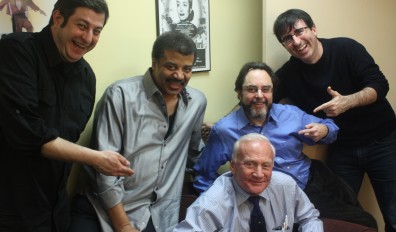
The crew of StarTalk Live continues their inaugural mission to Town Hall with a far-ranging discussion of space exploration. From asteroid deflection to the colonization of Mars, Commander Neil deGrasse Tyson, Co-Pilot Eugene Mirman, Apollo 11 moonwalker Buzz Aldrin, Andrew Chaikin and John Oliver go where no one has gone before. You’ll find out what Al Qaeda, the U.S. Senate, Maggie Thatcher, Russia, Spiro Agnew, NASA and the Tea Party have in common. You’ll hear about Carl Sagan’s plan for creating an atmosphere on Mars… and the reasons it might not work. You’ll also learn about the Voyager missions, Chinese research into gravity wave propulsion, and the challenges to terraforming Mars, which involve more than just putting up a habitation dome using robots. As Buzz Aldrin says, “Try milking a cow in a space suit.”
Transcript
DOWNLOAD SRT
Welcome to StarTalk, your place in the universe where science and pop culture collide. StarTalk begins right now. From Town Hall, Midtown, New York, welcome back to StarTalk Live! I'm your host, Neil deGrasse Tyson. I'm an astrophysicist with the...
Welcome to StarTalk, your place in the universe where science and pop culture collide.
StarTalk begins right now.
From Town Hall, Midtown, New York, welcome back to StarTalk Live!
I'm your host, Neil deGrasse Tyson.
I'm an astrophysicist with the American Museum of Natural History right here in New York, where I also serve as the director of the Hayden Planetarium.
And I've got with me Eugene Mirman, comedian extraordinaire.
Eugene, thank you.
And John, you've got this regular gig on The Daily Show.
I do, that's right.
Normally, it would be cool, but I am sitting with an astronaut.
So it only compounds the failure that the six-year-old version of myself.
And Andy Chaikin, you've become a journalist in your later years, an author writing about space and a geologist by background, a planetary geologist.
Welcome to StarTalk Live.
The one, the only, the truly inimitable Buzz Aldrin.
So Buzz, in the 1950s and 60s, everybody expected we'd be on Mars by like 1980, given the trajectory we were on.
Were you disappointed?
Yeah, but I knew we weren't going to do that, because that's what Spiro Agnew said.
Spiro Agnew said exactly what?
Well, after we came back from the moon, there was a space task study group, and he headed it up, and he said, if we really work hard, spend a lot of money, maybe we could get to Mars in 1980, 1985.
If we're kind of lackadaisical about it, it may take until 1995.
We were super lackadaisical.
Do you think that what America always needs is the threat that someone else might do something first?
Because it seems like part of the space program you were able to do well done, by the way, was in competition with the Russians.
Do you think it's going to take someone, be it China or Britain, we could still do it.
I'm trying to help you guys.
Do you think if we, Britain, said, we're going to Mars, America would say, no, we're going to get there, or do you think America would just laugh and say, that's sweet?
Maggie Thatcher kind of screwed you guys up.
Well, in so many more ways than I can even get into now.
But do you think that would be the best thing for a pioneering American space program, the threat that China may go to Mars first or Al-Qaeda?
Al-Qaeda.
If only Bin Laden were hiding on Mars.
Do you think then there would be the popular will to know we need to do that first?
Whatever we do, I think we should have a solid plan that leads to US leadership in what we're doing.
But Buzz, you admitted that in the 1960s, we were followers, not leaders.
We reacted to everything Russia did.
So John's point has got to be taken seriously.
Here's the thing, and I'm putting on my historian hat.
We went to the moon for the first time as a substitute for fighting a shooting war with the Soviet Union.
Good thing, glad we did it, but it was funded like a war.
And we won that war, we got there ahead of the Soviets.
The money flowed like rivers.
Money was a river.
And in fact, it ended up paying for a lot of other stuff like the Mars landing with Viking and the Voyager Grand Tour of the outer solar system.
But then once that was gone, once the political imperative was gone, that's not going to come again.
And I think the unfinished business is to lower the cost of getting into space so that we don't have to break the bank to do things like going back to the moon and going to Mars.
You ever heard of SLS?
Yeah, it's a mistake, I think.
Right.
Tell them.
It's the Senate Launch System.
Well, that's the nickname.
It's the Space Launch System, but everybody calls it the Senate Launch System because the Senate basically rammed it down NASA's throat and said, well, no, you will build this huge booster and it will cost a billion dollars per launch.
Buzz disagrees, but go on.
They mandated, that means they made certain, they passed the law, that it would be Mandate has two definitions.
constructed of heritage components.
Now, that's a fancy word for old stuff, right?
That lets people keep their jobs so that the Senators can get the votes.
And our space program, is it going to be run by Senators who want to get elected at the next election or based on a solid American leadership?
The first one, sadly.
I'm afraid you're right.
Unless you're provoked.
Unless America is provoked into looking beyond those things.
So our panel here is in consensus when we say, we do not have the incentive to lead unless someone is chasing us in some kind of way that freaks us out, or where we feel threatened economically, culturally, socially, militaristically.
If that doesn't happen, I don't think the evidence shows that we're going to go anywhere.
But there's other definitions of leadership.
Why can't we lead in developing lower cost ways of getting into space?
Because no one will get elected.
But I think if the Tea Party tomorrow said, we're going to space, the rest of America would be like, we're going to beat you there.
Just one plan, the same thing when Delaware did it.
So you want to be your own paysetter then?
Yeah.
Stephen Hawking, about a year and a half ago, say that the earth has about 200 years before it should establish a colony off earth to guarantee the survival of the human race.
Why did he say that?
He's worried about asteroids and runaway viruses and stuff that will render us extinct.
And he wants to protect the human genome.
But what does that guy?
Oh, everything.
I just worry that if in fact we do colonize another planet, then the asteroid is ready to render one of them extinct.
Do you just, does the other planet just say, bye, well, how about the billions of people that are there?
What do I rather do?
Rather than think that that's going to solve our problem, whatever effort it is required to colonize another planet, it's got to be easier to deflect the asteroid.
If you know about it in enough advance warning.
The big ones, you know about it.
The ones that could render us extinct, we got them.
How about diversifying doing both?
I would put enough money to save the human race with both options.
I would just put a few people on the moon, some on Mars, and then also a big laser gun.
Give all the money to Bruce Willis.
He's done it once, he'll do it again.
Yippee-ki-yay, Mother Asteroid.
That's exactly what we said.
What are the dangers going to Mars?
The time you're away from Earth, who knows what that means in terms of your physiology?
Suppose you catch some disease, and you didn't happen to bring that medicine cabinet with you for that problem, and plus there's the radiation from the sun.
What is your plan to go to Mars with your colony who never wants to come back and have them stay alive?
No, who is legally bound to stay?
It's different.
They signed the document.
They might want to come back.
There are no cows, there's no potato plants.
How are they going to survive?
We have to terraform Mars first.
No, no, you can put in an order and it'll get delivered two years later.
You owe me one million dollars, seamless web.
Call me tomorrow.
So you're literally talking about, like, you know, room service or delivery, Chinese takeout, right?
I'm talking about building a base there before you ever go down and land.
We didn't do that in Nepal.
Right, there was nothing.
We just landed and we took what we brought with us.
You built the base robotically before you set it up.
Yeah, from Phobos, less than a second away.
Oh, okay.
So this is setting up an advanced team on the moon of Mars Phobos, where you're not dealing with all the problems of landing, but you can radio control, you can drive the rovers around on Mars.
And why can't we drive the rovers from here?
We can.
Because it takes four minutes or longer, if it's closest to us, to get a message there.
So the watch out for the cliff doesn't work.
Because of the travel time of the radio signal, you lose your hardware.
And there's another problem psychologically with that, because when Mars is on the opposite side of the sun from us, and even when it's close, it's anywhere from 10 to 20 minutes, one way to send a radio signal.
So you will not have a real time conversation the whole time you're away from Earth and on Mars.
When you're on Mars and the Earth, everybody you know, every place you've ever been, is just that star in the sky.
What's that going to do psychologically?
He's saying it's not any different from the Pilgrims.
You pitch tent with the people you went there with.
The Pilgrims didn't know that America was not like Mars.
Yeah, but Mars doesn't look like, you know, trees and rivers and...
All right, so Buzz, you're saying you'd be cargo with food and supplies.
They'd be sent from Earth.
It'd be like the care package.
Then you start growing things.
Start growing things.
And it doesn't get very hot over the sun beaming for 14 days, the way it does on the moon.
Right.
It's about 24 hours, a little bit more than that.
So, a day on the moon is 29 days, day and night, and a day on Mars is like Earth, 24 hours.
So, would we have Mars cows?
Mars farm animals?
I don't think so.
They would need space suits.
That's a funny picture, I guess.
Try milking a cow in a space suit.
Wait, how would they have enough water?
You went just for eight days, so I could imagine that, but how would you have enough water to not come back to Earth?
There's a lot of water on Mars, and you can see it on the North Pole and the South Pole.
Oh, you could go and get it.
It's got ice caps.
Well, no, it's down underneath.
Even below the surface at lower latitudes, you can drill down.
And it's water like our water is, or it's water like it's irradiated and you'll get a Martian flu that you didn't bring the medicine cabinet for.
Or you just drop a little iodine, like it's the Appalachian Trail of Mars.
I'm pretty sure H2O is H2O wherever in the universe you find it.
And you're pretty sure it's H2O on Mars and not like H2, 2, 2, 2, 2-O.
Almost what we can drink.
Oops, I'm dead.
There is something called CO2.
Yeah, don't drink that.
It's colder than water.
How would we maintain the attention of people on Earth?
Because we've proven ourselves over the last 50 years to have a great capacity for being jaded with stuff almost instantly.
So you think about the Apollo programs.
We went to the moon a few times and that seems to be all it took people to go, oh yeah, that thing we do.
How would we get a colony on Mars to entertain us enough?
So we wouldn't just assume, oh yeah, there's that colony, I wonder what they've been up to.
Probably that cow weird cow milking thing.
That was fun the third time I saw it and then I just got bored.
You think we're the kind of nation that's going to send people to some place at Mars and then forget it?
Not to forget it.
But I worry that part of a space program now is the key is how to entertain people.
It's depressing as it is to say how to entertain people here enough to sustain their interest because we've become such appalling human beings.
Have you got some tapes of your comedic stuff?
I would like to know what it felt like to completely die on another planet.
Buzz, what are your views on terraforming?
It takes a long time to do it.
So you don't think that's a realistic between step?
Well, I think you can gradually modify things.
You can get the soil and you can put some water on it and probably grow things.
I'm convinced you can.
You have to do it over the whole planet and have the plants get oxygen.
No, like a greenhouse.
Oh, a bubble, a HAB module of some kind.
Neil, can you remind Eugene, you're not telling us, can you remind us what terraform is?
Terra.
Terra.
Terra, that's the earth.
They did it in Star Trek 3 where they were like the surfers, but they're like the Genesis program.
Duh, it was in Star Trek.
So that is what it is.
Yeah, I'm just reminding you that it was in Star Trek.
Okay, that jogs the memory identity.
You just blow up a planet and turn it into earth and then the Klinons are like, ahhh.
So the Genesis planet where the Genesis plan was they could take a planet and turn it into an oasis, an Eden, if you will, and then you come in after and live there.
So Carl Sagan's idea was that you would sprinkle very, very fine black dust on the south polar cap, which is made out of frozen carbon dioxide.
It would absorb more heat from the sun.
It would evaporate into the atmosphere.
Because being white, it reflects most of its energy from the sun.
Make it a little dark, it absorbs.
And so you liberate all that frozen CO2 to go into the atmosphere.
You thicken up the atmosphere and then you can start making Mars more earth-like.
In fact, you thicken it with CO2, which is a greenhouse gas, trapping more solar energy, warming up the Martian temperature.
But so, here's two problems with that.
Mars is only half the size of the earth.
And it has 38% of the gravity.
So how does it hold on to that atmosphere?
And it has no magnetic field to speak of.
So the solar wind, the subatomic particles from the sun, are sandblasting that atmosphere away.
So even if you can evaporate all that CO2 into the air, how do you keep it?
OK, so terraforming has issues.
But to Buzz's point, if you make a bubble, the bubble is insulated, and that's like the earth bubble.
Right?
It's the earth bubble.
Then you put your cows in there, and you don't have to milk them with...
Dome cities.
You're living in a dome city.
Dome cities.
What holds the dome up?
Air pressure?
Yeah.
Do you think that people would come...
We've seen the pictures of what Mars looks like, and I love Mars as a planet as much as anybody, but to look at it every day with the brown dust and the brown sky, which is the dust floating in the air, do you think people would learn to love that?
People who came from the Earth, their children, their grandchildren?
Would they start to feel like that's home?
They will be the most remembered, the most talked about pioneers that have ever set foot on Earth, because they pioneered something that nobody ever did, and they carried it out.
The leader who makes a commitment for human beings on the planet Earth.
How long we've been here?
We came down from the trees, whatever, and we've done kind of piddling things, but all of a sudden...
Couple of cool things, I think.
Earth is 5,000 years old, but anyway...
Thousands of years in the future, the person on Earth that kind of pushed human beings to go and establish a settlement that began to grow and grow.
You don't think that's a small thing in the history of mankind?
Oh, I do, but I think I'm asking for the people who are actually living on Mars.
Will they feel that they are happy in their lives?
There will be more movies written about them, more books and everything.
I think it's like Leica the dog.
Leica died, but it was a mutt stray dog running through the streets of Moscow, and now it's more famous than Lassie.
So if I were a mutt dog, I would want to die in space, because people would talk about me.
They'll be the velvet underground of space exploration.
If only that dog could understand the concept of fame, and not just the concept of, Oh my God, what's happening to me?
Buzz, do you want to go to Mars?
No?
You're writing books about sending people to Mars one way.
Why can't you go to Mars?
It's not one way.
It's permanent, settled.
It's a movement outward.
So why don't you want to be on that first colony?
I'm not going to be around that long.
If you were around that long, would you go?
Probably not.
What?
But how many people are there here on Earth?
There are a bunch of crazies that would want to go and do that.
You want to send crazy people, you want to send Donald Trump, wealthy, crazy, fancy.
Donald Trump, Chad O.
Chosynko, it's quite a team that you could put on up there.
I want to see what the hair does in zero gravity.
Alright, so to Buzz's point, there was a, was it a survey or some kind of a poll taken and people were asked, if we could send you on a one-way trip to Mars, would you go?
And there was no shortage of people who wanted to go and perhaps not all of them are crazy.
They just like the adventure, like the people who dangle off of cliff faces and climb out Everest, like they'd want to do something where their life is at risk.
Would you do that?
You ask me, would you?
I mean, you got to do something in this life of yours.
He just talked to you like you're parents at Thanksgiving.
Come on, Neil, do something.
It was an expensive education we paid for.
You can't play with planetariums the whole life.
You want to spend the rest of your life looking at a dome over you?
If I could bring my family and get a good Netflix account and some books.
Ten minutes for it to get there.
My wife is very well educated.
We can both totally space school space, home school, spaceship school our kids.
So then there's a family trip.
I could totally do that.
Yeah, but your kids would be furious.
They were like, yeah, we know all this math now.
We have no access to any movies before right this moment.
Teach us again how great Earth was.
Buzz, three years ago, I was asked by the NewsHour, their online edition, to tell them what I thought were the biggest news stories of the year in science.
Are they still waiting?
So they expected, I think, a traditional response.
Oh, the discovery of this.
A month before they asked me that question, this is December, Russia came out with an announcement that they were going to fund a mission to deflect asteroid Apophis.
This is a 300 meter class asteroid, the size of the Rose Bowl, that pretty much has Earth in its sights.
And I thought that was the biggest news story of the year, because they went around saying, who's going to join us?
And America said, yeah, we'll join you, and I thought, wait a minute, something's wrong.
Or something doesn't feel right about that, because it means somebody else is leading a space mission, and we're following.
And I'll share your sentiment here, where I think it's better to lead, particularly if you have the talent and the resources and the finance, lead.
Especially if the consequence is you save Earth.
You could have one, if you'd save the Earth.
So Buzz, how do we use your celebrity to get America to lead again?
Do something that nobody else is going to do.
Do what Dennis Tito is saying he's going to do.
He's going to fly around Mars.
If you do it, you're a leader.
But that's, you know, as they said in my neighborhood, you know, I can't repeat it here.
But what's the gist of it though?
What's the gist of it?
The gist of it is, if something walks and something else talks.
Money talks and, yeah, and bologna sandwiches walks.
So I'm asking, is he going to succeed?
It's one thing to lead, to say you're going to lead, and then you just die.
All right.
You know, how about Arnold Schmednick, who was the first person to go to the New World and then a hurricane took him.
We never heard of him.
There he's in the bottom of the ocean.
We're not even talking about another possibility.
Why can't this be an international effort?
Why do we have to do it alone?
It won't get done.
The thing is, there is something in that, though.
The way you talk about harnessing asteroids and so on, I'm sure it all sounds fiscally very smart, and maybe we could go up a little bit cheaper, but there is something about doing something borderline insane that does actually inspire people.
Going to the moon was crazy.
That was what was so incredible about it.
Going around Mars barely makes any sense, so it's kind of inherently inspirational.
So having the way Buzz talks is always going to inspire in a way that we could do it cheaper or we could harness energy does not have the same impact.
Saying, we'll do it because we'll do it and it'll be great and we're going to do it and it's going to be fine.
I will follow him.
You seem great.
So John, your thesis is the crazier the idea, the more audacious the idea, the more power it has of influence.
That's what America is built on.
It's built on doing something that makes almost no sense to anyone else at the time.
Certainly not to England.
Yeah, it made no sense.
We just wanted a little bit of tax.
Anyway, I don't want to go on.
What you did was unforgivable, but that's not the point.
So Buzz, you like the audacious idea.
Absolutely.
Nothing ventured, nothing gained.
Give me five audacious ideas.
Do you want to visit Europa?
That's too far away.
The moon was far away in 1962.
Sending people one way to Mars wasn't audacious enough for you?
The colony on Mars, that's audacious.
The reformation of the original Guns N Roses.
That just shows how jaded we get them.
Because he's proposing a colony on Mars and you want four other ideas.
You can't be bored by that.
Sure, that's one buzz.
One is fine when it's that.
But here's the thing about Mars that's so neat.
And this is something that Ray Bradbury pointed out.
When you go to Mars, if you can make it on Mars, baby, you can make it anywhere because you've got the cord with Earth.
You have become a multi-planet species and from there, you're on your way to the stars.
Once you get the hang of living on Mars, if you can solve all those problems, then the rest of the solar system opens up.
Mars is the easiest.
Yeah.
Mars is the easiest.
It's the closest, it's the most Earth-like.
What we learned during the Voyager missions, those old enough in the audience might remember, there were two Voyager missions and they had enough energy of motion to actually escape the solar system entirely.
They're still going and to their side was attached messages for what we might define as intelligent aliens who would find the craft.
It also gave our return address here, which is a bit controversial because you don't give your email address to people you don't want.
Here we're giving the address of the solar system.
You think Facebook is bad.
The point is, it was a fortuitous time in the solar system where the spaceship could do triple bank turns around multiple planets and get close-up views before it exited the solar system.
From my memory of that era, that was the first time we gave meaning to the moons of the giant planets.
We realized that one moon has a volcano, this has an atmosphere.
Not just a volcano, it's the most volcanic world in the solar system.
That would be Io.
That's right.
Io around Jupiter.
Have you thought about moons, habitable moons?
I mean, why not?
No, I've thought about stars.
Stars.
Stars.
How do you get to another star?
In your lifetime, the speed of Voyager, at that speed, it will get to the nearest stars in 75,000 years.
That's somewhat longer than a human life expectancy.
A little faster.
So how do you pull this off?
Gravity waves.
When I wrote my science fiction story, it was zero point energy.
But that isn't as jazzy as gravity waves.
Maybe the emphasis there is on the word fiction in science fiction, is it not?
The only problem is, in the study of gravity waves, China is ahead of us.
That's the best thing that could happen.
So who would have thought there's a gravity wave gap in the international politics?
So just to clarify, zero point energy in the vacuum of space where there is nothing, quantum physics requires that there are fluctuations in the energy level of nothing.
And there's some expectation, particularly from people who would like to write a science fiction story on it, that you can tap that energy rising up into your grasp in the vacuum of space without having to carry fuel tanks with you.
So you want to surf a gravity wave.
You get the gravity wave in front of you to be a little lower and the one behind and you.
The fabric of space and time can be distorted in the presence of mass or any kind of energy at all.
And so if you rapidly disrupt a region of space time, you can send a ripple through the fabric of space and time.
So three dimensional ripple goes out in all directions.
So you get two of them, one a little more energetic than the one in front of you, just like Buzz says, in principle, if you know how to ride that ripple, you will go at the speed of light to wherever you want to go.
But there's still an issue here.
Space is really, really, really big, vast, expansive, possibly infinite.
Is it just science fiction or is it...?
Gravity waves exist.
We know what makes them.
We don't have the power to make them the way nature makes them.
But it's certainly legitimate material for a science fiction.
Is it something that we could eventually make?
If we...
Maybe.
We would need much more energy than anything we could possibly dig out under the sands of the Middle East.
How about if you frack, can you frack gravity waves?
Can you frack a gravity wave?
In the news, Dennis Tito wants to send to...
What's the latest on this?
So Dennis Tito had a news conference today.
He announced that he and his group want to send a man and a woman from the earth to loop around Mars and come back in 2018.
He is going to put $100 million of his own money into the project.
He wants to get the rest by public donations.
The rest would be most of the money.
$100 million is nothing.
$100 million?
Oh, sorry, that big spread.
When you go into space, do you realize when the space shuttle, if it can't land in Florida because it's like thunderstorming and it's got to go to Edwards Air Force Base and it's got to stay in orbit another day, it's $100 million.
Just the extra day it's in space to land.
Insane Kickstarter campaign we're talking about.
Unimaginable.
One possible way is there's a fellow named Elon Musk who maybe you guys know about Tesla motor cars.
He also has a rocket company called SpaceX.
So SpaceX is the company that is trying to lower the cost of getting into space.
They're about to do their second cargo flight to the space station.
He's going to develop a human carrying version of that capsule.
And I think what Tito wants to do is something like, maybe with Musk's company or maybe with a different company, a capsule on a big rocket and maybe stick an inflatable habitat at the other end of the capsule, send the capsule in the habitat off to Mars.
Once you leave the Earth, you're committed.
You ain't coming back for 500 days.
And it's got to happen in 2018 because of the way the planets have lined up to make it the minimum energy requirements.
And you aim it just right so that you loop around Mars and the gravity of Mars bends your flight path to come back to the Earth.
Just to remind people, you are not aiming for where Mars is, you're aiming for where it will be when you arrive.
But they'll have GPS or something.
What's that?
You don't want to hit Mars.
You want to go past it.
You want to aim for it slightly near where Mars was.
I think it's a neat idea, but I mean, he wants to do this in 2018.
Is he going?
No, he is not going.
He's picked, why a man and a woman?
The funds.
That's heteronormal, I think is the word.
Is that the word?
He should pick just any people who want to do it.
Nothing.
I don't want to say it, if no one here knows, but there's a super-fun thing people can do.
The idea is that the two people are romantically compatible, I guess that's it.
Yes, and he also made the point he would like them to have had children and to have been older because, of course, it is likely to make you infertile that trip.
So he wants an older couple.
The radiation.
The radiation.
Zap your gonads.
This is radiation.
Now you get it.
But not zap the fun.
So just to clarify.
That's an important clarification.
I'm not talking about.
It slips some physics in.
So just to clarify.
The sun gives us not only light, and that light brings warmth, it sends charged particles of very high energy racing off of its surface.
And sometimes those come in huge pulses, and they're called solar flares.
That's actually not the problem with the mission in 2018, because the sun will be at a minimum of activity.
But why is that bad?
That's bad because the sun's solar wind acts to screen out galactic cosmic rays when the sun is active.
So if the sun is at a minimum of activity, it means you've got a bigger threat from galactic cosmic rays, which solar flare particles will kill you if you're exposed to them in a matter of days.
Galactic cosmic rays increase your lifetime risk of cancer over many, many years.
And which one of those rays makes you the Hulk?
That's what people want to know.
So, it's risky.
So, we're going to tell Columbus to go back.
I'm saying how do you do it?
How do you make a machine that will be reliable enough to function for 500 days without spare parts from Earth?
Buzz, in 1962, did we know how to go to the moon in 1962?
No.
There's your answer.
That's a very facile answer.
Facile.
But if we had tried to send somebody to the moon, we decided to go in 61.
If we tried to send somebody to the moon in 64, 65, and they died, how well would that have gone over?
We took all that time to figure out how to go in a way that wouldn't kill people.
Kill joy.
So it's not that we couldn't figure out a way to get there.
It has to be human safe.
Well, it has to be reasonable.
You know, one of the comparisons that people use is it should be about climbing Mount Everest.
You know?
The risk factor.
You climb Everest, you know, what is it?
One in 20 people, one in 50 people don't come back.
We should have guides that are already there, Sherpas and Mars, they bring them here and they guide us on our little walk to Mars and they're like, oh, you're adorable, you're a peep head.
I thought we were going to parachute people onto the top of the...
I mean, I think it's a spectacular idea for the long-term future of humanity, but I think we've got to do the groundwork and the moon is...
So that we don't die.
So that we don't become sterile.
What happened?
Kind of interferes with having a colony.
I kind of agree with Buzz.
Columbus didn't know there'd be land.
Why am I not surprised?
Columbus didn't know there'd be trees.
He didn't know anything.
He just knew it was India and here he is.
And it worked out fine.
This is StarTalk Live at Town Hall, everybody!
See the full transcript



 Unlock with Patreon




 Become a Patron