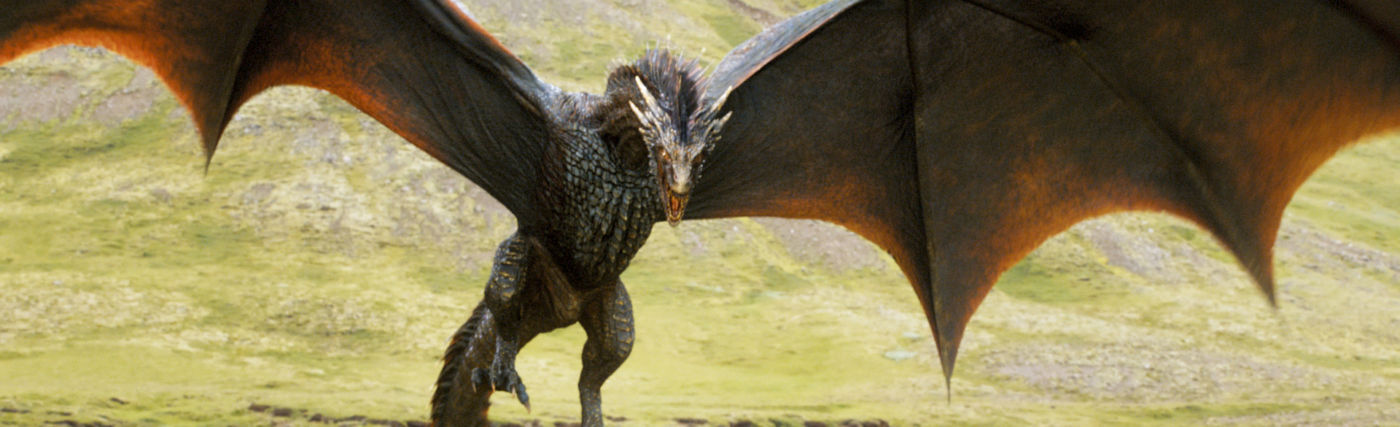
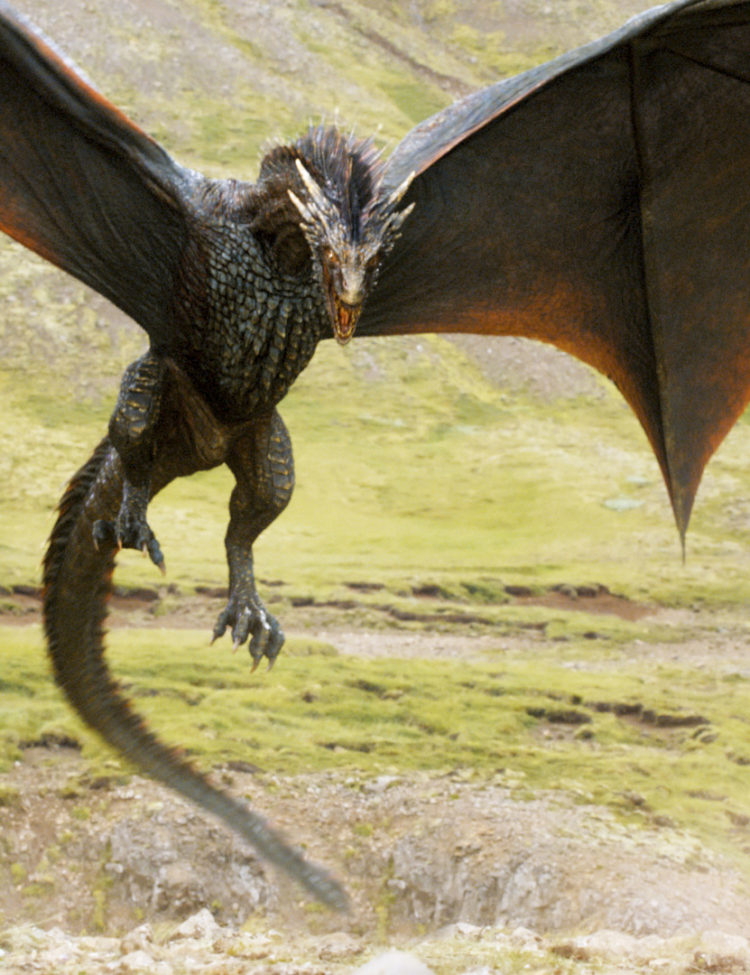
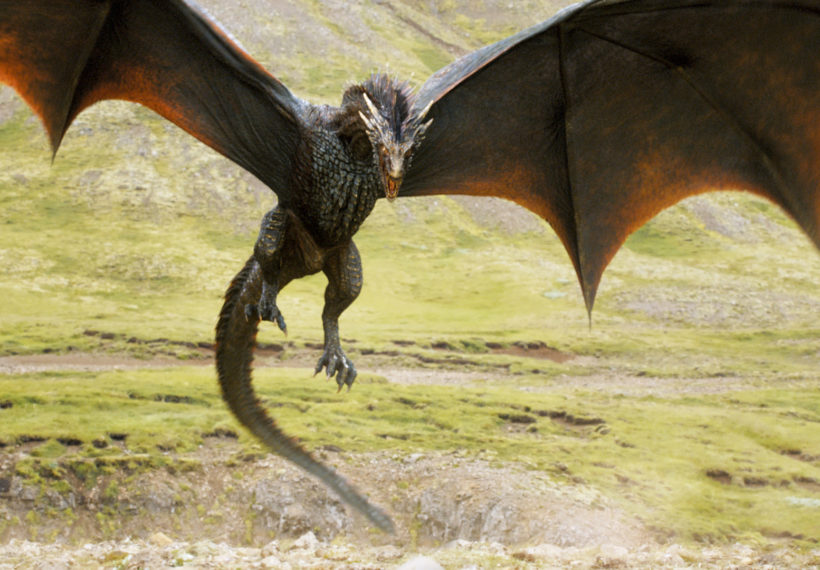
Dragons, Violence, and Magic – What mega-hit TV series has all that and more? This Friday, we’re talking about Game of Thrones with Neil deGrasse Tyson, cast member Isaac Hempstead Wright, comic co-host Michael Ian Black, author Helen Keen, and psychologist Travis Langley. Isaac tells Neil about what it’s been like to “grow up” on Game of Thrones, his character Bran Stark, his interests in physics, and the geekiest thing he’s ever done. But as with our episode about The Walking Dead, it’s time to geek out StarTalk Style. Join us as Neil investigates the source of myths and legends about dragons: how they might be based on medieval discoveries of dinosaur fossils and how dragons might be connected to the primal evolutionary fear and alarm calls of vervet monkeys. Ponder the physics of breathing fire. Travis discusses the brutality and violence in the show and the psychological effects watching violence on television can have on viewers. You’ll also hear about direwolves, the role magic played during the Middle Ages, the historical connections found in Game of Thrones (including what might be the real life inspiration for “The Wall” and the Red Wedding), Bran Stark’s abilities to see into the past and the future, real-life mind-control abilities found in nature, and the relationship between religion and scientific advancement. Plus Neil answers fan-submitted Cosmic Queries about comets, Westeros, and more!
Transcript
DOWNLOAD SRT
Welcome to StarTalk, your place in the universe where science and pop culture collide. StarTalk begins right now. I'm Neil deGrasse Tyson, your personal astrophysicist, and this is StarTalk. Tonight, we're going to explore the science behind the hit TV...
Welcome to StarTalk, your place in the universe where science and pop culture collide.
StarTalk begins right now.
I'm Neil deGrasse Tyson, your personal astrophysicist, and this is StarTalk.
Tonight, we're going to explore the science behind the hit TV series Game of Thrones.
From flying, fire-breathing dragons to magic, to what it takes to survive in the Middle Ages.
So let's do this.
Thanks.
I never tackle these subjects alone.
First, my co-host, Michael Ian Black.
Hello.
It's a professional comedian, and you are not a stranger to StarTalk?
No, I had the StarTalk jigsaw puzzle, I had the StarTalk stuffed animals.
So tonight, our topic is, of course, Game of Thrones, and I don't claim particular expertise in that, but other people do, especially this woman here, Helen Keen.
Helen, welcome to StarTalk.
We're gonna draw heavily on your expertise in this regard, because we couldn't believe this.
You wrote a book called The Science of Game of Thrones.
Destiny, it's destiny.
And I'm surprised it's even this thick.
Lots of pictures.
So let's get a taste of why Game of Thrones, it's such a pop culture phenom.
Let's check out this clip.
Wherever you are, wherever you go, someone wants to murder you.
Are you afraid?
Love me some fire-breathing dragons.
So this is based on a series, a fantasy series by George RR.
Martin of the same title.
And that program averages 23 million views per episode.
So Helen, this is set in a medieval age.
And so, to just put us on record, what defines a medieval age?
Is that even the right thing?
Or is it the dark ages?
What is it?
Well, I think it's kind of a term, it's always controversy around these things.
It's a term for the period in European history from the end of the Roman Empire, so about 400, 500 AD until the 15th century.
Wow, so this is 1,000 years.
But there are some things that are clearly, it seems to me, post-dark ages or very late Middle Ages.
So it's clearly a mixture of times to enable him to tell whatever story he wants.
Yeah.
That doesn't bother people, because it's fantasy, I guess, is that right?
And I think as well, any fantasy or science fiction always to a certain degree reflects the world that it's made in as well.
Okay, so I was out at Comic-Con, and we stumbled on one of the actors, Isaac Wright.
Isaac Wright who plays the character Bran Stark in the series on HBO.
Let's check it out.
So how old are you?
17.
17, and the show's been on for six years.
Yeah.
And you've been in there from the beginning.
Yeah.
So, do, do, do, do, carry the tube, and you would have been 11.
I think I was actually 10, because we did a pilot as well.
Oh, okay.
So you're a career Game of Thrones guy.
Yeah, that's me.
Game of Thrones for life.
So they've got to write your character to age with you.
Yeah, luckily for me.
Because when you're grown up, you kind of stay the same the whole time.
Yeah, it doesn't happen when you're this age.
Did you, as a kid, you wanted to be an actor?
Not especially.
No, I kind of fell into that.
Don't tell.
Sorry, yeah, it was my dream.
Were you a geeky kid or you're still geeky?
Definitely geeky.
Definitely.
Oh, you're card carrying.
Yeah.
Okay, excellent.
And what's your best measure of your geekitude?
Well, I'm big into physics.
Physics?
Yeah, I like physics.
If you're into physics, that's good.
We're done here.
Physics, so in the UK, do you have tutors or do you actually go to school?
No, I go to school.
You go to school, okay.
So that just means that the show is not taking you away all the time every day.
Well, it means that when I film the show, I just have to kind of take any work that I know I'm going to miss and try and get it done at the weekends or whenever I've got some days off.
Okay, so where are you this year in your educational trajectory?
So I'm year 12, which is...
So there'd be a senior in high school for us.
I think so, so I have one more year before college.
Before college, so what do you want to major in?
I think I'd quite like to do a joint honours in music and maths.
Music and maths, okay, cool.
Do you do music now?
Yeah.
What do you do?
I play piano mainly, but I'm playing a bit of guitar.
Okay, this is great.
I just met, recently, Brian May.
Oh, cool, he's the king of physics in your manor.
It's like I really wanted PhD in astrophysics, but I will...
You're a rock star.
Yeah, let me be a rock star first.
Let me delay that.
So Brian May, like lead guitarist of Queen, has a PhD in astrophysics.
Can't get cooler than that.
And Brian Cox as well.
Brian Cox.
Keyboard.
Yeah, Brian Cox, one of the best known scientists in the UK.
And many of us know him here as well, but it's not as big as he is in the UK.
But he was also a rock star in the UK, right?
Yeah, he was.
He had a top 10 song one year.
Yeah, so this may be the trend line.
Yeah.
So yeah, you'll be a famous actor, then a musician, then you get your PhD.
Yeah, sounds like a plan.
That's a plan.
We got this.
Tell your parents that you got this going, all right?
So what's the geekiest thing you ever did?
Ooh.
So it's got to be so geeky that you are simultaneously embarrassed and proud of it.
Oh.
I can recite Pi to quite a few decimal places.
Oh, oh.
How many decimal places?
It used to be 60, but I think it's down to about 40 now.
Ooh.
I know, I'm sorry.
Ooh, okay.
Well, why don't we get you on record for that?
All right.
And now, just so you know, 40, 50, 60, among Pi people?
That's mild.
Yeah, that's entry-level.
Yeah, I know.
They won't even let you in the bar, okay?
Some guy can do it to 67,000.
Yeah, I know.
That's what I'm saying.
But, but, but, among actors.
Yeah.
Maybe you win, okay?
So let's go.
Let's get the camera on him.
I'll rub your shoulders here.
Ready?
Okay.
Get ready.
Okay.
I'll start you off.
0.14159265358979323846264338327950.
How many did we get there?
You know who did really well?
Chris Hardwick.
Oh.
Because he majored in math and philosophy.
Oh.
So we had him on.
He went on.
It was like, can we stop him?
Can we stop him now, please?
No, but that's good.
That is plenty of precision to make any calculation you need to know where the universe is.
No, but that's good.
That is plenty of precision to make any calculation you need to know where the universe is.
The universe.
We will take that as card carrying.
We are coming out.
So I am convinced that they mistranslated that line in the Bible.
It's, and the geek shall inherit the earth.
So, had you imagined that this was something that would go this long?
No.
No, I mean, these kind of, you, there are every now and then…
You are supposed to say at this point, I would really rather direct.
I think every now and then you come across these shows that click and work and then kind of snowball into these huge phenomenons.
Why do you think it clicked and worked?
I think what's cool about Game of Thrones is it is medieval history but without kind of the historical aspect, if you get what I mean, because it has that sort of basis in reality, but there's still room to explore all these fantastical elements.
So the room to explore layered on top of enough that is medievally real, I guess that anchors it.
And is there anything that surprised you the most about it?
Because when I think about the medieval times, I'm just thinking I am so glad science got invented.
That's all I'm thinking.
Yeah, I completely concur.
They did what?
They believed what?
I think that's very evident in Game of Thrones.
You've got all these weird kind of religious sects and strange things going on.
And magic is real.
Yeah.
Gods are real.
What's interesting is the way Game of Thrones presents it is everyone in the world is sceptical about it.
They don't really believe that there are the dragons there and that all these white walkers died thousands of years ago.
But then there are the believers there where stuff actually happens.
Yeah, yeah.
Now you've got to deal with that.
Absolutely.
There were obviously so many things that back in those days you wouldn't have been able to explain or anticipate.
And so naturally you assume it's magic.
So Helen, tell me about what role magic played in the Middle Ages.
Well, I think in the Middle Ages magic and religion weren't really particularly separated.
I mean, I think there was an element in religion that was magic and an element in magic that was religion.
The mysterious.
Yeah.
I mean, and I think we go, if we go back even further.
So you don't think there was even a distinction?
There was just all mystery that you don't understand.
And there's somebody who's telling you about it.
Yeah.
And it's either coming from God, it's either coming from a good source or it's coming from demons and Satan.
So yeah.
Because you can't have a good source unless there's an evil source.
No, of course.
The yin and the yang.
Yeah.
The up and the down.
The up and the down.
The backwards and the forwards.
I get it, man.
Just try to stay with the cover.
No, I'm het.
I get it.
But there are other things.
So for example, remember Merlin from Arthurian legend.
In almost all of these stories, there's somebody who knows some chemistry or alchemy, and they've got power.
This would be medieval magic.
It's something that you don't expect.
It's something mysterious happening.
And in any pre-scientific era, if you do something that's scientific and don't explain it, it's magic.
One of the things that fascinates me most, of course, or I think anyone, is dragons.
They're just the coolest.
We all want a dragon.
What is the history of dragons?
Where do they originate, do you know?
Well, that's one of the interesting things.
They seem to originate all over the world.
There are lots and lots of different countries and cultures that all have a dragon myth.
All fire breathing?
Not all always fire breathing.
Then it's not a dragon.
I think often fire breathing.
Are the Asian dragons fired breathing, are they?
I don't know.
I know they don't have wings.
Yeah.
So there are different number of limbs as well.
Not all dragons have wings.
Yeah, and there are different number of limbs.
Some dragons have four legs and two wings, and some dragons have two legs and two wings, which would be more evolutionarily plausible.
Yes, yes, yes, exactly.
Yeah, did you get what she said there, it's important.
Let me explain it for the audience at home.
Two legs and two wings is more evolutionarily plausible.
Correct.
Because animals have four, and it would evolve into two, and horns and fangs.
Basically correct.
Yeah, you have four limbs to work with.
Why?
It just is, it's the…
Lame answer.
No, it's the branch of the evolutionary tree that led to mammals and other vertebrates, there are four limbs, and so that's what you're stuck with.
If you want to fly, you've got to give up two of those limbs for wings.
The bats did it, the birds did it.
The bats, their four limbs are wings.
And birds, they don't have front arms.
Those are, their front arms are their wings.
And so yeah, that'd be evolutionary sound.
So I asked one of the actors, Isaac Wright, I asked him about dragons, because that's a major part, a major force in the storytelling.
So let's check out.
How good could a fantasy possibly be, unless it's got dragons?
You need the dragon.
You need the dragons.
And in my home institution, the American Museum of Natural History, we had an exhibit a few years ago that was all about mythical monsters and whether they were the imaginations of people who discovered fossils of extinct dinosaurs.
Wow, that's fantastic.
Yeah.
So imagine, you know triceratops.
Imagine that emerging from the eroding side of a cliff.
That would be pretty…
Right?
And clearly no other animal you've seen.
It's extinct.
But the concept of extinction is a modern idea, though, a few hundred years ago.
So here's this thing.
It must be some monster that we fear in the night.
And so…
So you didn't know about that?
No, no.
I hadn't really thought about that.
Yeah.
You know, I think you love dragons because they're great if they're your friend, but if they're not, they're a super predator.
And that's another theory, actually, about where we have this idea of dragons from that's even more ancient than the idea of people discovering fossils, this idea that it might date back to when we were very frightened of apex predators.
An anthropologist called David E.
Jones, who puts forward this theory, he studied vervet monkeys in Africa, and he noticed that they are particularly anxious about three predators, lions, eagles and snakes.
And so they have a particular cry that they make when they see any of these three creatures.
And if you sort of merge those three creatures together, you sort of get something that resembles a dragon.
And so he again is sort of used this to sort of theorize.
Is this the cry?
Yeah.
You put it through the monkey translator, it is so loud.
So when you think about it, if you have something as ferocious as a lion that has the body type of a serpent such as the snake, but it can fly as a flying predator such as an eagle, yeah, I'll give him that.
So that would be terrible.
So yes, he has this idea that we would have had this sort of passed down through millions of generations, we would sort of evolved this fear that's so great that we've created this amalgamation.
A primal fear.
Where does the fire part come from?
I mean, we're all scared of, I mean, we would be scared of fire.
They just added that after, say we want to make it even more ferocious.
Right, right, right.
Is there anything in nature that, any process by which air can be converted to fire other than like Mexican food?
Well, if it's air, as we think of it, oxygen.
Is flammable.
And it's flammable, no.
I was kidding.
No, it's a common misconception.
Oxygen itself is not flammable.
Otherwise, when you lit a match, you would ignite the atmosphere.
All right.
Yeah, just want to be clear about that.
So what is burning?
So oxygen makes other things burn.
So, oxygen oxidizes things that then themselves burn, and they can make them burn more ferociously than they otherwise would.
There are gases that are themselves flammable when mixed.
So you take the gas that comes out of your stove and you ignite that in the presence of oxygen, that thing just goes.
Same with pure hydrogen, it just goes.
So you could imagine a beast, perhaps, certainly in fantasy world, where there's some process inside that produces flammable gas and then you need some flinting mechanism with its teeth and it ignites it and out comes flame.
When I was at camp, we would light a match, is that the same thing?
It is exactly the same thing.
Except that would be a different kind of dragon, that would be less ferocious.
You didn't smell what came out.
It was pretty ferocious.
It would hold up my tail while I…
That's methane by the way.
Methane, that's one of the interesting theories about where we get this idea of fire breathing from that people have gone underground and they've gone to maybe either mine for minerals like gold or they've gone to look in burial mounds and they've actually encountered, they've been carrying candles, they've encountered methane of a slightly different kind and there's been an explosion and they've thought well maybe there's some terrible huge creature that lives underground and that's just thrown all this fire in our direction.
That's right and underground you have anaerobic life acting when that happens, one of its byproducts is methane.
So you can have methane trapped in pockets and especially in mines as well.
You ignite that flame comes out of the hole, oh my gosh, well you know, there the dragon sleeps.
Yeah, I wouldn't come near that if I were in superstitious times.
But nowadays I just pull out the measuring tools and we got to plug the hole.
So there are other things, there's something on the show called the dire wolf, what is that?
The dire wolves are absolutely enormous wolves, they are the companions of the Stark children, so they're sort of like they guard dogs, come spirit animals almost.
So are they real or are they fantasy?
Well the size that they are on the show is fantastical but they were real dire wolves.
What are their actual dimensions?
They're probably roughly the size of a modern gray wolf, so maybe slightly stockier and they have a sort of more ferocious bite.
So these they just they just pumped them up a little.
Yeah they just made them a lot bigger.
So but they're extinct, we lost them in the ice age, the end of the ice age, so why not bring them back?
Why not?
Okay good, we're glad we agree on that.
So are we almost at a point where we can do that, where we can bring them back?
I'm not authorized to do that.
I don't see why not.
I mean in the very reachable near future.
Alright so if we can do that, then can we combine the snake, the eagle and the lion and make ourselves a dragon?
I like that.
To create the thing that we see her most.
Yes.
What could possibly go wrong?
Well, coming up, more on the science of Game of Thrones.
In particular, we'll talk about the power of mind control on StarTalk.
Bye We're back on StarTalk, right here at the American Museum of Natural History, and we're extracting science from the hit TV series, Game of Thrones, featuring my interview with one of their lead actors, Isaac Wright.
Now, in the show, his character is paralyzed, can't walk, but he's got some serious powers of the mind.
Let's check it out.
He pretty much has the entire history of the universe within his brain, or that's what's eventually gonna manifest itself in there.
And it makes him an incredibly powerful and wise character, I think.
And it's interesting to have that parallel with the fact that he's also such a weak physical character.
Yeah, and of course, what comes to mind is Stephen Hawking, who has brilliant thoughts, yet there's this shell of a physical body that remains.
Another sort of authentic element in the fantasy is that you had this power, but it had to be honed.
Because in all of our superheroes that we talk about, or people with power, when they come into that power, they really don't know how to use it.
Yeah, and that's very much the case with Bran.
And it's been spread over many seasons of him starting to unlock it more and more, and it just starts as this kind of small spark of something.
And he eventually finds himself in this cave of the Three-Eyed Raven, where he can fully explore and learn under the tutelage of a very wise, you know, thousand-year-old tree man.
Helen, a thousand-year-old tree man, could you explain this, please?
Well, just to give you a bit of background on Bran, he essentially walks in on the queen having sex with her brother.
And as a result, he's pushed out of a very high window.
He appears to be hovering between life and death, and he has these visions.
This is episode one of the serial.
The queen is having sex with her brother, and he's a child, walks in, and they push him out the window.
Yes.
And he becomes paralyzed.
Yes.
But then all seeing.
Yes, so he starts to develop these, he starts to have these visions, and he starts to sort of be able to sort of travel beyond his own physical body and into the body of his wolf, his dire wolf, and that's how it all begins, really.
It's clear, it's very clear.
So, but it also meant he had a mentor.
Yes.
The thousand year old tree man.
Yes, thousand year old tree man.
And mentors are, that's a fundamental part of anybody's powers.
But Michael, do you have mentors, comedic mentors?
Sure, sure, but people that, I mean, no, the answer is no.
Well, who is your mentor?
You must have a great science mentor.
I assembled my mentors a la carte.
So there'd be a little piece of this person whose expertise I greatly valued, but it wasn't the totality of what I sought for myself.
Then I find a little bit of expertise in another.
And then you get enough of that, you staple it together, and then you have sort of an amalgamated mentor.
Did you ever meet Carl Sagan?
Yes, so he's a little piece of that.
Right, and was he like the thousand year old tree man imparting the history of the universe into your head?
A little bit, this man, I was in high school and he was already accomplished and hadn't done his cosmos yet, but nonetheless he was fully accomplished.
So a little bit of wisdom came my way.
That has affected me my entire life.
The fact that he gave me any attention at all as a high school kid, age 17, and this is Carl Sagan, already famous, I said if I am ever remotely as famous as he is, I will give time to the next generation of students the way he gave time to me.
And that was just a certain duty.
And a passing of a torch that I felt was fundamental.
If only I felt that with my children.
But I don't.
Well, so of course, Isaac's character, he can see through time.
He's got bad attitude in this department.
So here's more from my interview with Game of Thrones star Isaac Wright.
Check it out.
Bran gets to look at certain events from the past specifically and there were hints at the fact that he might have had some connection with one of the characters in the past.
He sort of shouts and the character turns around but sees nothing.
And it's interesting because it is time travel in a sense.
And I think, as Stephen Hawking famously said, that the greatest evidence that time travel to the past isn't possible is that we haven't had anyone visit us from the future.
And what's interesting about Bran going back in time is that no one can see him when he's back in time.
So maybe that's our route into traveling back in time.
So what's your most memorable time sequence, force-telling moment?
Well, I think the key one from this past season which fits in with the whole kind of deterministic, indeterministic argument with the whole time element is the tragic death of Hodor.
Bran has, in trying to learn about the past of Hodor, has directly resulted in Hodor becoming Hodor.
So I think it definitely just lends to that concept that this was a predestined thing that had to happen.
Explain to me, working?
Working, okay.
Working, what's going on there?
Mystical, magical ability to be able to tank over the mind of another creature or a human being.
Okay, so you become that creature?
Yeah, exactly, exactly.
Okay, well, so to go into the mind of another creature, and it makes me think of this, you know, the singularity that people say we're approaching, when you upload your brain into a computer, and that would be interesting if you can not only upload your brain into a computer, if you could download it into another brain, that asks the question, what is your actual identity?
Right, so when you are occupying the other entity, are you still you, or are you that entity?
I suppose it comes to the end, what is consciousness?
Right, that's what it comes down to.
And that for me I think is one of the most interesting things, because neuroscience is a field that fascinates me, and I think...
Not fascinating enough for you to major it in college, let me just say.
But yet we still know so little about it.
Right, that's why it's fascinating.
And as you said, in the coming years, I think that's going to be exactly where the route that science is going to go down, and that's going to be the next...
Because I'm fascinated that two twins who are genetically identical have separate consciousness.
Yeah, yeah, exactly.
And every morning, not every morning, but more often than I'm ready to admit, I wake up and I say, why am I still me?
Yeah.
And not someone else or vice versa.
Or are you constantly just changing into different ways the whole time?
That's what I wonder.
Is my entity today just what I think I always was?
Yeah.
But yesterday I was actually something different.
Yeah.
Consciousness.
So do you go there in your book here?
A little bit, yeah.
I talk about how there are some quite new experiments that have been done with virtual reality, which can sort of convince the wearer who's got a headset on, that you can basically change someone's identity with virtual reality and they will experience that new body as their own body.
And when it's, they will feel that it's being touched and moved around and it's kind of quite a, it's quite a sort of at the front here.
So it's a modern version of what he just described.
Yeah, yeah.
Except he gets to pick whose mind he occupies.
Here it would be some avatar that you created.
Yes.
A fantasy version of yourself.
Yes, exactly, exactly.
But just the potential for that to sort of give you the experience of living, as they say, a completely different life is quite something, I think.
But it's not just occupying that state, but it's, by the way, the avatar that I occupy, that's me before during and after I occupy it, right?
Am I competing with itself to run its own life?
So that's a little different, just a little.
Right, so what do you know of mind control in nature?
Is there any example of that?
Yeah, I mean, there's some quite disturbing stuff that we see in nature.
I mean, it's interesting what you were saying about...
I didn't know I was gonna get a disturbing answer.
So now, can I retract the question?
Okay, so tell me.
So there's a creature, a tiny, tiny, tiny wasp called the Jewel Wasp, which is very beautiful, very, very small.
And it basically completely takes over the body of a cockroach.
To get the cockroach to raise, it lays its egg on the bottom of the cockroach, its body, and basically the cockroach loses its will to resist the power of the wasp and basically raises the wasp's young and serves as its protector.
Yeah, so basically it protects the wasp's young and it also feeds it, so the wasp's young, as it grows, gradually eats the body of the cockroach.
And the cockroach doesn't complain, it doesn't do anything.
It basically has its mind and its body completely taken over by this tiny creature that's much smaller and much less physically powerful.
My marriage is a lot like that.
Well, coming up next, we'll get into the psychology of Game of Thrones when StarTalk returns.
Welcome back to StarTalk, right here under the sphere of the Hayden Planetarium.
And tonight we're extracting science that can be found in the hit HBO series Game of Thrones.
And here is more of my interview with Game of Thrones actor, Isaac Wright.
You're immersed in this really creepy backwards world.
Oh my gosh.
And had you learned about the Dark Ages or the Middle Ages in school before you stepped into this acting gig?
Only kind of superficially, nothing.
The 10-year-old me wasn't an expert on any kind of medieval history or beheadings and all sorts of Game of Thrones violence.
For me, it was just quite fun to be on a set where you had all these dead bodies that you could play around with.
Didn't really register the violence.
Right, I see, because at 10 it just is.
Yeah, this is cool.
Oh, there's a head on the floor, take a picture of it.
Hey, you did a good job with the head.
I think what Game of Thrones has touched upon is the quite sort of brutal side, as it were, of that whole aspect of those times and has come under fire for it, I think, on certain occasions with a number of scenes.
But I think it's important that kind of horror did, you know, occur in those times.
Yeah, what we don't know, maybe psychologists know this.
Yeah.
Maybe bring one into the show.
If you're exposed to violence, does that mean you then become prone to violence?
Or is that a world you get to say, I want to make sure my world is not that?
Yeah.
I want to know, and none of us here are psychologists.
So Travis, are you there?
I am here, I've been summoned.
Hey.
So you're a professional psychologist, but also a fan of Game of Thrones.
Oh yes.
I am a psychology professor, a big nerd, and I love using fiction to talk about real psychology.
And I have here your book, Game of Thrones, Psychology.
That's the name of the book.
The mind is dark and full of terrors.
So what's the takeaway from all this violence in the minds of who's portrayed in their time and in their day and what effect it might have on the audience?
That's complicated.
There are a lot of different reasons.
In real life, it can be hard to study.
We know that in experiments that watching violence produces short-term effects on someone's behavior, but it's hard to study in the long run.
If you have an idea that this could turn someone into a violent psychopath, it's not exactly ethical or practical to do that study.
So, because I wonder if the same force of influence turns some people into psychopaths and others that has no effect, shouldn't we be studying the people on whom it has no effect?
And isn't that where we would learn more than only studying the people that it affects?
Because in the end, we want it to not affect you.
A number of prominent people in psychology have started to take exactly that point of view, that we need to learn more about what brings out the best.
Throughout the history of psychology, we looked at what brings out the worst in people.
Freud looking at everyone as neurotic, and Milgram and Zimbardo looking at what brings out the worst in people's behavior.
And Seligman, known for studying what makes people feel helpless, said we need to start looking at the good side of human nature.
Zimbardo, who became famous because of a prison simulation study that went very wrong when some of the guards, the people cast as guards, became very cruel to those cast as prisoners.
And Zimbardo said we need to study why some people didn't become those, why some people become heroes.
And the main thing he's finding is that there's not a lot known about this.
We know a few things about that.
We know a few things about resilience.
What makes someone do better in trauma and under pressure than other people.
But we don't know a lot.
And so it is a growing area right now.
Yeah, and I think it's long overdue.
In fact, you look in the military, of course, some people would suffer from PTSD and others don't.
Others come home.
And you cannot always predict who it's going to be.
That's interesting because if you could predict, that would be an amazing advance in our understanding of the psychological state of warriors.
There are people who, as a form of coping with horrible situations, do shut down parts of themselves.
We also know that traumatic brain injury, injury to areas in the frontal cortex, can shut off their empathy for other people.
Okay, tell me about the psychology of revenge.
This is a recurring theme in Game of Thrones.
And I have to confess, revenge, you know that feels good.
So it's gotta be something deep inside of us.
We want to feel power, power over our own lives, over others, and when we feel mistreated, when something horrible has happened that made us feel helpless, it's hard to maintain a sense of feeling strong.
Revenge is one way of feeling we've restored a sense of balance, of justice in the world, and a sense of power for ourselves.
The name Game of Thrones itself can be about power, where the throne is in people's own lives.
Every one of these characters is motivated to have power, power over others, power over themselves.
Arya, seeking revenge, my favorite character.
She's driven to restore her sense of balance in the world, but she already had spun before that.
Back when her father told her what life is like for the lady of a castle, she said, no, that's not me.
Learning to swing a sword was her way of having a sense of power even back then.
Later, another character horribly, sadistically abused by someone, found a way to have a sense of power in her own life by taking power over the person who had tormented her.
So if that is something fundamental within us and you have a clever screenwriter, storyteller, cinematographer, they would portray this and that would resonate deeply within us and we want to see more of it, presumably.
And I've always said I really think Game of Thrones is so popular because of the psychology of the characters.
It's not about the dragons, the white walkers of the magic.
It's about the human beings.
They hadn't had dragons in a long time.
For most of them, their concern about dragons is the idea of dragons.
The ears affect their whole lives.
Okay, Travis, thank you for sharing your psychological insights.
Thank you.
This was fun.
So, thanks again.
All right, everyone, Travis.
Thank you.
So, coming up, we're gonna break down fact and fiction of some key Game of Thrones story line, when StarTalk continues.
Right here in the hall of the university, American Museum of Natural History.
We're exploring the science and the history within the hit fantasy series, Game of Thrones.
And Helen, can you tell me about some of the storylines in Game of Thrones that might have actual roots in historical events?
Oh, well, I think there are lots of them.
I mean, it's sort of almost like a sort of hall of historical mirrors where you can pick out lots of things that actually happened.
And so they're not by accident, you're saying they're purposefully put in.
I think so, I think they're sort of an inspiration, but usually they're a sort of jumping off point.
So things like the wall, which is obviously this huge, completely impossible wall made of ice that divides the seven kingdoms from the sort of lands of the barbarians beyond is sort of based on Hadrian's wall.
It was the extreme edge of the Roman Empire.
And beyond that was Northern England and Scotland, which was never really conquered by the Romans.
And-
It's an ancestor of Donald Trump.
Yeah, and that's the thing, there's still a bit of debate about whether, whether it was a good idea to build the wall, whether the amount of people you have to have garrisoned on that wall was actually an effective way of combating the threat of people from beyond the wall.
And how about the Red Wedding?
Again, that was a sort of possibly inspired in part by Scottish history.
And some guests of the King of Scotland were invited to this wonderful dinner and it was all going brilliantly.
And then suddenly at the end of the dinner, a single drum began to beat and everybody went quiet.
And then a bull's head on a platter was brought in and the Douglas's who were at the dinner were all killed.
You also messed up people over there.
So what it means is I think that if you're gonna tell this kind of story, George R.
R.
Martin has to be fluent in the history of cruelty and the storytelling that surrounded it and the legends and the culture of this kind of barbaric conduct.
Absolutely, so it has its roots in this sort of real event from our very unpleasant European past.
Coming up next, we'll answer your questions called From the Internet and the Fanbase of StarTalk.
Your questions on Game of Thrones, when StarTalk returns.
StarTalk, Hall of the Universe.
We're exploring the underlying science from the storytelling in the ever popular series Game of Thrones.
And right now, it's time for the ever popular Cosmic Queries segment.
This is a fan favorite where we cull questions from our fan base.
So, you're gonna read them to me?
I've never seen them or heard them before.
Dan Hone from Melbourne, Australia.
What kind of solar system would Westeros have to be in to experience such long summers?
Obviously, it's a normal day-night cycle, he says.
Yeah, so that's a great question.
So, in fact, we have a 24-hour day, day and night.
If we rotated more slowly, our day would be longer and relative to the year.
And in the case of Venus, its day is on the same time scale as its year so that one day lasts about as long as its year.
Now, so...
So every day's your birthday.
Yeah, I guess so.
I guess so.
That's good.
And thought about that.
So I suppose you could configure that.
The difference is to have these long periods of winter and summer, what you would need is a planet that would have a strongly elliptical orbit.
And if it's a strongly elliptical orbit, you would spend time near the sun, time far away from the sun.
When you have strong, or it's host star, when you have strong elliptical orbits, it turns out it's not symmetric.
You spend way more time far away than you do close up.
Comets experience that.
So a comet's around, it's only here for a couple of weeks, then it's gonna spend 100 million years out of the outer solar system.
Is that because of the slingshot effect of gravity is throwing you back out?
Yeah, exactly.
The closer you get to the sun, the faster you will move.
And Kepler discovered this in the early 1600s.
So if you had long winters, long summers, the winters would be vastly longer than your summers in this configuration.
Got it.
I don't got it.
Okay.
Elena Clark from Burbank, California.
In Game of Thrones, there is a bright red comet featured.
Is this possible?
Can there be other colors as well?
Do you know this bright red comet in Game of Thrones?
Yeah, there is a comet appears because it's sort of seen as the sort of herald of dragons returning to the world, but there's also...
Yeah, there are no red comets, but if you see a comet very low on the horizon, it would take on sunset colors, just the way the sun would because the light is coming through the atmosphere.
So you can make something look red, but it wouldn't be red natively.
No.
So the answer to the second question, could there be other colors as well?
No, right?
There's blue in the comet.
You get a blue.
There's an ion tail that has two kinds of tails.
There's something called a dust tail and an ion tail.
So those are the two colors you get.
You generally don't get red.
Terry Rogers, Vancouver, British Columbia.
Bran can see both the past and the future in visions.
My understanding is that time travel to the future would take a near infinite amount of energy and time travel to the past is impossible, but is viewing the past or future theoretically possible without actually traveling there?
You want me to take this one?
Anybody?
No.
So, backwards time travel would take an extraordinary amount of energy because you have to curve.
So, the writer said it backwards.
You'd have to curve the fabric of space and time, create a trajectory where you could then join your space-time life at an earlier time.
So, that is theoretically possible.
Traveling to the future, you don't need anything special.
You just travel fast.
If you travel fast, your time takes much more slowly for you.
Or if you just live.
I mean, we're time traveling to the future right now.
We are.
We're traveling at a rate of one second per second.
But if you travel fast, then you will enter the future at a slower rate than the rest of us, as prescribed by Einstein's general theory of relativity.
So the second part is, can we view the past or future theoretically without actually traveling there?
Is there some way?
I know of no way.
No, no.
Yeah.
That was my guess.
We are prisoners of the present forever stuck in transition between the past and the future.
Did you just make that up?
Yeah.
Good.
It was good.
Well, thank you, Michael, for those questions.
So we've been comparing the reality and fantasy of living in medieval times through my interview with Game of Thrones star, Isaac Wright.
Let's check it out.
When I think of the Middle Ages, I think of people in desperate need of science.
Yeah, absolutely.
And when you are seeing what people do as written and scripted, what are you thinking?
I'm thinking, boy, I'm glad I don't live in...
More than anything, it's look at this barbarism.
The barbarism.
Yeah, absolutely.
But if that is the world, and you're born into that world, do you even know it's barbaric?
It just is.
That's a very good point.
I think, you know, relatively speaking, you're born into that world, you just survive it, you just see it as...
500 years from now, will people be saying, oh, those barbaric years of 2016, I'm glad I don't live there, you know?
You know what, given the way everything's given now, I think that's perfect.
Yeah, I mean, is there anything today that you would judge to be medieval, and you could just as soon not have any of it?
I think religion is the number one.
Come right out.
There it is.
I think for them, it was their science.
So, that's an interesting observation, that religion was their science.
So, in Game of Thrones, the gods are real, right?
Yeah.
Kind of.
There's a certain amount of skepticism about them, and one of the academics that I spoke to said the reason that she loved the show so much was because if you asked a medieval person what are the things they'd most like to see, they would say a resurrection and a dragon, and so obviously Game of Thrones has both of those and nudity as well.
Female nudity especially.
Yes.
Yes.
Yes, they need to work on the male nudity.
Yeah.
But they need to up that.
What about sacrifice?
That's something that's been with the human, do they recall it, civilization, like from the beginning.
But in the case of Game of Thrones, we have people being burned just to please the gods so that you could win a battle.
Yes, so there's an idea that, for instance, the flesh and blood of a king is very valuable.
This is also an idea we see in medieval Europe as well, but not in quite the same way.
And so the child of one of the would-be kings is burned alive to ensure victory in battle.
You know what intrigues me, and I wonder if you have insight into this, as a professional scientist, if there's something I don't understand, I just say, I don't understand it.
I'll investigate it further.
In medieval times, if they didn't understand it, they would just invoke some supernatural explanation for it, and then that was that.
Yes.
So, being steeped, knowingly steeped in ignorance, there was no room for that.
Everything had to have a cause and effect.
Well, I mean, I suppose in Game of Thrones, you have, one of the things that really developed understanding and curiosity in Europe, as part of the Renaissance, were things like the telescope and the microscope, and so, yeah, you already-
Both invented within 10 years of one another, by the way.
Kind of, yeah, extraordinary.
The telescope and the microscope, yeah.
Yeah.
So, yeah, so I think, and even when people were developing those technologies, there was still, obviously, quite a lot of debate about whether that was going against religion, whether that was prying into things that God didn't want human beings to know about.
So, I suppose, there's always got to be a way around that.
In order for people to have that curiosity, they've got to try and find a way of squaring that with the predominant religious thought.
You know, I hadn't actually thought that through completely, but you needed that for there to be the full-up Renaissance and the Enlightenment.
I think there was a sufficient amount of curiosity.
There was a sufficient sort of, organizations were starting to be founded, I suppose, slightly post the medieval period, but people were starting to sort of get together and form sort of science associations and meet and exchange ideas.
And once that starts, I think it's very difficult, even for something like religion to kind of stop it.
That's something I hadn't fully appreciated.
If you don't have an exchange of ideas, you can wallow in your own superstitions without the thoughts ever getting challenged.
I want to pick up on a point that I began in the last clip there.
At any given moment, is anyone actually saying to themselves, boy, we live in backwards times?
No, I bet back then they were not even saying that.
Back in medieval times they're saying, well, we've come a long way.
Look how I now can cure this disease compared with my ancestors or compared with even decades before.
And I ask myself, what the year 2016 would look like in the year 2116?
How primitive will we be to them?
How barbaric would we look to them to try to make sure that we can look forward to tomorrow and not fear it?
This a point of view of the cosmic perspective.
You've been watching Star Talk.
I've been your host, Neil deGrasse Tyson, your personal astrophysicist, and as always, I bid you to keep looking up.
See the full transcript



 Unlock with Patreon

 Become a Patron