Captain on the bridge: Neil deGrasse Tyson invites Captain Kirk himself, William Shatner, to discuss Star Trek and the enduring power of science fiction. Joined by comic co-host Chuck Nice and astrophysicist Charles Liu, we hit warp speed as we explore the ins and outs of the Star Trek universe. You’ll hear how William landed the iconic role as Captain Kirk and about his memorable role in The Twilight Zone. Charles breaks down why Star Trek: The Original Series was more popular in syndication than during its original on-air run. You’ll also hear William reflect on Star Trek episodes “Let That Be Your Last Battlefield” and “The City on the Edge of Forever,” the J.J. Abrams’ Star Trek reboots, the design of the bridge, and his fascination with the science fiction genre. William also gets a chance to ask Neil questions about the universe, igniting a wonder-infused conversation about spacetime, photons, relativity, and the speed of light. NASA Aerospace Technologist David Batchelor stops by to discuss his article “The Science of Star Trek” and weighs in on what technology from the show could soon become reality. All that, plus, fan-submitted Cosmic Queries on the disappearance of the sun, distant galaxies, neutron stars and we check in with Bill Nye as he shares his appreciation for Star Trek’s optimistic views of the future.
Transcript
DOWNLOAD SRT
Welcome to StarTalk, your place in the universe where science and pop culture collide. StarTalk begins right now. I'm your host, Neil deGrasse Tyson, your personal astrophysicist. And tonight, we celebrate the enduring power of science fiction because we're featuring...
Welcome to StarTalk, your place in the universe where science and pop culture collide.
StarTalk begins right now.
I'm your host, Neil deGrasse Tyson, your personal astrophysicist.
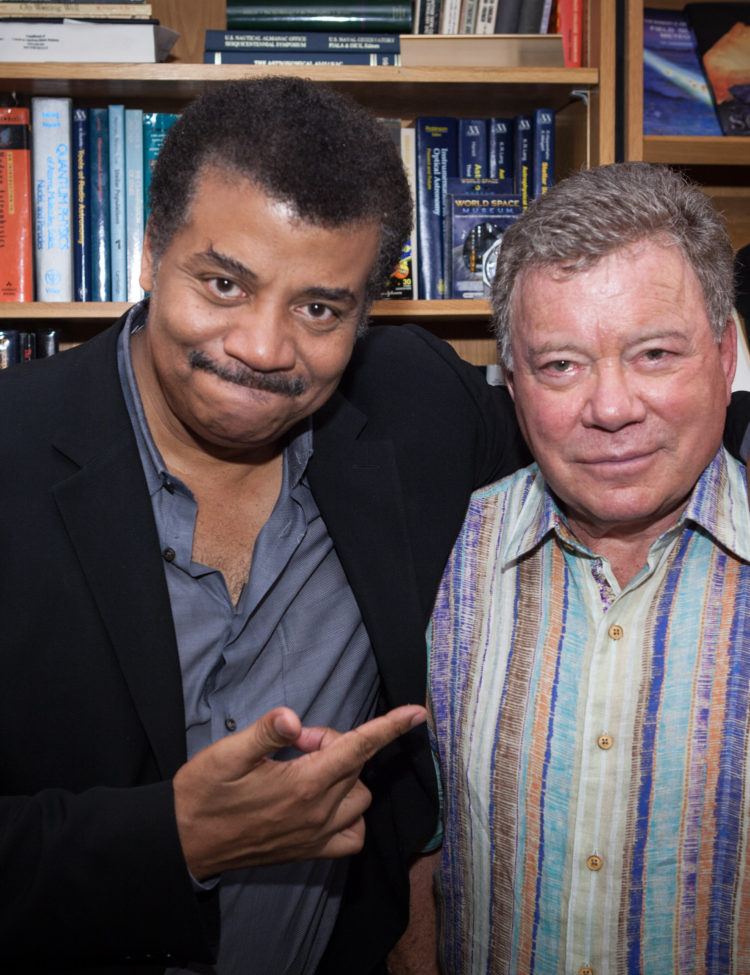
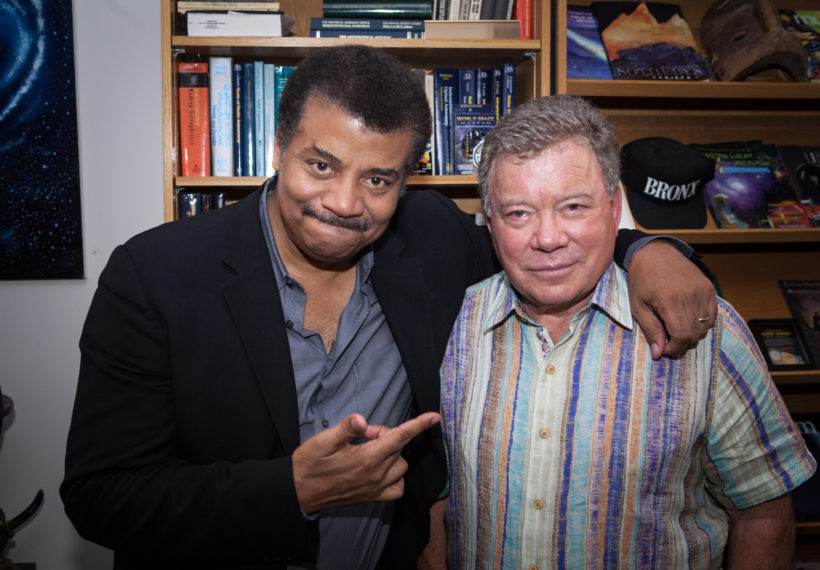
And tonight, we celebrate the enduring power of science fiction because we're featuring my interview with Captain Kirk himself, the actor, the American icon, William Shatner.
So, let's do this.
My co-host, Chuck Nice.
And Charles Liu of my friend and colleague, Professor of Astrophysics at CUNY, the City University of New York on Staten Island.
So we've got my interview.
William Shatner came through town, so I nabbed him and stuck him in my office and grabbed that interview with the original captain of the SS Enterprise.
And so I asked him, how did he find his path to that iconic role?
Let's check it out.
I was born in Montreal.
Montreal, okay.
I was in the theater and I was in radio and I was in movies and film in Canada before I came to the United States.
Did you have any early sort of geeky experiences or were you sort of pure artist actor?
I was not a geek.
I was a kid actor, a child actor, and I loved sports.
Okay.
And I was a very experienced actor at a very early age because I started sort of when I came down to the United States in a play by Marlowe.
We played 12 weeks on Broadway and then I was essentially cast loose into the casting world of America.
The thespian world of America, exactly.
So I was a stage actor.
So when I was asked to do Star Trek, oh, they had made a pilot prior to with another actor and they asked me to see the pilot and I looked at it and I thought that was magical.
They, NBC wanted to recast it.
So I was cast as the captain and the second pilot of Star Trek and it sold.
But it was, nobody knew what it would become by any.
Of course, no.
You talk about madness.
No one knew what it would become even after it was canceled.
For years.
Charles, this show got canceled after, it's hard to imagine.
Now it's hard to imagine.
Yeah, so any insight as to why it got canceled and why it would then get picked up heavily in syndication and then spawn multiple series after it?
I think it's because it talked about the future.
Wait, wait, you're saying it got canceled because it talked about the future?
Yes.
Or it resurrected?
Both.
I think the answer is that Star Trek was talking about a future at a time when people were still paying attention to the present, just a little too much.
And then as the future came, they saw how wow, this Star Trek thing is reflecting what the present is and what the future could be.
And that's how the popularity built.
I never saw a first run episode of Star Trek.
It was purely from the reruns that it got me as a child to love the future.
I don't remember being particularly excited about it.
I didn't see every episode to step back.
Plus I was a kid, so a lot of the more mature concepts, social, cultural, ethnic concepts, kind of fell beyond me.
But the popularity faded and then was resurrected.
But you're saying people saw the future predicted and then coming to fruition and then the show had more meaning than it did when it first came out.
I think that's 100% right.
And as people were looking for more optimistic views of the world, as opposed to say nuclear apocalypse and things like that, people were really starting to say, hey, this is kind of cool.
Well, William Shatner, his sci-fi roots go actually a little bit deeper than Star Trek itself.
And I asked him about another role that's always stuck with me.
So let's check it out.
My first exposure to you was The Twilight Zone.
And you're looking out the window.
I'm not going to go out the window.
There's this, uh...
This creature.
Creature.
Ripping apart the metal structure of the wing.
And you are freaking out.
Yes.
The actor has to treat that with reality.
Yes.
And without your convincing performance, I would have just laughed at this furry creature.
Alright, so now why would that thing made so many years ago in black and white...
Black and white.
Why does it still exist and you're still talking about...
What do you think is the underlying principle there?
Chuck, why is that scene so memorable?
I don't know, but I'll tell you this much.
What is the underlying principle behind the fact that that guy still looks younger than he should?
He's 85 years old.
I mean, he looks amazing.
How does that even happen?
I researched this.
Yeah, if you add up all the time, he's traveling faster than the speed of light from the orbit.
Einstein's relativity, it bought him 40 years of lifetime.
Chuck, you did the same calculation.
I did the same calculation, but I came up with a different number than you did.
No, I think the reason why this still matters is not because it was black and white and we look in color now, but because it shows a very interested desire by audiences of all ages, all periods of time to look at mysterious things that you know you are right and somebody else can't believe you.
But here's what I'm interested in, because I remember that, that Twilight Zone episode.
And I think, like he said, he sold it.
Yeah, he's, you believe that he saw that, even though it's just some fuzzy dude in a suit.
He was terrified, he was sweating.
But what I'm interested in is because this guy is a regular guy in this, you know, scenario.
And he's like, hey, there's a gremlin on the wing.
And a regular person would see them and be like, hey, you got to do something about this.
But you two are scientists.
So what would you do if you saw a gremlin on the wing of a plane?
How would you handle that?
I'd pull out my iPhone and take a picture.
This is how we know flying saucers aren't real because we don't have extra images of people being abducted in flying saucers because everybody's got a video camera.
You are no fun at all.
So here's more of my interview with American icon William Shatner about the science fiction that was portrayed in the original Star Trek.
So let's check it out.
The greatest Star Trek episodes were stories suggested by the great science fiction writers.
Asimov being one of the most obvious, but there were others who had great story ideas but they didn't know how to write a well-made television play.
So we had television writers take their great ideas and make the great Star Trek episodes.
That magic of science fiction and its projection into the future, its ability to try to imagine an explanation of some of the things we can't explain, moving lights, back in time, that whole thing that astrophysicists wrestle with, science fiction wrestles with, but with an imaginative explanation.
Even Shatner is doing Shatner.
He doesn't even look, he looks like he's doing an impression of himself, explanations.
So Charles, you're a colleague, we both work in the same field, and there's always some imagination at the frontier.
Oh, 100%.
You and I both know that if all we did in the stereotypical sense was as scientists be in our white lab coats and do the same things over and over again that you expect that somebody who doesn't have any creativity to do, we would never get anywhere.
We imagine answers to questions whether we have the technical expertise yet or not to answer them.
And it just turns out that in real science we try to use our technical abilities to produce legitimate experiments, whereas in science fiction they are freed from that constraint.
So what they also do is not just imagine what science is in the future, in almost all cases certainly the best cases, they're finding all the ways that new science affects culture, culture, civilization, humanity.
And of course Ray Bradbury is famous for saying…
The Martian Chronicles.
Ray Bradbury was accused of saying, why are you always all dystopic about the future?
And you know what he said?
He said, is this the future you're wishing we go to?
He says, no, I write these futures so that we don't go there.
Oh, that's pretty cool.
That's deep.
We have to imagine both the good and the bad in order to prepare for either one.
So when you have science fiction and an imaginative palette, it's like a multiverse of options of where you can take the future of our civilization.
And I'm trying to think, you go back a few decades, let's say to the 80s, people were already making movies, dystopic movies about pandemics, of course, nuclear destruction.
We were still in the Cold War, cloning, a little bit of cyberspace was in there.
So it's just fun to think about what the creativity of a science fiction writer will do and how much we have to pay attention to.
So depressing.
Not at all.
Yeah, it is.
The 80s were a few decades ago.
Oh my gosh.
It's nice that you mentioned Ray Bradbury.
Just as much as scientists of our generation were inspired by his say Martian Chronicles, he too was inspired by scientists who were just studying Mars at that time.
So it all interplays together.
It's a very, very nice combination of creativity and technology.
Well, up next in my interview with William Shatner, we'll be discussing race relations in America, through the lens of Star Trek, when Star Talk continues.
Welcome back to Star Talk from the American Museum of Natural History.
We're featuring my interview with William Shatner, one of the great icons of the sci-fi series Star Trek.
And it was created, as you know, by producer Gene Roddenberry back in the 1960s.
Let's check it out.
Were you self-aware of Roddenberry's larger mission statement that he was trying to make a difference in the world?
Well, both of those statements are suspect.
I'm not sure how much of a difference Roddenberry was trying to make in the world.
He had a wonderful idea, no interference, live long and prosper, whatever the edicts were, except the crew did go down and interfere.
That was the, that resulted in a plot.
That was the story.
If you didn't interfere, you'd just say, hi guys, we'll just fly by.
Yeah, right, good going guys.
So you had to interfere to have a plot.
So we throw that out the window.
But those ideas that were in the individual plots that each movie, each segment of the series was based on, those were great ideas, half white, half black, half black, half white, fighting over the stupidity of racial fighting.
In a time when the civil rights movement is in full swing.
Right.
And so this is a story in space forcing us to...
Forcing us to look at the inanity of race relationships.
That's science fiction at its best.
So that idea, I don't know where it came from.
I don't know who suggested that idea.
And I would imagine Roddenberry had the last statement saying this goes, we'll do this story.
So from that point of view, he was doing something.
From my point of view, of whether I was aware, I read that story and my gosh, what a wonderful story idea this is.
How dramatic.
They fight.
I hate you because you're black on that side.
That's a great...
It's obvious I'm fighting you because I'm black on the other side.
Yeah.
That was clear to them for whatever reason.
So it was clear to everybody what a glorious story that was.
And we had so many others down the line with other subjects in mind.
So yes, I was very much aware.
So do you remember that episode and what your reactions were to it?
Oh my God, yes.
And by the way, I'll just remember myself being a kid and watching that and going, when will this half on half crime end?
That episode was entitled Let That Be Your Last Battlefield.
And indeed it was a very moving story.
But the story was so compelling that it was almost impossible to act it in any subtle fashion.
Everything was highly choreographed, was highly dramatized, because you couldn't actually do it in a normal, regular thought process.
But you got to remember, wasn't this the 60s?
I mean, I don't know if you remember.
I mean, I couldn't physically remember, but I've seen like PBS during Black History Month.
It wasn't cool back then.
Yeah, the footage is not good.
Like dogs and water hoses.
To have, just to be able to broach the subject, I think was extremely brave.
It wasn't just black and white.
There's more conflict between they and aliens.
There's the Goren fight in the arena.
Maybe it was inevitable that you'd have to pull one off that dug to the heart of sort of American society.
All good television eventually does that.
Star Trek broke more ground on race relations.
They featured the very first interracial kiss on American television.
I had to ask Shatner about this.
Let's check it out.
Did you know at the time that your first kiss with Lieutenant Uhura was the first interracial kiss ever on television?
I don't remember knowing whether it was the first.
I mean, most folks don't keep tabs on that.
But I remember that there was a discussion of what might cause some controversy.
And in fact, I recall some station.
Kissing the blue alien and the green alien, no problem.
No, no problem.
The black alien, problem.
On the other hand, she's such a beautiful woman.
And she's a glorious lady.
So that how anybody could even.
How's that even written?
It was a subject matter.
But I remember the potential for controversy.
So Chuck, how is it, how is it that Star Trek can become the landscape on which you'd have the first interracial kiss?
There might have been a half a dozen other shows that could have done it, and they didn't.
This did it.
It's because it's not on Earth.
We can avoid all the trappings that keep us stuck in our mindsets if we're out in space.
Our social boxes.
That's right.
And in fact, there's a great...
Social prisons.
Social prisons.
And there's a great story behind all this that's often untold.
Nichelle Nichols, who played Lieutenant Uhura, they were forced to kiss by aliens who were pushing them together.
Because you know that's the only way a black person and a white person could kiss in the 60s.
Aliens made us do it!
But when they kissed, actually, the censors and the director wanted not to have that scene because it was too controversial.
And so I said, okay, let's film two versions.
One that actually has a kiss and one that doesn't.
And William Shatner purposefully took so much time doing the kissing scene that there was only time left for one more take for the non-kiss.
And he purposefully botched it so that the next day everybody who would have censored it, they said, we have no choice, we must go with the actual kiss.
So that's good.
That's pretty cool.
I can't imagine though an interracial.
No, no.
We have families.
We have families.
Here's 20 bucks.
Get a room.
Well, up next, science fiction becomes science reality.
When Captain Kirk William Shatner tells me about the first time he ever used a flip phone.
When Star Talk returns.
From the Hayden Sphere, the American Museum of Natural History, we're featuring my interview with Star Trek star, William Shatner.
Let's check it out.
Did your performances on Star Trek sensitize you to the future of technology?
I've always been fascinated by the beauty of manmade tools, whether it's a chisel or a gun or an engine or a watch.
I love that refinement.
I love the idea that manmade tools from the beginning and then when I was asked to go into the lunar excursion module at the time, the most complex tool that man had ever made, I was totally aware of the millions of systems that had to work for these two guys to be safe.
And I was and am fascinated by those tools and the tools by which we observe nature, the telescopes, the microscopes, the various instruments that delve into the mystery of how our world, how our universe works.
That fascinates me.
So were you enchanted when you saw that one of the earliest cell phones was a flip phone inspired by that?
I had one.
They gave me one.
Motorola.
Motorola.
Motorola gave me one.
You've got to be like customer one.
I was customer one.
And the magic of having this phone in your hand and not having to find a pay phone and put quarters in, and I was in a crowded airport with one of the new TAC phones, I think they called them.
Startalk.
Startalk.
Startalk.
And I was making a call and people were passing by laughing.
And I couldn't figure out why they were laughing.
But I had to communicate.
He hasn't shaken that character.
They just let him out.
So we look at the list of technology Startalk inspired, clearly in that particular case the flip phone, which was the communicator I guess.
And it was cool.
And the funny thing is it was seen as so futuristic back then and now nobody has a flip phone.
If you had a flip phone, it's like what's wrong with you?
What you mean like this flip phone?
Oh, no, you don't.
What?
Chuck to Enterprise.
Ha ha ha.
Wait.
Charles, you own that?
Is that work?
Chuck to Enterprise.
Enterprise, do you read?
Chuck.
I do.
Come in, Chuck.
Ha ha ha.
Actually, I do use this phone still.
I have a smart phone.
But you notice, I could open this with one hand.
I can't dial with what's one hand on my smart phone.
Furthermore...
Because you're incompetent with your smart phone.
It's that simple.
True.
Furthermore, it is possible for me to use this to control the amount of input I get from this crazy world.
So I only get texts or voicemails when I want to.
But of course, when I need the actual power of a smart phone, I bring that reluctantly.
Well let me tell you, Neil, I use this to control my teenage daughter.
Because I say, if you don't do what I say, this is your phone.
She must tell those nightmare stories at school.
It works.
I will take your iPhone and you get this.
Well it's also very economical.
Costs way, way less to run something like this.
Stop trying to defend 20 year old technology, okay?
Just stop now.
If it ain't broke.
What?
If it ain't broke.
Well, did you know?
I didn't know this till recently.
NASA's official website has a whole page on the science of Star Trek, really.
And it's written by a NASA engineer.
His name is David Batchelor.
And I think we have him standing by right now live on video.
David, are you there?
Welcome to StarTalk.
How do we know this is not some corner of your parents' basement you haven't moved out yet?
This is my library.
Yeah.
Uh-huh.
In my parents' basement.
So you wrote an article, The Science of Star Trek.
And it's by far the most read article on that subject on the internet.
Just type it in.
It goes straight there.
And because Star Trek had this whole list of things, could you rank them by maybe most extraordinary but possible, like the warp drives or the impulse engines?
What's the start, the top three things we don't have, but you think one day we will?
Well, I think we'll have impulse engines of some type.
And anti-matter is the thing you would need to power them, because if you think about a starship like the Enterprise, it was supposed to have the mass something like the USS Enterprise.
And if you were going to try to propel that up to 90% of the speed of light or something, you would take titanic amounts of energy to do that.
So anti-matter is about the only thing that could possibly do it.
Which gives you pure annihilation of the mass, converting it entirely into energy with E equals MC squared.
So where are they getting their anti-matter?
Well presumably they have a big production place somewhere.
Hopefully it's very far away from Earth, because if you had a containment accident, you could blow away all of Earth's atmosphere in short order with the kind of energy they're talking about, the starships.
I'm glad somebody's calculating these risks.
Wait, so how do you transport, in what vessel do you transport anti-matter if on contact with matter it annihilates?
Well there's a book by Rick Sternbach and Mike Okuda called the Star Trek Next Generation Technical Manual, and it gives diagrams of all of the containments and things like that.
So what you want to have is like hydrogen gas, and it's frozen into a solid form and you just manipulate it with magnetic fields so it never touches anything.
Oh okay, so it's a magnetic.
If I'm not mistaken there are also anti-matter containment fields that they use as well, which surrounds the warp engine, right?
Okay, I'm done, I'm sorry.
And somehow they pass it through dilithium crystals.
Exactly.
And so what the hell are dilithium crystals?
It was a crystal that was made up as a plot element, kind of a MacGuffin in one of the stories.
Have you seen the periodic table of fictional elements?
Oh, very interesting.
Yes, very, it's got all the fictional, like unobtanium, go to every possible story ever told where they made stuff up, that element is in this periodic table, it's great.
So tell me about cloaking devices.
Well there's actually a little progress on that.
They can surround an object with specially engineered exotic material and make light go around it in a way.
It doesn't work for every single wavelength of light, so there's still some visible wavelengths.
I think I've seen pictures where the light gets wrapped around the object and then comes back out the other side.
Exactly.
And you're working on this in your basement.
Sure.
Where your parents' library is.
Tell me about, there was some kind of acceleration damper so that when it accelerates from zero to warp speed, people aren't a pile of goo stuck to the back wall.
Right.
What was?
They had to have something called inertial dampers.
Inertial dampers.
How did that work?
Have you ever looked at the levitating frog?
If you Google levitating frog, you can see that there's actually a way to have a frog hover in space without going up or down in a magnetic field.
Oh, okay.
I'm just glad that I feel sorry for the frog, but I'm happy it's happening.
Well, David, thank you for teleporting your wisdom and knowledge to us.
Up next, I break down the physics of space time to Star Trek star William Shatner when Star Talk returns.
Welcome back to Star Talk from the American Museum of Natural History, featuring my interview with American icon William Shatner, Captain Kirk himself.
You know, he had a question for me about the universe.
Let's check it out.
What is space time?
You already know.
You have never met someone at a place unless it was also at a time.
You have never met someone at a time unless it was...
Okay, I get it.
So we...
Well, wait a minute.
What happens to a photon from 13 billion point 800 million years that comes this way and enters my eye so I can see it?
Why, where is space involved in that?
It entered your eye at a time and at a place, right here.
That's all that matters here.
Is that all we're saying?
Well, once you have formalized space and time and know that they're conjoined, then you can make all kinds of fascinating calculations.
Well, what is all that?
The train's going and I'm walking down there.
I'm walking down the train.
I'm walking on the train.
And the time.
And the train goes.
What is all that?
That's all the consequences of thinking about space and time as conjoined.
But it's confusing.
The universe is under no obligation to make sense to William Shatner.
No, but William Shatner is under the obligation to make sense of the universe as is you are doing.
And why do I slow down as I approach the speed of light?
Does it apply to a photon 13?
No, you want to freak out?
I don't want your head to explode.
You ready?
Yeah.
Okay, no, you're not ready.
Are you ready?
No, I'm ready, I'm ready.
Okay, the faster you go, the slower time ticks.
Say that again.
The faster you move, the slower time ticks for you as seen by others.
Right.
As you approach the speed of light, time continues to slow down.
Yes.
At the speed of light, time stops.
Which means for a photon moving at the speed of light, when it is absorbed in your retina, it is the same instant it was emitted at the Big Bang 14 billion years ago.
That's what I thought.
The photon gets emitted, bam!
It's in your, as far as it's concerned, it is in your eye in that same instance.
Can we measure that photon and observe the Big Bang?
I know that that came from the Big Bang and I'm watching it and it's taken 13.8 billion years to reach you, but if you are that photon, it does not experience that time delay.
What a great science fiction story, that.
Instantaneous.
That is awesome.
So, William Shatner's question takes us right up to Cosmic Queries on Star Talk.
And that's all tonight about the physics of space time.
So, Chuck, you got some questions.
So what do you have?
All right, here we go.
This is Gabriel Fellin from Australia, who says, a warp field is formed by contracting space time in front of a spacecraft and expanding it behind it.
Could we say that in a loose theoretical sense, that is like riding a gravitational wave.
Surf's up.
Chuck?
No.
Just to be clear, gravity waves move at the speed of light.
If you want to ride the gravity wave, you're not doing any better than the speed of light.
That's right.
And what he was describing there was a theoretical construct of creating a warp bubble and it doesn't work.
But nevertheless, it's a cool thing to think about.
Such a buzzkill, man.
Well, I'm not saying it won't work eventually.
Who knows what great discoveries will come just around the corner.
Next, if suddenly the sun disappeared, how long would it take for the warped space around it to go back to normal?
How would that adjustment be felt on Earth?
Ooh.
I'm giving this eight minutes and 20 seconds.
How about you, Charles?
Well, eight minutes and 20 seconds and our Earth would notice.
But the change in space time there would be at the speed of light, right?
The sun is about 853,000 miles across.
So we take maybe four or five seconds for space time where the sun was to come back to as if there were nothing there.
Eight minutes and 20 seconds later, that effect would come to Earth.
Right.
So another way to say it is you can pluck the sun from the middle of the solar system.
Right.
And we wouldn't know about it.
You would still bask in sunlight.
You would still orbit with nothing happening.
500 seconds later, bada-bing, we steep into darkness as we get cast at a tangent off into interstellar space.
So Stanley, your answer is you're going to die in eight minutes and 23 seconds.
Last question.
This is from Merrill Gwynne Speeder from Toronto, Canada.
Would like to know this.
What does civilization in the galaxy, one billion light years away from us, see the universe as one billion light years younger than we are?
No.
Well, there you have it.
The reason is the universe is expanding away from that galaxy exactly the same way that the universe is expanding away from our galaxy.
So over there, one billion years, they would see us as being one billion years younger than we are today, but they would be the same age.
Similarly, we see them as being one billion years younger, but we are the same age as we are now.
And my favorite such galaxy would be one that's 65 million light years away.
Such that they, looking upon us, with their super duper alien telescopes, would witness events in real time unfolding on Earth 65 million years ago.
Because that light is only just now reaching them.
And 65 million years ago, what was going down on Earth?
An asteroid the size of Mount Everest slammed in the Yucatan Peninsula, although that's not what they called it back then, and taking out the dinosaurs.
So they would bear witness to this.
And they would be seeing us in the past.
Right.
Just as we see them in their past.
There you go.
Yep.
So next up, William Shatner explains why being a starship captain is a lot like being a football quarterback on Star Talk.
Welcome back to Star Talk, featuring my interview with William Shatner, Star Trek star.
And I asked him about the unique look and design of the bridge of the Starship Enterprise.
So let's check it out.
A guy by the name of Herman Zimmerman designed that whole cabin.
He's a set designer for Star Trek.
Yes.
Thought about the ergonomics and the dynamics of a cruise movement.
Exactly.
So the chair is in the center, the people are all around him to give him information.
The people in front, the screen in there.
Interesting.
So anytime you look this way, it's always the same person giving you a certain kind of information.
And I turn that way.
So it's part of a rhythm of your...
So that I was watching Peyton Manning work as a quarterback.
That's just not who I thought you would say in that sentence.
No.
Peyton Manning guiding the other players, rehearsing them again and again.
When I do this, you do that.
I'm gonna take three steps here and I'm gonna do it there.
You can imagine that in battle that this captain would say, all right, I'm gonna turn here.
I need that information.
I'm gonna turn here.
You gotta need that.
And everything was set up so that he could make an informed decision.
I lived that.
So you're a quarterback of the universe.
You like that?
Okay.
William Shatner, quarterback of the universe.
So, you know, I couldn't...
Kirk, I wasn't gonna let him go until I had to ask him the perfunctory question, what was his favorite Star Trek episode?
And I did.
Let's check it out.
Sorry.
I have to ask you this.
So, what was your favorite episode?
Oh, Neil.
That is so bad.
I know.
It's the lamest question ever.
It is so lame.
I'm not worthy.
All right, my favorite episode.
Well, I don't remember them too well.
I didn't see many, although I don't like to watch me on camera.
But there was one that going back in time, where you try and change-
Just so you have a tear here on this.
I'm crying over the question.
Right there, good.
There was one episode where we went back in time.
I think it was called City Across the Rivers.
It was City on the Edge of Forever.
City on the Edge of Forever.
Listen to you.
I remember-
It involved time travel.
But what is time travel, but a yearning to go back to a past that was brighter and better or something that you could alter.
There's something so basic about all human beings saying if I could just go back to that moment and change it, I wouldn't have done what I did.
So, I remember thinking that, that going back in time and having an affection for that moment.
It was a lovely story and a nostalgic story.
It touched you.
So, I might point to that as one of them.
And of your six or seven, eight movies, which one of the Star Trek series?
Well, I thought Star Trek V was brilliant.
Yeah, V was going back to God, trying to find God.
Which one did the best out of that series?
Was it that?
Probably.
But they were all in that $100,000, $100 million thing.
Yeah, four was dubbed the Save the Whales.
That was the Save the Whales episode.
Again, it was going back in time and interacting out of place.
Exactly.
That's reintroducing a whale.
Yeah, yeah, to the future from the past.
Right.
That was my favorite of the set.
I have very simple story telling needs.
You deal in such mysticism anyway.
Well, up next on Star Talk, featuring my interview with American icon William Shatner, captain of the USS Enterprise.
And Star Trek today is more popular than ever.
In part, I think because of the reboot by JJ.
Abrams.
And I had to ask William Shatner, what was his take on this new movie and the whole reboot of the series?
Let's check it out.
I think JJ.
Abrams is a wonderful director and a wonderful imaginative writer.
What we found in the movies we made, that they would make $100 million.
And none of the movies made more than $100 million.
So the budget was limited.
Oh yeah, once you know those numbers reliably, everything gets pre-defined.
The budget is already in place.
So there's not much room for special effects.
To make this movie.
When JJ got a hold of it, he must have decided that the way to increase the revenue was to go and make a ride and give the special effects full emphasis.
Spend the money on the ride.
It's a science fiction ride.
It's the ride.
And the characters, as a result, I think, suffered somewhat.
But those movies are a box office sensation.
It's refreshed the franchise.
Now the characters act in a somewhat different fashion than they would have had Roddenberry been issuing his edicts.
But the proof is in the popularity of the movies.
Whoo!
Charles, if Roddenberry rebooted the movie today, why would it be any different?
He'd have a big budget, high special effects?
I think William Shatner here is not taking to account perhaps the way he should the fact that it's much harder to develop characters in an hour and a half or two hours than it is over two or three seasons.
In reality, JJ Abrams has done a lot within what time was available, but it is true.
There's a substantial ride going on.
So what you're really saying, if I may, is William Shatner is being a little bit of a hater.
No, no, no, no, no, no.
No, no, no, no.
In the end, he said, look, it's making money.
He's in the business.
If it's making money, it's making money.
That's right.
Now, when Gene Roddenberry actually did get a chance to reboot the Star Trek franchise with Star Trek The Next Generation for the first several seasons, he was still involved in it pretty substantially.
Gene Roddenberry didn't give edicts so much as he gave a vision.
So Star Trek has gone beyond just the multiple reincarnations of the TV series, the original set of movies, and then the next set of movies.
It also spilled into fan fiction, a whole other dimension, internet-based dimension of storytelling, where people feel maybe it's kind of the internet's version of a multiverse.
Right?
So it's a multiverse where fans get to explore plot lines, never intended, but they have to have some plausibility, otherwise they don't work as fan fiction.
And guess what?
Some of that fan fiction actually gets adopted into the Star Trek stories.
And I think one of them is like Captain Kirk and Spock, they have like a relationship.
Once you go Vulcan, you never go back.
Neil, are you a big enough fan that you would have a plot line?
I guess if I had to have fiction, I would want to see Captain Kirk fight Jean-Luc Picard.
Ooh.
I just want to see that, because Kirk did his own fighting.
That would be awesome.
And Picard didn't.
That's true.
So I just want to see how that would play.
And then they have to play that music.
We're going to catch up with my good friend, good friend Bill Nye the Science Guy to get his take on the enduring power of Star Trek.
Let's check it out.
The Unisphere.
In 1964, it represented our shrinking globe and our expanding universe.
Now let me tell you something.
I was here at the World's Fair and it was the coolest place.
This optimistic view of the future through science and technology.
And when Star Trek came along, it took that view to a whole other level or another quadrant of the galaxy with each character becoming a metaphor for the tribal conflicts that we still have here on Earth.
Now in Star Trek, they didn't stay on Earth with conflicts between countries.
No, they had conflicts between entire planets.
Each one a unique place in space.
And it was Captain Kirk especially who worked hard to resolve those conflicts.
So thank you.
That optimistic view is still with us.
Thank you, Star Trek.
Okay, Neil, you have the con.
I look at Star Trek as a vision of the future.
And there's one thing that was persistent in every episode.
It was at the end of the day, no matter what you saw, there was some dose of morality.
Storytelling is about other worlds.
Ideally, better worlds.
Worlds where people treat each other more kindly.
Where we are better shepherds of our own planet.
And that is a cosmic perspective.
You've been watching Star Talk.
I've been your host, Neil deGrasse Tyson, your personal ad for physicist.
And as always, I bid you to keep looking up.
See the full transcript




 Unlock with Patreon



 Become a Patron