
Transcript
DOWNLOAD SRT
Welcome to StarTalk, your place in the universe where science and pop culture collide. StarTalk begins right now. Welcome to the Hall of the Universe. I'm your host, Neil deGrasse Tyson, your personal astrophysicist, and tonight, we're featuring my interview...
Welcome to StarTalk, your place in the universe where science and pop culture collide.
StarTalk begins right now.
Welcome to the Hall of the Universe.
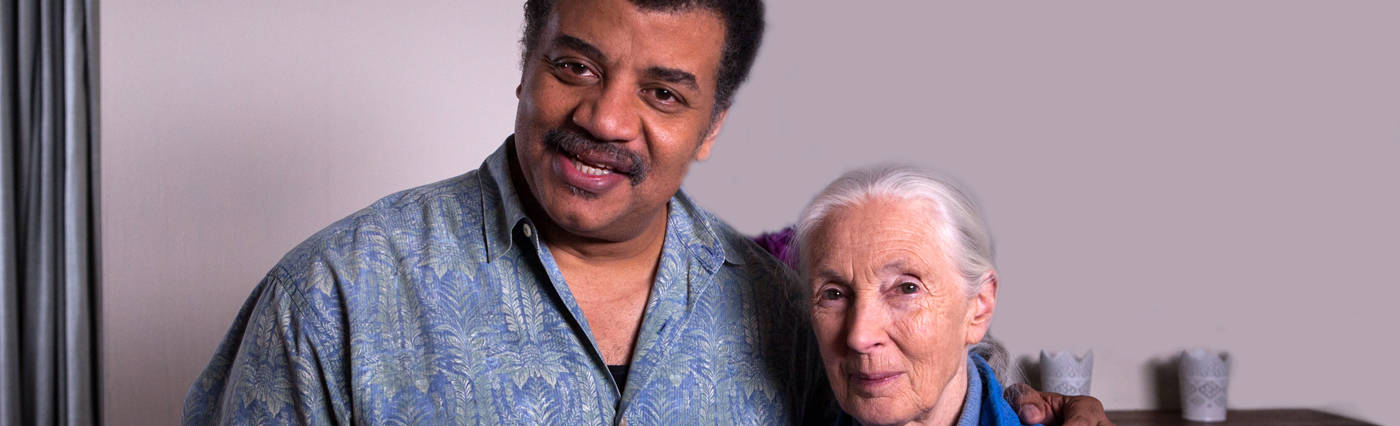
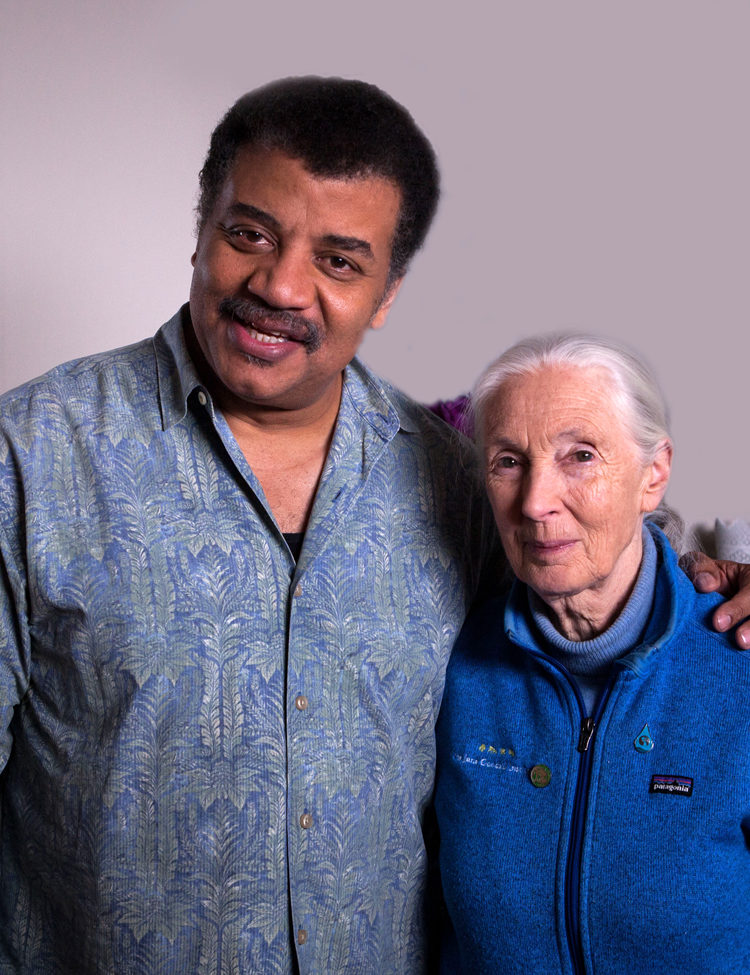
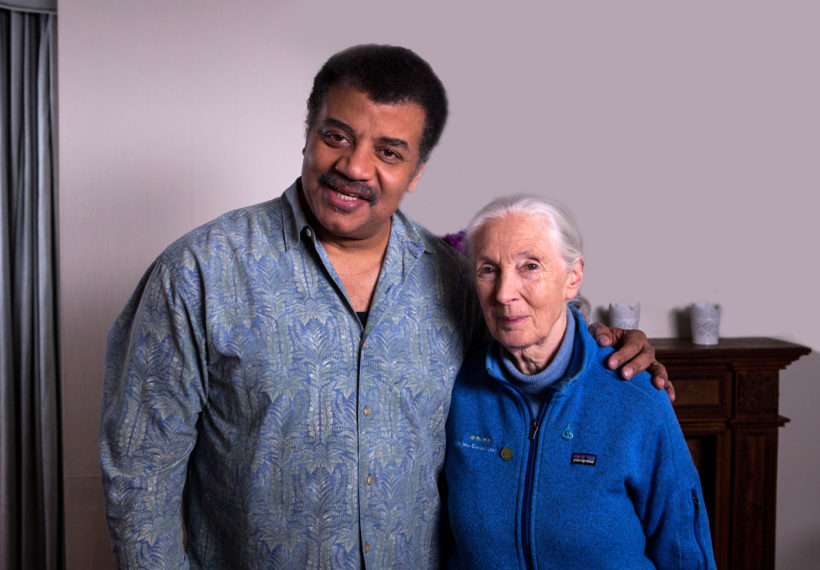
I'm your host, Neil deGrasse Tyson, your personal astrophysicist, and tonight, we're featuring my interview with the legendary chimpanzee researcher, Jane Goodall.
Who, with binoculars and a notebook, completely redefined our understanding of both primates and ourselves.
So let's do this.
Chuck Nice, joining me, my comedic co-host, Hey, hey, Neil.
Chuck, always good having you, Chuck.
Always good being here, man.
Chuck the baby, you're my man.
Yeah, you're my man, too.
Oh, because we pay him, so he says that back.
See, that's how that works.
No, I say that because you my man.
Ha ha ha.
Ha ha ha.
Also joining us is biological anthropologist, Jill Pruetz.
Jill, welcome.
So you're a professor of anthropology?
Texas State University, what town is that in?
San Marcos.
San Marcos, of course.
And you're a National Geographic Explorer?
That's a whole category of person that they have.
And you studied chimpanzees in Senegal?
I do.
Senegal, very cool.
So we'll be relying heavily on your expertise because as you know, we're featuring my interview with living legend, Jane Goodall.
Was she an inspiration?
Oh yes, of course.
Yes, yes, her field work is, as I understand it, the foundation of all modern primate science.
Is that overstating it or is what?
I don't think so.
I think she's a rock star.
Rock star, okay, justifiable rock star.
Well, in my interview, I asked her, how did her path into science begin at all?
Because we all have a story.
She's got a story.
All right, let's check it out.
It began in a hen house when I was four and a half years old.
We went to stay on a farm in the country and I always loved animals.
And we lived in London at the time.
So mom and I went to this farm, Popper Farm, where animals are out in the fields and hens are clucking around in the farmyard.
And I was given a job to collect the eggs.
So I don't remember this, but apparently I was asking everybody, but you know, here's the egg, where's the hole on the hen?
Where does the egg come out?
And nobody could tell me or wouldn't tell me.
So what I do remember distinctly is this hen, a brown one, and she's going into this little hen house and there were nest boxes around the edge.
So I must have thought, ah, she's going to lay an egg.
And I crawled after her.
And apparently I was gone four whole hours and the family had no idea where I was.
They even called the police.
And yet when mom saw me running towards the house with shining eyes, instead of getting mad at me, how dare you go off without telling us, don't you dare do it again, she sat down to hear the wonderful story of how a hen lays an egg.
So isn't that the making of a little scientist?
Curiosity, asking questions, not getting the right answer, deciding to find out for yourself, making a mistake and not giving up and learning patience.
It was all there when I was four and a half and a different kind of mother might have crushed that scientific curiosity.
Maybe I wouldn't have done what I've done.
So I always tell people what do parents do.
They spend the first year of your life teaching you to walk and talk and the rest of your life telling you to shut up and sit down.
And if they don't, then you become a scientist.
So, Jill, could you highlight for us Jane's legacy, if you may?
I mean, I think that there's so many things she discovered.
Yeah, what the first, I guess, is?
Tool use, that chimpanzees are other animals that use tools, whereas before we thought we were the only species.
What we presumed, and maybe we needed that for our own ego to assert.
Right, and so now we know there are a number of things that Jane discovered that war, what some people call war in chimpanzees, a number of behaviors that we thought were unique to our own species.
So if we use these things that are unique to our own species as a definition of being human, and then we find another animal out there, do we now call those other animals human?
We usually just raise the bar a little bit.
We just keep inching into a new place, just so we can feel good about ourselves.
Exactly, we just have to redefine ourselves.
Apparently she's been knighted.
I didn't know you can knight women.
Is it called knight?
Is that a knighting?
Dame Jane Goodall.
I mean, that's the corresponding to Sir, I guess, but for women.
No, it's not Dame.
It's more like, damn, Dame Goodall, damn.
So I assume you agree that everything she described there in her profile is what makes a good scientist.
I think so.
Accepting what goes wrong, curious, to the point of risking your health and the concerns of all others who care about you.
Well, back in the 1960s, Jane Goodall with no formal training in science at the time.
I mean, holding aside her four-year-old exploits, the fact is in the real world, people look, well, what's your resume?
Where'd you get your degrees in science?
She had no formal training in science and she went alone into the Tanzanian jungle to study chimpanzees, which, by the way, had never been done before.
So I asked her how and why she found herself on that path without having any science background at all, certainly not anthropology.
Let's check it out.
So in the 1960s, there's of course, we're in the Cold War, we're going to the moon and you're thinking about chimps.
I'm desperately trying to get into their world and find out about them.
If no one had really done that before, then you're not following in anyone's footsteps.
No, and my mentor, Dr.
Louis Leakey, paleontologist, spent his life searching for the remains of the earliest humans in Africa.
So not even he is looking for chimps or he's looking for something en route to humans.
His argument was, okay, about 60 million years ago, there's an ape-like, human-like creature and if you uncover a fossil of an early human, you can tell an awful lot from the muscle attachment, from the wear on the teeth, from the tools associated with the living floor, you can learn a lot about, but behavior, social behavior, that doesn't fossilize.
So his theory was, if Jane sees behavior that's similar or the same between chimpanzees today and humans today, perhaps that same behavior was brought by humans and by chimps along our long evolutionary journey and originated in that ape-like, human-like creature.
That's why he sent me out to Gombe, but he didn't know anything about the field work.
He just sent me off on my own to go and find out about the chimps.
A great line there, behavior doesn't fossilize.
And I just never thought about it on such simple and very clear terms.
So if you look at sort of taxonomy of muscles and bones and this sort of thing, that's one thing.
But so much of what defines a species is its behavior, right?
So could you tell me more about that, at least in your studies, and how you think about behavior genetically?
I mean, one of the things that Jane discovered, tool use, is something that is a great example because most of the tools that chimps use wouldn't fossilize.
So there are some chimps that use stone tools, but most of the tools they use are made of wood.
So those would deteriorate.
And so at my site, for example, the chimps actually hunt with tools.
And that's something that, again, we had used to...
Not yet.
With an AK-47.
That's a cartoon right there.
But so those are examples of behavior that you couldn't anticipate or couldn't interpret from the fossil record.
Social behavior as well.
Most of chimpanzee behavior would be hard to discern from the fossil record, I think.
So let me just try to get my vocabulary straight.
All right.
So give me the list of, I guess, the great apes.
The great apes.
And we are in this list.
We are a great ape.
Well, thanks.
I'm just saying, it's very nice of you.
So humans?
Humans, chimpanzees and bonobos.
Orangutans and gorillas.
All great apes.
And that's it?
That's it.
Not baboons.
No, baboons are monkeys.
So, all right, just so I get this clear.
So, humans and chimps are closer to one another than either are to old world monkeys.
Right, than either are to gorillas actually.
Okay, so we go back to a common ancestor between we two.
And before that, there's a common ancestor to these other apes in the categories.
Right.
If we don't have a fossil of a common ancestor, how do we talk about the common ancestor?
We just presume there must have been one.
Well, we do.
And it changes our thoughts on the common ancestor change.
So morphologically, we think that...
Morphologically shape and form.
Right, the body structure.
We think it looked more like a chimp than like a living human.
Probably more like a bonobo, which is more grassile, slimmer than a chimpanzee.
What's that word?
Grassile, slimmer.
Slimmer, slimmer, thinner, leaner, long body.
From eating grass?
Grassile.
That's why it's thin.
Because anybody who eats grass is going to be thin.
That's for sure.
I mean, unless you're a cow, I take it back.
Well, cows are just machines we invented to turn grass into steak.
That shows true.
So, what?
Am I wrong?
I've never heard that.
But that's what it is.
But that is awesome.
I'm sorry.
It's our own creation.
You know, wild steak cows wandering the milk side?
Herds of milk cows terrorizing.
That's so cool.
I just see now people say, hey, man, why don't you have some grass?
You look delicious.
So, for Jane Goodall to study chimps in the way she did, right, she had to figure out how to get close enough to them to make these observations, something other people hadn't thought to do, figured out was necessary, and so something that had never been done before.
So I asked her how she did it.
So let's check it out.
If I were a chimp and I saw you coming...
You'd run away.
Run away.
What was your tactic?
I found a peak, and with my binoculars, I sat there, and I could actually begin learning quite a bit about the chimps, from the foods they ate, the different calls they were making.
I could see how they bent over branches to make sleeping platforms or nests at night.
And gradually, the chimpanzees got used to me because I wasn't frightening them.
I wore the same colored clothes every day.
I didn't try to get too close too quickly.
And eventually they realized I wasn't as scary as they first had thought.
And then came the scary bit for me because having realized that I wasn't scary, they treated me a little bit as though I was a carnivore and they tried to chase me away as if I was a leopard, screaming at me and waving branches and charging past.
And, you know, they're about ten times stronger than me.
So I just pretended I wasn't interested in them.
I dug little holes in the ground.
I pretended to eat leaves.
And I suppose in the end they thought, well, she's not hurting us, she's not harming us.
She doesn't go away, so we better just accept her.
Okay, two things, Neil.
What?
What?
First, number one, moving closer and closer over several months, that's how I met my wife.
Because, you know, you don't want to look like you're stalking.
Okay, you just slowly, slowly got closer, all right.
And number two, for you, Jill, isn't it possible that, you know, she's sitting digging holes and eating leaves, the other chimps are like, hey, guys, clearly that is the ugliest chimp we have ever seen.
We should show some compassion.
So how hard is it to gain trust?
I think it depends.
So I studied chimps in a savanna, and they were, it actually took us four years to get them used to us.
Because in a savanna, they can't climb the trees to get away.
They just, they go away.
They run.
And so, yeah, it took longer.
I think that's one of the lengthiest habituation periods, we say, just wearing them down in a nice way.
Habituation.
Habituation.
That's a word.
You invented that word.
I didn't.
I think Jane might have.
I'm just saying, in my field, our words are simple.
We saw spots on the sun.
We call them sunspots.
Sunspots.
See, that's how we were all just saying.
You're going to invent habituation, okay?
So I also learned, and I was delighted to learn, but I didn't know that it would be controversial, that she named her research subjects rather than numbering them.
And anthropologically, this poses a problem.
But why?
They worry that they might become attached, invest feelings that interfere with their note-taking.
What's the real issue here?
So I have just a few rules about naming chimps, and we shouldn't name them after people that we know or at least we all know.
And so I had one person that started to name a chimp Saddam, and I said, no, we can't really name a chimp Saddam.
That's not a nice thing to do.
Why, was that chimp trying to take over all the oil from the other chimps?
Whatever it was she did that she wasn't supposed to do, her observations basically shattered everything that we had previously listed that distinguished us from them.
And I think that's a good thing.
Coming up, we will find out how not special we humans really are when StarTalk returns.
To StarTalk, we're featuring my interview with chimpanzee, researcher, and living legend, Jane Goodall.
I asked her about a discovery she made that redefined what it means to be human.
Check it out.
I remember in my biology class how much of the book was devoted to distinguishing we from they, humans from all other life in the world.
There's less of that in modern books, but certainly when I was growing up.
And they would say, humans, we use tools, and no other animal does.
I said, okay, yeah, all right, I'm human.
I got that.
And you blew that wide open.
It was very exciting, and it was the first chimpanzee who began to lose his fear of me, who I saw one day break off grass stems, push them into termite mounds, pull them out and bite off the termites, and then breaking off a leafy twig.
So to use that as a tool, he had to strip the leaves.
That's the beginning of tool making.
And it was that observation, because we were, as you say, the only creature to make and use tools.
We were man the tool maker.
And it was that observation that enabled Leakey to go to National Geographic Society.
And they agreed A, to fund the research when my six months' money ran out, and B, they sent a photographer and filmmaker to document what, by that time, I was learning.
Jill, what was the impact of that discovery?
That chimpanzees use tools.
Gosh, I think it was just a turning point in how we considered not only chimpanzees, but humans.
So, I mean, it's-
Yeah, so it wasn't just a discovery in situ about the animal, it came back to us.
Right, and we continued to do things to see discoveries kind of make us redefine ourselves, but that was really a huge one.
I don't think we've seen another one like that.
Is this quote from Leakey?
I had it in my notes.
What was it?
We must either redefine tool, redefine man, or accept chimpanzees as human.
Yeah.
Or redefine ourselves as tools.
Yeah, that's a permutation he didn't consider, yeah, yeah.
So, but that was unprecedented, right?
I think it really was at the time in the 60s.
So, I mean, I had to ask her about the implications.
Well, you came later, obviously, but at the time, just how mind-blowing this must have been.
So I asked her about what impact that had.
Check it out.
Can you help me assess the philosophical impact of realizing we're not the only tool makers in town?
Did that force us to redefine ourselves to keep some distance between us and chimps?
Or did it help us embrace chimps and perhaps other animals in the kingdom?
Well, at first when I reported this, Leakey of course believed it.
But other scientists were saying, well, this is just a young girl.
She hasn't been to college.
Why do we have to believe?
Then a photograph.
And so then people said, oh, she must have taught the chimps to use tools.
And I'm thinking that would have been really brilliant as they were still mostly running away from me.
How on earth would I have even thought of teaching them?
I'm thinking if you had taught them how to use tools, that's a way more amazing discovery than discovering that they do use tools.
It would have been incredible.
So anyway, gradually people were learning more about the information from the field that in communication they kiss, embrace, hold hands, pat one another, swagger, shake the fist, learning they have a dark side like us.
They can be violent, brutal, aggressive and kill, but that they also can show compassion and altruism.
And so all of this blew away this crazy idea that there is this line between us and the rest of the animal kingdom.
So Jill, I got a question.
Would they have been as skeptical of her discovery if she were pedigreed, academically pedigreed like the rest of them?
Because it's still an amazing discovery no matter who's making it, it seems to me.
Right, I think they probably wouldn't have been as critical, but I think it was such a huge blow to our human ego that you would have seen a lot of skepticism.
Now, skepticism is a natural part of science.
And so the greatest scientists and discoveries have met skepticism when they came out, like Galileo and Darwin especially and Einstein.
But when other people can double check and see themselves and then it just, the skepticism evaporates quickly if the original observation has integrity.
Right, right.
So how long did it take?
Well, around the time that Jane started her studies, the Japanese started studies in Tanzania as well.
And so that is the second longest running research site associated with chimpanzee behavior.
And they also began to see tool use other places in Uganda.
So she's vindicated.
Right, oh, definitely now, many, many times over.
So she mentioned that chimps have a dark side.
Yes.
Yeah, that's a little scary.
Yeah, because guess what?
I mean, a chimp on the dark side, that's not, Luke, I'm your father.
That's, Luke, I'm your very distant cousin.
So Jill, you've observed chimps behaving badly firsthand, is that correct?
We have.
Well, we had indirect evidence.
We heard it happen at night, but we had a former alpha male at my site killed by the other males in his group a few years ago.
Like a gang, gang murder?
Yes, there were 10 adult males that ganged up on this former alpha.
So this, of course, leads us to say, if this is our closest neighbor, genetic neighbor, and it's got violence, does that mean violence is natural in humans, and we shouldn't view it as a socially regressive behavior, but as a natural behavior that we then try to stop?
I think aggression is a natural behavior.
The lethal aggression that you see is pretty rare in chimps, and it's more common in subspecies.
But by the way, all fairness is also rare in humans.
I mean, how many people just go out every day and just kill people?
It's an extremely small fraction of the population.
Right, right.
One of the reasons I think that that male was killed was he was an especially brutal alpha, and so he was he was ostracized for five years.
That's it.
And when he tried to come back in is when they caught up with him.
He became beta.
Let me tell you something.
There's no justice like chimp justice.
So, again, if chimps are relatives, but so are bonobos.
Right.
How do you pronounce that?
Bonobo.
Bonobo.
So I'm told that they resolved differences with sex.
Yes, they do.
And they're just as related to us as chimps are.
Right.
So it's like we can pick and choose what we want to say is natural for us.
So this whole exercise is flawed.
If our two nearest neighbors solve problems in complete opposite ways, then what does it even mean to say, we are related, therefore this behavior in us is natural?
Right.
So what about altruism?
Altruism, I think, you see some amazing examples of altruism and chimps, but that's another area where we have this really high bar where we use ourselves as an example of true altruists, if that's something that exists, so completely selfless behavior.
But you see definitely examples of altruism.
What's an example?
And chimpanzees.
We had an infant kidnapped, an infant taken by poachers, and we were able to-
Human poachers.
Human poachers.
We were able to confiscate her and give her back to the group within five days.
But her mother had been injured in that attack by poachers, so she couldn't carry the baby.
So an adolescent male carried the baby for the mother a couple of days.
And so if you look at the different steps that were taken or stages, he qualified as being, you know, exhibiting altruism and empathy.
So something that's costly to yourself, and it's not necessarily-
Genetically costly.
Right.
Right.
Again, we look at the humans and say, well, we have altruism, so it's normal, I guess.
So basically, the theme here is, we're just not that special.
I don't think so.
Yeah.
You think you are hot stuff, but you really are not.
Okay, coming up, more of my interview with legendary T-Pan T researcher, Jane Goodall.
Check it out.
They can.
They can learn sign language.
They can learn 400 signs or more of American sign language.
They can do amazing things on a computer.
Chimps in different parts of Africa show different tool-using behaviors, and the young ones watch and learn.
So if we accept a definition of human culture as behavior paths from one generation to the next through observation, chimps have culture.
I think that the thing that makes us more different, some point in our evolution we develop this ability to communicate with words, spoken, written.
And once you have speech, our kind of speech, you can teach children about things that aren't present.
Chimps learn by watching.
Once you have speech, you can discuss the past, hand it on, you can plan the future.
You can bring people together from different backgrounds to try and solve a problem.
So I think this is what's led to this development of the intellect.
Well, so, okay, so tools no longer left us distinct.
So now we got language.
Yeah, we got language.
Yes.
So is that the defining difference now?
I think spoken language, but as Jane mentioned, we can teach apes to use sign language, they can use symbolic, lexigram languages.
Okay, so that rules out language then?
Spoken language.
Spoken, okay, so this, cutting this category is.
Very thin, like a slice of bologna at a very cheap deli.
Like let's just cut it thin, like spoken language.
All right, so they don't have words, but we've all seen chimps communicate.
Right.
Do we call them vocalizations?
There's some sounds that are modulated in ways that they seem to know what they're talking about.
Right, we can understand quite a bit of what they say.
I think that's one area that we really need to.
What do you mean you can understand what they say?
Well, when we hear.
You speak chimp?
I do speak a little chimp.
Oh, get out of here.
Oh, you speak chimp.
I understand it better than I speak it.
You know what, I just came up with an idea.
What?
A little game called Chimp Chat.
Chimp Chat.
Chimp Chat.
Here's what I'm gonna do.
I'm gonna call up some audio sounds of a chimp and then Neil and I can figure out what the chimps are saying and you can tell us if we're right enough.
All right?
All right.
All right, where's the first one?
Here we go, guys.
First one.
Okay, I think that Chimp just said, how many times do I have to tell you the lock on the bathroom is broken?
Please not.
Next time, put down the toilet seat when you're done.
I like that.
Okay, all right, so what were they really...
That was close, so that...
Get out.
But that was a raw bark, but sort of a medium level.
Medium level raw bark.
Medium level, which could be yelling at someone or...
So, right.
So maybe not a predator, which would be more of a...
Alarmist, that's an alarmist.
Yeah, because this is a graded vocalization.
So it's not just kind of an inquisitive raw or who, but it's, if someone is doing something, you'd rather not do it.
So it's kind of like, I'm terribly sorry, but this coffee is just not hot.
I like my complaint.
What's the next one, guys?
Oh, I got that one.
Oh, I know what that one is.
Yeah, I got that.
That's pretty clear.
That one's pretty clear.
Yeah, let me tell you something.
Here's what that was.
Yeah, okay, so what was it?
Maybe not that.
That.
So it's a no, I think.
Maybe not that.
Maybe not that.
It's just a no, okay.
Sort of like, hey buddy, we're here.
That was even closer.
Like advertising yourself there.
It could have been like at a fruiting tree, or it could have been when males, that was a male, comes up and joins a group because chimps are fission-fusion, so not all of them are all together at one time.
Fission and fusion.
Yeah, she took both our words.
Yep.
Thermonuclear fission.
I thought those were our words.
Thermonuclear fusion.
That's right, that's right.
So chimps and the sun got a lot in common.
So that brings us to the part of our show called Cosmic Queries.
Normally we take questions from the internet, fan base of StarTalk, to on the topic at hand, but Jane Goodall sent a question my way.
And I figured that'll be the Cosmic Queries for today.
Ladies and gentlemen, Jane Goodall.
It was the full moon and a very clear sky and coming, shooting out were little lights.
It was as though it was a firework coming out, a single firework and then there'd be one, two, three, four, and then it would come from the other side and then it would be quiet for a bit.
And then this display started up again.
It was absolutely extraordinary.
And nobody seems to know what it could have been.
These were emanating from the full moon.
From the full moon.
It was completely amazing.
I was awestruck.
So here's what we know.
So, Earth, the planet, plows through several hundred tons of meteors a day.
Almost all of it burns up in our atmosphere.
Because we have an atmosphere.
And this is a protective blanket for us.
The moon has no such protection.
There are places in our orbit where the amount of this debris is more than other places.
This is what takes us from a meteor shower to a meteor storm.
If we are plowing through this extra heavy debris section of space and they're hitting the moon, nothing stops it from going all the way to the surface.
It goes to the surface and all of that energy has to go somewhere because the thing stopped moving.
You can get explosions off the surface of the moon, which in your case, I'm thinking it would have happened on the edges of the moon so that you can see the sparks coming out.
Yes, it was coming out of the edge.
No, I bet it was also coming out towards you, but you wouldn't have noticed it.
You wouldn't have seen it because the moon is in the way.
I mean, the moon is bright.
You couldn't have seen it.
So that is what I would guess that you saw.
Well, thank you because nobody else has had any ideas at all.
Or they were just aliens celebrating July 4th.
Like well, if you.
Up next, we visit a group of chimpanzees being relocated to their new home in Georgia after a life in a medical research lab when StarTalk returns.
On StarTalk, from the American Museum of Natural History, the Rose Center for Earth and Space.
We're featuring my interview with the legendary chimp researcher, Jane Goodall.
I asked her how we should treat our closest relatives.
Check it out.
Is there a sense that we should treat some animals differently from others just because they're genetically closer to us?
No, I think that's wrong.
So where do you say, okay, they're in our brain club, but the rest is not?
How do you coach people to think about that question?
Well, most of the people who, ethical philosophers, they're saying the line stops or the division comes when an animal can feel.
And if it's a, does it have consciousness?
Can it feel pain?
Can it feel fear?
Can it feel distress?
There's a lot of multiple sides of the issue of animal testing in the service of human health.
Where do you land in that conversation?
I land that I don't think we have the right to take animals and do things to them just for the sake of human health.
But fortunately, it's being more and more proven.
On the one hand, that a huge, huge, huge amount of animal experimentation actually hasn't helped us at all because they're different.
Even chimps, you know, they're so like us.
They can be infected with many otherwise uniquely human diseases, but they don't react in the same way.
And the vaccines that are developed might work on a chimp, but not a human or vice versa.
And on the other hand, there are more and more alternatives, other ways of finding out answers to these questions without using live animals.
So Jill, do you think much about animal testing?
I do.
I began my experience with chimps working in a facility that was a captive chimpanzee breeding facility.
And so my job was to try to help those chimps have the best life they could.
But their behavior indicates that it's very similar to what you see in humans.
And in fact, with captive chimpanzees, they've treated chimps with the same antidepressants.
One thing that is distinctly different in chimps is a chimpanzee's smile, which is a fear grin for them.
So we have a very distinct smile, and their smile is actually a fearful grimace.
So when they smile, they're afraid?
Yes, yes.
So that's something that's very...
So that reminds me of the famous photo, the space monkey, the space chimp, who came back and they opened the capsule, and we thought he was smiling.
Right, that was a fear grin.
He was scared to death.
He was scared, yeah.
And then they put him on Zoloft.
Could you tell us, I read something about, apparently there's a new law in 2015 that basically barred research on captive chimps.
Biomedical research, invasive biomedical research.
I think that's great.
So we can ask the question, what now becomes of these chimps that were all in captivity in these labs?
We can ask that.
And to find out, we sent StarTalk science correspondent and primatologist Natalia Reagan to meet some new arrivals at the chimpanzee sanctuary in Georgia.
Let's check it out.
Let's go.
Hey, Neil, I'm at Project Chimps.
It is a sanctuary deep in the backwoods of North Georgia where chimpanzees are getting a new lease on life.
This sanctuary is 263 acres of lush green hills.
They're gonna be in primate paradise here.
Today is a really exciting day.
They're getting six new chimpanzees from a research facility in Louisiana.
They just spent 16 hours in this transport vehicle.
So, as you can hear, they are very excited to get out.
Why am I wearing this sexy face mask?
Well, it's not so much to protect myself, it's to protect the chimps.
Because humans and chimps are so similarly, biologically, genetically, we can transmit diseases back and forth to one another.
It's called zoonosis, so this is to protect them.
Right now, they're taking the first chimpanzee off this transport vehicle.
They're gonna take him inside, get him acclimated for a little bit, and then he's gonna go outside to the sanctuary area where he's gonna be reunited with his friends.
He's coming off right now.
He's fairly calm.
Seems to almost know that he's going to be entering a very cool new life.
We're gonna let these guys settle in and get acclimated, and we're gonna meet the woman who runs this place, and she's gonna introduce us to some chimps who've been here for a while.
Here we are with Sarah Baeckler, the founder of this wonderful place.
Now, who are these guys?
These are nine females, and this is Emma right here, who really wants some juice.
Oh, Emma.
See, primates are really interesting in the fact that we love sugar, all primates do, across the board, and chimps are no exception.
They're excited about the party coming next, I think.
Behind me, they're getting ready for a birthday party for Samira, who turns 14.
If you've ever wondered what a chimpanzee birthday party looks like, look no further, guys, you've got streamers, you've got stuffed frogs, stuffed chimps, watermelon, and I actually got her a gift.
Well, because chimps were the first primate to go into space, we got her a space shuttle.
Hopefully, it'll inspire them to start looking up.
Back to you, Neil.
Hello.
You're a primatologist and anthropologist and a part-time comedian?
Yeah, I do it all.
Do it all.
Children's parties.
Whoa.
So what's this, a birthday party for a chimp?
Yeah.
So Samira, she turned 14 and...
14, is that like in dog years?
What is that?
It's young because chimps can live, you know, 55, 60, sometimes 70 years.
Wow, okay.
Yeah, in captivity.
So she's young, you know?
And like most 14-year-old girls' birthday parties, they don't necessarily do each other's hair, but there's grooming.
They had, instead of having a birthday cake, they had watermelon.
There wasn't really banana daiquiris, but you know, they had some juice.
It was a lot of fun.
But there was one chimp in particular that really had it in for me.
And sometimes you have a connection with a primate.
We had a fecal connection, Gertrude and I.
Gertrude is their resident poo thrower.
And she and I had a few deep connections where she chucked her fecal matter in my general direction.
Did you throw your fecal matter back at her?
You know, I really resisted Neil.
It was tough.
But I actually did decide you can actually sponsor chimps at Project Chimps.
And I decided to sponsor Gertrude.
Because she loved you so much that her...
We're fecal family, man.
Fecal family.
We're poo sisters.
So you were wearing this plastic mask that you duly described to us.
Why wasn't everyone else wearing a plastic mask?
They've already gone through all the rigmarole of making sure that they don't have anything that can be transmitted.
So you never touched the chimps?
No, and this is...
Well, again, like we talked about, the zoonosis is a problem.
But as we've talked about, those chimps seemed rather tame, right?
They seemed pretty cool.
However, we know that chimpanzees can be extremely violent and they're incredibly strong when it comes to, well, human strength.
They're very top-heavy.
If I went in there and wanted to say, you know, pat a chimp on his shoulder, it might tap me, and I might go flying across the room, whether it meant it or not.
So this is kind of like a fake wild setting here.
Why not put them into the real wild?
Well, it's a great question.
Like we mentioned, they were born and bred in captivity, so all they know is life with humans, having food available, presented to them by humans.
They don't have the skills that they would need to hack it in the wild.
And once the groups get acclimated, they'll hopefully introduce them to one another, because they're not hoping to breed them.
They're all fixed.
Like the females are on oral contraceptives.
I believe they're oral contraceptives, and the males are snipped.
Yeah, exactly.
Exactly.
They don't want to breed them there because they really feel like chimp should not be bred in captivity.
Yet, it was kind of interesting to see the males be introduced because each of them reacted to the freedom of choice to leave their crate differently.
Some were gregarious and ready to get out and be free, and some were really taking their time.
And they finally were given a chance to make a decision.
The ones that were excited heard that the other female chimps were on the pill.
Yeah.
Coming up, I asked chimp expert Jane Goodall whether she should be the first person we call when aliens land on Earth.
StarTalk returns.
We're featuring my interview with primatologist and living legend, Jane Goodall.
And since her first research journey into Africa in the 1960s, more than half the chimpanzees on Earth have disappeared.
So I asked Jane about this tremendous loss.
Check it out.
In the 1960s, there was about a million chimps in the world?
Somewhere between one and two million in this great equatorial forest belt in Africa.
And today, what is there?
Today, it's maximum 300,000.
And what accounts for the drop in numbers?
Destruction of the forest.
So their habitat.
Their habitat, but also the bushmeat trade, which is the commercial hunting of wild animals for food, different from subsistence hunting.
And then finally, the live animal trade.
Shoot a mother to steal the baby to sell.
And we thought we'd stamp that out, but now there's a whole new inflow of chimpanzees moving from Africa, often through the Middle East, to places like China.
So it's a difficult place out there, but it's also difficult for so many of the African people.
So many living in abject poverty, not enough food, not enough education or health facilities.
And it was when I flew over Gombe in 1990 and looked at what had been part of this great equatorial belt, and saw a tiny oasis of forest surrounded by bare hills.
More people than the land could support.
Too poor to buy food from elsewhere.
You have to cut the last trees down because you've got to survive.
You've got to try and grow more food.
So poverty alleviation is really important, but at the same time, the unsustainable lifestyle of the rest needs to come down.
We need to think differently.
There's a lot of work to be done.
Luckily, as I travel around, I find people doing amazing work in all these areas and projects which are really changing things around.
The next Janes.
Or the current Janes.
Yeah, so this is the hope.
Do you see the same threats that Jane talks about and writes about?
I mean, fortunately, no.
Not where I work in Senegal, but we see other threats like mining.
That's a big threat right now to chimps in Senegal.
Why is mining a threat?
There's been a gold rush, and so you have thousands of people coming in from neighboring countries.
Displacing habitat.
Right, right.
Well, I thought the chimps were leaving their habitats to go mine for gold.
That's a new species that just used.
Is that good?
So, of course, initially, with no formal training, she found a way to communicate with chimps as no one had done before.
So that got me thinking.
Maybe she'd be our best hope to communicate with another sentient species.
I just wonder.
Let's check it out.
If an alien species, space alien, lands on Earth, do we call you first to see if you can figure out how to communicate with them?
I would love to.
Suppose they look at us the way we look at chimps.
They would, I'm sure.
Because if they got here, that means they've got better technology than we do because we really haven't been anywhere.
Quite honestly, if an intelligent alien looks at us now, they would think, what on Earth has gone on?
What separates us most from the chimps and other animals is this intellect that designs technology that enables you to learn about the stars.
So how on Earth has this most intellectual creature to ever walk on the planet?
Why is it destroying its only home?
Why are we polluting it, cutting down the rainforest, acidifying the ocean?
Why on Earth are we doing all this?
So those aliens would look at us and shake their heads and say, they're not so intelligent after all.
Intellectual maybe, but not wise.
We've lost our wisdom.
We're making decisions based on how does it help me now, the next shareholders meeting, next political campaign, not as the indigenous people do.
How does this decision affect future generations?
There's a disconnect between this clever, clever brain and love and compassion.
So, Jill, in your line of study, do you think about wisdom?
Since at every turn, your research, there's a mirror back at us as humans in this world.
Where do you land on this?
I mean, I think of the loss, losses we would, so, I mean, I love chimps, that's why I study them.
Is that what's on your forearm there?
It is, that's one of my favorite.
You have a chimp tattoo?
I do.
Oh my gosh.
Is that an actual chimp that you knew?
It is, it was Frito, one of my favorites.
Frito, you named it after a fried snack from Frito-Leg.
Frito-Leg.
But I think about with the extinction of chimpanzee communities, the fact that we're still finding out new information about them, even though, you know, we've been studying them for 50 years, that, you know, we're missing out on a lot and-
We need to think differently.
Right, definitely.
Okay, let's just get just a final thought here.
So, Jill, what makes us human?
Gosh, that's a good question.
I think that it's-
I didn't try to stump you here.
No, it's something I think about all the time.
I'm not sure.
I keep going back to language and what it has enabled us to do.
You know, I think we have a lot of power and the ability to do good things, but-
I was going to go with Hot Pockets, but-
Because they need microwave ovens to have been developed in tandem.
There you go.
Okay.
So, I actually think about this question often.
I think about who chimps are to us.
Or is it genetically, we're 99% identical DNA with chimpanzees.
So I think about this and I say, all right, what are we prone to say?
We're prone to say, what a difference that 1% makes.
We have philosophy and art and the Hubble telescope.
And they can just put a stick in a termite mound and pull out termites.
Well, just imagine this.
An alien shows up with 1% genetic difference beyond us that we are relative to the chimp.
Consider that our most complex thoughts would be trivial matters for that community of aliens.
Because I asked, who defines humans as intelligent?
We do.
Would we be considered intelligent to this species of aliens that has the same genetic difference in intelligence that we had to chimps?
I'm thinking maybe they have visited Earth already, took a look and kept going because they were certain there was no sign of intelligent life here at all.
And that is a cosmic perspective.
This has been StarTalk.
Jill Pruetz, thank you.
Jane Goodall.
I've been your host, Neil deGrasse Tyson, your personal astrophysicist, and as always I bid you to keep looking up.
See the full transcript