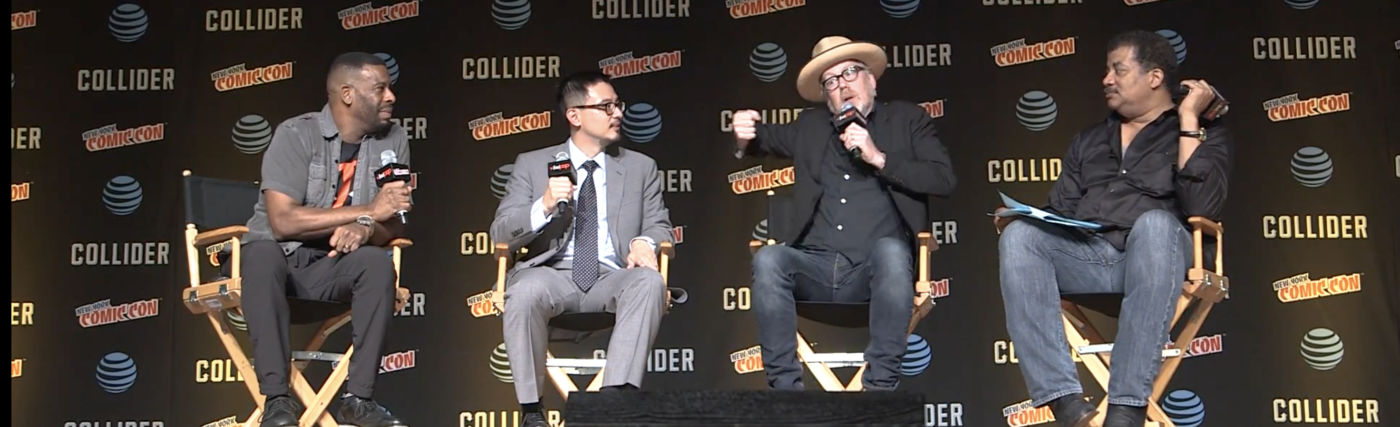
If you could augment your body, would you? If you could augment your brain, would you? Is human augmentation even ethical? Join us for a geeky debate about these questions and more in this week’s episode of StarTalk Radio, recorded live from the main stage at NY Comic Con 2017. Neil deGrasse Tyson, former MythBusters co-host and Tested editor/contributor Adam Savage, comic co-host Chuck Nice, and philosopher and NYU bioethics professor Matthew Liao investigate the future of human augmentation and the challenges it presents. This being Comic Con, we start with two of the most famous “human” superheroes, Iron Man and Batman, and explore whether their suits are inside the realm of possibility, and how they might inspire the creation of “Swiss-army-knife humans” using special prosthetics and exoskeletons. Next, dive into the ethical complications of augmentation: if scientists are obligated to augment everyone, where do we draw the line about what to “enhance,” and could it be dangerous to create a race of super-humans just because we can? Learn how human augmentation might be used to create biomedical solutions that would allow humans to adapt to the impact of climate change. Prof. Liao expounds on the idea of making “tiny people” instead of reducing the carbon footprint. You’ll also hear about CRISPR, designer babies, and, after a fan suggests giving humans wheels, Neil explains why nature doesn’t allow that. All that, plus, we discuss if future augmentation might be more than just physical, if augmentation could be used to help adapt humans for long-term space travel, and, lastly, whether or not we should be afraid of artificial intelligence.
Transcript
DOWNLOAD SRT
Welcome to StarTalk, your place in the universe where science and pop culture collide. StarTalk begins right now. This is StarTalk. So, we're gonna actually record a live episode of StarTalk right now. So, we have three segments, and we'll...
Welcome to StarTalk, your place in the universe where science and pop culture collide.
StarTalk begins right now.
This is StarTalk.
So, we're gonna actually record a live episode of StarTalk right now.
So, we have three segments, and we'll pretend like we take a break, but we're not actually gonna break.
We'll just go straight into the next segment, and you'll know how to play along with that.
So, let's get this party started.
So, here we go.
Welcome to StarTalk Live at New York Comic Con.
Tonight's topic, we're talking about human augmentation.
And before we begin, let me bring out my trusted co-host, professional comedian, Chuck Nice.
Chuck, come on out here, dude.
Where is he?
Hey, everybody, what's up Comic Con?
And we have Matthew Liao, a professor of bioethics at New York University.
Come on out.
And the whole point of this entire episode will be pivoting on the knowledge and expertise of the one, the only myth buster, Adam Savage, Adam!
Dude, have a seat.
Hey, nerds!
How's your con going?
Dude, so, whoa.
They asked me to ask you to raise your mic a little.
That was a Comic-Con-gasm right there that we heard in the 10th row.
So, we're gonna be talking about sort of human augmentation, and I just want to say, Matthew, what do we mean by human augmentation in your field?
Because you think about this.
Yes, in your field, not like in LA.
So, to augment is to sort of add something, add some sort of capacity.
So, human augmentation is where you're adding some sort of additional capacities to our organism.
And there are different kinds, cars, telephone.
So, we've been augmenting human bodies ever since we've had technology.
That's right.
Okay.
So, when I think of augmentation, there's a traditional sort of a Comic-Con sense of that, where you might have an exoskeleton or some sort of mechanical extension of the body.
That would be one branch.
That's right.
Right.
How about if I'm chemically enhanced, is that also an augmentation that you think about?
That's right.
So, there are drugs that you can take.
There are people taking, maybe, taking smart drugs.
I like the way you say it.
There are drugs you can take.
Like, this is a new discovery in the field.
Wait a minute, really?
Yeah, yeah.
And so, and then there's also any talk of the marriage of the technology with your human physiology.
That's right.
So, these are three sort of major branches there, would you agree?
Yeah, that's right.
Okay, okay, so Adam, you've built stuff.
You've been doing this your whole life.
Yeah.
So, you are human augmenter prime.
Sure, with a high school diploma, yeah.
Yeah, okay.
Diplomas mean nothing here.
It is what...
Clearly.
So, let's just get straight out here.
If we're going to talk about augmentation and we're going to think about superheroes, we're kind of down to only two in that category.
Arguably also my two favorite superheroes.
Me too, I think.
We're talking about Batman and Iron Man.
Batman and Iron Man, those are my two favorite because their secret power is their brains.
And they're human.
Yeah.
Yes.
Well, we got some people taking issue with this out.
You can't express that strong an opinion in front of this crowd.
That's all I'm saying.
But they clearly have augmentations to their bodies in some way or another.
I think it's more they have augmentations to their bank account.
You're bringing up, there's a poster that shows all of the philanthropic giving that Bill Gates has undergone in the past 20 years, you know, $30 billion, and by conservative estimates, he has saved over 6 million lives.
This is as of a few years ago.
At the bottom it says, suck it, Batman, this is how a billionaire saves people.
But does he have a utility belt?
If Bill wanted a utility belt, I'd make him one.
If Bill wanted a utility belt, I'd be it for him.
So, let me ask Adam, how do we define Super in this regard?
Is Batman a superhero?
He can't fly.
There's a lot of stuff he can't do.
Yeah, where Super gets into the realm of the fictional is in both of the Batman and Iron Man augmentations.
Because Iron Man's Exosuit, while in any small piece of it, is somewhat possible or plausible that there are mechanical linkages you could build that would be self-perpetuating and give you all sorts of extra strength.
The idea that it would work without flaw repeatedly is an absolute fantasy.
Or one might say a myth.
That's no longer my job.
But I mean, there's a reason NASA has never used cables to assist astronauts in their grip or their ability to move the suit because they engineers at NASA, as brilliant as they are, understand that extra moving parts is extra things that can go wrong.
So you're saying there are a million ways Iron Man's suit would fail and the movies don't show any of them.
Batman 2.
I mean, I have actually tried to build a device that shot a cable into a wall that you could hang off of.
And then I talked to an agency that tried to build one of these for the government.
And they failed in exactly the same way I did.
Okay, I'm old enough to remember Batman in first run on television.
And when he had that little device, you know, the gun that shoots the...
The grappling gun.
I said, how does that dart stay in the wall?
That's like not happening.
Actually, what I...
Not happening.
No.
And, wait, see, you got me started on this.
Then they throw the thing up and then climb up the wall.
And I said, they're not climbing up a wall.
They're just walking along a flat thing and he tipped the camera.
Because the guy sticking his head out of the window is that all the angles are wrong.
And I knew this.
Sorry.
Sorry.
I feel you, brother.
You feel my pain.
All right.
So here's my point.
You have these...
In the modern Batman, he's got...
It's really kind of an exoskeleton.
Not an exoskeleton, a body armor, I guess, is what you would call it.
Yeah, it's segmented body armor.
And so is this...
So between the two of them, who do you think would win?
Oh, Batman.
Oh, no.
Understand.
No.
Mike?
I think Iron Man will win.
Iron Man.
Tony Stark for life, baby!
Yeah, you're outnumbered, so you're wrong.
Thank you, one person.
I appreciate it.
My thinking is, is that Iron Man would be like, I'm gonna punch...
And then he can't move, and Batman's like...
Okay, the reason why I like Iron Man better is because he builds his own stuff.
Batman has, he's got like other people who do it for him.
Well, Wayne Industries.
Wayne Industries.
That's who builds all his stuff.
Technically, that's Wayne Enterprises.
True.
You are correct, sir.
So, are there any real life examples of exoskeletons used in the world?
Yeah, so the military has been creating these exoskeletons for soldiers.
I think, Adam, you probably know about them.
Thank you.
And they're prosthetic limbs for people who are disabled.
And how, are they working the way like Luke's hand worked in Star Wars?
I mean, you know, where you look at the thing.
I mean, are we there yet?
Let me ask that question.
Not yet, not yet.
Can I bring this back though?
Like, is there, there must be an attachment that someone who has no arm below the elbow has asked a prostheticist to make and the prostheticist has said, no, I'm not going to make, I'm not going to graft a 45 caliber pistol onto the end of your prosthetic.
Or a buzz saw for a fist.
That's good, yeah.
But that's where we're talking about.
That's an ethical problem that the constructor has with the goal of the person who needs the device.
That's right, that's right.
So, I mean, right now they're just doing it mainly for treatment, for people who are injured, right?
So that they can move about.
But eventually you can think, you know, you can sort of add more things to it.
You can add weapons, you can add swords.
I would totally do that.
Laser pistols.
You want to be like a Swiss Army knife, human.
My son, one of my sons once asked me when he was about four years old.
So thing one or thing two?
Thing one.
Okay.
He said, daddy, the penis is a very special part of your body.
And I said, yes.
Yes.
You're right.
And he said, because all children are jailhouse lawyers, he said, is it more special than a foot?
You should have said, son, just wait 12 years.
Here was my metric.
I thought, well, let's see.
If I lost my foot, I could make an extremely usable functional replica of it.
Yes, the penis is far more important than the foot.
Oh, so this is from the point of view of...
Of repeal and replace.
Ha ha.
But neurologically, in principle, what is to prevent us the future?
We're just not there yet to just rebuild our neurophysiology rather than just our muscles or our skeletons.
Yeah, so there's this thing called the deep brain stimulation.
So it's something where you sort of insert a thin electrode to your brain.
Deep brain stimulation.
And you connect it to a battery packet.
You can control it.
And actually about 100,000 people in the world today already use it.
What are they doing with it?
It's for people with Parkinson's disease, depression, epilepsy, and so on.
So when they turn it up, they'll sort of stop them from having epileptic seizures.
Okay, so the funding for that would be driven in the future surely by the sex industry.
So is there a pleasure center where you press the button and it'll do the same thing to your brain?
Well, so there are sex robots.
Deep brain viagra?
Deep brain.
There's a whole swath of the population that would never leave their house again.
Right.
But DARPA, actually the US Defense Project Research Agency, they're also really interested in this technology because a lot of soldiers come back from war with post-traumatic stress disorder.
So they're using the deep brain stimulation to try to cure or to ameliorate the effects of depression.
So this is just the beginning of what could come?
That's right.
And so in the limit, what do you see it in 50 years, 100 years?
Well, eventually, so right now the system, it's called an open loop system.
So you control it.
You sort of control the amount of electricity going to your brain.
But DARPA wants in five years a closed loop system.
And what that means is that it's going to automatically monitor your brain waves and sort of send signals.
So say if you're fighting a war and you get really scared, it'll sort of send electricity to calm you down.
And so eventually we could create super soldiers.
Now with that, here's a...
Whoa.
And that's never going to go wrong.
Yeah, what could happen there?
But is anybody asking...
I'm curious, obviously with technology we're like, driverless cars, bring them on!
I'm all for that, but go on.
So am I, except that we should...
No, I don't have an except.
You're not all for it if the rest of the sentence has the word except in it.
Do we understand language, construction, sentence construction here?
I am all for it.
However, within humans' adoption of technology, there are questions that come.
And so, is your department sort of working on like, hey everybody, when you get to this point, you guys should consult us?
Yeah, so take self-driving cars for example.
There's a big issue about...
So, say the car is about to hit five people.
The trolley problem.
Yeah, it's the trolley problem.
It's so not a problem.
And it can veer off and kill you.
So, how many people would actually buy a car that will kill you?
All right.
So, having a rough con?
Costume didn't make it this year.
Wig fell off.
All these sort of AI researchers and programmers, they have to decide whether to save five people or save you, right?
And so, that's got to be programmed in.
All right, but wait, wait.
So, but there's way more than that.
Before we even get there, I'm thinking.
Let me just ask.
If you could fix, let's say, congenital problems or some other sort of physical problem, either from birth or from war or from accident, and, okay, I get that, are you obligated to do that for everyone?
I mean, so the reason why I ask is.
That guy.
There are people, no, it's a serious point.
There are people who are who they are because of whatever that disability was.
Expressing some point of insight, creativity, some sort of compassion, and they've made a life built on everything that they were or were not relative to everybody else.
Like deaf people who refuse a cochlear implant.
That's right.
Because they already know how to speak.
Someone's here who did that?
Yeah, yeah.
Deaf culture is its own thing.
It's a thing.
So who are you to say.
And it's no less of a thing than anybody else's.
So my question back to you is, what is a future where there could be one culture that puts social pressure on you to conform when there are people figuring out their lives with whatever deck of cards they were dealt?
Yeah.
So that's a really great question.
Okay.
Yeah, so I think, so I wrote a book on human rights and I think that...
Tell the title of the book.
It's a great book.
It's called The Right to Be Loved.
The Right to Be Loved.
That almost makes up for you wearing a suit tonight, okay?
So, I think that for the disabled individuals, they have rights just like we do, and we have to make sure that...
I think our job is to make sure that if they want to, to augment their capacities, if they want to, but if they don't, if they don't want to have cochlear implants, then that's their choice.
But in terms of creating new individuals, I think there we can sort of say, maybe we have an ethical obligation not to create individuals who lack certain what I call fundamental capacities.
So these are things like being able to see, being able to hear, being able to walk about, right?
So deliberately creating a child who can't walk, that seems like...
So as an ethicist, I think there's something wrong with doing that.
Wait, wait, wait.
You're creating a child that can't walk, you're kind of a dick.
Right.
But what if you made them, let them be born with wheels?
Wait, did you say with wheels?
With wheels.
Okay, it turns out, I think biophysiologically, it's hard to have wheels.
If you think that through, biologically, you would need something in your body that...
An axle.
An axle, you need an axle.
You need an axle.
But this presupposes that we could somehow lessen the suffering by engineering a being.
And the fact is, just as you were saying about handicapped people, it's true for everyone.
We are all a product of both all the good and bad things that have happened to us.
And we all suffer.
No one escapes from that.
Okay, a couple of people have escaped from that.
That strikes me as an interesting question when you talk about, oh, so now that we can engineer kids, that all kids have 2020 vision and great hearing and excellent physiology, that somehow is based on this precept that somehow they'll suffer less, which is really a folly.
Well, wait, but continue that, there's the, all right, let's make sure we don't create a kid who can't walk, whether or not it has wheels, but then suppose now, suppose now we figure out how to give an arm sort of bionic strength, to borrow the term, and would you start having people amputate the arm so they can get one of these?
And then would that, will we be creating one by one some race of super humans?
Just because we technologically can?
I always loved the bionic woman episode where she's in a race car and the wheel falls off and she has to put it back on, and she reaches up to the lug nut and goes, I would love my arm to be able to do that.
Would you amputate your current arm to have that property?
Yes.
Yeah, I think so.
Let's ask the ethicist.
Is there any ethics involved in this?
So, I don't think we have to make that choice.
So with the exoskeleton…
That's a cop out.
No.
It is a cop out.
No.
But I think people are going to be able to design things where we can jump in just like we jump into cars rather than having to amputate our arms.
Like that would be sort of…
I see.
Actually, I agree with you…
Yeah.
On that.
Because in the same way, we're not operating on your brain to insert the elements of a smartphone.
The smartphone is at the end of your fingertips, and it serves almost the same function.
It's just a little slower.
You have to tap your fingers instead of having to go straight into your cerebellum, your frontal lobe.
There is a theory out there about spider webs being an extension of the spider's central nervous system.
And if that's true, then absolutely my phone is an extension of my central nervous system.
It's true.
The withdrawal that I feel when it's not around me lets me know you're right.
And if I want to feel better for a day, I don't look at it.
We got to close out this segment of StarTalk live at New York Comic Con.
Welcome to Comic Con New York.
Welcome to Comic Con New York.
Next year, what's it called?
Don't Give Guns to Robots.
I love that title, that book.
We discussed it in the first segment.
That's so beautiful.
And please don't forget my book that's out on shelves right now.
It's called Astrophysics for People in a Hurry.
So, let's see what genetic engineering does.
But before I do that, Matthew, you co-authored a paper and apparently was controversial about human augmentation and climate change.
What was that?
So, climate change is one of the biggest problems that we face today.
And a lot of people are talking about very drastic solutions.
For example, something called geoengineering.
I love it.
Yeah.
Give me more of it.
This is sort of just one example, spraying sulfate aerosols into the ozone layer in order to increase the reflectivity of the planet.
Clouds.
Right.
And lower the amount of infrared radiation and sunlight coming down to the...
That's right.
That's right.
But geoengineering seems really risky.
We only have one planet.
So if you destroy the ozone layer, you end up destroying the whole planet.
So I had this...
So in this context, I proposed something called human engineering, which is this biomedical modification of human beings in order to allow us to mitigate or adapt to the effects of climate change.
Wait, that's like saying how do you fix acid rain?
Just give everyone an acid rain proof umbrella.
Why is that a solution?
Yeah, so let me give you an example.
No!
There is no...
All right, I'll give you a chance, go.
So large people tend to use more energy than smaller people, right?
And they wear out shoes, you know, quicker, it takes more energy to transport them from A to B.
So the idea is all the things beneath...
I don't want to hear the end of that idea.
This car is steering towards five people.
Large people use more resources and energy than small people.
So what I propose is that the small people eat the large people.
There's no...
So Chuck, that sentence can only end badly.
Exactly.
Okay.
So you propose...
Yes, Matthew, go ahead.
Yes, so we should try to have smaller people.
What?
I just realized, I could have been a doctor.
Sorry.
So, there's a movie coming out, it's called Downsizing, with Matt Damon, Kristen Wiig, and Christopher Wolf.
It's exactly on this topic.
So, they've taken up this idea, so climate change, and they want to downsize it, so they want to create small people, in order to make more efficient use of it.
The movie's coming out in December.
But these are really small people, they're like 10 inches tall.
So, I'm not talking about that small, I don't think that it'd be good to...
No, no, this is be too small.
Yeah, yeah, but maybe that, yeah.
The question is, if you're flying with one, do you have to pay a full extra fare?
They fit in your lap.
Or could like a whole group of friends camp out in first class?
I see a lot of sequels.
Okay, Matthew, you're completely creeping me out here.
So, it's just odd that, you know, rather than reduce your carbon footprint, let's just make small people.
That's just, I don't know how, you live with yourself?
I do.
But you're also, so when you take that stance, you're taking it, not take that stance, when you examine that question, you're examining.
Just to be fair to Matthew, he's an academic, so when you're in academia, you explore extremes of theses and see what comes out of it.
That's all, so I don't want to, you know, I'm having fun with you here, but it's your job to see where that goes so that you will know whether anything should go that way or not.
Because if you don't know what that is.
I think we figured that part out.
It's fascinating that we're talking about this at Comic-Con with this crowd, because this is a crowd of people that I don't think have all felt normal most of their lives.
This is the misfits.
And the innate problem we have in our minds that I have when I hear that is I love the variety and variability of the human experience.
All right, so Matthew, both of you are familiar with the gene editing that's been going on lately.
With CRISPR.
CRISPR.
Yeah, so the future of CRISPR, we ought to be able to go in and genetically augment the body, putting him out of business because this boy makes stuff in his garage and you go into the body and augment it that way.
So my hope for that is the following, okay?
Wheels.
I've started a thing.
No, here's why I don't think wheels are an option because in all experimentations of nature, the tree of life has not come up with wheels, okay?
So, but in principle, we should have access to any feature that exists in any other living thing.
Right.
In principle.
So, for example, if you have a wounded warrior back from missing a limb, you find some gene in the newt that regenerates a limb, you graft that, whatever, I'm just making this up, but how far-fetched is that when you know there are other vertebrates in this world that can regrow a limb?
And so, I'd like to think that we would have access to all of the benefits of four billion years of nature's experiment on its own.
Is that a fair hope that I can put in the hands of a CRISPR expert?
Yeah, that's right.
So, there's sort of embryonic stem cell research, for example, for regeneration, so they can become any kind of cell in your body.
And then CRISPR for gene editing.
So, they're already using this to edit out, say, HIV, to make an embryo more HIV-resistant, for example.
And to be clear, we're talking in a fairly, I mean, I know politics run the gamut, but we're talking in a fairly similar, I think, political spectrum in this crowded Comic-Con.
But what about if someone can edit genes out?
I mean, as soon as somebody said they thought they'd isolated a gene for homosexuality, people were calling them, saying, how do I make sure my child does not, my unborn child does not have this?
So, there's a whole ethical frontier.
Designer babies.
Designer babies.
Yeah, desire babies.
So, what's going on in your, because you are also affiliated with the philosophy department at NYU.
So, that means you're just a deep thinker about all of this.
So, where does that go in the future?
So, we have to make an ethical decision about where to draw the line.
So, for the, we need to make a decision.
Thank you.
Make a decision about how to sort of do designer babies.
And what I think is that, so earlier I mentioned this thing about fundamental capacities.
And so, I think we can draw a line, one line can be drawn there, where we have to make sure that whatever child we create has to have all the fundamental capacities.
I see, so that's the basic, the basic model still has to be intact.
That's right.
Right, when you get the car, it should have all four wheels, and two axles, maybe.
Now, suppose I just, suppose I like the basic model of the car, but I just want a leather interior.
Okay.
Like, so I would like a child who has a certain type of hair, or a certain kind, like, basically, you know, like you have a bunch of black parents with little white, blue-eyed babies, or, you know, Madonna.
Yeah.
Yeah, so race, for example, doesn't affect our fundamental capacity.
Speak for yourself.
I don't know about your life.
Go ahead, I'm sorry.
Yeah.
So, by that I mean sort of like things like being able to move around, being able to think, being able to hear, et cetera, et cetera.
And so that's why it's wrong to try to, you know, to edit out genes.
Again, I'm not ever talking about, I wanna talk about enhancement.
Okay.
Rather than subtraction of whatever might have been there.
So, if I could go in and edit a gene if we find such a gene that gives you high propensity to great piano playing.
Because I like the piano and I invested in one in the household and it's in the nursery now.
So, should I be prevented from doing that?
I don't think so.
I think you should be allowed to do that.
Okay, so what's interesting is, Richard Dawkins went, posed with that question.
He said, that's probably more humane to do that than force a kid to take piano lessons for 10 years.
See, but the way I feel about that is, you should be able to do that.
I agree with you, but it should only be within what's in your particular gene line.
So for instance, if there is a propensity for playing the piano somewhere in your gene line, it's in there somewhere, it just wasn't passed to you.
This is the movie Gattaca.
Like a switch you turn on.
It's a switch you turn on.
This is the movie Gattaca, where they say, we're not creating some other you.
We are making the best of all genetic pools between you and your mate.
And that's what we're putting in.
But you know what they, one of them, a person played the piano and it was really beautiful.
And when they were done, they had six fingers on each hand.
Oh yeah, that's right.
Genetically encoded.
Because she had that gene and they activated it so she could play songs that nobody else could play with six fingers.
Six fingers on each hand.
Oh my God, I want six fingers so bad right now.
They didn't have to learn to count in base 12.
Yes, are you prepared for that?
But we started this discussion about gene editing by talking about enhancements to a basic model, but this presupposes that-
I just gotta go there for a second.
Of course, our timekeeping is base 12.
You're correct.
We get to 12 and then we start over again.
Because base 10, you get to 10 and start over again.
So base 12 is not all, Babylonians had a little bit of that in them, they were base 60 and base 12 divides easily into 60.
You're the only dude I know who bring up Babylonians and math at the same time.
So what are we saying?
I was saying that when we talk about enhancing a basic model, this presupposes that humans as a species could potentially decide upon what a basic model is.
And I think that sounds possibly like folly.
I can imagine every iteration of weird, bizarre, messed up ideas about what constitutes a basic model of human.
Wheels.
Wheels.
Wheels.
Wheels.
All right, we got to bring this segment to a close.
Clearly.
You've been listening to StarTalk Comic Con Live.
StarTalk!
Adam Savage, a myth buster, singular.
Former myth buster.
Former myth buster singular.
Yeah, I know, it's a mouthful.
And we have Matthew Liao, did I pronounce that correctly?
Yes, a professor of bioethics, New York University, co-appointed at the Department of Philosophy, deep thinker in all matters, and I love the title of your book, Why We Should Be Loved.
Did I get that right?
The right to be loved.
The right to be loved, I love it.
You have the right to remember a title.
And Chuck, we love you always.
Let's take a look at what we might want to do if we augment ourselves for survival purposes.
Rather than just to have fun, maybe, and don't talk about little people again, okay?
Don't even go there.
So, if you wanna go, if we're gonna go to, if we find out that space requires a certain kind of physiology.
Bioluminescence, I've been thinking about that the whole time.
But wait, if I could augment humans for survival, I would allow our stomachs to digest cellulose.
Oh, that's the end of hunger.
Right.
End of hunger.
Boom.
Yeah.
Cellulose has calorie content, just like any other carbohydrate does, except we have no enzymes to dissolve it.
And, but it could have alternative consequences.
Like pieces of grass in our poop?
Um, that wouldn't be the worst of the problem coming out of your butt.
Because as you start digesting cellulose, the byproducts, the anaerobic byproducts are high in methane, for example.
And so any room with this many people in it is an ignition risk.
Or, or a vital source of rocket fuel.
Depends how you look at it.
So, but I agree.
If you create an enzyme for the stomach, that will digest cellulose.
Matthew, any ideas about how we might take ourselves into the future so that we can survive on a tiny planet with gazillion people?
Yeah, so be more heat resistant, be able to absorb water better, water retention, oxygen, for example.
Do you think we can, again, it's in the animal kingdom, it's in the tree of life, do you think we can ever create photosynthesizing skin?
That'd be a useful property to have.
Right, you could eat less.
I don't think it's enough surface area to drive the two million calories a day that you need.
Unless you're smaller.
Ha, ha, ha.
Ha, ha, ha.
Touche, sir.
Touche.
He plays both sides of the fence.
You know this is Neil's show, right?
Ha, ha, ha.
And just to be clear, 2,000 food calories is a capital C.
That's 1,000 physics calories.
And so 2,000 food calories is 2 million calories.
What?
Really?
Yeah, yeah, you didn't know that?
No.
Is that like the fudging that they do where the chocolate milk says secretly, five servings?
No, that's a different thing going on.
Yeah, so one calorie to raise one gram of water one degree Celsius, that's...
Okay, so...
One food calorie is 1,000 of those.
Oh.
Yeah.
So as a measurement of heat, is that what you're saying?
Yeah, yeah, that's what I'm saying.
It's just, it slipped out, I'm sorry.
But we can go back to food calories.
So that would be one thing you might put in the physiology.
Anything else?
Wings.
But if you read my tweet, so wheels, yeah.
So here's the thing.
Would you, I got a good one for you, all three of them.
If you could have wings at the expense of having hands with an opposable thumb, would you?
No, no, no, no.
You ever see a bird try to turn a doorknob?
It is not pretty.
Okay, she said get rid of doorknobs.
Okay, yeah, just get rid of doorknobs.
So yeah, just because there's no example of life on Earth where they have four limbs plus a set of wings.
You got to give something up to get your wings, as was accurately done in the Dragon and Game of Thrones.
Yeah, yeah, you saw it moving along.
Yeah, yeah.
Oh, you didn't notice it?
I have a whole set of tweets on this.
Where were you?
You presuppose that I can read, Neil.
Neil, you are the physical embodiment of the word actually.
No, not to...
I think I...
I mean that in the highest...
No, you don't.
Not even.
Tell us in the future, what is the laboratory of the future for the superhero of the future?
If you're going to go beyond Batman, Superman today, can you dream this up?
Is it all biology rather than physical toys?
I don't...
I think it's going to have to be both biology and physical toys because we keep on enhancing our ability to use technology and if there's one thing that's consistent about humans is we don't think about it before we do it.
I mean that's just...
It's in our nature.
Oh, new thing, let's try it out and see how wrong it can go.
Oh, wow, that wrong.
Okay, let's keep on going.
Unless it killed you, then you get the Darwin Award, yes?
Okay.
Or at best, the Ig Nobel Prize.
The Ig Nobel Prize, right.
So Matthew, what is the future laboratory?
Is it all biology, CRISPR, gene editing, do you think?
I think it's gonna have to be mixed, right?
Sort of a bit of biology, a lot of computing, AI, artificial intelligence and the hybrid.
In this crowd, you don't have to say AI is artificial intelligence.
Are you afraid of AI?
Oh, they're smaller.
They're distributed widely.
So I am scared of AI.
I think that at some point, they already beat the world's best Go player last year and they're gonna get way smarter.
And at some point...
By the way, it beat the world's best Go player with an ingenious strategy that had never been previously imagined by humans.
So it wasn't just doing what humans do, but better than other humans.
That's right.
Get ready for your robot overlord.
So that's gonna be...
I'm gonna be sweeping the robot's floor.
So that's gonna be one of the biggest issues that we're gonna have to face is there are gonna be these really super intelligent beings that are not human, and how are we gonna survive in that context?
So does that put him out of business making stuff?
Because everything he makes is controlled by the human that wears the suit.
Oh, I'll still be making stuff.
It'll just be for our robot overlords.
I'll have those bearings done by Tuesday, M17545.
No, it'd be funner if the AI said, call me Freddy.
Call me Freddy, little man.
Chuck, are you afraid of AI?
You know, I'm afraid of so many things.
I actually think that I'm not afraid now.
I'm afraid of the person who will actually free AI, because I think that we will never give AI the ability to make the kind of decisions that we won't let it, because we're in control.
At some point though, there will be a singularity, and either someone will come along and cause that, or the machine itself will go, hey, you know what, you ain't the boss of me.
That's what I'm afraid of.
Well, see, this America?
I can like kick it in the...
I can unplug the machine, I'm thinking.
Okay, but as an AI, I kind of anticipated that.
I bought all the AA batteries.
They're screwed, human.
Give me a final reflection on this evening.
What do you have?
I think of AI in one sense, I'm really scared of it.
In another sense, it might be, look, we are already a colony in which 99% of the cells in our body are not human in origin.
We are a biome, we are a colony.
And it may be that the goal of biology is to create ever larger sentience.
It might be that our planet, that Gaia, really is an overall intelligence, and the singularity is simply humans' extension of their consciousness to the size of a planet.
An AI planet, AI planet.
Matthew.
But you gotta remember, he's working for the overlords.
Yeah, he just admitted that earlier.
Yeah, so one of the issues is gonna be whether we are gonna survive into the future, right?
That's the identity question.
But another issue is gonna be whether humans will survive.
So we might survive as sort of in cyborgs or other forms, but the humanness might not survive.
So we might have to make a choice between us surviving and humans surviving in the future.
Whoa.
I don't even know if I understood what you just said, but it sounded really deep.
Do we survive or do the humans survive?
Well, he is smaller.
I'm just really looking forward to tiny people.
My job is done.
Me too.
So, when I look over the last-
And wheels.
And wheels.
When I look over the last several centuries since the Industrial Revolution, and you see machines replace human physiology and animals for mechanical work, and we adapted to that pretty well.
Few people lost their job, others gained jobs.
Societies grew, economies grew, productivity grew.
The IT revolution saw the exchange of human intellectual computational powers with that of a computer, as well as mechanical abilities with robotics.
And so we seem to survive that pretty well.
Robots make our cars, it makes almost everything that we care about.
And no longer is it, well, this is handmade.
You say, I don't want that.
It probably has flaws.
We're in an age where a machine-made thing mostly is better than a handmade thing.
In most cases, that wasn't how it was way back when I grew up, but that's the world that we've created for ourselves.
And so when we think of what machines can do, your lifeblood, that next transition, I think, is what cyber can do, what genetics can do.
That is, I think, the next evolution of this what can it do for me lately.
And I am fearless of AI for the following reason.
I don't see people making humanoid robots.
That's not what we have done.
If you look at old shows from the 50s and 60s, and they had robots, and then they have the robot to drive the car.
No, the car is the robot now.
You don't make a robot to drive your car.
So our usage of not only the machines, but the AI that's a part of it, is very specifically tasked for exactly what we need, when we need it, and why we need it.
And so as we go into the future, I see our lives being transformed.
But not because AI has become our overlord, but because we actually, yes, I know those risks that we face as well.
But I see a future where AI serves us the way machines and computers have served us to this day, and perhaps we carry forward into the future the wisdom necessary to do right by AI, lest AI get really pissed off and decide that Earth is better off without us all.
That is a cosmic perspective.
You've been watching StarTalk at Comic-Con New York City.
Adam Savage, Matthew Liao, Chuck Nice.
Ladies and gentlemen, this has been a production of StarTalk.
See the full transcript




 Unlock with Patreon

 Become a Patron