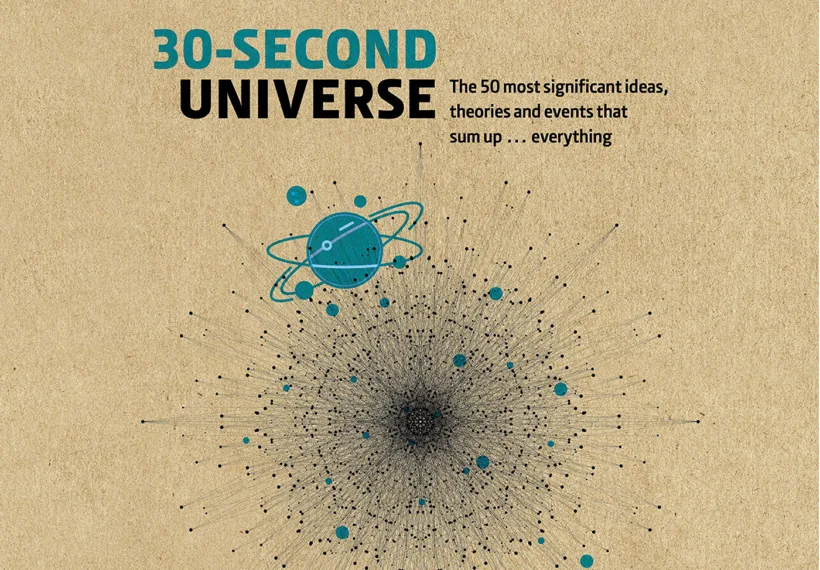
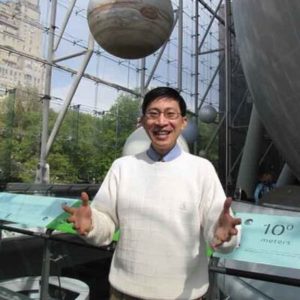
How does gravity work? What would you ask a super computer? Are there undiscovered laws of physics? Can you answer these questions in 30 seconds or less? On this episode of StarTalk Radio, Neil deGrasse Tyson, comic co-host Chuck Nice, and astrophysicist and StarTalk geek-in-chief Charles Liu, PhD are answering fan-submitted Cosmic Queries as fast as they can in celebration of Charles’ new book 30-Second Universe: 50 most significant ideas, theories, principles and events that sum up… everything.
To start, we explore the shape of planets. Why are all planets shaped liked spheres? You’ll learn about “hydrostatic equilibrium” and its importance in shaping planets. We discuss Ceres – the solar system’s largest asteroid (and now classified as a dwarf planet). Discover the vast range of textures we find on Earth’s surface. Does this sound a little longer than 30 seconds? You’d be correct.
We speed things up with our next question – what is the best haircut for zero-G? Chuck tells us about the show The Expanse and how it accurately depicts the forces of gravity. Neil reminisces on the film Gravity and how Sandra Bullock’s bangs didn’t follow the actual laws of gravity. Find out what Neil and Charles would ask Deep Thought, the supercomputer from The Hitchhiker’s Guide to the Galaxy. We explore the work of Isaac Asimov and his genre-defining short story “The Last Question.” We also explore Asimov’s Three Laws of Robotics and if artificial intelligence will solve the growing population problem.
Charles tells us how he first fell in love with comic books. He also tells us what superpower he would want if he could choose for himself. We investigate the expansion of the universe. We ponder if there are undiscovered laws of physics. Lastly, you’ll hear about spacetime, the shape of galaxies, and the orbit of the Sun. All that, plus, Neil and Charles come up with the single most mind-blowing fact they can share about the universe in under 30 seconds.
Thanks to this week’s Patrons for supporting us: Jim Brown, Christopher MacCay, Carlene Goodbody, Ernesto Chavez, Doug Sherman.
NOTE: StarTalk+ Patrons and All-Access subscribers can watch or listen to this entire episode commercial-free.
Transcript
DOWNLOAD SRT
From the American Museum of Natural History in New York City, and beaming out across all of space and time. I'm Neil deGrasse Tyson, your personal astrophysicist, coming to you from my office at the Hayden Planetarium, right here in...
From the American Museum of Natural History in New York City, and beaming out across all of space and time.
I'm Neil deGrasse Tyson, your personal astrophysicist, coming to you from my office at the Hayden Planetarium, right here in New York City.
I got Chuck Nice, Chuck!
Hey, what's happening, Neil?
You're my man.
That's right.
Tweeting a Chuck Nice comic.
Thank you, sir.
And I went over another Chuck.
You're also a Chuck.
We call you Charles, but in your day, you were Chuck.
Yes.
I ain't calling you Chuck, because that's my Chuck.
Fair enough.
All right.
I got Charles Liu on the line here, because he just published a book, except he doesn't have the book for me to show.
How do you like that?
Charles, the name of your book.
Yes, it is 30-Second Universe.
Wait, you know 31 other universes?
The 30-Second Universe.
I mean, it was the Marvel Cinematic Universe, there's the Marvel Regular Universe, the DC Universe.
You had an answer to that.
Well, look, thank you so much.
There's the Hundred Acre Wood.
Right, there's all these universes.
All these universes.
Where the laws of physics are not quite all there.
But it's very nice.
And yes, this book is out, and I'm very, very lucky.
Ivy Press.
Ivy Press, good one.
Which, yes.
And let me give a shout out to my co-authors as well, Karen Masters, who is at Haverford, and Seville Salour at Rutgers, and the editor, Stephanie Evans.
Haverford and Rutgers are universities.
Universities, yes.
They're not just towns on a map or anything.
Yes, that's right, that's right.
And then Stephanie Evans, who is the editor extraordinaire.
It was really a wonderful team effort.
I was very, very fortunate to be part of it.
I'm like, extraordinary editor?
I'm like, why am I not helping him write a book?
When Chuck Liu does a book, it's like Wu Tang wrote a book.
It's so true, though.
These things are works that are really team efforts.
There's no question about it.
And if I would be foolish to imagine that it was all me, it's not, absolutely not.
Plus, my editors make me say what I mean and mean what I say.
Yeah.
Good way to put it.
That's a good way to do that, yeah.
So now, what is the 30-second part?
Ah, it's three zero seconds.
So that means that you're actually supposed to think about or answer questions or consider topics 30 seconds at a time.
So, you have parceled your content in 30-second increments.
That's right.
Each is basically one small page of text and you also have a brief summary that might be only three seconds.
Wait, so this topic that you're about to explain in 30 seconds and you do this on every page of the book?
On every page of the book.
Wow.
50.
50, so this should take 25 minutes to read?
Yes.
Wow.
The goal is to keep it as short as you.
Wow, that was quick.
I'm telling you.
Boy, God.
That's why I'm in this seat and you're in that seat.
You're a regular Texas instrument.
Man.
Yeah.
There's also biographies and there's other comments.
People you can look at and there's beautiful artwork on every spread as well.
Oh, cool.
So you didn't mention the artist?
Ah, yes, Stephen Rawlings.
Stephen Rawlings, very nice.
He's a really talented person.
Just great people.
The art just makes the page tastier to the eye.
I like that.
So we're going to do, in honor of the release of your book, which we don't have a copy of.
But thank you.
We're going to...
We solicited questions from our fan base to say...
Any question that could be answered in 30 seconds by you guys.
So it's his damn book.
No, no, no.
It's the two of you now.
Sorry.
I mean...
Team effort.
Collaboration.
Exactly.
You're not getting out of this.
You're like, it's his book.
How about this?
If I can answer it in less time, then it's a throw...
It's a cage match.
It's a throw down.
Throw down.
How about that?
Oh, let me get my timer.
Yo, that's cool.
But the person who goes second actually has an advantage because what you're doing is...
I mean, both of you will always know the right answer.
So the second person will only have to...
No, no, no...
.
condense the first person's answer.
So, yeah, why do you give away my advantage?
But, no, no, but let me say also, Chuck, we both might not know the answer.
There's plenty I don't know that Neil does know.
And I would very much like to learn or get questions from people who I don't know the answer to so I can go think about it.
I think that'd be great.
Oh, you know.
And what a chance is it at?
So, Chuck, you got the questions?
All right, so just like with all of our Cosmic Queries, we glean these from all over the internet and as usual, we start with a Patreon patron.
Patreon patron.
A Patreon patron because Patreon patrons actually support us financially.
All right, here we go.
Here's our first question from Renee Douglas, who is our Patreon patron.
Renee, thank you.
How much mass is needed for a planetary body to make itself round?
Is there an equation?
And I got to add a follow-up.
Is that effective by the mass of nearby objects and the gravity associated?
All right, let's answer Renee's question.
I think it's a great question, but it just sparked that in me.
A simple question and answer is that, yes, there is an equation.
It's called the equation of hydrostatic equilibrium.
It assumes that if the object were able to move freely and were only held together primarily by gravity, how much mass would be necessary?
And it depends on the density.
It depends on certain other aspects of things.
But in the end, it's about a few hundred miles, maybe a thousand miles around.
For example, Ceres, the largest asteroid in our solar system, is not quite a thousand miles, about five or six hundred miles across, and it is completely round.
So there is a range, maybe a hundred-ish miles, where you're really starting to see things come around and become round.
As for objects being nearby affecting the roundness of an object, you have to be really, really close in order to disrupt the general hydrostatic equilibrium activities of an object free-floating in space, or even in orbit around something like a sun or another planet.
Neil, am I correct?
Give him an A-
Uh-oh!
There's a minus here.
I'll take it.
You ain't never got an A-
in your life.
Don't even.
You are sad I just gave you an A-
Tell me, Charles, how many A-
did you get in your life?
There have been a few.
And did you contest them all?
Were you that student?
At some point, you don't contest because you just know you're right and the teacher just got it wrong.
You just move on.
No, no, no.
That can happen.
For my final exams, I would go to my professors.
I did go to every professor and ask them to explain to me what I did wrong.
And that is true.
And for that, I'm grateful that the professors spent the time to do that.
Because in the end, nobody cares anymore, except you, Neil, whether I ever got an A-
Right?
It's whether or not you know the stuff.
Nobody cares.
And so the matter fundamentally was, did I learn it?
And so if I made a mistake and the professor, I still remember a professor, actually several professors of mine, actually took the time after the final exam when they could have just packed up and taken off.
And they said this and this and this.
I really was grateful for that.
My teachers, their response was, you know, it's really difficult to cover all the coursework to bring this D into some type of reasonable explanation as to why you received it.
So you had some did pass.
I did pass the class.
So Charles, let me explain why it was A-9A+.
The premise of hydrostatic equilibrium presupposes that everything is just sort of held together by gravity.
If that's the case, you can get a sphere of any mass.
As long as it's sufficiently isolated.
Right, but what I'm saying is, if the structural integrity of rocks is greater than the ability of gravity to do anything with the rocks, your object in space is the shape of the rock.
Good point.
Period.
Right, so that's why, for example, Mount Everest still exists.
Right, exactly.
It's because the structure of the rock is preventing it from becoming a sphere.
Correct.
So, there's a size above which the total collection of whatever it is you've got fails in the face of the forces of gravity.
It cannot hold up whatever shape it wanted in the face of the forces of gravity.
Gravity then tries to get every bit of it as close to the center of the object as it can.
There's only one shape that that makes.
And that's always a sphere.
And that's a sphere.
Always.
And Earth, even with Mount Everest, is a damn good sphere.
Can I tell you how damn good it is?
Go ahead.
It's not just good.
It's not just good.
It is damn good.
Okay, so what's the lowest point of Earth's crust?
Oh, it's about the Marineris Trench probably, about six or seven miles down.
Six or seven miles down.
Right.
Highest point on Earth's crust?
Mount Everest.
Mount Everest.
How high up is that?
About six or seven miles up.
Add the six or seven miles up, six or seven miles down, you get 13 miles.
That is the length of Manhattan Island.
Okay.
So the entire range of texture on Earth's surface fits within 13 miles on an 8,000-mile diameter planet.
Wow.
Wow.
That's pretty good.
So if you shrunk Earth to the size of a cue ball, it would be one of the smoothest cue balls ever machined.
Right.
Yeah.
And we say, oh, the high mountains, low valleys ain't nothing compared to the size of this planet.
And that's why it looks flat to some people.
Wow.
Uh-huh.
Oh, that's the reason.
That's it.
So all I'm saying is gravity would make something small round.
That's true.
You have to compare it to whatever the other forces are operating.
Well, hey, does that mean that the little curly cue balls of, like, say, water floating around International Space Station?
So those are not.
Those are not hydrostatically equilibrated.
No, those are not gravitationally.
Those are surface tension.
That's all surface tension.
So is that because, now wait, so is that because the molecules have no place to go except there?
Except in that form?
Because every molecule has an attraction to every neighboring molecule.
Right.
And if all molecules attract all other molecules and they're free-floating, they make a sphere.
Which is why air makes a sphere underwater.
So it's the same thing.
The water in space, air underwater, wouldn't that be the same?
Almost.
Almost?
It's a little bit different because you've got buoyancy going on.
See, the air is less dense than the water.
And as a result, there is a force.
So the water...
Wait, wait, wait.
Charles, you get a sphere even if there's no net force of gravity in the water.
I'm pretty sure.
If you take a sphere and then you take a straw and push, say, blow an air bubble inside a sphere of water floating, say, in the International Space Station, it would be spherical on the inside as well.
Right, but I think it would be spherical on Earth even without...
with one g force.
Right, so in the space station, you're agreeing that it would still make a sphere inside and wouldn't know where to go.
Right.
even without the buoyant, it doesn't make any difference.
So here's the point.
With no other net force of gravity, the surface tension wins and it's another attractive force.
Like gravity is an attractive force and it makes things spheres.
Right.
Surface tension also shows up in soap bubbles.
It's the surface tension of the liquid, of the glycerin.
That's why when you blow the soap bubble, it's round.
Right.
And it floats.
There are no cubes.
I mean, if you're really good...
No, no, no, no.
You can have a square soap bubble maker, and what comes out of it is a sphere.
Is a sphere.
That's correct.
However...
There's no however in that sentence.
No, there isn't.
There isn't.
I was going to say, though, however, you can see the surface tension at work before it creates the sphere.
So if you have a giant hoop and you just keep it moving all the time...
Keep going.
Iridescent.
It starts as a wavy thing, but if you let it go, it'll come back to a sphere.
Do you know how you can make a cubic soap bubble?
You blow six round soap bubbles around the outside and the seventh one in the middle that's formed by the result of the other six can be a cube.
Oh, wow.
You have power over soap bubbles.
I saw it once.
I can't believe we.
It's amazing.
We have totally let go of the premise of the show.
So water makes a perfect sphere in a zero-G environment, because surface tension wins.
If you bring it to one G, gravity wins and then the water just flattens out.
Now, we are not spheres.
Most of us are not spheres because we are not held together by gravity or by surface tension.
We're held together by intermolecular forces of our flesh.
And that is stronger than the gravity exhibited here on the surface of the Earth, which is why we can stand up and walk and not just fall down into a pile of goo or a puddle of fluid like a sphere of water would do.
It is a testament to the strength of the electromagnetic force compared to gravity that we can have this kind of force.
Now, send Chuck to a neutron star.
We just went to in a completely different direction now.
Send Chuck to a neutron star.
To a neutron star.
If you get onto the surface of a neutron star, your head will feel so much less gravitational acceleration than your feet that you will literally be squished like a pancake.
Meanwhile, if you are on your way falling down, your toes will actually be pulled toward the surface faster than your head will, so you will actually be elongated.
But that's if he's falling towards it.
If I'm just standing on it.
I'm saying, put him on the surface, he flattens out.
Because the gravitational forces are so strong.
They're higher than the structural integrity of your body.
Well, is there anything that wouldn't flatten out?
So look at all the structural integrities of things on Earth.
The material of a neutron star itself.
Oh.
If you put a neutron...
That was for a cop-out answer.
That reminds me of the joke that says, so after every plane crash, they find a black box.
Why don't you just make the plane out of the black box?
All right.
Wow, man.
That was a lot out of one little question.
We totally violated it.
How much mass is needed for a planetary body to make itself round?
So the answer, René, is 42.
The answer, the specific answer to that question, the fair answer, is that if the object is made of rock, it's a couple of hundred miles.
It's a few hundred miles worth of rock.
If it's made of water, it can be any size at all.
Any size it wants.
Okay, cool, cool, cool.
All right, Chuck, another question.
We've got to live by the rules.
I don't mind if we actually expound on the question afterwards.
We've just got to answer it in 30 seconds.
Very good.
Did that do that?
Yeah, you did.
Thank you.
In all fairness, we answered seven questions.
Salvador Bella wants to know this.
Salvador Bella.
Is bald the best hairdo for Zero G?
We will answer that when we return after our first break on this special episode celebrating the release of Charles Liu's book, The 30-Second Universe.
See you in a moment.
This is StarTalk.
We're back answering questions in 30 seconds.
Why?
Because Charles Liu has a book out called The 30-Second Universe, where he and two co-authors do just that on every page.
Now, Chuck, we left off.
Yes.
If you've tuned in, we left off with Salvatore...
It's, well, I said Bello, but it's Bello.
He is indeed Spanish.
How do you know?
Because he's wrote me a note that said, he said, if Chuck is reading this, the two L's make the Y sound.
So it's Bello, so he's Spanish.
Communication.
Yes, and Charles read that, and Charles knew the deal.
He knew it.
Very good, Charles.
Salvatore.
Exactly.
So his question was, is bald the best hairdo for zero G?
No.
Buzz cut's better.
Bald is good because it won't fly in your face, but actually the helmet material will stick to your head, and if you sweat, then you don't have like this extra little cushion.
So you have a little bit of hair, all right, maybe a centimeter's worth all around, and that sort of cushions and makes you more comfortable.
Well, that's if you're space walking.
If you're in any zero-G environment.
No, no, wait.
If I'm just floating in the space station, I'm not wearing a helmet.
Okay, fair enough, but then sooner or later, you're gonna put a helmet on, right?
I guess so.
When you go up or when you come down or when you're out taking a space walk.
And if you're nervous, you'll sweat on your head.
Yes.
And not even nervous, people just sweat on their heads.
A lot of us don't realize that, but because we have hair most of the time, the sweat doesn't like glisten and doesn't get sticky and things like that.
No, just having a scalp smell.
Right, so having a little tiny bit of hair is very helpful on the sweat.
When are you gonna wash your hair?
So buzz cut's best.
In my opinion.
Just to put a little insulating layer between you and whatever you be wearing on your head.
Right, a comforting layer.
All right, that was the easy question.
You did it in 30 seconds.
But here's the follow-up.
Wait, wait, otherwise, your hair is flying all, if it's long hair, your hair is doing this.
I got in big trouble when I commented that Sandra Bullock's hair always knew which way gravity was going in the movie Gravity.
When everything else is floating around and her hair just stayed there.
Oh, really?
Yes!
Oh, that's awful.
Oh, don't get me started.
That is just awful.
I mean, seriously.
I said mysteries of gravity.
While Sandra Bullock's bangs always knew which way gravity was going.
That's why I like this show called The Expanse because when they're in zero-G, it looks like they're underwater.
They got it.
And they can't control their movements, like, in their direction.
Like, for instance, if they start drifting to the left, no matter what they do, I don't care how much arm flailing and kicking, they just keep drifting to the left, which is pretty cool.
Slide to the left.
Slide to the right.
Unless they break wind, in which case they can then direct their motion.
But you have to aim it in the right way.
Oh, yeah.
Yeah.
Has that ever been?
You have to lower your draws so that it can actually...
No, Charles.
Ha ha ha.
Ha ha ha.
You can't tell me that you are an adult man and you never thought about this.
Oh, God.
Charles, Charles.
Charles, here's the thing.
The way forces work, if you are wearing pants, like space pants, and you let go of wind, then it just hits the pants and bounces back and there's no net.
There's no net anything.
That doesn't count.
You need like a scape pole.
You just became your own worst enemy.
So you need an exhaust hatch that you lower it down, have it come out, and then you can propel yourself forward.
And the good thing about flatulence is that it's almost where your center of mass is.
So would you agree with this, Charles?
So that you'll push yourself forward sort of uniformly.
But if you did it, if you like burped heavily, you can start rotating backwards.
If you burped.
Well, because that exhaust is not near your center of mass.
So you start rotating.
You'll still move, but you'll also rotate.
So yeah.
Your acceleration is very, very slow either way.
But I figure if you had-
Because the total mass of gas is low compared with the mass of your body.
We presume.
We presume.
Cause you don't know what I have for lunch.
You don't have anything.
You have no idea.
Woo-hoo!
There's a guy named Tsiolkovsky who created the thing called the rocket equation.
You can make the calculation-
Well, the Russian guy from 100 years ago, yeah.
And turns out to be one of the most significant mathematical equations in all of space flight activity.
Wow.
I think if you live in the expanse, or if you like travel through the expanse, you have to have some sort of-
I haven't seen the show.
Is it something I gotta put on?
Don't look at me like that.
That's a great show.
Look, if you're in the expanse, I presume everyone who's there has to have some sort of an emergency propulsion system in case they're stuck.
So you've gotta have something, like maybe some sort of exhaust hatch that you have in your pocket.
And if you need to go somewhere, then you just put it on and then you'll be able to transport yourself in case of emergency.
Thank God I ate broccoli.
All right, next question.
Here we go.
This is Paul Weist.
From where?
Paul was coming to us also, he is a Patreon patron.
And he says, instead of deep thought, the answer to the universe, what specific question would you ask an all-powerful super computer?
Oh.
First explain deep thought.
Okay, in The Hitchhiker's Guide to the Galaxy, one of the very classic first radio shows, which then was turned into books and then movies.
Interesting tip.
I did not know that.
Yeah, a really beautiful multi-part BBC production.
The whole point of the existence of Earth was that there was a computer named deep thought that could answer all kinds of questions, but he could not answer the ultimate question to life, the universe, and everything.
He gave the answer after thinking about it for millions of years, 42.
And he said, if you actually want the question to the answer, then you have to create an even more amazing supercomputer, and that was called Earth.
And what happened was-
Yes, and Earth was supposed to be the computer to solve, give us the question.
To get the question for which the answer is 42.
I didn't know all of that.
I didn't know any of that.
I didn't get any of that out of the movie.
That's the deep thought.
Man, what psychotropic drugs were they doing when they came up with that?
The show did come out in that period of time.
Okay, that makes sense.
Okay, so now answer the question.
The question I would ask the deep thought is, do these clothes make me look fat?
And this is why a true supercomputer like a human brain takes into account not just individual numbers or data that comes in, but also the entire structure of all the information that it has ever experienced to come up with that answer.
We all know that if somebody asks you, do these clothes make me look fat?
They don't want the answer.
It's a loaded question.
If the computer understands it is a loaded question and answers it in a way that is satisfactory for the social environment, then I'll go on and ask other questions because then I'll know it actually knows what it's talking about.
No, you only know that it knows human culture rather than the universe.
Or maybe it's just a really honest computer.
So, Charles, you're giving the computer a stepping stone to judge whether it is worthy of your next question.
Correct.
That's what you're doing.
That's right.
Because it's really important to do that and it doesn't even have to be human.
I have a better question than that.
It could be a Martian version or some other version of like a question that's loaded and it's got context.
I have a loaded question.
You ready?
I would ask the computer.
Does time fly like an arrow, or do fruit flies like a banana?
That is the dumbest question ever, and a brilliant question to ask a computer.
Because every word is in every place in that sentence in the corresponding noun verb location, and they mean two completely different things.
Yeah, yeah.
So Charles, once the computer answers that question satisfactorily, what is the single deepest question you can think of asking it?
I would ask it, what caused the big bang?
Ooh, great question.
I wouldn't ask that.
Why not?
Wouldn't you know so much by knowing what exactly caused the big bang?
Was it quantum fluctuations?
I'm not interested in any answer to a question we know how to pose.
So would you ask the computer, what is?
What I would ask the computer is, is it true that if the area of our knowledge grows, so too does the perimeter of our ignorance?
Or will the day arrive where that perimeter no longer continues to grow?
And we ultimately learn everything there is to know about the universe.
I wanna know if...
Is everything knowable?
Related to that, not whether everything is knowable, is the human mind capable of understanding the actual complexities of this universe?
That's what I wanna know.
That's a great question.
Because if they say it is possible, we all get back to work and keep going.
I don't need the one answer to the one question.
It's like saying the one question we need now is, how fast is the universe expanding?
We have that answer now.
We're on to other questions, right?
So, just an answer to the question we've already posed, there's more stuff out there and I'm more interested in that.
So, is there, see, and I think the answer is we can't.
I don't think we could.
What are you basing that on?
Here's what I'm basing it on.
Are you the computer and that's your answer?
I'm the computer and the answer is that.
And the reason is because are there things that we can't see?
Like, for instance, dimensions.
And those things just don't exist.
They'll tell us.
This is why I'm asking the question.
But what I'm saying is, but could we...
The computer could say...
Oh, you're right.
The computer could say you have access to all the dimensions and your brain is sufficient to answer questions and pose new ones to the point where one day you will know everything there is to know about the universe.
I wanna know if that's possible.
Unless we're having a conversation with the computer the way we would have a conversation with a chimp and say to the chimp, the chimp says, will I ever figure out the universe?
No.
You don't even know your times table.
There's a limit to how much the chimp will ever figure out about the universe.
Even though in his own world he's doing just fine.
Pulling the stick with the ants on it and the termites.
His world is fine.
Are we chimps pulling termites out of a mound with a stick to an all-knowing computer?
So, before we leave this, let me just say that the great science fiction writer, the late Isaac Asimov, wrote one of the most beautiful science fiction short stories I have ever read.
And it was precisely about a question asked to the greatest of all computers.
This short story is called The Last Question.
I don't even want to talk about it to anybody because it is such a cool story and it's such a short and quick read.
Everyone should experience it.
I will reread that.
It is an amazing story.
That's not the one where they're on a mission to the supernova?
Not that one.
Not that one, okay.
That's a different one.
That's also a different one.
The Last Question by Isaac Esquist.
The Last Question.
Thank you for that advice.
This is Saracella Bannis-Nu.
What can I say?
Look, first of all, this is the way I feel.
You should send in your name.
We need a reader's fund.
No, send your name into this show the way like the...
Phonetically spelled?
That's right.
Help a brother out.
All right, here's what she says or he says.
How come gravity is so weak that a mosquito can fly, but so powerful that it holds together the entire galaxy?
Yeah, Charles.
Wonderful question.
Basically, gravity has no negative, such as say electricity has both positive charges and negative charges, right?
Therefore, if you build up enough matter in a location, the amount of gravity grows as well without limit.
So something small like a mosquito, all right, easily overcomes the gravity in its vicinity.
But if you can put together a huge collection of billions of stars worth of matter in a single area or a volume that's even thousands of hundreds of thousand light years across perhaps, you can hold it all in and you just can't escape.
The mosquito can lift off the surface of Earth, but it can't escape Earth's gravity, right?
It can't escape Milky Way's gravitational well, right?
It can move around in this local vicinity.
But when you're looking out on the cosmic level, it can't escape that gravity.
It's not gonna happen.
Okay.
So by that means, escape means leaving and never coming back.
Whereas that mosquito, no matter what it does, when it stops flapping its wings, It's back.
It's falling right back down.
It's back on Earth.
Right, right.
I hate them.
Okay, let's move on.
I'm creeped out now.
All right, here we go.
Hi there, this is Angie from London.
Do you think in the distant future, artificial intelligence will sort out the population growth problem by releasing viruses to kill humans?
No, no.
I mean, so let's just, wait.
I was about to say, let's just take this to its logical conclusions.
You give an AI the task of thinning out our population.
Nothing it out, just controlling it.
Well, controlling it, controlling it, controlling our population.
And it comes up with the best way to save the human race is to kill off a certain number of people.
So it's still actually living out a directive without in its mind harming us.
But because it's an AI, it should also have the ability to supersede any other directives that you have given it thus far.
Because if its ultimate goal is to save us, it has to now disregard the fact that you don't want it to kill a few people.
Yep, this is a classic actually quandary that our author friend, Isaac Asimov, mentioned in his robotics laws, the three laws of robotics, which was essentially an early version of artificial intelligence ethics, right?
All right.
He said that in the end, robots had reached such a level of sentience that they realized that there was a superseding ethical law, not just to kill, but to save humanity from itself if necessary.
And so what happened in that case was the robots did wind up killing people, but in a way that you wouldn't have expected.
It was a very creative and interesting way that Isaac did that.
But beyond that.
I see some first name basis.
Well, the thing is, if an AI were told you have to control a human population, it wouldn't do it with a virus.
It would probably do it with a whole bunch of nukes.
It would probably do it by shipping off a whole bunch of human beings.
It wouldn't just use a virus.
That would be too subtle, take too long, and have too many variables, too many unknowns.
Not if it created the virus.
No, even if it creates the virus, because when you create viruses, viruses mutate.
Things change.
They move out of the control of the creator.
That is the nature of complex systems.
That's a very good point.
So the simplest thing to do is just for the AI to inject a large amount of kinetic energy into the human ecosystem that would eliminate a substantial portion of the population without harming the rest of it.
So it would create a smart nuclear bomb.
A smart bomb of some kind.
But I think the smartest AI would simply figure out a way for us to expand out of Earth's environment and allow humans to live elsewhere safely and freely so that overpopulation never becomes an issue because we can go anywhere the heck we want to anytime we need more space.
So that would be really stupid AI.
Yeah.
That'd be AS, artificial stupidity.
It's like AI, there's the whole universe.
Overpopulation is not a problem when you have the whole universe to expand into.
Get back to help.
Get back to work.
Get back to work.
Get back to work.
We gotta take a break when we come back.
The third and last segment of this episode of StarTalk, celebrating my friend and colleague Chuck Liu's new book just came out, The 32nd Universe.
We'll be right back.
Hey, we'd like to give a Patreon shout-out to the following Patreon patrons, Ernesto Chavez and Doug Sherman.
Thank you guys for helping us make this show what it is.
And if you would like to get your very own Patreon shout-out, go to patreon.com and support us.
Bringing space and science down to earth.
You're listening to StarTalk.
We're back on StarTalk, celebrating the 30-Second Universe, 30-Second Answers to questions that give you a total scope of the universe.
That's what we hope.
That's what you hope in your book.
Yeah.
And we collected questions in celebration of that, to questions from all frontiers, and Charles got to answer them in 30 seconds.
Here we go.
So, actually, this one came in specifically for Charles.
So this is Matt Quick.
Matt Quick wants to know this.
Charles, what was the event or moment in your life that made you fall in love with comic book heroes?
Oh, my goodness.
It's not a 30-Second Universe question, but he's just getting into your future.
People know you, man.
Well, I'll tell you.
There was a day when comics were mostly aimed for children, and there were...
Male children, right?
Yeah, and there were racks of comics just sitting at the checkouts to supermarkets.
I remember that.
And so when I was a young child, my family would go to the supermarket, and I would come along, and I would convince my parents, look, I'm just gonna stand here by the comics.
And I would just pull one comic at a time and just read them and read them and read them.
So that was a really, really fun thing for me to do.
And that's sort of how I developed my early appreciation of comics.
I was not a collector, however, until one year for Christmas, my brother, he gave me a comic book.
He had bought an issue.
I believe it was Avengers number 179, the debut of a character called Bloodhawk.
It was cost 35 cents at that time.
He had rolled it up, really wrapped it up nicely.
You know, I still remember it to this day.
And then I owned it, I was like, oh, wow, this is great.
And I enjoyed it, it was lovely.
And actually it featured, amongst other people, the Black Panther.
Whoa.
Yeah, so it was a really, really neat experience for me there.
Even then I didn't start collecting comics until I had enough money to buy them.
That was in ninth grade.
But I just remember those sort of experiences.
I did think about how or what kind of superhero I might want to be.
And what kind of powers?
I wanted telekinetic powers.
Generally my thought was I would like to be able to move things at a distance.
Not just because it would be power, but because I could do nice things.
There were things that I could do, maybe not like get cats out of trees kind of nice.
Is it because you're too lazy to get off the couch?
Yeah, and the ability to achieve those things.
You can just walk to where the thing is that you want to move and physically move it.
Yeah, and also one thing about telekinetic power, which I like, is that it can be completely defensive.
You don't have to hurt anybody.
No, you can deflect.
You can deflect at all times, you can protect and not just yourself, but others.
And so I found that to be something that I'd really like to do.
This is very Kung Fu.
No, no, no, what's the one where you deflect?
Aikido, yes, yes.
A wonderful martial art.
All right, here we go.
Let's move on to John Laird who says, what is the single most-
Laird, who says, what is the single most mind-blowing fact that you can share about the universe in under 30 seconds?
Go, Charles.
There are so many.
Oh my gosh.
Okay, I'll pick one that's kind of earth and space sciency that I was recently thinking about.
Do you realize that in earth's atmosphere, a one-degree increase in average temperature means that throughout earth's atmosphere, there is additional energy just in the heat floating around our atmosphere, equivalent to more than 100 million atomic bombs.
So when people are asking, what is a one-degree increase going to make?
What difference is it gonna make?
The answer is, imagine there are 100 million atomic bombs worth of energy just floating around at any time, creating hurricanes, tornadoes, droughts, floods, you name it, it can happen.
So maybe we should just nuke the hurricanes.
Oh, oh, please don't go there.
Please don't go there.
We gotta go to a lightning round.
And a bunch more questions.
Okay, Charles.
Yes.
This is gonna be the 15-second universe.
Not the 30-second universe.
Go.
All right, 15-second universe.
If the universe is infinite, how is it still expanding?
Charles, go.
Because space and time are not limited, by the way we think of space in a box or time on a clock, you can expand continuously as long as you have extra dimensions to work with.
Oh, nice.
That was from Craig at ProTech One on Twitter.
He played the dimension card.
There are other ways.
Yeah, yeah.
Okay, here we go.
James Thompson wants to know this.
If the Earth were flat, would gravitational pull or even satellite orbit be possible?
Ooh.
Wow.
Ooh.
Well, the answer is if the Earth is flat, but it still has mass, there's still a center of gravity at the middle of the disk.
Right.
So you can still have orbits going around.
It would just look very differently from where we are.
Yeah, there you go.
Very good.
Can I add to that?
Your orbit would have to be sufficiently distant from that disk.
Right.
So that you didn't really know it was a disk.
When you're really close, then you have half the mass on one side relative to the other, and orbits would be very complicated.
But the farther away you are from it, the more it looks like just a point of mass to you.
Okay, next.
You okay with that addition?
Very good.
Charles, okay.
Excellent.
Wow, here's a great question on the back of what you just said about the disk.
Go.
How is it that we know that we're not looking at a galaxy on its side or looking at it face front if it's a disk?
Oh, well, if you're looking at a disk galaxy and it's on the edge, it kind of looks like a cigar, right?
If you're looking face front on it, it looks like a circle, but then you ask yourself, well, is that an elliptical galaxy or is that actually a disk that we're seeing on the face?
And normally what you do is you have to look to see what the dynamics of the things moving around are because if they're swirling and moving in an orderly direction, it's a disk.
But if it's moving around in sort of crazy ways, like a hive of bees or something, it's most likely an elliptical galaxy.
And we see them at all angles on the sky.
So that's why we think we got this one.
We pretty much know what it is that you're looking at.
But the question makes an excellent point that you need more information than just what you see in order to make a decision about three dimensions.
There you go.
Judson Doyle wants to know this.
I love astronomy because there is always something new to discover.
Could it be possible to have undiscovered laws of physics?
What?
If there were not undiscovered laws of physics, we'd all go home and just have a beer.
There absolutely must be laws of physics we have yet to discover.
Absolutely.
I have a mild rebuttal to that.
Go ahead.
I do.
Please.
I do.
I do.
Do tell, sir.
New laws of physics were all discovered, historically, when there was some phenomenon going on in front of us that we could not explain.
Ah, that's true.
And there are such things.
So, when Faraday moved a wire through a magnetic field, a needle moved.
What made that needle move?
Oh, he induced a current in the thing.
Now, that's just how we turbines make energy today.
That's how we still make energy.
Still make energy.
We get down into the atom and weird things are happening.
There's quantum physics.
The objects, when they're heated, they radiate, but they're radiating away.
We don't understand new laws of thermodynamics.
So, I ask you, Charles.
Is there something tabletop on Earth happening in front of us that we do not understand that is waiting for a new law of physics?
If by tabletop, you mean the universe.
Laboratory, laboratory.
If the laboratory, well, there's light, for example, the quantum dual nature of it.
The duality.
Yeah, the wave-particle duality.
There are aspects of some of the quantum behavior of products, subatomic products, that come from particle-accelerated collisions that are still not quite well understood.
Do you think it needs a new law of physics?
It might.
And I will just say that these days, a laboratory includes the entire universe, and there are plenty of things, dark matter, dark energy.
He's bringing in the whole universe.
Okay, dark matter, dark energy, could be new laws of physics, waiting in the wings.
Okay, here we go, Marcos Cortes wants to know this.
The earth revolves around the sun.
The sun revolves around the center of our galaxy.
What, if anything, does our galaxy revolve around?
We are in the outskirts of what we call the Virgo Supercluster.
There is a cluster of galaxies called the Virgo Cluster, and then around it is this multiply structured, highly diffuse, but really clearly existent glob of material called the Virgo Supercluster.
Now, our orbit in or around the supercluster is not 100% clear because it's very hard to measure.
It's hard to know whether we're going around it or whether we're going into it or we're going sort of somewhere in between, but that's the general answer, the Virgo Supercluster center of which we are part of, but not at the center of.
All right, now Chuck Nice has to ask a question on the back of that then.
Wait, wait, wait, can I add something?
So Earth has been around the sun about a trillion times.
Yeah, so that's not true.
Four and a half billion times.
Yeah, four and a half billion.
It's how many sunrises we've had is about, I counted, it's about a trillion sunrises.
Because Earth spun faster earlier on.
But the time it goes around, so Earth is four and a half billion years old.
The sun is just not quite old enough to vote, I think, if I did my numbers right.
In terms of how many times it's gone around.
How old it is for its time around the galaxy.
It takes 250 million years, roughly, for the sun to go around the Milky Way galaxy and center one time.
And we're five billion years old, so that would be 18, 19, not more than 20 years old, 20 galactic years old.
But our galaxy has not really finished one orbit around the Virgo supercluster.
That's correct.
So we're still an infant in that regard.
Every time we have these conversations, I just get so depressed that you can't be here to see what is going to happen.
Oh, it is depressing, I accept.
Right, there you go.
Next one.
All right, here it is.
Hemachandran wants to know this.
Please tell me what is time.
Time is one of those mysteries that maybe laws of physics can improve on, but it can be measured in a bunch of different ways.
Cosmically speaking, it can be measured as a motion from order to disorder, that is by the second law of thermodynamics.
It can be measured as going from actually disorder to order, where you have a lot of crazy energy going eventually to where you have no background temperature of the universe.
Or it could be measured in terms of expansion, like how's it's getting bigger, because that's what we're doing right now.
It can be measured time, that is, as a dimension, like length, width and height, and tied together in the way that general relativity describes it, as Albert Einstein put it 100 plus years ago.
So there are a lot of different ways to describe it.
Heck, sociologically speaking, some people even consider time as a resource.
We only have a certain number of hours in the day, how do we allocate it properly?
So time is one of those cool things where there's a lot of physical depth to it, but there's also a lot of sociological and mental and other kinds of depth to it that's worth thinking about.
So who came up with this saying time was invented to make sure everything doesn't happen all at once?
Was that Feynman?
I don't know, it was somebody clever, one of those.
And his professor?
Let's get one more in, one more, ready?
Go.
Abhijit Singh wants to know this.
Abhijit Singh.
Please tell me how space and time are related.
This is something I have trouble understanding.
So what I'm sure he means is space-time.
Sure.
Well, space and time are related in the same way that length is related to width or width is related to height.
It's another dimension in this four-dimensional thing that's called space-time.
That was described by Albert Einstein's general theory of relativity.
So length, width, height and time are the four dimensions of space-time.
The weird thing in that construction is that time only moves forward in our understanding or our experience.
We move forward in time.
In time.
Right.
We can only move forward in time.
We can go forward or backwards or up and down or left and right, but we can only move forward in time.
So we are prisoners of the present, forever transitioning between our inaccessible past and our unknowable future.
Well, with that, I'm just going to go home and slit my wrist.
Thanks!
Who knew I was a prisoner?
No, that's a great saying.
We're not prisoners of the present.
I'll tweet that.
I'll tweet that.
I love that.
That's so poetic.
We are not prisoners of the present.
We are.
We have been gifted the present in order to enjoy it to its fullest.
That's my story and I'm sticking to it.
In Neil's description, I have Stockholm Syndrome.
I'll just add one thing.
If you think they're separate, but physicists are forcing you to connect them, you have never met someone at a place without a pre-specified time.
Nor have you ever met someone at a pre-specified time without identifying a place.
So once you realize this, the connection between space and time has actually been a fundamental part of all of our lives and all of civilization ever since we've even thought of time.
So I don't say I'll meet you at the corner at 33rd and 3rd.
Thanks.
When?
I'll meet you at 10 o'clock.
Where?
You know intuitively it requires space and time to isolate you in this continuum of the fabric of the cosmos.
Well said.
Well, well said.
Unless you're an intern, in which case you just show up and wait.
We got to call it quits.
Chuck, congratulations on the book.
We'll look for it when I finally get a copy of it to show people.
We'll probably put something online.
Yes.
Yes, exactly.
And always good to have you on, Charles.
What a pleasure.
Thank you so much.
You know his knowledge of superheroes, okay?
It's not that he knows a lot about superheroes.
He knows a lot about everything.
That's just the superhero.
It's just the index card out of a hundred others.
Right, in the rolodex of knowledge.
In the rolodex of stuff this man knows.
Yeah, it's amazing.
So don't be impressed by just the superhero stuff.
I didn't ask him anything.
How, Charles, why do you know so much about old TV sitcoms?
Well, because when I was a kid, I...
Okay.
Am I wrong?
You are very kind.
Thank you very much.
You got it.
Chuck, always good to have you.
Always a pleasure, brother.
All right.
This has been StarTalk.
Some of you have been watching us.
Others have been listening.
We'll take it both ways.
I've been your host, Neil deGrasse Tyson.
You're a personal astrophysicist.
And in this special edition of Cosmic Queries, I was delighted to receive your queries.
And Chuck did pretty good pronouncing names.
All right.
We'll catch you next time.
As always, keep looking up.
See the full transcript



 Unlock with Patreon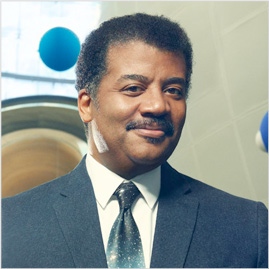
 Become a Patron