
Cosmic Queries: Spacetime

Credit: NASA-JPL-CalTech
  • Free Audio
  • Ad-Free Audio

About This Episode

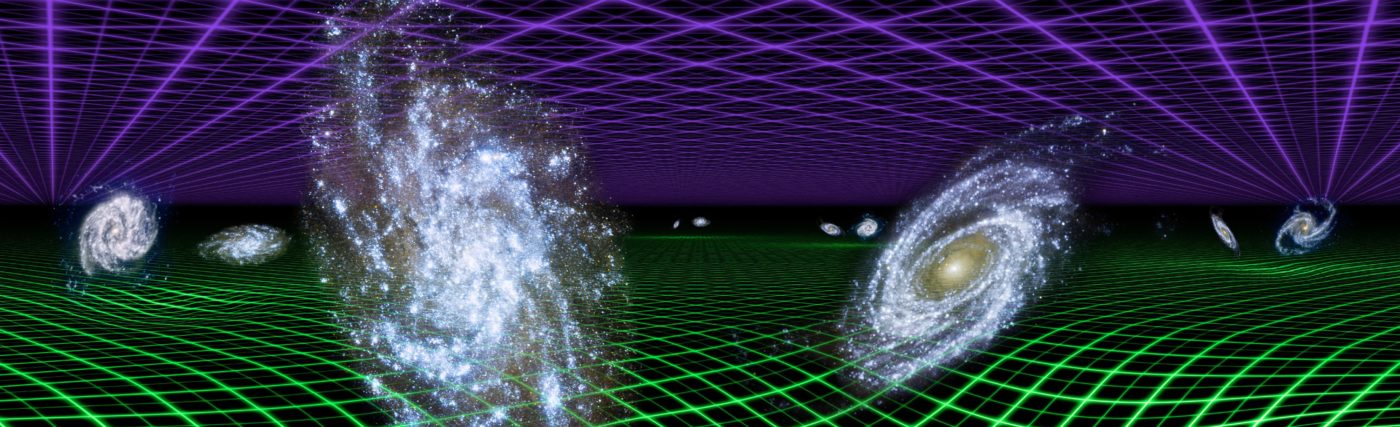
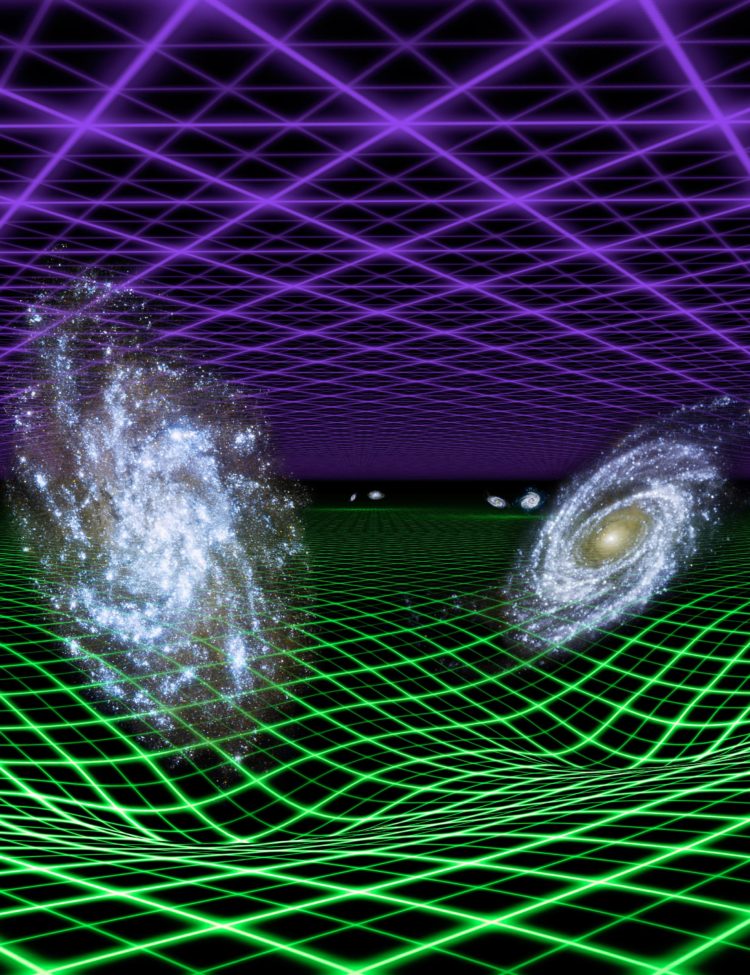
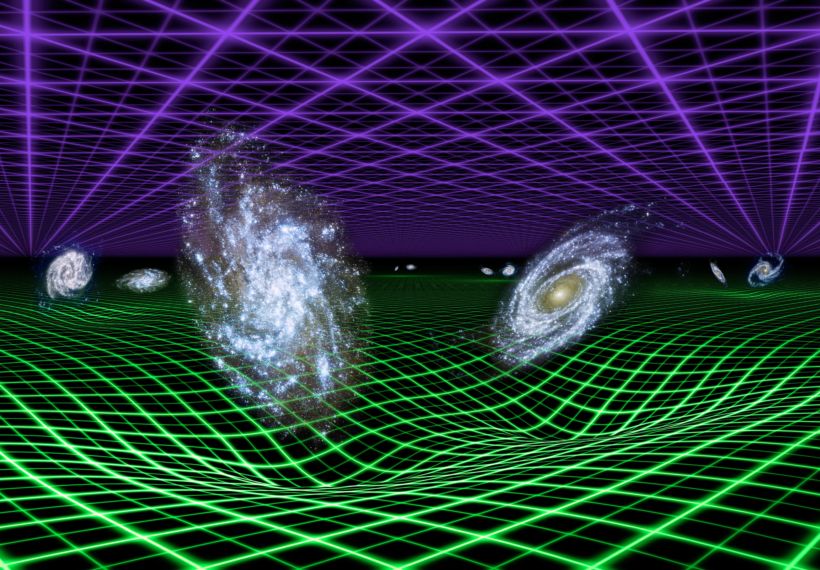
Fasten your interstellar seatbelt and flip your brain into overdrive. Neil deGrasse Tyson and comic co-host Godfrey are here to answer fan-submitted Cosmic Queries on the fabric of spacetime. Explore the edge of the known universe and whether there might be more unknown universe waiting beyond the horizon. You’ll learn about the fascinating theory describing our universe as a 3-D holographic projection of another higher-dimensioned reality. You’ll hear why dark matter could be “gravitational bleeding” from another dimension and how it’s possible that the study of dark matter and dark energy will unlock the secrets to traveling backwards in time. Investigate the connections between dark matter, Newtonian physics, and Occam’s razor. Neil also explains why the curvature of space is hard for us to see given that we are embedded in space itself. Find out about the Fermi paradox and the idea that extraterrestrial life might have already visited Earth and deemed life unintelligent. Discover more about Sir Isaac Newton: the problems Neil would ask him to solve today, how he invented calculus on a dare, and why Godfrey thinks he might be annoying to talk to in the modern era. All this, plus, a fan asks Neil, “How many physicists does it take to change a light bulb?” and his response is something you will not want to miss.

NOTE: All-Access subscribers can watch or listen to this entire episode commercial-free here: Cosmic Queries: Spacetime
Transcript

DOWNLOAD SRT
Welcome to StarTalk, your place in the universe where science and pop culture collide. StarTalk begins right now. This is StarTalk, and I'm your host, Neil deGrasse Tyson, your personal astrophysicist. I serve as director of New York City's Hayden...
Welcome to StarTalk, your place in the universe where science and pop culture collide. StarTalk begins right now. This is StarTalk, and I'm your host, Neil deGrasse Tyson, your personal astrophysicist. I serve as director of New York City's Hayden Planetarium right here in New York City. And today's edition is the fan favorite, Cosmic Queries. I've got with me Godfrey Danchima. Godfrey. What's happening? Welcome back. Thank you for having me back. Danchima, it's Nigerian. Danchima, yes. It's in- By a Tokyo, it sounds- It's funny, can I tell you something? What's that? That the Japanese pronunciations are the same as African pronunciations. Like for example, Fumi is a Japanese name and Fumi is also a Nigerian name, same spelling. It could be, if I understand correctly, that Swahili, every syllable is pronounced, just as is the case in Japanese. In Japanese. O-Ks and ooze and- Everything is there, you just plow through the word and you did it right. Connection, everybody's African, yeah. I don't know, I just made up this song. Everybody's African. If you're using whether people pronounce words the same as reason for all being African, that would exclude the French. Yes, cause everything's silent. Everything is silent. My favorite in French is the word for water. There's no- So arrogant. That's like the lamest word there ever was. Put a constant, give them words of muscle. If you're thirsty, I'm like, uh, uh. That's French thirst. Excuse me, they're still so French, even when you're thirsty. Uh, uh, please. Uh, I don't want to sound so agressive. So today's topic. Yes. Is. It's. Space time. Space time. Very nice. I like space time. And here we go. Some of my best friends live in the fabric of space time. There it is. All right, let's, I haven't seen any of these and it called from our social media. Okay, here we go. Let's do it. Okay, Kyle Yocum spelled with a C, but it's still pronounced Kyle from Tennessee. Wait, I've heard that name before. Is he one of our Patreon people? He is your Patreon patron. Oh yeah, so he bought his way to the top of this list. Oh yeah, he's not, he's not planned. I mean, he got a lot of space time. I put money in that time. I got a lot of money in that space. So you better read. If you support the show, there are perks you get. You do. Right on up the ladder. I mean, this is just one of them, but there's others. It's great. I think he deserves it. He's always at the top. Yokum, I love that last name. Yokum. Okay, ready? Yeah, give me some Yokum. If Isaac Newton were alive again today, which of our more recent- I wouldn't be able to hold my pee. Yeah, right, that would be kind of nice. Yeah. To be gripping him like a fanboy. Yeah, no, I would totally, yeah. Yeah, would you like touch his wig? Yeah, I would touch his wig, probably. No, no, I wouldn't touch it. Why are you getting me to say that? I would be like- No. You're not gonna touch it. Laws of inertia, baby. Laws of inertia, no, nothing. Come on, some thug that knows about- No, I'm not touching his wig. Okay, you're not touching his wig? Angela Davis came forward into the present kitchen. Can I touch your fro? No. That's true. She would slap you silly. She would slap us silly. Even today. Right. If Isaac Newton were alive again today, which of our more recent understandings about the universe do you think he might find most exciting if you were to get to work with him on a particular project of your choice? What would that be and why? He was so brilliant. I would present all the world's problems to him no matter whether or not they were in physics and just to get his brilliant mind to apply to it. Really? I've read his writings and you can't, the hair stands up on the back. I don't have hair there, but if I had hair, it would stand up on the back of my neck because he was so plugged in to the operations of nature. He had an understanding. He had a sensitivity to what we knew and did not know and where the frontier was to ask questions. There's a whole section of one of his books, one of his books, Optics, written in 1704. You understood it? Didn't they talk differently out there? I don't know, I'm just saying. So you learn how to read, you know, yeah. So the language was a little more classical. Yeah. For English, you know, at the time, yeah. Not quite Shakespeare. Right. That was 100 years earlier, but it's transitioning. And even the writing, isn't the penmanship a little different? Yeah, penmanship is different and even the printed words are different. Right. Some words are capitalized and others are not. I do that in my Twitter stream, by the way. I capitalize certain nouns. Okay. I want to bring attention to. Like the V's would be like U's? Oh no, that's different. So that would be, the U's would be like V's. V's like U's would be like V's or whatever. In Roman times with the, yeah. Yeah. That's annoying. Before the U was fully developed as a letter. Right, it took somebody to go put a butt on it. This is the evolution of language. Yes, so I would learn how to communicate with him. That wouldn't be too hard, because he's still speaking English. Okay. And so he'd be speaking recognizable English, right? So I would just show him all the problems. We have a famine issue, we got this issue, but the problem is, and I've gone through this mental exercise many times, you sit him down, okay? And he hears some car noises outside. He said, what's that? I said, it's a car. And he says, what's a car? Oh, it's a horse-drawn carriage without the horse. So then he says, well, what draws it? And I said, oh, an engine. So what's an engine? Well, it uses fuel. Well, what's fuel? Well, it's gasoline. Well, what's gasoline? Well, it's fossilized, ancient, dead, extinct. What's extinct? None of these ideas existed in his day. Okay. Wow, but he'd be annoying. What? He'd be like the eight-year-old kid who's asking questions. Right, I'd be like, shut up, Isaac. Jesus. The law of inertia, I'd push him. I'd say we use chemical energy. And he says, what is chemical energy? And what is energy? Because energy was not a fully developed idea in his day. That would take another hundred years. So conversation would be really, but he's a quick study. So I think. Give him an afternoon. He just kept asking you questions. And then it would be like, what is that? What's what is that? And then he will emerge like the most brilliant person. Once he got it. Once he got it. And if you said Trump, what is Trump? Our top scientists have yet to figure it out. Best laboratories in the world. So I think he would be very intrigued by Einstein's relativity, general theory, because those were extensions of his theories of his laws of motion and gravity. So I think special theory of relativity is the continuation of Newton's laws of motion. And Einstein's general theory of relativity is the continuation of Newton's laws of gravity. So he would be intrigued how his ideas failed. And then Isaac and am I getting these? Yeah, you got it right. His ideas failed. And Einstein's picked up to take to regimes that he never even dreamt of. But do you think that Isaac Newton would be a hater? Who would he be like this? Yo, oh man, as they say, yo, you know the stuff you were talking about? Well, this guy took it to the next level. You think he'd be like, man, forget that dude, man. No, no, I don't. You don't think he'd hate a little bit? If he said that, he wouldn't say it that way. I'm sure. There had to be some beat. Forget this dude. He'd be like, that bloke. That bloke. Oh, goodness, I can't believe he actually took my theories. That ruffian. Came on him. He took my publishing. Nothing? That ruffian. He was in dispute with Leibniz, who's a German philosopher, mathematician, who, there's a contention between the two who invented calculus. By the way, Newton is not even best known for having invented calculus. That's how brilliant he was. That's how brilliant. Calculus was basically on a dare. Right, friends said, why do the planets orbit the sun in this shape and not this ellipse and not some other shape? He said, I don't know, I'll get back to you. I'll get back. He comes back and a month later, here's why. How did you figure it out? I had to invent integral and differential calculus. I had to invent something that I couldn't pass. Thanks, Isaac. He invented something that you couldn't learn. For him to see that, to see that, to see that if he was, see Einstein's, whatever you call it. I mean, no, but he would feel like a failure though. No, he wouldn't know, because he was the foundation of it all. There was no industrial revolution without the intellectual muscle of Isaac Newton. So no, no, the man was never any. So you said, you talked about that German philosopher, sorry for cutting you off, and they dispute each other? They disputed, and it's clear they came up with it independently of one another around the same time. That's just like Einstein around the time, Boers and all those guys, Madame Q, they were all hanging out. Everybody's together. Each other, right? In fact, if Einstein. Einstein. Heisenberg. Heisenberg, sorry. Yeah, so Wernher von Heisenberg. You have one more time, huh? I don't know if there's a von in there, but. I don't think, I think I just put in a von, actually. I think it was just Heisenberg. Sounded like it needed a von, right? What about uns at the beginning? Uns waren in von. Whatever any of those mean. You know what my name, my name is in German, is Gottfried. Gottfried, oh yeah, okay. Like Gottfried, it means God's gift of peace, Gottfried. Oh really? You didn't know that, did you, Mr. Neil deGrasse Tyson? Nein, no, nein, nein. But they had, I thought they, because I know when I read, I actually read Walter Isaacson's biography on Einstein. Einstein, uh-huh. And so. One of many great biographies he's written, including Steve Jobs, yeah. It's amazing. So I saw that picture they all took. It was Bohr's, Heisenberg, all those guys. All the hitters. Madame Curie, Pierre, all of them. I say they all hung out with each other. They all hung out, and they discovered the modern physics. Yes. The birth of quantum mechanics. Unbelievable. The birth of relativity. Unbelievable. Yeah, yeah. They were all haters a little bit. They all hated on each other. I know what it is. It's friendly competition. That's true. That's all. That's true. That's all it is. Okay, next question. That was awesome. Two warring football teams, they don't really hate one another, really? No, yeah. On the field, maybe, but afterwards, they're having a beer. You sure? Yeah, they're having a beer. Who are you talking about? I don't know. Cowboys or Giants. Okay, here we go. Next one. Steve Latham, Facebook. Steve Staffordshire, England. If the shape of the universe is hyperbolic or hyperbolic, hyperbolic, parabolic, then why doesn't the universe expand evenly? As far as we know, the universe is expanding evenly. Uniformly is the right word. So wherever you are, you will measure the same expansion rate of the universe. Okay. No matter what. And so that would mean it's expanding uniformly. And so, yeah, I don't know why he thinks there's a problem there. It's a sheet. Well, the two-dimensional version is a sheet. We all pull on the edge of the sheet and we all start pulling. Right. And dots on the sheet will all start moving away from one another. All at a uniform rate. And so that's how we measure this. We see this. So yeah, no, it's not a problem. You think that it was just a bad question? There are no bad questions. There are no bad questions. Okay, all right. But this is a serious question though. No, no, people do, they do serious homework on this. Hyperbolic paraboloid, wow, it's nice. That sounds like a problem, like with your bladder. Yeah, no, no. It's an ointment. Fix that right up. Hyperbolic paraboloids. Do you have hyperbolic paraboloids? We got a new salve for you. It sounded like a- It's suppository. Suppository. No more hyperbolic paraboloids. Okay, here we go. Next one is this Phil Sasse. Sass, it might be Phil Sass. I don't mean to mispronounce his last name. Phil Sass from Georgia, USA. All right. If we decided to launch a manned exploration spacecraft, how long would it take for it to explore the entire galaxy and how could we prep it for such an undertaking? Yeah, it depends on how fast you're going. Now, if they manage to go the speed of light, they won't age, but we will. So, at the speed of light, it would take 100,000 years to cross the galaxy. We're all dead and none of us will remember that we ever launched you anywhere. So, that's at the speed of light. Speed of light, so stuff is... Speed of light. Yeah. Okay, so now, let me reshape the question a little bit because there's an interesting, there's a fascinating avenue that comes out of this. It turns out that if you created a robot, that could use resources on the planet it lands on to replicate itself, so to make two robots, and then send one robot off to another planet, okay? Let's say three robots, send off two, one stays. So, then they then make two robots. And if you keep this up, you can populate the galaxy over what we call an evolutionary lifetime. So, over much less than the age of a star. So, over hundreds of thousands, millions of years, you can significantly populate the galaxy. And this led to what was at the time known as the Fermi Paradox, because any alien who could do that would have done that by now, and easily have populated the entire galaxy in the time the universe has been around. So, he asked, where are they now? Right. How come they're not among us? So, I have two responses. One of them is, maybe we are they. I like that. Or the one I just say all the time, because it's like, it's a cheap and easy crack at our species. So maybe they did come and take a look and conclude there's no sign of intelligent life on Earth. That's so mean. No, that's true. Look at these dummies, we're out. I know, we're out, we out. Going to China, out. We out. Two minutes left on this segment, let's go. Boom, okay, how many physicists does it take to change a light bulb? That's Hunter G. Hornet, Facebook. How many physicists? How many physicists does it take to change a light bulb? Yes. Since it's physicists who invented the LED. Right. Going forward, the physicist will never have to change the light bulb, it will burn longer than their lifespan. Boom, next, that's what you get. A little smart little question, little punk. Just to be all fair, so two Nobel Prizes ago or one Nobel Prize ago, the Nobel Prize in physics was to a team of physicists who invented the blue light emitting diode. We had had a green and we had the red. Okay, we never didn't have a blue. Now that we have the blue, we have RGB, you can make any color at all using LEDs. Whew, and that blew open the entire lighting market. That's why you can't even get a light bulb that you need to change in a hardware store. Right. Am I right? You're right. Oh, that's it. So if he asked you how many physicists does it take, they were clever enough to remove the meaning of the question itself. Oh man, I love that. This cosmic way of destroying that dude. That was awesome, Hunter, whatever your name is, you're slick with your little jokes. No. It's you a lesson. We got 20 seconds left. Okay, ready? Okay, go. Okay, ready, ready, ready. Does space time have limit or is it infinite? If we're on a spaceship going faster than light, would we stop eventually because we reached the edge and there is no more space nor time? This guy is CypoXO Instagram. Whoa. Well, there's no time to answer that in this segment. Okay, you'll have to wait until the next segment of Cows and Aquarius on StarTalk. We're back on StarTalk. I'm sorry, I had it. That's hilarious! That's why I'm Godfrey. Godfrey, just Godfrey. And Chima, you said Manchimo. Mandingo, and bingo. You remember 900 billion galaxies, that's it. Manchimo, excellent. Now, you ready? So, there was a cliffhanger there. Cliffhanger, yes. I just wanted to know, was there an edge to the universe if you just kept traveling? So, here's the thing. We do not know how big the actual universe is. There is the size of the universe we see. And light from the edge of that universe has been traveling for 13.8 billion years to reach us. Now, of course, over that time, the universe has expanded. So, the actual universe is bigger than that today. It's bigger than that. But you have to ask, beyond that horizon, is there more universe to be found? We can only assume yes, but we don't know for sure. But isn't that just- And it could be infinite. And here's why I say infinite. Let me tell you why I say infinite. Because infinity makes people uncomfortable. The biblical version of infinity is eternity, right? That'd be a new car. There's a word, eternity. The fragrance. The fragrance. They're more science words. The event horizon. Yeah. Once you get close, you are in eternal embrace. People want to know that it's like an immortal thing. It's like cosmic word, infinity. Yes. Yes, so, and they want it big because there's also infinitesimal, but nobody's naming anything that. Infinitesimal, yeah. Yeah, nobody's naming that. So, so. The infinitesimal. So you go out there and we don't know. We say infinity because we don't have any reason to give any other value. What am I gonna say? It's 138 billion light years across. We have no reason to. Well, just say, you have to say infinity. No reason to assign one number versus another, so we just say infinite until we have better reason. You have to say infinite because you can't go over there. You can't, you do everything from Earth. You can't. Maybe one day. Don't be such a Luddite. Man, you're trying to go to Mars, man. We've been to Mars many times. Yeah, not a person. Our robotic emissaries have. Yeah, okay, you got your robot over there. Okay, there you go. That's a little GI Joe whatever over there. That's right, you got it. I'm saying, but you can't, that's a smart thing that astronomers say and all you guys say because I would say it too. I go, it's infinite, man. No, but I say it's infinite only because I can't justify giving any other value to it. And so we just say it's infinite until we have a better. You're not saving your own ass by saying that? No, because- I'd be like, yo, it's infinite. Then if you said, listen, it's 138 billion, then they can't wait to go, you lied, you told me. No, because I didn't say it is infinite. I said, we have no reason to think it isn't. That's different. Ooh, I like that little Elvis thing you just did to me. Elvis do this? I think that he said it's infinite. Oh, infinite. Don't forget, baby, it's infinite. Next question. I think this is, this is guy David Hamilton. I think this is one of the toughest things to wrap my head around. When we talk about space curving or warping, are we talking about something permeating everything we see that bends and warps? Yes. So what is it made of? And does that mean on some level space isn't truly a vacuum? He's from Mayagüez, Puerto Rico. Mayagüez, Puerto Rico. Fantástico. The world's largest radio telescope was in Puerto Rico. What? What part? Arecibo. Arecibo? Increible. Increible. But you're not gonna ask who's got it now. Who's got the biggest? Okay, who has it now? Who has it now? It's not China. What? So if aliens are gonna talk to us and we need the most sensitive radio telescope, Chinese are gonna hear the aliens first. So the Chinese are gonna hear it first. Yeah, that's right. First of all, if the aliens hear the Chinese, they're not gonna know. The Chinese, Chinese is hard. Oh, thick. They howl and then it's howls, howls, howls, whoa. Aliens will be like, whoa, let's go back to Puerto Rico. I'm just saying, I'm trying to learn Chinese, it's tough. It's hard, it's hard. It's the hardest language ever. Even though more people know that language than any other. You know what I'm saying. So how hard could it be? It has to be hard. I'm just saying. But you gotta be Chinese to know it. No, you gotta be, no, I'm just saying. 1.3 billion people speak Mandarin. Woo-wee. Whatever, 800 million, whatever is the number. Man. And. That is, I'm trying to learn it. 你好. 你好. 你好吗? 你好吗? 你说很好,谢谢,谢谢,不客气. You said thank you, I said, you're welcome. Okay. Watch this. 我是美国人, I am American. I just said that. 我是美国人. 我是美国人. There you go. Oh, you did it. And now you put me in the middle of Chinatown. You know, I'll just point to the food I'm gonna buy. Let's do karate moves. Karate is Japanese. If I. No, karate is Japanese. Kung Fu. When I can sound like Chinese, I can literally sound like I'm speaking Chinese because it's tonal, dude. Tonal. It's tonal. It's five tonal. It's five tones. And watch, watch this. Watch how I sound like I know Chinese. Watch this. He's how I didn't teach him. So was that gibberish? That's a kung fu movies. That's gibberish though. It's gibberish. There's a video. Yes. Of a guy speaking English gibberish. Oh yeah. And it is mind-blowing. So it is what English sounds like to a non-native speaker. I love that. So how's it, do you know? It's like, I should understand this, but- Not really. Nothing makes any sense at all. Exactly. But there's no accent. You don't hear, usually if there's an accent trying to speak English, but you can't understand them, it is a perfect American accent, but nothing is coming out, nothing meaningful is coming out. That's he speaking Trump. Yes, so, Trump speaking Trump. That's what he's speaking. Moving his mouth, but no real time for anything. Wrong. Wrong. Wrong. Total disaster. Wrong. There's some bad hombres out there. Wrong. Did I answer the question yet? Yes, you did answer the question. It was a question. I forgot the question. Oh. It was, he said that it's about the space curving. Curving, no, I didn't answer the question yet. No, so space, so the idea that space is curved is hard for us to see because we're embedded in the space. So of course it's hard to see. In the same way, it's hard to know that Earth is round because we're kind of in a sense embedded in the surface of that curve and we are small relative to it. If we step out of the dimensionality and look back, yeah, there's the round Earth. That's what we did when we went to the moon. There's the round Earth. You stepped out of the surface of the Earth. If we step out of the dimensionality of our universe, you would see all the curvature manifested by all the mass and the total curvature represented in the universe itself. So it's all a matter of your point of view. Well, it's like a crappy relationship. You have to step out of it and say, what the hell was I doing? Sometimes you're in a crappy relationship and you don't even know until you're some distance. You think it's normal until you don't, right. Exactly. All right, you did. That was great. Let's do it. Okay, we're moving on, right? Here we go. This is Lucas Meza Nova Instagram from Columbia. Columbia, oh yeah. Columbia, it said not Columbia, Columbia. And I got it. I know how to pronounce Columbia. No, no, he said it right there. Well, he's trying to make sure. Yeah, he was like, it's Columbia, not Columbia, whatever. Ready? Even though I think it's named after Columbus. Okay, no, I believe that. Yeah, yeah, all right. Here's a... Some theories say that our universe is a 3D hologram of another universe with more dimensions. How would this affect space time? Is there a proof of this? No, there's no proof, but there's a very cogent argument to support it. And so the idea is that the surface of an event horizon is the complete record of anything that ever have, having passed through it. So that it is the sort of the ghost of all things. And so you can ask, have we passed through some other event horizon? The horizon of the universe can be thought of as kind of like an event horizon of the universe itself. And so if that's the case, then we could be shadows to a higher dimension on the edge of the event horizon that they observe. And so it's been called a holographic principle. We're shadows. Yeah, it's been suggested that that is the case. We might be shadows. Yes. So that means. This is very platonic, Plato imagined a world where you're in a cave and there's a campfire. And all you can do is look in the adjacent wall and you see shadows, your own shadow and the shadows of others. So if you only see the shadows and that is your reality, then look at how much you're missing when someone else comes in and say, wait a minute, there's a campfire there and there are people with clothing on and there's all this. But all you see and know is that wall. That is your entire existence. So could it be that everything we see and think is real is just a projection of a much more textured higher dimensional reality? And in fact, we are blind, deaf and dumb to it all. Interesting. Fantastico. Fantastico. Here's another one. That was good, you answered it. It was amazing. Ricardo Montalban would be proud. Smiles, everyone smiles. Smiles, only if you have Codinthian leather. Yeah, you broke down the Montalban. That's awesome. Yeah, if you pull out the Montalban, there's no turning back. There's no turning back. Boss, the plane, the plane. Yeah, the plane, the Cosmic Orion. I was there, I was there, I was there. You ready? Yeah, go. This guy, he has an interesting last name. His last name is Jeff Sostarek, because I think it's Polish. Sostarek, I don't know. He's from Bethlehem, Pennsylvania. Is there anywhere in the universe where you can find a zero? Usually yes. No matter what follows in that question, the answer is probably yes. The universe is large, it's old, and stuff happens in the universe. You can find a zero state of energy, perhaps where even the cosmic background radiation does not permeate. Man, these questions are something else. That would be an absolute zero. As far as we know, the vacuum of space is a seething ocean of what we call virtual particles that are predicted by quantum physics. Quantum physics has been right in every other way it's ever made a prediction, so we have high confidence that what it's saying is true. But as long as you have particles, even in the vacuum, there's going to be an energy level there and you never actually get to perfect zero energy because of the quantum. And so the quantum prevents it. We would need some higher theory of understanding of the universe that might enclose quantum physics that will enable us to get to places that our current understanding does not. But right now, there's no way to get to a perfect zero energy because every state, even the zero energy state, has a probability of having real energy. Quantum physics requires it. Yeah. Yeah, quantum physics, everything bows to quantum physics at the end of the day. Invisible math, man. Where you get this from? Invisible math. There's math that can describe invisible things, but the math itself is not invisible. I like calling it invisible math. It's invisible, man. I'm not accepting it. We observe weird stuff happening in the lab, and for people who hate math, this must freak them out. So we have scientists of the day saying, hmm, let's attach math to this to make it easier, so we can bring some understanding to it. So the mathematics of quantum physics is an extraordinary achievement of the human mind. Yeah, that's another brain that you, that's something I don't have that. No, but maybe you did, and it still has to be found. You think that I could bring that out? I can get good at quantum physics? I think we can all always get better. No, I think- Whether or not we can become great at anything, we can always become better at it. You're naturally good at math. I think it's a natural knack. It is. There's people I knew in grade school, like some guys I knew and girls that would just do- They didn't even study. They didn't even study. I had to use the teacher's example and flip the page over to do a math- To look at the answer in the back of the book. My friends were just certain guys. They were just naturally good at it. You know that. You're naturally good at math. I spent a lot of time at home reading books on math. Does that mean I'm naturally good? Does that mean I'm naturally curious and I happen to apply that curiosity to math and therefore got higher grades in math than you did? What were you doing when you went home after school? I was confused. So I just kept watching cartoons, man. You know what I mean? And there's stuff that you were reading, you were probably reading. I was reading. You were reading reticle stuff about mathematics. I was reading math, yeah, I was reading. You naturally have an inclination for that because you were naturally gifted for math. That's what it is. I had curiosity in childhood that never left me. That's what I want. I watch comedies, man. I told you, I love, I love comedies. You love comedies, too? You're a funny guy. But I continued my funniness in that way, comedian. You funny guy, but astrophysicist because you're amazing at math and invisible math because you see the invisibility of. Okay. You made your case. Are you ready? Yeah, what's the next question? Nicholas Lambert, Facebook. Why is dark matter presumed to exist when modified Newtonian dynamics is able to account for most of the missing mass? Have physicists forgotten the principle of Occam's razor? Occam's razor. Occam's, I'm sorry. Occam's razor. When we come back to StarTalk. I got Godfrey, the comedian. Tweeting at GodfreyComedian. GodfreyComedian. Yes. Excellent, excellent. Do you do Instagram? Yeah, you got Instagram? I'm comedian Godfrey Instagram. Someone else was GodfreyComedian Instagram? I did that and I don't know how to get into that. I messed myself up. I don't know how to get into that old account, so I had to go comedian Godfrey. I'm stupid. Median Godfrey Instagram. Yeah, I got Instagram, but I'm not yet live on it. I'm gonna be, I got a whole lot of stuff I wanna post. I'm sure you're not worried about. I'm putting you on my Instagram, though. All right. So we got questions here. Someone asked about dark matter and modified Newtonian gravity as a solution in Occam's Razor. So Occam's Razor, there was like, I think it was Earl of Occam, British fellow, I think he was British, who uttered the following words, multiplicity ought not be posited without simplicity. Which is, what he means is, I think I got that quote, right? What he means is, if you have an explanation for something that is long and complicated, and someone else has a really simple explanation, the simplest explanation is probably the correct one. Gotcha. That's all. So for example, let's take epilepsy. Before we understood epilepsy, there you are, writhing on the ground, so people had an argument for it. Well, the creator of the universe in the Judeo-Christian tradition has a nemesis called the devil, and that devil has occupied the body of this particular person because of the things this person has done. Okay? Or the brain is misfiring in its neurosynapses. Okay? So this is what we're contending with, right? So there you have it. So, in the movie The Exorcist, it's like, this is the 21st century, the 20th century, I think. We got this one. All right. So the notion there is, if you modify Newton's equations of gravity, then you don't need to posit dark matter to explain things in the universe. And it would mean that our understanding of gravity was flawed in this way, where when we corrected it, we wouldn't need to invoke this magical, mystical thing called dark matter. And so it turns out you can modify Newton's laws of gravity to explain some of the places where dark matter was otherwise invoked. There are other places where it fails completely, and we have no way around that. You can't modify Newton's gravity in the same way to account for it. And so that's why we all haven't jumped on the bandwagon adding terms to Newton's equations of gravity. That's why. Awesome. Awesome. Okay. I like that one. Go for it. Here we go. Adrian Gray-Martson from California. California. We currently can only go forward in time with regards to black hole triknology. Triknology. Triknology. Given what little we know about dark matter and dark energy being our physics opposite, do you think our future insights and education on all things dark will grant the option to move backwards in time? Oh, all things dark, all right. And black hole technology. What is it? Black hole technology. It's black hole technology. Triknology. Okay. So it turns out if you can warp the fabric of space and time, by the way, I have been told this, I have not double checked the math. These are people whose math in other cases I trust implicitly. So that there's a configuration of curved space time, where if you go around a black hole in a particular trajectory and come back around another one, you can actually go back in your own space time. So effectively go backwards in time. But it's still a little bit mysterious to me. Okay. I got people who do this. I'm not the one who does it. Right. As a colleague of mine, J. Richard Gott III, who I actually am co-author on in a book that was just released. Right. Princeton University Press. There it is. What's the title? That title is Welcome to the Universe. Yeah, yeah. An astrophysical tour. How? Just at a local bookstore near you. I'm gonna get it. So no. So in there, he talks about these solutions to Einstein's equations where you go back in time, but they're involved very exotic trajectories. The point is, the bigger point of the question is, we've got dark matter. We don't know anything about it. Dark energy. We don't know anything about it. And who knows what else we don't know anything about. That's kind of the fun part of not knowing about something. Not even knowing that you don't know about something. Right. Okay. So with all of this, could it be that once all of that's figured out, we can have access to the past? I can't rule that out. I will not rule that out. Almost everything we've discovered that came about from profound ignorance has transformed civilization. Think about the discovery of electricity. What it has done. Yes. It's probably the greatest thing to ever happen, the civilization. I can't even imagine not having these. I can't even imagine not plugging stuff in. Plugging stuff in, flicking a switch. Right. Don't know how it works, don't care, it's here. It's not even, and we've made it into something that's not even only about light, movies and- Everything, everything. Okay, so this is harnessing something that previously we ran away from or didn't understand. So I look forward to a future where dark matter and dark energy come to be understood, but then that only puts us in a new place to stand, possibly observing new unknowns that today are yet to be dreamt of. All right. I like that. Maybe access to our past lurks among those unknown. I like that. Next. All right. Here we go. I like this one, I think. Gonzalo Martin, Facebook, from Chile, land of the stars. That'll be Gonzalo Martin? Yes, Martin. How you know him? You know him? Did I say Martin? No, you said Martin. Martin. We were in South America. Martin. I didn't even want to be American. It's Martin. Martin. I'm sorry. And he says land of the stars? He said land of the stars. All the data that went into my PhD thesis was obtained in the Andes Mountains of Chile. Wow. That's deep. Cerro Tololo Inter-American Observatory. Outside of the town of La Serena. Fantastico. I wish I could say it that good. You say it that good. I'm not even going to try. I studied Spanish. It was my... I studied Spanish in college. Fantastico. Fantastico. No, see, that's better. I can't do that. I can't even come to the... You do the whole universe thing smooth. Like, do your... Title your book. Welcome to the universe. See what I'm saying? No, no, yeah, no, no. Fantastico. Fantastico. Okay, ready? All right, go. If sound won't travel through space, how does the sound of celestial bodies... Whoa, whoa, wait. If sound won't travel through space, how does the sound of celestial bodies can be listened to? Yes. I guess you just said listen. It's because we are not consistent with our vocabulary. We play loosey-goosey with our words, okay? So when we say, let's listen for aliens who send us radio waves, it means we're pulling out a radio telescope trying to detect electromagnetic waves, light, sent by them from another place in the galaxy that has now trapped... And this signal has traveled through the vacuum of space. We can then turn that electromagnetic signal into sound if you want, but that doesn't mean they're making sounds. They're making electromagnetic energy. And so we have the unfortunate word radio because radio became not only the name for the light waves, it became the name of the object that brought you radio waves turned into sounds. So we hear the word radio and we think sound. The astrophysicist hears the word radio waves and we think radio wave light. So we've been sloppy. I feel bad. We're sloppy. No sound moves through space in the vacuum of space, period. Even if we say that we're listening. Sound waves. Sound can't travel through, sound needs a medium to vibrate. Right. To transmit itself from one place to another. That's right. So like for example, let's say a comedy club. You need a particular building for sound to travel, right? Is that how microphones work? I don't know what you're talking about. I thought I had it. You said your sound needs a medium to travel through. Air is a medium. It travels through the air. Right. It vibrates. Okay. So what did you just say? I just got confused. I said air propagates sound. Right. But light does not need a medium to propagate through. One of the great discoveries of the 20th century, that this is not necessary, it can travel through the vacuum of space, which is why the sign on every broadcast door that says on the air, On the air, right. No, they're on space. Okay. The radio waves don't need air. It is technically on the air, but the air is not carrying it. If you're in the moon, you could still broadcast your TV and radio, and there's no air. You'd have to say on the vacuum of space. Gotcha. Okay, I guess I was confused. That's just a weird thing. It's a weird thing. Okay, but in Comedy Club, you speak, it goes through the microphone, it gets converted into electrical signals, comes out through speakers. Some people hear you directly through the air, other people hear you through the speakers through the air. Okay. Yeah. There it is. Oh, we got to do lightning round. Oh! Three minutes left. Okay, here we go. If we built the time machine, what's the best way to log time? Isn't it the same as Earth years? Ooh, if you have access to your timeline, there is no logging of time, because time is a permanent fixture in your life. Bam. There you go. Theodore Smith, how would you explain... In the same way, when you're looking at a map, you're not logging distance, because the whole map is just right there. Boom. You just see New York to California. It's just all there. Right. You're not logging distance from New York to California while you're looking at a map, any more than you would need to log time looking at your entire timeline of your life. Boom. Hit it. Theodore Smith, how would you explain space time to a non-scientist or anatomist who is generally bad but fascinated by physics? I would say, sir, that, is it a sir? Yes. What's his name? Theodore Smith. Theodore Teddy Smith. Teddy, if, Teddy, you have never been at a place unless it was at a time, and you had never been at a time unless you were at a place, recognizing that fact, you will understand that space and time are forever intertwined with one another. You've never said, I'll meet you at 10 o'clock tomorrow. Where? Or I'll meet you at the corner of Hollywood and Vine. When? We know intuitively that space and time are conjoined, even if you don't think actively about it. Space and time were always together, like beans and rice. Ooh. It just took Einstein to show us. Hey. That's a fundamental property of the cosmos. Wow. Let's do it. This is Kyle Suckeal. Suckeal. Where in the known universe would you experience extreme time dilation? Ooh. Ooh. Several places. Near the surface of a black hole. Near the event horizon of a black hole. Extreme time dilation there. Near the surface of a black hole. Time will go so slowly for you that the entire future history of the universe unfolds before your eyes. That is perhaps the most serious time dilation that exists. So avoid black holes. One more. We got time for one more. Chris Couples. Oh, here we go. Lordcouples, at Lordcouples Twitter. Could gravitational bleeding from other dimensions be what we call dark matter? That is my favorite explanation for what dark matter could be, but I'm told, I've had this conversation with folks, it's unlikely, only because it would have to bleed in a higher dimension out of the other universe. And if you bleed in a higher dimension, it drops off much faster than one over R squared. Gravity drops off as one over R squared, it would drop off as one over R cubed. So that means to feel it in another universe, it would have to be really, really, really, really strong in the adjacent universe for, while it's dropping off as one over the distance cubed, for you to feel it in the adjacent universe. So if that were the case, then dark matter would just be ordinary matter harassing matter in our universe. It'd be ordinary matter in a parallel universe harassing us. Harassing us. I'd have no other way to account for that, to explain. Lesting? Harassing with? Harassing. Okay, bothering. It's bothering. It's I got my planet, I got my star, I got my gravity. Being a dick. Now there's more gravity I gotta mess with. I don't know where it's coming from, what it's about, why you messing with me this way. Why you mess with me. Punching the face, harassing me. If I could find you. If I could find you. Yeah! Godfrey, we gotta call this, we gotta land this plane. Godfrey, thanks for being on StarTalk. Thank you. I hope I come back again. I'm glad you slipped us into your schedule. You're on your way to California. I'm on my way to California. You got some gigs that you'll talk about in another time. Another time. All right. In another space time. Another space time. Fantastical. There you go. I'm Neil deGrasse Tyson. This has been StarTalk. And as always, I bid you good-bye.
See the full transcript

In This Episode

Get the most out of StarTalk!

Ad-Free Audio Downloads
Priority Cosmic Queries
Patreon Exclusive AMAs
Signed Books from Neil
Live Streams with Neil
Learn the Meaning of Life
...and much more

Episode Topics