Join us for a unique Cosmic Queries ‘Grab Bag” where astrophysicist Neil deGrasse Tyson and comic co-host Chuck Nice answer your questions that didn’t make it into other episodes. Questions like, “If an astronaut dies in space, what do the other astronauts do with the body?” “What is spring like on Jupiter and Mars?” “What exactly is a Quasar?” “Why do planets revolve around the Sun in the same plane?” “Why do neutron stars have magnetic fields?” “How fast would you have to throw a baseball on the Moon to have it orbit back to yourself?” “Would gravity exist if mass wasn’t in motion?” “Is it a good idea for NASA to plan a manned mission to Mars?” “Can you hear yourself scream in space?” “How can we see light that was created 13 billion years ago after the Big Bang?” Throw in a couple of Doctor Who questions and it’s an eclectic assortment guaranteed to get your brain buzzing.
NOTE: All-Access subscribers can listen to this entire episode commercial-free here: Cosmic Queries: Grab Bag.
Transcript
DOWNLOAD SRT
Lenovo is sponsoring Life with Machines, a new video podcast hosted by comedian and tech whiz Baratunde Thurston, where he discusses all things AI. Lenovo's Smarter AI is your AI. Personalized and easy to scale, Smarter AI delivers outcomes that...
Lenovo is sponsoring Life with Machines, a new video podcast hosted by comedian and tech whiz Baratunde Thurston, where he discusses all things AI.
Lenovo's Smarter AI is your AI.
Personalized and easy to scale, Smarter AI delivers outcomes that matter most to you and your business.
With full stack AI hardware, software and service solutions, Lenovo is bringing the transformative power of AI to industries, organizations and people of all kinds.
Discover how Lenovo and Baratunde are using AI for good to power people forward.
Listen to Life with Machines now streaming wherever you listen to your podcast.
The holidays bring the world together and language can help us enhance our connections.
How will you be connecting with others this holiday season?
As the most trusted language learning program for over 30 years, Rosetta Stone immerses you in an enriching experience.
I'm learning and practicing Spanish with Rosetta Stone so that I can say things at the holiday table and nobody will know what I'm talking about.
Things like, Estas terriblemente equivocado, which means you are horribly mistaken.
Start learning today with Rosetta Stone's Lifetime Membership Holiday Special.
Visit rosettastone.com/startalk for unlimited access to 25 language courses for the rest of your life.
Available for a short time at rosettastone.com/startalk.
With incredible new features and upgrades, there's never been a better time to armour up and play the critically acclaimed action RPG Diablo 4.
Get ready to continue the epic story in your battle against evil in the new expansion Vessel of Hatred.
As darkness spreads through the lands of Sanctuary, it's up to you to fight back the encroaching corruption.
Read the benefits of massive updates to character progression, loot systems, difficulties, and tons of added activities.
Face off against new and iconic bosses teeming with the spoils of Sanctuary.
Plus, harness formidable powers of the jungle with the all-new Spirit-Born Class, now yours to customize and progress alongside five other iconic classes.
Embark on the epic journey solo or with friends.
You'll quickly understand why Diablo 4 has been called one of the best action RPGs of the last decade by PC Gamer.
Forge your own path through hell-torn lands of Sanctuary.
Get Vessel of Hatred, available now in the Diablo 4 expansion bundle, rated M for Mature.
Welcome to StarTalk, your place in the universe where science and pop culture collide.
StarTalk begins right now.
This is StarTalk.
I'm your host, Neil deGrasse Tyson.
Co-hosting with me today, the one and the only Chuck Nice comic.
Hey, what's happening, Neil?
Chuck, you're still doing your TV thing, Strange Home?
Yeah, yeah, Home Strange Home.
It's a show on Home and Garden Television.
Can't believe you're on Home and Garden Television Network.
That would make two of us.
Okay.
I think I told you it's my sister's favorite show.
I'm waiting for her to just call me, what the hell?
So you're just going to people's shows.
I go to people's homes, I invade their homes.
Talk about it.
And then I talk about their house.
It's cool.
I'll get a full report from my sister and I'll let you know.
Tell her I said hi.
So we are on the Cosmic Queries edition of StarTalk.
That's right.
And normally we will theme them, but occasionally we get questions that don't fit any previously organized theme, and so we create a grab bag.
So this is going to be our grab bag Cosmic Queries.
And you collected these from where?
These are collected from the internet, from of course the internet, but from Google+, from Twitter, from Facebook.
From our identity.
From our identity.
Yes.
On Facebook, Twitter, Google+, and the like.
And I have not seen them before, but that's just so the answer is fresh.
We're not trying to stump me.
No, that's not the point.
Right.
It gives us a great perspective and spontaneous reaction from you, and it makes it a lot more fun.
Okay.
All right.
So let's-
Well, give them to me.
Let's jump on in there.
This is from the subject of our solar system.
Okay.
Also, let me know where the question came from, as well as the name.
I like knowing where they come from, if you have it.
Sure, sure, sure.
Okay, go for it.
Sure.
So this is on the subject of our solar system.
This is from Facebook.
This is Gus Centrone.
And Gus wants to know, why do planets revolve around the sun along the same plane?
So why aren't the planets lined up differently, as in perpendicularly, or in some other strange formation, why do we seem to follow the same pattern on the same plane?
I think you embellished his question.
Well, that's what he was asking.
He didn't say it like that, but that's what he was asking.
So that question has plagued philosophers and scientists for centuries.
Really?
Yeah.
And it was, well, up until the 1700s, up until then, people didn't really know.
And there was a great philosopher, Immanuel Kant, K-A-N-T, doesn't mean he's unable, right?
C-A-N-T.
He's a brilliant philosopher.
And there's another guy, a mathematician, physicist named Laplace.
And each of them came up with the idea that in the formation of the solar system, you have this huge gas cloud and everything in the universe rotates, right?
So you have this rotating gas cloud and it wants to collapse under its own gravity.
And as it collapses, it pancakes and out of that rotating material, it makes objects.
And so if you make planets out of that rotating material, the planets all orbit the sun in the same direction in a plane.
In the same rotation.
Exactly.
And we have comets which are sort of everywhere scattered around the borders of the solar system.
They can come in at every which way.
Those orbits we are pretty sure were scattered there by encounters with planets over the billions of years of the solar system.
And so when you have scattered, when you scatter gravitationally, you'll slingshot, you can end up in any which way kind of orbit.
And so you have comets coming in from above and below and around and retrograde around the sun as well.
Yeah.
So you can get comets from every which way and planets all in one direction around the sun.
Interesting.
Interesting.
Back then it was called the nebular hypothesis, but we've worn it out in computer simulations.
This is surely how it happens.
Yeah.
Yeah.
And you get it all for free.
You get everything's in a plane and they're going in the same direction together.
Nice.
Right.
Sweet.
Sweet.
Oh, by the way, it's so powerful is that idea that if you come upon a solar system and a planet is orbiting some other funky way, you can bet your bottom dollar.
What a classic expression that is.
You just went Don Cornelius on me.
You can bet your electrons or bet your orbital parameters that that other planet was captured from another place in the solar system, from another place outside of your solar system.
So it was a rogue planet that joined another gang.
Yeah.
It would not know that you're in a plane.
It's just feeling all the gravity of everybody.
Yeah.
Yeah.
Sweet.
All right.
Yeah.
Fascinating.
Fascinating stuff.
Let's move on.
Okay.
Still on the subject of our solar system.
This is from Jason and this is from Twitter.
How fast must I throw a baseball on the moon to have it orbit back around to me?
Oh, so moon's orbital speed.
Right.
Basically.
Yeah.
I have to figure that one out in my head.
So the moon's surface gravity is one-sixth that of earth's gravity, and orbital velocity on earth is 18,000 miles an hour.
I'm just trying to think, but the moon is small.
I have to do that.
But you'd have to calculate the mass of the moon.
I can do that during the commercial break, or during the break we take, whether or not it has a commercial.
But I can do it, but it'll be less than 18,000 miles an hour.
But I assure you, it'll still be faster than you can throw.
Okay.
And there is your real answer.
That's the actual answer we're looking for.
Your real answer is you need to do some more curls and pull-ups.
You need to do a few more pull-ups before you attempt this.
18,000 miles an hour is about five miles per second on earth.
So some smaller fraction of that, but still pretty fast.
Right.
And I think the world he really wants to know is, if you throw a rock on the moon or a baseball on the moon.
It's coming back down.
It's coming back down.
Yeah, you can awesomely throw it, but it's still coming back down.
It's still coming back down, right.
Because, okay, that makes sense.
All right, all right.
What else you got?
Let's go to Alex Douglas.
Long one, long one.
I'm going to read it, though.
You mentioned in a recent StarTalk radio that 100s of tons of meteors collide with the earth every day.
Every day.
And obviously, they're rarely-
By the way, by the way, there's some uncertainty there, but a nice round number is 100 tons.
Okay.
Yeah.
It's still bad.
It's still a lot.
Obviously, they never make it to the ground.
I don't know the average size, but I assume they're small.
And thus, there are many, many of them.
So when we send something into space, be it a satellite manned mission, do we just rely on low probability of these colliding into our spacecraft?
Have you done any calculations regarding the probability of being hit by a meteor while in a spacesuit?
Or considering the satellites are in orbit for many years, how much time needs to pass before we should expect to see one of these collide with the meteor and blow the hell up?
I put that last part.
Okay, so stuff gets hit all the time.
By the way, what's the size of these meteor?
They're like the size of a blueberry or a pebble, a pea kind of size.
That's your average shooting star, and that's the bulk of that 100 tons a day.
And yeah, it hits spacecraft.
In fact, Hubble has a safe mode when we have a meteor shower where the probability will go up, we close that puppy up.
We just put the electronics in safe mode, close the opening, because you want to protect the mirror.
But yes, the space station is hit all the time, and they have some repair kits.
You can go out, well, sorry, they did in the movie.
Actually, we'll pick this up after the break.
We're listening to StarTalk Cosmic Queries edition.
We're back, StarTalk, Cosmic Queries edition, the grab bag.
Yeah, exactly.
We get questions, and we collect the ones that relate to one another, and we put them in for special shows, but now there's just like the bottom of the barrel here.
Right, yeah, well, yeah.
Or maybe it's the top of the barrel.
I was gonna say, it could be the cream that rose to the top.
It is, but it's just stuff that didn't group with anything else, and that's great.
And we left off, someone wanted to know how fast he'd have to throw a baseball on him.
Have it orbit back to him on the moon.
So he can catch it.
So he could catch it.
So throw it in one direction, turn around, wait for it, pop.
Okay, I did the calculation.
I think I did it right here.
I saw you actually make these calculations.
During the commercial.
By hand, on a piece of paper.
I must say, I am terribly impressed.
It's called the Brain App.
Tell me about it.
Try to get one.
Where can I get one of those?
All right, so I did the calculation.
I get, basically, it's two-ninths of our own speed, where you can throw it and catch it coming back the other direction.
Two-ninths of 18,000 miles an hour is 2,000 miles an hour.
You'd have to throw the ball at 2,000 miles an hour.
Yeah.
And then you can turn around and wait for it to beam yourself and kill you.
And a ball going at that speed will explode your head to smithereens.
Exactly.
Have you seen the, who's that pitcher who threw a ball and it hit a pigeon that flew by?
Yes, I've seen that video.
Yeah, that's like, there was nothing.
Nothing left of the dog on bird.
Of the bird.
And that was only 92 miles an hour.
So, yeah, if something at that speed hit his head, if he's not a good enough catcher, yeah, that would be a bad day.
Yeah, he'd be headless body there, right?
Yeah, talk about getting beamed.
Yeah, so that's just to close out that question about how fast you'd have to throw it.
Okay, what else you got?
All right, let's move on to Dave Caolo.
Dave Caolo, and this one comes to us from Facebook, and Dave wants to know this.
There's a lovely romantic song called Fly Me to the Moon.
I love it.
Fly me to the moon, written by Bart Howard in 1954.
Love it.
I imagine you've heard it.
One line is, let me know what spring is like on Jupiter and Mars.
Yeah.
So, what is spring like on Jupiter and Mars?
All right, so Jupiter doesn't have a surface for you to stand on, so it's not an interesting place to visit in that respect.
Okay.
You can walk around on its moons, that's kind of cool.
It has plenty of those.
Plenty of those, and they're all hard surfaces, and the light gravity that still holds you down.
Right.
And we don't know that Jupiter goes through seasons.
Seasons come about when your axis is tipped, either towards or away from the sun, and the heating on the surface gets higher or lower, and so there's thermal fluctuations over the year that you took to get around the sun, and that's what happens with us.
On Mars, Mars' axis is tipped.
Yes.
About 24 degrees, almost the same as ours.
I was gonna say.
Yeah, I know.
So that means Mars has distinct seasons as well?
And it rotates once a day, a Martian day, but that's slightly longer than our day.
So Mars has very close parameters to that of Earth.
Mars has seasons.
It has winter, spring, summer, and fall.
But without plants with leaves to drop, we can't think of a fall.
There are places on Earth where there's not much of a fall, like the equator, right?
Correct.
The equator is like the same amount of sun every day of the year.
Yeah, pretty much.
And in fact, you can use something called the Mean Value Theorem, very cool, a variant of the Mean Value Theorem to prove that that has to be the case.
Because if in June, July, August it's summer, in the Northern Hemisphere and winter in the Southern Hemisphere, what is it on the equator?
It's something in between those two extremes, right?
Swap them back, it still has to be in between.
It's in between everything that ever happens.
That's right.
So it's sort of constant in the same and kind of climatically boring in that regard.
Yes, yeah, that's why they have the saying in Hawaii, just another crappy day in paradise.
Exactly.
Because every day is basically the same.
And if you're on the equator, you can't have cyclones, you can't have storms, there are no hurricanes.
The hurricane won't know which way to turn.
Oh, really?
Right, because the hurricanes go turn counterclockwise in the Northern Hemisphere, clockwise in the Southern Hemisphere.
On the equator, hey guys, which way do I turn?
You know, I had an uncle who had that same problem.
So, I forgot, I distracted myself from the thrust of the question.
Did I get, did I answer it?
No, you answered the question, and pretty doggone cool too.
All right.
Oh, so by the way, Jupiter, no, Mars, definitely.
Definitely.
And you can tell winter and summer because the ice caps grow and shrink on Mars.
Is that cool?
Oh, that is cool.
Yeah.
So summer, the ice caps shrinks in that hemisphere and it grows in the opposite hemisphere.
So definitely distinct seasons on Mars.
Distinct seasons on Mars.
Yeah, I'd love to summer on Mars.
That's awesome.
All right, let's move on.
This is a little morbid.
Okay.
Okay.
So here we go.
This is from Charles Araho.
No, Araho.
Okay.
Charles Araho.
Araho.
Charles Araho.
Roll the Mars.
Okay, go.
If one of the astronauts dies in space during a mission, what are the procedures that the others have to do?
Does NASA have a contingency plan?
I know this may seem morbid.
Yes.
Yes, Charles, it does.
But I think it's very interesting to explore.
If humans are going to be traveling in space sooner or later, inevitably someone's going to die in space.
Yes.
And so you want to send up healthy people to minimize that risk.
Okay.
But on the possibility that someone dies, you're going to want to bring back the body, okay?
That's just what we do as humans.
However, if you are on some mission where you, let's say it's a colony on Mars that ain't coming back, one of those one-way colonies, you bury them on Mars.
Right.
Here's the problem.
If you're in a planet where there's no microbes and you bury the body, the body just never decompose.
You die on the moon, your body's just hanging out there, you know, looking like your grandfather asleep in the bed, right, with eyes open, whatever, nothing will happen to the body.
We take it for granted that burying garbage will decompose it.
Right.
It's active microbes doing this.
Right.
You're not the only one on this planet.
So yeah, you would bring them back if you could.
If you can't, then it's the space version of Davy Jones' locker.
Right.
So basically you put them in the, it's like Spock, you put them in a torpedo tube and you shoot them out in the space.
So I had to be buried spaces, so the place I want to go.
Yeah, that's kind of cool, actually.
You're buried in the vacuum plus starlight that permeates all of the cosmos.
Do you think-
Instead of being eaten by worms.
Right.
So do you think there's any astronaut that would opt to actually come back to Earth instead of what you just very romantically said, be left amongst the cosmos for eternity?
I bet if there were dangerous missions, they were at such a risk.
I wouldn't be surprised if they had an option.
Do you want to be buried in space or not?
That's a question they ask.
Which is where I say I'm no longer going on the trip?
Actually, Gene Roddenberry, creator of Star Trek, there's some of his remains that were launched on a rocket that went and crash landed on the moon.
That way, when you look up to the moon, you'll always know he's there.
Because if you get buried on Earth, people forget where you're behind is buried, right?
I can never look at the moon the same way.
You just did it for me.
There you go.
Yeah.
All right.
Okay.
Our next question is from Mary Ann Landers.
She says, do you think it's a good idea for NASA or any space agency to consider a manned mission to Mars?
I don't.
I think we don't have the technology yet.
Such a project would be a burden on the taxpayers, a PR disaster for NASA, and a suicide for the astronauts.
What do you say?
Chuck, the way you read that, you had your finger up and you were like copping an attitude.
All I can tell you is I picked up a very distinct tone from Marianne Landers.
So first, you're right, we don't have the technology.
That's why you do things that are never been done before.
It stimulates the growth of technology.
True.
By the way, Mars is not farther away from us technologically than the moon was in 1961, when President Kennedy said, let's go to the moon before my watch is out, okay?
Okay, so not having technology doesn't count.
No, no, because we got rockets, we've been to Mars with crafts that don't have people.
So the challenge is not as great as it sounds.
Yeah, there's radiation, we haven't figured out how to shield yet, but these are challenges that engineers love.
It's like, bring it on, we'll make this happen.
So that's a non-issue, and that's how society advances.
Okay.
And the next one was a burden on the taxpayer.
That's right.
Right now NASA's a half a penny on your tax dollar.
Is that a burden?
Yeah, I would go with a no.
Yeah, I would go with a no on that, and let's quadruple NASA's budget.
Now it's two cents on your tax dollar.
Is that a burden?
I mean, look at all the rest of what the country's spending money on, and then look to NASA and ask yourself, is NASA a burden?
Especially when you look at the benefits that you glean from the space station.
I mean, that thing you're talking on to your mom.
Right.
And when you consider that the military in one year spend the entire 50 year running budget of NASA.
Oh my God.
So you want to talk about, but think twice about when you say one thing is a burden relative to something else.
It's actually really cheap.
And I would ask you, how much is the universe worth to you?
We'll be right back.
You're listening to StarTalk Cosmic Queries.
Experiences make life more meaningful.
And with MasterCard's priceless.com, you can immerse yourself in unforgettable experiences in dining, sports, art, entertainment, and more in over 40 destinations.
From a round of golf with a legendary player, to a cooking class with a celebrity chef, you can fuel your passions and create lasting memories.
Explore experiences today at priceless.com exclusively for MasterCard card holders.
Terms and conditions apply.
Lenovo is sponsoring Life with Machines, a new video podcast hosted by comedian and tech whiz Baratunde Thurston, where he discusses all things AI.
Lenovo's smarter AI is your AI, personalized and easy to scale.
Smarter AI delivers outcomes that matter most to you and your business.
With full stack AI hardware, software, and service solutions, Lenovo is bringing the transformative power of AI to industries, organizations, and people of all kinds.
Discover how Lenovo and Baratunde are using AI for good to power people forward.
Listen to Life with Machines, now streaming wherever you listen to your podcast.
If you're ready to elevate your driving experience, the first ever Kia K4 is worth a closer look.
It combines style and performance with a sleek futuristic design featuring StarMap LED headlights and an available panoramic display for unforgettable looks.
SiriusXM comes standard in every Kia K4, bringing you closer to what you love.
Plus, with an available 190 horsepower turbocharged engine, the Kia K4 delivers everything driving enthusiasts crave.
Learn more at kia.com/k4.
We're back on StarTalk Cosmic Queries edition.
We're doing Grab Bag edition, questions that came in through all of our media outlets, and they're all to me, not to stump me, but we're just gonna have fun with this.
Just have fun getting your reaction to the questions that plague the minds of our viewers.
The tangled mental roadways that sometimes plague our curiosity.
I love it.
All right, go.
You know, before we go forward, I don't think we gave Marianne Landers, the angry woman, yes, okay.
Her complete answer, because there was-
Well, I leave out.
Aren't I done?
No?
No, because there was one thing.
She talked about the PR disaster of dead astronauts on a suicide mission.
We would not send them up knowing that it's a suicide mission, even if it is dangerous.
First.
Second, deaths on extraordinary missions of high risk have never in the past created a PR problem.
No, that what they created are heroes.
They create heroes that are remembered forever and others that want to carry on that mission.
That's right.
And it happens even on earth.
The deadliest year in the history of Mount Everest with mountain climbers, the year after that had more applicants to climb it than any year before.
So dying in the act of-
Did they not hear about the people that came before?
What happened?
So dying in the act of doing great things has a way of stimulating further effort to do great things.
Absolutely.
Like when during the Columbia disaster, where the space shuttle, we lost it burning up on re-entry.
That's right.
To a person, you go one by one, the spouses and their loved ones of those who died, should we stop this carnage?
I'm paraphrasing.
And to a person, they would say, we must continue this mission.
We must continue to honor the memory of those who have died before us.
So it never is, yes, it's bad, but it doesn't, it has never in the past stopped the advance of human curiosity and human discovery.
Well, there you have it, Mary Ann Landers, point by point, an answer to why it's a good idea.
Okay?
All right.
Chuck, next question.
All right, here we go.
Okay, give it to me.
This is from Ben Reiche.
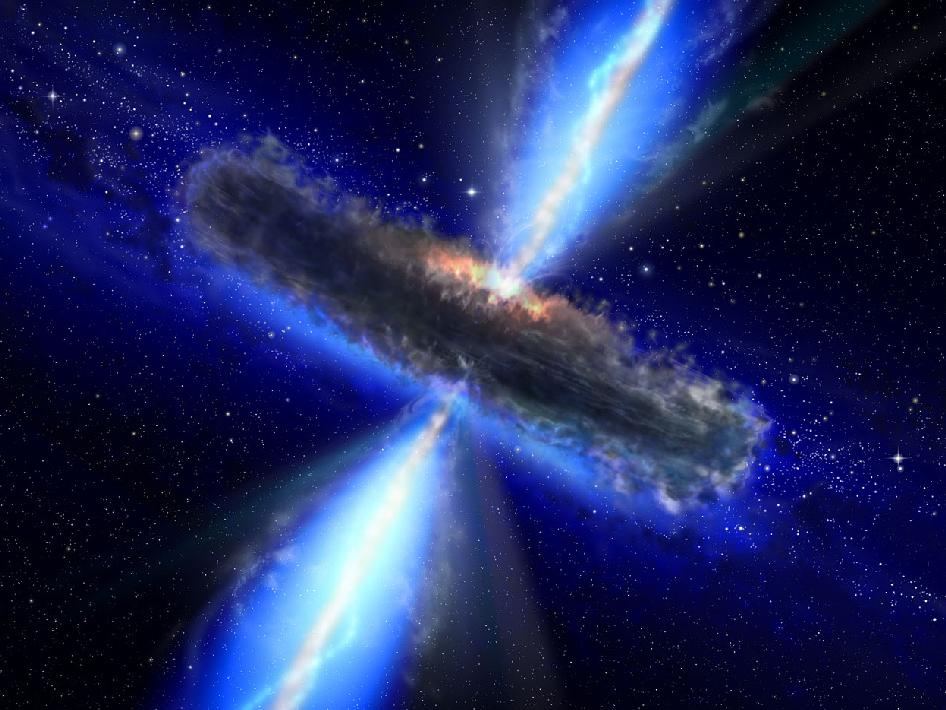
Ben wants to know, I'm confused about what exactly quasars are.
And could you break down what a quasar is believed to be?
Is there one quasar around every black hole that is in the center of the galaxy or multiple quasars for one black hole?
I researched around the internet.
Yeah, let's tell us how that went.
And for answers, I couldn't find anything that completely made sense, kind of like his question.
Okay, quasar is a brand of television, and pulsar is a brand of watch, right?
Nice.
So the fact he doesn't know what a quasar was, joined the club in the community of astrophysicists up until the 1970s.
We did not know what quasars were.
We devoted scads of telescope time to solve that question.
And as we came to learn the conduct of black holes in the presence of matter, we said we had a ready-made solution for what a quasar is.
So what we have come to learn is that black holes, which lurk in the centers of galaxies, these are super massive black holes.
In some cases, millions, and in other cases, billions of times the mass of the sun.
These aren't ordinary black holes, these are hungry monsters.
And so they lurk in the centers of galaxies, and when galaxies are forming in the early universe, there's material everywhere.
And if you happen to be material too close to the black hole, the black hole will dine upon you.
And the act of dining will force all this material to spiral down into the small volume.
And as that happens, there's friction in the material as it descends, and it renders that material hot.
Just as rubbing your hands together makes your hands warm, this happens on an awesome scale.
And it makes so hot that it radiates x-rays.
Wow.
X-rays, okay?
Now that's hot.
That's hot.
Okay, if you radiate x-rays, how does that energy get out?
It punches out through the top and the bottom of this disk of material that's trying to feed its way into the black hole.
And these are jets.
It is highly energetic.
And this is the quasar phenomenon lurking in the center of a galaxy.
Now, how do you turn off a quasar?
How would you do it?
I hope that there's a switch.
That's right.
I hadn't thought of that.
So if the quasar runs out of stuff to eat in its vicinity, the quasar turns off and then it's done.
Right.
Everybody else is orbiting at a safe distance.
Black holes aren't these things that just gobble up anything it sees.
You got to wander too close.
So you would expect quasar phenomena to be more common in early galaxies, galaxies long ago, than in modern galaxies.
And in fact, that's what we see.
We explained everything.
So it's the black hole model for quasars.
It's no longer in contention.
There's some details about the behavior of the matter, but that's on the edges of the basic understanding of this phenomenon.
And so they're extremely bright in a small volume and they're primarily from galaxies that are young.
And we see black holes in the center of every galaxy we've had the power to look into.
And you can say, I bet you were a quasar back in your youth.
And you used to be a fine little quasar back in the day, girl.
Now you just an old black hole.
So we're going to come back.
StarTalk Cosmic Queries edition.
I'm Neil deGrasse Tyson here with Chuck Nice.
By the way, on the internet, you can find us at startalkradio.net and there's also on Twitter at Star Talk Radio.
We'll see in a moment.
We are back on StarTalk Radio, Cosmic Queries edition, and we're reaching into the grab bag.
All those questions that didn't fit into other categories that we had previously culled.
Chuck Nice, you're reading them out to me.
I haven't heard these before.
No, you have not, my friend.
Okay, so give them to me.
But you're about to hear them now.
Let's go to Daniel.
Daniel Mejelde.
Now, Daniel says, hi, I was told that gravity wouldn't exist if mass wasn't in motion.
As in, if we weren't moving away from the point of where the Big Bang happened, there would be no gravity.
The person who told me this said that this was a part of a tested scientific theory, but didn't name the theory.
And I can't find it on Google.
Is it true?
No.
Okay, next question.
He's been walking ever since.
He's afraid if he stops moving, he would float into the air.
No, gravity is uncorrelated with motion.
Look at that.
See there, Daniel, you were lied to.
You were lied to, and that's probably not the first time folks been doing some lying.
Yes.
You know you're lying to when you couldn't even verify it on the internet.
On the internet.
Nothing.
Even the internet said, we lie all the time.
We are not siding with that.
Well, there you go.
But Daniel, if it makes you feel any better, when you put your tooth under your pillow, there is a fairy that leaves you money.
That don't believe in the other.
Chuck Nice, yeah.
Okay.
Okay.
Let's go to Walter, okay?
Little astrophysics question from Walter.
Walter for the last name or he's going anonymous?
Walter just went by Walter, man.
He don't want people to know.
Yeah, Walter is in the witness protection program and wants to keep it that way.
Walter says, if a giant, huge, powerful magnet appeared one light-
Not an ordinary powerful magnet, but a giant, huge, powerful magnet.
Giant, huge, powerful magnet appeared one light-year away out of nowhere, then would it take exactly one year for magnets on earth to feel its pull, however small it may be?
Yes.
Oh, really?
Yes, yes.
Okay, okay.
So, a magnetic force-
If it appeared out of nowhere, a light-year away, all the things related to it that move at the speed of light, including light from it, its gravitational field that we would then feel, any sort of electromagnetic forces, it would take a year.
It would take one year?
Yeah.
All right.
Well, look at you, Walter.
I got a feeling Walter already knew the answer to that question.
Something just tells me he was showing off a little bit.
I think he wanted to know if maybe magnetism moved a little faster than anything else in the universe.
You know what?
I think that might have been it too.
Yeah.
Yep, yep, yep.
Because he does specifically say magnetic force.
Okay.
Look at you, look at you.
All right.
Let's go to Derek Ho.
Derek Ho.
All right.
I'm just wondering why neutron stars or pulsars would have magnetic fields given they are made of neutrons.
Looking forward to hearing the answer in the next Cosmic Query.
Well, hey Derek, you're about to do so, my friend.
It's like, there you go.
So we call them neutron stars because most of their mass is neutron.
But towards the outer edge, it's not all neutron.
You have other kinds of matter that was matter before what was inside became neutrons.
In other words, protons and electrons are the primary ingredients of matter as we know it.
Correct.
And you find them in white dwarf stars, which are also dense states of matter.
And they're held up by an interesting property in physics called electron degeneracy.
But we don't have to get into that.
But just know that that's what holds them up.
If the power of gravity is greater than the electron repulsive force, then the electrons will get crushed into the protons.
And what happens when you mix some positive charge and a negative charge?
That's it.
They cancel.
They cancel each other out.
And you get neutrons.
So that's what gives you neutrons.
But that's only where the pressure is greatest, and that's down in the center.
In the outer regions, you get protons and associated electrons that are free to roam.
And when you have a spinning neutron star, you have electrons moving, and you create what's called a dynamo, and that gives you a magnetic field, and that will accelerate particles, and you get the magnetic pulsar.
Wow.
The neutron star, yeah.
So the whole star is not pure neutron.
So that's getting to the heart of his question.
Yeah, right.
The outer edges were not enough high enough pressure for that to happen.
Gotcha.
Yeah, and I calculated, because I thought in Thor, I thought the dude said in the movie that Thor's hammer is made of the material of a dying star.
So then I calculated how massive his hammer would be, and I tweeted that, and I said it would be, it would have the mass of a herd of 300 billion elephants.
Whoa.
And that's why even the Hulk couldn't lift it, right?
Right, right.
So that made perfect sense.
And then some guy, some like Thor geek science guy, a professor somewhere, said, no, it's not made of the material of a dying star, it's made in the material of a dying star, of some magical material in Thor's world.
And he got the density of that, and he said that the hammer weighs something like a pillow of feathers.
But so therefore it's spiritual forces, god forces.
I like your answer better.
I so like my answer better.
But I concede to the experts.
When we come back, our final segment coming up, Cosmic Queries, StarTalk.
If you're ready to elevate your driving experience, the first ever Kia K4 is worth a closer look.
It combines style and performance with a sleek futuristic design featuring StarMap LED headlights and an available panoramic display for unforgettable looks.
SiriusXM comes standard in every Kia K4, bringing you closer to what you love.
Plus, with an available 190-horsepower turbocharged engine, the Kia K4 delivers everything driving enthusiasts crave.
Learn more at kia.com/k4.
When it comes to hiring, the best way to search for a candidate isn't to search at all.
With Indeed, don't search, match.
Indeed is your matching and hiring platform with over 350 million global monthly visitors, according to Indeed data, and a matching engine that helps you find quality candidates fast.
If you need to hire, you need Indeed.
You can even use Indeed for scheduling, screening and messaging to connect with candidates faster.
93% of employers agree that Indeed delivers the highest quality matches compared to other job sites, according to a recent Indeed survey.
And since Indeed's matching engine is constantly learning from your preferences, the more you use Indeed, the better it gets.
Join over 3.5 million businesses worldwide that use Indeed to hire great talent fast.
Plus listeners get a $75 sponsor job credit to get your jobs more visibility at indeed.com/sxm.
Just go to indeed.com/sxm right now and support our show by saying you heard about Indeed on this podcast, Terms and Conditions Apply.
Need to hire?
You need Indeed.
We're back on StarTalk Cosmic Queries edition Grab Bag Questions that came to us from all over the internet.
All over the internet.
And this is the final segment.
Yes.
So, of course, being this final segment, this has to be our lightning round.
It is the lightning round.
We're gonna pack in as many answers as I can.
That's right.
Go for it.
Here we go.
Let's start off with Steve Kramer, this one from Facebook.
In space, no one can hear you scream, but you can hear yourself.
A friend and I have actually conflicting views on this.
We know that there is no air to allow your voice to reach your ears, but he brought up bone conduction that might be able to get a hum of scream, okay?
I told him a change of pressure would force all the air out so you wouldn't happen.
What do you think?
No, it's not what I think.
It's just what the laws of physics are.
Okay, what are those laws of physics?
You need air to move sound from you to the other person.
Correct.
But air is just a thing that vibrates.
Your body is a vibratory medium, and especially the rigid objects such as your teeth and your bones.
So definitely you can hear your own body digestive and mouth functions in space.
Sweet.
Sweet.
All right, let's move on.
This is from Michael Shambo.
Michael says, I just finished reading Space Chronicles, and it was an absolute delight.
Thank you, Neil.
You can say you're welcome.
Oh, you're welcome.
Thank you.
My question is, if birds or any other animal capable of flight never existed on planet Earth, but the rest of the world didn't change as we know it, would humans have ever developed a need or a want to fly?
Or would it have just taken us more time to have that need?
As it was, it took us a long time to fly.
We didn't fly until 110 years ago.
So, and we've been around for thousands of years.
So, the existence of birds apparently didn't speed up that process, all right?
So, I think we still would have flown.
We have really clever folks out there.
We would have seen paper flutter to the ground.
We probably would have invented a glider.
It might have taken a little longer, but I so think we would have been up there flying and been on the moon.
Nice, nice.
All right.
Okay, here we go.
This is from Anthony Combs.
What implications does the recent discovery of recording temperatures lower than absolute zero have on science?
Most particular, the implication that I'm seeing on the interwebs about how it exhibits properties of dark matter.
This is a fascinating question.
Right.
I read the research paper that talked about temperatures below absolute zero, and I didn't understand a word.
So, I cannot answer that, but generally speaking, when you go to, when you take matter to a state it's never been in, when you explore the universe on energies never reached, new things rise up, and new explanations for previously held long-standing points of ignorance are sometimes solved.
So, yeah, we can all be hopeful that people are finding new ways to take matter.
So, let's go.
Sweet.
I like the answer.
Caroline Kello, this is what she says, on an episode of Doctor Who, parts of the universe exploded due to a very complicated string of events, and the stars exploded.
That got me thinking, how would this affect us?
If there were suddenly no more stars, excluding the sun, there still was a sun in the episode.
What would the consequences be?
All right, what would the consequences be?
What's the consequences of nothing but our solar system?
Okay, there'd be no consequences whatsoever.
Next question, okay.
Will we be missing songs in the repertoire?
All right, Stardust Memories.
So pretty much a lot of art would go away.
A lot of art would go away.
It would be, I think, a little bit culturally impoverished, but we'd still be here.
We'd still be fine, nice.
Boom.
Go.
Derek, I've recently started watching Dr.
Who, another Dr.
Who question, and every now and then, or more to be more accurate, every episode, they have some freaky science phenomenon which makes me scoff at the television.
Without spoiling anything in one episode, Dr.
Who's spaceship, which is a police box, tugs the planet Earth back into its regular place in the solar system after it was stolen and dumped in a void in the universe.
This leads me to my question.
Thank God.
What would happen to a planet that somehow was being tugged throughout the universe, and is it possible to calculate how much force would be necessary to pull that planet?
Yes, and by the way, the doctor's police box can tow a planet because of course, the police box is bigger on the inside.
That's right.
When you're that, then it can have any mass it wants and any power.
Just let the man have his day.
Because it's interdimensional.
Let the man have his day.
That's right.
But otherwise, we will surely have to learn how to start towing planets when the sun becomes a red giant because it will expand.
If we don't move out behind farther away from the sun, we will incinerate as the oceans come to a rolling boil and evaporates into the atmosphere, and the atmosphere evaporates into space.
And we are a charred ember burning deep within the gaseous envelope of the sun.
We will want to live farther away from the sun when that happens.
We better figure out how to tow.
Happy thoughts.
Okay.
Happy thoughts.
Real quick.
Go.
Jerry Taylor.
Go.
I know nothing about astronomy, but it doesn't make sense.
The most distant galaxy that we say we're looking back 13 million years at the beginning of the Big Bang.
Basically, how can we say that?
How can we say that?
First it's 13 billion years ago because it's taken like that long to reach us.
That's how far away the damn thing is.
Chuck, I don't see you as you are, but as you once were, three billionths of a second ago.
I've changed.
In the past.
So the farther away you are, the more you see into its past, it's that simple.
Boom!
Now, actually, I missed a bell from the previous one.
There you go.
We have ended StarTalk, the lightning round, Cosmic Queries edition.
I'm Neil deGrasse Tyson.
Chuck Nice, thanks for being here.
It's a pleasure.
We brought you apart by a grant from the National Science Foundation.
As always, keep looking up.
If you're ready to elevate your driving experience, the first ever Kia K4 is worth a closer look.
It combines style and performance with a sleek, futuristic design featuring StarMap LED headlights and an available panoramic display for unforgettable looks.
SiriusXM comes standard in every Kia K4, bringing you closer to what you love.
Plus, with an available 190 horsepower turbocharged engine, the Kia K4 delivers everything driving enthusiasts crave.
Learn more at kia.com/k4.
See the full transcript



 Unlock with Patreon

 Become a Patron