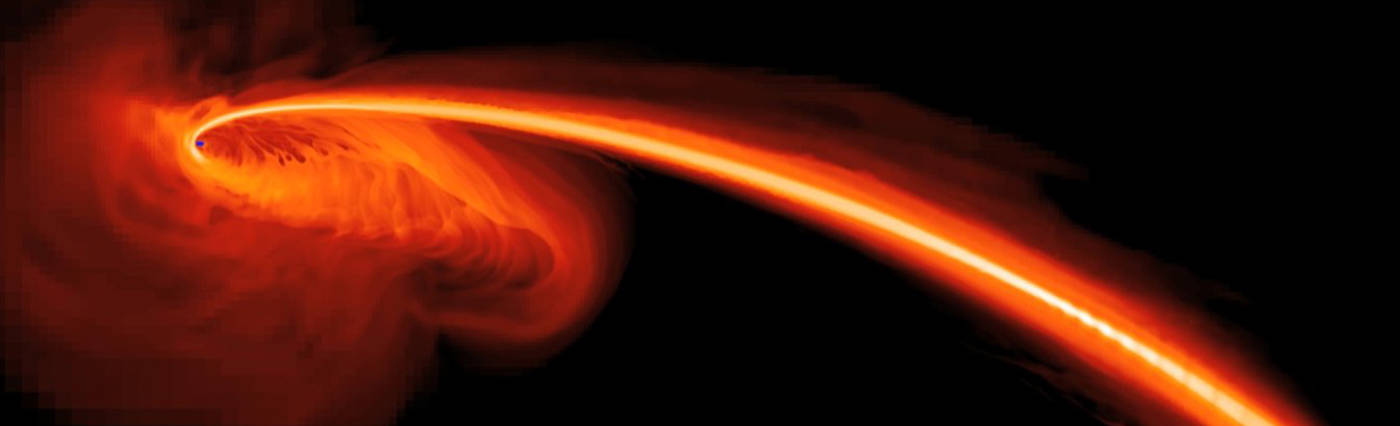
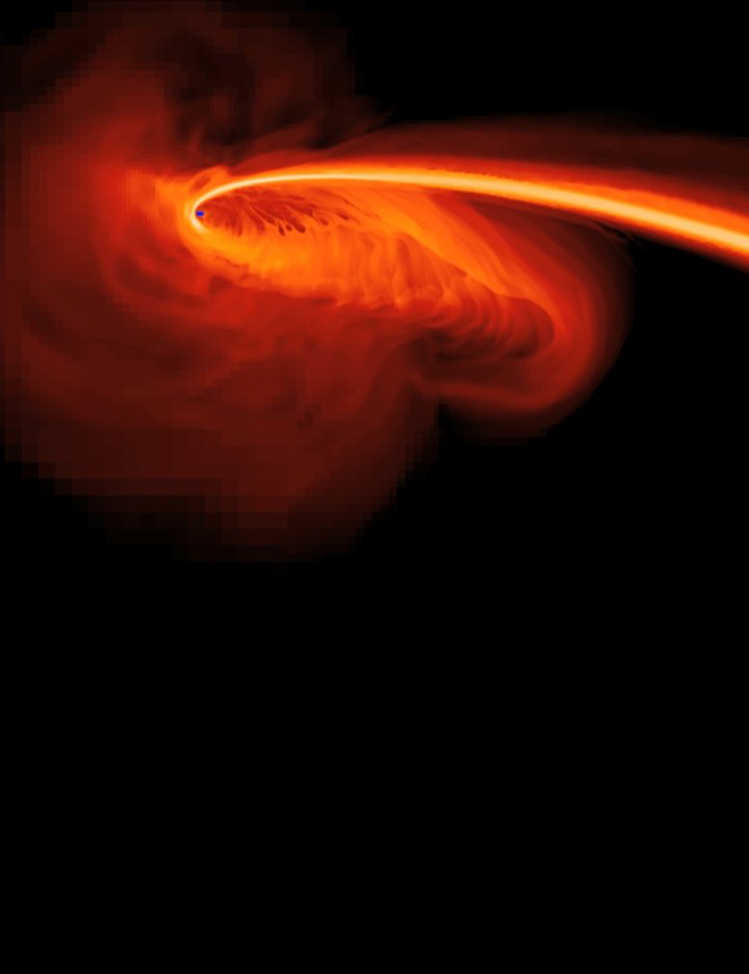
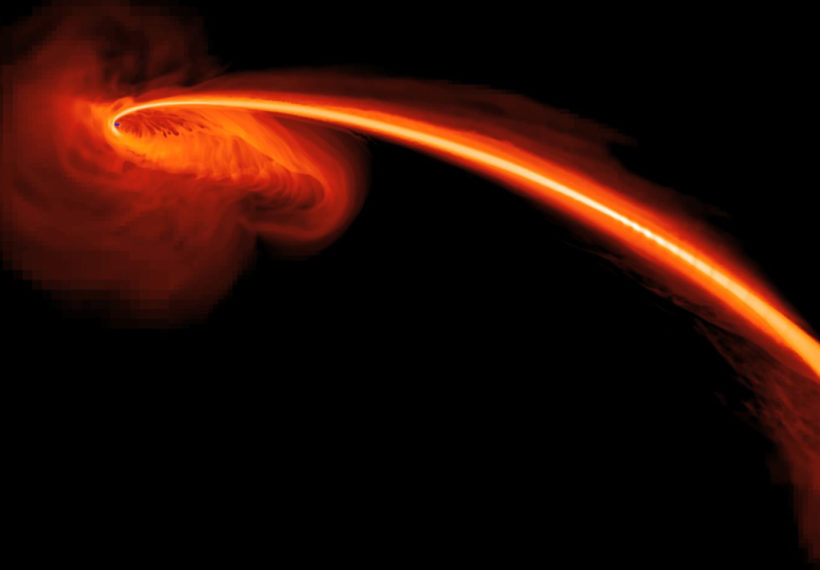
We start with a simple question: are we sure there’s a black hole at the center of the galaxy? Neil teaches us the methods we use to measure black holes. He also reminds us of the Copernican principle. You’ll learn why the more massive the galaxy, the more massive the black hole at its center. Neil and Chuck reminisce on the movie Marooned. Discover more about electron degeneracy, neutron stars, and pulsars.
You’ll hear if it’s possible for a black hole to re-ignite into a star once it loses enough mass through Hawking radiation. Chuck has an idea for a science fiction film about a killer black hole until Neil squashes it with some Star Trek trivia. We explore whether a black hole can warp spacetime around it. You’ll learn what happens to the gravitational well of a star if the star comes across a black hole. And, of course, it wouldn’t be a show about black holes if we didn’t talk about the movie Interstellar.
We ponder if “Planet 9” could be a black hole. If the Earth turned into a black hole would it still orbit the sun? The answer may surprise you. We investigate what might be at the center of a supercluster. Then, we dive into dark energy. Neil explains why dark energy is still mysterious. You’ll also learn more about the Albedo effect and the Doppler shift. All that, plus, you’ll find out if dark energy has an impact on your everyday life.
Thanks to our Patrons Ashod Kuyumjian, Tony Biell, Jon Emerson, Zap Andersson, and Ocean & Dylan McIntyre for supporting us this week.
NOTE: StarTalk+ Patrons and All-Access subscribers can watch or listen to this entire episode commercial-free.
Transcript
DOWNLOAD SRT
Welcome to StarTalk, your place in the universe where science and pop culture collide. StarTalk begins right now. StarTalk, Neil deGrasse Tyson here, your personal astrophysicist. We've got a Cosmic Queries edition for you today, and I got with me...
Welcome to StarTalk, your place in the universe where science and pop culture collide.
StarTalk begins right now.
StarTalk, Neil deGrasse Tyson here, your personal astrophysicist.
We've got a Cosmic Queries edition for you today, and I got with me the one, the only, Chuck Nice.
What's up, Neil?
Chuck, I followed your tweets during the Super Bowl.
They were hilarious.
Oh, thanks, man.
So you were watching the game or tweeting?
What were you doing?
You know what?
I only tweeted during the halftime because I was actually watching the game and enjoying it.
And then halftime came up and I started, and of course, it was very Latino.
It's right.
It was every dimension.
Very Latino in every single way.
You know, I have a partial Latino household.
So, you know, my wife is Puerto Rican and Korean.
This is my mother.
Right.
Yeah.
So, my wife is Puerto Rican and, you know, so we're sitting around and the kids and we're all looking at all the Puerto Rican-ness happening on the screen and we're like, yeah, this is great.
And then it occurs to me, they better get this show over quickly before Donald Trump supports the whole damn Super Bowl.
Across the border.
So, Cosmic Quest today, what's the topic?
It's black holes and dark energy.
I should have sufficient expertise for that.
Yeah.
But if not, we'll get Jan 11 on SpeedDial and we'll have to check in on her.
We'll get a little Black Hole Blues boogieing over here.
Oh, yeah, that's her book.
Black Hole Blues.
Yeah.
All right.
Should we start?
So she's my cosmologist at large.
Yes.
Yes.
All right.
I'm sorry we didn't have her here.
I love when you guys get into it, man, because there's always such great information that you two seem to...
It's not quite...
In physics language, it's called resonate, there's a resonance.
Excellent.
In physics lingo.
So you have two waves.
So if they're not resonating, they can actually cancel out and you get nothing.
If the peaks go with the troughs.
But once the peaks go with the peaks and the troughs and troughs, then it magnifies the strength of the wave and then you have extra flow.
A little constructive interference.
Oh!
Chuck remembered his high school physics lab.
And we're going to stop right there while I'm ahead.
Give it to me.
All right.
Here we go.
Sunil Engel from Patreon because we always start with a Patreon patron because they give us money and we appreciate that.
So thank you, Sunil.
And Sunil wants to know this.
Why are we so sure that there are black holes at the center of ours and perhaps every galaxy?
It could be empty space, like the eye of a hurricane spiraling outwards.
Oh, wow.
Check this out.
Oh, I love me some eyes of hurricanes.
Right on.
There was a movie back in the 60s.
Really?
You know, the Apollo program was fully up and running and so it influenced storytelling and there's a movie called Marooned.
Marooned.
Yeah.
So there was some spacecraft that got marooned.
It's like they couldn't come back down out of orbit.
Nice.
So they had to launch, what do you mean nice?
Nice for a story.
It's great for a story.
That's all.
All space movies.
People go to space and something bad happens.
Exactly.
That's the plot.
Right.
So, of course, it's in Florida, you know, this space program launch bases are in Florida and so they had to ready a craft to get to them before they died.
Right?
So they ready the craft and then a hurricane shows up.
Sweet.
Because it's Florida.
Right?
So, they can't launch the hurricane and someone calculates, wait, the eye of the hurricane is going to pass directly over the launch tower.
Right.
But will there be a launch tower left?
That's the problem.
They didn't ask that question.
Of course.
But it was like, very cool.
That's how I learned that the center of the hurricane is actually a very silent, quiet place.
And so the eye came over, then they launched and you see the rocket coming out from the center of the thing.
So what they're asking is, in this question, what Sunil is asking is, we see all this activity in the center of the galaxy starts orbiting a big dark area.
How do we know it's not just like the center of a hurricane?
And the reason why we know that is because what we learned from Kepler and later Newton is the orbit that you have is the speed of your orbit is completely determined by the mass that's sitting inside your orbit, the mass around which you revolve.
So what you say is, here are these things, I can see how fast they're moving, run back to Kepler's equation and say there must be a mass, a huge mass, like bigger than the size of the orbit.
Wait, wait, and then you say, but wait a minute, we don't know anything that's that massive, that's smaller than the orbit, except for a black hole.
Okay.
So in other words, if it was a star with that much mass, it would be huge or some other thing and you'd see it, you'd see a glowing thing.
This is dark and it has huge mass and it's small.
That's three smoking guns right there, implicating a supermassive black hole.
Supermassive black hole.
Yes.
And our black hole is less massive than the one in the center of the Andromeda galaxy, our nearest big galaxy.
Do we have black hole envy?
Well, I think we do.
But we're talking about hundreds of millions of times the mass of the sun.
But it's a black hole.
So it's small for that much mass.
And so that's why.
So we do it for our galaxy.
Then we do it for our neighboring galaxy.
Go ahead.
And we can't, other galaxies are far away.
So ground-based telescopes, you can't see it.
So we send up Hubble.
And so we say, well, if we have it, and we're not really a special galaxy in the universe, and Andromeda has it, our nearest neighbor, maybe, this is astronomy think.
These two galaxies have it.
Maybe every galaxy has it.
Okay?
Because why should we be special?
Right.
It's called the Copernican principle.
You're probably not special.
Right.
Exactly.
Copernican is better known as my father.
I don't know what you think, but go ahead.
You're father interacting with you.
So, we hypothesized that maybe all galaxies have black holes.
So you invoke Hubble, who can see farther away galaxies, and measure the movements of stars down deep in the middle, and they were moving fast, too.
And every next galaxy, and so we've now done enough.
We're just resigned to the fact that every galaxy has got a black hole.
Even some of the smaller galaxies that might not have, they got black holes.
They still have black holes, right.
So, no, we haven't measured every one of the 100 billion galaxies in the universe, but every galaxy we measured, the big ones, the small ones, the...
It's like taking a poll.
Yeah, except even better.
Because the universe doesn't have weird people living in back roads who think weird stuff.
Well, actually, it might.
The universe could have some weird galaxy that we've never discovered before.
Every galaxy that fits into a category of galaxies that we've observed, it's got a black hole of different masses.
And the more massive the entire galaxy, then the more massive the black hole is.
Yeah, there's some that have billions of times the mass of the sun as a black hole sitting in the middle.
Yeah.
That's a very dated reference.
It is.
1974.
It really is.
It's a great, great movie and scene.
Deliverance.
Deliverance.
That's right.
That movie was so great, I have on purpose never seen it a second time.
Because it was so disturbing.
It is a disturbing movie.
It's the most disturbing movie I've ever seen in my life.
It's really, yeah.
Which is why I have it on a loop.
That explains, Chuck.
That explains it.
Sorry.
So, that had Ned Beatty, it had a boy.
What's his name?
A Burt.
Burt Reynolds, right?
Burt Reynolds.
Yeah.
In a serious role.
Yeah.
At a time, he was making comedies.
That's right.
Super cool.
Really good.
All right.
I guess we'll move on.
Wait, why not do another Patreon?
We took way too long to answer that question.
That's not true.
All right.
I know you always want to answer more.
We took a poll.
But here's the thing.
We took a definitive poll.
Yes, we did.
And you know what they said?
What?
They said, so these folks said, we want, keep the long answers.
Right.
And other people said, no, we want more questions.
This is true.
But guess what?
That's what...
They split right down the middle.
Everybody wants that, though.
There's always going to be people who are like, I love your long answers.
It's entertaining.
I find out stuff that I otherwise wouldn't have thought about.
Did you know about the movie Marooned from 1960?
I love that.
This is why I...
It's how I learned...
As a kid, how am I?
Ten years old?
The Eye of Hurricanes is a quiet place.
As far as I'm concerned, that's what makes the show good.
But listen.
And here's the thing, people, and just listen to me.
Trust me.
Actually, good point.
Here's the point.
What?
We're going to get to your question at some point.
At some point.
Here's the thing.
At some point.
You raise an interesting point.
If I just gave answers, then you don't really need me.
No, you just be Black Google.
Neil de Black Google.
Right, so these are not Google answers.
These are sort of fleshy.
Exactly.
Notice, like, again, I'm just dating myself here.
In the old days, when you look something up, you go to an encyclopedia.
That's right.
But you never, it would take you an hour to get to the thing you were looking up.
Right.
Because you stumbled all along the way.
All along the way.
That's right.
There was a whole journey to find your answer.
And see, kids, this is what you're missing out on by not having an encyclopedia.
Because that experience you just said right there is one of the best things in the world.
It is.
You go look up in your world book.
Same with dictionaries.
You get lost.
Obstreperous.
What the hell was that?
Right?
You know, it's, no, and that's the front of it.
And this is kind of what we're doing.
So, yeah.
All right.
Here we go.
Alex wants to know this.
Alex, Alex Veps.
Alex from Omaha, Nebraska.
I was just in Omaha, Nebraska.
You were where?
Nice.
Every time I hear Omaha, all I think of is Peyton Manning.
Kind of small, but yeah.
No, he's not.
But he screams that out when he's at the line of scrimmage.
He goes, 345, 345, Omaha.
I swear to God.
Yeah.
And I have no idea what it means in football or anything, but maybe somebody will write it and then let us know.
Okay.
This is what Alex Betts wants to know.
Can a small black hole orbit a bigger black hole?
And if so, can it be a stable orbit where it would never fall into or merge with the larger black hole?
Academy of Black Google here.
The answer is yes.
Boom.
Let's move on.
No, no, no.
So, here's the thing.
I don't think a black hole knows it's a black hole.
Really?
It's just a lump of mass out there looking for love, okay?
That's why it's a black hole.
In all the wrong places.
Now I get the black part.
So, the point is, so a way to answer that is, if Earth today turned into a black hole, it'd be a mini black hole like the size of, I calculated once, of a plum, okay?
Oh, really?
So, you mean all of this Earth got down to the size of a plum?
So, our event horizon, it would be deep within the plum, but the plum is the size of our event horizon, okay?
Wow, with the mass of the Earth.
Yes!
Holy crap.
Black holes don't play, dude.
Before we go on further with this, I just gotta, because you really freaked me out.
I'm in the middle of an answer.
I know, but where's the space come from?
So as you're collapsing, why don't you run out of space inside of what's collapsing?
Okay, you're wondering, isn't there a point beyond which you cannot compress it any further?
Yes!
Yes!
All right.
Alex, we're getting back to your question.
But this is really freaking me out right now, and I just got to know.
So there are various states of matter.
Why is a rock a rock?
Because something is preventing it from collapsing.
Right.
So what is it?
Well, it's the forces between molecules and atoms.
Okay.
Right.
So they're called electronic forces, they're called.
I got that.
Right.
That's why we all have...
Right.
That's why I can't put my hand through my leg.
Through your leg.
Or through this chair.
Correct.
Okay.
Correct.
Unless you were Invisible Man or something.
Or some other...
So now, it turns out under high enough pressure, you can collapse that, okay?
And close down the gaps that are between those atoms and molecules.
Okay.
All right?
Now they get closer together.
And you get something called electron degeneracy.
That's what it's called.
It has nothing to do with its moral compass.
That's it.
Of electrons.
Right.
Exactly.
So, electron degeneracy.
They're so tightly packed, okay?
That you're trying to cram electrons into the space of other electrons and they don't allow that.
All right?
From quantum physics.
Okay.
All right?
So, they keep their own identity within the structure.
And then we have matter out there that resemble it and it's called white dwarfs.
White dwarfs are electron degenerate and they're extremely dense.
Wait a minute, you can go further.
Okay?
There's still the gap between the nucleus of an atom and the electrons themselves.
Let's collapse that gap and that is the biggest gap of them all.
You know what that gap is?
Take a football stadium.
Okay, and then put, I don't know, a mustard seed or something tiny.
Tiny is a mustard seed.
A poppy seed.
Mustard seed is biblical.
Right.
But let's take like a poppy seed.
All right.
Put that in the middle of the stadium.
That's the nucleus and the outer size of the stadium is the orbits of the electrons.
Atoms are mostly empty space.
And the first dude to determine this, his name was JJ.
And he performed the experiment by firing particles through a very thin film of gold.
Gold, you can hammer it so thin, you can have practically one layer thick of atoms, okay?
You can, it's very malleable as a chemistry term, right?
Make it really thin.
And he fired particles and he's ready to see them.
Some bounce back, careen to the left, to the light, and 99.999999% of them went straight through like nothing was there.
And he was the first person to realize that matter is mostly empty space.
And the next morning he is rumored to be afraid to step onto the floor getting out of bed.
That he might fall through it.
Wow.
Because he alone knew how empty matter was.
So the next stage is collapsing everything down and you're cramming the electrons into the protons because they're no longer can they separate themselves, all right?
But they're not going to occupy the same space anymore.
They're crammed together.
If you combine a proton and an electron, what happens to the charge?
It becomes what?
I don't know.
Thank you for that admission.
All right.
Electron has a negative charge, the proton has a positive charge.
They cancel out and how much charge are you left with?
Neutral.
Neutral.
So you put them together, you create a neutron.
Right.
Okay.
So now you so you don't have the electron degeneracy and you have a pack of neutrons.
And that is the densest matter that exists out there that is not a black hole.
So these are called neutron stars because in my field we tell it like it is, all right?
And neutron stars that rapidly rotate have magnetic fields that they pulse in radio waves.
We call those pulsars.
Pulsars.
Okay, that makes sense.
The person who discovered pulsars, Anthony Hewish, won the Nobel Prize for it back in the 1970s.
And started a watch company.
Little known fact.
People always taking our words.
Exactly.
We got Milky Way candy bar.
We, excuse me.
Can we get some world teas for that, please?
The Mars bar, I know it's a family name, but still, I'm taking it.
Right.
All right.
And you know how many car names are astronomically named?
There's like the Astro.
That's the name of a minivan.
That was a, oh my God, there is an Astro minivan.
Yes.
I made a whole list.
I got a whole list.
We'll do a whole show.
On car names.
Car names.
All right.
A whole show.
I could do a whole show.
Okay, gotcha.
Don't get me started.
Don't make me go there.
A whole show on names of stuff that came from my field.
That came from your astrophysicist.
Yeah, okay?
That's it.
Promise.
We'll do a show.
Okay.
All right.
So.
So now we're a pulsar.
Okay, now a pulsar.
That stuff is dense.
So that's, if you take, want to know how dense that is, take a herd of 300 billion elephants and cram them into a thimble.
Holy crap.
So now you can calculate how much pressure that makes to stop it from collapsing further.
And you can calculate that.
And then you figure out, in a black hole, the collapsing force is even greater.
So we don't know, we got no physics anymore after that.
Right.
So, in a black hole, it's denser than the density of 300 billion elephants.
In a thimble.
Crammed into a thimble.
Right.
And just imagine trying to do that, you know, with your...
Definitely need a crowbar.
Or something.
Something.
Just spray.
So...
Wow.
So, yes.
I can get you to the neutron star density.
After that, it's all black holes.
It's all black holes.
It's all black holes.
Wow.
So now, Earth becomes a black hole.
We just continue to orbit the sun.
The gravity between us and the sun is determined just by our masses.
Our mass didn't change.
Right.
It's still the same mass.
Who cares if we're a black hole?
Right.
All right?
Now, if you turn the sun into a black hole, we don't care if it has the same mass.
Right.
So, we're these mini black hole orbiting a black hole, and there you go.
Right.
So, we'd just be orbiting the little mini black hole.
That's all.
No, we'd be the mini black hole orbiting...
Oh, no.
I'm saying if the sun became a black hole, we would just continue to orbit that little black hole.
But we're littler.
So, we're the plum size black hole.
Right.
The sun is the big black hole.
Bigger black hole.
Bigger.
Right.
So, the point is, the reason why we see black holes have such high gravity is they have high surface gravity.
But if you step the same distance away from it that you were before it became a black hole, there's not any difference.
Right.
It's just that you can get real close to the center of gravity, and the force of gravity keeps getting higher and higher and higher and higher and higher.
Okay.
So, that's how that works.
That's awesome.
So, the answer is yes.
The answer is yes.
We got to take our first break.
When we come back, more Cosmic Queries, Black Holes, and Dark Energy on StarTalk.
We're back, StarTalk, Cosmic Queries, Chuck Nice.
That's right.
The basic ingredients.
You, me, Cosmic Queries, StarTalk.
That's it, that's it.
Let's take it from there.
Let's take it from there.
All right, and topic again.
Dark energy and black holes.
Let's do it.
I think I can get through that topic.
So far, so good.
All right, let's jump right back into this with a question from Facebook, and Kent Bayaker.
Yep, Kent.
People, would you please give, like, phonetics pronunciation guides for Chuck.
Yes.
Yes.
Because reading is fundamental.
And I think you guys are just screwing with me, to be honest.
I really do.
Anyway, he goes like this, Chuck, Chuck, Chuck, please ask Neil if a black hole can reignite into a star once it has lost enough mass through hawking radiation.
Oh, really?
What a great question.
Good question.
Interesting.
No.
There you go, Ken.
No, because if somehow the black hole could stay the same size and you pulled mass out, then I don't know, I have to think that through.
But what happens is as you pull mass out, the black hole gets smaller and smaller and smaller and smaller to be the appropriate size black hole for the mass that's left over.
Okay.
Okay, so that's what's happening.
Gotcha.
So the black hole just continues to shrink, keeping all of its parameters, sort of black hole proper.
Ah, gotcha.
So that's why.
Gotcha, gotcha.
There you go, all right.
That's pretty cool.
All right, this is Jon.
But that's, I mean, that'd make a good sci-fi story.
Someone in the future figures out a way to undo black holes.
Oh, cool.
Turn them back into sort of masses that they once were.
Right.
Yeah, okay.
That's kind of cool.
Let's do it.
That, well, if you could do that, you probably can just create a black hole.
Yeah, once you start controlling black holes, they will bend to your whims.
And then the first thing people do is weaponize it.
Of course.
Yes, this is what humans do.
Now, that's a great sci-fi story.
Instead of some stupid, like, death star.
Like, you actually have a killer black hole.
No, no, they did that in Star Trek.
Oh, they did?
Yes.
It was this drill that would drill down to the center of a planet and then drop red matter.
And then it would turn this planet into a black hole.
That's right.
So, yeah, they've been there.
I'm late, I'm late, I'm late on that one.
You're right, that was the red matter.
Right, again, why destroy the whole planet?
Wouldn't you want to keep the planet?
If you're enemies with who's on the surface, get rid of them by some diabolical means.
Right.
But keep the real estate.
What are you doing?
And it's always about revenge, like it's not gonna bring your wife and children back.
Okay, get over it.
All right, here we go.
John Feltran, a black hole warps space, time around it.
Yes.
A star does the same.
Yes.
What happens to the gravitational well that the star has formed, if the star begins to fall into the gravitational well formed by the black hole?
Does it dissipate at the same rate as the amount of mass being stripped, or do both wells combine?
I love the people.
Be some good.
No, this is so good, John.
You're just showing off.
Oh, that's what you're doing, John.
John probably worked right here at the museum.
John is downstairs, sending us questions through, babe.
All right.
All right, so there's a lot to...
Okay, so if you think of it as the classical distortion in like a rubber sheet.
Right, the rubber sheet model.
Right, so the black hole is like a very deep hole in the rubber sheet, but everybody's got a dimple in the rubber sheet, okay?
You got...
I have my own little dimple.
You have your own little dimple.
Right, they're adorable.
Depending on the mass...
My dimples.
Depending on the mass...
Depending on the mass, it determines how deep the dimple is in the fabric of space and time, okay?
As you merge two dimples, if the black hole, if it's a black hole in a star, if the black hole begins to fillet the star as black holes are known to do, then its dimple will get deeper and the black hole's dimple will get deeper and the star's dimple will get shallower in response to this.
Welcome to Cooking with Black Holes.
Today we're going to fillet a star.
I didn't say fillet.
I know, you said fillet.
You know what that means?
It means to disperse.
No, no.
Oh, what's it mean?
No.
I thought it meant to pull apart.
No, it's to skin.
Got you.
I'm pretty sure.
I thought it meant to pull apart, but to skin?
Well, it could be, generally, if you're pulling someone apart, you would do it with the skin first because that's the outer layer.
So, maybe that could have led to your hypothesis that, all right, let's do this.
I love that he actually looks it up instead of just going, hey, Siri.
Okay.
Here we go.
To strip off the skin.
You're correct.
Or outer covering of.
Right.
So, it's not really pull apart.
It is indeed skinned, because stripping is skinning.
And then you metaphor it, and it's like to criticize or scold with scathing severity.
You just got flayed.
Exactly.
And here's another one.
To deprive or strip of money or property.
Oh, that's mine.
Because these are your outer accoutrements, right?
Exactly.
Better known as divorce.
So divorce is a legal flaying.
It's legal flaying.
That's all.
Sweet.
So anyway, the star is flayed by the bigger dimple of the black hole.
Yes.
And so if you flay that, so the dimples change size relative to the mass that has changed hands.
Right.
All right.
So it is possible for the star to flay the star, for the black hole to flay the star completely so that it no longer has a dimple and it has consumed all of its mass.
And then it is the sum of the two dimples together.
Gotcha.
All right.
Otherwise, you can have a star that's getting flayed while it's orbiting the two.
And so you have two dimples just in orbit with a slow change in the two until one just disappears completely.
This is kind of fun to watch.
Right.
You can imagine that.
Right.
Yeah.
So there you go.
There you have it.
So that's how it is.
All right.
Let's go to Love Marauder.
You know how to pronounce that.
How big of an impact does dark energy have on my everyday life?
None.
Next question.
It's not always about you, Love Marauder.
It's not always about you.
Okay.
So the thing is dark energy is this still mysterious pressure in the vacuum of space that's forcing the universe to accelerate in its expansion against the wishes of all the galaxies and their gravity trying to slow the thing down.
Right.
And so some people thought of it as an anti-gravity force.
Could we one day harness it and make spaceships out of it?
Right.
So there's an interesting sci-fi frontier there.
But what I can tell you is because it's manifesting in the vacuum relative to where there isn't a vacuum, there's not much vacuum here.
No.
Right?
So gravity and electromagnetism and all these other things are really dominating where you happen to be.
So no, there's no known visible or measurable effect on anything you will do in your life.
Right.
There you go.
If you're not a galaxy, don't worry about it.
Right.
Yeah, it's not a galaxy among other galaxies in the expanding universe.
Just chill.
Just chill.
Chill on that.
All right.
Well, there you go.
That's it.
Love Marauder.
I hope you find that sufficient to continue your love exploits.
All right.
This is Brian Bull and he wants to know this.
Does a black hole still produce light or other radiation that just can't escape the black hole's gravity?
So, yeah.
Yeah.
There's a lot of energy and matter inside of a black hole.
So, if you're in the black hole, yeah, he's probably as bright as I don't know what.
Right, exactly.
Because the light got no place to go.
It's got no place to go.
And so, it's all in there.
So, now, we don't have direct evidence of this.
Chuck, you want to be?
Chuck.
Yeah.
Call me when you get back.
Let me go get on this.
Yeah.
You report back.
I'm going to full report on my desk in the morning.
I'll be like Matthew McConaughey in that String Theory movie.
Damn, what was the name of that movie?
Interstellar.
Interstellar, yes.
What do you mean that's String Theory?
Interstellar.
Interstellar.
Get with the program.
Listen, I'm on new medication.
It's really bothering my memory.
All right.
So, yeah, there's no reason why you wouldn't still see light and other things inside the black hole.
Right.
Right.
It's just not getting out.
Cool.
Yeah.
That's excellent.
Excellent.
Excellent.
All right.
You know what else you'd see?
If you try to look outside the black hole, you'd see all the stuff coming in.
Oh, yeah.
That'd be really bright.
Oh, yeah.
That's kind of cool, actually.
Yeah.
Not a bad...
The only problem is, you'd just be like, don't come in here.
There's no way out.
Don't come in.
You know.
What's that guy saying down there?
This is RYP.
Thank you, RYP, for just using your initials, okay?
RYP wants to know this.
Maybe that's his name.
Rip.
Like, yeah, that's cool.
RYP wants to know this.
Could dark energy or matter, dark matter or dark energy, is it possible to manipulate it, to use it as a fuel of some sort?
Interesting.
So here's the problem.
Dark energy, we don't know how to interact with it.
We just measure its effects on the universe.
Dark matter reveals itself to us through its gravity.
But it doesn't reveal itself to us in any other way that we normally interact.
So we can see its effects, but not what it is itself.
Not materially.
Not materially.
That's correct.
Because materially, what do you do?
You touch it, you pinch it, you weigh it, you grab a piece of it, put it on a scale.
You do all this and dark matter, in order to have something, you are this person called Chuck because all your atoms are all attached to each other.
Thank God.
Okay?
Yes.
They're all there.
Right.
Dark matter not only doesn't attach to your atoms, it doesn't attach to itself.
So as far as we know, there are no lumps of dark matter out there.
There are no dark matter planets, no dark matter galaxies.
In the cosmos that is oatmeal, there are no lumps of dark matter.
You don't like lumps in your oatmeal?
No, I do not.
I used to as a kid, because you would roll them in sugar and eat them like oatmeal candy, but go ahead.
Oh, that was early.
You were early out of the box with granola.
Yeah.
Those are rolled oats.
Rolled oats.
You take the oatmeal lump, you roll it in some sugar and you eat it.
So there you go.
All right.
Yeah.
So, yeah, there's no, we have no way to harness it in that sense.
If you can't grab it because your hand goes straight through it and it doesn't make itself give itself any kind of density, you can't.
There's nothing you can do to it.
Right.
So you can see it.
No, no, you can see its effects.
You can see its effects, but you can't see it and you can't interact with it.
It is literally invisible.
Wow.
Because not only do your molecules and atoms not interact, light doesn't interact with it.
Oh my gosh.
And light and molecules and atoms are all related to each other.
Correct.
They all interact.
They all, you reflect light.
Right.
Some light goes through you, but gets absorbed inside of you, like x-rays go into your bones.
This is true.
And they can see this on a map.
They shadow your bones.
I absorb a little more light than most, I will say.
That's true.
Yeah, exactly.
Yeah, it's a very, it's called albedo.
Albedo.
Wait a minute.
We have a word for that.
Albedo.
Yes.
Yes.
Okay.
If you have an albedo of one.
You reflect 100% of the light that hits you.
Not to be confused with libido.
If you have an albedo.
If you have a libido of one.
If you have an albedo of zero, you absorb everything that comes to you.
That would be a black hole.
If you have a libido of zero, you are married.
How many more libido jokes can you fit in to a minute?
I can't help it.
I don't know what it is, but go ahead.
Albedo.
The point is, yeah, albedo.
Albedo is the ability of a surface of something to reflect light.
It's a percent.
One would be 100%.
Nice.
Zero, zero.
The moon has a very low albedo.
As bright as it can be, it doesn't reflect much light.
Yeah, it's like 10% of the lighters.
I forgot the exact number.
But it's absorbing most of the rest of it.
Yeah, yeah.
So, where was I?
All I'm saying is, if you can't grab something and put it in a box.
You can't harness it.
You can't.
We don't know how to harness it.
We need some other way that we invent.
Once we figure out what it is, we might be able to find a dark matter trap.
How do you figure out what something is if you can't interact with it?
I know.
Thank you.
He's like, welcome to my world.
I know.
Thank you.
This is the longest unsolved problem in astrophysics.
It's been with us since 1936.
Yeah.
Dude, that is amazing.
That is really cool.
I'm just saying.
So the guy who figures that out.
The person.
The person.
The human.
You're right.
I shouldn't say guy.
I don't know how to say.
We're living in 2020 now.
The person who figures that out is going to win a Nobel Prize time ten.
The person who figures out what dark matter is.
And then we ideally we can control it, manipulate it, put some in a box.
That'd be cool.
All right.
We got to take a break.
Okay, when we come back, more StarTalk Cosmic Queries, black holes, dark matter, dark energy.
Time to give a Patreon shout-out to the following Patreon patrons, Ashod Kuyumjian and Tony Biell.
Thanks so much, guys, for supporting us and helping us make our little trek through the cosmos.
And anyone else, if you would like your very own Patreon shout-out, make sure you go to patreon.com/startalkradio and support us.
We're back, StarTalk, Cosmic Query, Chuck Nice, tweeting at ChuckNiceComic.
Thank you, sir, yes, that is correct.
Very good.
So, it turns out we are like luxuriating in these answers.
I will executive privilege and say we will not do lightning round.
Excellent.
Okay, we'll just continue to bask.
Nice, nice.
And the cosmic knowledge juxtaposed with cosmic ignorance.
Sweet.
And therein is the movie.
Did you just describe the two people who are on this podcast?
Wait a minute.
What just happened?
Chuck, you need more self-confidence here, but I was describing something bigger than us.
Okay.
All right, all right.
It's the intersection of cosmic knowledge and cosmic ignorance that is the moving frontier of cosmic discovery.
Ooh, nice.
I love that.
You should tweet that.
Let me go ahead and tweet that.
Yeah, you should.
That's quite eloquent and elegant at the same time.
All right, here we go, Martin Quevas.
And Martin wants to know this.
What would happen to the earth if it came close or directly in contact with a black hole, the one being hypothesized to be perhaps the planet nine orbit?
So I didn't realize that planet nine was actually posited to be a black hole.
I thought that's why they call it planet nine because it's supposed to be this supermassive object that's out past the Kuiper belt.
That's new to me too.
Is it?
Okay, all right, good.
I'm just saying.
All right, good, then I'm not alone.
I don't know who's hypothesizing that we have external black holes orbit, I don't know who.
Maybe I missed that.
Right, a new development.
That morning edition of the Astrophysical Journal.
I might have, you know.
But it's still a fascinating question.
And I think about this all the time.
Oh, really?
If Earth happened upon a black hole that was traveling through space, an encounter between Earth and a black hole, Earth loses.
Gotcha.
Okay?
Right.
Now, because we know about this tidal force that will stretch things, where the side of the Earth nearest the black hole will experience a much higher force of gravity than the side that's farthest, that means the side closest to the black hole will pull towards it faster than the side of the Earth, and so you'll end up stretching Earth.
Now, the problem with the word stretch is, Earth is not Gumby, right, or Elastic Man.
I am Earth, dammit.
Earth is not made of rubber.
Earth is made of sort of solid substance.
So, if you're going to stretch, put under stress, the solid sphere that is Earth, Earth will basically begin to crumble into smaller and smaller bits of rock.
So, you're looking at massive earthquakes.
Oh, yeah, but it would happen pretty quickly.
And tidal waves.
Oh, it would happen very quickly.
Oh, yeah, yeah, yeah, oh, yeah.
If you're falling straight in, oh, oh.
So, yeah, so Earth will distort, become more and more oblong until the strength of the materials can't hold that shape anymore.
And then, it'll start sort of crumbling apart.
And we call that spaghettification, is when you start becoming this long strand.
But again, spaghetti is one continuous string, right?
Whereas this will be a stream of particles.
That's right.
A parade of particles as they.
So, is this Netflix occasion?
Instead of spaghettifications.
How do you get Netflix in there?
It's streaming.
Now, I am going to.
Okay, you have to flub one every now and then.
We're gonna cut that out.
We're cutting that one out.
That one was just for me.
You were testing new material.
We were testing materials.
That was just for me.
You're the person who came up with spaghettification, if I'm not mistaken.
No, I just popularized it.
Really?
Yeah, it's true.
Oh, I thought you actually coined the term.
No, I popularized it.
But it's traceable to Martin Rees.
Martin Rees.
Sir Martin Rees.
In fact, he's now Lord Rees.
Lord Martin.
Do you go first?
A little full of himself, isn't he?
No, no.
Just, you call me Lord Rees.
Oh, Sir Martin Rees.
That's Lord Rees to you.
What the hell is that with Martin?
No, Marty, Marty, Marty from the street corner.
What happened to you?
Hey, Marty, it's Lord Rees now.
Hey, Marty, what the hell is your problem, Marty?
Wait, he's not from Brooklyn.
I command thee to.
I command thee to bring me my spaghettification.
All right, so, okay, all right, well, yeah.
Did we answer that?
Oh, yeah, yeah, so we just break apart.
So we break apart.
So if you're sitting here on Earth, it would just be an interesting phenomenon to behold, that's all.
Yeah, that's cool, man.
All right, hey, Martin, great question.
It would break open the very hot liquid core of the Earth.
Now, that doesn't sound good.
No, that's not.
I'm just gonna say, I don't know if I like that.
Cracking open the Earth.
And the whole middle.
This is a glowing iron nickel ball of molten iron.
Yeah, that's a bad day for Earth.
Yeah, that's not cool.
Right on.
All right, let's go to Todd Tobin then.
Todd says, how does a black hole not consume space time itself and just go BS crazy, bat crap crazy and destroy the entire universe?
Why aren't black holes running amok?
Did he say BC crazy?
He said bat, you know, the bad stuff, the bad word.
Did he say crap or did he say the S word?
No, he said the S word.
Oh, you were translating for us.
Yes, I was.
Because you're acting as your own sponsor.
You know why?
Because.
Acting as your own censor.
These little kids, they write me and they're just like, hey man, you know, children are listening to this.
And I'm like, well, you shouldn't be.
Stop trying to learn stuff and give up your dreams.
Damn you.
Those are joke people.
Yes, they were.
Please, these are jokes.
Go ahead.
But anyway, yeah, so he said BS crazy, back crap crazy.
And why aren't Black Hole's running amok?
Wait, wait, so.
So he's saying, why doesn't the whole thing just like, why aren't they out of hand?
Why aren't they just like consuming not only.
Why aren't they consuming space time itself and just eating away the entire universe, just eat it away.
Okay, because Black Hole's are not any more voracious as Black Hole's than they were as stars before they became Black Hole's.
Interesting, so it's really about mass.
It's just the mass.
It's just mass.
That's all.
If you get, now, so the thing, here's how to think about it.
Think of the sun, okay?
Okay, before you, how close can you get to the sun?
You get near the surface and you just vaporize, okay?
All right, so now, the sun's surface, its atmospheric surface, has a certain strength of gravity there, all right?
Now let's cram the sun into a smaller volume.
Same amount of mass, it's just denser.
You can now get closer to the sun's center of mass.
So its surface gravity is now higher.
Cram it smaller.
The surface gravity is even higher.
Black holes are fun to think about and talk about because you can get close to them.
If you get closer to earth's center of mass, you're leaving half of earth behind you and it's not interesting.
The good thing, the fun thing about black holes is you can get close to their center of mass and their entire mass is between you and their center.
That's why they become interesting.
But puff it back up to the original size, there's no different.
There's no different, nobody cares.
That's right, so black holes are just, they're, they're, it's, you can just get, it's, it's.
They're, they're, they allow you to get close to them without you knowing how deadly they are in such a state.
That's all.
Oh snap.
That's the difference.
Okay, I got you.
All right, so, and but technically, they are consuming the space time around them.
Space folds back on itself so that you cannot even come back out.
You can think of a black hole as completely consuming the volume of space time in its vicinity.
I have no qualms with you thinking of what's inside the event horizon as the black hole having eaten its own space time continuum.
I have no problems with that.
That is super cool.
Wow, what a great question then.
And there's that old ancient question, what happens if a snake starts eating its tail and continues to do so?
Will the snake one day disappear?
I don't know, but it certainly won't be hungry.
This we're sure of.
No, just think that through.
If it just keeps eating itself.
But then how does the head eat itself?
It comes in from behind the head.
Okay, if you imagine a completely flexible snake at one time.
It just keeps going, going, going.
It comes eating, then it eats.
And there you go.
I love that sound.
That is the sound a snake would make if it didn't.
That's the sound at the end of the meal.
And it's gone.
No more snake.
Right.
That's a black hole.
There you go.
All right, that's cool.
All right, Christopher Kyrens wants to know this.
So, just to be clear, if you turn on an axis, we say you're rotating.
If you move around another object, we say you're revolving.
So, most people don't know that, but since the language can distinguish it, why not?
And they're not weird words.
We've all used them before.
Okay, so go.
So, stars spin and revolve around galaxy centers.
So, spins rotate and then they revolve, yes.
Even galaxies are spinning.
Yes.
Is there any evidence that they are rotating around something?
They spin, but do they rotate or revolve?
And with the new vocabulary, revolve around something else.
Revolve around something else.
So, in our neck of the woods, no.
Wow.
Okay, well, because we don't have enough galaxies where we are to be able to create an orbital system.
Right.
Right now, as far as we can tell, we're on a one-way collision course with an aromatherapy.
We're not orbiting each other or anything like that.
However, there are places in the universe that have hundreds and in some cases thousands of galaxies in a sort of a beehive configuration.
You can track those galaxies, those would have orbits around the center of that galaxy, we call it superclusters.
Superclusters.
Right.
So yes, in not all cases, but in some interesting cases, you do have stars that rotate, orbit the center, revolve around the center of their galaxies as do all the other stars in their galaxies and the galaxy itself is orbiting the center of the supercluster.
Yes.
Now, is it possible to see the movement of the galaxy and measure it in such a way that we could possibly see if there's something there revolving around like a black hole or something that's at the center of the supercluster?
Oh, you know, centers are superclusters.
That's an interesting thing.
Yeah, that's what I'm saying.
That would be a really cool thing to find out if the supercluster is actually revolving around.
Around a black hole.
A black hole, itself.
Yeah, that's an interesting question.
I don't know.
I don't know.
Cool.
Well, please go find out.
Is that my assignment between now and the next time?
Okay, Chuck, I'll get right on it.
I'll get on that for you, buddy.
But it turns out you might ask, could the supercluster be orbiting around some other concentration of some metamassive of galaxies?
Right.
Here's a problem.
Here's a problem.
You ready?
Go ahead.
You can look at the speed of galaxies moving in the largest of the superclusters.
Because you can measure this with the Doppler shift.
Okay, that makes sense.
We all know the Doppler shift intuitively.
All right, so if a car's, exactly.
You stand on the edge of a freeway.
Here.
Oh, that was good.
Oh, sorry, that was a speedway.
That was, yeah.
Not bad.
So no one ever asked, why doesn't it sound the same coming towards you as it does going away?
Why doesn't it?
No, it's.
Okay, so the pitch changes, okay?
Why are you laughing?
I'm trying to teach here, dude.
I love it.
So it's a higher pitch if it's coming towards you.
And a lower pitch as it goes.
So it's like compression and expansion.
Exactly.
Gotcha.
And so even though it's only giving the same sound, if the car is parked in front of you, the engine is making one sound.
Right.
Inside the car, all you hear is the sound of a car.
It's a very simple formula that was developed by Christian Doppler, who was a German physicist.
He might have even been a chemist, actually.
But he was, I think this was the 19th century, he figured this out.
And he did it with a railroad train, the whistle of a train as it came by, because they didn't have race cars in the 19th century.
So you measure how fast the galaxy is moving, and then you look at how big the galaxy cluster is.
You can say, how long will it take at that speed to cross the cluster?
Got you.
That's nothing, that's a perfectly honest question.
Yeah, no worries.
No, okay.
For the biggest of these clusters, it takes longer than the age of the universe.
Wow.
So the cluster has not had enough time to have everybody sort of organize into their orbits.
Got you.
So, for many of these measurements, you can't use the speed as an indication of other stuff that's going on.
Yeah, yeah, it's an interesting.
We don't live long enough.
I know.
Damn it.
I know.
Our time frame is like that.
During the Super Bowl, I tweeted that.
Did you know that?
No, I did not.
I read your tweets, you don't read my tweets?
No, I'm embarrassed.
All I said was, while you're watching, if the hundred yards on the field were a timeline of the universe, Okay.
Of the 14 billion year universe, and one end zone is the Big Bang.
And modern day is like the other end zone, then the thickness of a blade of grass, the width of a blade of grass at the other end zone is from 30,000 years in our past to the present.
Just one.
The thickness.
The thickness.
Not the width, the thick, just.
Just right.
The thickness.
Yeah.
Cavemen to modern time.
That's our little, that's what we occupy.
Well, humans, yeah, Cro-Magnet, Cro-Magnet humans over that time.
So, that's the entire history of our species on a hundred yard long football field.
So, were it not for computers to simulate what's going on over time scales longer than we live, we would not know anything about things that lasted longer than we do.
That's pretty wild.
And our ego historically was we are the know everything.
So, why should Earth be much older than our history books?
Right.
Why should it?
Why should it?
When this is all about us.
Why should your eyes not see things that are seeable in the universe?
Right, when I'm the only one that matters.
Right.
So, even the telescopes that were first constructed only brought us visible light.
Right.
So, we have better versions of our eyes, but it's still light that we can see.
We discover infrared, x-rays, ultraviolet, x-ray, gamma rays, the whole rest of the spectrum you can't see.
How dare the universe communicate in ways that our senses cannot detect?
Wow, you know what, this is really fascinating because it starts, as you look at the fact that we are indeed one chromosome away from, you know, the other apes.
Mm-hmm, mm-hmm.
But yet, at the same time, we're the only, or are we, are other animals thinking about this kind of stuff that we're talking about right now?
Are there dolphins just like, yeah, I'm telling you right now, man, there's something more than this ocean.
Yeah, there was a, we gotta end like right now, but there's a comic, Gary Larson, you remember the illustrator?
There was a chicken, a horse, a cow and some other farm animal in the barn.
They're having a conversation.
Okay, and the chicken says, but if you divide by the square root of the mass, you get the same result.
And then like the cow said, wait, but you're missing the basic premise of my theory.
And one of them looks out the window, farmer, okay, farmer's coming towards the dirt and the farmer comes in, cluck, cluck, cluck.
Right, yeah, that's cool.
So you don't know if they're not talking that way when you're not looking?
No, I'm pretty sure they're not.
It's like the refrigerator light.
How do you know?
Right.
You don't know if it's on or off?
Is it really on or closed?
You don't know?
All right, we gotta go.
We went way over time here.
This has been StarTalk Cosmic Queries, Chuck Nice, Neil deGrasse Tyson, your personal astrophysicist.
As always, I bid you keep looking up.
See the full transcript



 Unlock with Patreon

 Become a Patron