Transcript
DOWNLOAD SRT
Lenovo is sponsoring Life with Machines, a new video podcast hosted by comedian and tech whiz Baratunde Thurston, where he discusses all things AI. Lenovo's Smarter AI is your AI. Personalized and easy to scale, Smarter AI delivers outcomes that...
Lenovo is sponsoring Life with Machines, a new video podcast hosted by comedian and tech whiz Baratunde Thurston, where he discusses all things AI.
Lenovo's Smarter AI is your AI.
Personalized and easy to scale, Smarter AI delivers outcomes that matter most to you and your business.
With full stack AI hardware, software, and service solutions, Lenovo is bringing the transformative power of AI to industries, organizations, and people of all kinds.
Discover how Lenovo and Baratunde are using AI for good to power people forward.
Listen to Life with Machines, now streaming wherever you listen to your podcasts.
The holidays bring the world together and language can help us enhance our connections.
How will you be connecting with others this holiday season?
As the most trusted language learning program for over 30 years, Rosetta Stone immerses you in an enriching experience.
I'm learning and practicing Spanish with Rosetta Stone so that I can say things at the holiday table and nobody will know what I'm talking about.
Things like, Estas terriblemente equivocado, which means you are horribly mistaken.
Start learning today with Rosetta Stone's Lifetime Membership Holiday Special.
Visit rosettastone.com/startalk for unlimited access to 25 language courses for the rest of your life.
Available for a short time at rosettastone.com/startalk.
With incredible new features and upgrades, there's never been a better time to armour up and play the critically acclaimed action RPG Diablo IV.
Get ready to continue the epic story in your battle against evil in the new expansion Vessel of Hatred.
As darkness spreads through the lands of Sanctuary, it's up to you to fight back the encroaching corruption.
Read the benefits of massive updates to character progression, loot systems, difficulties and tons of added activities.
Face off against new and iconic bosses, teeming with the spoils of Sanctuary.
Plus, harness formidable powers of the jungle with the all-new Spirit-Born Class, now yours to customise and progress alongside five other iconic classes.
Embark on the epic journey solo or with friends.
You'll quickly understand why Diablo IV has been called one of the best action RPGs of the last decade by PC Gamer.
Forge your own path through hell-torn lands of sanctuary.
Get Vessel of Hatred, available now in the Diablo IV expansion bundle, rated M for Mature.
Welcome to StarTalk, your place in the universe where science and pop culture collide.
StarTalk begins right now.
From all over the universe of the American Museum of Natural History, this is StarTalk.
And I'm your host, Neil deGrasse Tyson, your personal astrophysicist.
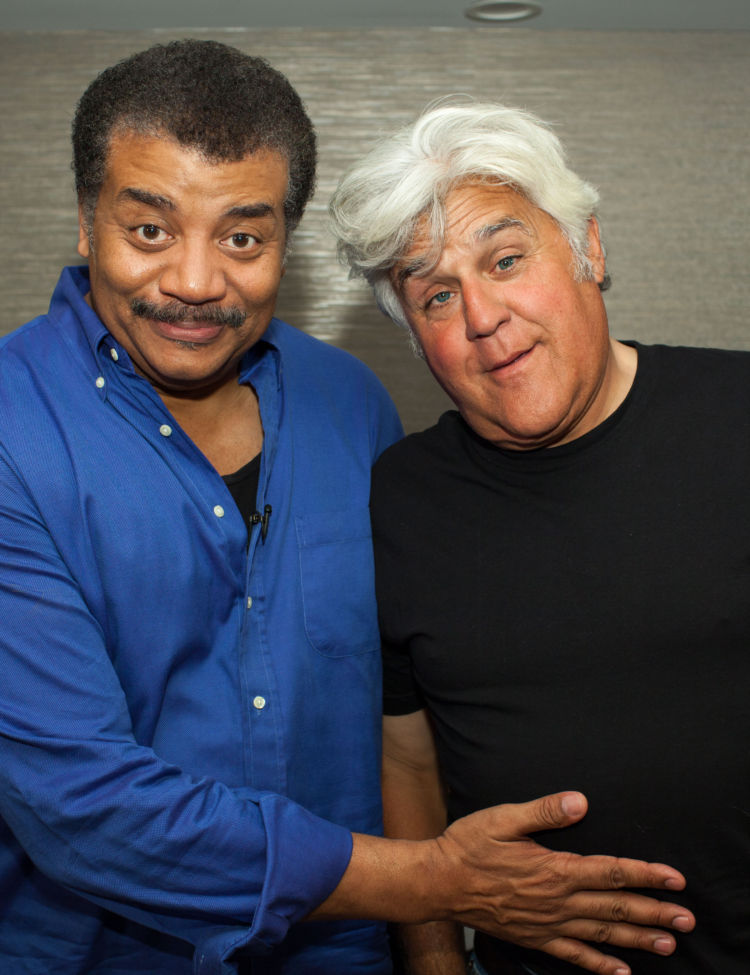
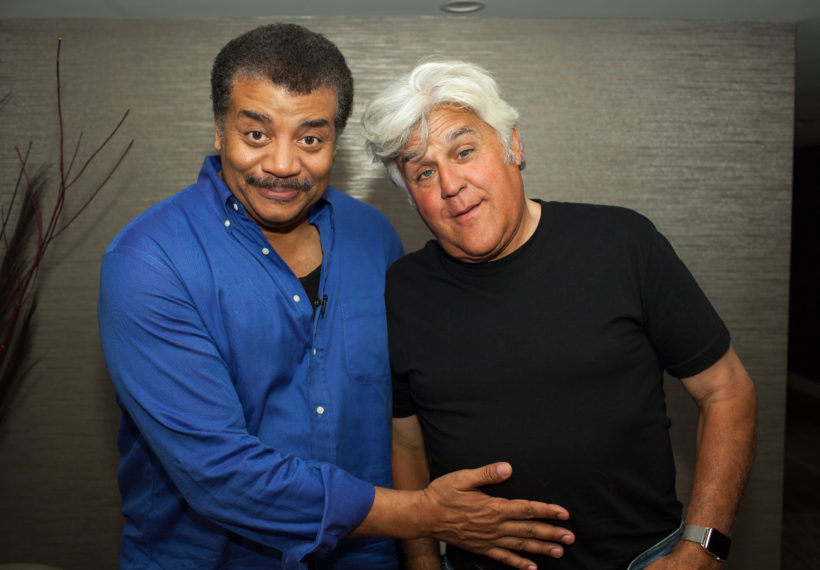
Tonight, we're featuring my interview with legendary comedian, nighttime talk show host and car fanatic, Jay Leno.
And our conversation started from the roots of comedy, all the way up to the past, present and future of cars.
So let's do this.
I never tackle these topics alone.
So I've got my comedic co-host, Matt Kirshen.
Yeah.
You host a podcast called Probably Science.
I do.
And I told you never to come back until it became definitely science.
We've bumped it up to likely.
And my next special guest, Bill Nye, the Science Guy needs no introduction, so no introduction.
Bill.
Neil.
Bill, this is a show about a comedian gearhead.
A man can dream.
And so we got you on here because you've got a huge background in engineering.
You worked for Boeing.
You worked on the original 747.
Yeah.
It had already been designed, but I contributed.
But it needed some parts that you need.
We tweaked it.
You tweaked it.
You're the one who's like, let's make it big.
Actually.
It's just a biplane at first.
And you're like, you know what?
We can get a lot more than two people on this thing.
If we really think large.
But it is interesting to note that if you have the cargo version of the 747, you could fly the very first Wright Brothers flight inside a 747 and secondly, when you build an airplane like a 747, you plan to make it bigger.
And that's what I kind of worked on.
Extended upper deck.
But it's not the only reason why I have you on the show.
Because you are best known for bringing sort of fun and humor to your science.
Yes.
So comedy is a dimension of your professional identity.
Yes.
And so...
What kind of turn of phrase is that?
That's just...
Dimension of my professional identity.
I like the word dimension.
I use it any possible time that I can.
No, I strongly believe that we can use science technology, energy production technology to make the world better for all of us.
Better for all of us.
And Bill Nye being an American icon, but not the only American icon.
There's at least another one out there, former Tonight Show host Jay Leno.
I asked Jay about just the roots of his comedic inclinations.
So let's check it out.
So you were the class clown?
Yeah.
Okay.
You know, most comedians you speak to have the ability to remember everything that got a laugh.
I remember being four years old, four, maybe five.
My mother took me.
We're going to some lady's house in the Bronx and it was an apartment full of all sort of middle ages.
If you were four, this would be one of your earliest memories in life.
Yeah, and I was the only kid there and I asked what I thought was a reasonable question.
I said, how come women have humps like camels?
Well, you heard this.
You heard, Oh my God, you hear that?
Women shrieking and laughing.
Kathy, that little boy of yours.
My mother's turning red and embarrassed.
I thought I asked a personal reasonable question.
But I remember it because it got such a huge reaction.
And I thought, Oh, I mean, it just stayed in your memory.
And consequently, things that got a big laugh in class or whatever, to this day, it seems very clear.
So hang on, Neil, what is the reason?
The reason for what?
For the, the humps.
The humps.
I'm an engineer, Neil.
We're not exposed to these things.
You know how to keep the humps in place.
You could structurally hold the humps.
I've just given that a lot of thought, actually.
Matt, do you remember the first laugh you got?
I'm still waiting.
And there it was.
It was right there.
I will never forget it.
Let the record show we have established Matt's first laugh.
Mark that down.
Note the time.
I had the root of realizing halfway through a mathematics degree that I'm not going to be a mathematician, but I am funny.
And that was my natural root.
So how far along did you get?
I graduated on a technicality.
I have a diploma.
I have the thing.
And then I've never used it since.
But in the US you have an undergraduate degree.
I had an undergraduate degree.
Wow.
In mathematics?
In mathematics.
Okay.
Now there's some hilarious mathematics that's out there.
Well, you could write a, you know, a 531-8008 on a calculator and then...
Oh.
Well, so getting back to Jay, Jay Leno.
Oh, yeah.
So I got the, you know, funny man.
And I had to...
I know comedians hate it when you do this, but I had to do it.
I said, okay, Jay, tell me a joke.
Not only tell me a joke, but how do they work?
What makes a good joke?
Let's find out.
Okay, the joke is, these two hunters are in the woods.
And it's 6.30 at night, and it's sort of twilight.
It's kind of dark.
And they're walking along, and one guy goes, whoa, be careful.
What?
Look out.
And they look down, and there's a six-foot hole, perfectly cylindrical, perfectly smooth, straight down.
He goes, you saved my life.
I almost stepped into that hole.
He goes, how deep do you think it is?
I don't know.
Let's throw something in the hole and see how deep it is.
So they look around, they see this old anvil.
The two of them pick the anvil up, throw it and.
Don't even hear it hit.
Just go, God, how deep is this hole?
Next thing they hear, this goat come running at them, like 20 miles an hour.
And the guy goes, look out.
The goat almost knocks them over, dives in the hole.
The two hunters go, you know, this place is crazy.
Let's get out of here.
So they're walking back and they hear a farmer going, Becky, Becky.
And the farmer goes, hey, you two hunters, come over here.
You see a goat around here?
The guy goes, yeah, the goat ran by us about 20 miles an hour, almost knocked over, dove in that hole.
The farmer goes, that's impossible.
I had him chained to an anvil.
Okay, now see, but the reason that joke works, or doesn't work, is that you're focused on six foot perfectly cylindrical.
I've taken your mind off the actual circumstances that have happened.
You've given me geometric details.
Right, right.
So you consequently, to someone like yourself, I could see you focusing on, what could that be, six foot?
Yeah, I'm sitting there thinking, I'm not even listening to the rest of it.
That's what I'm saying.
It's like a verbal form of magic, where you distract with this hand.
So, actually, what I forgot to say in that bit was, why is an anvil out there?
Well, that's another question you got to roll with.
You got to suspend your disbelief.
And then how do you casually pick up an anvil?
Right, right, right.
Every man just tossed it in.
But he throws it with like, this old anvil.
You see him just underplay that crucial element of it, because that's more misdirection.
I was intrigued that he said it's kind of, it's intellectual magic, sleight of hand, but it's sleight of misdirection with verbal.
Would you agree, Professor?
I say the only thing, the big thing that's different with magic and comedy and a joke is when a joke's happened, you now know all the information.
You know everything that's happened.
But when you've seen a magic trick, okay, you now know that what's going to have happened is the person goes into that cabinet but comes out of that cabinet.
But you still ideally don't know how.
You don't know what's taken place.
In a joke, you have all the information laid out in front of you but it's still meant to surprise.
Which is why jokes are less effective the second and third time around.
Okay, whereas it's still great to see someone get sawed in half or whatever.
It's always great.
But ideally, unless you're sort of working out the trick, you still, a magic trick will still baffle and entertain the next time it happens.
I remember a New Yorker comic where there's a funeral.
Right, Neil.
So here's the thing about some jokes with more than one.
The magician is here in the cape.
There's a funeral.
They said she was a good assistant.
And there are two half-size coffins.
That's as troubling as the goat.
But notice that it's still funny to him.
And so there is something of longevity to certain jokes.
And we retell jokes.
Is there logic to a great joke?
You know what?
There's 20 different theories as to how humor works.
Freud had a theory, and there's been endless ones probably before and certainly since.
And none of them are sufficient, that I've heard.
I've never heard a theory of comedy or a theory of humor that makes you go, like, oh, that's it.
That's everything.
That person has cracked what humor is and what comedy is.
So, yeah, there are...
Because if you could, then everyone could be a comic.
You just follow the formula, but that's not the case.
And people have tried to write computer programs that then write jokes and they all end up being sort of riddles and wordplay and half of them are vaguely funny and half of them aren't.
And I think that's where those theories fall down.
Just wait till the super computer...
Because a good scientific theory, I think, correct me if I'm wrong, but a good scientific theory should also be able to predict.
That's what you want.
Otherwise, it's not worth much of anything.
And most of the humor theories are ones where you've already got the information and you're drawing various inferences from that.
Nevertheless, though, for any topic, you can go, let's say, to the electric computer machine, to the internet, and find a list of jokes that someone has gone to the trouble to record.
Yes, I wonder whether at some point someone can program some neural network that takes every decent joke and plugs it in and converges on it.
We had a StarTalk episode where we interviewed Joan Rivers in her apartment in New York, and I'm there and she has 20-foot ceilings in her.
The way she does.
The way she does.
On one of the walls, over 20-foot ceilings.
Watch for the misdirection with the ceiling.
Was a goat.
There was one of these library card catalogs from the original New York library, and there's like hundreds of them, and they go up higher than I can reach.
And she pulls them out, pulls it, and every single card, there's a joke.
I can believe it.
Were they good?
I bet there were some good jokes.
There were some good ones.
There were some good ones.
Can you remember any?
No, I remembered the interview.
I don't remember the single jokes that came out.
Well, yeah, there was one joke.
Ready?
I asked her, Joan, when the aliens come, what are you going to do?
She said, I don't care if the aliens come, just as long as they're single and Jewish.
That's good.
That's good.
Well, did you know that Jay Leno hosted The Tonight Show 4,610 times longer than Johnny Carson before him?
And so I wondered, do we here in America have an unlimited appetite for entertainment?
I had to ask him.
Let's check it out.
We're the first generation that has to be entertained 24 hours a day.
People actually used to come up with things to do.
That actually think.
Themselves.
Kids say to me, what do people do before television and computers?
Well they made stuff.
The idea of having free time without something in it to constantly keep you amused seems foreign.
So this doesn't bode well for successful civilizations.
They get fat lazy.
I'm one of those people who believe engineers will save the world.
And I think it's true.
When I came to LA, there were at least 120 days a year, they told you not to go outside because of the smog.
Well, now you have 10 times as many cars you had in 1972.
And there's no smog days anymore.
I mean, is it still a problem?
Sure.
But it's way better.
I mean, getting the lead out of the air is, well, you see what that's had in urban crime.
In the cities, with lead out of gasoline, there's less shootings, there's less murder.
Just to be clear, so lead got banned in 1973, 74, around there, leaded gas, and which was the biggest source of lead in the environment, the inhalable lead.
So then you add 15 years to that.
Right.
Okay, you get to late 80s, early 90s, that's when the crime rate started dropping.
So the crime rate wouldn't drop immediately because they're just children at the time.
So when you get to the crime committing age, that's when we saw nationwide crime dropping.
So yeah.
Bill, so he's your man.
I'm loving this, Jay.
He's loving you.
Engineering, right on.
He knows it, he understands.
I also love that he seems to have the quality that both of you have, which is somehow steer every conversation back to your pet subject.
Because you asked him a question about humor and somehow he ended up talking about cars.
So Bill, if engineers can change the world as you call for it daily, can you also save the world?
Save the world, Neil, you're an astronomer, astrophysicist, my bad.
The world is going to be here no matter what we do.
Can you save humans on the world?
Yeah, that's what we want.
I want to save the world for me.
Now there are, of course, a few humans.
I wouldn't mind if they go elsewhere, but writ large, yes.
But the estimates are, the US government made the estimate based on projections that we need a million more scientists and engineers.
I'm working on it.
Than what we will produce at the current rate in the next decade if we were to maintain our preeminence in science and technology in this world.
That's our mission in life, Dr.
T.
A million.
I don't see that happening on college campuses.
How many bloggers will we need?
So how do you boost those numbers, Bill?
We get young people excited about science out there in the audience, yes.
So thank you.
The people who didn't pay for their ticket tonight.
There's a couple of things about Jay Leno's comment about engineers and the air quality in Los Angeles, air quality writ large.
There was an engineering solution involving the catalytic converter, but also people were so fed up with the air quality that they decided to do something about it and they did what in the United States as in here in the summer of 2016 is perhaps the greatest evil you can ever perpetrate on the populace.
They passed regulations, like, oh my, you can't say that word, and they also paid taxes, and this led to using technology for the greater good.
Back then.
Back then, and so the air quality is generally better in so many ways, even though, as Jay Leno pointed out, there are so many more cars.
But he makes, fine, but he also makes the point that we surround ourselves with entertainment 24-7.
And so the big question is, is the entertainment supplanting anybody's need for actual knowledge?
Is this, where is this going?
Matt, I don't know, right?
Bill.
So it feels like you're talking your way out of a job right now.
So I would say that if you go to a dinner party, if you're with people at lunch, and a question comes up, some exotic thing, where's the fourth or something, you can look it up.
You can look up the capital of New Jersey on the electric internet.
You can find out how many shows Jay Leno hosted instantly.
So this enables...
So what's the capital of Jersey?
Sort of Mouth it Clearer?
Trenton?
Trenton, very good.
There we go, yeah.
Just edit that last bit out.
Very good, says the Brit.
So what you're saying is basically technology has killed the bar trivia night.
It's changed it.
Because there'll be who can use their thumbs.
So what's your point?
We know we got the internet.
So the claim that people watch television all day and don't create anything at all, I think is an extraordinary claim, it's difficult to back up.
We now have phones that do way more than a Star Trek communicator with people using all their imagination.
You know my regret?
We should set up a rule that if two people disagree, you have to argue for at least 10 minutes before anyone looks up the answer.
I'll go for that.
That way it can force your brain through new thought pathways.
It would be the chest with the clock backwards.
You can't go to the clock till after you've properly guessed.
That's okay.
You chose 10 minutes.
Let's take another number that I think would be more reasonable at a party.
Two minutes?
Not right now.
You get to explore mental pathways of solution making.
Sometimes you don't know the answer, but you have fragments of an answer that you bring together in a fresh way, establishing new neurochemical pathways in the brain.
What I wonder is whether there's a generational distinction between among and between how people think about knowledge and information and entertainment.
Coming up next, we will try to gauge what millennials know or don't know compared with generations that have pursued them on Star Talk.
Experiences make life more meaningful.
And with MasterCard's priceless.com, you can immerse yourself in unforgettable experiences in dining, sports, art, entertainment, and more in over 40 destinations.
From a round of golf with a legendary player to a cooking class with a celebrity chef, you can fuel your passions and create lasting memories.
Explore experiences today at priceless.com exclusively for MasterCard cardholders.
Terms and conditions apply.
Lenovo is sponsoring Life with Machines, a new video podcast hosted by comedian and tech whiz Baratunde Thurston where he discusses all things AI.
Lenovo's smarter AI is your AI.
Personalized and easy to scale, smarter AI delivers outcomes that matter most to you and your business.
With full stack AI hardware, software, and service solutions, Lenovo is bringing the transformative power of AI to industries, organizations, and people of all kinds.
Discover how Lenovo and Baratunde are using AI for good to power people forward.
Listen to Life with Machines, now streaming wherever you listen to your podcast.
If you're ready to elevate your driving experience, the first ever Kia K4 is worth a closer look.
It combines style and performance with a sleek futuristic design featuring star map LED headlights and an available panoramic display for unforgettable looks.
SiriusXM comes standard in every Kia K4, bringing you closer to what you love.
Plus, with an available 190 horsepower turbocharged engine, the Kia K4 delivers everything driving enthusiasts crave.
Learn more at kia.com/k4.
On StarTalk, we are here for Needs the Hayden Sphere of the American Museum of Natural History.
We're featuring my interview with Jay Leno, and one of my favorite segments of his show was called Jaywalking.
And so I thought I'd ask him about it when we're chatting.
Let's check it out.
So you're asking people questions, you know, how many moons does Earth have?
Right, right.
And-
These seem like common sense questions more than science questions.
And nobody gets the right answer.
No, but there is a reason for that.
Why?
Why?
We're not quite as doomed as it appears.
Just to be clear, in case people don't remember, you would go out into the street.
Mostly Melrose Avenue.
Melrose Avenue is a good cross-section, and we'd always try to find people between the ages of 21 and maybe 40.
Okay.
Because there's something that happens there hormonally, that people just are rushed, they're confused, and they don't pay attention.
Because I thought one day we'd-
Because they're no longer in school.
No longer in school.
And they're no longer settled in life.
Right, right.
Okay.
So they're in some gap.
For example, when we ask 8th graders questions, got them all right.
When we ask elderly people questions, got them all right.
I mean, to the point where we'd have to talk to 25, 30 people to get one.
Whereas in the 20 to 40 range, we would never talk to more than 15 to 16 people, we would have nine gems.
Fantastic.
Okay, so you would throw science in there as well as politics and other things, but I was always impressed how much science you touched upon.
But just normal science.
To me, it never really seemed like science.
It seemed like common sense.
I've got a book at home.
It's called Projects for Boys, Popular Mechanics.
Back when you can get away with a title like that.
Yeah, yeah, yeah, yeah.
1927.
And it's these complicated projects that I think an adult would have a hard time doing.
But if you worked on a farm, you grew up on a farm or your dad had a store, you were expected to know these things.
To fix stuff.
You know, before Netflix, people did stuff.
You had to learn things.
So what we need to know is how do we gauge what we know today, versus what people knew a generation ago.
We can try to guess that or we don't have to guess when we have access to real data on this very subject.
And when we need data and numbers, we turn to Mona.
Mona Chalabi, thanks for joining us once again on StarTalk.
She's a data journalist.
So Mona, what do you have for us?
So I'm trying to answer this question, which is, do some age groups like say millennials really know less than others?
So let's just set aside intelligence for a second and look at general knowledge.
Pew Research Center asked Americans to look at photos of historical figures and name them.
And what they found was that almost everyone correctly identified Martin Luther King Jr.
But when it came to some politicians and world leaders like North Korea's Kim Jong Un, older respondents did better than younger respondents, which might mean that Jay Leno is right.
But I also have some data that might explain why that is.
So we know that different age groups get their information from different sources.
Younger Americans those age 18 to 29 are more likely to go online, while older Americans tends to go to TV, print and radio.
There's one last thing I think is really important here, which is what do we mean by general knowledge?
Very often that gets defined by the cultural gatekeepers in society.
Maybe if that quiz had asked about Kim Kardashian rather than Kim Jong Un, those younger millennials might not have appeared quite so unknowledgeable.
Okay, so maybe you need millennials to write their own general knowledge test.
Maybe, and then you'd see that older Americans don't do so well.
So thank you, Mona.
Mona.
Yes.
I always wondered what millennials thought.
Do they think coherently enough to deserve their own demographic name?
Well, yes.
It's also unclear exactly who is a millennial, what a millennial is because millennial seems to be defined less by age group and more by lifestyle and attitude.
So I don't know, you might be more millennial than me just in terms of your outlook and your behaviors.
We've got a little test here just to see.
Oh, you have a test?
We have a little test, yes.
No, it's your millennial quotient.
How millennial are you?
Yeah, how millennial?
Your millenniality.
You've got a test.
Yes, we're going to test your MQ here.
Millennial IQ.
All right, let's go.
So are you afraid of any non-text communication?
My daughter satisfies this.
Your daughter is exclusively text-based.
Yeah, yeah, she's all text.
She'll be sent at the end of it.
Not even email.
I get an email over at Spy a week later.
Why didn't you text me?
Because it's email.
Yeah, yeah, she's been at the other end of the table, and she'll send you a text.
I guess that's not uncommon.
Pass the salt.
I fit partially in that category, in terms of if someone calls me up, why are you doing that?
That's a weird thing.
I have to talk to you now.
Yeah, leave a message.
And okay, next, are you a total pro at taking a selfie?
I pretty much am the pro-iest at selfie.
I would grade myself a B plus, but this man over here, A plus.
So, one of my favorite stories, I don't tell it every day, but I'm there with Neil deGrasse Tyson in the White House, which is where a federal employee lives.
All right, name dropping Neil deGrasse Tyson.
And so, here comes the president with his entourage.
And when the president walks around, there's several people with cameras, impressive cameras like NFL Films cameras.
But Dr.
Tyson has it in his head that he's going to get a selfie with the freaking president of the United States.
Wait, wait, so we have to choreograph this because we didn't know if he would allow it, so.
Plus, this is just a cultural reference.
Guy of my ancestry, not going to ask the freaking president for a selfie.
You can do a little brother to brother thing that I ain't got.
So, we set this up.
The president is going one person at a time, greets Bill, then greets me.
And so, now the three of us can form a triad.
And I say, Mr.
President, I'd like, do you mind if I get a selfie?
He's, oh, okay.
So, I pull out my cell phone and I'm holding it up.
And the three of us are there smiling.
And I click the button, disc full.
And then Bill, with his A-plus selfie taking, boom, boom, boom, saves the day.
He pulls it out.
So, everybody, if you're going to do the selfie, just a couple things.
Practice holding the phone so you don't have to squeeze a mechanical button.
You can touch the white button at the bottom, because then you don't shake the phone.
Okay, touch the white button.
Then, the other thing is, hold the phone a little above your eyes.
Otherwise, your eyes look closed.
Plus, it gets rid of a double chin, if that's one of the things you're trying to hide.
Then, the other thing is, look at the lens.
Everybody looks at the yellow box or the yellow circle, and so you're not looking at the lens.
Let's take one now.
Just take one now.
All right.
Okay.
You're going to show us?
So, let's line this up.
Everybody there?
Matt, you got to lean forward.
Matt, get in there.
I'll go sideways.
There you go.
Okay.
So, we're featuring my interview with Jay Leno, award-winning comedian, late night, former late night talk show host, and he's still out there, and he's a car nut.
He owns like 300 cars.
You're not kidding.
That's not a joke.
That's not a joke.
So, I asked him, can he reflect on just what role and impact the car has had in our culture?
Let's check it out.
I'm amazed that we went thousands of years with horse and buggy, and within a couple of decades, it's gone.
Everybody's got a car.
Yeah.
I mean, New York City had 80 tons of manure a day dumped in the city, and in the summertime, people dying of dysentery, horses would drop dead from the heat, guys would cut the reins, leave the carcass on the road, it would sit there for two or three days, then the car comes along, a little puff of blue smoke in your face once in a while.
That doesn't seem so bad, does it, than a big thing of horse crap.
So, but this is a very important period, transitioning from horses to cars, and you can understand better how and why that transition happened so quickly.
Because at the time, in New York City, there were 170,000 horses in New York City, used mostly, of course, for transportation.
But there's something called the horse pollution crisis.
And those 170,000 horses produce up to 30 pounds of manure each per day.
Multiply that by the number of horses, you get 3 million pounds of horse poo piling into the streets every day.
Not to mention, 60,000 gallons of horse pee.
And so, the most urgent problems in urban life were what to do about this environmental disaster.
And then the car arrives, where there is no poop.
Just like he said, a puff of smoke.
So you're saying the car was the solution?
Yeah, yeah.
It was the solution to the pollution.
But then I think the point is, that's then going to carry on.
We're going to presumably in 30, 40, 50 years from now, look back at this generation and go, can you believe people drove around in cars burning dinosaur fossils?
Is that the future you try to make happen in your books?
That's what I envision, is we get away from driving our own cars except recreationally on the weekends, self-driving cars.
But you're admitting we have a problem, a pollution problem caused by the car that has solved the pollution problem.
That's right, it was a step.
Will innovation save us once again?
That is my hope.
Okay, as a kid, what was your favorite magazine?
Popular Science.
How about Popular Mechanics?
Oh yeah, I liked it.
I liked it.
I liked both.
Okay, I subscribe to Popular Science.
I thought you were a Popular Mechanics guy.
The reason why I say is Jay Leno wrote a column for 15 years for Popular Mechanics.
Which I read from time to time.
So you knew about this.
But it means he spent a lot of time thinking about how we relate to our technology.
And I would find out about it in the next clip.
Check it out.
We live in a replace society now.
We don't live in a repair society.
And that's what Popular Mechanics is all about.
It's about fixing things that are broken and understanding why they're broken and how they work.
You know, most technicians work.
For example, I have a fairly new car.
There was a leak in the transmission.
Now to me, it was a replacement gasket.
You split the two sides, you clean it, you put a new gasket in and you seal it up.
No, they replaced the entire transmission.
Dropped it, took it out and put a new one in.
It didn't cost me anything.
It was under warranty.
But it was actually cheaper for them to do that than to try and fix it when there's really nothing wrong with it.
See I had a car that blew a gasket a while ago.
And that was when I found out that was actually a thing and not a turn of phrase.
Oh I see.
It literally blew a gasket.
It literally blew a gasket.
Not figuratively.
And I did not know that was like, oh okay I guess there's a gasket and it can blow.
Who knew?
This is basically like it's just a furious man under the hood.
So this not fix it throw away culture actually goes back more than 100 years now.
Our crack team of researchers found that the first routinely throw awayable thing was a bottle cap.
A disposable bottle cap back in 1892.
That was the beginning of this is a lid that I will never reuse.
I must throw it away.
And some of us here are old enough to remember that gentlemen had monogrammed handkerchiefs that they would reuse.
Which was the nastiest thing I could possibly.
Bill, don't leave that in the pocket.
Thank you.
So there'd be a woman crying and the man would take his handkerchiefs up and give it.
What is there snot in the handkerchief?
And she's going to pat her tears with it?
So then we have disposable handkerchiefs, right?
So I think it's a cultural thing that no longer in America do we repair things.
I think it's a cultural economic.
But in Jay Leno's transmission's case, they put it, that's a pun.
They put a new transmission in there.
So somebody was under there with wrenches doing some wrenchy things.
Yeah, they did at least replace the transmission and not the car.
Right, right.
That would have been the truest throwaway culture.
Like, all right, it's gone.
This thing's out of gas.
Get a new one.
Wait, I'll tell you a little bit about my joy ride with Jay Leno in his jet-powered supercar.
He calls it his Ecojet.
I got to ride in it.
And we talked about that in my interview with him.
Let's check it out.
Jay, did you look at your field of cars and say, I want more power?
Is this what led you to put a jet engine in an automobile?
Well, it's alternative power.
It's alternative fuel.
Yeah.
So would a nuclear fusion reactor be an alternative power?
What's compelling you to do that?
It runs on renewable fuel.
So that's why it's called EchoJet.
EchoJet.
We had 165 miles an hour.
We have plenty more to go.
I just didn't want to push any further because, you know, if I killed Tyson, oh, Jay Leno killed Tyson.
And I got to cancel the show for the weekend, pretend that I'm in mourning.
Yeah, because I killed Tyson.
I'll be back next weekend.
You know, so that's why we kept this weekend.
As we sped past 130 miles an hour, we had a window blow out.
Driver side window blew out.
Yeah, yeah, I got to get a new seal for the window.
That's how you test.
So that is 40 miles an hour faster than I've ever gone on wheels.
Oh, there you go.
We'll hit 200 next time.
Wow.
This is a jet engine car, but it is not propelled by jet exhaust.
It's connected to transmission.
Exactly.
So the engine power is all directed to a drivetrain.
It can go 245 miles an hour faster than a Ferrari F1.
It also has 650 horsepower.
And so what charms me is we're using a jet engine car and measuring its power in horses.
How many tons of manure does the car leave?
A **** ton of manure.
Yeah.
I wonder how much, just thinking out loud, how many acres or hectares of corn do you need to get to that much oil?
That I don't know.
That's a great question.
But it is biofuel, biodiesel.
And so we have horsepower, there are a lot of terminology that, to hear the engineers talk, I didn't understand a single, because I'm a city kid.
See, I appreciate that because also, like you said, I know almost no terms.
Gasket even was relatively unfamiliar to me.
You had never blown a gasket.
Yeah, but there are these sort of terms.
You ever have pulled a tranny?
I'm not even going near that my field.
We actually got up another little quiz here, because there are these terms in mechanics.
What did you do?
We have a little quiz, a little game show.
I want you to know, I want to know whether this mechanical problem is a science fiction problem or a real life, real mechanical problem.
Real or not?
Real or not, is that right?
Okay, all right.
Do we go bing?
Yeah, so is it a real thing, is it a real thing in real life if you have a cracked harmonic balancer?
You can be cracked harmonic, yeah.
No, I would say it's science fiction.
You harmonically balance a crankshaft and things.
You're exactly right.
It is a real car thing.
The harmonic balancer is a device connected to the crankshaft of an engine to reduce torsional vibration and serves as a pulley for drive belts.
And now I have more questions than that actually answered.
So what that means is, because I pay attention to when I have to pay to get my car fixed, I've never broken my harmonic balancer.
No, they're usually geared, they're very high-rel, high reliability, they're oil bath.
But Neil, you like this.
The rate of change of position is?
That's velocity.
Rate of change of velocity is?
So the rate of change of acceleration is a jerk.
And that's what will make that go away.
Okay, cool.
Yeah.
The third derivative.
There'll be physics stuff going on there.
Yes.
All right.
Would it be a real?
Wait, wait, just to be clear.
So rate of change of position is speed or velocity, and we've all familiar with being at a constant velocity.
When you're at a constant velocity, you don't feel it.
So now, if you're accelerating and you're positioned yourself and all your muscles are resisting the constant acceleration, then you have a change in the acceleration, that's a jerk.
So you feel it and then you punch the brakes some more, then you'll feel a jerk forward.
That's why it's appropriately called a jerk.
So what else do you have?
All right, what about defective planetary gears?
Sure.
Defective planetary gears.
Yeah, yeah, yeah, planetary gears, where you have a sun gear and planet gears.
I didn't know anything about it.
You have a three-speed bicycle, you have a planetary gear train.
That is exactly it.
They're the primary gears within an automatic transmission.
Okay, very good.
All right.
What if you had an unmotivated binary motivator?
That sounds like science fiction to me.
So what is it?
So what is it?
You are straight up correct.
That isn't Star Wars.
It's device in droids.
Star Wars, okay.
Tell me one more.
What if you had a damp flux capacitor?
That is, of course, real.
So there was a documentary called Back to the Future.
I highly recommend it.
I think it's on Netflix.
You'll learn a lot of stuff.
Thank you, Matt, for straightening us out.
When we come back, is everybody's favorite segment.
It is Cosmic Queries.
We'll take your questions about the physics of cars next on StarTalk.
If you're ready to elevate your driving experience, the first ever Kia K4 is worth a closer look.
It combines style and performance with a sleek, futuristic design featuring StarMap LED headlights and an available panoramic display for unforgettable looks.
SiriusXM comes standard in every Kia K4, bringing you closer to what you love.
Plus, with an available 190-horsepower turbocharged engine, the Kia K4 delivers everything driving enthusiasts crave.
Learn more at kia.com/k4.
Welcome back to StarTalk, with my interview with TV legend and icon Jay Leno, talking about his love of comedy and his comedic challenges.
So let's check it out.
What do you make of this emergent social, cultural, political sensitivity that the next generation is carrying with them up in the ranks?
So, can't say that it offends this group, that group or the other group.
And it's kind of the comedian's thing.
Well, it is.
If I don't give you room to offend, do you even exist as a comedian?
Well, you can offend, it's just how you offend.
You know, I remember years ago, years ago, going to see Rickles.
Don Rickles.
Don Rickles.
Master of offenders.
Right, okay.
And the young people and old people in the audience.
And Rickles come out and go, when he would use a cuss word, young people would laugh, but old people would go, ooh.
But when he did a joke like, and the black guy here, steal my hubcaps, young people go, ooh, gee, what's that?
And the older people laugh.
So it's just a matter of, it changed.
You know, it seems overly sensitive now, but you know, if you go back to Vaudeville.
There are no hubcaps anymore.
Exactly.
I don't even know what a hubcap is.
No, but I mean, if you go back to Vaudeville, really racist joke.
Pre-TV.
Yeah.
There is a real, there's a reason for political correctness.
It exists for a reason.
I mean, I remember as a young man being in a room and guys doing jokes that were really offensive to women and all the men laughed because only the men counted.
Okay, these people really didn't count.
What's the matter with her?
She's got a stick up her butt.
What's her problem?
Whatever it might be, you would just discount it.
As you get people more and more equal, suddenly the equality thing needs to reach everybody, if this makes any sense.
You know what I'm saying?
I mean, you reach the point where-
The humor pathway is-
Yeah, you know, instead of making the black guy the butt of the joke, the stupid guy near me, it's really the same joke.
There's no reason to make it the black guy other than to put a racial aspect to it, to make it funnier to someone who already believes that.
But does some of it go too far?
Oh, sure.
I mean, I had an example once.
I was just talking on stage.
You still do stand up.
Oh, yeah, all over the country.
And I said, I walk in the house, you know, my wife's in the kitchen.
I go, no, my wife, we have a house that has a kitchen.
My wife was standing.
You want her in the den, I'll make it the den.
I just happened to go in and she was in the kitchen.
She wasn't barefoot.
She wasn't bread-feeding children while making a cake.
She was just in the kitchen.
That her home happens that.
I mean, it was so ridiculous.
So people reacted in that moment.
Yeah, yeah, sometimes.
You didn't even tell the joke.
Didn't even tell the joke.
So now some emergent sensitivities is in the transgender community.
Right.
And I just wonder, are these no longer a fair game for comedic?
It depends how you go after it, I guess.
I mean, like the Caitlin Jenner, there was a story that said Caitlin Jenner was writing her autobiography.
See, I think it's gonna be one of those he said, she said kind of thing.
And you go, well, what's wrong with it?
Somebody said, what's wrong with the, it was a he, now she, so what's wrong?
It's a he said, she said.
That seems pretty good to me.
Did anyone complain about that?
Nobody complained about that.
Okay, so it's how you do it.
And right now, it's time for Cosmic Queries.
This is where we answer questions from our fans from the internet and other sources of social media.
And we solicited questions about the physics of cars and driving.
And Matt, I've not seen these questions.
You have not.
But I've got Bill here to help me.
And whatever I don't know, I'm going to direct to him, which will probably be most of them.
So let's check it out.
All right.
Well, Drew Davenport from Illinois asks, how much more difficult would high-speed driving be on a lower-gravity planet or the moon?
Oh, so a couple of things.
First, if you are relying on friction between your rubber tires and the road, then the lower your surface gravity, the lower your maximum acceleration can possibly be.
Your acceleration is related to the normal force, what's called the normal force, the weight of the car on the road.
I mean, it's at a right angle.
That's what the normal means.
The vertical force of the car on the road.
So, the greater that force is, the more you can propel the car forward by rotating the wheels.
If the gravity gets lighter and lighter and lighter, then there's less pressure on the wheels, and then the wheels will start to skid.
So, lower-gravity planets, your 0 to 60 best acceleration will not be 3.6, 3.8 seconds as it is on Earth.
It would be 4 seconds, 5 seconds, 6 seconds, what it would ever be on the moon.
Next.
Next.
Chris Roe from Dorset in my home country asks, how long do you think it will be until we have viable flying cars, and what impact do you think this will have on the world?
Bill, we're the flying cars.
When you say impact, I think that's the problem.
We've got the teenage air car people, the elderly air car people.
There's going to be issues.
Where's the flying cars?
I'm blaming you for this.
It's a really difficult problem.
I think we already have flying cars.
They're called helicopters.
Yeah.
And they're noisy.
They're noisy and they're hard to really drive on city street or above city streets.
That's what we mean by a flying car, really.
I think it's a car that can go on the ground and then can take off at will.
Yeah, yeah.
And you can park them.
Yeah.
It's a difficult problem.
I'm saying we have flying cars.
They're called helicopters.
All right.
Ricardo Cruz from Miami, Florida says, be honest.
Do any of you nerds know how to change a tire?
So what I really recommend is everybody get in the habit of the verb is cracking the nuts before you jack it up.
Just take that time and loosen all the nuts.
There's an entire episode of The Big Bang Theory where they attempt to remove the lug nuts of a wheel and they end up burning down the car.
So maybe that's where that question came from.
Featuring my interview with Jay Leno, talking about comedy, talking about cars.
At one point, the conversation got to electric cars.
Apparently, electric cars have been around since the beginning and they never really caught on and so I didn't understand why.
I had to ask him, let's check it out.
When electric cars came out initially, they were targeted at women.
The idea was the man liked the big thing that you cranked it and boom it burst into life and exploded.
Where electric car you could get in and just press on the pedal and go.
I've got a couple of ads from the turn of the century.
Make this your wife's Christmas the happiest.
She can go 80 miles and it shows the husband.
This was far back then.
Who lived any?
Who never go 80 miles?
For New York City, whatever.
New York City had charging stations every 10 blocks in 1908, 1907.
You had electric, steam and gas.
Each one had a third of the market.
But electricity was the way to go because it was cheap, it didn't pollute.
But eventually though because men liked things that roll, explode and make noise, it became more popular.
For new technology to exceed, it can't be equal.
I mean, it's got to be better than.
We are men, we like noise and explosions.
After you drive electric, you'll never go back.
Yeah?
Never go back.
It's quiet, outperforms any gas powered car.
How would the world have been different if we stayed with electric cars back then?
Well, I tell you, instead of back then, when the batteries had real limitations to chemistry, requiring the materials for the batteries is challenging, but 1999, when General Motors was marketing the electric vehicle one, the EV one, which they whimsically called the impact.
If General Motors had stuck with that, it would be a whole other.
Okay.
So Bill, as we wind things down here, I want to, you, normally I would introduce your dispatch.
Oh, but I did.
Nine times in the city.
Yes, but I'm very proud of this one.
But you are here.
So I defer to you.
Thank you.
I got back to my roots as a gear head.
We went to a frou-frou cool rental car place where you only rent crazy fancy cars.
And they let me get under there and turn some wrenches.
Really?
Let's check it out.
I became an engineer because I'm a bit of a gear head.
I mean, let's face it, cars are cool.
I mean, you're in your own seat, listening to your own music, going almost anywhere you want, sometimes really fast, and in safety, or relative safety.
We've turned bunny trails and cow paths into streets and super highways.
But now, we have more cars and trucks than we have people, millions of them.
This has led to air pollution and traffic congestion and transportation inefficiency.
I can imagine a day where car driving is like horseback riding.
It's for enthusiasts.
People go out in the country and drive around on the open road.
Meanwhile, us city folk will get around in our self-driving electric taxi pods.
Back to you, Neil.
I got to finish torquing these coilovers.
Well, now I just have to confess.
If the auto mechanic came out from under my car with a bow tie on, I just don't know how I would react.
It's a TV show.
I think I'd like punch him in the face or something.
I'm glad.
For no reason.
That's just weird to me.
Well, note well that if you look at old pictures of the gas station attendant, he would often have a bow tie.
Yeah, that's true.
They were, they were.
They were dapper.
That's some dapp.
And if you look even closer, you'll see Neil punching them.
I strongly recommend.
I'm not violent.
I strongly recommend against a straight tie around any rotating machinery.
Oh, yes, because you'll take your neck and with it.
Could be catastrophic, yeah.
What we learned in, there's an old saying in wrestling, as you're wrestling a person, wherever you bring their head, their body will follow.
Ouch.
I'll sit back here.
But that was really fun.
I appreciate you guys let me go to that.
So, I do a fair amount of reading on the history of science, the history of human thought, really.
And one thing that intrigues me persistently is the state of human awareness of their time.
And every year for the past several hundred, since the Industrial Revolution, not a year goes by without someone writing, we are living in special times.
Look at all the inventions.
We've just created the steam engine.
We have transformed all of life and civilization.
Oh, look, we've just created the aeroplane.
What will that bring for the future?
And I see this persistently, decade after decade, century after century.
And here we are, the dawn of the 21st century, grappling over societal challenges of pollution, global warming, death tolls on the highways from driving cars.
And I ask myself, should I wait around for innovation?
I don't know.
I just want to make sure that we live in a world that values innovation, because then we can all look forward to a tomorrow where maybe no one will ever have to be stuck in traffic because there is no traffic and there are no cars.
This is a thought from the Cosmic perspective.
You've been watching StarTalk.
I've been your host, Neil deGrasse Tyson, Matt Kirshen, Bill Nye, the Science Guy.
As always, I bid you to keep looking up.
If you're ready to elevate your driving experience, the first ever Kia K4 is worth a closer look.
It combines style and performance with a sleek futuristic design featuring StarMap LED headlights and an available panoramic display for unforgettable looks.
SiriusXM comes standard in every Kia K4, bringing you closer to what you love.
Plus, with an available 190 horsepower turbocharged engine, the Kia K4 delivers everything driving enthusiasts crave.
Learn more at kia.com/k4.
See the full transcript




 Unlock with Patreon




 Become a Patron